





Introduction
Epidemiological studies indicate that mental health problems in youth are common and tend to persist well into adulthood (Collishaw, Reference Collishaw2015). Approximately one out of every five youth will experience some form of psychological distress in the United States (Merikangas et al., Reference Merikangas, He, Burstein, Swanson, Avenevoli, Cui, Benjet, Georgiades and Swendsen2010). Without intervention, mental health problems can impede all aspects of life, including social development, academic achievement, employment, and criminality (Cuellar, Reference Cuellar2015; Delaney & Smith, Reference Delaney and Smith2012; Masten et al., Reference Masten, Roisman, Long, Burt, Obradović, Riley, Boelcke-Stennes and Tellegan2005). Given the prevalence and negative sequelae of mental health problems, research on the prevention and treatment of mental health in youth is critical. Early identification and treatment may alleviate a substantial amount of suffering (e.g., Moffitt et al., Reference Moffitt, Arseneault, Belsky, Dickson, Hancox, Harrington, Houts, Poulton, Roberts, Ross, Sears, Thomson and Caspi2011). Addressing mental health problems early in life is necessary to decrease correlated impairment and improve overall well-being.
The family environment plays an essential role in child development. Indices of family functioning, such as cohesion, may be protective factors against psychopathology in youth (Jozefiak & Wallander, Reference Jozefiak and Wallander2016). Nevertheless, little is known about the time sequence that links child psychopathology with family functioning. Most research assumes that children passively receive parental input that either predisposes or alleviates psychopathology (cf. Bell, Reference Bell1968). However, children are active participants in the family dynamic, and ignoring the role that children may play in shaping their environment can lead to faulty conclusions. Interventions designed without acknowledging the potential role of the child may not be effective. In this study, we tested for time-ordered associations between several measures of family functioning (e.g., cohesion, conflict, and emotional expressiveness) and child psychopathology (e.g., total behavior problems, externalizing problems, and internalizing problems) using data from the Longitudinal Studies of Child Abuse and Neglect (LONGSCAN; N = 1143, 52.3% female, Nwaves = 5). We also examined whether race/ethnicity or gender moderated these associations. Our results are more consistent with early child psychopathology negatively impacting subsequent family functioning, rather than the reverse.
Child psychopathology
In the developmental psychopathology literature, youth mental health concerns tend to be classified in terms of internalizing and externalizing problems (Achenbach & Edelbrock, Reference Achenbach and Edelbrock1978). Internalizing problems are characterized by covert, inner-directed symptoms that cause trouble within the self. This broad band of problems groups together symptoms such as depression, anxiety, social isolation, and somatic complaints. By contrast, externalizing problems are outer-directed symptoms that tend to generate discomfort and conflict in others. Externalizing problems group together syndromes such as aggressiveness and delinquency or rule-breaking behavior. Youth may experience internalizing and externalizing problems as early as toddlerhood (Fanti & Henrich, Reference Fanti and Henrich2010; Lui et al., Reference Lui, Chen and Lewis2011), and the rates of these problems are fairly low and stable throughout childhood (Olson et al., Reference Olson, Choe and Sameroff2017; Sterba et al., Reference Sterba, Prinstein and Cox2007). In adolescence, however, there is an increase in levels of both internalizing and externalizing problems (Merikangas et al., Reference Merikangas, He, Burstein, Swanson, Avenevoli, Cui, Benjet, Georgiades and Swendsen2010). In particular, depression symptoms tend to drastically increase during middle to late adolescence (Hankin et al., Reference Hankin, Young, Abela, Smolen, Jenness, Gulley, Technow, Gottlieb, Cohen and Oppenheimer2015). As for externalizing problems, most symptoms slowly increase at the beginning of adolescence and level out by the end of adolescence (Atherton et al., Reference Atherton, Ferrer and Robins2018). The effect that these problems have on development last well into late adolescence and beyond.
Adolescence is a period characterized by substantial social change and biological maturation. These changes are postulated to contribute toward increases in susceptibility for internalizing symptoms through a variety of mechanisms, including engagement in negative interpersonal relationships (e.g., Rudolph et al., Reference Rudolph, Flynn, Abaied, Abela and Hankin2008). Alarmingly, internalizing symptoms engender a cascade effect, whereby experiences with distress during adolescence not only impact short-term outcomes (e.g., poor school performance; van Lier et al., Reference van Lier, Vitaro, Barker, Brendgen, Tremblay and Boivin2012), but also psychological functioning and impairment during adulthood (e.g., unemployment; Clayborne et al., Reference Clayborne, Varin and Colman2019). Adolescence also represents a critical period for the emergence of externalizing symptoms. For example, as peer social skills mature, parental oversight of adolescent activities decreases, thus increasing opportunities for association with deviant peers and rule-breaking behaviors (e.g., Osgood & Anderson, Reference Osgood and Anderson2004). Similar to internalizing symptoms, the presence of externalizing symptoms during adolescence is a potent indicator for long-term outcomes, including adult criminal activity, the development of antisocial personality disorder, and substance use and abuse (Babinski et al., Reference Babinski, Hartsough and Lambert1999; Biederman et al., Reference Biederman, Petty, Dolan, Hughes, Mick, Monuteaux and Faraone2008; Elkins et al., Reference Elkins, McGue and Iacono2007). As such, a clearer understanding of potential protective or buffering factors for psychological distress occurring during adolescence holds the promise for providing insight into alleviation of short and long-term quality of life presentations.
Family functioning
Family functioning is a well-researched risk and protective factor for the development of psychopathology (i.e., internalizing and externalizing problems). Family functioning is conceptualized as a family’s capacity to cope with stressors and promote a healthy interpersonal environment (Hughes & Gullone, Reference Hughes and Gullone2008). Family functioning encompasses a variety of aspects of family life and relationships including communication, conflict, cohesion, affective expression, adaptability, and organization. Healthy family functioning is considered to occur within a family environment when there is clear communication, well-defined roles, cohesion, and affective expression. In contrast, poor family functioning occurs when there are high levels of conflict, disorganization, and poor affective expression and regulation (Alderfer et al., Reference Alderfer, Fiese, Gold, Cutuli, Holmbeck, Goldbeck, Chambers, Abad, Spetter and Patterson2008).
The nature and importance of family functioning has been found to change throughout development. For example, family conflict has been found to increase from childhood to adolescence (Mastrotheodoros et al., Reference Mastrotheodoros, Van der Graaff, Dekovic, Meeus and Branje2019), which may be due to an adolescent’s increased need for autonomy and independence (Branje et al., Reference Branje, Keijsers, van Doorn and Meeus2012). Theoretical work (e.g., Scarr & McCartney, Reference Scarr and McCartney1983) and empirical studies (e.g., Allen et al., Reference Allen, Costello, Kansky and Loeb2021) have also found that in adolescence peer relationships grow in importance, which in turn can affect later life outcomes and family relationships. Previous literature has documented moderate relations between family functioning and child psychopathology (r ≈ .30; Crawford et al., Reference Crawford, Schrock and Woodruff-Borden2011; Henderson et al., Reference Henderson, Dakof, Schwartz and Liddle2006; Hughes & Gullone, Reference Hughes and Gullone2008; Simpson et al., Reference Simpson, Vannucci and Ohannessian2018). In recent years, a growing emphasis within the literature has been identifying both positive and negative facets of global family functioning to better understand what specific behaviors or environments may confer mental health risk and resilience in youth.
Family cohesion, defined as the emotional bonding between family members (Barber & Buehler, Reference Barber and Buehler1996), may mitigate some risk for psychopathology (Rabinowitz et al., Reference Rabinowitz, Osigwe, Drabick and Reynolds2016; Richmond & Stocker, Reference Richmond and Stocker2006; White et al., Reference White, Shelton and Elgar2014). Youth from highly cohesive families tend to display fewer psychopathology symptoms compared to youth who come from families who are low in cohesion. The relation between family cohesion and psychopathology has been found to be stable during middle childhood (Lucia & Breslau, Reference Lucia and Breslau2005), early adolescence (r ≈ −.20; Rabinowitz et al., Reference Rabinowitz, Osigwe, Drabick and Reynolds2016; Sheidow et al., Reference Sheidow, Henry, Tolan and Strachan2014), and late adolescence during the high school–college transition (r ≈ −.30; Guassi & Telzer, Reference Guassi and Telzer2015). However, recent research suggests that family cohesion declines as youth get older which in turn leads to negative outcomes later in life such as higher levels of depressive symptoms and low self-esteem (Lin & Yi, Reference Lin and Yi2017). On the other hand, research on the impact that child development and psychopathology may have on family cohesion is minimal. In an exception, however, Lubenko and Sebre (Reference Lubenko and Sebre2010) found that total behavior problems (i.e., internalizing and externalizing symptoms) predicted levels of family cohesion one year later, but the reverse was not true. This echoes other research that has found social emotional individual differences in adolescence (i.e., self-worth) uniquely predicted prospective patterns of positive family functioning (i.e., familial warmth; Jaggers et al., Reference Jaggers, Church, Tomek, Hooper, Bolland and Bolland2015).
Family conflict, which is conceptualized as openly expressed anger and conflict among family members (Moos & Moos, Reference Moos and Moos1981), has been linked to an increased risk for the development of psychopathology in childhood (r ≈ .20; Gerard et al., Reference Gerard, Krishnakumar and Buehler2006; Kouros et al., Reference Kouros, Cummings and Davies2010) and adolescence (r ≈ .30; Caples & Barrera, Reference Caples and Barrera2006; Formoso et al., Reference Formoso, Gonzales and Aiken2000). The majority of research examines the effects of marital and interparental conflict (Davies & Lindsay, Reference Davies and Lindsay2004; Doyle & Markiewicz, Reference Doyle and Markiewicz2005) and parent–child conflict (El-Sheikh & Elmore-Station, Reference El-Sheikh and Elmore-Station2004; Marmorstein & Iacono, Reference Marmorstein and Iacono2004; Vandewater & Lansford, Reference Vandewater and Lansford2005) on psychopathology as opposed to family conflict as a whole. Focusing on conflict in specific family systems (e.g., interparental and parent–child) limits the conceptualization of family conflict as a risk factor (Cummings et al., Reference Cummings, Koss and Davies2015). This has important implications for the prevention and treatment of psychopathology since conflict may be difficult to confine to one specific dyad and may involve multiple family members. Furthermore, few studies have investigated the impact that child psychopathology has on conflict. Those that have examined this relation found that early psychopathology predicted higher subsequent family conflict (Briere et al., Reference Briere, Archambault and Janosz2013; Kelly et al., Reference Kelly, Mason, Chmelka, Herrenkohl, Kim, Patton, Hemphill, Toumbourou and Catalano2016; Lubenko & Sebre, Reference Lubenko and Sebre2010), but null results have also been found (Simpson et al., Reference Simpson, Vannucci, Lincoln and Ohannessian2020).
Family emotional expressiveness, a family’s ability to communicate emotional experiences through verbal and nonverbal behaviors (Gross, Reference Gross1999), is also associated with psychopathology. Expression of positive behavior in the family environment, in particular, may serve as a buffer for the emergence of psychological distress. In line with the broaden and build theory (Fredrickson, Reference Fredrickson1998), situations that enhance positive emotions serve as the catalyst for resources necessary for sustainment of positive emotionality (Frederickson & Joiner, Reference Fredrickson and Joiner2002). Relatedly, previous studies have demonstrated that family environments supporting expression of positive emotions are associated with lower levels of youth psychopathology (r ≈ −.30; Eisenberg et al., Reference Eisenberg, Zhou, Spinrad, Valiente, Fabes and Liew2005; Luebbe & Bell, Reference Luebbe and Bell2013). Importantly, a focus on the expressiveness of positive emotion within the family setting represents an emerging mechanism in the broader literature on youth distress (e.g., Ramsey & Gentzler, Reference Ramsey and Gentzler2015), in contrast to the strong tendency for research to focus on the expression of negative emotionality. Given expression’s unique role in emotionality, providing insight into positive emotional expressiveness as it relates to adolescent adjustment could highlight effective intervention targets. In addition, previous research on emotional expressiveness and psychopathology has narrowly focused on a single individual’s tendencies to express emotions (e.g., parent or child emotional expressiveness) rather than the combined role of family emotional expressiveness. According to Halberstdat (Reference Halberstadt1999), it is important to examine simultaneous components of family emotion socialization (e.g., family emotional expressiveness as a whole) in relation to children’s development and well-being. For example, preliminary evidence suggests that adolescents reciprocate parent emotions, such that an expression of adolescent positive affect may be a direct response to a caregiver’s display of positive emotionality (e.g., Lougheed, Reference Lougheed2019). Finally, prior research examining the association between psychopathology and family emotional expressiveness has primarily focused on internalizing symptoms (e.g., Suveg et al., Reference Suveg, Zeman, Flannery-Schroeder and Cassano2005), rendering an understanding of the relation between externalizing distress and family emotional expressiveness incomplete. Together, these shortcomings highlight the need for a comprehensive exploration into the ties between adolescent distress and familial emotional expressiveness.
Developmental models and theoretical frameworks
Research on the relation between family functioning and psychopathology is guided by the idea that youth develop in multiple contexts, and the family environment is considered the most proximal and influential (Brofenbrenner & Morris, Reference Brofenbrenner, Morris and Lerner2007). According to this developmental perspective, changes in family functioning will lead to changes in youth’s psychopathology. However, multiple theoretical frameworks suggest that this influence may be bidirectional. As examples, developmental biosocial models emphasize the role that individuals play in constructing their environments (Klahr & Burt, Reference Klahr and Burt2014; Scarr & McCartney, Reference Scarr and McCartney1983), and in the clinical domain, stress generation theory (Conway & Brennan, Reference Conway and Brennan2012; Hammen, Reference Hammen2006) highlights the empirical tendency for individuals with depression (and other forms of psychopathology) to report higher rates of stressful life events. Under both theoretical models, child-to-family processes may be expected, at least as an additional potential pathway of interest. Nonetheless, there is substantially less research examining the pathways from psychopathology to subsequent family functioning (Hughes & Gullone, Reference Hughes and Gullone2008). This lack of research implies that children are passively influenced by parental and familial input. According to Bell (Reference Bell1968), this interpretation is limiting and ignores the interactional model of parent and child effects.
Family systems theory defines the family as a complex system made up of interdependent parts in which individual members interact to influence each other’s behavior and the larger family system (Bowen, Reference Bowen1974). Not only is an individual strongly influenced by their family, but families are also strongly influenced by the characteristics and behavior of an individual. Family systems theory further postulates that patterns in a system are circular as opposed to linear (Minuchin, Reference Minuchin1985), meaning that the effects a family has on an individual, or vice versa, will “feedback” to create a loop (Hughes & Gullone, Reference Hughes and Gullone2008). According to this theory, psychopathology should be both predicted by and predictive of family functioning. Similarly, relational developmental systems theory states that the relationship between children and their family should be conceptualized as bidirectional since the individual and context mutually affect each other (Lerner et al., Reference Lerner, Johnson and Buckingham2015). Without understanding the pathways from psychopathology to subsequent family functioning, important information for designing prevention and intervention programs is absent. Although there has been an increasing number of studies addressing how child adaptation is reciprocally linked to parenting (Keijsers et al., Reference Keijsers, Loeber, Branje and Meeus2011; Padilla-Walker et al., Reference Padilla-Walker, Carlo, Christensen and Yorgason2012), few studies have examined the bidirectional relation between child psychopathology and family functioning as a whole.
Potential moderators
Internalizing problems and externalizing problems have consistently been found to differ by gender in adolescence, with females more likely to experience internalizing problems and males more likely to experience externalizing problems (Rutter et al., Reference Rutter, Caspi and Moffitt2003; Zahn-Waxler et al., Reference Zahn-Waxler, Shirtcliff and Marceau2008). These gender differences have been found to be consistent across cultures, racial/ethnic groups, and socioeconomic backgrounds (Weissman et al., Reference Weissman, Bland, Canino, Faravelli, Greenwald, Hwu, Joyce, Karam, Lee, Lellouch, Lepine, Newman, Rubio-Stipec, Wells, Wickramaratne, Wittchen and Yeh1996). In addition, family functioning may also vary across gender during adolescence, in part because of differences in parental expectations and socialization pressures applied by parents depending on child gender (Wood & Eagly, Reference Wood and Eagly2012). Specifically, females tend to be more responsive to their families compared to males at this developmental period (Geuzaine et al., Reference Geuzaine, Debry and Liesens2000; Operario et al., Reference Operario, Tschann, Flores and Bridges2006), which may imply that associations between family functioning and child psychopathology are stronger for girls compared to boys. Differences in how girls and boys experience family interactions during adolescence may help explain the disparities seen in internalizing adolescent outcomes. For example, females tend to experience more daily negative family interactions compared to males which may uniquely contribute towards elevated emotional distress (Telzer & Fuligni, Reference Telzer and Fuligni2013). As for externalizing behaviors and family functioning, the research on gender differences has been inconsistent. Some studies have found that experiencing family risk predicts externalizing disorders for adolescent girls only (Skeer et al., Reference Skeer, McCormick, Normand, Mimiaga, Buka and Gilman2011), whereas other studies have not found any gender differences (Fagan et al., Reference Fagan, Lee Van Horn, Antaramian and Hawkins2011). Mixed findings may reflect that girls and boys may be differentially influenced by subtypes of family functioning. Further research on this, as well as potential gender differences in adolescent mental health predicting future family functioning, is needed.
The prevalence of internalizing and externalizing problems has also been found to vary across racial/ethnic groups. Numerous studies have found that racial/ethnic minority youth have higher rates of psychopathology compared to their White counterparts (Anderson & Mayes, Reference Anderson and Mayes2010; McLaughlin et al., Reference McLaughlin, Hilt and Nolen-Hoeksema2007). In particular, Hispanic youth have reported higher levels of depression and anxiety whereas Black youth have reported higher levels of aggressive behavior and disordered eating (McLaughlin et al., Reference McLaughlin, Hilt and Nolen-Hoeksema2007). Furthermore, the relation between family processes and psychopathology may differ across racial/ethnic groups (Reeb et al., Reference Reeb, Chan, Conger, Martin, Hollis, Serido and Russell2015; Vendlinski et al., Reference Vendlinski, Silk, Shaw and Lane2006). Although family cohesion has been found to be a protective factor for all adolescents, it may be more salient for Hispanic youth who are part of collectivist cultures (Henneberger et al., Reference Henneberger, Varga, Moudy and Tolan2016). Past research highlights the importance of further disentangling the role that race/ethnicity plays in the relation between family functioning and child psychopathology.
Present study
The present study aimed to bridge the gap between theory and empirical evidence on the directionality of family functioning and child psychopathology by testing for time-ordered associations between the constructs. We had three main goals for this study.
Based on previous research, our first hypothesis was that family conflict would be positively associated with child psychopathology (Caples & Barrera, Reference Caples and Barrera2006) and that family cohesion and emotional expressiveness would be negatively associated with psychopathology (Rabinowitz et al., Reference Rabinowitz, Osigwe, Drabick and Reynolds2016; Silk et al., Reference Silk, Ziegler, Whalen, Dahl, Ryan, Dietz, Birmaher, Axelson and Williamson2009). We tested these relations between family functioning and child psychopathology to determine whether the associations grew stronger or weaker over time and whether the associations differed across family functioning domains (i.e., cohesion, conflict, and emotional expressiveness) or psychopathology domains (i.e., total behavior problems, internalizing problems, and externalizing problems).
Our second hypothesis was that we would find evidence for a bidirectional relation between the constructs (i.e., family functioning and psychopathology both preceding and predicting one another). We fit a series of random intercept cross-lagged panel models (Hamaker et al., Reference Hamaker, Kuiper and Grasman2015) to disaggregate between-person associations from within-person associations. These models allowed us to identify whether within-person deviations in one construct tended to precede and predict subsequent deviations in the other construct.
Finally, we examined whether race/ethnicity or gender moderated the association between family functioning and child psychopathology as an exploratory research question without strong expectations given inconsistencies in previous research. We answered this research question by testing if model parameters could be constrained to be equal across groups.
The present study was pre-registered on Open Science Framework (OSF) and the analysis plan can be found at https://osf.io/z5n6w/. Footnote 1
Methods
Participants
Data for the present study were drawn from the Longitudinal Studies of Child Abuse and Neglect (LONGSCAN). LONGSCAN is a consortium of research studies aimed at comprehensively exploring the antecedents and consequences of child abuse and neglect. These investigations were conducted at five sites located throughout the United States including three urban sites, East (n = 282 at age 6), Midwest (n = 245 at age 6), and Northwest (n = 254 at age 6), one suburban site (Southwest; n = 330 at age 6), and one site that consisted of urban, suburban, and rural communities (South; n = 243 at age 6). Each site followed a sample of children who were identified as being maltreated, at high risk for maltreatment, or cohorts of children matched on background characteristics (see Runyan et al., Reference Runyan, Curtis, Hunter, Black, Kotch, Bangdiwala, Dubowitz, English, Everson and Landsverk1998 for complete details of the sampling frame and methodology). Children from the Southwest site were removed from their family and placed into foster care because of child maltreatment. The Northwest, Midwest, and South sites recruited children based on referral to Child Protective Services. Lastly, the East site included low-income children who were recruited during infancy from primary health care clinics based on demographic risk factors.
Participants’ caregivers were first contacted when the child was 4 years old or younger and were then assessed comprehensively every two years until the age of 18 (i.e., ages 4, 6, 8, 12, 14, 16, and 18). At the age 6 assessment, the caregivers were predominantly biological mothers (n = 793), an adoptive mother, stepmother, or foster mother (n = 136), a grandmother (n = 94), or some other female caregiver (n = 63). Respondents were also biological fathers (n = 37) or some other male caregiver (n = 12). The race/ethnicity composition of the caregivers was Black (n = 582), White (n = 351), Hispanic (n = 80), or some other race/ethnicity (n = 56). In terms of marital status, caregivers were never married (n = 444), married (n = 359), divorced (n = 153), separated (n = 85), or widowed (n = 29). Respondents ranged in educational attainment from not completing high school (n = 336) to a small number with an Associate’s Degree or more advanced degree (n = 96). The median years of education was 12, consistent with the typical participant having a high school degree. The median caregiver earned $10,000–$14,999 a year, with 73% of the sample earning less than $25,000 a year.
The present study focused on family functioning and psychopathology data, which was available at ages 6, 8, 12, 14, and 16. Family functioning was not assessed at ages 4 or 18 and therefore these ages were not included. Our analytic approach required variables to be measured on similar timescales, and therefore we did not make use of psychopathology data at other ages. The number of participants at each wave varied and can be found in Table 1. Within this subsample, 53.5% of child participants were Black, 26.0% were White, 12.2% were Mixed-race, 7.1% were Hispanic, 0.5% were Other, 0.3% were Native American, and 0.3% were Asian. The gender breakdown was 52.2% female and 47.8% male child participants. LONGSCAN’s longitudinal design across childhood and adolescence, diverse, at-risk sample, and multi-faceted assessment of family functioning and psychopathology, informed our decision to use this study’s data for our secondary data analyses.
Descriptive statistics for variables

Note. Expressiveness = Emotional Expressiveness.
Measures
Family functioning
The Self-Report Family Inventory (SFI) was used to measure family functioning in the LONGSCAN dataset. The SFI is a 36-item measure designed to assess perception of family functioning across five domains: Family Health/Competence, Cohesion, Conflict, Emotional Expressiveness, and Directive Leadership (Beavers and Hampson, Reference Beavers and Hampson1990). Primary caregivers were asked to rate items on a 5-point scale, ranging from 1 (“fits our household very well”) to 5 (“does not fit our household at all”). On all scales, lower scores indicated greater competence. This study used the Cohesion, Conflict, and Emotional Expressiveness subscales of the SFI. The Cohesion subscale consists of five items related to family togetherness and time spent with family members (e.g., “We would rather do things together than with other people”). The Conflict subscale consists of 12 items that are related to unresolved conflict, openly fighting, and arguing (e.g., “Grownups in the household compete and fight with each other”). The Emotional Expressiveness subscale consists of six items that focus on verbal and nonverbal expressions of warmth, caring, and closeness (e.g., “Family members pay attention to each other’s feelings”). Cronbach’s alpha for each subscale can be found in Table 1.
Psychopathology
The Child Behavior Checklist (CBCL) was used to measure childhood psychopathology. The CBCL is a widely used caregiver report consisting of 113 items designed to assess a child’s competencies and behavior problems over the past six months (Achenbach, Reference Achenbach and Maurish1999). Caregivers rated items on a 3-point scale ranging from 0 (“not true”) to 2 (“very true or often true”). Although the CBCL includes syndrome subscales (e.g., Social Withdrawal, Delinquent Behavior), our analyses focused on the two broad categories of Internalizing Problems and Externalizing Problems. We also combined the two broadband measures to examine Total Behavior Problems (i.e., Internalizing and Externalizing Problems combined). As a robustness check, we also tested models which included internalizing problems as a time-varying covariate of externalizing problems and vice versa (see supplement for results from these models). Cronbach’s alpha for the CBCL at each age wave can be found in Table 1.
Analytic approach
All analyses were performed using R (R Core Team, 2020) and the structural equation modeling package lavaan (Rosseel, Reference Rosseel2012). To account for the small amount of missing data, we made use of full information maximum likelihood estimation (Raykov, Reference Raykov2009). Since the family functioning variables tended to be somewhat skewed, we used the MLR estimator which is robust to violation of normality (Lei & Shiverdecker, Reference Lei and Shiverdecker2020). For simplicity, the term “child psychopathology” will be used to refer to all three outcome variables (i.e., total behavior problems, internalizing problems, and externalizing problems). In the main text, we focus on fully standardized output and provide full unstandardized output in the online supplement.
Cross-sectional associations
We first tested for cross-sectional associations between child psychopathology and family functioning at each wave to determine the relation between the constructs. We examined whether the correlations differed across waves (i.e., whether the associations grew stronger or weaker across age) and whether correlations differed across domains (i.e., conflict vs cohesion vs emotional expressiveness).
Testing longitudinal models
We then fit a series of random intercept cross-lagged panel models (Figure 1; Hamaker et al., Reference Hamaker, Kuiper and Grasman2015) to disaggregate between-person associations from within-person associations to determine directionality of the relation between family functioning and child psychopathology. Between-person associations allow for the examination of how families compare to one another in terms of stable variance across time in family functioning and child psychopathology. Within-person associations allow for the examination of how individuals deviate from their stable level across time on family functioning and child psychopathology. For example, a within-person association between early child psychopathology and later family functioning would imply that when children experience elevations in their psychopathology relative to themselves, family functioning deteriorates relative to the family’s typical level of family functioning.
Example random intercept cross-lagged panel model. Between-person variance is captured by the random intercepts (Family Functioning and Child Psychopathology factors). Within-person variance is captured by the time-specific deviations from the intercept (FF6–FF16 and CP6–CP16). Pathways from one construct to itself at a later point in time represent stability. Cross-pathways indicate whether within-person deviations at an earlier point in time for one construct predict subsequent deviations in the other construct.

Nine models were examined, one for each family functioning variable (i.e., cohesion, conflict, and emotional expressiveness) paired with each child psychopathology variable (i.e., total behavior problems, externalizing, and internalizing). For each of the models, we tested for stationarity of the cross-lagged and auto-regressive pathways by comparing a model in which these pathways were freely estimated (i.e., baseline model) with one in which they were constrained to be equal across time (i.e., stationarity model). A stationarity model would imply that the association between family functioning at age 6 and psychopathology at age 8 is equal to the association between family functioning at age 14 and psychopathology at age 16. Stationarity was evaluated by whether the model comparative fit index (CFI) decreased by more than .01 (Cheung & Rensvold, Reference Cheung and Rensvold2002). This allowed us to determine if the model fit was substantially worse compared to the baseline freely estimated model and whether we would reject the stationarity model. If the stationarity model was rejected (i.e., ΔCFI > .01), we explored a partial stationarity model in which only some parameters were held equal across time.
The parameters for each model (baseline, full stationarity, and partial stationarity) included family stability (i.e., auto-regressive pathways), psychopathology stability (i.e., auto-regressive pathways), family to psychopathology cross-paths (i.e., cross-lagged pathways), psychopathology to family cross-paths, and between-person/within-person variances and covariances.
Positive stability paths indicate that participants who deviate from their between-person average at one point in time tend to deviate in a similar direction at a later point in time.
The cross-paths between the variables are the primary parameters of interest for testing the directionality of the different constructs of family functioning and child psychopathology. Non-zero cross-paths indicate that earlier within-person deviations in one construct can predict subsequent deviations in the other construct. In other words, a positive cross-path from early family conflict to subsequent child psychopathology would indicate that families who experience worse conflict, relative to their typical functioning, tend to have subsequent elevated child psychopathology.
The variance of the between-person factors represents variability in family functioning and psychopathology that is stable across time. The variance of the within-person factors represent variability in family functioning and psychopathology that is time-specific and separate from stable variance. That is, this variance estimate indicates the extent to which people tend to differ from their across-time average at a given point in time.
The between-person covariance reflects the extent to which individuals who tend to score higher on psychopathology across all the time points tend to score higher or lower on family functioning averaged across all time points. The within-person covariance reflects the extent to which individuals who deviate from their average on psychopathology at a specific time point tend to also deviate from their family functioning average in a similar manner. For example, a negative within-person covariance would indicate that individuals who score higher on psychopathology at a specific time relative to their own average tend to score lower on family functioning relative to their own average.
Other longitudinal models which address similar research questions are available (see Usami et al., Reference Usami, Murayama and Hamaker2019). We view the random-intercept cross-lagged panel model as the most appropriate for our data and hypotheses which focus on time-ordered associations at the within-person level. Other models can estimate mean-level growth or decompose stability into various components, but these statistics are not relevant to our hypotheses, and the more complex models tend to result in convergence difficulties and Heywood cases (Usami et al., Reference Usami, Murayama and Hamaker2019). In all models, we allowed a saturated mean structure at the manifest variable level.
Testing moderated longitudinal models
To test whether race/ethnicity moderated the relation between family functioning and child psychopathology, we fit a multiple group version of each random-intercept cross-lagged panel model treating race/ethnicity as the grouping variable. In this study, only four out of seven race/ethnicity groups were used (White, Black, Hispanic, and Mixed-race) since there were less than ten participants in the remaining groups (Native American, Asian, and Other). We tested whether the auto-regressive paths and cross-paths could be constrained to be equal across these groups without worsening the model. Evidence for race/ethnicity moderating these pathways would mean that the parameters could not be constrained without loss of fit. Loss of fit was evaluated by the CFI changing more than .01 for each model.
We began by comparing a model in which parameters were freely estimated with one in which between-person variance was equal across all groups (i.e., fixed between-person variance model). Fixed-between variance means that the amount of variability in family functioning and psychopathology that is stable across time is the same across all race/ethnicity groups. If this model did not fit substantially worse, a model in which the between-person variance and within-person variance was equal across all groups would be evaluated (i.e., fixed within-person variance model). Fixed within-person variance means that the extent to which families tend to differ from their across-time average at a given point in time was the same for all four race/ethnicity groups. If these models did not fit substantially worse, then we additionally fixed the auto-regressive paths and cross-paths to be equal (i.e., fixed parameters across groups model). This final model implies that all parameters are equivalent across groups. If this model does not fit significantly worse than the reference model, then we would interpret this result as showing no evidence for moderation. If this model does fit significantly worse, then this result would imply that at least some stability or cross-paths differ across groups, consistent with moderation. We repeated this analytic process to test whether gender moderator any model parameters.
Results
Results were largely consistent for internalizing problems, externalizing problems, and total behavior problems. Results for all models can be found in the supplementary materials. Results indicate that each family functioning variable displays generally similar longitudinal dynamics with the common and specific variance of child psychopathology. For this reason, we focus on the results for total behavior problems in this report and note where inferences differ for other child psychopathology variables.
Descriptive statistics and cross-sectional associations
Descriptive statistics and zero-order correlations between family functioning and total behavior problems were calculated at each age wave (see Table 1 and supplementary file). As expected, we found that total behavior problems were negatively correlated with family cohesion (r’s ranging from −.15 to −.34) and emotional expressiveness (r’s ranging from −.17 to −.28), and positively correlated with conflict (r’s ranging from .31 to .37). The correlation between each family functioning construct and total behavior problems grew stronger from age 6 to age 16. For family conflict, there was a small overall increase from age 6 (r = .31) to age 16 (r = .35). More substantially, there was an overall increase from age 6 (r = −.22) to age 16 (r = −.33) for family cohesion, and for family expressiveness from age 6 (r = −.19) to age 16 (r = −.28). The strongest correlation between total behavior problems and family functioning was for conflict followed by family cohesion and then family emotional expressiveness. Figure 2 plots these trends.
The magnitude of association between family functioning and child psychopathology strengthens with age.

Time-ordered associations
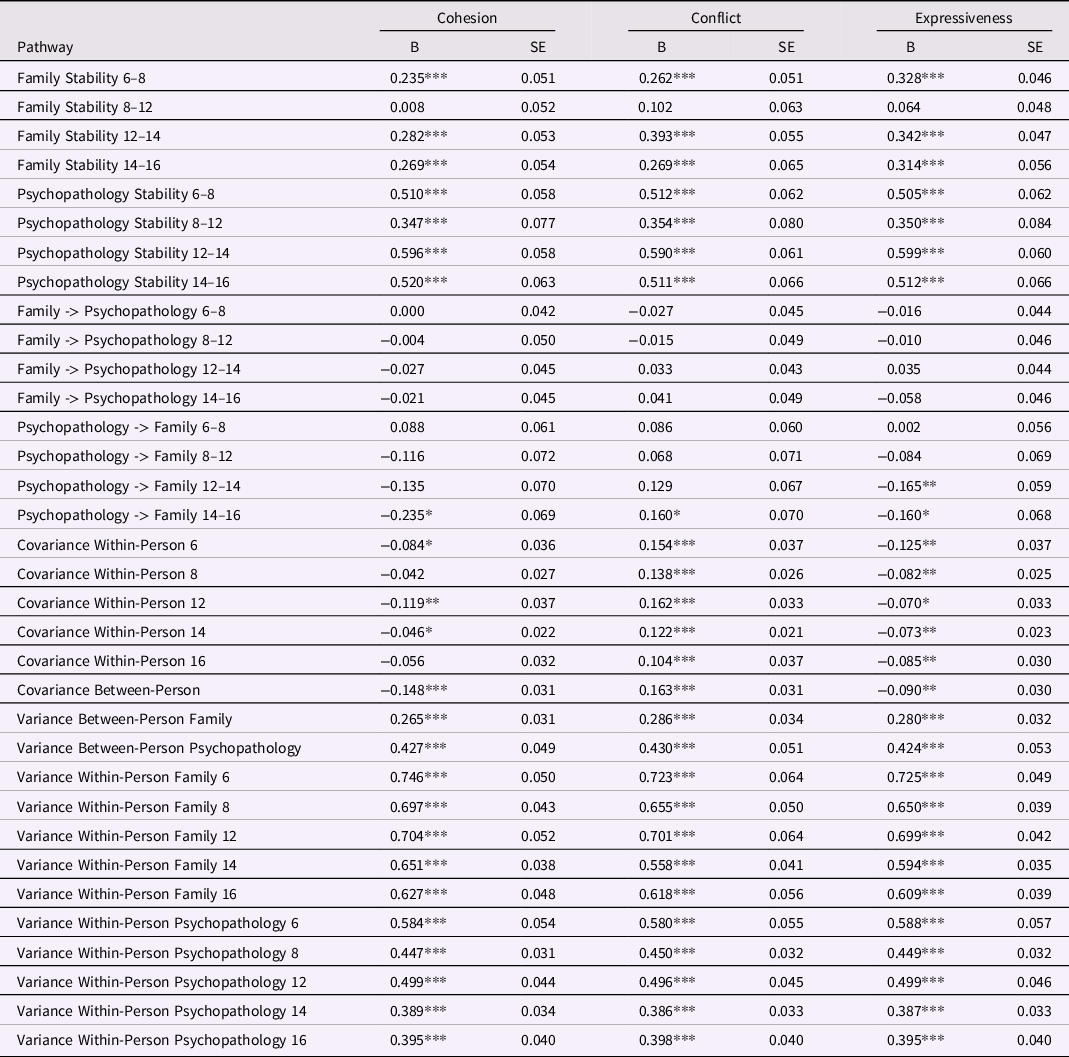
Table 2 presents the total behavior problems parameters for the freely estimated random-intercept cross-lagged panel models. Substantial between-person variance was found for each construct (p < .001), indicating the importance of separating within-person and between-person variance. The between-person correlation was significant for each type of family functioning (p < .01). The family stability parameters for cohesion, conflict, and emotional expressiveness were significant (p < .001) with the exception of family stability from age 8 to 12 for all constructs. The total behavior problems stability parameters were also all significant (p < .001), and the lowest magnitude was from age 8 to age 12 for all family functioning constructs. Lower stability between these time points is likely primarily due to the longer time lag (4 years vs. 2 years), but instability may also be due to the transition to adolescence. Within-person, time specific covariances were frequently detected. Generally, these coefficients indicated that at times when families were experiencing worse functioning, their children were also experiencing worse psychopathology.
Total behavior problems parameter estimates for freely estimated model
Note. Expressiveness = Emotional Expressiveness.
*p < 0.05, **p < 0.01, ***p < 0.001.
Now, we turn to the primary coefficients of interest, the cross-paths linking early family functioning and total behavior problems to the other construct across time. The family functioning to total behavior problems cross-paths were not significant, meaning that all measures of family functioning did not predict subsequent total behavior problems across any of the waves. By contrast, the total behavior problems to family functioning cross-paths were significant from ages 14 to 16 for cohesion (b = −.235, p < 0.001) and conflict (b = .160, p < .05), and from ages 12 to 14 (b = −.165, p < .001) and ages 14 to 16 (b = −.160, p < .05) for emotional expressiveness. This means that total behavior problems at age 14 predicted subsequent family cohesion and conflict at age 16. Furthermore, total behavior problems at age 12 predicted subsequent family emotional expressiveness at age 14 and total behavior problems at age 14 also predicted subsequent family emotional expressiveness at age 16. Figure 3 plots the magnitude of the cross-paths.
Magnitude of cross-pathways between family functioning and child psychopathology. Error bars are 95% confidence intervals. CP = Child psychopathology. FF = Family functioning.

Having described the baseline freely estimated random-intercept cross-lagged panel models, we next performed model comparisons to determine whether a more parsimonious model could provide equivalent fit to the data. Fit statistics for all models are presented in the supplementary file. The full stationarity model for each family functioning construct fit significantly worse compared to the baseline model so we therefore rejected the stationarity model (ΔCFIcohesion = .024, ΔCFIconflict = .013, ΔCFIexpressiveness = .020). This means that the associations between the different measures of family functioning at age 6 and total behavior problems at age 8 were not equal to the association between family functioning at age 14 and total behavior problems at age 16 (see the supplementary file for the parameters for the stationarity model). However, we did find partial stationarity (all ΔCFI <.001) for the adolescent years (i.e., ages 12 to 14 and 14 to 16), but not childhood (i.e., ages 6 to 8 and 8 to 12).
The results were similar for internalizing and externalizing problems with a few exceptions. We found that internalizing problems to family functioning cross-paths were only significant from ages 14 to 16 for conflict (b = .114, p < .05) and ages 12 to 14 for emotional expressiveness (b = −.116, p < .05). The family cohesion to internalizing problems cross-paths were not significant unlike the total behavior problems to family cohesion cross-paths. Similarly, the externalizing problems to family functioning cross-paths were only significant from ages 12 to 14 for emotional expressiveness (b = −.145, p < .05).
Moderated longitudinal models
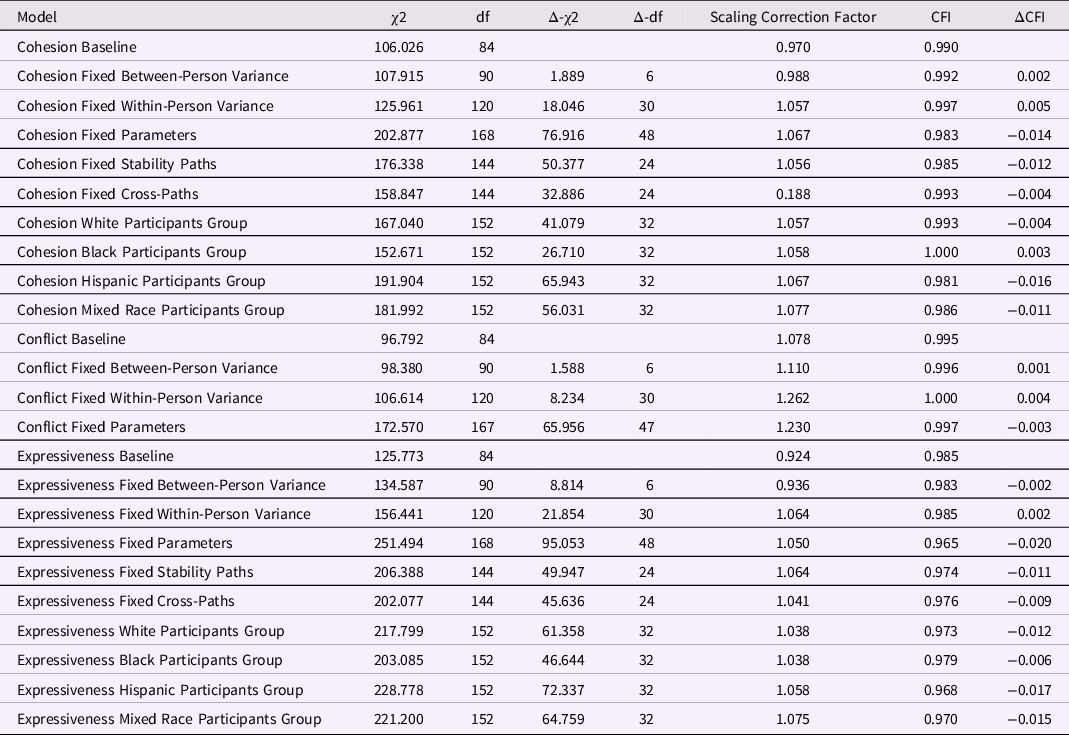
Fit statistics for all moderation models can be found in Table 3. Full parameter estimates freely estimated across groups are reported in the supplementary file. For all models, we could fix the between-person and within-person variances to be equal across groups (ΔCFI < .01). Further, we found no evidence of moderation by race/ethnicity for conflict or cohesion (ΔCFI < .01) and no evidence of moderation for any variable by gender (ΔCFI < .01). The supplement provides a full description of all moderation results. Here, we focus on moderation results for cross-pathways as the cross-pathways are most relevant to our primary research questions.
Total behavior problems moderation fit statistics
Note. Expressiveness = Emotional Expressiveness.
Only for emotional expressiveness did the moderation results indicate that the cross-pathways, and therefore the time-ordered nature of associations between family functioning and psychopathology, differed across race/ethnicity groups. The parameter estimates for the participants who identified as Black differed the most from other groups, according to fit statistics. For the participants who identified as Black, but not the other groups, results indicated a bidirectional pattern of association in adolescence in which emotional expressiveness at age 14 predicted subsequent total behavior problems at age 16, and total behavior problems at age 14 predicted subsequent emotional expressiveness. Results for externalizing problems were similar in that the participants who identified as Black differed the most from other groups and demonstrated evidence of a bidirectional relationship in adolescence for emotional expressiveness. We did not find evidence of moderation when examining internalizing problems and emotional expressiveness.
Discussion
The present study tested for time-ordered associations between family functioning and child psychopathology. We first estimated cross-sectional associations between different measures of family functioning (e.g., cohesion, conflict, and emotional expressiveness) and psychopathology to determine whether these associations grew stronger over time and whether they were stronger across one domain compared to another. In line with previous research, we found that family conflict was positively associated with psychopathology, whereas family cohesion and emotional expressiveness were negatively associated with psychopathology. We also found that these associations grew stronger from childhood to adolescence for all constructs and that the strongest association was between family conflict and child psychopathology.
We then tested for the directionality of these relations by using random-intercept cross lagged panel models to bridge the gap between theoretical frameworks and empirical evidence. In adolescence, we found that child psychopathology predicted subsequent family functioning. Child psychopathology at age 14 predicted subsequent family cohesion and conflict at age 16, and child psychopathology at ages 12 and 14 predicted subsequent family emotional expressiveness at ages 14 and 16. These results are inconsistent with a large body of research that operationalizes family functioning as an index of prospective adolescent mental health outcomes (Simpson et al., Reference Simpson, Vannucci and Ohannessian2018; White et al., Reference White, Shelton and Elgar2014, Yap et al., Reference Yap, Pilkington, Ryan and Jorm2014). This discrepancy with past empirical results may be due to our use of the random-intercept cross-lagged panel model which is better able to model constructs with high temporal stability (Hamaker et al., Reference Hamaker, Kuiper and Grasman2015). When allowing for stable, between-child differences in family functioning and child psychopathology, we primarily found evidence for child psychopathology predicting subsequent family functioning. We did not find much evidence for the reverse pathway from family functioning to child psychopathology, but we did find substantial correlated change within a time point. Future research, thus, may wish to further consider narrower timescales to better identify the time course of the correlated change, as well as the explanatory role of independent stressors (e.g., Hamilton et al., Reference Hamilton, Strange, Abramson and Alloy2015) during childhood and the role of dependent stressors during adolescence.
Finally, we tested whether the pattern of results differ across race/ethnicity or gender. Overall, results primarily indicate largely consistent patterns across youth subpopulations. We did not find evidence of moderated cross-pathways across race/ethnicity for the relation between child psychopathology and family conflict or cohesion. There was also no evidence of moderation for any of the relations by gender. For emotional expressiveness, we found evidence of moderated cross-pathways for total behavior problems and externalizing problems, but not internalizing problems. Sensitivity analyses indicated that the moderation was primarily driven by the participants who identified as Black, such that for this subgroup there was a bidirectional relation. Black families may be especially sensitive to emotional expressiveness given common stereotypes surrounding anger (Motro et al., Reference Motro, Evans, Ellis and Benson2022) and past work demonstrating that such societal pressures impact parenting decisions (Lugo-Candelas et al., Reference Lugo-Candelas, Harvey, Breaux and Herbert2016). Taken together, these results imply that, at least for some families, expressing emotions is linked to subsequent child mental health, and at the same time, child externalizing problems tend to weaken the tendency to express emotions across time.
Overall, the current study supports long held beliefs that youth’s emotional and behavioral well-being is associated with positive and negative aspects of family functioning across different levels of trauma exposure (e.g., McMaster Model, Epstein et al., Reference Epstein, Bishop and Levin1978; Family Stress Model, Masarik & Conger, Reference Masarik and Conger2017). However, our findings expand on the literature in several important ways.
First, we highlight that in adolescence, it is more likely that adolescent mental health predicts family functioning, rather than the other way around. Given that foundational developmental psychopathology research (e.g., Lynch et al., Reference Lynch, Sunderland, Newton and Chapman2021), and accompanying interventions (e.g., MATCH-ADTC; Weisz, & Chorpita Reference Weisz, Chorpita and Kendall2012), conceptualizes family behavior as a mechanism of risk for adolescent psychological distress, these findings have important theoretical and clinical implications. From a theoretical perspective, this suggests that current prevailing intra- and interpersonal theories of psychopathology may need to be integrated to understand these trends as they relate to distress and family functioning. Though the literature on intrapersonal theories of psychopathology, such as the stress-generation perspective (Hammen, Reference Hammen2006), has received empirical attention as it related to psychopathology and peer relations among adolescents, this line of research may need to be expanded to understand the role of dependent stressors in family functioning. These empirical queries hold potential for improving upon current targets of intervention across internalizing and externalizing symptoms.
Second, these findings suggest the relation between family functioning and youth’s mental health is different from the mid/late-childhood to early/mid adolescent transition. This pattern of developmental discontinuity (see Schulenberg et al., Reference Schulenberg, Maggs, O’Malley, Mortimer and Shanahan2003) demonstrates the dynamic nature of family relationships and youth mental health, and the need to integrate a lifespan-sensitive approach to understanding the prospective relation between these psychosocial constructs.
The present study also illustrated the importance of considering specific aspects of family functioning as well as psychopathology. Although findings were largely similar between internalizing and externalizing patterns of distress, one important exception was that emotional expressiveness predicted externalizing behaviors in participants who identified as Black. Given that externalizing behavioral problems in childhood serve as a robust risk factor for adolescent distress and impairment, dissemination and implementation efforts around evidence-based interventions targeting the family to ameliorate behavioral problems in children (e.g., parent-child interaction therapy; Eyberg & Boggs, Reference Eyberg, Boggs, Briesmeister and Schaefer1998; Hembree-Kigin & McNeil, Reference Hembree-Kigin and McNeil1995) are still warranted. In addition, the strongest and most stable association existed between family conflict and child psychopathology, which highlights the importance of understanding tactics to mitigate family conflict, particularly when caused by previous maladaptive child behavior, at all ages regardless of developmental periods. These findings join other research that highlights negative aspects of family functioning (i.e., conflict) tend to be stronger predictors of pediatric psychological distress compared to positive indices (i.e., cohesion, emotional expressiveness; Prevatt, Reference Prevatt2003). It is also important to consider, however, that incorporating emic approaches to defining positive indices of well-being may lead to more inclusive measures that better captures the impact these aspects of family functioning have on child and adolescent well-being (e.g., Gardiner et al., Reference Gardiner, Miller and Lach2020; McWayne et al., Reference McWayne, Mattis, Green Wright, Limlingan and Harris2017).
Strengths, limitations, and future directions
The present study has several strengths. We made use of a large sample of at-risk youth who have been longitudinally assessed across much of childhood and adolescence using high quality assessments of psychopathology and family functioning. Because the dataset included many waves of data collection, we were able to document the unfolding of a developmental process, from minimal within-person associations to clear child-to-family within-person associations in adolescence. The at-risk nature of the sample also maximized our ability to detect these effects as child problem behaviors may be more likely.
The strengths of this study must be considered against several limitations. The present study used LONGSCAN, a sample of maltreated and at-risk youth. At the most extreme end, participants were removed from their homes due to child maltreatment, and on the other end, participants were recruited based on demographic risk factors. Family functioning in families with maltreated youth has been found to differ compared to families of non-maltreated youth in that these families experience greater hardships that may foster harsher parenting practices (Baumrind, Reference Baumrind1995). Generalizability to the broader population of adolescents is limited. The participants differ greatly from the broader population based on parental education and income data. Also at least in some sites, the children had already interacted with child services, a non-normative experience. Thus, our results may not translate to a population that does not experience these risk factors. In terms of context, the participants tended to be urban, and we do not know whether the results would apply similarly to children raised in a rural context. In terms of culture, all participants resided in the United States. It is unclear if the results would hold in cultures that differed in terms of family values. Further studies are needed to determine whether these results are found in families with non-maltreated youth that live in a variety of contexts.
Furthermore, this study is based on caregiver-reports of family functioning and child psychopathology. Although caregiver-reports provide insight on children’s development and the family dynamic, future studies need to investigate whether these results are consistent when considering self-reports and/or behavioral observations. Self-reports may provide unique information as individuals may have self-knowledge of internal states more than caregivers. We did not incorporate aspects of the caregiver into our models, including whether the child was placed in a new home from the previous assessment wave. Such a change in family structure could be a likely source of residual within-child correlated change in our models. Analyses focusing on event-based, rather than age-based, trends could shed further light on this possibility and the likely ramifications for child development. Our results, based on multiple year time lags rather than organized events, would indicate that such a shift in family functioning would be unlikely to have downstream consequences for child psychopathology, but this inference may only hold for a certain timeframe. Further characteristics of the caregiver, such as caregiver psychopathology, could also be useful additions to the model. We also used assessments of general family dynamics, rather than specific relationships. This approach is beneficial in providing a whole home perspective, but future work could also investigate specificity of the identified trends (e.g., whether conflict with specific parents or siblings show differing patterns).
Lastly, it is important to consider the timing of assessments. It may be the case that the relatively long-time interval between assessments meant we did not capture some of the dynamic interplay between the child and their family. Indeed, we found consistent within-person, time-specific covariance, meaning that developmental processes between the assessments linked the variables (i.e., correlated change, rather than time-ordered associations). More frequent assessments may have been better able to capture the process. The time interval between assessments was also not consistent. There was a 4-year gap between the second wave (age 8) and the third wave (age 12) whereas there were only 2-year gaps between all other waves. Age 8 falls in line with early childhood, whereas age 12 is the beginning of preadolescence, which are two different developmental stages in youth’s life. This study design factor may explain why we were not able to find stationarity across all ages.
Conclusion
The present study advanced the literature on the relation between family functioning and child psychopathology in a sample at elevated risk for psychopathology. We accomplished this goal by testing for time-ordered associations to determine the directionality of this relation. In adolescence, psychopathology subsequently predicted family functioning. These results were largely consistent across race/ethnicity and gender. The present study also emphasized the importance of separating between-person associations from within-person associations to better understand the relation between families and children’s mental health. Together, these results indicate a complex relation between the family unit and child.
Supplementary material
The supplementary material for this article can be found at https://doi.org/10.1017/S0954579423000585.
Acknowledgements
D.A.B. was supported by a Jacobs Foundation Research Fellowship.
Funding statement
This research received no grant from any funding agency, commercial, or not-for-profit sectors.
Competing interests
The authors declare none.


 Open access

