




Introduction
Around 10 000 BP, the first open settlements emerged on terraces along the Yongjiang River in southern Guangxi in southern China (Fu Reference Fu2002; Zhang & Hung Reference Zhang and Hung2010, Reference Zhang and Hung2012; Hung Reference Hung2019; Hung et al. Reference Chi, Matsumura, Zhen, Matsumura, Hung, Li and Shinoda2017; Li et al. Reference Li, Hung, Huang, Matsumura, Matsumura, Hung, Li and Shinoda2017a & Reference Li, Hung, Huang, Matsumura, Matsumura, Hung, Li and Shinodab; Zhang et al. Reference Zhang, Huang, Qin, Pu, Wei and Huang2021; Guangxi Provincial Institute of Cultural Relics and Archaeology & Fusui Institute of Cultural Relics 2023). These settlements were inhabited by communities of the Dingsishan cultural group and experienced rapid population growth in contexts that pre-date direct evidence for food production, resulting in the accumulation of numerous large shell midden sites. Although this cultural group did not farm rice or millet, it was characterised by large settlements and cemeteries. For instance, more than 300 human burials have been excavated from cultural contexts dating to 9000–7000 BP from the Dingsishan site alone (Zhu et al. Reference Zhu, Li, Chen, Fu and Hu2020). Similar shell middens and cultural remains, including pottery vessels, lithic tools, and large cemeteries have been excavated in nearby western Guangdong and northern Vietnam; in the latter, such assemblages belong to the Đa Bút culture and date to approximately 6700–4500 BP (Nguyen Reference Nguyen2005; Zhang & Hung Reference Zhang and Hung2012; Higham Reference Higham2014; Bellwood Reference Bellwood2017; Oxenham et al. Reference Oxenham2018).
Our research aims to understand how the subsistence techniques of Dingsishan populations and their successors were able to support such dense populations and settlements in apparently pre-agricultural contexts. The enhanced exploitation of freshwater faunal resources has been confirmed through archaeological and isotopic analyses at Dingsishan (Zhu et al. Reference Zhu, Li, Chen, Fu and Hu2020); and archaeobotanical findings from Guangxi and northern Vietnam suggest the exploitation of palms and tree nut resources in these areas at least since the Early Holocene (Nguyen Reference Nguyen2008; Deng et al. Reference Deng, Hung, Li, Carson, Huang, Huang and Lu2019; Zhang et al. Reference Zhang2020) (Table 1). Seeds, tubers and cycads (palm-like evergreen cone-bearing plants, including some with edible starch inside the trunk) may have contributed to local diets (Li Reference Li2016; Zhang et al. Reference Zhang, Huang, Qin, Pu, Wei and Huang2021, Reference Zhang, Huang, Zhou, Olsen, Huang and Guan2022). For instance, the prevalence of carious lesions among the dentition of human skeletons from Dingsishan and Liyudun suggests an increased consumption of tubers and other high-carbohydrate plants during the Early Holocene, but associated archaeobotanical evidence is lacking (Chen & Li Reference Chen and Li2013; Zhang et al. Reference Zhang, Li and Wang2018; Zhu et al. Reference Zhu, Li, Chen, Fu and Hu2020). In the broader Asia-Pacific context, southern China has long been proposed as a potential region of early plant cultivation, particularly for vegetatively propagated plants such as taro and yam but also for palms. Yet archaeobotanical evidence to support this hypothesis remains scarce (Zhao Reference Zhao2011; Denham et al. Reference Denham, Zhang and Barron2018).
The representative archaeobotanical findings from pre-farming sites in Guangxi (southern China) and northern Vietnam.

# Direct dating of the analysed plants or human remains; * phytoliths; ** parenchyma; (n) number of starch grains or macro-remains.
Taro (Colocasia esculenta) is one of the oldest cultivated crops in the Asia-Pacific region, currently distributed throughout the northern and southern temperate through to tropical zones (Matthews Reference Matthews and Ertug2006; Matthews & Ghanem Reference Matthews and Ghanem2021). Previous archaeobotanical studies have proposed Papua New Guinea as a primary domestication centre for aroids—plants from the family Araceae that grow from tubers, including taro (Denham et al. Reference Denham2003; Fullagar et al. Reference Fullagar, Field, Denham and Lentfer2006). However, recent analysis of chloroplast DNA diversity from cultivated and wild Colocasia indicates that domestication of this aroid first took place in Southeast Asia during the Early to Middle Holocene, with a later introduction into Papua New Guinea (Ahmed et al. Reference Ahmed, Lockhart, Agoo, Naing, Nguyen, Medhi and Matthews2020). This recent study emphasises an Asian origin for Colocasia, but a precise geographical origin for cultivated taro remains elusive (Grimaldi et al. Reference Grimaldi, Muthukumaran, Tozzi, Nastasi, Boivin, Matthews and van Andel2018). Indeed, the great diversity of taro cultivars may suggest multiple episodes of domestication (Matthews & Nguyen Reference Matthews, Nguyen and Smith2018). Geographically, the highest diversity in wild Colocasia species occurs in mountainous regions stretching from the eastern Himalayas to Vietnam and southern China, with the diversity gradually declining to two species in Island Southeast Asia and a single species in Australia and Melanesia (Matthews et al. Reference Matthews, Nguyen, Fang and Long2022).
Archaeological sites of the Dingsishan and Đa Bút cultures in southern China and northern Vietnam have produced a range of stone grinding tools, reflecting an emphasis on the processing of plant foods. In this article, we discuss the extraction and analysis of micro-remains (starch grains) from human dental calculus, as well as from excavated shell and stone tools, from the sites of Huiyaotian and Liyupo in southern China. We compare our results with those from surrounding regions.
Archaeological sites and chronology
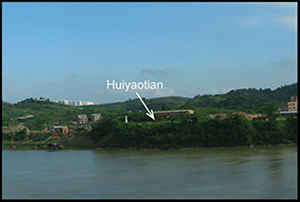
The analysed samples from the Dingsishan culture sites of Huiyaotian and Liyupo were excavated by Zhen Li, Hirofumi Matsumura, Hsiao-chun Hung, Chi Zhang and colleagues through an international collaboration project (Hung et al. Reference Chi, Matsumura, Zhen, Matsumura, Hung, Li and Shinoda2017; Matsumura et al. Reference Matsumura, Hung, Zhen, Yamagata, Qiang, Chi, Matsumura, Hung, Zhen and Shinoda2017, Reference Matsumura2019) (Figure 1). Huiyaotian (22°47′24″N, 108°25′48″E) is a well-preserved shell midden located on the first terrace of the Yongjiang River in Nanning (Li et al. Reference Li, Hung, Huang, Matsumura, Matsumura, Hung, Li and Shinoda2017a) (Figure 2). The site covers 1800m2, of which 280m2 were excavated in 2006. Radiocarbon (14C) dating of two charred Canarium sp. seed fragments and one human tooth indicates occupation at Huiyaotian between 9030 and 8315 cal BP (Hung et al. Reference Chi, Matsumura, Zhen, Matsumura, Hung, Li and Shinoda2017; Li et al. Reference Li, Hung, Huang, Matsumura, Matsumura, Hung, Li and Shinoda2017a) (Figure 3, Table 1).
The locations of Huiyaotian and Liyupo (red triangles) and other sites mentioned in the text (black dots) (figure by Weiwei Wang).

The Huiyaotian site on the Yongjiang River (photograph by Zhen Li).

Radiocarbon dates from Huiyaotian and Liyupo. All dates were calibrated with OxCal v4.4.4 and presented at 95.4% probability (figure by Weiwei Wang).

More than 60 human burials were excavated at Huiyaotian, associated with pits, post moulds, ground-stone tools, earthenware pottery, animal bones and riverine shells. Bodies consistently were placed in flexed or squatting postures (found in both upright and side-laying positions) in burials that contained no grave goods. The Huiyaotian pottery shows sand tempers and cord-marked surfaces. Among the stone implements are polished adzes, axes and grinding stones; most adzes or axes are partially polished and many show use-wear on their blades. The site is rich in both aquatic and terrestrial animal remains, including knives made from large bivalve shells—called ‘fish-headed knives’ by Chinese archaeologists—that are a unique characteristic of the Dingsishan cultural assemblage.
The Liyupo site (23°10′48″N, 107°58′12″E) is a small soil mound surrounded by limestone hills in Longan County, located 53km north-west of Nanning (Li et al. Reference Li, Hung, Huang, Matsumura, Matsumura, Hung, Li and Shinoda2017b). A total of 26m2 was excavated in 2008, and five 14C dates on a charred Canarium sp. nutshell, charcoal, human bones and a human tooth range from 7667 to 6741 cal BP, thus corresponding with the Dingsishan cultural phase (Li et al. Reference Li, Hung, Huang, Matsumura, Matsumura, Hung, Li and Shinoda2017b) (Figure 3 & Table 1). As at Huiyaotian, the 43 human burials reported from Liyupo were without grave goods, and all contained flexed inhumations. Almost all burials were covered with large stones (Figure 4). Other artefacts from the site include grinding stones, stone pestles, bone awls, bone needles, small perforated shell ‘shovels’ and three cord-marked sherds.
Human burials under excavation at Liyupo. Some are covered by large stones (photograph by Zhen Li).

Extraction and identification of micro-remains
The assemblages of human bone and artefacts excavated from Huiyaotian are stored in the Nanning Museum; those from Liyupo are in the Guangxi Provincial Institute of Cultural Protection and Archaeology. The current study focuses on five stone tools, one shell knife and six human dental calculus samples from Huiyaotian, and on six stone tools and five human dental calculus samples from Liyupo (Figure 5 & Table S1).
Analysed stone and shell tools and human remains with dental calculus from Huiyaotian (A–L) and Liyupo (M–W). A–C & M–O) grinding stones; D & P) mullers/pounders; E) a shell knife; F & R) adzes; Q) a single-bevelled axe. All scale bars represent 50mm (figure by Weiwei Wang).

Sediments adhering to the artefacts, and storeroom dust, were collected as control samples to exclude the possibility of modern contamination. Micro-remains analysis of artefacts and dental calculus followed previously reported procedures (Piperno & Dillehay Reference Piperno and Dillehay2008; Mickleburgh & Pagán-Jiménez Reference Mickleburgh and Pagán-Jiménez2012; Yang et al. Reference Yang2013; Wang et al. Reference Wang, Nguyen, Le, Zhao, Carson, Yang and Hung2022) with minor modifications, focusing on the recovery of starch grains (see details in the online supplementary material (OSM)).
Recovered starch grains were counted and measured under an optical microscope (Machine model: Olympus BX-51) at 400× magnification. No starch grains were recovered from any of the control samples. Species identifications are based on modern reference collections from Guangxi, a Chinese starch database containing more than 200 Asian species (Yang et al. Reference Yang2018), and published datasets from tropical and subtropical areas of Asia and the Pacific (Fullagar et al. Reference Fullagar, Field, Denham and Lentfer2006; Lentfer Reference Lentfer, Haslam, Robertson, Crowther, Nugent and Kirkwood2009; Yang et al. Reference Yang2013; Wang Reference Wang2017; Li Reference Li2021; Wang et al. Reference Wang, Nguyen, Le, Zhao, Carson, Yang and Hung2022).
In total, 503 starch grains were recovered from all samples (Table S1). Among them, 69 could not be identified due to damage or a lack of diagnostic characteristics. The remaining 434 starch grains are classified into six types and 10 subtypes based on their morphological features and visible attributes, after comparison with the modern reference samples (Figures 6 & 7; see identification details in OSM and Tables S1 & S2).
Type Ia starch grains from archaeological samples (A–A’) and modern reference samples (B–C’). A) Type Ia starch grains from a Liyupo stone pounder; A’) compound starch grains of Type Ia; B) wild taro starch grains (Colocasia esculenta var. aquatilis); C) domesticated taro starch grains (Colocasia esculenta); C’) compound starch grains of domesticated taro. Scale bar 20μm (figure by Weiwei Wang).

Ancient starches of Types Ib–V (A–I’) and comparable modern reference samples (J–R’) under polarised and brightfield light. A/A’) Type Ib; B/B’) - Type IIa; C/C’) Type IIb; D/D’) Type IIIa; E/E’ & F/F) Type IIIb; G/G’) Type IVa; H/H’) Type IVb; I/I’) Type V; J/J’) Amorphophallus konjac; K/K’) Dioscorea esculenta; L/L’) Dioscorea alata; M/M’) Setaria viridis; N/N’ & O/O’) Coix lacryma-jobi; P/P’) Castanopsis fargesii; Q/Q’) Quercus franchetii; R/R’) Arenga pinnata. Scale bar 20μm (figure by Weiwei Wang).

Starch grains from aroids and yams accounted for around 34 per cent of the total findings (Type I & II, n > 170) (Figure 8). Numerous small grains (Type Ia) on a stone pounder from Liyupo resemble both wild and domesticate taro starch grains (Figure 6A–C). Furthermore, eight clusters (compound grains) comparable with taro were also identified from all examined samples (Figure 6A’–C’).
The plant species identified at Huiyaotian and Liyupo, displayed as relative proportions (A) and total numbers (B) of starch grains recovered (figure by Weiwei Wang).

Eighty-five starch grains exhibit a large size and a multifaceted morphology (Type Ib, Figure 7A–A’) consistent with other aroid plants outside the Colocasia genus, including konjac (Amorphophallus konjac) (Figure 7J–J’). Raphides—needle-shaped calcium oxalate crystals—are commonly produced in aroid plants, but none were observed in our samples. This lack of observation can be attributed to the complexities of preservation at archaeological sites, varied raphide content in aroid species and probable raphide destruction during food processing. Fifteen per cent of the grains are from Dioscorea (Type II, n = 77, Figure 8), including 65 small polygonal granules (Type IIa) that compare well with lesser yam (Dioscorea esculenta) (Figure 7B–J’, K–K’). Twelve starch grains of Type IIb have triangular ovoid shapes and larger sizes that relate them to the greater, or purple, yam (Dioscorea alata) (Figure 7C–C’, L–L’).
Thirty-seven per cent of the starch grains exhibit the typical features of panicoid grasses (Type III, n = 187, Figure 8). Forty-eight (Type IIIa) probably come from wild grasses such as green foxtail (Setaria viridis) (Figure 7D-D’, M–M’; Table S2). The other 139 specimens (Type IIIb) resemble Job's tears (Coix lacryma-jobi) (Figure 7E–E’, F–F’, N–N’, O–O’).
Fourteen per cent of the starch grains (Type IV, n = 52) can be identified as from Castanopsis (Figure 7G–G’, P–P’) and Quercus tree nuts (Figure 7H–H’, Q–Q’) from the family Fagaceae. One per cent are from piths of the Arenga palm (Arenga sp.) (Type V, n = 6, Figure 7I–I’, R–R’).
Discussion
Taro (Colocasia esculenta)
The oldest written records of taro in China are more than 2000 years old; the plant is mentioned in Guanzi (Writings of Master Guan) of the Warring States period (476–221 BC) and in Shiji (Records of the Grand Historian) of the Western Han Dynasty (202 BC–AD 8) (Li et al. Reference Li, Yang, Li and Zhou2005). Remains of taro only rarely are identified at archaeological sites as they generally produce no phytoliths and their carbonised corm fragments are difficult to identify through macro-botanical identification (Piperno Reference Piperno2006; Tromp & Dudgeon Reference Tromp and Dudgeon2015). Starch grains from taro have not yet received much attention from archaeobotanists in China, likely due to their extremely small size which makes recognition difficult. Prior to the current study, the only ancient taro reported in China came from the identification of starch grains at Zengpiyan Cave in Guangxi (c. 12 500–7600 BP), together with the charred remains of unidentified roots and tubers (Institute of Archaeology, Chinese Academy of Social Sciences et al. 2003). Our study is the first to capture abundant and clear evidence of taro starch grains from China, although the morphological differences between the starch grains of modern cultivars and wild types of taro still lack comprehensive study.
In the wider Asia-Pacific region, the utilisation of aroids (Alocasia, Colocasia, Cyrtosperma) and yams can be traced back to at least the late Pleistocene at sites such as the Niah Caves in Sarawak and Kilu Cave on Bougainville Island, and into the Early Holocene at Ille Cave on Palawan Island in the Philippines, Kuk Swamp in Papua New Guinea and Cai Beo in north-eastern Vietnam (Loy et al. Reference Loy, Spriggs and Wickler1992; Barton Reference Barton2005; Fullagar et al. Reference Fullagar, Field, Denham and Lentfer2006; Barton & Paz Reference Barton, Paz, Denham, Iriarte and Vrydaghs2007; Barker et al. Reference Barker2007, Reference Barker, Hunt, Carlos, Barker and Janowski2011; Wang et al. Reference Wang, Nguyen, Le, Zhao, Carson, Yang and Hung2022) (Figure 9). Colocasia taro was probably transported from Southeast Asia to the Remote Oceanic Islands by Austronesian speakers around 3000 BP (Matthews Reference Matthews1995; Horrocks & Nunn Reference Horrocks and Nunn2007), where it became a staple food crop and remained so until modern times, with plentiful linguistic and ethnographic documentation (Pollock Reference Pollock, Gnecchi-Ruscone and Paini2017). Without claiming any direct relationship, we note that the morphologies of stone pounders at Dingsishan cultural sites (Figure 10A) are similar to those used for pounding and mashing cooked plant foods, such as breadfruit, into preservable pastes in Pacific Oceania (Carson Reference Carson2018: 334–8). Dingsishan-type pounders and shell knives occur in dense concentrations in western Guangxi and the adjacent areas of Guizhou and northern Vietnam (Li & Wu Reference Li and Yan2017), within the natural distribution of wild Colocasia species.
Archaeological sites with aroids (Alocasia; Colocasia) and yams mentioned in this article (figure by Weiwei Wang).

A) a stone pounder from Liyupo; B & C) two shell knives from Huiyaotian, Guangxi, China (image A, B & C from Zhen Li); D) Hawaiian men pounding taro (image from Bishop Museum Archives, Honolulu, Hawaii, reproduced with permission); E) a food-pounding stone from the Hawaiian Islands (©Pitt Rivers Museum, University of Oxford. Accession number: 1901.43.12, reproduced with permission) (figure by Weiwei Wang & Hsiao-chun Hung).

Ethnographic accounts surrounding the preparation of a paste of breadfruit or taro, known as poi in many parts of Polynesia, are particularly detailed in the Hawaiian Islands (McElroy Reference McElroy2003) (Figure 10D–E). Preparing Hawaiian taro poi involves first steaming taro roots in an earth oven, followed by peeling the cooked roots with a scraper, sometimes made of shell (McElroy Reference McElroy2003). The peeling is necessary for removing the raphides (needle-shaped crystals) from the taro exterior or to remove the inedible outer skin of breadfruit. Similarly, shell ‘breadfruit scrapers’ have been found with traces of breadfruit, taro and other remains in the Marquesas Islands of East Polynesia (Allen & Ussher Reference Allen and Ussher2013). The peeled items next are placed onto a wooden pounding board to be mashed with a stone pounder before being set aside to ferment (McElroy Reference McElroy2003). Such processing extended the storage life of the poi, whether made of breadfruit or of taro.
These ethnographic accounts from Pacific Oceania offer valuable insights for understanding food preparation at the Dingsishan sites and the possible function of shell knives featuring a single perforation that were unearthed in large quantities at Guangxi (Figures 10B–C). While these shell tools may have been used in various ways—for example, in the scraping and cleaning of plant fibres or serving as finger sickles for harvesting grasses—identification of starch grains from taro and yam on the knife from Huiyaotian indicates that one of its functions was the scraping of tuber skins.
Yams (Dioscorea)
Compared with taro, yams (Dioscorea sp.) are more commonly identified at archaeological sites as they produce more prominent and distinctive starch grains (Wang Reference Wang2017). China is a significant yam domestication centre, where various Dioscorea species, including the greater, lesser and Chinese (D. polystachya) yams are cultivated for food and medical preparations (Wu et al. Reference Wu2014).
Yams have been exploited in Island Southeast Asia and China since the late Pleistocene (Liu et al. Reference Liu, Ge, Bestel, Jones, Shi, Song and Chen2011, Reference Liu, Bestel, Shi, Song and Chen2013; Wan Reference Wan2012), although preserved remains are infrequent in southern China and potential evidence from pre-farming contexts was previously reported only at the Haogang site in Guangdong (c. 6000–4000 BP) (Li Reference Li2021). Large quantities of starch grains from at least five species of Dioscorea have, however, been recovered from stone tools excavated at Cai Beo in north-eastern Vietnam (Wang et al. Reference Wang, Nguyen, Le, Zhao, Carson, Yang and Hung2022) (Table 1), a site with a potentially Early Holocene chronology.
Other plants
Our results show that early populations in southern China exploited panicoid grasses, as also observed at Niulandong (c. 12 000 BP), Zengpiyan (c. 12 500–7600 BP) and Baozitou (c. 8000–7000 BP). Starch grains from grasses account for a large proportion of the micro-remains so far identified at these sites (Institute of Archaeology, Chinese Academy of Social Sciences et al. 2003; Wan Reference Wan2012; Li Reference Li2016).
We recovered 139 starch grains (Type IIIb) that resemble those from the Job's tears plant (Figure 7E–E’, F–F’, N–N’, O–O’). Despite widespread documentation of starch grains from this plant at archaeological sites in both southern and northern China (Yang Reference Yang2017; Liu et al. Reference Liu, Duncan, Chen and Cui2019), their starch identification is controversial due to the scarcity of associated macro-remains of the plant. The lack of macro-remains of Job's tears at Huiyaotian (Deng et al. Reference Deng, Hung, Li, Carson, Huang, Huang and Lu2019) means that we cannot confidently claim that the 139 micro-remains of starch grains reported here are from it. This plant is, however, a widespread and potentially early crop in Mainland Southeast Asia that grows easily in ditches and watercourses (Fuller & Castillo Reference Fuller, Castillo, Sidwell and Jenny2021). Overall, the role of Job's tears in ancient economies needs further investigation.
Acorns (Castanopsis sp. and Quercus sp.) and palms (Arenga sp.) were important supplementary food resources for Dingsishan groups. Both Castanopsis and Quercus seeds contain large amounts of starch. As elements of the native forest flora, they were widely distributed in the Pearl River Delta and adjacent areas during the Early to Middle Holocene (Cao et al. Reference Cao, Deng and Zhang2007; Hao et al. Reference Hao, Li, Ouyang, Culligan, Hu, Zhao and Chen2021). Archaeobotanical evidence already indicates that acorns provided essential starch resources in southern China and northern Vietnam prior to the arrival of rice and millet farming (Yang et al. Reference Yang2017; Li Reference Li2021; Wang et al. Reference Wang, Nguyen, Le, Zhao, Carson, Yang and Hung2022).
The trunk pith of the sugar palm (Arenga westerhoutii) may be processed to produce sago flour, which remains a traditional nutritional specialty in the Chongzuo region of Guangxi today (Ge Reference Ge2015; Lan et al. Reference Lan, Liang, Yang, Li, Ma and Huang2022). Additionally, the sap yields palm sugar, the consumption of which (possibly in the form of alcoholic beverages) could account partially for the high rate of dental decay in Dingsishan populations.
Our findings add to the wider regional evidence about the presumed interface between the indigenous Dingsishan-associated populations of southern China and Southeast Asia and the incoming rice farmers who were present across the region by at least the fourth millennium BP. The Neolithic cemetery of Man Bac (c. 3900 BP) in northern Vietnam contained both an indigenous Hoabinhian-derived population of Australo-Papuan genetic and craniofacial affinity and a majority population of East Asian Neolithic affinity (Oxenham et al. Reference Oxenham, Matsumura and Nguyen2011; Lipson et al. Reference Lipson2018; Matsumura et al. Reference Matsumura2019). Indigenous pre-rice populations were able to integrate, to some degree, with the incoming rice farmers, and their aroid and yam food staples likely contributed to the emergence of the Neolithic economies of Southeast Asia and Oceania. The absorption of indigenous horticultural practices may have played an important role in the incremental expansion of rice farming communities in these tropical regions.
Conclusions
Previous archaeological, linguistic and genetic studies indicate that farming groups with rice and/or millet production originated in central China and expanded southwards into southern China and Mainland Southeast Asia, admixing with indigenous Dingsishan and Đa Bút populations around 4500–4000 BP (e.g. Zhang & Hung Reference Zhang and Hung2010, Reference Zhang and Hung2012; Higham et al. Reference Higham, Xie and Lin2011; Hung et al. Reference Chi, Matsumura, Zhen, Matsumura, Hung, Li and Shinoda2017; Lipson et al. Reference Lipson2018; McColl et al. Reference McColl2018; Matsumura et al. Reference Matsumura2019; Bellwood Reference Bellwood2023). The recovery of taro, yam, palm, acorn and panicoid grass starch grains from Huiyaotian and Liyupo indicates the processing of these plant materials in pre-rice contexts but does not clarify whether these resources were gathered from fully wild plants or cultivated and domesticated by humans. Nevertheless, the plant assemblages from Huiyaotian and Liyupo, together with those from Vietnam (Wang et al. Reference Wang, Nguyen, Le, Zhao, Carson, Yang and Hung2022), portray an Early Holocene economy that depended upon a range of indigenous tuber, nut and palm foods (Table 1), with no evidence for domesticated cereals such as rice or millet (common or foxtail).
The research presented here provides strong evidence that edible aroids (Araceae) and yams (Dioscorea) have been major food plants in Southern China for at least 10 000 years. Congruent with the recent genetic study of taro (Ahmed et al. Reference Ahmed, Lockhart, Agoo, Naing, Nguyen, Medhi and Matthews2020), this discovery from Guangxi shell middens, and the previous findings from Zengpiyan Cave (northern Guangxi) and Cai Beo (northern Vietnam), provides further support for the view that southern East Asia was among the earliest centres of taro exploitation.
Acknowledgements
The authors extend their gratitude for the insightful comments provided by two anonymous reviewers and Antiquity's editor Dr Robert Witcher and the feedback offered by Professor Peter Bellwood (Australian National University) and Dr Zhenhua Deng (Peking University).
Funding statement
This work received support from the Australian Research Council (grant number: DP190101839) and Japan Society for the Promotion of Science (JSPS) (grant number: 22H02709).
Supplementary material
To view supplementary material for this article, please visit https://doi.org/10.15184/aqy.2024.67.


 Open access

