





Introduction
The United States is the largest producer of corn, accounting for 31% of global corn production (USDA–FAS 2025). Broadleaf weed species are among the most troublesome and prevalent weeds that require annual management to maximize corn grain yield (Soltani et al. Reference Soltani, Diller, Burke, Everman, VanGessel, Davis and Sikkema2016; Van Wychen Reference Van Wychen2020). Giant ragweed and waterhemp are consistently recognized as problematic species in corn throughout the eastern corn belt, specifically Indiana (Kruger et al. Reference Kruger, Johnson, Weller, Owen, Shaw, Wilcut, Jordan, Wilson, Bernards and Young2009; Regnier et al. Reference Regnier, Harrison, Loux, Holloman, Venkatesh, Diekmann, Taylor, Ford, Stoltenberg, Hartzler, Davis, Schutte, Cardina, Mahoney and Johnson2016). Giant ragweed has an early emergence pattern (Werle et al. Reference Werle, Sandell, Buhler, Hartzler and Lindquist2014) that coincides with the typical planting and germination window of corn. Waterhemp has an extended emergence period, enabling potential interference with corn throughout the season (Steckel and Sprague Reference Steckel and Sprague2004). Overlapping applications of soil residual herbicides are the most effective way of controlling species with extended emergence periods (Sarangi and Jhala Reference Sarangi and Jhala2019; Steckel et al. Reference Steckel, Sprague and Hager2002), highlighting the need for herbicide options with preemergence and postemergence application flexibility. When giant ragweed and waterhemp are not controlled early in the season, corn yield losses of 90% and 59%, respectively, have been demonstrated (Harrison et al. Reference Harrison, Regnier, Schmoll and Webb2001; Steckel and Sprague Reference Steckel and Sprague2004).
Chemical weed control is a primary weed management tactic in the United States, with 96% of corn production area treated with a herbicide at least once in 2021 (USDA–NASS 2022). Consequently, there has been a rapid rise in cases of herbicide-resistant weed populations. Specifically, giant ragweed has been confirmed to be resistant to herbicides that inhibit acetolactate synthase (categorized as a Group 2 herbicide by the Herbicide Resistance Action Committee [HRAC and Weed Science Society of America), 5-enolpyruvyl shikimate phosphate synthase (glyphosate, a Group 9 herbicide), and protoporphyrinogen oxidase (PPO (a Group 14 herbicide) (Faleco et al. Reference Faleco, Machado, Bobadilla, Tranel, Stolenberg and Werle2024; Heap Reference Heap2025). Similarly, waterhemp has been confirmed to be resistant to herbicides in Groups 2, 4, 5, 9, 14, 15, and 27 (Tranel Reference Tranel2021). As a result, multiple weed management tactics must be deployed, including applications of full rates of preemergence herbicides and overlapping applications of residual herbicides, to mitigate the further development of herbicide-resistant populations (Loux et al. Reference Loux, Dobbels, Johnson and Young2011; Norsworthy et al. Reference Norsworthy, Ward, Shaw, Llewellyn, Nichols, Webster, Bradley, Frisvold, Powles, Burgos, Witt and Barret2012; Young Reference Young2006).
Saflufenacil, an N-phenyl-imide PPO-inhibiting herbicide, is rapidly absorbed by shoot and root tissues (Grossmann et al. Reference Grossmann, Hutzler, Caspar, Kwiatkowski and Brommer2011) and provides foliar burndown and soil residual control of many broadleaf weed species. At least 80% control of the aforementioned troublesome broadleaf weeds has been demonstrated with saflufenacil (Soltani et al. Reference Soltani, Shropshire and Sikkema2011; Steppig Reference Steppig2022). The selectivity of saflufenacil depends on both the plant species and placement of the herbicide (Grossmann et al. Reference Grossmann, Hutzler, Caspar, Kwiatkowski and Brommer2011); when applied preemergence, corn can effectively metabolize saflufenacil at rates up to 200 g ai ha−1 (Soltani et al. Reference Soltani, Shropshire and Sikkema2009). However, corn is unable to metabolize saflufenacil rapidly enough following foliar absorption (Grossmann et al. Reference Grossmann, Hutzler, Caspar, Kwiatkowski and Brommer2011) and therefore, saflufenacil has been limited to preplant burndown and preemergence applications thus far.
In 2024, a microencapsulated formulation of saflufenacil was registered with the U.S. Environmental Protection Agency for use in a premixture with pyroxasulfone (HRAC Group 15) (BASF 2024). In the microencapsulated formulation, foliar absorption of saflufenacil on corn and weed leaf surfaces is greatly reduced due to the much larger size of saflufenacil microcapsules, compared with nonencapsulated saflufenacil molecules (Noller et al. Reference Noller, Fuchs, Simon and Sowa2022). The encapsulation expands the window of saflufenacil applications to include early postemergence applications, making it the only PPO-inhibiting herbicide with soil-residual activity available for early postemergence application to corn (Bangarwa et al. Reference Bangarwa, Hartman, Steppig, Osterholt, Putman, Klingaman, Frihauf, McCaskey, Fitterer, Carruth and Findley2024). Although this formulation represents an additional herbicide mode of action for residual early postemergence weed management in corn, the encapsulation limits foliar saflufenacil absorption across all species, and thus, provides only soil residual weed control.
Microencapsulated herbicide formulations have been commercialized for several decades; typically, they are produced through an interfacial polymerization reaction between the liquid herbicide molecule and the encapsulation polymer (Scher et al. Reference Scher, Rodson and Lee1998). Encapsulated saflufenacil differs in that the solid, inactive herbicide is encapsulated (Noller et al. Reference Noller, Fuchs, Simon and Sowa2022). Thus, to become available for plant uptake, rainfall or irrigation is required after application to release saflufenacil from its encapsulation and resuspend the herbicide (BASF 2024). Previous research demonstrated 90% waterhemp control or greater from the encapsulated saflufenacil + pyroxasulfone premixture when applied preemergence to corn (Nelson Reference Nelson2024). However, that research did not isolate the influence of the encapsulation on saflufenacil, which may have been masked by the co-application with pyroxasulfone in the commercial premixture formulation. Research herein was conducted over 3 yr to evaluate broadleaf weed control and crop injury from encapsulated saflufenacil applied alone and in the commercially available premixture with pyroxasulfone.
Materials and Methods
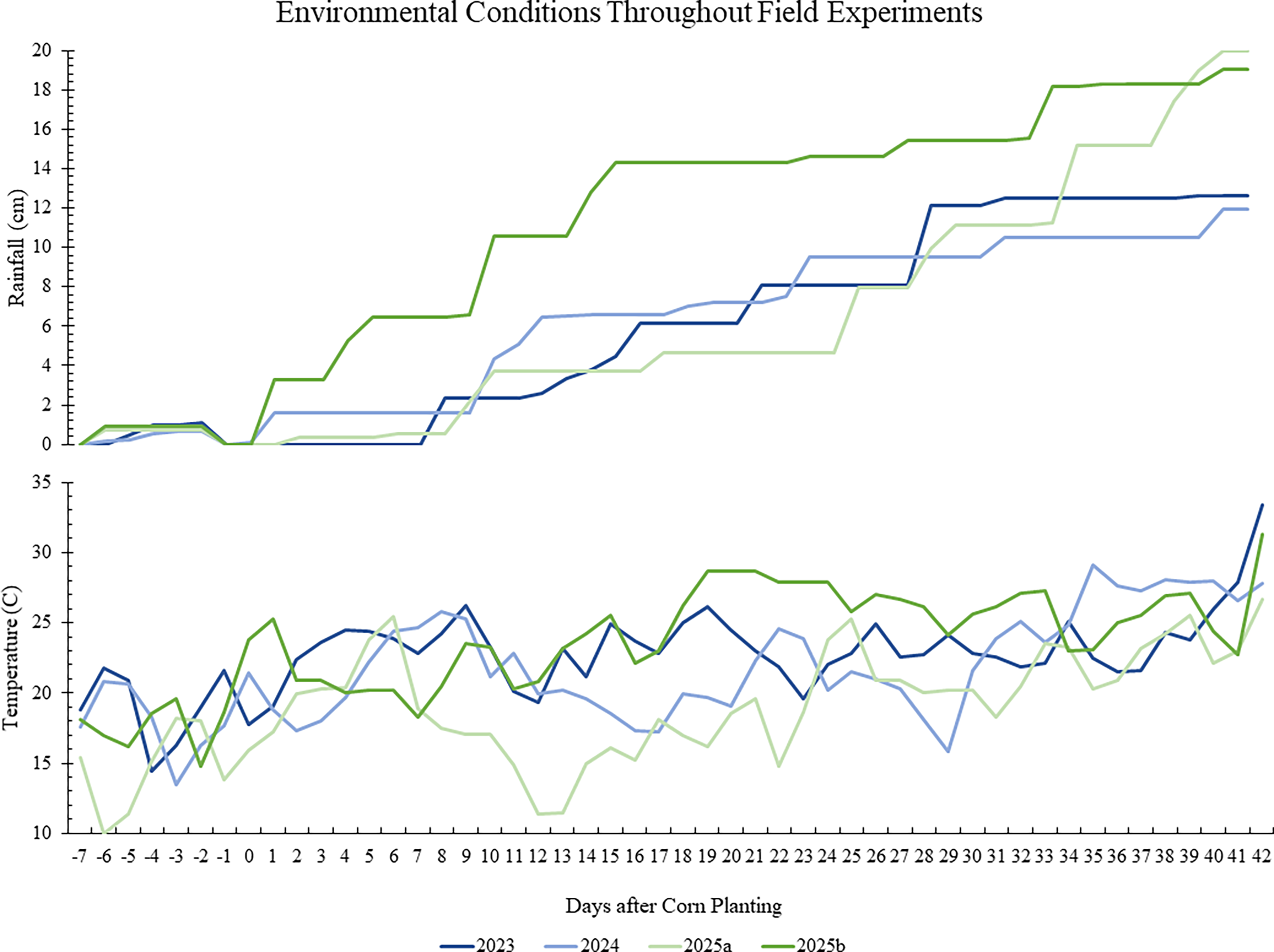
Two field experiments were conducted with 4 site-years per experiment at the Throckmorton Purdue Agricultural Center near Lafayette, Indiana (40.29°N, 86.90°W). The field was selected based on the prevalent infestation of giant ragweed (Ambrosia trifida L.) and relatively lower abundance of waterhemp [Amaranthus tuberculatus (Moq.) J.D. Sauer] and common lambsquarters (Chenopodium album L.). Experiments were initiated in a weed-free environment created by chisel plow in the autumn and mulch finisher operations in the spring. The soil was a silt loam, pH 5.8, with 3.4% organic matter content. A corn hybrid (8339SXE; Hoegemeyer Hybrids, Corteva Agriscience, Indianapolis, IN) with tolerance to glyphosate, glufosinate, 2,4-D, and aryloxyphenoxy-propionate herbicides was planted at 86,450 seeds ha−1 with 76-cm row spacing, and both experiments were planted on the same date each year. Due to limited rain after planting in 2025 (Figure 1), both experiments were conducted a second time to allow an evaluation under more ideal environmental conditions. -years are hereafter referred to as 2023, 2024, 2025a, and 2025b, with 2025a representing the first planting in 2025 and 2025b representing the second planting in 2025.
Cumulative rainfall and average air temperature from 7 d before planting through 42 d after corn planting.

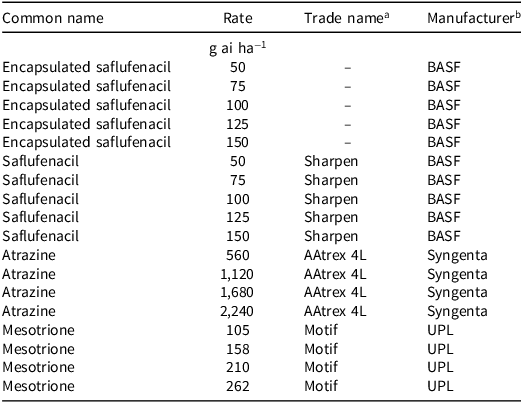
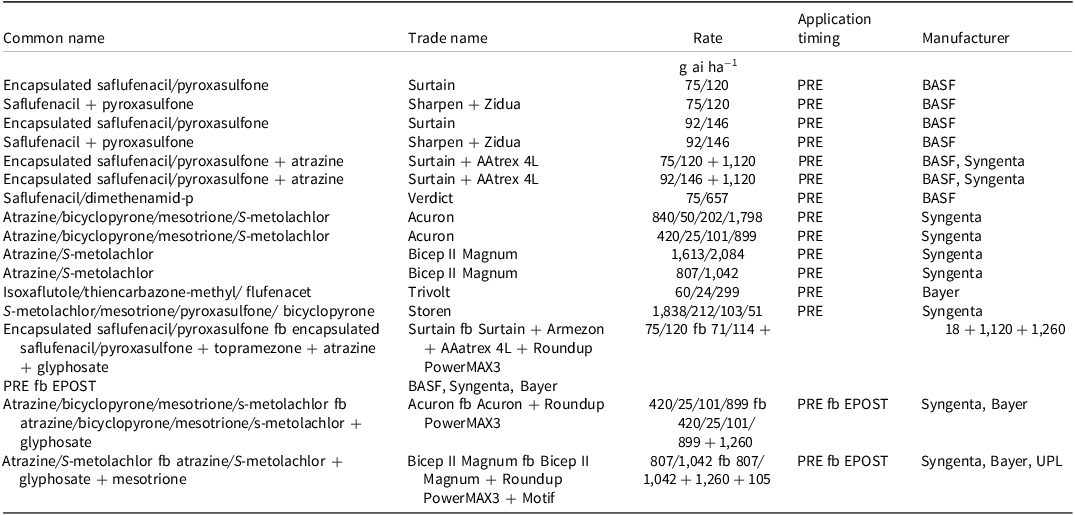
Experiments were arranged in a randomized complete block design with four replications and plots measuring 3 m wide by 9 m long. Only the center 2 m of each plot was treated, allowing for nontreated check strips between plots. The first experiment, a comparison of individual herbicides, was a two-factor (herbicide by herbicide rate) factorial design that evaluated residual broadleaf weed control and corn tolerance to preemergence applications of encapsulated saflufenacil (50, 75, 100, 125, and 150 g ai ha−1), nonencapsulated saflufenacil (50, 75, 100, 125, and 150 g ai ha−1), atrazine (560, 1120, 1,680, and 2,240 g ai ha−1), and mesotrione (105, 158, 210, and 262 g ai ha−1) (Table 1). The second experiment compared preemergence or preemergence followed by early postemergence sequential applications of the encapsulated saflufenacil + pyroxasulfone premixture to standard commercial herbicide practices for corn (Table 2).
Sources of herbicides and herbicide rates used in the solo herbicide comparison experiment applied preemergence to corn.

a Encapsulated saflufenacil is not commercially available as a single active ingredient, and does not have a trade name.
b Manufacturer locations: BASF Corporation, Research Triangle Park, NC; Syngenta Crop Protection, Greensboro, NC; UPL North America, Cary, NC.
Sources of herbicides, herbicide rates, and application timings used in the multiple herbicide comparison experiment.

aAbbreviations: EPOST, early postemergence; fb, followed by; PRE, preemergence.
bManufacturer locations: BASF Corporation, Research Triangle Park, NC; Bayer CropScience, St. Louis, MO; Syngenta Crop Protection, Greensboro, NC; UPL North America, Cary, NC.
Treatments with preemergence herbicides were applied after corn planting, while early postemergence treatments were applied at the corn V2 growth stage. All applications were performed using a CO2-pressurized backpack sprayer and a 2-m handheld spray boom equipped with four flat-fan XR11002 nozzles (TeeJet Technologies, Glendale Heights, IL) calibrated to deliver 140 L ha−1 at 207 kPa. In 2024 and 2025, trial areas were maintained free of annual grass weed species with quizalofop-ethyl (62 g ai ha−1, Assure II; AMVAC Chemical, Newport Beach, CA) applied before the early postemergence application.
Data collection included visual estimates of crop phytotoxicity and weed control at 28 and 42 d after planting (DAP) on a 0% to 100% scale, where 0% represented no injury or control, and 100% representing complete plant death or control. Crop phytotoxicity was also evaluated at 21 DAP during the 2025a planting due to rain that fell before the 28 DAP evaluation, resulting in minor levels of phytotoxicity. At 42 DAP, broadleaf weed densities were quantified, by species, in each plot from two quadrats each measuring 0.5 m2, from the front and back sections of the plot. In the 2025a and 2025b plantings, giant ragweed germination was greater and persisted longer than in 2023 and 2024. Consequently, a second flush germinated in herbicide-treated plots that initially exhibited high levels of control. However, in plots where preemergence treatments failed soon after application, subsequent flushes of giant ragweed were inhibited by competition with large, early emerging weeds. To account for this, aboveground biomass was harvested and oven-dried at 40 C until a constant mass was achieved from the 2025a and 2025b plantings. Density and biomass were combined across locations within the plot, yielding a total collection area of 1 m2. Both biomass and density measurements for each treated plot were analyzed as a percent reduction relative to the nontreated control. End-of-season corn yield (in kilograms per hectare; kg ha−1) was collected using a small-plot combine with grain yield and moisture recorded with a HarvestMaster system (Juniper Systems, Logan, UT). Grain yield data were adjusted to a moisture of 15.5%. Yield was not collected from the 2025a planting due to the dense giant ragweed competition (97 plants m−2, data not shown).
Statistical analyses were performed using RStudio software (v.2025.05.0+496; R Core Team 2024). Data were fit to separate generalized linear mixed models for each data type and data collection timing using the glmmTMB package (Brooks et al. Reference Brooks, Kristensen, Van Benthem, Magnusson, Berg, Nielsen, Skaug, Machler and Bolker2017). Due to similar levels of herbicide efficacy and treatment responses, waterhemp and common lambsquarters data were analyzed as a combined group for small-seeded broadleaf control. For the first experiment, herbicide, herbicide rate, site-year, and their interactions were treated as fixed effects, while block nested within site-year was treated as a random effect. Data were tested for normality and homogeneity of variance using the Shapiro-Wilks test and Levene test. If either test yielded a significant result for control, biomass reduction, or density reduction, data were fit to a beta distribution. Yield data were fit to a gamma distribution if the Shapiro-Wilks test or the Levene test failed. Across all data types, the non-transformed means are presented for clarity. Each fitted model was subjected to ANOVA with a Type II chi-square test using the car package (Fox and Weisberg Reference Fox and Weisberg2019). Although Type III tests are more appropriate for testing interactions between fixed effects, a Type II test was necessary to account for the unbalanced design of this experiment. Estimated marginal means were obtained with the emmeans package (Lenth Reference Lenth2024), and significant means were separated using the Tukey HSD test (α = 0.05) with the multcomp package (Hothorn et al. Reference Hothorn, Bretz and Westfall2008).
For the second experiment, treatments containing only saflufenacil and pyroxasulfone were subjected to ANOVA with a Type III chi-square test. Herbicide treatment and site-year were treated as fixed effects, while block nested within site-year was treated as a random effect. ANOVA assumptions were checked, and significant means were obtained and separated as previously described. Additionally, orthogonal contrasts were used to compare treatments containing encapsulated saflufenacil + pyroxasulfone + atrazine with other commercial standard herbicide treatments and to compare the encapsulated saflufenacil + pyroxasulfone sequential application treatment to other sequential application treatments.
Results and Discussion
Environmental Conditions
Saflufenacil efficacy and rain amounts shortly after preemergence application varied across the 4 -years of each experiment. Residual herbicides rely on adequate rain to move the herbicide into the soil solution (Mueller et al. Reference Mueller, Boswell, Mueller and Steckel2014) and to become available for plant uptake. The nonencapsulated saflufenacil and encapsulated saflufenacil + pyroxasulfone product labels require at least 1.27 cm of rain after application and before weed seedling emergence for full activation (BASF 2013, 2024). Additionally, fluctuations in rain amounts can significantly affect weed control and corn injury from mesotrione and atrazine applications (Armel et al. Reference Armel, Wilson, Richardson and Hines2003). More than 1.27 cm of rain was recorded within 7 d after preemergence herbicide applications in the 2024 and 2025b plantings, while in the 2023 and 2025a plantings, more than 1.27 cm of rain did not fall until 10 and 14 d after preemergence applications, respectively (Figure 1). Thus, variability in herbicide efficacy across site-years may be partially explained by differences in rain timing. Furthermore, encapsulated herbicide formulations often require a greater amount of rain to move the herbicide out of the encapsulation and distribute in the soil solution to initiate weed uptake compared with the nonencapsulated formulations (Butts et al. Reference Butts, Pearson, Souza and Cooper2025; Doub et al. Reference Doub, Wilson and Hatzios1988). As such, the 1.63 cm of rain that fell within 7 d after preemergence herbicides were applied in 2024 may have still been inadequate to provide free saflufenacil outside of the capsule and in the soil solution relative to no encapsulation.
The period of giant ragweed emergence starts in the early spring, with 90% giant ragweed emergence predicted to occur before June (Werle et al. Reference Werle, Sandell, Buhler, Hartzler and Lindquist2014). However, other research has suggested that germination patterns may shift based on temperature and precipitation patterns (Schutte et al. Reference Schutte, Regnier and Harrison2012). Specifically, under cool conditions with adequate rain, agricultural populations of giant ragweed may exhibit a continuous rate of germination from April to August. In contrast, when conditions are warmer and drier, two distinct germination cycles are exhibited (Schutte et al. Reference Schutte, Regnier and Harrison2012). In the 2025a planting, the average daily temperature from 0 to 14 DAP was 18 C, while the average daily temperature was 22 C during all other runs (Figure 1). Additionally, cumulative rain during the 2025a and 2025b plantings was 8 cm more than the amount of rain that fell in 2023 and 2024 (Figure 1). As such, the conducive conditions for giant ragweed germination in the 2025a and 2025b plantings could explain the much greater giant ragweed densities observed and overall variation in herbicide efficacy across site-years.
Corn Injury
In the solo herbicide comparison experiment, treatments with preemergence herbicides did not cause any corn stunting, stand loss, or foliar injury in the 2023, 2024, or 2025b trials (data not shown). In contrast, in the 2025a trial, low levels of foliar corn injury were observed at 21 DAP (F = 26.65, P < 0.0001) from the preemergence herbicide applications. Both formulations of saflufenacil caused 2% injury or less, in the form of necrotic leaf speckling, while no foliar injury was observed from atrazine and mesotrione (data not shown). The limited amount of corn injury can be attributed to the delayed activating rain that occurred 10 DAP, during early corn emergence from the soil. The heavy rain likely splashed the free saflufenacil onto the shoot tissue, which resulted in a small percentage of leaf tissue necrosis. However, the injury did not persist to the subsequent evaluation at 28 DAP. Similar transient injury to soybean [Glycine max (L.) Merr] has been previously observed from other PPO-inhibiting herbicides when a splashing rain occurs after soybean have cracked the soil surface (Wise et al. Reference Wise, Mueller, Kandel, Young and Legleiter2015). In the herbicide programs experiments, up to 3% corn injury was observed 28 DAP from the early postemergence application of all sequential application treatments (data not shown). The encapsulated saflufenacil + pyroxasulfone treatment at early postemergence caused necrotic lesions similar to those observed in the solo herbicide comparisons experiment applied preemergence, but due to foliar absorption during emergence. Foliar-applied saflufenacil causes rapid tissue necrosis (Grossmann et al. Reference Grossmann, Hutzler, Caspar, Kwiatkowski and Brommer2011), so the necrotic lesions observed were a likely result of any free saflufenacil contained in the early postemergence application treatments. Similar to the injury from soil splashing from the preemergence experiment, the corn injury did not persist to the following evaluation.
Giant Ragweed Control: Solo Herbicide Preemergence Comparison Experiment
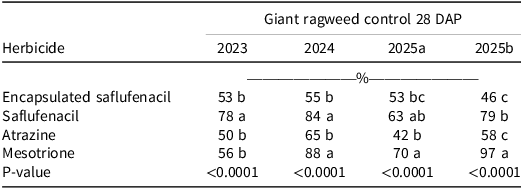
The interaction between herbicide and herbicide rate was not significant at 28 DAP (F = 7.50, P = 0.678). However, there was a significant herbicide by site-year interaction (F = 86.70, P < 0.0001); therefore, site-years are presented separately, and herbicides are pooled across herbicide rates. Across all site-years, saflufenacil and mesotrione typically resulted in greater residual control of giant ragweed than encapsulated saflufenacil and atrazine (Table 3). Control of giant ragweed from encapsulated saflufenacil was 10 to 33 percentage points less than control from saflufenacil at 28 DAP. Control of giant ragweed was up to 84% with saflufenacil at 28 DAP, with as low as 63% control observed in the 2025a planting (Table 3). The decreased efficacy observed in the 2025a planting could be a result of optimal conditions for giant ragweed germination and the delayed activating rain (Figure 1). In contrast to saflufenacil, encapsulated saflufenacil never provided greater than 55% control of giant ragweed, regardless of environmental conditions. Variable giant ragweed control ranging from 45% to 80% at 28 d after emergence has been previously reported with saflufenacil (Soltani et al. Reference Soltani, Shropshire and Sikkema2011).

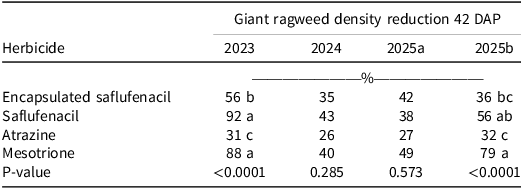
The visual analysis of control at 42 DAP was similar to observations of giant ragweed density reduction at 42 DAP. Therefore, only density reduction data are presented. Similar to 28 DAP reporting data, site-year data were analyzed independently due to a significant herbicide by site-year interaction (F = 32.32, P = 0.002). Density reduction by herbicide was nonsignificant in the 2024 and 2025a plantings (F = 3.792, P = 0.285; F = 1.996, P = 0.573), likely due to the overall low giant ragweed density in 2024 (<4 plants per m2, data not shown) and delayed activating rain for the 2025a planting. In both the 2023 and 2025b trials, giant ragweed density was reduced by 30 percentage points or more when mesotrione was applied than when encapsulated saflufenacil and atrazine were applied (Table 4). Furthermore, the reduction in giant ragweed density from the saflufenacil applications was at least 20 percentage points greater than that of encapsulated saflufenacil in both 2023 and 2025b trials.
Preemergence herbicide efficacy for giant ragweed density reduction, pooled across herbicide rate.a–c

a Abbreviation: DAP, days after planting.
b Density reductions were determined relative to the average nontreated.
c Means within a column followed by the same letter are not different according to the Tukey HSD test (α = 0.05).
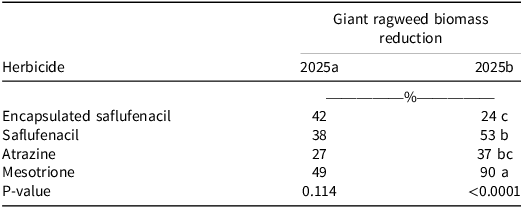
Although the giant ragweed density was similar for saflufenacil and encapsulated saflufenacil in the 2025b trial, many plants emerged later in the plots that received saflufenacil treatments than in the encapsulated saflufenacil–treated plots, as shown by the biomass data. Giant ragweed biomass reduction was nonsignificant in the 2025a planting (F = 10.59, P = 0.391). However, in the 2025b planting, giant ragweed biomass reduction was significant by herbicide (F = 49.99, P < 0.0001). Giant ragweed biomass was reduced by 90% when mesotrione was applied, which was 37, 53, and 63 percentage points greater than when saflufenacil, atrazine, and encapsulated saflufenacil, respectively, were applied (Table 5). Giant ragweed biomass was reduced by 53% with applications of saflufenacil, whereas biomass was reduced by only 24% when encapsulated saflufenacil was applied (Table 5). Despite the lack of difference in giant ragweed density between the plots that received saflufenacil and encapsulated saflufenacil, giant ragweed emerged earlier in the plots treated with encapsulated saflufenacil, allowing for a longer period of growth, which increased biomass.

In this solo herbicide preemergence experiment, mesotrione was the only herbicide to provide high levels of giant ragweed control late in the season. Previous research has similarly shown 80% or greater control of giant ragweed at 42 d after application from herbicide treatments that contained mesotrione (Westrich et al. Reference Westrich, Johnson and Young2024). Incomplete control of giant ragweed has been reported previously from applications of atrazine and saflufenacil (Bollman et al. Reference Bollman, Kells, Bauman, Loux, Slack and Sprague2006; Soltani et al. Reference Soltani, Shropshire and Sikkema2011). Although no published research has directly compared residual weed control between encapsulated and nonencapsulated saflufenacil formulations, the results of this research consistently demonstrated a reduction in giant ragweed control with the encapsulated formulation. Based on these results, encapsulated saflufenacil alone is not an optimal herbicide option for residual control of giant ragweed.
Giant Ragweed Control: Herbicide Programs Experiment
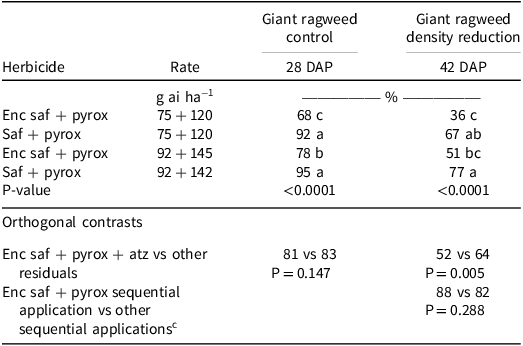
The encapsulated saflufenacil + pyroxasulfone premix formulation controlled giant ragweed by 24 and 17 percentage points less than the tank-mixture of saflufenacil + pyroxasulfone at the low (75 + 120 g ai ha−1) and high (92 + 142 g ai ha−1) rates at 28 DAP (Table 6). In the 2025a planting, the soil residual activity of all treatments was limited by the lack of rain (Figure 1). As such, there were no significant differences between saflufenacil + pyroxasulfone treatments (F = 4.37, P = 0.224). There was a significant treatment by site-year interaction when 2023, 2024, and 2025b plantings were combined (F = 12.87, P = 0.045). However, the main effect of treatment (F = 63.16, P < 0.0001) was more important in explaining model variation than the treatment by site-year interaction. Therefore, the 2023, 2024, and 2025b trials were combined for analysis. Orthogonal contrast analysis indicated that tank-mixing atrazine with the encapsulated saflufenacil + pyroxasulfone premixture at either rate resulted in similar giant ragweed control at 28 DAP to that of the other residual treatments (Table 6). Previous research has also demonstrated that the encapsulated saflufenacil + pyroxasulfone premixture must be tank-mixed with an additional herbicide to achieve a level of broadleaf weed control similar to the atrazine + S-metolachlor + mesotrione + bicyclopyrone premixture (Nelson et al. Reference Nelson, Soltani, Budd, Sikkemna and Robinson2025a).
Efficacy of saflufenacil with or without encapsulation + pyroxasulfone, compared to other residual corn herbicides, on giant ragweed control, pooled over the 2023, 2024, and 2025b plantings.a,b

a Abbreviations: atz, atrazine; DAP, days after planting; enc, encapsulated; pyrox, pyroxasulfone; saf, saflufenacil; vs, versus.
b Means within a column followed by the same letter are not different according to the Tukey HSD test (α = 0.05).
c Sequential application programs were not compared 28 DAP due to the postemergence application occurring within 3 d of the 28 DAP evaluation.
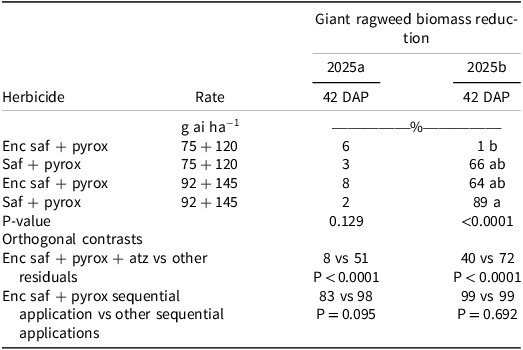
The analysis of visual control and giant ragweed density reduction at 42 DAP were similar; therefore, only density reduction data for giant ragweed are presented. There were no differences between treatments across 2023, 2024, and 2025b (F = 5.8, P = 0.446), but the main effect of treatment was significant (F = 21.99, P < 0.0001). Efficacy from all saflufenacil + pyroxasulfone treatments had substantially declined by 42 DAP. Despite the decline in control, use of the nonencapsulated formulation still resulted in a density reduction of greater than 67% at both rates. In contrast, applications of the encapsulated saflufenacil + pyroxasulfone premixture resulted in only 36% and 51% control, at the low and high application rates, respectively (Table 6). Orthogonal contrast analysis also confirmed a lower density reduction from the encapsulated saflufenacil + pyroxasulfone premixture tank mixed with atrazine at 42 DAP compared to other residual herbicide treatments (Table 6), despite no difference in visual control at 28 DAP. Furthermore, the biomass reduction in giant ragweed in the 2025b planting that resulted from the encapsulated saflufenacil + pyroxasulfone premixture tank mixed with atrazine was more than 30 percentage points less than all other residual herbicide treatments (Table 7). Based on the relatively short soil half-life of 1 to 36 d for saflufenacil (Mueller et al. Reference Mueller, Boswell, Mueller and Steckel2014; Papiernik et al. Reference Papiernik, Koshinen and Barber2012), the herbicide may have been present below the biologically effective dose for control of giant ragweed when applied preemergence only, with or without encapsulation, + pyroxasulfone, while the other residual herbicides may have still been present above the biologically effective dose.
Efficacy of saflufenacil, with and without encapsulation, + pyroxasulfone, compared to other residual corn herbicides, on giant ragweed biomass reduction in the 2025 plantings.a,b

a Abbreviations: atz, atrazine; DAP, days after planting; enc, encapsulated; pyrox, pyroxasulfone; saf, saflufenacil; vs, versus.
b Means within a column followed by the same letter are not different according to the Tukey HSD test (α = 0.05).
When the encapsulated saflufenacil + pyroxasulfone premixture was sequentially applied preemergence then early postemergence, giant ragweed control was similar to that when standard residual herbicides were applied sequentially (Table 6). Additionally, sequential applications of encapsulated saflufenacil resulted in a 99% reduction in giant ragweed biomass (Table 7). The increased giant ragweed control supports previous research reporting that multiple herbicide modes of action are necessary in each application to achieve the most effective giant ragweed control (Silva et al. Reference Silva, Arneson, Dewerff, Smith, Silva and Werle2023). The results of this research further suggest that adding atrazine to a preemergence application of the encapsulated saflufenacil + pyroxasulfone premixture may provide adequate giant ragweed control until a postemergence herbicide is applied, but it will not provide season-long control without an effective postemergence herbicide.
Small-Seeded Broadleaf Weed Control
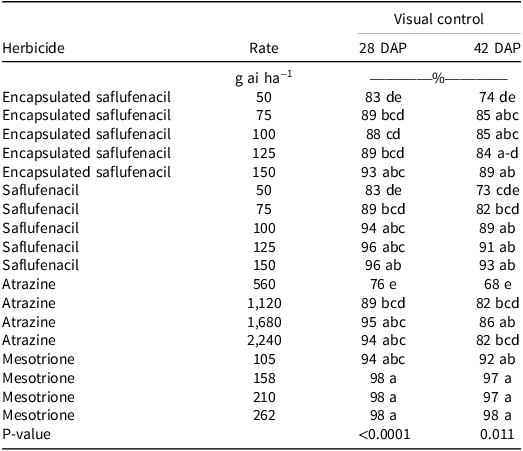
Control of small-seeded broadleaf weeds (waterhemp and common lambsquarters) in the solo herbicide preemergence comparison experiment was pooled across all site-years at 28 and 42 DAP due to a nonsignificant interaction between herbicide, herbicide rate, and site-year (F = 21.40, P = 0.374; F = 31.05, P = 0.413). A significant interaction between herbicide and herbicide rate was observed at both 28 and 42 DAP (F = 41.19, P < 0.0001; F = 22.96, P = 0.011). Small-seeded broadleaf weed control from encapsulated saflufenacil ranged from 83% to 93% at 28 DAP and 74% to 89% at 42 DAP (Table 8), results that were similar to that of saflufenacil applied at the same rates. At 42 DAP, greater than 90% control of small-seeded broadleaf weeds resulted from mesotrione at all application rates. Reduced weed control was observed 42 DAP only from the 50 g ha−1 rate of encapsulated saflufenacil; 50 and 75 g ha−1 rates of saflufenacil; and the 560, 1,120, and 2,240 g ha−1 rates of atrazine (Table 8). Given the relatively short half-life of saflufenacil (Mueller et al. Reference Mueller, Boswell, Mueller and Steckel2014; Papiernik et al. Reference Papiernik, Koshinen and Barber2012), saflufenacil applied at 50 or 75 g ha−1 may have been present below the biologically effective dose for small-seeded broadleaf weed control by 42 DAP. Although atrazine typically provides effective soil residual control of triazine-sensitive waterhemp and common lambsquarters (Bollman et al. Reference Bollman, Kells, Bauman, Loux, Slack and Sprague2006; Steckel et al. Reference Steckel, Sprague and Hager2002), triazine resistance has been documented in both species (Heap Reference Heap2025). The resistance profile of the waterhemp and common lambsquarters populations at the field used in this study has not been characterized, but neither has it been suspected to be resistant to atrazine. Additionally, microbial degradation of atrazine can be enhanced in fields with a history of repeated atrazine usage (Barriuso and Houot Reference Barriuso and Houot1996). Therefore, the reduced atrazine control observed in this study could potentially be a result of reduced sensitivity to triazine herbicides and enhanced microbial degradation. However, this experiment was not designed to evaluate herbicide sensitivity or herbicide degradation, so this conclusion is speculative.
Efficacy of preemergence corn herbicides for control of small-seeded broadleaf weeds, pooled over species and site-years.a–c

a Abbreviation: DAP, days after planting.
b Weed species included waterhemp and common lambsquarters.
c Means within a column followed by the same letter are not different according to the Tukey HSD test (α = 0.05).
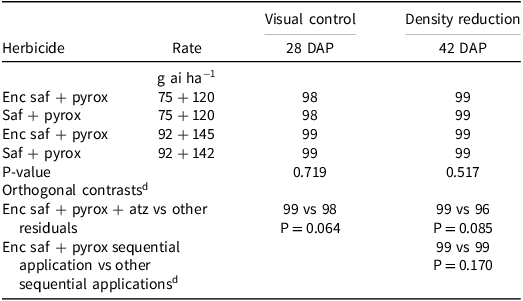
In the herbicide programs experiment, there were no significant differences between saflufenacil + pyroxasulfone treatments for small-seeded broadleaf weed control at 28 DAP or for weed density reduction at 42 DAP (F = 1.34, P = 0.720; F = 1.39, P = 0.708). At both evaluation timings, control from all treatments was at least 98% (Table 9). Previous research has documented similar soil-residual waterhemp and common lambsquarters control from saflufenacil and pyroxasulfone applied alone (Meyer et al. Reference Meyer, Norsworthy, Young, Steckel, Bradley, Johnson, Loux, Davis, Kurger, Bararpour, Ikley, Spaunhorst and Butts2016; Soltani et al. Reference Soltani, Shropshire and Sikkema2012, Reference Soltani, Brown and Sikkema2019; Steppig Reference Steppig2022). Although greater than 90% soil-residual waterhemp control has been reported from applications of the encapsulated saflufenacil + pyroxasulfone premixture (Nelson Reference Nelson2024), less than 60% residual control of common lambsquarters has been reported at the same rate of the premixture (Nelson et al. Reference Nelson, Soltani, Budd, Sikkemna and Robinson2025a).
Efficacy of saflufenacil with or without encapsulation, + pyroxasulfone, compared to other residual corn herbicides, for control of small-seeded broadleaf weeds, pooled over species and site-years.a–c

a Abbreviations: atz, atrazine; DAP, days after planting; enc, encapsulated; pyrox, pyroxasulfone; saf, saflufenacil; vs, versus.
b Weed species included waterhemp and common lambsquarters.
c Means within a column followed by the same letter are not different according to the Tukey HSD test (α = 0.05).
d Sequential applications were not compared at 28 DAP due to the postemergence application occurring within 3 d of the 28 DAP evaluation.
Despite differences in activating rainfall across site-years influencing giant ragweed control, a similar effect was not observed for small-seeded broadleaf control. Waterhemp is a late-emerging species that germinates best under high temperatures (Leon et al. Reference Leon, Knapp and Owen2004; Werle et al. Reference Werle, Sandell, Buhler, Hartzler and Lindquist2014). Thus, environmental conditions immediately following preemergence applications may not have been suitable for its germination. As a result, delayed rain did not affect waterhemp control. Although common lambsquarters is an early-emerging species (Werle et al. Reference Werle, Sandell, Buhler, Hartzler and Lindquist2014) similar to giant ragweed, in site-years when an activating rain was delayed, common lambsquarters was likely unable to compete with the aggressive growth of giant ragweed (Harrison et al. Reference Harrison, Regnier, Schmoll and Webb2001).
Corn Grain Yield
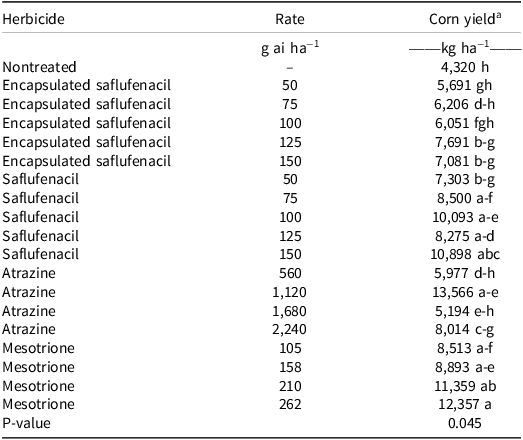
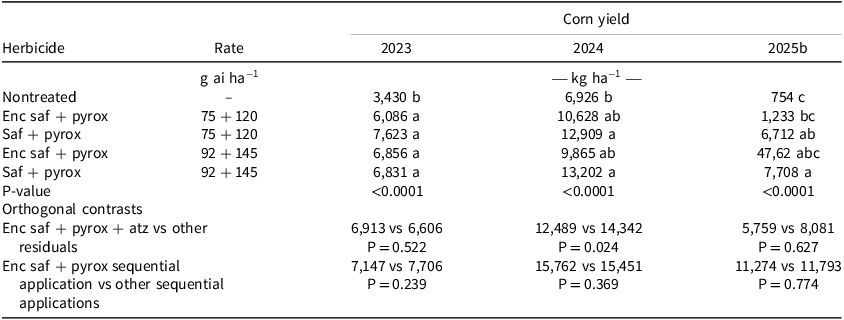
The interaction between herbicide and herbicide rate for corn grain yield in the solo herbicide preemergence experiment was significant (F = 18.59, P = 0.046). Site-years were combined since the interaction between herbicide, herbicide rate, and site-year was not significant (F = 24.58, P = 0.218). Encapsulated saflufenacil applied at 50, 75, and 100 g ha−1 resulted in corn grain yields that were similar to that of the nontreated control (Table 10). However, saflufenacil applied at the same rates resulted in yields that were 2,983, 4,180, and 5,773 kg ha−1 more than yields from the nontreated control plots (Table 10). The highest yield occurred after 262 g ha−1 of mesotrione was applied, which was 5,276, 1,519, and 4,343 kg ha−1 greater than the highest rates of encapsulated saflufenacil, saflufenacil, and atrazine, respectively (Table 10). In the herbicide programs experiment, yield responses varied across site-years (F = 40.09, P < 0.0001) and were analyzed separately. Across site-years, yields were greater with saflufenacil + pyroxasulfone relative to nontreated plots (Table 11). In contrast, yield relative to the nontreated plots was higher with applications of the encapsulated saflufenacil + pyroxasulfone premixture only in 2023, which is a similar result of previous research that found preemergence applications of the encapsulated saflufenacil + pyroxasulfone premixture resulted in corn grain yields that were similar to those of a nontreated crop (Nelson et al. Reference Nelson, Soltani, Budd, Sikkema and Robinson2025b). However, when the encapsulated saflufenacil + pyroxasulfone premixture was applied sequentially as a residual herbicide, the resulting yield was similar to those of the comparative treatments (Table 11).
Effect of preemergence herbicides and herbicide rate on end-of-season corn grain yield, pooled over 2023, 2024, and 2025b plantings.

a Means within a column followed by the same letter are not different according to the Tukey HSD test (α = 0.05).
Influence of saflufenacil, with or without encapsulation, + pyroxasulfone applied preemergence on end-of-season corn grain yield.a,b

a Abbreviations: atz, atrazine; enc, encapsulated; pyrox, pyroxasulfone; saf, saflufenacil, vs, versus.
b Means within a column followed by the same letter are not different according to the Tukey HSD test (α = 0.05).
Corn grain yield is affected to the greatest extent by weed competition when the critical weed-free period from the VE to the V3 stage of corn is not maintained (Page et al. Reference Page, Cerrudo, Westra, Loux, Smith, Foresman, Wright and Swanton2012). Furthermore, previous research demonstrated that yield losses from giant ragweed competition can be mitigated by maintaining a giant ragweed–free environment for the first 4 wk after emergence (Harrison et al. Reference Harrison, Regnier, Schmoll and Webb2001). Thus, in the solo herbicide preemergence experiment, when giant ragweed control exceeded 50% at 28 DAP, end-of-season yields were greater than those of nontreated plots. However, when encapsulated saflufenacil and atrazine residual activity diminished early, and giant ragweed was allowed to compete with corn during early corn development, the end-of-season yield was decreased. Similarly, end-of-season yield in the herbicide programs experiment increased only in 2023 when the encapsulated saflufenacil + pyroxasulfone premixture. Outside of end-of-season yield, the long-term effects of allowing such a high density of giant ragweed to produce seed must also be considered. While maximum seed production from a single giant ragweed plant is relatively low, around 2,300 seeds per plant (Goplen et al. Reference Goplen, Sheaffer, Becker, Becker, Coulter, Breitenbach, Behnken, Johnson and Gunsolus2017), seeds can remain viable in the soil seedbank for 4 yr (Harrison et al. Reference Harrison, Regnier, Schmoll and Harrison2007). Therefore, to preserve the yields of future cropping seasons, achieving high levels of giant ragweed control is essential for minimizing seed inputs into the seedbank each season.
Practical Implications
The results of this field research demonstrated that residual broadleaf weed control from the encapsulated saflufenacil + pyroxasulfone premixture is dependent on the specific weed species present. Encapsulated saflufenacil, with or without pyroxasulfone, was consistently efficacious in controlling small-seeded broadleaf weeds, specifically waterhemp and common lambsquarters. However, control of giant ragweed with encapsulated saflufenacil was consistently limited and inferior to the no-encapsulation formulation of saflufenacil. Furthermore, the limitations of encapsulated saflufenacil in controlling giant ragweed were observed regardless of rain amounts after application. Thus, saflufenacil may be more efficacious than encapsulated saflufenacil when used in fields where giant ragweed is problematic. Perhaps an important consideration is the depth of germination for giant ragweed versus small-seeded broadleaf weeds. Under our research conditions, the amount of rain that fell after encapsulated saflufenacil was applied may have been sufficient to move free saflufenacil down into the germination zone for the small-seeded broadleaf species, but not farther down into the soil profile where giant ragweed germination occurs. Regardless of formulation, an additional herbicide such as atrazine or mesotrione, should be tank-mixed with saflufenacil to achieve the most effective control of giant ragweed. The encapsulated saflufenacil + pyroxasulfone premixture provides growers with an additional postemergence herbicide mode-of-action option for use on corn for soil-residual weed control. However, the results of this research suggest that the most effective use of this premixture for residual broadleaf weed control is a program of preemergence followed by early postemergence herbicide applications with overlapping residual herbicides, aligning with best management practices for mitigating herbicide resistance.
Funding
This research was funded in part by BASF Corporation.
Competing Interests
The authors declare they have no competing interests.

 Open access

