1. Rayleigh–Bénard convection: its simplicity, relevance and the historical context
Rayleigh–Bénard (RB) convection, the flow in a container heated from below and cooled from above, is one of the paradigmatic systems in fluid dynamics and the physics of fluids. It is – so to say – the Drosophila of the physics of fluids, as many new concepts in fluid dynamics have been tested with this system, be it linear instabilities, pattern formation, turbulence or the so-called ultimate regime of turbulence for very strong thermal or buoyant driving. The reason for this is the conceptual simplicity of the system, with high symmetries, the dynamical equations and their boundary conditions being well known, and the accessibility, both experimentally and more recently also numerically.
One of the most impactful papers in the history of RB research is the paper ‘Scaling of hard thermal turbulence in Rayleigh–Bénard convection’, by B. Castaing, G. Gunaratne, F. Heslot, L.P. Kadanoff, A. Libchaber, S. Thomae, X.-Z. Wu, S. Zaleski and G. Zanetti (Castaing et al. Reference Castaing, Gunaratne, Heslot, Kadanoff, Libchaber, Thomae, Wu, Zaleski and Zanetti1989), the ‘Chicago Nine’, as they have been called, alluding to the ‘Chicago Seven’ trial against seven civil right activists in 1969. This paper also has had a tremendous impact on me personally, having first read it in 1990 as a first-year PhD student. In the authors’ words, the popularity of the RB system lies in the fact that ‘this system is in many respects of unsurpassed simplicity for the study of the irregular and complex motions in fluids and hence is well-suited for a fundamental study’, that ‘it has an advantage over open flow systems because of the greater ease with which very well-defined boundary conditions can be realized experimentally’ and that ‘in a cavity one only needs to control the temperature of the walls and this can be done to a remarkable precision and with great stability over a long period of time’ (see figure 1a).
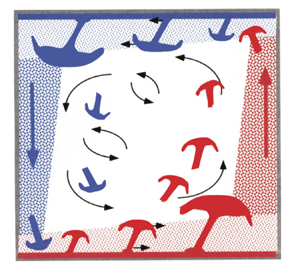
Figure 1.(a) Experimental set-up of the highly controlled RB cell. With the bolometers, time series of the local temperature were measured. (b) Hand-drawing by Leo Kadanoff: visualization of the plumes detaching from the laminar boundary layer and driving the large-scale flow, one of the central ideas of Castaing et al. (Reference Castaing, Gunaratne, Heslot, Kadanoff, Libchaber, Thomae, Wu, Zaleski and Zanetti1989), from where (a,b) are taken, with (a) being coloured for this article for clarity. (c) Later hand-drawing by Leo Kadanoff of how the ‘wind of turbulence’ would evolve in the RB cylinder (taken from Kadanoff (Reference Kadanoff2001)). Some years later Shang et al. (Reference Shang, Qiu, Tong and Xia2003) and Sun, Xia & Tong (Reference Sun, Xia and Tong2005) found that the tilting of the wind of turbulence is along the other diagonal; for more details on the flow organization as presently known, the reader is referred to the review by Xia (Reference Xia2013).
Let us sketch the research landscape in the physics community in the 1970s and 1980s. The fields of nonlinear dynamics and deterministic chaos experienced a boost, as very nicely described in the textbook by Strogatz (Reference Strogatz1994) or in the more popular book by Gleick (Reference Gleick1988). Rayleigh–Bénard flow played a very central role therein, already starting with Lorenz (Reference Lorenz1963), who developed very simplistic model equations for thermal convection just beyond its onset (now called Lorenz equations), and continuing with Ahlers (Reference Ahlers1974) and Maurer & Libchaber (Reference Maurer and Libchaber1979), who both found new routes to chaos in the RB system by analysing the spectra of time series of the heat transport. The thermal driving strength in both cases was weak, i.e. the Rayleigh number  ${\textit {Ra}}$ (the non-dimensionalized temperature difference $\varDelta$ between the hot bottom and cold top plates, defined by ${\textit {Ra}} \equiv \beta g L^3 \varDelta / (\nu \kappa )$, where $L$ is the distance between the plates, $\beta$ the thermal expansion coefficient, $g$ the gravitational acceleration, $\nu$ the kinematic viscosity and $\kappa$ the thermal diffusivity) was relatively low, just beyond the onset of convection. Both Ahlers (Reference Ahlers1974) and Maurer & Libchaber (Reference Maurer and Libchaber1979) did these RB studies with cryogenic helium as the working fluid, having had a background in the field of critical phenomena and in the knowledge of how well such a system can be controlled. With these new insights it was very natural to ask what would happen for stronger thermal driving, i.e. larger ${\textit {Ra}}$, so that the flow inside the container loses its spatial coherence and becomes turbulent, rather than simply being chaotic. Threlfall (Reference Threlfall1975) was the first to perform turbulent convection experiments in that regime in low-temperature gaseous helium.
Castaing et al. (Reference Castaing, Gunaratne, Heslot, Kadanoff, Libchaber, Thomae, Wu, Zaleski and Zanetti1989) picked up the idea of these experiments, but now with a much higher degree of precision and control and with much stronger thermal driving, up to ${\textit {Ra}} \sim 10^{13}$, so clearly in the turbulent regime. These high ${\textit {Ra}}$ numbers were possible with a relatively small cylinder height of only 8.7 cm (and the same diameter), as at the low operating temperatures (around 5 K) and operating pressures up to 2 atm the kinematic viscosity and thermal diffusivity of helium are very small. Moreover, Castaing et al. (Reference Castaing, Gunaratne, Heslot, Kadanoff, Libchaber, Thomae, Wu, Zaleski and Zanetti1989) varied ${\textit {Ra}}$ over eight orders of magnitude, by changing the operating pressure. The main objective of the paper was ‘to provide some phenomenological explanation’ of the results. In retrospect, one can say that the reason for the huge impact of the paper on the community and on me personally is not that it provided the right answers – in fact it partially did not – but as it stated the problem, developed versatile concepts and asked the right questions, which have stimulated the field for decades.
2. Asking the right questions
The questions which Castaing et al. (Reference Castaing, Gunaratne, Heslot, Kadanoff, Libchaber, Thomae, Wu, Zaleski and Zanetti1989) asked were: (i) What is the overall flow organization? (ii) What is the dependence of the Nusselt number ${\textit {Nu}}$ (the dimensionless heat transfer, i.e. the heat transfer normalized by the purely conductive heat transfer) on the Rayleigh number ${\textit {Ra}}$? (iii) Is there, for very large ${\textit {Ra}}$, an ultimate regime of turbulence, with different scaling properties? Correctly answering these questions has always been of utmost importance, in order to develop a theory of the flow to be able to predict the heat transfer and to extrapolate the results to the much larger ${\textit {Ra}}$ relevant in geophysical and astrophysical contexts.
The answer to question (i) on the overall flow organization was in those days – in the times prior to elaborate particle image velocimetry and detailed direct numerical simulations – much more difficult to find than it is nowadays. To get some idea, Castaing et al. (Reference Castaing, Gunaratne, Heslot, Kadanoff, Libchaber, Thomae, Wu, Zaleski and Zanetti1989) placed thermal probes (bolometers) into the flow at different locations and detected temperature time series, thus partially illuminating the fluid dynamics inside the non-transparent pressurized container. Inspired by such time series and parallel RB visualization experiments in water at much lower ${\textit {Ra}}$ (Zocchi, Moses & Libchaber Reference Zocchi, Moses and Libchaber1990), Castaing et al. (Reference Castaing, Gunaratne, Heslot, Kadanoff, Libchaber, Thomae, Wu, Zaleski and Zanetti1989) developed the picture of thermal plumes detaching from a thermal boundary layer (figure 1b) into a mixing layer (coloured regions in figure 1c). These thermal plumes, with a thickness typical of the boundary layer, self-organize on a larger scale and ultimately form the so-called ‘wind of turbulence’ on the scale of the container, see figure 1(c), a key notion that Castaing et al. came up with.
This picture then inspired Castaing et al. (Reference Castaing, Gunaratne, Heslot, Kadanoff, Libchaber, Thomae, Wu, Zaleski and Zanetti1989) to develop their so-called mixing zone theory, in which they postulated the existence of a mixing layer between the thermal boundary layer and the bulk. With this central picture in mind, they tried to rationalize their observed scaling behaviour for various quantities, most importantly for ${\textit {Nu}}$ (the dimensionless heat transport through the cylinder) as a function of ${\textit {Ra}}$; cf. above question (ii). The result was ${\textit {Nu}} \sim {\textit {Ra}}^{2/7}$, which seemingly was consistent with Castaing et al.'s experimental data; see figure 2(a). In fact, the best fit to an overall scaling law gave an exponent of $0.282\pm 0.006$, very close to $2/7 \approx 0.286$. Moreover, the mixing zone theory of Castaing et al. (Reference Castaing, Gunaratne, Heslot, Kadanoff, Libchaber, Thomae, Wu, Zaleski and Zanetti1989) gave the scaling laws $\varDelta _c/\varDelta \sim {\textit {Ra}}^{-1/7}$ for the typical temperature fluctuations in the bulk, ${\textit {Re}}_c \sim {\textit {Ra}}^{3/7}$ for the typical (non-dimensionalized) velocity fluctuations in the bulk and ${\textit {Re}} \sim {\textit {Ra}}^{1/2}$ for the (non-dimensionalized) velocity of the large-scale wind of turbulence, which develops out of the plumes. All these scaling laws were consistent with Castaing et al.'s experimental data.
Figure 2.(a) Plot of ${\textit {Nu}}({\textit {Ra}})$ as originally shown in Castaing et al. (Reference Castaing, Gunaratne, Heslot, Kadanoff, Libchaber, Thomae, Wu, Zaleski and Zanetti1989). The slope $2/7$ (solid line) has been added for this Focus on Fluids article. (b) A better way to see details of the scaling is a compensated plot, here done in the form ${\textit {Nu}}/ {\textit {Ra}}^{2/7}$ versus ${\textit {Ra}}$ for the heat transfer data of Ahlers & Xu (Reference Ahlers and Xu2001). Now a smooth transition between different scaling dependence is revealed, consistent with the earlier prediction of the GL theory (solid line) (Grossmann & Lohse Reference Grossmann and Lohse2000, Reference Grossmann and Lohse2001).
The final question (iii), that on the ultimate regime, was put forward, but not answered in Castaing et al. (Reference Castaing, Gunaratne, Heslot, Kadanoff, Libchaber, Thomae, Wu, Zaleski and Zanetti1989). They distinguished ‘soft turbulence’ with Gaussian temperature fluctuations for small ${\textit {Ra}}$ up to ${\textit {Ra}} \sim 4\times 10^7$ and ‘hard turbulence’ with temperature fluctuations with a stretched exponential distribution for larger ${\textit {Ra}}$; see figure 2(a). Whether there is an ultimate regime for very large ${\textit {Ra}}$, in the sense as suggested by Kraichnan (Reference Kraichnan1962), they left open, writing: ‘We do not know. Perhaps the hard turbulence extends to infinitely high values of ${\textit {Ra}}$, perhaps not’.
3. The answers to these questions today
Castaing et al. (Reference Castaing, Gunaratne, Heslot, Kadanoff, Libchaber, Thomae, Wu, Zaleski and Zanetti1989) began their conclusions with the statement: ‘Clearly, our work here is a beginning, not an end’. And indeed, it was. Later in the conclusions Castaing et al. (Reference Castaing, Gunaratne, Heslot, Kadanoff, Libchaber, Thomae, Wu, Zaleski and Zanetti1989) themselves identified various weaknesses of the paper and the mixing zone theory, one of them being the Prandtl number (${\textit {Pr}} \equiv \nu /\kappa$, i.e. a material parameter characteristic for the fluid) dependence resulting from the mixing zone theory. This dependence was not spelled out in Castaing et al. (Reference Castaing, Gunaratne, Heslot, Kadanoff, Libchaber, Thomae, Wu, Zaleski and Zanetti1989) (neither was it measured), but only implicitly present. It was spelled out a few years later by Cioni, Ciliberto & Sommeria (Reference Cioni, Ciliberto and Sommeria1997), giving ${\textit {Nu}} \sim {\textit {Ra}}^{2/7}{\textit {Pr}}^{-1/7}$ for moderate ${\textit {Pr}}$ and ${\textit {Nu}} \sim {\textit {Ra}}^{2/7}{\textit {Pr}}^{2/7}$ for small ${\textit {Pr}}$. The heat transfer measurements of Cioni et al. (Reference Cioni, Ciliberto and Sommeria1997) for RB convection in liquid mercury (${\textit {Pr}} \approx 0.02$) indeed found a strong increase of ${\textit {Nu}}$ with increasing ${\textit {Pr}}$. It was this experimental work by Cioni et al. (Reference Cioni, Ciliberto and Sommeria1997) of which I became aware during my visit to Sergio Ciliberto in Lyon in October 1997, which triggered the development of a unifying theory for the scaling in RB convection (Grossmann & Lohse Reference Grossmann and Lohse2000, Reference Grossmann and Lohse2001). This theory can explain the dependences ${\textit {Nu}}({\textit {Ra}}, {\textit {Pr}})$ and ${\textit {Re}} ({\textit {Ra}}, {\textit {Pr}})$, consistent with the experimental and numerical results. It is now known as GL theory and reviewed in Ahlers, Grossmann & Lohse (Reference Ahlers, Grossmann and Lohse2009), Stevens et al. (Reference Stevens, van der Poel, Grossmann and Lohse2013) and Lohse & Shishkina (Reference Lohse and Shishkina2024). The key insight of that theory is that there are no pure scaling laws, but smooth transitions between different regimes, dominated by either the boundary layer contributions or the bulk contributions to the kinetic and thermal dissipation rates. The effective scaling law ${\textit {Nu}} \sim {\textit {Ra}}^{2/7}$ found by Castaing et al. (Reference Castaing, Gunaratne, Heslot, Kadanoff, Libchaber, Thomae, Wu, Zaleski and Zanetti1989) can in fact then be understood as a smooth transition between ${\textit {Nu}} \sim {\textit {Ra}}^{1/4}$ for small ${\textit {Ra}}$ (boundary layer dominance) to ${\textit {Nu}} \sim {\textit {Ra}}^{1/3}$ (bulk dominance). The smooth increase of the scaling exponent was confirmed in Ahlers & Xu (Reference Ahlers and Xu2001), who had higher precision in their heat transfer measurements, a nearly constant Prandtl number and, in contrast to Castaing et al., plotted their precise heat transfer data in a compensated way, namely as ${\textit {Nu}} / {\textit {Ra}}^{2/7}$ versus ${\textit {Ra}}$, in which much more details of the dependence can be seen; see figure 2(b). I emphasize that a key ingredient in the GL theory is the existence of the wind of turbulence, which first had been identified by Castaing et al. (Reference Castaing, Gunaratne, Heslot, Kadanoff, Libchaber, Thomae, Wu, Zaleski and Zanetti1989).
Roughly a decade after Castaing et al.'s pioneering paper, also the ${\textit {Pr}}$ dependence of ${\textit {Nu}}$ had become clear. In addition to the experiments by Cioni et al. (Reference Cioni, Ciliberto and Sommeria1997) for small ${\textit {Pr}}$, the pioneering direct numerical simulations of Verzicco & Camussi (Reference Verzicco and Camussi1999) had revealed an increase of ${\textit {Nu}}\sim {\textit {Pr}}^{0.14}$ (for fixed ${\textit {Ra}} = 6 \times 10^5$) up to ${\textit {Pr}} \approx 0.3$ and then a saturation and for larger ${\textit {Pr}}$ beyond ${\textit {Pr}} \approx 7$ even a slight decrease, and the experiments by Xia, Lam & Zhou (Reference Xia, Lam and Zhou2002) in the up to then totally unexplored large-Prandtl-number range $4 \le {\textit {Pr}} \le 1350$ confirmed and quantified that decrease in a much larger ${\textit {Ra}}$ range, all consistent with the predictions of the GL theory.
The answer to Castaing et al.'s question on the ultimate regime has taken much longer and the research is in fact still ongoing. The first who found the transition to a much steeper increase (as had been suggested by Kraichnan (Reference Kraichnan1962)) in the ${\textit {Nu}}$ versus ${\textit {Ra}}$ relation were Chavanne et al. (Reference Chavanne, Chillà, Castaing, Hebral, Chabaud and Chaussy1997), namely an effective scaling of ${\textit {Nu}} \sim {\textit {Ra}}^{0.38}$ beyond ${\textit {Ra}} \sim 10^{11}$. These results could not be reproduced by Niemela et al. (Reference Niemela, Skrbek, Sreenivasan and Donnelly2000) and Urban et al. (Reference Urban, Hanzelka, Musilová, Králík, Mantia, Srnka and Skrbek2014), but were reproduced by Chavanne et al. (Reference Chavanne, Chillà, Chabaud, Castaing and Hébral2001) and Roche et al. (Reference Roche, Gauthier, Kaiser and Salort2010), who provided many details on the transition. Also He et al. (Reference He, Funfschilling, Nobach, Bodenschatz and Ahlers2012b,Reference He, Funfschilling, Bodenschatz and Ahlersa) did find a transition, though at larger ${\textit {Ra}} \sim 10^{14}$. A much more detailed discussion on the various experiments on the transition to the ultimate regime and their seemingly conflicting results is provided in Lohse & Shishkina (Reference Lohse and Shishkina2024).
These various seemingly conflicting results can be reconciled by the insight that the transition to the ultimate regime is of non-normal–nonlinear nature (Roche Reference Roche2020; Lohse & Shishkina Reference Lohse and Shishkina2023, Reference Lohse and Shishkina2024). Such type of transition is typical in shear flow (Trefethen et al. Reference Trefethen, Trefethen, Reddy and Driscol1993; Avila, Barkley & Hof Reference Avila, Barkley and Hof2023). Here the strongly sheared (by the wind of turbulence) boundary layers undergo such a transition from laminar type to turbulent type, thus strongly enhancing the heat flux. The nature of such a transition is subcritical, with a strong sensitivity to distortions (such as provided by the thermal probes in the boundary layer in Chavanne et al. (Reference Chavanne, Chillà, Castaing, Hebral, Chabaud and Chaussy1997), which were absent in other experiments) and other details of the flow and the set-up. A detailed discussion of the suggested non-normal–nonlinear transition in strongly driven RB turbulence can again be found in Lohse & Shishkina (Reference Lohse and Shishkina2024). In that paper we also suggest various experiments and numerical simulations which should be done to further elucidate the transition to the ultimate regime of RB turbulence and its suggested subcritical and non-normal–nonlinear nature. A very promising line of research is to apply controlled distortions to the boundary layer flow at a Rayleigh number ${\textit {Ra}}$ around the onset to the ultimate regime, and to study how the temporal development of these distortions depends on this driving strength ${\textit {Ra}}$ and on the history of the system, similarly to what had been done in pipe flow in order to study the transition from laminar to turbulent flow (Avila et al. Reference Avila, Barkley and Hof2023).
In summary, remarkable progress in the understanding of RB turbulence has been achieved since the pioneering work by Castaing et al. (Reference Castaing, Gunaratne, Heslot, Kadanoff, Libchaber, Thomae, Wu, Zaleski and Zanetti1989). This also includes huge progress in the direct numerical simulations of the RB system (for the state of the art, again see Lohse & Shishkina (Reference Lohse and Shishkina2024)), in which ${\textit {Ra}} \sim 10^{13}$ (the largest experimental value of Castaing et al. (Reference Castaing, Gunaratne, Heslot, Kadanoff, Libchaber, Thomae, Wu, Zaleski and Zanetti1989)) has now become achievable, though only for ${\sim }20$ large-eddy turnover times and for a cylinder aspect ratio of $\varGamma =1/2$, rather than $\varGamma = 1$ (Stevens, Lohse & Verzicco Reference Stevens, Lohse and Verzicco2020). All this progress could also be achieved because of Castaing et al. (Reference Castaing, Gunaratne, Heslot, Kadanoff, Libchaber, Thomae, Wu, Zaleski and Zanetti1989) asking the right questions 35 years ago. Clearly, for me personally the paper had a tremendous impact.







 Open access


1. Rayleigh–Bénard convection: its simplicity, relevance and the historical context
Rayleigh–Bénard (RB) convection, the flow in a container heated from below and cooled from above, is one of the paradigmatic systems in fluid dynamics and the physics of fluids. It is – so to say – the Drosophila of the physics of fluids, as many new concepts in fluid dynamics have been tested with this system, be it linear instabilities, pattern formation, turbulence or the so-called ultimate regime of turbulence for very strong thermal or buoyant driving. The reason for this is the conceptual simplicity of the system, with high symmetries, the dynamical equations and their boundary conditions being well known, and the accessibility, both experimentally and more recently also numerically.
One of the most impactful papers in the history of RB research is the paper ‘Scaling of hard thermal turbulence in Rayleigh–Bénard convection’, by B. Castaing, G. Gunaratne, F. Heslot, L.P. Kadanoff, A. Libchaber, S. Thomae, X.-Z. Wu, S. Zaleski and G. Zanetti (Castaing et al. Reference Castaing, Gunaratne, Heslot, Kadanoff, Libchaber, Thomae, Wu, Zaleski and Zanetti1989), the ‘Chicago Nine’, as they have been called, alluding to the ‘Chicago Seven’ trial against seven civil right activists in 1969. This paper also has had a tremendous impact on me personally, having first read it in 1990 as a first-year PhD student. In the authors’ words, the popularity of the RB system lies in the fact that ‘this system is in many respects of unsurpassed simplicity for the study of the irregular and complex motions in fluids and hence is well-suited for a fundamental study’, that ‘it has an advantage over open flow systems because of the greater ease with which very well-defined boundary conditions can be realized experimentally’ and that ‘in a cavity one only needs to control the temperature of the walls and this can be done to a remarkable precision and with great stability over a long period of time’ (see figure 1a).
(a) Experimental set-up of the highly controlled RB cell. With the bolometers, time series of the local temperature were measured. (b) Hand-drawing by Leo Kadanoff: visualization of the plumes detaching from the laminar boundary layer and driving the large-scale flow, one of the central ideas of Castaing et al. (Reference Castaing, Gunaratne, Heslot, Kadanoff, Libchaber, Thomae, Wu, Zaleski and Zanetti1989), from where (a,b) are taken, with (a) being coloured for this article for clarity. (c) Later hand-drawing by Leo Kadanoff of how the ‘wind of turbulence’ would evolve in the RB cylinder (taken from Kadanoff (Reference Kadanoff2001)). Some years later Shang et al. (Reference Shang, Qiu, Tong and Xia2003) and Sun, Xia & Tong (Reference Sun, Xia and Tong2005) found that the tilting of the wind of turbulence is along the other diagonal; for more details on the flow organization as presently known, the reader is referred to the review by Xia (Reference Xia2013).
Let us sketch the research landscape in the physics community in the 1970s and 1980s. The fields of nonlinear dynamics and deterministic chaos experienced a boost, as very nicely described in the textbook by Strogatz (Reference Strogatz1994) or in the more popular book by Gleick (Reference Gleick1988). Rayleigh–Bénard flow played a very central role therein, already starting with Lorenz (Reference Lorenz1963), who developed very simplistic model equations for thermal convection just beyond its onset (now called Lorenz equations), and continuing with Ahlers (Reference Ahlers1974) and Maurer & Libchaber (Reference Maurer and Libchaber1979), who both found new routes to chaos in the RB system by analysing the spectra of time series of the heat transport. The thermal driving strength in both cases was weak, i.e. the Rayleigh number ${\textit {Ra}}$ (the non-dimensionalized temperature difference $\varDelta$ between the hot bottom and cold top plates, defined by ${\textit {Ra}} \equiv \beta g L^3 \varDelta / (\nu \kappa )$, where $L$ is the distance between the plates, $\beta$ the thermal expansion coefficient, $g$ the gravitational acceleration, $\nu$ the kinematic viscosity and $\kappa$ the thermal diffusivity) was relatively low, just beyond the onset of convection. Both Ahlers (Reference Ahlers1974) and Maurer & Libchaber (Reference Maurer and Libchaber1979) did these RB studies with cryogenic helium as the working fluid, having had a background in the field of critical phenomena and in the knowledge of how well such a system can be controlled. With these new insights it was very natural to ask what would happen for stronger thermal driving, i.e. larger ${\textit {Ra}}$, so that the flow inside the container loses its spatial coherence and becomes turbulent, rather than simply being chaotic. Threlfall (Reference Threlfall1975) was the first to perform turbulent convection experiments in that regime in low-temperature gaseous helium.
Castaing et al. (Reference Castaing, Gunaratne, Heslot, Kadanoff, Libchaber, Thomae, Wu, Zaleski and Zanetti1989) picked up the idea of these experiments, but now with a much higher degree of precision and control and with much stronger thermal driving, up to ${\textit {Ra}} \sim 10^{13}$, so clearly in the turbulent regime. These high ${\textit {Ra}}$ numbers were possible with a relatively small cylinder height of only 8.7 cm (and the same diameter), as at the low operating temperatures (around 5 K) and operating pressures up to 2 atm the kinematic viscosity and thermal diffusivity of helium are very small. Moreover, Castaing et al. (Reference Castaing, Gunaratne, Heslot, Kadanoff, Libchaber, Thomae, Wu, Zaleski and Zanetti1989) varied ${\textit {Ra}}$ over eight orders of magnitude, by changing the operating pressure. The main objective of the paper was ‘to provide some phenomenological explanation’ of the results. In retrospect, one can say that the reason for the huge impact of the paper on the community and on me personally is not that it provided the right answers – in fact it partially did not – but as it stated the problem, developed versatile concepts and asked the right questions, which have stimulated the field for decades.
2. Asking the right questions
The questions which Castaing et al. (Reference Castaing, Gunaratne, Heslot, Kadanoff, Libchaber, Thomae, Wu, Zaleski and Zanetti1989) asked were: (i) What is the overall flow organization? (ii) What is the dependence of the Nusselt number ${\textit {Nu}}$ (the dimensionless heat transfer, i.e. the heat transfer normalized by the purely conductive heat transfer) on the Rayleigh number ${\textit {Ra}}$? (iii) Is there, for very large ${\textit {Ra}}$, an ultimate regime of turbulence, with different scaling properties? Correctly answering these questions has always been of utmost importance, in order to develop a theory of the flow to be able to predict the heat transfer and to extrapolate the results to the much larger ${\textit {Ra}}$ relevant in geophysical and astrophysical contexts.
The answer to question (i) on the overall flow organization was in those days – in the times prior to elaborate particle image velocimetry and detailed direct numerical simulations – much more difficult to find than it is nowadays. To get some idea, Castaing et al. (Reference Castaing, Gunaratne, Heslot, Kadanoff, Libchaber, Thomae, Wu, Zaleski and Zanetti1989) placed thermal probes (bolometers) into the flow at different locations and detected temperature time series, thus partially illuminating the fluid dynamics inside the non-transparent pressurized container. Inspired by such time series and parallel RB visualization experiments in water at much lower ${\textit {Ra}}$ (Zocchi, Moses & Libchaber Reference Zocchi, Moses and Libchaber1990), Castaing et al. (Reference Castaing, Gunaratne, Heslot, Kadanoff, Libchaber, Thomae, Wu, Zaleski and Zanetti1989) developed the picture of thermal plumes detaching from a thermal boundary layer (figure 1b) into a mixing layer (coloured regions in figure 1c). These thermal plumes, with a thickness typical of the boundary layer, self-organize on a larger scale and ultimately form the so-called ‘wind of turbulence’ on the scale of the container, see figure 1(c), a key notion that Castaing et al. came up with.
This picture then inspired Castaing et al. (Reference Castaing, Gunaratne, Heslot, Kadanoff, Libchaber, Thomae, Wu, Zaleski and Zanetti1989) to develop their so-called mixing zone theory, in which they postulated the existence of a mixing layer between the thermal boundary layer and the bulk. With this central picture in mind, they tried to rationalize their observed scaling behaviour for various quantities, most importantly for ${\textit {Nu}}$ (the dimensionless heat transport through the cylinder) as a function of ${\textit {Ra}}$; cf. above question (ii). The result was ${\textit {Nu}} \sim {\textit {Ra}}^{2/7}$, which seemingly was consistent with Castaing et al.'s experimental data; see figure 2(a). In fact, the best fit to an overall scaling law gave an exponent of $0.282\pm 0.006$, very close to $2/7 \approx 0.286$. Moreover, the mixing zone theory of Castaing et al. (Reference Castaing, Gunaratne, Heslot, Kadanoff, Libchaber, Thomae, Wu, Zaleski and Zanetti1989) gave the scaling laws $\varDelta _c/\varDelta \sim {\textit {Ra}}^{-1/7}$ for the typical temperature fluctuations in the bulk, ${\textit {Re}}_c \sim {\textit {Ra}}^{3/7}$ for the typical (non-dimensionalized) velocity fluctuations in the bulk and ${\textit {Re}} \sim {\textit {Ra}}^{1/2}$ for the (non-dimensionalized) velocity of the large-scale wind of turbulence, which develops out of the plumes. All these scaling laws were consistent with Castaing et al.'s experimental data.
(a) Plot of ${\textit {Nu}}({\textit {Ra}})$ as originally shown in Castaing et al. (Reference Castaing, Gunaratne, Heslot, Kadanoff, Libchaber, Thomae, Wu, Zaleski and Zanetti1989). The slope $2/7$ (solid line) has been added for this Focus on Fluids article. (b) A better way to see details of the scaling is a compensated plot, here done in the form ${\textit {Nu}}/ {\textit {Ra}}^{2/7}$ versus ${\textit {Ra}}$ for the heat transfer data of Ahlers & Xu (Reference Ahlers and Xu2001). Now a smooth transition between different scaling dependence is revealed, consistent with the earlier prediction of the GL theory (solid line) (Grossmann & Lohse Reference Grossmann and Lohse2000, Reference Grossmann and Lohse2001).
The final question (iii), that on the ultimate regime, was put forward, but not answered in Castaing et al. (Reference Castaing, Gunaratne, Heslot, Kadanoff, Libchaber, Thomae, Wu, Zaleski and Zanetti1989). They distinguished ‘soft turbulence’ with Gaussian temperature fluctuations for small ${\textit {Ra}}$ up to ${\textit {Ra}} \sim 4\times 10^7$ and ‘hard turbulence’ with temperature fluctuations with a stretched exponential distribution for larger ${\textit {Ra}}$; see figure 2(a). Whether there is an ultimate regime for very large ${\textit {Ra}}$, in the sense as suggested by Kraichnan (Reference Kraichnan1962), they left open, writing: ‘We do not know. Perhaps the hard turbulence extends to infinitely high values of ${\textit {Ra}}$, perhaps not’.
3. The answers to these questions today
Castaing et al. (Reference Castaing, Gunaratne, Heslot, Kadanoff, Libchaber, Thomae, Wu, Zaleski and Zanetti1989) began their conclusions with the statement: ‘Clearly, our work here is a beginning, not an end’. And indeed, it was. Later in the conclusions Castaing et al. (Reference Castaing, Gunaratne, Heslot, Kadanoff, Libchaber, Thomae, Wu, Zaleski and Zanetti1989) themselves identified various weaknesses of the paper and the mixing zone theory, one of them being the Prandtl number ( ${\textit {Pr}} \equiv \nu /\kappa$, i.e. a material parameter characteristic for the fluid) dependence resulting from the mixing zone theory. This dependence was not spelled out in Castaing et al. (Reference Castaing, Gunaratne, Heslot, Kadanoff, Libchaber, Thomae, Wu, Zaleski and Zanetti1989) (neither was it measured), but only implicitly present. It was spelled out a few years later by Cioni, Ciliberto & Sommeria (Reference Cioni, Ciliberto and Sommeria1997), giving ${\textit {Nu}} \sim {\textit {Ra}}^{2/7}{\textit {Pr}}^{-1/7}$ for moderate ${\textit {Pr}}$ and ${\textit {Nu}} \sim {\textit {Ra}}^{2/7}{\textit {Pr}}^{2/7}$ for small ${\textit {Pr}}$. The heat transfer measurements of Cioni et al. (Reference Cioni, Ciliberto and Sommeria1997) for RB convection in liquid mercury ( ${\textit {Pr}} \approx 0.02$) indeed found a strong increase of ${\textit {Nu}}$ with increasing ${\textit {Pr}}$. It was this experimental work by Cioni et al. (Reference Cioni, Ciliberto and Sommeria1997) of which I became aware during my visit to Sergio Ciliberto in Lyon in October 1997, which triggered the development of a unifying theory for the scaling in RB convection (Grossmann & Lohse Reference Grossmann and Lohse2000, Reference Grossmann and Lohse2001). This theory can explain the dependences ${\textit {Nu}}({\textit {Ra}}, {\textit {Pr}})$ and ${\textit {Re}} ({\textit {Ra}}, {\textit {Pr}})$, consistent with the experimental and numerical results. It is now known as GL theory and reviewed in Ahlers, Grossmann & Lohse (Reference Ahlers, Grossmann and Lohse2009), Stevens et al. (Reference Stevens, van der Poel, Grossmann and Lohse2013) and Lohse & Shishkina (Reference Lohse and Shishkina2024). The key insight of that theory is that there are no pure scaling laws, but smooth transitions between different regimes, dominated by either the boundary layer contributions or the bulk contributions to the kinetic and thermal dissipation rates. The effective scaling law ${\textit {Nu}} \sim {\textit {Ra}}^{2/7}$ found by Castaing et al. (Reference Castaing, Gunaratne, Heslot, Kadanoff, Libchaber, Thomae, Wu, Zaleski and Zanetti1989) can in fact then be understood as a smooth transition between ${\textit {Nu}} \sim {\textit {Ra}}^{1/4}$ for small ${\textit {Ra}}$ (boundary layer dominance) to ${\textit {Nu}} \sim {\textit {Ra}}^{1/3}$ (bulk dominance). The smooth increase of the scaling exponent was confirmed in Ahlers & Xu (Reference Ahlers and Xu2001), who had higher precision in their heat transfer measurements, a nearly constant Prandtl number and, in contrast to Castaing et al., plotted their precise heat transfer data in a compensated way, namely as ${\textit {Nu}} / {\textit {Ra}}^{2/7}$ versus ${\textit {Ra}}$, in which much more details of the dependence can be seen; see figure 2(b). I emphasize that a key ingredient in the GL theory is the existence of the wind of turbulence, which first had been identified by Castaing et al. (Reference Castaing, Gunaratne, Heslot, Kadanoff, Libchaber, Thomae, Wu, Zaleski and Zanetti1989).
Roughly a decade after Castaing et al.'s pioneering paper, also the ${\textit {Pr}}$ dependence of ${\textit {Nu}}$ had become clear. In addition to the experiments by Cioni et al. (Reference Cioni, Ciliberto and Sommeria1997) for small ${\textit {Pr}}$, the pioneering direct numerical simulations of Verzicco & Camussi (Reference Verzicco and Camussi1999) had revealed an increase of ${\textit {Nu}}\sim {\textit {Pr}}^{0.14}$ (for fixed ${\textit {Ra}} = 6 \times 10^5$) up to ${\textit {Pr}} \approx 0.3$ and then a saturation and for larger ${\textit {Pr}}$ beyond ${\textit {Pr}} \approx 7$ even a slight decrease, and the experiments by Xia, Lam & Zhou (Reference Xia, Lam and Zhou2002) in the up to then totally unexplored large-Prandtl-number range $4 \le {\textit {Pr}} \le 1350$ confirmed and quantified that decrease in a much larger ${\textit {Ra}}$ range, all consistent with the predictions of the GL theory.
The answer to Castaing et al.'s question on the ultimate regime has taken much longer and the research is in fact still ongoing. The first who found the transition to a much steeper increase (as had been suggested by Kraichnan (Reference Kraichnan1962)) in the ${\textit {Nu}}$ versus ${\textit {Ra}}$ relation were Chavanne et al. (Reference Chavanne, Chillà, Castaing, Hebral, Chabaud and Chaussy1997), namely an effective scaling of ${\textit {Nu}} \sim {\textit {Ra}}^{0.38}$ beyond ${\textit {Ra}} \sim 10^{11}$. These results could not be reproduced by Niemela et al. (Reference Niemela, Skrbek, Sreenivasan and Donnelly2000) and Urban et al. (Reference Urban, Hanzelka, Musilová, Králík, Mantia, Srnka and Skrbek2014), but were reproduced by Chavanne et al. (Reference Chavanne, Chillà, Chabaud, Castaing and Hébral2001) and Roche et al. (Reference Roche, Gauthier, Kaiser and Salort2010), who provided many details on the transition. Also He et al. (Reference He, Funfschilling, Nobach, Bodenschatz and Ahlers2012b,Reference He, Funfschilling, Bodenschatz and Ahlersa) did find a transition, though at larger ${\textit {Ra}} \sim 10^{14}$. A much more detailed discussion on the various experiments on the transition to the ultimate regime and their seemingly conflicting results is provided in Lohse & Shishkina (Reference Lohse and Shishkina2024).
These various seemingly conflicting results can be reconciled by the insight that the transition to the ultimate regime is of non-normal–nonlinear nature (Roche Reference Roche2020; Lohse & Shishkina Reference Lohse and Shishkina2023, Reference Lohse and Shishkina2024). Such type of transition is typical in shear flow (Trefethen et al. Reference Trefethen, Trefethen, Reddy and Driscol1993; Avila, Barkley & Hof Reference Avila, Barkley and Hof2023). Here the strongly sheared (by the wind of turbulence) boundary layers undergo such a transition from laminar type to turbulent type, thus strongly enhancing the heat flux. The nature of such a transition is subcritical, with a strong sensitivity to distortions (such as provided by the thermal probes in the boundary layer in Chavanne et al. (Reference Chavanne, Chillà, Castaing, Hebral, Chabaud and Chaussy1997), which were absent in other experiments) and other details of the flow and the set-up. A detailed discussion of the suggested non-normal–nonlinear transition in strongly driven RB turbulence can again be found in Lohse & Shishkina (Reference Lohse and Shishkina2024). In that paper we also suggest various experiments and numerical simulations which should be done to further elucidate the transition to the ultimate regime of RB turbulence and its suggested subcritical and non-normal–nonlinear nature. A very promising line of research is to apply controlled distortions to the boundary layer flow at a Rayleigh number ${\textit {Ra}}$ around the onset to the ultimate regime, and to study how the temporal development of these distortions depends on this driving strength ${\textit {Ra}}$ and on the history of the system, similarly to what had been done in pipe flow in order to study the transition from laminar to turbulent flow (Avila et al. Reference Avila, Barkley and Hof2023).
In summary, remarkable progress in the understanding of RB turbulence has been achieved since the pioneering work by Castaing et al. (Reference Castaing, Gunaratne, Heslot, Kadanoff, Libchaber, Thomae, Wu, Zaleski and Zanetti1989). This also includes huge progress in the direct numerical simulations of the RB system (for the state of the art, again see Lohse & Shishkina (Reference Lohse and Shishkina2024)), in which ${\textit {Ra}} \sim 10^{13}$ (the largest experimental value of Castaing et al. (Reference Castaing, Gunaratne, Heslot, Kadanoff, Libchaber, Thomae, Wu, Zaleski and Zanetti1989)) has now become achievable, though only for ${\sim }20$ large-eddy turnover times and for a cylinder aspect ratio of $\varGamma =1/2$, rather than $\varGamma = 1$ (Stevens, Lohse & Verzicco Reference Stevens, Lohse and Verzicco2020). All this progress could also be achieved because of Castaing et al. (Reference Castaing, Gunaratne, Heslot, Kadanoff, Libchaber, Thomae, Wu, Zaleski and Zanetti1989) asking the right questions 35 years ago. Clearly, for me personally the paper had a tremendous impact.
Acknowledgement
The author thanks his PhD advisor Siegfried Grossmann for having introduced him in 1990 to the great problem of RB convection and his postdoctoral advisor Leo Kadanoff for immersing him in the versatile scientific environment of the James Franck Institute at the University of Chicago and both for many years of inspiring joint scientific work and for all I learnt from them. I also thank all my later collaborators on this wonderful scientific problem.
Declaration of interests
The author reports no conflict of interest.