





1. Introduction
The Brinkman equation, also known as the Brinkman–Debye–Bueche equation (Debye & Bueche Reference Debye and Bueche1948; Brinkman Reference Brinkman1949a , Reference Brinkmanb ), describes the effective flow of a fluid through a porous medium (Ingham & Pop Reference Ingham and Pop1998). The Brinkman description represents an extension of the classical form of Darcy’s law (Auriault Reference Auriault2009) and was originally formulated to model the viscous flow past a sparse array of identical non-overlapping spherical particles (Happel Reference Happel1958; Childress Reference Childress1972; Howells Reference Howells1974; Durlofsky & Brady Reference Durlofsky and Brady1987). It becomes important when the length scale of the flow gradients becomes comparable to the screening length in the porous medium. Brinkman equation can also be viewed as the Stokes equation with an additional local drag force density on the permeating fluid that is negatively linear in the fluid velocity. The Brinkman description is also naturally linked to unsteady Stokes flow and linear viscoelastic fluids by a correspondence principle (Kim & Karrila Reference Kim and Karrila2013).
In a Stokes fluid, the Green’s function in the presence of a wall with a no-slip boundary belongs to the oldest and most fundamental solutions. It was first formulated by Lorentz (Reference Lorentz1907) and later represented by Blake as a multipole image (Blake Reference Blake1971), which gave it the now common designation as Blake’s tensor. The solution is central in problems where the flow is induced by an object embedded in a planar surface, such as a beating cilium (Blake Reference Blake1972; Vilfan Reference Vilfan2012), or moving in the proximity of such a surface, like a swimming microorganism or an artificial microswimmer (Spagnolie & Lauga Reference Spagnolie and Lauga2012; Ibrahim & Liverpool Reference Ibrahim and Liverpool2016; Daddi-Moussa-Ider et al. Reference Daddi-Moussa-Ider, Lisicki, Hoell and Löwen2018). Furthermore, the Green’s function provides the basis to determine the leading-order correction to the viscous drag coefficient of a small particle in the proximity of a wall (Happel & Brenner Reference Happel and Brenner1983).
In the case of a Brinkman fluid or unsteady Stokes flow, a general analytical expression for the Green’s function does not exist. Pozrikidis (Reference Pozrikidis1989) has determined the solution in Fourier space, but concluded that the integrals could not be solved in a closed form, which implies that the image system may not be represented with a finite number of wall-image singularities. Felderhof has derived the solution in a different form in frequency (Felderhof Reference Felderhof2005) and time domain (Felderhof Reference Felderhof2009), and used it to evaluate the reaction fields that determine the wall effect on the mobility of a small particle. For the latter, a closed-form solution was found (Felderhof Reference Felderhof2005). Simha, Mo & Morrison (Reference Simha, Mo and Morrison2018) have refined the result beyond the point-particle approximation. A review of the existing results is provided by Fouxon & Leshansky (Reference Fouxon and Leshansky2018), who also derived analytical asymptotic solutions for the self-mobility of a spherical particle in the presence of a wall in the limit of distances that are short or long compared to the viscous penetration depth. The frequency-dependent mobility of a particle can be directly compared to microhydrodynamic experiments (Jeney et al. Reference Jeney, Lukić, Kraus, Franosch and Forró2008; Franosch & Jeney Reference Franosch and Jeney2009). In addition to point particles, an exact representation of Brinkman flow due to a regularised Brinkmanlet near a plane wall has also been provided in Fourier space (Nguyen, Olson & Leiderman Reference Nguyen, Olson and Leiderman2019), but as in the case of a point force Brinkmanlet, it requires numerical Fourier transformation to return to real space. Another extension includes replacing the infinite no-slip wall with a finite-sized disk, which has been solved for the axisymmetric case (Daddi-Moussa-Ider et al. Reference Daddi-Moussa-Ider, Hosaka, Vilfan and Golestanian2023). For a force parallel to the wall, the far-field limit and the integral force balance have been discussed by Daddi-Moussa-Ider & Vilfan (Reference Daddi-Moussa-Ider and Vilfan2025).
In this paper, we revisit the problem for the case when the point force is acting perpendicular to the no-slip boundary and is localised close to the wall, at a distance that is much smaller than the screening length. The general solution has a closed form up to one integral, which can be expanded in a Taylor series in both the far-field and near-field regimes. The main contribution of this work is therefore the derivation of closed-form analytical far-field and near-field solutions for the flow induced by a point force near a no-slip wall in a Brinkman medium. Earlier studies have discussed this problem, but relied on numerical evaluations or integral representations, without obtaining an analytical asymptotic form (Feng, Ganatos & Weinbaum Reference Feng, Ganatos and Weinbaum1998; Clarke et al. Reference Clarke, Cox, Williams and Jensen2005).
The asymptotic solutions derived here provide clear physical insight into the nature of hydrodynamic singularities in Brinkman flow, and reveal how the presence of the no-slip wall and the medium permeability modify the long-range flow structure. Beyond its theoretical significance, this result has practical relevance: it can be applied to any problem where a non-steady force is acting on a fluid in the vicinity of a wall, e.g. by a beating cilium. Besides active particles, the Green’s functions determine the time-dependent cross-correlation functions of Brownian particles near a wall. Further, they can be used as a fundamental building block for studying hydrodynamic interactions in systems where a force multipole, such as a microswimmer, acts on a fluid in the proximity of a wall.
2. Problem statement
The flow is governed by the Brinkman equation and the incompressibility condition (Brinkman Reference Brinkman1949a )
 \begin{align} \eta {\nabla }^2 \boldsymbol{v} - \eta \alpha ^2 \boldsymbol{v} -\boldsymbol{\nabla }\!p + \boldsymbol{f} = \boldsymbol{0} , \quad \boldsymbol{\nabla } \boldsymbol{\cdot }\boldsymbol{v} = 0 , \end{align}
where $\eta$
is the dynamic viscosity of the Newtonian fluid,
$\eta$
is the dynamic viscosity of the Newtonian fluid, $\alpha ^2$
is the impermeability of the porous medium, which has dimensions (length)
$\alpha ^2$
is the impermeability of the porous medium, which has dimensions (length) $^{-2}$
, and
$^{-2}$
, and $\boldsymbol{v}$
and
$\boldsymbol{v}$
and $p$
are the fluid velocity and pressure, respectively. Here,
$p$
are the fluid velocity and pressure, respectively. Here, $\boldsymbol{f} = \boldsymbol{F} \delta ( \boldsymbol{r} - h \hat {\boldsymbol{e}}_z )$
is a point-force density acting on the surrounding fluid above the no-slip wall at position
$\boldsymbol{f} = \boldsymbol{F} \delta ( \boldsymbol{r} - h \hat {\boldsymbol{e}}_z )$
is a point-force density acting on the surrounding fluid above the no-slip wall at position $(0,0,h)$
. We adopt the system of cylindrical coordinates
$(0,0,h)$
. We adopt the system of cylindrical coordinates $(\rho , \theta , z)$
, where
$(\rho , \theta , z)$
, where $\rho$
,
$\rho$
, $\theta$
and
$\theta$
and $z$
denote the radial, azimuthal and axial coordinates, respectively.
$z$
denote the radial, azimuthal and axial coordinates, respectively.
3. Hydrodynamic fields
We express the solution for the hydrodynamic fields in the form
 \begin{align} \boldsymbol{v} = \frac {F}{8\pi \eta }\boldsymbol{G} , \quad p = \frac {F}{8\pi }P , \end{align}
where $\boldsymbol{G} = \boldsymbol{G}^\infty + \boldsymbol{G}^{{B}}$
and
$\boldsymbol{G} = \boldsymbol{G}^\infty + \boldsymbol{G}^{{B}}$
and $P = P^\infty + P^{{B}}$
. Here,
$P = P^\infty + P^{{B}}$
. Here, $\boldsymbol{G}^\infty$
and
$\boldsymbol{G}^\infty$
and $P^\infty$
denote the free-space contributions to the velocity and pressure fields, respectively, while
$P^\infty$
denote the free-space contributions to the velocity and pressure fields, respectively, while $\boldsymbol{G}^{{B}}$
and
$\boldsymbol{G}^{{B}}$
and $P^{{B}}$
represent the corresponding correction terms required to satisfy the prescribed no-slip boundary conditions at the wall.
$P^{{B}}$
represent the corresponding correction terms required to satisfy the prescribed no-slip boundary conditions at the wall.
In the absence of forces, a general solution of the Brinkman equation can be decomposed into a pressure driven flow and a solution of the Helmholtz equation
 \begin{align} \boldsymbol{G}=-\alpha ^{-2} \boldsymbol{\nabla }\!P + \alpha ^{-2}\boldsymbol{\nabla }\boldsymbol{\nabla } \boldsymbol{\cdot }\boldsymbol{\varPsi } -\boldsymbol{\varPsi }, \end{align}
where ${\nabla }^2{\kern-1pt}P=0$
and
${\nabla }^2{\kern-1pt}P=0$
and $({\nabla }^2 - \alpha ^2) \boldsymbol{\varPsi }=\boldsymbol{0}$
. For the free-space Green’s function, the two functions read (Kim & Karrila Reference Kim and Karrila2013)
$({\nabla }^2 - \alpha ^2) \boldsymbol{\varPsi }=\boldsymbol{0}$
. For the free-space Green’s function, the two functions read (Kim & Karrila Reference Kim and Karrila2013)
 \begin{align} P^\infty = \frac {2}{s^3} (z-h) , \quad \boldsymbol \varPsi ^\infty =\hat {\boldsymbol{e}}_z \varPsi ^\infty = -\hat {\boldsymbol{e}}_z \frac {2}{s} {\rm e}^{-\alpha s}, \end{align}
with $s=\sqrt {\rho ^2+(z-h)^2}$
denoting the distance from the singularity. The first contribution represents a long-range pressure-driven flow, equivalent to a source-dipole. The second is an exponentially decaying shear-driven flow. In this way, the free-space Brinkmanlet is given by (Howells Reference Howells1974)
$s=\sqrt {\rho ^2+(z-h)^2}$
denoting the distance from the singularity. The first contribution represents a long-range pressure-driven flow, equivalent to a source-dipole. The second is an exponentially decaying shear-driven flow. In this way, the free-space Brinkmanlet is given by (Howells Reference Howells1974)
 \begin{align} G_\rho ^\infty &= B_2 \frac {\rho \left (z-h\right )}{s^3} , \\[-12pt] \nonumber \end{align}
 \begin{align} G_z^\infty &= \frac {B_1}{s} + \frac {B_2}{s^3}\!\left (z-h\right )^2 , \\[9pt] \nonumber \end{align}
where the two functions of distance $B_1$
and
$B_1$
and $B_2$
are defined as
$B_2$
are defined as
 \begin{align} B_1 &= 2 \textrm{e}^{-\alpha s} \left ( 1 + \frac {1}{\alpha s} + \frac {1}{(\alpha s)^2} \right ) - \frac {2}{(\alpha s)^2} , \\[-12pt] \nonumber \end{align}
 \begin{align} B_2 &= \frac {6}{(\alpha s)^2} - 2 \textrm{e}^{-\alpha s} \left ( 1 + \frac {3}{\alpha s} + \frac {3}{(\alpha s)^2} \right ) \!. \\[9pt] \nonumber \end{align}
After a zeroth-order Hankel transform, the solutions can be expressed in integral form as
 \begin{align} P^\infty &= \int _0^\infty 2k \, \textrm{e}^{-k\,|z-h|}\, J_0(k\rho ) \, \mathrm{d} k, \\[-12pt] \nonumber\end{align}
 \begin{align} \varPsi ^\infty &= - \int _0^\infty \frac {2k}{K} \, \textrm{e}^{-K\,|z-h|}\, J_0(k\rho ) \, \mathrm{d} k , \\[9pt] \nonumber\end{align}
where we have defined $K = \sqrt {k^2+\alpha ^2}$
, with
$K = \sqrt {k^2+\alpha ^2}$
, with $k$
denoting the wavenumber. Here,
$k$
denoting the wavenumber. Here, $J_0$
represents the zeroth-order Bessel function of the first kind (Abramowitz & Stegun Reference Abramowitz and Stegun1972). Note that the integral defined in (3.6a
) can be found in Gradshteyn & Ryzhik (Reference Gradshteyn and Ryzhik2014), equation (6.621.4), whereas (3.6b
) follows from equation (6.646.1) after applying the substitution
$J_0$
represents the zeroth-order Bessel function of the first kind (Abramowitz & Stegun Reference Abramowitz and Stegun1972). Note that the integral defined in (3.6a
) can be found in Gradshteyn & Ryzhik (Reference Gradshteyn and Ryzhik2014), equation (6.621.4), whereas (3.6b
) follows from equation (6.646.1) after applying the substitution $x = \sqrt {t^2 + 1}$
.
$x = \sqrt {t^2 + 1}$
.
We now use the same decomposition for the image fields. The no-slip boundary condition at the wall requires
 \begin{align} G_z=-\alpha ^{-2}\partial _z P +\alpha ^{-2} \partial ^2_z \varPsi -\varPsi =0 \end{align}
and
 \begin{align} G_\rho =-\alpha ^{-2}\partial _\rho P +\alpha ^{-2}\partial _\rho \partial _z \varPsi =0. \end{align}
Because both fields vanish at infinity, the radial condition is equivalent to $\left . (P-\partial _z \varPsi )\right |_{z=0}=0$
. The boundary conditions are satisfied with the image solution
$\left . (P-\partial _z \varPsi )\right |_{z=0}=0$
. The boundary conditions are satisfied with the image solution
 \begin{align} P^{{B}} &= \int _0^\infty 2k \big( {-}(\kappa +1)\, \textrm{e}^{-kh} + \kappa\textrm{e}^{-Kh}\big) \textrm{e}^{-kz}\, J_0(k\rho ) \, \mathrm{d} k, \\[-12pt] \nonumber\end{align}
 \begin{align} \varPsi ^{{B}} &= \int _0^\infty 2 \left ( {-}(\kappa +1)\frac k K \, \textrm{e}^{-Kh} + \kappa \textrm{e}^{-kh}\right ) \textrm{e}^{-Kz}\, J_0(k\rho ) \, \mathrm{d} k , \\[9pt] \nonumber\end{align}
where we have introduced the dimensionless function
 \begin{align} \kappa = \frac { 2k ( k+K)}{\alpha ^2} . \end{align}
Note the mixed nature of the image: a source dipole (contribution of $P^\infty$
) induces both a pressure-driven image (first term in (3.9a
)) and a shear-driven image (second term in (3.9b
)). Conversely, the shear-driven part of the free-space solution (
$P^\infty$
) induces both a pressure-driven image (first term in (3.9a
)) and a shear-driven image (second term in (3.9b
)). Conversely, the shear-driven part of the free-space solution ( $\varPsi ^\infty$
) induces a pressure-driven image (second term in (3.9a
)) and a shear-driven image (first term in (3.9b
)).
$\varPsi ^\infty$
) induces a pressure-driven image (second term in (3.9a
)) and a shear-driven image (first term in (3.9b
)).
3.1. Limit of small $h$
$h$

The following analysis applies in the limit where the force is close to the boundary such that $\alpha h \ll 1$
and
$\alpha h \ll 1$
and $h \ll r$
, where
$h \ll r$
, where $r=\sqrt {\rho ^2+z^2}$
. As in the case of the Stokes fluid and a force perpendicular to the wall (Blake Reference Blake1971; Blake & Chwang Reference Blake and Chwang1974), the zeroth and first-order terms in
$r=\sqrt {\rho ^2+z^2}$
. As in the case of the Stokes fluid and a force perpendicular to the wall (Blake Reference Blake1971; Blake & Chwang Reference Blake and Chwang1974), the zeroth and first-order terms in $h$
vanish. The Green’s function can therefore be expanded to the leading order as
$h$
vanish. The Green’s function can therefore be expanded to the leading order as
 \begin{align} \boldsymbol{G} = h^2 \boldsymbol{G}^{(2)} + \mathcal{O} ( h^3) . \end{align}
The same expansion also holds for the pressure $P$
and the function
$P$
and the function $\varPsi$
. Specifically,
$\varPsi$
. Specifically,
 \begin{align} P = h^2 P^{(2)} + \mathcal{O} ( h^3) , \quad \varPsi = h^2 \varPsi ^{(2)} + \mathcal{O} ( h^3) , \end{align}
with
 \begin{align} P^{(2)}=2\int _0^\infty k^2(k+K ) \, \textrm{e}^{-kz}\, J_0(k\rho ) \, \mathrm{d} k \end{align}
and
 \begin{align} \varPsi ^{(2)}=-2\int _0^\infty k(K+k ) \, \textrm{e}^{-Kz}\, J_0(k\rho ) \, \mathrm{d} k . \end{align}
The first term in each of the integrals can easily be recognised as the second $z$
-derivative of the free-space solution (3.6). The solution therefore consists of a force quadrupole and further corrections resulting from the mixed terms mentioned above. We decompose the solutions as
$z$
-derivative of the free-space solution (3.6). The solution therefore consists of a force quadrupole and further corrections resulting from the mixed terms mentioned above. We decompose the solutions as
 \begin{align} P^{(2)}=P^{(2)}_1 +P^{(2)}_2 , \quad \varPsi ^{(2)}=\varPsi ^{(2)}_1+ \varPsi ^{(2)}_2, \end{align}
where
 \begin{align} P^{(2)}_1 = \partial _z^2 P^\infty |_{h=0} , \quad \varPsi ^{(2)}_1= \partial _z^2 \varPsi ^\infty |_{h=0} . \end{align}
In the following, all expressions are evaluated at $h=0$
unless
$h=0$
unless $h$
appears explicitly.
$h$
appears explicitly.
3.2. Pressure field
The first contribution to the pressure in (3.15) is obtained as the second derivative of the pressure from (3.3) and reads
 \begin{align} P^{(2)}_1 = 6 \, \frac {5z^3-3r^2z}{r^7}. \end{align}
It corresponds to an axisymmetric source octupole, which can be expressed in terms of a Legendre polynomial as
 \begin{align} P_1^{(2)} = \frac {12}{ r^4} \, P_3(z/r) . \end{align}
For the second contribution, we are not aware of a closed-form analytical solution. By substituting $k = \alpha t$
, the second term from the integral in (3.13) can be written as
$k = \alpha t$
, the second term from the integral in (3.13) can be written as
 \begin{align} P^{(2)}_2 = 2\alpha ^4 \int _0^\infty t^2 \sqrt {t^2+1} \, \textrm{e}^{-\alpha z t} \, J_0(\alpha \rho t) \, \mathrm{d} t . \end{align}
In the far-field limit, we have $\alpha z \gg 1$
. Therefore, only small values of the integration variable
$\alpha z \gg 1$
. Therefore, only small values of the integration variable $t$
contribute to the integral. We can expand the expression
$t$
contribute to the integral. We can expand the expression $\sqrt {t^2+1}$
in a Taylor series
$\sqrt {t^2+1}$
in a Taylor series
 \begin{align} \sqrt {t^2+1}=\sum _{n=0}^{\infty } \varphi _n t^{2n}, \end{align}
where
 \begin{align} \varphi _n = \frac {(-1)^{n+1} (2n-3)!!}{ 2^{n} n! } , \end{align}
with $n!!$
denoting a double factorial. The leading coefficients have the values
$n!!$
denoting a double factorial. The leading coefficients have the values $\varphi _0 = 1$
,
$\varphi _0 = 1$
, $\varphi _1 = 1/2$
,
$\varphi _1 = 1/2$
, $\varphi _2 = -1/8$
,
$\varphi _2 = -1/8$
, $\varphi _3 = 1/16$
,
$\varphi _3 = 1/16$
, $\varphi _4 = -5/128$
, etc.
$\varphi _4 = -5/128$
, etc.
Inserting (3.20) into (3.19), each term corresponds to a derivative of the free-space pressure Green’s function $P^\infty$
with respect to
$P^\infty$
with respect to $z$
. This yields the series representation
$z$
. This yields the series representation
 \begin{align} P^{(2)}_2=-\sum _{n=0}^{{N}} \frac {\varphi _n} {\alpha ^{2n-1}} \frac {\partial ^{2n+1}}{\partial z^{2n+1}} P^\infty . \end{align}
Here, $N$
is the maximum number of terms in the series required for the best approximation. This upper limit is necessary because after the initial convergence, the general term diverges for large
$N$
is the maximum number of terms in the series required for the best approximation. This upper limit is necessary because after the initial convergence, the general term diverges for large $n$
. Equation (3.22) can be expressed in terms of Legendre polynomials as
$n$
. Equation (3.22) can be expressed in terms of Legendre polynomials as
 \begin{align} P_2^{(2)} = 2\sum _{n=0}^N (2n+2)! \, \frac { \varphi _n}{\alpha ^{2n-1}} \, \frac {P_{2n+2} (z/r)}{r^{2n+3}} . \end{align}
For $N=0$
, the leading-order term is given by
$N=0$
, the leading-order term is given by
 \begin{align} P_2^{(2)} \simeq \frac {2 \alpha }{r^3} \left ( 3 \, \frac {z^2}{r^2}-1\right ) \end{align}
and has the properties of an axisymmetric source quadrupole. The final asymptotic expression for the far-field pressure is
 \begin{align} P=h^2\big(P^{(2)}_1+P^{(2)}_2\big) \simeq h^2 \left ( 2\alpha \, \frac {3z^2-r^2}{r^5}+ 6 \, \frac {5z^3-3r^2z}{r^7} \right ) \! . \end{align}
In the near field, $\alpha r \ll 1$
, we evaluate (3.19) by expanding
$\alpha r \ll 1$
, we evaluate (3.19) by expanding $\sqrt {t^2+1}$
for large
$\sqrt {t^2+1}$
for large $t$
as
$t$
as
 \begin{align} \sqrt {t^2+1} = t + \frac {1}{2t} - \frac {1}{8t^3} + \mathcal{O} \left ( \frac {1}{t^5} \right )\!. \end{align}
We obtain
 \begin{align} P_2^{(2)} \simeq 6 \, \frac {5z^3-3r^2z}{r^7} +\alpha ^2\, \frac {z}{r^3} + \frac {\alpha ^4}{4} \log \left ( \alpha (r+z)\right ) \quad (\alpha r \ll 1). \end{align}
The first term is identical to $P_1^{(2)}$
from (3.17). Together, they give the pressure
$P_1^{(2)}$
from (3.17). Together, they give the pressure $P=12 h^2 (5z^3-3r^2z)r^{-4}$
, in agreement with the pressure from Blake’s solution (Blake Reference Blake1971) in the limit
$P=12 h^2 (5z^3-3r^2z)r^{-4}$
, in agreement with the pressure from Blake’s solution (Blake Reference Blake1971) in the limit $h\to 0$
. The second term represents the leading-order correction in a Brinkman fluid. Note that the improper integral in (3.19) diverges in the third term, but it can still be evaluated up to a constant by first computing
$h\to 0$
. The second term represents the leading-order correction in a Brinkman fluid. Note that the improper integral in (3.19) diverges in the third term, but it can still be evaluated up to a constant by first computing $\boldsymbol {\nabla }\!P_2^{(2)}$
and then integrating it in space.
$\boldsymbol {\nabla }\!P_2^{(2)}$
and then integrating it in space.
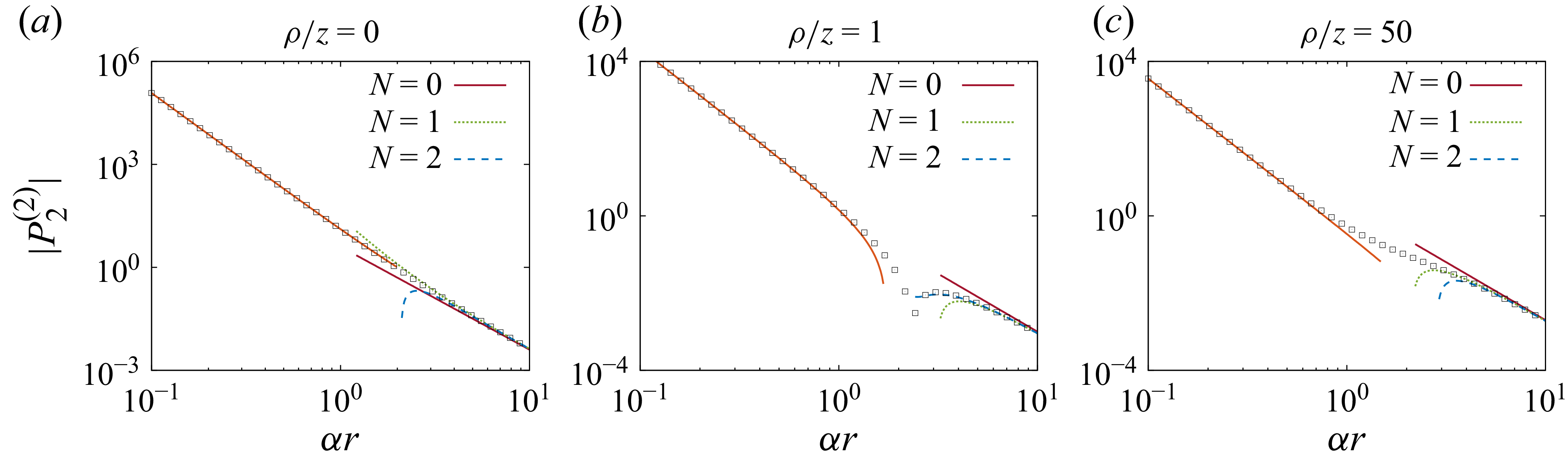
A comparison between the numerically evaluated $P^{(2)}_2$
and both asymptotic approximations is shown in figure 1. The far-field prediction from (3.24), shown in figure 1(a), agrees well with the numerical integration for
$P^{(2)}_2$
and both asymptotic approximations is shown in figure 1. The far-field prediction from (3.24), shown in figure 1(a), agrees well with the numerical integration for $\alpha r \gg 1$
. Overall, the best agreement is achieved with
$\alpha r \gg 1$
. Overall, the best agreement is achieved with $N=1$
. Adding additional terms improves the accuracy at
$N=1$
. Adding additional terms improves the accuracy at $\alpha r \gg 1$
, but worsens the divergence in the intermediate range (
$\alpha r \gg 1$
, but worsens the divergence in the intermediate range ( $\alpha r \lesssim 2$
). The near-field behaviour predicted by (3.27), illustrated in figure 1(b), gives good agreement for
$\alpha r \lesssim 2$
). The near-field behaviour predicted by (3.27), illustrated in figure 1(b), gives good agreement for $\alpha r \lesssim 1$
. Because
$\alpha r \lesssim 1$
. Because $P^{(2)}_2$
is just one of the contributions, and the others will be given by closed-form analytical expressions, the overall error of any of the approximations in the final result will be less pronounced.
$P^{(2)}_2$
is just one of the contributions, and the others will be given by closed-form analytical expressions, the overall error of any of the approximations in the final result will be less pronounced.


3.3. Shear-driven flow
The first contribution to $\varPsi ^{(2)}$
in (3.15) is obtained as the second derivative of
$\varPsi ^{(2)}$
in (3.15) is obtained as the second derivative of $\varPsi ^\infty$
from (3.3), and reads
$\varPsi ^\infty$
from (3.3), and reads
 \begin{align} \varPsi ^{(2)}_1= 2\left ( -(1+\alpha r) + \frac {z^2}{r^2}\big(3 + 3\alpha r +(\alpha r)^2 \big) \right ) \frac {\textrm{e}^{-\alpha r}}{r^3}. \end{align}
The second contribution, expressed with a dimensionless integrand, is
 \begin{align} \varPsi ^{(2)}_2 = -2\alpha ^3 \int _0^\infty t^2 \, \textrm{e}^{-\alpha z \sqrt {t^2+1}} \, J_0(\alpha \rho t) \, \mathrm{d} t , \end{align}
which can be evaluated exactly. To do so, we introduce the following convergent improper integral
 \begin{align} S_0 = \int _0^\infty \frac {1}{\sqrt {t^2+1}} \, \textrm{e}^{-a \sqrt {t^2+1}}\, J_0(b t) \, \mathrm{d} t , \end{align}
which can be found in Gradshteyn & Ryzhik (Reference Gradshteyn and Ryzhik2014), equation (6.645.1), by making the substitution $x = \sqrt {t^2 + 1}$
. Defining
$x = \sqrt {t^2 + 1}$
. Defining $\lambda _\pm = ( \sqrt {a^2+b^2} \pm a ) / 2$
, we obtain
$\lambda _\pm = ( \sqrt {a^2+b^2} \pm a ) / 2$
, we obtain
 \begin{align} S_0 = I_0\kern-1pt\left ( \lambda _- \right ) K_0\kern-1pt\left ( \lambda _+ \right ) \!, \end{align}
with $K_0$
and
$K_0$
and $I_0$
denoting the zeroth-order modified Bessel functions of the second and first kinds, respectively. Using higher-order derivatives of
$I_0$
denoting the zeroth-order modified Bessel functions of the second and first kinds, respectively. Using higher-order derivatives of $S_0$
with respect to
$S_0$
with respect to $a$
, denoted by
$a$
, denoted by $S_0^{(m)} = \partial ^m S_0 / \partial a^m$
, the solution of the integral in (3.29) is given by
$S_0^{(m)} = \partial ^m S_0 / \partial a^m$
, the solution of the integral in (3.29) is given by
 \begin{align} \varPsi ^{(2)}_2 = 2\alpha ^3 \big(S_0^{(3)} - S_0^{(1)}\big) , \end{align}
evaluated at $a=\alpha z$
,
$a=\alpha z$
, $b=\alpha \rho$
and
$b=\alpha \rho$
and $\lambda _\pm =\alpha (r\pm z)/2$
. By simplifying the resulting expressions, we obtain
$\lambda _\pm =\alpha (r\pm z)/2$
. By simplifying the resulting expressions, we obtain
 \begin{align} \varPsi _2^{(2)} = I_0(\lambda _-) \left [ A_0 K_0(\lambda _+) + \varGamma _+ K_1(\lambda _+) \right ] +I_1(\lambda _-) \left [ A_1 K_1(\lambda _+) + \varGamma _- K_0(\lambda _+) \right ] \! , \end{align}
where
 \begin{align} A_0 = \frac {\alpha ^2 z}{r^2} \left ( 1-\frac {3z^2}{r^2} \right ) \! , \quad A_1 = - \frac {3\alpha ^2 z\rho ^2}{r^4} , \end{align}
and
 \begin{align} \varGamma _\pm = \frac {\alpha }{ r^2} \left ( 1 \pm \big (1+\alpha ^2\rho ^2\big ) \frac {z}{r} -\frac {3z^2}{r^2} \mp \frac {3z^3}{r^3} \right ) \! . \end{align}
From the asymptotic form of the modified Bessel functions ( $K_0(x)\sim \exp (-x)$
and
$K_0(x)\sim \exp (-x)$
and $I_0(x) \sim \exp (x)$
), it is clear that
$I_0(x) \sim \exp (x)$
), it is clear that $\varPsi ^{(2)}_2$
decays
$\varPsi ^{(2)}_2$
decays $\sim\!\exp (-\alpha z)$
, and the same then holds for the velocity field. Therefore,
$\sim\!\exp (-\alpha z)$
, and the same then holds for the velocity field. Therefore, $\varPsi ^{(2)}_2$
describes the short-range flows induced by the tractions on the no-slip boundary.
$\varPsi ^{(2)}_2$
describes the short-range flows induced by the tractions on the no-slip boundary.
3.4. Velocity field
With the knowledge of the two scalar fields, the velocity Green’s function is determined as
 \begin{align} \boldsymbol{G}^{(2)}= \partial _z^2\boldsymbol{G}^\infty +\alpha ^{-2} \boldsymbol{\nabla }\big({-}P^{(2)}_2 + \partial _z \varPsi ^{(2)}_2 \big) -\hat {\boldsymbol{e}}_z \varPsi ^{(2)}_2 . \end{align}
Due to the length of the resulting expression, we do not present the full result here. It can, however, be readily obtained using computer algebra systems or symbolic computation tools.
3.4.1. Far field
We now assume $\alpha r \gg 1$
, retaining only the terms with
$\alpha r \gg 1$
, retaining only the terms with $\textrm{e}^{-\alpha z}$
, but not those with
$\textrm{e}^{-\alpha z}$
, but not those with $\textrm{e}^{-\alpha r}$
. The field
$\textrm{e}^{-\alpha r}$
. The field $\varPsi _1^{(2)}$
does not contribute to the far field, and
$\varPsi _1^{(2)}$
does not contribute to the far field, and $\varPsi _2^{(2)}$
has the asymptotic expansion
$\varPsi _2^{(2)}$
has the asymptotic expansion
 \begin{align} \varPsi _2^{(2)} \simeq \frac {\textrm{e}^{-\alpha z}}{r^3} \left ( 2 + \frac {3\alpha z (3 + \alpha z)}{(\alpha r)^2} + \frac {15 \alpha z \big(15 + 15\alpha z + 6 (\alpha z)^2 + (\alpha z)^3 \big)}{4(\alpha r)^4} \right ) \! . \end{align}
The Green’s function for the velocity can now be split up as
 \begin{align} \boldsymbol{G}^{(2)} = \boldsymbol{W} + \boldsymbol{H} \, , \end{align}
where the first term $\boldsymbol{W}$
represents contributions from
$\boldsymbol{W}$
represents contributions from $\boldsymbol{G}^\infty$
and
$\boldsymbol{G}^\infty$
and $P_2^{(2)}$
that correspond to a series of source multipoles. Defining
$P_2^{(2)}$
that correspond to a series of source multipoles. Defining
 \begin{align} \boldsymbol{g} = - \boldsymbol{\nabla } \frac 1 r = \frac {\rho \hat {\boldsymbol{e}}_\rho + z \hat {\boldsymbol{e}}_z}{(\rho ^2+z^2)^{3/2}} \end{align}
as the flow of a source singularity, this can be written compactly as
 \begin{align} \boldsymbol{W} = \frac {2}{\alpha ^2} \frac {\partial ^3 \boldsymbol{g}}{\partial z^3} -2 \sum _{n=0}^{N} \frac { \varphi _n}{\alpha ^{2n+1}} \, \frac {\partial ^{2n+2} \boldsymbol{g}}{\partial z^{2n+2}}, \end{align}
with $\varphi _n$
defined in (3.21). In terms of Legendre polynomials, the radial component of
$\varphi _n$
defined in (3.21). In terms of Legendre polynomials, the radial component of $\boldsymbol{W}$
can be expressed as
$\boldsymbol{W}$
can be expressed as
 \begin{align} W_\rho = -\frac {12}{\alpha ^2 r^5} P_4^1(z/r) -2 \sum _{n=0}^N (2n+2)! \, \frac {\varphi _n}{\alpha ^{2n+1}} \frac {P_{2n+3}^1 (z/r)}{r^{2n+4}} , \end{align}
with $P_n^1(z/r) = -(\rho /r)\, P_n'(z/r)$
denoting the associated Legendre function of degree
$P_n^1(z/r) = -(\rho /r)\, P_n'(z/r)$
denoting the associated Legendre function of degree $n$
and order 1, where
$n$
and order 1, where $P_n'(x)={\mathrm{d}} P_n(x)/{\mathrm{d}} x$
. The axial component is given by
$P_n'(x)={\mathrm{d}} P_n(x)/{\mathrm{d}} x$
. The axial component is given by
 \begin{align} W_z = \frac {48}{\alpha ^2 r^5 } \, P_4(z/r) + 2 \sum _{n=0}^N (2n+3)! \, \frac {\varphi _n}{\alpha ^{2n+1}} \frac {P_{2n+3}(z/r)}{r^{2n+4}} . \end{align}
By retaining only the first three terms of the series ( $N=2$
), we obtain
$N=2$
), we obtain
 \begin{align} W_\rho &\simeq \frac {3\rho }{\alpha r^5} \left ( \frac {10z^2}{r^2}-2 +\frac {10 z}{\alpha r^2} \left ( \frac {7z^2}{r^2}-3 \right ) +\frac {15}{(\alpha r)^2} \left ( \frac {21z^4}{r^4}-\frac {14z^2}{r^2}+1 \right ) \right )\!, \\[-12pt] \nonumber \end{align}
 \begin{align} W_z &\simeq \frac {3}{\alpha r^5} \left ( \frac {10z^3}{r^2}-6z + \frac {2}{\alpha } \left ( \frac {35z^4}{r^4}-\frac {30z^2}{r^2} + 3 \right ) + \frac {5z}{(\alpha r)^2} \left ( \frac {63z^4}{r^4}-\frac {70z^2}{r^2}+15 \right ) \right )\!. \\[4pt] \nonumber \end{align}
The second term $\boldsymbol{H}$
in (3.38) contains the far-field contributions stemming from
$\boldsymbol{H}$
in (3.38) contains the far-field contributions stemming from $\varPsi _2^{(1)}$
, which can be evaluated exactly, with radial and axial components given in the far field by
$\varPsi _2^{(1)}$
, which can be evaluated exactly, with radial and axial components given in the far field by
 \begin{align} H_\rho &\simeq \frac {\textrm{e}^{-\alpha z}\rho }{\alpha r^5} \left ( 6+\frac {15}{(\alpha r)^2} \big ( (\alpha z)^2 + 3 \alpha z -3\big ) \right )\! , \\[-12pt] \nonumber \end{align}
 \begin{align} H_z &\simeq -\frac {\textrm{e}^{-\alpha z}}{\alpha ^2r^5} \left ( 18 + \frac {45 \alpha z}{(\alpha r)^2} (\alpha z+5) \right )\! . \\[9pt] \nonumber \end{align}
Finally, the far-field expression for the velocity is $\boldsymbol{G}=h^2(\boldsymbol{W} +\boldsymbol{H})$
, with
$\boldsymbol{G}=h^2(\boldsymbol{W} +\boldsymbol{H})$
, with $\boldsymbol{W}$
given by (3.42), and
$\boldsymbol{W}$
given by (3.42), and $\boldsymbol{H}$
given by (3.43).
$\boldsymbol{H}$
given by (3.43).
A comparison between the far-field flow and the result of numerical integration of (3.9) and their derivatives is shown in figure 2, showing near-perfect agreement in the far-field regime.


3.4.2. Near field
The velocity can also be analytically evaluated in the near-field limit, where $\alpha r \ll 1$
, while still maintaining the condition
$\alpha r \ll 1$
, while still maintaining the condition $r \gg h$
. We obtain
$r \gg h$
. We obtain
 \begin{align} \varPsi _2^{(2)} \simeq \frac {2r^2-6z^2}{r^5} + \alpha ^2 \frac {z^2}{r^3} +\frac {\alpha ^4}{4} \left ( z\left ( \frac {1}{4} + \gamma + \log \left ( \frac {\alpha (r+z)}{4} \right ) \right ) - \frac {z^2}{r} \right ) \! . \end{align}
Substituting the expressions for $\varPsi _2^{(2)}$
from (3.44) and
$\varPsi _2^{(2)}$
from (3.44) and $P_2^{(2)}$
from (3.27), together with
$P_2^{(2)}$
from (3.27), together with $\boldsymbol{G}^\infty$
from (3.4), into (3.36), we obtain
$\boldsymbol{G}^\infty$
from (3.4), into (3.36), we obtain
 \begin{align} G_\rho ^{(2)} &\simeq \frac {6\rho z}{r^7}( 3z^2-2\rho ^2) + \frac {\alpha ^2 \rho z }{2r^5} ( 2\rho ^2-z^2), \\[-12pt] \nonumber \end{align}
 \begin{align} G_z^{(2)} &\simeq \frac {6z^2}{r^7} ( 2z^2-3\rho ^2) + \frac {\alpha ^2 z^2}{2r^5} ( \rho ^2-2z^2). \\[9pt] \nonumber \end{align}
The terms of order $\mathcal{O}(\alpha ^0)$
coincide with Blake’s tensor for a normal force in the limit
$\mathcal{O}(\alpha ^0)$
coincide with Blake’s tensor for a normal force in the limit $r\gg h$
(Blake & Chwang Reference Blake and Chwang1974). Terms of order
$r\gg h$
(Blake & Chwang Reference Blake and Chwang1974). Terms of order $\alpha ^2$
then represent the leading correction in the Brinkman flow.
$\alpha ^2$
then represent the leading correction in the Brinkman flow.
3.5. Discussion
A complete solution of the flow problem in the presence of a no-slip wall will also require the Green’s function for a force acting parallel to the wall, in which case the height dependence will be $\sim\!h$
. Although the absence of axial symmetry makes the problem more complex, we hope that the solution method developed here can be generalised to parallel forces as well.
$\sim\!h$
. Although the absence of axial symmetry makes the problem more complex, we hope that the solution method developed here can be generalised to parallel forces as well.
Another open question is whether the same problem can be solved in a two-dimensional Brinkman fluid, which can also be used as an approximation for the Hele-Shaw flow in a thin channel.
Out results can be used to model hydrodynamic interactions in porous environments where particles or microorganisms move near boundaries. A force-free swimmer can, for example, be modelled by placing two oppositely directed point forces asymmetrically relative to the swimmer body (Menzel et al. Reference Menzel, Saha, Hoell and Löwen2016; Daddi-Moussa-Ider & Menzel Reference Daddi-Moussa-Ider and Menzel2018; Hosaka et al. Reference Hosaka, Golestanian and Daddi-Moussa-Ider2023). In biological contexts near boundaries, such as microorganism motion in gels or tissues, these solutions describe long-range hydrodynamic disturbances. Moreover, they serve as fundamental building blocks for modelling suspensions near walls or active matter in confined or partially permeable environments.
Although we introduced the Brinkman equation for porous media, our solution remains valid for unsteady flows in the presence of inertia, where we use $\alpha ^2= - {\rm i} \omega /\nu$
, with the angular frequency
$\alpha ^2= - {\rm i} \omega /\nu$
, with the angular frequency $\omega$
, and the kinematic viscosity
$\omega$
, and the kinematic viscosity $\nu =\eta /\rho$
(Kim & Karrila Reference Kim and Karrila2013). For instance, the solution can then be applied for any oscillatory assembly of forces in the proximity of a no-slip boundary. For example, it has been shown that for sufficiently far distances, inertial effects become relevant in the flows driven by a beating cilium (Wei et al. Reference Wei, Dehnavi, Aubin-Tam and Tam2019, Reference Wei, Dehnavi, Aubin-Tam and Tam2021). A straightforward extension of our solution could also apply to source singularities near a wall, such as an oscillating gas bubble in the linear regime, or more complex multipole singularities.
$\nu =\eta /\rho$
(Kim & Karrila Reference Kim and Karrila2013). For instance, the solution can then be applied for any oscillatory assembly of forces in the proximity of a no-slip boundary. For example, it has been shown that for sufficiently far distances, inertial effects become relevant in the flows driven by a beating cilium (Wei et al. Reference Wei, Dehnavi, Aubin-Tam and Tam2019, Reference Wei, Dehnavi, Aubin-Tam and Tam2021). A straightforward extension of our solution could also apply to source singularities near a wall, such as an oscillating gas bubble in the linear regime, or more complex multipole singularities.
Acknowledgements
A.V. acknowledges support from the Slovenian Research and Innovation Agency (grant nos P1-0099 and J1-60009).
Declaration of interests
The authors report no conflict of interest.


 Open access

