





1. Introduction
Bilingualism, the daily use of more than one language, is a valuable avenue for exploring core questions regarding language processing and representation. One of the driving questions in the study of bilingualism relates to the interactions between the two (or more) languages of the bilingual (e.g., Fernandes et al., Reference Fernandes, Brophy and Schwieter2024; Francis, Reference Francis2024; Gathercole, Reference Gathercole2010; Schwieter, Reference Schwieter2024). To date, there is a large body of evidence suggesting that the first language (L1) of a bilingual speaker exerts significant influence on their second language (L2) at all levels of linguistic descriptions, including phonology/phonetics (Avery & Ehrlich, Reference Avery and Ehrlich1992; Flege, Reference Flege and Strange1995; Major, Reference Major1992), semantics (Altakhaineh & Zibin, Reference Altakhaineh and Zibin2017; Izquierdo & Collins, Reference Izquierdo and Collins2008; Jiang, Reference Jiang2004), syntax (Ionin et al., Reference Ionin, Zubizarreta and Maldonado2008; Shin & Christianson, Reference Shin and Christianson2012) and morphology (Ionin & Montrul, Reference Ionin and Montrul2010; Lardiere, Reference Lardiere2009). The reverse effects of L2 on L1 are also well documented and have been observed across all linguistic domains (Caramazza & Yeni-Komshian, Reference Caramazza and Yeni-Komshian1974; Klassen et al., Reference Klassen, Kolb, Hopp and Westergaard2023; Montrul & Sánchez-Walker, Reference Montrul and Sánchez-Walker2013; Pavlenko et al., Reference Pavlenko, Jarvis, Melnyk and Sorokina2017; Treffers-Daller & Tidball, Reference Treffers-Daller, Tidball, Guijarro-Fuentes, Schmitz and Müller2015). Indeed, as Flege and Bohn (Reference Flege, Bohn and Wayland2021) argue, cross-linguistic influences are not merely possible but inevitable, reflecting the dynamic interplay and bidirectional nature of bilingual language systems.
A much less understood issue in bilingual language processing concerns how the two languages interact at the level of processing mechanisms involved in lexical retrieval. A compelling example of this gap is how readers process transposed-letter (TL) pseudowords (e.g., jugde for judge, or caniso for casino). These TL stimuli are typically easier to recognize than pseudowords in which the same letters are replaced altogether (e.g., junpe, caviro). This advantage is clearly demonstrated in masked priming paradigms (Forster & Davis, Reference Forster and Davis1984), where TL primes (e.g., jugde preceding JUDGE) lead to significantly greater facilitation in word recognition than replacement-letter primes (e.g., junpe, Perea & Lupker, Reference Perea and Lupker2004).
Masked priming studies in Indo-European languages using Roman script consistently reveal robust TL effects in lexical decision tasks (Acha & Perea, Reference Acha and Perea2008; Adelman et al., Reference Adelman, Johnson, McCormick, McKague, Kinoshita, Bowers, Perry, Lupker, Forster, Cortese, Scaltritti, Aschenbrenner, Coane, White, Yap, Davis, Kim and Davis2014; Duñabeitia et al., Reference Duñabeitia, Perea and Carreiras2007; Grainger et al., Reference Grainger, Granier, Farioli, Van Assche and van Heuven2006; Perea & Lupker, Reference Perea and Lupker2004) and prelexical tasks like same-different matching (Duñabeitia et al., Reference Duñabeitia, Dimitropoulou, Grainger, Hernández and Carreiras2012; García-Orza et al., Reference García-Orza, Perea and Muñoz2010; Kinoshita & Norris, Reference Kinoshita and Norris2009; Massol & Grainger, Reference Massol and Grainger2022). Importantly, these effects generalize to non-Indo-European scripts, including morpho-syllabic Chinese (Yang et al., Reference Yang, Chen, Spinelli and Lupker2019), abugida Hindi (Rimzhim et al., Reference Rimzhim, Johri, Kelty-Stephen and Fowler2020), and logographic-syllabic Japanese (Perea et al., Reference Perea, Nakatani and van Leeuwen2011), challenging script-specific accounts. This cross-linguistic consistency has prompted a shift in word recognition models, with newer frameworks, such as the Bayesian Reader (Norris, Reference Kinoshita and Norris2009), Overlap Model (Gomez et al., Reference Gomez, Ratcliff and Perea2008), Spatial Coding Model (Davis & Bowers, Reference Davis and Bowers2006) and open bigram model (Grainger & van Heuven Reference Grainger, Van Heuven and Bonin2004), replacing strict serial processing with probabilistic, position-tolerant mechanisms.
Interestingly, the flexibility in letter-position coding observed in Indo-European languages, and in others like Chinese, Hindi and Japanese, has parallels in non-linguistic domains, such as object recognition, suggesting a domain-general processing mechanism for pattern recognition (Ahn & Bhanu, Reference Ahn and Bhanu2002; Hoffman & Richards, Reference Hoffman and Richards1984; Biederman, Reference Biederman1987; Pentland, Reference Pentland1989). Both object recognition and letter processing are thought to be supported by the same brain region: the left fusiform gyrus (Dehaene et al., Reference Dehaene, Cohen, Sigman and Vinckier2005; Dehaene & Cohen, Reference Dehaene and Cohen2011). This area originally evolved for object recognition, and part of it – commonly referred to as the Visual Word Form Area – was subsequently repurposed to process written language, suggesting that certain visual-cognitive mechanisms may be shared across domains. Thus, tolerance for spatial transpositions appears to be a default property of the visual system, generalizable across tasks and across languages.
Subsequent research, however, has suggested that this flexibility is not universal. Indeed, Semitic languages like Arabic and Hebrew, with their rich morphological structures, impose strict constraints on letter-position coding. This study investigates TL priming in Arabic-English bilinguals, testing whether bilingual exposure reveals the typical morphological rigidity of Arabic with attenuated TL effects in both languages or the positional flexibility of English with robust TL priming in both.
In the remainder of this paper, we first outline the morphological and orthographic systems of Arabic, then review TL effects in Semitic languages, analyzing how task demands, morphology and script adaptability influence this phenomenon. Finally, we examine how bilingual exposure to English might enhance orthographic flexibility in Arabic, presenting two experiments to ask whether bilingual experience increases letter-coding flexibility in Arabic readers.
2. Brief overview of Arabic orthography and morphology
Semitic languages use three distinct orthographic systems: abugida (consonants with inherent vowels), Latin script (alphabetic) and abjad (consonantal). Ethio-Semitic languages like Amharic and Tigrinya use abugidas, where consonants are primary but include inherent vowel notation (Daniels, Reference Daniels2018). In contrast, Maltese, a Semitic language heavily influenced by Romance languages, adopts the Latin script with explicit vowel representations (see Perea et al., Reference Perea, Gatt, Moret-Tatay and Fabri2012). As for Arabic and Hebrew, the writing system is an abjad, which primarily represents consonants – 28 in Arabic and 22 in Hebrew – with vowels typically indicated through optional diacritics. Each language also repurposes certain consonant letters to represent long vowels: Arabic uses three such letters, while Hebrew uses four, thus reflecting a common structural approach to vowel representation within their predominantly consonantal scripts. Beyond these shared abjad characteristics, however, Arabic exhibits distinctive complexity in its orthography. For instance, its script employs ligation, requiring letters to adopt context-dependent allographs (initial, medial and final) – as seen in the four forms of the letter ‘ع’ (ع, ـعـ, عـ, ـع) (Taha et al., Reference Taha, Ibrahim and Khateb2013; Tibi et al., Reference Tibi, Edwards, Kim, Schatschneider and Boudelaa2022). Another layer of complexity arises from diacritical dots, which disambiguate phonemes sharing the same base glyph (e.g., ج/ʤ/, ح /ħ/, خ /x/), a critical feature that is much less pronounced in Hebrew (Boudelaa et al., Reference Boudelaa, Norris and Kinoshita2024; Perea et al., Reference Perea, Abu Mallouh, Mohammed, Khalifa and Carreiras2016).
Semitic languages also differ in how their morphological systems are organized: some, like Arabic and Hebrew, rely on the prototypical non-linear root and-pattern system, while others – most notably Maltese – incorporate substantial non-Semitic morphological features, primarily of Romance origin (Azzopardi & Borg, Reference Azzopardi-Alexander and Borg1997; Hoberman, Reference Hoberman and Kaye1997). Arabic, our subject of study here, exemplifies a striking alignment between its orthography and its morphology. Indeed, Arabic orthography, with its ligation rules, allographic variation and dominantly consonantal letters, appears to be functionally well-adapted to its morphological system, which relies on root consonants (Boudelaa et al., Reference Boudelaa, Boujraf, Belahcen and Marslen-Wilson2023; Tibi et al., Reference Tibi, Edwards, Schatschneider and Kirby2020; Tibi et al., Reference Tibi, Edwards, Kim, Schatschneider and Boudelaa2022). Almost all Arabic words derive from nonlinear root-pattern structures (Boudelaa, Carreiras, et al., Reference Boudelaa, Carreiras, Jariya and Perea2025; Boudelaa & Marslen-Wilson, Reference Boudelaa and Marslen-Wilson2015), where consonantal roots (e.g., ‘ktb’, writing) interleave with word patterns to generate semantic and syntactic diversity. For example, the root ‘ktb’ gives rise to various derived forms that evolve around the general meaning of writing (e.g., ‘kAtib’, writer, kitAb book and ‘maktwb’ written), and differ only by virtue of the word pattern. Importantly, the consonantal roots in Arabic occupy a densely populated lexical space such that even minor permutations of consonant order generate entirely distinct words with different meanings. For instance, the root ‘sHb’ signifies pull, but ‘sbH’ denotes swimming or glorifying, ‘Hbs’ means confining and ‘Hsb’ means thinking, calculating or assuming something, (Boudelaa et al., Reference Boudelaa, Norris, Mahfoudhi and Kinoshita2019). Thus, in Arabic, transposing root consonants almost invariably produces valid roots with divergent meanings, creating a lexical architecture in which orthographic adjacency is subordinate to root integrity. This tight interplay between orthography and morphology confers a privileged status on consonants – not only as primary carriers of semantic information but also as rigidly ordered units resistant to transposition (Boudelaa et al., Reference Boudelaa, Norris, Mahfoudhi and Kinoshita2019; Friedmann & Haddad-Hanna, Reference Friedmann, Haddad-Hanna, Saiegh-Haddad and Joshi2014; Perea et al., Reference Perea, Abu Mallouh and Carreiras2010).
3. Transposed-letter effects in Semitic languages
TL effects, a hallmark of flexible orthographic processing (Grainger, Reference Grainger2018), are influenced in Semitic languages by three main factors: task demands (lexical vs. perceptual), morphological architecture (root-based vs. non-root-based) and script adaptability (abjad vs. non-abjad systems).
To begin with, consider Maltese, a Semitic language that uses the Latin script (non-abjad), features explicit vowels and exhibits hybrid Semitic–Romance morphology. In a Rapid Serial Visual Presentation task, Perea et al. (Reference Perea, Gatt, Moret-Tatay and Fabri2012) found no processing costs for sentences containing words with transposed root consonants, relative to their intact counterparts. These results aligned with English-like flexibility and contrasted sharply with findings in Hebrew. This flexibility was attributed to the transparent orthography of Maltese and its reduced reliance on root-based morphology, which together could weaken the constraints typically imposed by consonantal roots.
By contrast, Hebrew, a prototypical root and word pattern (WP) language, exhibits a stark divide between native and loanwords. Native Hebrew words (e.g., ‘mbrgh’, electric screwdriver) show no TL priming when root letters are transposed (e.g., ‘bgr’ priming ‘mbrgh’), while loanwords (e.g., ‘agrtl’, vase), which lack root-WP structure, do show sizeable TL priming (Velan & Frost, Reference Velan and Frost2009, Reference Velan and Frost2011), This suggests two distinct processing routes: a rigid, root-sensitive pathway for native words and a flexible, position-tolerant one for loanwords. Task demands further modulate this such that in the same–different matching task, even native Hebrew words show TL priming, revealing latent positional flexibility when lexical access is bypassed (Kinoshita et al., Reference Kinoshita, Norris and Siegel2012).
Arabic, the other major Semitic language, broadly mirrors but also extends the Hebrew results. Using masked priming with the lexical decision task, Perea et al. (Reference Perea, Abu Mallouh and Carreiras2010) found no TL priming effects when root letters were transposed (e.g., عبيد ‘Ebyd’ slaves versus بعيد bEyd’ far), but TL priming effects emerged when the transpositions preserved root order (e.g., فراغ ‘frAg’ vacuum → فارغ ‘fArg’ empty). Critically, Boudelaa et al. (Reference Boudelaa, Norris, Mahfoudhi and Kinoshita2019) replicated Perea et al.’s (Reference Perea, Abu Mallouh and Carreiras2010) findings in the lexical decision task with Arabic monolinguals, observing no TL priming for the same TL pairs (e.g., يعسدون ‘yEsdwn’ vs. يسدعون ‘ysdEwn’ priming يسعدون ‘ysEdwn’). However, when testing the same materials in the same-different matching task, they reported robust TL priming effects modulated by allography. That is, a target like يسعدون is primed more efficiently by the non-allographic TL prime يعسدون, than by the allographic TL prime يسدعون. This dissociation between TL effects in the lexical task and the same-different matching task suggests that Arabic orthography tolerates letter-position flexibility at pre-lexical stages (i.e., same–different task) but enforces strict constraints during lexical access (i.e., lexical decision), likely to safeguard root-based semantic processing (cf. Lee et al., Reference Lee, Lally and Rastle2021 for similar results in Korean).
Importantly, this rigidity is not script-driven. For example, Uyghur, a Turkic language using Arabic script but lacking root-based morphology, shows clear TL priming in lexical decision (Yakup et al., Reference Yakup, Abliz, Sereno and Perea2015). This points to morphological structure – not the script itself – as the key limiting factor.
Other studies using single-letter substitutions also point to orthographic tolerance in Arabic, even when root integrity is partially compromised. Perea et al. (Reference Perea, Mallouh and Carreiras2014) found facilitation when a single root consonant was altered (e.g.,كتابة ‘ktAbp’ → كخابة ‘kxAbp’), and Boudelaa et al. (Reference Boudelaa, Norris and Kinoshita2024) extended this to cases where both the root and the WP were affected. Although these are not TL priming effects in the strict sense, they suggest that Arabic orthography may accommodate a degree of positional and featural noise – particularly in tasks that downplay lexical access. This result, together with evidence of TL priming in perceptual same–different tasks, raises the question of whether such latent flexibility is amplified in Arabic-English bilinguals, whose second language relies on coarser letter-position coding.
Given that bilingual orthographic processing is shaped by cross-linguistic exposure (Cook, Reference Cook and Cook2000; De Bot, Reference De Bot1992; Francis, Reference Francis2000; Jessner, Reference Jessner2002; Kecskes, Reference Kecskes1998; Kecskes & Papp, Reference Kecskes and Papp2000; Kroll, Reference Kroll, Schreuder and Weltens1993; Kroll & Stewart, Reference Kroll and Stewart1994; Meade et al., Reference Meade, Grainger and Holcomb2022; Nan Jiang, Reference Jiang2000), we ask whether the inherent perceptual flexibility of Arabic – combined with sustained experience in English – might increase the tolerance of the word recognition system for letter transpositions. More specifically, we examine whether flexible letter coding, arguably a default property of the perceptual system, becomes more apparent in speakers of Arabic as a first language (L1) as a result of exposure to English as a second language (L2).
4. Bilingualism and the modulation of orthographic flexibility
Two recent studies have addressed the TL priming effect in bilinguals. The first is by Velan and Frost (Reference Velan and Frost2007), who examined the impact of TL in balanced Hebrew-English bilinguals and reported a marked asymmetry between the two languages. Specifically, these authors showed that Hebrew-English balanced bilinguals reading English materials exhibited a high tolerance for letter transpositions, demonstrating resilience typical of English readers, but when reading Hebrew native words, the same participants faced significant challenges due to the critical role of precise letter coding in identifying root morphemes. This suggests that Velan and Frost’s (Reference Velan and Frost2007) bilinguals operated with two distinct letter-coding schemes: a strict scheme for Hebrew and a flexible one for English. Notably, the English scheme did not permeate the Hebrew one, despite the participants’ high proficiency in English. These findings contrast with a recent study conducted by Meade et al. (Reference Meade, Grainger and Holcomb2022), who recorded event-related potentials in a masked lexical decision task and found that bilinguals’ dominant language (English) displayed greater flexibility in letter coding than their L2 (Spanish). The authors attributed this not to an inherent inflexibility in Spanish but rather to the idea that increased exposure to a language enhances position-tolerant orthographic processing within that language. This suggests that extensive reading experience enhances orthographic adaptability, making TL effects more pronounced in one’s frequently used language.
This raises the question of what might be expected with Arabic-English bilinguals, who navigate between a Semitic language with a less rigid orthographic structure than Hebrew (Boudelaa et al., Reference Boudelaa, Norris and Kinoshita2024; Perea et al., Reference Perea, Abu Mallouh, Mohammed, Khalifa and Carreiras2016) and a more flexible Indo-European language, English. Will they behave like the Hebrew-English bilinguals studied by Velan and Frost (Reference Velan and Frost2007), or will they instead exhibit some cross-linguistic TL effects as was the case of Meade et al.’s (Reference Meade, Grainger and Holcomb2022) participants? To test these questions, we used a lexical decision task, as it best highlights the contrast between Arabic and English. In this task, Arabic monolinguals typically show no TL priming effects when root letters are transposed (e.g., Boudelaa et al., Reference Boudelaa, Norris, Mahfoudhi and Kinoshita2019; Perea et al., Reference Perea, Abu Mallouh and Carreiras2010), whereas English monolinguals generally display robust TL effects.
We hypothesized that, since flexible letter coding is a fundamental aspect of human visual perception – and given that recent research has shown that root integrity is not strictly required for lexical access in Arabic, as evidenced by one-letter-different priming effects (e.g., mftAH primed by m$tAH and mAtAH; Boudelaa et al., Reference Boudelaa, Norris and Kinoshita2024; Perea et al., Reference Perea, Mallouh and Carreiras2014), Arabic-English bilinguals may engage this default visual-perceptual mechanism, leading to TL priming effects in a lexical decision task in both Arabic and English. A further question is whether these TL priming effects in lexical decision will be modulated by allographic variation in Arabic, mirroring the modulation observed in the same–different matching task with Arabic monolinguals reported by Boudelaa et al. (Reference Boudelaa, Norris, Mahfoudhi and Kinoshita2019).
5. Experiment 1: Lexical decision in Arabic-English bilinguals with English stimuli
Orthographic coding in L2 can be shaped by experience with an L1. Meade et al. (Reference Meade, Grainger and Holcomb2022) examined English-Spanish bilinguals and found that although TL priming effects were stronger in English (L1), they were still present in Spanish (L2). The presence of TL effect in Spanish as an L2 is consistent with the idea that domain-general processing mechanisms are at play and that bilinguals may rely on inherent cognitive flexibility even when processing a less familiar orthographic system.
Yang et al. (Reference Yang, Chen, Spinelli and Lupker2019) expanded on this line of research by studying Chinese-English bilinguals, whose L1 features a particularly flexible character-position coding scheme. Although their experiment did not follow a traditional TL priming design, Yang et al. (Reference Yang, Chen, Spinelli and Lupker2019) used backward primes such as ‘naelc’ for the English target ‘CLEAN’ and found significant priming effects in Chinese-English bilinguals but not for Spanish-English bilinguals and English monolinguals. These results suggest that the flexible orthographic processing system developed for Chinese carried over into the processing of English, revealing an imprecise letter-position coding in their L2. Yang et al. (Reference Yang, Jared, Perea and Lupker2021) examined Arabic-English bilinguals and found that they did not exhibit significant backward priming effects in English. However, because their study did not focus on standard TL priming, it remains unclear how letter-coding strategies developed in Arabic influence processing in the second language.
Arabic, while sharing certain structural similarities with Hebrew, appears to have a more flexible letter coding system. Indeed, although Arabic does not exhibit TL effects when root letters are transposed – a hallmark of its rigid morphological structure – there is compelling evidence that its orthographic system is more adaptable than previously thought (Boudelaa et al., Reference Boudelaa, Norris, Mahfoudhi and Kinoshita2019; Perea et al., Reference Perea, Abu Mallouh and Carreiras2010). First, Arabic shows TL priming when a root letter and a WP letter are transposed (Perea et al., Reference Perea, Abu Mallouh and Carreiras2010), indicating some tolerance for position variation when roots are partially involved. Second, Arabic reveals robust TL priming effects in pre-lexical tasks suggesting that the early stages of orthographic processing may support greater flexibility (Boudelaa et al., Reference Boudelaa, Norris, Mahfoudhi and Kinoshita2019). Finally, and perhaps most strikingly, Arabic demonstrates orthographic facilitation between non-word primes and word targets that differ by only a single root letter – whether they share the same word pattern (e.g., ‘mfyr’ priming ‘mdyr’) or not (e.g., ‘mAyr’ priming ‘mdyr’), as documented by Perea et al. (Reference Perea, Mallouh and Carreiras2014) and Boudelaa et al. (Reference Boudelaa, Norris and Kinoshita2024), respectively.
These findings point to a far greater flexibility in orthographic coding in Arabic than in sister Semitic languages, where even minor alterations in root letters significantly disrupt recognition. Taken together, these results suggest that despite its reliance on root-based morphology, Arabic exhibits a surprising capacity for flexibility at the level of its orthographic system. This raises the strong possibility that Arabic-English bilinguals, when reading in their more flexible L2, may exhibit TL priming effects in English – driven by both, their experience with the adaptable aspects of Arabic and the inherent flexibility of English. This pattern would mirror the cross-linguistic flexibility observed by Velan and Frost (Reference Velan and Frost2007) in Hebrew-English bilinguals, who similarly demonstrated TL priming effects in their L2 (English).
6. Method
6.1. Participants
Sixty-four Arabic-English bilingual students (Mean age 22; SD = 2.31) from the United Arab Emirates University participated in the English version of the experiment. These participants were randomly assigned to this condition as part of a broader study, with a comparable group completing the experiment in Arabic. All participants reported daily use of both Modern Standard Arabic and English. Their proficiency in both languages was confirmed through a self-reported questionnaire assessing their speaking, writing and reading skills in each language. Additionally, participants’ English proficiency in the current study was validated by their International English Language Testing System (IELTS) scores (IELTS, 2023). The IELTS is a standardized assessment that evaluates proficiency across listening, reading, writing and speaking skills, with scores ranging from 0 to 9, where higher scores indicate greater proficiency. Our participants achieved an average score of 6.26 (range = 5–8), reflecting a generally proficient level across the assessed domains. This study received approval from the Research Ethics Committee of the United Arab Emirates University and was conducted in accordance with the Declaration of Helsinki, including the signing of informed consent.
6.2. Materials
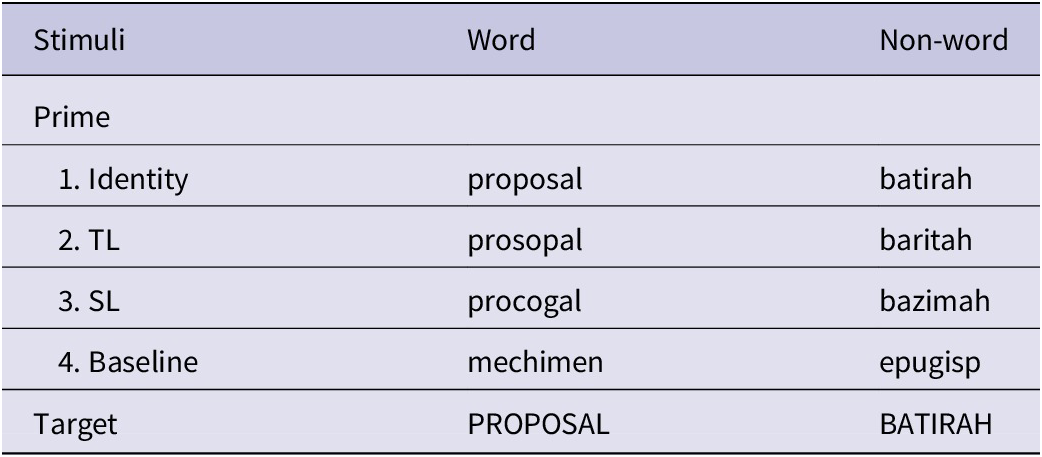
The materials for the English experiment were adapted from Lupker et al. (Reference Lupker, Perea and Davis2008). Sixty-word targets from their Experiment 1a were used, paired with four different prime types: Identity prime, TL prime, substituted-letter (SL) prime and an unrelated Baseline prime. The target items had a mean length of 7.23 letters (range = 6–9). Word frequency was calculated using SUBTLEX-US, with a mean of 15.73 occurrences per million (range = 0.29–101.96), and frequency in the Hyperspace Analog to Language (HAL) database was 21920 (range = 878–1,26,061). The average Orthographic Levenshtein Distance (OLD20) was 2.57 (range = 1.7–3.7). To match the design of the Arabic experiment, baseline non-word primes were created. For the lexical decision task, 60 non-word targets were also created, each paired with four prime types. The average length of the non-word targets was 7.25 letters (range = 6–9). Table 1 below provides examples of the stimuli used in experiment 1, showing the word and non-word targets along with their associated primes.
Sample stimuli used in Experiment 1 (reproduced with permission from Lupker et al., Reference Lupker, Perea and Davis2008, transposed-letter effects: consonants, vowels and letter frequency)
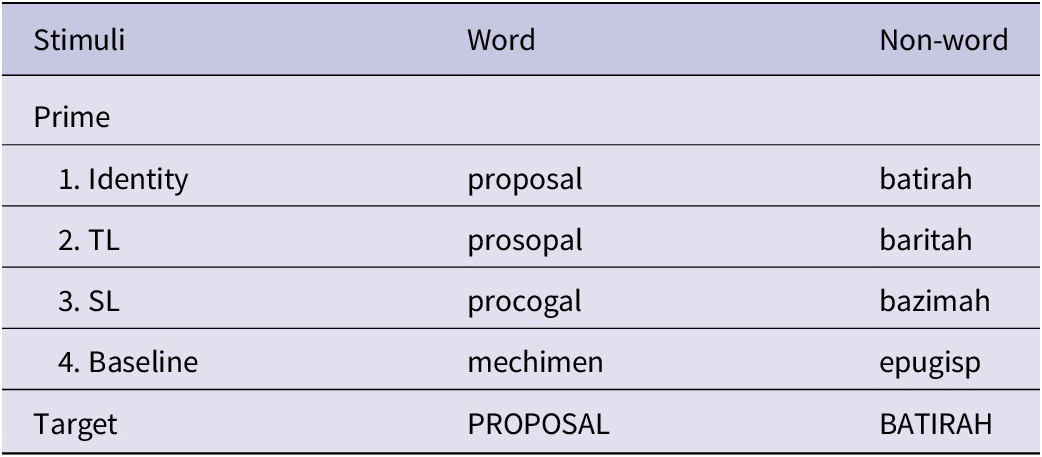
Table 1. Long description
The table consists of three columns: Stimuli, Word, and Non-word.
Under the Prime category, there are four conditions:
1. Identity: Word is ‘proposal’, Non-word is ‘batirah’.
2. T L: Word is ‘prosopal’, Non-word is ‘baritah’.
3. S L: Word is ‘procogal’, Non-word is ‘bazimah’.
4. Baseline: Word is ‘mechimen’, Non-word is ‘epugisp’.
The final row, labeled Target, shows the intended results in all caps: Word is ‘PROPOSAL’, Non-word is ‘BATIRAH’.
We created four counterbalanced lists of materials so that each target appeared only once per list but each time in a different priming condition. Each participant received only one list consisting of a total of 120 targets.
6.3. Procedure
The presentation of stimuli and recording of response times were controlled using SuperLab™ 6.0 (Cedrus Corp, San Pedro). Primes were presented in lowercase and targets in uppercase. Each trial began with a forward mask (######) displayed for 500 ms in the center of the screen, followed by a prime shown for 50 ms, which was then replaced by the target. The target remained on screen until participants responded or 2 seconds had passed. Participants pressed a green-labeled key (‘?’) if the target was a word and a red-labeled key (‘Z’) if it was a non-word. Each session began with 20 practice trials, followed by the 120 experimental trials (60 words and 60 non-words). Bilingual examiners from the same population as the participants explained the task in English for Experiment 1 and in Arabic for Experiment 2. In both experiments participants were tested individually or in groups, depending on their availability, and received auditory feedback on their responses. Each session lasted approximately 25 minutes.
7. Results
We analyzed correct response times (RTs) and error rates using linear mixed-effects (LME) models with crossed random effects for subjects and items (Baayen, Reference Baayen2008). Following Shmueli’s (Reference Shmueli2010) approach, we focused on testing hypotheses through fixed effects significance rather than model prediction. Analyses were performed in R (Version 3.5.1; R Core Team, 2018) using lme4 (Bates et al., Reference Bates, Mächler, Bolker and Walker2018) and lmerTest (Kuznetsova et al., Reference Kuznetsova, Brockhoff and Christensen2017). For the English experiment, fixed effects contrasted Type of Change against the SL baseline to test TL differences. The complete dataset and analysis scripts are publicly available at: https://osf.io/s6qat/.
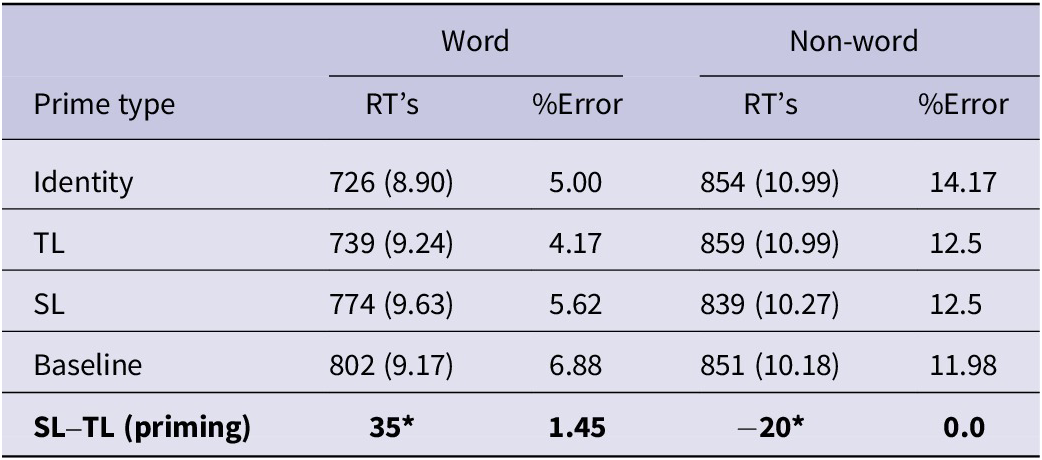
In the analysis of RTs, error trials were excluded, and RTs were log-transformed to meet the distributional assumptions of LME. Our data pruning procedure, based on Q–Q plot inspection, established cutoff points at 100 and 2,000 ms. Linear mixed-effects models with random slopes and intercepts were evaluated, and simplified if convergence or singularity issues arose. The mean correct RTs and error rates for Experiment 1 are presented in Table 2.
Mean response latencies (RT, in ms), standard errors (in parenthesis), error rates and magnitude of facilitation (priming in ms) in Experiment 1
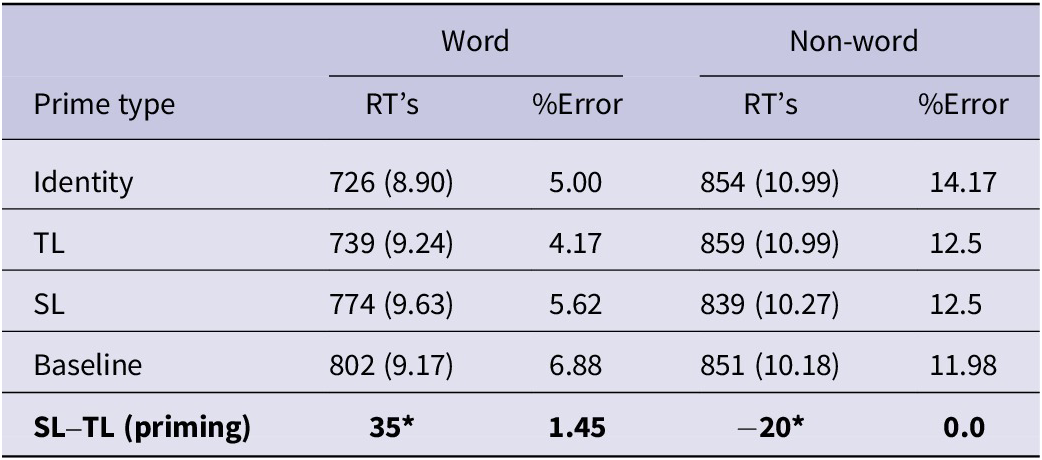
Table 2. Long description
The table is organized into five columns. The first column lists the Prime type, followed by two columns for Word targets and two columns for Non-word targets. Each target category includes R T (response time in milliseconds with standard error) and percentage Error.
* Identity prime: Word R T 726 (8.90), 5.00 percent error; Non-word R T 854 (10.99), 14.17 percent error.
* T L (transposed letter) prime: Word R T 739 (9.24), 4.17 percent error; Non-word R T 859 (10.99), 12.5 percent error.
* S L (substituted letter) prime: Word R T 774 (9.63), 5.62 percent error; Non-word R T 839 (10.27), 12.5 percent error.
* Baseline prime: Word R T 802 (9.17), 6.88 percent error; Non-word R T 851 (10.18), 11.98 percent error.
* S L minus T L (priming): Word R T 35 (significant at p less than .05), 1.45 percent error; Non-word R T minus 20 (significant at p less than .05), 0.0 percent error.
Note: TL = transposed letter, SL = substituted letter, Baseline = unrelated non-word.
* p < .05.
7.1. Word analyses
The data set for Experiment 1 consisted of 3,840 data points (64 participants × 60 targets). Out of these, 208 (5.42%) were errors and 25 (0.65%) outliers, leaving 3607 data points for analysis. We report the effects of the models that converged. For both this experiment and the next, full model details and fit indices – including fixed and random effects – are provided in Tables S1–S8 (Supplementary Materials), following the recommendations of Brysbaert and Stevens (Reference Brysbaert and Stevens2018) and Meteyard and Davies (Reference Meteyard and Davies2020).
Turning to the results for response latencies (see Supplementary Table S1 for details), the analyses revealed significant effects of both Type of Change and IELTS score. The three levels of Type of Change showed distinct patterns: Identity primes produced faster responses (β = −0.065, SE = 0.011, t = −5.84, p < .001), as did TL primes (β = −0.053, SE = 0.011, t = −4.80, p < .001), while Baseline primes showed slower responses (β = 0.026, SE = 0.011, t = 2.31, p = .021). Higher IELTS scores were associated with significantly shorter latencies (β = −0.068, SE = 0.030, t = −2.30, p = .022). Importantly, these effects were not modulated by interactions between IELTS and Type of Change (all ps > .272), indicating that proficiency influenced processing similarly across prime conditions.
For the error data, a logistic mixed-effects model was used to predict errors based on Type of Change and IELTS scores, with random intercepts for both subject and target. The results of this model indicate that the effects of Type of Change and IELTS on error rates did not reach statistical significance. Specifically, Identity (β = −0.09, SE = 0.23, z = −0.42, p = .677, 95% CI [−0.54, 0.35]), TL (β = −0.34, SE = 0.23, z = −1.45, p = .148, 95% CI [−0.79, 0.12]) and Baseline (β = 0.25, SE = 0.21, z = 1.21, p = .228, 95% CI [−0.16, 0.66]) conditions did not show significant differences compared to the reference category (SL). IELTS was also non-significant (β = −0.46, SE = 0.25, z = −1.89, p = .058, 95% CI [−0.94, 0.02]).
7.2. Non-word analyses
The non-word data of Experiment 1 consisted of 3840 data points, of which 491 (12.75%) were errors and 14 (0.35%) were outliers. A model similar to that used for word latencies was fitted to the English non-word data. The results indicate that Type of Change and IELTS significantly influenced response latencies. Specifically, the TL condition showed a significant effect (β = 0.032, SE = 0.012, t = 2.62, p = .009, 95% CI [0.008, 0.06]). IELTS was also significant (β = −0.062, SE = 0.030, t = −2.06, p = .044, 95% CI [−0.12, −0.003]). The interaction effects between IELTS and Type of Change were nonsignificant (all ps > .255).
As for the non-word accuracy data, we fitted a logistic mixed-effects model also similar to the one applied to the word errors. The results of this model indicate that Type of Change did not significantly influence error rates for English non-words (Identity: β = 0.22, SE = 0.18, z = 1.24, p = .214, 95% CI [−0.13, 0.56]; TL: β = −0.005, SE = 0.18, z = −0.03, p = .978, 95% CI [−0.35, 0.34]; Baseline: β = −0.08, SE = 0.18, z = −0.44, p = .658, 95% CI [−0.43, 0.27]). IELTS scores had a significant negative effect (β = −0.70, SE = 0.28, z = −2.48, p = .013, 95% CI [−1.26, −0.15]).
8. Discussion
The results from Experiment 1 provided clear evidence of substantial TL priming effects in English among Arabic-English bilinguals, aligning with previous research on the flexibility of English orthographic coding (Perea & Lupker, Reference Perea, Lupker, Kinoshita and Lupker2003; see also Kinoshita & Norris, Reference Kinoshita and Norris2009; Lupker et al., Reference Lupker, Perea and Davis2008). The significantly faster reaction times for the TL priming condition compared to the substitution-letter (SL) priming condition confirm the high tolerance for letter transpositions in English, driven by domain-general visual processing mechanisms that allow for spatial flexibility (Biederman, Reference Biederman1987; Tarr & Bülthoff, Reference Tarr and Bülthoff1995). Furthermore, the finding that higher IELTS scores were associated with faster responses highlights the role of language proficiency in enhancing orthographic flexibility, which echoes findings by Meade et al. (Reference Meade, Grainger and Holcomb2022), where more proficient bilinguals demonstrated greater adaptability in L2 processing.
These results raise questions about how orthographic flexibility might function in Arabic. For some time, Arabic was thought to have a rigid letter coding scheme akin to Hebrew due to its root-based morphology. This was strongly corroborated by the absence of TL priming effects when root letters are manipulated in lexical tasks (e.g., Boudelaa et al., Reference Boudelaa, Norris, Mahfoudhi and Kinoshita2019; Perea et al., Reference Perea, Abu Mallouh and Carreiras2010). However, recent studies challenge this rigidity, showing that Arabic, on the one hand, exhibits TL priming at the pre-lexical processing stages (Boudelaa et al., Reference Boudelaa, Norris, Mahfoudhi and Kinoshita2019), and on the other hand, it shows evidence of orthographic priming among prime target pairs differing by a single root letter (Boudelaa et al., Reference Boudelaa, Norris and Kinoshita2024; Perea et al., Reference Perea, Mallouh and Carreiras2014). The results from Experiment 1 raise the question of whether Arabic-English bilinguals may carry over some of the orthographic flexibility they develop in English into their orthographic processing of Arabic. We test this possibility in Experiment 2.
9. Experiment 2: Lexical decision in Arabic-English bilinguals with Arabic stimuli
The present experiment is predicated on four observations: First, the results of Experiment 1 indicate that proficient Arabic-English bilinguals adopt the flexible coding system of English when processing that language (cf. Velan & Frost, Reference Velan and Frost2007). This finding supports the view proposed by Meade et al. (Reference Meade, Grainger and Holcomb2022) that letter-position encoding is not a fixed property of the visual–lexical system but rather a variable characteristic modulated by exposure and proficiency, such that tolerance for imprecision increases over time.
Second, Arabic – unlike its sister Semitic language Hebrew – has shown reliable orthographic priming between targets and non-word primes that differ by only one root letter (e.g., m$tAH–mftAH, mAtAH–mftAH; Boudelaa et al., Reference Boudelaa, Norris and Kinoshita2024; Perea et al., Reference Perea, Abu Mallouh, Mohammed, Khalifa and Carreiras2016). This suggests not only that root integrity can be bypassed but also that letter-position coding may be less rigid in Arabic than in Hebrew, where altering a single root consonant disrupts lexical access (Frost et al., Reference Frost, Kugler, Deutsch and Forster2005).
Third, Arabic aligns with many other languages in showing flexible letter-position coding at the pre-lexical level. Research using the same–different matching task has shown robust TL priming modulated by allographic variation (Boudelaa et al., Reference Boudelaa, Norris, Mahfoudhi and Kinoshita2019; cf. Kinoshita et al., Reference Kinoshita, Norris and Siegel2012, for Hebrew). In Arabic, letters vary in shape depending on their position – initial, medial, final or isolated – which introduces a layer of visual complexity (Khateb et al., Reference Khateb, Khateb-Abdelgani, Taha and Ibrahim2014; Taha et al., Reference Taha, Ibrahim and Khateb2013; Tibi et al., Reference Tibi, Edwards, Schatschneider, Lombardino, Kirby and Salha2021; Tibi et al., Reference Tibi, Edwards, Kim, Schatschneider and Boudelaa2022). This positional variation, or allography, may influence TL priming in Arabic, suggesting that despite visual variability, the system allows for flexible letter-position coding at early processing stages.
Fourth, tolerance for spatial transpositions appears to be a default feature of our visual perceptual system, cutting across object recognition (Biederman, Reference Biederman1987; Hoffman & Richards, Reference Hoffman and Richards1984) and word recognition (Grainger et al., Reference Grainger, Granier, Farioli, Van Assche and van Heuven2006; Perea & Lupker, Reference Perea and Lupker2004).
The convergence of these observations supports the view that while letter-position coding varies across languages, the underlying visual–perceptual system remains inherently tolerant of transpositions. Given that Arabic allows for some positional flexibility at the early processing stages (Boudelaa et al., Reference Boudelaa, Norris, Mahfoudhi and Kinoshita2019) and in one-letter-different priming (Boudelaa et al., Reference Boudelaa, Norris and Kinoshita2024; Perea et al., Reference Perea, Mallouh and Carreiras2014), exposure to English – a language with coarser position coding – may amplify this latent flexibility. In particular, proficient Arabic-English bilinguals, having internalized the more flexible system of English, may exhibit TL priming effects in Arabic.
To investigate this, Experiment 2 used a set of target words to examine not only whether TL priming effects occur in Arabic in a lexical decision task but also whether these potential effects are modulated by allographic changes resulting from letter transposition. Specifically, we ask whether a target (e.g., أغلقنا ‘we closed’) is more facilitated by a non-allographic TL non-word prime (e.g., أغقلنا) than by an allographic one (e.g., ألغقنا). Following Boudelaa et al. (Reference Boudelaa, Norris, Mahfoudhi and Kinoshita2019), we define allography as a change in letter shape, as in أغلقنا- ألغقنا where the letter ‘غـ’ changes into ـغـ, or a change in the position of white space within the word, as in ينقذون ‘they save’ becoming the non-word ينذقون, where white space shifts within the word. In Boudelaa et al.’s (Reference Boudelaa, Norris, Mahfoudhi and Kinoshita2019) experiments, these stimuli revealed no effects in lexical decision but a reliable TL priming effect in the same–different matching task modulated by allography. Interestingly, Yakup et al. (Reference Yakup, Abliz, Sereno and Perea2015) reported a similar pattern in Uyghur, a Turkic language using the Arabic script but lacking the morphological constraints of the Semitic root, indicating that TL priming effects can emerge in Arabic script when unconstrained by dense root-based morphology, suggesting that language structure, rather than script alone, governs these effects. This supports the notion that linguistic structure, rather than script alone, governs letter-position effects.
Two outcomes are possible in this experiment: Bilinguals may extend English-like flexibility to Arabic, yielding TL priming, or adhere to root-based rigidity, blocking priming.
10. Method
10.1. Participants
Seventy-three Arabic-English bilinguals (Mean age = 22, SD: 2.29), all students at the United Arab Emirates University and from the same population as those in Experiment 1, were randomly assigned to participate in the Arabic-language experiment. These participants reported daily use of both Modern Standard Arabic and English, demonstrating balanced bilingualism, and had normal or corrected-to-normal vision. Language proficiency was confirmed through a self-reported questionnaire assessing speaking, writing and reading skills in both languages. Additionally, their average IELTS score was 6.21 (SD = 0.91), indicating a high level of English proficiency.
10.2. Materials
For this experiment, we used the materials from Boudelaa et al. (Reference Boudelaa, Norris, Mahfoudhi and Kinoshita2019). These consisted of 60-word targets and 60 non-word targets. Each of these was combined with six prime types to form six priming conditions as shown in Table 3. The TL and SL were systematically root letters. The word targets averaged 6.12 letters long (range: 4–8) with an average frequency of 15.36 per million (range: 0.01–234) in the ARALEX and SUBTLEX-AR databases (Boudelaa, Carreiras, et al., Reference Boudelaa, Carreiras, Jariya and Perea2025; Boudelaa & Marslen-Wilson, Reference Boudelaa and Marslen-Wilson2010). The non-word targets averaged 6.35 letters long (range: 5–8) and complied with the orthotactic constraints of the language.
Sample stimuli used in Experiment 1 (reproduced with permission from Boudelaa et al., Reference Boudelaa, Norris, Mahfoudhi and Kinoshita2019, transposed letter priming effects and allographic variation in Arabic: insights from lexical decision and the same – different task)
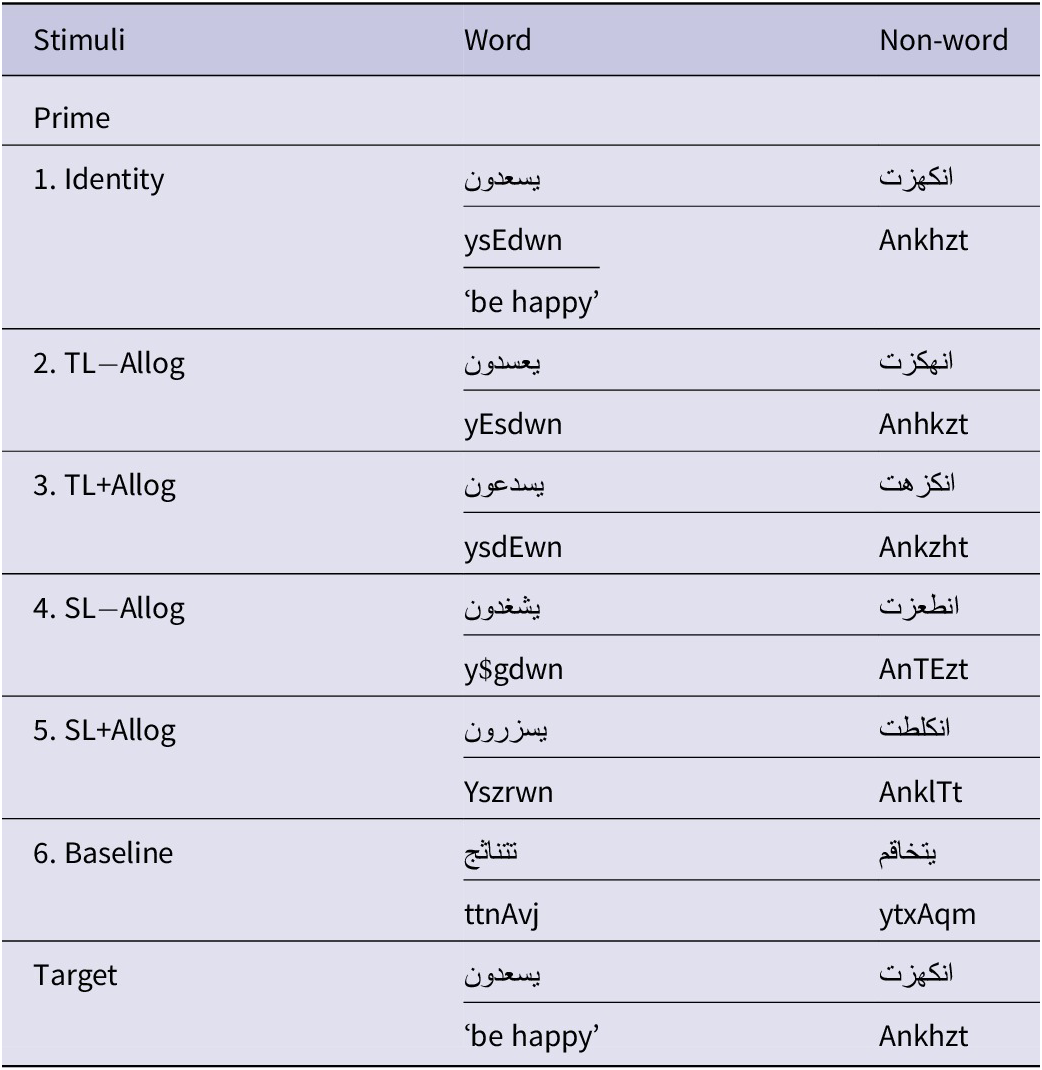
Table 3. Long description
The table is organized into three columns: Stimuli, Word, and Non-word. It details six prime conditions followed by the target stimuli.
* 1. Identity: Word prime is ysEdwn (be happy); Non-word prime is Ankhzt.
* 2. T L minus Allog (transposed letter without allography): Word prime is yEsdwn; Non-word prime is Anhkzt.
* 3. T L plus Allog (transposed letter with allography): Word prime is ysdEwn; Non-word prime is Ankzht.
* 4. S L minus Allog (substituted letter without allography): Word prime is y$gdwn; Non-word prime is AnTEzt.
* 5. S L plus Allog (substituted letter with allography): Word prime is Yszrwn; Non-word prime is AnklTt.
* 6. Baseline (unrelated prime): Word prime is ttnAvj; Non-word prime is ytxAqm.
* Target: The target for the Word column is ysEdwn (be happy); the target for the Non-word column is Ankhzt.
Each entry includes the Arabic script followed by its phonetic transcription.
Note: TL−Allog = transposed letter without allography; TL+Allog = transposed letter with allography; SL−Allog = substituted letter without allography; SL+Allog = substituted letter with allography; Baseline = an unrelated prime.
Six counterbalanced experimental lists were created such that each target (word or non-word) appeared once in each list, primed by one of the six prime types.
10.3. Procedure
To account for the fact that Arabic lacks the upper- and lower-case distinction found in English, the prime and target stimuli were differentiated by font size to reduce visual similarity between the two stimuli and minimize low-level perceptual overlap. Specifically, priming items were presented in 28-point, while targets appeared in 58-point, both in the Traditional Arabic Regular font. Each trial began with a forward mask (######) displayed centrally for 500 ms, followed by the prime for 50 ms (Boudelaa, Carreiras, et al., Reference Boudelaa, Carreiras, Jariya and Perea2025, Boudelaa, Perea, & Carreiras, Reference Boudelaa, Perea and Carreiras2025; Perea et al., Reference Perea, Mallouh and Carreiras2014). The target then appeared and remained on screen until the participant responded or 2 seconds had passed. Participants were instructed to press the ‘green key’ for real words and the ‘red key’ for non-words. Each participant completed 20 practice trials, followed by 120 experimental trials (60 words, 60 non-words), with the session lasting approximately 25 minutes.
11. Results
For this experiment, the full data set consisted of 4380 data points (73 participants × 60 targets). Out of these we removed 83 error trials (1.89%) and 41 outliers (0.94%). Table 4 presents the average RT’s, percent errors and magnitude of priming for Experiment 2.
Mean response latencies (RT, in ms), standard errors (in parenthesis), error rates and magnitude of facilitation (priming in ms) in the Arabic Experiment
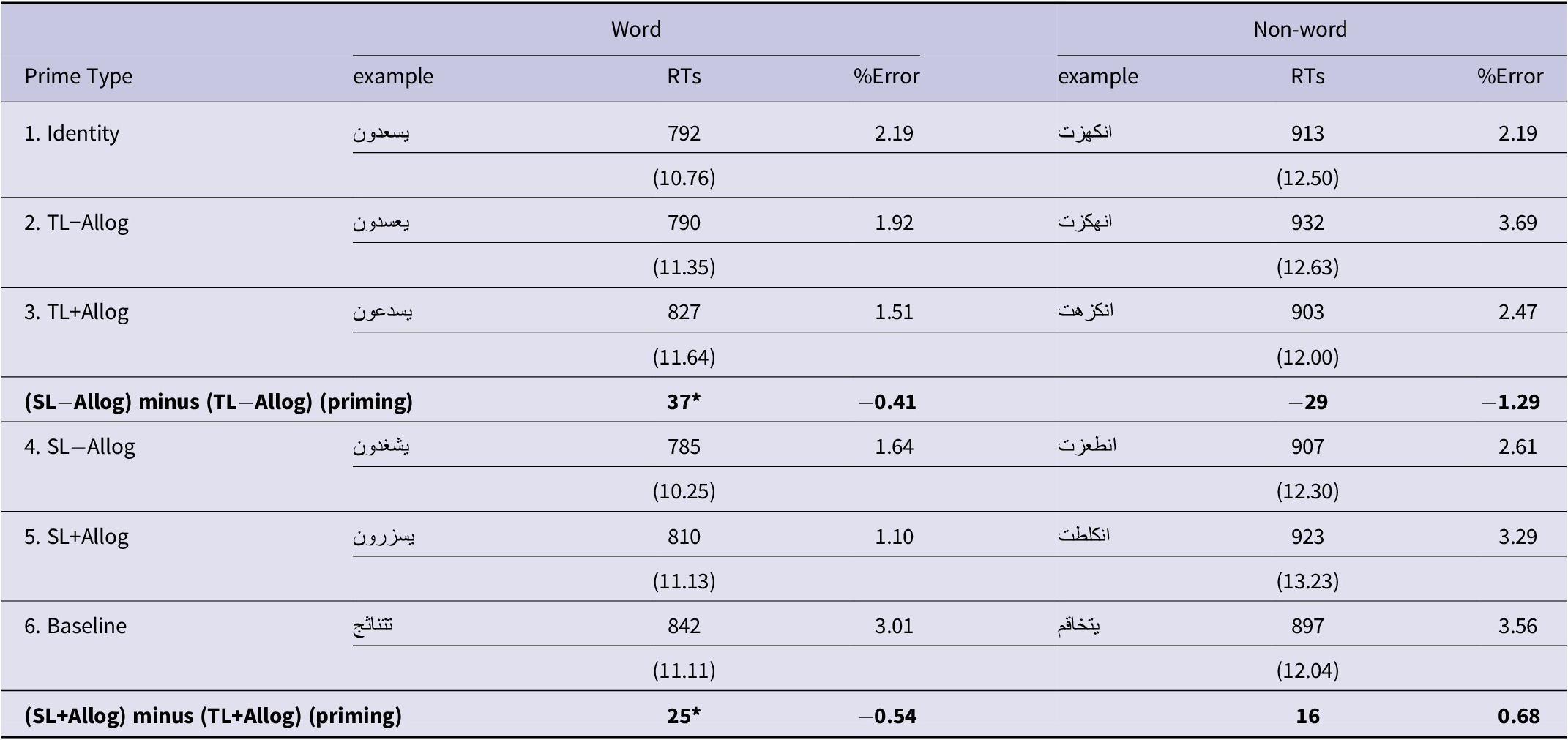
Table 4. Long description
The table is divided into two main columns: Word and Non-word, each containing sub-columns for example, R T s (response latencies in milliseconds), and %Error.
Row 1: Identity. Word: example يسعدون, R T s 792 (10.76), %Error 2.19. Non-word: example انكهزت, R T s 913 (12.50), %Error 2.19.
Row 2: T L minus Allog. Word: example يعسدون, R T s 790 (11.35), %Error 1.92. Non-word: example انهكزت, R T s 932 (12.63), %Error 3.69.
Row 3: T L plus Allog. Word: example يسدعون, R T s 827 (11.64), %Error 1.51. Non-word: example انكزهت, R T s 903 (12.00), %Error 2.47.
Priming Calculation 1: (S L minus Allog) minus (T L minus Allog). Word: 37* R T s, -0.41 %Error. Non-word: -29 R T s, -1.29 %Error.
Row 4: S L minus Allog. Word: example يشغدون, R T s 785 (10.25), %Error 1.64. Non-word: example انطعت, R T s 907 (12.30), %Error 2.61.
Row 5: S L plus Allog. Word: example يسزرون, R T s 810 (11.13), %Error 1.10. Non-word: example انكلطت, R T s 923 (13.23), %Error 3.29.
Row 6: Baseline. Word: example تتناتج, R T s 842 (11.11), %Error 3.01. Non-word: example يتخاقم, R T s 897 (12.04), %Error 3.56.
Priming Calculation 2: (S L plus Allog) minus (T L plus Allog). Word: 25* R T s, -0.54 %Error. Non-word: 16 R T s, 0.68 %Error.
Note: Standard errors are in parentheses. Asterisks indicate p < .05.
Note: The example primes are for the word target يسعدون ‘ysEdwn’ (be happy) and the non-word target انكهزت ‘Ankhzt’.
* p < .05.
11.1. Word analyses
Since we were mainly interested in the TL effects and their possible interaction with Allography and focused only on the four conditions (i.e., TL-Allog, TL+Allog, SL−Allog, SL+Allog) and fitted a full structure lmer model including random intercepts and random slopes for both subjects and target. The fixed effects included Type of Change (TL vs SL), Allography (+Allog vs. −Allog) and IELTS score meant to assess whether proficiency in English affects TL priming in Arabic. The model’s intercept corresponded to Type of Change = SL, Allography = NoAllog and IELTS = 0.
The analyses revealed a significant effect of TL changes on response latency (β = −0.04, SE = 0.015, t = −2.6, p = .009, 95% CI [−0.07, −0.01]). In contrast, neither allographic variation (p = .325) nor IELTS proficiency scores (p = .135) was statistically significant. Similarly, the interaction between TL changes and allography was non-significant (p = .741).
To quantify the amount of evidence for TL priming effects in Arabic, we used an approximation of the BF based on the BIC to compare the model reported above with an intercept only model (Raftery, Reference Raftery1995). The results of this analysis revealed a BF of 5.01e+33, which provides extremely strong evidence in favor of the reported model over the intercept only model, that is, for the presence of TL priming effects in Arabic-English bilinguals.
For the accuracy data, we fitted a logistic mixed-effects model using maximum likelihood estimation with the Nelder–Mead optimizer to predict errors based on Type of Change, Allography, and IELTS, including random intercepts for both Subject and Target. As with the RT model, the intercept was set to Type of Change = SL, Allography = −Allog, and IELTS = 0. The results of the model yielded no reliable effects for TL (p = .534), Allograhy (p = .434) or IELTS scores (p = .870).
11.2. Non-word data
The non-word data consisted of 4380 data points, with 130 errors (2.97%) and 100 outliers (2.28%) removed. We focused on four conditions (TL and SL, with and without Allography) and fitted a linear mixed-effects model to predict logged reaction times (RTs) based on Type of Change, Allography and IELTS score. The results revealed the main effects of TL changes (p = .798), allographic variation (p = .848), and IELTS scores (p = .382) to be statistically non-significant. However, the interaction between TL changes and allographic variation was significant (β = −0.05, SE = 0.022, t = −2.08, p = .038, 95% CI [−0.09, −0.003]).
For the error data, the results revealed that none of the fixed effects (TL: p = .599, Allography: p = .926, IELTS scores: p = .888) had any impact on error rates.
12. Discussion
In this lexical decision experiment, bilinguals showed robust TL priming effects in Arabic – using the same stimuli in which Arabic monolinguals failed to show such effects (Boudelaa et al., Reference Boudelaa, Norris, Mahfoudhi and Kinoshita2019; cf. Perea et al., Reference Perea, Abu Mallouh and Carreiras2010). It is important to note that ‘monolingual’ in Boudelaa et al. (Reference Boudelaa, Norris, Mahfoudhi and Kinoshita2019) refers to individuals with minimal functional proficiency in other languages, whereas our bilingual cohort had advanced English proficiency and regular L2 use and exposure. Critically, the task type alone cannot explain this divergence: monolinguals showed no TL priming in lexical decision but did so in the same–different matching task (Boudelaa et al., Reference Boudelaa, Norris, Mahfoudhi and Kinoshita2019). This pattern suggests that monolinguals rely on root-based decomposition at the lexical level, whereas bilinguals – possibly influenced by exposure to English – show more flexible coding, even in a lexical decision task. These results align with the idea that bilingual experience, particularly with tolerant letter coding of English, can foster greater positional flexibility even in a language with traditionally strict orthographic constraints like Arabic (Biederman, Reference Biederman1987; Perea & Lupker, Reference Perea and Lupker2004).
The absence of allographic effects in the present experiment stands in contrast to previous findings with Arabic monolinguals (Boudelaa et al., Reference Boudelaa, Norris, Mahfoudhi and Kinoshita2019) and Uyghur readers (Yakup et al., Reference Yakup, Abliz, Sereno and Perea2015), where TL priming was modulated by letter-shape variation. This discrepancy likely reflects task differences: same – different tasks tap early, form-based processing, while lexical decision draws on more abstract orthographic representations. Thus, while allography modulates visual-form comparison, lexical access appears to operate on shape-invariant codes. In this respect, it is indicative that the non-word data showed no discernible transposition or allography effects, reinforcing the idea that the observed priming effects are lexically constrained – consistent with the view that letter position coding in lexical decision tasks emerges primarily through word-specific representations (Kinoshita & Norris, Reference Kinoshita and Norris2009).
A final observation concerns the role of L2 proficiency. In Experiment 1 (English), higher IELTS scores predicted faster responses, consistent with previous findings (Meade et al., Reference Meade, Grainger and Holcomb2022), and reflecting the fact that IELTS is a direct measure of English proficiency. In Experiment 2 (Arabic), however, no such effect emerged – unsurprisingly, since IELTS does not index proficiency in Arabic. This asymmetry underscores that while bilingual exposure to English may foster orthographic flexibility, such flexibility does not manifest uniformly across languages. Indeed, in Arabic the dense root-based morphological system limits how much positional imprecision can be tolerated. For instance, transposing the letters of the root sHb (pull) can yield multiple real roots with distinct meanings (sbH ‘swim’, Hsb ‘think’, Hbs ‘imprison’). In contrast, English rarely yields lexical competitors via transposition (e.g., jugde → judge). Therefore, while bilingualism may promote orthographic flexibility, its manifestation is shaped by the morphological architecture of each language.
13. General discussion
The present study set out to investigate TL priming effects in Arabic-English bilinguals and assess whether the orthographic flexibility that characterizes Indo-European languages would extend to a Semitic language like Arabic that is characterized by a stricter orthographic coding scheme. We reasoned that proficient Arabic-English bilinguals are likely to show TL priming in their two languages based on four key facts. The first is that letter encoding in Arabic allows for more orthographic facilitation than Hebrew. Indeed, in Hebrew, lexical decision studies consistently show minimal orthographic priming for root-letter changes, as these disrupt morphological integrity (Deutsch et al., Reference Deutsch, Frost and Forster1998; Frost et al., 1997, Reference Deutsch, Frost, Pollatsek and Rayner2005; Velan & Frost, Reference Velan and Frost2011) and orthographic effects emerge only in loanwords in lexical decision tasks (Velan & Frost, Reference Velan and Frost2011) or in pre-lexical tasks (e.g., same-different matching tasks) that bypass morphological decomposition (Kinoshita et al., Reference Kinoshita, Norris and Siegel2012). In contrast, Arabic exhibits greater orthographic flexibility, with priming observed at longer SOAs (Boudelaa & Marslen-Wilson, Reference Boudelaa and Marslen-Wilson2005), in minimal consonant substitutions (e.g., ‘m$tAH’−‘mftAH’ and ‘mAtAH’−‘mftAH’) (Boudelaa et al., Reference Boudelaa, Norris and Kinoshita2024; Perea et al., Reference Perea, Abu Mallouh, Mohammed, Khalifa and Carreiras2016).
Second, Arabic, like Hebrew, also exhibits robust TL priming in a pre-lexical task (i.e., the same–different matching task), indicating that the first stages of processing in Arabic may operate on a flexible letter positioning coding (Boudelaa et al., Reference Boudelaa, Norris, Mahfoudhi and Kinoshita2019; Experiments 2 and 3). Third, previous research with bilinguals strongly suggests that letter position encoding adapts with increased language exposure and proficiency, tolerating more imprecision over time (Meade et al., Reference Meade, Grainger and Holcomb2022). Finally, tolerance for spatial transpositions is a general feature of the visual system, relevant to both object and word recognition (Biederman, Reference Biederman1987; Grainger et al., Reference Grainger, Granier, Farioli, Van Assche and van Heuven2006; Hoffman & Richards, Reference Hoffman and Richards1984; Perea & Lupker, Reference Perea and Lupker2004). Our results clearly bear out this prediction. Arabic-English bilinguals showed reliable TL effects in both languages. This reinforces the idea that proficiency in a language with a more flexible letter-coding system, namely English, influences orthographic processing in a language with a less flexible system, like Arabic, leading to increased tolerance for letter transposition and the adoption of the default object coding scheme. Indeed, although individual English proficiency did not directly modulate TL effects in Arabic, the bilinguals’ divergence from Arabic monolinguals studied by Boudelaa et al. (Reference Boudelaa, Norris, Mahfoudhi and Kinoshita2019), despite using the same stimuli and task, strongly suggests that sustained exposure to the orthographic flexibility of English broadly shifts processing strategies, even as the morphological constraints of Arabic continue to affect proficiency-related gradations (Perea et al., Reference Perea, Abu Mallouh and Carreiras2010).
An interesting second outcome of the current study is the lack of allographic effects in the Arabic experiment. A word target (e.g., يسعدون) is equally facilitated by a non-allographic non-word prime (e.g., يعسدون) as it is by an allographic non-word prime (e.g., يسدعون). This finding contrasts with prior research, particularly those by Boudelaa et al. (Reference Boudelaa, Norris, Mahfoudhi and Kinoshita2019), who reported a significant modulation of TL priming by allographic variations in Arabic monolinguals, and Yakup et al. (Reference Yakup, Abliz, Sereno and Perea2015) who observed robust TL priming effects among Uyghur speakers when ligation patterns (the ways in which letters connect) were maintained. The discrepancy with Boudelaa et al.’s (Reference Boudelaa, Norris, Mahfoudhi and Kinoshita2019) findings may be attributed to differences in task demands as noted earlier. In the present study, we used a lexical decision task, requiring participants to make quick word/non-word judgments, likely based on abstract, underlying representations that do not account for positional variations in letter shapes. In contrast, Boudelaa et al. (Reference Boudelaa, Norris, Mahfoudhi and Kinoshita2019) used a same-different matching task, which may allow for more flexible orthographic processing by relying on the overall shape of the target and benefiting from the positional information of letters (see Fernández-López et al., Reference Fernández-López, Solaja, Crepaldi and Perea2024, for dissociative effects related to top-down influences in masked priming effects across lexical decision and same–different tasks). In sum, TL priming in lexical decision reflects abstract orthographic coding that is unaffected by allography, whereas allographic modulation emerges in tasks that emphasize pre-lexical visual-form comparison (e.g., same–different matching task). This distinction explains why TL effects generalize across tasks, while allography effects remain task-specific.
Additionally, Arabic-English bilinguals are regularly exposed to the Roman alphabet in English, which encodes letters as abstract units without shape variations based on position. This experience could encourage Arabic-English bilinguals to develop a more abstract, less shape-sensitive approach to letter recognition, even when processing Arabic script. Consequently, they may become less sensitive to specific Arabic letter shapes (allographs). This abstraction aligns with findings that bilinguals tend to form unified orthographic representations across languages (Dijkstra et al., Reference Dijkstra, Grainger and van Heuven1999) and suggests that Arabic-English bilinguals are potentially applying the Roman script’s shape-invariant processing to Arabic script as well, especially in fast-paced tasks like lexical decision. Indeed, although Dijkstra et al. (Reference Dijkstra, Grainger and van Heuven1999) examined bilinguals with shared scripts, their findings highlight a broader principle: orthographic processing relies on abstract coding mechanisms (e.g., letter identity, positional encoding) that operate beyond script-specific visual forms. Much like linguistic variables that generalize across phonological systems (Berent et al., Reference Berent, Everett and Shimron2001), these mechanisms enable positional and identity-based coding to function independently of surface differences, allowing distinct scripts (e.g., Arabic ب vs. English B) to be processed through common structural principles. Supporting this, Wiley and Rapp (Reference Wiley and Rapp2019) demonstrated that Roman and Arabic letters, despite their visual dissimilarity, share processing dynamics shaped by complexity-distinctiveness trade-offs. This suggests that cross-script interactions occur at the level of structural features (e.g., diacritics, line orientation) rather than holistic shapes, enabling bilinguals to form abstract orthographic codes that go well beyond script differences, an idea further reinforced by evidence of cross-script interaction in Japanese-English bilinguals (e.g., Nakayama et al., Reference Nakayama, Sears, Hino and Lupker2012).
In contrast, Uyghur speakers, whose primary language uses the Arabic script in a fully represented vowel structure and within a morphologically simple (non-root-based) system, might process Arabic script more in line with its allographic features. Because they rely on the script’s visual characteristics – such as letter connection patterns (ligatures) – as consistent cues in reading, their orthographic processing is naturally tuned to allography. Therefore, TL effects in Uyghur unsurprisingly depend on these allographic features since such cues are integral to their reading system and recognition strategies.
Thus, while Arabic-English adult bilinguals likely rely on abstract representations less influenced by allography due to cross-script cognitive adaptation, Uyghur speakers show allographic modulation because they use these visual-structural cues in their primary orthographic processing. This difference underscores how bilingual exposure, proficiency and orthographic familiarity shape cognitive flexibility and attention to script-specific features.
Finally, it is worth emphasizing that while previous research with Arabic monolinguals found no evidence of TL priming effects in lexical decision tasks (Boudelaa et al., Reference Boudelaa, Norris, Mahfoudhi and Kinoshita2019; Perea et al., Reference Perea, Abu Mallouh and Carreiras2010), suggesting rigid orthographic coding in Arabic, the present study demonstrates robust TL priming effects in Arabic-English bilinguals using comparable stimuli and procedures. Although the absence of a monolingual control group limits our ability to attribute these effects solely to bilingualism, the divergence from prior monolingual findings (e.g., Boudelaa et al., Reference Boudelaa, Norris, Mahfoudhi and Kinoshita2019) aligns with growing evidence that bilingual exposure reshapes orthographic processing (Meade et al., Reference Meade, Grainger and Holcomb2022). In particular, extensive experience with English – a language characterized by flexible letter position coding – may enhance bilinguals’ tolerance for positional deviations in Arabic, attenuating the influence of its traditionally stricter orthographic constraints.
14. Implications for theories of orthographic processing
The findings of this study have important implications for theories of orthographic processing and visual word recognition. First, our results highlight the fact that the language-specific nature of orthographic representations is not a fixed property but rather a dynamic one, likely to change as a function of exposure (cf. Rastle et al., Reference Rastle, Chang, Lally, Pugh and McCardle2011). Arabic speakers who learn English as a second language and use it on a daily basis shift their letter encoding strategies toward the default and show evidence of tolerating deviations from the canonical internal representations of words. Indeed, these speakers accept a TL-string (يعسدون or يسدعون) as an instance of the correct form يسعدون much like native English speakers find it easier to reconstruct JUDGE from the string ‘jugde’ (Grainger et al., Reference Grainger, Granier, Farioli, Van Assche and van Heuven2006; Kinoshita & Norris, Reference Kinoshita and Norris2009; Norris & Kinoshita, Reference Norris and Kinoshita2008; Perea & Lupker, Reference Perea, Lupker, Kinoshita and Lupker2003, Reference Perea and Lupker2004).
These findings align with models of bilingual language processing that emphasize the dynamic interaction between two languages, where linguistic experience in one language influences cognitive processes in the other (Green & Abutalebi, Reference Green and Abutalebi2013; Kroll & Bialystok, Reference Kroll and Bialystok2013; Meade et al., Reference Meade, Grainger and Holcomb2022). These findings suggest that Arabic-English bilinguals may gradually shift from the root-based decomposition typical of Arabic monolinguals (Boudelaa, Reference Boudelaa2018; Boudelaa et al., Reference Boudelaa, Boujraf, Belahcen and Marslen-Wilson2023) to greater reliance on full-form representations for word recognition. Full-form representations offer the advantage of occupying a less densely populated lexical space, making it less likely for letter transpositions to yield an existing word, in contrast to the root system, where such transpositions often produce another valid root (Boudelaa et al., Reference Boudelaa, Norris, Mahfoudhi and Kinoshita2019). The TL priming effects observed with Arabic-English bilinguals support this shift, indicating that lexical processing in this population increasingly favors full-form recognition, with reduced interference from the dense root-based neighborhood.
Our findings further suggest that orthographic processing may involve both domain-general and language-specific mechanisms. The tolerance for letter transposition observed in our Arabic-English bilinguals supports the view that letter coding flexibility may be a default feature of the visual perceptual system, which is also involved in object recognition (Biederman, Reference Biederman1987; Hoffman & Richards, Reference Hoffman and Richards1984). However, in cases where lexical processing units coexist in densely populated neighborhoods, as is the case of the root in monolingual Arabic speakers, the default domain-general mechanism gives in to stricter language-specific mechanisms (Velan & Frost, Reference Velan and Frost2011).
To integrate these findings within current TL priming models, Grainger’s open-bigram model offers a compelling explanation (Grainger & Van Heuven, Reference Grainger, Van Heuven and Bonin2004). This model encodes letter positions relatively rather than absolutely, allowing flexible recognition despite positional shifts. Crucially, it represents bigrams at the level of abstract letter identities rather than as specific visual forms. This abstraction enables the model to focus on the sequence and relative positioning of letters without sensitivity to their visual shape, which supports consistent word recognition even if letter forms change due to contextual variations like font or script differences. For instance, the Arabic word يسعدون (‘ysEdwn’, ‘be happy’) would be encoded by 12 bigrams, including five contiguous (“ون“ ”,دو“ ”,عد“ ”,سع“ ”,يس”), four non-contiguous with one skipped letter (دن“ ”,عو“ ”سد“ ”,يع), and three non-contiguous with two skipped letters (“عن“ ”,سو“ ”,يد”). This bigram pattern captures the word structure independently of precise letter positions, allowing both non-allographic (e.g., يعسدون) and allographic primes (e.g., يسدعون) formed by letter transpositions to activate the target word يسعدون equally, as both share 10 bigrams with the target.
On the other hand, perceptual models of letter order encoding such as the Overlap model (Gomez et al., Reference Gomez, Ratcliff and Perea2008) and the Bayesian Reader model (Norris et al., Reference Norris, Kinoshita and van Casteren2010) suggest that spatial tolerance in letter position is a feature of broader perceptual mechanisms that operate across both linguistic and non-linguistic domains. In the Overlap model, for example, letters are encoded as probabilistic distributions spanning adjacent positions, not fixed points, allowing for similarity across position-independent letters. Thus, allographic and non-allographic primes such as يعسدون and يسعدون are both predicted to resemble the target ‘يسعدون’. Experimental implementations of the Overlap model on our Arabic stimulus set reveals comparable response probabilities for both TL-allographic primes (overlap: 0.68, SD = 0.055; response probability: 0.80, SD = 0.06) and TL+ allographic primes (overlap: 0.67, SD = 0.037; response probability: 0.80, SD = 0.056).
Recently, hybrid models, such as those proposed by Grainger (Reference Grainger2024) and Romero-Ortells et al. (Reference Romero-Ortells, Baciero, Marcet, Perea and Gómez2024), have emerged that integrate orthographic and perceptual processing. These frameworks are particularly effective for Arabic-English bilinguals, where TL priming effects remain strong despite allographic changes. The hybrid model suggests that TL priming is driven by an abstract, allography-independent orthographic level, allowing bilinguals to experience consistent TL priming across different visual letter forms in each language. Consequently, letter identity and relative position are encoded in a way that is robust to visual shifts, preserving TL effects even when letter appearances vary significantly. This dual-layer processing framework accounts for the resilience of TL priming to changes in letter appearance, capturing the phenomenon more comprehensively than either purely orthographic or perceptual models alone.
15. Conclusions
To sum up, this study highlights the dynamic interaction between bilingualism and orthographic processing in Arabic-English bilinguals. Our findings revealed that while monolingual Arabic readers typically rely on strict letter coding to recognize root-based words (Boudelaa et al., Reference Boudelaa, Norris, Mahfoudhi and Kinoshita2019; Perea et al., Reference Perea, Abu Mallouh and Carreiras2010), Arabic-English bilinguals exhibit greater flexibility in letter position coding during word recognition, paralleling the patterns of English monolinguals. This flexibility likely stems from exposure to English, which may foster a tolerance for flexible letter order encoding. The results suggest that Arabic-English proficient adult bilinguals gradually shift toward full-form word recognition, moving away from the rigid root-based decomposition typical of Semitic languages, which is manifested by their skilled reading. Future research may explore these processes in novice readers. Overall, these insights emphasize that orthographic processing is shaped by both domain-general visual perception mechanisms and language-specific constraints, with bilingual experience driving adaptations in letter coding strategies.
Data availability statement
Raw data, analysis scripts, stimuli and additional details about our experiments are available at the Open Science Framework page of this project: https://osf.io/s6qat/.
Acknowledgements
This research was supported by the United Arab Emirates University under Grant Number G00004517 awarded to Sami Boudelaa. The raw data and analysis files for this study are openly available on the Open Science Framework at https://osf.io/s6qat/.
Competing interests
The authors declare no competing interests related to this research.


 Open access

