

Introduction
In Denmark, dairy breed bulls are raised for beef production by feeding pelleted grain-based concentrates ad libitum supplemented with straw. A growth rate above 1100 g/day is required to fulfil the slaughter standards and to achieve the maximal pay-off. However, this traditional feeding regimen leads to a risk of rumen acidosis due to a high starch load (Krause and Oetzel, Reference Krause and Oetzel2006). In addition, feeding concentrates ad libitum often results in a concomitant low roughage intake (Thomas and Hinks, Reference Thomas and Hinks1982; Drennan and Keane, Reference Drennan and Keane1987) and straw in itself does not favour a high intake (Jorgensen et al., 1971). Rumen acidosis is known to be related to diseases such as ruminitis, rumen parakeratosis, liver abscesses (LAs), laminitis and bloat (Nocek, Reference Nocek1997; Galyean and Rivera, Reference Galyean and Rivera2003; Krause and Oetzel, Reference Krause and Oetzel2006). The development of LAs is mainly feed related and the pathology of the ruminitis – LA complex is described in detail by Scanlan and Hathcock Reference Scanlan and Hathcock(1983) and Nagaraja and Chengappa Reference Nagaraja and Chengappa(1998). The high frequency (11%) of LAs in Danish bulls clearly indicates that there is a high incidence of rumen acidosis in this intensive production system (Kjeldsen et al., 2002).
Animals having a high incidence of LAs or large abscesses have reduced dry-matter intake (DMI), growth rate and feed efficiency and can show dullness and depression (Brown et al., Reference Brown, Bing, Grueter, McAskill, Cooley and Rathmacher1975; Brink et al., Reference Brink, Lowry, Stock and Parrott1990; West, Reference West1997). Foster and Woods Reference Foster and Woods(1970) found that average daily gain (ADG) was reduced by 5.9% for cattle having LAs, whereas Brown et al. Reference Brown, Bing, Grueter, McAskill, Cooley and Rathmacher(1975) found that severely abscessed livers reduced ADG by 12.7%, when compared with cattle with no abscessed livers.
Adjusting the ration by increasing the cell wall fraction of the concentrate (Utley et al., Reference Utley, Lowrey and McCormick1974) or by increasing the overall roughage intake (Kreikemeier et al., Reference Kreikemeier, Harmon, Brandt, Nagaraja and Cochran1990; Zinn and Plascencia, Reference Zinn and Plascencia1996) can reduce the risk of LAs and thereby increase the health and welfare of the animals. However, there is a possibility of a reduction of the growth rate when the cell wall or roughage fraction exceeds a certain level and this level is highly dependent on the feed sources used (Utley et al., Reference Utley, Lowrey and McCormick1974; Kreikemeier et al., Reference Kreikemeier, Harmon, Brandt, Nagaraja and Cochran1990; Zinn and Plascencia, Reference Zinn and Plascencia1996).
We hypothesise that it would be possible to formulate a low starch concentrate with a high cell-wall content, which would improve ruminal conditions and thereby decrease LA formation without jeopardising performance. The objective of this study was to investigate the effect of replacing some of the starch content by cell-wall-rich compounds in the concentrate ration and the effect of increasing intake of straw, by adding molasses, on feed intake, animal performance, damage to the rumen wall and incidence of LAs in intensively fattened young bulls.
Materials and methods
Health, care and use of experimental animals
Housing, rearing, feeding, transportation and slaughtering of the animals were in compliance with the Danish Ministry of Justice Law No. 382 (10 June 1987), Act No. 726 (9 September 1993) concerning experiments with animals and care of experimental animals. Furthermore, the Danish Animal Experimentation Inspectorate approved the study protocols and supervised the experiment. The health of the animals was monitored and sick animals treated by a veterinarian. Veterinary treatments were unrelated to the experimental treatments. In total, 11 animals (seven in year 1 and four in year 2) were culled or they died during the experimental period, primarily due to severe respiratory disease (pneumonia or BRS virus) (7), bloat (2) or accidental reasons (2).
Animals and feeding
A 30-week trial with 48 Danish Friesian bull calves allocated to four treatment groups in a 2 × 2 factorial design was repeated in two consecutive years. Each year, the bulls were blocked according to sire and date of birth and randomly allocated with 12 animals per treatment group. The bulls entered the experiment at 4.4 (±0.5) months of age weighing 146 (±2.6) kg live weight (LW) and were weighed every 2nd week during the experiment.
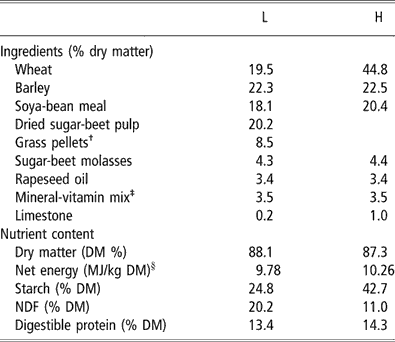
The bulls were fed one of two concentrates: a high (H) starch (43% of DM) or a low (L) starch (25% of DM) concentrate (Table 1), and one of two roughages; chopped barley straw (S) or chopped barley straw containing 25% (wt:wt) sugar-beet molasses (Sm).
Composition and nutrient content of the low (L) and high (H) concentrate ration
† Dangroent A/S Quality plus.
‡ Content per kg DM: Ca 220 g, P 55 g, Mg 40 g, Na 50 g, Cl 80 g, S 0.5 g, Mn 4000 mg, Zn 4500 mg, Cu 900 mg, Co 25 mg, Se 20 mg.
§ Net energy, MJ/kg DM = 7.89 × [−0.369 + 0.0989 × ((24.237 × digestible crude protein) + (34.116 × digestible crude fat) + (17.300 × digestible carbohydrate) − (0.347 × crude fibre)] Weisbjerg and Hvelplund (1993).
The L concentrate was formulated by replacing 25% of the wheat (DM) in the H concentrate by dried sugar-beet pulp and high-quality grass pellets. Digestible protein, mineral and vitamin contents were equal in both rations. For both concentrate rations, the ingredients were coarsely ground and pelleted in 3-mm pellets.
The animals were housed indoors in the treatment groups with 12 animals/pen. The pen had one automatic feed bin containing concentrate pellets and one automatic feed bin containing roughage. Concentrates and roughage were available ad libitum and were fed twice daily. Orts were removed once daily. Individual feed intake was recorded continuously by Insentec® RIC Feed System (Insentec BV, The Netherlands). The pens were bedded with wheat straw and water was available from open drinking troughs.
Sampling
Feed samples were collected weekly and pooled for chemical analysis after the experiment. The animals were stunned and killed by exsanguination. At slaughter, the reticulorumen was removed immediately from the abdominal cavity and a 10 × 10 cm2 area of the rumen wall was taken from the bottom of the atrium ruminis. The rumen wall samples were cleaned in 37°C 0.9% NaCl solution and were kept in the solution until stripping of the muscular layer from the epithelium. A circular piece of epithelium (diameter 6.6 cm) was cut out, oven dried at 90°C for 24 h and moved to a desiccator for 24 h before weighing in order to determine the density of the papillae.
The reticulorumen was emptied and rinsed in cold water and weighed after dripping off. A macroscopic evaluation was made of the rumen wall in the atrium ruminis and the ventral sac. The rumen wall condition was scored using a scale from 0 (normal) to 4 (very severe clotting, hyperaemia, etc.) (Mgasa, Reference Mgasa1991). The papillary colour and shape was examined at the bottom of the atrium ruminis. The colour of the papillae were scored as 1, pale; 2, medium; and 3, dark. The papillae shape was scored according to Mgasa Reference Mgasa(1991): 1, short and slender; 2, short and leaf-like; 3, long and slender; and 4, long and leaf like.
At slaughter, the weight of the liver, heart, kidneys, kidney fat and hot carcass were measured. Carcass length was measured from the posterior edge of the first rib to the symphysis pubis. Carcasses were scored according to the EUROP system for conformation (1–15) and fatness (1–5) and for lean/fat colour (1–5).
Lungs were examined for acute or chronic signs of pneumonia and pleuritis. All organs were examined for abnormalities. The liver was frozen at –18°C for later dissection. Livers were dissected by slicing up the semi- thawed liver in 1–2 cm slices. The numbers, positions and size of LAs and their capsule thickness were recorded.
The LAs were being categorized as follows: 0, no abscess; 1, one abscess or more small abscesses less than 2.5 cm in diameter; 2, two to four abscesses, more than one of them larger than 2.5 cm in diameter; 3, more than four abscesses, more than one larger than 2.5 cm in diameter (modified after Brink et al. Reference Brink, Lowry, Stock and Parrott(1990)).
Feed analysis
For DM determination, feed samples were dried in a forced air oven for 20 h at 103°C. Samples for chemical analysis were ground through a 1.0-mm screen. Ash was determined by combustion at 525°C for 6 h. Total nitrogen content was determined according to Dumas principle (Hansen, Reference Hansen1989). Crude fibre was determined using FiberTec system (Foss Tecator, Hillerød, Denmark) according to Weende’s method. Ash-free NDF was determined using FiberTec system, according to Van Soest et al. Reference Van Soest, Robertson and Lewis(1991), applying an overnight pretreatment with α-amylase (A6380, Sigma) at 38°C in accordance with Ferreira et al. Reference Ferreira, Kerstens and Gast(1983), and followed by addition of sodium sulphite and a thermostable α-amylase (Termamyl, Novo Nordisk, Bagsværd, Denmark) during neutral-detergent boiling. Starch was determined based on gelatinisation of starch and simultaneous partial hydrolysis at 100°C using thermostable α-amylase (Termamyl) followed by complete hydrolysis at 60°C using amyloglucosidase as described by Åman and Hesselman Reference Åman and Hesselman(1984). Sugar was determined by spectrophotometry after extraction with sodium acetate buffer and precipitation with zinc sulphate (Jacobsen, Reference Jacobsen1981). Fat was determined by a Soxhlet extraction with petroleum ether after HCl hydrolysis according to Stoldt Reference Stoldt(1952). Organic matter digestibility was determined enzymatically, and the net energy content was calculated by multiplying the content of Scandinavian feed units by 7.89 MJ as described by Weisbjerg and Hvelplund (1993).
Calculations
ADG and the increase in roughage DMI as a percentage of the total DMI were estimated by linear regression procedure of Statistical Analysis Systems Institute (SAS, 1997) for each individual. Estimating the ADG by linear regression resulted in R 2 of at least 0.95. Feed conversion efficiency (FCE) was calculated for DMI (FCEDM) and for net energy intake (NEI) (FCENE) by dividing the total weight gain (g) estimated from the linear regressions, by either the total DMI (kg) or NEI (MJ). The standard error of the mean of daily DMI of either concentrate or roughage was estimated as a percentage of the average daily DMI for each individual in order to express the day-to-day variation in DMI.
Statistical analysis
Statistical ANOVA was performed by using the GLM procedure of SAS (1997). Data were analysed using concentrate type, roughage type and their interaction, year of experiment and block within year as class variables and initial LW of the animal as a co-variable.
In the analysis concerning the weight of organs (liver, kidney and heart), animals with LAs were excluded from the analysis. The effect of treatment on rumen score, papillae colour, density and the day-to-day variation (%) in DMI was analysed without block and initial LW in the model. When analysing the effect of different LA categories or lung remarks, either the LA categories or lung remarks were included in the model as a class variable and without initial LW as a co-variable. The incidence of LAs, lung remarks and the score for papillae shape were analysed by using the χ 2 method in SAS (1997). Results are presented as least-squares means. Standard errors presented in the tables correspond to the maximum s.e. of the treatment group with the lowest number of observations. Differences with P < 0.05 were considered to be significant. Few interactions were found between treatments and these will be described in the text.
Results
In the first year 41 bulls and in the second year 44 bulls completed the experiment. The bulls were slaughtered at 11.3 ± 0.3 months of age weighing 440 ± 4.2 kg LW.
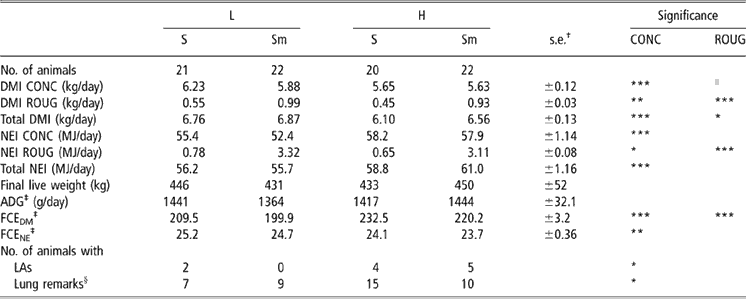
The average daily concentrate consumption was 0.4 kg DM (7.5%) higher (P < 0.001) but 7% lower (P < 0.001) in NEI for the L groups than for the H groups (Table 2). The total NEI was significantly higher in the H groups compared to L groups (P < 0.001).
Effect of concentrate (low starch (L), high starch (H)) and roughage (S, Sm) on dry-matter intake (DMI) of concentrate (CONC) and roughage (ROUG), net energy intake (NEI), average daily gain (ADG), feed conversion efficiency of dry matter (FCEDM g gain per kg DM) and net energy (FCENE g gain per MJ) and frequencies of liver abscesses (LAs) and lung remarks
† For the H-S group.
‡ Significant effects of year: (ADG P < 0.01), (FCEDM and FCENEP < 0.05).
§ Signs of chronic/acute pneumonia and/or pleuritis at slaughter.
∥ Approaching significance (P < 0.1).
The L concentrate had a positive effect (P < 0.01) on the roughage DMI (Table 2). Adding molasses to the straw increased the daily intake of roughage from 0.50 to 0.96 kg DM per day. On a DM basis, the roughage intake amounted to 7.8% and 14.3% of total DMI for S and Sm, respectively. Considering the molasses from the Sm roughage as a part of the concentrate, the straw DMI was 0.8 kg and amounted to 12% of the total DMI for the Sm groups.
Both concentrate and roughage DMI increased as expected during the experiment. Furthermore, the percentage to which the roughage DMI amounted of the total DMI also increased, as shown in Figure 1. This increase in roughage percentage was significantly higher for the L-Sm group compared with the other treatment groups. The NEI from roughage was three-fold higher in the Sm groups than in the S groups. Inspite of a tendency to a negative effect on the concentrate DMI in the Sm-fed groups, the total DMI was significantly higher in the Sm compared with the S groups (P < 0.05). However, the total NEI was not affected by roughage treatment.
Average roughage dry-matter intake in percentage of the total dry-matter intake as a function of live weight for the four treatment groups (L-Sm: y = 0.042x + 0.70, R 2 = 0.84; H-Sm: y = 0.025x + 5.29, R 2 = 0.74; L-S: y = 0.0014x + 3.04, R 2 = 0.75; H-S: y = 0.0089x + 4.37, R 2 = 0.40).

The ADG was 1409 g/day and there was no significant treatment effect even though ADG was numerically higher (P = 0.13) for the H groups (Table 2). The H groups had a better (P < 0.001) FCEDM (226 v. 205 g gain/kg DM); however, in terms of net energy the FCENE was lower (23.9 v. 24.9 g gain/MJ; P < 0.01) compared with the L groups. The FCEDM was lower (210 v. 221 g/kg DM; P < 0.01) for Sm compared with S, whereas the FCENE was unaffected.
There was a significant difference in the frequency of LAs between years (P < 0.01). In the first year, 10 animals had LAs and, in the second year, only one animal had LAs. The type of concentrate affected the frequency of LAs (P < 0.05) with H groups having a higher frequency than L (9 v. 2) (Table 2). The roughage did not have any effect on the frequency of LAs.
Animals were categorised into four LA categories as follows: score 0: 74 animals, score 1: seven animals, score 2: two animals, and score 3: two animals. ADG was only significantly reduced for animals having severe abscessation (score 3) (P < 0.05). In general, animals with LAs had an 8% higher (P < 0.05) day-to-day variation in their roughage DMI than animals without LAs, whereas day-to-day variation in concentrate DMI was unaffected.
There was a tendency (P = 0.08) to a higher incidence of animals having LAs in the group of animal with pleuritis and/or pneumonia findings at slaughter. The number of animals with LAs was eight in the group of animals having lung remarks (41 animals) compared with only three in the group without lung remarks (44 animals) (Table 2). As for the frequency of LAs, the number of animals with lung remarks was higher the first year compared with the second year (26 v. 15 animals; P < 0.01), indicating that the general health level of the animals was better the second year. More animals had lung remarks on H, compared with L concentrate (P < 0.05), whereas no difference was found for roughage treatment (P > 0.1) (Table 2). Animals having lung remarks tended to gain less (P = 0.08) and had a significant lower DMI of concentrate (P < 0.01). Furthermore, animals with lung remarks had a 7% larger day-to-day variation in their concentrate DMI than animals with no lung remarks (P ⩽ 0.004). No difference was found in roughage DMI day-to-day variation.
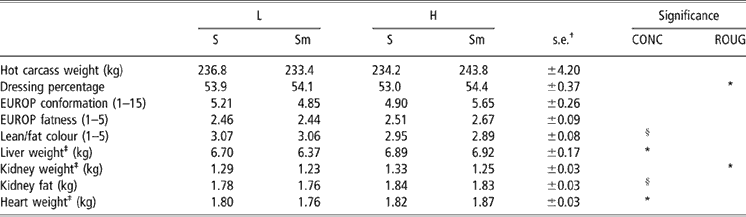
Hot carcass weight and carcass length were not different between the treatment groups (Table 3). The dressing percentage was significantly higher in the Sm compared with S groups (P < 0.05). There was an interaction between the treatment groups (P < 0.05) on the EUROP conformation score. The L groups had a higher conformation score when fed S compared with Sm (5.2 v. 4.9) whereas the H groups had a higher conformation score when fed Sm compared with S (5.7 v. 4.9). There was no effect of treatment on EUROP fatness (P = 0.11). The L groups showed a tendency to have a darker lean/fat colour score compared with H group (P < 0.08).
Effect of concentrate (CONC: low starch (L), high starch (H)) and roughage (ROUG: S, Sm) on carcass characteristics and organ weight
† For the H-S group.
‡ Data from 11 animals with abscessed livers are excluded.
§ Approaching significance (P < 0.1).
The average weight of the liver with no abscesses was 6.71 ± 0.7 kg and with abscesses 8.54 ± 3.3 kg. In one case with severe abscessation, the liver weighed 17.7 kg. The average weight of the liver and the heart was 0.4 kg (P < 0.05) and 60 g (P < 0.05) higher, respectively, in the H compared with L groups, when the animals with LAs were excluded from the data set. The roughage did not affect the size of liver or heart. The amount of kidney fat tended to be higher for H compared with L groups (P < 0.07). There was no effect of concentrate type on the size of the kidneys, but the animals fed S had larger kidneys than the animals fed Sm (1.31 v. 1.24 kg; P < 0.05).
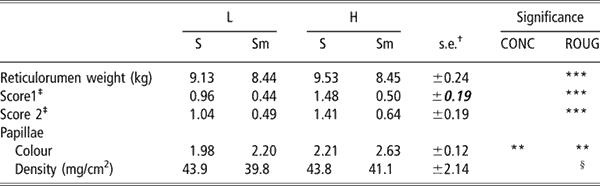
The weight of the reticulorumen was significantly higher in the groups fed S compared with Sm (P < 0.001) (Table 4). Macroscopic evaluation of the rumen wall at slaughter showed that the bulls with a higher straw intake (Sm groups) had a lower rumen score (less clotting, hyperaemia and/or necrosis) for both sample sites of the rumen (P < 0.001) than did the S groups. For concentrate type, the rumen score was numerically higher for H-fed animals (P = 0.16).
Effect of concentrate (CONC: low starch (L), high starch (H)) and roughage (ROUG: S, Sm) on the weight of the reticulorumen, the macroscopic evaluation of the rumen wall, papillae colour and density
† For the H-S group.
‡ Score 1: atrium ruminis. Score 2: ventral sac.
§ Approaching significance (P < 0.1).
The animals fed H concentrate and the animals fed Sm had a significant darker colour of the ruminal papillae. The papillae density was not affected by concentrate type, but there was a tendency to a larger papillary density of animals fed S compared with Sm (P < 0.10). There was no effect of treatment on the shape of the papillae (data not shown). The majority had a score of 3 or 4.
Discussion
In general, the growth rate and the carcass classifications were satisfactory compared with Danish results for intensively fed young bulls of the Friesian breed (Therkildsen et al., 1995). Substitution of dietary starch by fibre in the L concentrate resulted in an increased total DMI, which compensated for the reduced energy content, and the animals were able to attain the same ADG as on H. This resulted in a lower FCEDM for the L groups as found by Utley et al. Reference Utley, Lowrey and McCormick(1974) when increasing the level of peanut hulls from 10 to 30% in an all-concentrate ration. However, in the present experiment the FCENE was improved in groups fed the L concentrate, which could be caused by a more efficient utilisation of the cell wall fraction in the rumen, due to a more favourable ruminal environment with the lower level of dietary starch. Results by Kreikemeier et al. Reference Kreikemeier, Harmon, Brandt, Nagaraja and Cochran(1990) show that the cellulolytic bacteria in the rumen of steers fed high-grain diets only represented relatively small numbers (~1%) of the total bacterial population, and DeGregorio et al. Reference DeGregorio, Tucker, Mitchell and Gill(1982) found that the digestion of ADF in the rumen was reduced from 48% to 8% when the amount of grain in the diet was increased from 40% to 80% of the diet DM. Similarly, Brink and Steele Reference Brink and Steele(1985) found that NDF digestion declined from 69% to 35% when the amount of grain was increased from 70% to 90% of the diet (kg). With a grain level of 68% and 42% of DM in the H and L ration, respectively, the number of cellulolytic bacteria could have been reduced when feeding the H concentrate. In our study, feeding the L concentrate stimulated the animals to eat more roughage, indicating that either passage and/or fermentation efficiency has been enhanced. Another possible reason for the lower FCENE in the H groups could be a metabolic disturbance leading to reduced efficiency of utilisation of the metabolisable energy.
Similar to our results, the total DMI was found to increase with increasing roughage levels in a high-grain ration fed to steers (Kreikemeier et al., Reference Kreikemeier, Harmon, Brandt, Nagaraja and Cochran1990; Stock et al., Reference Stock, Sindt, Parrott and Goedeken1990; Shain et al., Reference Shain, Stock, Klopfenstein and Herold1999) but these studies show no consistency in the way gain or feed efficiency was influenced. In the present experiment, the positive effect of the Sm treatment on straw intake was too small to affect total NEI, ADG or feed efficiency. The low intake of the straw in the S groups supports earlier Danish studies showing that the average daily intake of straw rarely exceeded 0.5–0.7 kg/day in an ad libitum feed situation (Jorgensen et al., 1971; Andersen, 2000) and that such a low amount of straw was insufficient to avoid pathological changes in the rumen (Jorgensen et al., 1971).
In the Sm groups with the higher roughage intake, the average rumen and atrium score was improved, which agrees with Tamate et al. Reference Tamate, Ishihara, Yoneya and Miura(1976). Sugar-beet molasses are known to elevate the proportion of butyric acid in the ruminal content of short-chain fatty acids (Shen et al., Reference Shen, Seyfert, Lohrke, Schneider, Zitnan, Chudy, Kuhla, Hammon, Blum, Martens, Hagemeister and Voigt2004). Results by Shen et al. Reference Shen, Seyfert, Lohrke, Schneider, Zitnan, Chudy, Kuhla, Hammon, Blum, Martens, Hagemeister and Voigt(2004) with goats, Shen et al. Reference Shen, Kuhlam, Zitnan, Seyfert, Schneider, Hagemeister, Chudy, Lohrke, Blum, Hammon and Voigt(2005) with steers and Mentschel et al. Reference Mentschel, Leiser, Mülling, Pfarrer and Claus(2001) with calves, show that an increase of butyric acid content in the rumen, enhances the cell proliferation of the papillae, thus enhances the papillae length, shape and density. In the present study, we found no effect on the papillae shape or density of the papillae in atrium ruminis. On the contrary, there was a tendency to a higher papillae density in the S groups.
Several experiments show that increasing the proportion of roughage in a concentrate diet lowers the incidence of LAs (Foster and Woods, Reference Foster and Woods1970; Utley et al., Reference Utley, Lowrey and McCormick1974; Zinn and Plascencia, Reference Zinn and Plascencia1996). However, except for Foster and Woods Reference Foster and Woods(1970) the severity of LAs is usually not changed when increasing the roughage level from 0% to a maximum of 15% of DMI (Kreikemeier et al., Reference Kreikemeier, Harmon, Brandt, Nagaraja and Cochran1990; Shain et al., Reference Shain, Stock, Klopfenstein and Herold1999). Utley et al. Reference Utley, Lowrey and McCormick(1974) also found that a level of peanut hulls less than 20–30% of DM was inadequate to reduce the severity of LAs. These findings agree with our results concerning the LA finding in L and H groups. However, unlike Tamate et al. Reference Tamate, Nagatani, Yoneya, Sakata and Miura(1973), we found no difference in the rumen scores between the H and L groups.
With the exception of animals with a severe number of LAs, growth rate and feed efficiency were generally not reduced by the presence of LA, which is in accordance with results found by Brink et al. Reference Brink, Lowry, Stock and Parrott(1990). In agreement with our findings, Kjeldsen et al. (2002) reported that having lung remarks at slaughter was associated with a doubling in the incidence of LAs and that animals fed high grain concentrate had a significantly higher level of lung remarks. Lofgren Reference Lofgren(1983) also reported an increased rate and severity of bovine respiratory disease complex when the amount of concentrate in the diet fed to calves was increased. Results by Donovan et al. Reference Donovan, Hippen, Hurley and Chase(2003) show that the immune response of calves fed an acidogenic diet is weakened, which could be a possible factor contributing to the higher level of respiratory diseases and LAs among animals fed the H concentrate. Another explanation of the higher risk of LAs could be that animals with respiratory diseases might have a different eating pattern with reduced feed intake during periods of illness followed by a period with compensatory growth and feed intake. Our result indicate that the day-to-day variation in DMI was more variable in animals suffering from either respiratory diseases or LAs compared with healthy animals.
The results showed that when reducing the starch content of the concentrate ration, the young bulls were able to maintain the performance level and slaughter quality. There was a better effect of reducing the starch content of the concentrate than increasing the straw intake by adding molasses, on the incidences of LAs. However, in terms of improving the condition of the ruminal wall, the results indicated that the roughage intake is of importance.
Aknowledgements
Allan Mikkelsen, Jane Eriksen and staff at the Danish Cattle Research Centre and Connie Middelhede are acknowledged for feeding, handling and weighing of animals, and for data collection and handling. Holger Thrane and staff at the Experimental Slaughter Unit are thanked for help in sampling and registrations in connection with slaughter. H. Refsgaard is acknowledged for help in planning the experiment and designing the concentrate rations.



