


In the Crypt of Oceanus in the catacombs of S. Callixtus in Rome, there is a painted bust of a woman who is missing her head (Fig. 1). This is not because the fresco has deteriorated or been cut away, but because the head was originally attached separately, on a mobile support probably consisting of a linen canvas.Footnote 1 Only the rectangular shadow of this portrait remains, along with holes at regular intervals where it had been attached to the wall with nails. While admittedly odd-looking to the modern observer, the use of a portrait on a mobile support is not unique to this tomb. A similar fresco is found in the catacombs of Domitilla, in which a family group was depicted with the heads of the mother and children added separately (Fig. 2).Footnote 2 A cubiculum from SS. Marcellino and Pietro has a recess in the wall in which it has been argued was affixed a wooden panel, perhaps a portrait of the deceased (Fig. 3), and another cubiculum preserves evidence of a complete portrait attached on cloth (Fig. 4).Footnote 3 These “invisible” images, attested only by shadows in the spaces they occupied, the presence of recesses, and the remains of attachments, are rare reminders of a genre of portraiture common in the ancient world but rare in the archaeological record: painted portraits on perishable media like wooden panels or cloth.
Composite portrait from the Crypt of Oceanus in the catacombs of S. Callixtus. (Wilpert Reference Wilpert1907, fig. 3.)

Composite family group portrait from the catacombs of Domitilla. (Courtesy of the Pontifical Commission for Sacred Archaeology.)

Recess for a panel painting(?), SS Marcellino and Pietro. (Courtesy of the Pontifical Commission for Sacred Archaeology.)

Arcosolium painted with rectangular framed panel for attachment of a portrait on cloth, with nails preserved around the edges, SS Marcellino and Pietro. (Courtesy of the Pontifical Commission for Sacred Archaeology.)

Painted portraits on wood or cloth were a popular form of commemoration in the catacombs of 4th-c. Rome but have not received the scholarly attention they deserve. The first reason for this is that the absence of an image has been unable to compete with surviving frescoes, especially religious scenes, which dominate the study of catacomb art. Portraits in general are understudied; even those that are well preserved have only recently begun to receive detailed investigation and are still overshadowed by biblical motifs.Footnote 4 “Multi-media” funerary compositions like those described above have attracted limited attention, largely due to their peculiarity.Footnote 5 This is unfortunate, since in addition to these composite images which utilized wood or cloth, many more funerary portraits in various media imitated or referenced the use of panel portraits, thereby attesting to their desirability for funerary commemoration. This was mainly achieved through the addition of painted frames.Footnote 6 For example, the bust from S. Callixtus incorporated a facial portrait on cloth but was also depicted inside a rectangular painted frame that imitated a panel painting. Looped pieces of string were even painted protruding from either side of the frame, mimicking the cord used to hang a painting on the wall.
The second reason that these portraits have been neglected is that the perishability of wood and cloth mean such portraits rarely survive in the archaeological record and are therefore difficult to study. To date, research into ancient painted portraiture in these media has followed two main trajectories: study of the Fayum mummy portraits, and the relationship between panel portraits and icons.Footnote 7 Both early icons and mummy portraits have primarily been preserved in the dry climate of Egypt. This limited preservation context has narrowed the scope of research into painted portraiture, which is regrettable given that it was a common form of representation across the empire. The Fayum portraits in particular captivate modern viewers, but they represent only a fraction of the painted portraits that once existed and exemplify a highly specific and localized practice. It has been debated whether these portraits originally served a domestic or funerary function, but it is now generally agreed that this was a funerary practice which dovetailed with traditional mortuary procedures.Footnote 8 These portraits are beautiful and survive in relatively large numbers, but if we are to better understand ancient portraiture, we must look for a greater range of material to study, even if the evidence preserved is not ideal. While the catacombs also represent a specific and localized funerary context, many of the portraits retained their connection to the portraiture that adorned people's homes: framed and hung on the walls of the tomb rather than the house. As will be discussed below, it is possible that these paintings were originally domestic items that were reused in a secondary context. The catacomb portraits therefore also provide us with a valuable link to domestic portraiture and wider portrait practices. This is especially important given the almost complete lack of archaeological evidence for such portraits in domestic contexts.
This article examines the evidence for portraits on wood and cloth in the catacombs and asks what made this form of portraiture so effective and desirable for commemorating the dead.Footnote 9 It also considers where these portraits might have come from and analyzes the connection between the world of domestic portraiture and funerary commemoration. Through this analysis, I hope to adjust our expectations of material evidence and archaeological inquiry in a context in which physical remains are minimal. No actual portraits on wood or cloth survive from the catacombs, but that does not mean knowledge of them is lost to us forever. I begin with an overview of painted portraiture in the first four centuries CE, which will allow us to situate evidence from the catacombs within a long-standing portrait tradition. I will then turn to the catacombs themselves and what they can tell us about this understudied form of portraiture, both in 4th-c. Rome and beyond.
Painted portraits in the Roman Imperial period and Late Antiquity
In the 1st c. CE, Pliny the Elder dedicated Book 35 of his Natural History to painting, its history, techniques, and materials. In the introduction he lamented that while painting had formerly been highly honored among the visual arts, in his own day marble carving was more popular.Footnote 10 With regard to portraiture in particular, Pliny bemoaned a turn away from painted portraits and towards those produced in marble, bronze, and precious metals, a choice which he says sacrificed a true likeness for the prestige of the material.Footnote 11 A preoccupation with preserving an individual's features for posterity pervades Pliny's discussion of painted portraiture.Footnote 12 Pliny considered painted portraits more accurate than other media and therefore important for the preservation of memory. To have one's likeness preserved in this way was a sign of social esteem.Footnote 13 The wish to conserve a person's memory through an accurate representation of their physiognomy is also reflected in the aristocratic practice of creating wax portrait masks of illustrious male ancestors, the imagines maiorum.Footnote 14 These masks were worn by actors during funeral processions, at which the realism of the portraits made the dead appear to “come to life again.”Footnote 15 The imagines did not simply resemble the deceased, they acted as their doubles.Footnote 16 Painted portraits seem to have functioned in a similar, although less theatrical, fashion. They were prized for the close resemblance they represented to an individual and thus elided the barrier between image and person.
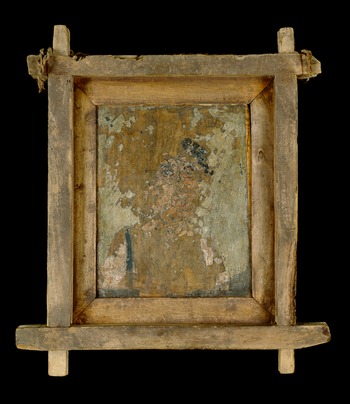
Despite Pliny's concerns, painted portraits continued to be created throughout the Imperial period.Footnote 17 They were awarded to prominent citizens alongside statues, and emperors and their families were represented in paintings displayed in public spaces, temples, and private homes.Footnote 18 The most famous surviving example is the Berlin Tondo, which depicts Septimius Severus (r.193–211), Julia Domna, Caracalla, and Geta.Footnote 19 Only a handful of paintings like this one have survived, but evidence from texts and other visual sources testifies to their ubiquity. For example, in Pompeii and Herculaneum, wooden panel paintings (pinakes) were incorporated into the decorative schemes of wall paintings, both by inserting panels into recesses in the wall and by including simulated panels in the fresco design.Footnote 20 Sometimes such simulated panels concerned portraits, such as that of Terentius Neo and his wife in their house-cum-bakery.Footnote 21 Panel portraits also appear in other decorative media. The painted interior of a late 1st-c. CE sarcophagus from Kerch shows a scene of a portrait painter in his workshop. He has paintings on his easel and completed pieces on the wall.Footnote 22 In Antioch a mosaic from ca. 200 CE depicts a young man contemplating a small, framed portrait of a woman, perhaps an image of his beloved.Footnote 23 The panel is similar to the only complete framed portrait to survive from antiquity (Fig. 5).Footnote 24 Found propped against a mummy in Hawara – presumably acting as a pseudo-mummy portrait – the painting itself is badly preserved, but the frame is in good condition with a rope for suspension. Unlike other mummy portraits, there can be little doubt that this painting originated in the home of the deceased.
Framed wooden panel portrait from Hawara, Egypt, 1st c. CE? (© The Trustees of the British Museum.)

As intimated by Pliny, a painted portrait was normally cheaper than one sculpted from marble or bronze and may therefore have been a common choice outside elite circles.Footnote 25 However, we know little about how much such portraits cost, and it may have depended significantly on the caliber of the painter and the size of the piece. Diocletian's Price Edict of 301 informs us that the pictor imaginarius was paid 150 denarii per day, twice the amount received by a wall painter and three times the wage of a floor mosaicist.Footnote 26 While this indicates that portrait painters were skilled and valued artisans, it does not suggest an individual portrait's cost. In 362 a man called Zoilos arranged to pay a painter called Heraclides one artaba of wheat and two Cnidian jars of wine for a portrait.Footnote 27 Variation in the price of wheat in the 4th c. makes equating this with a cash amount difficult, however, it does not appear an astronomical sum.Footnote 28 A 2nd-c. papyrus records that a soldier named Apion stationed in Misenum sent a portrait of himself back to his family in Egypt, presumably intended as a keepsake.Footnote 29 That such a portrait was accessible on a soldier's wage suggests that commissioning a painted portrait was possible for many. Affordable, portable, and desirable, painted portraits were probably common in the homes of non-elites, but simply do not survive.
In the home, painted portraits functioned as foci for memory and contemplation. This was presumably facilitated by the fact that they were prized as accurate representations of their subject. Easily portable, they could also represent a transportable substitute for the person depicted. These features made them suitable for funerary uses, as can be seen in the case of the framed painting reused as a mummy portrait. Funerary inscriptions sometimes mention the contemplation of an image of the deceased during mourning or the creation of a portrait for commemoration and memorialization.Footnote 30 The 2nd-c. epitaph of Allia Potestas from Rome, for example, refers to a small portable image (effigiem) of the woman that was revered by those who outlived her.Footnote 31 What form this image took is unknown and often assumed to be a sculpture, but there seems no reason why it could not have been a painted portrait.Footnote 32 A 1st-c. epigraphic inventory from Apateira of a tomb's furnishings records some 13 painted portraits.Footnote 33
The suitability of painted portraits for funerary commemoration is illustrated by tomb frescoes that incorporated simulated panel paintings like those integrated into domestic decoration. A well-known example concerns the Tomb of the Three Brothers in Palmyra, where nine tondo portraits in yellow frames are supported by Victories.Footnote 34 It is not certain whether these tondi portrayed the people buried in the tomb or served a purely decorative purpose, but they nevertheless mimic tondo portrait paintings. As already mentioned, the aristocratic wax imagines also played important funerary roles.Footnote 35 The masks brought the dead back to life at funerals, animated by living actors. The perceived realism of these images gave them a strong connection to the individual they represented, allowing them to move between the worlds of the living and the dead. This may explain the interest in painted portraits in funerary contexts, whether made for that purpose or transferred from a domestic setting: the idea that painted portraits preserved a true resemblance of the individual made them potent loci for memory.
Pliny would have been delighted to see interest in three-dimensional art forms begin to wane in Late Antiquity, replaced by two-dimensional painting and mosaic.Footnote 36 In reality, a taste for painting had probably never disappeared and has simply been obscured by the better survival of sculpture. In the early 3rd c., Philostratus the Elder praised painting over sculpture for its ability to accurately capture details and emotions through the use of color.Footnote 37 Color is also hailed in Late Antique and Byzantine sources as integral to a lifelike and engaging image.Footnote 38 It has been suggested that a preference for the emotional engagement that could be elicited from paintings or mosaics contributed to the decline in the so-called statue habit.Footnote 39 Elucidating the reasons for this decline in Late Antiquity is beyond the scope of this article, however, it is evident that paintings had always played important roles alongside sculpture and would ultimately persist long after statue production dwindled.Footnote 40 Two-dimensional media would dominate the visual culture of Late Antiquity and the Early Middle Ages, especially when it came to portraiture.Footnote 41
In Late Antiquity there was significant continuity concerning the use of painted portraits and the ideas with which they were associated.Footnote 42 Emperors continued to be depicted in paintings and the portraits of high-ranking ecclesiastical figures were displayed in churches and public places.Footnote 43 The imperial image was hung in lawcourts as a stand-in for the man himself, attesting to the continued intimate association between painted images and their subjects.Footnote 44 Like Pliny centuries earlier, 4th-c. authors demonstrated a clear attachment to painted portraits for their perceived accuracy, and by extension their ability to provoke personal and emotional interactions.Footnote 45 For example, a letter written by the orator Libanius conveyed his delight over a portrait he received of the famous Aelius Aristides.Footnote 46 The picture was apparently so lifelike that Libanius considered it the next best thing to having the man himself beside him and recounted how he talked to the painting as he read Aristides's work. In his Lives of the Philosophers, Eunapius praised the work of the painter Hilarius, who had mastered the art so completely that, like Libanius's portrait of Aristides, his subjects too seemed to come to life.Footnote 47 Ausonius played with these ideas in a poem addressed to a painter concerning a portrait of an enslaved girl called Bissula.Footnote 48 The poem expressed concern that the painter could not capture her beauty with conventional paints and suggested the use of roses and lilies to approximate her features.
The famous case of the portraits made for the baptistery at Primuliacum in Gaul presents the exception that proves the rule. In 403, Sulpicius Severus wrote to his friend Paulinus of Nola, asking him to send a portrait of himself to Gaul for his baptistery.Footnote 49 Paulinus refused, instructing Sulpicius to get a local painter to make a portrait based on existing paintings and descriptions. In his letter, Paulinus made it clear that the physical accuracy of the portrait was unimportant, as the true “portrait” of a person was in their words and deeds, not appearance.Footnote 50 Paulinus contrasted the perishable materials of wax and wood with the immortality of the internal, spiritual image written on the heart.Footnote 51 However, this exchange does not indicate that people were no longer invested in painted portraits by the early 5th c., or that their relationships to such images had changed significantly. In his resistance to the portrait, Paulinus made a rhetorical point about his Christian identity, a point illustrated through opposition to the apparently popular view of portraiture seen in other sources. Paulinus was arguing that investment in earthly, bodily images was shallow, whether expressed in paint or in flesh. Painted portraits were thus the vehicle for his argument, not its target, and his rhetorical use of them confirms their continued social relevance.
From Pliny to Libanius, painted portraits were prized for their perceived accuracy, and painters were praised for their ability to make the image of a person seem to come alive. Painted portraits were cheaper and more widely accessible than sculpted portraits, but the perishable nature of their materials skews the archaeological evidence. Beyond this difference in cost, painted portraits also seem to have played to subtly different desires on the part of the purchaser. While sculpture could be lifelike, paintings were valued as accurate likenesses of specific people, images with which one could interact on a personal level. This interaction formed part of the rhythms of daily life, whether it concerned a portrait of a family member far from home, an object of romantic desire, or an admired figure from the past.
This understanding of painted portraits would be influential for the development of icons, which were prized as true depictions of holy figures.Footnote 52 Their status as portraits meant they were also capable of acting as “stand-ins” for the person they represented: interaction with an icon could trigger a spiritual connection between the viewer and the person portrayed.Footnote 53 At times, these interactions even mirrored experiences with secular portraits discussed above. In the 7th c., George of Alexandria described how John Chrysostom conversed with a portrait of the apostle Paul in much the same fashion that Libanius talked with his portrait of Aristides.Footnote 54 The “iconization” of portraiture, in which portrait features were understood to be spiritual rather than strictly physical, also spoke to Paulinus's concerns about flesh being prioritized over spirit.Footnote 55 The evidence from the catacombs, to which we will now turn, sits squarely in the middle of this long tradition, connecting a Christian future with ideas that reach far back into antiquity.
Painted portraits in the Roman catacombs
The actual remains of portraits painted on wood and cloth have not survived from the catacombs, but there is substantial evidence that such portraits were highly desirable for funerary commemoration. As already mentioned in the introduction, two paintings survive which incorporate mobile media into fresco portraits, one in the Crypt of Oceanus in the catacombs of S. Callixtus and the other in arcosolium 12 in the catacombs of Domitilla. Lesser known and more complex a composition, the latter depicts a family group of a mother, father, and at least one child, probably two (Fig. 2).Footnote 56 The bust of the father is depicted entirely in fresco on the viewer's right, wearing a tunic and cloak. His wife, however, is shown in fresco from the shoulders down, her yellow tunic with dark clavi painted directly onto the wall of the arcosolium. Where her head should be is a rectangular space where her portrait was affixed, perhaps on a wooden panel painting.Footnote 57 Between the parents one can just make out the shoulders of a small figure painted in fresco, above which is a rectangular shadow bordered with nail holes. This indicates where the portrait of a child was added, probably on cloth. To the viewer's far left Norbert Zimmermann has also noted evidence of adhesive for the addition of a fourth portrait, probably another child.Footnote 58
Zimmermann has suggested that the portrait of the second child added to the group's far left may have been an unexpected addition, and that therefore affixing the cloth image was a matter of convenience.Footnote 59 Yet the original group was clearly a planned composition.Footnote 60 The patrons of the tomb evidently saw value in attaching separate facial portraits of the mother and child, but it remains unclear why the father was executed solely in fresco. Perhaps portraits of the mother and child already existed and were transferred to the tomb because they were prized for the close connection they represented to their subjects. If no such portrait of the father existed, it would have to be executed in fresco. As we have seen, painted portraits were thought to bear a close likeness to individuals and could even be perceived to act as stand-ins for them – whether physically absent or deceased. Alternatively, the fresco portrait may indicate the father was still alive when the tomb was executed, whereas his wife and children had died.Footnote 61 Whatever the reason, it is likely that the portraits of the mother and children originated in the home and were transferred to the catacomb for secondary use. This is because they concern only facial portraits positioned on frescoed busts. If they were commissioned specifically for the tomb, why only paint the head? The same is true of the portrait from S. Callixtus (Fig. 1). It seems logical that a facial portrait was already in existence but that a different composition was desired for the funerary image, in this case a bust holding a scroll and a group portrait in the case of the family. Both formulations were popular choices for funerary commemoration. This was especially true of family groups, which are rare in 4th-c. visual culture outside tombs.Footnote 62 These funerary compositions referenced qualities like intellectual cultivation and family harmony in a way that small domestic portraits did not. In both cases, a composite painting achieved the desired effect while sacrificing neither the mimetic powers of the facial portraits nor the wider context of the preferred compositions.
In the catacombs of SS. Marcellino and Pietro there is potential evidence for a panel painting incorporated into a recess in the wall of a tomb.Footnote 63 In cubiculum 49, the back wall of the arcosolium preserves a rectangular recess surrounded by a stucco frame (Fig. 3).Footnote 64 Two metal attachments are visible in the upper corners of the recess, which Claudia Corneli argues were used to affix a wooden panel.Footnote 65 The recess is large, 90 cm x 67 cm with a depth of 2.08 cm, meaning the panel it once contained was sizeable, certainly large enough to depict the bust of an individual or several figures. Under the arch of the arcosolium is a painted portrait of a woman in a tondo frame; perhaps the panel depicted the same individual.Footnote 66 It is also possible, however, that the recess contained an inscribed marble slab. Two inscribed slabs were found positioned in recesses in and around an arcosolium in the cripta di Ampliato in the catacombs of Domitilla.Footnote 67 These recesses were both framed with red paint, but neither had a stucco frame, perhaps lending credence to the interpretation that the example from SS. Marcellino and Pietro contained a painted portrait. The rear wall of an arcosolium was also the standard location for portraits painted in fresco.Footnote 68 As Corneli suggests, if the recess in cubiculum 49 of SS. Marcellino and Pietro contained a panel portrait, it may have been a domestic object moved to the tomb because it was valued as a painted “double” of the deceased.Footnote 69
In cubiculum 41, also in the catacombs of SS. Marcellino and Pietro, we find a similar situation, but the portrait here was most likely attached on cloth. The back wall of the lunette has a red ground, in the center of which a white rectangle was painted, bordered in black.Footnote 70 Johannes Deckers recorded that around the edges were the rusted remains of 19 iron pins or nails, which he interpreted as attaching a separate portrait or inscription on brick, wood, or fabric (Fig. 4).Footnote 71 From the published photograph, it appears that the nails ran along the edge of the white rectangle; the black border was perhaps intended to provide a frame for the attached image. Given the framed recess from cubiculum 49 of the same catacombs discussed in the previous paragraph and the entirely painted examples discussed below, it seems most likely that a portrait on cloth was attached to the back wall in the white rectangular field.
In addition to tombs that preserve evidence of portraits on wood or cloth, probably transferred from domestic settings, there are numerous portraits in other media which imitate them. Perhaps the most ambitious imitation of a panel portrait is the “orante nel trittico” painting from the cover of loculus 51 in the catacombs of Domitilla. It depicts a bust of a woman in the orans position on a wooden panel with side leaves imitating folding doors.Footnote 72 A simpler composition is found in the Coemeterium Maius, where a woman in bust form is depicted on the back wall of an arcosolium with a thick rectangular painted frame around her, flanked by two orants (Fig. 6).Footnote 73 This may imitate panels like the one perhaps inserted into the recess at SS. Marcellino and Pietro. Two other arcosolia from the catacombs of Domitilla preserve similar compositions, one with the central panel flanked by Peter and Paul, the other by Cupids (Figs. 7–8). In the former, there are traces of the depiction of a single orant individual and in the latter, a couple can still clearly be seen.Footnote 74 Several other portraits were executed within round frames imitating tondi, the best preserved of which is the bust portrait of a young boy from arcosolium 67 in the catacombs of Domitilla.Footnote 75 A beautiful pair of tondi representing a couple from the cimitero di Ciriaca also belong to this group, but were executed in mosaic.Footnote 76
Bust portrait of a woman with a painted frame, Coemeterium Maius. (Wilpert Reference Wilpert1903, pl. 223.)

Framed portrait in an arcosolium in the catacombs of Domitilla, flanked by Peter and Paul. (Wilpert Reference Wilpert1903, pl. 154.1.)

Framed painted portrait of a couple in an arcosolium in the catacombs of Domitilla, flanked by Cupids (white sections are in the image as provided). (Courtesy of the Pontifical Commission for Sacred Archaeology.)

Returning to the catacombs of S. Callixtus, a fragmentary marble slab from gallery E8, cubiculum C – probably part of the closure of a loculus – preserves the incised portrait of a woman (Fig. 9).Footnote 77 She is shown in bust form and is surrounded by a square frame. For an image incised into marble, the portrait is rendered in a highly sensitive manner and with a painterly quality, with particular attention paid to her facial features. The woman has a pointed chin, a pronounced cupid's bow with her mouth held slightly open, somewhat gaunt cheeks and high cheekbones. Shallow lines around her eyes and nose give her a mature appearance, and care has been taken to render the strands of hair that make up the thick braid winding over the top of her head. Her portrait is in sharp contrast to other incised images from the catacombs, which often appear hasty and naïve.Footnote 78 The elegant details of her face and the frame that surrounds her bust both indicate that this image was intended to imitate a painted portrait panel, just like those we find in fresco.Footnote 79
Incised portrait in imitation of a painted panel portrait, from a fragmentary loculus cover in the catacombs of S. Callixtus. (Courtesy of the Pontifical Commission for Sacred Archaeology.)

The form of this incised portrait is unusual, but it reminds us of another intersection between painted and sculpted portraits in funerary contexts. Many sarcophagi included portraits of the deceased, and a popular composition in the 4th c. was to position the bust of an individual or couple in a tondo or a rectangular frame.Footnote 80 While this naturally recalls sculptural tondi portraits, the relatively low relief of most depictions also connects them to painted panels. This seems especially true for those with rectangular frames, although these are less common than tondi. Once painted, such low-relief portrait images resembled framed panel paintings as much as sculptures and perhaps owe their popularity on sarcophagi to the taste for painted portraits rather than statuary. The potential for intermediality between panel paintings, sarcophagi, and fresco portraits is illustrated by a ceiling painting from the cubiculum of Lazarus in the catacombs of Priscilla.Footnote 81 Above three loculi in the right-hand wall is a long, narrow painted panel that bears a striking resemblance to the front of a sarcophagus. In the center is a portrait of an orans woman in a tondo, flanked symmetrically on either side by three figures, each separated by painted pilasters. The similarities with columnar sarcophagi are remarkable and highly unlikely to be accidental.
A final example, from the catacombs of S. Agnese, attests to the sheer variety of media used to imitate panel paintings. Now lost, a small, framed portrait of a woman in an opus sectile-style panel was embedded in a loculus cover next to the funerary inscription (Fig. 10).Footnote 82 Only a 19th-c. illustration survives, so the portrait's details cannot be properly examined, but the piece may represent a domestic trinket that depicted the woman now deceased.
“Opus sectile”-style portrait of a woman imitating a framed panel painting, from a loculus cover in the catacombs of S. Agnes. (Armellini Reference Armellini1880, pl. VIII.)

Whether executed on wood, cloth, or directly onto the surface of the tomb, the portraits discussed above demonstrate that painted portraiture was a desirable form of commemoration. Painted portraits were closely associated with their subjects and therefore may have been particularly valuable in funerary contexts for preserving the memory of the deceased. The ability of color to evoke emotions, as described by Philostratus, could have been an especially valuable characteristic when remembering a loved one. For those who owned painted portraits of family members, incorporating them into the tomb enabled them to preserve their memory as effectively as possible through the precise representation of their features.Footnote 83 As seen in the context of the imagines, this desire had a long pedigree in the Roman world. Even as the practice faded among the aristocracy, Kelsey Madden has shown that death masks became popular among non-aristocratic families, who deposited plaster masks into graves or used them to make busts of the deceased.Footnote 84 Death masks were also part of Romano-Egyptian funerary culture connected to pharaonic traditions.Footnote 85 The remains of some Egyptian portrait shrouds indicate that the head was added on a separate piece of cloth, perhaps a similar practice to that observed in the catacombs.Footnote 86 For those who did not possess a painted portrait or did not want to remove it from the home, imitating one was apparently also an effective choice. A funerary portrait might be copied from a domestic one, created from a verbal description, or even executed in advance as part of planning for a funerary monument.Footnote 87 In whichever case, by imitating a medium prized for its accuracy the portrait was declared a truthful representation and by extension claimed the power to effectively memorialize the individual.
The so-called square nimbus
The enduring appeal of using portrait panels to commemorate individuals and their likenesses is illustrated by the phenomenon of the “square nimbus.” The square nimbus is perhaps best known from early medieval Italy, when donors and important figures depicted in churches were often shown with a distinctive rectangular blue panel framing their head.Footnote 88 The connection between the square nimbus and panel portraits was first made by Josef Wilpert in 1905. In an article examining paintings from Santa Maria Antiqua in Rome, Wilpert stated that the facial portrait of the 8th-c. donor Theodotus had been added to his depiction separately on a piece of cloth.Footnote 89 He compared this to the composite portrait from S. Callixtus discussed above. Over a series of publications, Wilpert argued that the square nimbus derived from this practice of attaching separate facial portraits when a true likeness was desired. Since it would be difficult to affix a portrait of just the head or face without damaging the features, the portrait was attached in the form that it normally took, that is, as a rectangular panel. A colored background, normally light blue or sea green, was included to bring the image into harmony with the rest of the painting. Wilpert considered that eventually this form became so common that the rectangular blue panel was incorporated around the head even if the whole figure was executed in fresco or even mosaic.Footnote 90 The shape alone was able to attest to the status of the depiction as a true portrait and emphasized the individual's importance.
Wilpert supported his argument with an extract from the 9th-c. author John the Deacon. In a passage describing a portrait of Gregory the Great in Rome, John stated that around Gregory's head was not a round nimbus, but the likeness of a picture panel.Footnote 91 This appears to be a direct description of the square nimbus and its perceived connection to panel portraits. John also commented on the relationship between the square panel and the subject, conventionally understood to indicate the subject was alive when it was produced. This interpretation of John's words may be questioned,Footnote 92 and in any case the square nimbus was not always used for living people: several scholars have demonstrated that it was used in funerary portraits and depictions of biblical figures.Footnote 93 Indeed, the usage of the square nimbus in the funerary sphere far predates that for donors: the placement of a blue square or rectangle behind the head of the deceased is found on Romano-Egyptian portrait shrouds and on a handful of mummy portraits.Footnote 94
The origin of the square nimbus is therefore to be found in Roman funerary art, an association it retained into Late Antiquity.Footnote 95 In this early period, it was not commonly conceived of as a nimbus in the sense of the round version worn by holy figures. Instead, the resemblance of the square nimbus to a panel painting appears to have qualified the portrait as faithful to its subject, rather than an imagined or idealized depiction.Footnote 96 Portraits with a square nimbus are thus related to the portraits discussed in the previous section, as they essentially “imitate” a panel painting or, more correctly, associate themselves with the virtues of accuracy and fidelity traditionally accorded to painted portraits. In the 4th c., the square nimbus in this early incarnation as a simple blue rectangle is attested in the Roman catacombs and a tomb from modern Serbia, which will be discussed further below. Its subsequent trajectory in the West, however, remains unclear owing to a lack of evidence. In the East, especially in Egypt, the square nimbus is much better attested, particularly from the 6th c. By this point, its usage seems to have broadened to incorporate donors and other important individuals, including religious figures. For example, donors appear with square nimbi in the 6th-c. apse mosaic of the church of St Catherine on Mt Sinai.Footnote 97 Perhaps as the square nimbus grew in popularity in Egypt it was “reintroduced” to the West in the Early Middle Ages along with its expanded significance, in time for its reappearance in Italy around the 8th c.Footnote 98
Scholarship on the square nimbus consistently takes its rectangular shape to be its defining feature: a direct reference to panel portraits and in geometric contrast to the round nimbus of Christ and the saints. I submit, however, that the blue color may also have been a significant characteristic that connected it to panel portraits. When panel portraits are depicted in other visual media, they are often shown with a distinctive blue background. In frescoes from Pompeii and Herculaneum, panel paintings incorporated into wall decoration are often shown with a blue ground. The famous frescoes depicting a woman painter from Pompeii, for example, show her painting a human figure on a framed panel with a light blue ground.Footnote 99 The painted tondi portraits from the Tomb of the Three Brothers in Palmyra are also all shown with blue backgrounds.Footnote 100 In a particularly distinctive example, the scenes of Christ before Pilate from the 6th-c. Rossano Gospels include portraits of emperors with striking bright blue grounds (Fig. 11).Footnote 101
Christ before Pilate, with framed portraits of emperors in the background, Rossano Gospels, 6th c. (Album / Alamy Stock Photo.)

Blue grounds are also found in imitation panel portraits from the catacombs. The painted portrait from Domitilla flanked by Cupids mentioned above has a distinctive blue background, as may the one flanked by Peter and Paul.Footnote 102 Blue grounds are also found on a tondo portrait from the catacombs of Praetextatus and the mosaic tondi of a couple from the cimitero di Ciriaca.Footnote 103 This may further support the argument that these images were intended to mimic panel portraits, distinguished not only by a painted frame but perhaps also by a blue background.Footnote 104 In the recently restored catacombs of S. Tecla a portrait in an arcosolium represents a woman and her small daughter with Peter and Paul.Footnote 105 The heads and shoulders of the three adults are framed by rectangular blue panels, which have been noted as an early form of square nimbus (Fig. 12).Footnote 106 This suggests that in addition to affixing separate painted portraits or imitating them with painted frames, it was also acceptable to simply include a blue panel behind the subject to indicate a portrait. This practice was apparently widespread: as well as appearing in Rome and Egypt, we also find it in an early 4th-c. tomb from Viminacium in Serbia, in which a young woman is shown with a conspicuous blue panel framing her head (Fig. 13).Footnote 107 The use of the panel behind the heads of Peter and Paul may be connected to the idea of preserving an accurate representation of a holy individual that would later contribute to the development of the icon.Footnote 108
Detail of the arcosolium tomb painting of a woman and her daughter from the catacombs of S. Tecla, with blue panels framing the adult figures. (Courtesy of the Pontifical Commission for Sacred Archaeology.)

Portrait of the deceased lady, western wall of the Pagan tomb (G2624) from Viminacium, documentation of the Institute of Archaeology. (Belgrade, Project Viminacium.)

A passage from a homily of John Chrysostom mentions blue backgrounds in relation to portrait paintings. He writes: “Come, let us consider the images that painters delineate. You have often seen an imperial image covered with blue color. Then the painter traces white lines and makes an emperor…”.Footnote 109 While Chrysostom is talking specifically about imperial portraits, the visual evidence suggests that blue was a common ground color, perhaps so common that a simple blue rectangle could come to stand for a portrait panel and carry its symbolic connotations. It is unclear why blue was popular, but it may be related to its technical qualities.Footnote 110 Blue and green were regularly included in paint mixtures for flesh colors, used to impart realistic ‘cool’ tones to skin. The widely used Egyptian blue, for example, has been identified in flesh areas on panel portraits, free-standing sculpture, and sarcophagi.Footnote 111 Once thought to have been forgotten by Late Antiquity, imaging techniques now show that Egyptian blue was used well into the Middle Ages.Footnote 112 Blues and greens were also common components of underpaint for flesh tones for the same reasons that they were mixed into flesh-colored paint.Footnote 113 A portrait required large areas of the composition to be painted with flesh tones, and a blue ground may have provided an appropriate base color. Blue pigments derived from rare minerals like lapis lazuli were probably prohibitively expensive for such use, but the ubiquity of synthetic Egyptian blue suggests it was not costly. Analysis of mummy portraits from the Phoebe A. Hearst Museum of Anthropology has proved the use of Egyptian blue as a toning agent in backgrounds that appear grey to the naked eye.Footnote 114 Light grey to greyish-blue are common backgrounds on surviving mummy portraits and other panel paintings, and may represent a more toned-down version of what we see in representations of paintings in other visual media.Footnote 115
Elizabeth Jastrzebowska has also commented on the color of the square nimbus, hypothesizing that different colors signified different meanings. Jastrzebowska suggested that black denoted night, blue the sky, and green the earth, the latter two representing the mortal world in contrast to the golden round nimbus which indicated the heavens.Footnote 116 However, as Paolo Liverani warns us, we should be careful before reading modern color associations into ancient evidence. When blue indicates the sky in mosaics, distinctive features such as clouds or stars are added, suggesting color alone was not sufficient.Footnote 117 This makes Jastrzebowska's color spectrum concept unlikely. In Italy in particular, most square nimbi were blue. When other colors were used, it may have been for a specific reason now obscure: that the rectangular shape was considered sufficient, that it referred to a particular portrait with a different ground color, or that blue was not as strongly associated with panel painting in that region.Footnote 118
The square nimbus seems to have represented the taste for painted portraits taken to its most abstract extreme. A blue square or rectangle behind the head of an individual could stake a claim to authenticity for the image by associating it with a painted panel portrait simply through shape and color. This development appears to have occurred early and is witnessed in the Roman catacombs alongside portraits that made use of actual painted panels. The popularity of the square nimbus in later centuries is an echo of this desire to preserve the likeness of individuals and by extension their memory. The portraits from the catacombs thus look backwards to ancient ideas of painted portraiture epitomized by Pliny and forwards towards the visual world of the Middle Ages.
Between the living and the dead
The catacomb portraits speak not only to ideas about commemoration and memory, but also to the close connection between the worlds of the living and the dead. Part of the appeal of painted portraits was that they were often created from life, with color, light, and shade used to capture a person's features for posterity. When the person passed away, their image represented a connection between two worlds, a site for memory and continued interaction with the person depicted.Footnote 119 Yet when portraits are discovered in funerary contexts, their connection to the dead is emphasized over the living and they are commonly classified as “funerary art” as though this were a discrete category of visual culture. However, as mentioned above, it is probable that at least some of the portraits used or imitated in the catacombs were originally domestic images that were transferred or copied to symbolically move an individual from their earthly home to their eternal one.
The distinction between the visual culture of the home and the tomb was often blurred.Footnote 120 There is ongoing discussion, for example, about whether gold glasses had a domestic function before being deposited in tombs or whether they were commissioned for funerary meals and commemoration.Footnote 121 It seems likely that there was no fixed practice: some gold glass was used in the home and some was commissioned specifically for the tomb.Footnote 122 One argument made for the funerary nature of gold glass is the close relationship between the iconography of couples on the glasses and that found on sarcophagi.Footnote 123 The similarities are undeniable, but such compositions are also found on domestic silver and jewelry.Footnote 124 The connection here is not a matter of funerary context, but rather the wider social importance of the marriage bond and conjugal harmony. A similar pattern can be observed for the orans pose, common in funerary images but also prevalent in Late Antique donor portraits.Footnote 125 An expression of prayer or piety was relevant to both these contexts, as donor portraits are exclusively found in connection with religious benefactions. The living and the dead were bound together within the same social system and its visual traditions. While specific funerary motifs were sometimes necessary, the virtues associated with living people largely continued to have relevance after their death.
When commissioning a portrait, whether on a painted panel or gold-glass vessel, there may have been an awareness that it could eventually take on funerary connotations.Footnote 126 This dual potential may help us understand the context of portraits which appear to stray between genres. For example, near the Damascus Gate in Jerusalem was discovered the 6th-c. “Orpheus chapel”, which was decorated with a mosaic carpet containing the portraits of two women, Theodosia and Georgia, along with a representation of Orpheus and hunters fighting wild animals.Footnote 127 The function of the space and identity of the women has been debated. The room was originally identified as a tomb chamber and has since been labelled a funerary chapel. Yet no burials were found, and therefore the funerary significance of the space and the mosaic have been questioned.Footnote 128 Was this Theodosia and Georgia's intended tomb, or were they donors who constructed a chapel or other communal space? A third option is that it was both. The women may have patronized the structure while recognizing that after death their donor portraits would carry further funerary meanings even if they were not buried there. Donor portraits in general were probably intended to commemorate benefactors beyond their lifetime, and the same may be true of other types of portraiture. There is no need to make rigid distinctions between the public, the domestic, and the funerary: just as people could move through these worlds, so could their images.
Conclusions
The popularity of painted portraiture was on the rise in Late Antiquity, fueled by far-reaching changes in visual culture and long-held ideas about the authenticity of the medium. The perishable nature of portraits on wood and cloth means that to study this phenomenon beyond the exceptional preservation conditions of Egypt, we need to adjust our methods and our expectations of the material evidence. When we do so, we can identify traces of a rich tradition of portraiture in both the domestic and funerary spheres, a tradition embedded in ideas about memory, commemoration, and the emotional connections between people and images that stretched from this life to the next.
Acknowledgments
This publication arises from research funded by the John Fell Oxford University Press Research Fund. It was written under the auspices of the project “Buried Practices: Material Religion and Daily Life in Late Antique Aphrodisias (4th – 7th centuries)”, held at the University of Oxford (2020–2021) by Dr Ine Jacobs. I am grateful to both Ine and Dr Hugh Jeffery for reading several versions of this article and providing thoughtful and critical feedback. I would also like to thank Prof. Jaś Elsner, Prof. Bert Smith, and Prof. John Osborne for their comments, queries, and corrections, which much improved the article. Prof. Paolo Liverani also kindly provided many copies of relevant articles. A version of this paper was presented at the Oxford Byzantine Graduate Seminar in Trinity Term 2021, and I am grateful to the enthusiastic audience for their thought-provoking feedback. Thanks are also due to the anonymous reviewers for their detailed comments. All remaining errors, of course, are my own.
Supplementary Materials
The Supplementary Materials constitute an appendix cataloguing portraits from the catacombs with evidence for images on perishable media or that imitate such images. Descriptions and bibliographic information are provided. To view the Supplementary Materials for this article, please visit https://doi.org/10.1017/S1047759422000319.
Competing interests
The author declares none.




 Open access

