

In recent years Sweden, Canada, Luxembourg, France, Mexico, Spain, Libya, Scotland, Germany, Colombia, Chile, Liberia, the Netherlands, Mongolia, Slovenia, and Argentina have adopted (or have stated they will adopt) a feminist foreign policy (FFP).Footnote 1 While some states have rescinded these policies (notably Sweden and Argentina), the proliferation of FFP in different parts of the world continues to receive sizeable academic attention. Much academic work has concentrated on the normative dimension and nature of these states’ FFPs, and the ways in which the “feminist” brand may be perceived to be coming up short (Achilleos-Sarll Reference Achilleos-Sarll2018; Aggestam and Bergman-Rosamond Reference Aggestam and Bergman-Rosamond2016; Aggestam and Bergman Rosamond Reference Aggestam and Bergman-Rosamond2019; Bergman Rosamond Reference Annika2020; Bergman Rosamond, Cheung, and De Leeuw Reference Rosamond, Annika and De Leeuw2023; Cheung and Scheyer Reference Cheung and Scheyer2024; Husband-Ceperkovic and Tiessen Reference Husband-Ceperkovic, Tiessen, Tremblay and Everitt2020; Morton, Muchiri, and Swiss Reference Morton, Muchiri and Swiss2020; Parisi Reference Parisi2020; Robinson Reference Robinson2021; Thomson Reference Thomson2020; Tiessen, Smith, and Swiss Reference Tiessen, Smith and Swiss2020; Vucetic Reference Vucetic2017). Other work has considered the ways in which this normative focus is framed and communicated by FFP states, and perceived by others (Aggestam, Bergman Rosamond, and Hedling Reference Aggestam, True, Kaarbo and Thies2024; Jezierska Reference Jezierska2021; Rosén Sundström and Elgström Reference Sundström and Elgström2020; Sundström, Zhukova, and Elgström Reference Sundström, Zhukova and Elgström2021; Zhukova, Rosén Sundström, and Elgström Reference Zhukova, Sundström and Elgström2021). Beyond this normative focus, there has been less consideration of the process through which actors decide to adopt FFP, and the political machinations that enable its uptake (although see Achilleos-Sarll et al. Reference Thomson2022; Chapnick Reference Chapnick2019; Thomson Reference Thomson2022). In this article we explore this uptake in two states, Chile and Sweden, asking the following questions: How can we explain their journey toward the formal adoption of FFP? What factors created an environment in which these states were willing (and able) to declare their foreign policy feminist?
We argue that a range of factors that are systematized by and grounded in the literature on foreign policy change help to make FFP possible for government adoption. Firstly, the uptake of FFP is strongly linked to a favorable domestic context in terms of both the political environment and the broader social acceptability of feminist ideas. This domestic context has been built by the political action of civil society actors both incrementally and through political activism. However, a favorable domestic context also needs actors with agency to encourage FFP. In other words (and secondly), the uptake of FFP is strongly linked to the work of policy entrepreneurs. Entrepreneurs seek to anchor this new foreign policy framework into existing principles in order to make it acceptable to foreign policy elites who may be more skeptical about the feminist moniker. Thirdly, the possibility of formally adopting FFP largely comes about in the course of formal political changes — in both of these cases, national elections which saw a decisive change of government ideology and political elites. Finally, we argue that the broader international environment around gender equality enables change to be accepted by states.
Our article contributes to the literature on gender and foreign policy by establishing a bridge between the subfields of FFP and foreign policy change (FPC) as a key area of scholarship in foreign policy analysis. To date, the literature on FFP has largely developed in silo, rather than in conversation with broader FPA work, despite recent efforts to bring them together (Achilleos-Sarll et al. Reference Achilleos-Sarll, Thomson, Haastrup, Färber, Cohn and Kirby2022; Aggestam and True Reference Aggestam and True2020, Reference Aggestam, Bergman-Rosamond and Hedling2024). We drill deeper into this potential connection by focusing on the type of factors that facilitate the adoption of FFP as a process of change. The incipient literature on FFP has given priority to normative debates on what FFP should constitute, with less attention paid to conditions and contexts that domestic actors have to navigate in order to bring about FFP. Taking a step back to highlight how FFP becomes established in domestic state contexts helps to deepen our understanding of it by bringing to bear key lessons from FPC literature.
At the same time, FPA is increasingly aware that it needs to pay greater attention to more critical approaches (Aggestam and True Reference Aggestam, Bergman-Rosamond and Hedling2024; Brummer Reference Brummer2022), including the uptake of FFP. In fact, FPA is still largely understood to be relatively silent on questions of gender (Smith Reference Smith2020), and ethical and normative theorizing. Recent work has encouraged researchers to establish a dialogue between these literatures, particularly in relation to gender and feminist questions (Achilleos-Sarll et al. Reference Achilleos-Sarll, Thomson, Haastrup, Färber, Cohn and Kirby2022; Aggestam and True Reference Aggestam and True2020, Reference Aggestam, Bergman-Rosamond and Hedling2024; Sjoberg and Thies Reference Sjoberg and Thies2023). Likewise, the literature on FPC is also gender-blind. Yet, it does spell out the factors that both enable and hinder processes of change that can account for the process of adoption of FFP. Foreign policy change can span from a series of incremental adjustments as much as the entire reorientation of the foreign policy of an actor (Haesebrouck and Joly Reference Haesebrouck and Joly2021a; Hermann Reference Hermann1990). The different factors mentioned here come from this rich literature on foreign policy change. However, as we will show, it remains under-equipped to analyze the normative nature of FFP as a type of change. According to Haesebrouck and Joly (Reference Haesebrouck, Joly, Haesebrouck and Joly2021b, 17), international norms are factors of change and non-change, yet the rest of their framework around factors of change tend to prioritize more strategic and material dynamics. These strategic dimensions of change are something that the literature on FFP lacks, while the normative focus on FFP brings an emphasis that is often missing from FPA in general and in FPC in particular. Hence, this paper is another step forward in the direction of establishing a mutual dialogue between FPA, with a particular focus on FPC, and the developing literature on FFP.
This paper focuses on the experiences of Sweden and Chile as most dissimilar comparative cases. The former could, until recently, be described as an advanced case of FFP. Sweden has been a pioneer in the field of FFP and was the first state to adopt it. The country officially adopted an FFP in 2014 after years of promoting human rights and gender equality at home and abroad. In the following years, Sweden produced multiple iterations of its FFP documents as well as publishing a handbook in 2019 to encourage other states to take up FFP.Footnote 2 Sweden was spoken of by other states as a “leader” within the FFP community, and their policy’s focus on the three “Rs” (Rights, Responsibility, and Representation) has a clear enduring impact on the substance of FFP elsewhere. Following elections in 2022, which saw the center-left Social Democrats lose power to the center-right Moderate party, which currently rule through a confidence and supply arrangement with the far-right Swedish Democrats, Sweden abandoned its FFP (Towns, Jezierska, and Bjarnegård Reference Towns, Jezierska and Bjarnegård2024). In spite of this dramatic volte-face in relation to FFP, we discuss Sweden historically here in terms of its initial uptake and integration of the policy framework.Footnote 3 By way of contrast, Chile has only very recently adopted an FFP under the Presidency of Gabriel Boric (2022–present). Yet, this does not mean that Chile has not developed a tradition of gender and feminist movements and policies over time. This happened during and against the dictatorship of Pinochet, but especially since the return to democracy in the early 1990s (see Baldez Reference Baldez2002). However, the feminist social mobilizations of 2018, which began across universities (Arce Reference Arce, Reverter and Molini2022), and then the broader social unrest and political protests of October 2019 around social living conditions and questions of justice in the country were underpinned by feminist mobilization (Vergara-Saavedra and Muñoz-Rojas Reference Vergara-Saavedra, Muñoz-Rojas, Navarrete and Tricot2021). They created an opening through which policies around gender might be discussed, contributing to an existing favorable domestic context.
While a diachronic comparison of an advanced (Sweden) and developing (Chile) case of FFP presents some challenges, our focus on the process that brings actors to the formal adoption of FFP reduces these problems. As we are only interested in factors and experiences that facilitated the adoption of an FFP and not on the normative substance, scope, and quality of these two countries’ FFP, then systematic comparisons of commonalities and differences are possible to advance under two cases that have a different historical context. Further, we adopt an abductive approach that allows us to move between a deductive and inductive logic as our factors come from the existing literature on FPC and through a back-and-forth between the cases (Blagden Reference Blagden2016; Sil and Katzenstein Reference Sil and Katzenstein2010).
The remainder of this article proceeds as follows: firstly, we bring together FPC with the empirical study of FFP to develop a theoretical framework which allows us to account for policy change in these two contexts. Secondly, we introduce our methodological approach that combines process tracing of the ways in which FFP was adopted in each context via in-depth interviews and secondary literature analysis. Thirdly, we analyze each case study individually using four enabling factors developed from the literature on FPA and change to allow for a systematic comparison: favorable domestic context; the role of entrepreneurs; new government, and opportunities presented by the existing international context for feminism. We then flesh out commonalities and differences in our case studies before presenting some broader trends from our analysis and suggesting avenues for future research. While we find similar situations in Sweden and Chile, as we show below, a consideration of FPC literature helps to anchor this more clearly in the process of domestic deliberation and contestation. Thus, a bridge between both fields is needed in order to capture the process of foreign policy change that the formal adoption of FFP entails for a state actor.
Feminist Foreign Policy as Foreign Policy Change
Feminist Foreign Policy
The fast-growing literature on FFP has largely developed in silo from the mainstream literature on foreign policy. To date, there has been little interaction between work on FFP and the academic foreign policy community (for exceptions see Aggestam and True Reference Aggestam and True2020, Reference Aggestam, Bergman-Rosamond and Hedling2024; see also Sjoberg and Thies Reference Sjoberg and Thies2023). FFP literature tends to unpack the ethical dimensions of this policy framework, and foreign policy more generally (Achilleos-Sarll Reference Achilleos-Sarll2018), and its moral inconsistencies. FFP is largely understood in terms of its perceived values and normative positioning. Aggestam et.al. (Reference Aggestam and Bergman-Rosamond2019, 24) affirm this normative picture of FFP: “(F)eminist foreign policy is in itself ethical since it places at the center of the analysis such things as gendered discrimination, inequalities and violence as well as the lack of inclusion and representation of women and other marginalized groups.” While this normative emphasis has produced rich theoretical and empirical results, it has meant less engagement with the field of FPA.
Furthermore, most FFP work has tended to focus on individual states’ FFPs, and to critique them from a feminist standpoint. The majority of feminist scholarship concludes that FFP fails to meet feminist expectations. FFPs have been criticized for their absence of attention to how gender intersects with other identity markers (Achilleos-Sarll Reference Achilleos-Sarll2018; Bergman Rosamond Reference Annika2020; Mason Reference Mason2019); for equating gender and women (Aylward and Brown Reference Aylward and Brown2020, Bergman Rosamond Reference Annika2020); for neglecting to consider these states’ colonial pasts (Cheung and Scheyer, Reference Cheung and Scheyer2024); and for adopting a doggedly neoliberal economic framework (Parisi Reference Parisi2020; Thomson Reference Thomson2020). These works have largely focused on individual case studies, although there is a developing literature which places these states in conversation with one another (Thomson Reference Thomson2022, Reference Thomson, Eroukhmanoff and Partis-Jennings2024; Zhukova Reference Zhukova2023; Zhukova, Sundström, and Elgström Reference Zhukova, Sundström and Elgström2021). Canada and Sweden have received the most attention as the countries which initially adopted this framework, with less consideration given to states who have more recently adopted FFP, such as Spain, Germany, and Chile.
Work on FFP’s development thus far has tended to look at the contents of FFP documentation and its normative underpinnings, and less at the processes and political contexts which enable their adoption. To date, there has been less consideration of the institutions and actors within these states, and how they have influenced the uptake of FFP (although see Chapnick Reference Chapnick2019; Thomson Reference Thomson2022). The Australian NGO, the International Women’s Development Agency (IWDA), conducted the first comparative study considering the factors influencing the uptake of FFP across different contexts (Gill-Atkinson et al. Reference Gill-Atkinson, Ridge, Pradela, Tilbury, Warambourg and Porras2021). They argue that five factors are key in getting a state to make a declaration of FFP: high level political will, an enabling global environment, personal values of political leaders, need for an announceable, and opportunity on the world stage.
Foreign Policy Change
The adoption of FFP involves a degree of foreign policy change for the state. However, beyond the use of the word feminist it is not clear what the magnitude (or even necessarily the substance) of such change is. FFP means very different things for the different states that adopt it. For instance, Mexico has adopted (at least so far) a series of changes around FFP that mainly covers internal bureaucratic aspects. Other countries like Sweden (until 2022), Germany, and Spain, have adopted very comprehensive policy frameworks. Many countries have included either explicit or implicit reference to the three “Rs” framework promoted by Sweden. Others, however (such as the Netherlands or Slovenia) have made a declaration of FFP but have yet to launch a full policy explaining what this means in practice. Given the wide variation within the umbrella of FFP, it is therefore hard to use existing models to explore the type of normative change it brings. However, the understanding of an FFP as a rebrand (see Thomson Reference Thomson2022) suggests that FFP implies an incremental change away from a state’s foreign policy total reorientation. This rebrand is consistent with some sort of adjustment or program change in foreign policy (see Haesebrouck and Joly Reference Haesebrouck and Joly2021a; Hermann Reference Hermann1990) as it builds from cumulative gender developments over time and the feminist brand becomes a new means to achieve relatively constant foreign policy goals.
Most of the existing models to study foreign policy change are event or context-based and evolved to capture a very different geopolitical space and time — such as the need to explain the end of the Cold War (see Gustavsson Reference Gustavsson1999; Hermann Reference Hermann1990). The most used model is that advanced by Hermann (Reference Hermann1990), which still underpins new attempts of theorizing the types of foreign policy change, but not necessarily its underlying factors (see e.g., Haesebrouck and Joly Reference Haesebrouck, Joly, Haesebrouck and Joly2021b). Hermann (Reference Hermann1990) outlines four different forms of foreign policy change.Footnote 4 First, “adjustment change” refers to quantitative changes in the level of effort made by foreign policy agents but the means, instruments, and the goals of the foreign policy remain unchanged. Second, “program change” refers to the type of changes made to both methods or means used by foreign policy agents, but the foreign policy goals remains constant and unchanged. Third, “goal change” refers to a replacement of the aims and purposes in the foreign policy of an actor. Finally, “international orientation change” is the total redirection and restructuring of an actor’s international orientations to the world. While these forms of change are still predominant in the study of foreign policy (see Haesebrouck and Joly Reference Haesebrouck and Joly2021a), the factors enabling change, especially external pressures, or crises (Gustavsson Reference Gustavsson1999; Hermann Reference Hermann1990), seem different from what an FFP entails as a process of cumulative progress.
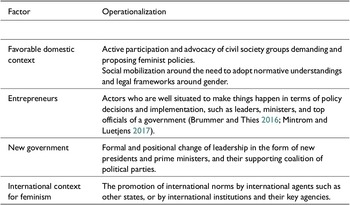
Haesebrouck and Joly (Reference Haesebrouck, Joly, Haesebrouck and Joly2021b) present a series of external and domestic factors to account for foreign policy change. At the domestic level, leader and government coalition change are key, as well as the agency of entrepreneurs that work with a favorable domestic context promoted by domestic groups channeling their domestic societal demands to a new government coalition. Thus, not all changes are crisis driven and can also start due to domestic groups promoting a particular type of policy (Leeds and Mattes Reference Leeds and Mattes2022). This understanding and factors of foreign change mentioned above are also consistent with more recent works that adopt an events-based account of change in the form of shocks (be these domestic and/or external). One key variable here relates to a new leader and government coalition in power. An electoral shock creates a window of opportunity in which entrepreneurs are able to reduce the pressure of domestic constraints inhibiting change and rely on favorable contexts and advocates’ agency to adopt a new type of foreign policy goal, perspective, and behavior (see Thies and Wehner Reference Thies, Wehner, Thompson and Volgy2023; Thompson and Volgy Reference Thompson, Volgy, Thompson and Volgy2023). Thus, we frame the following domestic factors for change using the literature on FPC as follows: 1) a favorable domestic context constituted by the agency of civil society groups and demands advanced over time and present in public debate; 2) the role of policy entrepreneurs (which also includes formal leaders such as presidents and prime ministers); and 3) a new governing coalition that brings a new group of decision-makers, policy ideas, and ideology contrasting a previous government (see Table 1).
Foreign policy change and FFP

Foreign policy change and FFP in Chile and Sweden

Haesebrouck and Joly (Reference Haesebrouck, Joly, Haesebrouck and Joly2021b) also analyze external factors that facilitate change, including systemic ones that are more material and less normative. Yet, they do also mention the importance of international norms and international institutions which help to reduce the emphasis on shocks and crisis of some kind as triggers of FPC (see Gustavsson Reference Gustavsson1999; Hermann Reference Hermann1990; Thompson and Volgy Reference Thompson, Volgy, Thompson and Volgy2023). International norms (see Brazys, Kaarbo, and Panke Reference Brazys, Kaarbo and Panke2017) and institutions may encourage a state to adopt a particular foreign policy. A supportive international environment around progressive ideas around gender may offer an opportunity and an incentive for actors to innovate, advance a status strategy (Larson and Shevchenko Reference Larson and Shevchenko2010), and brand themselves around. Thus, norms and international institutions together constitute the process of socialization and the promotion of gender and feminist norms, which we call the existing international context for feminism (see Table 1). Feminist foreign policy scholarship has been far more interested than FPC in thinking about the role that norms play in encouraging uptake of gender equality platforms (Krook and True Reference Krook and True2012, Zhukova, Sundström, and Elgström Reference Zhukova, Sundström and Elgström2021; Zwingel Reference Zwingel2012, Reference Zwingel2017). Furthermore, the wholesale adoption of a feminist approach to foreign policy suggests, at least in name alone, a new approach.
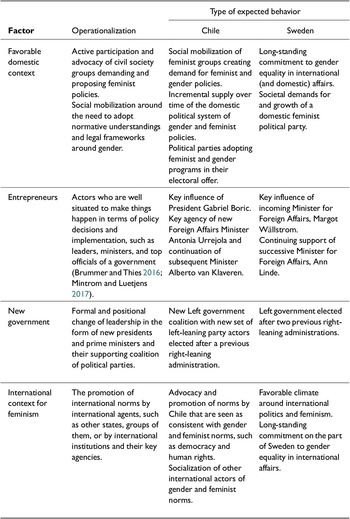
Despite certain oversights, the abovementioned literature on change may help us to make sense of the process in which FFP is conceived, advanced, and located as a constitutive part of the foreign policy of the state. The literature on foreign policy change highlights key forces such as a favorable domestic context, the role of entrepreneurs and a new government at the domestic level, and an international context for feminism, all of which we argue in the below carry key importance (Haesebrouck and Joly Reference Haesebrouck, Joly, Haesebrouck and Joly2021b, Leeds and Mattes Reference Leeds and Mattes2022). On the other hand, this literature might learn from FFP work, which stresses the ethical and normative aspects of feminist approaches. Thus, we focus on these steps and processes that allow the adoption of FFP by using the factors named above that the literature on FPC stresses (Haesebrouck and Joly Reference Haesebrouck, Joly, Haesebrouck and Joly2021b). These different elements serve as analytical yardsticks to organize and structure the empirical analysis of the Chilean and Swedish case. However, it is important to note that we do not expect all these factors to play an equal role in the process of adopting an FFP in Sweden and Chile.
Genealogical Framework and Process Tracing
Before moving into the empirical analysis, it is pertinent to connect the theorization with our methodology. This paper adopts a process tracing framework, asking how the development of FFP occurred in both Sweden and Chile to the point that both took the formal decision to establish a new type of foreign policy. Process tracing allows us to recreate the different steps of the actors involved in the process leading to adoption, providing an understanding of how agents navigate the existing structures and contexts at both the domestic and international level. Moreover, process tracing is consistent with interpretive approaches such as practice tracing (Pouliot Reference Pouliot, Bennett and Checkel2014), and forms of historical process tracing (Price Reference Price1997). Rubach (Reference Rubach2010) shows how narrative analysis adds texture to the sequence of events that occurred to make a decision and policy possible.
A historicist approach to process tracing is also important when studying changes in foreign policy. As Subotic (Reference Subotić2016) asserts, when advancing change, actors need some sort “storical” continuity. Wehner (Reference Wehner2020) argues that processes of change only make sense when anchored against existing historical experiences and practices of the nation that inform the present, and thus, the novelty of change. Thus, we recreate the story and events that brought Chile and Sweden and their different actors to set up an FFP through a framework of four indicative elements which were identified from the research (favorable domestic context, entrepreneurs, new government, and the international context for feminism).
In addition to the above, we also conducted interviews with key actors in both countries in addition to surveying secondary media articles, policy papers, and literature on the social and political context in both countries. Looking beyond just the formal outputs of states in relation to their FFP and situating them in a wider context helps to create a clearer picture of how they came to be. As Chappell and Mackay note, we need to “not … accept what we see from the outside at face value” (Chappell and Mackay Reference Chappell and Mackay2020, 10). This triangulation of sources helped to situate FFP in its specific context in both case studies and to engage in the method of process tracing. Seven interviews were conducted with civil society actors in the Swedish context. Interviewees were approached following a survey of existing gray literature on the Swedish context of FFP which helped to identify suitable candidates. Five interviews were conducted individually with one author, and two interviewees were interviewed simultaneously. Interviews were semi-structured, based around questions related to actors’ understanding of the context around 2014 when FFP was first announced. They were conducted online (Zoom) in English. The interviewees are representatives of Swedish civil society organizations and asked their responses to be anonymized. In the case of Chile, three interviews were conducted with academics and diplomats that have acted as FFP policy advocates. Some of them are currently in key governmental positions and thus in charge of giving substance to the announcement of an FFP under the government of President Gabriel Boric. Another interview was conducted with the then-foreign policy program officer of then-presidential candidate Paula Narvaez from the center-left coalition. One additional interview was conducted with one of the spokespersons of the presidential campaign of then-senator Yasna Provoste during the Chilean presidential elections of 2021, who was also one of the creators of the gender parity electoral formula for the Chilean Constitutional Convention. These interviews were conducted online (Zoom) and in Spanish.
Sweden
Favorable Domestic Context
There is a long history of gender equality within the Swedish state, situated within the strong history of women-friendly welfare states in the Nordic region (Bergman Rosamond Reference Annika2013; Borchorst and Siim Reference Borchorst and Siim2002). Gender equality is part of Sweden’s international reputation and a framing that it has used in the context of its national “branding” (Einarsdóttir Reference Einarsdóttir2020; Jezierska and Towns Reference Jezierska and Towns2018). As a result, gender equality and feminism were an accepted part of Swedish society at the time of the initial FFP adoption. Interviewees referenced the particular context in the run-up to the 2014 election, in which the Feminist Initiative (F!) party performed well, and in which there was, in the words of one interviewee “a feminist wave sweeping over Sweden … everyone was a feminist … the time was ready for them to use that term” (Interview 4). The party was the fastest growing in Sweden at this point, enrolling over 20,000 new members in 2014 alone (Filimonov and Svensson Reference Filimonov and Svensson2016). This favorable political context for feminism meant that it “wasn’t such a big step, perhaps, [for the government] to take” (Interview 4) by adopting FFP.
Interviewees also stressed that FFP was part of a wider agenda in terms of Swedish policymaking around gender. They repeatedly pointed out that Sweden has a long history of promoting gender equality “since the mid-nineties at least” (Interview 1; also Interview 3; Interview 4; Interview 6). Gender equality has long been seen as a key aspect of Swedish foreign policy (Bergman Rosamond Reference Annika2013). FFP was therefore another iteration of this long existing agenda, rather than a dramatic change in policy direction.
Finally, the fact that there had been a prior declaration of feminist domestic policy in Sweden was also important for a new FFP. The incoming Prime Minister, Stefan Löfven, had repeatedly declared himself to be a feminist (Filimonov and Svensson Reference Filimonov and Svensson2016). As one interviewee described it, “when the feminist foreign policy was first launched, it was together with Sweden declaring itself to be a feminist government, it was bigger than just a feminist foreign policy” (Interview 4). This movement toward FFP was not just the addition of a new foreign policy, but part of a much wider agenda across the entire program of government.
Policy Entrepreneurs
Margot Wallström, the former Minister for Foreign Affairs, was a key actor in the context of Sweden’s FFP (Aggestam and Bergman-Rosamond Reference Aggestam and Bergman-Rosamond2016). Wallström announced the FFP in 2014 and spearheaded its successful integration into the Swedish government. When asked where they thought FFP had originated from in Sweden, all seven interviewees independently brought up the importance of Wallström in instigating and pushing through the policy. As one described it, “Wallström … she’s the mother of this [FFP]” (Interview 3). Wallström, and her position in the Ministry of Foreign Affairs, were seen across the interviews as being the originators of the FFP agenda, as opposed to civil society. As one interviewee stressed “it really did come … from the Ministry” (Interview 1) and seemed to have been largely a surprise to civil society, rather than a policy which was formulated in conversation with them (Interview 4; Interview 6; this is reiterated also in Gill-Atkinson et al. Reference Gill-Atkinson, Ridge, Pradela, Tilbury, Warambourg and Porras2021).
Wallström has been personally strongly associated with FFP, particularly in its early years. Numerous international media articles clearly associated the advent of FFP with Wallström and her personal history,Footnote 5 and a documentary has been made about her time as Foreign Minister.Footnote 6 Wallström’s previous role with the UN as Special Representative on Sexual Violence in Conflict from 2010–12 also gave her key institutional experience in relation to gender equality within international affairs. Wallström’s personal commitment to feminism and to furthering gendered issues within her various mandates and her career at large are therefore key to the advent and success of FFP in the Swedish context. As one interviewee described it, “it would have surprised me if she had taken over that position [Foreign Minister] without putting gender at the front-center” (Interview 4). The role of an entrepreneur was therefore key in the Swedish context, demonstrating that FFP was not just a development of feminist norms, but also a result of a specific person who had power at a specific time.
New Government
FFP in Sweden was announced in the context of a new left-leaning coalition government. In this context, pressure from other electoral forces was also key, particularly the impact of the feminist political party, F!. F! was formed in 2005 and had been relatively minor, but as discussed above, was experiencing greater momentum at the time of the 2014 elections. It won 3.1% of the national vote in the 2014 elections and one seat in the European Parliament the same year. Their growing success led to a contagion effect in which other parties were keen to adopt more feminist principles (Cowell-Meyers Reference Cowell‐Meyers2017; Filimonov and Svensson Reference Filimonov and Svensson2016). While this was particularly seen on the left, where F! challenged other left-wing parties in terms of their vote share, it was also seen in more mainstream political parties and thought, where they displayed “disproportionate influence” (Cowell-Meyers Reference Cowell‐Meyers2017, 490). Interviews reiterated the impact that F! had at the time on political discourse (Interview 1; also Interview 4). The adoption can therefore be seen in part as a response to political context, and not only a desire to support feminist norms.
The previous two Swedish governments had been led by a center-right coalition. From 2014, a center-left coalition of the Social Democrats and the Green party took power, supported by the Left party from December of that year. The makeup of this new coalition was cited in interviews as being an important factor, with the feminist perspective of the Greens referenced as being key (Interview 4), in addition to the strong traditional links the Social Democrats had to the organized women’s movement. The development and announcement of Sweden’s FFP therefore happened at a critical juncture in the country’s politics. The country’s administration had taken a decisive shift, with a new government and new leadership. This provided the opportunity for a moment for policy change and for the announcement of a new direction in foreign policy.
International Context for Feminism
As previously discussed, feminism and gender equality are increasingly seen in multilateralism and individual states’ policies as important to security, defense, and international politics. More broadly, the feminist zeitgeist allowed for greater acceptance of the term (Banet-Weiser, Gill, and Rottenberg Reference Banet-Weiser, Gill and Rottenberg2020). There was therefore a welcoming international context for the announcement of FFP. Furthermore, interviewees stressed how adopting FFP gives Sweden a clear brand on the world stage. As one interviewee described it, “Sweden loves to export … good guy ideas,” going on to acknowledge the strategic importance that FFP has for the country: “this is what we want the world to know us for, and this is what we bring to the table, in the… from the international arena.” (Interview 1; also Interview 6; Interview 7) The advent of FFP ties into the existing ideas that the country has of itself on the international stage as a gender equality actor (Jezierska and Towns Reference Jezierska and Towns2018; Larsen, Moss, and Skjelsbaek Reference Larsen, Moss and Skjelsbaek2021; Towns, Karlsson and Eyre Reference Towns, Karlsson and Eyre2014; Zhukova Reference Zhukova2021) — but also as a middle power, eager to work multilaterally and happy to be seen as a key player on development issues. It can thus be understood as a strategic, as much as a normative, framework (Stamm Reference Stamm2023).
Chile
Favorable Domestic Context
Chilean University students mobilized in 2018 to demand for further set of normative principles and policies regarding gender and feminism. The social mobilizations of female university students were also supported by a broader set of social movements and public opinion. In a way, this social articulation of gender and feminist issues was similar to the #Metoo movement (Arce Reference Arce, Reverter and Molini2022). In the following year, Chile again experienced social unrest and mobilizations of different groups of civil society. A student mobilization was the starting point for other societal groups to join these political and social manifestations on the streets of Chile. These societal groups demanded social inclusiveness, social justice, and equality, and called for stronger redistributive social policies (Bywaters, Sepúlveda, and Villar Reference Bywaters, Sepúlveda and Villar2021).
Feminist groups (colectivos) were key actors within the social movement and street manifestations against the current system in Chile in 2019 (Interview 5). Their demand was to advance a gender equality policy agenda, especially the provision of more protection to women experiencing violence. Femicide cases were increasingly covered by media as the outcome of systematic abuse and violence against women. Femicides also highlighted deeper day-to-day patterns of violence. They also reflected a lack of policy and social provisions for women from the state apparatus. While in previous governments progress was achieved, such as the creation of a special Ministry to promote women’s rights and equality in 2016 (Arce Reference Arce, Reverter and Molini2022), the practice of violence against women was still being normalized in Chile’s society.
Thus, the active political mobilizations of the Chilean social movement in 2018 and 2019 amplified the visibility of gender and feminist advocacy groups and on the need to introduce a new set of gender and feminist policies within the state apparatus (Sepúlveda Soto Reference Daniela, Bywaters, Soto and Gertner2021). The social unrest and mobilization of a vast sector of civil society in 2019 also helped to cement a favorable context for open debate on the normative substance of gender and feminist issues. These issues were part of a broader pool of societal demands, but social movement activism centered feminist questions. In other words, the agency of domestic sectors was key to articulate and create a new context that was now more receptive to include new principles and policies at the interplay gender and feminism.
Policy Entrepreneur
A favorable context still needs direction and advocacy to convince state actors of the appropriateness and convenience of adopting an FFP. Within the Ministry of Foreign Affairs, there had been advance work to prepare for an FFP. Carola Muñoz, former advisor of the then Minister of Foreign Affairs, Antonia Urrejola (2022–23), mentions that Chile’s Free Trade Agreements (FTA) policy need renegotiations and updates when in place for a long period of time. When different FTAs had been updated, this allowed for the possibility to include sections on gender issues (Interview 1; Sepúlveda Soto Reference Daniela, Bywaters, Soto and Gertner2021).
Moreover, internal advocacy for gender equality and feminist principles within the organization of the foreign affairs office had been resisted (Interview 1). During his electoral campaign, President Boric (2022–present) promised to adopt principles of gender parity within the government (Manifiesto Programático Gabriel Boric Presidente 2021). He also promised to implement a new foreign policy that is multilateral, pro-climate protection, and feminist. Once in power, he appointed Antonia Urrejola as new Minister. She became the key actor to implement an FFP. Symbolically, she enjoyed credibility within the masculine structure of the foreign affairs office (Interviews 1, 2, and 3). She served as High Commissioner of Human Rights Issues at the Organization of American States (OAS) in 2018–21, where she oversaw human rights problems, including sexual rights and gender issues (see Nueva Política Exterior 2022).
As an entrepreneur, she appointed a female diplomat as head of the diplomatic academy training in order to introduce a gender and feminist program to make sense of this new foreign policy. She also appointed Andrés Villar Gertner as Director of Strategic Planification at the Ministry of Foreign Affairs. These two appointees are also members of an advocacy group “New Foreign Policy” to which Muñoz and Urrejola also belong. This group promotes the idea of a new foreign policy that is feminist, turquoise (named in this way to refer to a strong climate protection oriented foreign policy), and multilateralist (Bywaters, Sepúlveda, and Villar Reference Bywaters, Sepúlveda and Villar2021). This group published a book in 2021 to offer conceptual and empirical ideas of how to advance this type of foreign policy for Chile (Bywaters Sepúlveda, and Villar Reference Bywaters, Sepúlveda and Villar2021). Other members of this group have also been appointed in strategic posts within the foreign affairs ministry (see Nueva Política Exterior 2022). The strategic decision to form a cohesive group in key positions spoke of Urrejola’s determination to advance an FFP. The new FFP has become the cornerstone of a new foreign policy orientation and these policy entrepreneurs are introducing changes at the formative, bureaucratic, and external behavior of Chile as international actor. The idea of a new FFP along the other new pillars is that Chile develops a reputation around these issues to make eventual policy reversion difficult to achieve (Interview 2).
The change of Minister Urrejola (as entrepreneur) for Alberto van Klaveren as member of the traditional foreign policy establishment under democratic rule did not weaken the advance of the FFP. In fact, he adjusted the narrative of an FFP by stressing how this policy, along with the environmental pillar and multilateral vocation of Chile’s foreign policy under the government of Boric, were embedded in Chile’s traditional view of and actions in the international. van Klaveren and his team highlighted that the FFP, as new as it is, is also part of Chile’s consistent actions, and thus, part of the human rights policies and credentials of this country since the return to democracy in the early 1990s. Chile’s foreign policy has been about promoting the norms of democracy and human rights multilaterally, which is consistent with and underpins the promotion of gender and feminism in the foreign policy of this country (see MINREL 2023, 6–7). This adjustment move from the new Minister was meant to advance the policy mandate of President Boric and reduce resistance amongst foreign policy sceptics to the FFP change and elevate Chile’s international status (MINREL 2023; Pérez Reference Pérez2023). At the same time, this adjustment change allowed for “storical” continuity in Chile’s foreign policy, and thus anchor and frame the FFP as a process of continuity in change (MINREL 2023, 22–5).
Thus, we observe the work of different entrepreneurs in the new government of which the agency of President Boric has been fundamental to the adoption of gender and feminist principles. He declared the new government to be feminist. We also observe the driving force of then Minister Urrejola and her team of experts that started framing a new foreign policy for Chile from a think-tank before they took their respective post in the foreign affairs office. However, it is also possible to see that the new Minister substituting Urrejola has not undone the previous work on gender and feminist principles. In fact, the new Minister van Klaveren has managed to embed the FFP within the existing traditional principles of Chile’s foreign policy with the purpose of easing the reluctance and resistance amongst different domestic groups and the foreign policy elite to an FFP.
New Government
As a consequence of the social movement for greater equality, both the center-right government of then-President Piñera (2018–22) and political parties agreed on the need to channel the societal demands by calling for a political plebiscite about a new constitution. Chile was involved in a process of writing a new constitution that would replace the existing one approved under Pinochet (1973–90).Footnote 7 The constitutional draft sought to introduce a new series of principles and social rights. It also includes principles of parity in political participation and representation (Interview 5), as well as crystallizing the demands of gender equality and feminist societal groups (see Borrador Nueva Constitución 2022). Furthermore, the electoral context of the presidential election provided a window of opportunity for policy advocates advancing gender equality and feminist norms, values, and principles. In fact, all center-left candidates adopted feminist principles in their foreign policy programs, while now-President Boric and candidates Paula Narvaez and Yasna Provoste explicitly named their foreign policy program as feminist (Interviews 4 and 5; see Programa de Gobierno 2022-2026 Yasna Provoste Campillay 2021, 155). One of the two right-wing candidates (first presidential round), Sebastian Sichel, also proposed advancing and implementing gender principles in his government, such as the promotion of gender equality as part of Chile’s foreign policy (see Programa de Gobierno 2022-2026 Sebastian Sichel 2021, 33).
The societal pressure on political parties and presidential candidates was the result of social unrest, and the mobilization of feminist groups in 2018 and 2019 around the reality of femicides. Gender equality and the development of a safety net for women and minority groups started to take form in new laws. One example is the change and update of femicide law in 2020 (in place since 2010) to process societal demands for more protection and higher sanctions to perpetrators. Thus, the Chilean political system experienced pressure from advocacy groups, social movements, and epistemic communities; pressures that were processed by the presidential candidates and congress. Most of the pressure exerted was regarding gender equality issues at the domestic level, but such pressure also permeated and gave momentum to locate the need for a feminist foreign policy agenda. Domestic advocacy is key to pressure the political system as a whole, but above all to translate such demands into concrete policy outputs regarding gender and feminist policies.
The new FFP was officially announced as soon as Boric took office on March 11, 2022, so the FFP was announced in the context of a new government. A new government with a new set of ideas provided the policy space for innovation and change in Chile’s foreign policy. The idea of an FFP was already present and was socialized during the electoral campaign in 2021. The new government was underpinned by a coalition of left-leaning parties called Social Convergence and the Broad Front. These coalitions enacted the ideals of feminism, and within it there are proactive feminist movements. The new political coalitions, and within it the inclusion of progressive ideas, was key to understanding the shift in foreign policy and the adoption of feminist principles (Interviews 2 and 3). Thus, the formal announcement of an FFP for Chile as soon as the administration of Boric started responds to a critical juncture that provided a window of opportunity to formalize a new foreign policy for Chile.
International Context for Feminism
The norms of feminism and gender equality are present in the institutional makeup of the UN. Regional institutions such as the Organization of American States (OAS) has also promoted these norms and others such as human rights. These norms have permeated the domestic context and matched societal demands of advocacy and social movements that were previously left out of the decision-making process (Friedman Reference Friedman2009; Roggeband Reference Roggeband, Vleuten, Eerdewijk and Roggeband2014). Therefore, Chile experienced a welcoming international context supporting the development of an FFP. Moreover, the fact that other states, such as Sweden and Canada, that Chile identifies with or used as role models in gender policies also adopted an FFP, were key for Chile’s decision to adopt this policy (Interviews 1, 2, and 3).
The branding of an FFP by the new Chilean authorities relates to a need to strategically create identification with the new policy, especially when the existing cultural material to create identification is rather thin and politically contingent (Thies and Wehner Reference Thies and Wehner2021). This new FFP also matches Chile’s foreign policy tradition of being a responsible power that on certain occasions can act as role model for others in the region of Latin America. Moreover, the formal adoption of the FFP has created new opportunities for Chile in the international as a type of social mobility strategy — that is, status and branding. The idea of generating more influence for Chile in the international has eased the reluctance amongst members of the foreign policy elite (Espinoza Reference Espinoza2022). Chile started to access a new group of states and position herself in UN agencies to shape and influence the development and implementation of gender policies and its intersectional aspects in the UN. Without the name FFP, Chile would perhaps not have accessed the coalition of states at the UN working on and leading debates around gender (Interview 3; see also, Espinoza Reference Espinoza2022). Thus, the adoption of a FFP in Chile’s case was facilitated by a welcoming external context for feminism and its agents.
Discussion
Sweden and Chile are at very different points in their FFP journeys. Sweden developed and worked with the concept of FFP for almost a decade, before rejecting it following a change of government in 2022 (Towns, Jezierska, and Bjarnegård Reference Towns, Jezierska and Bjarnegård2024); Chile only first adopted it in 2022, with a change of government bringing a new ideology and set of ideas that have been long present amongst some civil society groups. Sweden produced multiple iterations of its policy documents in relation to this agenda, including a handbook encouraging other states to follow suit; Chile has written a formal policy and is in the process of implementing it. Despite clear differences, a series of key factors encouraged both states to adopt FFP. These map onto existing work in this area and reinforce previous findings about how FFPs come to be announced by governments (Gill-Atkinson et al. Reference Gill-Atkinson, Ridge, Pradela, Tilbury, Warambourg and Porras2021). They also tell us much about how FFP as a type of foreign policy change has been possible in these cases.
Firstly, both states had highly favorable domestic contexts which allowed for governments to make such policy announcements. The social upheaval in Chile was underpinned amongst others by social movements promoting gender equality for decades. While progress in Chile on gender and feminism has been implemented especially since the 1990s, these social demonstrations precipitated deeper progress and public debates about gender issues. In Sweden, there is a long history of gender equality policy and public understanding of and support for feminism. This was reinforced through feminist social movement and political activity at the time of the initial FFP announcement, and particularly the influence of the F! party. Both case studies also saw the FFP agenda promoted by key policy entrepreneurs. In Sweden, Wallström’s connection to the policy was key, while in Chile there is a cohesive group of policy entrepreneurs working to cement FFP within the state apparatus.
Secondly, both states witnessed specific moments of political pressure along with the window of opportunity of a new government. Both the coalition government in Sweden from 2014 and the Boric Presidency in Chile from 2022 were electoral shock events in each country’s politics. They provided a window of opportunity for a radical rethinking of domestic and foreign politics, including key changes such as FFP. The force of a change of government was combined with pressure from other sources — again in Sweden, the F! party had gained considerable ground and was encouraging wider political debate around feminism (Cowell-Meyers Reference Cowell‐Meyers2017; Filimonov and Svensson Reference Filimonov and Svensson2016), and in Chile, the combination of social activism (much of it underpinned by feminist ideas [Cruz Reference Cruz2023]), the process of rewriting the constitution, and the presidential debates and election. In both contexts, this political contagion around the ideas of gender equality and feminism helped to create fertile grounds for FFP.
Furthermore, both contexts benefited from a favorable international context for feminism and gender. Favorable discourse around feminism, including in key multilateral institutions such as the UN as well as regional bodies, helped to create an environment in which feminist policymaking no longer seemed impossibly radical. Both states appeared keen to adopt the FFP brand and the idea of themselves as feminist actors on the world stage.
Beyond the comparative empirical discussion offered here, this article shows the mutual benefits of merging theorizing on FFP with broader FPA literature. As stressed earlier, the normative underpinning of much work on FFP has produced a distance from mainstream FPA approaches such as that of FPC, while the latter research agenda suffers from a lack of critical scrutiny and has remained silent on questions of gender (Achilleos-Sarll et al. Reference Achilleos-Sarll, Thomson, Haastrup, Färber, Cohn and Kirby2022). This initial discussion of FFP in the context of FPC concepts shows that many can be fruitfully used to explain this turn to feminism in foreign policy. As the above discussion shows, and different work on FPC emphasizes favorable domestic context built by domestic actors, the agency of entrepreneurs, a new government, and a welcoming international context for FFP are key aspects present in the FPC literature (Haesebrouck and Joly Reference Haesebrouck and Joly2021a; Hermann Reference Hermann1990; Thompson and Volgy Reference Thompson, Volgy, Thompson and Volgy2023). Existing ideas around foreign policy change can clearly speak to the development and adoption of FFP. In doing so, they help to tell a broader story about FFP than has largely been told in the literature so far. A focus on normative evaluation in FFP literature means that the emphasis tends to be on the “finished product” of final policy documents, speeches, or actions on the part of key actors of the state. As a result, there is less emphasis on the more granular process of how FFP came to be adopted — the politics of individuals and actors involved; the importance of domestic and international feminist discourse and social movements; the role of internal political change, ideologies, and key events such as elections — even though this has much to tell us about how (purportedly) feminist change happens (Chappell and Mackay Reference Chappell and Mackay2020). Without this emphasis on institutional uptake, we cannot see the full picture of FFP’s adoption.
At the same time, and as much of the literature on FFP stresses, we have shown that successful adoption of it as a framework is related not just to institutional context, but to broader international norms around feminism and gender equality. The literature on FPC has tended to emphasize the role of external shocks (see Gustavsson Reference Gustavsson1999; Hermann Reference Hermann1990; Thompson and Volgy Reference Thompson, Volgy, Thompson and Volgy2023), rather than the gradual adoption of norms. A consideration of FFP thus prompts the wider field of FPA to think about more subtle mechanisms of change. Foreign policy change in many cases, particularly in the case of a deliberatively ethical framing of foreign policy as in the case of FFP, may be the result of “incremental changes” over time (Haesebrouck and Joly Reference Haesebrouck and Joly2021a) rather than the exclusive force of severe crisis, in which change materializes in a sudden way.
Conclusion
FFP has experienced notable setbacks in recent years. Its founding state, Sweden, abandoned its commitment in 2022 (Towns, Jezierska, and Bjarnegård Reference Towns, Jezierska and Bjarnegård2024), and Argentina’s adoption of FFP in 2023 vanished with the new government of right-wing populist leader Javier Milei in 2024. The electoral victory of right-wing populists in the Netherlands may see similar results for FFP there. As an idea however, FFP is continuing to gain traction, with international civil society paying it increasing attention.
As discussed above, academic work on it is also flourishing. However, very little of the existing FFP literature has adopted a comparative perspective, and most literature to date has focused on Sweden and Canada as the countries with the most established policies. This work has also tended to look at the normative and ethical underpinnings of FFP, rather than the political contested processes that have led to its uptake. Thus, we know more about what FFP is or should be, rather than about how it has come to be announced and promoted. This article has begun a tentative addition in this direction. Taking a comparative approach to FFP adoption, a number of key factors that lead to the uptake of FFP have been identified. In particular, the roles of the favorable domestic context, policy entrepreneurs, a new government, and the international context for feminism, were all highlighted as having clear impact on the decision to adopt FFP.
In doing so, it has pushed our understanding of FFP forward in two ways, by highlighting both the political structures and processes that create FFP, and how FFP may be analyzed from the perspective of existing FPA literature, more specifically that of FPC. In so doing, this work helps to answer the call for greater interaction between FFP work and mainstream FPA (Achilleos-Sarll et al. Reference Achilleos-Sarll, Thomson, Haastrup, Färber, Cohn and Kirby2022; Aggestam and True Reference Aggestam and True2020, Reference Aggestam, Bergman-Rosamond and Hedling2024; Sjoberg and Thies Reference Sjoberg and Thies2023) and has shown that the benefits of this conversation are mutual. FPA work, including that of FPC to date, has largely not adopted a critical perspective as it has been encouraged by scholars (e.g. Brummer Reference Brummer2022), and questions of gender have been occluded. This article has provided an additional step in thinking about how gendered questions might influence FPA and FPC alike. Future work may expand this present analysis by focusing on the types of changes that FFP involves, which in our account hints toward incremental changes that the FFP brand brings, allowing for further interaction and mutual dialogues between FFP and FPC. Further work might also address the extent to which a feminist identity is linked to states such as Sweden and Chile that are distinctly “middle” powers, and the ways in which adopting feminist policies helps such countries to cast issue-specific status strategies to distinguish themselves on the global stage.
Acknowledgments
Jennifer Thomson’s contribution to this article was supported by ESRC grant ES/V016407/1.

 Open access

