Introduction
Hydrogen is, still, the most abundant matter in the universe. Unimaginably, astronomically long times warrant that physical processes with extremely small probability such as proton tunneling eventually manifest in the proton–proton reaction where two hydrogen nuclei approach each other so close that they melt into a deuterium nucleus and further react to a helium nucleus. Subsequent chain reactions cause radiative energy release in the MeV range.
Reference Bertulani and Kajino1,Reference Adelberger, García, Robertson, Snover, Balantekin, Heeger, Ramsey-Musolf, Bemmerer, Junghans, Bertulani, Chen, Costantini, Prati, Couder, Uberseder, Wiescher, Cyburt, Davids, Freedman, Gai, Gazit, Gialanella, Imbriani, Greife, Hass, Haxton, Itahashi, Kubodera, Langanke, Leitner, Leitner, Vetter, Winslow, Marcucci, Motobayashi, Mukhamedzhanov, Tribble, Nollett, Nunes, Park, Parker, Schiavilla, Simpson, Spitaleri, Strieder, Trautvetter, Suemmerer and Typel2
Our sun is a hotspot, one hundred million miles away in safe distance from the Earth, where the proton–proton reaction has taken place for 4 billion years and will continue so for the next 4 billion years to come. About 95% of our energy supply today on our planet derives from the energy which we receive from the sun.
3
Given this size of the matter, is there any doubt that our current Terawatt Challenge
Reference Smalley4
can be met?
Access to energy is a precondition for economical welfare and for social welfare. While fossil fuels and nuclear power dominate world energy supply, renewable energy has an increasing share in the energy mix. Fear for global warming with gross scenarios such as a new mass extinction of species
Reference Barnosky6
or flooding and droughts has helped increase efforts in sustainable development, and peer pressure by the sustainability movement helped to turn the direction.
Reference Priddy7
The world energy consumption is to 20% electric energy. The other 80% are provided by all kinds of fuels. With increasing electrification in our modern world, an increase of the share of electric energy to >20% is anticipated.
Reference Thapper, Styring, Saracco, Rutherford, Robert, Magnuson, Lubitz, Llobet, Kurz, Holzwarth, Fiechter, de Groot, Campagna, Braun, Bercegol and Artero5
Such growth would be good news for the photovoltaic industry and business, and for wind and hydropower.
Would not it be great if still the 80% of fuels (fossil, nuclear, biomass) could be produced by renewable energy? The idea of the hydrogen energy economy is almost 100 years old
Reference Bockris8
and is based on the calculation that transporting energy as H2 gas through pipes is less costly than by electricity running through electric cables.
Reference Gregory9,Reference Gregory, Ng, Long and Bockris10
Artificial photosynthesis for the production of solar fuels, inspired by Ciamician over 100 years ago,
Reference Ciamician11
took center stage in the early 1970s in response to the first Arab Oil Crisis.
Reference Eden12
The interest in solar fuels faded away when oil prices came down again. With efforts in the space exploration programs in the 1950s and 1960s, and the onset of the Green movement in the 1970s, fuel cell and battery research became part, and in the late 1980s the integral part of general energy research.
Reference Thapper, Styring, Saracco, Rutherford, Robert, Magnuson, Lubitz, Llobet, Kurz, Holzwarth, Fiechter, de Groot, Campagna, Braun, Bercegol and Artero5
The senior author of this commentary researched at Berkeley National Laboratory on lithium batteries and photosynthesis from 1999 to 2001. In the presidential election campaign 2000, George W. Bush emerged as an oil-friendly candidate.
Reference Seelye13
When George W. Bush was inaugurated in January 2001 as the 43rd President of the United States, some senior leading staff at LBNL expressed at one of our informal meetings their worries that “now we can forget about all of our fuel cell research funding.”
To our surprise, only two years later, in his State of the Union address on 28 January 2003,
Reference Bush and Secretary14
President Bush announced “Tonight I am proposing $1.2 billion in research funding so that America can lead the world in developing clean, hydrogen-powered automobiles.”
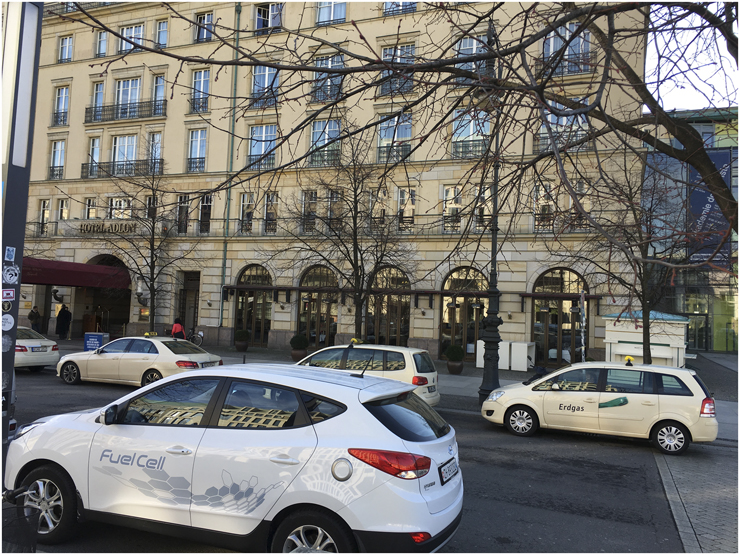
The senior author of this paper spotted the first fuel cell electric vehicle (FCEV) in December 2010 on a Highway in Honolulu—still loaded on a truck.
Reference Motavalli15
In December 2016, the big picture
Reference Ginley, Cahen and Kócs16
of renewable energy condensed to a personal life experience when he had his first ride with a commercially available FCEV in Switzerland. By September 2017, he had a record of over 7500 km driven with hydrogen across Europe. He had been filling the FCEV at eleven different publically accessible hydrogen pumping stations in Belgium, Germany, and Switzerland. The infrastructure for such long distance travel is thus there. H2 Mobility in Berlin, a spin-off company from 11 global players, is aiming at operating 400 such H2 filling stations in Germany by 2023.
17
Their mobile phone app H2.LIVE showed on 30 October, 2017, over 64 H2 filling stations in operation, 59 of them were ready for filling, spanning ten countries from Scandinavia to Italy. Has hydrogen economy arrived? The Germans have already two large H2 pipeline systems in operation, the longest of which with 240 km at 25 bar pressure; they estimate that their H2 mobility infrastructure will cost 61 billion Euro.
Reference Emonts, Schiebahn, Görner, Lindenberger, Markewitz, Merten and Stolten18
Given that the existing oil-based economy was not based on the principles of competitiveness,
Reference Olson and Lenzmann19
there will not be too hard feelings with continuing the renewable way.
In the 1930s, Franz Lawaczeck supposedly “pointed out that, due to the low viscosity of hydrogen, it would be cheaper to transport energy in the form of hydrogen in pipes rather than electricity in wires”.
Reference Bockris8
Gregory et al. published a quantitative study in 1972 and also addressed the potential concerns about gas safety and compared with natural gas.
Reference Gregory, Ng, Long and Bockris10
At the macroscopic scale, transport properties of hydrogen and electrons do obviously play a role in the optimized “logistics” of energy. It sure does so at the microscopic scale, as we see later in this commentary. Storage and transport of energy in general and electric charge carriers in particular is essential for our modern society’s needs for technology.
Lawaczeck likely considered H2 as fuel for transportation powered by combustion engines. Despite all advancement in modern combustion engine technology, such engines are subject to Carnot’s fundamental thermodynamic limitation of efficiency. Electrochemical energy conversion in batteries and fuel cells is not subject to Carnot’s limit and hence can be more efficient. A FCEV with 5.63 kg H2 which you can fill in only 3 min can bring you as far as 600 km (at moderate speed), at a nominal price of around 50 Euros: this is the reality which the senior author of this commentary has tested over 7500 km in 10 months with hydrogen produced by local water power, local solar power, and as a side product from chemical industry, for example. This corresponds with the energy of almost 50 L of gasoline from crude oil which was shipped over the oceans. This sounds very promising even after reading Refs. Reference Hermans20 and Reference Liu, Ross and Newman21 which favor battery powered vehicles. Is it still necessary to do the math when comparing these numbers? Given that such a car is sold for around 66,000 Euros, it easily outperforms the projections in Fig. 1 of Ref. Reference Liu, Ross and Newman21. For sure, costs and prices for the FCEV will come down once larger number of cars are manufactured and sold.
The argument of higher thermodynamic efficiency is one reason why fuel cells have been further developed for automotive propulsion. Another reason for deploying fuel cells is that they do not produce air pollution, in contrast to combustion engines, and they run on hydrogen from renewable energy.
One scientifically trivial but important technical detail in electromobility technology is that it is not only the electrons which bring about the electromotoric force necessary to power the electric motor but also the ions, particularly protons H+ in the fuel cells and lithium Li+ in the batteries, which are stored as chemical energy in the hydrogen fuel and in the battery electrodes, respectively.
The electron is a well-understood charge carrier in condensed matter physics. Its transport behavior in the well-conducting metals was first described by Drude.
Reference Drude22
Drude used kinetic gas theory for the derivation of the equation of motion of “free electrons”—a somewhat stretched approximation which describes the reality surprisingly well not only for electrons but also for electron holes h+—the positive charge carriers.
While Drude’s model is based on the concept of the free electron gas where the conductivity of the metal conductor is not influenced by mutual interaction of the conducting electrons, the interaction of these electrons in fact takes place. Such an interaction manifests in the temperature dependency of the conductivity. At very low temperature, some metals show superconductivity—a quantum effect. With the increasing temperature, the electrons interact increasingly with each other and with the atoms, thus decreasing the conductivity. It has been therefore of technological interest to minimize such losses by enhancing the conductivity. Lowering the operation temperature to reach superconductivity is as important as identifying new materials that will be superconducting at a temperature as close as possible to ambient operation temperature. The electric transport properties of materials are determined by their electronic structure. Thermal excitations of the crystal lattice produce phonons (coherent vibrations of the lattice) which couple to the electrons and form charge carrier excitations, the polarons. They are noticeable because of the exponential increase of the conductivity upon rising temperature.
When electrochemical energy storage and conversion come into play, the chemical reactions of the redox partners
Reference Hermans20
require that we consider also ions as charge. Ionic transport in liquid electrolytes is popular in knowledge. It can be rationalized as frequent hopping of ions. Ions diffuse and migrate in condensed matter, too. For fuel cells and solid state batteries, we consider here the ion transport in solids.
Some solids show very high ionic conductivity. Such fast ion conductors are interesting materials for electrolyte membranes in ceramic fuel cells, electrolyzers, and solid state batteries.
Reference Mahato, Banerjee, Gupta, Omar and Balani23
With respect to hydrogen as solar fuel and its use in electrolyzers and fuel cells, proton conducting membranes are interesting.
Reference Kreuer24,Reference Norby, Widerøe, Glöckner and Yngve25
They operate at around 400 °C, whereas oxygen ion conductors operate at 800 °C.
Because proton conductivity in such membranes is a temperature activated process, improving them requires understanding the nature of proton transport. In doing so a surprise awaited us, as we found polaron-like transport behavior for the proton,
Reference Samgin26
hitherto not known in solid-state science.
Reference Braun and Chen27
Remarkably, some pioneering ideas about proton polarons were developed for biomembranes in photosynthesis.
Reference Tomchuk, Protsenko and Krasnogolovets28
Due to the remarkable way protons and vibrations of the atoms interact, which produces such proton polarons, there is promise that one can push the operation temperature of the all-important proton conducting membrane further down to close to ambient temperature, if they are grown very thin under strain.
Reference Chen, Huang, Baldini, Hushur, Pomjakushin, Clark, Mao, Manghnani, Braun and Graule29–Reference Chen, Braun, Ovalle, Savaniu, Graule and Bagdassarov31
Figure 1 illustrates how the activation energy for proton conductivity decreases linearly with the strain parameter in compressed proton conductors. Extrapolation to tensile strained materials such as in epitaxial films could lower the activation energy to 0.2 eV or below.
Figure 1.
(a) Variation of activation energy versus the elastic strain parameter ε for a proton conductor membrane. (b) The film (blue) has larger lattice parameter a* than the support material (green) with lattice parameter a
0, as the film is tensile strained with respect to the support layer. Tensile strain is illustrated by arrows inside spring coils. Protons H+ move easier through the film than through the substrate. Tensile strain should be used to reduce the activation energy.
We feel that there is potential for improvement of proton conductivity beyond the state-of-the-art, with the potential of making electrochemical energy systems even more attractive than hitherto known.







DISCUSSION POINT
• Hydrogen economy is not impeded by scientific or technological shortcomings. The challenge is only one of political, social, and ultimately mental nature. Competition against traditional energy carriers is the challenge.
Introduction
Hydrogen is, still, the most abundant matter in the universe. Unimaginably, astronomically long times warrant that physical processes with extremely small probability such as proton tunneling eventually manifest in the proton–proton reaction where two hydrogen nuclei approach each other so close that they melt into a deuterium nucleus and further react to a helium nucleus. Subsequent chain reactions cause radiative energy release in the MeV range. Reference Bertulani and Kajino1,Reference Adelberger, García, Robertson, Snover, Balantekin, Heeger, Ramsey-Musolf, Bemmerer, Junghans, Bertulani, Chen, Costantini, Prati, Couder, Uberseder, Wiescher, Cyburt, Davids, Freedman, Gai, Gazit, Gialanella, Imbriani, Greife, Hass, Haxton, Itahashi, Kubodera, Langanke, Leitner, Leitner, Vetter, Winslow, Marcucci, Motobayashi, Mukhamedzhanov, Tribble, Nollett, Nunes, Park, Parker, Schiavilla, Simpson, Spitaleri, Strieder, Trautvetter, Suemmerer and Typel2
Our sun is a hotspot, one hundred million miles away in safe distance from the Earth, where the proton–proton reaction has taken place for 4 billion years and will continue so for the next 4 billion years to come. About 95% of our energy supply today on our planet derives from the energy which we receive from the sun. 3
Given this size of the matter, is there any doubt that our current Terawatt Challenge Reference Smalley4 can be met?
Access to energy is a precondition for economical welfare and for social welfare. While fossil fuels and nuclear power dominate world energy supply, renewable energy has an increasing share in the energy mix. Fear for global warming with gross scenarios such as a new mass extinction of species Reference Barnosky6 or flooding and droughts has helped increase efforts in sustainable development, and peer pressure by the sustainability movement helped to turn the direction. Reference Priddy7 The world energy consumption is to 20% electric energy. The other 80% are provided by all kinds of fuels. With increasing electrification in our modern world, an increase of the share of electric energy to >20% is anticipated. Reference Thapper, Styring, Saracco, Rutherford, Robert, Magnuson, Lubitz, Llobet, Kurz, Holzwarth, Fiechter, de Groot, Campagna, Braun, Bercegol and Artero5 Such growth would be good news for the photovoltaic industry and business, and for wind and hydropower.
Would not it be great if still the 80% of fuels (fossil, nuclear, biomass) could be produced by renewable energy? The idea of the hydrogen energy economy is almost 100 years old Reference Bockris8 and is based on the calculation that transporting energy as H2 gas through pipes is less costly than by electricity running through electric cables. Reference Gregory9,Reference Gregory, Ng, Long and Bockris10
Artificial photosynthesis for the production of solar fuels, inspired by Ciamician over 100 years ago, Reference Ciamician11 took center stage in the early 1970s in response to the first Arab Oil Crisis. Reference Eden12 The interest in solar fuels faded away when oil prices came down again. With efforts in the space exploration programs in the 1950s and 1960s, and the onset of the Green movement in the 1970s, fuel cell and battery research became part, and in the late 1980s the integral part of general energy research. Reference Thapper, Styring, Saracco, Rutherford, Robert, Magnuson, Lubitz, Llobet, Kurz, Holzwarth, Fiechter, de Groot, Campagna, Braun, Bercegol and Artero5
The senior author of this commentary researched at Berkeley National Laboratory on lithium batteries and photosynthesis from 1999 to 2001. In the presidential election campaign 2000, George W. Bush emerged as an oil-friendly candidate. Reference Seelye13 When George W. Bush was inaugurated in January 2001 as the 43rd President of the United States, some senior leading staff at LBNL expressed at one of our informal meetings their worries that “now we can forget about all of our fuel cell research funding.”
To our surprise, only two years later, in his State of the Union address on 28 January 2003, Reference Bush and Secretary14 President Bush announced “Tonight I am proposing $1.2 billion in research funding so that America can lead the world in developing clean, hydrogen-powered automobiles.”
The senior author of this paper spotted the first fuel cell electric vehicle (FCEV) in December 2010 on a Highway in Honolulu—still loaded on a truck. Reference Motavalli15 In December 2016, the big picture Reference Ginley, Cahen and Kócs16 of renewable energy condensed to a personal life experience when he had his first ride with a commercially available FCEV in Switzerland. By September 2017, he had a record of over 7500 km driven with hydrogen across Europe. He had been filling the FCEV at eleven different publically accessible hydrogen pumping stations in Belgium, Germany, and Switzerland. The infrastructure for such long distance travel is thus there. H2 Mobility in Berlin, a spin-off company from 11 global players, is aiming at operating 400 such H2 filling stations in Germany by 2023. 17 Their mobile phone app H2.LIVE showed on 30 October, 2017, over 64 H2 filling stations in operation, 59 of them were ready for filling, spanning ten countries from Scandinavia to Italy. Has hydrogen economy arrived? The Germans have already two large H2 pipeline systems in operation, the longest of which with 240 km at 25 bar pressure; they estimate that their H2 mobility infrastructure will cost 61 billion Euro. Reference Emonts, Schiebahn, Görner, Lindenberger, Markewitz, Merten and Stolten18 Given that the existing oil-based economy was not based on the principles of competitiveness, Reference Olson and Lenzmann19 there will not be too hard feelings with continuing the renewable way.
In the 1930s, Franz Lawaczeck supposedly “pointed out that, due to the low viscosity of hydrogen, it would be cheaper to transport energy in the form of hydrogen in pipes rather than electricity in wires”. Reference Bockris8 Gregory et al. published a quantitative study in 1972 and also addressed the potential concerns about gas safety and compared with natural gas. Reference Gregory, Ng, Long and Bockris10 At the macroscopic scale, transport properties of hydrogen and electrons do obviously play a role in the optimized “logistics” of energy. It sure does so at the microscopic scale, as we see later in this commentary. Storage and transport of energy in general and electric charge carriers in particular is essential for our modern society’s needs for technology.
Lawaczeck likely considered H2 as fuel for transportation powered by combustion engines. Despite all advancement in modern combustion engine technology, such engines are subject to Carnot’s fundamental thermodynamic limitation of efficiency. Electrochemical energy conversion in batteries and fuel cells is not subject to Carnot’s limit and hence can be more efficient. A FCEV with 5.63 kg H2 which you can fill in only 3 min can bring you as far as 600 km (at moderate speed), at a nominal price of around 50 Euros: this is the reality which the senior author of this commentary has tested over 7500 km in 10 months with hydrogen produced by local water power, local solar power, and as a side product from chemical industry, for example. This corresponds with the energy of almost 50 L of gasoline from crude oil which was shipped over the oceans. This sounds very promising even after reading Refs. Reference Hermans20 and Reference Liu, Ross and Newman21 which favor battery powered vehicles. Is it still necessary to do the math when comparing these numbers? Given that such a car is sold for around 66,000 Euros, it easily outperforms the projections in Fig. 1 of Ref. Reference Liu, Ross and Newman21. For sure, costs and prices for the FCEV will come down once larger number of cars are manufactured and sold.
The argument of higher thermodynamic efficiency is one reason why fuel cells have been further developed for automotive propulsion. Another reason for deploying fuel cells is that they do not produce air pollution, in contrast to combustion engines, and they run on hydrogen from renewable energy.
One scientifically trivial but important technical detail in electromobility technology is that it is not only the electrons which bring about the electromotoric force necessary to power the electric motor but also the ions, particularly protons H+ in the fuel cells and lithium Li+ in the batteries, which are stored as chemical energy in the hydrogen fuel and in the battery electrodes, respectively.
The electron is a well-understood charge carrier in condensed matter physics. Its transport behavior in the well-conducting metals was first described by Drude. Reference Drude22 Drude used kinetic gas theory for the derivation of the equation of motion of “free electrons”—a somewhat stretched approximation which describes the reality surprisingly well not only for electrons but also for electron holes h+—the positive charge carriers.
While Drude’s model is based on the concept of the free electron gas where the conductivity of the metal conductor is not influenced by mutual interaction of the conducting electrons, the interaction of these electrons in fact takes place. Such an interaction manifests in the temperature dependency of the conductivity. At very low temperature, some metals show superconductivity—a quantum effect. With the increasing temperature, the electrons interact increasingly with each other and with the atoms, thus decreasing the conductivity. It has been therefore of technological interest to minimize such losses by enhancing the conductivity. Lowering the operation temperature to reach superconductivity is as important as identifying new materials that will be superconducting at a temperature as close as possible to ambient operation temperature. The electric transport properties of materials are determined by their electronic structure. Thermal excitations of the crystal lattice produce phonons (coherent vibrations of the lattice) which couple to the electrons and form charge carrier excitations, the polarons. They are noticeable because of the exponential increase of the conductivity upon rising temperature.
When electrochemical energy storage and conversion come into play, the chemical reactions of the redox partners Reference Hermans20 require that we consider also ions as charge. Ionic transport in liquid electrolytes is popular in knowledge. It can be rationalized as frequent hopping of ions. Ions diffuse and migrate in condensed matter, too. For fuel cells and solid state batteries, we consider here the ion transport in solids.
Some solids show very high ionic conductivity. Such fast ion conductors are interesting materials for electrolyte membranes in ceramic fuel cells, electrolyzers, and solid state batteries. Reference Mahato, Banerjee, Gupta, Omar and Balani23
With respect to hydrogen as solar fuel and its use in electrolyzers and fuel cells, proton conducting membranes are interesting. Reference Kreuer24,Reference Norby, Widerøe, Glöckner and Yngve25 They operate at around 400 °C, whereas oxygen ion conductors operate at 800 °C.
Because proton conductivity in such membranes is a temperature activated process, improving them requires understanding the nature of proton transport. In doing so a surprise awaited us, as we found polaron-like transport behavior for the proton, Reference Samgin26 hitherto not known in solid-state science. Reference Braun and Chen27 Remarkably, some pioneering ideas about proton polarons were developed for biomembranes in photosynthesis. Reference Tomchuk, Protsenko and Krasnogolovets28
Due to the remarkable way protons and vibrations of the atoms interact, which produces such proton polarons, there is promise that one can push the operation temperature of the all-important proton conducting membrane further down to close to ambient temperature, if they are grown very thin under strain. Reference Chen, Huang, Baldini, Hushur, Pomjakushin, Clark, Mao, Manghnani, Braun and Graule29–Reference Chen, Braun, Ovalle, Savaniu, Graule and Bagdassarov31 Figure 1 illustrates how the activation energy for proton conductivity decreases linearly with the strain parameter in compressed proton conductors. Extrapolation to tensile strained materials such as in epitaxial films could lower the activation energy to 0.2 eV or below.
(a) Variation of activation energy versus the elastic strain parameter ε for a proton conductor membrane. (b) The film (blue) has larger lattice parameter a* than the support material (green) with lattice parameter a 0, as the film is tensile strained with respect to the support layer. Tensile strain is illustrated by arrows inside spring coils. Protons H+ move easier through the film than through the substrate. Tensile strain should be used to reduce the activation energy.
We feel that there is potential for improvement of proton conductivity beyond the state-of-the-art, with the potential of making electrochemical energy systems even more attractive than hitherto known.
Acknowledgment
During the preparation of this manuscript, A.B. was on leave to Yonsei University funded by the Swiss National Science Foundation project IZK0Z2-175249. Funding by NanoTera SHINE project no° 20NA21-145936 is acknowledged.