



LEARNING OBJECTIVES
After reading this article you will be able to:
-
understand different machine learning approaches with potential use in mental health research
-
evaluate the opportunities these approaches present, along with the challenges
-
appraise the potential use of predictive modelling supported by machine learning approaches in research and mental healthcare.
Artificial intelligence (AI) refers to the capability of machines to mimic human abilities such as communication, reasoning and decision-making with minimal human intervention (Jiang Reference Jiang, Jiang and Zhi2017). In recent years, advancements in AI have increasingly focused on machine learning, a subset of AI that involves systems processing vast data-sets using algorithms to identify patterns, which are revised and refined through a series of training, calibration and testing. Predictive modelling uses these identified patterns to make predictions about new, unseen cases.
In healthcare, machine learning has emerged as a powerful tool for developing predictive models that enhance diagnosis, treatment and patient outcomes. By analysing vast amounts of medical data, machine learning algorithms can uncover patterns and insights that may be missed by traditional methods (Eloranta Reference Eloranta and Boman2022). For example, these systems can identify patterns in electronic health records that may predict treatment response or disease progression.
Although psychiatry can be a practice relying on the interpretation of subjective and nuanced symptomatology that would seem to present a challenge for AI models, novel techniques have been developed that address the humanistic elements of psychiatric practice. Examples include the use of natural language processing (NLP) to develop AI-generated rapport, interpret the quality of textual language, and provide summaries of large volumes of medical data in a way that has utility for the end user. Furthermore, the burgeoning area of medical data provides scope for AI to harness continuously captured data from non-traditional technologies, such as wearable devices and smartphones.
Data sources could include social media posts, text messages, pictures or videos and chat rooms, in addition to the traditional health data. Extracting large amounts of data from traditional sources such as electronic health records and new sources as described provides a huge potential to explore emotions expressed in a variety of ways and can map these to patterns to enable identification of conditions or events, as well as monitoring progress over time. The quality of the data and explainability (see below) of the machine learning models are key to assessing the reliability and trustworthiness of the interpretations.
Machine learning approaches: supervised, unsupervised and deep learning
Two common machine learning approaches in predictive modelling are supervised learning and unsupervised learning. Supervised learning is goal-oriented and follows a ‘task-driven’ approach, where the system learns from labelled data with a known desired outcome, such as analysing patient records where the diagnosis is known, enabling it to make predictions or classifications on new, unseen data. Unsupervised learning adopts a ‘data-driven’ approach. In this method, the model is not given explicit goals or labelled data; instead it explores data independently, uncovering patterns, relationships or knowledge without prior guidance. This approach is particularly valuable in psychiatry for identifying previously unknown patient subgroups or symptom clusters that may not fit traditional diagnostic categories (Abakasanga Reference Abakasanga, Kousovista and Cosma2024a, Reference Abakasanga, Kousovista and Cosma2024b).
Deep learning is an advanced form of machine learning that can utilise both supervised and unsupervised mechanisms and employs multi-layer neural networks for computations. These networks can process complex clinical information through multiple stages, with each layer analysing increasingly complex features. The term ‘deep’ signifies the multiple layers or stages through which data pass, enabling the model to extract hierarchical features as it learns. Although deep learning models require significant computational time for training owing to their complex parameters, they execute predictions rapidly compared with traditional machine learning algorithms (Sarker Reference Sarker2021). This efficiency enables fast clinical decision support in practice.
Applications of predictive modelling in psychiatry
Data value in psychiatric diagnosis and treatment
The diagnostic process in psychiatry requires the integration of multiple complex and subjective information sources, which has historically limited the translation of predictive models from research to clinical practice (Rocheteau Reference Rocheteau2023). Clinical trial data have emerged as especially valuable for machine learning applications, providing structured information with clear baseline characteristics, measurable outcomes and controlled interventions that can be used effectively to train predictive models (Koppe Reference Koppe, Meyer-Lindenberg and Durstewitz2021).
Evidence from large-scale clinical trials
Availability of large-scale clean data-sets that could be accessed to train the models is essential for the future. The Sequenced Treatment Alternatives for Depression (STAR*D) trial (Rush Reference Rush, Fava and Wisniewski2004) is an example of a data-set source that has provided a springboard for several research studies utilising machine learning techniques to create predictive models aiding personalised treatment. Perlis (Reference Perlis2013) developed a model using STAR*D data predicting treatment resistance based on whether an individual would reach remission following two antidepressant trials, enabling the early identification of the problem. Chekroud et al (2016) identified 25 variables that could predict remission when citalopram was prescribed to treat depression. This model has been used to predict remission with other antidepressants and it has been externally validated using an entirely different data-set to demonstrate generalisability, which is the ability to predict outcomes beyond the original data. Although these examples focus on depression (because of the robust data-sets available), the field is increasingly moving towards transdiagnostic approaches that can identify shared patterns and predict outcomes across multiple mental health conditions, drawing on the dimensional nature of psychiatric symptoms (Hansen 2022; de Lacy Reference de Lacy, Ramshaw and McCauley2023; Rosellini Reference Rosellini, Andrea and Galiano2023; El-Sappagh Reference El-Sappagh, Nazih and Alharbi2025).
Applications in psychological therapy
In psychotherapy, predictive models have been used to predict the efficacy of a specific modality of therapy for the individual, as well as the relative efficacy when choosing between multiple therapies, or between pharmacological and psychotherapeutic management. Models can further recommend the optimal intensity of therapy, as well as the order of modules that should be delivered for the individual. Beyond treatment selection, predictive models have been created to analyse patient engagement data, including the frequency and duration of engagement with internet-based cognitive–behavioural therapy (CBT), and markers of engagement in language collected from audio or visual transcripts of CBT, where the degree of engagement is used as a predictor of efficacy (Chekroud 2021). Among different therapeutic approaches, CBT models are well represented, probably because of the high volume of patients, which supports machine learning techniques.
Natural language processing
Natural language processing is the analysis of language in unstructured text, which can gain insights such as sentiment and satisfaction and can explore large volumes of narrative information within medical records. It is also used in text generation, such as the development of chatbots and AI-generated summaries (Crema Reference Crema, Attardi and Sartiano2022). NLP has been utitlised to integrate both use cases to identify language differences in individuals with emotional distress and implement timely interventions that reduced the incidence of anxiety and depression (Sachan Reference Sachan2018). NLP can also identify depression remission states (Hansen 2022). Interactive chatbots, virtual avatars and even robots have been used to simulate rapport building and foster a therapeutic relationship, which has had wide utility, such as improving treatment adherence in the management of schizophrenia (Bain Reference Bain, Shafner and Walling2017) and improving well-being, mood and social connections in individuals with dementia (Yu Reference Yu, Hui and Lee2015).
Several examples of NLP demonstrate the potential of AI-based approaches in identifying and utilising digital markers for symptom severity or as potential indicators of specific conditions, across clinical prediction, symptom monitoring and population surveillance contexts. Hansen et al (2025) conducted a machine learning analysis of electronic health records from 24 449 psychiatric patients, demonstrating that diagnostic progression to schizophrenia or bipolar disorder could be predicted using routine clinical data, although with higher accuracy for the former than the latter. The study suggests that such approaches are feasible for detecting schizophrenia progression in particular, potentially reducing diagnostic delays and duration of untreated illness. At the individual level, NLP approaches have shown promise for real-time symptom assessment. Crocamo et al (2025) conducted a pilot mobile health (mHealth) study with 32 individuals with bipolar disorder, using a mobile app to analyse speech patterns through NLP and acoustic signal processing. The study found that remotely collected speech patterns underlying both linguistic and acoustic features were associated with symptom severity levels and may help differentiate clinical conditions during mood state assessments.
Systematic examination of the field reveals both rapid growth and persistent challenges. Malgaroli et al (Reference Malgaroli, Hull and Zech2023) conducted a systematic review of 102 studies examining NLP applications in mental health interventions, finding rapid growth since 2019, with increased use of large language models and larger sample sizes. The review found that text-based features contributed more to model accuracy than audio markers, and it highlighted limitations, including lack of linguistic diversity, limited reproducibility and population bias in current NLP mental health research.
Beyond clinical settings, NLP has demonstrated utility for monitoring population-level mental health trends. Crocamo et al (2021) conducted sentiment analysis on 3 308 476 English-language COVID-19-related posts (tweets) on the Twitter platform between January and March 2020, finding that negative sentiment gradually increased following key pandemic events, with most active users showing increasingly negative sentiment scores. The study authors suggest integrating social media surveillance as a preventive approach to hinder emotional contagion and support community mental health during health crises. Similarly, Low et al (Reference Low, Rumker and Talkar2020) used NLP to analyse posts from 15 mental health support groups on Reddit during COVID-19, finding that a community for people with health anxiety (r/HealthAnxiety) showed early spikes in pandemic-related posts and that support groups related to attention-deficit hyperactivity disorder, eating disorders and anxiety showed the most negative semantic changes. The study revealed that suicidality and loneliness clusters more than doubled during the pandemic, with mental health support groups becoming linguistically more similar to health anxiety discussions.
Advances in the use of medical data
Medical data can be collated in an active or passive manner. Active data collection refers to the submission of data, typically via smartphone or computer-based devices. Examples include self-reported symptoms, which could contribute to assessment, risk management or monitoring of treatment response. In comparison, passive data are collated automatically through wearable devices or smartphones (AI-READI Consortium 2024). Data types collected include voice recording, heart rate variability, sleep, GPS data, social media use and textual communication. Predictive modelling can harness data to identify behavioural patterns and make predictions based on models. Saito et al (Reference Saito, Suzuki and Kishi2022) developed a predictive model integrating passive medical data collected on a wearable device with medical examination data to predict the onset of mental illness, using training based on past mental illness insurance claims data. Additionally, predictive models can identify behavioural anomalies for the individual when compared with their baseline, which is particularly useful for episodic mental health conditions, for example behavioural patterns gleaned from active and passive medical data to predict relapse risk and early detection of relapse in schizophrenia (Henson Reference Henson, D’Mello and Vaidyam2021).
Advanced applications and multimodal approaches
Moving beyond the single-modality approaches discussed above, advanced machine learning applications in psychiatry now integrate multiple types of data source simultaneously. The widespread use of digital medical records, data collection from smart devices and the ability to link multiple databases have redefined the use of big data in psychiatry, promising to overcome the limitations of conventional statistical methods in capturing psychiatric phenotypes (Stein Reference Stein, Shoptaw and Vigo2022). Multimodal machine learning approaches, which combine multiple types of data source, have demonstrated success in predicting psychosis risk and social functioning impairments in clinically high-risk individuals. By integrating clinical assessment data, neurocognitive testing results, neurophysiological measurements and magnetic resonance imaging (MRI) scans (Koutsouleris Reference Koutsouleris, Kambeitz-Ilankovic and Ruhrmann2018), these models process multiple sources of patient information simultaneously to make predictions, similar to how clinicians consider multiple factors in their assessment. These models can efficiently identify patterns across varied data sources without requiring separate statistical tests (Chekroud 2021) and continue to evolve as new data become available. The ability to access and manipulate such diverse data promises to advance individualised medicine by matching patients with appropriate therapies (Stein Reference Stein, Shoptaw and Vigo2022). However, these models have primarily been developed using data from Western populations, requiring further validation across different ethnic groups.
Deep learning applications in precision psychiatry
The field is progressing towards precision psychiatry through innovative approaches like deep neural networks (DNNs) (Koppe Reference Koppe, Meyer-Lindenberg and Durstewitz2021). The critical need in psychiatry for precision therapies and deeper understanding of neurobiological mechanisms has driven these developments. Although DNNs show promise where traditional approaches have fallen short, their complexity typically demands large samples. However, models can be adapted for smaller data-sets by first training on group data before refining for individual predictions. Understanding DNN internal representations could reveal new insights into pathological mechanisms, as demonstrated by patterns in schizophrenia and autism. Current developments in DNN visualisation techniques may help uncover interpretable multimodal biomarkers, connecting pathophysiological understanding with tailored treatment.
Advantages and challenges of predictive modelling in psychiatry
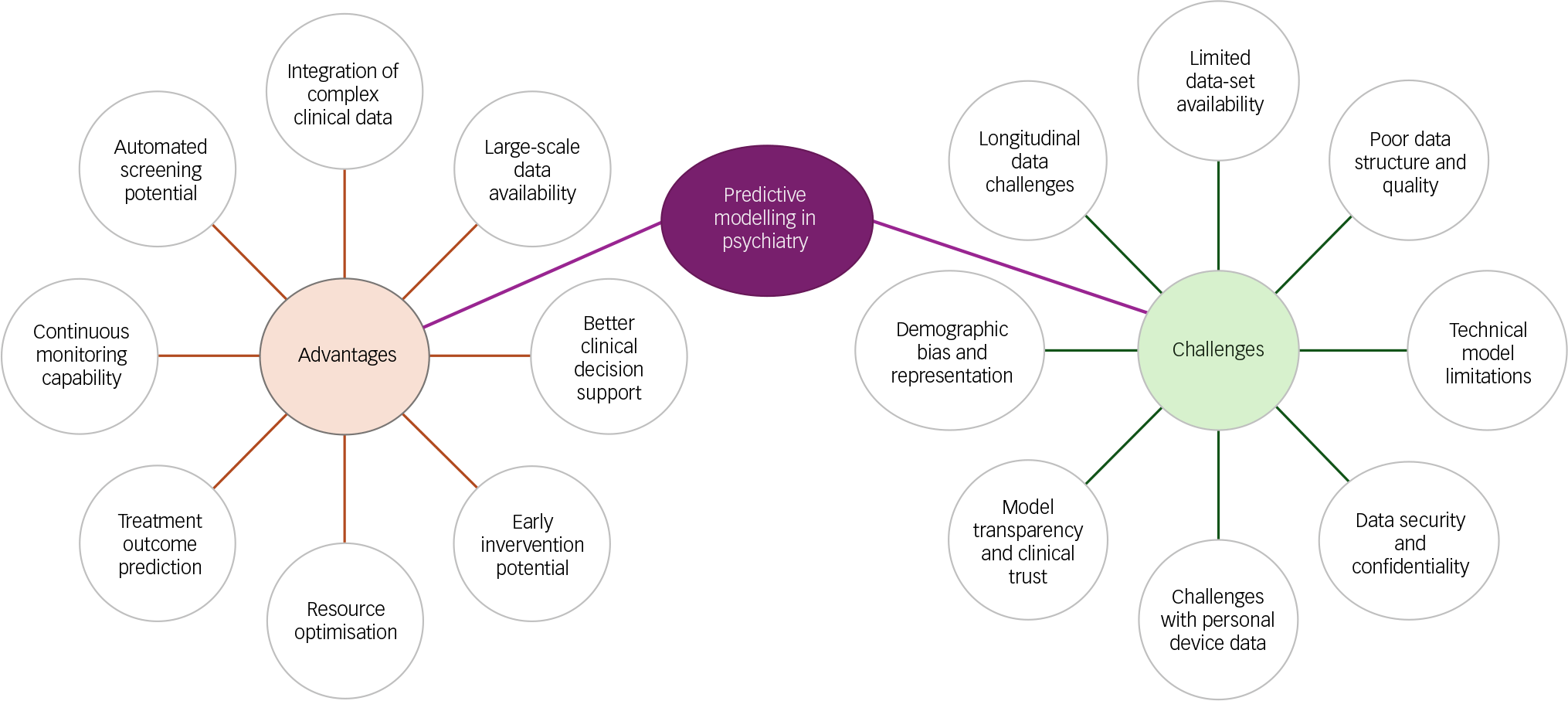
The applications described above highlight both the potential and limitations of machine learning in psychiatric practice. Figure 1 summarises the key advantages and challenges in psychiatric predictive modelling.
Key advantages and challenges in psychiatric predictive modelling.

Advantages and applications
Predictive modelling in psychiatry offers significant potential benefits alongside notable challenges. The key advantages include the ability to integrate complex clinical data through multimodal machine learning, which can process various information sources simultaneously, from clinical notes to brain scans. These models can enhance clinical decision-making by identifying subtle patterns in patient data, enabling earlier interventions and more efficient resource allocation. They show promise in predicting treatment outcomes, particularly for antidepressants and psychological therapy, and can provide continuous monitoring through wearable devices and automated screening capabilities.
Current implementation challenges and limitations
The literature identifies several limitations in psychiatric predictive modelling. Areas where smaller sample sizes have been an obstacle to robust machine learning application include neurobiological treatments such as transcranial magnetic stimulation (TMS) and electroconvulsive therapy (ECT). When data-sets are small, there is an increased risk of over-reliance on limited data, which can result in model bias and overfitting. Specifically, bias occurs when the model systematically favours certain outcomes, and overfitting happens when the model becomes excessively tailored to the training data, reducing its ability to generalise to new, unseen data. Other factors that can have an impact on the translation of predictive models from research to clinic include logistical and cost-related barriers, for example in the application of predictive models within electrophysiology and neuroimaging. A systematic review of the genetic prediction of psychiatric conditions indicates a high degree of bias and low levels of standardisation between studies, which affects the utility of existing predictive models (Bracher-Smith Reference Bracher-Smith, Crawford and Escott-Price2021). Polygenic risk scores may support the performance of multimodal clinical models but remain insufficient in isolation.
Natural language processing considerations
Natural language processing is a particularly promising area in psychiatric predictive modelling, demonstrating effectiveness across clinical prediction, individual symptom monitoring and population-level surveillance. NLP techniques have shown capability in predicting diagnostic progression, analysing speech patterns for mood assessment, and monitoring mental health trends through social media platforms. However, NLP applications face specific challenges, including limited linguistic diversity in training data, difficulties in capturing cultural variations in language expression and the need for robust validation across different demographic groups. The integration of clinical notes and conversational data through NLP offers unique insights into patient experiences, although concerns regarding privacy and the interpretation of complex linguistic patterns remain significant considerations.
Technical and data considerations
High-quality psychiatric data-sets are scarce, and existing electronic health records often contain poorly structured data with inconsistent coding practices. Technical limitations include the risk of overfitting and substantial computational requirements. Data security is particularly important given the sensitive nature of mental health information, and gathering data through personal devices raises additional privacy concerns. The issue of model transparency is vital, as clinicians and patients must understand how these algorithms reach their conclusions to trust and adopt them effectively. Demographic bias is another challenge, as models trained on limited population groups may perform poorly for others, failing to account for cultural, age and gender differences in how mental health problems manifest.
Trade-offs between optimisation and explainability of predictive models
The integration of AI and machine learning into psychiatry introduces a fundamental tension between model optimisation and explainability. Highly optimised models, such as deep neural networks (DNNs), can process vast amounts of patient data, yielding highly accurate predictions about mental health conditions and treatment outcomes. However, their complexity often makes them difficult to understand how specific predictions are generated. These sophisticated models can uncover subtle patterns across diverse data sources, ranging from electronic health records to genetic information – potentially surpassing human capabilities in predictive accuracy. In contrast, simpler models like decision trees or linear regression may offer better explainability but often fail to capture the full complexity of the data, leading to less accurate predictions.
In healthcare, however, transparency and understanding of AI decisions are crucial, as they have a direct impact on patient care. Clinicians and patients need to trust and understand the reasoning behind AI-generated treatment recommendations or diagnoses, making explainability a top priority. To address this need, several explainable AI (XAI) techniques are being explored. Post hoc explainability methods, such as LIME (local interpretable model-agnostic explanations) and SHAP (Shapley additive explanations), offer valuable insights into the decision-making process of complex AI models (Ali Reference Ali, Abuhmed and El-Sappagh2023; El-Sappagh Reference El-Sappagh, Nazih and Alharbi2025). These methods help clinicians understand which features of the data most influenced a given prediction, regardless of the underlying model’s complexity.
Another approach is the use of hybrid models (Ali Reference Ali, Abuhmed and El-Sappagh2023; Pavez Reference Pavez and Allende2024), which combine the simplicity of decision trees or linear models with the power of complex deep learning algorithms. This strategy aims to deliver both enhanced accuracy and improved explainability. It is also important to note that AI models are not intended to replace clinicians, but rather to support them in decision-making. These models work alongside healthcare professionals, providing predictions and recommendations, while the final decisions remain in the hands of qualified clinicians who can evaluate the rationale behind the suggestions generated by AI.
Ultimately, the goal is to develop AI systems that strike a balance between high predictive accuracy and clear, interpretable insights, ensuring that the systems are both trustworthy and effective in clinical settings.
Future directions
Looking ahead, priorities should include developing standardised data collection practices, establishing clear ethical frameworks and ensuring models are validated across diverse populations. Success will depend on balancing technological innovation with robust ethical standards while maintaining trust in mental health services. Despite these challenges, the potential benefits to patient care and service efficiency suggest this remains a valuable area for continued development.
MCQs
Select the single best option for each question stem
-
1 Potential uses of machine learning-based predictive modelling in mental healthcare could include:
-
a early diagnosis of conditions
-
b identification of adverse events
-
c personalisation of treatment
-
d all of the above
-
e none of the above.
-
-
2 Challenges to the successful integration of machine learning-based predictive modelling in mental healthcare include:
-
a demographic bias
-
b lack of standardisation
-
c model explainability
-
d model complexity
-
e all of the above.
-
-
3 A strength of the unsupervised machine learning approach is that it:
-
a has good explainability
-
b requires labelled training data
-
c is intuitive and easy to interpret
-
d works better with small data-sets
-
e identifies hidden patterns in data.
-
-
4 Which of the following is not a machine learning approach?
-
a supervised learning
-
b deep learning
-
c natural language processing
-
d neuro-linguistic programming
-
e unsupervised learning.
-
-
5 Types of data that could be used by a machine learning approach include:
-
a coded data in electronic health records
-
b descriptive notes in electronic health records
-
c videos/images
-
d data from wearable devices
-
e all of the above.
-
MCQ answers
-
1 d
-
2 c
-
3 e
-
4 a
-
5 b
Data availability
Data availability is not applicable to this article as no new data were created or analysed in this study.
Author contributions
G.L., E.A. and I.T. undertook the review of literature, supervised by G.C. and S.G. An initial draft written by G.L. and I.T. was substantially revised by E.A., G.C. and S.G. All authors reviewed and approved the final draft and are accountable for all aspects of the work.
Funding
This research received no specific grant from any funding agency, commercial or not-for-profit sectors. Leicestershire Partnership NHS Trust and Loughborough University provided support in kind by allowing time for the authors to do this review.
Declaration of interest
None.



eLetters
No eLetters have been published for this article.