

In many democratic countries, candidates from diverse ethnoracial backgrounds increasingly run for office, drawing significant attention to the electoral impact of these attributes. Numerous studies using real-world data have shown that ethnoracial majority voters often prefer their coethnic candidates over those from outgroup ethnoracial minorities (Fisher et al., Reference Fisher, Heath, Sanders and Sobolewska2015; Thrasher et al., Reference Thrasher, Borisyuk, Rallings and Webber2017; Portmann and Stojanović, Reference Portmann and Stojanović2019, Reference Portmann and Stojanović2022). The dynamics of coethnic preferences are shaped by sociotropic factors, such as prevailing social norms of coethnic voting and shared preferences for public goods among coethnic voters and candidates (Habyarimana et al., Reference Habyarimana, Humphreys, Posner and Weinstein2007; Lieberman and McClendon, Reference Lieberman and McClendon2013). Additionally, candidate-specific factors – including perceived performance, shared identity, and policy positions – also play a role (van Oosten et al., Reference van Oosten, Mügge and van der Pas2024). These candidate-specific factors have the potential to mitigate coethnic bias, as evidenced by ethnic majority voters not penalizing ethnic minority candidates when they perform well. Despite expectations of bias mitigation, previous research has predominantly focused on the role of performance (e.g., Adida et al., Reference Adida, Gottlieb, Kramon and McClendon2017; Carlson, Reference Carlson2015; Long and Gibson, Reference Long and Gibson2015), paying less attention to the importance of shared identity and policy positions between minority candidates and ethnoracial majority voters (see Devroe, Reference Devroe2020; Erzeel and Caluwaerts, Reference Erzeel and Caluwaerts2015; Hoffman and Long, Reference Hoffman and Long2013; Orr et al., Reference Orr, Fowler and Huber2023 for studies addressing policy positions and partisanship in other contexts).
Given this context, a crucial question arises: Can coethnic bias be mitigated when ethnic minority candidates adopt policy positions favorable to the ethnoracial majority electorate and share a common group identity with them? We have yet to know whether policy alignment and shared group identity are sufficient to overcome the disadvantages faced by ethnic minority candidates. These considerations are important for ethnoracial minority candidates as they formulate their electoral strategies, especially when their electoral success hinges on gaining support from the ethnoracial majority. Supporting policies favored by the majority may provoke backlash and result in the loss of ethnic minority votes (see Bauer et al., Reference Bauer, Harman and Russell2024, and Ono and Yamada, Reference Ono and Yamada2020, for research on potential backlash arising from incongruence with gender roles). Therefore, it is essential to assess whether the benefits from aligned policy positions and shared group identity can effectively secure the majority’s votes. However, previous research has rarely explored the compensatory effects of policy stances and shared identity for candidates with ethnic minority backgrounds.
To address these questions, we first theorize that the benefits of shared identity and policy positions stem from the reduction of perceived group threats posed by minority candidates. We then conduct a pre-registered vignette experiment that manipulates information cues about the ethnic origin, policy positions, and cultural assimilation levels of electoral candidates within the context of Japan, where ethnoracial majorities are predominant. To be eligible for elected office in Japan, candidates must hold Japanese citizenship. Although the number of ethnoracial minority candidates is relatively small, similar to trends in the United States and European countries, the immigrant population in Japan is rapidly increasing. According to the Immigration Services Agency, over 2.3% of Japan’s populations consisted of foreign nationals (including permanent residents) by 2024.Footnote 1 Moreover, several iconic politicians with ethnic minority backgrounds serve at both national and local levels and across both ruling and opposition parties.Footnote 2 For instance, in the 2023 Lower House by-election, a candidate of Uyghurs background from the Liberal Democratic Party (LDP) garnered significant voter attention due to her ethnicity and won the election. Similarly, another candidate, who has a Taiwanese father, has won four Upper House elections and led the major opposition party, the Democratic Party, between 2016 and 2017.
Drawing from group threat theory, we hypothesize that ethnic majority candidates will receive greater support from majority respondents compared to ethnic minority candidates. Furthermore, we posit that any electoral disadvantage faced by minorities will be mitigated when these candidates endorse policies favorable to the ethnic majority or demonstrate cultural assimilation, as these strategies are expected to reduce perceived threats among majority voters. Interestingly, our survey experiment results unexpectedly demonstrated that a candidate’s ethnic origin is not significantly relevant to the voting intentions of Japanese citizens, nor is there any interaction between the ethnic origin cue and the other two candidate cues regarding policy positions and cultural assimilation.
To further explore the reasons for these null findings, we exploratively tested whether respondents’ perceptions of threats from immigrants as ethnoracial minorities could moderate the effects of the experimental cues. The results reveal that respondents who perceive higher threats from immigrants are less willing to vote for candidates of ethnoracial minority backgrounds, while those with lower threat perceptions are more supportive. In other words, perceived threats lead to heterogeneous responses to candidates’ ethnic origins and voting intentions, which neutralizing each other and resulting in null findings. These findings underscore the importance for ethnoracial minority candidates to campaign in areas with a positive atmosphere toward immigrants.
Theory on coethnic and outgroup candidates
Analyses of real-world data consistently indicate that coethnic candidates tend to receive more votes than their ethnoracial outgroup counterparts. A meta-analysis of experimental studies on candidates’ ethnicity conducted by van Oosten et al. (Reference van Oosten, Mügge and van der Pas2024) attributes these electoral differences to two main factors: “useful stereotype” and “shared identification.” The term “useful stereotype” suggests that under conditions of limited information, voters tend to assume that ethnic minority candidates hold liberal ideologies and support pro-minority policies. “Shared identification” refers to the tendency of majority voters to support candidates who belong to their own ethnic group.
Despite the valuable insights these theories provide into our understanding of ethnic affinity in voting, as noted by Goodyear-Grant and Tolley (Reference Goodyear-Grant and Tolley2019), it remains unclear why policy preferences and shared identification are relevant when ethnic majorities vote for coethnic candidates. We argue that group threat theory offers useful insights into both the primary effects of ethnic minority status on vote acquisition and the underlying reasons for these effects. Group threat theory posits that majority group members develop anti-minority sentiments when they perceive that minorities threaten resources crucial to the majority group (Blumer, Reference Blumer1958). Subsequent scholars have expanded the types of resources perceived as threatened to include economic, cultural, and safety considerations (Sniderman et al., Reference Sniderman, Hagendoorn and Prior2004; Valentino et al., Reference Valentino, Soroka, Iyenga, Aalberg, Duch, Fraile and Kobayashi2019). Since political power encompasses these resources, majority group members often resist minorities’ effort to exert political influence, and this conflict over resources leads to political intolerance. Blalock (Reference Blalock1967) showed that, following the civil rights movement, White voters developed more negative attitudes toward African Americans as the proportion of African Americans approached a majority. This perception continues to influence contemporary politics; perceived threats to their dominant status significantly affected voting behavior among the dominant group (i.e., White males) in the 2016 American presidential election, particularly in support of Donald Trump (Mutz, Reference Mutz2018). These findings indicate that to maintain their dominant status and political power, majority voters are more likely to vote for ingroup candidates over outgroup candidates.
Perceived threats can explain why the concepts of “useful stereotype” and “shared identification” may lead to a preference for coethnic majority candidates over minority ones. First, the “useful stereotype” regarding the policy positions presumed of ethnic minority candidates may be seen as a threat to majority interests. Majority voters might perceive that ethnoracial minority candidates, by promoting policies primarily beneficial to their own groups, will disproportionately protect these group benefits in the future (e.g., Lerman and Sadin, Reference Lerman and Sadin2016; Martin and Blinder, Reference Martin and Blinder2021), thereby threatening the dominant status of the majority. Conversely, majority of voters presume that their coethnic candidates will propose policies that benefit them, leading to a preference for coethnic candidates. Second, extensive research indicates that voters tend to prefer candidates who share their ethnoracial group identity (Portmann and Stojanović, Reference Portmann and Stojanović2019, Reference Portmann and Stojanović2022; Thrasher et al., Reference Thrasher, Borisyuk, Rallings and Webber2017. For meta-analysis, see van Oosten et al., Reference van Oosten, Mügge and van der Pas2024). A shared identity significantly ensures that candidates will align with the interests of their group members, thus mitigating perceived threats among voters toward ingroup candidates.
Examined through the lens of group threat theory, the concepts of “useful stereotype” and “shared identification” suggest that outgroup members are likely to receive negative evaluations from ingroup voters because they are perceived as a threat to the ingroup’s valued political resources. However, if outgroup members demonstrate that they do not threaten these resources – either by proposing policies that align with the interests of the ingroup or by showing alignment with ingroup identity, thereby appearing non-threatening – then outgroup candidates may receive positive evaluations. In essence, the disadvantages typically faced by ethnoracial minority candidates can be mitigated by these attributes. We test these hypotheses in the context of Japan.
The Japanese context and hypotheses
We selected Japan as our target country for several reasons. Forms of discrimination that are observable in Western societies, such as statistical and taste-based discrimination, also exist in Japan (Igarashi and Mugiyama, Reference Igarashi and Mugiyama2023). Given the similarities in discrimination mechanisms between Western societies and Japan, voter behavior may also show parallel trends. However, the majority of existing studies have been conducted in Western countries, leaving a significant gap in our understanding of voter attitudes toward ethnoracial minority candidates in diverse contexts (van Oosten et al., Reference van Oosten, Mügge and van der Pas2024). This lack underscores the need for further survey experiments in non-Western settings. In addition, Japan has experienced a rapid increase in the number of immigrants (i.e., ethnoracial minorities). By the end of 2023, foreign residents in Japan numbered over 3.4 million (see Strausz, Reference Strausz2019, for a discussion on the recent developments in Japan’s immigration policy). This demographic shift has brought about a new wave of politicians and candidates from immigrant backgrounds, making it crucial to study Japanese voters’ attitudes toward these ethnoracial minority candidates.
Using the Japanese context, we aim to test whether candidates from ethnic outgroups receive fewer votes than their ingroup counterparts. We first hypothesize that members of the majority prefer coethnic candidates because they perceive them as posing a lower level of threat to the electorate. For clarity and to reflect the specific context in Japan, we employ the term “immigrant background” instead of “ethnoracial minorities” in our pre-registration and hypotheses. In Japan, these terms are often used interchangeably. In alignment with this reality, we assume that voters are of Japanese ethnicity, given that all voters must possess Japanese citizenship and only a very small number of non-Japanese residents choose to naturalize. Our hypothesis is articulated as follows:
Hypothesis 1: Japanese respondents exhibit a greater willingness to vote for candidates with Japanese backgrounds than for those with immigrant backgrounds.
While ethnic minority candidates may encounter challenges in gaining voter support, they can mitigate these disadvantages by signaling a shared identity with the majority group. By demonstrating loyalty to the majority through shared identification, outgroup candidates can reduce perceived threats to that group, as a shared identity leads the ethnic majority to assume that these candidates will align with their interests (see van Oosten et al., Reference van Oosten, Mügge and van der Pas2024). One effective way to signal a shared identity with the majority group is through a candidate’s name. For instance, candidates’ names can serve as distinct group cues that indicate their level of assimilation into the host society (Butler and Broockman, Reference Butler and Broockman2011; see also Landgrave and Weller, Reference Landgrave and Weller2022). Specifically, names that conform to Japanese styles are likely to suggest greater cultural and social assimilation into Japanese society, whereas names reflecting a candidate’s place of origin are likely to indicate the retention of their ethnic group status. We posit that Japanese voters use candidates’ names as cues to assess their level of assimilation into Japanese society and to gauge their shared identification, thereby reducing perceived threats. This leads to the following hypothesis:
Hypothesis 2: The gap in willingness to vote between candidates with Japanese backgrounds and those with immigrant backgrounds narrows when the latter are perceived as assimilated.
Ethnic minority candidates can also mitigate the electoral disadvantages they often face by advocating for policies that do not overtly benefit their ingroup members. Previous research has shown that ethnic majority voters may feel threatened by ethnic minority candidates who are perceived as likely to implement policies that primarily benefit their own ingroup, potentially depleting resources controlled by the majority (e.g., Plaut et al., Reference Plaut, Flannery, Buffardi and Sanchez-Burks2011). One such policy area is minority political rights, where candidates can signal their policy positions to indicate that they do not pose a threat to the majority group. Granting local suffrage to ethnic minority residents has periodically emerged as a prominent national issue, discussed in 260 meetings of the Diet (the national parliament of Japan) from 1995 to 2023. In 2009, the Democratic Party of Japan – a liberal party within a coalition government – faced significant backlash for proposing local suffrage. We expect that, in Japan, ethnoracial candidates who advocate for restricting migrants’ political rights will be viewed more favorably by the majority group – Japanese voters. Such candidates are perceived as protecting Japanese resources from outgroups, thereby reducing perceived threats to the majority. We propose the following hypothesis:
Hypothesis 3: The gap in willingness to vote between candidates with Japanese backgrounds and those with immigrant backgrounds narrows when the latter advocate for restricting immigrants’ rights in Japan.
Research design
To test these three hypotheses, we conducted a pre-registered survey experiment with eligible Japanese voters from March 12th to 18th, 2024 (Igarashi and Ono, Reference Igarashi and Ono2025).Footnote 3 We recruited respondents through Rakuten Insight, Inc., one of Japan’s largest opt-in online survey platforms. To ensure a representative sample, we set quotas based on gender, age, and residential areas, matching the demographic composition of the national census. After excluding participants who failed to pass an attention check question embedded in the survey, we obtained 3,000 valid responses. Demographic and socioeconomic details of the respondents, along with the balances of their assignments to experimental conditions, are presented in Table A1 of the Appendix.
Respondents were randomly assigned to one of ten vignettes, each depicting a hypothetical candidate from the LDP running for national office. The LDP, as a “catch-all” party with candidates in nearly every district and a broad ideological spectrum, provides a representative context for our study. The exact wording of these vignettes is available in the Appendix. In each vignette, we varied the candidate’s origin, name, and proposed migrant policies. Table 1 summarizes the attributes of the candidate that were varied in the vignette. While we recognize the advantages of alternative experimental methods, such as conjoint analysis – which facilitates the simultaneous comparison of effects across multiple treatments – we chose to use a vignette focusing on a single candidate in this study. This approach was primarily selected to enhance participant engagement by presenting a detailed and cohesive description of each candidate’s characteristic, rather than presenting them in a fragmented manner.
Candidate’s varying attributes in the vignette

Note: This table shows the attributes and their respective values that are used to generate the candidate vignettes.
The origin of the candidate varied among Japanese, Chinese, and American backgrounds. Given the Japanese nationality requirement for electoral candidacy – determined by jus sanguinis, or right of blood – we indicated that candidates of Chinese or American descent had parents who acquired Japanese nationality after immigrating. The Japanese candidate was described as having parents who relocated from a neighboring municipality, ensuring that all candidates experienced some form of internal migration. We focused on China and the United States because, according to the Immigration Services Agency (2024), China is the largest source of immigrants to Japan and these immigrants are viewed the least favorably among Japanese; in contrast, the United States, though ranking tenth in terms of immigrant origin, is viewed the most favorably by Japanese citizens (Igarashi and Mugiyama, Reference Igarashi and Mugiyama2023). This variation in public perception lends robustness to our experiment.
We used each candidate’s name as a cue to indicate their level of assimilation. In each vignette, a Chinese candidate was assigned either a Chinese or Japanese name, while an American candidate was assigned either an American or Japanese name. The Japanese candidate was consistently assigned a Japanese name, establishing five conditions based on the candidate’s origin and level of assimilation. Furthermore, there are two additional conditions based on policy position, resulting in a total of ten vignette variations. The candidates’ proposed immigration policies are detailed in Table 1. We specifically focused on the political rights of immigrants, a critical area for migrants that remains inadequately established (Tsutsui and Shin, Reference Tsutsui and Shin2008). Each candidate in the vignettes proposed policies aimed at either facilitating or restricting the political participation of immigrants.
Following the presentation of the hypothetical candidate, we asked respondents to rate their likelihood of voting for the candidate on a 5-point scale. To ensure the robustness of our findings, we also asked respondents to evaluate their favorably toward the candidate using another 5-point scale. After completing these two outcome measures, respondents were further asked about the candidate’s parents’ hometown, their stance on granting local suffrage to immigrants, and their party affiliation as depicted in the vignette to verify whether the manipulation was successful. The results for the respondents who correctly answered all manipulation check questions are presented in the Appendix (see Figure A1).
Results
We first examine the main effects of candidates’ attributes on voting intentions. Figure 1 summarizes the results of our primary analysis. The dots in the figure represent the coefficient estimates from OLS models, where the dependent variable is the respondents’ intention to vote for the candidate featured in the vignette. The horizontal bars surrounding the dots indicate 95% confidence intervals. The results reveal that the origin of candidates does not have a statistically significant effect on the likelihood of Japanese respondents voting for the candidate. Contrary to Hypothesis 1, we found no disadvantages for candidates from ethnic outgroups. To validate these findings, we changed the dependent variable to the respondents’ favorability toward the candidate, confirming that the candidates’ attributes did not affect favorability (see Figure A2 in the Appendix). In addition, the policy positions and names were not statistically significant at the 5% level.
The effects of candidates’ attributes on willingness to vote.

Figure 1 Long description
A horizontal dot plot displays the effects of candidates' attributes on willingness to vote. The plot is divided into three sections: Origin, Name, and Policy. Each section contains three categories: Japan, U.S., and China for Origin; Japanese, American, and Chinese for Name; and Pro-immigrant and Anti-immigrant for Policy. The x-axis represents the range of values from -0.2 to 0.2, indicating the effect size. Dots represent the mean effect, and horizontal lines indicate the confidence intervals. Japan and Japanese names show positive effects, while China and Chinese names show negative effects. Pro-immigrant policies have a slight positive effect, whereas Anti-immigrant policies have a slight negative effect. The U.S. and American names are centered around zero, indicating a neutral effect. All values are approximated.
Second, we tested whether citizens evaluate ethnic minority candidates who appear assimilated into Japanese society more favorably. For this analysis, we categorized candidates into five groups: ingroup candidates (Japanese), non-assimilated Chinese and American candidates (i.e., Chinese candidates with a Chinese name and American candidates with an American name), and assimilated Chinese and American candidates (i.e., Chinese or American candidates with a Japanese name). Figure 2 presents the results, which do not show a significant effect of assimilation on the likelihood of Japanese respondents voting for the candidate. Notably, non-assimilated Chinese candidates receive less support compared to the Japanese candidates. However, favorability toward candidates with Chinese origin and names does not consistently align with the likelihood of voting for them, as the difference between a Japanese candidate and a candidate with Chinese origin and name is not statistically significant (b = –0.088, SE = 0.052, p = 0.093) (see Figure A3 in the Appendix). In other words, Japanese citizens are less willing to vote for non-assimilated Chinese candidates compared to assimilated Chinese candidates, yet the tendency is inconsistent across the two dependent variables. These results suggest that assimilated candidates are not necessarily evaluated more positively. Thus, these findings do not support Hypothesis 2.
Invariance in the evaluation of assimilated migrant candidates.

Third, we examined whether Japanese citizens evaluate ethnic minority candidates more favorably when they advocate policies that restrict immigrants’ political rights. The results, incorporating an interaction term between a candidate’s ethnicity and their proposed migration policy, are shown in Figure 3. We categorized ethnic minority candidates based on their migration policy stance – either advocating for tolerance or imposing restrictions on immigrants. The reference group consisted of Japanese candidates, irrespective of their proposed policy positions. Similar to the findings in Figure 2, the results indicate that respondents’ choices are not necessarily influenced by the candidates’ policy positions. This pattern persists even when we change the dependent variable from voting intention to favorability (see Figure A4 in the Appendix). Thus, Hypothesis 3 is not supported. The results across Figures 1 to 3 consistently demonstrate that Japanese citizens’ reactions are not influenced by candidates’ ethnicity, regardless of the candidates’ level of assimilation into Japan or their advocacy for restrictive migrant policies.
Consistency in evaluating migrant candidates with tolerant migrant policy.

Figure 3 Long description
A horizontal dot plot compares evaluations of migrant candidates with tolerant migrant policy across different groups. The y-axis lists categories: Japanese, Americans pro-immigrant policy, Chinese pro-immigrant policy, Americans anti-immigrant policy, and Chinese anti-immigrant policy. The x-axis ranges from -0.3 to 0.2. Each dot represents a data point with error bars indicating variability. The Japanese category shows a positive value around 0.1. Americans pro-immigrant policy and Chinese pro-immigrant policy categories are near zero. Americans anti-immigrant policy and Chinese anti-immigrant policy categories show negative values around -0.1 and -0.2, respectively. The plot highlights differences in evaluations based on policy stance and ethnicity. All values are approximated.
Our three pre-registered hypotheses yielded null results. To explore why significant associations were not found, we conducted further heterogeneity tests across the respondents. It is important to note that this analysis was not pre-registered, thus it is exploratory. In the theory section, we posited that perceived group threats might deter voters from supporting outgroup candidates, with voter willingness varying depending on their perceived levels of threats. Although the main effects of the candidates’ origins were not significant, the absence of expected effects could be attributed to the counterbalancing of threat perceptions: respondents who feel highly threatened by immigrants are less likely to vote for migrant candidates, whereas those perceiving lower threats may be more supportive, valuing their diverse political perspectives. To substantiate this hypothesis, we performed an interaction analysis between respondents’ perceived threats and the experimental manipulations.
Our survey included a series of questions on perceived threats covering aspects such as jobs, culture, and rights.Footnote 4 We conducted a factor analysis, with all factor loadings exceeding 0.8, to generate a factor score from these variables. This score has a mean close to zero and a standard deviation of approximately one (0.912), though it exhibits some extreme values at higher levels of perceived threats. Specifically, the factor score for the upper 5% is 1.776, while it is −1.313 for the lower 5%, indicating a somewhat disproportionate level of perceived threats.
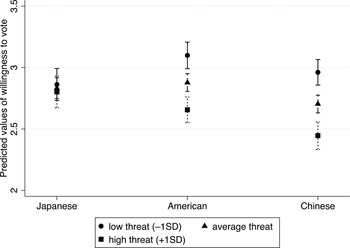
We present the results from analyzing the interaction between the factor scores of perceived threats and experimental cues. To aid interpretation, we display predicted values at the mean, and at one standard deviation above and below the mean. For clarity, we set the range of the y-axis, which shows predicted voting intentions, from 2 to 3.5. The results, depicted in Figure 4, suggest that respondents perceiving higher threats are more likely to react negatively to the candidates’ origins and their proposed migrant policies. Specifically, those feeling more threatened by immigrants exhibit more negative attitudes toward outgroup candidates and those advocating for tolerant migrant policies. By contrast, respondents who perceive less threats from immigrants tend to evaluate outgroup candidates more positively.
Predicted effects of perceived threats on voting likelihood for Japanese and non-Japanese candidates.

Figure 4 Long description
The line graph illustrates the predicted values of willingness to vote for Japanese, American, and Chinese candidates under varying levels of perceived threat. The x-axis represents the candidate's ethnicity, categorized into Japanese, American, and Chinese. The y-axis indicates the predicted values of willingness to vote, ranging from 2 to 3.5. Three data points are plotted for each ethnicity, corresponding to low threat, average threat, and high threat levels. For Japanese candidates, the willingness to vote is highest under low threat and decreases slightly under average and high threat levels. For American candidates, the willingness to vote is highest under low threat, with a noticeable decrease under average threat and a further decrease under high threat. For Chinese candidates, the willingness to vote follows a similar pattern, with the highest value under low threat and decreasing under average and high threat levels. Error bars are included to show the variability of the data. All values are approximated.
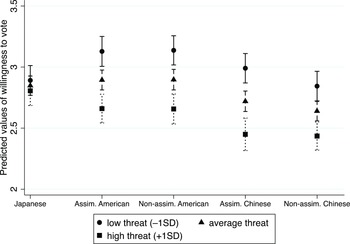
Similarly, the results of interaction between candidates’ origins and names and respondents’ perceived threats show that respondents who feel highly threatened become more negative toward both assimilated and non-assimilated outgroup candidates (see Figure 5), and they are specifically more negative toward outgroup candidates who propose pro-immigrant policies (see Figure 6). In contrast, respondents who feel less threatened by immigrants tend to respond more positively toward both assimilated and non-assimilated outgroup candidates, as well as toward those advocating pro-immigrant policies.
Predicted effects of perceived threats on voting likelihood for assimilated and non-assimilated candidates.

Figure 5 Long description
The line graph presents predicted values of willingness to vote for candidates with varying levels of assimilation and perceived threat. The x-axis categorizes candidates into Japanese, Assimilated American, Non-assimilated American, Assimilated Chinese, and Non-assimilated Chinese. The y-axis represents the predicted values of willingness to vote, ranging from 2 to 3.5. Three data points are plotted for each category, representing low threat, average threat, and high threat. The low threat data points are marked with circles, average threat with triangles, and high threat with squares. Error bars indicate the variability of the data. All values are approximated.
Predicted effects of perceived threats on voting likelihood for candidates advocating tolerant or restrictive policies.

Figure 6 Long description
The line graph presents predicted values of willingness to vote for candidates from different ethnic backgrounds under varying threat levels. The x-axis categorizes candidates into Japanese, American pro-im., Chinese pro-im., American anti-im., and Chinese anti-im. The y-axis represents the predicted values of willingness to vote, ranging from 2 to 3.5. Three data points for each category represent low threat, average threat, and high threat levels, indicated by circles, triangles, and squares, respectively. The graph shows that willingness to vote tends to decrease as the perceived threat increases, with notable variations across different candidate backgrounds. All values are approximated.
These findings indicate that the level of perceived threats affects citizens’ support for outgroup candidates. Respondents who feel highly threatened by immigrants generally evaluate outgroup candidates negatively, whereas those who perceive lower threats tend to evaluate them positively. Thus, these contrasting evaluations seem to cancel each other out, resulting in the null effects observed in the main results presented in Figures 1, 2, and 3.
Conclusion
This study aimed to explore the mitigating effects on coethnic bias in voting behaviors. Previous research suggests that majority group voters typically evaluate ethnoracial minority candidates negatively and coethinic candidates positively. This bias stems largely from the perception that minority candidates are likely to propose policies beneficial to their own groups and the lack of shared identity with majority group voters. We hypothesized that these two factors could counteract these negative evaluations and mitigate coethinic bias. We anticipated that the voting gaps between ethnoracial majority and minority candidates would diminish when ethnoracial minority candidates adopt pro-majority policies and align with majority identities, as these strategies potentially reduce perceived threats to the resources of majority voters.
Contrary to expectations, the results of our pre-registered survey experiment show that Japanese respondents did not evaluate ethnic minority migrant candidates more positively or negatively, regardless of whether the candidates proposed pro-migrant policies or showed a lack of assimilation into Japanese society. Our exploratory analyses partially reveal the potential reasons for these null findings. Consistent with group threat theory – a theoretical rationale for negative evaluations of ethnic minority candidates – respondents who perceived higher threats from migrants tended to negatively evaluate migrant candidates, particularly those advocating for pro-migrant policies and being non-assimilated. Conversely, the respondents perceiving lower levels of threats generally evaluated these migrant candidates positively. These opposing effects are equal and balance each other out, lending to the null effects.
We believe that our research contributes to the existing literature and offers substantial implications. Our null findings contrast with real-world data that consistently identify disadvantages for ethnoracial minority candidates (Fisher et al., Reference Fisher, Heath, Sanders and Sobolewska2015; Thrasher et al., Reference Thrasher, Borisyuk, Rallings and Webber2017; Portmann and Stojanović, Reference Portmann and Stojanović2019, Reference Portmann and Stojanović2022), yet they align with survey experiment results that typically show no difference in support between ethnoracial minority and majority candidates (van Oosten et al., Reference van Oosten, Mügge and van der Pas2024). This discrepancy between real-world outcomes and survey experiment results was previously unclear. Our study suggests that in the real world, ethnic minority candidates are not elected due to threat-driven voting behaviors. Importantly, unlike in experiments, the placement of candidates by parties and the choice of residential locations among citizens in the real world are not random. English (Reference English2019) demonstrated that political parties often place minority candidates in unwinnable seats in areas with negative public opinion. Combined with our findings, it becomes evident that ethnic minority candidates cannot win because they are placed in areas where a large number of highly threatened citizens reside. Our results indicate that future research should consider the heterogeneity of respondents based on group threats, as the effects of minority status can vary significantly depending on perceived threats. Addressing this variability could help reconcile the inconsistencies between survey experiment outcomes and real-world electoral outcomes.
These arguments have substantial implications for increasing the representation of ethnoracial minority candidates in political offices. One potential strategy involves nominating such candidates in electoral districts where the majority of voters exhibit lower levels of perceived threats from immigrants. These voters tend not only to favor ethnoracial minority candidates but also those who advocate pro-migrant policies. In other words, the combination of a candidate’s ethnicity, their proposed policies, and the prevailing attitudes within electoral districts can significantly influence the votes that ethnoracial minority candidates receive. Strategically aligning these factors may enhance the electoral success of ethnoracial minority candidates, potentially leading to more inclusive and representative governance.
Supplementary material
To view supplementary material for this article, please visit https://doi.org/10.1017/XPS.2025.1
Data availability
The data, code, and any additional materials required to replicate all analyses in this article are available at the Journal of Experimental Political Science Dataverse within the Harvard Dataverse Network, at: https://doi.org/10.7910/DVN/Z518MY.
Acknowledgements
The authors would like to thank Kentaro Fukumoto, Hirofumi Miwa, Masahiro Zenkyo, and other seminar participants at Gakushuin University for their helpful comments on our research design. We also extend our gratitude to Nick Petrovsky, Ji Yeon Hong, Edmund W. Cheng, and participants of the international workshop held at the City University of Hong Kong, as well as the editor and the anonymous reviewers for their insightful comments on earlier drafts. Any remaining errors are our own.
Financial Support
The authors received financial support from the Japan Society for the Promotion of Science, Grants-in-Aid for Scientific Research KAKENHI (19H00584, 19H01449, 20H00059, 22H05086, 23H05426, 23KK0023, 23K22076, and 23K17543), and Waseda University Grants for Special Research Projects (2024C-005 and 2023C-003).
Competing interests
The authors declare none.
Ethics statement
The survey in this manuscript received approval from the Ethics Review Committee on Research with Human Subjects at Waseda University (Approval ID 2023-406).




 Open access

