





1. Introduction
Individuals differ in how they engage with structural, semantic, and emotional language features (Kidd et al., Reference Kidd, Donnelly and Christiansen2018). Idioms, whose meanings are not fully inferable from literal components (Gibbs, Reference Gibbs1994), provide a useful lens on IDs in language processing. Prior work shows that idioms are often processed faster and more accurately than comparable literal phrases, especially by L1 speakers. This idiom processing advantage over matched novel control phrases has been linked to psycholinguistic dimensions such as familiarity and ambiguity (Libben & Titone, Reference Libben and Titone2008). However, idioms also carry affective meaning as part of their figurative interpretations, making valence and arousal relevant dimensions for modeling idiom processing (Citron et al., Reference Citron, Cacciari, Kucharski, Beck, Conrad and Jacobs2016; Morid & Sabourin, Reference Morid and Sabourin2023, Reference Morid and Sabourin2024). Most studies use L1 group-level ratings to provide standardized, stable, and comparable indices of these properties (Milburn et al., Reference Milburn, Vulchanova and Vulchanov2021; Siyanova-Chanturia et al., Reference Siyanova-Chanturia, Conklin and Schmitt2011; Soto-Sierra & Ferreira, Reference Soto-Sierra and Ferreira2024). Although useful, such norms may not fully capture IDs among L1 speakers or the experiential and cognitive realities of L2 learners, whose processing variability is well documented (Ellis, Reference Ellis, Davies and Elder2004). To address these questions, L1 and L2 participants completed a phrase judgment task and a subjective ratings task. This study analyzed six psycholinguistic dimensions, namely familiarity, knowledge, transparency, ambiguity, valence, and arousal, at two levels: (1) Item-level norms were estimated from L1 group-level mean ratings because L1 ratings are commonly used as target-language norms in idiom research (e.g., Bulkes & Tanner, Reference Bulkes and Tanner2017; Libben & Titone, Reference Libben and Titone2008; Titone & Connine, Reference Titone and Connine1994). These norms provided a common baseline for comparing L1 and L2 speaker-specific deviations and were used to approximate relatively stable properties of the expression. (2) Speaker-specific ratings captured each individual’s perception or experience of the same idiom. We then examined whether speaker-specific deviations from item-level average ratings (deviation scores) predicted the idiom judgment advantage, defined as faster responses to idioms than matched novel control phrases in the meaningfulness judgment task. The findings refine theoretical accounts of idiom processing by showing that IDs across psycholinguistic dimensions are integral to how idioms are represented and accessed, rather than mere noise.
2. Literature review
2.1. Idiom processing in L1 and L2 speakers
Idioms, such as spill the beans, are expressions whose figurative meanings are not always inferable from their constituent words (Gibbs, Reference Gibbs1994). The dual-route model (Titone & Connine, Reference Titone and Connine1999) characterizes idiom processing as the joint outcome of two parallel, interacting mechanisms: a holistic route, which retrieves idiomatic meaning from stored multiword representations, and a compositional route, which incrementally constructs meaning from constituent words. The relative contribution of these routes is sensitive to psycholinguistic dimensions such as familiarity (Siyanova-Chanturia et al., Reference Siyanova-Chanturia, Conklin and Schmitt2011).
Comparisons between L1 and L2 speakers suggest that the two routes are weighted differently across groups. L1 speakers tend to engage holistic retrieval together with compositional analysis, allowing relatively rapid access to idiomatic meanings. Consistent with this account, L1 speakers show an idiom processing advantage over matched literal expressions, including faster processing in minimal contexts (Carrol & Conklin, Reference Carrol and Conklin2014) and shorter and fewer fixations on idioms than on literal controls (Siyanova-Chanturia et al., Reference Siyanova-Chanturia, Conklin and Schmitt2011). However, L1 processing is not exclusively holistic: literal interpretations may be activated early and delay figurative access when an idiom becomes identifiable only late in the string (Cacciari & Tabossi, Reference Cacciari and Tabossi1988). Eye-tracking evidence likewise suggests simultaneous recruitment of both routes, with their relative weighting shaped by how strongly component words support the figurative meaning (Titone & Connine, Reference Titone and Connine1999). In L2 speakers, by contrast, the compositional route may remain more strongly weighted than in L1 processing, even among highly proficient L2 speakers, given their less naturalistic pre-immersion English learning or use and comparatively less cumulative idiom-specific exposure than L1 speakers. Studies of L2 English speakers suggest that idiom processing advantages are often weaker or less consistent than in L1 speakers (Siyanova-Chanturia et al., Reference Siyanova-Chanturia, Conklin and Schmitt2011). Evidence from highly proficient German-Dutch bilinguals with several years of residence in the L2 environment further shows activation of both figurative and literal meanings during L2 idiom processing, while sensitivity to idiom properties remains reduced relative to L1 speakers (van Ginkel & Dijkstra, Reference van Ginkel and Dijkstra2020). Together, these findings support a route-weighting account in which L1 and L2 speakers recruit both pathways but differ in their default balance and in the conditions enabling reliable holistic retrieval.
The dual-route framework, therefore, accommodates ID effects: the balance between holistic retrieval and compositional analysis should vary with both item-level psycholinguistic properties and speakers’ experience and knowledge. In L1 speakers, such variability likely reflects differences in the efficiency of holistic access and the use of compositional cues across idioms. In L2 speakers, for whom processing more often relies on compositional analysis and holistic access depends more on supportive cues, IDs may be larger and more consequential, reflecting greater heterogeneity in experience, proficiency, and representational stability. This motivates testing whether item-level average norms and speaker-specific perceptions moderate route weighting similarly across L1 and L2 speakers, and whether ID effects capture systematic cue-weighting differences rather than residual noise.
2.2. Psycholinguistic dimensions in idiom processing
Idiom processing is shaped by multiple psycholinguistic dimensions, including familiarity, knowledge, transparency, ambiguity, valence, and arousal (e.g., Morid & Sabourin, Reference Morid and Sabourin2023). In prior work, these dimensions have typically been operationalized as item-level average normed ratings from L1 speakers, although they may obscure speaker-specific perception variation.
Familiarity indexes prior exposure and recognition (Abel, Reference Abel2003) and robustly facilitates idiom recognition and interpretation in L1 speakers, although effects may attenuate when familiarity is near ceiling (e.g., Carrol & Conklin, Reference Carrol and Conklin2014). In L2 processing, familiarity can still support figurative activation, but its impact is often less differentiated, consistent with restricted exposure and reduced variability in familiarity within L2 samples (Conklin & Schmitt, Reference Conklin and Schmitt2008; Titone et al., Reference Titone, Columbus, Whitford, Mercier, Libben, Heredia and Cieślicka2015).
Knowledge can refer to objectively verified knowledge of an idiom’s conventional figurative meaning or to speakers’ self-rated access to that meaning. The present study focuses on the latter, as perceived knowledge may influence whether an idiom is treated as meaningful and readily available during the judgment task, although it does not verify objective meaning accuracy. In L1 speakers, knowledge supports rapid figurative retrieval via entrenched lexicalized representations (Abel, Reference Abel2003). In L2 speakers, especially those with less entrenched idiom representations, knowledge may play a comparatively larger role because idiom comprehension depends on the stability of associations between an idiom’s phrase form and its figurative meaning (e.g., O’Reilly et al., Reference O’Reilly, Onysko, Rasse, Papitsch, Colston and van der Horst2025). Knowledge also covaries with other dimensions: in L1 speakers, familiarity reliably predicts idiom knowledge, whereas in L2 speakers, cross-language similarity is a stronger predictor (Soto-Sierra & Ferreira, Reference Soto-Sierra and Ferreira2024; Titone & Connine, Reference Titone and Connine1994).
Transparency refers to the extent to which figurative meaning can be inferred from constituents (Siyanova-Chanturia et al., Reference Siyanova-Chanturia, Conklin and Schmitt2011). Findings for L1 speakers are mixed: transparency effects can be weak when idioms are highly familiar, yet more transparent idioms are sometimes processed more readily (e.g., Swinney & Cutler, Reference Swinney and Cutler1979; Titone & Connine, Reference Titone and Connine1999). In L2 processing, transparency may be especially relevant because learners often rely more strongly on analytic, word-based routes (Steinel et al., Reference Steinel, Hulstijn and Steinel2007). This aligns with dual-route accounts in which analytic and holistic mechanisms jointly contribute, with relative weighting varying across speaker groups and item properties (Libben & Titone, Reference Libben and Titone2008).
Ambiguity captures competition between literal and figurative interpretations (Titone & Connine, Reference Titone and Connine1994). In L1 speakers, ambiguity can facilitate processing in literal-biased contexts, whereas in L2 speakers it more often increases difficulty, given stronger initial reliance on literal meanings and delayed figurative activation (Cronk & Schweigert, Reference Cronk and Schweigert1992; Milburn & Warren, Reference Milburn and Warren2019; Siyanova-Chanturia et al., Reference Siyanova-Chanturia, Conklin and Schmitt2011). Importantly, effects depend on context and proficiency, and divergent patterns among advanced L2 learners suggest meaningful individual variability in how ambiguity is resolved (Milburn et al., Reference Milburn, Vulchanova and Vulchanov2021).
Idioms also carry emotional meaning as part of their figurative interpretations, and this affective content may influence how they are represented and processed. Valence and arousal, defined as pleasantness and physiological activation (Russell, Reference Russell2003), vary systematically across idioms, showing that emotional meaning characterizes figurative phrases as well as individual words (Citron et al., Reference Citron, Cacciari, Kucharski, Beck, Conrad and Jacobs2016; Morid & Sabourin, Reference Morid and Sabourin2023, Reference Morid and Sabourin2024). These affective dimensions influence word-level processing alongside established psycholinguistic dimensions such as ambiguity, concreteness, and imageability, providing a basis for examining their role in idiom processing (Citron, Reference Citron2012; Kuperman et al., Reference Kuperman, Estes, Brysbaert and Warriner2014; Morid & Sabourin, Reference Morid and Sabourin2023, Reference Morid and Sabourin2024). These affective dimensions are especially relevant for L1–L2 comparisons because emotional effects in L2 speakers may be weaker or more variable, depending on learning context and language experience (Pavlenko, Reference Pavlenko2012; Sheikh & Titone, Reference Sheikh and Titone2016). Recent work further suggests that valence and arousal influence idiom processing and interact with core psycholinguistic properties (Morid & Sabourin, Reference Morid and Sabourin2023). By including valence and arousal alongside familiarity, knowledge, transparency, and ambiguity, the present study tests whether affective meaning provides processing-relevant information beyond form-based and semantic-inferential cues, and whether these effects differ across language backgrounds.
2.3. IDs in speakers’ perceptions of psycholinguistic dimensions
IDs refer to systematic variation across speakers in cognitive, linguistic, and experiential factors that shape how language is perceived, represented, and processed (Kidd et al., Reference Kidd, Donnelly and Christiansen2018).
In L1 speakers, IDs systematically moderate language processing across representational levels. For example, IDs in spelling proficiency were found to modulate neighborhood-priming effects in L1 word recognition (Andrews & Hersch, Reference Andrews and Hersch2010), and IDs in lexical familiarity have been shown to shape performance in naming, lexical decision, and semantic categorization tasks (Lewellen et al., Reference Lewellen, Goldinger, Pisoni and Greene1993). At the phrasal level, linguistic knowledge and processing skills modulate contextual facilitation in idiom processing (Tilmatine et al., Reference Tilmatine, Hubers and Hintz2021), while idiom comprehension also varies with working memory, inhibitory control, and personality-related factors (Cacciari et al., Reference Cacciari, Corrardini and Ferlazzo2018). Together, these findings show that L1 ID effects extend beyond domain-general cognitive abilities to include speaker-specific linguistic experience.
In L2 speakers, IDs may be especially consequential because processing is shaped by cognitive capacities, proficiency, immersion, and language-use history. At the word level, IDs in lexical entrenchment shape L2 word recognition, with less entrenched representations showing stronger frequency effects (Diependaele et al., Reference Diependaele, Lemhöfer and Brysbaert2013). Similarly, IDs in L2 experience modulate frequency effects during reading, suggesting that language-use history affects lexical access (Whitford & Titone, Reference Whitford and Titone2012). Yi (Reference Yi2018) showed that advanced L2 speakers’ processing of adjective-noun collocations varies with cognitive profiles linked to implicit and explicit aptitude. Similar ID-driven variation occurs in idiom processing: even in literal-biased contexts, some L2 learners activate figurative meanings, suggesting that idiom conventionality can outweigh contextual information for certain individuals (Milburn et al., Reference Milburn, Vulchanova and Vulchanov2021). Beyond overgeneralized figurative activation, some L2 speakers may rely more on compositional analysis. Milburn et al. (Reference Milburn, Vulchanova, Vulchanov, Saltzman and Magnuson2026) found that L1 and advanced L2 speakers use different idiom processing strategies, with L2 speakers showing greater compositional reliance. Such variability in L2 idiom processing provides a useful test case for whether speaker-specific ratings capture variation not fully represented by item-level average norms.
A key limitation of norm-based idiom research is that item-level norms may obscure speaker-specific variation in how idioms are perceived and processed. Rating tasks are commonly used to assess psycholinguistic dimensions, and most studies average L1 ratings to create normed values for use in both L1 and L2 research (Milburn et al., Reference Milburn, Vulchanova and Vulchanov2021; Siyanova-Chanturia et al., Reference Siyanova-Chanturia, Conklin and Schmitt2011; Soto-Sierra & Ferreira, Reference Soto-Sierra and Ferreira2024). This practice assumes that L1 speakers provide stable, low-noise estimates of key properties, yielding reliable baselines for cross-group comparisons. However, aggregate norms may obscure meaningful individual variation: two speakers may rate the same idiom very differently, producing processing differences that disappear when ratings are averaged. Incorporating speaker-specific ratings, therefore, provides a more ecologically valid and precise account of how mental representations relate to idiom processing.
In the present study, each psycholinguistic dimension was analyzed at two distinct levels: item-level norms and speaker-specific ratings. Item-level norms, estimated from group-mean ratings from L1 speakers, approximate relatively stable properties of each expression, whereas speaker-specific ratings capture individual perceptions or experiences of the same idiom. Although their relative importance may differ by dimension, both levels remain relevant: familiarity and knowledge are experience-based but can yield useful speech-community norms, whereas transparency may be more item-inherent but still varies in perceived form-meaning relations across speakers (e.g., Bulkes & Tanner, Reference Bulkes and Tanner2017; Citron et al., Reference Citron, Cacciari, Kucharski, Beck, Conrad and Jacobs2016; Libben & Titone, Reference Libben and Titone2008; Morid & Sabourin, Reference Morid and Sabourin2024; Titone & Connine, Reference Titone and Connine1994).
2.4. L1-L2 differences in ID effects
Usage-based accounts attribute L1-L2 differences to input history, with repeated, contextually rich experience strengthening form-meaning mappings. Richer exposure supports entrenched, semantically integrated representations, whereas limited input yields weaker, more form-driven representations (Bybee, Reference Bybee2010; Ellis, Reference Ellis2002). Accordingly, L1 idiom processing is supported by experience-based representations built through rich contextual exposure (Siyanova-Chanturia & Martinez, Reference Siyanova-Chanturia and Martinez201 Reference Bulkes and Tanner4). In contrast, L2 speakers often show qualitatively different processing profiles, even when they are highly proficient and immersed. The Representation Deficit Hypothesis proposes that L2 idioms may be stored as loosely connected lexical strings with reduced semantic integration relative to L1 representations (Abel, Reference Abel2003). This account remains relevant to the present highly proficient L2 speakers with later immersion experience because target-language residence does not necessarily yield L1-like idiom comprehension (van Ginkel & Dijkstra, Reference van Ginkel and Dijkstra2020). The dual-route model further predicts that L1 speakers typically rely more on holistic processing for familiar idioms, whereas L2 speakers may rely more on analytic or literal-first parsing (Libben & Titone, Reference Libben and Titone2008). This may also apply to highly proficient L2 speakers, reflecting less naturalistic pre-immersion English learning or use, weaker idiom-specific entrenchment, and less culturally embedded experience rather than limited general proficiency. These accounts suggest that idiom processing reflects cognitive capacities, experiential histories, and task demands, with systematic differences between L1 and L2 speakers.
Prior empirical research shows clear L1–L2 contrasts in idiom processing. L1 speakers show a robust idiom processing advantage over novel control phrases, supported by rapid retrieval from entrenched representations (Carrol & Conklin, Reference Carrol and Conklin2014; Siyanova-Chanturia et al., Reference Siyanova-Chanturia, Conklin and Schmitt2011; Swinney & Cutler, Reference Swinney and Cutler1979). In contrast, L2 learners rely more on compositional, word-by-word analysis and show delayed or reduced figurative activation, yielding a smaller processing advantage (Conklin & Schmitt, Reference Conklin and Schmitt2008; Kyriacou & Köder, Reference Kyriacou and Köder2024; Senaldi & Titone, Reference Senaldi and Titone2022). As reviewed above, the effects of item-level average norms for psycholinguistic dimensions diverge systematically between L1 and L2 speakers. Item-level average familiarity norms tend to facilitate figurative activation less robustly in L2, reflecting the critical role of reduced exposure in shaping idiom retrieval (Soto-Sierra & Ferreira, Reference Soto-Sierra and Ferreira2024; Titone et al., Reference Titone, Columbus, Whitford, Mercier, Libben, Heredia and Cieślicka2015). In contrast, item-level average knowledge norms may exert a disproportionately larger influence on L2 than on L1 speakers, consistent with evidence that L2 idiom representations may be less lexicalized or entrenched than L1 representations across both non-immersed and highly experienced L2 populations (Soto-Sierra & Ferreira, Reference Soto-Sierra and Ferreira2024; van Ginkel & Dijkstra, Reference van Ginkel and Dijkstra2020). Likewise, idioms with higher item-level average transparency norms are often easier for L2 speakers to interpret, whereas transparency effects in L1 speakers are more variable and task-dependent (Soto-Sierra & Ferreira, Reference Soto-Sierra and Ferreira2024). In addition, item-level average ambiguity and emotionality norms may impose greater cognitive costs in L2 than in L1 speakers, because resolving literal-figurative competition and emotional meaning can be more effortful without deeply entrenched conceptual grounding (Carrol & Conklin, Reference Carrol and Conklin2017; Milburn & Warren, Reference Milburn and Warren2019).
IDs further accentuate L1–L2 contrasts. In L1 speakers, group-level ratings often provide reliable indices of psycholinguistic dimensions, with individual ratings adding finer-grained variation (Ellis, Reference Ellis2006). In L2 speakers, however, IDs tend to exert stronger effects on online processing. For example, Yi (Reference Yi2018) found that L1 and advanced L2 speakers’ adjective-noun collocation processing differed in relation to cognitive profiles, with L2 performance more strongly tied to implicit and explicit aptitude. Similarly, Morid and Sabourin (Reference Morid and Sabourin2024) reported greater L2 than L1 variability in speaker-specific ratings of idiom valence, arousal, familiarity, imageability, and concreteness. Thus, L1 speakers may rely on more stable, automatized idiom representations, whereas L2 speakers may rely on more variable learning experiences and therefore show stronger ID effects in perceptions of psycholinguistic dimensions.
3. The current study
Despite growing interest in idiom processing, several issues remain underexplored. First, most studies rely on item-level L1 ratings without testing whether IDs in speakers’ perceptions of psycholinguistic variables better predict idiom processing advantage in real-time tasks such as phrase judgment tasks. Second, research has focused mainly on semantic properties such as familiarity and transparency, whereas emotional dimensions such as valence and arousal have received less attention despite their role in cognitive processing. Third, few studies have examined whether ID effects vary in scope or direction across L1 and L2 speakers. To address these gaps, the present study examined whether speaker-specific deviations from item-level average ratings across psycholinguistic dimensions predicted idiom judgment advantage in a phrase judgment task. This advantage was defined as faster meaningfulness judgment processing for idioms than for matched novel control phrases.
RQ1: To what extent do deviations in speaker-specific perceptions from item-level norms improve the overall prediction of idiom judgment advantage in L1 speakers and highly proficient L2 speakers with later immersion experience, and does this overall contribution differ across the two groups?
Support for RQ1 would be shown by deviation-inclusive models outperforming norm-only models, as indicated by improved expected log predictive density (ELPD)/leave-one-out information criterion (LOOIC) and Bayesian R2. Group differences in this improvement would indicate that speaker-specific ratings contribute differently to prediction in L1 and L2 speakers.
RQ2: How do deviations in speaker-specific perceptions of each psycholinguistic dimension, namely familiarity, transparency, ambiguity, knowledge, valence, and arousal, predict idiom judgment advantage, and do these effects vary across L1 and L2 speakers?
Support for RQ2 would be shown by credible effects of specific deviation predictors, indicating that speaker-specific variation in each psycholinguistic dimension predicts idiom judgment advantage. Credible interactions with the language group would indicate that these dimension-specific effects differ between L1 and L2 speakers.
4. Methodology
4.1. Participants
Data were collected from 128 English speakers, including 71 L1 speakers (mean age = 22.6; 40 females) and 57 L2 speakers (mean age = 22.2; 38 females), all of whom were students at a U.S. university. L1 participants were U.S.-born native English speakers. The L2 participants were highly proficient L2 speakers with later immersion experience and met the following criteria: began acquiring English after age 3 and before age 10, at least three years of residence in English-speaking countries, and self-rated proficiency above 7 on a 9-point scale. Most were exempt from standardized language tests or had advanced scores (IELTS >7.5, TOEFL >100). Their mean age of acquisition (AoA) was 5.6 years (SD = 2.1), with an average of 68.4 months (SD = 43.5) living in English-speaking environments. They reported using English for 59.2 hours per week (SD = 21.2) over an average of 63.1 months (SD = 19.4). Self-rated proficiency scores were overall (M = 7.8, SD = 0.8), speaking (M = 7.7, SD = 0.7), listening (M = 8.1, SD = 0.8), reading (M = 8.0, SD = 0.9), and writing (M = 7.7, SD = 0.9). This profile differs from that of typical classroom-based L2 learners: participants were studying at a U.S. university, had substantial residence experience in English-speaking countries, and reported high proficiency. However, they should not be treated as simultaneous or balanced bilinguals, as all began acquiring English after age 3 and had, on average, over 16 years of English learning or use before full immersion. Participant demographics for the L2 group are summarized in Table 1.
Demographic information of advanced L2 speakers

Table 1. Long description
The table presents data for L 2 speakers across three statistical columns: Mean, S D, and Range.
* Age: Mean 22.4, S D 3.4, Range 17 to 32.
* Age of acquisition: Mean 5.6, S D 2.1, Range 3 to 10.
* Length of residence in months: Mean 71.3, S D 28.1, Range 37 to 132.
* English-use intensity in hours per week: Mean 59.2, S D 21.2, Range 26 to 95.
* Months of English use at the reported intensity: Mean 63.1, S D 19.4, Range 26 to 101.
* Overall proficiency on a 9-point scale: Mean 7.8, S D 0.8, Range 7 to 9.
* Speaking proficiency on a 9-point scale: Mean 7.7, S D 0.7, Range 7 to 9.
* Listening proficiency on a 9-point scale: Mean 8.1, S D 0.8, Range 7 to 9.
* Reading proficiency on a 9-point scale: Mean 8.0, S D 0.9, Range 7 to 9.
* Writing proficiency on a 9-point scale: Mean 7.7, S D 0.9, Range 7 to 9.
Note: English proficiency test scores were not reported, as only 19 L2 participants had taken a standardized test, and the test types varied (e.g., IELTS, TOEFL, SAT).
We conducted an exploratory L2-only participant-level analysis using two broad language-experience measures: length of residence in English-speaking countries and weekly English use. As reported in Supplementary Appendix S1, neither measure reliably predicted participant-level mean idiom judgment advantage. This null finding should be interpreted cautiously because the analysis was exploratory and relied on broad self-reported measures rather than idiom-specific exposure.
Figure 1 shows that the L2 group was linguistically diverse, with Chinese-related backgrounds forming the largest subgroup. We therefore conducted an exploratory Chinese-English cross-language similarity analysis for this subgroup. As reported in Supplementary Appendix S2, Analysis 1, Chinese-English idiom overlap did not reliably predict judgment advantage, and the key ID effects remained qualitatively similar after including cross-language similarity. We also conducted a high-level exploratory comparison between the two largest L1-background subgroups, Chinese-related and Spanish backgrounds (Supplementary Appendix S2, Analysis 2), which showed no evidence of subgroup differences in overall RT-based judgment advantage.
The distribution of L1 backgrounds among the L2 participants.

Figure 1. Long description
The Y-axis is labeled Number of L 2 participants and ranges from 0 to 28 in increments of 2. The X-axis is labeled First-language background and lists 14 different languages. The data is presented in a series of colored vertical bars in descending order from left to right.
* Chinese: 27 participants (orange bar)
* Spanish: 8 participants (purple bar)
* Korean: 4 participants (teal bar)
* German: 3 participants (olive bar)
* Arabic: 2 participants (coral bar)
* Portuguese: 2 participants (blue bar)
* Russian: 2 participants (lavender bar)
* Vietnamese: 2 participants (pink bar)
* French: 1 participant (gold bar)
* Hebrew: 1 participant (green bar)
* Hindi: 1 participant (emerald bar)
* Japanese: 1 participant (cyan bar)
* Lahu: 1 participant (sky blue bar)
* Turkish: 1 participant (magenta bar)
4.2. Stimuli
A total of 4,356 English idioms were initially extracted from the Oxford Dictionary of Idioms (Siefring, Reference Siefring2005). Candidate expressions were retained only if they showed conventionalized figurative use. Purely literal expressions, non-conventional metaphors, and transparent comparison phrases were excluded. The stimulus set was controlled along length, affective, syntactic, semantic, and frequency dimensions. Idioms longer than five words were excluded to control for length. To reduce the possibility that idiom-level affective ratings were driven by single emotional words or by literal interpretations, two independent L1 English raters evaluated the valence and arousal of each idiom’s component words on a 9-point scale. Idioms containing highly emotional words, defined as scores below 3 or above 7, were removed. The same raters then assessed the emotionality of each idiom’s literal meaning, and idioms with extreme literal-meaning emotionality scores were excluded. Next, they rated the figurative meanings of the remaining idioms. Based on these ratings, idioms were assigned to nine groups formed by crossing valence (negative, neutral, positive) with arousal (low, medium, high) (see Table 2). This grouping was used to ensure that the final stimulus set covered a broad affective range, rather than being concentrated within a narrow portion of the valence-arousal space. Then 25 or 26 idioms were randomly selected from each category, yielding 228 idioms for the experiment.
Examples of idioms across valence and arousal categories

Table 2. Long description
The table consists of three columns: Valence category, Arousal category, and Example idiom. It is organized into nine rows of data:
* Negative valence, Low arousal: under the weather.
* Negative valence, Medium arousal: hit rock bottom.
* Negative valence, High arousal: have a cow.
* Neutral valence, Low arousal: the dust settles.
* Neutral valence, Medium arousal: the bottom line.
* Neutral valence, High arousal: a race against time.
* Positive valence, Low arousal: go with the flow.
* Positive valence, Medium arousal: on cloud nine.
* Positive valence, High arousal: with flying colors.
For the 228 matched novel control phrases, the syntactic structure and syntactic category of each idiom were preserved by replacing one content word with an alternative from the same part-of-speech category and with comparable collocational properties (e.g., kick the bottle from kick the bucket). Replacement words were selected to be semantically similar to the original words where possible, and both the selected words and resulting control phrases were checked by the same L1 English raters for semantic plausibility and meaningfulness. Replacement words were also selected to be affectively similar to the original words where possible, and the same raters confirmed that both the selected words and resulting control phrases fell within the neutral valence/arousal range of 3–7 on the 9-point scales. Control phrases with COCA frequency values above 3 were excluded to minimize phrase-level frequency effects. In addition, 150 semantically meaningless filler phrases were constructed by randomly combining two to five words drawn from the idiom and control sets.
4.3. Procedure
The study comprised a phrase judgment task and a norming study, carried out in that order. In the phrase judgment task, 228 idioms, 228 matched novel phrases, and 228 fillers were divided into four lists (57 idioms, 57 controls, and 57 fillers each). L1 and L2 participants were evenly assigned to one list. To avoid the co-occurrence of idioms and their controls, each pair was split into two sets (Set 1: 28 pairs; Set 2: 29 pairs). Each participant completed two blocks: Block A contained idioms from Set 1 and controls from Set 2, and Block B reversed this pairing. Block order was counterbalanced. After informed consent and instructions, participants completed five practice trials with feedback, then proceeded to the main task without feedback. Each trial began with a 500-ms fixation, followed by a phrase. Participants judged its meaningfulness by pressing “F” (meaningful) or “J” (meaningless) within 4,000 ms. This task was designed to assess how efficiently participants recognized phrases as meaningful. Accordingly, RTs were interpreted as indexing phrase-level meaning recognition and decision efficiency, rather than a specific subprocess such as early idiom recognition, figurative meaning retrieval, or semantic integration. Accuracy and RTs were recorded using DMDX (Forster & Forster, Reference Forster and Forster2003). The trial order was randomized, with a short break provided halfway.
The norming task followed the phrase judgment task. The norming task was designed to obtain speaker-specific ratings of psycholinguistic dimensions and to derive item-level average norms based on the mean ratings of L1 speakers. Each L1 and L2 participant rated the same idioms that they had responded to in the phrase judgment task on six psycholinguistic variables using a 9-point Likert scale (see Supplementary Appendix S3 for more details). Valence and arousal were rated using the same dimensions and scale anchors as in stimulus selection, but by the experimental participants rather than the independent L1 raters. These follow as below:
-
(1) Familiarity (Bulkes & Tanner, Reference Bulkes and Tanner2017; Citron et al., Reference Citron, Cacciari, Kucharski, Beck, Conrad and Jacobs2016; Libben & Titone, Reference Libben and Titone2008): How often the idiom had appeared to participants, rated from 1 = “I have never heard or read this idiom,” 5 = “I have sometimes heard or read this idiom,” to 9 = “I have very often heard or read this idiom.”
-
(2) Transparency (Citron et al., Reference Citron, Cacciari, Kucharski, Beck, Conrad and Jacobs2016): The extent to which the idiom’s figurative meaning could be inferred from its parts, rated from 1 = “not at all,” 5 = “to some extent,” to 9 = “very easily.”
-
(3) Ambiguity (Bonin et al., Reference Bonin, Méot and Bugaiska2013; Bulkes & Tanner, Reference Bulkes and Tanner2017; Libben & Titone, Reference Libben and Titone2008): How likely the idiom could be interpreted literally across contexts, rated from 1 = “not at all,” 5 = “possibly,” to 9 = “almost always.”
-
(4) Knowledge (Bulkes & Tanner, Reference Bulkes and Tanner2017; Citron et al., Reference Citron, Cacciari, Kucharski, Beck, Conrad and Jacobs2016; Libben & Titone, Reference Libben and Titone2008): How well participants knew the figurative meaning of idioms, rated from 1 = “not at all,” 5 = “approximately,” to 9 = “completely.” This measure captures participants’ subjective confidence in their idiom knowledge rather than an objective verification of meaning accuracy. Although this measure does not test objective definition accuracy, it captures speakers’ perceived access to idiom meaning, a factor that may shape how readily a phrase is recognized as meaningful and available during online judgment tasks.
-
(5) Valence (Citron et al., Reference Citron, Cacciari, Kucharski, Beck, Conrad and Jacobs2016; Stadthagen-Gonzalez et al., Reference Stadthagen-Gonzalez, Imbault, Pérez Sánchez and Brysbaert2017; Warriner et al., Reference Warriner, Kuperman and Brysbaert2013; Yao et al., Reference Yao, Wu, Zhang and Wang2017): How positive or negative the idiom felt, rated from 1 = “completely unhappy,” 5 = “neutral,” to 9 = “completely happy.”
-
(6) Arousal (Citron et al., Reference Citron, Cacciari, Kucharski, Beck, Conrad and Jacobs2016; Warriner et al., Reference Warriner, Kuperman and Brysbaert2013): the extent to which it made participants feel calm or excited, rated from 1 = “very calm,” 5 = “moderately arousing,” to 9 = “very excited.”
5. Data analysis
Table 3 summarizes the analytic workflow, with Steps 1–7 serving as preparatory analyses and Steps 8–9 addressing RQ1 and RQ2.
Analysis plan

Table 3. Long description
The table consists of four columns: Step, Analytic step, Purpose, and Role in relation to R Q s.
* Step 1: Data preprocessing. Purpose: Prepare norming and R T data; screen rating responses; exclude incorrect trials and predefined R T outliers. Role: Preparatory.
* Step 2: Rating consistency analyses. Purpose: Assess the reliability and internal consistency of psycholinguistic ratings within L 1 and L 2 groups. Role: Preparatory.
* Step 3: Descriptive statistics for each dimension. Purpose: Report L 1 and L 2 means and S D s for familiarity, self-rated knowledge, perceived transparency, ambiguity, valence, and arousal. Role: Preparatory.
* Step 4: Correlations among rating dimensions. Purpose: Examine relationships among the six dimensions separately for L 1 and L 2 speakers. Role: Preparatory.
* Step 5: Idiom representational-space analyses. Purpose: Assess how idioms are organized in six-dimensional psycholinguistic space in L 1 and L 2 groups using distance matrices, Mantel, and Procrustes analyses. Role: Preparatory.
* Step 6: Individual deviations from item norms. Purpose: Quantify participant-specific deviations from L 1-based item means for each dimension. Role: Preparatory.
* Step 7: Radar plot of L 1–L 2 dimensional profiles. Purpose: Summarize aggregate group-level convergence/divergence across the six dimensions. Role: Preparatory.
* Step 8: Norm-based versus deviation-inclusive model comparison. Purpose: Test whether individual-level ratings improve prediction beyond group-level item norms. Role: R Q sub 1.
* Step 9: Full Bayesian multilevel model. Purpose: Estimate which individual-deviation dimensions predict R T advantage and whether effects differ by group. Role: R Q sub 2.
5.1. Descriptive analysis
5.1.1. Data preprocessing
Norming and RT data yielded 7,012 observations (see Supplementary Appendix S4 for raw data). We excluded participants whose ratings showed excessive consistency across dimensions, defined as assigning the same score to >80% of items, but no participants met this criterion. For averaged norming scores, outlier responses within each psycholinguistic dimension were removed using a ± 3 SD threshold around the mean. Outliers were rare, occurring only in arousal (N = 23) and knowledge (N = 11), and accounted for less than 1% of observations (N = 3,819 per dimension), indicating strong overall data integrity. For RT analyses, incorrect trials (Accuracy = 0) were excluded so that RTs reflected idiom comprehension. We also excluded two anticipatory outliers using predefined criteria: idiom or control RTs below 200 ms, or RTs more than 3 SD below a participant’s mean RT, computed separately by trial type.
5.1.2. Rating consistency
To assess rating consistency across participants within each language group, we computed intra-class correlation coefficients (ICC2k and ICC3k) for L1 and L2 groups separately across all six psycholinguistic dimension ratings. Unlike Pearson correlations, which measure associations between variables or rating sets, ICCs estimate how consistently multiple raters rate the same items. Higher ICCs indicate greater agreement and more reliable item-level ratings. ICC2k estimates reliability when raters are treated as sampled from a broader population, whereas ICC3k estimates consistency among the specific raters in this study.
L1 speakers showed high reliability across dimensions, with all ICCs exceeding .96 and the highest ICC3k values for familiarity (.98), transparency (.97), and knowledge (.98). L2 speakers also showed high reliability across dimensions (ICCs > .93) despite greater proficiency variability, with familiarity and transparency again showing the strongest consistency (ICC3ks = 0.90). These results indicate stable and internally coherent item ratings in both groups. To assess external validity, we compared our L1 ratings with published idiom norms. For the 39 identical idioms in Bulkes and Tanner (Reference Bulkes and Tanner2017), correlations for ambiguity (r = .74), familiarity (r = .53), and transparency (r = .74) indicated moderate to substantial agreement (Cicchetti, Reference Cicchetti1994). For 98 semantically comparable but structurally different idioms (e.g., up one’s alley versus in one’s wheelhouse), correlations remained stable for ambiguity (r = .61), familiarity (r = .50), and transparency (r = .64).
Overall, the ICC analyses indicate reliable item-level consistency within each language group while preserving meaningful speaker-specific variability.
5.1.3. Descriptive analysis
Table 4 summarizes L1 and L2 descriptive statistics for the six psycholinguistic dimensions and behavioral measures of idiom judgment advantage.
Descriptive statistics for L1 and L2 groups across the six psycholinguistic dimensions

Table 4. Long description
The table consists of three columns: Measure, L 1 speakers M S D, and L 2 speakers M S D.
Psycholinguistic Dimensions:
* Ambiguity: L 1 speakers 4.88 1.85; L 2 speakers 4.92 1.84.
* Arousal: L 1 speakers 5.99 1.53; L 2 speakers 5.95 1.55.
* Transparency: L 1 speakers 4.84 1.87; L 2 speakers 4.83 1.87.
* Familiarity: L 1 speakers 6.29 1.87; L 2 speakers 6.20 1.92.
* Knowledge: L 1 speakers 6.77 1.81; L 2 speakers 6.63 1.86.
* Valence: L 1 speakers 4.99 1.78; L 2 speakers 5.01 1.77.
Performance Metrics:
* R T-based judgment advantage: L 1 speakers 0.11 0.51; L 2 speakers minus 0.06 0.56.
* Accuracy proportion correct: L 1 speakers 0.94 0.23; L 2 speakers 0.85 0.36.
Note: Means for each measure are followed by the standard deviation in parentheses. Although L1 and L2 speakers showed highly similar mean ratings across the six psycholinguistic dimensions, this may reflect group-level convergence rather than identical processing profiles or balanced bilingual status.
5.1.4. Correlations across dimensions
To examine relationships among the six psycholinguistic dimensions within each group, we computed pairwise Pearson correlations for ambiguity, arousal, transparency, familiarity, knowledge, and valence separately for L1 and L2 speakers.
In the L1 group (Figure 2A), familiarity and knowledge were strongly correlated (r = .72). Transparency showed small-to-moderate positive correlations with familiarity (r = .25) and knowledge (r = .31). Ambiguity was weakly related to other dimensions, showing a small positive correlation with transparency (r = .17) and near-zero to small negative correlations with familiarity (r = −.05) and knowledge (r = −.17). Arousal showed weak negative correlations with familiarity (r = −.23), knowledge (r = −.22), and transparency (r = −.14), but near-zero correlations with ambiguity (r = −.02) and valence (r = −.03). Valence was only weakly related to the other dimensions (−.10 < rs < .00).
Correlation matrix of psycholinguistic dimensions in (A) L1 speakers and (B) L2 speakers.

Figure 2. Long description
Two triangular heatmaps labeled a and b. Each displays correlations between six variables: Ambiguity, Arousal, Compositionality, Familiarity, Knowledge, and Valence. A color scale on the right of each panel ranges from dark blue at negative 1.0 to white at 0.0 and dark red at positive 1.0.
Panel a, L 1 speakers:
* Ambiguity correlates with itself at 1.0.
* Arousal correlates with Ambiguity at negative 0.02.
* Compositionality correlates with Ambiguity at 0.17 and Arousal at negative 0.14.
* Familiarity correlates with Ambiguity at negative 0.05, Arousal at negative 0.23, and Compositionality at 0.25.
* Knowledge correlates with Ambiguity at negative 0.17, Arousal at negative 0.22, Compositionality at 0.31, and Familiarity at 0.72.
* Valence correlates with Ambiguity at 0.07, Arousal at negative 0.03, Compositionality at 0, Familiarity at 0.1, and Knowledge at 0.05.
Panel b, L 2 speakers:
* Ambiguity correlates with itself at 1.0.
* Arousal correlates with Ambiguity at negative 0.03.
* Compositionality correlates with Ambiguity at 0.33 and Arousal at negative 0.2.
* Familiarity correlates with Ambiguity at negative 0.01, Arousal at negative 0.19, and Compositionality at 0.35.
* Knowledge correlates with Ambiguity at negative 0.16, Arousal at negative 0.14, Compositionality at 0.23, and Familiarity at 0.67.
* Valence correlates with Ambiguity at 0.14, Arousal at negative 0.06, Compositionality at 0.19, Familiarity at 0.16, and Knowledge at 0.
In the L2 group (Figure 2B), correlations largely followed the L1 pattern. Transparency was positively correlated with familiarity (r = .35) and knowledge (r = .23), and more strongly correlated with ambiguity than in L1 (r = .33). Familiarity and knowledge remained strongly correlated, though slightly less so than in L1 (r = .67). Arousal showed small negative correlations with familiarity (r = −.19), knowledge (r = −.14), and transparency (r = −.20), whereas valence showed small positive correlations with ambiguity (r = .14), transparency (r = .19), and familiarity (r = .16), but was unrelated to knowledge (r ≈ 0).
5.1.5. Semantic representations of idioms
To assess L1–L2 similarity in idiom representations, we constructed idiom-by-idiom dissimilarity matrices from the six rated dimensions (ambiguity, arousal, transparency, familiarity, knowledge, and valence) and applied Mantel and Procrustes analyses. The Mantel analysis tested cross-group correlations in overall pairwise dissimilarity structure, whereas the Procrustes analysis assessed how closely the multidimensional idiom spaces of L1 and L2 speakers aligned after rotation, translation, and scaling.
Heatmaps of the idiom distance matrices for L1 (Figure 3A) and L2 (Figure 3B) speakers showed highly similar clustering patterns, with nearly identical hierarchical clustering on both axes. These similarities suggest that L2 speakers encode idiom meanings in a semantic structure closely aligned with that of L1 speakers. In both panels, the diagonal reflects zero distance between identical idioms, whereas off-diagonal blocks indicate clusters of semantically related idioms.
Idiom distance matrices for (A) L1 and (B) L2 speakers. The heatmaps show pairwise semantic distances among idioms in the six-dimensional rating space. Cooler colors indicate smaller distances, reflecting greater semantic similarity.

Figure 3. Long description
The figure consists of two vertically stacked panels labeled a and b.
Panel a represents L 1 speakers. It features a large square heatmap with a diagonal line of dark blue running from the top-left to the bottom-right, indicating zero distance between identical idioms. The heatmap is surrounded on the top and left sides by complex dendrograms showing hierarchical clustering of the idioms. The colors in the heatmap range from dark blue for low semantic distance to bright red for high semantic distance. Large blocks of light blue and yellow suggest clusters of idioms with similar semantic ratings, while scattered red patches indicate pairs with high semantic distance. To the right of the heatmap is a vertical color scale bar ranging from 0 in dark blue to 10 in bright red.
Panel b represents L 2 speakers. It follows the same structural layout as panel a, with dendrograms on the top and left and a central heatmap. While the overall pattern is similar to panel a, the distribution of colors shows subtle differences in clustering density. The red regions, indicating greater semantic distance, appear slightly more concentrated in specific blocks compared to the L 1 heatmap. The same color scale bar from 0 to 10 is positioned to the right.
The Mantel test revealed a strong correlation between the L1 and L2 dissimilarity matrices (Mantel r = .986, p < .001, 9,999 permutations), indicating highly similar idiom organization across L1 and L2 groups. Procrustes analysis likewise showed strong alignment between the L1 and L2 multidimensional rating spaces after rotation, translation, and scaling (r = .990, sum of squares = .019, p < .001).
To assess within-group organization, we applied agglomerative hierarchical clustering to the idiom rating matrices. The resulting cophenetic correlation coefficient (C = .674) indicated moderately strong clustering, suggesting coherent semantic structuring in both groups. Together, these results show that L1 and L2 speakers organize idioms along psycholinguistic dimensions in highly similar ways, consistent with previous findings (Morid & Sabourin, Reference Morid and Sabourin2024). This cross-group alignment supports the structural reliability of the rating data and provides a foundation for subsequent individual-level modeling.
5.2. Dispersion of individual ratings relative to group norms
Following prior research, we used mean ratings from L1 speakers as item-level average norms for subsequent analyses (Milburn et al., Reference Milburn, Vulchanova and Vulchanov2021; Siyanova-Chanturia et al., Reference Siyanova-Chanturia, Conklin and Schmitt2011; Soto-Sierra & Ferreira, Reference Soto-Sierra and Ferreira2024). To visualize dispersion around these norms, we plotted individual ratings against L1 group means for each dimension separately for L1 (Figure 4A) and L2 speakers (Figure 4B).
L1 (A) and L2 (B) participants’ ratings for a given idiom were plotted against the item-level average norm for the same idiom across the six psycholinguistic dimensions. Strong clustering around the identity line (y = x) suggests minimal individual deviation.

Figure 4. Long description
The figure consists of two large panels labeled a and b. Each panel contains six scatter plots arranged in two rows and three columns. All plots share a common y-axis labeled Individual Rating and a common x-axis labeled Group Mean Rating, with scales ranging from approximately 1 to 9.
Panel a features red data points representing L 1 participants. The six plots are titled Ambiguity, Arousal, Compositionality, Familiarity, Knowledge, and Valence. In each plot, a dense cluster of red dots follows a diagonal dashed identity line where y equals x, indicating high agreement between individual and group ratings. The clustering is tightest in the Arousal and Valence plots, while Ambiguity shows slightly more dispersion.
Panel b features blue data points representing L 2 participants, organized with the same six titles: Ambiguity, Arousal, Compositionality, Familiarity, Knowledge, and Valence. Similar to panel a, the blue dots cluster along the diagonal identity line. However, the dispersion of points away from the line is visibly greater in the L 2 plots compared to the L 1 plots, particularly in the Ambiguity and Knowledge dimensions, suggesting more individual variation in the L 2 group.
In L1 speakers, familiarity, knowledge, and transparency showed particularly tight alignment, suggesting robust shared representations, whereas ambiguity and arousal showed greater spread, indicating higher subjectivity. L2 ratings followed the same general linear trend but were more dispersed than L1 ratings, suggesting greater inter-individual variability, especially for emotional properties and ambiguity. In contrast, familiarity, knowledge, and transparency showed stronger clustering, suggesting more reliable acquisition of these properties by L2 learners. Overall, both groups showed internal coherence, but L2 learners adhered less closely to group norms, particularly for properties requiring emotional or inferential integration.
5.2.1. Group-level convergence across psycholinguistic dimensions
Finally, the radar plot of dimension-wise differences (L2–L1; Figure 5) showed no apparent group differences across the six dimensions, suggesting group-level representational convergence.
Radar plot illustrating the differences between advanced L2 speakers and L1 speakers across six psycholinguistic dimensions.

5.2.2. Bayesian multilevel model
Hierarchical Bayesian linear mixed-effects models, implemented in the R package brms (Bürkner, Reference Bürkner2017), were used to analyze ID effects on judgment advantage. This approach accounted for crossed random effects of participants and items, captured IDs in subjective ratings and behavioral measures, and provided full posterior distributions for all parameters. Analyses included only correct trials. RT advantage was defined as the standardized difference between idioms and their matched novel controls, allowing item-level subtraction to serve as the dependent measure and control for item-specific variability. This measure captures faster responses to idioms than to matched novel control phrases in the meaningfulness judgment task during real-time processing, rather than indexing a specific subprocess. To ensure that higher scores indicated greater judgment advantage, each item’s value was derived by subtracting idiom RTs from their corresponding literal controls. All psycholinguistic predictors were z-transformed before analysis.
For each of the six rated dimensions, namely familiarity, knowledge, transparency, ambiguity, valence, and arousal, two predictors were computed: (1) the L1-based item-level normed rating, calculated as the mean rating for each item across L1 speakers. This predictor followed the common practice of using L1 ratings as relatively stable idiom norms (e.g., Libben & Titone, Reference Libben and Titone2008) and provided a shared baseline for calculating speaker-specific deviations in both groups. (2) The participant-specific deviation from this norm (deviation scores), which indexed the extent to which a given speaker’s individual perception or experience of that idiom differed from the item-level average norm. These predictors allowed us to separate item-level normed ratings from speaker-specific variation.
Two models tested ID effects on idiom judgment advantage. The norm-based model included language group, the six L1-based group-mean psycholinguistic ratings, their interactions with language group, and random intercepts for participants and items. The full ID model additionally included standardized participant-specific deviation scores for each dimension and their interactions with language group, testing whether individual-level ratings improved prediction and whether these effects differed between L1 and L2 speakers. Both models used weakly informative priors: Normal (0, 1) for fixed effects and Student-t (3, 0, 0.5) for random effects and residuals. Four MCMC chains were run for 8,000 iterations, with convergence confirmed by R-hat = 1.00 and effective sample sizes >1,000.
RQ1 asked whether deviations in speaker-specific perceptions from item-level norms improved overall prediction of idiom judgment advantage beyond item-level norms, and whether this contribution differed between L1 speakers and highly proficient L2 speakers. To address RQ1, we assessed model performance using leave-one-out cross-validation, examining differences in ELPD and LOOIC, complemented by Bayesian R2 to evaluate explained variance. RQ2 asked how speaker-specific deviations in each psycholinguistic dimension predicted idiom judgment advantage and whether these effects differed between L1 speakers and highly proficient L2 speakers. To address RQ2, we examined the posterior estimates of the deviation scores as well as their interaction terms with language group in the full model.
6. Results
As shown in Table 5, the deviation model outperformed the average-only model in the full sample (ΔELPD = 1503.8, SE = 58.0), with LOOIC decreasing from −1825.6 to −4833.2. Bayesian R2 increased from 0.772 to 0.875 (ΔR2 = 0.103), indicating ~10% additional variance explained in RT advantage. Overall, modeling participant-specific deviations improved fit beyond item-level average norms.
Performances of item-level norm-only and deviation-inclusive models in all groups

Table 5. Long description
The table consists of six columns: model, e l p d underscore diff, s e underscore diff, l o o i c, group, and weight.
Row 1: Model m underscore dev underscore int, e l p d underscore diff 0.000, s e underscore diff 0.000, l o o i c minus 4833.195, group 1, weight 0.875.
Row 2: Model m underscore avg, e l p d underscore diff minus 1503.814, s e underscore diff 58.045, l o o i c minus 1825.568, group 0, weight 0.772.
Separate analyses by language group showed the same pattern (Table 6). For L1 speakers, the deviation model markedly improved fit (ΔELPD = 919.1, SE = 40.7) and increased Bayesian R2 from 0.773 to 0.883 (ΔR2 = 0.110). For L2 speakers, improvements were smaller but robust (ΔELPD = 584.7, SE = 41.3), with R2 rising from 0.735 to 0.845 (ΔR2 = 0.110).
Performances of item-level norm-only and deviation-inclusive models in L1 and L2 groups

Table 6. Long description
The table consists of seven columns: model, e l p d underscore diff, s e underscore diff, l o o i c, group, weight, and R super 2.
For the L 1 group:
* Model m underscore dev underscore int has an e l p d underscore diff of 0, s e underscore diff of 0, l o o i c of minus 3220.13, weight of 1, and R super 2 of 0.883.
* Model m underscore avg has an e l p d underscore diff of minus 919.130, s e underscore diff of 40.717, l o o i c of minus 1381.87, weight of 0, and R super 2 of 0.773.
For the L 2 group:
* Model m underscore dev underscore int has an e l p d underscore diff of 0, s e underscore diff of 0, l o o i c of minus 1613.07, weight of 1, and R super 2 of 0.845.
* Model m underscore avg has an e l p d underscore diff of minus 584.679, s e underscore diff of 41.307, l o o i c of minus 443.713, weight of 0, and R super 2 of 0.735.
As shown in Tables 7 and 8, the Bayesian multilevel model indicated that L2 speakers showed smaller idiom judgment advantages than L1 speakers (b = −0.268, 95% CrI [−0.276, −0.260]).
Full Bayesian multilevel model predicting phrase-judgment-based RT advantage

Table 7. Long description
The table contains 8 columns: Predictor, Estimate, Est. Error, l-95% C I, u-95% C I, R-hat, Bulk_E S S, and Tail_E S S.
Key rows include:
* Intercept: Estimate 0.174, C I 0.148 to 0.200.
* group L 2 (ref = L 1): Estimate -0.268, C I -0.276 to -0.260.
* avg_Familiarity_z: Estimate 0.199, C I 0.129 to 0.269.
* avg_Arousal_z: Estimate 0.087, C I 0.060 to 0.115.
* avg_Valence_z: Estimate 0.088, C I 0.063 to 0.114.
* avg_Knowledge_z: Estimate 0.075, C I -0.001 to 0.150.
* avg_Transparency_z: Estimate -0.111, C I -0.142 to -0.078.
* avg_Ambiguity_z: Estimate -0.164, C I -0.195 to -0.134.
* dev_Ambiguity_z: Estimate 0.128, C I 0.122 to 0.134.
Interaction terms for group L 2 (ref = L 1) include:
* with avg_Arousal_z: Estimate -0.062.
* with avg_Knowledge_z: Estimate -0.111.
* with avg_Transparency_z: Estimate 0.064.
* with dev_Valence_z: Estimate 0.046.
* with dev_Transparency_z: Estimate 0.069.
* with dev_Ambiguity_z: Estimate -0.108.
All R-hat values are 1.00, indicating model convergence.
Group-specific conditional effects of item-level norms and individual deviations on phrase-judgment-based RT advantage

Table 8. Long description
The table contains five columns: Predictor type, Dimension, L 1: b [95% C r I], L 2: b [95% C r I], and L 2 minus L 1: b [95% C r I].
Under the Predictor type ‘Item-level norm’:
* Familiarity: L 1 = 0.199 [0.129, 0.269]; L 2 = 0.208 [0.138, 0.279]; Difference = 0.009 [-0.013, 0.030].
* Arousal: L 1 = 0.087 [0.059, 0.116]; L 2 = 0.025 [0.003, 0.054]; Difference = -0.062 [-0.071, -0.053].
* Valence: L 1 = 0.088 [0.063, 0.114]; L 2 = 0.061 [0.036, 0.087]; Difference = -0.027 [-0.036, -0.018].
* Knowledge: L 1 = 0.075 [-0.001, 0.150]; L 2 = -0.034 [-0.108, 0.041]; Difference = -0.111 [-0.134, -0.088].
* Transparency: L 1 = -0.111 [-0.142, -0.078]; L 2 = -0.046 [-0.078, -0.014]; Difference = 0.064 [0.054, 0.074].
* Ambiguity: L 1 = -0.164 [-0.195, -0.134]; L 2 = -0.149 [-0.180, -0.119]; Difference = 0.015 [0.006, 0.025].
Under the Predictor type ‘Individual deviation’:
* Familiarity: L 1 = 0.004 [-0.002, 0.009]; L 2 = 0.005 [-0.002, 0.011]; Difference = 0.001 [-0.008, 0.009].
* Arousal: L 1 = -0.001 [-0.006, 0.005]; L 2 = -0.005 [-0.010, 0.001]; Difference = -0.004 [-0.012, 0.004].
* Valence: L 1 = 0.006 [0.000, 0.012]; L 2 = 0.051 [0.041, 0.062]; Difference = 0.046 [0.034, 0.057].
* Knowledge: L 1 = 0.000 [-0.005, 0.006]; L 2 = -0.002 [-0.008, 0.003]; Difference = -0.003 [-0.011, 0.005].
* Transparency: L 1 = -0.005 [-0.010, 0.001]; L 2 = 0.065 [0.054, 0.075]; Difference = 0.069 [0.057, 0.081].
* Ambiguity: L 1 = 0.128 [0.122, 0.134]; L 2 = 0.020 [0.012, 0.028]; Difference = -0.108 [-0.118, -0.099].
Note: Table 8 reports group-specific effects from the full deviation-inclusive interaction model. Because L1 speakers were the reference group in Table 7, L1 effects correspond to the Table 7 estimates. L2 effects were calculated by adding the relevant Group × Predictor interaction to the L1 effect, and the L2–L1 column reports this interaction-based group difference.
For the effects of L1-based item-level norms, Familiarity positively predicted idiom judgment advantage in both groups (L1: b = 0.199, 95% CrI [0.129, 0.269]; L2: b = 0.208, 95% CrI [0.138, 0.279]). Valence and Arousal norms were also facilitatory in both groups (Valence: L1: b = 0.088, 95% CrI [0.063, 0.114]; L2: b = 0.061, 95% CrI [0.036, 0.087]; Arousal: L1: b = 0.087, 95% CrI [0.060, 0.115]; L2: b = 0.025, 95% CrI [0.003, 0.054]), but these effects were reliably weaker in L2 speakers (Valence: b = −0.027, 95% CrI [−0.036, −0.018]; Arousal: b = −0.062, 95% CrI [−0.071, −0.053]). Knowledge norms did not show a significant main effect in either group, but the interaction analysis indicated that their effect was reliably stronger in L1 than in L2 speakers (b = −0.111, 95% CrI [−0.134, −0.088]). In contrast, Transparency and Ambiguity norms were inhibitory in both groups (Transparency: L1: b = −0.110, 95% CrI [−0.143, −0.079]; L2: b = −0.046, 95% CrI [−0.078, −0.014]; Ambiguity: L1: b = −0.164, 95% CrI [−0.195, −0.134]; L2: b = −0.149, 95% CrI [−0.180, −0.119]), with both inhibitory effects attenuated in L2 speakers (Transparency interaction: b = 0.064, 95% CrI [0.054, 0.074]; Ambiguity interaction: b = 0.015, 95% CrI [0.006, 0.025]).
Speaker-specific perception deviations from item-level average norms explained additional variance. Valence deviations significantly predicted idiom judgment advantage in both L1 speakers (b = 0.006, 95% CrI [0.000, 0.012]) and L2 speakers (b = 0.051, 95% CrI [0.041, 0.062]), with a reliably stronger effect in L2 speakers (b = 0.046, 95% CrI [0.034, 0.057]). Likewise, positive Transparency deviations facilitated idiom judgment advantage only in L2 speakers (b = 0.065, 95% CrI [0.054, 0.075]) and were significantly stronger than in L1 speakers (b = 0.069, 95% CrI [0.057, 0.081]). Ambiguity deviations, by contrast, showed a positive effect in both L1 (b = 0.128, 95% CrI [0.122, 0.134]) and L2 speakers (b = 0.020, 95% CrI [0.012, 0.028]), with the effect significantly larger in L1 than in L2 speakers (b = −0.108, 95% CrI [−0.118, −0.099]).
7. Discussion
7.1. General ID effects
The idiom judgment advantage indexes how efficiently participants recognized idioms as meaningful relative to matched novel controls, rather than a specific subprocess such as early recognition, figurative meaning retrieval, or semantic integration. IDs in idiom-related psycholinguistic dimensions, captured through speakers’ own ratings, significantly shaped judgment advantages in both L1 and L2 groups. This suggests that although these dimensions appear stable at the group level, aggregate norms do not fully capture experience-based individual variability. Speaker-specific ratings are therefore more sensitive to item- and speaker-specific factors and prevent subtle experiential differences in phrase meaningfulness judgments from being obscured. These findings echo prior L1 and L2 research showing that IDs shape language processing (e.g., Andrews & Hersch, Reference Andrews and Hersch2010; Cacciari et al., Reference Cacciari, Corrardini and Ferlazzo2018; Milburn et al., Reference Milburn, Vulchanova and Vulchanov2021; Tilmatine et al., Reference Tilmatine, Hubers and Hintz2021) and extend this work by showing that such variability also arises in idiom-related psycholinguistic dimensions. The results suggest that phrase-level meaning access is experience-sensitive. For L1 speakers, cumulative and culturally embedded idiom experience may support efficient meaning judgments by strengthening structural, semantic, and emotional associations (Bybee, Reference Bybee2010; Ellis, Reference Ellis2002). For highly proficient L2 speakers, judgment advantages also changed when speaker-specific ratings were incorporated, suggesting that these ratings capture meaningful psycholinguistic cues used as idiom representations that continue to develop.
The overall benefits of modeling IDs were greater in L1 than in L2 speakers. One possibility is that L1 ratings are more stable and differentiated, whereas L2 ratings often show flatter response profiles and weaker itemwise differentiation (Morid & Sabourin, Reference Morid and Sabourin2024; Wolter & Gyllstad, Reference Wolter and Gyllstad2011). Under this interpretation, L1 between-participant variability may more systematically reflect differences in the strength and accessibility of idiom representations, which may increase the explanatory value of speaker-specific deviations for judgment advantage. In highly proficient L2 speakers, subjective ratings may also reflect variability beyond representational strength, including strategic reliance on constituent-based reasoning, because L2 idiom experience can remain uneven despite high proficiency and immersion (Morid & Sabourin, Reference Morid and Sabourin2024). This pattern is consistent with dual-route accounts, in which L2 idiom processing may rely more on compositional analysis unless holistic access is strongly supported (Libben & Titone, Reference Libben and Titone2008). It also helps extend representation-based accounts (Abel, Reference Abel2003) originally developed with non-immersed L2 learners to highly proficient immersed L2 speakers, suggesting that L2 idiom representations may remain less robust or less richly specified under some conditions. More broadly, it is compatible with the Shallow Structure Hypothesis, which posits less automatically deployed structural representations in adult L2 processing (Clahsen & Felser, Reference Clahsen and Felser2006). It is noted that the smaller overall predictive gain in L2 speakers than in L1 speakers does not imply uniformly weaker ID effects for each specific dimension, which should be examined separately.
7.2. IDs in speakers’ perceptions of psycholinguistic dimensions
Several ID effects were consistent across L1 and L2 speakers. Familiarity, knowledge, and arousal showed reliable L1-based item-level norm effects, but no additional contribution from deviations in participant-specific perceptions from the item-level mean in either L1 or L2 speakers. This suggests that these norms already capture the core experiential and emotional properties driving idiom processing, providing robust estimates of lexical-semantic properties by smoothing idiosyncratic, transient, and task-related variability. In contrast, positive deviations from item-level average norms in ambiguity and valence predicted judgment advantages for both L1 and L2 speakers, indicating that individual variation in semantic uncertainty and affective evaluation carries explanatory value beyond group-level norms.
IDs in psycholinguistic dimensions also showed asymmetric effects across groups. Perceived valence exhibited stronger ID effects in L2 than in L1 speakers. This pattern is consistent with greater reliance on analytic strategies and more variable emotional grounding in L2 speakers (Milburn et al., Reference Milburn, Vulchanova, Vulchanov, Saltzman and Magnuson2026; Pavlenko, Reference Pavlenko2012; Sheikh & Titone, Reference Sheikh and Titone2016). IDs in Ambiguity, by contrast, showed a stronger positive effect in L1 than in L2 speakers, plausibly because more entrenched idiom representations in L1 speakers allow them to exploit ambiguity-related interpretive flexibility more efficiently during online comprehension.
7.3. Convergent effects of IDs across L1 and L2 speakers
Item-level average familiarity norms consistently facilitated idiom judgment advantages in both L1 and L2 speakers, consistent with the findings that higher familiarity supports faster access to phrase-level meaning (Cacciari & Tabossi, Reference Cacciari and Tabossi1988; Conklin & Schmitt, Reference Conklin and Schmitt2012; Siyanova-Chanturia et al., Reference Siyanova-Chanturia, Conklin and Schmitt2011). Familiar idioms are more likely to have readily available phrase-level representations, which may facilitate meaningfulness judgments for both groups (Cacciari & Tabossi, Reference Cacciari and Tabossi1988; Libben & Titone, Reference Libben and Titone2008). However, incorporating speaker-specific perceptions of familiarity did not improve model performance in either L1 or L2 speakers. This suggests that item-level average familiarity norms already capture the cumulative effects of conventionalized usage and long-term exposure, particularly for culturally entrenched expressions. By contrast, speaker-specific familiarity ratings may reflect temporary biases and may lack the resolution needed to robustly track subtle item-level variation (Morid & Sabourin, Reference Morid and Sabourin2024). Therefore, item-level average familiarity norms appear to function as stable population-level predictors, with limited added value from speaker-specific familiarity deviations.
Item-level average knowledge norms did not show a significant main effect in either group, but there was still a reliable group difference. The interaction indicated that item-level knowledge norms had a weaker positive effect in L2 than L1 speakers, plausibly because L2 idiom self-rated subjective knowledge is less entrenched and semantically integrated, limiting rapid access to phrase-level meaning. This pattern suggests that even highly proficient L2 speakers with later immersion experience may show reduced semantic integration of idiom representations relative to L1 speakers, extending the Representation Deficit account (Abel, Reference Abel2003) to highly proficient immersed L2 speakers and aligning with proposals that L2 comprehension relies on comparatively shallow or less automatically deployed structural representations under online constraints (Clahsen & Felser, Reference Clahsen and Felser2006). Notably, adding self-rated speaker-specific knowledge ratings did not improve model fit for either group, suggesting that self-rated knowledge, unlike objective meaning accuracy, may be too coarse to capture the phrase-level meaning availability that supports efficient idiom judgments.
Item-level average valence norms exerted a significant facilitatory effect on idiom meaningfulness judgments in both L1 and L2 speakers, consistent with evidence that negative information delays attentional engagement relative to positive content, thereby slowing access to the figurative meaning of idioms (Kuperman et al., Reference Kuperman, Estes, Brysbaert and Warriner2014). Yet the effect was attenuated in L2 speakers, likely due to reduced emotional resonance and encoding in an L2 (Pavlenko, Reference Pavlenko2012). However, incorporating speaker-specific deviations in valence ratings significantly improved model fit. In both groups, idioms judged as more emotionally positive than the item-level average valence norm showed more efficient phrase-meaning activation. This suggests that speaker-specific valence ratings capture affective engagement that item-level average valence norms cannot represent. The effect appears in both L1 and L2 speakers because emotional evaluation is inherently personal: language speakers rely on their own emotional interpretations during online phrase meaningfulness judgments, making individual variation informative even when overall emotional resonance differs.
Item-level average arousal norms positively predicted judgment advantages for idioms in both L1 and L2 speakers, suggesting that emotionally activating information may support task-relevant availability of phrase-level meaning (Citron et al., Reference Citron, Weekes and Ferstl2013). The effect was smaller for L2 than for L1 speakers, consistent with attenuated emotional resonance in an additional language (Pavlenko, Reference Pavlenko2012). Reduced emotional grounding in highly proficient L2 speakers with later immersion experience may reflect differences in the contexts and affective richness of language experience, as well as less embodied experience and weaker autobiographical associations than in the L1 speakers, which together can dampen arousal effects (Sheikh & Titone, Reference Sheikh and Titone2016). This may occur because many L2 idioms were initially learned through less naturalistic input before full immersion, rather than through early-life, emotionally rich, and autobiographically grounded interactions. Notably, speaker-specific deviations in arousal did not predict idiom judgment advantage in either group. This pattern may indicate that arousal is largely stimulus-driven, with limited reliable between-participant variability, and that decontextualized rating tasks make arousal difficult to assess precisely.
Item-level average ambiguity norms significantly inhibited idiom judgment advantages in both L1 and L2 speakers, consistent with findings that ambiguity activates competing interpretations and reduces the efficiency of phrase meaningfulness judgments (Titone & Connine, Reference Titone and Connine1999). More ambiguous idioms often lack a dominant, context-independent reading that can be readily retrieved during phrase-meaning judgments. When the dominant figurative meaning is less readily accessible, speakers may be more likely to rely on literal or constituent-based processing, especially for idioms that are highly ambiguous or less familiar. This greater reliance on analytic processing may slow phrase-meaning decisions. The inhibitory effect was stronger in L1 speakers, likely because they may rely more readily on conventionalized figurative interpretations for familiar idioms (Cacciari & Tabossi, Reference Cacciari and Tabossi1988; Libben & Titone, Reference Libben and Titone2008; Swinney & Cutler, Reference Swinney and Cutler1979; Titone & Connine, Reference Titone and Connine1999) and are therefore more disrupted when semantic indeterminacy weakens access to a dominant figurative meaning. In contrast, L2 learners may be less likely to assume idiomaticity unless strongly cued (Siyanova-Chanturia et al., Reference Siyanova-Chanturia, Conklin and Schmitt2011). Many idioms may already be processed more like compositional phrases, making ambiguity less disruptive for L2 speakers’ judgment routines. Importantly, IDs in speaker-specific ambiguity deviations positively predicted judgment advantages in both L1 and L2 groups, which was the opposite direction of the item-level average norm effect. One plausible explanation is that, at the individual level, higher ambiguity ratings index semantic richness rather than unresolved competition. Speakers who perceive an idiom as having more literal or alternative readings may have richer, more flexible representations that support phrase-level meaningfulness judgments. In the present task, this representational richness may facilitate judgment efficiency rather than hinder it. Item-level average ambiguity norms collapse speakers with genuinely unclear representations and those with richly elaborated ones. Thus, speaker-specific ambiguity deviations index disambiguation experience that item-level average norms cannot capture.
Item-level average transparency norms exhibited a general inhibitory effect on idiom judgment advantage in both L1 and highly proficient L2 groups, consistent with the dual-route model (Libben & Titone, Reference Libben and Titone2008), which posits that more transparent idioms may encourage constituent-based analysis and reduce reliance on whole-phrase cues during meaningfulness judgments. This item-level average transparency norm effect was more pronounced in L1 speakers than in L2 speakers, likely because constituent-based information interferes with their deeply entrenched idiomatic representations during the judgment task. In contrast, L2 speakers may use item-level average transparency as a compensatory mechanism when idiomatic knowledge is less entrenched. This also aligns with the Shallow Structure Hypothesis, which suggests that L2 speakers may rely more on surface-level or semantically driven cues, such as transparency, when fully entrenched linguistic representations are less automatically available (Clahsen & Felser, Reference Clahsen and Felser2006).
7.4. Divergent ID effects across L1 and L2 speakers
The positive effect of speaker-specific ambiguity deviations tended to be stronger in L1 speakers than in L2 speakers. This pattern likely reflects group differences in representational strength and cue utilization. For L1 speakers, IDs in perceived ambiguity may be informative when idiom representations are well established, because alternative readings can be evaluated against a readily available figurative interpretation (Libben & Titone, Reference Libben and Titone2008; Titone & Connine, Reference Titone and Connine1999). Ambiguity may therefore serve as a useful cue rather than only a source of difficulty. For L2 speakers, the same facilitative pattern was present but weaker, perhaps because ambiguity ratings reflect more variable knowledge of how literal and figurative meanings are distributed across contexts (Milburn et al., Reference Milburn, Vulchanova and Vulchanov2021). Thus, perceived ambiguity may map less directly onto meaningfulness judgments in L2 speakers, where figurative access is more contingent on proficiency and the strength of instructed form-meaning mappings (Clahsen & Felser, Reference Clahsen and Felser2006; Libben & Titone, Reference Libben and Titone2008).
In addition, speaker-specific valence deviations exerted a stronger positive impact on idiom judgment advantages in L2 speakers than in L1 speakers. This indicates that L2 speakers’ speaker-specific perceptions of emotional content, though more variable, capture systematic differences in how emotion is engaged during phrase-level meaningfulness judgments. These divergences are not random fluctuations but reflect speaker-specific perceptions of emotional information. One explanation is that reduced emotional grounding in L2 learners, even highly proficient ones, may lead them to depend more on deliberate reasoning or contextual cues than on automatic emotional responses (Morid & Sabourin, Reference Morid and Sabourin2024), making their speaker-specific valence ratings more predictive. This also suggests that ID effects in speaker-specific valence perceptions may be negligible in L1 speakers, where emotional representations are more entrenched and largely convergent, but may continue to shape variability in L2 speakers despite their advanced proficiency and immersion. This pattern aligns with experience-dependent accounts in which emotional processing is shaped by usage exposure and contextual diversity (Sheikh & Titone, Reference Sheikh and Titone2016).
Importantly, speaker-specific transparency deviations positively predicted judgment advantage only in L2 speakers, with a stronger effect than in L1 speakers and in a direction opposite to the item-level average transparency norm effect. Individual L2 speakers showed a greater judgment advantage for idioms they rated as more transparent than the item-level norm, effectively overriding the baseline inhibitory effect of item-level transparency. This pattern indicates that speaker-specific perceptions of the association between an idiom’s component words and its figurative meaning capture adaptive phrase judgment strategies in L2 speakers. In L2 speakers, speaker-specific transparency ratings may reflect not only subjective perception but also the extent to which learners strategically draw on structural information based on their individual experience during phrase meaningfulness judgments. Viewing an idiom as more transparent may give L2 learners a more reliable basis for structure-driven parsing, resulting in stronger and directionally distinct speaker-specific perception effects. These findings also show that speaker-specific transparency effects are more pronounced in L2 speakers than in L1 speakers. For L1 speakers, holistic and automatized representations may dominate, leaving little room for additional speaker-specific transparency cues to influence meaningfulness judgments beyond the item-level average norm. In contrast, L2 learners rely more on analytic, composition-based processing when idiomatic representations are weak or still developing. This interpretation is consistent with recent visual-world evidence showing that even advanced L2 speakers may rely more strongly than L1 speakers on compositional processing during idiom processing (Milburn et al., Reference Milburn, Vulchanova, Vulchanov, Saltzman and Magnuson2026). Consequently, IDs in speaker-specific perceptions of transparency provide a more sensitive index of strategy use in L2 than in L1 idiom judgment.
8. Limitation
This study has several limitations. First, rating-based measures do not show that intrinsic idiom properties vary across speakers. Rather, they show that speakers differ in their perceptions of the same idioms, and that these differences predict judgment advantage beyond item-level norms. Future work could combine speaker-specific ratings with independent linguistic coding to distinguish intrinsic properties from subjective perceptions. Second, this study focused on transparency. Future work could examine compositionality as a related but distinct dimension to clarify how idiom structure and perceived meaning inferability contribute to processing. Third, our L2 participants were highly proficient speakers with immersion experience in English-speaking environments. Future research should compare classroom L2 learners and early sequential bilinguals to examine language-use history. Fourth, our exploratory cross-language similarity analysis was limited to Chinese-background L2 speakers, the largest L1 subgroup. Future work should use larger samples from specific L1 backgrounds. Fifth, although the phrase judgment task indexes idiom judgment advantage, it cannot isolate subprocesses within idiom processing. Faster idiom responses may reflect phrase-form recognition, figurative-representation access, reduced semantic-integration demands, or decision-stage facilitation. Future work using eye tracking, self-paced reading, or electrophysiology could separate these subprocesses. Finally, speaker-specific knowledge was measured through self-ratings rather than definition production or meaning selection. Similar ratings may not indicate the same figurative interpretation, especially for idioms with multiple meanings and strong contextual dependence. Future work can combine self-ratings with objective meaning-accuracy measures to distinguish perceived from verified knowledge.
9. Conclusion
Taken together, these results show that idiom judgment advantages in English are shaped by psycholinguistic dimensions shared across L1 and L2 speakers, while also showing systematic ID effects. Although L1-based item-level ratings capture broad semantic, emotional, and structural regularities, IDs in valence, transparency, and ambiguity reveal additional representational diversity. These effects also differed between L1 and highly proficient L2 speakers, suggesting that idiom judgment advantage reflects the interplay between entrenched linguistic conventions and individualized experiences shaped by exposure, representations, and processing strategies. Overall, idiom processing reflects the joint influence of shared psycholinguistic dimensions and speaker-specific experience, with their relative weight differing across L1 and L2 speakers.
Supplementary material
To view supplementary material for this article, please visit http://doi.org/10.1017/S1366728926101606.
Data availability statement
The supplementary and supporting materials associated with this study are available on OSF at https://osf.io/4x2ju.
Acknowledgments
The authors thank the editor and the anonymous reviewers for their constructive comments and helpful suggestions.
Competing interests
The authors declare none.
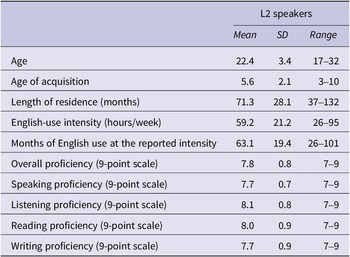
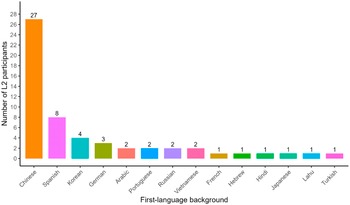
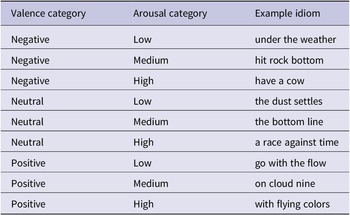
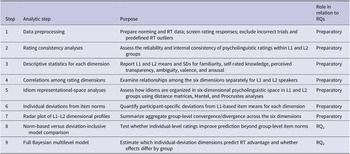
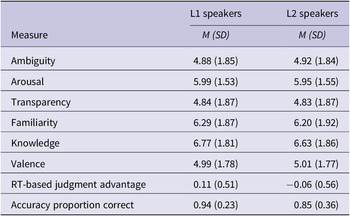
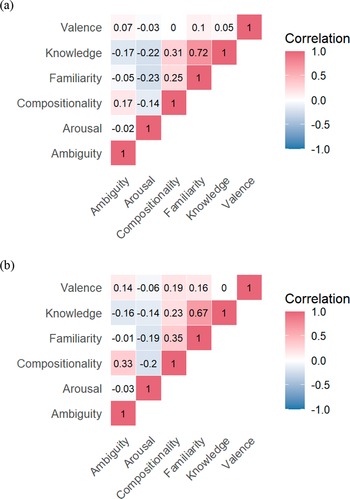
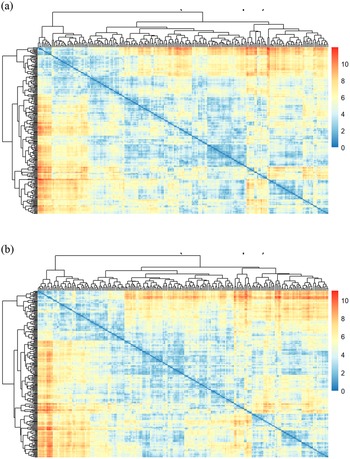
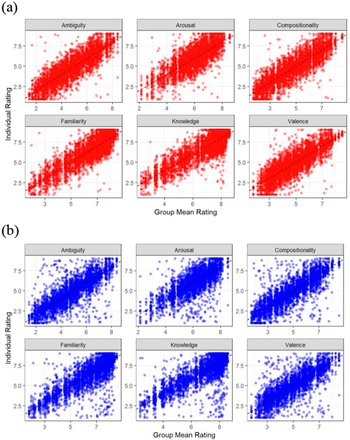
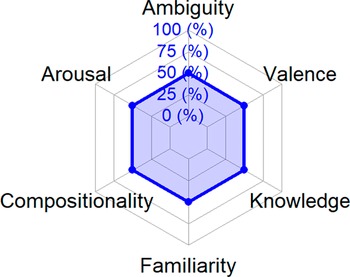


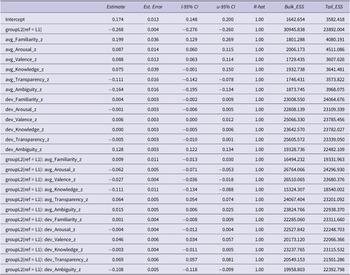
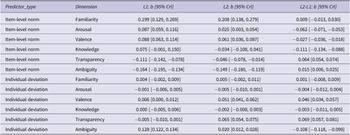


 Open access

