





Introduction
For much of the eighteenth and nineteenth centuries, Spanish Cuba was the most prolific sugar producer in the world and fed an almost insatiable sweet tooth in Europe and North America. The sugar profit contributed to the island’s substantial economic growth and was a reliable revenue source for Madrid’s treasury. But from the beginning of the nineteenth century, the abolitionist movements across the Atlantic posed a growing threat to the planters in Cuba and the reputation of the Spanish Empire. The anti-slavery voice grew louder in Europe, North America, and Latin America, and the transatlantic slave trade and slavery were abolished in one country after another after 1803. Although Cuba continued to import slaves during much of the nineteenth century, legislation against the slave trade by the British and American governments made the procurement and transportation of slaves much costlier. An alternative to slavery was urgently sought after for the continued success of Cuban agricultural production.
The Real Junta de Fomento, an association representing Cuban planters, first experimented with bringing European workers to Cuba in 1835. The pilot project, involving workers from Ireland, Galicia, and the Canary Islands, quickly became economically unviable, as only a limited number of them accepted the low wages and hard labour that the Cuban plantation economy required. For those who came to Cuba, complaints, desertion, and rebellions were the result.Footnote 1When this initial scheme failed, the planter association looked beyond Europe for a supplementary workforce. In 1846, its agents found such a workforce—the “coolies”—on the other side of the world, namely South China, which fulfilled all the requirements for the Cuban agricultural apparatus.Footnote 2
The overwhelming majority of these labourers came from Canton (now Guangdong) Province in South China, where emigration for better economic opportunities was already a centuries-old tradition. The unique geographical location of Canton put its people in touch with foreigners earlier than the rest of China. More immediate motivations for the Cantonese to emigrate came with the Sino-Western military conflicts and domestic rebellions in China, both of which caused havoc in the region. As a result, the supply of Chinese labourers to Cuba’s agricultural industry appeared limitless. Moreover, they were affordable. Most importantly, however, they were legal since their employment could be formalised in a contract signed by the indentured worker and the employer.
That was the start of the Chinese coolie trade to Cuba. Between 1847 and 1874, more than 141,000 Chinese workers were transported to Spanish Cuba alone, while others were sent elsewhere in Latin America. Eventually, the sugar industry, the rest of Cuba’s economy, and the Cuban government would embrace these indentured labourers from China, relying on them to fulfil tasks that few others were able or willing to take on. When the coolie trade finally ended in 1874, amid worldwide condemnation for its inhumane practices, the modernisation of Cuba’s state and economy was already well underway.
This research retraces the collective story of these colonos asiáticos and their historical significance in Cuba’s period of economic transition during the second half of the nineteenth century. Until recent years, a limited amount of literature has shed light on this historical episode, while a great deal more research has focused on Chinese migration to Southeast Asia and North America. The literature on Chinese migration to Latin America, mainly written in Chinese and Spanish, pays much attention to the abuses and maltreatment suffered by Chinese workers during their voyages and in the sugar industry. While this paper does not disregard the enormous human suffering involved, it concentrates on the underappreciated contributions of these Chinese labourers to Cuba’s state and economy. Their work within plantations is well documented. Nevertheless, their assignments beyond the plantations, such as in critical infrastructure projects including railway construction and road repair, facilitated Cuba’s domestic economy and its cash crop industry’s connections to the outside world. This aspect has been notably missing in the literature about Cuba’s Chinese coolie trade.Footnote 3
This missing link could be rooted in a lack of application of Chinese primary sources in the study of the coolie trade to Cuba. The Spanish and English sources, which most of the research literature has relied on, often give us an official view from the state but offer no first-person Chinese voices concerning their own experiences during and after the indenture.Footnote 4Therefore, this research engages with the individual, Chinese-written depositions made by more than 1,100 Chinese indentured workers who were interviewed by the international delegation sent by Beijing to Spanish Cuba in 1874 to investigate their well-being.Footnote 5These depositions give us much-needed insights into their day-to-day activities during and after the eight-year indenture, beyond the sugar plantations.
Furthermore, by examining the contributions made by Chinese workers in nineteenth-century Cuba’s depots, prisons, and other civil and military sites, this research challenges the conventional focus on their involvement in agricultural industries, particularly sugar production. By going beyond the ingenios, this paper reveals the Chinese stories in an until-now unexamined post-indenture initiative that perpetuated the ongoing exploitation of the Chinese in the 1860s and 1870s. I also argue that this largely successful and affordable move further sustained economic growth and state operations in Spanish Cuba during the same period. Chinese indenture at sugar plantations was just part of the story. Their post-indenture forced assignments fulfilled the needs of an evolving Cuban political economy.
Finally, the study of Chinese workers beyond the sugar plantations uncovers the public-private nature of this initiative. While the conventional literature focuses on the coolie trade as a private enterprise, these post-indenture activities illustrate the extent to which the state was intimately involved in the comprehensive exploitation of these indentured workers. Under the state’s direction, these ex-coolies continued to work for the profit-making tobacco industry, as well as in municipal maintenance and in the construction of civil and military infrastructure. In traditional scholarly literature, the Spanish state acquiesced to the exploitation of Chinese workers in Cuba, but this paper demonstrates that they went far beyond that: the colonial authorities actively participated in extending this system, keeping the coolies within it and making them contribute further to the political economy of Spanish Cuba.
This paper will first provide a summary of Cuba’s Chinese coolie trade, including the origins of these workers, the mechanism of this trade, and contemporary reactions to this human trafficking. The second section demonstrates how Chinese indentured labourers created the basis on which Cuban planters could revolutionise sugar production across the island. The third part illustrates how the focus on plantations has long masked the full contributions made by the Chinese in Cuba and beyond. I make a case for los colonos asiáticos as one of the key contributors to the modernisation of the Cuban state and economy in those years. I further posit that they helped feed the global appetite for sugar, which, without the assistance of these people, would otherwise have been impossible. The story of Cuba’s coolies aims to highlight the astonishing resilience and accomplishments of these people despite the drastic exploitation meted out by Cuba’s oppressive regime. All this further serves as a vivid reminder that economic progress and consumption patterns in the nineteenth century relied significantly on the underpaid or even unpaid toil of millions of workers, not least the often-overlooked community who are the focal point of this paper: Cuba’s population of Chinese coolies.
On paper, these Chinese constituted a new, unique category of workers in Cuba during a period when production methods were modernised and the workforce faded away from slavery. These Chinese coolies have long been viewed as an intermediate form of worker, between the conventional types of enslaved and wage labourers.Footnote 6On the one hand, their freedom was severely restricted for eight years. On the other hand, they were supposed to regain their liberty when their contracts were completed. During the indenture, coolies were supposed to enjoy contractual rights and benefits that were not extended to slaves. They did not, however, benefit from the physical and occupational mobility afforded to wage labourers. Although the coolie was in theory an intermediate form of employment, this paper takes the position that the indentured system was in practice an extension of the abusive mechanism that slaves had long suffered. As this paper will demonstrate, the Cuban state and its agricultural entrepreneurs successfully established a private–public partnership that transformed the contract-based, indentured system into a perpetual exploitative mechanism, which retained los colonos asiáticos in the workforce. This hidden history of labour not only had significant implications for Spanish Cuba but also for the wider world during the nineteenth century.
The Chinese Coolie Trade to Cuba, 1847–1874
To understand the subsequent contributions of these indentured workers in Cuba, one needs to examine their origins. An estimated 85 per cent of the labourers who went to Cuba came from the Canton Province (Figure 1).Footnote 8This province in South China had witnessed regular emigration for centuries because of its convenient position and established trading routes to Southeast Asia. Driven by local, regional, and foreign economic opportunities, Cantonese workers and merchants were mobile despite maritime bans imposed by the Ming and Qing courts from the sixteenth century. The question for many Cantonese men in their prime was not if, but where they should migrate to seek economic betterment for themselves and their families back home. Some went to the next village, some to the next town, and some to Southeast Asia. Migration was part of their shared experience, supported by kinship networks and family practices.Footnote 9This experience was almost exclusively male, as women were expected to stay behind and take care of the household, elderly, and children.Footnote 10
Origins of 1,176 Chinese coolies reported by the Cuba Commission of 1874 and a typical coolie voyage in the 1850sFootnote 7.

In 1759, the Qing government, in an attempt to maintain social and political stability, restricted Sino-foreign trade to the city of Canton. This policy further developed the region into a critical hub for Cantonese and foreign traders. By the 1840s, the Pearl River Delta region—the centre of the Canton Province—had already developed into a highly sophisticated economy featuring new industries and work specialisations which did not appear elsewhere in China until decades later.Footnote 11Western merchants, products, and ideas were not foreign to the Cantonese. In turn, one can imagine that such an awareness of the West would have made them more likely to accept the idea of emigrating abroad, especially in the mid-nineteenth century. To survive, the Cantonese were regularly required to acquire new skills (e.g., pidgin English), meet new people and learn their cultures (e.g., foreign merchants and missionaries), and be innovative in their individual and collective endeavours (e.g., new trading and job opportunities). All this challenged the Cantonese to become more agile, versatile, and adaptable. These helpful traits were not innate but were survival skills acquired through generations of migratory experience and intercultural exchanges with Westerners in arguably the most cosmopolitan port town in nineteenth-century Asia. These survival skills would prove to be essential in Cuba.
Nevertheless, the most immediate factor that pushed these Cantonese to sojourn abroad was a series of military events in South China. The Opium War (1839–42) between Qing China and Great Britain caused substantial economic and political chaos. The resulting Treaty of Nanking (1842) opened the door to massive Sino-Western trade along the southern coastline of China, which also allowed for the trading of low-paid Chinese labour to the world. This war was followed by the domestic Taiping Uprisings (1850–64), which came close to toppling the Qing dynasty. Although the Manchus held on to power, South China was in social and political disarray for almost two decades. The subsequent social disorder and economic displacements became powerful motivators for the exodus. Furthermore, the highly lucrative human trade enticed foreign coolie brokers and local Chinese intermediaries to use legal and illegal means to recruit the maximum number of indentured workers to Cuba.
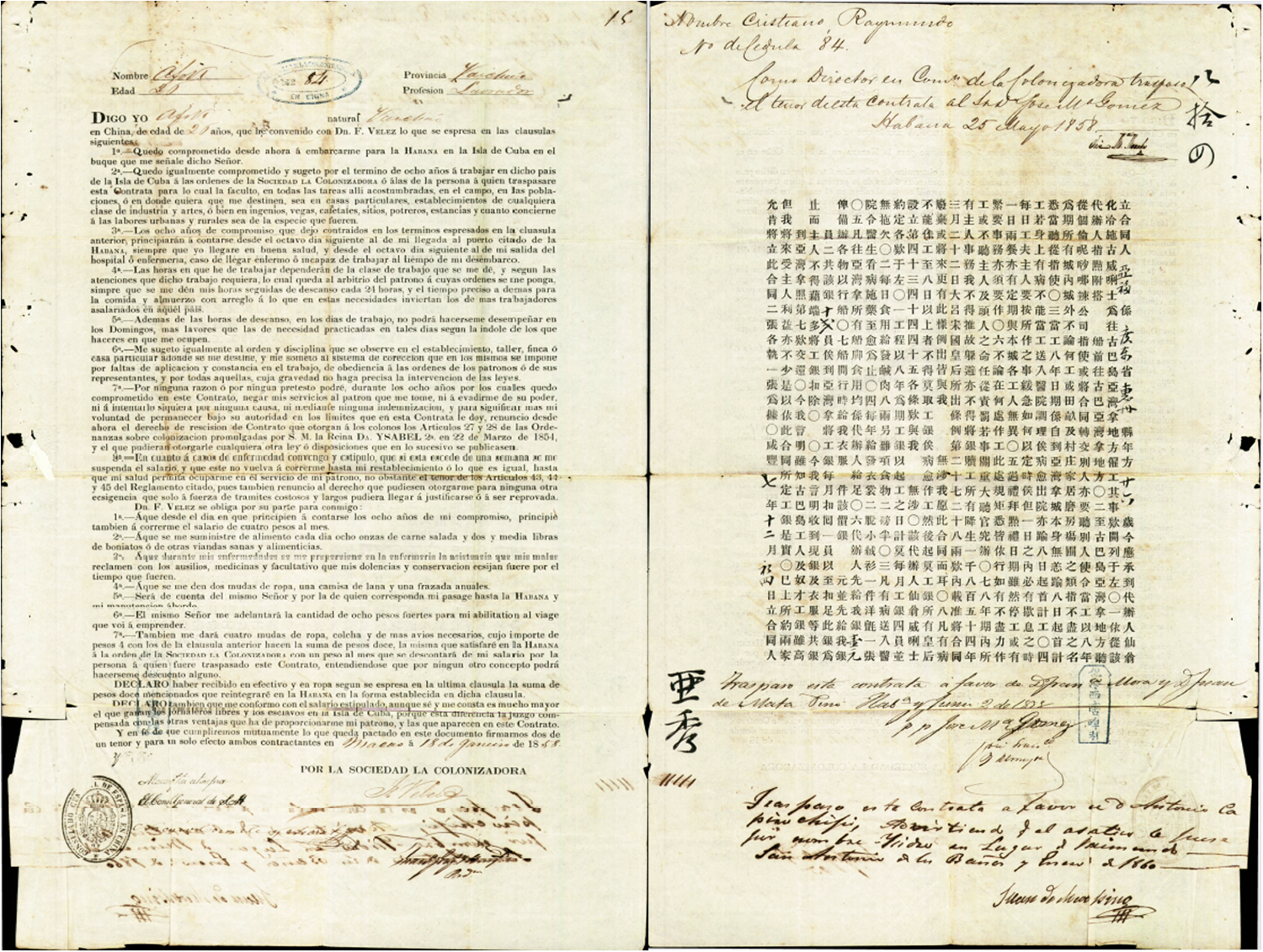
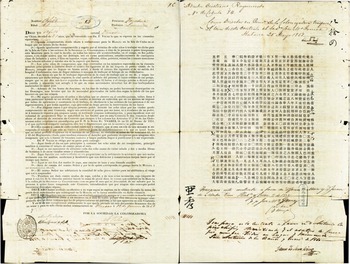
For these men to leave, however, motivation alone was not enough. The mass migration of Chinese people from China to the other side of the world had to happen within a legitimate framework, at least in theory, in order to pass judgement with Qing China and the rest of the world. Under the growing denunciation of slavery, the coolie trade had to be—or at least appear to be—different. To validate the legality of the Chinese indenture operation, a written agreement between the coolie agent and the Chinese indentured labourer laid out the terms and responsibilities for all parties involved. The legally binding agreement stated the names of the contracting parties, employment duration, monthly salary, and benefits, including medical care, accommodation, food allowance, and holidays. A vital clause for the coolies was their supposed liberty upon finishing the contract. This would entail the issuance of a cédula (“滿身紙” in Chinese sources), with which the Chinese worker could gain some degree of physical and employment mobility in Cuba after the eight-year term. The contract also stipulated the nature and location of the work in which the indentured individual was to be engaged. The agreement was to be signed by the two parties (Figure 2).
Coolie contracts in Spanish and Chinese, between the coolie, Afno 亞秀, and the coolie agent, F. Valdez, 1858Footnote 12.
Despite this legitimate framework, the coolie trade attracted damning publicity almost from the start.Footnote 13On the one hand, frequent shipwrecks, mutinies on board, and alleged abuses in Cuba kept the coolie trade in disrepute. Unscrupulous recruitment tactics, including widespread trickery and outright kidnappings, caused sweeping unrest in the treaty ports where the coolie trade took place. The Amoy Riots in 1852 were an example of this.Footnote 14Newspapers in Europe and the United States became increasingly vocal in their opposition to the trade, often equating the Chinese coolie trade to the African slave trade. The Times in London called the business nothing short of “wholesale massacre,”Footnote 15and the New York Times called it a “murder.”Footnote 16In China, the nascent print media warned people not to trust the coolie brokers and not to migrate to Latin America. A bestseller, featuring very graphic terms and depictions, Shengdiyu Tushuo 生地獄圖說 [Illustrated description of the living hells] exemplified the atrocities committed against Chinese workers, arguing that the coolie trade was simply another form of slavery.Footnote 17
Partly in response to this international outcry, the British and American legislatures practically forbade their citizens from engaging in this human trade in 1855 and 1862 respectively.Footnote 18However, the Portuguese and Spanish governments proved eager to keep and expand the Chinese coolie trade to Cuba, as it provided a reliable source of income to Portuguese Macau and much-needed labour for Spanish Cuba.Footnote 19Foreign diplomats and missionaries in China kept pressuring the Qing court, and a few high-profile mutinies on the high seas helped push Beijing to take drastic action to stop the coolie trade.Footnote 20
In 1874, the Tongzhi Emperor sanctioned an official delegation—the Cuba Commission—to investigate the alleged abuses of the Chinese labourers in Cuba. The team, made up of representatives from China, France, Britain, and the United States, spent almost three months on the Spanish island, visiting plantations, factories, depots, and prisons. As noted above, they interviewed 1,176 Chinese labourers and received eighty-five group petitions from the Chinese who could not be physically present. These depositions and petitions formed the basis of the Cuba Commission Report, which ultimately sealed the collapse of the Chinese coolie trade to Cuba in the same year. While the Report itself has been often cited, the supporting testimonies by the coolies have not been widely considered in the research on Chinese indentured labour in Cuba. Based on these primary documents, the following sections will discuss the contributions made by the Chinese in Cuba, some of which do not appear in the Spanish sources archived in Cuba and Spain.
At the Sugar Plantations: Enabling the Modernisation Process
Without the Chinese, who knows how the advances already made in Cuba would have been possible?
— Ramón de la SagraFootnote 21
As the Cuban scholar Ramón de la Sagra observed in 1860, the Chinese indentured labourers made an indelible mark on the sugar plantations. In this section, I argue that Cuba’s sugar revolution in the nineteenth century could not have materialised without the Chinese workers. I shall explain below how these Chinese became essential to the mechanisation of sugar production from the 1840s to the 1860s. Three aspects should be highlighted. First, the Chinese workers gave Cuba the additional labour that it sorely needed for its continuous expansion and mechanisation. Without the Chinese, the Spanish island would not have had enough people to do the job. Second, apart from their sheer numbers, the Chinese were cheap, which gave the planters the economic capacity to finance mechanisation, namely, to import expensive, state-of-the-art sugar machines from Europe and the United States.Footnote 22Third, the agility and versatility of the Chinese workers demonstrated at plantations made them perfect for the modernisation of the sugar industry. The ever-changing workplace and increasing specialisations required individuals who could adapt and learn quickly. The workers had to take on new and multiple tasks. Los chinos were able to do both. Eventually, all major mechanised sugar production sites came to rely on the service of coolies.Footnote 23
While sugar planters had known about the growing opposition against the slave trade in Europe and the Americas since the early nineteenth century, a series of events took place in the 1840s that created a panic among them. The British and Americans were increasingly proactive in their abolitionist initiatives. London, in 1840, appointed a famous abolitionist, David Turnbull, as the British envoy to Havana. Madrid, under international pressure, passed anti-slave-trade legislation in 1845, prohibiting individuals from engaging in slave trade. The idea of possible exile and a fine of up to 100,000 pesos meant that the planters were now desperate, looking for any alternative to slaves.Footnote 24Miguel Aldama, a Spanish aristocrat and prominent Cuban landowner, succinctly summed up the sentiments of the planter class: extra hands ought to be recruited “from Siberia, if necessary.”Footnote 25In reality, facing a labour shortage and an expanding economy, the planters had little choice but to import both the legal Chinese coolies and the illegal African slaves. The coexistence of indentured and enslaved workforces lasted nearly four decades, with the final coolie contract completed in 1882 and slavery abolished in 1886.
After two initial trial shipments in 1847, regular importation of Chinese workers into Cuba began in 1853 and was then continuous throughout the coolie period.Footnote 26Between 1847 and 1874, more than 141,000 Chinese workers were transported to Cuba, and about 125,000 survived the journey (see Appendix 1). There is no clear record of all their occupations, but judging by the Commission’s collection of depositions and petitions, the majority of them were dispatched to sugar plantations.Footnote 27The Chinese presence was concentrated in the Western Department and part of the Central Department.
The Chinese workforce alleviated the labour crisis many planters encountered in the 1850s and 1860s. Cuban sources from the 1850s and 1860s indicate that virtually all major plantations relied on the Chinese workforce. Las Cañas, in Matanzas, hired more than one hundred Chinese. Flor de Cuba, in Cárdenas, possessed 170; Alava, also in Cárdenas, 130. Other sizable plantations that profited from the services of the Chinese included Angelita (Cienfuegos), San Pelayo (Cárdenas), Santa Susana (Cienfuegos), Conchita (Matanzas), San Martín (Cárdenas), and La Ponina (Cárdenas).Footnote 28Testifying to the Cuba Commission in 1874, the coolies corroborated the continued level of Chinese presence in most sugar mills.Footnote 29
In addition, the coolies provided the new type of labourers that the planters needed. In the 1830s, propelled by the imminent threat of labour shortage related to the abolitionist movement, the Cuban planter class began to embrace the modernisation of sugar production to reduce human labour. Such a series of changes in the production line involved new milling methods, installing watermills, running steam engines, and operating vacuum pans. On the one hand, these latest innovations substantially reduced the need for human resources. On the other hand, they required new kinds of labourers with operational techniques and maintenance know-how. Many planters came to rely on the Chinese workforce to fill these new, mechanised positions.Footnote 30
In the 1860s, the French machine builder Derosne and Cail virtually dominated the new mechanised sugar production.Footnote 31The centrepiece of the Derosne-Cail apparatus was its steam-powered boiler, and many Chinese workers were assigned to its operation and maintenance. One of them was Xie A-geng 謝阿庚; when he was not fixing the sugar machines, he was his plantation’s blacksmith.Footnote 32At El Progreso, a mechanised plantation in Cárdenas with the new Benson and Day centrifuge, forty Chinese helpers worked in the boiler room, assisting the French chief technician.Footnote 33Eventually, some even assumed supervisory roles over these machines. He A-fa 何阿發 reported to the Commission that his primary responsibility at a sugar plantation in Colón was controlling the sugar machine.
Nevertheless, plenty of examples attest to the brutality inflicted on the Chinese workers. Corporal punishment by the overseers or accidents involving machine operations often inflicted bodily harm on the coolies.Footnote 34Still, the capability of the Chinese to work with machines did not escape the eyes of Ramón de la Sagra when he was visiting numerous sugar plantations in 1860:
It is necessary to have seen them, already in the mills of Cienfuegos and Villaclara, … which I have visited before now, to conceive the identification of the intelligent work of the Chinese with the constant regularity of the industrial operations subjected to the incessant blow of the piston, or to the tension of the steam, or to the fixed degree of the thermometer.Footnote 35
The Chinese were not only capable of being trained for mechanised posts. In their depositions to the Cuba Commission, coolies often reported that they had held multiple positions simultaneously. At the España plantation in Colón, He Zhangquan 何章權 toiled in the field and also served as the personal chef of the site overseer.Footnote 36He A-si 何阿四 explained to the interviewers that, when he was not a plasterer at the Esperanza plantation in Cárdenas, he worked as a farmer in the field.Footnote 37Li Bi 李璧 was first hired as a ship’s doctor during the coolie voyage. Upon arrival in Havana, he was sold to a sugar plantation. For three months, he cultivated sugarcane in the field. After that, he was again a doctor, caring for other Chinese workers at the plantation.Footnote 38The multiple talents of the coolies served the modernising plantations well, as work specialisation developed rapidly. It is thus not entirely surprising that the Cuban planters generally found the agile and versatile performance of the Chinese satisfactory.Footnote 39
The planters were more agreeable to coolie importation because of the project’s affordability. The Chinese worked remarkably cheaply. In the 1840s, just when the coolie trade began, a free labourer in Cuba could earn up to twenty pesos a month. In the 1860s, his monthly salary rose to forty pesos. In the town, the wage could reach fifty pesos. The monthly salary for all Chinese coolies in their first indenture was four pesos—unchanged—until 1874, when the coolie trade was shut down.Footnote 40Even if planters added up all the commission fees, transportation costs, and other related expenses, the coolies still offered an incredible bargain throughout this period in Spanish Cuba. In the 1860s and early 1870s, even when the coolie contract reached a higher cost of 340 pesos per head, it was still a much better deal than the cost of procuring a slave for 600 pesos.Footnote 41With the importation of the Chinese, the substantial savings gave the planters a much-needed economic edge, transforming into financial leeway to keep modernising the sugar production line by importing more sugar technologies from abroad.
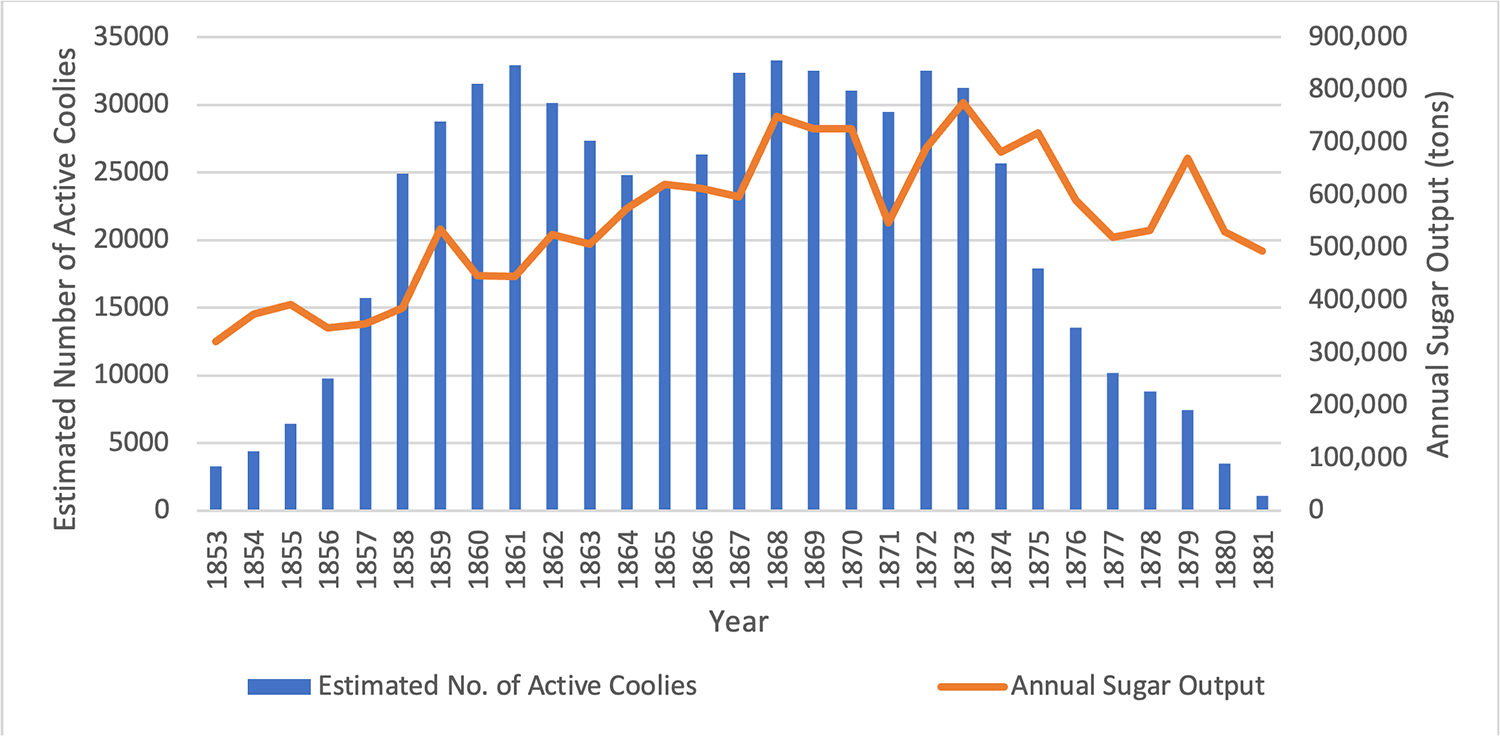
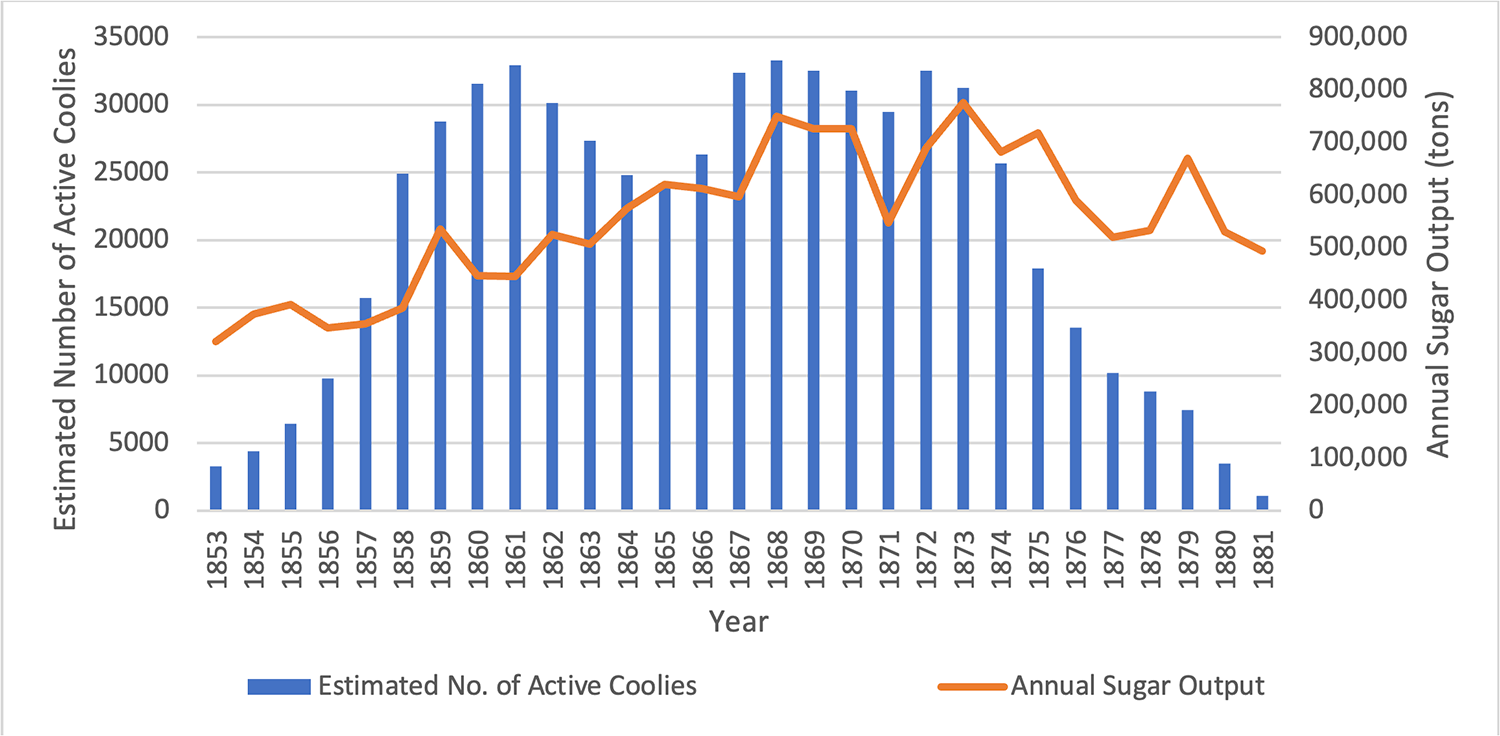
Thanks to the adaptability and affordability of the Chinese workers, the sugar revolution in Cuba continued unabated in the second half of the nineteenth century. Figure 3 shows the comparable upward trends of both the annual sugar output in Cuba and the estimated number of active coolies in Cuba. Between 1853 and 1865, Cuban sugar mills saw a fivefold increase in Chinese workers while their collective sugar production doubled. Two exceptions can be explained. First, the temporary reduction of coolie numbers between 1861 and 1865 did not reverse the increasing sugar output.Footnote 42Many Chinese were forced to re-indenture at plantations, and those who physically survived were experienced labourers.Footnote 43Second, and similarly, the permanent decrease in coolie numbers after 1874 did not substantially reduce Cuba’s sugar production. Although the coolie trade ended in 1874, the Chinese who arrived in and before 1874 still had to serve out their contracts.Footnote 44For those whose contracts had expired, some continued to work at the plantations, albeit as wage labourers. Furthermore, the maturing mechanisation of the Cuban sugar industry helps explain Cuba’s high sugar output after the end of the coolie trade. Thus, throughout the second half of the nineteenth century, Cuba maintained its world-beating position, supplying more than half of the world’s demand for sugar and outproducing its closest competitors by far.Footnote 45
Estimated Number of Active Coolies and Annual Sugar Output of CubaFootnote 46.
Beyond the Sugar Plantations: Coolies in Other Industries
While the primary beneficiaries of the Chinese coolie trade were the sugar planters, other key industries—both the manufacturing and service sectors in Cuba—also materially depended on los colonos asiáticos. From tobacco factories, coffee plantations, gold mines, bakeries, restaurants, and liquor stores, to private homes, the Chinese kept Cuba running, carrying out mundane tasks in ways that the white, Black, and Creole populations were not willing or deemed able to do. The perceived docility and dexterity of Chinese workers contributed much to the use of coolies in these economic activities, while the low costs no doubt also drove demand. Nevertheless, their involvement in the non-sugar sectors has been neglected in the historiography, and I will briefly explain the scope of Chinese participation in these industries.
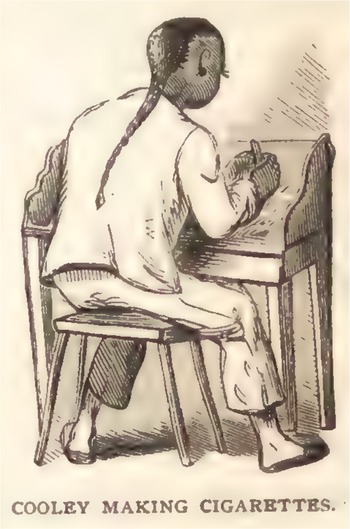
After the sugar industry, it was the Cuban tobacco economy that benefited most from Chinese labour. During the nineteenth century, the European and American appetite for Cuban cigars and cigarettes was swelling. To keep up with production while maintaining the high quality of their products, cheap and dexterous workers were needed. When the tobacco bosses noted that women and white workers could not be enticed to work at tobacco factories en masse, Chinese indentured workers became an attractive alternative.Footnote 47The cigar makers and contemporary observers considered the Chinese the most adroit, affordable, and hardworking. Samuel Hazard, an American traveller to Cuba in 1871, visited a tobacco plant and saw first hand how a room full of Chinese workers busily filled cigarettes. He made an illustration of one of them (see Figure 4) and was impressed with their performance:
Each workman has a small table to himself, at which he folds, counts, and does up in packages the little cigarettes; and it is astonishing what facility and dexterity they acquire from long practice in handling and counting these small bits of paper. I watched the movements of one whose business it was to enclose twenty-five cigarettes in a package, just as we buy them, and this he did apparently without counting them; and yet by a movement of his fingers he would tell if there was one of two more or less, with surprising accuracy, and apparently simply by the sense of touch. The usher informed me that they rarely or never made a mistake.Footnote 48
“Cooley Making Cigarettes”Footnote 49.

A celebrated tobacco establishment in Cuba, Susini, was also pleased with the Chinese performance. Of the in-house staff of 150 at its flagship factory, La Honradez, the Chinese operatives constituted eighty-five.Footnote 50As at the sugar plantations, they were responsible for the procedures requiring manual dexterity. From measuring tobacco leaves and rolling cigars to counting cigars for each package, the manager relied on the Chinese workers day and night to meet the tight production schedule. Mechanisation came to cigar and cigarette production much later than it did to the sugar industry in Cuba. Manual production remained the tobacco industry’s core even when machines were gradually imported to assist with rolling.Footnote 51Thus, the Chinese remained an essential asset to the tobacco enterprise long after the coolie period. The owner of Susini, José Susini, demonstrated his appreciation of the Chinese when he advised the factory manager, “Take good care of the Chinese, for they are our capital.”Footnote 52
Yet factories such as La Honradez represented only a small proportion of all cigar and cigarette production.Footnote 53Unpaid Chinese workers did most of this work, at prisons and depots across the island. The majority of the Chinese detained at depots were ex-coolies who had already completed their first contracts. Other Chinese landed in prisons because they violated Cuban laws or because of fictitious charges brought by planters or the state. All these incarcerated coolies had little choice but to undertake the “voluntary” work for the Cuban tobacco industry. Cigarette rolling involved extremely long hours, typically from 5 am until midnight,Footnote 54and a specific, demanding target, such as three bushels of leaves in a week. If the coolie failed to achieve the target, he would receive lashes.Footnote 55Chinese labourers at coffee plantations,Footnote 56gold mines,Footnote 57and tileriesFootnote 58could not have expected much better conditions.
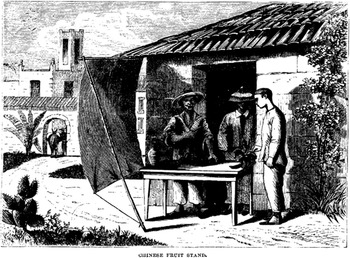
Beyond hard labour, the Chinese were also engaged in the flourishing service sector, particularly in urban areas. Examples included food services, retail commerce, and general hospitality. Bakeries were a popular destination for some who did not get dispatched to the sugar mills. Hu A-ting 胡阿聽 deposed that he toiled for eight years in a Havana bakery and afterwards became a private baker for two years until the local police seized him for the state’s Trocha project (see “For the People and the State” below).Footnote 59After completing their first indenture at sugar plantations, some coolies found more lucrative positions in the service industries. These ex-coolies found jobs in barber shops,Footnote 60liquor stores,Footnote 61butcheries,Footnote 62and fruit stores.Footnote 63Fruit stands operated by the Chinese in Cuba were so noteworthy that Harper’s Magazine found they merited an illustration (Figure 5). The depositions and petitions demonstrate a wide range of professions these Chinese occupied after working at plantations. They all provided essential services to a growing economy.
Chinese Fruit StandFootnote 65.

Within the hospitality business, some Chinese labourers garnered a reputation for their cooking talents. In particular, some expatriates in Cuba enjoyed having Chinese coolies as their private chefs. Wu A-yi’s 吳阿義 culinary skills dazzled two British expatriates in Cuba. One of them employed him for two years. In return for his outstanding service, the British employer obtained a certificate of contract completion from the Spanish authorities on his behalf. The certificate afforded him substantially more bargaining power on the job market: after leaving the British household, he was offered a job at another plantation at thirty pesos a month—an above-average salary in the early 1870s. From there, a second British expatriate recruited Wu to be his family chef in Matanzas.Footnote 64Wu likely mastered a decent English proficiency in Canton Province that facilitated his communications with his British employers in Cuba.
Thus, Chinese workers participated in all parts of the plantation and non-plantation world. An often-overlooked advantage to Spanish Cuba was the adaptability these Chinese workers displayed on the island, effectively increasing the number of available workers in the entire economy. In their first indenture, second indenture, and post-indenture lives, the coolies displayed their multiple talents in a rapidly modernising economy, fulfilling the new and varied tasks arising out of growing work specialisation and division of labour.Footnote 66The overwhelming majority of the depositions and petitions record multiple lines of work across Cuba. Nevertheless, these sources almost always included one task omitted from conventional historiography about the Chinese coolie experience on the island: unremunerated work for the Cuban state, which will be scrutinised in the following section.
For the People and the State: Public Service and the Trocha Project
Perhaps the most neglected aspect of the early Chinese stories in Cuba are their contributions to the island’s public services and infrastructure projects. As Cuba’s economy was booming, the island needed the roads, ports, and railways that would facilitate the seamless transportation of products, machines, and workforce. Similarly, the Havana government needed many more day-to-day public services to keep Cuba running. These services included road cleaning, street lamp repair, and sewer fixing, among many others. Like the sugar planters, the Cuban authorities were desperate for workers for their labour-intensive public projects.Footnote 67Cuba’s economy and, more importantly, Spain’s treasury in Madrid depended on its captain-general in Havana to find a solution to this problem.
The solution was the Chinese. The planter class and the Cuban state jointly created a private-public partnership that continued to retain the coolies, virtually in perpetuity, for services that were needed either by private enterprises or the Cuban public. After their eight-year indenture, although the labourers could technically return to China, the planters trumped up various excuses for refusing to issue certificates of contract completion, such as violations of plantation rules, poor performance at work, sick leave taken, and debt incurred during indenture. Lacking the necessary paperwork from their employer, the coolies were conveniently sent to the regional depots under the supervision of the Cuban government.
Among the 1,176 Chinese indentured labourers interviewed by the Cuba Commission, 676 had already finished their initial contract. Among these 676, only five had not been coerced into public-sector work via government-run depots. Worse, many of them were forced into doing “tours” of construction jobs and public services for different depots, from Havana, via Matanzas, to Cienfuegos, for example. Over 35 per cent of these coolies in depots received no pay at all, with the rest minimally remunerated.Footnote 68Any one job given by local depots could last a few days to a few months. If they were not dispatched to public-sector projects, the Chinese would usually be instructed to do essential work for private companies, such as rolling cigarettes, inside the state-run depots.
The individuals who had completed their indenture, or those who had completed unpaid work for any depot, could still be forced to return to public service if the captain-general or local authorities saw fit. While the Irish workers could blend into the Cuban society for being white, and the Canary Islanders could do the same for being able to speak Spanish, the Chinese did not have these natural advantages and could hardly avoid the attention of the authorities. Until 1874, they had little legal recourse against any arbitrary actions of the Cuban state.Footnote 69At the time, Qing China had no diplomatic representation in Cuba and could offer no protection to any Chinese on the island. Some British and US envoys intervened, but the results were largely piecemeal and did not fundamentally challenge the oppressive mechanism in which the Chinese were entirely trapped.Footnote 70
During the coolie era, the Cuban government took advantage of the virtually unpaid service of Chinese labourers after their initial indenture, through a system of cooperation between the Havana government, the sugar planters, and a cooperative judiciary on the island. From the depots and prisons, the Chinese contributed to all kinds of infrastructure initiatives and public services. Depositions and petitions highlight the development projects essential to Cuba’s booming economy. These included hard labour, such as constructing roads, railways,Footnote 71and buildings. “Lighter” tasks were road cleaning,Footnote 72lamp fixing, and drainage repair.Footnote 73All these were essential for the running of the economy and the state.
The Chinese were also essential to other development projects that were not directly economy related but were crucial for the general functioning of the Cuban state. The construction of churches, for instance, involved the participation of the Chinese from depots. Wen Chang-tai 文長泰 reported to the Commission investigators that he helped construct the church opposite the hotel where the Commission was residing at Sagua la Grande.Footnote 74Among the public services, the captain-generals probably paid the most attention to the military fortifications across the island, particularly after the Ten Years’ War outbreak between the Spanish loyalists in the east and the rebels in the west.
As this military conflict became imminent, the Havana authorities prioritised the protection of the west, especially the Havana-Matanzas-Cárdenas triangle, where most sugar plantations were located. The government conceived a massive defensive construction, the Trocha, from the northern port town of Jairo to the southern city of Morón, effectively splitting the island into two halves (Figure 6). The Trocha was a system of trenches accompanied by forty-three forts alongside a dedicated railway, telegraph lines, barbed wire, palisades, and other defensive structures.Footnote 75It stretched over sixty-eight kilometres over rugged, tropical terrain that few chose to inhabit on this part of the island. As usual, the problem associated with such an enormous undertaking was a labour shortage.
Sketch of the Trocha Project, 1871Footnote 76.

Between 1871 and 1874, four successive captain-generals of Cuba encountered this challenge in planning and executing the Trocha plan. For instance, Captain-General Cándido Pieltaín told Madrid how frequent desertion and disobedience had repeatedly frustrated his recruitment attempts. Colonial records regularly noted the government’s inability to force prisoners or freed people to work. Black, Brown, and white workers fled the Trocha project before their departure from Havana, during the transit, and from the Trocha site.Footnote 77In 1873, Pieltaín issued a desperate call to the planter class, asking for three thousand slaves for six months. Zulueta and other influential planters flatly refused. However, they agreed to finance the project and urged Pieltaín to use all Chinese labourers detained in prisons and depots across the island.Footnote 78
In this urgent situation, the Cuban authorities maximised the number of Chinese in prisons and depots by making false accusations against the Chinese who had already become freed individuals and seizing Chinese labourers outright from the street. The charges ranged from misdemeanours, such as carrying incorrect papers and violating minor contract terms, to severe wrongdoings trumped up by the Cuban government. To motivate the Chinese to do the hard work for the Trocha project, the Cuban authorities promised an unusually high salary—thirty pesos per month. Despite this prospective reward, many Chinese remained unwilling to go to the Trocha project and had to be chained and dragged on board.Footnote 79This high-handed approach succeeded in gathering a sizable workforce for the Trocha. By 1874, the Spanish government claimed to have dispatched 1,932 labourers to the fortification project. More than 90 per cent of them were Chinese (1,827).Footnote 80The figure was likely an underestimate.
At the Trocha, the most demanding task was land clearing, while the actual construction tasks were no less hazardous. Workers were required to build roads and dig trenches, among other duties, every day from 6 am until 6 pm, with a one-hour lunch break.Footnote 81As if this back-breaking work were not challenging enough, the Chinese had to deal with threats arising from natural sources. The coolies pointed to the unsanitised water, which they drank and which caused bloating, as the core reason behind the high mortality at the Trocha project.Footnote 82Dense forests posed another danger to their work, and tropical diseases were an even more deadly hazard. Torrential rains poured down regularly. Even the most work-hardened coolies found this environment physically torturous.Footnote 83To top it all, the crossfire between the Spanish troops and the revolutionaries put all workers under constant threat. For instance, Liang A-ke 梁阿壳 reported that his ankle was severely injured as he fled the raid staged by the rebels.Footnote 84
Some surviving labourers estimated that one-third of the Chinese perished during the construction of the fortifications.Footnote 85For the survivors, the aftermath was not much better. The promised high salary and certificate of contract completion rarely materialised. Instead of releasing the Chinese back to the free labour market, the Cuban government sent them back to the Havana depots, waiting for their next no-wage or low-wage assignments.Footnote 86If anyone had entertained the idea of returning to China or leaving the plantation-depot institution, the aftermath of the Trocha project dispelled all such illusions. The lucky minority who had enjoyed a brief period of freedom after their first indenture now realised their liberty was short-lived and all could be taken away by the Cuban state at will.
With the full cooperation between the Cuban authorities and private business people, such as sugar planters and tobacco manufacturers, the original contract-based Chinese indenture system evolved into a permanent enslaving apparatus—ruthlessly effective yet technically lawful. It was effective, as the agriculturalists and the government took seamless turns exploiting the hard labour that the Chinese offered. It was legal, at least in the eyes of the Cuban state, in that the contract terms were first fulfilled at plantations and the subsequent services rendered at the depots, prisons, or elsewhere were legitimate punishments for the crimes the Chinese allegedly committed, conveniently, whenever Cuba needed labour for various public projects. Little did the Chinese themselves understand the meaning of the work they did on behalf of the government and its broader implications for Cuba’s maintenance of economy and order, of which they were ironically the victims.
Conclusion
Conventional scholarship has paid attention to Chinese suffering at all stages of the coolie trade between 1847 and 1874. Maltreatment was undoubtedly extreme in recruitment, transportation, and the workplace, even by nineteenth-century standards. The hopeless situation experienced by the coolies made their achievements even more remarkable. This paper thus takes a broader approach to examine the full experience—the exploitation and accomplishment—of the Chinese indentured labourers in Cuba inside and outside the sugar plantations. I posit that their work outside of the plantations was at least equally, if not more, important to their contributions within the plantations. Without the Chinese, Spanish Cuba would not have been able to maintain and expand its world-leading sugar output, transitioning from a manual-labour-driven to a machine-based production, while the Cuban state and economy could hardly have sustained essential public works and infrastructure projects. The Chinese were the hidden drivers of Cuba’s economic transformation.
First, given the imminent abolition movement, from 1847 the 141,000-strong Chinese indentured labourers came to the rescue of desperate sugar planters. The sheer number of these workers ensured the sugar industry’s continued operation, expanding sugar output throughout the second half of the nineteenth century. The planters got more than they bargained for: the Chinese were agile, versatile, and docile workers and cheaper than everyone else in Cuba. All these features made them optimal candidates for the mechanised plantations, which required individuals that could learn new skills quickly.
A much less discussed aspect of these Chinese was their work outside the plantations. They constituted a robust workforce supporting tobacco factories, gold mines, coffee plantations, and tileries, among other industries that required hard labour. Los colonos asiáticos were also an essential part of the developing service industry. Some Chinese labourers quickly assimilated into the larger Cuban economy in bakeries, restaurants, barber shops, liquor stores, and fruit stands. All these occupations demonstrated the remarkable adaptability of these Asian workers in a completely foreign environment.
Perhaps the most underappreciated experience of the Chinese in Cuba was their “voluntary” work for the Cuban state. Little about this, especially regarding the Trocha project, has been recorded in the Spanish documents; however, when questioned by the Cuba Commission in 1874, the Chinese workers spoke and wrote about the inhumane working conditions and unfulfilled promises of the Cuban government. In their depositions and petitions, they relived the experience of building the critical infrastructure of a modernising Cuba in the 1850s, 1860s, and 1870s, including major networks of roads, railways, bridges, and ports. They also cleaned roads, constructed churches, and repaired street lights, among other community services. In contrast to their plantation duties, the effort put into this construction went virtually unremunerated. In full cooperation with the sugar planters, the Spanish Cuban authorities created and maintained this perpetual arrangement, ensuring the full utilisation of Chinese labour at the most affordable costs to both the state and the sugar producers.
Despite these inhumane conditions, the Chinese labourers demonstrated remarkable perseverance in Cuba, capable of assuming new, varied tasks in a foreign land. This resilient adaptability made them indispensable to the Cuban planter class and the Cuban state in the second half of the nineteenth century. The modernisation of Cuba, which involved much more than just the mechanisation of its sugar production process, required more labourers and an agile workforce willing and able to improvise alongside the ever-changing technological advancements. In just four decades, the Cuban planters went from primarily manual-driven production to the most modern sugar production. In the same period, Cuba became an interconnected economic powerhouse, thanks to a network of new infrastructure developments and public services. This would have been inconceivable without the Chinese input.
This private-public partnership created by the planters and government only ended in 1877, when Beijing and Madrid struck an agreement that included a clause releasing all Chinese detained in depots.Footnote 87The overwhelming majority of the 141,000 coolies that arrived in Cuba never returned to China. Some died on the voyage out, and more succumbed to misery during the first contract. Still more could not withstand the forced re-indenture and the government depots. The few that endured all these became the survivors. Having garnered invaluable skills and experience in Cuba, they became the first generation of chino-cubanos, building the Chinese communities in Havana, Matanzas, Cárdenas, and elsewhere in the Americas. Few today remember the achievements of these survivors in the midst of intense suffering.
Acknowledgements
Anna Leung performed indispensable research on this project early on. Brian Lai provided further assistance. The guest editors and peer reviewers offered meticulous feedback. I am grateful to them. However, all errors remain my own.
Funding information
A Taiwan Fellowship and an Arts and Humanities Research Council Travel Grant afforded me access to primary sources in Taiwan and Cuba.
Appendix 1: Annual Immigration of Chinese Labourers to Cuba, 1848–74
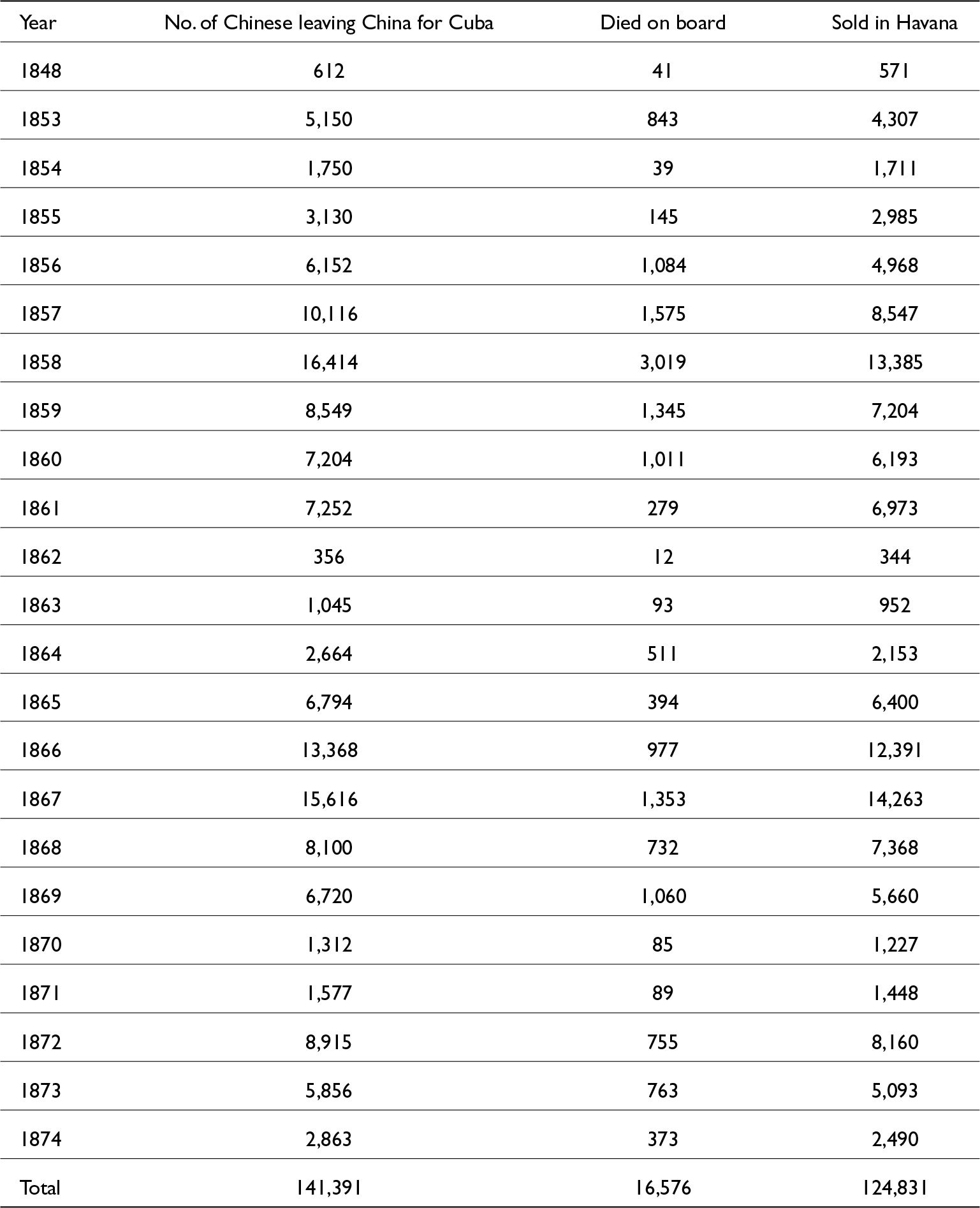
Sources: Pérez de la Riva, “Demografía,” 6.
Notes: Both Arnold Meagher (“Chinese Laborers,” 182a) and Juan Pérez de la Riva compiled statistics on Chinese immigration to Cuba between 1847 and 1874. Meagher’s work draws on the estimates done by John Crawford, then the British Consul at Havana. Pérez de la Riva bases his on data printed in the official Cuban periodical, Boletín de Colonización. Their figures are not materially different. I rely more on Pérez de la Riva’s statistics, as the Cuban authorities probably received more comprehensive intelligence at the port of Havana.
Appendix 2: Estimated Coolie Mortality during Eight-Year Indenture, 1853–1874
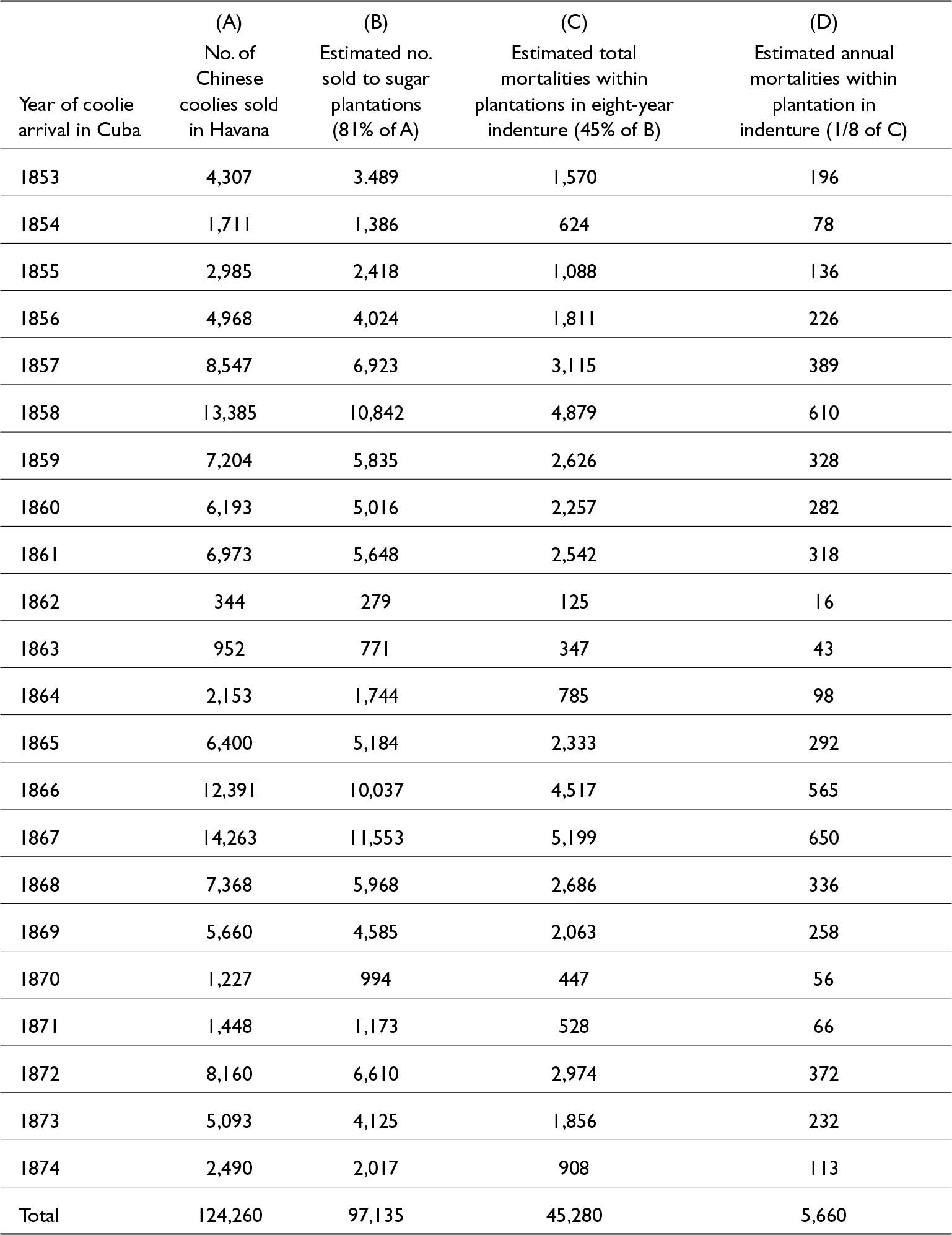
Sources: Pérez de la Riva, “Demografía,” 6; Cuba Commission Report’s depositions; Meagher, “Chinese Laborers,” 236.
Notes: The number of Chinese coolies sold in Havana is drawn from Pérez de la Riva’s study. The estimated figure of Chinese labourers sold to sugar plantations is based on the 1,176 depositions taken by the Cuba Commission, in which 953 (81 per cent) reported sugar plantations as their first indenture’s workplace. For the estimated number of deaths of Chinese labourers during their typically eight-year contract, I rely on Meagher’s figure of 45 per cent, which appears most reasonable in conventional literature. No reliable year-to-year mortality rate exists. Thus, the annual estimate is calculated using one-eighth of Meagher’s figure. Appendix 3 summarises my calculation of the number of active coolies on sugar plantations during the coolie period.
Appendix 3: Estimated Number of Active Coolies on Sugar Plantations in Cuba, 1853–81

Sources: Pérez de la Riva, “Demografía,” 6; Cuba Commission Report’s depositions; Meagher, “Chinese Laborers,” 236.
Notes: Although the coolie period spanned from 1847 to 1874, regular shipments of coolies from China to Cuba only began in 1853. The coolie trade effectively ceased in 1874 when the Portuguese authorities in Macau closed the port to the coolie trade. However, Chinese labourers who arrived in Cuba in 1874 were still required to complete their eight-year contracts, meaning the final indentures concluded in 1882. The individual figures in the table represent the number of active coolies after accounting for estimated annual deaths within each relevant cohort (see Appendix 2). For example, in the first row, 3,293 active coolies, all of whom had arrived in Cuba that same year, were working on sugar plantations in 1853. In the second row, by 1854, two overlapping cohorts (3,097 who arrived in 1853 and 1,308 who arrived in 1854) were active on the sugar plantations.
Appendix 4: Annual Sugar Output of Cuba

Source: Noël Deerr, History of Sugar, vol. 1 (London: Chapman and Hall, 1949), 131.



 Open access

