

Desde que el republicano Donald Trump asumiera la presidencia del gobierno de los Estados Unidos en enero de 2017, el retorno de mexicanos a su país de origen ha venido registrando un incremento entre los diferentes años de su mandato (Instituto Nacional de Migración 2017, 2018, 2019), dando continuidad a la política del retorno que iniciaron sus antecesores a finales de la década de los noventa (Reference Gandini, Aranzalez and RiveraGandini y Aranzalez 2019; Reference Masferrer, Prieto and RiveraMasferrer y Prieto 2019; Reference RiveraRivera 2019).
El regreso de los connacionales mexicanos está teniendo lugar de diferentes maneras: más de un millón han sido deportados, miles de ellos han firmado una orden de retorno voluntario esperando reunirse algún día con sus familiares en Estados Unidos y cientos de miles de niñas, niños y jóvenes viven ahora en México debido a la deportación de uno o ambos progenitores (Reference JacoboJacobo 2017, 77–78). Aunque el retorno desde Estados Unidos a México no es un fenómeno nuevo (Reference Castaño and MoralesCastaño y Morales 2015; Reference Gandini, Lozano-Ascencio and GasparGandini, Lozano-Ascencio y Gaspar 2015; Reference Garrido and AndersonGarrido y Anderson, 2018; Reference Santos, Ibarra, Carregha, de la Vega and GonzálezSantos et al. 2010), “la magnitud del flujo de retorno, lo involuntario del regreso en la mayoría de los retornados y la prevalencia de niños y adultos jóvenes en la población retornada hacen del reciente fenómeno de retorno algo distinto” (Reference JacoboJacobo 2017, 77–78).
El propósito de este trabajo es analizar los procesos de (re)inserción escolar de la niñez y la adolescencia inmigrante y retornada desde Estados Unidos a Oaxaca, donde examinamos cuáles son los elementos concretos que dificultan dicha (re)inserción y cuáles son sus consecuencias. Si bien los estudios sobre la inserción y el éxito escolar de las niñas, niños y adolescentes (NNA) que migran desde México a Estados Unidos es muy abundante, la actual emergencia del sentido inverso del recorrido toma especial relevancia (Reference Garrido and AndersonGarrido y Anderson 2018; Reference Vargas and CamachoVargas y Camacho 2015), no solo por la magnitud del flujo sino también por la complejidad y diversidad de trayectorias y características de la niñez y la adolescencia que lo integran, y los problemas que enfrentan para (re)insertarse adecuadamente en la escuela y en la sociedad mexicanas, lo que hace necesaria la proliferación de investigaciones en tal sentido.
En México la migración de retorno tiende a concentrarse en municipios situados en zonas que han sido expulsoras de migrantes (Reference Vargas and CamachoVargas y Camacho 2015). Este es el caso del estado de Oaxaca, ubicado en el suroeste de México, y configurado desde los años ochenta como uno de los principales expulsores de migrantes a la Unión Americana (Reference Bartolomé and BarabasBartolomé y Barabas 2016; Reference StephenStephen 2016), que ahora regresan a él en el marco de la actual coyuntura migratoria binacional. Según la Unidad de Política Migratoria (2019), desde enero hasta diciembre de 2019 han sido deportados de los Estados Unidos más de doscientos once mil migrantes mexicanos, de los cuales 19,654 son oaxaqueños. A estas cifras, que sitúan a Oaxaca en segundo lugar a nivel nacional solo por detrás de Guerrero —quien registra más de veintidós mil deportados para el mismo periodo—, se le deben añadir los retornos voluntarios y los retornos a los que en este trabajo denominamos seudovoluntarios. Con estos nos referimos a aquellos que se producen como resultado de las condiciones de coerción social, económica, política y cultural en las que viven los migrantes en destino y que definitivamente les obligan a retornar a su país de origen, por lo que en estos casos no puede hablarse de retornos voluntarios propiamente dichos. El interés en denominar a estos retornos seudovoluntarios reside en la importancia de resaltar el carácter coercitivo en las condiciones sociales, culturales, económicas y políticas que se encuentran en la base de los mismos y que constituyen causas de expulsión migratoria. Estas causas distinguen a estos retornos de otros llamados involuntarios, por ejemplo, los que se producen por efecto directo de una deportación, así como de los que verdaderamente obedecen a la voluntad sin coerción de los migrantes.
Pese a que el estado de Oaxaca es hoy uno de los principales receptores de migrantes en retorno, históricamente no ha sido uniforme en sus patrones de migración (Reference RobsonRobson 2019): el istmo de Tehuantepec ha sido región de recepción y no de expulsión de migrantes (Reference GómezGómez 2013), mientras que las regiones de los Valles Centrales y la Sierra Norte tienen una larga tradición de expulsión a la Unión Americana (Reference StephenStephen 2007, Reference Stephen2016). Es en estas últimas regiones donde se centra nuestra investigación por representar zonas de alta expulsión de migrantes que ahora retornan con sus hijos menores, algunos nacidos en México y otros en Estados Unidos. En este sentido, nos preguntamos: ¿cómo son los procesos de (re)inserción escolar de la niñez y la adolescencia en estas regiones?, ¿con qué obstáculos se encuentran para desarrollar dicha (re)inserción y qué repercusiones tienen? Nuestros hallazgos revelan la existencia de tres elementos principales que impiden la adecuada (re)inserción educativa de este sector poblacional: la burocracia, la lengua y las prácticas culturales, elementos que tienen repercusiones determinantes sobre su presente y su futuro socioeducativo.
Metodología
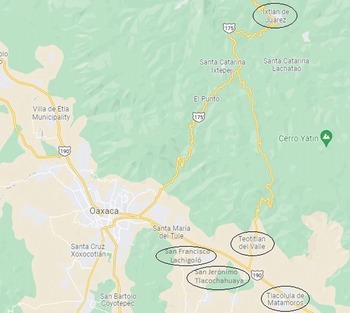
Los resultados que presentamos corresponden a un trabajo de campo etnográfico,Footnote 1 desarrollado durante los años 2018 y 2019 en distintas instituciones con competencia en educación, migración y (re)inserción escolar y social, así como en diferentes escuelas de las regiones Valles Centrales y Sierra Norte de Oaxaca. Estas instituciones son: el Instituto Oaxaqueño de Atención al Migrante (IOAM), la Oficina de Derechos Humanos y de la Niñez, el Sistema para el Desarrollo Integral de la Familia (DIF) de Oaxaca y el Instituto Estatal de Educación Pública de Oaxaca (IEEPO), todas ubicadas en la capital del estado. Por su parte, un total de seis escuelas de los niveles de Primaria, Secundaria y Educación Media Superior, situadas en distintos municipios y comunidades de las regiones Valles Centrales y Sierra Norte, fueron etnografiadas en nuestro estudio, como se indica en la Tabla 1 y en la Figura 1.
Relación de instituciones educativas, niveles, ámbito y ubicación.

Localización geográfica de las instituciones educativas.

La metodología desarrollada ha estado basada fundamentalmente en la observación con y sin participación, complementada con la realización de conversaciones informales, grupos de discusión y entrevistas en profundidad a las NNA, padres y madres de familia, directores de escuela, docentes y responsables de distintos departamentos de las instituciones señaladas.
La observación participante y no participante se ha realizado sobre la base de un cuestionario para cada modalidad de observación, dirigido a registrar el desarrollo de los procesos de enseñanza-aprendizaje —con especial centralidad en el aspecto sociolingüístico, de lectoescritura y cultural— y en las interacciones entre NNA con y sin experiencia migratoria —tanto dentro como fuera del aula—, así como entre el alumnado inmigrante y retornado y el personal docente de las distintas escuelas. Ello ha permitido detectar y analizar la construcción de diferentes fronteras de (re)inserción —burocrático-administrativas, lingüísticas y socioculturales— a partir de la experiencia migratoria.
La observación participante ha favorecido el contacto con los distintos agentes sociales, cuyos discursos han sido recogidos y analizados a partir de conversaciones informales, entrevistas y grupos de discusión dirigidos a expresar sus trayectorias, percepciones y experiencias personales en torno a la movilidad internacional y la (re)inserción escolar.
Se han registrado y entrevistado cincuenta y un alumnos inmigrantes y retornados con edades de entre seis y diecisiete años procedentes de Atlanta (Georgia), Chicago (Illinois), Harvard (Massachusetts), Las Vegas (Nevada), Los Ángeles (California), San Bernardino (California), Santa Mónica (California), Seattle (Washington), Tennessee (Nashville) y Phoenix (Arizona). Del total de cincuenta y un alumnos, treinta y cinco son inmigrados y dieciséis retornados. Entre los inmigrados, doce fueron registrados en escuelas primarias, diecisiete en secundarias y seis en medias superiores; mientras que entre los retornados, cinco fueron registrados en escuelas primarias, siete en secundarias y cuatro en medias superiores. Lo anterior se detalla en la Tabla 2, con indicación de las edades de inmigración y retorno y de las edades actuales.
Número de alumnas/os por nivel educativo, edad de inmigración/retorno y edad actual.

Igualmente, han sido entrevistados un total de doce padres y madres de familia —entre los que se pudo detectar la existencia de retornos por deportación (siete) y retornos seudovoluntarios (cinco)—, seis directores de escuela, veintidós docentes de los distintos niveles educativos de Primaria (ocho), Secundaria (nueve) y Educación Media Superior (cinco) y siete responsables departamentales del IOAM (tres), la Oficina de Derechos Humanos y de la Niñez (uno), el DIF Oaxaca (dos) y el IEEPO (uno). Con la misma finalidad de indagar en las trayectorias, percepciones y experiencias personales de los sujetos en torno a la movilidad internacional y a la (re)inserción escolar se aplicaron tres grupos de discusión: dos a alumnos y uno a docentes.
La información obtenida en el terreno ha sido contrastada y complementada con fuentes estadísticas sobre migración y retorno, normativas vigentes en materia de acceso al sistema educativo mexicano de la población migrante, datos disponibles en la prensa internacional y la producción bibliográfica especializada sobre el objeto de estudio.
Migración, retorno y (re)inserción escolar
A partir de la década de los noventa las migraciones desde México a Estados Unidos experimentaron una notable transformación, pasando de ser un fenómeno exclusivamente centrado en adultos varones que se desplazaban al norte en busca de trabajo a incorporar mujeres, niñas, niños y adolescentes (Reference Masferrer and RobertsMasferrer y Roberts 2012; Reference Santos, Ibarra, Carregha, de la Vega and GonzálezSantos et al. 2010; Reference ValdézValdéz 2012). Desde entonces y hasta la actualidad, la niñez y la adolescencia siguen formando parte de este fenómeno con una presencia creciente y con un importante rol como actores políticos, económicos y culturales (Reference ValdézValdéz 2011, 11).
Pese a ello, y a diferencia del privilegio concedido a los estudios migratorios centrados en los varones y en su rol económico y social y posteriormente el incremento experimentado por los estudios sobre las mujeres y su capacidad de agencia en el fenómeno migratorio (Reference ValdézValdéz 2011, 12), los estudios sobre migraciones siguen adoptando una visión adultocéntrica que obvia e invisibiliza a este sector de la población altamente vulnerado y con necesidades distintas (Reference PavezPavez 2013; Reference QuechaQuecha 2016; Reference ValdézValdéz 2011).
De acuerdo con la Ley General de los Derechos de Niños, Niñas y Adolescentes (Cámara de los Diputados 2014), la niñez está integrada por personas de entre cero y doce años y la adolescencia por personas de entre doce y dieciocho. Por lo anterior, definimos la niñez y la adolescencia migrante como aquella integrada por personas menores de doce y dieciocho años, respectivamente, que participan en procesos de movilidad nacional o internacional. En el caso que nos ocupa, hablamos de NNA inmigrantes y retornados desde Estados Unidos que integran lo que Zúñiga y Giorguli (Reference Zúñiga and Giorguli2019) han dado en llamar “generación 0.5.”. Esta categoría “resalta el hecho de que este flujo de menores que migran desde Estados Unidos no forma parte de las categorías generacionales utilizadas en la literatura sobre migración” (Reference Zúñiga and GiorguliZúñiga y Giorguli 2019, 19–20), sino que se trata de algo nuevo: “migrantes internacionales que viven y se educan en México y son, a la vez, mexicanos criados en Estados Unidos y, algunos, estadounidenses educándose en México” (Reference Zúñiga and GiorguliZúñiga y Giorguli 2019, 61).
Los migrantes mexicanos en retorno son aquellos procedentes de Estados Unidos “que regresan a su país mediante procesos de deportación, repatriación y retorno forzado o voluntario” (Reference ValdézValdéz 2012, 19). Dentro del retorno forzado, en este trabajo presentamos una contribución que pretende resaltar el carácter de involuntariedad de muchos de los retornos que realizan los migrantes mexicanos y que sin embargo son contabilizados como retornos voluntarios. El retorno forzado tiene lugar como consecuencia de la existencia de condiciones coercitivas y/o desfavorables en términos políticos, legales, económicos, sociales, culturales, climáticos y otros posibles que hacen de este un proceso no deseado (Reference Herrera, Moncayo and RiveraHerrera y Moncayo 2019), en el que los migrantes se ven obligados a interrumpir su migración. Si bien entre estas condiciones se encuentra la deportación, esta es solo una más de las causas por las que los migrantes interrumpen involuntariamente su proceso migratorio, pero no la única. Nuestra investigación ha registrado retornos no deseados que se producen por causas distintas a la deportación y que igualmente expulsan a los migrantes involuntaria y forzosamente: precarización laboral, condición de deportabilidad (Reference De Genova, Dowling and IndaDe Genova 2013); miedo a situaciones de tortura en centros de detención de migrantes (Reference RiveraRivera 2019); miedo a la separación familiar; discurso y crímenes de odio, por señalar solo algunas. Los retornos efectuados por estas causas son aquellos a los que llamamos seudovoluntarios, denominación que empleamos para resaltar el falso carácter de voluntariedad que, de facto, estos presentan. Los retornos seudovoluntarios son procesos de “bulimia social” (Brotherton y Barrios 2011, citados por Reference RiveraRivera 2019, 36), altamente rentables para los Estados-nacionales, quienes por acción de estos mecanismos de coerción no necesitan recurrir al gasto público para desarrollar expulsiones migratorias, a diferencia del gasto que sí requiere la ejecución de detenciones y deportaciones.
Si bien dentro del retorno —incluido el seudovoluntario— están presentes la niñez y la adolescencia, es conveniente realizar algunas distinciones. En su definición de retorno, Valdéz (Reference Valdéz2012) y Ruiz y Valdéz (Reference Ruiz, Valdéz and Valdez2012) incluyen no solo a los NNA nacidos en México sino también a los hijos de migrantes mexicanos nacidos en Estados Unidos que ahora residen en México a causa del retorno de uno o ambos progenitores. Las autoras afirman que estos se sitúan dentro de una familia retornada y que, como tal, son parte fundamental del proceso de retorno (Reference Ruiz, Valdéz and ValdezRuiz y Valdéz, 2012).
Frente a estos postulados, Zúñiga y Hamann (Reference Zúñiga and Hamann2006) sostienen que los hijos de padres mexicanos nacidos en Estados Unidos no pueden contabilizarse como retornados sino como inmigrantes. Se afirma que los NNA retornados son aquellos que nacen y se escolarizan en México, después migran con sus padres a Estados Unidos, donde se escolarizan en un nuevo centro, y posteriormente regresan otra vez a México y continúan su proceso de escolarización. Por su parte, los NNA inmigrantes son aquellos que nacen en Estados Unidos, donde inician su escolaridad, y migran a México con sus padres, donde la continúan (Reference Zúñiga and HamannZúñiga y Hamann 2006). Frente a aquellos, estos no desarrollarían un proceso de retorno propiamente dicho, sino que serían estadounidenses que emigran por primera vez a México. Esto nos lleva a afirmar con Zúñiga y Hamann (Reference Zúñiga and Hamann2006) que los hijos de padres mexicanos nacidos en Estados Unidos no deben contabilizarse como migración de retorno, ya que nunca estuvieron en México y desarrollan una inmigración para entrar por primera vez al país.
Pero, ya sea como inmigrantes o retornados, estos NNA han experimentado un proceso de socialización en Estados Unidos, determinado por un universo simbólico, cultural y lingüístico muy distinto del que encuentran en México. Ello puede conducir al choque cultural, dificultar su adecuada (re)inserción escolar y favorecer la exclusión, pues el hecho de habitar la categoría de niñez y adolescencia migrante (Reference PavezPavez 2013, 35) frecuentemente lleva asociada la estigmatización de quienes la habitan. Pese a que estos NNA son mexicanos por derecho de sangre y/o suelo (Cámara de los Diputados 1917,Footnote 2 artículo 30), la condición migratoria actúa como base sobre la que se construye una frontera que los coloca en el lado de la alteridad.
La llegada de esta alteridad construida sobre la frontera simbólica de la migración y la alerta de desequilibrio social asociada a la misma justifican la necesidad de asumir por su parte las normas, valores y códigos de la sociedad de destino. En otras palabras, se entiende que el mantenimiento del equilibrio social solo es posible en la medida en que se sostiene un marco referencial integrado por marcadores culturales comunes que garantizan la cohesión social a partir de la identificación colectiva con los mismos (Reference BlancoBlanco 2005, 18). En nuestro caso, estos marcadores culturales serán denominados como medidores de mexicanidad, entendidos como aquellos elementos definitorios de la cultura mexicana que los inmigrantes y retornados deben incorporar a su ethos para cubrir sus déficits de mexicanidad y ser aceptados como verdaderos mexicanos por parte de la sociedad receptora. De lo contrario, estos marcadores culturales se convierten en marcadores de exclusión.
El cauce principal a través del que la niñez y la adolescencia inmigrante y retornada realiza su (re)inserción en la sociedad de destino/retorno es la escuela (Reference Castaño and MoralesCastaño y Morales 2015; Reference Gandini, Lozano-Ascencio and GasparGandini, Lozano-Ascencio y Gaspar 2015; Reference Vargas and CamachoVargas y Camacho 2015), donde debe “enfrentarse rápida e intensivamente a la nueva cultura” (Reference Suárez-Orozco and Suárez-OrozcoSuárez-Orozco y Suárez-Orozco 2003, 131). De aquí, la importancia de estudiar las formas de bienvenida o rechazo de los alumnos con experiencia migratoria, la facilidad o dificultad en los trámites administrativo-burocráticos para su escolarización, las relaciones con sus compañeros y docentes, el desarrollo de los procesos de enseñanza-aprendizaje, etc., elementos que determinarán el éxito de sus procesos de (re)inserción escolar, como ya han señalado otros estudios en el campo (Reference Despagne and JacoboDespagne y Jacobo 2016; Reference Santos, Ibarra, Carregha, de la Vega and GonzálezSantos et al. 2010; Reference Zúñiga, Hamann and SánchezZúñiga, Hamann y Sánchez 2008).
En contextos migratorios, la inserción escolar es definida en este trabajo como el proceso por el cual la niñez y la adolescencia inmigrada se escolariza e incorpora a las escuelas públicas y privadas del país de destino, donde accede a los conocimientos, habilidades y destrezas necesarias para adquirir un desarrollo integral como persona; a las normas, valores, códigos y pautas socioculturales para insertarse en la sociedad (inserción social); y a los conocimientos y capacitaciones básicas y necesarias para insertarse a futuro en el ámbito laboral de la misma (inserción laboral).
En el caso de la niñez y la adolescencia retornada a la sociedad de origen, en la práctica la reinserción escolar remite al mismo proceso anteriormente referido, ya que, si bien se trata de NNA nacidos en México, una gran mayoría de ellos emigró a Estados Unidos siendo bebés o niños muy pequeños —de entre cero y tres años— donde desarrolló su principal proceso de socialización y enculturación. Numerosos estudios (Reference Despagne and JacoboDespagne y Jacobo 2016; Reference Gandini, Lozano-Ascencio and GasparGandini, Lozano-Ascencio y Gaspar 2015; Reference JacoboJacobo 2017; Reference Zúñiga and GiorguliZúñiga y Giorguli 2019) señalan que, tras pasar los primeros años de su vida en Estados Unidos, esta población regresa a México, un país que desconoce y en el que debe llevar a cabo un proceso de inserción escolar propiamente dicho que va más allá de su situación administrativo-migratoria como retornada.
Teóricamente, la (re)inserción escolar respalda un modelo pedagógico que fomenta la diversidad, en este caso, a partir de la inclusión de NNA inmigrantes y retornados. Ahora bien, dependiendo de cómo la escuela trate la diversidad cultural generará procesos inclusivos o excluyentes. Como ya señaló Foucault (Reference Foucault2002), los sistemas de exclusión se construyen sobre una serie de prácticas y se sostienen sobre una base institucional. La escuela es una de las instituciones en las que más claramente se manifiesta la exclusión mediante determinadas prácticas pedagógicas. Estas están apoyadas por determinados elementos —sistema burocrático-administrativo, inversión pública, infraestructura escolar, material educativo, etc. (Reference Sánchez, Zúñiga, Hamann and SánchezSánchez 2008, 50)— que reproducen modelos monoculturales, mononacionales y homogeneizantes que niegan otras formas posibles de ser y estar en ella, como las de los estudiantes inmigrantes y retornados.
Barreras en la (re)inserción escolar: La construcción de los nuevos “otros”
El trabajo de campo etnográfico ha permitido registrar tres elementos principales que dificultan la (re)inserción escolar de la niñez y la adolescencia inmigrante y retornada desde Estados Unidos en Oaxaca. Estos elementos son: la burocracia, la lengua y las prácticas culturales.
La burocracia
El sistema burocrático-administrativo es la primera barrera con la que se encuentran estos NNA para realizar su (re)inserción escolar. No obstante, y aunque hay elementos comunes en los estatus de inmigrante y retornado, el hecho de haber nacido en México o en Estados Unidos representa una importante condición de partida para facilitar o dificultar dicha (re)inserción.
Con anterioridad al año 2015, la Secretaría de Educación Pública (SEP) exigía un acta de nacimiento apostillada y traducida al español por perito oficial para la inscripción en las escuelas mexicanas del alumnado nacido en Estados Unidos. Sin embargo, este requisito fue eliminado en 2015, justamente para facilitar su acceso (SEP 2015, 20–21), pudiendo presentarse en su lugar cualquier documento con igual validez sin necesidad de apostilla —carta de naturalización, acta de reconocimiento, pasaporte, documento migratorio, Documento Nacional de Identidad o algún otro reconocido por la autoridad federal competente (SEP 2018, art.3.3.3.). Pese a lo anterior, nuestra etnografía ha evidenciado que esta acta de nacimiento se sigue exigiendo a los estudiantes inmigrados en los términos anteriores a 2015 para su inscripción escolar, lo que les impide tener acceso a los servicios educativos. Por ejemplo, en las escuelas de los Valles Centrales se registraron varios casos de directores que estaban solicitando a los alumnos recientemente inmigrados desde Estados Unidos esta documentación en dicha forma para permitirles su inscripción. Evidentemente, estos niños no consiguieron el acta de nacimiento estadounidense apostillada y traducida al español por perito oficial: en primer lugar, porque llegaron de manera exprés a Oaxaca como consecuencia de la deportación de sus progenitores y no pudieron solicitar el acta de nacimiento en Estados Unidos; en segundo lugar, porque sus familias no disponen de los medios económicos para realizar los trámites de adquisición y traducción del acta en México. No pudieron, pues, acceder a esta escuela. Como señalaba el padre de uno de estos niños: “A mi hijo no le aceptaron porque no tiene la documentación de allá [Estados Unidos] y no sabemos cómo hacerle”.
En la misma línea de actuación de los directores escolares apunta el relato de un responsable del Departamento Jurídico del IOAM, lo que muestra el desconocimiento y la falta de aplicación de las normativas vigentes sobre la escolarización de la población inmigrante que llega desde Estados Unidos: “Ese es el gran problema que tenemos en Oaxaca: niños que nacen en Estados Unidos y sus papás son deportados, se vienen con los niños, pero no apostillan su acta. Y vienen con un acta que no es apostillada y que obviamente no tiene la validez legal acá y no pueden ingresar a la escuela”.
Otros registros etnográficos han evidenciado la importancia de la condición de “deportabilidad” (Reference De Genova, Dowling and IndaDe Genova 2013) de muchos progenitores, quienes por su situación de irregularidad documental en Estados Unidos, y ante el temor de que a ellos mismos les soliciten identificaciones que revelen tal situación, deciden no dirigirse a ninguna institución a pedir documentos escolares ni otros de salud e identidad de sus hijos. La condición de “deportable” (Reference De Genova, Dowling and IndaDe Genova 2013), aunada a un ambiente de creciente hostilidad contra los migrantes, terminaron provocando el retorno seudovoluntario de varios progenitores con consecuencias determinantes para la escolarización de su descendencia en México, debido a la falta de documentos:
Es que fíjese que está bien difícil allá … ¡la situación pues! … entonces nosotros tenemos miedo, tenemos miedo porque hay los lugares donde nada más están cazándonos a nosotros porque pues … no tenemos los papeles y … no nos quieren, no nos quieren a nosotros [los inmigrantes] pues. Y tú tienes que dar tu estatus migratorio, porque … aunque la ley diga … pero tú tienes que dar tu estatus migratorio y entonces ellos te deportan, y póngase lo que es eso … no, no, no … entonces pues ya nos vinimos, por … todo eso y por eso no pedimos los documentos de los niños.
Aunque el acta de nacimiento apostillada no es necesaria para el ingreso al sistema educativo, esta sí se requiere para la obtención de una Clave Única de Registro de Población (CURP). La CURP es un instrumento de registro que se le asigna a todas las personas que viven en el territorio nacional mexicano, así como a los mexicanos residentes en el extranjero (Secretaría de Gobernación 2015). Para poder obtenerla cuando se ha nacido fuera de México, uno de los documentos indispensables es el acta de nacimiento apostillada y traducida al español por perito oficial. Aunque las Normas de Control Escolar para la Educación Básica (SEP 2018) y Media Superior (SEP 2018) determinan insistentemente que “en ningún caso, la ausencia de la CURP obstaculizará el acceso a los servicios educativos” (artículo 11), tras su ingreso al sistema escolar el alumnado debe tramitar y obtener esta identificación a fin de formalizar su inscripción. Para ello dispone de un periodo máximo de seis meses y necesita su acta de nacimiento apostillada. Con este problema no se encuentran los retornados, quienes nacieron en México y obtuvieron la CURP, pero sí los inmigrantes, nacidos en Estados Unidos.
En nuestra experiencia de trabajo de campo hemos encontrado, no obstante, casos en los que las barreras impuestas por el sistema burocrático han sido suavizadas por los propios directores de escuela, quienes han tratado de facilitar a los NNA inmigrados sin CURP el acceso al centro a petición de que la presenten para su registro en cuanto dispongan de ella. Sin embargo, la demora exacerbada del acta de nacimiento ha impedido obtener la CURP, de manera que los alumnos han ido siguiendo el curso lógico de las etapas educativas hasta concluir el nivel Medio Superior, pero a su término no constan en ningún lugar y no pueden obtener el certificado de estudios cursados ni acceder al nivel de Educación Superior, ya que no disponen de este documento. El propio director de una de las instituciones de Educación Media Superior señalaba que “no se puede emitir un certificado si el alumno termina y no tiene CURP. Tenemos que tener una CURP para eso”.
En el mismo sentido se registra lo señalado desde el IOAM. Tal y como apunta uno de los responsables del Departamento Jurídico:
Ahorita tenemos muchísimos niños que nacieron en Estados Unidos y no tienen CURP. Las escuelas están ahorita nada más les dicen “nada más este año te voy a aguantar así, el año que viene a ver qué cosa vas a hacer” porque ya no puede ser que el niño … esté en situación irregular en México. Muchos se quieren ya salir de la Secundaria y de ahí se van a la Prepa y los niños están ya como si no existieran, porque realmente son niños americanos, no constan como mexicanos, no han obtenido la doble nacionalidad. Entonces acaban y como que no tienen nada.
Otro de los requisitos exigidos por la SEP antes de 2015, tanto para alumnos inmigrados como retornados, era la presentación en el centro educativo correspondiente de los certificados de estudios cursados en Estados Unidos e igualmente apostillados. En el mismo acuerdo de junio de 2015, la SEP también modificó el requisito de revalidación de estudios para este alumnado, eliminando el requerimiento de la apostilla y la traducción por parte de un perito oficial de los certificados de estudios estadounidenses a fin de facilitar su ingreso a la Educación Básica y Media Superior (SEP 2015). De tal manera, al día de hoy el alumnado procedente de Estados Unidos —ya sea inmigrando o retornado— solo debe presentar el certificado de estudios cursados en ese país, sin necesidad de apostilla ni traducción.
Pero este requisito también es desconocido por muchos directores de escuela, así como por instituciones federales con competencia en migración y educación, como puede verse en el relato de uno de los responsables del Departamento de Comunicación del IOAM: “Fíjate que eso a Oaxaca todavía no llega. Acá tenemos muchísimos niños que nacieron en Estados Unidos o que retornan ahora que se vinieron sin los certificados de estudios con la apostilla, por lo tanto, no pueden acceder a todos los beneficios sociales, a la educación”.
En la misma línea han ido varios de los registros etnográficos realizados, en los que los directores de escuela solicitan a estos alumnos el certificado de estudios cursados en Estados Unidos apostillado y traducido. Incluso, en uno de los casos el director de una primaria estaba requiriendo a varios alumnos este certificado emitido por las correspondientes escuelas estadounidenses y dirigido expresamente a él, con su nombre y apellidos. Estos alumnos no pudieron, obviamente, conseguir el certificado exigido por el director en estos términos ni ingresar a la escuela. Este hecho no solo se constató mediante la observación, sino también mediante la entrevista a los padres de los niños afectados:
Vaya yo a la China o donde vaya, me dijeron que la obligación de ellos [los directores] es ofrecerles la educación, pero aquí el director dijo que no. Y no aceptaron a mis hijos en la escuela. Querían la documentación de la escuela de acá, pero de acá no tienen ellos, tienen de allá [de Estados Unidos]. Entonces me dijo el director que “si me traes los papeles dirigido a mí los dejo entrar”, pero nosotros no tenemos eso, no podemos conseguirlo.
La lengua
Ya en el ámbito escolar propiamente dicho, la lengua es uno de los principales obstáculos para la (re)inserción escolar y uno de los principales medidores de mexicanidad. Los registros revelan que la totalidad de los alumnos que han formado parte de esta investigación tienen el inglés como lengua principal, independientemente de que hayan nacido en Estados Unidos o en México, mientras que el español y la lengua indígena representan sus lenguas de herencia (Reference Parra, Trifonas and AravossitasParra 2014; Reference ValdésValdés 2000). Si bien estos NNA nacieron en hogares integrados por hablantes de español y, en su caso, de lenguas indígenas, una vez iniciada la escolarización en los Estados Unidos estas lenguas fueron desplazadas por el inglés, que terminó entrando también en el hogar como lengua de comunicación preferida entre hermanos (Reference Hernández-Chávez, Bernal-Enríquez, Roca and ColombiHernández-Chávez y Bernal-Enríquez 2003), pasando a convertirse el español y, en su caso, la lengua indígena, en lenguas heredadas.
El ochenta por ciento de estos NNA —cuarenta de los cincuenta y uno que han integrado la muestra de investigación— desconocía el español cuando llegó a México, debido a su falta de transmisión por los progenitores, a una naturalización del inglés como lengua exclusiva de comunicación dentro y fuera del ámbito doméstico y a una frecuente interacción con grupos anglohablantes en Estados Unidos. Asimismo, y pese a que muchos progenitores son de ascendencia indígena, solo un 3,9 por ciento de los estudiantes —dos de los cincuenta y uno— son hablantes de lengua indígena, concretamente de zapoteco. Este les fue transmitido por sus padres en Estados Unidos, donde la familia se comunicaba en zapoteco en el ámbito doméstico, pero los hijos empleaban exclusivamente el inglés fuera del hogar y eventualmente en su interior. Entre estos estudiantes se registró un refuerzo de la lengua indígena en la comunidad de llegada a México —Teotitlán del Valle—, ya que el zapoteco es ampliamente hablado por sus habitantes.
Por su parte, el veinte por ciento de los estudiantes —once de cincuenta y uno— manejaban un español hablado —no así escrito— a su llegada a Oaxaca, debido a que este sí les había sido transmitido por sus progenitores en los Estados Unidos, aunque los círculos de interacción fuera del hogar eran igualmente anglohablantes. Como lo comentaban algunos alumnos durante la celebración de un grupo de discusión: “Nosotros sabemos algo de español porque en la casa nos hablaban nuestros papás, pero fuera era puro inglés”. No obstante, en todos los casos el desconocimiento de la lengua del país de destino en sus distintas competencias —leída, escrita, hablada— supone una barrera para la (re)inserción escolar, tanto en lo relativo al proceso de enseñanza-aprendizaje, como al de las relaciones interpersonales y la construcción de capital social.
En lo relativo al proceso de enseñanza-aprendizaje, el desconocimiento del español es una importante limitación. Muchos de los estudiantes confesaron tener que “aprender el español a la fuerza”, a través del transcurso de las clases y sin una enseñanza previa del mismo, debido a la falta de programas y docentes disponibles. Al día de hoy, muchos de ellos no dominan aún el español —principalmente escrito— y todos arrastran graves problemas de lectoescritura. El desconocimiento del español ha redundado en problemas de aprendizaje, bajas calificaciones y baja autoestima, como demuestran sus discursos: “Yo no sé muy bien qué dice la maestra porque todo dice en español … o sea, no la capto y entonces igual, las pronunciaciones en español, no puedo pronunciar yo bien y … hago en inglés porque no sé español … después repruebo, pero es porque no sé”.
Por otro lado, el mismo desconocimiento de la lengua de instrucción y comunicación limita considerablemente la participación de este alumnado en clase y la comunicación con sus docentes y compañeros. Los registros obtenidos mediante observación participante muestran cómo estos alumnos permanecen en silencio en el salón de clase, ajenos a la dinámica educativa que se desarrolla a su alrededor, debido al desconocimiento de la lengua en la que tienen lugar los procesos educativos y de interacción socioescolar. Por lo anterior, su condición migratoria y sus necesidades lingüísticas y educativas distintivas se mantienen invisibilizadas hasta la realización de una prueba formal a calificar por el docente correspondiente, donde se descubre que el alumno en cuestión procede de Estados Unidos y desconoce el español. Uno de los docentes reconocía al respecto: “Es que pues, nosotros los docentes llegamos ‘tun, tun’, empezamos a trabajar, muchos todavía de manera … tradicionalista digamos … y no nos percatamos de cómo está la situación. O sea, no nos damos cuenta que … ‘y el alumno este’ … cuando ya le paso el examen y hablo con él dice ‘no, pues yo me quedé así porque no entendía nada’”.
Pero el desconocimiento de la lengua de instrucción y comunicación también afecta al ámbito de las relaciones sociales y limita la posibilidad de construir capital social y, por tanto, la (re)inserción escolar. Los registros etnográficos evidencian que la gran mayoría de este alumnado no tiene redes de amistad en Oaxaca porque ha pasado la totalidad o la mayor parte de su vida en los Estados Unidos, donde las ha tejido. En todo caso, el único capital social del que pueden disponer estos NNA es el de sus familiares. De manera particular, toman importancia aquellos miembros de la familia con edades iguales a las suyas o que se encuentran en rangos etarios cercanos, ya que por afinidad pueden facilitar su (re)inserción en círculos de amistad, tanto dentro como fuera de la escuela, mediante la práctica de deportes colectivos, la asistencia a fiestas locales o privadas —como la celebración de cumpleaños—, etc.
Por lo demás, en la mayoría de los casos registrados los estudiantes procedentes de Estados Unidos no disponen de redes familiares en el ámbito escolar y muchos de ellos desconocen el español hablado. Esta circunstancia los mantiene en situaciones de aislamiento social, ya que no conocen la lengua de comunicación, herramienta fundamental para interaccionar y construir capital social.
Las prácticas culturales
El desarrollo o la ausencia de determinadas prácticas culturales fuertemente identificadas con la concepción de mexicanidad dominante y, en definitiva, con el ethos nacional,Footnote 3 también actúan como medidores de mexicanidad de la población inmigrada y retornada desde Estados Unidos en el contexto escolar. Dentro del mismo, se han registrado dos prácticas principales que miden el grado de mexicanidad de estos alumnos: comer chile y en el caso de las niñas, además, hacer tortillas.
En escenarios socioeducativos caracterizados por el consumo de comida, como los recesos y la celebración de algún evento de convivencia en el centro, la mayoría de estos alumnos rehúsa comer chile o comidas que lo contengan porque su paladar no ha sido educado para ello. Por su parte, en contextos similares en los que se elabora comida, las niñas son las encargadas de hacer las tortillas, un alimento muy característico de la gastronomía mexicana cuya preparación es desconocida por aquellas que han tenido experiencia migratoria. Ello lleva a escuchar una frase ya casi estándar en los contextos escolares y extraescolares en los que existen NNA inmigrados y retornados: “¿No comes chile? ¿No haces tortillas? Entonces no eres mexicano/a”. A partir de aquí, el grado de (re)inserción va incrementándose en la medida en la que estos sujetos sociales van incorporando dichas prácticas.
Se trata de prácticas culturales que, sin embargo, algunos estudiantes han decidido no incorporar, desplegando su capacidad de agencia frente a la estructura cultural establecida. Ello revela que no se trata de agentes sociales pasivos que incorporan de manera acrítica e involuntaria las prácticas que dicha estructura les pretende imponer, sino de sujetos sociales que se desenvuelven activamente en el nuevo universo sociocultural, decidiendo qué elementos incorporar y cuáles no a su mundo de vida bicultural. El relato de una alumna ilustra muy bien esta realidad:
Siempre te dicen si no hablas español, no comes chile y no haces tortilla no eres mexicana. Yo nací en Seattle, pero aunque hayas nacido aquí te dicen. Pero es característica, carácter que tienen mexicanos, porque pues se sienten mal porque el hecho que hayas nacido en Estados Unidos y no tengas las virtudes, las cualidades que tiene mexicano, se sienten mal y te discriminan, te dicen que pues no eres mexicano. Pero, pues … ahorita, aunque no hago tortilla …sí como algo de picante porque ya me acostumbré, pues ya después de comer chile sí te aceptan un poquito, pero sigo sin hacer tortilla, eso … no me gusta hacer.
La pertenencia a universos sociales, culturales y simbólicos distintos representa una importante barrera para la (re)inserción escolar de la niñez y la adolescencia con experiencia migratoria, en la medida en la que esta es excluida por no identificarse con los mismos elementos simbólicos y culturales mexicanos y oaxaqueños que sus pares sin experiencia migratoria. Como señaló una alumno inmigrado desde Santa Mónica, California: “A la gente como que no le gusta que uno venga de otro lugar, nada más te aceptan si eres de ese mismo lugar, si eres de otro te hacen a un lado, aunque no te conozcan creen que ya pues eres … menos pues, por lo que no haces las mismas cosas que ellos … comer el chile … esas cosas”.
Asimismo, la propia experiencia migratoria actúa como una barrera para la (re)inserción escolar y favorece la exclusión: a partir de dicha experiencia se construye una frontera entre la pertenencia al nosotros y a los otros que opaca la nacionalidad mexicana de los NNA inmigrados y retornados, ya sea por derecho de suelo o de sangre (Cámara de los Diputados 1917, artículo 30). En tal sentido, una de las alumnas participantes en un grupo de discusión, relataba:
Los compañeros no te tratan igual … son contados los que te tratan bien y el resto no. No sé qué tienen, no les da por hablar contigo. Por ejemplo, me habían dicho que cantara una canción mexicana. Dije “bueno, voy a cantarla”. Pero después una compañera salió con un comentario de que “ah, pero tú por qué, si tú nacistes allá, no cuenta”; y como cinco veces al día me lo repitió. Ya le dije “tú sí eres mexicana, según tú, porque yo nací ahí, no, pero yo soy mexicana”. Entre los compañeros en vez de motivarte a hacer algo no lo hago, o sea, cantar canción mexicana debería dar orgullo a todos, pues no solo a quien lo interpreta.
Discusión
Aunque México ha avanzado en la emisión de algunas —aunque escasas— normativas dirigidas a favorecer el acceso de la población inmigrante y retornada al sistema educativo, esta sigue encontrando obstáculos para ello. En primer lugar, porque dichas normativas no tienen en cuenta la realidad migratoria binacional. En este tenor, debe considerarse la diversidad de situaciones que enfrentan la niñez y la adolescencia inmigrante y retornada, entre ellas: las deportaciones exprés de sus progenitores y, con ello, su llegada repentina a México; y el desarrollo de retornos seudovoluntarios en los que la situación de deportabilidad de aquellos les lleva a evitar instituciones en las que se les puede requerir una identificación para solicitar los documentos de sus hijos, delatándose así su estatus migratorio irregular. Esto conlleva a una serie de condicionantes de partida que dificultan de manera determinante sus posibilidades de acceder al sistema educativo mexicano. Por ejemplo, el hecho de que sus padres no soliciten la documentación correspondiente en Estados Unidos —como el acta de nacimiento apostillada y el certificado de estudios cursados— para ingresar al sistema escolar en México.
En segundo lugar, porque, en no pocos casos, las normativas no son efectivamente implementadas, como demuestra esta investigación. La falta de implementación de la normativa vigente tiene que ver con el desconocimiento de la misma, por lo que se torna necesaria su socialización y descenso al nivel ejecutor, representado por los directores y el personal administrativo de las instituciones educativas. La falta de conocimiento de las normativas conduce al desarrollo de importantes irregularidades que están impidiendo el acceso al sistema escolar de esta población por la vía burocrática, lo que redunda en su desigualdad y exclusión con respecto a aquella sin experiencia migratoria. En este sentido, advertimos junto con Medina y Menjívar (Reference Medina and Menjívar2015) la existencia de una fuerte indiferencia institucional.
Otro de los retos más importantes para estos estudiantes en las escuelas mexicanas es el desconocimiento de la lengua de instrucción y comunicación, el español, elemento que adquiere una importante ponderación en sus procesos de (re)inserción escolar. Pese a la necesidad manifiesta de estos alumnos de aprender español en forma hablada, leída y escrita, no existen políticas ni programas bilingües para su enseñanza. Lo anterior tiene consecuencias determinantes sobre su desempeño y éxito escolar y sobre las posibilidades de construir capital social. Una alumna o alumno no puede superar con éxito un curso académico si los procesos de enseñanza-aprendizaje se desarrollan en una lengua que no conoce y en la que en ningún momento se le ha instruido. Dicha forma de proceder promueve el fracaso escolar y la exclusión del alumnado con experiencia migratoria: este recibe un trato desigualitario con respecto al alumnado no migrante, quien desarrolla su proceso formativo en su propia lengua y, por tanto, disfruta de mayores oportunidades de promoción escolar.
El desconocimiento de la lengua en la que se desarrolla la vida escolar convierte a estos alumnos en alumnos infrarrepresentados (Reference Ríos-Aguilar, Kiyama, Gravitt and MollRíos-Aguilar et al. 2011), ya que ni sus necesidades lingüísticas y educativas actuales, ni sus lenguas y experiencias formativas previas son tomadas en consideración (Reference FrancoFranco 2017, 708). Asimismo, el dominio de la lengua del país de destino representa un elemento fundamental para la (re)inserción socioescolar a través de la construcción de capital social. La movilidad implica un cambio de residencia, pero también un cambio de universo social, que en este caso no se ve favorecido por la existencia de redes sociales para la (re)inserción. La llegada de esta niñez y esta adolescencia a Oaxaca se caracteriza por un escaso o inexistente capital social, que le impide aprovechar las oportunidades del entorno (Reference Hernández, Santos, Soriano, Fuentes and GonzálezHernández et al. 2015, 331). En ocasiones, estos NNA pueden apoyarse en algunos familiares. Normalmente se trata de primas y primos que se encuentran en la misma o similares franjas etarias y favorecen su (re)inserción socioescolar, pero la mayoría no cuenta con familiares ni amistades que promuevan su (re)inserción; estas últimas quedaron en Estados Unidos, donde fueron tejidas durante su larga experiencia de vida allí. Por lo anterior, en el contexto escolar la lengua se torna un instrumento esencial en la construcción de un nuevo capital social. Esto tiene importantes repercusiones para la (re)inserción, entre las que se encuentran el aislamiento y la exclusión.
Pero, junto a la incidencia de la barrera lingüística en los procesos de (re)inserción escolar, también encontramos la barrera cultural. Debe tenerse en cuenta que estos NNA han nacido y/o crecido en grandes ciudades estadounidenses, donde han pasado la mayor parte de sus vidas y desde donde se desplazan a municipios y comunidades oaxaqueñas en las que el universo con el que se encuentran, además de ser radicalmente distinto, entraña una gran complejidad étnica, social, cultural y lingüística.
La distancia cultural es vivenciada por esta población en el ámbito escolar, donde se desarrollan y reproducen diferentes prácticas culturales fuertemente identificadas con el concepto de mexicanidad existente —como tomar chile y hacer tortillas— y mediante las que se mide, a partir de la integración de las mismas, su ser mexicano. Sin embargo, la etnografía ha demostrado que estos no son sujetos pasivos que asumen e incorporan sin más las prácticas culturales dadas, anulando sus propios fondos de conocimiento (Reference CookCook 1992; Reference Moll and ÁlvarezMoll 1997). Al contrario, estos sujetos sociales actúan sobre los límites culturales impuestos por la sociedad, transformando el mundo en el que viven (Reference GirouxGiroux 1992). Ello nos lleva a cuestionar el prototipo monocultural de mexicanidad, ya que existen “otros” mexicanos que por su experiencia migratoria representan y construyen activamente un nuevo modelo de ciudadanía que es desatendida y excluida por diferente.
Reconociendo, como lo hace Fitgerald (citado por Reference ValdézValdéz 2012), que la migración es un agente de cambio en la identidad nacional, debemos subrayar, con sustento en nuestros datos etnográficos, la construcción de unos nuevos “otros” sobre la base de una serie de elementos diferenciales como los que venimos analizando, que suman a la diversidad ya de por sí existente en un estado como el de Oaxaca y en un país como México. Por lo tanto, la categoría de mexicanidad debe ser repensada desde la pluriculturalidad y desde la verdadera diversidad de la sociedad mexicana. En este sentido, “la escuela puede convertirse en un medio favorable o desfavorable para la construcción de la identidad transnacional del estudiante” (Reference ValdézValdéz 2012, 87), y para la incorporación de la verdadera diversidad cultural en ese nuevo concepto de mexicanidad. Pero hasta el momento presente la escuela es una institución que no potencia la existencia de “otras formas de ser y estar” en ella (Reference FrancoFranco 2017, 709), al contrario, es una institución que legitima y fomenta la desigualdad de oportunidades y que la proyecta sobre la sociedad mexicana. En tal sentido, los factores macroculturales (Reference Moll, González, Moll and AmantiMoll 2009) deben ser tenidos en cuenta para analizar y comprender las relaciones de poder y la construcción de periferias escolares, en las que se sitúa a los “otros” inmigrantes y retornados.
Conclusiones
Este trabajo ha analizado los procesos de (re)inserción escolar de niñas, niños y adolescentes inmigrados y retornados desde Estados Unidos a Oaxaca, uno de los estados mexicanos más afectados por el retorno —principalmente forzoso y seudovoluntario — debido a la política migratoria de Trump. Nuestros hallazgos muestran la falta de preparación del sistema educativo mexicano para recibir a este sector poblacional con características y necesidades educativas distintivas, quienes encuentran determinadas barreras para desarrollar adecuadamente su (re)inserción escolar. Particularmente, identificamos tres barreras principales: la burocracia, la lengua y las prácticas culturales.
Respecto a la burocracia, nuestros resultados revelan que si bien la SEP modificó en 2015 la normativa dirigida a la inserción escolar de estudiantes con experiencia migratoria internacional, estas siguen aplicándose en los mismos términos anteriores a esa modificación, debido a la falta de socialización e implementación de la misma. Por lo demás, se trata de una normativa que sigue sin considerar la realidad migratoria binacional que viven estos NNA, provocando procesos de exclusión y desigualdad en su acceso al sistema educativo.
En cuanto a la lengua, la inexistencia de programas de enseñanza del español tiene consecuencias determinantes sobre el progreso educativo de estos estudiantes, así como sobre sus posibilidades de construcción de capital social y de comunicación con sus docentes y pares. La lengua se presenta como una herramienta esencial en el proceso de (re)inserción escolar, no solo en términos estrictamente académicos sino también de construcción de redes que impidan una experiencia socioeducativa aislada.
Por último, si bien las prácticas culturales actúan como medidores de mexicanidad a partir de los que se generan procesos de inclusión/exclusión, los registros etnográficos evidencian la capacidad de agencia de los estudiantes procedentes de Estados Unidos en el nuevo universo social y cultural al que llegan, donde activamente deciden qué practicas incorporar y cuáles no a su mundo de vida. Con esto desdibujan los límites del concepto de mexicanidad vigente y evidencian la necesidad de repensarlo, a fin de ser incorporados como ciudadanos mexicanos con características diferenciales, debido a su experiencia de movilidad internacional. Para lo anterior, la escuela representa un importante espacio de socialización del fenómeno migratorio en el que es necesario empezar a incorporar este concepto desde el enfoque de la diversidad.



 Open access

