

Obsidian has been a key Andean resource since the late Pleistocene, central to toolmaking and socioeconomic networks. Provenance studies track its role in hunter-gatherer mobility (Burger and Glascock Reference Burger, Glascock and Bauer2007; Craig et al. Reference Craig, Speakman, Popelka-Filcoff, Glascock, Robertson, Shackley and Aldenderfer2007; Dulanto et al. Reference Dulanto, Pérez-Balarezo, Briceño, Yataco, Silva, Icochea, Tarrillo and Vergara2025), expanded exchange under agropastoralism (Burger et al. Reference Burger, Giesso, Balderrama, Goldstein and Glascock2022; Eerkens et al. Reference Eerkens, Vaughn, Linares-Grados, Conlee, Schreiber, Glascock and Tripcevich2010; Kellett et al. Reference Kellett, Golitko and Bauer2013), and distribution in complex societies (Belisle et al. Reference Bélisle, Quispe-Bustamante, Hardy, Davis, Condori, González, Víctor Gonzáles Avendaño, Reid and Williams2020; Burger et al. Reference Burger, Chávez and Chávez2000; DeLeonardis and Glascock Reference DeLeonardis and Glascock2013). During the Middle Horizon (AD 600–1000), procurement intersected Wari and Tiwanaku spheres (Burger et al. Reference Burger, Chávez and Chávez2000; Kaplan Reference Kaplan2018; Rademaker et al. Reference Rademaker, Glascock, Reid, Zuñiga and Bromley2022). This report analyzes the provenance and technology of two obsidian bifaces from Cerro de Oro (AD 550–950; Fernandini Reference Fernandini2015) that were recovered in abandonment offerings with Wari, Nasca, and Lima prestige goods (Oshiro Reference Oshiro2024), raising questions beyond highland contexts (Kaplan Reference Kaplan2018; Tripcevich and Contreras Reference Tripcevich and Contreras2011).
Materials and Methods
The obsidian bifaces were recovered in the context of the abandonment of a residential compound, in which closure practices placed selected items, caches, and deceased individuals in multiple rooms. A funerary context of a young female was associated with textile implements (loom, spindle whorls, and yarn) and several textiles with Lima-style iconography, together with four large ceramic vessels bearing Nievería-influenced imagery (Figure 1b). In a rectangular storage area, we recorded a cache of four lithic objects—two obsidian bifaces and two non-obsidian items (a rectangular slate and a triangular lithic; Figure 1c)—indicating an internally structured deposit.
Cerro de Oro and the lithic cache analyzed in this study: (a) location of Cerro de Oro in the Cañete Valley relative to the Wari site and the Quispisisa obsidian source, with eight-hour isochrones representing a one-day journey at 2.5 km/h; (b) aerial view of the residential compound showing the biface findspot; (c) cache with two obsidian bifaces and associated lithic artifacts. (Color online)

The two obsidian bifaces from Cerro de Oro were analyzed by portable X-ray fluorescence (pXRF) at the Laboratorio de Arqueología, Pontificia Universidad Católica del Perú (PUCP); we used a Bruker Tracer 5g equipped with a proprietary 20 mm2 silicon drift detector (140 eV at 250,000 cps, Mn Kα), an 8 μm Be window, an Rh thin-window X-ray tube, and a 6–50 kV, 4.5–195 μA generator. Each sample was run for 60 seconds using Bruker’s standard obsidian calibration. Comparative source samples collected by Jalh Dulanto were analyzed with identical settings and calibration to ensure consistency.
Technological Analysis
The technological study followed the chaîne opératoire framework to relate removal characteristics to manufacturing processes (Inizan et al. Reference Inizan, Reduron-Ballinger, Roche and Tixier1999). For the finished tools, we conducted a diacritical analysis of both bifaces using Dauvois’s scheme (Reference Dauvois1976) and then assessed their structural organization through the distribution of retouched edges. This second stage used a techno-structural approach based on Structural Units (SUs) as a means of energy transfer (González-Varas et al. Reference González-Varas, Lourdeau, Gonçalves, de Souza, Mendes, de Oliveira, Silva, Forestier, Romero and Pérez-Balarezo2025; Lepot Reference Lepot1993). SUs are defined by recurring morpho-technical elements such as angles and cross sections and were classified as transformative or prehensive (passive/gripping) zones, with potential functions inferred a posteriori.
Results
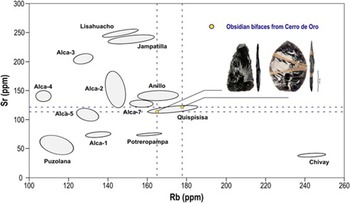
Most archaeological obsidian artifacts from the Central Andes can be reliably attributed to known major or minor sources (Glascock et al. Reference Glascock, Speakman, Burger, Glascock, Speakman and Popelka-Filcoff2007:543). pXRF analysis typically provides sufficient resolution to determine the provenance of Central Andean obsidian artifacts. Of the elements commonly measured using this method, rubidium (Rb) and strontium (Sr) exhibit the highest discriminatory power for source differentiation in this region (Glascock et al. Reference Glascock, Speakman, Burger, Glascock, Speakman and Popelka-Filcoff2007:547; Rademaker et al. Reference Rademaker, Glascock, Reid, Zuñiga and Bromley2022:61). This is clearly demonstrated in Figure 2, where the 95% confidence ellipses for these two elements across nearly all major and minor Central Andean sources show no overlap, with the known exception of Jampatilla and Lisahuacho—sources not relevant to this study—that can be further distinguished using yttrium (Y).
Scatterplot of pXRF Rb (ppm) and Sr (ppm) values. Confidence ellipses (95%) are shown for the major Peruvian obsidian sources (Quispisisa, Alca-1, and Chivay) and minor sources in Ayacucho and Apurímac (Puzolana, Jampatilla, Potreropampa, and Lisahuacho), based on geological samples collected by Jalh Dulanto. (Color online)

Table 1 and Figure 3 present the results of the pXRF analysis, which confirm that the elemental compositions of the Cerro de Oro artifacts match those of Quispisisa across all nine measured elements at a 95% confidence level. The Quispisisa source is located on Cerro Jichqa Parco, in Sacsamarca, Ayacucho (Burger and Glascock Reference Burger and Glascock2000).
pXRF Analysis Results (ppm) for Specimens CD00039 and CD00040, alongside Samples Collected from Three Major Sources in Peru and from All Minor Sources in Ayacucho and Apurímac.

Note: Samples collected by Jalh Dulanto from Quispisisa, Alca-1, and Chivay in Peru and from Puzolana, Jampatilla, Potreropampa, and Lisahuacho in Ayacucho and Apurímac.
Large obsidian biface CDO00039 from Cerro de Oro site: (a) photo; (b) diacritical analysis. (Color online)

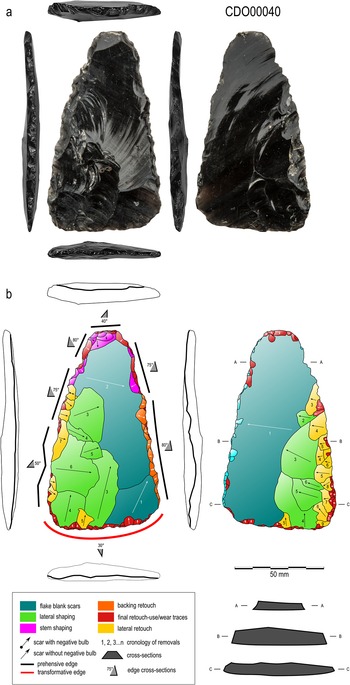
Both pieces are complete, made from black (N1 Munsell) banded obsidian (Figures 3a and 4a), and correspond to bifacially shaped tools. CDO00039 exhibits bilateral and bifacial symmetry but transverse asymmetry, with a straight base, convex lateral edges, and a convergent distal end. In contrast, CDO00040 shows bilateral, bifacial, and transverse asymmetry, with a trapezoidal silhouette, a straight base, converging straight lateral edges, and a straight distal end parallel to the base.
Large obsidian biface CDO00040 from Cerro de Oro site: (a) photo; (b) diacritical analysis. (Color online)

CDO00039 preserves remnants of nipple isolation at its base, a technique for fluting-like removals to thin the base. It measures 125 × 91 × 10 mm, with maximum thickness at the mesial portion, and weighs 106.2 g. CDO00040 measures 108 × 63 × 11 mm, with a maximum thickness that is also mesial, and weighs 65.6 g. CDO00039 has a generally biconvex cross-section but has a trapezoidal cross-section at its base (Figure 3b). CDO00040 exhibits an overall trapezoidal cross section, but with a biplanar cross section at both the base and distal end (Figure 4b).
Both were manufactured on large, relatively thin flakes. However, they differ in their technological axis: CDO00039 was struck at the distal end (Figure 3b), whereas CDO00040 was struck from the left lateral edge (Figure 4b). Neither retains a bulb nor a striking platform. Shaping was not fully invasive; CDO00039 exhibits a centripetal pattern that leaves the mesial area unmodified (Figure 3b), whereas CDO00040 follows an orthogonal method concentrated on the left latero-proximal section (Figure 4b). Additionally, CDO00040 presents backing retouch, mainly on the right lateral edge (Figure 4b). Both represent primary designs with no reconfiguration evidence.
Techno-structural analysis suggests that CDO00039 accommodated a transformative edge (biconvex in cross section, convex in frontal view, and sawtooth-like or avoyé in transversal view, with a 40° average angle) at the distal end, obliquely aligned with the morphological axis (Figure 3b). This edge, despite a preserved stringing feature, lacks macro use wear. In contrast, CDO00040’s transformative edge (plano-convex, straight in frontal view, avoyé in transversal view, 30° angle) is positioned at the base, is transversely aligned, and shows macro use wear (scaling and hinged removals). This hypothesis will require confirmation through future microscopic analysis. The distal end features a stem with edge angles from 40° to 80° (Figure 4b).
These characteristics suggest that CDO00039 was unused or discarded after minimal use, whereas CDO00040 was likely functional, possibly as an adze (oblique percussion) or axe (perpendicular percussion) using a throwing motion. Differentiating these functions requires experimental replication and use-wear analysis.
Discussion and Conclusions
Results show that Cerro de Oro obsidian derives from Quispisisa, a source that dominates Wari assemblages and may reflect Wari influence over procurement (Burger et al. Reference Burger, Chávez and Chávez2000; Kaplan Reference Kaplan2018). The bifaces also fit Wari-style technology—being large, carefully shaped, and refined—paralleling Conchopata and Cerro Baúl, where Quispisisa bifacial tools occur in domestic and ritual contexts (Burger et al. Reference Burger, Bencic and Glascock2016; Williams et al. Reference Williams, Reid, Nash, Chacaltana, Costion, Goldstein, Sharratt, Feinman and Riebe2022). Use-wear contrasts are meaningful: one piece appears unused, whereas the other shows damage consistent with use, possibly as an adze. The cache is additionally a structured set: two exogenous Quispisisa bifaces plus two non-obsidian lithics (rectangular slate and triangular piece), likely on locally available stone. Thus, they juxtapose exotic and local categories in a household storage context. Within the obsidian pair, an apparently unused, secured/bundled piece (stringing feature) contrasts with a used one, supporting deliberate curation and deposition during abandonment.
Iconographic evidence from Wari centers such as Conchopata (Ayacucho) reinforces the multifunctionality and symbolic significance of large bifacial tools. Some urns depict warriors kneeling on reed boats, holding a long-handled axe in the left hand and a rectangular shield in the right (Ochatoma and Cabrera Reference Ochatoma, Cabrera, Silverman and Isbell2002:231, Figure 8.5; see Figure 5). These images—especially the black-painted axe—suggest that obsidian may have carried symbolic or prestigious value beyond functional properties. As Chamussy (Reference Chamussy2014) argues, such tools may have begun in woodworking roles and later been repurposed as weapons.
Image of a warrior kneeling on reed boats depicted on Conchopata pottery: (a) line drawing; (b) colored reconstruction based on the original ceramic painting (Ochatoma and Cabrera Reference Ochatoma, Cabrera, Silverman and Isbell2002:231, Figure 8.5). Courtesy of José Ochatoma and Martha Cabrera. (Color online)

To contextualize these findings, we need to consider that no obsidian artifact has ever been recorded at Cerro de Oro, whereas clearly distinguishable Wari objects, such as a tie-dye textile and four-cornered hats, have been found in association with local, Nasca, Lima, and North Coast elements. As Nash (Reference Nash2025) notes, Wari household contexts often contain objects deliberately deposited during abandonment rituals; some of these deposits contain high-value items that blur the line between refuse and offering. At Cerro de Oro, the inclusion of obsidian bifaces in abandonment contexts reflects a similar logic of meaningful closure, in which exotic materials acquired additional ritual significance. Because abandonment ceremonies have been exclusively recorded within residential compounds at Cerro de Oro, we propose that family groups were in charge of obtaining these prestigious objects and designing their closure rituals. This hypothesis is consistent with broader regional patterns observed during the Middle Horizon, in which local communities—despite the presence of Wari enclaves—maintained autonomous exchange networks and selectively incorporated Wari-style goods into their own social and ritual practices (e.g., Bélisle et al. Reference Bélisle, Quispe-Bustamante, Hardy, Davis, Condori, González, Víctor Gonzáles Avendaño, Reid and Williams2020; Reid et al. Reference Reid, Williams, Rosas, Goldstein, Dussubieux, Banikazemi and Rademaker2025).
This evidence supports the view that obsidian procurement was not necessarily monopolized by the state. Instead, the presence of Quispisisa obsidian at Cerro de Oro, a site without direct Wari architectural presence, indicates that access to this material was possible for nonstate actors. This aligns with studies in Moquegua that demonstrate how obsidian circulated through both hierarchical and informal networks, sometimes via ceremonial or logistical nodes like tambos (Reid et al. Reference Reid, Williams, Rosas, Goldstein, Dussubieux, Banikazemi and Rademaker2025; Williams et al. Reference Williams, Reid, Nash, Chacaltana, Costion, Goldstein, Sharratt, Feinman and Riebe2022).
In conclusion, these results show that the procurement of prestigious items, such as obsidian, was accessible to individual groups, indicating that negotiations were not restricted to strict political hierarchies. Although further studies will illuminate the specific process of the exchange of these items, this study shows that the Middle Horizon in Cañete was a highly interactive period during which diverse elements from established stylistic traditions were procured to be included in family ritual practices, thereby acquiring new layers of significance.
Acknowledgments
We would like to thank Marcellus de Almeida for his valuable comments. We extend our gratitude to José Ochatoma and Martha Cabrera for providing Figure 5.
Funding Statement
Research was supported by the Dirección de Gestión de la Investigación PUCP (Grant ID754).
Data Availability Statement
Both bifaces are in temporary custody of the Programa-Arqueología-de-Cañete and will eventually be returned to the Ministerio de Cultura del Perú.
Competing Interests
The authors declare none.





 Open access

