





Introduction
The late theoretical physicist Stephen Hawking predicted that the twenty-first century would be the century of complexity (Hawking, Reference Hawking2000). True to his prediction, the last two decades have seen the primacy of complexity thinking and its transdisciplinary applications, including in the field of applied linguistics, especially in second language acquisition (SLA).Footnote 1
In applied linguistics, Complex Dynamic Systems Theory (CDST) debuted in the 1990–2000s, initially as two separate entities: Complexity Theory (CT) and Dynamic Systems Theory (DST). CT puts a premium on the system properties of a complex phenomenon like second language acquisition (L2A), DST puts a premium on its process. The last decade has seen the unification of the two into a broader CDST framework (de Bot, Reference de Bot, Ortega and Han2017; de Bot & Larsen-Freeman, Reference de Bot, Larsen Freeman, Verspoor, de Bot and Lowie2011). The merger is a natural consequence of CT and DST sharing similar concerns about SLA and espousing a holistic view of language, language use, and language development.
CDST has already proven to be an appealing theoretical anchor for understanding second language (L2) development, spurring a rapidly growing number of studies (see, e.g., Hiver et al., Reference Hiver, Al-Hoorie and Evans2021). These studies lean on CDST for a slew of purposes, ranging from framing a study to justifying a design to interpreting a (uninterpretable) result to simply jumping on the bandwagon for no substantive reasons (for discussion see Hiver & Al-Hoorie, Reference Hiver and Al-Hoorie2016). The keen interest in recent years has led to the conjecture that CDST is “‘the’ ultimate metatheory for phenomena of language acquisition, language use, and language change” (Hulstijn, Reference Hulstijn2020, p. 2; emphasis in original).
While CT has been a dominant trend of thinking across a multitude of scientific disciplines since the 1990s resulting in distinct applicational strands of complexity research (for an overview and critique, see Manson, Reference Manson2001),Footnote 2 the present article has a singular intent, namely, zooming in on its application in SLA. Such an endeavor is both necessary and past time. Despite a pervading interest in the SLA community in paying tribute to complexity, there persists a glaring void in CDST, the gap between the theory and the research, which impedes our understanding of the potential and utility of CDST.
In what follows, we break down the epistemology of CDST, an emergent and synergistic theoretical entity in SLA, and track its ontology. To that end, we chronicle the evolving conceptualizations and discuss CDST-inspired empirical research on L2 learner language.Footnote 3 In doing so, we seek a nuanced understanding of both the theoretical and the empirical, with a view both to ascertaining the current status of CDST and identifying directions for future research.
The Epistemology and Ontology of Complex Dynamic Systems Theory
In applied linguistics and SLA, CDST is an amalgam of what started out as two separate theoretical lineages, CT and DST, the former predating the latter.
CT-for-SLA
The first publication debuting leading ideas of complexity theory for SLA (CT-for-SLA) is an article by Larsen-Freeman published in Applied Linguistics in 1997. Inspired by Chaos TheoryFootnote 4 in physics, Larsen-Freeman wrote:
There are striking similarities between the new science of chaos/complexity and second language acquisition (SLA). Chaos/complexity scientists study complex nonlinear systems. They are interested in how disorder gives way to order, of how complexity arises in nature.… the study of dynamic, complex nonlinear systems is meaningful in SLA as well. (p. 141)
Larsen-Freeman argued that parallels exist between a complex physical phenomenon, like the motion of a quantum particle, and that of L2A, seeing both as “dynamic, complex, nonlinear, chaotic, unpredictable, sensitive to initial conditions, open, self-organizing, feedback sensitive, and adaptive” (p. 142).
Complex nonlinear systems have two hallmarks. First, they comprise multiple interactional components. Second, the system is emergent, transcending the sum of its components, with the whole being greater than the sum of its parts. For Larsen-Freeman, applying a complex systems (CS) lens to SLA would help “discourage reductionist explanations in matters of concerns to L2 researchers” (ibid.) and encourage models of grammar to capture dynamism and variability of language in use.
A CS perspective on language compels that language be viewed as dynamic. This entails seeing it, synchronically, as a processFootnote 5 and, diachronically, as an organism that grows and changes. As a process, language is isomorphic with language use; language evolves as a function of use. As Larsen-Freeman (Reference Larsen-Freeman1997) put it, “Language grows and organizes itself from the bottom up in an organic way, as do other complex nonlinear systems” (p. 148).
A dynamic view of language underpins the importance of chaos or variability of language. For SLA, this is tantamount to suggesting that attention be shifted from language “competence” to “performance.” Language allegedly does not proceed top-down—through computations of rules or instantiation of preexisting rules, or in other words, from rule-based representations—to their deployment in communicative use. Rather, language change begins bottom-up. Therefore, “a dynamic model of performance is needed, which relates individual use to system change” (ibid., p. 149).
As a complex system, language consists of multiple components or subsystems that are interdependent. It follows that the study of language must be holistic, not narrow, discrete, or isolated (cf. Byrne & Callaghan, Reference Byrne and Callaghan2014; Goldstein, Reference Goldstein2011). Likewise, L2A is the result of multiple factors—learner-external and learner-internal—acting in tandem. Larsen-Freeman (Reference Larsen-Freeman1997) noted, “perhaps no one of these by itself is a determining factor, the interaction of them, however, has a very profound effect” (p. 151).
As a nonlinear system, language is “tethered” to its initial condition, because “the changes a language undergoes leave its basic shape intact” (ibid., p. 150). Put differently, the initial conditions contribute to the fractality of the attractor states of language, such that the “pattern that exists at one level of scale holds for other levels and for the whole system” (ibid., p. 151).
Citing the second law of thermodynamics, which states that closed systems move increasingly toward entropy or equilibrium,Footnote 6 Larsen-Freeman contended that living systems—human language or language learning included—are an exception because they are open rather than closed systems. She stated that “[a]s open systems evolve, they increase and complexity by absorbing energy from the environment” (ibid., p. 144) and, thus, are free from the tendency to reach equilibrium or the highest entropy.
For Larsen-Freeman, L2 phenomena such as acquisition order, restructuring, and fossilization encapsulate the qualities of a complex system. Restructuring, for instance, is indicative of the learner’s interlanguage self-organizing. Fossilization or absence of learning, however, hints that the learner’s “grammatical system is closed and settles down to a fixed point attractor” (ibid., p. 152). From the complex, dynamic, nonlinear system perspective, L2A is constrained by the initial conditions, for instance, the typological distance between the L1 and the target language (TL), and should benefit from negative feedback.
But a CS perspective on L2A purports to be more profound than offering an alternative way of looking at concrete acquisitional phenomena. It elucidates hotly debated issues in SLA—such as mechanisms of acquisition, definition of learning, the stability and instability of interlanguage, differential success, and effects of instruction. As it were, the case Larsen-Freeman made for the parallelism between complex, dynamic nonlinear systems, on the one hand, and language and L2A, on the other, portended to upend the mainstream conceptions and practices pervading decades of research on language and L2A, foreshadowing a break with long-standing traditions. Among many possible consequences, a CS view suggests that our quest for explanatory mechanisms for L2A should be broader; that our assessment of learning should be longitudinal; that we should view instability as the mainstay of interlanguage; and that we may never be able to pin down the contributions of individual difference variables to acquisitional outcomes because “we would not be able to predict the outcome of their combination” (ibid., p. 157). Furthermore, we should view instruction as part and parcel of L2A, an integral part of a complex dynamic system. All this is antithetical to traditional approaches to SLA, which are typically narrow, static, and reductionist.
Despite much uncertainty looming at the time about whether or not a CS view would eventually prevail in SLA, Larsen-Freeman (Reference Larsen-Freeman1997) dwelled on its potential, noting that a complex dynamic system view can:
-
1. Encourage a blurring of boundaries;
-
2. Warn against settling for simple solutions prematurely;
-
3. Provide some fresh images for SLA phenomena;
-
4. Foreground certain problems and obviate others;
-
5. Discourage theory construction through the aggregation of simple univariate cause-effect links;
-
6. Underscore the importance of details; and
-
7. Remind us to hold the whole and to find a unit of analysis that allows this.
(pp. 158–159)
Accordingly, our understanding of language and L2A would, inter alia, benefit from breaking with dichotomous conceptualizations; “we need to see SLA as both/and rather than either/or” (ibid., p. 158). We should resist the temptation of simplifying a complex phenomenon. Furthermore, capturing the developmental trajectory including how growth emerges from the alternation of chaos and order and fractality would be a way of gaining insight into the complexification of interlanguage. In Larsen-Freeman’s words, “we need a camcorder, not a camera to do our research” (p. 159). And our understanding of development should not derive from accumulations of univariate studies, because “complex systems are composed of many interacting parts” (ibid.). But most of all, identifying—or rather, establishing—a proper unit of analysis would be key to unraveling the whole. This unit should serve as a microcosm for the whole—a complex nonlinear phenomenon and system.
The Larsen-Freeman (Reference Larsen-Freeman1997) article is both metaphorical and exploratory. Drawing parallels between a complex physical system and L2A, it proposed a new conceptual lens for SLA. The article is patently dense, and even today—twenty-five years later—it still keeps many readers at arm’s length. But the significance of this work cannot be overstated. It was an audacious attempt to connect natural science and applied linguistics. In doing so, it charted an innovative perspective on SLA that “discourage[s] reductionist explanations in matters of concern to second language acquisition researchers” (ibid., p. 142).
In the ensuing years, this preliminary treatise of complexity epistemology in applied linguistics evolved into a more SLA-specific conception, leading even to a change of parlance, as in substituting “second language development” for “second language acquisition” (de Bot & Larsen-Freeman, Reference de Bot, Larsen Freeman, Verspoor, de Bot and Lowie2011; de Bot et al., Reference de Bot, Lowie, Thorne, Verspoor, Mayo and Adrian2013; Larsen-Freeman, Reference Larsen-Freeman, VanPatten and Williams2015). The applicational scope of CT-for-SLA markedly broadened, from initially language and L2A to attrition (see, e.g., Schmid et al., Reference Schmid and de Bot2013) and instruction. Another notable development was that longitudinal descriptive studies mushroomed, attesting to some of the complex system properties delineated in Larsen-Freeman (Reference Larsen-Freeman1997). Interlanguage, amid the rising enthusiasm, was now a main target of description.
Twenty years later since 1997, Larsen-Freeman (Reference Larsen-Freeman, Ortega and Han2017) took a grand sweep of two decades of CT in applied linguistics, outlining its scope and pondering the lessons learned. Her point of departure, as usual, was the world around us, citing natural phenomena as instances of complexity, and from there she went on to differentiate between restrictive complexity, relegating it to the domain of physical sciences, and general complexity, taking it to be broadly applicable to social phenomena including L2 development. Continuing on her 1997 path further connecting complexity epistemology to applied linguistics, Larsen-Freeman (Reference Larsen-Freeman, Ortega and Han2017) drew on a constellation of characteristics and tenets from a variety of sources.
Addressing the question of what CT is, Larsen-Freeman put forth 10 primary tenets, as displayed in Table 1.
Primary tenets of CT.

Source: Larsen-Freeman, Reference Larsen-Freeman, Ortega and Han2017.
Clearly, these claims are broad-brush strokes, akin to those made initially in the Larsen-Freeman (Reference Larsen-Freeman1997) article. They are mostly descriptive, touching on attributes of a complex system; little, if any, in the statements speaks to what gives rise to the attributes. As an example, point 5 does not say what fuels the self-adaptation of the system nor who is the agent of self-adaptation. CT, construed as such, prescribes a view of complex systems and, by extension, a complexity lens on SLA. Table 2 summarizes the basic tenets of CT-for-SLA (Larsen-Freeman, Reference Larsen-Freeman, Ortega and Han2017).
Primary tenets of CT-for-SLA.
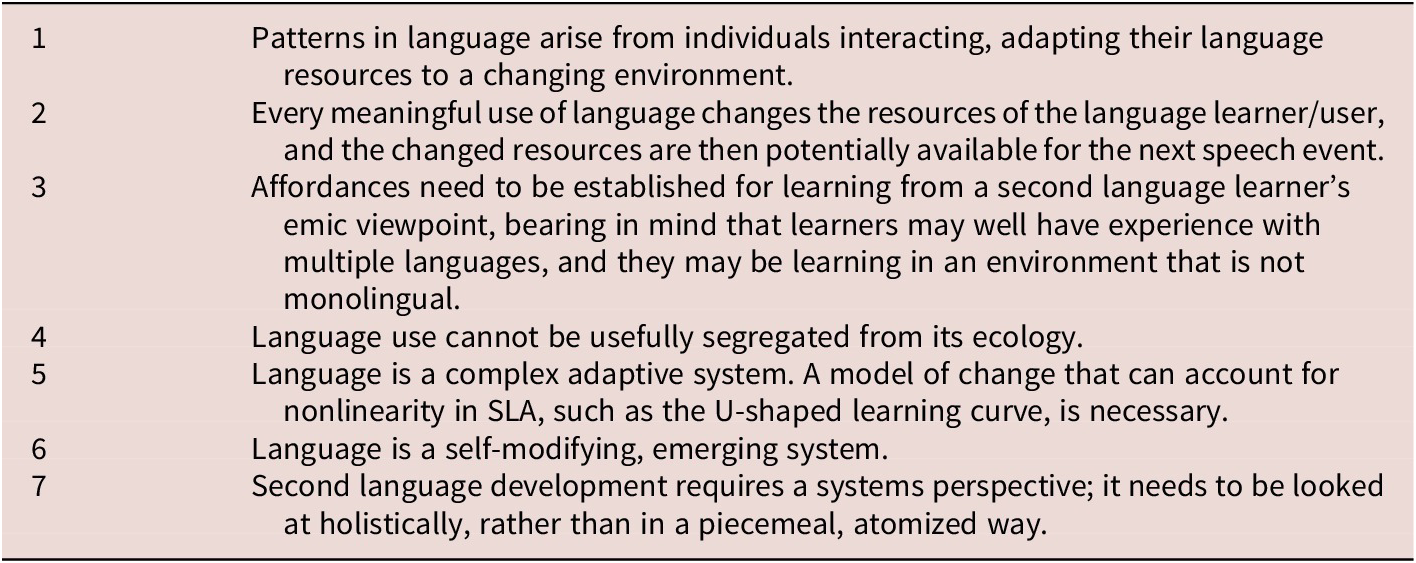
Source: Larsen-Freeman, Reference Larsen-Freeman, Ortega and Han2017.
It is apparent that the central tenets of CT-for-SLA are loose and generic, with no particular coherence beyond highlighting the relevance of language use to learner language development.
Citing Overton (Reference Overton2007), Larsen-Freeman (Reference Larsen-Freeman, Ortega and Han2017) maintained that CT, while inspiring a transformative view of language, would remain metaphorical and, as such, would only be a metatheory in applied linguistics, pointing out that object theories—theories concerning observable phenomena, like language and language development—would still be needed, and “these theories need to be aligned with the principles of the metatheory” (Larsen-Freeman, Reference Larsen-Freeman, Ortega and Han2017, p. 23). Such object theories of language may include cognitive, corpus, integrationist, probabilistic, and systemic-functional linguistics, construction grammar, and emergent grammar. And for object theories of language development, usage-based theory, connectionism, dynamic systems, constructivism, enactivism, relational developmental systems, network analysis, and emergentism are deemed compatible with CT.
Again, following Overton’s conception, Larsen-Freeman (Reference Larsen-Freeman, Ortega and Han2017) emphasized:
A metatheory is a coherent set of interlocking principles that both describes and prescribes what is meaningful and meaningless, acceptable and unacceptable, central and peripheral, as theory—the means of conceptual exploration—and as method—the means of observational exploration—the context in which theoretical and methodological concepts are constructed. Theories and methods refer directly to the empirical world, while metatheories refer to the theories and methods themselves. (p. 21)
Thus, in addition to guiding “conceptual exploration,” a metatheory has prescriptions about how to engage in observational exploration. Larsen-Freeman contemplated the following: “How are we to resolve [the] inherent indeterminacy? How are we to draw boundaries around the object of concern when everything is connected to everything else? How are we to undertake the research enterprise in a way that honors the wholeness without becoming awash in holism? Is it truly possible to generate replicable findings? Further, given context dependency, is it possible to generalize our findings beyond a given study?” (ibid., p. 23).
Further, in an effort to expand the relevance of CT to applied linguistics, Larsen-Freeman (Reference Larsen-Freeman, Ortega and Han2017) rallied more than 30 topics that run the gamut from L1 acquisition to language policy and planning. Harnessing extant studies—some conceptual and some empirical—on these topics (see Online Supplementary Materials), she then put forth 30 aphorisms on language, language learners/users, language learning, and language teaching (see Online Supplementary Materials).
The updated thinking was extensive and more discipline-specific—compared to Larsen-Freeman (Reference Larsen-Freeman1997). But then the wider scope renders CT more elusive. For one, it is unclear how some of the topics have any bearing on CT or vice versa. Nonetheless, through the heuristic of abduction, Larsen-Freeman (Reference Larsen-Freeman, Ortega and Han2017) laid out her vision for a field guided by complexity epistemology, asserting that “a tipping point has been reached” for a paradigmatic shift (p. 17).
In essence, the new paradigm envisioned by CT-for-SLA champions a focus on exposing or discovering relationality, interactivity, and reciprocity in learner language and its development, calling for an understanding of the ecosystem where the interaction between the organism and the social environment takes place (see also Larsen-Freeman, Reference Larsen-Freeman and Gurzynski-Weiss2020a). This position has over time found its echo and an ally in dynamic systems theory.
Dynamic Systems Theory
DST (see, e.g., de Bot et al., Reference de Bot, Verspoor and Lowie2005; de Bot & Makoni, Reference de Bot and Makoni2005; Verspoor et al., Reference Verspoor, De Bot, Lowie, Aertsen, Hannay and Lyall2004) is an instantiation in applied linguistics of a school of thought in cognitive psychology on growth and learning (e.g., Thelen & Smith, Reference Thelen and Smith1994; van Geert, Reference van Geert1995; van Gelder, Reference van Gelder1998), which was, in turn, inspired by Dynamical Systems Theory, a mathematical framework for describing the behavior of complex dynamical systems employing differential equations. In a keynote article for a special issue of Bilingualism: Language and Cognition, de Bot, Lowie, and Verspoor (Reference de Bot, Lowie and Verspoor2007a) attributed DST to two lines of pioneer work respectively by van Geert (Reference van Geert1991, Reference van Geert1998) on DST for first language acquisition and by Larsen-Freeman (Reference Larsen-Freeman1997) on CT for SLA.
Like CT, DST in applied linguistics is metaphorical,Footnote 7 tendering an alternative perspective on language development. Notwithstanding their many shared conceptions, DST and CT are distinct, most notably in that CT puts a premium on systemic properties, but DST’s emphasis is on the process. CT stresses complexity, DST stresses dynamicity.
DST-for-SLA claims to be a theory of change, an object theory. Mathematically expressed as x(t + 1) = f (x(t)), it provides a framework for describing how a state x at t is transformed into a new state x at time t + 1. Many of the central tenets of DST, as outlined in de Bot et al. (Reference de Bot, Lowie and Verspoor2007a), overlap with CT-for-SLA. For example, “language development shows some of the core characteristics of dynamic systems: sensitive dependence on initial conditions, complete interconnectedness of subsystems, the emergence of attractor states in development over time and variation both in and among individuals” (de Bot, Reference de Bot2008, p. 7).
The sensitive dependence on initial conditions implicates that a small difference in the initial condition may prompt sizable changes down the line, the “butterfly effect” (Lorenz, Reference Lorenz1963). The complete interconnectedness of subsystems means that all variables are interconnected, such that any change to one would prompt changes to all. The attractor state speaks to the system’s preferred resting level, its dispreferred counterpart known as “the repeller state” (Hiver, Reference Hiver, Dornyei, MacIntyre and Alastair2015). Dynamic systems exhibit nonlinear trajectories over time, an example of which is that the system follows the power law pattern, where there is a “non-linear relationship between the size of an initial perturbation of a system and the effects it may have in the long run” (de Bot et al., Reference de Bot, Lowie and Verspoor2007b, p. 8). Dynamic systems develop through interaction with their environment and through internal self-reorganization. Furthermore, like CT-for-SLA, DST assumes fractality in the sense that dynamic systems are nested— “every system is always a part of another system … with the same dynamic principles operating at all levels” (de Bot et al., Reference de Bot, Lowie and Verspoor2007a, p. 8).
With its emphasis on the developmental process, DST has tracked the developmental psychology research on growth (e.g., Thelen & Smith, Reference Thelen and Smith1994; van Geert, Reference van Geert1991; van Gelder, Reference van Gelder1998; van Gelder & Port, Reference van Gelder, Port, Port and Van Gelder1995), in particular, the work of van Geert (Reference van Geert1991) on L1 acquisition.
Van Geert (Reference van Geert1991) proposed a model of cognitive growth and language development that is premised on the concept of ecosystem that is made up of a grower and the environment. The grower putatively possesses four types of resources: (a) the internal spatial (e.g., the information processing capacity); (b) the internal temporal (e.g., time allowed for completion of a task); (c) the internal motivational/energetic (e.g., the amount of energy, arousal, effort invested in specific tasks of learning); and (d) the internal material (e.g., the physical properties of the learner including working sensory and nervous systems). These types of resources are matched by four similar types that come with the environment: (a) the external spatiotemporal (e.g., the amount of spatial and temporal freedom afforded to the learner by the controlling environment); (b) the external informational (e.g., items of information that could be assimilated by the learner); (c) the external energetic/motivational (e.g., reinforcement from the environment following successful completion of a learning task); and (d) the external material (e.g., food, shelter, books, pens). Crucially, the internal and external resources are limited, varying in their availability to the learner or the grower. Consequently, development is enabled as much as constrained. The individual’s upper limit of growth, which is “the maximal stable growth level of a particular grower” in the ecosystem, called “carrying capacity,” is determined by the optimal interaction between the internal and external resources. Naturally, learners have different carrying capacities.
Drawing on this model of cognitive growth, DST-for-SLA advances similar claims. First, learner language is a system that develops over time, undergirded by the interaction between learner internal and external resources. De Bot et al. (Reference de Bot, Lowie and Verspoor2007b) state, “In a DST perspective, the cognitive system interacts with the environment (social and cultural), and development results from an interaction of characteristics of the cognitive system as represented in the head and the environment” (p. 51). Second, these resources are limited, which constrains learners’ carrying capacity. Development is putatively nonuniform, featuring (a) uneven distribution of growth, with some subsystems cooperating (i.e., connected growers) and others competing (i.e., competitive growers); (b) stagnation when the interactional resources reach an equilibrium; and, even, (c) attrition when resources are depleted. Third, the process of development is iterative with each succeeding phase dependent on its predecessor, a process displaying, among other patterns, the butterfly effect, variation, and nonlinearity.
DST-for-SLA highlights the meaningfulness of variability (Verspoor & van Dijk, Reference Verspoor, van Dijk and Chapelle2013), especially in learner developmental trajectories, considering it a telltale sign of an active underlying sociocognitive process, an inherent part of the learning process, and a potential indicator of development, not a developmental “noise” as from a Chomskyan innatist perspective (Verspoor et al., Reference Verspoor, Lowie and van Dijk2008). Meanwhile, DST recognizes that “the range of variation is delimited—there is order in the apparent chaos” (de Bot et al., Reference de Bot, Lowie and Verspoor2007b, p. 52).
Explaining the main differences between traditional SLA studies on variation (e.g., Tarone, Reference Tarone1983) and a DST approach, de Bot et al. (Reference de Bot, Lowie and Verspoor2007b) contended:
SLA studies tend to see interlanguage as a fixed system and tend to focus on explaining or finding the causes of variation (such as the psychological processing constraints mentioned by Pienemann), whereas in a DST approach a system will never be fixed and it is not the possible causes but the degree of variability in itself (which may include systematic, free and unsystematic variation) that is taken as providing insight in the developmental process…. [T]he degree of variation can tell us more about the developmental process. Periods of high variability are transitional phases and by examining when transitional phases occur for different sub-systems we can discover precursors, successors and connected growers in the developmental process. (p. 53).
The assumption that an interlearner and an intralearner variable outcome should be expected from an ostensibly similar set of learning procedures—as adopted, say, in a classroom setting—requires that attention be given to development at the individual level. Methodologically, it follows that case studies involving dense, longitudinal data should reveal developmental dynamics.
De Bot et al. (Reference de Bot, Lowie and Verspoor2007a) argued that the DST approach surpasses traditional SLA approaches in tackling some of the recalcitrant issues in SLA, including but not limited to the role of initial states, attractor states, variation, and nonlinearity, maintaining that “[t]he strongest point of a DST approach to SLA is that it provides us with a framework and the instrumentation that allows us to merge the social and the cognitive aspects of SLA and shows how their interaction can lead to development” (p. 18).
Underscoring the self-organizing nature of dynamic systems, de Bot (Reference de Bot2008) hinted that DST studies should explore, among other things, the interaction between input and the self-organizing system, that is, the L2 or interlanguage a learner has developed (see also Larsen-Freeman & Cameron, Reference Larsen-Freeman and Cameron2008). That a system tends to self-organize as a function of the interaction between the cognitive and the social and to become critical, catalyzing a state change in the system, should arguably be a key concern in any study of a dynamic system. Self-organized criticality (SOC), as it is called, is what allegedly enables the system to adapt to a new situation (Bak et al., Reference Bak, Tang and Wiesenfeld1987). It is what leads to structuring and restructuring of L2 knowledge. SOC, which de Bot (Reference de Bot2008) pointed out as underresearched in SLA, is the idea that a learner’s language experience can build up to reach and cross the threshold for a qualitative change in L2 knowledge, hence “critical.” A way to see SOC in action, according to de Bot, would be to trace smaller and larger changes that show a power law pattern in learner language development.
By virtue of its emphasis on the process of development, DST-for-SLA puts a premium on an empirical methodology that yields a longitudinal perspective, a focus on individual patterns of development, and an attention to multiple underlying factors. DST assumes that “specific patterns of variation may be inherent in complex systems and that large changes are part of these patterns; as such, large changes do not need a specific explanation, or at any rate not more than small changes” (de Bot, Reference de Bot2008, p. 174). This idea that smaller changes are the mirror image of larger changes echoes the concept of “fractality” in CT, that patterns of small and large changes are self-similar or, put simply, the same mechanisms work on all scales, in a complex system (see, e.g., Evans, Reference Evans2020).
On the future of DST as a model of L2 development, views appear to divide between providing fuller descriptions of moment-to-moment changes, through microgenetic analyses of language use data (Larsen-Freeman & Cameron, Reference Larsen-Freeman and Cameron2008; Verspoor et al., Reference Verspoor, Lowie and van Dijk2008), and pursuing a rational, theoretical simplification, through some form of reductionism, to arrive at a model of development over time (Van Geert, Reference van Geert2008). The difference amounts to a choice between a humanistic approach and a scientific approach to a developmental system.
Future DST empirical studies, by de Bot’s (Reference de Bot2008) account, are likely to proceed along three interrelated lines: (a) analysis of learner language based on dense, longitudinal data; (b) experimental studies exploring interaction among variables; and (c) computer modeling of language processing, use, and development on different timescales. This projection, as will be discussed in a later section, has more or less materialized.
The Merging of CT and DST
As is evident from the discussion thus far, the merging of CT and DST for SLA is natural and inevitable. Over the last decade, the two lines of thinking have notably converged to emphasize the importance of viewing and framing L2 development as a complex dynamic system, with CDST as the label for a new paradigm in SLA (de Bot, Reference de Bot, Ortega and Han2017; de Bot & Larsen-Freeman, Reference de Bot, Larsen Freeman, Verspoor, de Bot and Lowie2011; Larsen-Freeman, Reference Larsen-Freeman, VanPatten, Keating and Wulff2020b).
Reacting to the merging, Han and Liu (Reference Han, Liu and Han2019) noted:
But perhaps more than a hybrid moniker, we read the “C” as a complex system that subsumes multiple interconnected parts, where the whole is greater than the sum of its parts, and the “D” as underscoring the mechanics and an interactional chemistry among the multiple parts—cooperative, competitive or emergent—that gives rise to nonlinear alternation of variability and stability. (p. 7)
Conceptually, this to an extent brings out the theoretical niche of CT and DST in an otherwise combined theory.
Prior to their merging, CT and DST have each offered a similar descriptive framework, with CT more abstract than DST. But, with the merging, there are signs of the descriptive nature giving way to an explanatory function (see de Bot & Larsen-Freeman, Reference de Bot, Larsen Freeman, Verspoor, de Bot and Lowie2011). Introducing CDST, Larsen-Freeman (Reference Larsen-Freeman, VanPatten, Keating and Wulff2020b) underscored that complexity theorists have sought to “explain the functioning of emergent, complex, interconnected, dynamic, self-organizing, context-dependent, open, adaptive, and nonlinear systems (Larsen-Freeman, Reference Larsen-Freeman1997)” (emphasis added; p. 250).
Taking issue with the static, one-point connotation of the term “second language acquisition,” CDST makes two conceptual moves: first, changing “SLA” to “SLD,” thereby broadening the scope of inquiry from acquisition to development, a putatively ongoing process whereby growth and decline are the staple; and second, conflating development with use, forging an “eclectic” approach to the study of SLD that unifies sociolinguistic and psycholinguistic perspectives.
Theories are subject to empirical falsification, and CDST is no exception. De Bot and Larsen-Freeman (Reference de Bot, Larsen Freeman, Verspoor, de Bot and Lowie2011) argued that “[i]n the evaluation of theories, the notion of what constitutes proof is essential: A theory makes certain assumptions, and empirical data are gathered to test whether these assumptions hold or not” (p. 7). All told, nine assumptions are put forth for empirical validation:
-
1. Sensitive dependence on initial conditions;
-
2. Complete interconnectedness;
-
3. Nonlinearity in development;
-
4. Change through internal reorganization and interaction with the environment;
-
5. Dependence on internal and external resources;
-
6. Constant change, with chaotic variation sometimes, in which the systems only temporarily settle into “attractor states”;
-
7. Iteration, which means the present level of development depends critically on the previous level of development;
-
8. Change caused by interaction with the environment and internal organization; and
-
9. Emergent properties.
To what extent have these assumptions been investigated and attested in CDST-inspired empirical studies?
CDST-Inspired Empirical Studies
Complementing Hiver et al. (Reference Hiver, Al-Hoorie and Evans2021), for our purposes we have chosen to confine our discussion to a selection of 30 studies. In selecting these studies, our approach was to identify, on the one hand, (a) empirical studies that are often-cited in conceptual and authoritative papers as examples of studies adopting a CDST approach and, on the other hand, (b) studies that have cropped up within the last few years to see methodological trends (see the listing in Online Supplementary Materials).Footnote 8
A number of general observations can be made forthwith on these studies as a whole. First, while the studies covered an array of topics, from language advising (Castro, Reference Castro2018) to listening strategies (Dong, Reference Dong2016) to teacher-student question and answer (Smit et al., Reference Smit, van Dijk, de Bot and Lowie2021), the preponderance of the studies focused on learner language, employing lexical and morphosyntactic features such as syntactic complexity, lexical complexity, and formulaic sequences as the unit of analysis or the grower. Next, most of the studies were longitudinal case studies of 1–5 learners, some cross-sectional analyzing, for instance, a learner language corpus (e.g., Duan & Shi, Reference Duan and Shi2021; Verspoor et al., Reference Verspoor, Schmid and Xu2012). The temporal span of these studies varied widely, ranging from four months (e.g., Yu & Lowie, Reference Yu and Lowie2020) to three years (e.g., Verspoor et al., Reference Verspoor, Schmid and Xu2012). The studies were mostly descriptive. Across the board, the system was not established, but assumed (see, e.g., Duan & Shi, Reference Duan and Shi2021; Larsen-Freeman, Reference Larsen-Freeman2006a; Spoelman & Verspoor, Reference Spoelman and Verspoor2010; Yu & Lowie, Reference Yu and Lowie2020). Additionally, the majority of the studies set out to showcase trajectories, connected growth or otherwise (see, e.g., Spoelman & Verspoor, Reference Spoelman and Verspoor2010; Verspoor et al., Reference Verspoor, Lowie and van Dijk2008; Yu & Lowie, Reference Yu and Lowie2020; Zheng, Reference Zheng2016). Last but not least, CDST variably functioned as a guiding framework for the study design or a source of interpretation of study results (see also Hiver et al., Reference Hiver, Al-Hoorie and Evans2021).
Collectively, these studies demonstrated the productivity of individual-oriented or subject-specific studies. Through looking closely at intralearner variability, they portrayed development as a dynamic process (see, e.g., Spoelman & Verspoor, Reference Spoelman and Verspoor2010; Verspoor et al., Reference Verspoor, Lowie and van Dijk2008).
The Ellis and Larsen-Freeman (Reference Ellis and Freeman2009) study stands out as one of the two studies in the corpus that employed computer simulations. The study yielded findings in support of learning as following simple principles—such as the psychological principle of category learning and the social principle of coadaptation—and that learning is sensitive to input attributes of frequency, reliability of form-meaning mappings, prototypicality, and generality of function. Meara (Reference Meara2006), the other simulation study, modeled monolingual, bilingual, and trilingual lexical attrition, using a simple set of assumptions and basic operations. Results showed, inter alia, similarity to behaviors of acquisition of real lexicons. Bilingual lexicons, for instance, showed a “lexical switching mechanism, which allows rapid activation of one language, and a simultaneous deactivation of another language,” while trilingual models illustrated that “under certain conditions, activity in an L2 can sometimes generate spontaneous reactivation of words in an L2” (ibid., p. 638). A putative strength of simulation studies is that they can model the emergence of a phenomenon (Cangelosi, Reference Cangelosi2007). Another strength is that it may allow researchers to ask questions that are impossible to observe in real life.
Taken together, the 30 studies, while embodying an intense interest in finding evidence of dynamic system properties, expose a number of gaps, in the light of the claims of CT and DST discussed in the preceding text. For one, none of the studies investigated the interaction between internal and external resources. Instead, the studies mostly focused on elements of learner language as a stand-alone system—in isolation from the learner and from the environment (see, e.g., Baba & Niita, Reference Baba and Nitta2014; Duan & Shi, Reference Duan and Shi2021; Larsen-Freeman, Reference Larsen-Freeman2006a; Spoelman & Verspoor, Reference Spoelman and Verspoor2010; Verspoor et al., Reference Verspoor, Lowie and van Dijk2008; Zheng, Reference Zheng2016). This is true even for a study on the development of syntactic complexity in identical twins (Chan et al., Reference Chan, Verspoor and Vahtrick2015). For another, what comprises the system in question is arbitrarily defined.Footnote 9 Spoelman and Verspoor (Reference Spoelman and Verspoor2010), for instance, took rates of morphological accuracy and complexity measures—the “developmental variables”—as forming a system, finding that “the interaction of different complexity measures changes over time … no meaningful relationship was found between accuracy and complexity measures over time” (p. 532). Similarly, in a longitudinal study of 10 learners’ writing samples spanning 19 months, Bulté and Housen (Reference Bulté and Housen2018) treated “a judicious selection of quantitative measures of syntactic complexity”—mean length of T-unit, subclause ratio, coordinate clause ratio, mean length of finite clause, and mean length of noun phrase—as components of a system (p. 149). Yu and Lowie (Reference Yu and Lowie2020), however, took accuracy and complexity—performance variables—as forming a system, asserting that “from the perspective of CDST, CAF comprises the three subsystems of the language system” (p. 859). Zheng (Reference Zheng2016), for her part, considered lexical sophistication, lexical diversity, lexical density, and lexical bundles as components of the lexical use system.
Relating this body of research to the nine characteristics or principles of complex dynamic systems that de Bot and Larsen-Freeman (Reference de Bot, Larsen Freeman, Verspoor, de Bot and Lowie2011) posited, it is apparent that extant empirical research has generated much descriptive evidence on variability in development, some evidence on iteration (e.g., MacIntyre & Legatto, Reference MacIntyre and Legatto2011; Spoelman & Verspoor, Reference Spoelman and Verspoor2010; Verspoor et al., Reference Verspoor, Schmid and Xu2012), and, to a lesser extent, on emergence (Meara, Reference Meara2006). But the studies as a whole fall substantially short on evidence of most of the other characteristics:Footnote 10
-
• Complete interconnectedness;
-
• Change through internal reorganization and interaction with the environment;
-
• Dependence on internal and external resources;
-
• Constant change, with chaotic variation sometimes, in which the systems only temporarily settle into “attractor states”;
-
• Change caused by interaction with the environment and internal organization; and
-
• Emergent properties.
Together the studies reveal, more broadly, three limitations. One is seen in the chosen scope of the system in question—too often only narrowly focused on elements of learner language,Footnote 11 while ignoring environmental influence and the learner as the agent of learning (Mercer, Reference Mercer2012).
Another deficit lies in the duration of the study, insufficient to enable and capture the dynamics of the system beyond providing glimpses of variability (see, however, Lowie & Verspoor, Reference Lowie and Verspoor2019; Verspoor & de Bot, Reference Verspoor and de Bot2021), leaving intact the important question of whether the observed variability is a patterned behavior, a system hallmark known as fractality or self-similarity. A third major limitation is the arbitrary decisions taken on what constitutes a system, lacking both principled reasoning and an organic basis.
That learner language is a system is by no means a novel idea, the notion harkening back to the founding texts in the field of SLA (e.g., Corder, Reference Corder1967; Nemser, Reference Nemser1971; Selinker, Reference Selinker1972). In focusing on the systems nature of learner language, CDST studies did not seem to depart markedly from how learner language had been studied over the decades, especially if through a longitudinal case study design (see, e.g., Huebner, Reference Huebner1983; Schmidt, Reference Schmidt, Wolfson and Judd1983; Schumann, Reference Schumann1978; Young, Reference Young, Bayley and Preston1996).Footnote 12 Development arguably has been the shared interest of both CDST and traditional studies on learner language.
The question, then, becomes: What’s new about CDST studies? There are, in actuality, several developments that are increasingly consequential. First is the ample amount of attention given to describing variability, especially at the intralearner level (e.g., Baba & Nitta, Reference Baba and Nitta2014; Larsen-Freeman, Reference Larsen-Freeman2006a; Spoelman & Verspoor, Reference Spoelman and Verspoor2010; Verspoor et al., Reference Verspoor, Lowie and van Dijk2008), which effectively elevates the status of interlanguage variability in SLA studies from what was once conceived of solely as a tangential, sociolinguistic phenomenon, one that allegedly concerns performance, not competence, hence of little import to understanding acquisition (see, e.g., White, Reference White2003). Second, by focusing on individual, rather than groups of, learners, the studies illuminated “the individual nature of the process of second language development” (Larsen-Freeman, Reference Larsen-Freeman, VanPatten, Keating and Wulff2020b, p. 256). In an example of analyzing learner language data synchronically and diachronically, Bulté and Housen (Reference Bulté and Housen2018) reported that “development over time is relatively regular at the group level, whereas individual developmental paths are characterized by a high degree of variability and often deviate from the mean group trends” (p. 147). Third, the studies explored and exemplified techniques for showcasing developmental trajectories. Studies in the present corpus have notably resorted to what is known as “idiodynamic methods,” which enable visual display of variations, such as the moving min-max graph (including the use of altitude or% lines), the progmax-regmin graph (a technique able to detect sudden increases of variability), the critical frequency method testing moving skewness of the distribution pattern, moving minimum and maximum scores, moving averages, Monte Carlo simulations, change point analysis, and microgenetic analysis. These techniques, applied to longitudinal, often dense or times series, data, allow for intraindividual variability to be captured and shown (see, e.g., Baba & Nitta, Reference Baba and Nitta2014; Spoelman & Verspoor, Reference Spoelman and Verspoor2010; van Geert & van Dijk, Reference van Geert and van Dijk2002; Verspoor & van Dijk, Reference Verspoor, van Dijk and Chapelle2013; Yu & Lowie, Reference Yu and Lowie2020). Additionally, the singular focus on individual learners, combined with use of dense longitudinal data, has enabled the capturing of granularities of the developmental process, something beyond the reach of traditional static or snapshot studies.
However, despite the methodological innovations, it is becoming increasingly clear that descriptive studies can only go so far in advancing CDST, as a metatheory or an object theory. A robust theory must have explanatory and predictive power (VanPatten & Williams, Reference VanPatten and Williams2007). In a recent longitudinal, cross-sectional study of the development of formulaic expressions, Duan and Shi (Reference Duan and Shi2021) went beyond displaying developmental trajectories and explored factors influencing the trajectories, coupling idiodynamic methods with traditional factor analysis, to both describe and explain. Another notable study is Pfenninger (Reference Pfenninger2021), a closeup of which helps us understand recent methodological developments.
Inspired by CDST, Pfenninger (Reference Pfenninger2021) set out to establish dynamic patterns of relationships between age of onset (AO) of learning and L2 development and to explain the level of attainment both in terms of AO and of extracurricular L2 activities. Following the suit of several previous studies (e.g., Larsen-Freeman, Reference Larsen-Freeman2006a; Yu & Lowie, Reference Yu and Lowie2020), Pfenninger treated complexity, accuracy, and fluency as subsystems of learner language, tracing their changes over time and exploring the influence of two learner variables: AO and use of English in daily life.
The Pfenninger (Reference Pfenninger2021) study was conducted in two parts. The first part was cross-sectional involving 176 students with AO of learning 5, 7, or 9 who learned English under either of two instructional conditions: (a) 71 participants attended a partial content and language integrated learning (PAC) program where instructional time was equally divided (50/50%) between German (the L1) and English (the L2); and (b) 105 participants attended a minimal CLIL program (MIC) where 90% of instruction was delivered in L1-German and 10% in L2-English—a situation typical of foreign language instruction. The second part of the study was longitudinal, focusing on the 71 participants of PAC.
Data for the Pfenninger (Reference Pfenninger2021) study came in two types. One type consisted of L2-English written and oral narratives serving as a proxy for L2 development and measured for complexity, accuracy, fluency, and lexical richness. The other type of data comprised learners’ self-reports on extracurricular activities, feelings, emotions, cognitive processes, and the like and were coded for prominent themes serving, in turn, as predictors of development, in addition to age.
Longitudinal analysis of developmental trajectories for the 71 participants was performed using generalized additive mixed modeling (GAMM), a statistical tool allegedly capable of showing, statistically and visually, the iterative nature of the developmental processes, accounting for interdependency in subsystems of learner language, taking account of nested dependencies, modeling nonlinear trajectories, and so on. The learner trajectories were then juxtaposed with the likely predictors identified from learners’ self-reports, through mixed-effects regression modeling, to ascertain what might have underlain the points of inflection (indicative of substantial change) in the developmental trajectories.
Findings show, inter alia, that age was a significant predictor of development in PAC, but not in MIC, suggesting that age effects are evident only in an L2-input rich instructional environment. A related finding is that the amount of extracurricular, technological activity mediated in English can offset age effects (see also De Graaff, Reference de Graaff2015).
The study is methodologically refreshing. As Pfenninger noted:
[T]he design of this study is noteworthy among the growing body of CDST-inspired studies of L2 development because of (1) its combination of cross-sectional analysis and longitudinal design with fairly dense data collection points, (2) the integration of quantitative and qualitative analyses, and (3) its sample size, which is relatively large for a micro-development study. (p. 23)
The methodological novelty of the study granted, questions at the conceptual level can still be raised, not the least of which is: were the regression results valid at the individual level?
For sure, CDST-inspired studies are exhibiting a trend of methodological expansion and diversification (see, e.g., Hiver & Al-Hoorie, Reference Hiver and Al‐Hoorie2020; MacIntyre et al., Reference MacIntyre, MacKay, Ross, Abel, Ortega and Han2017; Verspoor et al., Reference Verspoor, Lowie, Wieling, Le Bruyn and Paquot2021b; Verspoor & de Bot, Reference Verspoor and de Bot2021). The earlier dominance of longitudinal, individual-oriented case study appears to be giving way to longitudinal mixed methods, group-based studies (see, e.g., Lowie et al., Reference Lowie, Michel, Keijzer and Steinkrauss2020). The case study approach made much sense in the early days and has continued to hold sway in CDST studies to this date, guided not only by the conception of the individual nature of development but also by the ergodicity concern, the concern that group results do not extrapolate to individual learners (Lowie & Verspoor, Reference Lowie and Verspoor2019; Molenaar, Reference Molenaar2008; Verspoor et al., Reference Verspoor, Lowie, Wieling, Le Bruyn and Paquot2021b). By the same token, concerns have surfaced about generalizability, the lack of which is generally associated with the case study or the idiodynamic approach. While CDST theorists have found ways of fending off the criticism (see, e.g., Al-Hoorie et al., Reference Al-Hoorie, Hiver, Larsen-Freeman and Lowie2021; Larsen-Freeman, Reference Larsen-Freeman, Ortega and Han2017, Reference Larsen-Freeman, VanPatten, Keating and Wulff2020b; Lowie & Verspoor, Reference Lowie and Verspoor2019), many have come to realize that group-based studies can be value-added so long as they are longitudinal and are accompanied by a focus on individual learners (for a recent methodological synthesis, see Hiver & Al-Hoorie, Reference Hiver and Al-Hoorie2019). It has been argued that group-based studies may boost the reliability and generalizability of findings, potentially imbuing CDST with explanatory and predictive power. Still, an eclectic approach has both benefits and limitations (see, e.g., Kliesch and Pfenninger, Reference Kliesch and Pfenninger2021), which, due to space constraints, we will not discuss here. In the next and final section, we offer our take on the big picture.
The Big Picture
CDST, spurred by insights from physics and mathematics and inspired by their applications in social sciences, started out as two separate theories, CT and DST, in applied linguistics and SLA. Over more than two decades, CT (Larsen-Freeman, Reference Larsen-Freeman1997) has evolved into a metatheory, one that provides a conceptual lens on L2 development, while DST (de Bot et al., Reference de Bot, Lowie and Verspoor2007a, Reference de Bot, Lowie and Verspoor2007b) has remained an object theory, targeting L2 development—in particular, learner language—as a primary object of inquiry. Accordingly, empirical studies have mostly followed DST (Hiver et al., Reference Hiver, Al-Hoorie and Evans2021), while conceptual studies have focused on extending and expanding the analogy of complexity epistemology to developmental phenomena in applied linguistics and SLA (see, e.g., Larsen-Freeman, Reference Larsen-Freeman, VanPatten, Keating and Wulff2020b).
But because CT and DST subscribe to a common set of tenets, they have, by and large, morphed into one larger entity, CDST. Studies invoking CDST nowadays have tended to use it either a priori as a framework or a posteriori as an explanatory course of action, applied to otherwise inexplicable findings (see also Hiver et al., Reference Hiver, Al-Hoorie and Evans2021).
CDST, in its current form, is amorphous, serving partly as a metatheory and partly an object theory. As a metatheory CDST arguably emphasizes the system character of L2 development, that is, its relational nature, and the system’s complexity, that is, the interplay of multiple systems, not the least the learner-external and learner-internal systems. It provides a conceptual lens, as it were, on ultimate questions (Hulstijn, Reference Hulstijn2020), notably, what enables development or change and what underlies developmental trajectories, prescribing, inter alia, that:
Language development is isomorphic with language use. As a complex, dynamic and adaptive system, language development reacts to contextual influences. Patterns in language use arise from individuals interacting, adapting their language resources to a changing environment. In order for patterns to be revealed, organic interactional affordances must be available to L2 learners. Language in use cannot be usefully segregated from its ecology. (Larsen-Freeman, Reference Larsen-Freeman, Ortega and Han2017, p. 17)
CDST as an object theory, for its part, addresses proximate questions, mostly what a developmental process looks like, what elements in the learner language, over time, are connected growers, what elements are competing growers, and so forth. Its overarching assumption is that development is dynamic, idiosyncratic, and contingent.
CDST as an object theory has guided the bulk of empirical research to date. Most of these studies are descriptive, with a heavy focus on exposing variability or nonlinearity as a hallmark of a developmental process, employing data that are dense, individually oriented, and longitudinal. Analytic techniques strong in visual display are particularly coveted. Recent years have, however, seen an expansion of methodological options, in particular, the mixing of group and individual analyses of longitudinal data. Reliability and generalizability, which were once deemed tangential to CDST studies, are now receiving much attention (see, e.g., Hiver & Al-Hoorie, Reference Hiver and Al-Hoorie2019; Hiver et al., Reference Hiver, Al-Hoorie and Evans2021; Lowie et al., Reference Lowie, Michel, Keijzer and Steinkrauss2020; Verspoor et al., Reference Verspoor, de Bot and Lowie2011).
Despite the methodological developments, the epistemology embodied in CT and the phenomenology embodied in DST are not yet in full unison; there, in reality, remain substantive chasms. In the following text we highlight ten of them.
First, as a metatheory CDST emphasizes the system nature of L2 development, arguing in favor of a conception of development as a function of dynamic interaction between the learner and the environment. Yet, few empirical studies (enacting CDST as an object theory) have set out to demonstrate the interaction. The majority of studies have expressly eschewed the inclusion of environment as an interacting factor, much less tracing its interaction with the learner (i.e., internal resources).
Second, CDST as a metatheory highlights nonlinearity as a hallmark of a complex, dynamic, and adaptive system—undergirded by systems interaction creating alternation of chaos and order, and of peaks and valleys. Yet empirical studies enacting CDST as an object theory have mostly stopped short of further exploring nonlinearity (see, however, Evans & Larsen-Freeman, Reference Evans and Larsen-Freeman2021), content only with displaying a trajectory. In some cases, a curvy line is not necessarily indicative of nonlinearity, as a simple statistical procedure of producing the trend line might reveal. True nonlinearity usually involves and exhibits sharp points of inflection, dramatic turns, or sudden discontinuities, underlain or provoked by changes in system-internal interactional forces. On the surface, the magnitude of variability matters. Most crucially, a process is continuous when the system’s underlying properties are similar at two temporal points; otherwise, it is discontinuous—when the underlying properties are different (van Geert, Reference van Geert1998).
Third, CDST as a metatheory stipulates that system change is bottom-up, through language use. Yet few empirical studies enacting CDST as an object theory have employed a bottom-up approach to data interpretation. Studies have, in general, tended to start out with a premise of knowing what the system is (see also Hiver & Al-Hoorie, Reference Hiver and Al-Hoorie2016), with the study intent on identifying how the assumed systemic components relate to each other. As a result, the real system may not have been unearthed, much less its underlying fabric. Organic, bottom-up explorations of system properties of the type witnessed in past SLA research (e.g., Bardovi-Harlig, Reference Bardovi-Harlig, VanPatten, Williams, Rott and Overstreet2004; Huebner, Reference Huebner1983; Schmidt & Frota, Reference Schmidt, Frota and Day1986; Young, Reference Young, Bayley and Preston1996) are few and far between in CDST studies. What constitutes a proper or sensitive unit of analysis has remained a thorny issue for CDST research.
Fourth, CDST as a metatheory champions a holistic approach to the study of learner language as an emergent system from the interaction of multiple, otherwise independent, variables. Few studies, however, have demonstrated sufficient scope and magnitude that brings together multiple variables.Footnote 13 Most studies are narrow and arbitrary in scope, targeting learner language without exploring it as a function of interaction between the learner, the environment, and the time (see Figure 1). As noted earlier, learner-environment interaction has remained underinvestigated. Likewise, learner factors have not been factored in the general calibration of learner language development. Above all, time has not been genuinely treated as a participating variable, eliding the fact that as time changes, the learner changes, the environment changes, and so does their interaction (see also MacWhinney, Reference MacWhinney2007).
Learner language as a function of space, time, and organism.

Fifth, CDST as a metatheory amplifies the emergent and autopoietic nature of learner language, fractality, dependence on initial conditions, sensitivity to small changes (the butterfly effect), and self-organized criticality, features that have largely remained untapped. Extant studies, hamstrung by a narrow view of learner language development, are coarse-grained and reductionist, mostly concerned with producing an uneven developmental trajectory for the said linguistic element(s) and not much beyond that. Studies typically prevaricate about mechanisms of change.
Sixth, as a metatheory, CDST intends to guide both description and explanation. Recent empirical studies that have attempted to describe and explain tend to be statistical, typically involving regression and correlation analyses. These analyses (see, e.g., Kliesch & Pfenninger, Reference Kliesch and Pfenninger2021) feel inadequate, insofar as they essentially replicate traditional univariate or multivariate analysis finding isomorphic relationships between a given cognitive, sociolinguistic, or socioaffect variable and a state of learner language.
Seventh, CDST as a metatheory underscores the dynamic nature of learner language. Few studies to date, however, have attempted or succeeded in revealing the dynamics underlying, or forces driving, the development of learner language. A first step to studying learner language as a complex dynamic system would be to make sure that the unit of analysis is not an isolated system, but a coupled system (van Geert & van Dijk, Reference van Geert and van Dijk2021).
Eighth, CDST as a metatheory views variability as a key indicator of change but encourages going beyond the surface changes and exploring systemic operations. However, empirical studies have mostly taken identifying variability not as a means to an end, but as an end in itself, mistaking variability as a driving force of development rather than as a surface manifestation of changes in underlying forces.Footnote 14
Ninth, CDST as a metatheory sees learner language development as patterned behavior, meaning that its complexity is organized, not random. Yet what counts as a pattern has neither been dealt with theoretically nor empirically. If a pattern exists, it ought to have certain regularity, recurring over time and/or transcending context (Geveke et al., Reference Geveke, Steenbeek, Doornenbal and Van Geert2017). That, however, has not been a concern in much of extant empirical research where it looks as if anything and everything is a pattern (see, e.g., Caspi, Reference Caspi2010; Verspoor et al., Reference Verspoor, Lowie and de Bot2021a; Verspoor et al., Reference Verspoor, Lowie, Wieling, Le Bruyn and Paquot2021b; Verspoor et al., Reference Verspoor, Schmid and Xu2012), essentially conflating process with pattern (Manson, Reference Manson2001). Identifying patterns of interaction of learner-external and learner-internal forces is just as, if not more, important as describing surface patterns, the former tantamount to uncovering mechanisms.
Tenth, as a metatheory CDST currently champions the view of learner language as an open system, forever changing and nonteleological (see, e.g., Larsen-Freeman, Reference Larsen-Freeman, Han and Odlin2006b). CDST as an object theory, however, has guided studies pursuing learner language as a closed system, with an end point. Constructs such as accuracy, fluency, and complexity are inherently directional.Footnote 15 With their respective emphasis on change and development, the metatheory and object theory of CDST, thus, convey two conflicting views of learning. Change and development, as Fowler (Reference Fowler1992) has convincingly argued, are not identical: Development is teleological while change is merely a transition from one state to another. Developmental change, accordingly, is directional toward an end point. In Fowler’s words, “Change is essential to, but not the essence of, development. Also essential to development is the idea that change occurs in a particular direction” (p. 1238; emphasis original; see also Polat & Kim, Reference Polat and Kim2014).
These discrepancies point to inadequacies at both ends of the theory-research equation. As a metatheory, CDST is metaphorical, relying on analogies drawn between a complex nonlinguistic system and a complex linguistic system. As such, it has palpable limitations. For one, it is vague, and as such, many of the claims are nonfalsifiable (Hulstijn, Reference Hulstijn2020). For another, because the theory is metaphorical, it does not really engage with the system’s dynamics or have a formal expression, which requires an understanding of physics—the epitome of study of complex systems—and predicative mathematical modeling (van Geert, Reference van Geert2008), something that eludes applied linguists and SLA researchers (de Bot, Reference de Bot2008).Footnote 16 As a result, and as yet, CDST has little explanatory and predictive power. The best conclusion that can be made so far regarding learner language development is that it is complex and it is dynamic. Yet that is a foregone conclusion, made long before CDST gained traction.
As an object theory, CDST has yet to inspire and compel studies that, in pursuit of the system along with its relational, dynamic, and adaptive properties, not only employ longitudinal data—dense and comprehensive—but also fine-grained qualitative analysis. Microgenetic studies—tracing individual patterns of change—that aim at recording conditions before, during, and after a change can be particularly illuminating (Siegler & Crowley, Reference Siegler and Crowley1991; see also MacWhinney, Reference MacWhinney2006). Siegler and Crawley (Reference Siegler and Crowley1992) maintained that the most straightforward way of studying change is “observing particular changes as they are occurring, having a high density of observations within that period, and intensely analyzing the changing behavior that is observed” (p. 1143), which underscores the need for concurrent observations of changes as they occur. And this is in contradistinction to the “retrodictive” approach (Dörnyei, Reference Dörnyei2014), which retrospectively charts trajectories, as attempted in most of extant CDST case studies or hybrid studies.
That a complex system is fractal or self-similar should accord individual-oriented case studies a unique status in CDST investigations of learner language development. In natural science research, the single-object approach is pivotal, and has proven instrumental in scientific breakthroughs. There is no reason why CDST studies cannot deploy the same playbook.
This does not mean that we should abandon concerns for generalizability or sample-based methodology. Our understanding of L2 development should proceed from intralearner variation to interlearner variation, not the other way round (cf. Verspoor et al., Reference Verspoor, Schmid and Xu2012). The importance of this sequence has been made clear by Molenaar (Reference Molenaar2015).
Addressing the nonergodic nature of aggregated results from sample-based studies, Molenaar (Reference Molenaar2015) underscored the primacy of subject-specific analysis, convincingly arguing:
Because a wide range of central psychological processes like learning, information processing, habituation, development and adaptation generally imply that some kind of growth or decline occurs, these processes are almost always non-stationary (violating the homogeneity in time criterion for ergodicity) and are, therefore, non-ergodic. This implies that their analysis has to be based on intra-individual variation to obtain valid information at the level of individual persons. (p. 37)
As discussed in the preceding text, CDST, right from the beginning, essentialized the case study approach, which should, rather than being undercut by concerns about generalizability, remain central, no matter what. Doing so would enable fuller development of CDST both as a metatheory and an object theory. And generalizability would likely follow as a matter of fact, with sample-based studies dedicated to testing the theory. And thus continues the critical rationalism loop, as envisioned by Popper (Reference Popper1959) for scientific inquiries.
Referencing a common methodological practice in cognitive neuroscience research, Molenaar (Reference Molenaar2015) highlighted a two-phase pathway to production of nomothetic knowledge about idiographic processes. The first phase ascertains parameter estimates through single-subject analysis of intralearner variation, and the second phase carries out analysis of interlearner variation of the estimated parameter values to arrive at generalizations at the population level.
This, we believe, is the way forward in CDST research. For all the work yet to be done, CDST, conceptually and empirically, is shaking the status quo of SLA—mostly insular, narrow, and static (Han, Reference Hanforthcoming), pointing it, instead, toward potentially achieving greater scientific rigor and greater real-world relevance. Exploring the interactional mechanisms of L2 development as a complex system and a dynamic and adaptive process should constitute the next frontier in CDST research.
Supplementary Materials
To view supplementary material for this article, please visit http://doi.org/10.1017/S0272263122000420.
Acknowledgments
We have no conflicts of interest to disclose. We gratefully acknowledge the thought-provoking and highly constructive critiques made by the editor and the anonymous reviewers of an earlier version of this article. We take sole responsibility for any shortcomings, errors, or omissions in this article.


 Open access

