





Introduction
Many would agree that stealing money to pay for expensive medicine for a loved one is more morally acceptable than stealing money to support an expensive life-style. Similarly, many might find an assault less deplorable if the attacker assaulted an individual after witnessing them taking advantage of a vulnerable close one. Indeed, such situations are often considered as mitigating circumstances for a crime and can lead to reduced sentences. This paper tests whether non-native speakers and native speakers judge crimes committed under such circumstances differently, such that native speakers are more swayed by the emotional mitigating circumstances than the non-native speakers.
Emotion in a foreign vs a native language
Bilinguals experience diminished emotional response in their second language. They rate emotional phrases in their native language as more emotional than their translation equivalents (Caldwell-Harris & Ayçiçeği-Dinn, Reference Caldwell-Harris and Ayçiçeği-Dinn2009; Dewaele, Reference Dewaele2004; Puntoni et al., Reference Puntoni, De Langhe and Van Osselaer2009). They also exhibit semantic priming in both their native and foreign language but they seem to exhibit affective priming only in their native language, at least in cases where they do not use their foreign language as often (Degner et al., Reference Degner, Doycheva and Wentura2011). Reduced responses to emotional words are also evident in an attentional blink task: while Chinese–English bilinguals and native English speakers exhibit similar attentional blink in English following neutral distractors, the native English speakers exhibit a larger attentional blink than the Chinese–English bilinguals following English taboo/sexual distractors (Colbeck & Bowers, Reference Colbeck and Bowers2012). The reduced emotional response in a foreign language can also be observed physiologically. Bilinguals exhibit reduced galvanic skin response (Caldwell-Harris & Ayçiçeği-Dinn, Reference Caldwell-Harris and Ayçiçeği-Dinn2009; Jankowiak & Korpal, Reference Jankowiak and Korpal2018) and smaller pupil dilation (Yao et al., Reference Yao, Connell and Politzer-Ahles2023) in response to reprimands and taboo words in their foreign vs their native language.
The reduced emotion that bilinguals experience in a foreign language leads bilinguals to greater self-disclosure in a foreign language. For example, Bond and Lai (Reference Bond and Lai2001) had Cantonese–English bilinguals interview each other in either Cantonese or English about embarrassing topics, such as sexual attitudes of Chinese and Western individuals, and non-embarrassing topics, such as comparison of the educational systems in mainland China and Hong-Kong. The researchers measured the time participants spent discussing each topic, excluding pauses. Notably, when the interviews were conducted in English, the participants' foreign language, they allocated a greater proportion of their time to discussing the embarrassing topics (Bond & Lai, Reference Bond and Lai2001). The reduced intensity of emotion also leads bilinguals to report feeling less as though they are being untruthful when telling a lie in a foreign language compared to their native language (Caldwell-Harris & Ayçiçeği-Dinn, Reference Caldwell-Harris and Ayçiçeği-Dinn2009), and to be more likely to free-ride when using a foreign rather than a native language (Urbig et al., Reference Urbig, Terjesen, Procher, Muehlfeld and Van Witteloostuijn2016).
Decision making in a foreign vs native language
The lower intensity of emotion that bilinguals experience in their second language leads them to make different decisions in their two languages. For example, people tend to avoid taking bets, even when these are favourable, because of loss aversion. The reduced emotionality in a foreign language reduces loss aversion, increasing bilinguals’ willingness to take such favourable bets (Keysar et al., Reference Keysar, Hayakawa and An2012). The reduced emotion in a foreign language also increases bilinguals’ willingness to consume aversive but sustainable products, such as recycled water and cookies made of insects (Geipel et al., Reference Geipel, Hadjichristidis and Klesse2018), and it reduces framing effects that are induced by loss aversion or risk seeking, as in the Asian Disease problem (Keysar et al., Reference Keysar, Hayakawa and An2012).
The influence of diminished emotion in a foreign language has been most extensively studied with regards to moral dilemmas. Most studies presented participants with the footbridge dilemma. In that dilemma, participants are asked to imagine that they are standing on top of a bridge. They see a trolley coming. If nothing is done, the trolley will hit five workers that work on the tracks. They are told that the only way to save these five workers is to push off the bridge a large man standing next to them. The trolley will then kill him but the five workers will be saved. Participants are then asked whether they would push the person. Multiple studies found that bilinguals are more willing to push the person when performing the task in a foreign vs a native language (Brouwer, Reference Brouwer2019; Cipolletti et al., Reference Cipolletti, McFarlane and Weissglass2016; Costa et al., Reference Costa, Foucart, Hayakawa, Aparici, Apesteguia, Heafner and Keysar2014; Dylman & Champoux-Larsson, Reference Dylman and Champoux-Larsson2020; Geipel et al., Reference Geipel, Hadjichristidis and Surian2015b), at least when the languages are dissimilar enough and differ in amount of use.
Some of the studies specifically contrasted the footbridge dilemma with a less emotional version of the dilemma, in which the trolley can be diverted with a switch. Pulling that switch would lead the trolley to a different track where it would kill one worker rather than five. Even though in both versions one innocent person is sacrificed to save five, people are more willing to pull the switch than to push a person as the less direct nature of the act of sacrifice renders it less emotional. Correspondingly, studies that contrasted the two dilemmas show that responding to the dilemma in a foreign language influences responses in the emotional version of the dilemma (pushing a man from a footbridge) but not in the less emotional version of the dilemma (pulling a switch; Cipolletti et al., Reference Cipolletti, McFarlane and Weissglass2016; Costa et al., Reference Costa, Foucart, Hayakawa, Aparici, Apesteguia, Heafner and Keysar2014; Geipel et al., Reference Geipel, Hadjichristidis and Surian2015b). This pattern of an effect of language in dilemmas that require direct personal acts and lack of an influence in more indirect impersonal dilemmas also extends to similar other moral dilemmas, such as suffocating your crying baby to avoid discovery of multiple people by enemy soldiers vs pressing a switch to divert deadly fumes from a hospital room with three patients to a hospital room with only one patient (Shin & Kim, Reference Shin and Kim2017). One study also provides suggestive evidence that bilinguals are not only more willing to sacrifice others, but are also more willing to sacrifice themselves in order to save others when responding in a foreign vs native language (Romero-Rivas et al., Reference Romero-Rivas, López-Benítez and Rodríguez-Cuadrado2022). Bilinguals exhibit greater acceptance of moral violations when using a foreign language even when these are not conducted to avoid greater harms. Geipel et al. (Reference Geipel, Hadjichristidis and Surian2015a) have shown that bilinguals are more accepting of relatively harmless violations, such as consensual incest between adult siblings that does not lead to pregnancy or eating the meat of your deceased dog, when responding in their foreign language than their native one. The robustness of the influence of language on moral decision making has been verified in a couple of meta-analyses (Circi et al., Reference Circi, Gatti, Russo and Vecchi2021; Del Maschio et al., Reference Del Maschio, Crespi, Peressotti, Abutalebi and Sulpizio2022).
Mechanism underlying the foreign language effect
While there is robust evidence for the difference in decision making in bilinguals’ foreign vs native language, there is no consensus with regards to the underlying cause of it. The most common account attributes the difference in decisions to experiencing diminished emotion in a foreign language than a native one. As mentioned earlier, bilinguals’ diminished emotion in their foreign languages has been documented in many studies spanning self reports, behavioral measures, and physiological measures (e.g., Caldwell-Harris & Ayçiçeği-Dinn, Reference Caldwell-Harris and Ayçiçeği-Dinn2009; Colbeck & Bowers, Reference Colbeck and Bowers2012; Degner et al., Reference Degner, Doycheva and Wentura2011; Dewaele, Reference Dewaele2004; Jankowiak & Korpal, Reference Jankowiak and Korpal2018; Puntoni et al., Reference Puntoni, De Langhe and Van Osselaer2009; Yao et al., Reference Yao, Connell and Politzer-Ahles2023). The account that attributes differences in decision making across languages to diminished emotion can also account for the effect of language on responses to the more direct/personal version of moral dilemmas but not the indirect/impersonal ones. The diminished emotion has also been linked to reduced mental imagery in a foreign vs a native language, which has indeed been found to moderate the foreign language effect (Hayakawa & Keysar, Reference Hayakawa and Keysar2018). But why do bilinguals experience diminished emotion in their foreign language? Several non-mutually exclusive and often correlated factors have been proposed, including differences in the context of language learning or language use – natural for the native language vs school-setting for foreign languages (e.g., Bond & Lai, Reference Bond and Lai2001; Dewaele, Reference Dewaele2004; Harris et al., Reference Harris, Gleason, Ayçiçeği and Pavlenko2006; Sheikh & Titone, Reference Sheikh and Titone2016), differences in age of acquisition (Harris et al., Reference Harris, Gleason, Ayçiçeği and Pavlenko2006), differences in proficiency (e.g., Degner et al., Reference Degner, Doycheva and Wentura2011; Dewaele, Reference Dewaele2004; Eilola & Havelka, Reference Eilola and Havelka2011), differences in amount of use (Dewaele, Reference Dewaele2004), and differences in accessibility of cultural norms (Geipel et al., Reference Geipel, Hadjichristidis and Surian2015a). In line with these explanations, some studies found that the foreign language effect is absent in bilinguals who are highly proficient and well acculturated in both their languages (Degner et al., Reference Degner, Doycheva and Wentura2011; Dylman & Champoux-Larsson, Reference Dylman and Champoux-Larsson2020) and a meta-analysis showed that language similarity moderates the foreign language effect (Circi et al., Reference Circi, Gatti, Russo and Vecchi2021).
While evidence exists for all these predictors, it is often mixed. For example, while there's evidence from individual studies for the moderating effect of proficiency on the foreign language effect (e.g., Degner et al., Reference Degner, Doycheva and Wentura2011; Dewaele, Reference Dewaele2004; Eilola & Havelka, Reference Eilola and Havelka2011), both meta-analyses that were conducted on the foreign language effect did not find proficiency to moderate the effect of language on moral decision making (Circi et al., Reference Circi, Gatti, Russo and Vecchi2021; Del Maschio et al., Reference Del Maschio, Crespi, Peressotti, Abutalebi and Sulpizio2022), though they examined proficiency at the experiment level and not individual differences within a sample, potentially reducing the sensitivity of the analyses. It should be noted though that while differences in emotionality and differences in moral judgments are both robust, direct tests of the link between emotionality and moral judgment yielded mixed results – some found evidence for such a link (e.g., Geipel et al., Reference Geipel, Hadjichristidis and Surian2015a) but others (e.g., Romero-Rivas et al., Reference Romero-Rivas, López-Benítez and Rodríguez-Cuadrado2022) did not.
Current study
Regardless of the precise mechanism underlying the foreign language effect, its implications are likely to be far reaching. One domain where its influence might be particularly strong is judicial decisions. As mentioned earlier, people judge relatively harmless moral violations more leniently in their foreign than native language (Geipel et al., Reference Geipel, Hadjichristidis and Surian2015a). Woumans et al. (Reference Woumans, Van der Cruyssen and Duyck2020) showed that bilinguals also judge real homicide cases less severely in their foreign language than their native one. If the foreign language effect is a consequence of reduced emotionality in a foreign language, then it should not influence the perceived severity of all crimes equally. Instead, it should influence the perceived severity of crimes with emotional motivations and consequences more than those where the offense was neither prompted by nor induced great emotion.
Furthermore, diminished emotion might not always lead to more lenient judgments in a foreign language. In some cases, it could lead to reduced sensitivity to mitigating circumstances, thus resulting in harsher judgments. For example, people sometimes commit crimes when under great emotion that distorts their judgment. Such emotional circumstances are sometimes considered as mitigating circumstances and lead to reduced sentences. This study tests whether non-native speakers are less influenced than native speakers by the emotional circumstances that led to the crime when assigning punishment. Specifically, the study tests whether native speakers assign shorter sentences to defendants who committed a crime under strong emotional circumstances compared with defendants who committed the same crime without such circumstances whereas non-native speakers assign more similar sentences to the two types of defendants. That is, the emotional mitigating circumstances should influence the sentencing decisions of native speakers more than those of non-native speakers. If so, the findings will have both practical implications and theoretical ones.
Study
Method
Ethical considerations
The authors assert that all procedures contributing to this work comply with the ethical standards of the relevant national and institutional committees on human experimentation and with the Helsinki Declaration of 1975, as revised in 2008.
Participants
We recruited native speakers of English and speakers of English as a foreign language. We aimed for a sample size of at least 146 participants, in line with Keysar et al.'s (Reference Keysar, Hayakawa and An2012) Experiment 3 which had a similar design of Language (native, non-native) manipulated between participants, and emotionality of the question manipulated within participants. Our recruitment relied on social media so we recruited until a set deadline. By that date two-hundred and thirty-one participants completed the study. Twenty-one participants were excluded for being native speakers of a variety of English other than British EnglishFootnote 1. Eight participants in the non-native speaking group were excluded for residing in an English-speaking country for longer than 3 years, as differences in context and amount of use are argued to underlie the foreign language effect (Bond & Lai, Reference Bond and Lai2001; Dewaele, Reference Dewaele2004; Harris et al., Reference Harris, Gleason, Ayçiçeği and Pavlenko2006; Sheikh & Titone, Reference Sheikh and Titone2016). Lastly, 143 scenarios were excluded because participants’ response time was shorter than the duration of the audio file, indicating they did not listen to the story in full. This left 655 observations from 190 participantsFootnote 2 (F = 109, M = 73, Non-binary = 5, Other = 3). Participants’ age ranged from 18 to 80 (M = 36, SD = 17.3). Sixty of the participants were native speakers of British English and 130 were speakers of English as a foreign language, mostly native speakers of German (N = 123). Of the 130 speakers of English as a foreign language, 86 have never resided in an English-speaking country, 25 have resided in an English-speaking country for under a year, and the rest resided in an English-speaking country for one year (N = 11), two years (N = 4), or three years (N = 2).
Stimuli
Four crime scenarios were generated with two versions for each scenario – one where the perpetrator acted out of strong emotional distress and one where the circumstances were less emotional. The scenarios were written as statements from the perpetrator in which they narrated the sequence of events. In the emotional version of the scenario, the perpetrator acted out of desperation or because they were faced with a difficult moral dilemma. In the non-emotional version of the scenarios, the defendant acted out of selfish reasons and could have decided against committing the crime at any point without facing any negative consequences. For example, in the fraud scenario, the perpetrator committed the crime in order to afford medical treatment for his wife that is not covered by insurance, and that they could not have afforded otherwise. In the non-emotional version of the scenario, the perpetrator committed the crime in order to afford luxury goods. The two versions of each scenario were as similar as possible and only differed in the section that described the motivation (See Appendix for all scenarios).
The scenarios were presented auditorily as a prior study suggested that auditory presentation can enhance the foreign language effect, especially among speakers of typologically similar languages (Brouwer, Reference Brouwer2021). Four amateur actors recorded the scenarios. Recordings took place in a soundbooth at the Psychology Department of the university. The actors were all native speakers of English. All recordings were captioned to facilitate comprehension. The scenarios were presented as videos with a black screen with captions appearing phrase by phrase aligned with the speaker's speech.
After each scenario participants were provided with information about the maximal sentence for such a crime in the UK (e.g., “The maximum punishment in the UK for financial fraud is 10 years' custody”). Then participants were asked: “If you were in a position to decide, what prison sentence would you give to the defendant?”. The scale ranged from 0 to the maximal sentence. In three of the scenarios, the maximal sentence was 10 years. In one case, it was 5 years.
Procedure
The study took place online on the survey platform Qualtrics (https://www.qualtrics.com). Participants first provided demographic information, including their native language. If they indicated that their native language was English, they were further asked to indicate the precise variety of English they speak. If they indicated a native language other than English, they were further asked how long they have resided in an English-speaking country, with the option ‘Never/0’ included. Participants next performed a short audio test.
Once participants completed the audio test, they were asked to imagine they were a jury member. They were informed that they would be presented with four court trials. In all cases, the defendant was pleading guilty to the charges and their task was to decide the length of the defendant's sentence. They then heard four recordings, one of each scenario, in random order. Each participant listened to two emotional and two non-emotional scenarios. Participants could take as long as they needed to listen to the recordings, including pausing and replaying them. During playback, captions of the recordings appeared, one line at a time to facilitate comprehension.
For each scenario, participants indicated their recommended sentence for the defendant (in years) by moving a slider on a scale from 0 to the maximum penalty for this kind of crime in the UK.
Results
All data and the analysis script are available at https://osf.io/8xtu6/?view_only=b63f710b742e4354b87509ec1865d093.
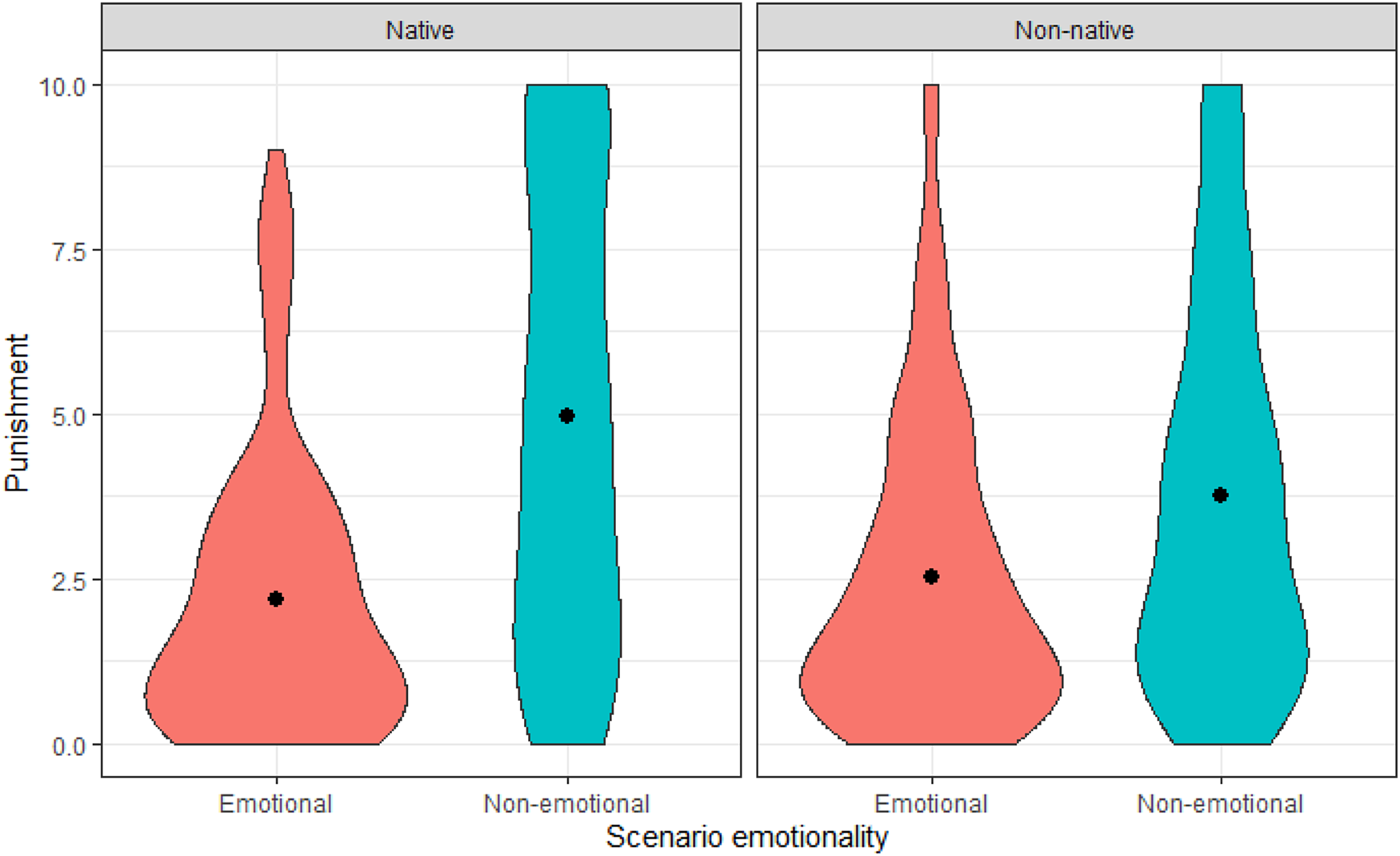
Before analysing the data, we transformed the dependent variable to make it comparable across scenarios. As mentioned earlier, the maximal sentence for one of the scenarios was 5 years whereas the maximal sentence for the other scenarios was 10 years. Therefore, before running the analysis, responses to the scenario with a maximal sentence of 5 years were doubled to make them comparable to the responses to the other scenariosFootnote 3. We ran a mixed effects regression analysis with Language (Native, Non-native; reference level=Non-native), Emotion (Emotional, Non-emotional; reference level = Emotional) and their interaction as fixed effects and Participants and Scenarios as random effects. The random structure also included by-participant and by-scenario slopes for EmotionFootnote 4. We did not include a by-scenario slope for Language as that slope led the model to fail to converge. Results revealed an effect of Emotion (β = 1.20, SE = 0.53, t = 2.26) at the reference level (Non-native), and crucially, an interaction between Language and Emotion (β = 1.42, SE = 0.41, t = 3.50). As can be seen in Figure 1, the interaction indicates that the effect of Emotion is larger for native speakers than non-native speakers.
Assigned sentence duration as predicted by whether participants responded in their native or non-native language and scenario's emotionality. Black dots indicate condition means.
General discussion
We tend to treat language as a vehicle to communicate a message. We assume that as long as the addressee understood the message, it does not make a difference whether the message was communicated in the addressee's native or foreign language. A growing body of literature, however, indicates that this is not the case. That literature shows that bilinguals experience greater intensity of emotion when processing content in their native language vs their foreign language, at least in cases where the two languages differ in age of acquisition and context of learning and use. Furthermore, the diminished emotion also leads bilinguals to make different decisions and draw different judgments in their two languages. This study provides further support for the influence of diminished emotion on moral judgment, while focusing on a situation that could have real world implications. The study shows that non-native speakers are less influenced by emotional mitigating circumstances when allocating punishments for a crime. These results could suggest that bilinguals’ evaluations of crime could be influenced by the language in which these crimes are described. While prior studies found that bilinguals are more lenient when judging a crime in a foreign language (Woumans et al., Reference Woumans, Van der Cruyssen and Duyck2020), this study shows that the effect of language might influence judgments in both directions, depending on whether and how emotion is involved in the motivations and consequences of the crime.
That said, an examination of the pattern of results revealed that native and non-native participants did not differ in the punishment they assigned to emotional cases (there was no effect of Language at the reference level, which is emotional scenarios), whereas native and non-native speakers differed in the sentences they assigned in the non-emotional cases. It is important to note that the pattern of results does not seem to be driven by floor effects in the sentencing decisions in the emotional scenarios. While they were lower than the sentences assigned in the non-emotional cases, they averaged over 2.5 years, and so could have allowed for a further drop. The pattern of results, then, seems to reflect baseline differences between the groups. What could explain the baseline differences? Several options present themselves. One might be due to cultural differences. German and British participants might view the appropriateness of prison sentences differently. Alternatively, the results might reflect two distinct foreign language effects working in tandem: general perception of crimes less severely in a foreign language, as was also reported in Woumans et al. (Reference Woumans, Van der Cruyssen and Duyck2020), and reduced sensitivity to emotional circumstances in a foreign language. Together, these effects would yield the observed pattern of results: In the non-emotional scenarios, the diminished emotional response to the act and its outcome led non-native speakers to judge the crimes more leniently (note that in these scenarios the act and its outcome can induce emotion; these scenarios were labelled non-emotional because they were not prompted by emotional mitigating circumstances). In the case of the emotional scenarios, non-native speakers experienced reduced emotional response to the crime and its outcome, similarly to the case of non-emotional scenarios, which led to more lenient judgments. At the same time, their diminished emotion also led them to be less influenced by the lenient mitigating circumstances, which led them to assign harsher sentences than they would have had they experienced an emotional reaction to the mitigating circumstances. Together, the two effects of diminished emotion cancelled each other leading to similar judgments to native speakers.
One interesting alternative interpretation of the results of the study is that the non-native speakers were less sensitive to the mitigating circumstances not because of diminished emotion in a foreign language, but because of reduced attention to intentions compared with consequences when processing a foreign language. Geipel et al.'s (Reference Geipel, Hadjichristidis and Surian2016) presented participants with acts prompted by good intentions that had negative consequences (e.g., a person giving a poor boy money, but then the boy uses it to buy drugs and dies of an overdose) and with acts prompted by dubious intentions that had positive outcomes (e.g., a company donating money to increase profits). Bilinguals in that study rated the former acts more negatively and the latter more positively when evaluating them in their foreign vs their native language (Geipel et al., Reference Geipel, Hadjichristidis and Surian2016). The non-native participants in our study, therefore, might have similarly focused on the outcome more than the intention, reducing their sensitivity to the mitigating circumstances. Such an account, thus, similarly predicts that individuals would be less sensitive to emotional mitigating circumstances in their foreign language, but it also suggests that non-native speakers might be less sensitive to other, non-emotional, mitigating circumstances as well. Future research should compare scenarios with different types of mitigating circumstances to better understand the extent of the effect and the underlying mechanism.
Several limitations of the study should be taken into account. The study compares two different groups of participants – native speakers of British English and (mostly) German–English bilinguals. That is, participants were not randomly assigned to a language condition. It would be good to repeat the study with native German speakers and English–German bilinguals performing the task in German to reduce potential effects of cultural differences. Importantly, the study tested for the existence of an interaction. That is, rather than testing whether one group gives more lenient or harsher punishment, it compared the sensitivity of each group to different types of scenarios. The presence of emotional mitigating circumstances was manipulated within participants, thus allowing for the test of the effect of language while controlling for baseline group differences. Nevertheless, there remains the possibility that members of different cultures differ in their sensitivity to emotional mitigating circumstances. Future research should control for this possibility.
It is also worth noting that the native and non-native participants in our study responded differently even though the native language of most of our non-native speaking participants – German, is highly similar to English (both are Germanic languages), and foreign language effects are often reduced with such pairs of languages (e.g., Circi et al., Reference Circi, Gatti, Russo and Vecchi2021). Our study thus might have under-estimated the size of the foreign language effect.
Another limitation of the study is the fact that participants’ comprehension was not tested. While we cannot rule out the possibility that the reduced sensitivity to emotional mitigating circumstances is due to lack of comprehension of these circumstances, participants’ general behavior does not suggest that. The non-native speakers in our study were not more likely to provide responses in the middle of the scale. Furthermore, the native and non-native speaking participants were also similar in their ranking of the severity of the scenarios. For example, when considering the non-emotional versions of the scenarios (where emotionality should not lead to group differences), both groups assigned the longest sentence to the darknet scenario and the shortest sentence to the grandparent scenario (see Appendix for the scenarios) suggesting comprehension of the depicted crimes. The similar ranking of the crimes also suggests that participants in the two groups possess similar values when evaluating such crimes.
Together, the study provides further support for the foreign language effect. Furthermore, it suggests that differences in experienced emotion in a native vs a foreign language can influence judicial decisions. Unlike prior literature, the study shows that diminished emotion might not influence judgment of all crimes similarly and its effect might be stronger for some scenarios than others. It also shows that diminished emotion does not always lead to more lenient sentences, as it can lead to reduced sensitivity to mitigating circumstances, thus resulting in harsher judgment than had they been taken into account. While the study presented participants with crime scenarios, the results are likely to apply to judgments of behavior of friends and colleagues as well. Native and non-native speakers might judge impolite or transgressive acts such as hurtful comments or ungenerous acts differently, and might differ in how understanding they would be to the emotional turmoil that prompted the behavior. The influence of the foreign language effect on social behavior might therefore be pervasive and complex.
Acknowledgement
The research was funded by a Leverhulme grant awarded to S.L. (RPG-2022-270). We would like to thank Niki Agrios, Samuel Clark, Matthew Davies, and Elyas Yusuf for recording the stimuli.
Competing interest
The authors declare none
Appendix – Scenarios
Grandson scenario, emotional version
You see, my grandpa hasn't been well for quite some time. He's in his eighties now and he's had Alzheimer's for many years. He is not aggressive or anything, just very confused, but still very lovely and trusting. I still visit him every week, even though I live ages away now. I'm still responsible for his insurance, finances and everything, I also have access to his bank account, but I don't touch his money.
When he was younger, he always told us he didn't want to end up in an old people's home, so when grandma passed away, my parents took him to their place. He's living in my old room now. But caring for him is very time-consuming and exhausting, I guess – on the bad days, he can't even go to the bathroom by himself. Since I'm not living at home anymore and both of my parents still work full-time, they hired some guy who was a trained healthcare worker to be at our house during the weekdays and care for him and keep him company. My parents did background checks and talked to the facility he had worked at before, everything seemed cool. It went well for a couple of months, but one day, grandpa's bank called me and informed me that there was suspicious activity going on in his bank account. Over the past few months, someone had regularly withdrawn large sums of money from it, over 3,000 pounds in total. At first, I thought someone had stolen his credit card, but when I asked grandpa about it, he showed me his card. He was too far gone to understand what I was making such a fuss about, but he mentioned that “nice young man” recently taking him to the ATM to pay for groceries.
I know that the responsible thing to do would have been to call the police immediately. I know I wouldn't have to make this statement otherwise. But I was just too upset at that moment. I left the house, but instead of driving home, I lingered around the street and waited for the care worker. He arrived shortly after. I wanted to go after him there and then, but there was still some doubt in my mind about whether this was all just a misunderstanding, so I waited for a while. It didn't even take half an hour before I saw both of them leave the house together, my grandpa holding onto the man's arm, who took him to the ATM under some made-up story to withdraw another three-digit sum of my grandpa's money. I just lost it then. I walked towards them – the care worker recognized me, let go of my grandpa's arm, and turned around – probably to run away – and then I just went at him. I think I was scared that he would just disappear with the 3,000 pounds he had already stolen from grandpa, and I was also really, really angry. I must have hit him three or four times, I don't remember. I do remember him lying on the ground at some point, with his face bleeding. I'm not sure I would do it again, but I also don't regret it.
Grandson scenario, non-emotional version
You see, my grandpa hasn't been well for quite some time. He's in his eighties now and he's had Alzheimer's for many years. He is not aggressive or anything, just very confused, but still very lovely and trusting.
When he was younger, he always told us he didn't want to end up in an old people's home, so when grandma passed away, my parents took him to their place. He's living in my old room now. But caring for him is very time-consuming and exhausting, I guess – on the bad days, he can't even go to the bathroom by himself. Since I'm not living at home anymore and both of my parents still work full-time, they hired some guy who was a trained healthcare worker to be at their house during the weekdays and care for him and keep him company. My parents did background checks and talked to the facility he had worked at before, everything seemed cool. I never liked him much, though. In my opinion, that care guy was obnoxious and resentful, and, to be frank, just not a very nice person. He would constantly get into arguments with my parents over money or his work schedule, get angry with my grandpa for little things and was generally very unreliable.
So, two months ago, I was at my parents' house, I was having a really bad day and I was super fed up with several things. My girlfriend had recently broken up with me and things at my job weren't going smoothly. When this guy came out of grandpa's room, he didn't even say Hi to me, he immediately started ranting about my grandpa wetting himself again and about the extra hours he had had to put in recently. He said that my grandpa was too much work and that if we wouldn't pay him more, he would quit immediately. I told him to talk to my parents about it but he said he wanted things to be sorted right now. He was right at my face and I could smell his breath. I turned away and started to walk away in order to not escalate the situation, but the other guy just grabbed my arm to keep me listening and kept shouting at me. Tthat was when I just lost it – I turned around, and while turning around I drew back my fist and landed a blow directly on his nose. He stumbled backward, I hit him a second and a third time before I came to my senses. He was bleeding from his face and I immediately felt bad about it. I'm not sure I would do it again, but I also don't regret it.
Financial fraud scenario, emotional version
Helen and I have been together for over 30 years, I can't even begin to tell you how much she means to me. She's a sweet woman, very, very kind to everyone. Two years ago, she came home and asked me whether I know how to use the washing machine on my own. Turned out she had been diagnosed with Amyotrophic Lateral Sclerosis, a very nasty muscle disease that gets progressively worse until you die. There is no cure for that yet, but after visiting dozens of doctors who said they couldn't do much, we read about a promising new treatment that gave us some hope. The treatment, however, was very expensive, and our insurance wouldn't cover it. We're not poor, I work as an accountant after all, but also not super-rich. There was just no way to pay for the treatment. But time was running away, and we were getting more and more desperate. It was clear that the basic medical treatment that was covered by the insurance would not save her life and only prolong her suffering, while there was this thing right there that could actually save her if we could just afford it. I just could not sit still and do nothing while my wife was wasting away, I just couldn't.
One day at work, I discovered this loophole in our IT system almost by accident. I transferred a two-digit sum of money into my own bank account, just to see whether it was possible, and I was baffled by the fact that it didn't have any consequences, and then, something in me started to wonder whether this could actually be a sign from above. Instead of reporting it, I did it again, and then, gradually, I began to do what I was eventually arrested for: It started small at first, just changing a few numbers here and there. But it soon turned into something bigger. I soon realized that it was possible to funnel large sums of my company's profits into my bank account without anyone noticing, and so I did exactly this when the next medical bill arrived for Helen, and the next one after that. I justified it with the thought that paying for Helen's treatment was, from an ethical point of view, more important than increasing the company's worth. When I was caught after a year or so, I had funneled several thousand pounds into my own bank account. It has caused damage to the company and my co-workers, I know that. I regret it very much. I didn't know what else to do at the time. I just couldn't bear the thought of watching her suffer without being able to do a single thing about it. All the money only ever went into paying for the treatment, I did not keep a single pound to myself.
Financial fraud scenario, non-emotional version
I work as an accountant. My wife and I are not poor, but it would be a huge overstatement to say we're rich. By the end of the month, we can pay all the bills and treat ourselves occasionally, but it's never enough for a big holiday, a new car, or retirement savings.
One day at work, I discovered this loophole in our IT system almost by accident. I transferred a two-digit sum of money into my own bank account, just to see whether it was possible, and I was baffled by the fact that it didn't have any consequences. Instead of reporting it, I did it again, and then, gradually, I began to do what I was eventually arrested for: It started small at first, just changing a few numbers here and there. But it soon turned into something bigger. I soon realized that it was possible to funnel large sums of my company's profits into my bank account without anyone noticing. The first thing I bought from that money was a necklace for my wife, then a new TV for myself, then a leather couch. When my wife or my neighbours asked me how I got afford all this stuff, I told them I had been getting bonuses at work for my achievements. Their admiration and the social status those items bought me was even better than the items themselves. I justified it with the thought that my wife and I were more deserving of that money than the gigantic company. When I was caught after a year or so, I had funneled thousands of pounds into my own bank account. It has caused damage to the company and my coworkers, I know that. I regret it very much.
Policeman scenario, emotional version
I used to be a police officer in London and I really enjoyed my job. I know a lot of people don't like cops, but I swear I worked in this job to do something good for the community, shield people from harm, and make the world a little bit more just.
About a year ago, we investigated the kidnapping of a young woman. It was all over the news, she was the youngest member of a rich family, and the kidnapper demanded a ransom of 5 million pounds in order to let her go. Along with the family, we staged a ransom drop and succeeded in arresting the kidnapper. However, we still couldn't find the kidnapped woman and he wouldn't tell us her whereabouts or anything else. This was the most difficult situation of my entire career – assuming that she was probably still alive, but most likely locked away somewhere and possibly without access to water and food, it was a race against time. We questioned the suspect for two days, but he wouldn't talk. Pressure from the media and the victim's family increased, and we became desperate. I didn't sleep at all during the two days, I was constantly thinking about that girl. On the third day, both my colleague and the suspect's attorney left the room for a minute or two. I was not supposed to talk to him during this time, but I did.
I openly confess to what I did when I was alone with him: I told him that if he didn't tell us where the woman was, I would shoot him in the knee. When he didn't respond, I took my gun out of the holster and acted like I was loading it, while verbally threatening him with the most intense pain he had ever felt in his life, the possibility of never walking again, and how much worse life in prison would be for someone who couldn't walk. He started crying, and under his breath, he finally told me where the girl was. We found her alive and physically well – thankfully, she had had access to food and water during all this time. I was suspended from my job the next day, as expected, for threatening and abusing a suspect, and I'm currently facing criminal charges. It was a very, very stupid thing of me to do. But back then, I thought it was a matter of life and death.
Policeman scenario, non-emotional version
I used to be a police officer in London and I really enjoyed my job. I know a lot of people don't like cops, but I swear I worked in this job to do something good for the community, shield people from harm, and make the world a little bit more just.
About a year ago, we caught this young guy a few hours after he had robbed a bank in South London. He had entered the building with a fake gun, threatened employees and customers, and left the place with a five-digit sum in cash. He was arrested very quickly, but he had had enough time to hide the money before his arrest. We couldn't find it anywhere – we assumed that it was buried somewhere, but even after a vast search, the money stayed gone. The suspect, obviously, wouldn't tell us where it was, even though it would have mitigated his sentence. He thought he could just go to prison for a few years and get the money at some point afterwards, go abroad, and live happily ever after.
In these days, I was very close to being promoted. I knew that if I could just get the suspect to tell us where the money was, it would look amazing on my job record, and I would most likely be one step closer to my dream position as a highprofile investigator. So I did everything I could to get him to talk, but nothing worked. I was getting frustrated – it would have been better for him, too, if he could just talk! Nothing worked on him, not even subtle threats, and I saw my prospects of being promoted retreating into the distance. On the third day of questioning him, both my colleague and his attorney left the room for a minute or two. I was not supposed to talk to him during this time, but I did.
I openly confess to what I did when I was alone with him: I told him that if he didn't tell us where the money was, I would shoot him in the knee. When he didn't respond, I took my gun out of the holster and acted like I was loading it, while verbally threatening him with the most intense pain he had ever felt in his life, the possibility of never walking again, and how much worse life in prison would be for someone who couldn't walk. He started crying, and under his breath, he finally told me the whereabouts of the money. It was a very, very stupid thing of me to do, and I don't know why I was thinking that I would get away with it. I guess I just thought he'd be too scared to tell anyone, or that no one would believe him over me. I was suspended from my job the next day for threatening and abusing a suspect, and I'm currently facing criminal charges.
Darknet scenario, emotional version
Your university years are supposed to be the most carefree years of your adult life, but for me, it's been hell so far. I'm a student at Bristol, but instead of studying, partying, and dating, the thing that was on my mind for most of the past year was Josh. We briefly met at a party during Fresher's week, although it later turned out that he wasn't even a student. We only talked a few times ever since, but from day one, he seemed to develop some sort of obsession with me. It started with texts and little letters. I told him very early on that I wasn't interested in him and I was nice about it, but that only made things worse. He started calling me at random hours, spamming me on all social networks, and sometimes randomly showing up at my campus, even though he doesn't study there. I didn't think much about it at first, but it became creepy very soon, and I started blocking him everywhere. However, he would just make a new fake account or change his number to keep messaging me. At first, he just wanted to go on a date with me, but after I told him numerous times that I wanted him to leave me alone, his texts became more and more threatening and disturbing.
After a few months, I reported him to the police, but they didn't take me seriously. They said that as long as he didn't send murder threats or physically assault me, he was no real danger to me and that they had more important cases to take care of. This really upset me – it's true, he didn't threaten me with murder, but I was still terrified of him. Every time I changed my number, he somehow found out my new one after a few weeks. He started to hang around in front of the building I live in, and even after being told numerous times by me and everyone else to stay the hell away from me, I still sometimes saw him around.
I just wanted him to understand that I didn't want him around me, and since the police wouldn't help me, I eventually decided to take matters into my own hands. I just didn't want to feel like a helpless victim anymore. I got into the darknet and hired four guys to corner him when he was lingering around my area again and beat him up thoroughly. I told them to threaten him with further violence should he ever come near me again. I'm not gonna lie, I felt good about it before I heard how badly hurt he was. They had kicked his head so hard that it broke his skull. The doctors say that he suffered a traumatic brain injury and is in a permanent vegetative state now. It's not clear whether his condition will ever improve. I wanted him to get hurt, but not this badly. This is definitely not what I intended, and I feel terrible about it.
Darknet scenario, non-emotional version
Your university years are supposed to be the most carefree years of your adult life, but for me, it hasn't been great so far. I'm a student at Bristol, but instead of studying, partying, and dating, the thing that was on my mind for most of the past year was Josh. We met at a party during Fresher's week (although it later turned out that he wasn't even a student) and started dating soon afterwards. Our relationship lasted for about a year. The break-up was very hard, but he hadn't been a great boyfriend, so I got over it. What I did not get over, however, was that he owed me a shitload of money. You see, he had a hard time financially during that year – his parents didn't support him and he lost his job in June. His landlord threatened to throw him out, and he desperately needed money. We had been together for ten months by then, so I trusted him and gave him the 2,000 pounds I had in savings under the condition that he would pay me back as soon as possible. But when we broke up, he still hadn't paid me back a penny, and when I texted him after the break-up that I still wanted and needed the money, he just didn't reply. Over the next few weeks, I repeatedly texted and called him, but he blocked me and refused to talk to me.
It's not like I desperately needed the money, it's just that the fact that he simply refused to pay me back made me so angry. It was just so ludicrous and disrespectful! The break-up had been bad enough, why would he humiliate me further? So instead of just reporting him to the police, I decided to humiliate him back. I just wanted him to understand that actions have consequences. I just didn't want to feel like a victim anymore. I got into the darknet and hired four guys to corner him and beat him up thoroughly. I told them to threaten him with further violence should he not pay me back the money as soon as possible. I'm not gonna lie, I felt good about it before I heard how badly hurt he was. They had kicked his head so hard that it broke his skull. The doctors say that he suffered a traumatic brain injury and is in a permanent vegetative state now. It's not clear whether his condition will improve. This is definitely not what I intended, and I feel terrible about it.


 Open access

