




Introduction
In the conventional view, humor is nice. Jokes are harmless fun that foster rapport by providing a diversion from the more serious and important concerns of life. The work of Billig (Reference Billig2005) has revealed the limitations of this view, critiquing it as an ideology that elides the many ambivalent and malevolent meanings and uses of humor. For Billig, ridicule is actually more central to social life than rapport. It is an instrument of discipline and rebellion by which participants enforce, challenge, and otherwise negotiate social norms, thereby helping to reproduce and reshape the social order (Billig Reference Billig2001:38, Reference Billig2005:202–14). It is not just its disciplinary and rebellious functions that make ridicule central to social life; it is also the more structural fact that ridicule requires an audience of onlookers. For these reasons, the study of ridicule has helped to demonstrate how humor is necessarily a product of and inextricable from social interaction.
Because it is structurally embedded in social interaction, understanding humor requires an analysis of particular situations. Humor is not always planned and is not reducible to jokes; analyzing the formal, linguistic properties of a joke cannot reveal tellers’ or hearers’ experiences, nor explain the experience of humor in situations where no jokes are told (cf. Billig Reference Billig2001:37, Reference Billig2005:66). Whether an instance of humor or laughter entails rapport or ridicule depends on how participants experience it, and it is not necessarily experienced in the same way by all. In other words, humor is indexical.
As a theory of variation, indexicality shows how meanings emerge, change, and stabilize. As an indexical phenomenon, humor does not have a static or fixed meaning but instead can be said to have a constellation of potential meanings that can be activated in the here-and-now of interaction, an ‘indexical field’ (Eckert Reference Eckert2008). An indexical field is emergent in that each particular, situated act of meaning-making has the potential to contribute to and change the field and its relationships (Eckert Reference Eckert2008:454). Beyond its conventional link with rapport, humor has an indexical field that is potentially very wide, or limitless, given the indeterminacy of indexical meaning-making. Billig's work on ridicule can be seen as an effort to map this field. As shown by Eckert, the social meanings in indexical fields form arrays of oppositions (Eckert Reference Eckert2008:466). Rapport and ridicule can be seen to form a key opposition in humor's indexical field.
The existence of a debate over rapport and ridicule as competing meanings of humor demonstrates that they are stereotypes. Stereotypes are those meanings that people explicitly notice and discuss, those that become ‘the overt topic of social comment’, as opposed to those at lower orders of indexicality where meanings and variables are used but not noticed (Johnstone, Andrus, & Danielson Reference Johnstone, Andrus and Danielson2006:82–83). If rapport and ridicule form a key opposition in humor's indexical field, it is important to remember that they are stereotyped social meanings and that their existence in the indexical field says nothing about if or how they might be activated in a given situation. A given instance of humor or laughter might index any number of meanings depending on how participants experience it. Investigating humor's indexical field helps us escape deterministic approaches to its meaning and get beyond commonplaces about its context dependency.
It is a truism that the meaning of a joke depends on its context, a truism that has long functioned as a folk theory of variation in humor's meaning. The problem is that the shape of context is not given or fixed; our experience of situations shapes and is shaped by discourse. From an indexical perspective, context is emergent and as Silverstein (Reference Silverstein2010:340) puts it, ‘projectively imaginable’. It is ‘projected from the radial perspective of the interactional here-and-now’ (Silverstein Reference Silverstein, Auer and Di Luzio1992:60). This helps explain why it is not necessarily experienced in the same way by all. Highlighting its indeterminacy, Silverstein describes context as ‘unboundedly large (or small), characterizable in unboundedly many different ways, and its indexical establishment (as having-been-brought into being) almost limitlessly defeasible’ (Silverstein Reference Silverstein, Auer and Di Luzio1992:55). If the meaning of a joke depends on its context, then the shape of its context depends in part on the experience and discourse of its participants.
Approaching critical humor research from an indexical perspective, this article presents a case study in the discursive construction of ridicule as a social meaning indexed by scientific humor. I examine how, in discussing her displeasure with a public joke made about her research, a scientist projects the macro-social situations of the news and the lab from the vantage of the particular micro-social circumstances of an interview, negotiating her professional scientific identity and giving shape to the social spaces where it operates. I suggest that such a projection—from ‘the radial perspective of the interactional here-and-now’ in Silverstein's terms—is realized through storytelling, stance-taking, and entitlement challenges. By adopting a critical stance toward the joke in the news and an approving stance toward the same joke in the lab, the scientist challenges the entitlement of reporters to joke about her research while reinforcing the joking rights of scientific insiders. In what follows, I review relevant literature on ridicule from critical humor research and connect it to work on narrative, stance-taking, and entitlement. I then introduce the data and approach and proceed to an analysis showing how the meaning and purpose of the joke changes and how the right to joke gets negotiated. The analysis shows that the joke does not have a fixed meaning, even for a single participant, but instead an indexical field comprised of at least two opposing social meanings—rapport and ridicule—activated in different situations.
The ideology of niceness and the elision of ridicule
Over a long discursive history, humor has come to be associated especially with benevolence and amusement, linked to sentimental social meanings, good-natured social personae, and rapport-building purposes. Billig calls this the ‘nice-guy’ theory of humor, a view he traces to Goffman, whose theories of face and social organization presume an overwhelming preference for affiliation and social solidarity, a world of empathy where ‘people are sympathetic repairers of social breakdowns’ (Billig Reference Billig2005:203). Billig (Reference Billig2001, Reference Billig2005) demonstrates how the ‘nice-guy’ theory has gone largely unquestioned, even by theorists of humor, and how it has led many to overlook or misinterpret acts of ridicule, even in the face of overwhelming empirical evidence. For Billig, it is an outgrowth of ‘ideological positivism’, a thoroughgoing ideology perpetuated by psychological research, clinical psychotherapy, popular psychology, and self-help stressing the positive aspects of life for individuals while downplaying the negative aspects of the larger social order, its cruelties, injustices, and disruptions.
The ideology of niceness pre-theoretically constrains the possible meanings and uses of humor, thereby limiting the kinds of questions that get asked and the kinds of interpretations made. One perverse effect of its presumed niceness is that humor tends be treated as a triviality both as a phenomenon and as a research topic. The bonhomme of social science research, humor is presumed to be wandering through life with handshake and a smile for everyone they meet, charming, fun, and unfailingly nice, but because of this, everyone suspects, fundamentally shallow and simple-minded. Humor might provide amusing entertainments and temporary distractions, but its value can never be more than discretionary or cosmetic. In his work, Billig challenges these assumptions about humor, writing that ‘it is not an extra but enjoyable adornment, like an embroidered pattern on a garment designed to keep out the cold’, and reminding us that the meaning of humor is not fixed but ‘can be an inherently controversial matter’ (Billig Reference Billig2005:4). ‘One person's harmless bit of teasing’, he writes, ‘will be another's cruelty’ (Billig Reference Billig2005:8). And though rapport and ridicule are common ways of interpreting humor, they are not the only ways. Instead, they might be said to be a key opposition in humor's ‘indexical field’, the constellation of potential social meanings that can be activated by a joke in a given interaction (Eckert Reference Eckert2008).
The ideology of niceness has led many humor researchers to overlook ridicule and other potential negative social meanings. Recent research about scientific humor in the sociology of science, for instance, tends to be grounded in the ideology of niceness. It is largely premised on the assumption that humor is a friendly, rapport-building adornment for science, investigating how it can be used as a marketing or public education tool for spreading scientific knowledge in the public sphere (Riesch Reference Riesch2014; Pinto, Marçal, & Vaz Reference Pinto, Marçal and Vaz2015; Marsh Reference Marsh2016; Fiadotava, Astapova, Hendershott, McKinnon, & Jürgens Reference Fiadotava, Astapova, Hendershott, McKinnon and Jürgens2023). Though making science fun would seem to be a worthy goal, this work tends to trivialize humor and bracket the possibilities for cruelty and ridicule that critical humor research emphasizes. There is a need for work that takes a critical perspective toward scientific humor, moving beyond the ideology of niceness to consider its negative potentials.
Meanwhile, critical humor research has made ridicule one of its central concerns, but it has had little to say about scientific humor. Instead, much of the work has investigated how ridicule is used to intervene in social, cultural, and political controversies in media and popular culture. Some of this work focuses on destructive uses and toxic effects of ridicule, like studies showing how habits of ridicule in the media are harming the culture or the moral order (Lichter & Farnsworth Reference Lichter, Farnsworth, Samoilenko, Icks, Keohane and Shiraev2019; Wodak, Culpeper, & Semino Reference Wodak, Culpeper and Semino2021; Jenks Reference Jenks2022), and those revealing how it is used to marginalize vulnerable groups (Santa Ana Reference Santa Ana2009; Cole & Morgan Reference Cole and Morgan2011; Eriksson Reference Eriksson2015; Breazu Reference Breazu2022). Other studies present ridicule as an instrument of activism, showing how, for instance, social media users ridicule public officials and public policies in order to challenge ignorance and oppression (Zappavigna Reference Zappavigna, Koller, Kopf and Miglbauer2019, Reference Zappavigna2022; Dynel Reference Dynel2021; Al Zidjaly Reference Al Zidjaly2022; Mould Reference Mould2022). There is work that shows how teasing and joking can index rapport for some participants and ridicule for others (Plester & Sayers Reference Plester and Sayers2007; Franzén & Aronsson Reference Franzén and Aronsson2013; Franzén, Jonsson, & Sjöblom Reference Franzén, Jonsson; and Sjöblom2021) and how a term of solidarity, over time, can become a term of ridicule (Wong Reference Wong2005; De Cock & Pizarro Pedraza Reference De Cock and Pedraza2018). Because much of this work examines well-publicized social conflicts between powerful and vulnerable groups, the intent of jokes is often inferred from the disalignments represented in the text, the demographic characteristics of participants, the reputations of public figures, and the public histories of the controversies.
Critical humor research has probably had little to say about scientific humor for some of the same reasons as everyone else. In their foundational work on scientific humor, Mulkay and Gilbert describe how their colleagues questioned both the existence and the value of their object of study: ‘Not only do they usually express surprise that there is a significant humorous element in science, but they also tend to question whether it would be worth studying anyway. It seems to be assumed that the study of scientific humour must itself be frivolous’ (Mulkay & Gilbert Reference Mulkay and Nigel Gilbert1982:586). As with the more recent work of sociologists of science who want to make science fun, the ideology of niceness keeps Mulkay & Gilbert's colleagues from imagining the possibilities and potential of scientific humor. Aren't ‘humor’ and ‘science’ antonyms? How could something so frivolous and trivial be part of the very serious and important enterprise of scientific knowledge making, the pinnacle of human reason? The elision of scientific humor would seem to be a special case of the elision of ridicule.
Ridicule, narrative, and the shape of situations
The meanings and purposes of humor can be controversial. How humor works depends on the perspectives and roles of participants in particular situations (Billig Reference Billig2005:8; Zwagerman Reference Zwagerman2010:3–4). Because it is never experienced in exactly the same way by all participants, humor necessarily creates opportunities for disagreements and disalignments. In his work on laughter and embarrassment, Billig emphasizes the important role played by the audience of onlookers. Whether or not an event is experienced as embarrassing depends a great deal on who is watching and listening, and how that audience reacts (Billig Reference Billig2001:26–27). An event that takes place in private—Billig offers the example of ‘bodily eruptions’—might elicit no embarrassment, while the very same event taking place in public, in front of an audience of onlookers, could be socially devastating. He notes that while some onlookers might engage in cooperative, ‘remedial’ facework, other onlookers might laugh, point, and revel, enjoying the devastating social embarrassment of another. It is not safe to assume that all onlookers will always respond to a gaffe with acts of rapport. Some may respond with ridicule. It is also not safe to assume that all humor will be intended or experienced as rapport.
It is one thing to acknowledge that humor is situational, in principle. This acknowledgement helps demystify and decenter sweeping generalizations and stereotypes by recognizing that the meanings and purposes of humor can be multiple and controversial. It also suggests a way forward: examine the situations where it occurs and the multiple meanings and purposes of humor will reveal themselves. The problem is that the shape of situations can also be controversial.
Because conversational data allows researchers to observe precisely when, where, and how humor develops in the moment-to-moment of spoken interaction, it helps address some aspects of the problem of determining the shape of a situation. However, not all ridicule takes place in the emerging here-and-now of conversation. What about so-called ‘larger’ situations, those that transcend the here-and-now of conversational interaction (cf. Lempert & Carr Reference Lempert and Summerson Carr2016)? In cases where audiences are auditing published jokes, interacting with texts or screens as readers or listeners, in largely silent, individual episodes widely distributed across time and place, what is the shape of the situation, and how can a researcher observe it?
Narrative is essential to understanding how humor transcends the here-and-now of conversation. Billig, for instance, shows how ‘laugh about it later’ stories help transform a teller's embarrassing past experience into a humorous, rapport-building anecdote in the here-and-now of interaction (Billig Reference Billig2001:35–38). Such an analysis requires a distinction between narrated events and interactional events, along with the participants involved in each (Jakobson Reference Jakobson1971:133). By telling embarrassing stories on themselves, tellers bring narrated events—a gaffe from the past—and narrated participants—the onlookers who witnessed the gaffe—into the present interaction where the telling and auditing events are taking place, transcending the here-and-now of conversational interaction by animating past events for their present hearers. But even as they transcend the here-and-now of conversational interaction, the narrated gaffes and the audiences of onlookers in ‘laugh about it later’ stories remain relatively local and fleeting: a professor recounts mispronouncing a word in front of a class, a star-struck fan recounts spilling a condiment at a restaurant where the star also happened to be dining. Few besides the teller probably even remember them, let alone recount them to friends. This limited publicity provides the teller anonymity and a great deal of authorial control over how the story is told, when, and to whom.
These protections do not exist in the more public embarrassments of published ridicule. A situation involving writers and their readers is what Bazerman (Reference Bazerman, Olson and Cole2006) has called a ‘literate situation’. Unlike synchronous and proximal talk-in-interaction, writing and reading in a ‘literate situation’ is distant and asynchronous. The audience of onlookers is quite different from that of conversation. As Bazerman points out, the relationship between writers and readers in written language is ‘much more tenuous and uncertain’ than the relationship between speakers and listeners in the real-time of spoken discourse (Bazerman Reference Bazerman, Olson and Cole2006:222). Investigating situations where writers and speakers address their audiences from a distance, researchers have shown how they respond to the lack of audience feedback by designing texts that anticipate and narrate the situation of their reception in an attempt to shape it (Bell Reference Bell1984; Bazerman Reference Bazerman1988:12–26; Geisler Reference Geisler1994; Blommaert Reference Blommaert2004:644–55). While we all bring presuppositions and generalizations to the situations we participate in, regardless of medium, for writers and readers there is much less immediate feedback than for speakers in interaction. For any particular writer or reader in a given moment, the ‘literate situation’ that they are participating in is their story about the situation, a largely abstracted generalization and projection from their circumstances.
Stance-taking about stance-taking
Along with narrative, stance is essential to understanding the embarrassments of published ridicule. Stance has long been an important way of understanding the relationships between identity and interaction (Ochs Reference Ochs, Duranti and Goodwin1992; Agha Reference Agha2007). The ‘stance triangle’ developed by Du Bois provides a model for understanding how stancetakers’ evaluations of phenomena place them in roles and position them in relation to others (Du Bois Reference Du Bois and Englebretson2007). In a prototypical stance-taking situation, two subjects evaluate an object they both witness in the interactional here-and-now. Take Billig's example of ‘bodily eruptions’. An audible ‘bodily eruption’ that took place on a city bus, for instance, could become a stance object by eliciting an evaluation by one bus rider (a subject) who whispers ‘disgusting’ to the rider sitting next to them (another subject). The stance triangle helps explain the social structure of ridicule, treating it as an act of evaluation that places subjects in roles and in relationships in the interactional here-and-now.
Unlike the prototypical stance-taking situation, however, published ridicule involves subjects and objects at distances from one another in time and space. Participants use narrative to transcend these limitations. Experiencing published ridicule means narrating a set of stance relationships based on abstractions and generalizations from the circumstances of one's reading experience. For instance, it might mean telling a story about how the writer of a text (a stance subject) took a mocking stance toward the topic discussed in the text (the stance object) in order to align with the intended readers of the text (the other stance subject). Nesting occurs when someone takes issue with the stance-taking depicted in such a story, evaluating that narrated triangle from the vantage of the interactional here-and-now.
Entitlement challenges and joking rights
In their foundational work on scientific humor, Mulkay & Gilbert (Reference Mulkay and Nigel Gilbert1982; Gilbert & Mulkay Reference Gilbert and Mulkay1984) investigated jokes about science told by scientific insiders to one another. Because the right of scientists to joke about their own scientific practice is generally taken for granted, entitlement was not a salient problem for them. They were more interested in how knowledge was portrayed in jokes rather than who had the right to make them. As Shuman puts it, entitlement ‘is not a speech act, but rather belongs to culturally specific conventions of meta-communication’ (Shuman Reference Shuman, Hill and Irvine1993:135). For this reason, it is often overlooked, becoming salient only in cases where it is challenged. Entitlement challenges, as Shuman points out, bring the question of rights into the open, with speakers making their presumptions more explicit, giving voice to conventions through meta-communicative acts.
In talk-in-interaction, speakers are conventionally granted priority in sharing and assessing their own experiences (Pomerantz Reference Pomerantz1980; Sacks Reference Sacks, Maxwell Atkinson and Heritage1985; Heritage & Raymond Reference Heritage and Raymond2005). In news reporting, journalists conventionally distinguish those with first-hand access to events from those with second-hand access, granting special authority to the former (Raymond Reference Raymond2000; Roth Reference Roth2002). With personal experience, whether biographical or reportorial, privilege in sharing and assessing is conventionally granted to those with firsthand knowledge. However, where experience is more shared, public, and collective, firstness may be difficult to determine or moot, making entitlement challenges more likely and more complex.
The privilege of first-hand experience in the negotiation of epistemic authority has parallels in the negotiation of what I call ‘joking rights’. Self-deprecating humor, for instance, is licensed by a presumed right to joke about ourselves and our own experience. The entitlements involved in joking about shared, collective, or public experiences are more complicated, involving a negotiation of rights that depend on the personal relationships of the participants, their shared categories of identification, and degrees of involvement or investment in the shared experience. Who has the right to joke to whom about a war or a natural disaster, a public policy or a court ruling, a community, or tradition? While participants might leverage macrosocial categories of race, nationality, age, gender, class, or profession in negotiating entitlement, these categories are not self-interpreting or self-justifying (Lo Reference Lo1999; Bucholtz Reference Bucholtz2001, Reference Bucholtz2003; Bucholtz, Skapoulli, Barnwell, & Lee Reference Bucholtz, Skapoulli, Barnwell and Lee2011). It is only through interaction that macrosocial constructs come into being, but micro-level interaction is also shaped by these constructs through the schemas and expectations leveraged by participants (Bucholtz & Hall Reference Bucholtz and Hall2005; Eckert Reference Eckert2008; van Dijk Reference van Dijk2009). As with epistemic rights, joking rights do not inhere in people but must be negotiated and accomplished in interaction, even in cases where the entitlement claim is presumed rather than challenged.
Data
The data for this study grew out of a chance event, a conversation with a colleague. At a social event Sophie,Footnote 1 a biologist at my university, was complaining to me about the way her research had been portrayed in news reports. I thought her experience might raise some interesting questions about scientific popularization. Later I asked her if I could interview her for a research project and she agreed. In the Fall of 2015 after receiving human subjects approval for the project, I conducted two unstructured interviews with her about her experiences serving as a source for news stories about her work. She brought to the interviews printed copies of two news reports about her research, printouts of her email exchanges with reporters, and a copy of her scientific journal article. We referred to these texts as we discussed her experience.
Her scientific article was accepted in the Fall and published by the journal online first. Sophie was then contacted by a reporter from a local news outlet who published the first news story about it in January, the one that initially raised alarms for her. On the heels of that story, she was contacted by reporters from a popular science magazine. She demanded a lot of feedback and follow-up from them because of her fears of misrepresentation. The email printouts were her exchanges with the magazine. Between January 11 and 27 there were eight emails from the magazine reporter, and five replies from Sophie, and between February 4 and 5, four emails from an intern and four replies from Sophie. The emails posed questions of clarification about her findings and asked her for approval of draft language. The popular science magazine article was published in April. Though we referred to these texts as we discussed her experience, the data under analysis is the talk-in-interaction from my interviews with Sophie.
Sophie consented to be interviewed about her experiences serving as a source for news stories about her work, and to have her words digitally recorded, transcribed, and quoted in published research.Footnote 2 She acknowledged that some of the questions might seem sensitive or personal and that she was under no obligation to answer any question. Still, I am concerned about the ways that publishing research about her experience of ridicule might somehow contribute to it. Though she agreed to be identified in published research, I have chosen to give her a pseudonym here because her biography is not material to this analysis, and because I would like to reduce as much as possible any chance that this article might somehow contribute to the ridicule she experienced. Some key words and lines from the news coverage that she disliked are material to the analysis and do appear in descriptions and transcribed fragments. Though these mentions do provide enough information for a motivated reader to track down the coverage, I have chosen not to cite the news stories or their authors.
The interviews were an outgrowth of our initial conversation about the way her research was reported in the news. That is, the prior discourse of that initial conversation helped shape the scope and purpose of the interviews. They were not completely unplanned conversations where topics and participant roles emerge and shift organically but somewhat planned interactions with an interviewer posing questions to an interviewee about a significant personal experience. As with other interviews about significant personal experiences where ‘speakers have been provided with a particular opportunity for reflection’, these interviews helped create a venue for disclosure (Bamberg Reference Bamberg, Milnes, Horrocks, Kelly, Roberts and Robinson2006:64). In disclosure, speakers narrate otherwise private experiences in an effort to question or challenge dominant public narratives (Shuman Reference Shuman, De Fina and Georgakopoulou2015:47–48). Though the topics and participant roles were relatively planned—I would interview her about her experiences serving as a source for news stories about her work—the particular topic of jokes was not. Before the interviews I thought this study was about scientific popularization; I never imagined it would have anything to do with humor.
Sophie and I were colleagues and acquaintances. This made me an ‘insider-interviewer’ rather than an ‘outsider-interviewer’ or ‘local stranger’ in Weinreb, Sana, & Stecklov's (Reference Weinreb, Sana and Stecklov2018:97–98) typology of interviewer–interviewee familiarity. When investigating sensitive topics, researchers often prefer insider-interviewers because interviewees trust them (Noland Reference Noland2006; Weinreb Reference Weinreb2006; Weinreb et al. Reference Weinreb, Sana and Stecklov2018; Greenleaf, Turke, Bazié, Sawadogo, Guiella, & Moreau Reference Greenleaf, Turke, Bazié, Sawadogo, Guiella and Moreau2021). The fact that Sophie and I were colleagues and acquaintances shaped the interviews in important ways, contributing to her willingness to share her reflections on an embarrassing and difficult experience and helping to transform the interview into a venue for disclosure.
Beyond questions of trust and familiarity, there is the principle of partialness. Any interview will necessarily result in a partial account or characterization of experience, an account that is, in the words of Bucholtz & Hall (Reference Bucholtz and Hall2005:605), ‘intersubjective in nature, constructed through the particulars of self and other in any localized encounter’. The data from these interviews is intersubjective in nature; my conversational turns appear in the transcripts, my questions and comments help to shape the stories, as do our shared prior texts. Though Sophie and I were the interactional participants in the interviews, speaking with one another and interacting with written texts, much of the talk features her narratives of her past experience speaking with reporters, speaking with colleagues in the lab, and reacting to news stories. All of the reporters mentioned are female, as are many of the peers in the lab. Though the topical focus of our conversations fell largely on narrated events and participants, I treat the interviews as a context of interaction like any other. Following De Fina's (Reference De Fina2009) work on the analysis of interview data, I aim to avoid the traditional tendency to bleach the interview context from the data, instead explicitly positioning myself as a researcher who is involved in the process.
Analysis
In her research, Sophie was investigating a novel pheromone-tagging mechanism used by a wasp in mating. After she and her co-authors published a scientific journal article about the work, she was contacted by a reporter from a local news outlet who interviewed Sophie and published a news story about the research. Her news story makes an anthropomorphic sex joke, portraying the wasps as clubgoers looking to meet at closing time, with sexually aggressive males scanning the room for willing females. It refers to the male wasps as ‘casanovas’ with ‘smooth moves’ who bear ‘a potent pheromone’ and female wasps as ‘lusty little buzzers’ who are ‘looking for love’. This local English-language news story was eventually picked up by wire services, republished by other news outlets, and translated into other languages. The anthropomorphic sex joke appears to be a cliché of news reporting on insect mating research. In her foundational work on news coverage of science, for instance, Nelkin mentions a 1963 Washington Post story announcing that scientists had identified ‘the sex-lure chemical by which the female German cockroach calls her boyfriend’ (Nelkin Reference Nelkin1995:3).
In the interviews with me, Sophie gave shape to the news and lab situations and her own experience in them through storytelling and stance-taking practices, bringing narrated events into the interaction of the interviews. She narrated her experience of the joke by portraying it in each case as a playful stance that has been taken toward her research. When adopted by reporters addressing public audiences, the playful stance indexed ridicule, but when adopted by scientists addressing peers, it indexed rapport. In the interviews with me, then, she adopted critical and approving stances toward the playful stances taken in the news and the lab narratives. It is through this stance-taking about stance-taking that she challenged the entitlement of reporters to joke about her work.
Ridicule
In the interviews with me, Sophie discussed her conversations with the reporter and commented on the published news story.

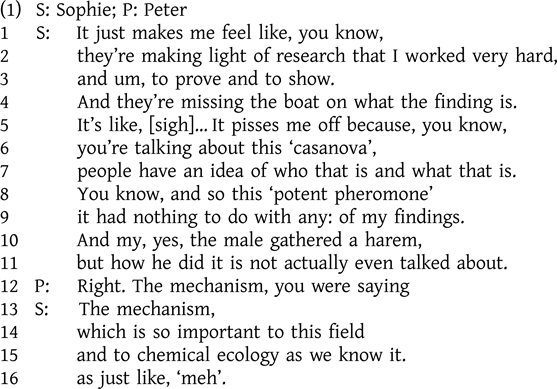
In this fragment, Sophie tells a story of ridicule, constructing a dialogue in which the reporters, “they”, “you”, address the reading public, “people”, in an exchange about her work, “research”. Like the storytellers interviewed by Carranza (Reference Carranza1999), Sophie is unhappy with the way she has been portrayed in public discourse and uses the interview as an opportunity to narrate her own version of events and raise objections in a private, face-to-face interaction, thereby ‘winning the battle in private discourse’. In these kinds of ‘low-narrativity narratives’, speakers put stories in service of arguments, portraying not only some particular past event but the general, ongoing conditions of a larger world about which they take a position (Carranza Reference Carranza1998). By dramatizing a hypothetical ‘conversation’ between reporters and readers, her story portrays the general, ongoing conditions of the public reception of the text, its literate situation. Once portrayed, these conditions can be evaluated.
The participants in the story form a stance triangle. Sophie's research is the stance object, and the reporter and news readers are stance subjects. The reporter's stance toward the research is portrayed in line 2, “they're making light of research that I worked very hard”, as is her address of her audience and its reading experience, “you're talking about this ‘casanova’, people have an idea of who that is and what that is” (line 6–7), forming a stance triangle involving the research, the reporter, and the readers. The problem is that the reporter is creating an alignment with the readers by appealing to their lack of scientific expertise. At several points, Sophie implies that the reporter's responsibility is to accurately convey the scientific contribution of her research as she criticizes her for failing to meet this responsibility. She notes that the article fails to convey the central finding of her research, “they're missing the boat” (line 4), “it had nothing to do with any: of my findings” (line 9). In line 11 she mentions that the central finding, the mechanism by which the wasp builds a harem, was overlooked: “but how he did it is not actually even talked about”. The mechanism was the key discovery of her research, showing how male wasps use a unique pheromone to tag particular females, providing evidence of an individual signature in a species where individual wasps are commonly treated as interchangeable clones. In lines 12–16, she elaborates on the scientific importance of the mechanism and voices the reporter's apathy, explaining that her response “Was just like, ‘meh’”.
While Sophie narrates a stance triangle involving her research, the reporter, and the news readers (research-reporter-readers), she is also criticizing the stance portrayed there. She is telling a story about how a reporter ridiculed and distorted her research by adopting a playful stance toward it and creating alignments with news readers, and she is simultaneously evaluating this set of narrated stance relationships (research-reporter-readers) in the interview, creating an alignment with me.
The interactional triangle emerges with Sophie's evaluation of the narrated triangle in line 5. Referring to the exchange between reporter and reader, she addresses me: “It's like, [sigh]… It pisses me off” (line 5). What she is evaluating is not only the joke, but its part in the larger dialogue between the reporter and news readers, where her research is the stance object, and they are the stance subjects. In other words, the narrated triangle helps explain her experience of ridicule, positioning news readers as an audience of onlookers, laughing at a distorted representation of her research. In this way the narrated triangle is the stance object in the interactional stance triangle involving Sophie and me.
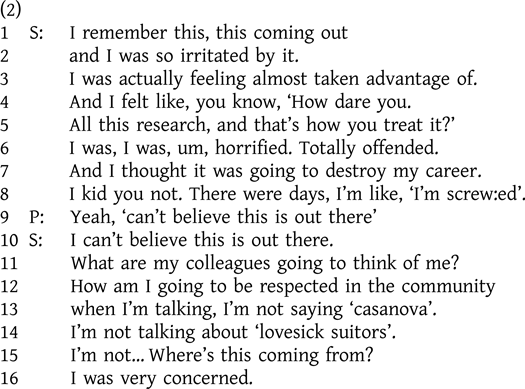
Sophie not only saw her research being made the ‘target’ of ridicule, in the traditional terminology of humor research, but also herself. As she elaborates on her experience, the stance object in the narrated triangle shifts from her research to her, and later she becomes a stance subject.
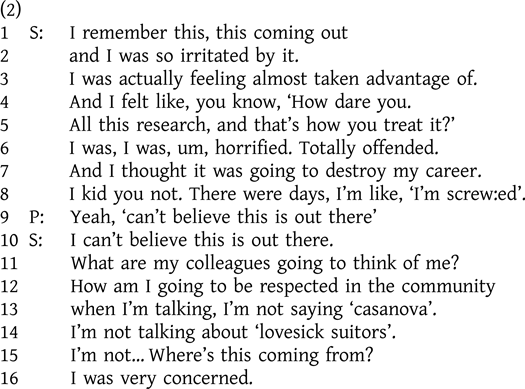
In the first part of the fragment, her research is the stance object: “All this research, and that's how you treat it?” (line 5), while the reporter and news readers are the stance subjects (research-reporter-readers). As it progresses, it is herself: “And I thought it was going to destroy my career” (line 7), “What are my colleagues going to think of me?” (line 11), “How am I going to be respected in the community” (line 12). In these lines, she is the stance object, while the reporter and news readers are the stance subjects (Sophie-reporter-readers). And finally in lines 13–16, a further shift occurs, with Sophie's past self becoming a stance subject addressing news readers about her research (research-Sophiep-readers):Footnote 3 “I'm not talking about ‘lovesick suitors’”. (line 14).
Meanwhile, in the interactional triangles that emerge, Sophie and I are stance subjects, and the narrated triangles are the stance objects, (Sophie-reporter-readers) and (research-Sophiep-readers). The initial critique is that the news story fails to accurately report the research findings. As this fragment develops, the critique is that it fails to properly portray the researcher, and then that it fails to properly attribute the joke. Her critical stance is taken, in part, through the expression of strong emotions, an ‘affective practice’ by which she defends the significance of her research (Wetherell Reference Wetherell2013). The vagaries of the news situation contribute significantly to her experience of ridicule here. One cannot know for certain who has read the news story and what their reading experience was like. Sophie's portrayals of the news situation feature what Carranza (Reference Carranza1998) calls ‘repeated or habitual’ and ‘hypothetical’ events involving generic participants—an imagined reader and their imagined reading experience common to any literate situation. In this fragment, it is the presumed presence of scientific peers among the mass of news readers that especially concerns her. It is not simply that, but where her colleagues might ‘witness’ the joke. In reading the article, they ‘witness’ the joke as part of an audience of onlookers, an imagined mass audience of news readers who are also ‘witnessing’ the joke ‘in public’. As with other cases of ridicule, an event that might cause no embarrassment if it takes place in private could be socially devastating if it takes place in public, in front of an audience of onlookers.
Unlike Billig's ‘bodily eruptions’, however, this joke, however hackneyed, is not necessarily a ‘gaffe’, a prototypically embarrassing event. So, the fact that it was published is necessary but not sufficient for understanding the experience of ridicule in this case. What makes it embarrassing to Sophie, in part, turns on her identity as a scientist. In formal, published accounts of their own work, scientists customarily adopt an ‘empiricist repertoire’, portraying knowledge making as a process by which ‘data, obtained from impersonal, standardized routines, are used to establish the validity of hypotheses and to discriminate unequivocally between competing theories’ (Gilbert & Mulkay Reference Gilbert and Mulkay1982:400). This kind of portrayal requires a ‘faceless’ stance, one ‘marked by the relative absence of all affective and evidential stance features’ (Biber & Finegan Reference Biber and Finegan1989). By backgrounding human subjectivity, the ‘faceless’ stance casts the writer or speaker as formal, measured, sober, and dispassionate, attitudes conventionally associated with a professional scientific persona. The playful stance of comedy, by contrast, foregrounds human subjectivity, agency, and artifice, casting the writer or speaker as casual, lighthearted, spontaneous, and facetious. Sophie experiences ridicule, in part, because the joke seems to position her publicly as a subject who is adopting a playful stance toward her own research, a stance at odds with the conventions of a professional scientific persona.
Following the publication of that first news story, Sophie changed her approach with reporters. When contacted by a popular science magazine, she cautiously agreed to an interview, but demanded a lot of feedback and follow-up. She read to me from her email exchange with the reporters from that magazine.
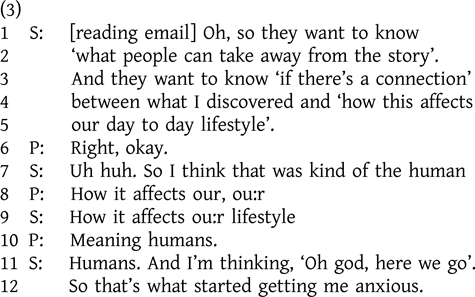
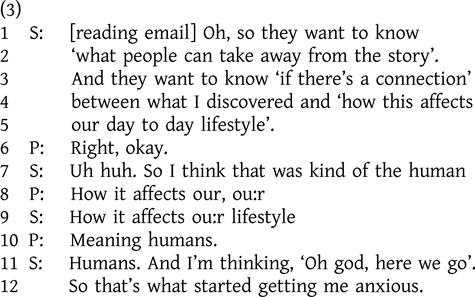
Here, Sophie is not narrating a past experience of ridicule, but a past experience of attempting to prevent it. The anthropomorphism in the reporters’ questions, “how this affects our day to day lifestyle” (lines 4–5), is enough to raise her suspicions about their motives. She keys their anthropomorphism in line 7 by mentioning the focus on humans, “that was kind of the human”, and our repetitions of elongated vowels in the first-person plural possessive pronoun “our” in lines 8 and 9 further emphasize the human-focus, “How it affects ou:r lifestyle” (line 9).
She takes a critical stance in lines 11–12 by voicing the anxiety of the past Sophie, “And I'm thinking, ‘Oh god, here we go’” (line 11), and then by addressing me in the here-and-now, “So that's what started getting me anxious”. She aligns with me as a stance subject in the interactional triangle that is formed.
The taboo against anthropomorphism has a long history in the biological sciences and is codified in science education through textbooks and instructional practice (Lockwood Reference Lockwood, Fox and Mickley1986; Zohar & Ginossar Reference Zohar and Ginossar1998). As a result, biologists who study the animal world have a professional aversion to it. So, an anthropomorphic joke about insects that for others might seem like harmless fun can be face threatening for a biologist, constituting a serious transgression of professional norms. It indexes ridicule here, in part, because it seems to position Sophie as a subject who is anthropomorphizing the insects in her own study, a depiction that contradicts a foundational tenet of her research community.
As she narrates her attempts to prevent ridicule, Sophie implicitly challenges reporters’ entitlement. In both fragments they have presumed their right to joke about the research. Since the anthropomorphic sex joke is a cliché of news reporting on insect mating research, there seems to be no professional journalistic norm preventing it. However, Sophie challenges their right to joke, even resisting anthropomorphic lines of questioning that might lead to a joke. Sophie's entitlement challenge makes explicit the clash between the norms of news reporting and the biological sciences. By challenging reporters’ right to joke about her research, she raises questions about who, if anyone, has the right to joke about science, and under what circumstances.
Rapport
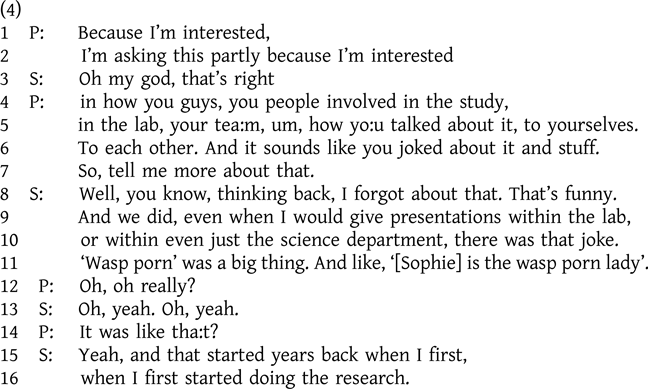
Having discussed the ridicule she experienced in the news and her attempts to prevent it, Sophie and I turned our attention to the lab. Earlier in the conversation, she had mentioned that there was a lot of joking in the lab. I asked her to elaborate.
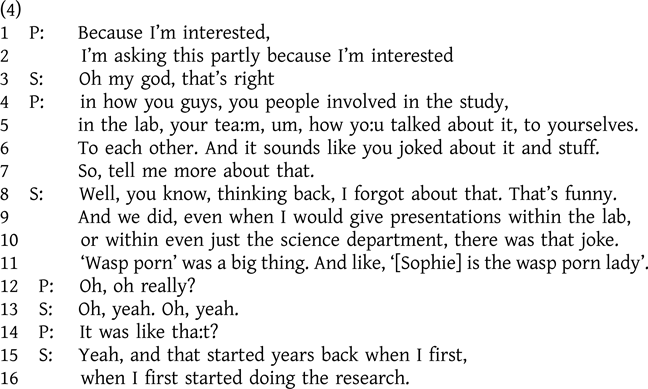
As she elaborates on the humor in the lab, it becomes clear that it revolves around the same anthropomorphic sex joke that troubled her in the news. Like the news situation, the story about the lab is what Carranza calls a ‘low-narrativity’ narrative, portraying not a particular past event but the general, ongoing conditions of a larger world. As I ask Sophie to elaborate, for instance, I propose some candidate characters for the story, all of which are collective or generic: “you guys, you people involved in the study, in the lab, your tea:m” (lines 4–5). Sophie continues in this vein, narrating a series of repeated, habitual, and hypothetical events that take place in generic places. In lines 9–11, for instance, she tells the story not of a particular presentation, but of a general pattern of repeated, habitual, and hypothetical events, not at a particular place and time, but across multiple places and times: “when I would give presentations within the lab, or within even just the science department, there was that joke. ‘Wasp porn’ was a big thing”. Depicting the general conditions of the lab situation, the low-narrativity narrative helps her establish that it was a running joke, routine and well-known to many.
The narrated stance triangle here positions the past-Sophie and her scientific peers as subjects who take a playful stance toward the stance object, her research—“‘Wasp porn’ was a big thing”—and toward her, as a researcher—“And like, ‘[Sophie] is the wasp porn lady’”. She is telling a story about how she and her peers adopted a playful stance toward her research in order to align with one another. The joke that indexed ridicule in the news indexes rapport here in the lab. I signal this contradiction in line 12 by enacting surprise and asking for confirmation, “Oh, oh really?”, and she confirms, “Oh, yeah. Oh, yeah.” (line 13). And then I both perform and invite an evaluation by elongating the vowel in the demonstrative “tha:t” in line 14, “It was like tha:t?”.
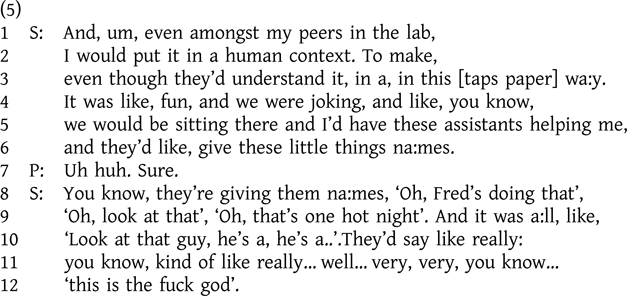
We then begin to discuss the contradiction more explicitly. In the following fragment, she puts her low-narrativity narrative in the service of an argument.
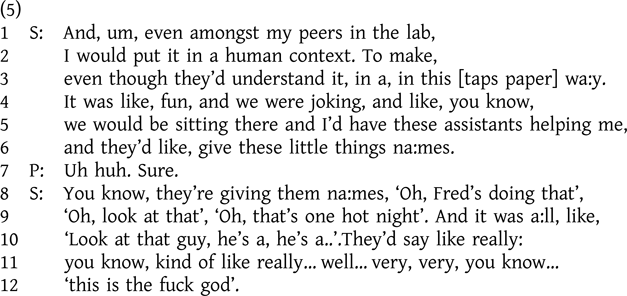
In lines 1–4, she explains how she anthropomorphized the wasps in the lab. She uses a stance adverb, “even” to signal the implicit contradiction with the news: “And, um, even amongst my peers in the lab, I would put it in a human context” (line 1–2). Then she provides a justification for telling the joke in the lab by pointing to the shared prior texts of the participants. In line 3, she taps her finger on the printed copy of her scientific journal article, sitting on the table in front of us during the interview, saying, “even though they'd understand it, in a, in this [taps paper] wa:y”. This deictic term and gesture index both her particular experiments and the larger prior literature and shared knowledge of the field.
In the interactional stance triangle that emerges, Sophie approves of this set of narrated stance relationships (research-Sophiep-peers), bidding for an alignment with me. As she says in line 4, “It was like, fun, and we were joking”. She approves of the joke in the lab because it indexes rapport, providing an opportunity for colleagues to share a laugh. In the lab it is funny not just in sophomoric ways, but also because it represents a performative violation of the taboo against anthropomorphism in the biological sciences. The violation contributes to the experience of rapport by indexing shared knowledge exclusive to the research community.
There are other factors that contribute to the indexing of rapport in the lab and ridicule in the news. The joking in the lab is not public or published, unlike the joke in the news. It is relatively private and ephemeral, enacted in a series of informal, undocumented conversations and asides that take place over many months and years among a small group of colleagues in one particular lab. And a number of her peers in the lab were female. The audience of onlookers, therefore, is small, proximal, familiar, and homogeneous. Scientific insiders customarily joke with one another about science in unpublished contexts, like informal talk (Mulkay & Gilbert Reference Mulkay and Nigel Gilbert1982; Gilbert & Mulkay Reference Gilbert and Mulkay1984). Sophie's lab situation is this kind of context.
As she narrates her experience of rapport-building in the lab, Sophie presumes her own right, and the rights of her colleagues, to joke about her research. Because she challenged reporters’ rights to make the same joke that she and her colleagues make in the lab, however, her otherwise tacit entitlement is implicitly challenged. She responds by providing an argument about the shared prior text of her and her peers. They have the right to make the joke because of their firstness; they are the ones conducting the research and the ones who understand it.
Conclusions
Whatever the intentions of a given speaker or writer, or form of a given text or utterance, the meaning of a joke and right to tell it are always matters of negotiation and interpretation. While it is a truism that the meaning of a joke depends on the situation, the shape of situations is not given or fixed. This study calls attention to the ways our experience of situations shapes and is shaped by discourse, how the shape of a situation is, in Silverstein's terms ‘projected from the radial perspective of the interactional here-and-now’. This projection is particularly conspicuous in cases of published jokes which take place in what Bazerman calls a ‘literate situation’, where communication is distant and asynchronous. Through storytelling, stance-taking, and entitlement challenges, the scientist in this study projected the macro-social situations of the news and lab from the vantage of the particular micro-social circumstances of the interview, negotiating her professional scientific identity and giving shape to the social spaces where it operates. Her representations of macro-social situations are themselves not simple reflections of the context, but are shaped by her expectations, themselves shaped by prior texts and discourses.
This study demonstrates how the meaning of a joke varies, even for a single participant, and provides evidence that rapport and ridicule are part of humor's indexical field, two opposing social meanings, among many others, that can be activated by an instance of humor. Rather than a zero-sum game over humor's true meaning or a sweeping generalization about context-dependency, indexicality helps to explain the situational dependency of meaning. It shows that the meanings and purposes of humor do not inhere in jokes, and joking rights do not inhere in people; they are activated in interaction. Billig points out that ‘one person's harmless bit of teasing will be another's cruelty’ (Billig Reference Billig2005:8). We might add that one person's harmless bit of teasing in one situation can be their cruelty in another, and that narrative, stance-taking, and entitlement can help to shape their experience of those situations.
By examining indexical aspects of ridicule, the study calls into question the fixed-meaning ‘nice-guy’ theory that positions scientific humor as a rapport-building instrument of public education. Though its intention may be benevolent, a joke about science can index different social meanings and entitlements for particular reporters, scientists, and auditors, among others. The indeterminacy is a particular challenge in literate situations, where it is difficult to know how each reader experiences a published text. The meanings and entitlements cannot all be inferred from the design of published text artifacts or from an investigator's conventional understanding of a situation. Interview data provides a way to study the variation in meaning-making that is happening in the silences.

 Open access

