


Introduction
Depression is a common mental disorder with the highest prevalence in Europe reaching 11.32% lifetime, and 10.3% in the Spanish population [Reference Gutiérrez-Rojas, Porras-Segovia, Dunne, Andrade-González and Cervilla1]. While Major Depressive Disorder (MDD) has been often considered as a transient condition, epidemiological data suggest that more than 30% of depressed individuals do not achieve remission following antidepressant treatment [Reference McAllister-Williams2, Reference Rush, Aaronson, Demyttenaere and Aust3]. In addition, MDD is a risk factor for suicide with a relative risk exceeding 7.6 compared to general population [Reference Moitra, Santomauro, Degenhardt, Collins, Whiteford and Vos4], especially in individuals suffering from treatment-resistant depression (TRD) [Reference Reutfors, Andersson, Tanskanen, DiBernardo, Li and Brandt5]. Despite the lack of consensus, the European Medicines Agency and the US Food and Drug Administration defined TRD in patients failing to achieve response to at least two antidepressant trials of different classes despite adequate dose, duration and adherence to treatment [Reference McIntyre, Alsuwaidan, Baune, Berk, Demyttenaere and Goldberg6]. Patients with TRD show lower quality of life, as well as increased work disability and utilization of health resources.
The clinical guidelines offer a range of recommendations for the treatment of TRD, including psychotherapeutic approaches, pharmacological alternatives, and especially the combination of both. Treatments currently available have limited effectiveness and clinical response is often delayed. Intranasal esketamine (Spravato®), a new antidepressant treatment increases response rates in patients with a TRD [Reference Mahase7]. In 2022, the Spanish Agency for Medicines and Health Products (AEMPS) authorized esketamine in combination with an oral antidepressant drug for the treatment of TRD in adults who did not respond to at least two different antidepressant treatments [8].
Trials have evidenced rapid efficacy of esketamine as an augmentation treatment for major depression [Reference Papakostas, Salloum, Hock, Jha, Murrough and Mathew9, Reference Zheng, Cai, Xiang, Zheng, Jiang and Sim10], and also as a treatment for TRD [Reference Calder, Kwan, Teopiz, Wong, Rosenblat and Mansur11]. In particular, the results of a prior real-world Italian study supported the safety and tolerability of the treatment [Reference Martinotti, Vita, Fagiolini, Maina, Bertolino and Dell’Osso12], and showed a response rate of 76% at 6 months to follow-up [Reference Rosso, d’Andrea, Barlati, Di Nicola, Andriola and Marcatili13]. Furthermore, esketamine showed effectiveness in various patients subsamples, including individuals with bipolar TRD [Reference Martinotti, Dell’Osso, Di Lorenzo, Maina, Bertolino and Clerici14] and in those with comorbid substance use disorders [Reference Chiappini, d’Andrea, De Filippis, Di Nicola, Andriola and Bassetti15]. The combination of esketamine with vortioxetine was linked with an increased reduction of emotional blunting and better tolerance as compared with other antidepressant augmentation strategies [Reference d’Andrea, Miuli, Pettorruso, Cavallotto, Marrangone and Cocco16]. Younger age, being employed and low number of prior antidepressant trials were identified as predictors of response and remission over one month [Reference Turkoz, Nelson, Wilkinson, Borentain, Macaluso and Trivedi17]. However, its therapeutic effect and long-term safety need to be further investigated.
While the response to antidepressants is measured through the Montgomery-Åsberg Depression Rating Scale (MADRS) in research [Reference Papakostas, Salloum, Hock, Jha, Murrough and Mathew9, Reference Borentain, Gogate, Williamson, Carmody, Trivedi and Jamieson18], clinical changes in patients receiving treatment for TRD in routine care are easy to investigate using the Clinical Global Impressions-Severity (CGI-S) that assesses severity at the time of the evaluation, and using the Clinical Global Impressions-Improvement scales (CGI-I) which investigates the evolution of the severity since last visit [Reference Morrens, Mathews, Popova, Borentain, Rive and Gonzalez Martin Moro19].
Hence, in this real-world naturalistic cohort study we aimed at evaluating the factors associated with achieving remission during esketamine augmentation treatment measured through the CGI-S and through the CGI-I. We also assessed the factors associated with the premature interruption of treatment in patients with TRD.
Materials and methods
Setting and design
This observational study was carried out across four psychiatry departments: Rey Juan Carlos University Hospital, Fundación Jiménez Díaz, Infanta Elena Hospital, and General University Hospital of Villalba. All of them are part of Spain’s National Health Services and affiliated with the Fundación Jiménez Díaz. The study was approved by the Hospital Fundación Jiménez Díaz Ethics Committee (CEIm-FJD) on 18th March 2024, and patients’ information was handled as stated in Spanish and European regulations on data protection and patients’ digital rights. All the participants provided written informed consent before entering the study.
Sample
The patients aged 18 years and older were included in the analysis if they filled the European Medicine Agency’s criteria for a diagnosis of TRD – i.e failure to achieve response to at least two prior antidepressant trials despite adequate dose, duration and adherence to treatment – [Reference McIntyre, Alsuwaidan, Baune, Berk, Demyttenaere and Goldberg6, 20], and if they received esketamine as an augmentation treatment for TRD. The use of esketamine in routine care started in January 2023 in the four centres. Patients with a TRD were proposed intranasal administration of flexible doses of esketamine (28 mg, 56 mg or 84 mg/administration) according to clinical judgment for augmenting antidepressant treatment according to the following sequences:
-
- Standard esketamine protocol including an induction phase (2 administrations per week for 4 weeks, 8 in total), and a maintenance phase (1 administration per week for 5–8 weeks, 5–8 in total).
-
- Treatment continuation (1 weekly administration or every 2 weeks) according to clinician’s judgment and patient’s choice.
All the patients received concomitant standard clinical care for TRD involving at least one antidepressant (Selective Serotonin Reuptake Inhibitor/ Serotonine-Norepinephrine Reuptake Inhibitor or other antidepressant), and eventual psychotherapy as recommanded [Reference McIntyre, Alsuwaidan, Baune, Berk, Demyttenaere and Goldberg6]. Current antidepressant medication was unchanged at esketamine initiation.
The routine sociodemographic and clinical data from 75 patients recorded in the electronic medical records at baseline and after each esketamine administration were anonymized and extracted in compliance with Spanish laws on the Protection of Personal Data.
Variables and measures
The following information was drawn from structured fields in electronic health records: baseline sociodemographic data, psychiatric diagnosis, comorbidities and depression subtype according to the International Statistical Classification of Diseases and Related Health Problems 10th (ICD-10) criteria (single episode (F32.x), or recurrent depressive disorder (F33.x)). After each esketamine administration, clinicians assessed the occurrence of suicidal ideation and attempts, treatment dosage, and the CGI level. The occurrence of dissociative symptoms, headache, hypertension, anxiety and drowsiness were systematically assessed after treatment intake. The CGI-S scale includes items concerning psychosocial aspects, behavior, symptoms and the impact of depression on daily life. It allows to establish different levels of disease based on the physician’s clinical experience. The CGI-I is measured by comparing the patient’s baseline symptom severity with its state following treatment administration. According to Morrens et al (2022), remission was defined in patients with a decrease of ≥2 points from the baseline CGI-S value or a CGI-S score of ≤3 points over the follow-up (from slightly depressed to normal) [Reference Morrens, Mathews, Popova, Borentain, Rive and Gonzalez Martin Moro19].
During the last visit of the follow-up, physicians assessed the general clinical improvement. All the data were retrieved from the electronic health records (HER).
Statistical analysis
All statistical analyses were performed using the Statistical Package for the Social Sciences (SPSS) version 29. First, we provided descriptive statistics of the whole population and performed univariate analyses to compare the clinical characteristics of patients receiving esketamine according to the occurrence of remission and premature interruption of treatment. The univariate analyses were performed using F-exact test, chi-square, or ANOVA.
Then we used logistic regression models to assess the multivariate relationship between the outcomes (the occurrence of remission and premature interruption of treatment), and the clinical factors associated in the univariate analysis with p < 0.1. Overall, the significance level was set at p < 0.05, using 2-sided tests and 95% confidence intervals.
Results
Baseline characteristics of the sample
Out of the 75 candidate patients screened for esketamine, 65 initiated the treatment and were evaluated through the CGI measures over the standard protocol. Out of them, 45 patients (69.2%) completed the standard protocol (i.e., received esketamine at least during the induction and the 5 weeks maintenance phases). The median number of esketamine administrations per subject was 19. The mean esketamine dosage was 66.04 mg [SD = 15.39] per administration in the patient sample. The Figure 1 shows the study flow chart.
Flow chart.

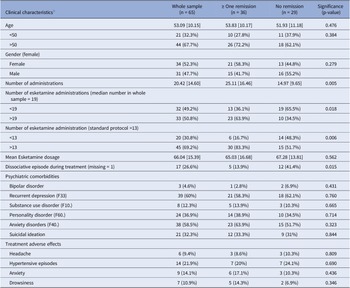
The baseline clinical characteristics of the patients are reported in Table 1. The mean age of the sample was 53.09 [SD = 10.15] and 52.3% of the patients were females (N = 34). The mean number of esketamine administrations was 20.42 [SD = 14.60]. Overall, 4.6% of the patients were diagnosed with bipolar disorder, 60% had recurrent depressive disorder, 12.3% were diagnosed with comorbid substance use disorder, 36.9% with a comorbid personality disorder, and 58.5% with a comorbid anxiety disorder. Over the follow-up, 32.3% reported suicidal ideation. In terms of esketamine-related adverse effects, 26.6% of patients experienced a dissociative episode, 9.4% reported headaches, 21.9% had hypertensive episodes, and 10.9% experienced drowsiness.
Occurrence of remission recorded with CGI-S over the follow-up according to the clinical characteristics at baseline and to the number of treatment administration a

a Remission is defined according to Morrens Criteria: CGI-S < 4 or CGI-S decrease ≥2 from baseline.
b Data are means [Standard Deviation], or number (%).
Factors associated with achieving remission
Remission was assessed using CGI-S measurement and defined according to Morrens’ criteria at each clinical visit. Out of the whole sample, 36 (55%) of the patients achieved remission over the follow-up. Overall remission rates elevated to 67% in those who completed the standard protocol, and to 70% in those having received more than 19 esketamine administrations, (i.e., the median number; Figure 1). Figure 2A shows the clinical improvement according to the CGI-I scale over the follow-up.
(A) Clinical improvement measured through the CGI-I scale over the follow-up. (B) Clinical improvement measured through the CGI-I scale over the follow-up according to the occurrence of dissociative symptoms subsequently to esketamine intake.

The occurrence of remission measured during follow-up was significantly associated with a higher mean number of esketamine administration (25.11 [SD = 16.46] vs 14.97 [SD = 9.65] in patients remitted and not remitted respectively, p = 0.005); with completing the standard esketamine protocol (30 (83.3%) vs 15 (51.7%) in patients remitted and not remitted respectively, p = 0.006); with a number of administration greater than 19 (23 (63.9%) vs 10 (34.5%) in patients remitted and not remitted respectively, p = 0.018); and was less frequent when dissociative symptoms occurred during esketamine administration (5 (13.9%) vs 12 (41.4%) in patients remitted and not remitted respectively, p = 0.015). The results are shown in Table 1. Figure 2B highlights clinical improvement measured through the CGI-I scale over the follow-up according to the occurrence of dissociative symptoms subsequently to esketamine intake.
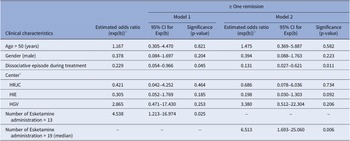
In the multivariate analysis taking into account possible confounding factors, the occurrence of remission over the follow-up was associated with the absence of dissociative symptoms during esketamine administration, and with completing the standard esketamine protocol (OR = 0.229 95%CI [0.054–0.966], p = 0.045; and OR = 4.538 95%CI [1.213–16.974], p = 0.025 in model 1, respectively). The results are shown in Table 2. In model 2, receiving more than 19 esketamine administrations was associated with remission over the follow-up (OR = 6.513 95%CI [1.693–25.060], p = 0.006).
Occurrence of remission over the follow-up according to the clinical characteristics and to the number of esketamine administration a

a Data are means [Standard Deviation], or number (%).
b The association between the clinical characteristics and treatment patterns, and the overall improvement of depression was tested in a logistic regression model. We included Age, gender and center in both models 1 & 2.
c HRJC: Rey Juan Carlos University Hospital; HIE: Infanta Elena Hospital; HGV: General University Hospital of Villalba.
Factors associated with the number of esketamine administrations
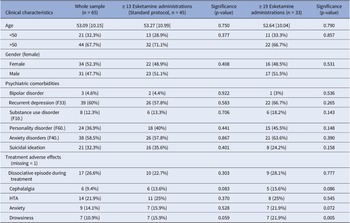
During the treatment course, 20 patients (30.8%) discontinued esketamine before completing the standard protocol (induction and maintenance phases), while 33 patients (50.8%) received more than the median of 19 treatments. In the univariate analysis, drowsiness following esketamine administration was the only factor significantly associated with receiving more than 19 treatments (drowsiness occurred in 21.9% of patients (n = 7) who received more than 19 administrations compared to 0% in those who received fewer than 19, p = 0.005). The results are detailed in Table 3.
Quantities of esketamine intake according to the clinical characteristics at baseline and to the adverse effects of treatment a

a Data are means [Standard Deviation], or number (%).
In the multivariate analysis taking into account possible confounding factors, this association did not remain significant. Results are not shown.
Discussion
In this naturalistic retrospective study, most of the patients with TRD receiving esketamine showed remission over the course of the treatment. Remission rates were positively associated with the number of esketamine administrations and with the absence of dissociative symptoms recorded over the follow-up. Receiving more than 19 administrations increased overall chances of remission. Finally, no clinical factors predicted the total quantity of esketamine received.
Factors associated with esketamine efficacy
Although the placebo controlled Transform 1 clinical trial and the Transform 3 study in older adults failed to show significant effect of esketamine nasal spray as an add-on treatment of TRD [Reference Fedgchin, Trivedi, Daly, Melkote, Lane and Lim21], Popova et al. (2019) reported efficacy of flexible doses of esketamine against placebo measured through the MADRS score at 4 weeks [Reference Popova, Daly, Trivedi, Cooper, Lane and Lim22]. Doses varied between 56 and 84 mg. Esketamine effect was predominant in clinical subgroups including females, patients aged between 45 and 64 years, or prior treatment failures ≥3 [Reference Popova, Daly, Trivedi, Cooper, Lane and Lim22]. Similarly, esketamine was more effective in patients with ≥3 prior antidepressant failures in the Transform 1 trial [Reference Fedgchin, Trivedi, Daly, Melkote, Lane and Lim21]. Ochs-Ross et al. (2020) reported a significant difference in patients aged between 65 and 74, while not in those aged 75 and over [Reference Ochs-Ross, Daly, Zhang, Lane, Lim and Morrison23].
In our study, the overall remission rate was related with the number of esketamine administrations. While expending the length of esketamine treatment may be associated with higher rates of patients showing remission, longer follow-up may increase chances to observe natural remission of depressive symptoms. Further comparative studies should be conducted to confirm the specific effect of extending esketamine administration upon achieving remission in patients who failed to improve during induction and maintenance phases. Moreover, from the 36 patients who achieved remission over the follow-up, 9 (25%) filled remission criteria at the final evaluation. Hence, maintaining remission remains challenging in individuals with TRD, although other studies showed higher rates of remission maintenance at study endpoints [Reference Zaki, Chen, Lane, Doherty, Drevets and Morrison24, Reference Daly, Trivedi, Janik, Li, Zhang and Li25]. Other therapeutic strategies involving non-invasive brain stimultation protocols were suggested to help prevent depression relapse [Reference d’Andrea, Mancusi, Santovito, Marrangone, Martino and Santorelli26]. Hence, their efficacy in maintaining remission may be tested whether in combination, or as comparator to esketamine in TRD [Reference Pettorruso, d’Andrea, Carlo, Risio, Zoratto and Miuli27].
In addition, we reported that remission rate was inversely associated with the frequency of dissociative symptoms. A prior systematic review suggested an absence of association between dissociation and antidepressant outcomes in the patients treated with esketamine [Reference Grabski, Borissova, Marsh, Morgan and Curran28]. Subsequent post-hoc analyses found no relationship between dissociation scores measured with the Clinician Administered Dissociative States Scale (CADSS) and the effect of esketamine in patients with TRD [Reference Chen, Chen, Zhang, Li, Lane and Lim29, Reference Mathai, Nayak, Yaden and Garcia-Romeu30]. In a recent study, the intensity of dissociative symptoms explained the antidepressant effect only within the 24 hours subsequent to the administration [Reference Echegaray, Mello, Magnavita, Leal, Correia-Melo and Jesus-Nunes31], while this effect occurred within a specific range of CADSS level [Reference Echegaray, Mello, Magnavita, Leal, Correia-Melo and Jesus-Nunes31]. Those diverging results may relate to different methodologies regarding dissociation assessment, as in our study the occurrence of dissociative symptoms were recorded according to ICD-10 criteria. Furthermore, the intensity of the dissociative symptoms was not quantified, which prevented us to investigate its relationship with the antidepressant response.
Also, we found no significant relationship between the remission rate and sociodemographic factors including age and gender, although individuals aged over 50 and females tended to be more represented in patients showing remission. The lack of association may be due to limited statistical power.
Factors associated with completing standard protocol
In our study, 69% of the patients finalized the standard esketamine protocol. Discontinuation rates appear higher than in prior controlled randomized trials [Reference Zheng, Cai, Xiang, Zheng, Jiang and Sim10]. As esketamine intake was proposed as part of routine care, it is likely that the administration protocol may have been applied with increased flexibility. No factors predicted the overall quantities of esketamine administered.
Interestingly, treatment adverse effects were not related with discontinuation rates over the follow-up, which confirms the general favorable tolerability profile reported in prior studies [Reference Vasiliu32]. The most frequent adverse event reported in our real-world study was the occurrence of dissociative symptoms (27%). This is in accordance with rates of dissociative symptoms reported by Popova [Reference d’Andrea, Miuli, Pettorruso, Cavallotto, Marrangone and Cocco16], that reached 26% in the active treatment group [Reference Popova, Daly, Trivedi, Cooper, Lane and Lim22].
Limitations and strengths of the study
This study reflects the real-world use of esketamine as an adjunctive treatment for TRD in psychiatric clinics, hence it is limited by several factors. First, although we assessed the remission of depression through Morrens’ criteria involving the measure of CGI-S score [Reference Morrens, Mathews, Popova, Borentain, Rive and Gonzalez Martin Moro19], our results should be confirmed with other scales such as the MADRS which has been widely validated in depression treatment trials [Reference Borentain, Gogate, Williamson, Carmody, Trivedi and Jamieson18]. Second, our study lacked control group. Further comparative studies may help confirm the specific effect of esketamine treatment length upon the remission rates, against the natural evolution of the disease. Nevertheless, as our study was conducted in individuals bearing TRD, depression is unlikely to show spontaneous remission at short or mid-term in our sample. Also, the size of the sample with complete data remains limited as some variables (such as CGI) were not systematically collected by clinicians at all time points. In fact, the post hoc power analysis on the sample size of 65 patients showed a statistical power of 67.7% related to CGI scores. Moreover, interobserver differences may have skewed the results within each psychiatric centres or between hospitals. However, we found no centre effects when performing multivariate analysis. Finally, this study is retrospective with an open label design, and data were retrieved from clinical records. This prevented us from further comparison with other standardized protocols. This also limited the possibility to control results for a wider range of potential confounding factors as they were not all systematically recorded in patient files. While the patients included in the analysis responded to TRD criteria as defined by the European Medicine Agency (that is failure to achieve response to at least two prior antidepressant trials of different classes despite adequate dose, duration and adherence), the exhaustive list of prior administered treatments was not collected in the current study. Hence, we were not able to investigate the impact of the number of prior treatment failure on the patients’ outcomes. Nevertheless, prior real-world studies failed to evidence any effect of the number of antidepressant trials lifetime [Reference Martinotti, Vita, Fagiolini, Maina, Bertolino and Dell’Osso12], nor effects of the number of concomitant antidepressant medication [Reference Estrade, Petit, Sylvestre, Danon, Leroy and Perrain33].
Conversely, our study has several strengths. This is a naturalistic study reflecting real daily clinical practice. Hence, the results are more generalizable since the patient sample was less strictly selected, especially regarding the existence of psychiatric comorbidities. Furthermore, the use of CGI-S as outcome reflects clinical practice due to its large utilization by clinicians. In addition, remission criteria based on CGI-S have been previously validated [Reference Morrens, Mathews, Popova, Borentain, Rive and Gonzalez Martin Moro19].
Conclusions
This real-world naturalistic study suggests that adjunctive treatment with intranasal esketamine may be beneficial for most patients with TRD. Our results suggest that the length of esketamine treatment may predict remission rates in TRD. Especially, extending the numbers of esketamine administration may increase the chances to obtain remission. This results should be confirmed in further comparative studies assessing the natural evolution of depression. Furthermore, we found that the adverse effects measured did not significantly impact the treatment course. Hence, the use of esketamine appears well tolerated in routine clinical care with overall favorable outcomes. Those outcomes may be easily assessed through evaluation tools widely used in psychiatric practice. Further naturalistic studies are needed to evaluate esketamine utilization in long term.
Data availability statement
Data will be made available upon request.
Acknowledgements
We are very grateful to Rosa Nunes for helping drafting and formatting the manuscript.
Memind Group: María Luisa Barrigón, Jorge Lopez-Castroman, Phillippe Courtet, Antonio Artés-Rodriguez, Enrique Baca-Garcia, Fuensanta Aroca Bisquert, Ana De Granda-Beltrán, José Luis Palomo, Elizabeth Madridejos, Lucía Albarracín García, Carmen Aguilar Castillo, Laura Jiménez-Muñoz, Sofía Abascal-Peiró, Ana Pérez-Balaguer.
Financial support
This research was supported by CIBER -Consorcio Centro de Investigación Biomédica en Red- (CB/07/09/0025), the Instituto de Salud Carlos III with the support of the European Regional Development Fund (ISCIII JR22/ 00011; ISCIII PI23/00614), by Ministerio de Ciencia e Innovación/a Agencia Estatal de Investigación MCIN/AEI/10.13039/501100011033 and “NextGenerationEU”/PRTR (TED2021-131120B-I00), by Fundació La Marató de TV3 (202226–31) and by CaixaResearch Health 2023 HR23–00421.
CRediT taxonomy for contributors
Dr Conejero and Pr Baca-Garcia had full access to the data and take responsibility for the integrity of the data and the accuracy of the data analysis.
Conceptualization: Ismael Conejero, Raquel Alvarez García, Alejandro Porras-Segovia, Ana María De Granda Beltrán, Sergio Benavente López, Ezequiel Di Stasio, Jorge Lopez-Castroman, Philippe Courtet, Enrique Baca-Garcia.
Data curation: Lucía Albarracín-García, Raquel Alvarez García, Alejandro Porras-Segovia, Ana María De Granda Beltrán, Sergio Benavente López, Ezequiel Di Stasio.
Funing acquisition: Enrique Baca-Garcia.
Investigation: Raquel Alvarez García, Alejandro Porras-Segovia, Ana María De Granda Beltrán, Sergio Benavente López, Ezequiel Di Stasio.
Formal Analysis: Ismael Conejero, Alejandro Porras-Segovia.
Methodology: Ismael Conejero, Alejandro Porras-Segovia, Jorge Lopez-Castroman, Philippe Courtet, Enrique Baca-Garcia,
Supervision: Enrique Baca-Garcia.
Writing-Original Draft: Ismael Conejero, Alejandro Porras-Segovia.
Writing- review & editing: Alejandro Porras-Segovia, Jorge Lopez-Castroman, Philippe Courtet, Ismael Conejero, Enrique Baca-Garcia.
Competing interests
Enrique Baca-Garcia has been a consultant to or has received honoraria or grants from Janssen Cilag, Lundbeck, Otsuka, Pziffer, Servier and Sanoffi. Enrique Baca-Garcia is the founder of eB2. Enrique Baca-Garcia has designed the MEmind application.



 Open access


Comments
No Comments have been published for this article.