

The link between public confidence and good judicial behaviour is widely assumed and frequently expressed by the legal profession. The Canadian Judicial Council (CJC), which is responsible for ensuring the proper conduct of federally appointed judges, explains in its Ethical Principles for Judges that “the independence and integrity of the judiciary preserves public confidence in the rule of law and acceptance of court decisions. Unethical conduct by judges erodes that confidence. Thus, judges share a collective responsibility to promote and observe high standards of conduct” (Canadian Judicial Council, 2021: 16). Ethical lapses (perceived or real) in behaviour by any political actor can have profound effects on the public’s trust. For courts especially, institutional support for judges is a fundamental source of their political authority (Caldeira and Gibson, Reference Caldeira and Gibson1992). Without a democratic mandate derived from popular election, courts must rely on a strong public perception of legitimacy to ensure acceptance of and compliance with rulings. Existing studies show that scandal can damage executives’ and legislators’ reputations and electoral success (Basinger, Reference Basinger2019; Doherty et al., Reference Doherty, Dowling and Miller2011; Pereira Filho et al., Reference Pereira Filho, Stephenson and Turgeon2024). Less is known, however, about the effects of allegations of personal misconduct by judges and whether they affect a judge’s reputation and, more importantly, whether episodes of scandal may affect the institutional support of the courts themselves.
Whereas one established metric for the survival of a scandal is party support (Rottinghaus, Reference Rottinghaus2014; Shear, Reference Shear2011), Supreme Court judges do not have the same immediate benefits of partisanship. There is a small existing literature on judges and political scandal in the United States, which can be drawn from for thinking through the potential effects of allegations of personal misconduct. To the extent that scandals matter for Supreme Court judges, at least in the United States, it is at the time of appointment when past misconduct is most likely to be made public (Rottinghaus, Reference Rottinghaus2014; Shipan and Shannon, Reference Shipan and Shannon2003; Whittington, Reference Whittington2006). For example, in their analysis of Justice Brett Kavanaugh’s nomination to the U.S. Supreme Court following allegations of sexual misconduct, Carrington and French (Reference Carrington and French2021) find appointing a nominee who behaves in an overtly political manner during their confirmation hearings can significantly and meaningfully affect the institutional support afforded to the court. In another U.S. study, Boston et al. (Reference Boston, Kassow, Masood and Miller2023) use an experimental approach to test the effects of judicial scandal and find that they diminish public support for individual judges, but find no evidence that scandals undermine support for judicial decisions or diffuse support (i.e., legitimacy) for the courts. Accordingly, there is reason to anticipate that episodes of scandal may impact the individual public support of affected judges, and possibly institutional support for the courts. However, to our knowledge there have been no studies outside of the United States that test the comparative generalizability of these findings.
The departure of Justice Russell Brown from the Supreme Court of Canada (SCC) in June 2023 is a high-profile case that offers us the opportunity to consider these questions. We leverage a natural survey experiment conducted before and after Justice Brown’s retirement from the bench to consider what impact the alleged conduct by Justice Brown and the ensuing investigation by the CJC may have had on public attitudes toward the SCC. As part of a larger nationally representative survey on judicial legitimacy, we asked respondents in May of 2023 (pre-departure) about how they perceived the optics of the event surrounding Justice Brown as it related to the Court and Justice Brown himself. In November of 2023 (post-departure), we asked the same panel of respondents (N = 1,222) their thoughts on the same matters since Justice Brown had retired from the Court. Thus, the key question that drives this research agenda is to what extent does the coverage of alleged personal misconduct by judges erode public confidence?
Our findings show that most respondents thought the optics of the event were worse personally for Justice Brown than they were for the Supreme Court as a whole. We also find that a majority of respondents changed their opinion about the optics of the event for the Court after Justice Brown’s retirement, with a majority of respondents being less concerned about the optics for the Court post-departure. Taken together, these findings suggest that: (1) individuals do perceive even alleged lapses in conduct as harmful to both the individual judge and the court of which the judge is a member; but that, (2) these effects are either short in duration or can be mitigated by action taken by the institution/individual. Taken together, these findings suggest that the Supreme Court of Canada can weather occasional short-term challenges to its standing with minimal or no long-term consequences. For an institution that relies on public support for its legitimacy, this is good news.
The article proceeds in three parts. First, we present the case study of Justice Brown and some of the relevant literature on political scandals. Second, we apply our natural pre/post experimental design to the question of how individuals react to this instance of alleged misconduct and its effects on Justice Brown’s reputation and the Court’s more broadly. Finally, we conclude with observations about how to study the connection between the institutional processes of the courts and the public’s opinion toward judges as a unique class of political actors who are likely held to a higher set of standards than politicians. We consider why this might be and what steps organizations like the CJC may consider in the face of declining institutional trust more broadly.
The Case of Justice Russell Brown
On February 1, 2023, Chief Justice Richard Wagner placed Supreme Court Justice Russell Brown on paid leave and Brown quietly stopped hearing cases (Brionskill, Reference Brionskill2023). Justice Brown remained on leave without comment until March 7, when the Canadian Judicial Council (CJC) made an official statement that it was investigating an undisclosed complaint against him (Canadian Judicial Council, 2023b). The Supreme Court also made an official statement on the same day, acknowledging the CJC’s investigation and confirming that, in accordance with the Judges Act, the Minister of Justice had been notified when Justice Brown was placed on leave (Supreme Court of Canada, 2023b). The following day, Justice Brown made a statement that he was fully cooperating with the investigation but declined to comment further on the issue (Fine, Reference Fine2023b).Footnote 1
On March 9, 2023, the Vancouver Sun broke the story of the complaint lodged against Justice Brown by former U.S. Marine Jon Crump (Mulgrew, Reference Mulgrew2023). It was reported that on January 28, 2023 Justice Brown befriended a group of strangers following a ceremony honouring former Supreme Court justice, Louise Arbour, with the Sandra Day O’Connor Justice Prize. According to Crump, Justice Brown followed this group to their rooms and made the women in the group uncomfortable. This provoked Crump who allegedly physically assaulted Justice Brown. According to Justice Brown, Crump assaulted him without provocation, by punching him several times in the head (McCarten, Reference McCarten2023; Mulgrew, Reference Mulgrew2023). While the police investigated this incident without laying any charges, Crump filed a complaint against Justice Brown with the CJC on January 29 (Dawson, Reference Dawson2023).
Justice Brown’s attorneys released a statement on March 10 that confirmed his attendance at the banquet in Arizona while maintaining his innocence regarding the alleged misconduct (Dawson, Reference Dawson2023; Mulgrew, Reference Mulgrew2023). Crump continued to conduct media interviews in March, and his police interview and witness statements were released (Fine, Reference Fine2023b). On March 30, the CJC announced that the issue was being referred to a Judicial Conduct Review Panel, with a hearing set for June 13 (Canadian Judicial Council, 2023b).
While maintaining his innocence, on the eve of the CJC hearing, Justice Brown retired from the SCC. In a statement from Justice Brown’s attorneys, he expressed that he did not want to go through the lengthy investigation process and put his family through intense public scrutiny (Gover and Heine, Reference Gover and Heine2023). On June 12, the Supreme Court issued a press release and on June 13 Chief Justice Wagner conducted a press conference on Brown’s departure. In both of these communications, the legitimacy of the Supreme Court was emphasized, by focussing on the Court’s ability to function impartially without nine judges (Supreme Court of Canada, 2023a). On the same day, the CJC released a statement that the investigation was closed. Since Justice Brown was no longer a judge, the case now fell outside its jurisdiction (Aiello, Reference Aiello2023; Canadian Judicial Council, 2023b).
How the public viewed Justice Brown’s case while it was being investigated by the CJC is unclear. Certainly, the negative coverage that accompanied the events surrounding Justice Brown’s departure was unprecedented in the modern history of the Court. Even at the lower courts, where more judges serve, stories that call into question the personal conduct of judges are rare (CBC, 2016; Crawford, 2017). While there was little polling done at the time about the public’s opinion regarding the alleged events and ensuing investigation by the CJC, the story did reach audiences through mainstream media coverage. Whether the public is attentive to matters of judges’ behaviour is another issue altogether. One reason why the public’s collective attention may have been—at least passingly—on Justice Brown and the accusations that befell him, is that it amounted to one of the more sensational moments that the country’s highest court has seen in decades. Soroka defines sensational issues as those “that have little observable impact on the vast majority of individuals. They are unobtrusive and concrete, creating the greatest potential for public agenda-setting by the media” (Soroka, Reference Soroka2002: 21–22). The events surrounding Justice Brown fit this definition as the outcomes have little effect on citizens directly, and that it was largely, if not completely media-driven. A political body that generally thrives in a state of little to no attention, this incident drew attention to the Supreme Court and the ethical standards that govern judges.
Like many political events that take on an element of scandal, Justice Brown’s story provoked interest and remained in the news cycle for several weeks. Once the public (and media) learned that he was no longer sitting to hear trials, discourses about the feasibility of Justice Brown returning to active duty on the Court emerged. Several commentators in conservative media observed that the Chief Justice’s desire to improve the optics around the Court may have produced a rush to have Justice Brown retire, lest the Court’s reputation be tarnished (Greenspan and Greenspan, Reference Greenspan and Greenspan2023; National Post View, 2023). This appears different from the prevailing approach to political scandals where politicians may choose to remain in office and ride the attention out (CBC News, 2020).
Justice Brown’s continued absence from the bench, and the specter around an investigation by the CJC, created uncertainty around his status, which in turn likely affected the institutional stability of the Court itself. This uncertainty and instability existed irrespective of the facts of the event involving Justice Brown. Regardless of what actually took place, the fact that a breach of conduct was alleged, can only reasonably be treated as a negative event for the Supreme Court and, of course, Justice Brown. The question is to what extent, if any, this event went beyond affecting perceptions of Justice Brown personally and affected perceptions of the Supreme Court in a negative way.
Hypotheses
Taken together, the events surrounding Justice Brown’s departure and the existing literature point to testable hypotheses about how the public may react to such an event. First, we are interested in whether individuals indeed viewed the event as negative or whether they were unmoved. Here, we measure the degree to which the respondent thought the optics of the event reflected negatively on Justice Brown personally. Separately, we measure the degree to which the respondent thought the optics of the event reflected negatively on the Supreme Court of Canada. The first measures the effect of the scandal on the person (Justice Brown), while the second—separately—measures the effect of the scandal on the institution (the Supreme Court of Canada).
Second, we consider these groups in comparison with one another—specifically, the proportion of respondents who evaluated the event as reflecting more poorly on Justice Brown, the Court, or equally poorly for both the person and the institution. This points to whether the effects of a scandal of this variety are personalized or institutionalised in nature. For ease of interpretation, we call those individuals who think the optics of the event reflected more poorly on Justice Brown as “individual-centred” and those individuals who think the optics of the event reflected more poorly on the Court as “institution-centred.”
Finally, given the two time points of data and the panel nature of our data, we suggest that the intervention—Brown’s retirement in June of 2023—may serve as an institutional mechanism that acts to protect the Supreme Court from the negative perceptions of individual actions. On the other hand, it is possible that an individual could view the departure as having no impact on the Court’s reputation. Therefore, we put forward two sets of hypotheses that focus first on what affects court support and second, what changes pre/post levels of court support.
H1a: (Effect on the person at T1) The more a respondent believes that the optics of the investigation damaged the public’s perceptions of Justice Brown, the less confidence they will have in the Supreme Court of Canada.
H1b: (Effect on the institution at T1) The more a respondent believes that the optics of the investigation damaged the public’s perceptions of the Supreme Court of Canada, the less confidence they will have in the Supreme Court of Canada.Footnote 2
H1c: Those who believed the effects of the investigation were worse for the Supreme Court (the “institution-centred” respondents) are more likely to have lower confidence in the Supreme Court of Canada than those who believed that the effects of the investigation were worse for Justice Brown, personally (the “individual-centred” respondents).
H2a: Changes in support for the Supreme Court of Canada from T1 to T2 are conditional on whether the respondent’s view of the optics toward the Court improved (i.e. became less negative) post-departure.
H2b: Changes in support for the Supreme Court of Canada from T1 to T2 are conditional on whether the respondent’s concern is institution-centered (compared with individual-centred).
To measure court support, we apply a metric that we believe captures short-term support for the Supreme Court of Canada. This measure represents the public’s support for the apex court at any given moment and is prone to some fluctuation based on events surrounding the country’s high court. These fluctuations may be driven by myriad factors including judicial decisions that may be perceived as unpopular or public conflicts involving the judges. This type of support—as suggested above—is malleable to events but is generally expected to return to status quo levels. As the literature on court support in Canada points to a number of socio-demographic and attitudinal variables that may predict changes in court support or variation in perceptions toward judicial legitimacy at the individual level (Crandall and Lawlor, Reference Crandall and Lawlor2022; Hausegger and Riddell, Reference Hausegger and Riddell2004), we expect the effects of each will be moderated by media consumption, knowledge of the courts, subjective political agreement with the courts, and political ideology.
Data and Methodology
Our data come from a two-wave panel survey conducted by Léger Marketing in May (N = 1,911) and November of 2023 (N = 1,222). The survey was available in both French and English. Data are census-weighted for age, gender, and region. Respondents on Léger’s standing panel were asked questions about their support for courts and other political institutions, their perspective on the events surrounding Justice Brown’s retirement, as well various attitudinal and socio-demographic indicators and then matched across the two time points on Léger’s internal identification data.
For our first set of analyses, we measure respondents’ views on the optics of the events surrounding Justice Brown being put on leave and their support for the Court. In the first wave of the survey, we ask two similarly worded questions: “Supreme Court Justice Russell Brown was recently put on leave while an investigation takes place about his alleged role in a physical altercation while on a visit to the United States. To what degree do you think the optics of this investigation damage the public’s perceptions of Justice Russell Brown/the Supreme Court?” (see Online Appendix A for all question wordings—all respondents were asked both questions; question order was randomized). Respondents were permitted to answer on a four point scale ranging from having a strong negative impact to having no negative impact. It was presumed that the event would not generate any responses that would produce a positive effect, so no such option is contemplated in the question wording. In other words, we ask respondents to separate the perceived effects on Justice Brown personally compared with perceptions of the Supreme Court more broadly. We consider these responses separately, but we also provide a comparison of respondents who thought the optics of the event were worse for Justice Brown (“individual-centred” respondents) and those who think the event was worse for the Court (“institution-centred” respondents).
To facilitate the second set of analyses, we introduce data from the second wave of the survey, where we ask the same set of respondents “In June of 2023, Supreme Court Justice Russell Brown stepped down from the Court because of his alleged role in a physical altercation while on a visit to the United States. To what degree do you think the optics of this event damaged the public’s perceptions of the Supreme Court?” We do not ask the same question about perceptions of Justice Brown, as he had retired by this point. From here, we categorize respondents into those who believed the optics of the event became less harmful to the Court post-departure (i.e., Justice Brown’s retirement improved their opinion of the effects of the event—“less negative” in model 2 below) compared with those whose opinion stayed the same (“neutral”) and those whose who thought the optics of the event became worse for the Court (“more negative”). We acknowledge that the intervening period between Justice Brown stepping down and our survey was approximately five months, that coverage of the event was modest, and that the public tends to be less attentive to news cycles over the summer. However, we try to mitigate the likelihood of the respondent forgetting the event, by providing a neutral preamble to the questions in the second wave (see Online Appendix).
Our dependent variable (measured at both time points) is support for the Supreme Court of Canada, measured using the standard Canadian Election Study question wording to capture court support (“How much confidence do you have in the Supreme Court of Canada?”), on a four point scale (ranging from “a great deal” to “none”).Footnote 3 The measure is standardized from 0 to 1. For the second set of analyses, our dependent variable is difference in court support from May to November (standardized from +1 to −1). As suggested above, we expect political ideology, subjective ideological agreement, and media consumption will produce significant effects on opinion toward the Court and perspectives toward the optics of Justice Brown’s departure. We also expect these effects may be moderated by gender, education, knowledge of the courts and region. All variables are summarized in Table 1 of the Supplementary Information File with measures of central tendency and dispersion.
Results
First, we assess our two core explanatory concepts: (1) perceptions toward the optics of Justice Brown’s departure on Brown himself and on the Supreme Court of Canada, and (2) the effect of whether the respondent is individual-centred, institution-centred or neither. While 81% of respondents viewed the optics of the events surrounding Justice Brown being put on leave as negatively influencing their opinion of Justice Brown personally, 69% of respondents answered that this event negatively influenced their opinion of the Supreme Court of Canada. Note that this percentage dropped to 61% of respondents when it was asked in November. However, when we consider that approximately 70% of Canadians in the same survey still reported having either “quite a lot” or “a great deal of” trust in the Supreme Court more generally, this finding suggests that the magnitude of this movement may have been limited. Comparing the two groups, individual-centred respondents account for 28% of our sample, while only 8% were institutional-centred. The remainder, or 64% of respondents, thought the event was equally as bad for the Court as it was for Brown personally.
Our second item of interest is how these attitudes changed over time. Table 1 measures opinion change, showing the crosstabulation of attitudes toward the Supreme Court (not Justice Brown, personally) before (May) and after retirement (November). Public attitudes on the subject remained somewhat stable across the six month period that intervened between the two surveys. A plurality of respondents (44%) kept their opinion the same, while 23% changed their opinion for the worse and 33% changed their opinion for the better. We can speculate on why this might be: first, as we move further away from the events (the breaking of the news media story and the retirement itself), people understandably care less about the issue and are not as likely to take a firm stance on it. However, the effect of the retirement itself is also a plausible reason why opinion improved. It may suggest respondents perceived Justice Brown’s retirement as a response to the negative pressures on the Court, possibly easing concerns about the Court’s optics. Tellingly, when asked in November following Brown’s departure about whether a Supreme Court judge should take a leave of absence while under investigation for misconduct, a full 86% of respondents responded that they should. Therefore, it is plausible that the institutional mechanism explanation may have some validity.
Pre-/Post-Departure Attitudes Toward Public Perceptions of the Supreme Court of Canada

Total valid N = 885. Pearson χ 2(9) = 204.0197, Pr = 0.000; Question: Supreme Court Justice Russell Brown was recently put on leave while an investigation takes place about his alleged role in a physical altercation while on a visit to the United States. To what degree do you think the optics of this investigation damage the public’s perceptions of the Supreme Court? Asked pre-departure (May 2023) and post-departure (November 2023). Green cells indicate that perspective of the court improved; blue cells = stayed the same; yellow cells = became more negative.
To gain more insight into which attitudinal factors drive court support in the pre-departure period, we can model correlates of the differences between the three opinion groups (those who thought the optics for Justice Brown were negative, those who thought the optics for the Court were negative and those who thought the optics were worse for the Court than for Brown personally). These attitudes correspond to our hypotheses H1a-c. Figure 1 shows some support for hypotheses H1b (perceived optics of the Court) and H1c (optics of for the Court being worse than for Justice Brown) but none for H1a (perceived optics for Justice Brown). In other words, having a negative view of the optics of the event for Justice Brown did not have a significant association with a respondent’s level of Court support. By contrast, those who believed that the effect of the event looked bad for the Court, and those who believed that the effect of the event was substantively worse for the Court than for Justice Brown personally (the group we call the “institutional-centred” respondents), did show a negative and significant effect on support for the SCC. As expected, the usual explanatory factors that influence Canadian political opinion toward courts appear to matter on this specific evaluation of court support (see Crandall and Lawlor, Reference Crandall and Lawlor2022; Hausegger and Riddell, Reference Hausegger and Riddell2004). Perceiving yourself as in political alignment with the Court, consuming more news and being more educated are all positively correlated with court support. Confirming earlier work, being more to the right on the political spectrum is associated with more negative views toward the courts.Footnote 4 Considering the strong gendered component to the allegations, it is notable that there is some differentiation between respondents along gender lines, with women being less positive toward the Court than men. Interestingly, we also see a regional effect with Quebec respondents maintaining a more positive stance toward the Court when compared with their regional counterparts (Atlantic provinces as baseline). Incidentally, while some might speculate that Justice Brown’s appointment as a regional judge from Alberta and his history of what some may consider to be conservative decisions, or at least decisions that tended to favour the provinces in federal disputes, may mean that those in the West were more likely to support Justice Brown, we see no evidence of this effect. On the other hand, given the guaranteed representation of three justices from Quebec on the Supreme Court, it may be that Quebec respondents were more aware of regional differences amongst the judges and that Justice Brown was not from Quebec. At the very least, it supports the general finding that Quebecers have different attitudes towards law and politics in comparison to those in the rest of Canada (Bélanger and Godbout, Reference Bélanger and Godbout2022; Lawlor and Crandall, Reference Lawlor and Crandall2023; Turp, Reference Turp, Albert and Sirota2023).
Court Support Pre-Departure.
Note: Ordinary Least Squares model estimated. Dependent variable is support for the Supreme Court of Canada measured from 0 to 1. Coefficient plots reflect estimates (represented by the dots) and confidence intervals (represented by the lines). Coefficients falling completely to the right or left of line are significant at the p < .05 level. Models introduce independent variables separately, holding correlates the same. Full tables are available in the online appendix.

To test hypotheses 2a and 2b, which look at the change in court support, we use a combination of paired t-tests and regression modelling. By way of a baseline in change over time, Table 2 shows that there is a noticeable change (5 percentage points) in the pre- to post-departure levels of short term Court support (significant at the .001 level). Notably, however, the direction of the movement is positive. Therefore, if any part of the change was due to anything other than chance, it is possible that Justice Brown’s departure may have marginally changed some attitudes on what we believe should be a (short-term) variable measure (note that Court support was asked after the Brown question, by design, since this was the hypothesized cause of change).
Mean Scores of Court Support Pre-/Post-Departure

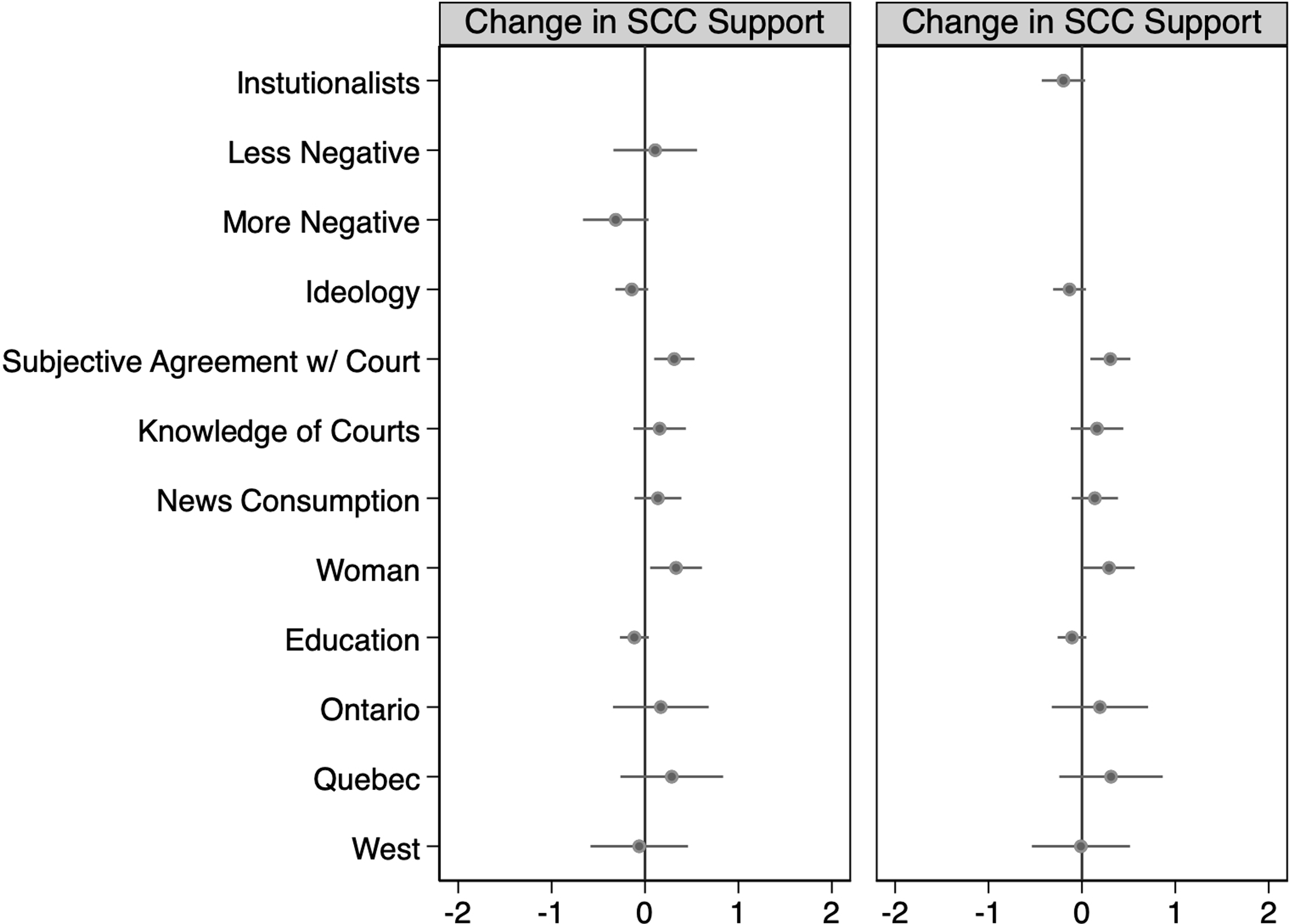
However, to get to the cause of the change and its relationship to individual perspectives toward the event pre- and post-departure, we suggest that change should be produced by having a specific evaluation of the event itself. This corresponds to work on short term fluctuations in specific court support that are related to scandal or event-driven change. We suspect that changing one’s opinion about the investigation to become less negative post-departure (H2a) and/or being institution-centred (H2b) should lead to a positive change in a respondent’s opinion toward the Court. Plainly put, this would suggest that the departure may have had some role in improving opinion toward the Court as observed above. Modelling change in court support as a binary variable—with those whose opinion toward court support became more positive (less negative) from T1 to T2 as the category of interest—we see no support for either hypothesis. Figure 2 illustrates two separately specified models that show: (1) the effects of being less negative about the events surrounding Justice Brown’s retirement post-departure (model 1), and (2) whether identifying as institution-centred (someone who cares more about the effects of an event on the institution, rather than the person) (model 2) changes support for the Supreme Court. Taken together, these models show that neither identifying as institution-centred or the nature of a respondent’s opinion change toward the optics of the events surrounding Justice Brown’s departure systematically altered their perspectives toward court support.Footnote 5 This is notable in that it suggests that the effects of the events may have been isolated and did not influence broader perspectives toward the Supreme Court—which could be normatively understood as a positive outcome for broader discussions of institutional trust.
Change in Support for the Court.
Note: Logit model estimated. Dependent variables coded so a positive indicator (one that falls to the right of the line) represents an individual whose opinion toward court support improved form T1 to T2. Coefficient plots reflect estimates (represented by the dots) and confidence intervals (represented by the lines). Coefficients falling completely to the right or left of line are significant at the p < .05 level. Full tables are available in the online appendix.

Taken together, we can observe the following effects of Justice Brown’s retirement on perceptions toward the Court. First, respondents were in clear agreement that a sitting justice who comes under investigation should sit out from hearing trials. Second, when asked about the optics of the event pre- and post-departure, more than half of respondents changed their mind about the effects on perceptions of the Court as an institution. Of these individuals, a greater number changed their opinion to be less negative. That is to say, after Justice Brown had retired, a majority expressed that the optics of the event were less harmful for the Court than they had originally thought before Justice Brown retired. This indicates there is some evidence that the departure, the handling of the event, or both, did push public opinion in a more positive direction. Even if the simple variable of time—the distance between the event and being asked in November—softened concern, it is still notable that, when prompted with the basic facts of the situation, opinion toward the Court improved. Third, and most interestingly, we observed that the sensational events surrounding Justice Brown, regardless of where one sat on the effects on the Court pre- and post-departure did not functionally move perceptions toward short term support for the Court as an institution.
The sum of these findings points to an understanding of what led to Justice Brown’s retirement as an isolated event and, while it was attaching to single point evaluations of the Court as an institution, there is no evidence to suggest that respondents were benchmarking their support over time to court support more broadly. What does this tell us about trust in courts more generally? These data imply that people in Canada are, indeed, concerned about negative events or coverage of the Court, but that these issues may not stay with individuals long enough to suggest they move measures of confidence in a sustained fashion. However, we are still left with the counterfactual problem of not being able to evaluate the alternative scenario (i.e., had the retirement not happened) on support for the institution, pointing to a need to continue studying event-driven responses to court actions.
Discussion
At the Supreme Court’s annual media conference in June 2024, Chief Justice Richard Wagner observed that while the Court continues to benefit from “great trust on the part of citizens,” it is “witnessing attacks on our judges and our institutions, something that we used to only see abroad” (Olijnyk, Reference Olijnyk2024). He went on to say, how it is “troubling when the judge is more scrutinized than the judgment itself” (Olijnyk, Reference Olijnyk2024). The Chief Justice’s observations are astute. While citizens continue to have a great deal of confidence in Canadian courts, this support no longer appears assured in the way it once was, and moreover, may be starting to divide along what can be considered traditional lines of political ideology. Understanding how a court can weather negative press involving one of its judges, therefore, seems more important than ever.
This research note offers a starting point for considering the potential impact of a scandal on support for Canadian courts. The data presented here suggest that the CJC investigation of Justice Brown and his subsequent retirement from the Court did not have long-term negative effects for support for the Supreme Court, which is an important finding for Canadian politics, and also contributes to the development of a comparative research agenda on the effects of negative events on courts. Still, there is increasing evidence that events—whether they are the statements or actions of individual judges or the political ramifications of a judicial decision—are both fodder for media and perhaps of increasing interest to citizens. In a political climate, such as that of the contemporary United States, where judges are highly politicized, understanding how high profile or salient events can affect public opinion toward a political institution, traditionally thought to be protected through “a reservoir of goodwill” (Easton, Reference Easton1956), demands greater attention.
A second dimension of a research agenda emerging from this type of work includes understanding the differences between short term support for the judiciary and perceptions of judicial legitimacy, typically defined along the lines of, “an institution’s rightful authority to render declarative rulings for the nation and a widespread belief that an institution is appropriate, proper and just” (Bartels, Reference Bartels and Thomas2022: 384). In comparison to court support, judicial legitimacy is anticipated to be relatively stable over time, with a single event being unlikely to have a significant impact. This research note does not explore whether the events surrounding Justice Brown’s departure affected judicial legitimacy. Given the small effects on court support found here, it would not be reasonable to anticipate the event placed any real pressures on judicial legitimacy. This does not, however, mean that a single negative event cannot affect judicial legitimacy, though as the literature on US courts suggests, how judicial legitimacy is measured will likely matter. For example, in their studies of the impact of the Kavanaugh confirmation hearing, Carrington and French (Reference Carrington and French2021) find the event had a larger negative impact on judicial legitimacy than Krewson and Schroedel (Reference Krewson and Schroedel2020), a difference they attribute to the battery of questions the studies use to measure judicial legitimacy. For future research on Canadian courts and other comparative cases, attention needs to be paid not just to the institutional and socio-political differences between jurisdictions, but the questions that are being used to measure concepts like court support and judicial legitimacy.
Also notable are the findings of a gender gap in court support while the allegations around the conduct by Justice Brown were being investigated. This is something that future research on the relationship between negative events and court support will want to pay attention to, especially considering that research on the confirmation of US Supreme Court Justice Kavanaugh, which dealt with allegations of sexual assault, found a strong gender gap in court support following his confirmation (Krewson and Schroedel, Reference Krewson and Schroedel2020). To date, a gender gap in support for Canadian courts has been less visible, however, a recent study found that identifying as a woman is the one clear correlate of comfort with reducing the powers of the court in the face of unpopular judicial decisions (i.e., court curbing) (Lawlor and Crandall, Reference Lawlor and Crandall2023).
Finally, it is worth noting that the investigation process of the Canadian Judicial Council serves an important function in maintaining judicial legitimacy, transparency, and accountability. The investigation of alleged ethical breaches is crucial for maintaining the impartiality and integrity of courts and the CJC process of investigation is intended to maintain the balance of judicial independence and accountability that informs the legitimacy of the institution for the public (Dick, Reference Dick2024; Friedland, Reference Friedland1996; Woolley, Reference Woolley2017). Long-term, investigations into the behaviour of judges if not transparently conducted have the potential to undermine court support. While challenging, future research could attempt to identify the drivers of court support and the role that professional bodies, like the CJC, play in enhancing that support. In the case of the CJC’s investigation of Justice Brown, the timeline was so protracted that it allegedly contributed to his decision to retire from the bench. Even if this was not the only contributing factor to his departure, it is arguably the case that the prospect of having the Supreme Court short-staffed for over a year was untenable and would extend pointed questions directed at both Justice Brown and the Court. While it is critical the CJC’s investigations are thorough, it is also the case that investigations extending beyond a time period that most would consider reasonable may have unintended negative effects on both the judge under investigation and the court on which they serve.
Supplementary Material
The supplementary material for this article can be found at https://doi.org/10.1017/S0008423925100383
Acknowledgements
The authors wish to thank Christa Scholtz for her helpful comments at the Canadian Political Science Association Conference in June 2024, as well as the Journal’s anonymous reviewers. The authors acknowledge the support of the Social Sciences and Humanities Research Council of Canada, Grant #430-2021-00746.
Competing interests
The author(s) declare none.





 Open access

