


Introduction
Wildlife trade is a major threat to biodiversity, with multi-dimensional impacts on conservation, public health, civil safety and economic development (Morton et al., Reference Morton, Scheffers, Haugaasen and Edwards2021). Ranked as the fourth most lucrative crime globally, wildlife trade is valued at c. USD 320 billion annually (Nijman, Reference Nijman2010; Robinson & Sinovas, Reference Robinson and Sinovas2018). However, CITES, the global body responsible for monitoring and regulating the trade of many highly traded species, has a budget of only USD 6 million annually, which may be insufficient to prevent illegal trade.
Wildlife trade negatively affects ecosystems, public health (Gómez & Aguirre, Reference Gómez and Aguirre2008), economy, tourism (Obour et al., Reference Obour, Asare, Ankomah and Larson2016) and both national and international security (Burn et al., Reference Burn, Underwood and Blanc2011). Overexploitation of wildlife can reduce the diversity and abundance of species (Natusch & Lyons, Reference Natusch and Lyons2012; Hughes, Reference Hughes2017). It can also be a source of zoonotic pathogens (Petrovan et al., Reference Petrovan, Aldridge, Bartlett, Bladon, Booth, Broad and Sutherland2021), such as avian influenza (Turner et al., Reference Turner, Feeroz, Hasan, Akhtar, Walker and Seiler2017) and SARS-Cov-2 (Gryseels et al., Reference Gryseels, De Bruyn, Gyselings, Calvignac-Spencer, Leendertz and Leirs2021).
In South-east Asia, Indonesia, Malaysia, Myanmar, Cambodia and Laos are source countries of wildlife in trade, Viet Nam and China are generally receiving countries, and Thailand is a transit hub for re-exporting products that originated from other countries in Asia (Nijman, Reference Nijman2010). Thailand, Singapore, China, Malaysia, Viet Nam, Laos and Myanmar all import wildlife from Bangladesh (Still, Reference Still2003; Amin, Reference Amin2019; Khan, Reference Khan2018). South Asia acts as a source, conduit and consumer of wildlife. Myanmar has high levels of trade with neighbouring China as well as having a significant domestic market (McEvoy et al., Reference McEvoy, Connette, Huang, Soe, Pyone and Htun2022), and trade across South Asia may be growing (Yi-Ming et al., Reference Yi-Ming, Zenxiang, Xinhai, Sung and Niemelä2000; Niraj et al., Reference Niraj, Sethi, Goyal and Choudhary2019).
In Bangladesh, c. 48% of people in rural communities use traditional medicine, which often contains animal parts (Huque & Chowdhury, Reference Huque and Chowdhury2014; Bardar et al., Reference Bardar, Fazlul, Johora, Begum and Ali2019). However, the dynamics of trade within Bangladesh are largely unknown, and although this trade is also linked to international trade, understanding how wildlife is used, sourced and transported within Bangladesh is important. This is especially the case given the high reliance of some communities on wildlife or wildlife parts and for developing interventions for different parts of society in Bangladesh. Circumventing these challenges requires a detailed understanding of the dynamics of trade, including the routes used, quantities traded and methods employed. Yet for much of the trade, especially domestic trade, such data are lacking, hindering the understanding of the impact of this trade on wild populations (Blair et al., Reference Blair, Le, Sethi, Thach, Nguyen and Amato2017).
The multi-billion dollar business of non-subsistence wildlife trade connects regions and syndicates using complex networks and entities and sometimes involves criminal cartels (Warchol et al., Reference Warchol, Zupan and Clack2003; Warchol, Reference Warchol2004). Commercial trade could be facilitated by national and transnational cartels through both physical markets and online portals such as eBay (Hernandez-Castro & Roberts, Reference Hernandez-Castro and Roberts2015), social media sites such as Facebook, Instagram and WeChat (Harrison et al., Reference Harrison, Roberts and Hernandez-Castro2016; Hinsley et al., Reference Hinsley, Lee, Harrison and Roberts2016) and even via the anonymized dark web (Harrison et al., Reference Harrison, Roberts and Hernandez-Castro2016). Contemporary seizure records, newspaper articles and research papers show that market-based wildlife trade persists in local markets in Bangladesh (Uddin et al., Reference Uddin, Enoch, Harihar, Pickles, Ara and Hughes2022). Yet little research has been conducted to understand the dynamics of this trade.
Data on trade dynamics are critical for preventing illegal or unsustainable trade, and thus research is needed to provide a basis for future interventions (Wyatt et al., Reference Wyatt, Maher, Allen, Clarke and Rook2022). We conducted a year-long observational survey of 13 wildlife markets to determine the baseline status and nature of wildlife trade in three types of market, and to address the following questions: (1) How does the abundance, diversity and distribution of wildlife trade vary across local markets in Bangladesh? (2) What are the drivers of illegal wildlife trade in local markets? (3) What are the trade routes and sources of illegally traded wildlife in local markets? Based on our findings, we provide recommendations to help reduce the market-based wildlife trade identified in our analysis.
Study area
We selected 13 markets (Fig. 1) based on areas selling wildlife, as recorded in published reports, government records of the seizure of wildlife or wildlife parts, unpublished wildlife seizure data from Bangladesh forest departments, and local newspaper reports. The selected markets were grouped into three types: hill, peri-urban and urban markets. We monitored three rural hill markets (in hilly areas in Alikodom, Sonirobor bazaar and Banarupa bazaar), four peri-urban markets in district-level headquarters or rural areas/villages (in Patharghata, Khalispure, Fultola and Bhairab) and six urban markets (in the cities of Tongi bazaar, Mirpure-1, Snakari bazaar, Maradia bazaar, Kaptan bazaar and Chattogram). We recorded sources of wildlife at the district level in all eight districts of Bangladesh, and at the international level where wildlife originated from outside Bangladesh. We also recorded the directions of trade flows.
Surveyed markets and wildlife trade directions within various districts in Bangladesh. Arrows show the directionality of this trade from each district to destination markets. The inset shows the markets of Dhaka and Gazipur. Of the 64 districts, only the 21 that are a source or destination for wildlife are indicated. Numbers inside circles indicate the number of markets.

Methods
Data collection
We carried out surveys in the 13 markets (Fig. 1) once every month during 2019. We recorded information on market location, type of market, road type to the market and law enforcement agency offices in closest proximity to the markets. We conducted interviews with individual traders during 6.00–11.59, to cover the period when most markets operate. We approached traders selling wildlife and asked if they would consent to being interviewed, and interviewed those who agreed to participate. We used an observation checklist and questionnaire to collect information on individual traders and their traded wildlife. At the start of the survey, we briefed traders on the purpose of the research and obtained their consent for the interview and specific uses of the information they provided. We observed 421 traders selling wildlife; 337 agreed to participate in interviews.
The data collected included three components: (1) For each market, we recorded market type, proximity of any law enforcement office, road type and port connectivity (seaports, land ports and airports) in the vicinity of the surveyed markets (Supplementary Table 1). (2) We used an observation checklist (Supplementary Table 1) to identify species, number of individuals/parts of each species, form of wildlife (live animals or parts/byproducts), date of trade, time, photographs and value of the species, availability of live animals, fresh meat and byproducts (feathers, oils from wild animals, skin, teeth, bile, bones); byproducts were recorded as trade of the respective species from which they originated. (3) We used a questionnaire (Supplementary Material 1) to collect information on origin, transit points and final destination, source (wild or captive-bred), transportation type, financial transaction mechanism, harvest method, motivation of traders engaging in market-based trade and conditions that enable trade in the area. During the survey we also asked the wildlife sellers about the availability of wildlife products at other market stalls and nearby shops (Barber-Meyer, Reference Barber-Meyer2010).
After collating the information for the checklist and interviews, we determined the CITES status and IUCN Red List status for each species observed. Although not all 421 traders participated in the questionnaire survey, they all answered the interview question relating to the unit price of the wildlife available for sale.
Data analysis
We considered each observation of an item for sale as independent, as each trader was reliant on unique sources and supply chains. We first conducted a descriptive statistical analysis using univariate analysis. We measured species diversity in each market type using both the Shannon diversity and Blau indices (although both indices usually give similar results, their joint use provided greater confidence in the results). We chose these two measures because they both give unbiased and reliable estimates compared to other diversity measures (Morris et al., Reference Morris, Caruso, Buscot, Fischer, Hancock and Maier2014; Konopiński, Reference Konopiński2020), and because they have also been used in previous studies (Grabchak et al., Reference Grabchak, Marcon, Lang and Zhang2017).
We then examined bivariate relationships using Pearson's χ 2 test (Rana & Singhal, Reference Rana and Singhal2015). Similar to previous studies, a 10% significance level was used (α = 0.10; Ara et al., Reference Ara, Rahman, Hossain and Ahmed2020; Rahman et al., Reference Rahman, Sagar, Dalal, Barsha, Ara and Khan2022). We examined any collinearity between variables using Crammer's V, which is widely used for assessing categorical variables (Supplementary Figs 1 & 2). No pair of variables had Crammer's V values of > 0.6, indicating there were no potential multicollinearity issues.
We used multinomial logistic regression and binary logistic regression models (Wright, Reference Wright, Grimm and Yarnold1995) to examine the factors that influence wildlife trading, and relative risk ratios and odds ratios, with 95% CIs, to report the coefficients of the multinomial logistic regression model and binary logistic regression model, respectively. We used relative operating characteristic curves to measure the performance of the final binary logistic regression models to verify accuracy of models (Wright, Reference Wright, Grimm and Yarnold1995).
We used Gephi 0.9.2 (Bastian et al., Reference Bastian, Heymann and Jacomy2009) for link charting and social network analysis, to assess which districts were connected with each market. We created a geocoded link chart of the surveyed markets and the districts of origin of the traded wildlife, and visualized these relationships in QGIS (QGIS Development Team, 2019). We used in-degree scores to determine the number of districts of origin for each market (Fig. 1). For directional analysis we used Circos plots (Krzywinski et al., Reference Krzywinski, Schein, Birol, Connors, Gascoyne and Horsman2009) with one-to-many directions. To explore seasonal trends, we considered June–October as the wet season, November–February as winter and March–May as summer (Banglapedia, 2021).
Results
Abundance of traded wildlife
In 1 year we recorded a total of 928 traded items in the 13 markets. Birds were the most abundant taxonomic group, followed by mammals and reptiles (Supplementary Table 2). We recorded 19 orders being traded, 12 of which were birds, four mammals and three reptiles (Fig. 2). Amongst all orders, Passeriformes comprised 27% of all observations, Columbiformes 16%, Artiodactyla 9%, Carnivora 7%, Testudines 5% and Squamata 3% (Fig. 2) Amongst birds, most individuals were Passeriformes (39%), followed by Columbiformes (23%); amongst mammals, Artiodactyla (47%) dominated, followed by Carnivora (36%); amongst reptiles, most individuals were Testudines (56%) followed by Squamata (34%; Supplementary Fig. 3). Amongst the nine species of Passeriformes, the common hill myna Gracula religiosa was most common (30%), followed by the common myna Arcidotheres tristis (27%) and the Java sparrow Lonchura oryzivora (15%; Supplementary Fig. 4).
The number of records of wildlife for sale, by class and order, recorded in 13 markets in Bangladesh (Fig. 1). Numbers after family names indicate the numbers of species traded.

Composition of wildlife
Passeriformes, Columbiformes and Psittaciformes were the three most traded orders of birds in all markets. The numbers of individuals for sale in urban markets were always higher than those in hill or peri-urban markets. Artiodactyla and Carnivora were traded in all three types of markets. For Artiodactyla, > 60% of individuals were traded in hill markets, and for Carnivora, almost 40% of individuals were traded in peri-urban markets (Fig. 3). For reptiles, almost 55% of Testudines were traded in peri-urban markets and 70% of Squamata were traded in hill markets (Fig. 3). Animals were traded whole or in parts, and mammals were the most expensive (mean BDT 300,433; maximum BDT 2 million for tiger parts), followed by reptiles (mean BDT 82,443; maximum BDT 500,000 for crocodile parts) and birds (mean BDT 8,711; maximum BDT 75,000 for cockatoos, which were the only exotic species). Most birds were traded live as pets, whereas mammals were generally traded dead, for meat, medicine or pelts, although some were traded live (possibly to keep them fresh), especially smaller species that could be carried and concealed easily whilst alive (large animals such as deer were sold dead as meat). Reptiles were mainly traded live, although some were dead and were probably traded for meat or medicine (including venoms) and only rarely for other reasons.
Composition of traded wildlife orders across the three types of market in Bangladesh. Numbers of species traded are listed after the family names.

Diversity of traded wildlife
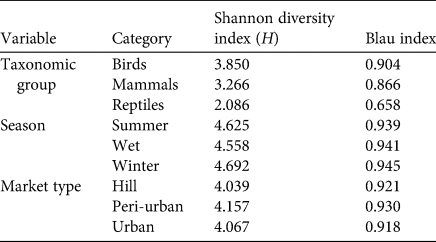
The Shannon diversity (H) and Blau indices produced similar results regarding species diversity across taxa, season and market type. We found the highest diversity in birds (H = 3.850, Blau index = 0.904). Species sold were most diverse in winter (H = 4.692, Blau index = 0.945). The highest diversity of species was in peri-urban markets (H = 4.157, Blau index = 0.930; Table 1)
Diversity of traded wildlife species in 13 markets in Bangladesh (Fig. 1) during 2019 by taxonomic group, season and market type.
Temporal trends of wildlife trade
Amongst the three seasons, trading in the wet season and winter was greater than in summer, and of the 50 species observed traded, 22 were traded more in the wet season than in winter and 18 were traded more in winter than the wet season. Amongst birds, 12 species (of 28) were traded more in the wet season than in winter and nine were traded more in winter than the wet season. Passeriformes and Columbiformes were traded less in summer. For mammals, there were equal numbers traded in each season (six of 15 species), and for reptiles, four species were traded more in the wet season than in winter and three species were traded more in winter than the wet season (of eight species). Amongst mammals, Artiodactyla were traded in all three seasons but Carnivora were traded more in summer and the wet season. Amongst reptiles, Squamata were only traded in summer and the wet season (Fig. 4), with most such trade being observed in the wet season. In total, 663 individual birds were traded, of which 39% were traded in the wet season. For mammals, 40% of the total of 179 observations were in the wet season. For reptiles, 43% of the total of 86 observations were in the wet season (Fig. 5).
Composition of traded wildlife orders across the three seasons in 13 markets in Bangladesh. Numbers of species traded are listed after the family names.

The number of records of birds (of 28 species), mammals (15 species) and reptiles (eight species) traded during summer, wet season and winter in 13 markets in Bangladesh. The numbers of individuals sold were highest in the wet season, followed by winter and then summer.

Factors associated with trading of taxa
Market type, proximity to law enforcement agency offices, road type and port connectivity status were associated significantly with the taxa of traded animals (as detailed below) (P < 0.10, bivariate Pearson χ 2 test; Supplementary Table 3). Using Pearson's χ 2 test, we tested the significant variables further using multinomial logistic regression. Market type (P < 0.001), proximity of law enforcement agency offices (P < 0.001), road type (P < 0.001) and port connectivity (P = 0.01) significantly influenced the trading of mammals in the multivariate model. Conversely, only market type and road type significantly influenced the trading of reptiles. Overall, 13% of birds were sold in hill markets, 32% in peri-urban markets and 55% in urban markets. For mammals, 46% were sold in hill markets, 31% in peri-urban markets and 23% in urban markets. For reptiles, 38% were sold in hill markets, 42% in peri-urban markets and 20% in urban markets (Supplementary Table 2). Trading levels for wild mammals and reptiles were almost four times higher in markets with a village road (Table 2).
The multinomial logistic regression model used to assess the variables that were influential in determining which animal taxa were traded in 13 markets in Bangladesh in 2019, and how these variables influence the trade of different groups (such as birds vs mammals). Variables that were associated significantly with traded taxa in the bivariate analysis were then included in the multivariate model. Bivariate analysis does not compare pairwise, but rather it provides approximate estimates of the relative importance of variables. The multinomial logistic regression model compares one base group to other groups pairwise to assess the relative importance of variables. (Supplementary Table 2).
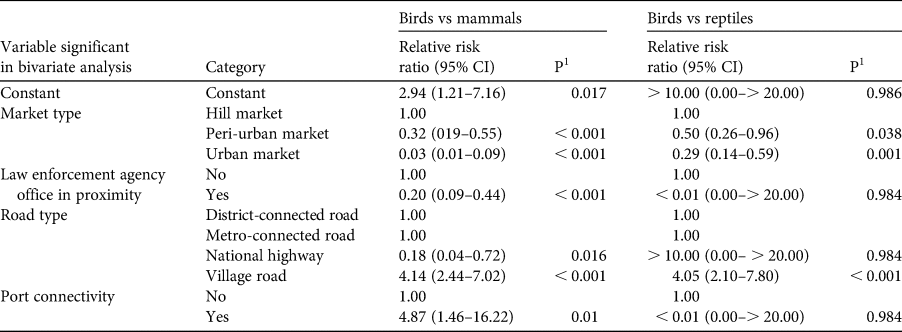
1 P < 0.05 considered significant.
Factors associated with trading of threatened species
Market type, law enforcement office proximity, road type, port connectivity, ornamental value and form of sale were associated significantly with the trading of threatened species (i.e. Critically Endangered, Endangered and Vulnerable; (P = 0.01) Pearson's χ 2 test; Supplementary Table 4). We then tested variables that were significant in the Pearson's χ 2 test using multinomial logistic regression. In total, 47% of threatened species that we found to be traded were sold in hill markets, whereas 26% were sold in peri-urban markets and 27% in urban markets (χ 2 = 3.44, P < 0.001; Supplementary Table 5). Trade of threatened species was 92% lower in markets connected to a national highway, whereas markets with ports (land ports, seaports or airports) sold 2.74 times more threatened species than unconnected markets. Furthermore, 51% of threatened species were sold as byproducts such as skin, bone and teeth. Markets closer to law enforcement agency offices sold 5.2 times more threatened species than those far from law enforcement offices (Table 3).
The multivariable logistic regression model used to assess the variables that were influential in the trading of threatened animals in 13 markets in Bangladesh in 2019, and where trade of threatened groups was most likely to occur. Variables that were associated significantly with traded animal taxa in the bivariate analysis were then included in the multivariable model to assess relative importance for different groups. Mean (maximum) prices of wildlife in hill, peri-urban and urban markets were BDT 11,069 (500,000), 86,553 (2,000,000) and 26,671 (1,000,000), respectively.
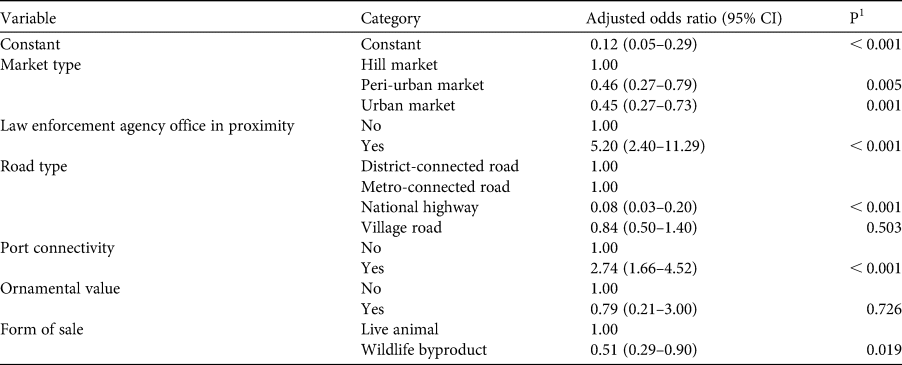
1P < 0.05 considered significant.
Trade routes
Chattogram was the main source of traded wildlife, comprising over one-third of all trade (Fig. 6). Almost half of this remained in Chattogram, with the remainder split between international destinations and Dhaka. Dhaka is the main destination for traded wildlife, with half coming from within Dhaka and the rest coming from other destinations. Origins were more diverse than destinations, with c. 50% of all traded wildlife destined for Dhaka, followed by international locations, then Chattogram and finally Khulna. Almost all trade was domestic, and we did not observe wildlife in international transit.
Network analysis demonstrating the directionality of wildlife trade from origin divisions (which comprise multiple districts; upper half) to destination divisions (lower half) within Bangladesh and internationally. Traded wildlife originated primarily from Chattogram, Dhaka, Mymensingh, Khulna, Rajshahi and Sylhet, and destinations were primarily Chattogram, Dhaka, Khulna and international.

Discussion
Dimensions of trade
Birds were the most traded taxa in all three market types. The high numbers of birds traded could be because of the absence of punishment for engaging in trade of this group (Wellsmith, Reference Wellsmith2011). Additionally, law enforcement agencies might overlook trade in wildlife as it is viewed as a low priority for enforcement, especially for low-value species such as birds (Sackl & Ferger, Reference Sackl and Ferger2016). Items that are small and easily concealed are more likely to be traded and trafficked (Clarke & Eck, Reference Clarke and Eck2005), and many birds are small-bodied and can be hidden in small cages for transport. Domestic birds such as pigeons are sometimes transported with wild birds to the markets, and at least 32 traders made statements to the effect of: ‘Sometimes people transport wild birds in domestic pigeon boxes or with domestic pigeons so that law enforcement agencies cannot detect them.’ Trade in birds does not require much capital, as noted by 12 traders who stated they can earn large sums of money in this way without substantial investment, as has been noted in previous studies (Ribeiro et al., Reference Ribeiro, Reino, Schindler, Strubbe, Vall-llosera and Araújo2019). High demand for pets and game meat and the ability to sell for cash encourages traders to offer birds at markets (> 80 traders noted that the payments they received were in cash, and only 41% of adults in Bangladesh have a bank account; TheGlobalEconomy.com, 2017), and > 30 traders made statements to the effect of: ‘When we bring birds, people buy them for meat or for pets, and they buy them with cash so we feel safer conducting bird trade at a market than we would with other wildlife.’ Wildlife trade laws are rarely enforced, and some traders made statements to the effect of: ‘Even if law enforcement agencies challenge us while we trade birds, we can easily escape from them by showing we are poor men and need to sell birds to generate an income.’ Furthermore, people often perceive birds as being easy to rear, as noted in other countries (e.g. in Latin America; Roldán-Clarà et al., Reference Roldán-Clarà, López-Medellín, Espejel and Arellano2014). Many traders mentioned that catching birds using locally made traps is easy, which motivates hunters to catch live birds and trade them in the local markets. Similar patterns of markets being dominated by bird trade have also been recorded in other parts of South Asia, such as Pakistan (Hussain & Khan, Reference Hussain and Khan2021). High demand for birds, the small capital investment required, their high abundance in local forests, the lack of awareness of laws on legality of trade, and the ease with which they can be hunted/caught, carried and concealed were the prime causes of the high level of bird trade in all of the markets we studied.
Passeriformes, Columbiformes and Psittaciformes
Passeriformes, Columbiformes and Psittaciformes are amongst the most traded bird orders globally, as well as in this study (Razkallah et al., Reference Razkallah, Atoussi, Telailia, Abdelghani, Zihad and Moussa2019; Xayyashith et al., Reference Xayyashith, Douangboubpha and Chaiseha2020). Amongst Passeriformes in our study, the most traded species was the common hill myna G. religiosa, mainly for the pet trade, as in other studies (Datta, Reference Datta2021). The common myna A. tristis is abundant in the wild in Bangladesh and is often hunted for its meat (Chowdhury, Reference Chowdhury2011) and for the pet trade because of its ability to mimic human voices. Psittaciformes (parrots, parakeets and macaws) are targeted worldwide for the pet trade (Sykes, Reference Sykes2017; Datta, Reference Datta2021). Trade of Columbiformes in Bangladesh could be attributed to demand for game meat and pets, as in other countries (Walker, Reference Walker2007; da Silva et al., Reference da Silva, Ruiz-Esparza, de Azevedo and de Souza Ribeiro2021).
Urban markets
There was a high diversity of live birds traded in urban markets, presumably a result of the high demand for birds as pets, and because the lack of enforcement meant traders were not afraid to trade openly (Datta, Reference Datta2021). People living in urban areas often keep birds as a connection to nature (Jepson & Ladle, Reference Jepson and Ladle2011). At least 50 traders made statements to the effect of: ‘People in urban areas are isolated from nature and sometimes want to be connected to nature by growing a garden on the roof or balcony, and keeping birds in the house.’ Twenty interviewed traders made statements to the effect of: ‘There are many online social media groups that promote the selling and rearing of birds in urban settings as pets, provide husbandry guidelines for rearing birds, and advertise birds for sale, which could encourage people to buy, keep and sell birds in urban areas.’
Peri-urban markets
Trade in Artiodactyla and Carnivora was high in peri-urban markets, especially in Khulna division near the Sundarbans. Traders who operate markets in and around the Sundarbans acknowledged the availability of tiger parts, crocodile parts and bushmeat in those markets, especially deer meat and skins. Demand for tiger parts is high in Bangladesh and local consumption has been recorded frequently (Saif et al., Reference Saif, Russell, Nodie, Inskip, Lahann and Barlow2016; Aziz et al., Reference Aziz, Tollington, Barlow, Goodrich, Shamsuddoha, Islam and Groombridge2017). Killing of deer for bushmeat in the Sundarbans is also well known; at least c. 11,000 deer are killed annually for bushmeat, and no evidence suggests significant changes in recent years (Mohsanin et al., Reference Mohsanin, Barlow, Greenwood, Islam, Kabir, Rahman and Howlader2013). We also detected the trade of tiger parts and deer meat in peri-urban markets in and around the Sundarbans. The availability of wildlife in surrounding forests, the demand for bushmeat and high-value wildlife such as tiger and crocodile parts, the motivation of local poachers and traders, and the inefficiency of law enforcement agencies (Mohsanin et al., Reference Mohsanin, Barlow, Greenwood, Islam, Kabir, Rahman and Howlader2013) in and around peri-urban markets could drive these high levels of wildlife trade. More threatened species were traded near law enforcement offices than elsewhere, perhaps because these areas are more developed and thus more likely to have wealthier clientele who buy higher-value processed products. In addition, threatened species were often sold as parts within products, making it easier to conceal these species compared to the trading of animals that are too large to conceal when alive.
Hill markets
We found that mammal species were abundant and highly traded in hill markets, probably because of the high abundance of mammals in the Chattogram hill areas and the consumption of these animals for their meat (Mukul et al., Reference Mukul, Biswas and Manzoor Rashid2018). Markets situated in hill areas sell the highest diversity of wildlife (Reza Khan, Reference Reza Khan1984), and these areas have Indigenous communities who traditionally consume bushmeat (Chowdhury et al., Reference Chowdhury, Halim, Miah, Muhammed and Koike2007; Bangladesh Forest Department, 2015). Hill markets are more likely to sell threatened wildlife (47% of all recorded threatened species in trade) than more common species, probably because of the higher demand for and abundance of mammals in hill areas and the local uses of threatened wildlife by Indigenous communities. In addition, law enforcement in hill areas is challenging because of their remoteness and the lack of communications systems, which hinder monitoring and enforcement. Amongst mammals, Artiodactyla and Carnivora were traded in all three types of market, but Artiodactyla, especially wild boar Sus scrofa and spotted deer Axis axis, were found more often in hill markets, possibly because of the high demand for their meat (Mohsanin et al., Reference Mohsanin, Barlow, Greenwood, Islam, Kabir, Rahman and Howlader2013) for consumption by Indigenous communities (Chowdhury et al., Reference Chowdhury, Halim, Miah, Muhammed and Koike2007).
Impact of law enforcement agencies
Regular presence and patrolling of law enforcement agencies in crime hotspots reduce crime (Braga et al., Reference Braga, Turchan, Papachristos and Hureau2019), and species that are difficult to conceal are less likely to be traded in such situations (Clarke & Eck, Reference Clarke and Eck2005). We found lower levels of trade in mammals and reptiles in markets closer to law enforcement agency offices. At least 10 traders made statements to the effect of: ‘In Bangladesh, when people sell live mammals in markets it can be easily detected and challenged by people, so trading of mammals is lower in those markets closer to law enforcement offices.’ The presence of law enforcement agency offices and patrolling of enforcement agencies deter the open sale of high-value wildlife; this was acknowledged by at least 50 traders, but trading of high volumes of lower-value wildlife (e.g. birds) was common in these markets and law enforcement overlooks such trade. Furthermore, law enforcement agency offices tend to be in accessible, sometimes more affluent regions, so the sale of high-value medicinal products that contain threatened species also tends to be higher in these areas, even though whole animals are sold less frequently.
High-value and threatened wildlife
High-value species such as the tiger, crocodile, fishing cat Prionailurus viverrinus and clouded leopard Neofelis nebulosa were sold as products or derivatives in some markets (Supplementary Table 6). We found byproducts of high-value wildlife, such as oils, processed meats, bile and skins, for sale in some urban markets. At least 20 traders revealed that keeping high-value wildlife species as live animals in markets or houses is risky as they are difficult to conceal from law enforcement agencies, so such species are generally sold as parts or byproducts, which are easier to hide. Similarly, the use of wildlife byproducts for traditional medicine is a major driver of the sale of high-value wildlife rather than the sale of live animals, and means it can be sold even in patrolled areas. The presence of ports was also associated with the trade of threatened species, suggesting these areas could be selling threatened species trafficked from other countries. As many threatened species are sold in the form of medicines and other byproducts, some of these species might be imported in such forms.
Seasonal trends
Hunting is often driven by poverty and other socio-economic factors (McNamara et al., Reference McNamara, Rowcliffe, Cowlishaw, Alexander, Ntiamoa-Baidu, Brenya and Milner-Gulland2016; Destro et al., Reference Destro, De Marco and Terribile2020). The availability of food and jobs in rural areas varies seasonally (Khandker, Reference Khandker2012; Rahman, Reference Rahman2017). In Bangladesh, unemployment rates increase and most of the casual workforce stays at home during the wet season, and we observed that the highest numbers of species were in trade in this season, for all taxa (Fig. 5; Rahman, Reference Rahman2017). During the wet season, people in rural areas often cannot work, so hunting and trading of bushmeat is a popular livelihood option at this time (van Vliet et al., Reference van Vliet, Nebesse, Gambalemoke, Akaibe and Nasi2012; Datta, Reference Datta2021). In addition, poor-quality village roads and the increased remoteness of rural areas during the wet season could also limit the surveillance of these markets by law enforcement agencies.
Is law enforcement adequate?
In the past, the killing and eating of wildlife in Bangladesh was considered heroic, and people were encouraged to hunt (Saif et al., Reference Saif, Tuihedur Rahman and Macmillan2018). Killing wildlife was listed as a criminal offence in Wildlife Ordinance 1973 (Hossan, Reference Hossan2014), and the Wildlife Conservation and Security Act was developed in 2012 under the Wildlife Crime Control Unit within the Bangladesh Forest Department. Nevertheless, the personnel, logistics and infrastructure available are insufficient for nationwide law enforcement. The Bangladesh Forest Department needs the support of police for the investigation of wildlife crime cases, which limits the ability of the Department to enforce wildlife laws. Improved coordination is required between the Department and law enforcement agencies. Furthermore, the lack of awareness and skills needed to trace wildlife products and to identify protected and non-protected species, and the lack of knowledge regarding national and international wildlife laws and regulations, reduce the ability of law enforcement agencies to recognize the importance of wildlife crime and control it effectively. The Bangladesh Forest Department has no intelligence-gathering system or ability to respond rapidly to reported wildlife crime. An intelligence-gathering system needs to be developed to coordinate preventative measures and store data. Given the lack of such approaches, opportunistic traders and consumers continue to conduct wildlife trade openly in the markets of Bangladesh. Dhaka is the main destination for traded wildlife from seven divisions and for internationally imported wildlife, and thus requires particular approaches to control trade. More than one-third of this wildlife comes from Chattogram division, although approximately half of this remains in internal circulation within Chattogram. As Chattogram is near to a port and to South-east Asia, it could be that wildlife might have originated internationally as well as from the Sundarbans. However, we did not detect international wildlife trade passing through, and more monitoring is required to confirm this. Myanmar has a similar wildlife trade profile in terms of species in trade for domestic and international use and thus Chattogram could be a conduit of wildlife from Myanmar (McEvoy et al., Reference McEvoy, Connette, Huang, Soe, Pyone and Htun2022). As Dhaka is the main destination for traded wildlife, disconnecting the city from wildlife trade from source divisions (e.g. by improved checks on roads and in markets) could hinder trade. Following disruption of internal trade, blocking or managing access to ports and better monitoring of trade within cities to allow targeted regulation would be needed.
Understanding the impacts of trade on wildlife
Wildlife trade is one of the major drivers of biodiversity loss (IPBES, 2019), yet understanding the impacts of trade is constrained by the absence of monitoring of wild populations and the lack of knowledge of trade routes and dynamics, and volumes of species in trade. However, the high numbers of threatened species traded in the vicinity of ports and law enforcement agency offices suggest trade in these species is underregulated and law enforcement is not effective. Preventing the unsustainable trade of species will require further monitoring and better regulation.
Conclusion and recommendations
The effect of trade on the conservation of many species remains overlooked in Bangladesh. The majority of traded mammals are sold in hill markets, highlighting the need for better monitoring in these areas, especially as we do not know the long-term implications of trade given the lack of baseline data for most groups. The greatest level of wildlife trade occurred during the wet season, and to a lesser extent in winter, possibly because of a lack of alternative livelihood options combined with the challenges of monitoring such trade when roads are impassable. The greatest number of species and the highest number of individuals were traded in urban markets, probably because of the importation of species both domestically and internationally to support urban consumption. Urban markets were dominated by birds traded as pets, whereas more rural markets were dominated by mammals and reptiles traded for consumption. Based on our findings, we make the following recommendations to help minimize the illegal wildlife trade within Bangladesh: (1) Improve awareness amongst local communities, especially amongst those that control markets. (2) Promote skill training amongst law enforcement agencies, to enable them to disrupt the major trade routes more effectively. (3) Intensify monitoring of village markets through local offices of the Bangladesh Forestry Department, police and community-based voluntary organizations, to facilitate law enforcement and provide higher-quality monitoring data. (4) Develop and launch a hotline to receive community intelligence about market-based wildlife trade and any other wildlife trade issues in markets. (5) Monitor social media and other digital groups, to track illegal wildlife trade activities. (6) Set up billboards and posters in local markets detailing wildlife laws, to remind people that wildlife trade is prohibited. (7) Implement initiatives to provide alternative livelihoods during the wet season and winter, to reduce dependence on wildlife.
Acknowledgements
We thank the eight field assistants who helped with data collection, the landscape ecology Group of Xishuangbanna Tropical Botanical Garden, Chinese Academy of Sciences for funding this research, and the Bangladesh Forest Department for supporting this research during the field surveys.
Author contributions
Research design: NU, ACH; data collection and analysis, writing: all authors.
Conflicts of interest
None.
Ethical standards
This research abided by the Oryx guidelines on ethical standards and received ethics approval from Xishuangbanna Tropical Botanical Garden, Chinese Academy of Sciences, and research permission from the Bangladesh Forest Department.


 Open access

