




Introduction
So, often still, I am shaken with wonder at being alive. … War taught me the fickle lightness of life, as prison camps taught me the frail tenacity of survival. Excellent to know one is worthless and alive.
David Piper. I am Well, who are You? Footnote 1
There are surprising gaps in the academic literature about prisoners of war (PoWs) of the Japanese in the Second World War despite many popular films and a plethora of life-writing. Primary sources are scarce: guards destroyed camp records at the end of the war, many Anglophone researchers find Japanese (and Dutch) documents difficult to access, and some British and American archives are not informatively catalogued; there is a ‘lack of documentary evidence and [a] breadth of anecdotal evidence.’Footnote 2 There is also preferential selection. Commentators, such as Gill, note that imprisonment in Japan itself, or its possessions of Taiwan, Korea and Manchuria, is less well-documented than, for example, in the camps on the Thai-Burma railway.Footnote 3 Flower argues that officers have received less attention than other ranks and are often disparaged or caricatured.Footnote 4 Although Japanese war crimes could reasonably be summarised as ‘medical’, historians have studied the work of captured doctors only rarely: a history of US Army medicine during the war against the Japanese, for example, includes only twenty pages on PoWs,Footnote 5 and Flower notes that an initial plan to add a volume on PoWs to the British official history was abandoned.Footnote 6 There was a flurry of articles about disease and practice in the camps in medical journals immediately after the war, but the material was not pulled together until Gill’s 2009 thesis and 2017 book.Footnote 7 Hearder published her book on captive Australian doctors in 2020.Footnote 8
In recent decades, a focussed approach has provided insights. As well as Gill’s and Hearder’s work, Kovner, for example, emphasises the rivalries and bureaucratic obstacles at the top of the Japanese PoW administration,Footnote 9 Michno documents the ‘hellship’ voyages,Footnote 10 Tett has published a detailed six-volume postal history,Footnote 11 Linton examines the work of the British War Crimes Courts in Hong Kong.Footnote 12 This article takes a similar approach by examining a complete group of all the Allied military doctors who were imprisoned by the Japanese in Taiwan; it aims to describe the diversity of their experience, as well as its commonalities.
Japan in the Second World War
The background to why these doctors were imprisoned in Taiwan stretches back to the nineteenth century when Japan became increasingly expansionist and competed commercially with European nations and America. Her military conflicts with imperial China, the old regional power, supplied her first overseas colony, Taiwan, in 1895 and Shirane’s wide-ranging history describes Taiwan’s role as the Japanese empire’s southern ‘gateway’.Footnote 13 Japan then gained control of Korea (1910) and Manchuria (1931) and developed the concept of the ‘Greater East Asia Co-Prosperity Sphere’ in which, as leader, she would free East and South-East Asian nations from their colonial oppressors. By the outbreak of the Second World War in September 1939 Japan’s army was unbeaten in the wars with China and she had a well-equipped navy and air force. In 1940 she signed pacts with Germany and Italy, Vichy France and neutral Thailand.
Then, on 7 December 1941, Japan opened a stunning series of surprise attacks on strongholds around South-East Asia and the Pacific. The attack on Pearl Harbor in Hawaii brought America into the war. The Allies had under-estimated the Japanese military, often in racialised terms but, by May 1942, they had captured over 300,000 PoWs, mostly in four major surrenders: about 14,000 in Hong Kong in December 1941 (British, Canadian, Indian), 130,000 in Singapore in February 1942 (British, Australian, Indian), 32,000 in Java in March 1942 (Dutch, British, Australian, American), and 75,000 in the Philippines in April and May 1942 (American, Filipino).Footnote 14
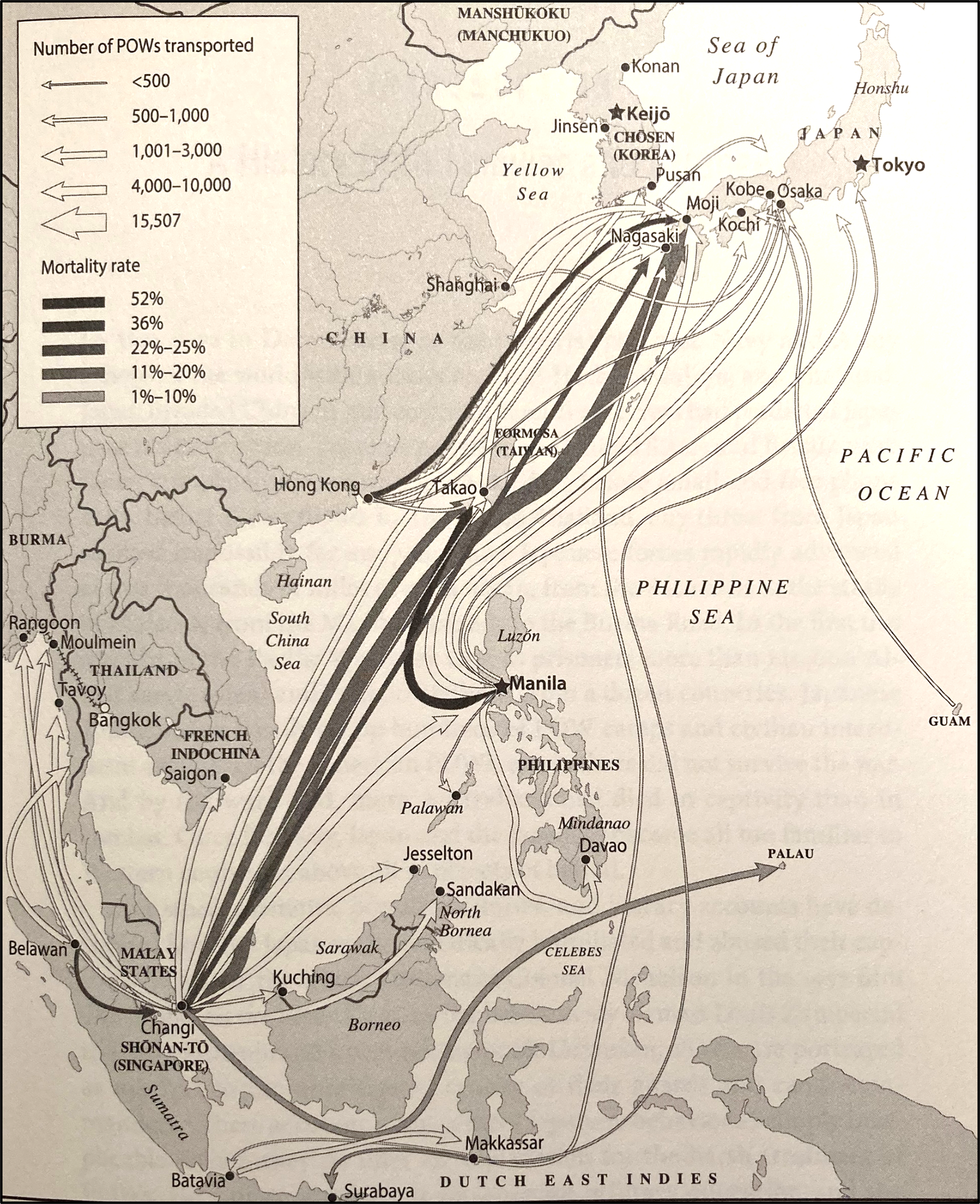
Hata summarises the evolution of Japanese attitudes to PoWs in the early twentieth century as ‘from consideration to contempt’.Footnote 15 Kovner stresses that the small, centralised but bureaucratically confused Japanese PoW administration was not equipped to deal with so many captives, echoing Flower’s description of it as ‘secretive’.Footnote 16 However, their labour would contribute to the war effort and propaganda using their images would demonstrate that Western imperialists could be defeated.Footnote 17 From April 1942 onwards the Japanese dispersed their captives to what would become about 300 camps. Figure 1 shows the major sea transport routes and illustrates Taiwan’s central location in Japan’s wartime possessions.
Map showing PoW movements around Japanese wartime possessions.
From Kovner, op. cit. (note 9), with permission.
Taiwan
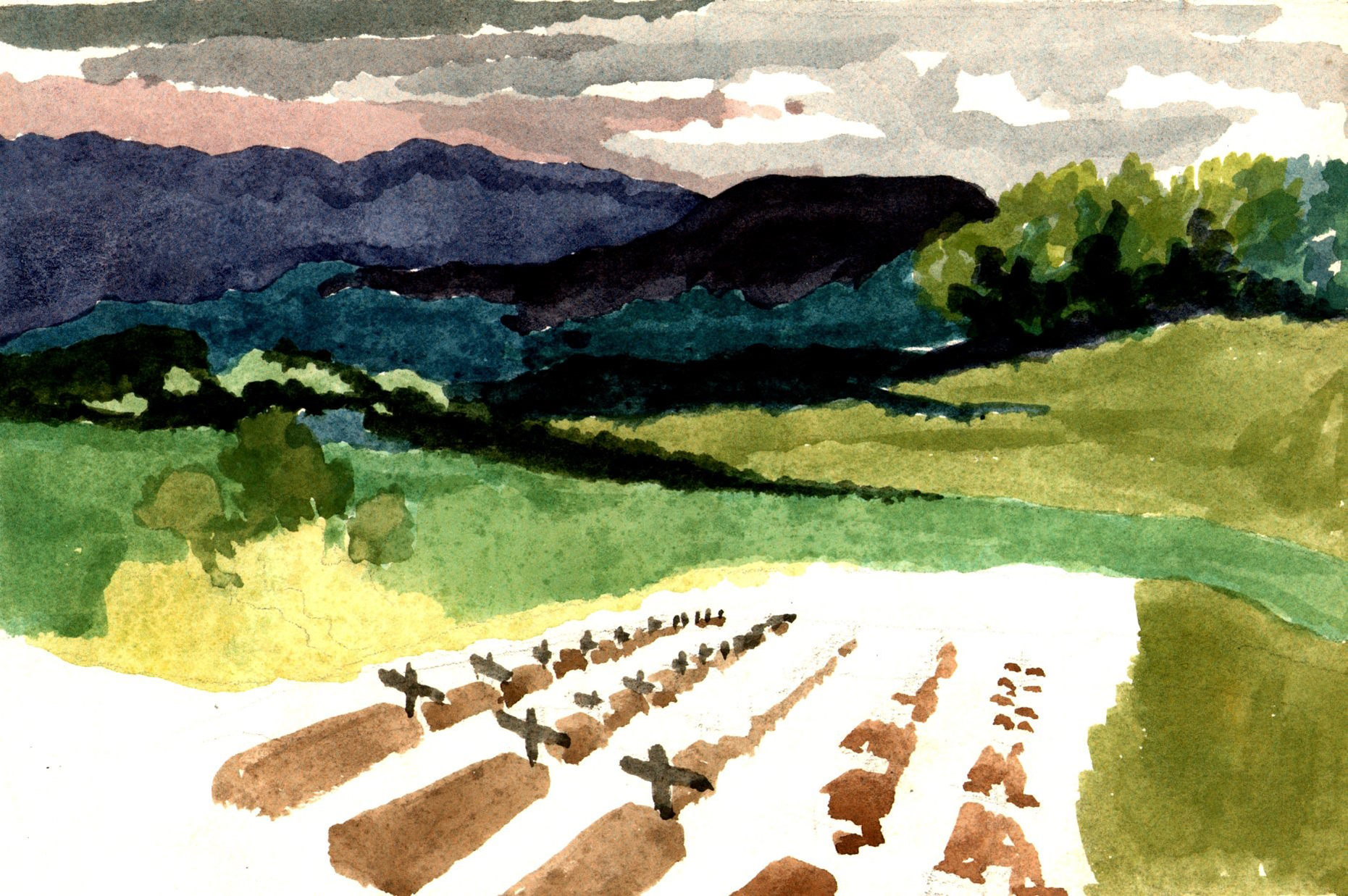
Taiwan is approximately 245 by 90 miles and situated about 100 miles off the coast of southeastern China. Mountains cover two-thirds of the island’s surface, rising to over 10,000 feet. It has a subtropical climate with over 100 inches of rainfall annually, but weather conditions depend on altitude and the monsoon pattern. Its old Portuguese name, Ilha Formosa, meant ‘beautiful island’ and prisoners noticed the island’s ‘lush countryside’,Footnote 18 its ‘hazy spray trees in the first sunlight’Footnote 19 and mountains like ‘misty jade’,Footnote 20 and sketched its landscapes (Figure 2).Footnote 21
Cemetery and mountains at Shirakawa.
Stallard, op. cit. (note 21), with permission.
In August 1942, when the first party of PoWs arrived, only older Taiwanese could remember life before Japanese rule. Young Taiwanese men became camp guards, some to be tried later as war criminals.Footnote 22 It had copper deposits, produced sugar, hosted military airfields, and its ports were stop-off points for naval and merchant ships. Thousands of PoWs were transported through the ports, confined in the holds of requisitioned cargo vessels, which became known as ‘hellships’ because of the conditions on board. Michno documents a total of 156 voyages around Japan’s wartime possessions in which c. 1,540 deaths are attributed to transport conditions alone.Footnote 23 The ships also carried troops and war supplies but there were no indicators that they were used for prisoner transport and c. 19,000 died in Allied attacks. In part, this explains the often-quoted higher death rate of PoWs of the Japanese compared with those in the European theatre, a topic explored by Sturma.Footnote 24
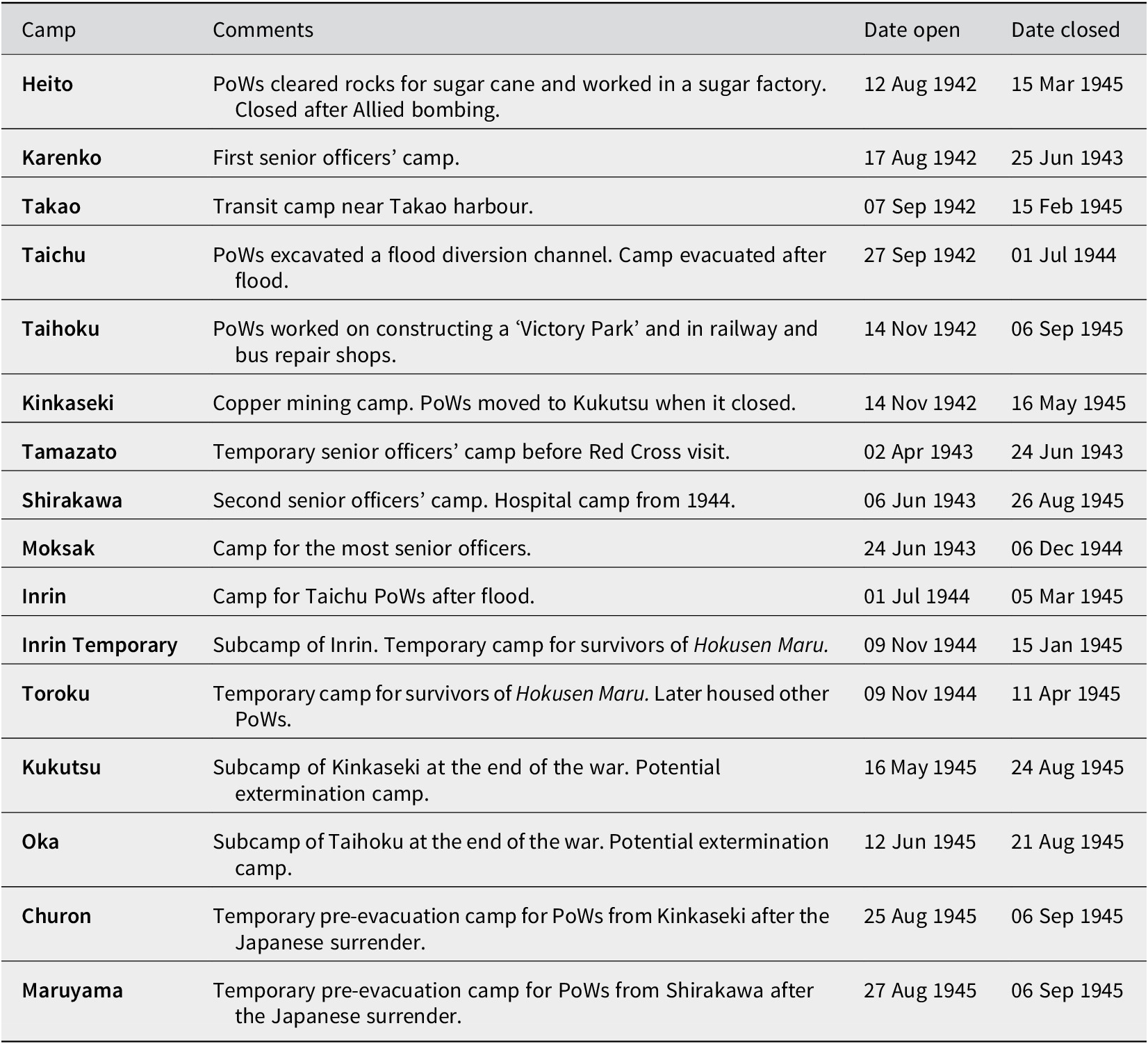
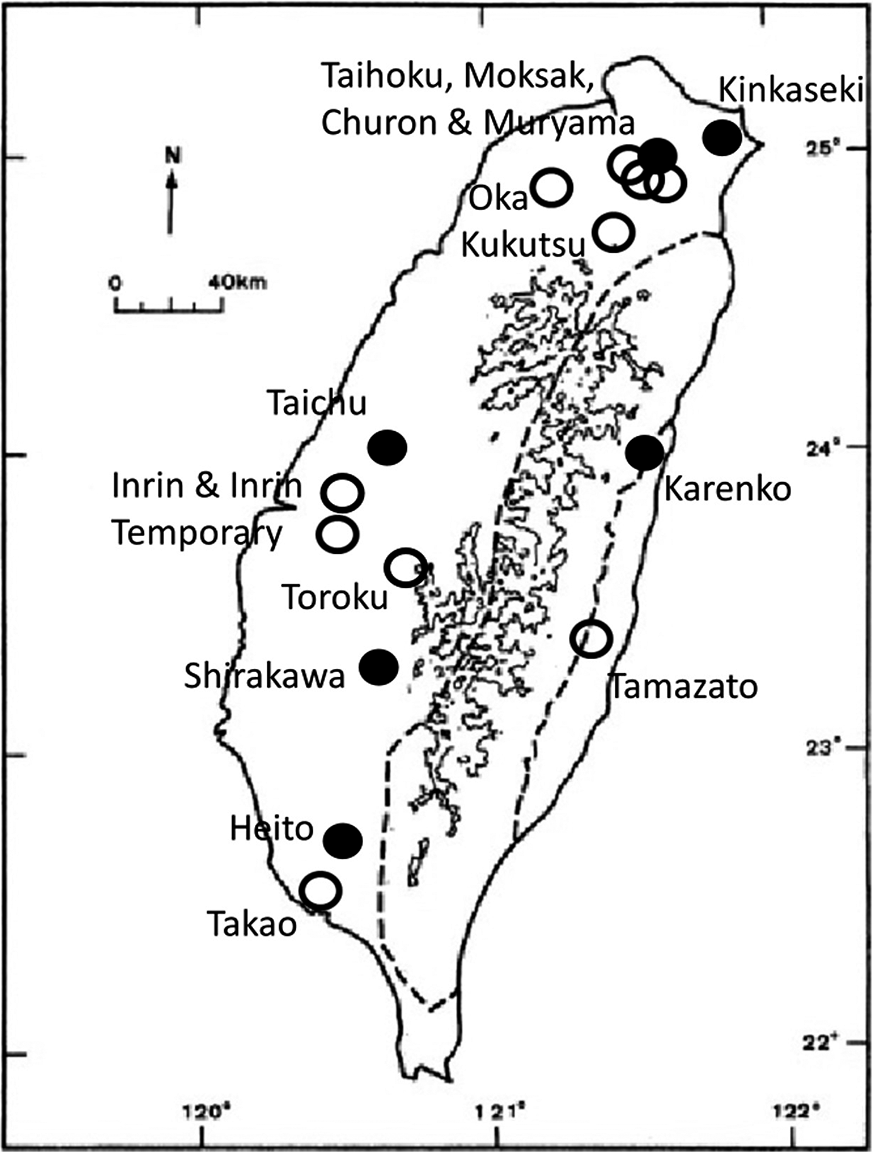
The authorities in Tokyo wanted to place 7,000 PoWs in Taiwan to work in mining, construction and agriculture.Footnote 25 A low estimate of the number actually incarcerated is 2,880, but others are higher, over 4,000.Footnote 26 The camps were poorly documented until Hurst’s extensive oral history and archival research led to a memorial society, a website and a book.Footnote 27 Hurst’s book is detailed, informative and comprehensively illustrated but does not use footnotes or references. Tett provides a summary description of the camps.Footnote 28 Sixteen are listed in Table 1 in order of the date they opened.Footnote 29 Their location is indicated in Figure 3.Footnote 30 Taihoku and Taichu were built as PoW camps, but others were in repurposed buildings, for example, a military barracks (Karenko), a school (Toroku) and a hotel (Inrin). Kukutsu and Oka were constructed by PoWs. They can be grouped into labour camps, senior officers’ camps, and temporary holding camps.
PoW camps in Taiwan
Modified from West Point Academy, op. cit. (note 29), public domain.
Map of Taiwan, showing the approximate location of PoW camps. Closed circle = major camp. Open circle = temporary camp. Contour lines at 2,000 and 3,000 metres. Dotted line shows boundary of Taiwan’s Backbone Range. Modified from Figure 2 in Yui and Chu, op. cit. (note 30), with permission.
The Taiwan doctors
The author searched the website of the Taiwan POW Camps Memorial Society for doctors using relevant search terms and compared the names with the 1944 list of Taiwan PoWs held in The National Archives which identified doctors by a handwritten Japanese character.Footnote 31 Searches were carried out for newspaper items, obituaries, directory entries,Footnote 32 and first-person material in diaries, memoirs, articles, theses, reports, and War Crimes Trial testimony. The indices of secondary histories were also searched. Forty-five doctors were imprisoned in Taiwan at some point but the number on the island at any one time was always lower than forty-five and probably lower than twenty. All are listed in Appendix 1. They arrived in Taiwan by sea.
Table 2 shows the number of doctors by country, branch of the military and rank. Four countries are represented, the largest group American (22), followed by 14 in the British forces (including a Canadian in the Indian Medical Service (IMS)), five from the Royal Netherlands East Indies Army and four from the Australian Imperial Force (AIF). Most (42/45) were army doctors. A surprisingly high proportion, 17/45, were full colonels (or their naval equivalent) and above. This unusual distribution is explained because from 1942 to 1944 the Japanese used Taiwan to imprison the most senior military officers and civilian colonial officials, an issue discussed in more detail below.
Branch of service and rank of the Taiwan doctors
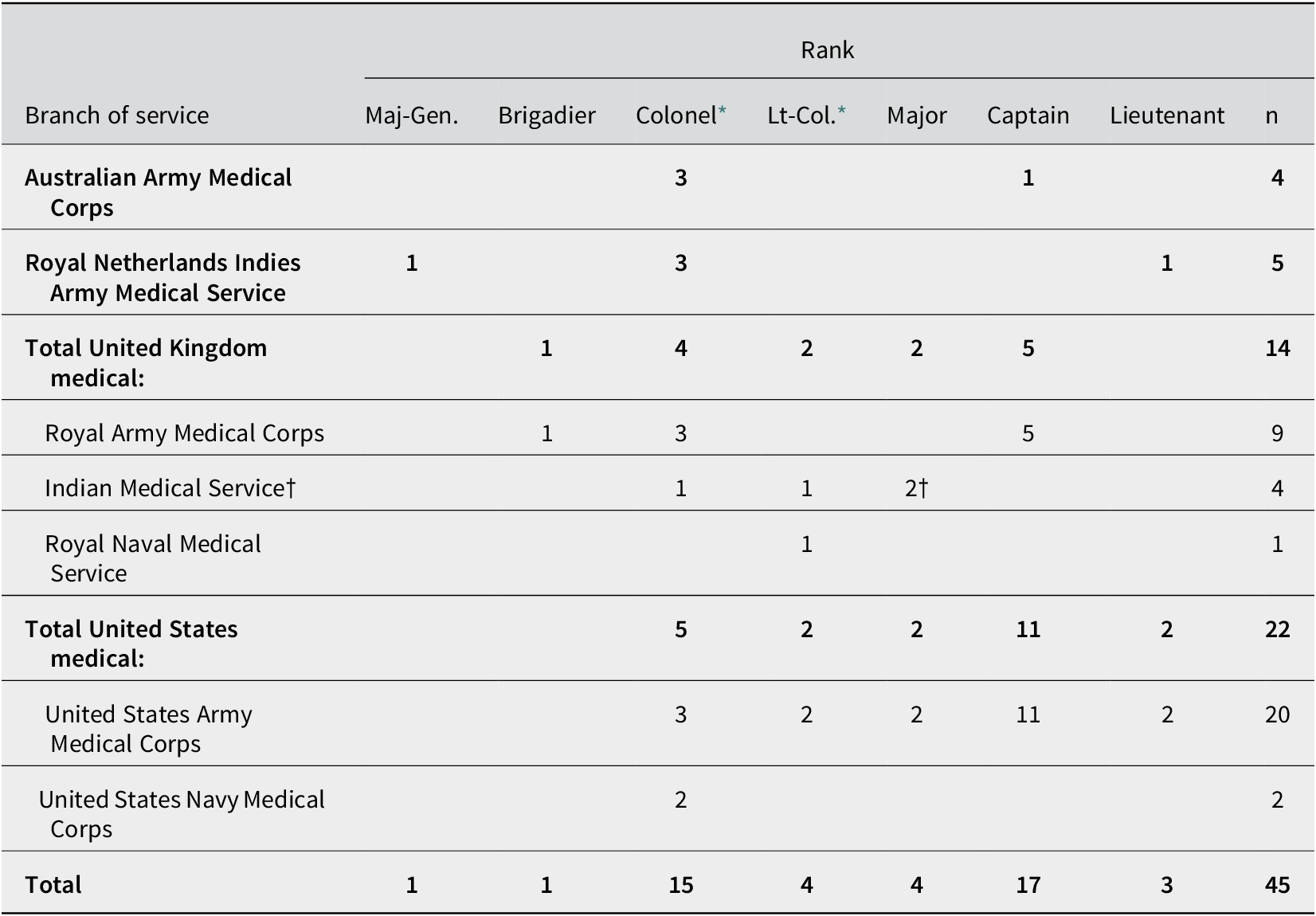
* or the equivalent naval rank; † includes a Canadian.
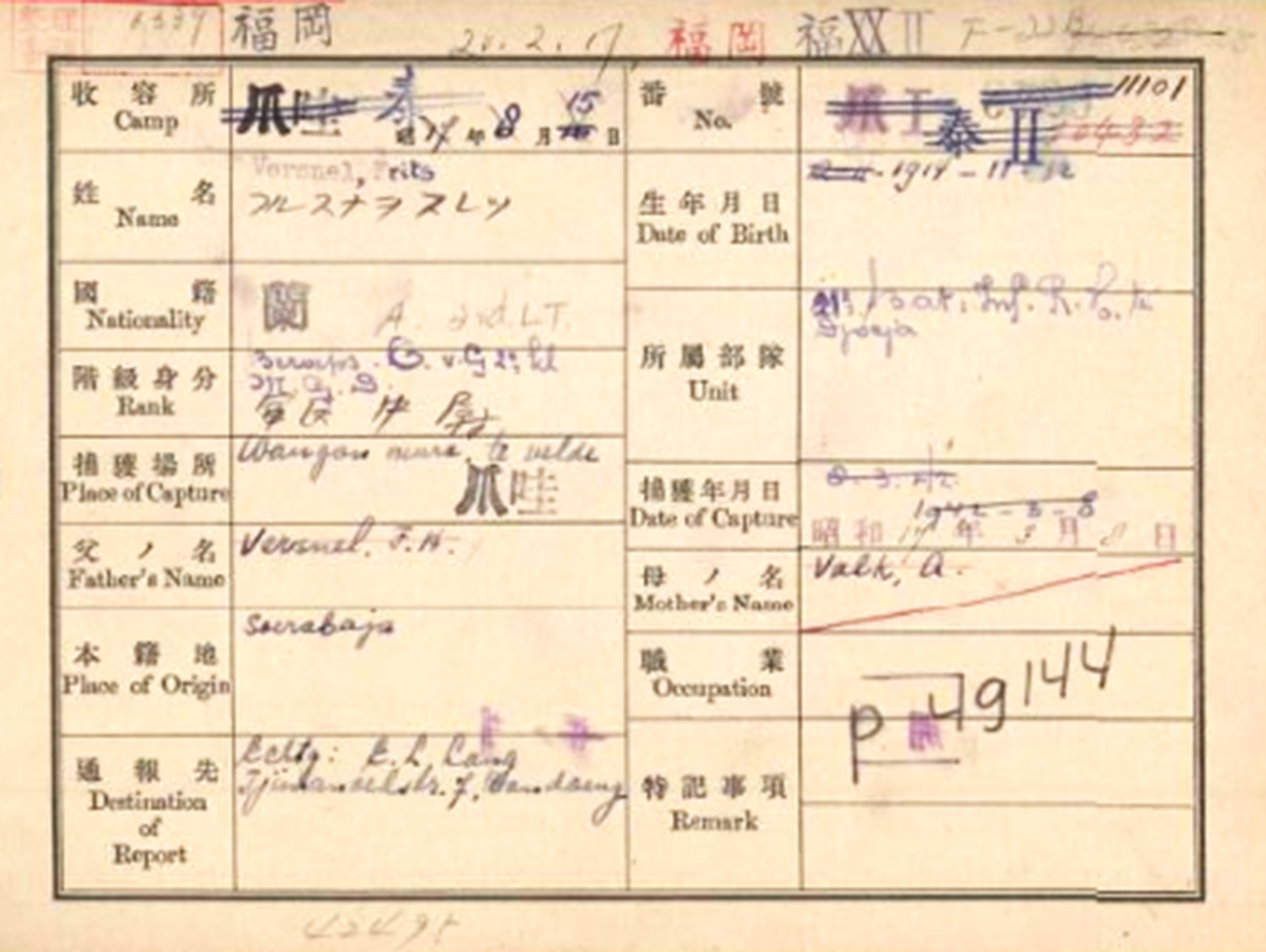
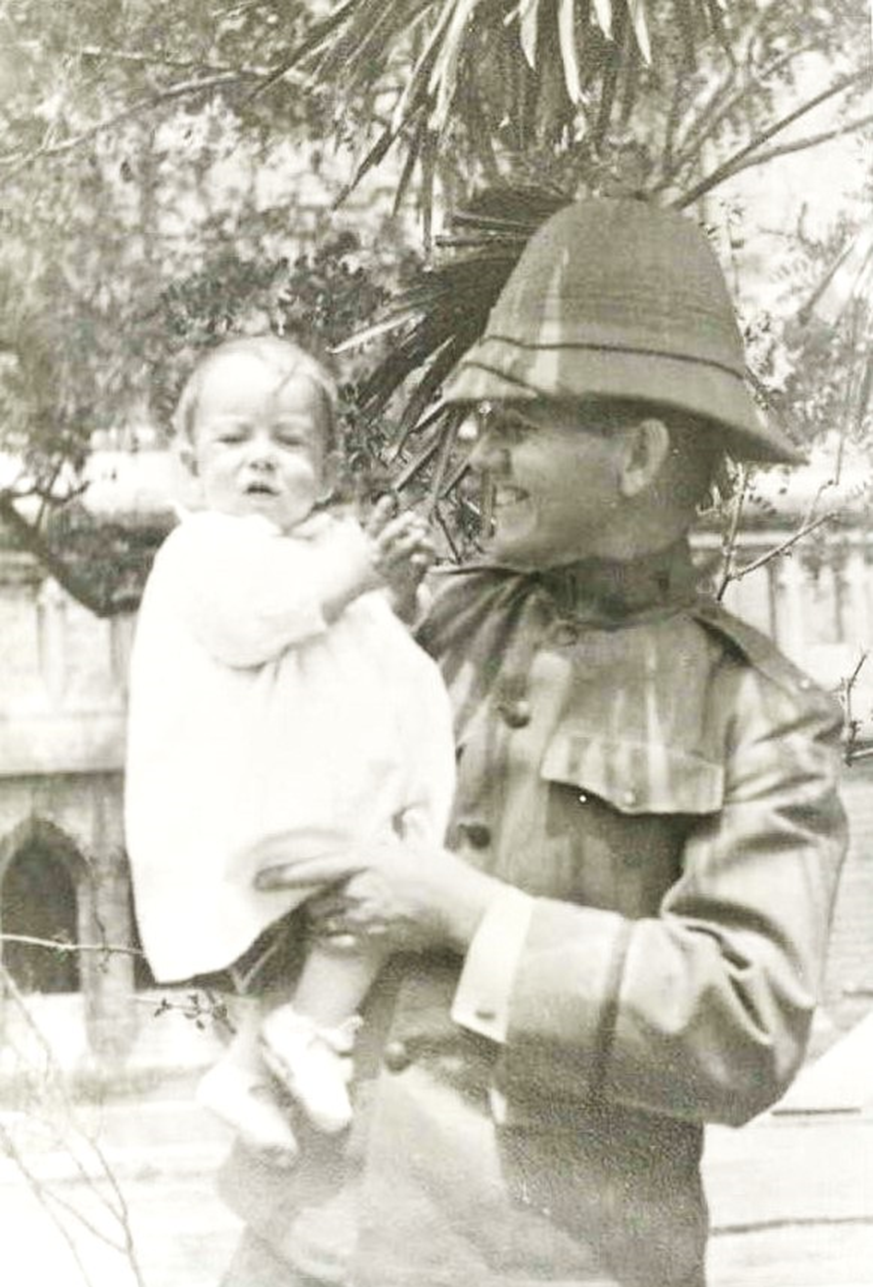
Many doctors had connections with the region. Their Japanese PoW cards show that four Dutch doctors gave Indonesian contact addresses and one (Versnel) was born in the Dutch East Indies (Figure 4) which implies not only that they were residents, but also that their wives and children may have been among the many civilians interned by the Japanese.Footnote 33 The four IMS doctors had worked in India (which then included modern Pakistan and Bangladesh) since the 1930s. This hybrid civil and military service originated with the East India Company and would form the nucleus of medical research and public health institutions after Independence.Footnote 34 Francis Allinson, one of twin surgeon brothers who served in the IMS, would become Professor of Surgery in Dacca after the war.Footnote 35 Several American doctors had served in the military in the Philippines and would return after the war (Figure 5).
Frits Versnel’s Japanese internment card. Dutch National Archives, op. cit. (note 33), public domain.
Wibb Cooper and baby son in the Philippines, about 1913. Ancestry.co.uk, Cooper family, with permission.
The search threw up incidental family information. Australian Colonel Derham’s son Thomas (1918–79), a private in the 2/9th Field Ambulance, was in the same camps as his father. Australian Dr Patrick O’Donnell’s brother Ian (1905–84), an engineer officer, was imprisoned with him in Heito. Their sister Alice (1901–43) was one of the AIF nurses killed when the hospital ship Centaur was sunk in 1943.Footnote 36 British Brigadier Stringer’s wife, Olga (1890–1942), a volunteer nursing assistant, also died at sea on the Tanjong Penang in one of the attempts by nurses to escape from Singapore in February 1942.Footnote 37
First-person accounts
First-person accounts are necessarily subjective and the influential military historian, John Keegan’s, statement fifty years ago that allowing combatants ‘to speak for themselves’ is ‘an essential ingredient of battle narrative’ was innovative at the time.Footnote 38 Keegan emphasised that contemporaneous impressions were the most valuable and, recently, Frances Houghton, in her study of veterans’ memoirs, reiterated the caveat that accounts written many years later are written and published in a social and cultural context with a particular narrative of the war.Footnote 39
Paper was scarce in the camps and the Japanese monitored and sometimes confiscated personal diaries. Dr John Glover wrote that the Japanese ‘were assiduous in preventing the collection of records and in destroying such scanty manuscripts as it was possible to write.’Footnote 40 Despite this censorship, the search identified several relevant records deposited in British and online archives. Other medically related Taiwan material may well survive.Footnote 41
The diary kept by Canadian Ben Wheeler is a good example.Footnote 42 His daughter, Anne Wheeler, is a film director and combined her father’s diary with oral history from his colleagues to make a drama-documentary, A War Story. Footnote 43 One of her sources was Dr Peter Seed who deposited his interview transcript in the Imperial War Museum along with notebook entries, letters and drawings.Footnote 44 Before the Wheeler files were closed his diary was quoted by others.Footnote 45
The Blair papers are another important source, a large archive spread across four collections. George Blair’s experience was unusual in that he spent all his Taiwanese captivity in one camp, Taihoku, where for over a year he was the only doctor.Footnote 46 His papers mainly comprise family letters and factual clinical records but information about camp conditions can be inferred, and the Wellcome and Royal Army Medical Corps (RAMC) Headquarters Collections include drafts of a thesis.Footnote 47
One of the most interesting contemporaneous records is that by Gunner John Clement, who developed tuberculosis, giving him a patient’s perspective on a succession of doctors in five camps in Taiwan.Footnote 48 He was a commercial artist before the war and illustrated his detailed and meticulous diaries with profuse coloured crayon sketches. The tone of the drawings is often humorous, which may have protected them from destruction.
There is other material written immediately after the war, while memories were fresh. Drs Wheeler, Blair and Lewis accompanied the sickest PoWs on the New Zealand hospital ship Maunganui after they were liberated and each contributed a short, factual essay to the ship’s newsletter, What Knots. Footnote 49 Several doctors sent affidavits to the British War Crimes Trials in Hong Kong in 1947 and 1948 in which there were 95 charges of 123 individuals of which 25 charges related to Taiwan.Footnote 50 Two doctoral theses (by Blair and Glover) were written for British universities immediately after the war.Footnote 51 John Bennet’s scholarly contributions on malnutrition include a substantial Introduction to the Medical Research Council’s Special Report No. 274 in 1951.Footnote 52 Wibb Cooper wrote an official report on the US Army Medical Corps’ work in captivity.Footnote 53
Personal memoirs were published later, and this search identified six, all by Americans. The first to appear was Braddock’s in 1961, in which Taiwan was only one episode in a life which included teaching in Japan, Serbia in the First World War, a brief spell in the RAMC, a Mexican oil company, a mining village in Nevada and the US Veterans Administration. Although then aged over 50, he rejoined the US Army in the Second World War, was posted to the Philippines, went to Taiwan with other senior officers on the Lima Maru and was eventually liberated in Manchuria by US paratroopers and Russian troops. Three memoirs appeared in the 1970s: Goodman’s in 1972, Gaskill’s in 1975, and Poweleit’s in 1976. In the 1990s, accounts were published by Coone (1992) and Donovan (1998).Footnote 54
This article does not aim to produce an exhaustive bibliography but there are several relevant memoirs by non-medical PoWs.Footnote 55 Accounts of interest include Brougher’s edited diary, Braly’s detailed memoir published immediately after the war, Kent Hughes’ epic poem, the short but beautifully written account of Shirakawa camp by David Piper, the future art historian, and Padre Fred Stallard’s collection of sketches, also from Shirakawa.Footnote 56 As a Dutch curator wrote, ‘Drawings are of major importance because there are hardly any photographs.’Footnote 57
Heito, Taichu, Kinkaseki, and Taihoku camps
There were four principal labour camps in Taiwan, each housing about 400–500, where prisoners worked for public authorities or commercial companies. At Heito they cleared ground and moved rocks in order to plant sugar cane and also worked in a sugar cane factory. The camp was closed in March 1945 after Allied bombing. At Taichu (River Valley, Wall) camp, PoWs dug a flood diversion channel and flooding closed the camp in July 1944. Kinkaseki, the copper-mining camp, was active until May 1945. Also in the north was Taihoku (Bamboo, Paradise) camp, near Japanese headquarters in Taihoku city, where the men constructed roads and a ‘Victory Park’ and worked in a train and bus repair shop.
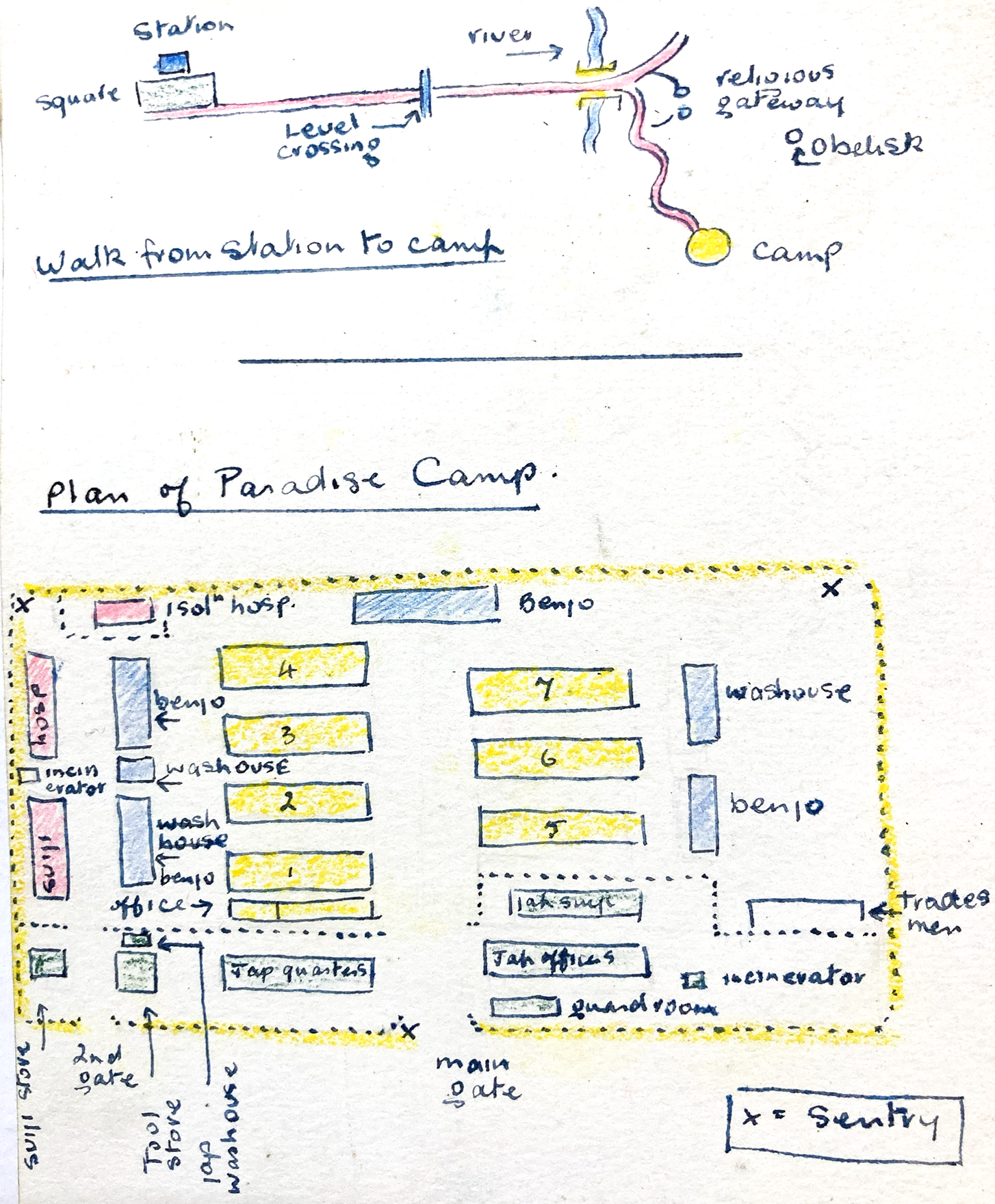
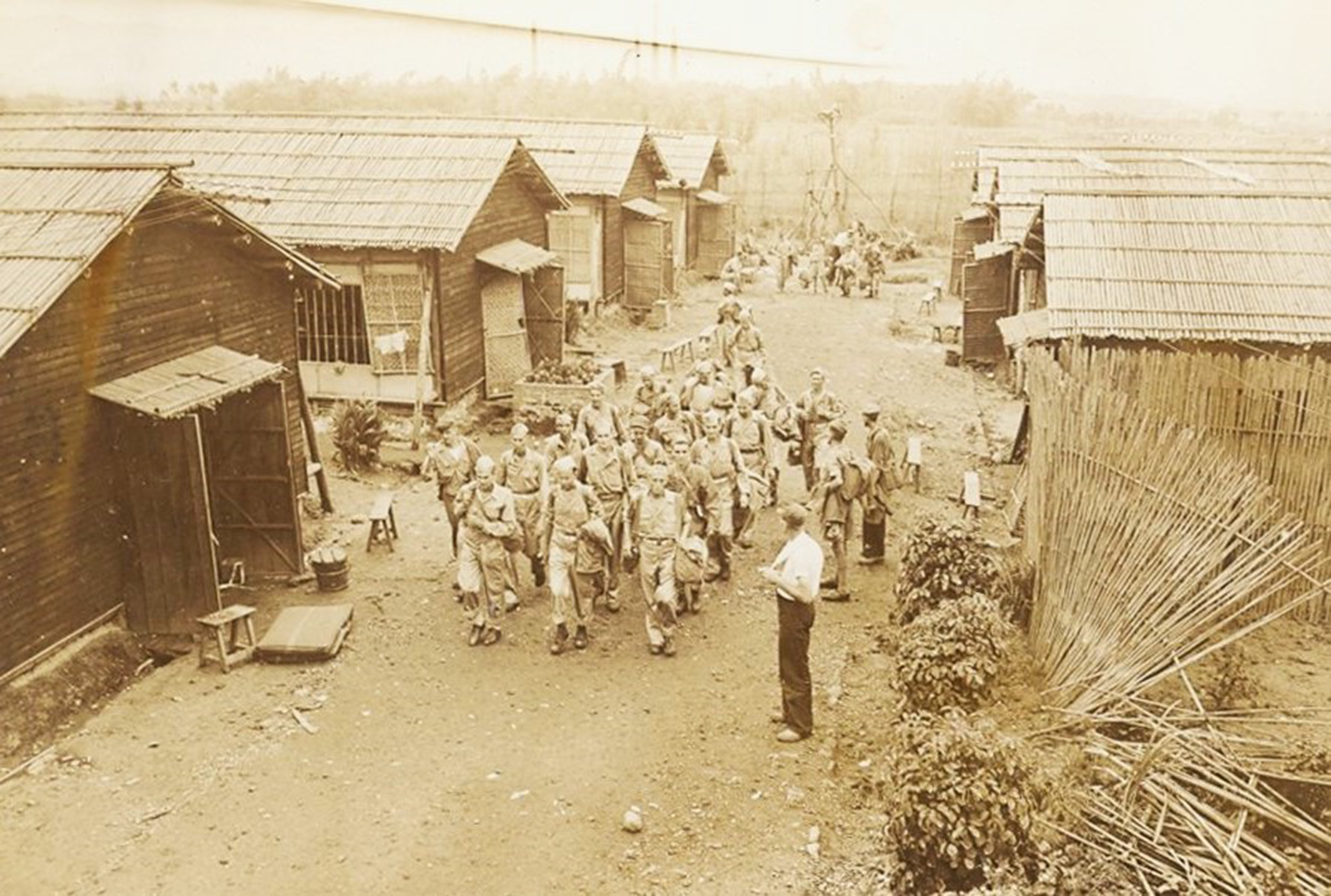
Kinkaseki is the camp most frequently associated with Taiwan, perhaps because the dangerous labour in an underground copper mine, coupled with an exhausting climb between camp and mine at the beginning and end of each work shift, corresponds most closely to the popular image of captivity under the Japanese. But, medically, Taihoku is the best-documented camp because of Blair’s surviving files. In Piper’s opinion, Taihoku was ‘a tight hard and claustrophobic camp’.Footnote 58 We know what it looked like from sketches, photographs from the time of liberation,Footnote 59 and War Crimes Trial testimony: a collection of bamboo huts surrounded by a bamboo fence. In the accommodation huts, men slept on a continuous shelf down each long side, and a line of narrow tables down the centre was used for eating and other activities. Each was partitioned into four messes, three with twenty-four men each and one for twelve. The camp also contained latrines, a cookhouse, stores, a hospital, and isolation huts. Clement’s coloured plan is in Figure 6 and a view at liberation is in Figure 7. The Imperial War Museum art collection includes a series of watercolours by James Morris, a British war artist who accompanied the liberation force.Footnote 60
Plan of Paradise (Taihoku) camp. Benjo = latrine. Clement, op. cit. (Footnote note 48), with permission.
Huts in Taihoku camp at liberation. USS Block Island Association, Formosa POW Rescue, op. cit. (note 59), with permission. No photographer credited.
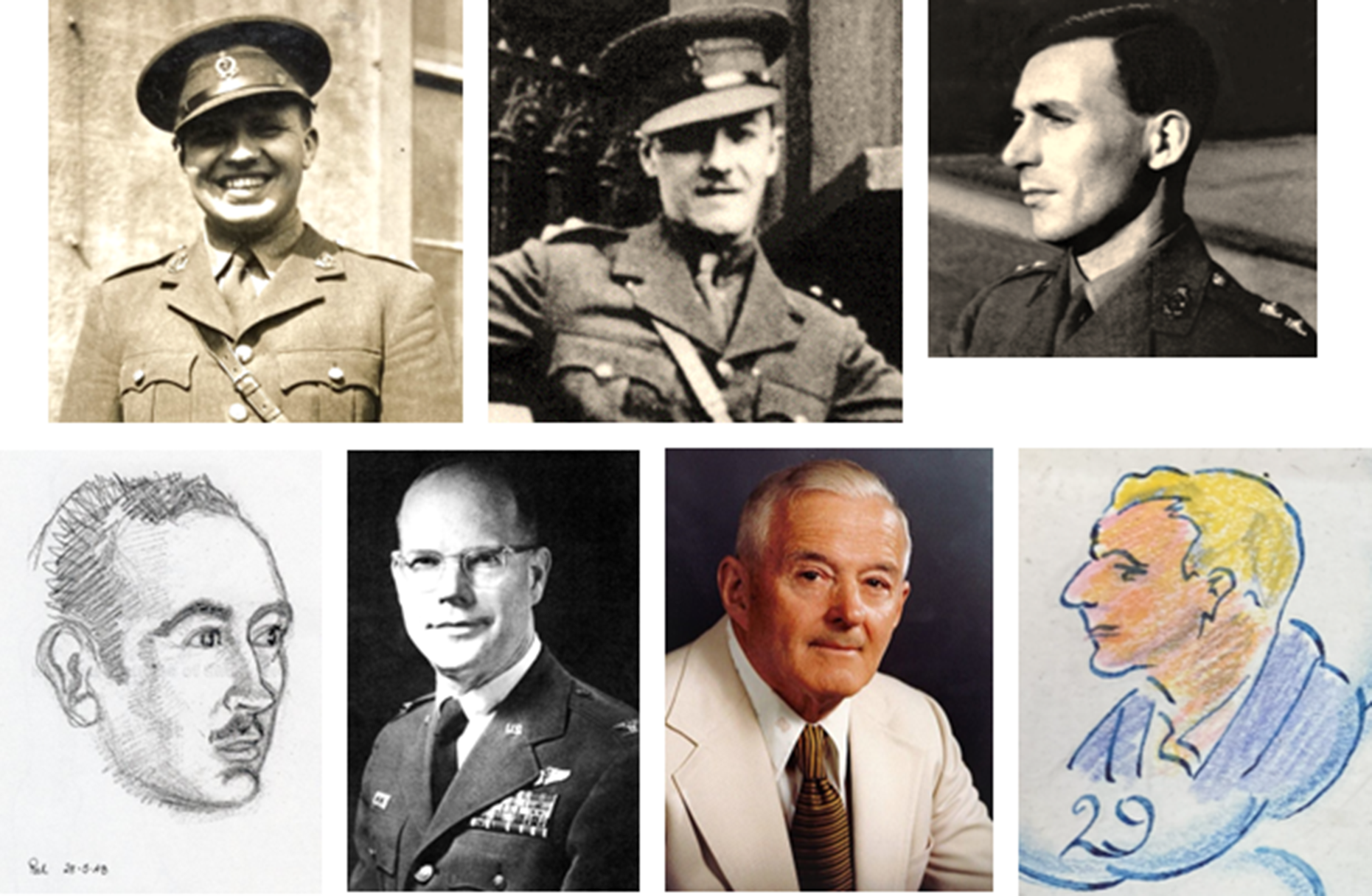
For most of the war, these four camps with their shifting population of almost 2,000 were staffed by only seven doctors: six from the British forces (four RAMC and two IMS) and one Australian (Figure 8). Drs Grant and O’Donnell arrived in Heito in August 1942 with the ‘Special Party’ of senior figures from Singapore,Footnote 61 Drs Allinson and Glover worked in Taichu, Drs Wheeler, Seed and Blair arrived in November 1942 on the England Maru’s second voyage from Singapore, accompanying 1,100 men from three artillery regiments in ‘Overseas Party ‘Z’, and covered Kinkaseki and Taihoku.Footnote 62 In November 1944 sixteen American doctors arrived from Manila, survivors of the ‘hellship’ Hokusen Maru, and added temporary medical staffing in several camps. One of them, ‘Herb’ Coone, came to Taihoku in February 1945 with a party of sick Americans and left for Oka in June. He was followed in March 1945 by Grant and O’Donnell from Heito. Blair wrote, ‘as a result of these moves I have taken over the Hospital and BB patients, O’Donnell continues to do the Fevers, while Grant does the surgical side, including the town party.’Footnote 63 Transfers of doctors are discussed more fully below.
Doctors stationed at the four work camps, 1942–45. Top row from left: Blair (Wellcome PP/GBL, op. cit. [Footnote note 47]), Wheeler, Seed (powtaiwan.org, op. cit. [Footnote note 27]). Bottom row from left: O’Donnell (Stallard, op. cit. [Footnote note 21]), Coone (powtaiwan.org, op. cit. [Footnote note 27]), Allinson (RCSEng op. cit. [Footnote note 35]), Glover (Clement, op. cit. [Footnote note 48]). All are either public domain or with permission. Grant is missing.
Doctors reported to the senior Allied officer and were involved with the rare visits by International Red Cross representatives. Interactions with the Japanese commander were not always constructive; doctors were sometimes beaten (‘the clouting’ according to Seed) and Piper recalled the commander at Shirakawa telling ‘the doctors they should work harder – there were too many people dying’ and that ‘walking barefoot on dewy grass’ was good for beri beri.Footnote 64 Hurst records that, unusually, the doctors took over as joint commanding officers (COs) at Heito in 1944 after the other officers were transferred. Most unusually for Japanese camps, Heito also contained a secret radio until 1943, smuggled in from Changi.Footnote 65 Hurst’s oral history documents that Dr Grant took it over after its original builder left, a dangerous responsibility.Footnote 66
Trained medical orderlies provided nursing care and the doctors spoke highly of these men. Other PoWs also volunteered. For example, Clement, while a long-stay hospital patient, nursed a man with a leg fracture who was immobilised by traction and Dr Blair notes the names of several officers and other ranks who volunteered in the Taihoku sick bay or hospital. The military chaplains were expected to work with the medical team alongside their pastoral duties.Footnote 67 Anglican Tom Pugh (1903–80) visited the Taihoku hospital regularly and also became George Blair’s messmate. Jesuit Richard Kennedy (1906–86) ran the diarrhoea ward at Kinkaseki for a time, as well as befriending Dr Peter Seed, a fellow Catholic.
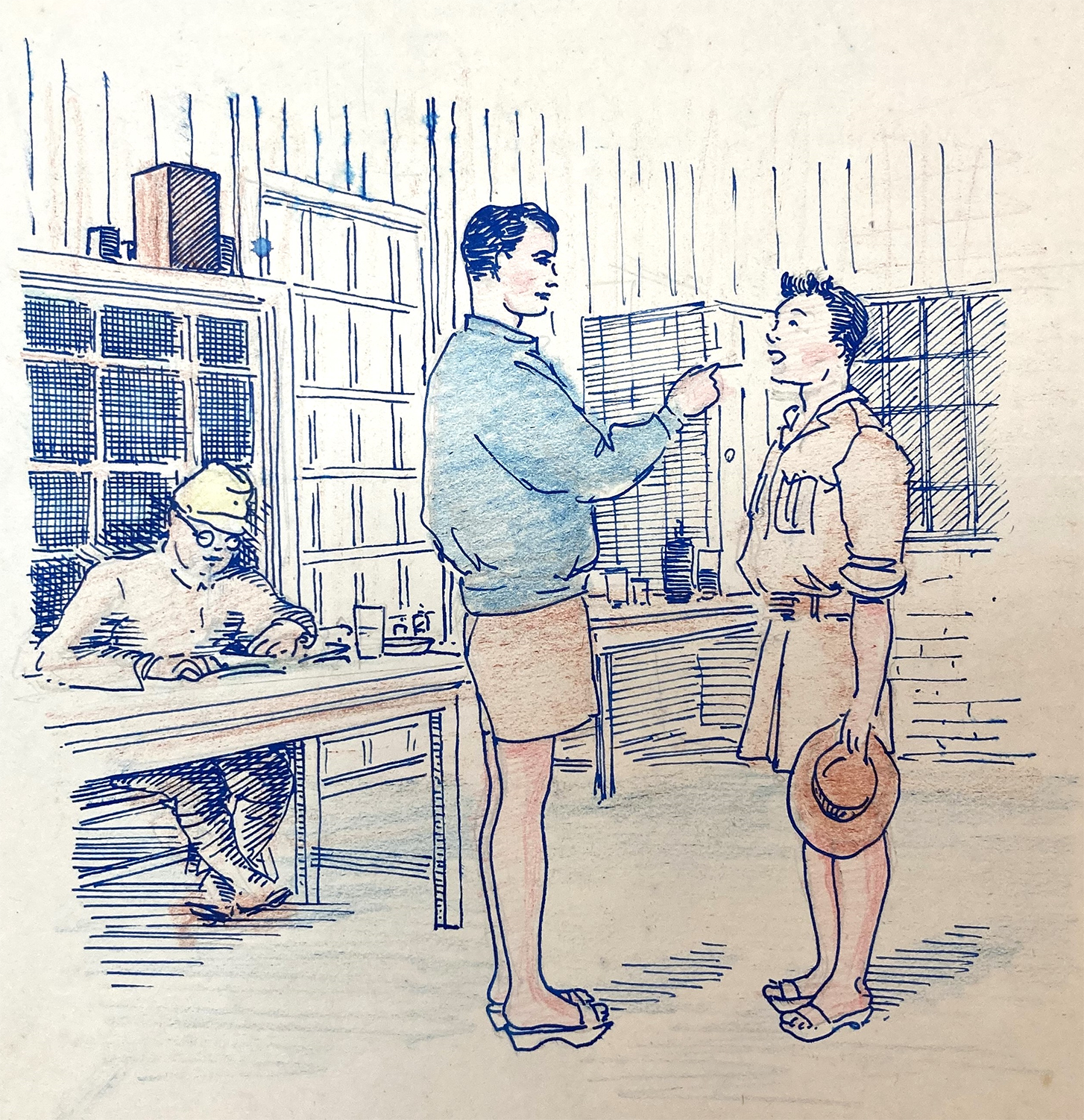
The daily timetable was similar across the camps. Blair notes a sick parade after each of the three camp meals, the one after lunch including a weekly review of beri beri cases.Footnote 68 He did morning and evening ward rounds and two minor operations and dressings sessions per day and recorded draining abscesses and treating foreign body injuries to the eyes of train and bus repair workers. The Japanese medical orderly attended after the morning sick parade and Peter Seed’s papers include a drawing, clearly sanitised, of a sick bay consultation (Figure 9).
Sick-bay consultation at Kinkaseki. Seed, op. cit. (note 44), public domain.
Medical practice
Japanese military culture meant there was a constant background of seemingly casual violence in slappings and worse beatings, but their war crimes were, largely, medical and the PoW experience was of starvation, malnutrition, infections and infestations. The cookhouse and latrines dominate diaries. Meals were rice-based and deficient in protein, calories and several vitamins.Footnote 69 The doctors were involved in overseeing aspects of diet, encouraging the eating of rice ‘polishings’ (husks), for example, to increase the intake of B vitamins. Most prisoners exhibited oedema caused by vitamin B deficiency, possibly combined with protein deficiency. Men displayed considerable ingenuity in buying or bartering additional supplies from local people and in foraging for food. Clement, for example, describes gathering bamboo shoots and catching snakes and snails: ‘got 3 snails also…baked in the embers…burnt them but will eat anything’, ‘Nearest approach to fish and chips I’ve had for a long time.’ For the senior officers, snails were ‘Karenko clams’.Footnote 70
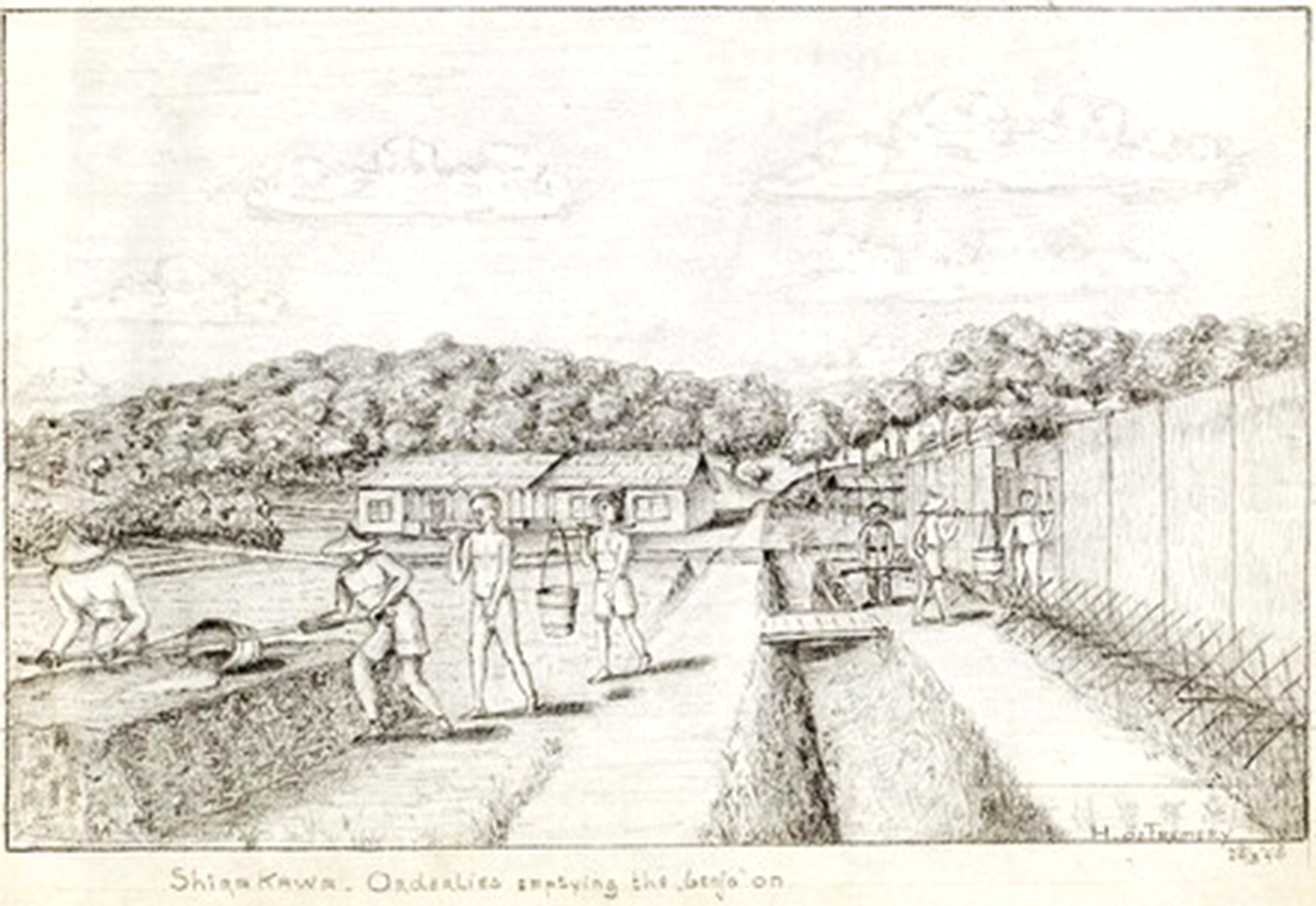
The Japanese organised immunisation campaigns and enforced isolation arrangements for infectious diseases but latrines were usually of the pit type, close to the cookhouse, emptied by hand, and the contents used to fertilise fields (Figure 10). Insanitary conditions led to repeated outbreaks of diarrhoeal disease and infestations with intestinal worms that could not be eradicated. Skin conditions could lead to ulcerated sores. Malaria does not appear to have been as much of a problem in Taiwan as it was in the jungle camps in Thailand and Burma, but there were recurrences from infections acquired before capture and, in parts of Taiwan, mosquitoes were prevalent.
Carrying benjo buckets to fertilise the fields, Shirakawa. De Fremery, op. cit. (note 97), with permission.
Prisoners were regularly weighed and all lost weight, even the most senior officers. Blair’s notes from August and October 1943 record camp averages of only 55 and 53 kg and PoW Lionel Haylor’s diary states that his usual weight was 85.7 kg but fell to its lowest in 1945, between 47.2 and 50.8 kg.Footnote 71 Dispersal decisions often depended on weight: heavier PoWs were deemed capable of heavier work and ‘thin man’ parties were transferred from work camps, such as Kinkaseki, to other camps, such as Shirakawa. Food, work, weight and illness were closely interrelated. It was Japanese policy that work was reflected in pay and rations, a policy which had its greatest impact on the sick. If a camp’s proportion of sick rose, less food was supplied, but most camps shared food equally and would supplement hospital rations when they could, which meant a deficient diet for all. Prisoners were placed into four groups: fit for heavy work, fit for light work, sick in camp, and sick in hospital. These categories were strictly enforced, and each camp had only a limited allocation of those tokens which denoted sickness. On a daily basis, the doctors mediated between men who were unable to work and Japanese medical orderlies who required a man to be visibly sick.
Camp doctors had few resources. They carried enough medical kit and stores from their camp of embarkation to cover the journey to Taiwan, ‘two Regimental Medical Panniers’ in Blair’s words,Footnote 72 but received little in the way of replacements. When gauze dressings and bandages had rotted after repeated rewashings, ‘I [Blair] used cellophane squares from the inside of Japanese cigarette packets. … When the Japanese no longer packed their cigarettes in cellophane…I had to use ordinary newspaper…’.Footnote 73 An ‘extraction of cinchona bark’ was prepared at Heito, ‘a revolting potion. It kept the malaria at bay.’Footnote 74 Clement records a medical orderly boiling up ‘dog ends’ in Inrin as a topical application for pellagra. There are records of Japanese-supplied drugs such as aspirin, quinine and a vitamin B preparation but ‘in general the Orderly would not give more than three days’ supply at once for any one man’ and the doctors had to ration these scarce medications.Footnote 75 They performed paracenteses to draw off peritoneal fluid to relieve abdominal distension in beri beri cases. For example, fourteen pints were recorded by Blair on 27 August 1943 and ten from a different patient on the following day.Footnote 76 He used Southey’s tubes (small cannulae) to drain fluid from oedematous ankles and gave small blood transfusions (the donor rewarded with an egg), procedures also carried out by other doctors elsewhere.
Despite these conditions, the doctors kept to a routine and made careful records. The Blair archive, for example, contains a large hard-backed book, originally designed for recording stores required for naval construction and presumably salvaged from the naval dockyard in Singapore, which became the Taihoku hospital admissions book. Small notebooks supplied by the Japanese record weights, administrative data and case histories. Between the pages are loose and evocative scraps of paper and card which contain surviving temperature charts, fluid balance charts, prescriptions and other temporary notes.
Patterns of illness and mortality in labour camps
The pattern of illness and death in Taiwan was broadly similar to the pattern elsewhere and technical medical details are not recapitulated here.Footnote 77 In vivid lay language, Piper wrote ‘I see back after back, wing-boned, vallied and shrunken in the skeleton. The sharp nobbled ridge of the back-bones… Ankles swollen like bladders, fold on the joints like a pillow folded, and the odd sprawl of toes from the shapeless balloon. Apathy of the eyes. Skin parchment texture, ingrained with grime, and blotched with sores and eruptions.’Footnote 78 One of Glover’s strongest memories was ‘the sound of noisy watery defaecation in the latrines; of tell-tale trails of liquid faeces on the ground…’Footnote 79 Blair remembered that ‘hunger was always predominant’, ‘many men had a mild degree of oedema throughout their captivity’, ‘worms were continually troublesome [after June 1943]’, ‘malaria was common’, and ‘skin diseases were constantly present’.Footnote 80 Interviewed in 1977, Seed remembered dying men, ‘I was the last human being they would have contact with in this squalid death at the other end of the world from their homeland.’
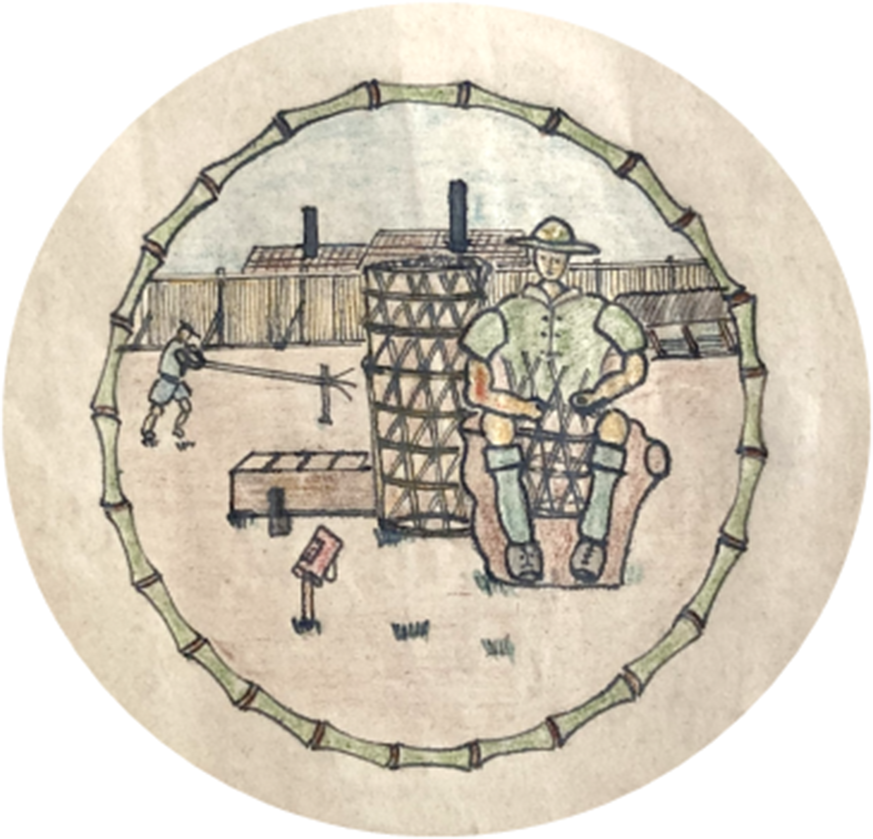
The War Crimes Trial files include a snapshot for Taihoku on 21 September 1943 when ‘105 men (over twenty per cent of the camp strength) were sick: 18 in hospital, 34 allowed to lie down in their huts, 46 carrying out light duties in camp, and seven who had reported sick but were not yet categorised. Of the sick, 35 had beri beri, 28 had disorders such as fevers, jaundice and diarrhoea and 42 had skin conditions including ulcers and boils.’Footnote 81 A hand-drawn greetings card illustrates the bamboo basket-making work which the sick carried out at Taihoku from October 1943 (Figure 11).Footnote 82 The Blair archive contains records of sick-bay attendances for less serious illnesses; we know, for example, that the only illness Padre Tom Pugh suffered was an episode of dengue, and he was not hospitalised.
Light duties making a bamboo basket, Taihoku. Detail from 1944 Christmas card. RAMC HQ, op. cit. (note 47), public domain.
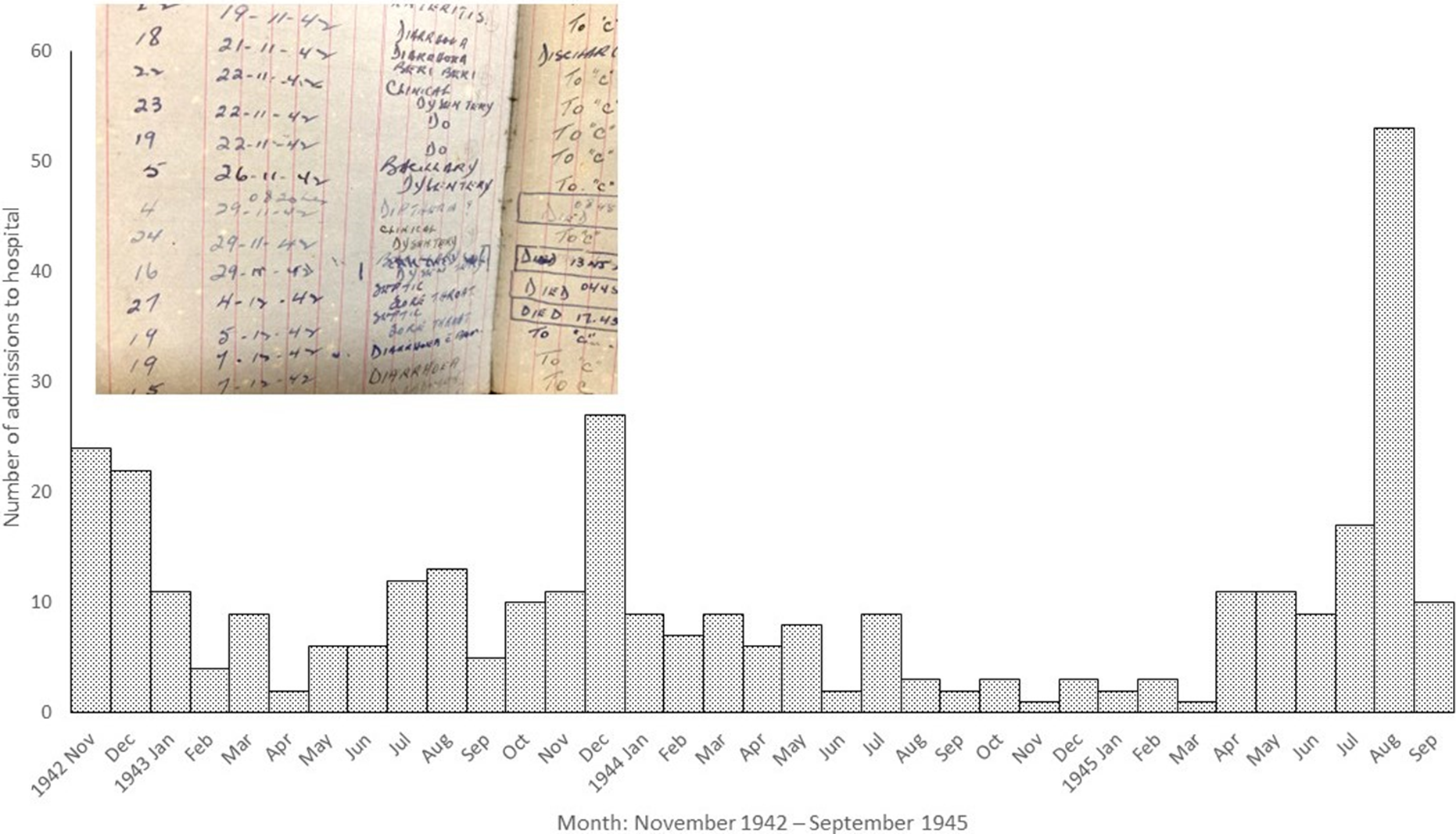
The Taihoku hospital admissions book provides a complete sequence of admissions and in-hospital deaths from one camp. Figure 12 shows the monthly hospital admissions. Most were for diarrhoeal diseases or beri beri, in its various forms. The peak at the beginning of Taiwanese captivity is related to the outbreaks of diarrhoeal disease and diphtheria that started on the ‘hellship’ England Maru. An anonymised extract in Ben Wheeler’s handwriting from the book’s early pages is also shown in Figure 12 and illustrates the precision the doctors attempted despite their lack of diagnostic resources: he distinguishes between ‘bacillary dysentery’, ‘clinical dysentery’ and ‘diarrhoea’. The peak at the end of the war occurred because the hospital was extended to take sick men from across the island ready for repatriation. At this stage, men were dying of starvation and diagnoses simply of ‘anorexia’ and ‘debility’ were recorded.
Monthly admissions, Taihoku hospital. Extracted from data in Museum of Military Medicine, op. cit. (note 47), public domain.
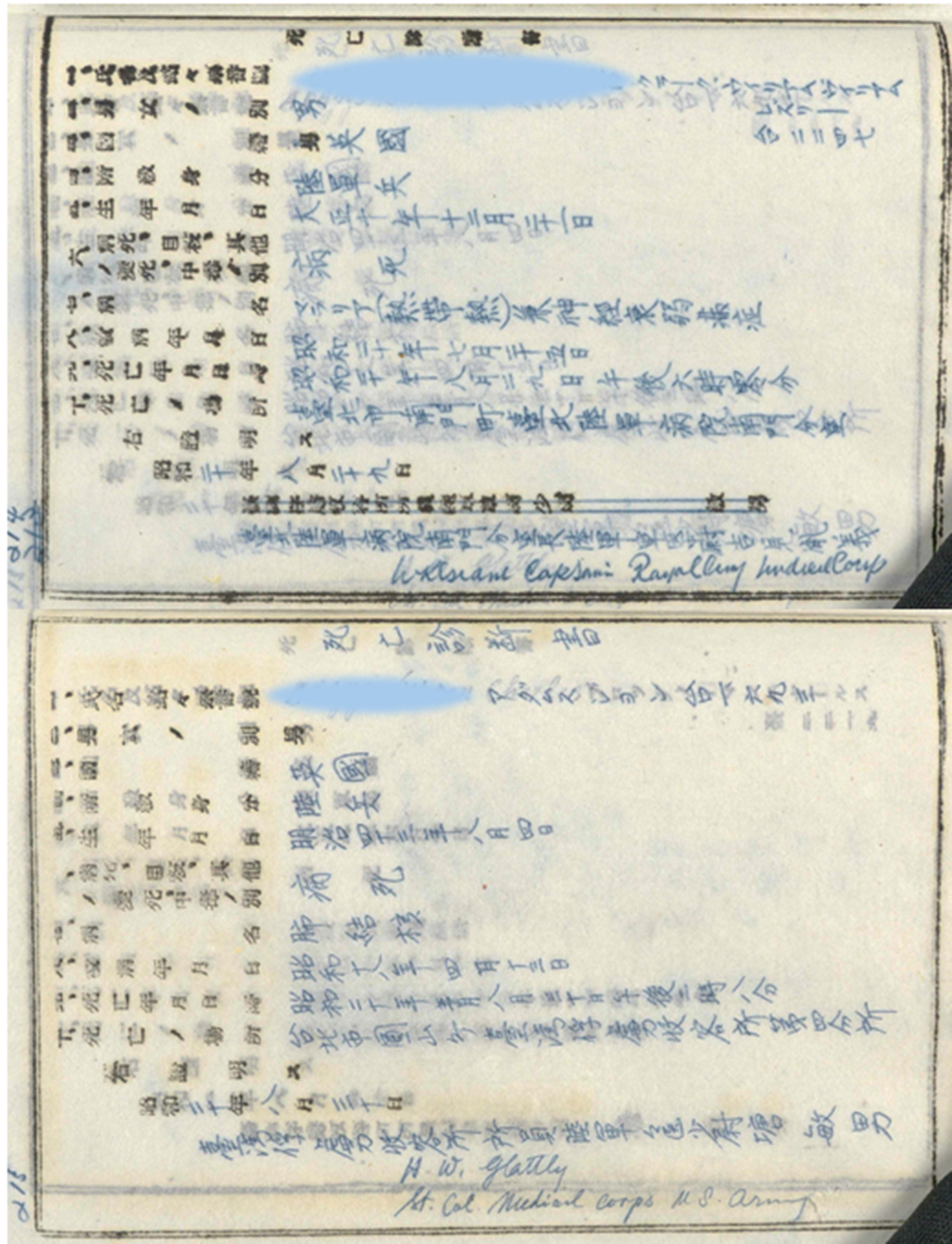
Mortality data were also recorded in as precise terms as possible and the Japanese authorities required a death certificate signed by an Allied doctor (Figure 13).Footnote 83 At liberation, Allinson and Blair gave lists of deaths under their care to MI9, the British agency responsible for interviewing repatriated or escaped PoWs.Footnote 84 Lists of deaths at Heito and Kinkaseki,Footnote 85 with their causes, are also preserved in The National Archives and these four sources provide information on the deaths of 330 prisoners from the four principal labour camps in Taiwan (Figure 14).Footnote 86 This number is an underestimate of the total. There were at least twenty-two additional deaths which occurred at sea or in other camps and deaths elsewhere in Taiwan are not included in Figure 14.
Japanese PoW death certificates (anonymised). Signed by Grant (top) and Glattly (bottom). TNA: WO/361/1475, op. cit. (note 83), public domain.
Monthly deaths in the four labour camps. Extracted from data in WO/361/1475, 1757 and 1758, op. cit. (notes 83 and 84), public domain.
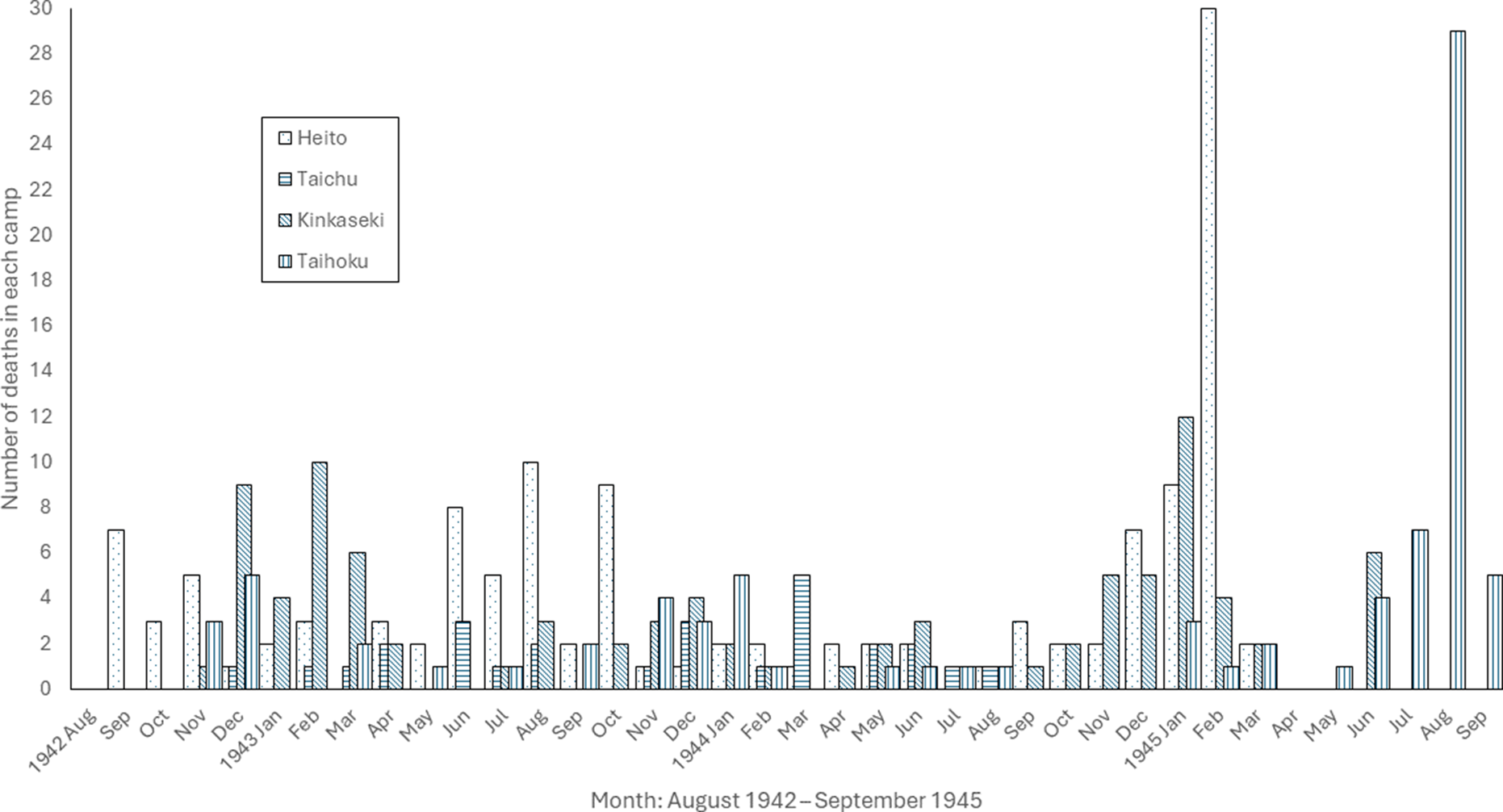
The first deaths in this series occurred in September 1942 during an outbreak of dysentery at Heito, the first camp to open. One of the doctors, William Kennedy, was among the seven dead. Heito’s sugar cane plantations were created from malarious swamps. Of the 129 recorded deaths, causes are available for 111 and, of these, twenty-three are listed as due to malaria alone, twenty-six from malaria and beri beri combined, and thirteen from beri beri alone, over half of the total (62/111, 56%). A further thirteen included malaria or beri beri as one of several causes of death (75/111, 68%). In February 1945, an Allied air raid killed more than twenty-five prisoners and injured others, leading to the camp’s closure. Blair noted that some men still had unhealed wounds from the bombing when they arrived at Taihoku.Footnote 87
At Taichu, a flood closed the camp after less than two years of operation. Allinson’s list of twenty-six deaths is unusual in the prominence it gives to pellagra, mentioned in almost half of the deaths (12/26, 46%). Deficiency of niacin (vitamin B3) causes pellagra, which gives a characteristic roughened appearance to sun-exposed skin, as well as diarrhoea and cerebral symptoms. He gave it as the only cause of death in two, in nine combined with beri beri and, in one, with beri beri and possible meningitis. The prominence of pellagra raises the usual questions about the subjectivity of death certification: it is possible that the diet at Taichu was more deficient in niacin than the diet in other camps, where pellagra is mentioned as a cause of death only rarely, but also possible that Allinson diagnosed it more frequently than other doctors, either because he was more familiar than they were with its manifestations (in the IMS since 1933)Footnote 88 or was more likely to attribute lethality to it. As in other camps, beri beri was a major cause of death, listed alone for one death and in combination with other causes for eighteen (19/26, 73%). Dysentery, malaria, meningitis and scabies are also mentioned.
At the Kinkaseki copper mining camp, Seed was joined by Wheeler in August 1943. In March 1945, Seed and Wheeler were transferred to Shirakawa hospital with a group of sick men. Unsurprisingly for a mine worked by slave labour, eight of the ninety-one deaths were due to injury, for example, crush injuries and fractured skulls. There were also non-fatal mining accidents; Seed remembered skull fractures and Blair recorded ‘several old mine injuries’ which would not heal in men transferred to Taihoku.Footnote 89 Illustrating the semantic aspects of death certification, the Kinkaseki list uses the terms ‘colitis’ and ‘enteritis’ instead of distinguishing between types of diarrhoeal disease, possibly at the request of the Japanese. These terms appear for over half of the deaths (48/91, 53%). As in other camps, beri beri was a prominent cause of death, the sole cause of twenty deaths, and at least one cause of almost two-thirds of deaths (57/91, 63%). Respiratory illnesses were noted for twelve deaths. Perhaps because of the camp’s altitude, malaria was mentioned for only one death.
Blair was at Taihoku for the whole of its operation, working under Wheeler for the first nine months, then alone until other doctors joined him towards the end of the war. He assembled a list of eighty-three deaths (eighty-six if deaths attributable to transport on the England Maru are included). Beri beri was the most common cause, the sole cause in twenty-nine, and one of several in a further twenty-six, two-thirds of all deaths (55/83, 66%). In November 1944, Blair wrote, ‘I have been working on an essay on beriberi but as soon as one argument is advanced, another, diametrically opposed, presents itself!’Footnote 90 He had started this project with Wheeler in February 1943 and would explore the topic further after the war.Footnote 91 A diarrhoeal disease was a cause of almost one-fifth of deaths (16/83, 19%). An outbreak of ‘fevers’ mentioned by Wheeler as starting on the ‘hellship’ led to five deaths probably from diphtheria.Footnote 92 Tragically, Allied air drops of canisters of food and other supplies after the Japanese surrender caused many injuries and two deaths and contributed to a third, one American, one British and one Dutch.
Senior officers and their camps
An unusual feature of the camps in Taiwan was their use to imprison military commanders, colonial governors, and other senior civilian officials. The first group to arrive in Taiwan, in August 1942, was a party of about 130 American officers with about fifty enlisted men from Manila, in Nagara Maru, known to its passengers as ‘Stinko Maru’.Footnote 93 They were followed two weeks later by the England Maru on its first voyage between Singapore and Taiwan carrying the ‘Special Party’ of 400 from Singapore, senior figures with their batmen (soldier servants), in convoy with the Fukkai Maru. Footnote 94 Other senior officers arrived from Hong Kong and Java. In rhyming couplets, Kent Hughes lamented that ‘…many a lesser rank could scarce but laugh/ To see a general, stripped down to his skin,/ Collecting water in an old jam tin/ …Gone was vain pride, false modesty, and rank,/ When everybody sweated, gasped and stank.’Footnote 95 They went first to Karenko then, in June 1943, inland to Shirakawa. In October 1944 they were transported further north to Japan, Korea and Manchuria, away from Allied bombing raids. Shirakawa became a de facto hospital camp.
To illustrate the seniority of these men, Lieutenant-General Arthur Percival (1887–1966), the British military commander in Malaya, came from Singapore with his civilian opposite number, Sir Shenton Thomas (1879–1962), Governor of the Straits Settlements. Major-General Merton Beckwith-Smith (1890–1942), CO of the British 18th Division, was also captured in Singapore and became the most senior British officer to die in captivity; he died of diphtheria in Karenko.Footnote 96 The CO of the Royal Netherlands Indies Army, Major-General Hans de Fremery (1875–1972) was captured in Indonesia and made detailed pencil drawings of camp life, reproduced in several memoirs.Footnote 97 From Corregidor came General Jonathan Wainwright (1883–1953), who became CO of the American forces in the Philippines after General Douglas MacArthur (1880–1964) controversially left for Australia in March 1942.
The strangeness of the picture of so many senior figures from different countries imprisoned together has appealed to surprisingly few commentators, although Mark Felton and Hamish Ion have published accounts.Footnote 98 Their average age was in the mid-fifties, and many were at the peak of a military career that started in the First World War. They were housed by nationality and Felton and Ion describe a wary cooperation, with tensions which Ion attributes partly to cultural diversity but largely to different political situations. The British Empire was in decline and the humiliating failure of the Malayan campaign had led to the ‘worst disaster’ of the fall of Singapore.Footnote 99 In contrast, the Americans had surrendered last and were now the best-resourced of the Allies, looking forward to post-war global dominance. Furthermore, as several commentators observe, its internment of over 100,000 Japanese citizens and Japanese-Americans gave the US unique leverage in negotiations with Japan.
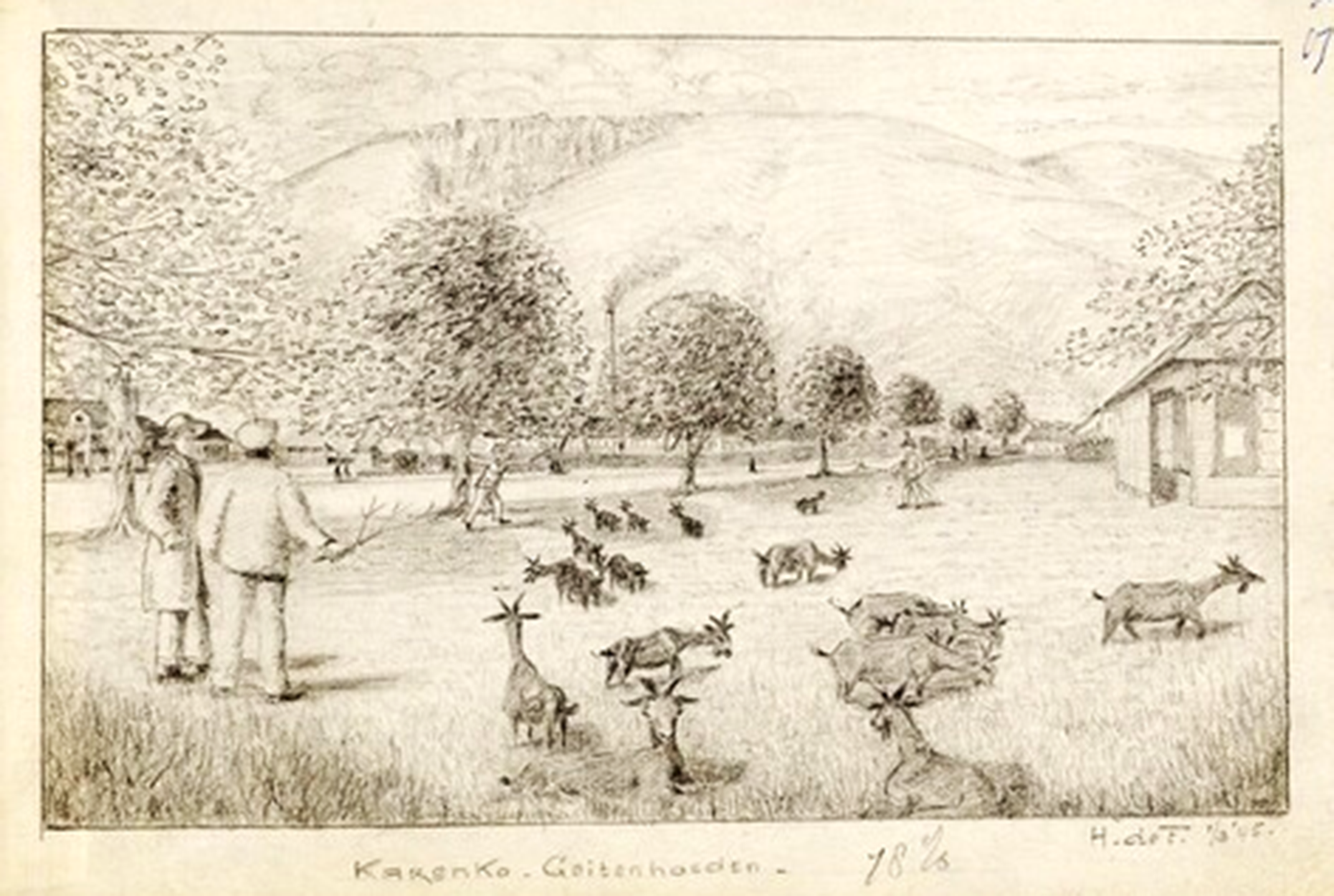
The Japanese sought to demean these senior officers and would not allow indicators of rank. Like other PoWs, they were expected to grow food and do housekeeping tasks. Figure 15 reproduces one of de Fremery’s drawings of Karenko where ‘It is instructive to watch “top brass” herding goats’.Footnote 100 Nevertheless, they had sufficient leisure to read and play bridge and, in December 1943, the first issue of a magazine, Raggle Taggle, was produced in Shirakawa. Some contributions survived the war to be published in 1947 and include humour, anecdotes, poems and cartoons.Footnote 101 Essays on specialised topics include one on differences between American and British English; ‘lack of space prevents a discussion of the ramifications which a humble word like “biscuit” offers.’Footnote 102 Many officers, such as General Percival, spent considerable time discussing with their peers the events leading up to surrender and drafting what would become their post-war reports.Footnote 103
Senior officers herding goats at Karenko. De Fremery, op. cit. (note 97), with permission.
Accommodation and working hours were better than at other camps but, as Wibb Cooper recalled, in captivity they were ‘beaten and disciplined for the least infraction of petty regulations. We were starved… The majority of the group lost from fifty to seventy-five pounds in weight. Some individuals halved their weight. Practically everyone had a nutritional disorder of some kind. Nutritional oedema was the rule.’Footnote 104 Harold Glattly was the senior doctor for much of Shirakawa’s existence as a senior officers’ camp and hospital camp and ‘managed the hospital very well under the most difficult conditions’.Footnote 105 He had survived the Bataan Death March and would become a distinguished figure in the post-war field of prosthetics for amputees.Footnote 106 Senior officers were well-supplied with doctors, relative to population; when about 100 were moved temporarily to Tamazato they were accompanied by two doctors (Derham and Glattly), with medical orderlies.Footnote 107
The seventeen senior doctors were imprisoned only in one or more of the senior officers’ camps, so it is clear that military rank determined their disposition rather than, say, professional specialty. Their pre-surrender roles carried heavy responsibilities and included, for example, Chief Surgeon to the US Asiatic Fleet (Lowman), CO of Canacao US Naval Hospital (Davis), CO US Army No. 2 Hospital (Gillespie), Divisional Director of Medical Services (DDMS) 8th Australian Division (Derham), ADMS 11th Indian and 18th British Divisions (Mitchell and Wardle), CO 10th and 13th Australian General Hospitals (White and Pigdon). The Australian official history recounts that Derham had asked the CO of the AIF in Malaya, Major-General Gordon Bennett (1887–1962) to evacuate the Army nurses from Singapore but Bennett delayed, citing the effect on civilian morale. After it eventually left, the SS Vyner Brooke was sunk off Sumatra and survivors who reached Banka Island were machine-gunned by Japanese soldiers as they attempted to surrender. Of sixty-five Australian nurses on board, twelve were killed at sea, twenty-one killed on Banka Island, and thirty-two interned in civilian camps, of whom eight died in captivity.Footnote 108
Temporary holding camps
Two of the ten temporary camps, Tamazato and Moksak, were used to segregate groups of senior officers in better conditions prior to (rare) visits from the International Red Cross. Another camp was at Takao harbour where many ‘hellships’ docked and at least one death occurred.Footnote 109 Three temporary camps were set up in 1944: Inrin to take PoWs from Taichu after the flood, and the Inrin Temporary and Toroku camps to take survivors of Hokusen Maru. Kukutsu and Oka were set up in mid-1945 and several accounts speculate that they were intended as extermination camps, should there be an Allied invasion; after the war, a draft ‘annihilation order’ was found in Taiwan.Footnote 110 Churon and Maruyama camps existed only for a matter of days, set up after the Japanese surrender to house PoWs from across the island before evacuation.
Transfers of doctors
Multiple transfers were the norm for prisoners of the Japanese. The northward moves made by senior officers are mentioned above. Taihoku had initially housed men from three British artillery regiments and Divisional signals and other staff but, because of repeated transfers, ended the war containing men from fifty-three different British units, as well as Americans, an Australian and a soldier from the Straits Settlement Volunteer Force.Footnote 111 Blair’s static captivity was unusual.
A group of American doctors made a series of transfers in 1944 and 1945. They were captured in the Philippines and had been through several camps before embarking in Manila in September 1944 on the Hokusen Maru, known as ‘Horror Maru’ or ‘Benjo Maru’.Footnote 112 Their convoy was depleted by Allied attacks and on arrival in Hong Kong was attacked again before leaving for Taiwan. The total journey duration was 39 days, with the same number of deaths. Robert Gaskill ‘lived in a sea of excrement in the hold’. PoWs were ‘dirty from head to foot, ragged, and swollen with beri-beri’.Footnote 113 Dr Coone lost 36 lbs in weight, despite bloating from oedema, and ‘we were covered with vermin, and filthy’.Footnote 114 Gaskill, the senior doctor, organised a rota of deck visits by groups of twenty but, in the heat, dehydrated men were ‘going insane’ and Raulston ‘was forced to resort to physical force to keep order in his corner.’Footnote 115 After their arrival, they spent several months in Shirakawa, ‘a lovely mountain resort’ with ‘clean and well-ventilated’ barracks where Coone roomed with Schneider, Goodman with Waters, and Poweleit with Donovan and several British officers.Footnote 116 Goodman reports tensions with British officers over food distribution.Footnote 117
After a few months, the Japanese transferred most of the Americans further north, but Dr Goodman was delegated to accompany a group of men with encephalitis to Toroku and later on to Moji and Nagasaki in Japan, where he would in August 1945 hear the ‘indescribable, earth-shaking sound’ of the atomic bomb, followed by an ‘all-encompassing silence’ then ‘a violent hurricane wind’. He was repatriated through the port and saw the ‘rubble and debris’ of the ‘flattened’ city.Footnote 118 Dr Gaskill left Taiwan on the Melbourne Maru for Japan, where prisoners worked for the Mitsubishi company in a lead and zinc mine in Sendai, about 300 miles north of Tokyo. Coone, however, was off-loaded from the ship at Kiirun with a group of sick PoWs who, like Goodman’s group, were quarantined with encephalitis. This led to Coone working alongside Blair in Taihoku for four months where, compared with Shirakawa, ‘the men were too weak for sports’. He then took a group to Oka prior to the Japanese surrender.Footnote 119
RAMC Captain Lewis had a particularly harsh transfer experience. The regimental medical officer to the Suffolk Regiment, captured with the 18th Division in Singapore shortly after its arrival, he went from Changi by rail in ‘Letter party ‘R” on 31 October 1942 to the Thai-Burma Railway.Footnote 120 Railway medicine is covered by Gill and Parkes and in several medical memoirs, such as Pavillard’s.Footnote 121 Sergeant Burgess of the Bedfordshire and Hertfordshire Regiment picks up Lewis’ story with a five-day rail journey from Thailand to Singapore in 1944, thirty or more men packed in each goods wagon where ‘our doctors did very good work with the little medical supplies at their command, and on two occasions I saw Dr Lewis (Capt, Suffolk Regt.) extracting teeth with ordinary pliers…’.Footnote 122
In an essay written shortly after liberation, Lewis describes embarking in Singapore on 27 June 1944 on the Hofuku Maru. It had engine trouble and took a month to reach Manila where it remained in harbour until 19 September. Ninety-four men died during this almost three months’ ordeal.Footnote 123 Burgess wrote:
dysentery, malaria, yellow jaundice, beri-beri and all manner of diseases were beginning to lift their grisly heads and the conditions were such that they were completely out of the control of the medical officers. Capt. Lewis was consulting the Japs every hour of the day endeavouring to get the conditions altered and had to literally beg for a little extra water for the sick. Needless to say we were not allowed out of the ship’s hold only for the purpose of nature. Even this privilege was denied after a time and the conditions prevailing in our living, sleeping and eating space cannot be conveyed to any but those who have experienced it.
Lewis continued, ‘While in the harbour the Japanese allowed us to evacuate 50 sick to the American hospital at Manila. All of these were so helpless that they could not walk nor do anything for themselves and it was only possible to have some of them removed by giving about 15 blood transfusions.’ Burgess again, ‘Capt. Lewis also performed the almost impossible by carrying out two major operations by the light of hand torches [and] ‘made incisions in both feet [of men with beri beri, to] prevent strangulation of the heart.’
When the ship finally sailed again it had, in Lewis’ account, ‘on board 200 men who were too weak to do anything for themselves. They passed urine and faeces where they lay…’. The convoy was attacked two days later with the loss of twelve ships and about 900 PoWs. Lewis was one of the survivors picked up by interisland patrol vessels which were also attacked by air, killing further PoWs. When they arrived back at Manila ‘all of us practically naked’, they were taken to Bilibid jail, which had become an American PoW hospital. There he met Gaskill, Coone and the other American doctors.
After about a week Lewis and his group of survivors sailed with the American party on another ‘hellship’, the Hokusen Maru which was ‘worse than the one we were on previously’. On Taiwan, he went first to Shirakawa where Piper described him as ‘the legendary Captain Lewis, the MO Doctor who removed an appendix in the bottom hold of a Japanese transport, with a razor… Six men to hold the patient down, and a gallery of enchanted Japaneses [sic] spectating from the upper walls. His patient was in the first party of survivors to arrive here’.Footnote 124 Lewis later met Blair in Taihoku and sailed with Blair and Wheeler on the hospital ship Maunganui to New Zealand. He returned home to Wales and became a rural general practitioner.
Patients’ perspectives
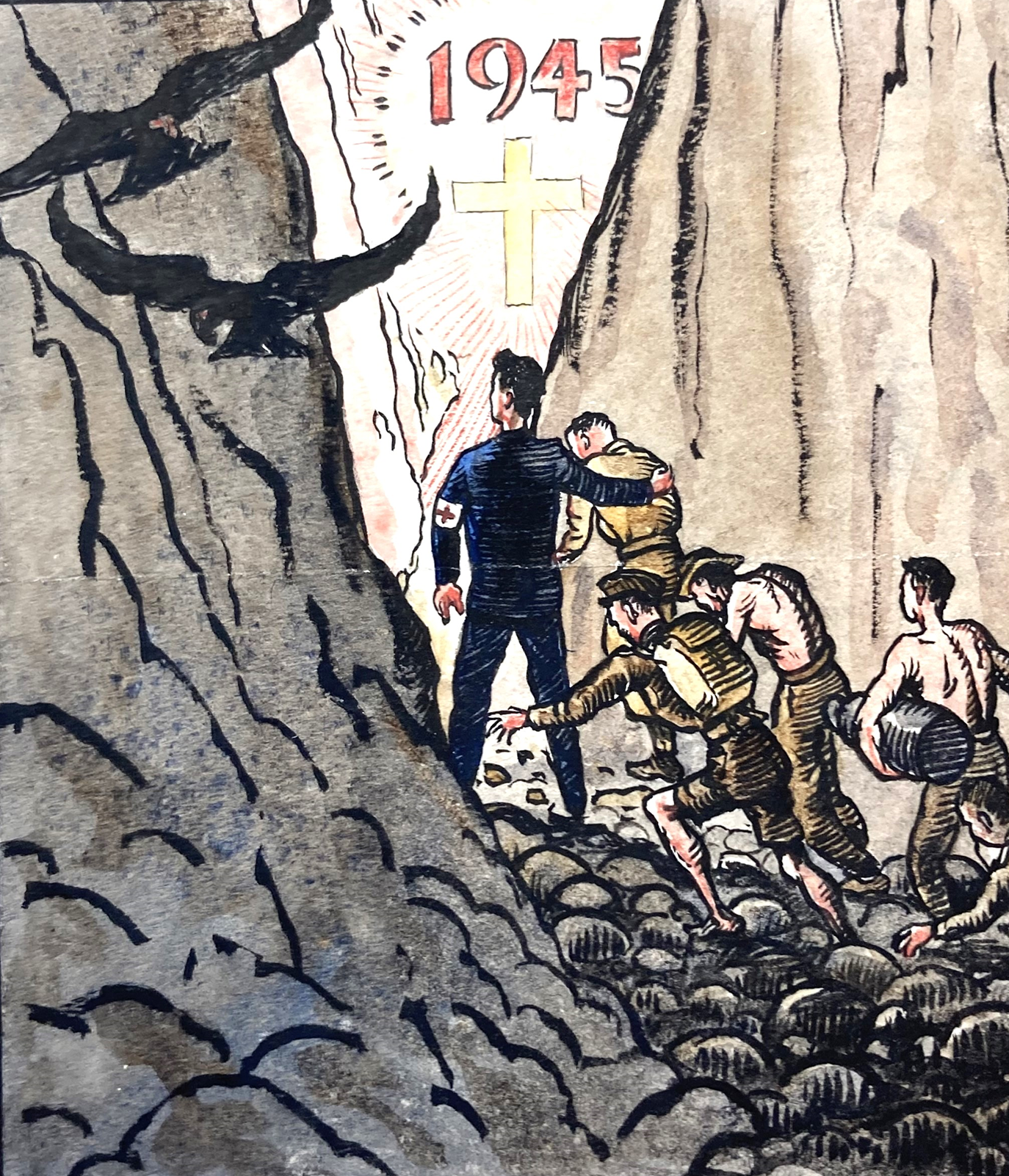
Many of the doctors were awarded honours by their country’s government after the war for their work in the camps. It is also clear that the prisoners valued their work. A Readers Digest profile of Wheeler used the phrase ‘a man sent from God’ and a similar expression was used for Blair in an appreciation published after his death in 1979 in The Gunner. Footnote 125 A moving tribute survives in Seed’s papers from the ‘squad chiefs’ at Kinkaseki, twenty other ranks who led the work groups. They composed a signed certificate for Wheeler and Seed on behalf of all PoWs to ‘express their high appreciation and deep gratitude’, ‘you have both given of your best and, through you your untiring efforts, many lives have been saved… We realise the limitations of medical aid placed at your disposal.’ A Kinkaseki greetings card with Biblical overtones shows the young Dr Seed as almost a saintly figure leading men towards a better future in 1945 (Figure 16).Footnote 126
Looking forward to 1945. 1944 Christmas card. Seed, op. cit. (note 44), public domain.
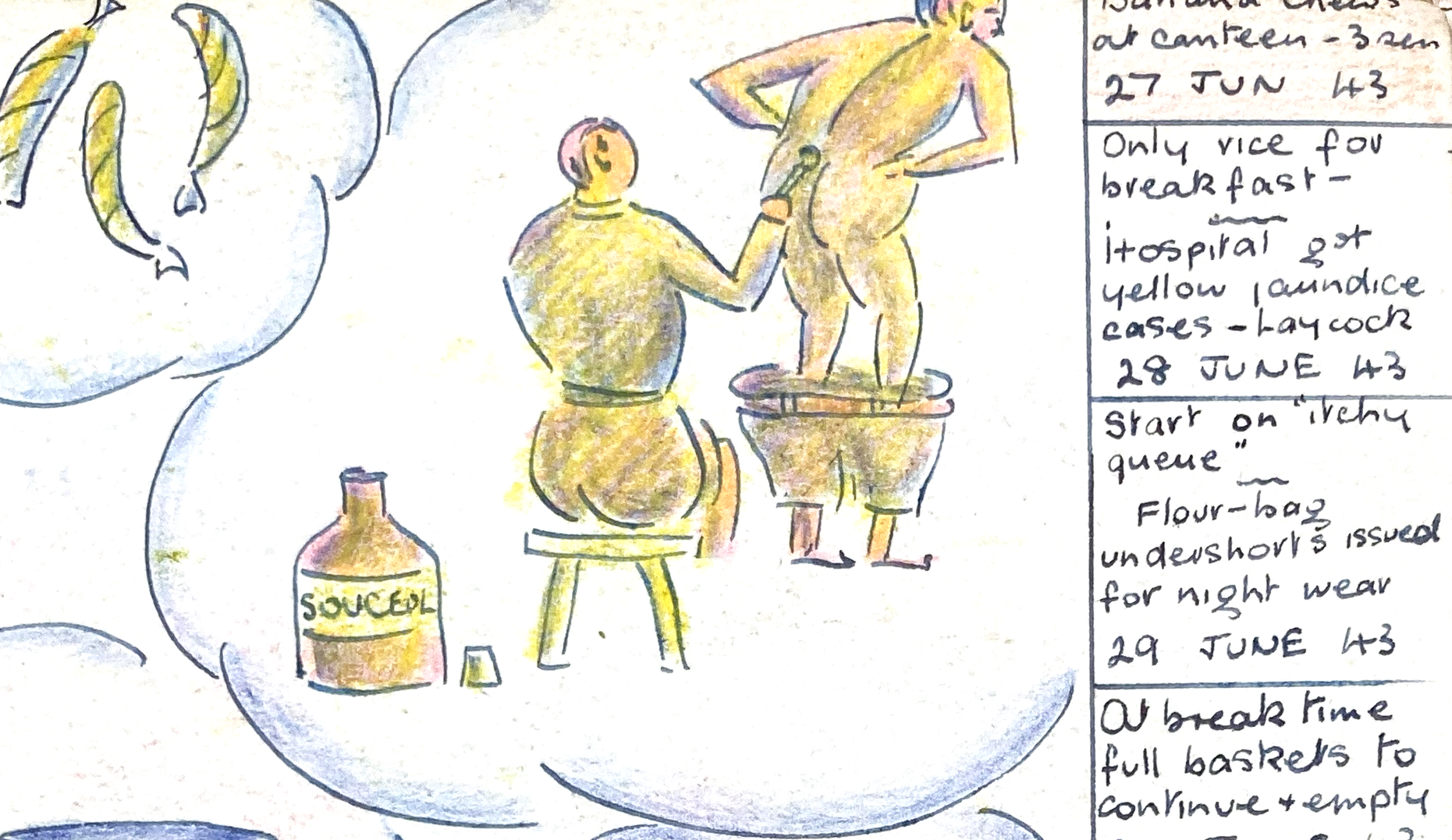
Clement’s illustrated diary gives a more nuanced, often humorous, patient’s perspective and records mundane, but important, interactions with named doctors. He was a private soldier in the 5th Field Regiment, Royal Artillery, to which Blair was attached, and he knew Blair in India, the Malaya campaign, Changi, Number 3 hold of the England Maru, and Taihoku. Blair prescribed, successively, an ointment for ‘eyes’, rice polishings for beri beri, baths for ‘prickly itch’ (Figure 17), and ‘hair pomade’ as a treatment for piles. Dr Wheeler and the camp CO ensured that Clement’s spectacles were repaired.
Treatment for ‘prickly itch’. Clement, op. cit. (note 48), with permission.
In November 1943, Clement was transferred to Taichu where he met Drs Allinson and Glover. His tuberculosis was confirmed there by a sputum test in January 1944, and he notes also having beri beri, diarrhoea, intestinal worms, malaria, scabies, boils, and pellagra. When Taichu was flooded in 1944 its patients went to Inrin and then Toroku. He describes both doctors as giving ‘lectures’, Allinson telling ‘yarns’ about his time in India and Glover talking on medical matters. Allinson is often a comic figure in Clement’s eyes, a keen surgeon and ‘the galloping major’ who played the accordion. Glover is the ‘junior’, a good doctor who teaches the orderlies, talks to patients, gives Clement an egg to eat, and sets him to work cleaning ‘a gross of rusty surgeon’s needles’. Glover is ‘a ginger-haired lad…a gentleman… He worked hard – gave away his Red Cross stuff to bad cases and won over even the Nips.’ He discusses his diagnosis of tuberculosis with Glover and sketches his portrait on his 29th birthday (Figure 8).
In November 1944, Clement met survivors of the Hokusen Maru, including doctors. In January 1945, his tuberculosis meant he was transferred by bullock cart, train, and lorry to Shirakawa hospital, where he remained until liberation, treated by American Captain Donovan, and also naming Kern, Heinbach, Poweleit, and Waters, with Glattly their senior doctor. He mentions the arrivals of Lewis (‘the Welsh MO’), Seed and Wheeler and wishes Wheeler was treating him, but does not want to antagonise his American doctors.
Consequences of captivity
Two of the forty-five doctors died in captivity. As mentioned above, William Kennedy died in Heito of dysentery in September 1942, soon after arriving in Taiwan. Australian Colonel Douglas Pigdon died only weeks before the end of the war in Mukden, Manchuria, one of the senior officers moved north when the American bombing campaign intensified. Other doctors were seriously ill during their captivity. Blair was admitted to his own hospital in Taihoku shortly after arriving in Taiwan with ‘a bad go of beri-beri’ which lasted several weeks.Footnote 127 Long after the war, in 1977, he was awarded a war disability pension on account of ‘duodenal ulcer, bacillary dysentery, beri beri, and helminthiasis’.Footnote 128 Wheeler and Seed both became ill with beri beri and dysentery at Kinkaseki and Seed believed his life was saved by the care given by Wheeler and the medical orderlies, which included eight small blood transfusions in March 1945.
Forty-three doctors survived and Appendix 1 shows that, although the two US Navy doctors died soon after the war, others lived to a great age. Some obituaries include a cryptic mention of the long-term effects of captivity but it is not possible to quantify this for such a small group. Robson et al. have summarised the epidemiological evidence for an early post-war excess of mortality from tuberculosis, liver disease and accidents, and prolonged morbidity from a variety of causes, including Strongyloides infection, neurological complications of malnutrition, and symptoms that would now be termed post-traumatic stress disorder.Footnote 129 Jones and Wessely have reviewed the evolving conceptualisations of the complex psychological consequences of captivity.Footnote 130 These outcomes were more pronounced than seen in former PoWs in the European theatres or the Korean War.
Prisoners of the Japanese were far more isolated than Britons and Americans in German camps and this compounded the mental effects of the extreme physical deprivation and ill-health they experienced for three and a half years. The isolation was not only by race and culture. The Japanese allowed only limited correspondence and at times deliberately withheld mail.Footnote 131 Piper’s first letter arrived in March 1944 and Clement’s in May 1944, posted in November 1942.Footnote 132 Blair recorded only three distributions of Red Cross parcels at Taihoku, in April 1943, May 1944 and May 1945.
Despite their privations, all the surviving doctors in the group described here seem to have returned to their peacetime professional lives after the war. One can speculate that the fact that they continued to practise their profession in the camps might have mitigated the psychological effects of captivity.Footnote 133 Several accounts imply that there were a few paradoxical, almost spiritual, benefits of being a PoW doctor. Seed reflected after the war that it gave him insights into the value of the monastic life. He told Wheeler’s daughter, Anne, that, ‘it was a very character forming experience… My army experience was more valuable to me than my university. Far more valuable. I received an education as a Japanese prisoner of war, quite different from my other experience. And that’s my considered opinion.’
Acknowledgements
I thank David Wiggins and the Museum of Military Medicine, Marie Ellis, Regimental Secretary of the Royal Army Medical Corps, the staff of the Wellcome Collection, Barbara McLean and Irene O’Brien of Glasgow City Archives, Siân Mogford of the Royal Artillery Archive, and David Blake of the Royal Army Chaplains Museum Archive. Anne Wheeler exchanged information and extracted excerpts from her father, Ben Wheeler’s, diaries, currently closed and held in the University of Alberta Archives. The Imperial War Museum holds Peter Seed’s papers, and The National Archives holds transcripts of the war crimes trials and other relevant documents. Michael Hurst, historian of the Taiwan camps, and Meg Parkes, Liverpool School of Tropical Medicine, answered questions, as did Hamish Ion and Michael Snape. At Oxford, I thank the staff of the Bodleian Library, and also Rana Mitter, Mark Harrison, Erica Charters, Rod Bailey, Kevin Noles, and Takehiko Kariya. Many thanks go to Rob Lyman and the Burma crew, to the Walker, Blair, and Pugh families, and to the anonymous journal reviewers.
Competing interest
George Blair, one of the subjects of this paper, was a family friend. This research contributed to the 2024 George Blair Lecture for the Friends of Millbank (friendsofmillbank.org).
Funding
None.
Appendix A: The Taiwan doctors
Australian Army Medical Corps
Colonel Derham, Alfred Plumley (1891–1962)*
Colonel Pigdon, Douglas Clelland (1891–1945)*
Colonel White, Edward Rowden (1881–1963)*
Captain O’Donnell, Patrick Neil (1916–73)*
Royal Netherlands Indies Army Medical Service
Maj-General van Rees, Jacob (1888–1962)
Colonel Goudswaard, Adriaan (1892–?)
Colonel Spier, Marcus (1890–?)
Colonel van Manen, Sipke Evert (1889–1965)
Lieutenant Versnel, Frits (1914–2003)
Royal Army Medical Corps
Brigadier Stringer, Charles Herbert (1886–1961)*
Colonel Bennet, John (1893–1976)*
Colonel Simson, John Thomas (1884–1976)
Colonel Wardle, Valentine Hutchinson (1886–1968)*
Captain Blair, George (1916–79)†
Captain Glover, John Arnold (1915–97)
Captain Grant, William Russell (‘Russ’) (1910–87)*
Captain Lewis, Cyril Vernon (‘Lew’) (1912–2001)‡
Captain Seed, Peter Gerard (1913–77)†
Indian Medical Service
Colonel Mitchell, John Marsters (1889–1975)*
Lt-Colonel Kennedy, William Graeme (1909–42)*
Major Allinson, Francis Ward (1904–90)
Major Wheeler, Benjamin Morrill (‘Ben’) (1910–63)†
Royal Naval Medical Service
Surgeon-Commander Tincker, Robert Wise Holden (1899–1981)
US Army Medical Corps
Colonel Braddock, William Hallock (1887–1968) Lima Maru September 1942
Colonel Cooper, Wibb Earl (1886–1983) Nagara Maru August 1942
Colonel Gillespie, James O (1902–92) Lima Maru September 1942
Lt-Colonel Gaskill, Robert C (1902–76)‡
Lt-Colonel Glattly, Harold Willard (1902–67) Nagara Maru August 1942
Major Raulston, John William (1907–98)‡
Major Ruth, Weldon Kenneth (1912–62)‡
Captain Coone, Herbert William (‘Herb’) (1912–2001)‡
Captain Donovan, William Nelson (1910–98)‡
Captain Goodman, Julien Max (1913–2006)‡
Captain Heinbach, Wilfred Francis (1906–91)‡
Captain Kern, Clyde Vincent (‘Ted’) (1911–62)‡
Captain Merkel, Emil Elvin (1907–2001)‡
Captain Poweleit, Alvin Charles (1908–97)‡
Captain Schneider, Leo Victor (1907–97)‡
Captain Vande Velde, Joseph Daniel (1909–75)‡
Captain Waters, William Isaac (1912–50)‡
Captain Wilson, William E (?–?)‡
Lieutenant Chamberlain, George Earle (1913–99)‡
Lieutenant Rose, William D (1913–89)‡
US Navy Medical Corps
Captain Davis, Robert Gaylord (1883–1948)
Captain Lowman, Kenneth Earle (1890–1946)
* In ‘Special Party’ from Singapore on England Maru and Fukkai Maru (O’Donnell) August 1942
† In Overseas Party ‘Z’ from Singapore on England Maru October 1942
‡ In a group from Manila on Hokusen Maru October 1944


 Open access

