




1. Introduction
Speaking represents an active ability to construct significance, encompassing the transmission, reception, and organization of information (e.g. Brown & Abeywickrama, Reference Brown and Abeywickrama2019). It is one of the crucial skills in language learning and communication (e.g. Luthfillah & Fauzia, Reference Luthfillah and Fauzia2023). In many English as a foreign language (EFL) regions such as China (Sun et al., Reference Sun, Lin, You, Shen, Qi and Luo2017) and South Korea (Ahn & Lee, Reference Ahn and Lee2016), the expanding circle in Kachru’s (Reference Kachru1992) Three Circles model where English is not an official or commonly spoken language, speaking is often considered the most challenging language skill. Speech fluency (Yan, Kim & Kim, Reference Yan, Kim and Kim2021), accuracy (Nunan, Reference Nunan2015), pronunciation (Chau, Reference Chau2021), and vocabulary (Afna, Reference Afna2018) serve as critical components in evaluating learners’ speaking proficiency. Take the International English Language Testing System (IELTS) speaking test, a globally recognized standardized English test, as an example. This test evaluates four core competencies: fluency and coherence (FC), lexical resource (LR), grammatical range and accuracy (GA), and pronunciation (PN).
Traditional approaches to teaching and learning English speaking include dubbing (e.g. Jao, Yeh, Huang & Chen, Reference Jao, Yeh, Huang and Chen2024), learning rules (e.g. Talley & Tu, Reference Talley and Tu2014), and presentation practice production (e.g. Criado, Reference Criado and Monroy2013) primarily targeting face-to-face learning environments. However, the post-pandemic era has witnessed a significant shift towards technology-mediated speaking instruction, with digital platforms (e.g. videoconferencing tools; Tran, Hoang, Gillespie, Yen & Phung, Reference Tran, Hoang, Gillespie, Yen and Phung2024) becoming a mainstream pedagogical medium (e.g. Cahyono, Fauziah, Santoso & Wulandari, Reference Cahyono, Fauziah, Santoso and Wulandari2024). Given the advancements in information and communication technology, the extensive integration of digital resources into educational practices represents a transformative shift in education (e.g. Shin & Yunus, Reference Shin and Yunus2021). As suggested by previous studies (e.g. Arkorful & Abaidoo, Reference Arkorful and Abaidoo2015), the use of electronic technologies is considered as one of the most effective approaches for instructing and acquiring speaking abilities, particularly due to its adaptability in accommodating constraints related to time and location. This study aims to develop and evaluate the effectiveness of a self-directed online oral ability learning approach to integrate corpus technology with multiple artificial intelligence (AI) tools to create an interactive learning environment for EFL learners.
1.1. Technologies in speaking teaching and learning
Previous studies integrated technologies like podcasting (e.g. Yeh, Chang, Chen & Heng, Reference Yeh, Chang, Chen and Heng2021), blogging (e.g. Parveen, Reference Parveen2016), videoconferencing (e.g. Bahadorfar & Omidvar, Reference Bahadorfar and Omidvar2014), videos (Kohen-Vacs, Milrad, Ronen & Jansen, Reference Kohen-Vacs, Milrad, Ronen and Jansen2016), and corpora (e.g. Chen & Tian, Reference Chen and Tian2022) in speaking teaching and identified their effectiveness.
Gablasova and Bottini (Reference Gablasova, Bottini, Jablonkai and Csomay2022) encouraged the use of learner corpora in teaching. Corpora findings can be used to create resources like dictionaries, grammar guides, and language curricula (e.g. Feak, Reinhart & Rohlck, Reference Feak, Reinhart and Rohlck2018). Teachers and students can also get access to corpora data directly (e.g. Gablasova & Bottini, Reference Gablasova, Bottini, Jablonkai and Csomay2022); furthermore, learners’ awareness could be raised by working with the corpora data (e.g. Chen & Tian, Reference Chen and Tian2022). Gablasova and Bottini (Reference Gablasova, Bottini, Jablonkai and Csomay2022) also suggested that tailoring corpora data to students’ language backgrounds could boost learning progress and motivation. Some of the technologies used are one-way, such as videos or podcasts that provide learners with a channel to access instructions and productions by native speakers or high-level learners. Videoconferencing tools offer a platform for learners to communicate with teachers or other learners; however, learners have limited access to feedback or communication opportunities, as most of their interactions and feedback occur during class, either from instructors or peers, with little to no engagement beyond in-class discussions. Studies integrating AI in speaking teaching and learning could help resolve this issue (e.g. Huang & Zou, Reference Huang and Zou2024).
1.2. AI for speaking teaching and learning
The use of AI tools (e.g. ChatGPT) has been encouraged in language teaching and learning (e.g. Kostka & Toncelli, Reference Kostka and Toncelli2023; Mompean, Reference Mompean2024). AI-powered tools allow students to engage in realistic conversations with virtual native speakers and receive feedback (e.g. Zou, Guan, Shao & Chen, Reference Zou, Guan, Shao and Chen2023). Fathi, Rahimi and Derakhshan (Reference Fathi, Rahimi and Derakhshan2024) found AI speaking tasks outperformed traditional methods in boosting EFL learners’ oral skills and communication confidence.
Zou et al. (Reference Zou, Guan, Shao and Chen2023) examined the impact of AI-powered apps on Chinese EFL learners’ English speaking. Learners viewed interactive activities positively, reporting enhancements in various speaking aspects, including oral fluency, grammatical range and accuracy, pronunciation, oral rhythm, idea organization skills, reading aloud skills, and presentation skills. However, the study relied on self-reports rather than measurable speech analytics, hindering assessment of specific skill improvements. This study aims to fill this gap by analyzing learners’ speech output across four key speaking subskills (GA, LR, PN, and FC).
Abdulhussein Dakhil, Karimi, Abbas Ubeid Al-Jashami and Ghabanchi (Reference Abdulhussein Dakhil, Karimi, Abbas Ubeid Al-Jashami and Ghabanchi2025) identified that the AI tool ELSA improved Iraqi EFL learners’ speaking skills (grammar, vocabulary, intonation, fluency) and communication willingness, though not pronunciation. However, feedback generated by AI tools may occasionally be inaccurate, which could negatively impact learners’ speaking development (Mompean, Reference Mompean2024). This study aims to address the limitations of previous research by integrating corpora with AI tools. This method establishes an interactive oral ability learning framework while ensuring feedback reliability, leveraging both corpus data and AI feedback to optimize learning outcomes.
Challenges have been identified when students use AI tools in the educational context. Prompt engineering is an essential component, which could help boost effective interaction skills with AI tools (Walter, Reference Walter2024). The development of critical digital literacy (CDL) assumes heightened importance (Satar, Hauck & Bilki, Reference Satar, Hauck and Bilki2023). The formulation of precise prompts is recognized as fundamental for obtaining optimal outputs from generative language models (Huang, Reference Huang2023). The current study will use corpus data to enhance learners’ ability to develop prompts.
1.3. Speaking instruction on learning management system (LMS) platforms
The utilization of web-based learning tools within educational settings has become a prevalent approach due to its adaptability, convenience, self-paced nature, and cost-effectiveness. A majority of learners prefer web-based learning over traditional classroom methods (e.g. Mendis & Dharmawan, Reference Mendis and Dharmawan2019). The effectiveness of web-based learning (e.g. LMS), however, depends on the level of interaction involved (e.g. Woo & Reeves, Reference Woo and Reeves2008).
Mendis and Dharmawan (Reference Mendis and Dharmawan2019) investigated an LMS system, Canvas, with high school learners’ English oral ability learning. Successful interactions occurred on Canvas LMS, so there is a compelling need to conduct English speaking lessons on this LMS. Suartama and Dewa (Reference Suartama and Dewa2014) proposed that activities could be designed on the Moodle LMS, including instruction videos, discussion forums, chat, and quizzes. However, limited previous studies have provided suggestions on how to make use of the functions (e.g. discussion forum and quiz function) on the LMS platforms to develop an interactive course and observe students’ learning process. This study will address this gap by introducing a self-directed corpus-based and AI-integrated English speaking course on Canvas and evaluating its effectiveness.
2. Research gaps and research questions (RQs)
Most approaches to learning oral communication provide learners with restricted feedback opportunities confined mostly to classroom settings. AI tools show promise in personalized and real-time feedback. However, prior studies on AI-powered tools for pronunciation training relied on self-reported data rather than empirical analysis of speech outputs. In addition, limited studies exist to synergize corpus data with AI’s adaptive feedback for targeted English speaking improvement. Based on these research gaps, two RQs were drafted:
-
1. To what extent does the online corpus-based and AI-integrated language learning approach facilitate and enhance English speaking development among learners?
-
2. What are learners’ attitudes and evaluations of the online corpus-based and AI-integrated language learning approach?
3. Methods
3.1. Participants
Sixty-two participants who were university students in Hong Kong (HK) with Chinese as their first language (L1) were enrolled in the online training. Among them, 20 participants engaged in a comprehensive study that encompassed a pre-test, a six-session training, a self-study session, a post-test, and a semi-structured interview.
3.2. Tests
During both tests, each participant received an IELTS speaking part 2 topic. We prepared six different topics for the two tests (three for each). These six topics were not included in the training sessions. A topic was randomly assigned to each participant. One minute was given to prepare the topic before participants delivered a two-minute speech on the assigned topic.
3.3. Training details
In the first session, we included a brief introduction of the spoken corpus, AI tools used in our training, and the corpus-based and AI-integrated oral ability learning procedure. In sessions 2 to 5, participants were instructed on how to use corpora and AI tools to build up ideas and practise the four subskills (GA, LR, PN, and FC). The functions of corpora and AI tools in our approach are shown in Table 1. Corpus-based practice is the core and could raise learners’ awareness of their English speaking proficiency, enhance prompts development ability, cross-check feedback accuracy, and perform self-reflection and self-assessment by comparing their own speech with corpus data. Learners use generative AI tools to generate ideas of conversation topics, receive personalized feedback, and communicate. Text-to-speech AI tools provide learners with tailor-made native speaker samples for imitation. The last session included an AI package for English oral ability learning and hands-on activities on how to use the AI tools in this package.
The functions of corpus and AI tools in our approach

All training sessions took place on Canvas. Each session included an instructional video along with a quiz to evaluate participants’ comprehension of the video content and an online discussion forum, giving participants the opportunity to communicate with one another, share their previous experiences in learning English oral communication, share the prompts and feedback they received on each subskill by using generative AI (e.g. Poe and Copilot), and express their opinions on the AI package. In the self-study session, all participants prepared a 250-word script based on an IELTS speaking part 2 topic, showcased the prompts used and responses received when interacting with AI tools, showcased how pauses were added to the script by using the text-to-speech AI tool, prepared a two-minute recording with the revised script, and shared their thoughts about using corpora and AI tools to learn spoken English.
3.4. The spoken corpus used in the training
The English Speech Corpus with Different Proficiency Levels (Chen, Reference Chen2022; hereafter the Spoken Corpus; http://corpus.eduhk.hk/english_speech_corpus/) consists of 91 sets of spoken data (78 sets of spontaneous speeches and 13 sets of classroom presentations). Among the 78 sets of spontaneous speeches, 48 sets were collected from learners in Chinese Mainland and HK, while 30 sets were extracted from publicly accessible IELTS speaking test recordings. Each spontaneous speech was annotated comprehensively according to four criteria adopted from the IELTS speaking test: GA, LR, PN, and FC. Key indicators annotated in the Spoken Corpus appear in the Appendix (see supplementary materials).
The main aim of using the Spoken Corpus data is to raise learners’ linguistic awareness of features that influence their speaking performance. Learners followed the following procedure: identifying the common features produced by speakers with lower proficiency level (e.g. band 5.5 or lower), performing self-reflection and self-checking on whether learners produce these features in their speech, identifying the common features produced by speakers with higher proficiency level (e.g. band 7.0 or higher), and comparing the features produced by the lower proficiency level with the higher level to identify the features that influence speaking performance.
3.5. Data analysis
For the pre- and post-tests, 20 features were analyzed by listener judgement (five for each subskill). For GA, we counted the number of sentences, the frequency of simple sentences, complex sentences, complex structures, and grammatical errors that the participants produced. For LR, we counted the frequency of inappropriate word choice, appropriate and inappropriate idioms, and appropriate and inappropriate collocations in participants’ speech. In terms of PN, we counted the frequency of consonant errors, vowel errors, schwa insertion at the end of a word, mispronunciation, and C-V linking. For FC, we calculated speech length, speech rate, the frequency of silent pausing, filled pausing, and discourse markers and connectives.
Participants’ prompts submitted to the discussion forum during the four after-training activities were further categorized based on the degree to which participants followed the sample prompt provided during training.
The interviews were conducted based on the themes related to how participants use the corpus-based and AI-integrated approach, as well as the evaluation of this approach and the LMS.
4. Results
In order to answer the first RQ, participants’ pre- and post-test performances on the four subskills (GA, LR, PN, and FC), participants’ self-report on how they used corpus and AI technologies to learn each subskill, and the prompts that they used for feedback were analyzed.
4.1. Pre- and post-test results
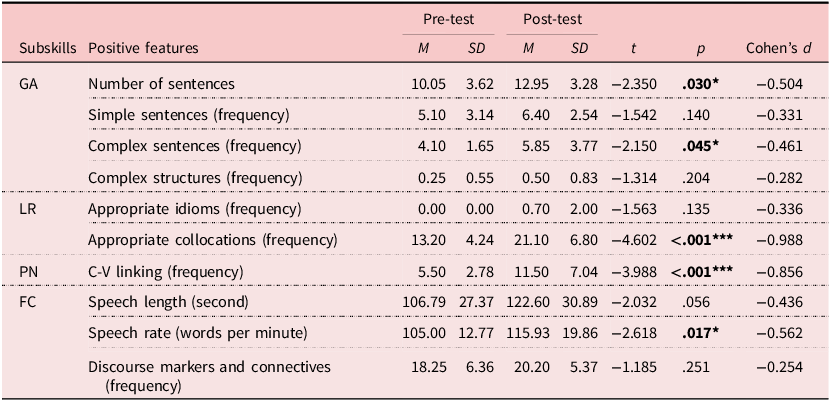
Participants’ performances in the pre- and post-tests (Tables 2 and 3) were compared. For the positive features, the frequency of participants’ production on these features in the post-test is higher than those in the pre-test, which indicates that participants attempted to use more positive features in their speech after training. Paired samples t-test results revealed that the number of sentences, the frequency of complex sentences, appropriate collocations, and C-V linking were significantly higher in the post-test compared to those in the pre-test (with p values equal to .030*, .045*, <.001***, and <.001*** respectively). Participants’ mean speech rate also increased significantly from 105.00 words per minute in the pre-test to 115.93 words per minute in the post-test (p = .017*).
Frequency of positive features by participants in both tests

Note. GA = grammatical accuracy; LR = lexical resource; PN = pronunciation; FC = fluency and coherence.
Frequency of negative features by participants in both tests

Note. GA = grammatical accuracy; LR = lexical resource; PN = pronunciation; FC = fluency and coherence.
The frequency of the negative features by participants decreased from pre-test to post-test except for the frequency of inappropriate idioms and mispronunciation. Participants’ speech performance improved after training by avoiding using negative features in their speech. Paired samples t-test results showed that participants made fewer grammatical errors (pre-test: 7.55, post-test: 3.95, p = .005**), consonant errors (pre-test: 15.35, post-test: 11.50, p = .031*), and vowel errors (pre-test: 7.40, post-test: 4.90, p = .011*) after training. Participants also produced fewer filled pauses in the post-test (M = 3.20) than in the pre-test (M = 7.05) with p = .008**.
4.2. Experience of learning the four subskills
Participants described how they applied corpora and AI tools for their speaking development, as well as how they integrated these two tools to enhance each speaking subskill. In the following sections, we detail how participants improved GA, LR, PN, and FC using corpora and AI tools.
4.2.1. GA learning
Fourteen participants found AI tools beneficial for identifying and correcting grammatical errors. Eight further stated that AI tools were useful in enhancing grammatical range, helping them construct more varied and complex structures:
Participant (P)16: AI corrects grammatical errors in my sentences and highlights areas where I’ve made mistakes, such as issues with verb tenses.
P9: I use AI to help me adjust my grammar, such as increasing complexity.
Only two participants found AI useful for simplifying overly complex sentences, making their speech more conversational and suitable for natural spoken English:
P11: AI can help me make my sentences more in line with everyday spoken English.
Five participants confirmed that the corpus served a supporting role by offering authentic examples of grammar in context, especially from higher-band learners:
P1: I learn complex sentence structures like adverbial and attributive clauses by observing high-scoring answers in the corpus.
4.2.2. LR learning
Twelve participants emphasized that AI tools helped them correct lexical errors (e.g. inappropriate collocations) and improve word choice by suggesting more natural or topic-specific expressions:
P12: AI tools like Poe help improve vocabulary by replacing unnatural phrases with more natural or appropriate ones.
P3: AI corrects inappropriate collocations.
Ten participants pointed out that the corpus was especially valued for exposing learners to vocabulary used in different band-level responses, helping them discover less common words, collocations, and contextual usage:
P1: By using a corpus, we can observe how high-band learners express themselves and then take note of their vocabulary for learning purposes.
Importantly, two participants emphasized combining both tools using AI to analyze their word usage and the corpus to refine it with authentic examples, enabling targeted vocabulary development:
P15: I use an AI tool to analyze my spoken responses and get feedback on my lexical resource. Then, I consult corpus examples to make targeted improvements accordingly.
4.2.3. PN learning
Eight participants highlighted that the AI tools were helpful in identifying pronunciation issues, such as misplaced stress and mispronunciations:
P11: I read a passage to the AI, which identifies problems in my pronunciation, such as incorrect word stress or mispronunciations.
In addition, nine participants stated frequent use of AI-generated audio, especially from text-to-speech AI tools like Murf, for modelling native pronunciation. The ability to modify accent and speed for targeted practice was a popular function. Participants also emphasized that slowing down and imitating AI-generated speech helped improve their pronunciation step by step:
P6: In terms of pronunciation, I find Murf more helpful. For example, it allows you to set nationality and accent, so I can listen to the generated audio and imitate it.
The corpus was also beneficial for pronunciation practice, particularly because it offered authentic recordings of high-band learners (reported by six participants). Participants favoured corpus-based audio over AI-generated audio due to its greater naturalness:
P14: I think corpus has an advantage when it comes to pronunciation. For example, I can listen to recordings of high-band speakers and imitate their pronunciation.
Three participants described the combination of corpora and AI tools facilitated targeted improvement in pronunciation by receiving feedback from AI on pronunciation and using corpus to make targeted improvements:
P15: I input my spoken content into an AI tool, and it provides feedback on my pronunciation. Then I use corpus to make targeted improvements.
4.2.4. FC learning
Twelve participants reported that AI tools helped add discourse markers and connectives, thus improving logical flow:
P13: AI tools add discourse markers and connectives to improve sentence flow and coherence.
In terms of fluency, six participants shared that text-to-speech AI tools helped reduce fillers and unnecessary pauses and improved their awareness of speech pacing. Participants also noted that they could compare different types of pauses and adjust their speech accordingly:
P3: AI helps me remove redundant content and improves flow through better pauses and connectives.
P4: I think it’s helpful, since we add different types of pauses. AI reads them differently, so we can compare how a weak pause compared to a stronger one and determine which is more effective.
The corpus further supported FC by providing authentic examples from spoken performances in IELTS practice tests by learners of different proficiency levels. Five participants observed from corpus data that high-band learners minimized excessive pauses and used clearer logical flow:
P14. In terms of fluency, I find the corpus especially helpful. I can listen to high-band speakers and try to imitate their fluency.
Another eight participants used examples in the corpus to identify common coherence issues in lower-band responses and to improve their own speech:
P1: I observed the differences between high- and low-band responses in the corpus to learn how to express myself more coherently.
Three participants emphasized that using both tools helped them diagnose and address fluency issues more effectively, creating a complementary and iterative learning process:
P15: I input my speech into AI for feedback on coherence, then use the corpus to make targeted improvements.
4.3. Prompt analysis
Participants reported the prompts that they gave to generative AI tools to request sample answers or feedback on GA, LR, PN, and FC, as well as the feedback that they received from the generative AI tools. A sample prompt was shared with them for each skill. For example, the sample prompt for PN is, “Can you help me identify my pronunciation mistakes on English vowels in the following speech?” Across the four sessions, 110 prompts were considered valid for analysis.
The analysis of prompts (Table 4) revealed notable differences in how participants utilized the sample prompt structures provided during training. Participants demonstrated more customization in idea generation. The most frequent type of prompt involved customizing the sample to target a higher IELTS band score (41.38%). In contrast, prompts that strictly followed the sample were relatively rare (10.34%). Other recurring types of modification included simplified prompts (13.79%), prompts without a specified band score (13.79%), requests for a time limit (10.34%), and the inclusion of additional contextual details (10.34%); 62.06% of the occurrences involved some form of prompt customization. One participant’s prompt is as follows:
P10: Please act as an IELTS candidate with a good command of English and answer the questions in part 2 of the Speaking test. Based on the background information given by me, give a reference answer (100s) that can get 7 points [band 7] according to the speaking test standards. The sentences and words used in the answer are colloquial and the content is easy to understand. And please try to reuse your used sentences, words, time, names, in order to improve the reusability, easy for me to remember.
Categorization of valid prompts

Note. GA = grammatical accuracy; LR = lexical resource; PN = pronunciation; FC = fluency and coherence.
For GA and LR, around 90.00% of prompts adhered closely to the sample format. Participants predominantly targeted lexical range (40.48%) and grammatical accuracy (30.95%), with fewer prompts addressing grammatical range (9.52%) or lexical accuracy (7.14%). Only five participants requested additional refinement for naturalness or alignment with a target band level. The heavy reliance on structured prompts in this session indicates a strong preference for explicit scaffolding. The sample prompts included (1) “Can you help me to correct my grammar mistakes for my following speech?” (for GA accuracy); and (2) “Can you help me to rewrite the following speech by using five paraphrases, five less common words, and five idioms?” (for LR range).
PN and FC learning showed a more balanced distribution between sample-based and customized prompts. PN demonstrated a more distributed pattern of focus across various pronunciation features. Participants most frequently targeted consonants (24.29%) and vowels (18.57%), word stress (20.00%), and intonation (18.57%). Interestingly, 12.86% of prompts included explicit requests related to fluency. Participants tended to associate pronunciation with fluency rather than viewing it in isolation. FC also exhibited a balanced distribution of prompt types, with 32.43% addressing FC in general terms and 40.54% explicitly focusing on discourse markers and connectives. A smaller proportion of prompts incorporated filled pauses (16.22%) and silent pauses (10.81%).
4.4. Evaluation of corpus-based and AI-integrated oral ability training
Participants’ interview data were used to answer RQ2. Particular attention was given to how the approach contributed to creating an interactive and engaging learning environment and what participants perceived as its major strengths in facilitating self-directed speaking practice.
Analysis of interviews identified AI’s dialogic real-time responses as central to perceived interactivity (Table 5). Thirteen participants described how generative AI tools enabled dialogue-like interaction, which allowed them to refine their responses through multiple rounds of feedback, providing examples and suggestions. Three participants also reported that feedback from AI tools created an interactive environment, which enhanced participants’ motivation and activated engagement. However, five participants found the interaction less engaging, describing it as lacking authentic conversational dynamics.
Participants’ evaluation of the corpus-based and AI-integrated oral ability training

Personalized and targeted feedback provided by AI tools emerged as a prominent strength (Table 5), with 12 participants reporting using the AI tools to address specific weaknesses in GA, LR, PN, or FC. Participants also highlighted the convenience and accessibility of the tools (P16), as well as their ability to tailor AI-generated audio to individual preferences, such as accent and speed.
Regarding the corpus, participants considered it particularly useful for offering localized, exam-relevant examples, especially those from Chinese learners, which they found relatable and accessible. Additionally, six participants reported that the corpus helped them identify and avoid common errors made by lower-band learners, particularly in pronunciation and coherence.
Furthermore, five participants highlighted that the combined use of corpora and AI tools contributed to a systematized and efficient learning process. One participant described it as a “closed loop” (P5), in which feedback, examples, and revision were closely linked. Although one participant (P15) pointed out that AI feedback may not always be fully accurate, they still found it immediate and useful, emphasizing its overall practical value.
4.5. Evaluation of the Canvas LMS
All 20 participants highlighted the flexibility of learning on Canvas as a major benefit. The ability to access course materials anytime and from any location was frequently mentioned. Seven participants emphasized the benefits of self-paced learning, including features like video replay and speed control. However, four participants reported difficulties maintaining concentration in the online environment, considering a lack of real-time engagement and external distractions as key issues. In addition, 11 participants expressed concerns about the limited interaction and feedback available in the online mode compared to face-to-face classes.
For the effectiveness of the discussion forum on Canvas, 16 participants reported that reading peers’ posts helped them reflect on their own responses. Additionally, three of them mentioned that peers’ posts also inspired how they wrote prompts for the interactive AI tools. Three participants suggested that requiring students to respond to peers’ posts could increase interaction and engagement. Regarding the effectiveness of quizzes, 14 participants reported that quizzes were effective in consolidating knowledge and reinforcing key concepts. Seven participants noted that quizzes helped them identify gaps in their understanding and reflect on their learning. Examples of participants’ reports also have been listed in Table 6.
Participants’ evaluation on the use of Canvas learning management system

5. Discussion
5.1. Effectiveness of corpus-based and AI-integrated training on speaking performance
Speech task results in the pre- and post-tests showed positive effects of the online corpus-based and AI-integrated speaking course on learners’ English oral ability. This finding is consistent with previous studies (e.g. Fathi et al., Reference Fathi, Rahimi and Derakhshan2024; Gablasova & Bottini, Reference Gablasova, Bottini, Jablonkai and Csomay2022; Mendis & Dharmawan, Reference Mendis and Dharmawan2019; Zou et al., Reference Zou, Guan, Shao and Chen2023), indicating the effectiveness of corpus and AI technologies, as well as LMS platforms, in speaking practice. For participants’ performance on the features (both positive and negative) of the four subskills, the findings are new. Participants in this study attempted to use more positive features in their post-test compared to their production in the pre-test. Participants’ performances of five among the 10 positive features (number of sentences, complex sentences, appropriate collocations, C-V linking, and speech rate) improved significantly from pre-test to post-test. For the other five positive features (simple sentences, complex structures, appropriate idioms, speech length, and discourse markers and connectives), participants attempted to produce these features more frequently in the post-test, but the production frequency improvement was insignificant. The possible reason could be attributed to the relatively short overall training duration. The entire training programme in this study had only six sessions. Nevertheless, initial evidence of improvement was observed. Participants had awareness of the positive features that may influence oral proficiency, but they may require additional time for practice.
For the negative features, participants tried to avoid producing eight out of the 10 negative features in the post-test. Their performance of four features among the eight showed a significant decrease for grammatical errors, consonant errors, vowel errors, and filled pausing. No significant decrease in the performances of inappropriate word choice, inappropriate collocations, schwa insertion, and silent pausing could also be attributed to the relatively short duration of the training. The frequency of two negative features (inappropriate idioms and mispronunciation) by the participants in the post-test increased slightly. After the training, participants had an awareness for using more idioms, producing longer speech, and using more complex words. In the post-test, they attempted to use more idioms in their speech, but their proficiency levels were not so high that they were familiar with the usage of some idioms. They made errors when using these idioms. The possible reason for producing more mispronounced words could be participants’ production of longer and more complicated utterances in the post-test. Inevitably, they made pronunciation mistakes with some complex words.
Participants’ PN improvement identified in this study is not in line with Abdulhussein Dakhil et al. (Reference Abdulhussein Dakhil, Karimi, Abbas Ubeid Al-Jashami and Ghabanchi2025), in which learners’ pronunciation performance remained unchanged. The current study enhanced participants’ pronunciation performance following three steps (1. enhancing learners’ perception, 2. providing feedback, and 3. using text-to-speech AI tools to improve learners’ production). Participants first used learner corpus data to raise their awareness of the possible PN features that they may have and the PN features that may influence speaking performance. Participants then sought feedback on PN from generative AI tools (e.g. ChatGPT), followed by generating and imitating native speakers’ samples by text-to-speech AI tools. This finding supported the pedagogical suggestions proposed by Chen and Tian (Reference Chen, Tian, McCallum and Tafazoli2025), indicating that using only one type of tool in language learning is not sufficient. Tools with different functions need to be combined, complement each other, to develop their strengths and compensate for their weaknesses.
5.2. Attitudes and evaluations of the corpus-based and AI-integrated oral ability training on Canvas
The current study confirmed that using corpus and AI technologies in pronunciation and fluency training helped create an interactive environment. This finding supported previous studies encouraging the application of AI to design interactive speaking activities and tasks (e.g. Fathi et al., Reference Fathi, Rahimi and Derakhshan2024; Zou et al., Reference Zou, Guan, Shao and Chen2023). Previous studies highlighted that the use of large language model AI tools helped create a highly interactive and engaging learning environment (e.g. Shafiee Rad & Roohani, Reference Shafiee Rad and Roohani2024) by providing instant feedback and offering opportunities for personalized and interactive practice, which fosters interaction, engagement, and language development. In the current study, giving prompts to AI tools and receiving feedback from AI tools could help build up an interactive learning environment.
The effectiveness of corpus use in learning oral communication has also been confirmed in the current study by offering authentic models and examples being consistent with previous studies (e.g. Gablasova & Bottini, Reference Gablasova, Bottini, Jablonkai and Csomay2022). Participants also reported on the prompts development function when combining corpus use and AI technologies in speaking, which helped enhance CDL. Corpus data is considered a valuable resource for prompts development in a variety of domains, such as enhancing LR range. Using the feature list summarized from the corpus data supported learners to formulate effective prompts for the AI and receive more accurate and detailed feedback. This is the beauty of the combination of the two types of technologies. Participants’ reports on the effectiveness of combining the two tools in speaking learning also supported the advice of integrating tools with different functions in teaching and learning by Chen and Tian (Reference Chen, Tian, McCallum and Tafazoli2025).
The corpus-based and AI-integrated training on Canvas LMS is flexible, convenient, and provides learners with self-paced learning, which is in line with Qaddumi and Smith (Reference Qaddumi and Smith2024). We utilized the quiz function on Canvas LMS to verify participants’ understanding of the key knowledge and help them reinforce learning in each session.
Interaction is the main factor in determining the success of a course on LMS (Woo & Reeves, Reference Woo and Reeves2008). Participants in this study confirmed interactions of the discussion forum on Canvas, which was the main interaction among peers. Participants could learn from others by browsing others’ posts and confirmed the interactions on Canvas, which is consistent with Mendis and Dharmawan (Reference Mendis and Dharmawan2019). However, participants also reported a lack of interaction or feedback and proposed that teachers should make participation mandatory to enhance more peer interactions during self-directed online learning.
5.3. Pedagogical implication
The findings of this study offer significant pedagogical implications based on the development of a corpus-based and AI-integrated oral ability learning framework (as shown in Figure 1). Teachers could use the four-step framework to design training lessons and speaking tasks. Learners first analyze authentic samples from spoken corpora at various proficiency levels. This comparative analysis not only raises awareness of effective speaking features but also highlights common difficulties encountered by learners, enhancing learners’ prompts development ability. Then, learners are encouraged to use generative AI tools to generate topic ideas and receive personalized feedback, focusing on the four key subskills (GA, LR, PN, and FC). Learners are also encouraged to use corpus data for cross-checking AI feedback accuracy. Text-to-speech AI tools provide audio models for learners to imitate, offering perceptual input that benefits PN, FC, and even GA and LR acquisition through multimodal practice. Learners then compare their own performance with corpus samples at their target band level as established benchmarks for self-monitoring. The framework concludes with compiling feedback and records from AI tools, comparing their performance against the corpus feature list, identifying the aspects that need further improvement, and reflecting on their progress.
Corpus-based and AI-integrated oral ability learning framework.

6. Conclusion
This study examined the effectiveness of the online corpus-based and AI-integrated approaches in facilitating and enhancing English speaking development. Quantifiable improvements were observed in several key linguistic features. After receiving the training, participants attempted to use more positive features, such as complex sentences, and avoid using negative features, such as grammatical errors. Learners expressed positive attitudes towards the online corpus-based and AI-integrated training, considering it as creating a more interactive and engaging speaking environment. The combination of corpora and AI tools was widely regarded as an effective approach for self-directed speaking practice. Learners highlighted the flexibility afforded by the Canvas LMS, along with the benefits of discussion forums and recap quizzes on this platform.
This study contributes to the field of intelligent computer-assisted language learning by highlighting the pedagogical potential of combining corpora with AI tools to improve learners’ oral proficiency. One limitation of this study is the relatively short duration of the training, which may have hindered participants’ speaking knowledge and tool consolidation. Future research should investigate the long-term effects of this approach. Another limitation is a lack of control group participants. For future studies, a control group using traditional speaking learning methods should be recruited.
Supplementary material
To view supplementary materials referred to in this article, please visit https://doi.org/10.1017/S0958344025100372
Data availability statement
Data available on request from the authors.
Authorship contribution statement
Chen Hsueh Chu: Conceptualization, Data curation, Funding acquisition, Methodology, Project administration, Supervision, Validation, Visualization, Writing – original draft; Zhou Xiaona: Formal analysis, Writing – review & editing; Tian Jing Xuan: Formal analysis, Writing – review & editing.
Funding disclosure statement
This study is supported by an EdUHK Faculty Knowledge Transfer Fund (Project No: #03124).
Competing interests statement
The authors declare no competing interests.
Ethical statement
This manuscript is the authors’ own original work, which has not been previously published elsewhere, and reflects the authors’ own research and analysis in a truthful and complete manner. The manuscript properly credits the meaningful contributions of co-authors and co-researchers. All participants anonymously volunteered and signed a consent form to participate in this study.
GenAI use disclosure statement
GenAI tools were used to help participants in this study improve their English speaking skills. The text was revised with ChatGPT-4 (OpenAI) to improve clarity, grammar, and writing style, ensuring consistency and accuracy throughout. The authors thoroughly reviewed and edited all AI-generated content and assume full responsibility for the published work.
About the authors
Hsueh Chu Chen is an associate professor at the Education University of Hong Kong and has been investigating a wide range of issues in interlanguage phonetics and phonology, third language phonology, foreign accent and intelligibility, and computer-assisted/corpus-based pronunciation teaching and learning.
Xiaona Zhou is an EdD student specializing in phonetics and phonology. Her research focuses on integrating technology tools into pronunciation teaching and learning in diverse linguistic contexts.
Jing Xuan Tian is a PhD student majoring in phonetics and phonology with over 10 years of experience in language education and has also published articles in linguistics, multilingualism, computer-assisted language teaching and learning, and pronunciation teaching and learning.



 Open access

