





1. Introduction
In contrast to the traditional assumption in linguistics that the relationship between the spoken form of a word and its meaning is arbitrary, there has been growing interest and evidence of the widespread existence of systematicity and iconicity in spoken language (Blasi, Wichmann, Hammerstom, Stadler, & Christiansen, Reference Blasi, Wichmann, Hammerstom, Stadler and Christiansen2016; Dingemanse, Blasi, Lupyan, Christiansen, & Monaghan, Reference Dingemanse, Blasi, Lupyan, Christiansen and Monaghan2015; Hinton, Nichols, & Ohala, Reference Hinton, Nichols, Ohala, Ohala, Hilton and Nichols1994; Monaghan, Shillcock, Christiansen, & Kirby, Reference Monaghan, Shillcock, Christiansen and Kirby2014; Nuckolls, Reference Nuckolls1999; Perry, Perlman, & Lupyan, Reference Perry, Perlman and Lupyan2015; Sapir, Reference Sapir1929). Systematicity refers to a non-arbitrary mapping between distinctions in speech sound and distinctions in the meaning of their references, and can be established in terms of determining statistical relations between sound and meaning. Iconicity, on the other hand, refers to a goodness of fit between the sound properties of a word and the object to which it refers, and can be tested by participants’ judgements of appropriateness of a label for a meaning, or guesses at the meaning of a given label (Cuskley, Reference Cuskley2013; Dingemanse et al., Reference Dingemanse, Blasi, Lupyan, Christiansen and Monaghan2015; Perniss, Thompson, & Vigliocco, Reference Perniss, Thompson and Vigliocco2010; Taylor & Taylor, Reference Taylor and Taylor1965).
There are now numerous studies indicating that particular sounds are associated with certain distinctions in meaning in terms of participants’ judgements of matches between labels and their referents. This has been exemplified in classic demonstrations that different-sounding nonwords, such as maluma and takete, are judged to relate to rounded and angular shapes, respectively (Brand, Monaghan, & Walker, Reference Brand, Monaghan and Walker2018; Fort, Martin, & Peperkamp, Reference Fort, Martin and Peperkamp2015; Köhler, Reference Köhler1929; Nielsen & Rendall, Reference Nielsen and Rendall2011, Reference Nielsen and Rendall2013). Such sound-symbolic associations between forms of words and meanings have now been shown for a range of semantic distinctions; for reviews see French (Reference French1977) and Lockwood and Dingemanse (Reference Lockwood and Dingemanse2015).
However, investigations of sound symbolism have traditionally been explored by relating particular sounds to meaning attributes using very small numbers of stimuli. These small stimulus numbers make it difficult to determine exactly which aspect of the sounds are relating to meaning, and may result in confounds between different phonological properties of the stimuli. For instance, for the nonwords maluma and takete, relating to rounded and angular shapes, there are differences in the phonological form of the words in terms of the consonants’ place of articulation, manner of articulation, and voicing, as well as vowel height and position. Exceptionally, some studies have aimed to isolate precisely which properties of the sound relate to meaning. Nielsen and Rendall (Reference Nielsen and Rendall2013) controlled the stimuli relating to angular and rounded objects and determined that both sonorant consonants and rounded vowels related more to rounded shapes, Fort et al. (Reference Fort, Martin and Peperkamp2015) found consonant features drove judgements more strongly than vowel properties, and d’Onofrio (Reference D’Onofrio2014) found that both vowel position, consonantal voicing, and place of articulation all related differently to rounded compared to angular shapes. In a series of studies, Klink (Reference Klink2000, Reference Klink2001, Reference Klink2003), Klink and Athaide (Reference Klink and Athaide2012), and Klink and Wu (Reference Klink and Wu2013) measured participants’ judgements about sets of written nonwords that varied in terms of either manner of articulation (plosives versus fricatives), or voicing of consonants, or vowel position of the pronunciation of these nonwords. Klink (Reference Klink2000, Reference Klink2001) showed that fricatives were more likely than plosives to relate to attributes of small, light, and feminine, and that voicing was related to large, and masculine, results that were confirmed in the subsequent studies (Klink & Athaide, Reference Klink and Athaide2012; Klink & Wu, Reference Klink and Wu2013).
There has been a preponderance of sound symbolism studies that have focused on manner of articulation (Fort et al., Reference Fort, Martin and Peperkamp2015; Monaghan, Mattock, & Walker, Reference Monaghan, Mattock and Walker2012; Nielsen & Rendall, Reference Nielsen and Rendall2011, Reference Nielsen and Rendall2013), but place of articulation has rarely been considered, though see d’Onofrio (Reference D’Onofrio2014) for an exception, where labial and velar consonants were found to relate more closely to rounded shapes, and alveolar consonants were found to relate more closely to angular shapes. In all these studies, however, place of articulation may be confounded with manner due to the small sets of experimental stimuli used. Furthermore, the relative contribution of different phoneme features – i.e., manner and place of articulation and voicing – have not been assessed simultaneously. Examining effect sizes of results in Klink’s (Reference Klink2000, Reference Klink2001) and Klink and Wu’s (Reference Klink and Wu2013) studies suggest that voicing may be a more powerful effect than manner of articulation (when comparing fricatives to plosives), but there has been no direct comparison in those studies. A first aim of the current study was thus to compare the extent to which manner of articulation, place of articulation, and voicing of consonants related to participants’ judgements about the effectiveness of certain speech sounds, prompted by written presentation of words, relating to meaning attributes.
Alongside studies of phoneme features of speech sounds, a parallel tradition in sound symbolism studies has investigated the role of particular phonemes in reflecting meaning attributes of words, characterised by work on phonaesthemes (Bergen, Reference Bergen2004). For example, in English, specific consonant combinations are commonly associated with certain meanings; words beginning with /fl/ are frequently associated with movement (e.g., fly, fling, flap, …) and words beginning with /gl/ are often linked with vision (e.g., glow, glare, glitter, …) (Jespersen, Reference Jespersen1922). Bergen (Reference Bergen2004) demonstrated that such phonaesthemes had observable effects on participants’ lexical access and processing. Otis and Sagi (Reference Otis, Sagi, Sloutsky, Love and McRae2008) quantified the extent to which several proposed phonaesthemes corresponded to meaning distinctions in English. They found evidence of statistical correspondences between phoneme clusters and meanings for 27 of the 46 phonaesthemes that were tested, supported by broader analyses by Abramova, Fernández, and Sangati (Reference Abramova, Fernández, Sangati, Knauff, Pauen, Sebanz and Wachsmuth2013), Cassani, Chuang, and Baayen (Reference Cassani, Chuang and Baayen2019), and Monaghan, Lupyan, and Christiansen (Reference Monaghan, Lupyan and Christiansen2014). The existence of such phonaesthemes appears to be general across languages (Dingemanse et al., Reference Dingemanse, Blasi, Lupyan, Christiansen and Monaghan2015). Furthermore, Blasi et al. (Reference Blasi, Wichmann, Hammerstom, Stadler and Christiansen2016) found that particular groups of phonemes were associated with certain meanings across a wide range of languages, such as high front vowels and /tʃ/ tending to occur in words for ‘small’, and /ɾ, ɹ, ʁ, ʀ, r/ featuring in words expressing ‘round’.
These studies of individual phonemes, or phoneme clusters, relating to meanings raise the question of whether the phoneme to meaning correspondences are due to the phoneme features of the phonemes, or due to the unindividuated phonemes themselves. Alternative theories of the origins and effects of sound symbolism in language make different predictions here (Spence, Reference Spence2011). Theories that relate to cross-modal correspondences between dimensions of sound and dimensions of non-auditory perceptual domains are consistent with accounts of sound symbolism residing in general characteristics of speech, reflected in phoneme features. For instance, the observation that vowel position relates to small versus large expressives across languages (Ultan, Reference Ultan1978) has been interpreted as due to differences in perceptions of pitch between front and back vowels, which in turn are symbolic of size due to associations between sound pitch and size (Ohala, Reference Ohala, Hinton, Nichols and Ohala1994; Ultan, Reference Ultan1978; Walker, Reference Walker2016).
In contrast, if the relation between sound and meaning is driven by individual phonemes rather than their phonological properties, then this is problematic for perspectives that relate particular speech properties to general cross-modal correspondences driven by acoustic characteristics (such as perception of pitch; Klink, Reference Klink2000; Ohala, Reference Ohala, Hinton, Nichols and Ohala1994; Walker, Reference Walker2016) that are then exapted as a special case into language processing. For example, the distinction between maluma and takete has been characterised as the distinction between continuant and obstruent consonants, which are acoustically realised in terms of the suddenness of the onset and offset envelope of speech (Rhodes, Reference Rhodes, Hinton, Nichols and Ohala1994), which can also be taken to suggest a physical analogy between temporal properties of sound and visual features. However, if the effects are found not to be related to general characteristics of the phonemes, but rather due to judgements about particular phonemes, then this means that effects are better described in terms of speech-specific associations, rather than more general cross-modal associations (Sidhu & Pexman, Reference Sidhu and Pexman2018).
It is generally assumed that written words can access these broad cross-modal associations. For instance, the literature on sound symbolism in brand names tends to assume that consumers’ decisions are affected by acoustic properties of written brands (Klink, Reference Klink2000, Reference Klink2001, Reference Klink2003; Klink & Athaide, Reference Klink and Athaide2012; Klink & Wu, Reference Klink and Wu2013; Shrum, Lowrey, Luna, Lerman, & Liu, Reference Shrum, Lowrey, Luna, Lerman and Liu2012). A second aim of our study was to directly compare whether phoneme features, or individual phonemes, drive participants’ iconicity judgements about sound to meaning relations for novel written words.
Recently, Westbury, Hollis, Sidhu, and Pexman (Reference Westbury, Hollis, Sidhu and Pexman2018) made valuable progress in addressing these issues of the importance of variation in stimuli, and contrasting the role of phonemes and phoneme features in explaining sound symbolism responses. They investigated relations between several phonemes in nonwords and several semantic attributes: rounded and sharp, large and small, and masculine and feminine. Further attributes of concrete/abstract and high/low valence were also tested, indirectly, by judging the appropriateness of spoken and written nonwords as names of referents that were abstract or concrete, or high or low in valence. Participants were required to make a forced choice between whether a nonword was effective or not in promoting that attribute. The results were then analysed by constructing binary logistic regression models with either phoneme features (manner and place of articulation features for consonants, and height and position features for vowels), letters and pairs of letters, phonemes and pairs of phonemes, or combinations of all these predictors. For each model, all predictors were initially introduced, then individual predictors that did not significantly contribute to distinguish the binary categories were removed, until only significant contributors were left. Westbury et al. (Reference Westbury, Hollis, Sidhu and Pexman2018) found that, for each of the three antonym pairs, the most accurate (in terms of most hits and fewest false alarms) statistical models tended to be those based on phonemes and pairs of phonemes, or the combination models.
However, Westbury et al.’s (Reference Westbury, Hollis, Sidhu and Pexman2018) study did not explicitly compare which phoneme features might account for most variance in participants’ responses, but counting the number and weights of particular phoneme feature parameters can go some way to indicating where those effects may lie. For instance, for their statistical model of the attribute round, three place of articulation features (labiodental, alveolar, velar) were found to be significantly negatively related, and one manner of articulation feature (nasal) was found to be a significant positive predictor. Furthermore, their analyses did not compare the extent to which phoneme features could explain the variance in the data in comparison to individual phonemes. Instead, the analyses resulted in hybrid models that incorporated phoneme features, individual phonemes, pairs of phonemes, and orthographic letters and pairs of letters. Determining the predictive power of phoneme features, or individual phonemes, is not yet discernible from these data.
Comparing analyses based on phoneme features with analyses of individual phonemes requires taking into account differences in the degrees of freedom introduced by each analysis. Phoneme features vary on few dimensions, and so an analysis using features adds only a few degrees of freedom to the model fitting the data. However, considering phonemes individually can add substantially more degrees of freedom to the model if the stimuli vary over many phonemes. Yet, it is possible to utilise model comparisons to determine which of alternative models can provide a better fit to the data, taking into account different degrees of freedom. We thus can compare models based on phoneme features to models based on individual phonemes in accounting for the observed data.
In the current study, we assessed the predictive role of consonant manner of articulation, place of articulation, and voicing, individually and combined, in participants’ judgements about the relation between properties of written nonwords and their appropriateness in terms of promoting particular meaning attributes. We also compared models based on phoneme features to models fitted with individual phonemes as predictors, to determine whether these sound symbolism effects were better characterised by properties over sets of phonemes, or by individual phonemes. We did not directly manipulate the vowels within the nonwords used in the study, but controlled for their contribution to the participants’ behaviour in the analyses by including the identity of the template as a random effect in the analyses. Our focus here is on the consonantal properties of speech, but future research could also investigate the role of vowels, in addition to the effects of the consonants reported here.
2. Method
2.1. participants
One hundred and twenty participants who were students or associates of Lancaster University completed the study. After screening for responses (see below) 28 participants were removed from the analysis. Of the 92 remaining participants, 41 were male, 50 female, and 1 self-identified as transgender, with age M = 28.8 years, SD = 12.1, range 18–73 years. All participants had University-level English, of whom the majority were native English speakers (n = 77), and the remainder spoke Mandarin (n = 4), Greek (n = 2), Arabic (n = 1), Konkani (n = 1), Malayan (n = 1), Somali (n = 1), Spanish (n = 1), Tamil (n = 1), Thai (n = 1), Russian (n = 1), and Welsh (n = 1) as first languages. Participants were recruited online via the distribution of an anonymous survey link through social media.
2.2. materials
We tested eight different semantic attributes in four antonym pairs – small/large, soft/hard, fast/slow, and masculine/feminine – which had been shown to relate to different sound-symbolic properties in previous work (Cuskley, Reference Cuskley2013; Klink, Reference Klink2000; Lockwood & Dingemanse, Reference Lockwood and Dingemanse2015; Westbury et al., Reference Westbury, Hollis, Sidhu and Pexman2018). In terms of iconicity, higher-frequency sounds have been related to smaller-sized referents (Ohala, Reference Ohala, Hinton, Nichols and Ohala1994; Sapir, Reference Sapir1929), which have also been related to properties of softness, faster speed, and femininity (Klink, Reference Klink2000). Fricatives and unvoiced consonants are perceived as higher in frequency than plosives and voiced consonants, respectively (Hinton et al., Reference Hinton, Nichols, Ohala, Ohala, Hilton and Nichols1994), and so a prediction would be that voicing and plosives would relate more closely to large, hard, slow, and masculine properties. For each semantic attribute, 40 nonwords were constructed, which comprised four nonword templates with each of ten letters (corresponding to different phonemes) beginning the nonword. Table 1 shows the templates used for each attribute. The nonword templates were taken from Klink (Reference Klink2000), and were designed to contain a range of vowels and other consonants to ensure the generalisability of the effects observed. The templates were bisyllabic, with one exception, and spanned at least four different vowels. The templates for each semantic attribute also included at least five different consonants varying in place and manner of articulation. The onset phonemes were selected to vary in manner of articulation (plosives versus fricatives), place of articulation (bilabial, labiodental, alveolar, velar) and voicing. The first phoneme was selected as the sound symbolism inbed, as word-initial phonemes have been shown to influence sound symbolism judgements to a greater degree than word-medial phonemes (Klink & Wu, Reference Klink and Wu2013). The phonemes were /p/, /b/, /t/, /d/, /k/, /g/, /f/, /v/, /s/, /z/. All combinations of initial phonemes and word templates were nonwords in English.
The semantic attributes, word template stimuli, and catch trial words used in the experiment

For example, for the attribute small, ten nonwords ending in _itav and each beginning with one of the ten phonemes were used (e.g., pitav, bitav, …, sitav, zitav), along with ten other nonwords each ending _olaw, _olud, or _urley. Order of nonwords for each attribute was randomised for each participant, and order of the semantic attributes was also randomised. The use of different templates enables us to determine whether the effects of phoneme features, or individual phonemes, are general across a range of word stimuli. If a particular onset consonant and template combination was adversely affecting the results, then the fixed effects of phoneme features or individual phonemes would not be significant when also including the intercept and slope as a random effect of template in the analyses. The analyses using random effects of nonword template also enables us to determine that the use of different templates for each nonword did not adversely affect the observed results.
Eight items could be interpreted as pseudo-homophones (kockle (cockle), bundel (bundle), bobal/gobal (bobble, gobble), burley/gurley/kurley/surley (burly, girly, curly, surly). Another contributor to possible links between particular nonwords and semantic attributes is the similarity in the form of the words, in terms of whether the nonword and the attribute began with the same letter or not. A further possible contributor to performance is repeat of the phonemes in nonwords such as fifin or zuzam. We repeated the following analyses excluding the pseudo-homophones, the shared phoneme between nonword and semantic attribute, and nonwords where the first phoneme was reduplicated. The key results remained the same (see Supplementary Materials 2, available at: http:/doi.org/10.1017/langcog.2019.20).
In order to determine whether participants were responding according to the meaning of the stimuli, one catch trial per attribute was also included as a semantically related real word. These are shown in Table 1.
2.3. procedure
Participants were required to respond according to how appropriate a brand name was for promoting the idea of each semantic attribute, the precise instructions were “How appropriate are these novel brand names for promoting the idea of X?”, where X was the semantic attribute in question. We gave no further guidance on how to interpret appropriateness as we did not want to lead participants to respond explicitly and strategically to graphical or auditory features of the nonwords. Each semantic attribute was tested in turn, with 40 nonwords presented as potential brand names for that attribute. Participants responded to each nonword using an ordinal 7-point Likert scale (from 1 = ‘Not Appropriate’ on the left to 7 = ‘Very Appropriate’ on the right), and they responded by selecting a radio button corresponding to the number of their response. For each participant, the order of the nonwords was completely randomised. We added one catch trial to each list of 40 nonwords, which was a real word relating in meaning to the attribute. This was included to ensure that the participant was responding to the attribute. After responding to the 40 nonwords and the catch trial, the next attribute was presented with 40 new nonwords and the next catch trial. The stimuli were presented visually on a computer using Qualtrics software.
We omitted participants whose responses used exactly the same appropriateness rating for 80% or more of the brand names, because these participants stood in stark contrast with the variation demonstrated by the majority of participants, and suggested that they were not responding on the basis of the individual stimuli. This removed 28 of the participants. All remaining participants responded appropriately to the catch-trial items.
3. Results
In the analyses, each meaning attribute was considered individually, as pairs of antonyms do not necessarily operate in opposite ways in terms of relations to sound properties (e.g., Westbury et al., Reference Westbury, Hollis, Sidhu and Pexman2018). For each attribute a series of linear mixed effects models were constructed, with participants’ appropriateness rating for each nonword as the dependent variable. Participant and nonword template were entered as random effects, with intercept and random slopes for each fixed effect (Baayen, Davidson, & Bates, Reference Baayen, Davidson and Bates2008). When the model failed to converge, we omitted random slopes for participants, and if the model still failed to converge we omitted random slopes for nonword template. We used the nloptr optimiser for convergence (Johnson, Reference Johnson2018). For the phoneme features model, we tested the model containing fixed effects of manner, place, and voicing to models where one of the phoneme features was removed, determining whether this significantly reduced model fit using log-likelihood comparison tests. For the phoneme model, we tested whether the fixed effect of phoneme improved model fit compared to a model containing only random effects.
To compare phoneme features and phonemes in terms of their explanation of variance in the data, a model with fixed effects of phoneme features and random intercepts only (so no slopes for the fixed effects) was compared to a model with fixed effects of phonemes and the same random effects structure. This is because model comparison has to be made with the same random effects structure, and including random slopes for either phonemes or phoneme features may have introduced bias into the model comparison. The full model results are reported in Supplementary Materials 1.
3.1. smallness and largeness
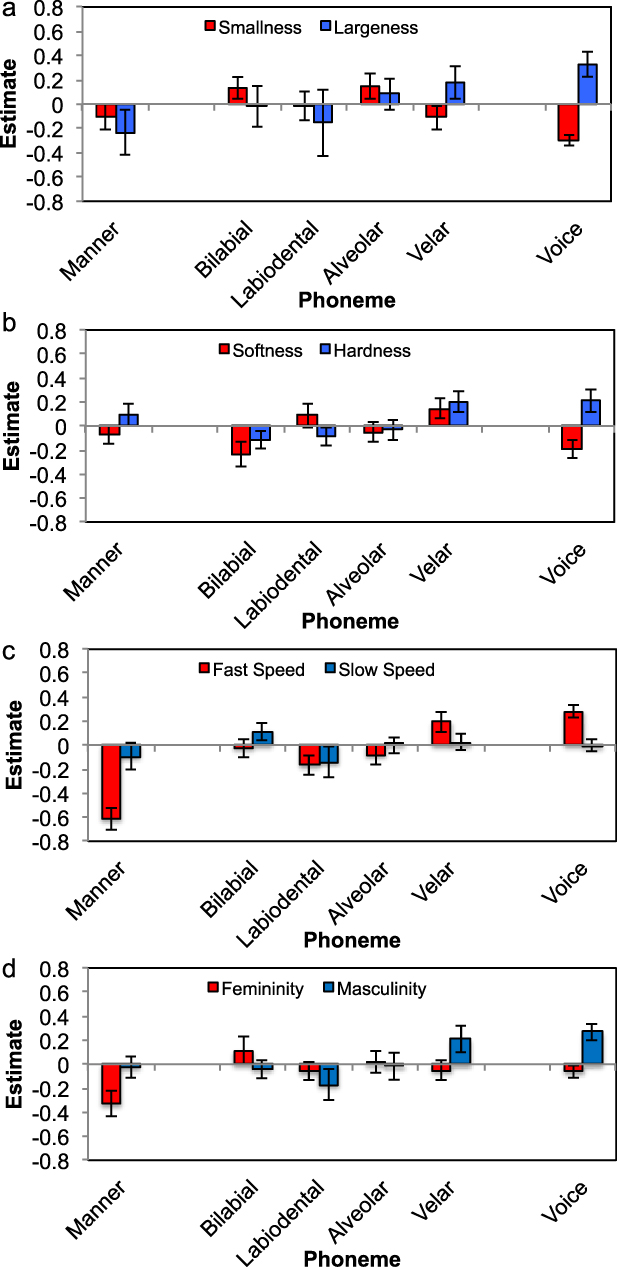
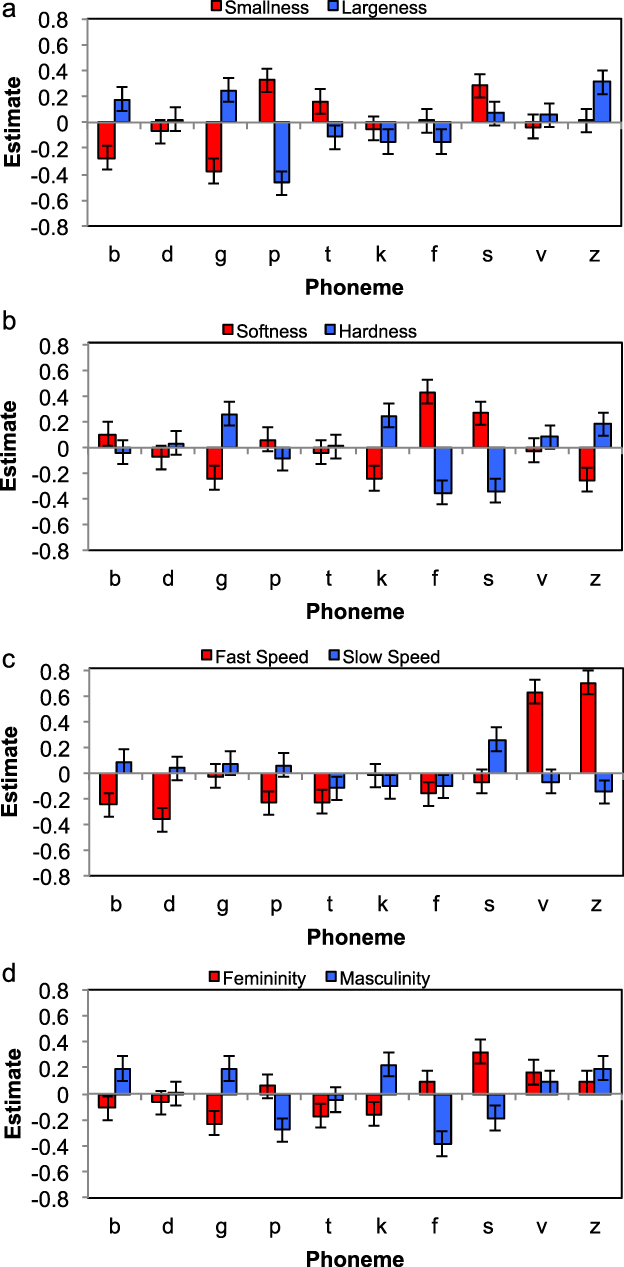
For smallness, manner of articulation did not significantly improve model fit (χ2(1) = 1.1525, p = .283). Place of articulation marginally improved model fit (χ2(3) = 7.6509, p = .05381). Voicing improved model fit (χ2(1) = 12.209, p < .001). Figure 1a shows the centred estimates for the features for smallness, in the red columns. Values that are greater than zero indicate that participants judged the feature to be more appropriate for expressing smallness than their mean response to the nonwords; values less than zero indicate judgements that the feature was less appropriate. To convert the estimates to responses on the 7-point Likert scale, the estimates can be added to the intercept from the model (see Supplementary Materials 1). For example, for the phoneme feature model, the intercept was 3.58, so the mean rating for nonwords containing voiced consonants was 3.58 – 0.30 = 3.28. Words containing unvoiced consonants were judged to be more appropriate, and words containing bilabial, labiodental, or alveolar consonants were marginally more appropriate than words containing velars. For the phoneme model, phonemes improved model fit compared to the model containing only random effects (χ2(9) = 51.248, p < .0001). Figure 2a shows the estimates for each phoneme in predicting the attribute.
Estimates from the MLE model of the appropriateness of phoneme features relating to each semantic attribute. Values below zero indicate that nonwords containing the phonological feature are judged to be negatively related to the attribute, values above zero indicate that the phonological feature is judged to relate positively.
Estimates for appropriateness of each phoneme relating to each semantic attribute. Estimates above zero indicate that nonwords containing the phoneme are judged to relate negatively to the attribute, positive values indicate judgements that the phoneme does relate to the attribute.
Comparisons of model fit for the phoneme feature model and the phoneme model demonstrated a significant improvement in model fit for the phoneme model (χ2(4) = 16.718, p = .002). Thus, judgements about nonwords relating to smallness are better explained by individual phonemes rather than more general phoneme features.
For largeness, for the phoneme feature analysis, manner of articulation did not significantly improve model fit (χ2(1) = 1.5809, p = .209). Place of articulation did not improve fit (χ2(3) = 4.1983, p = .241), but voicing did improve fit (χ2(1) = 5.9163, p = .015), with voicing relating to largeness, operating in the opposite direction to judgements about smallness, see Figure 1a. For the phoneme analysis, phonemes improved model fit compared to a model containing only random effects (χ2(9) = 102.86, p < .001), with /b, g, z/ relating positively and /p, t, k, f/ relating negatively to largeness (see Figure 2a).
The phoneme model fit was significantly better than the phoneme feature model fit (χ2(4) = 17.807, p = .001), so, as for the smallness comparison, responses were best explained in terms of individual phonemes rather than general phoneme features.
3.2. softness and hardness
For softness, analysing the phoneme features, manner of articulation was not significant (χ2(1) = 0.769, p = .380), but place of articulation (χ2(3) = 11.102, p = .011) and voicing (χ2(1) = 4.378, p = .036) were significant, with unvoiced and velars judged softer than voiced and bilabials (see Figure 1b). The Figure illustrates the estimates for each phoneme feature in terms of appropriateness of nonwords containing the feature reflecting the attribute of softness.
For the analysis of individual phonemes, phonemes explained significant variance (χ2(9) = 103.79, p < .001), with /f, s/ relating positively, and /g, k, z/ relating negatively to softness (see Figure 2b). In a comparison between the phoneme model and the phoneme feature model, the phoneme model was found to be a better fit to the data (χ2(4) = 33.776, p < .001).
For hardness, manner of articulation was not significant (χ2(1) = 2.073, p = .150), but place of articulation (χ2(3) = 25.237, p < .001) and voicing (χ2(1) = 25.397, p < .001) were significant, with velars and voicing relating positively to hardness. Phonemes contributed significantly to explaining variance in the phoneme model (χ2(9) = 95.191, p < .001), demonstrating the inverse pattern to softness (see Figure 2b), and once again the comparison between the phoneme model and the phoneme feature model revealed that the phoneme model was a better fit to the data than the phoneme feature model (χ2(4) = 28.233, p < .001).
3.3. fast and slow speed
For fast speed, all phoneme features were significant: for manner of articulation (χ2(1) = 76.169, p < .001), for place of articulation (χ2(3) = 18.490, p < .001), and voicing (χ2(1) = 39.886, p < .001), with fricatives, voicing, and velars relating positively to the fast speed attribute. Figure 1c shows the appropriateness of each phoneme feature relating to the attribute fastness. For the phoneme model, phonemes were significant (χ2(9) = 247.03, p < .001), with /v, z/ relating positively and /b, d, p, t/ relating negatively to fast speed. In model comparisons, the phoneme model was a better fit to the data than the phoneme feature model (χ2(4) = 87.787, p < .001).
For slow speed, none of the phoneme features related significantly: manner (χ2(1) = 1.922, p = .167), place (χ2(3) = 7.285, p = .063), voicing (χ2(1) < 0.001, p = .980). For the phoneme model, phonemes significantly contributed to explaining variance (χ2(9) = 30.291, p < .001), with /s/ relating positively and /t, z/ relating negatively to slow speed (see Figure 2c). Again, in a comparison of the phoneme and phoneme feature models, the phoneme model explained the data better than the phoneme feature model (χ2(4) = 22.786, p < .001).
3.4. femininity and masculinity
For femininity, manner of articulation was significant (χ2(1) = 5.756, p = .016) (see Figure 1d), with fricatives relating positively. Place of articulation (χ2(3) = 3.871, p = .276), and voicing (χ2(1) = 1.233, p = .267) were not significant. Phonemes in the phoneme model were significant (χ2(9) = 62.382, p < .001) (see Figure 2d), with /g, t, k/ relating negatively and /s, v/ relating positively to femininity. The comparison of models showed that the phoneme model was a better fit than the feature model (χ2(4) = 10.034, p = .040).
Finally, for masculinity, manner of articulation was not significant (χ2(1) = 0.137, p = .711), but place of articulation (χ2(3) = 22.706, p < .001) and voicing (χ2(1) = 41.396, p < .001) were both significant predictors, with velars and voicing relating positively. Phonemes explained significant variance in the phoneme model (χ2(9) = 98.377, p < .001), with /b, g, k, z/ relating positively, and /f, s/ relating negatively to masculinity. As with all the other model comparisons, the phoneme model was a better fit to the data than the phoneme feature model (χ2(4) = 26.643, p < .001).
4. Discussion
We tested the extent to which phoneme features or individual phonemes better explained participants’ preferences for the appropriateness of written nonwords in expressing a range of attributes. We found that, for eight different attributes drawn from four antonym pairs, various phoneme features and individual phonemes explained significant variance in participants’ responses. Thus, effects of sound symbolism across a broad set of attributes were effectively captured in terms of the sounds contained in the words. The only exception was that no phoneme features significantly predicted variance in responses to slow speed. Thus, previous explorations of effects of sound symbolism in relating to semantic attributes (Bergen, Reference Bergen2004; Klink & Wu, Reference Klink and Wu2013; Lockwood & Dingemanse, Reference Lockwood and Dingemanse2015; Nielsen & Rendall, Reference Nielsen and Rendall2013) are shown to be extensive and prevalent across a range of different meanings.
As noted by Westbury et al. (Reference Westbury, Hollis, Sidhu and Pexman2018), the relations between particular speech sound properties and antonyms were sometimes diametrically opposed, but not always. One possible contribution to this may have been the spatial arrangement of the Likert scale responses (‘not at all appropriate’ always appeared on the left of the display, and ‘very appropriate’ always appeared on the right of the display), which may have affected complete reversal of effects. For instance, participants may have a preference for small at the left of (any) scale. For smallness and largeness, we observed opposing effects for velar place of articulation (more related to largeness) and voicing (more related to largeness), consistent with Klink (Reference Klink2000, Reference Klink2001, Reference Klink2003). At the phoneme level, we found /b, g/ relating positively to largeness and negatively relating to smallness, and /p, t/ relating positively to smallness and negatively to largeness. Thus, the voicing effect appeared to be specific to only some phoneme contrasts.
For the softness and hardness antonym pair, again the features of velar and voicing related positively to hardness and negatively to softness. For the phonemes, /g, k, z/ were positively related to hardness and negatively related to softness, and /f, s/ related positively to softness and negatively to hardness, similar to trends in the results of Klink (Reference Klink2000).
For fast and slow speed, no phoneme features related significantly to slow speed, but for the individual phoneme model, /v, z/ related positively to fast and negatively to slow speed, and /b, d, s/ showed trends for positive relations to slow and negative to fast speed.
Finally, for the antonym pair of femininity and masculinity, no phoneme features related more closely to femininity than masculinity, but for the individual phoneme model, /s/ related positively to femininity and negatively to masculinity, and /b, g, k/ showed the opposite effect. Previous observations of relations between femininity and manner of articulation thus seem to be driven by particular phonemes rather than phoneme features (Klink, Reference Klink2000).
Taken together, these analyses demonstrate that place of articulation of consonants relate to numerous meaning attributes in terms of iconicity, in addition to the established effects previously observed of relations between manner of articulation and meaning relations. However, the focus of previous studies on manner of articulation effects, e.g., continuants versus obstruents, or frication versus plosive (Fort et al. Reference Fort, Martin and Peperkamp2015; Monaghan et al., Reference Monaghan, Mattock and Walker2012; Nielsen & Rendall, Reference Nielsen and Rendall2011, Reference Nielsen and Rendall2013, though these particular studies relate to different attributes than those tested here), are shown in the current study to be less prevalent than effects of voicing, and alternate somewhat with the effects of place of articulation in the analyses. These mixed results demonstrate the volatility of analyses based on phoneme features, and point instead to the value of considering individual phonemes in explaining the data. Indeed, the current results highlight that design of sound symbolism studies that aim to test phoneme features must include sufficient numbers of different phonemes to be assured that apparent feature effects are not instead due to the contribution of individual phonemes, an issue that may have led researchers to overgeneralise their observed effects beyond the immediate items employed.
Interestingly, certain phonemes appeared to be particularly strongly related to several of the meaning attributes. For example, /s/ related positively to small, soft, slow, and feminine, and related negatively to hard, and masculine, and /g/ was positively related to large, hard, and masculine, and negatively related to small, soft, and feminine. These relations may be due to correspondences that already occur between meaning attributes – small and soft may be more related than small and hard; see Westbury et al. (Reference Westbury, Hollis, Sidhu and Pexman2018) and Walker (Reference Walker2016) for further discussion. Nevertheless, the results highlight that phonemes are not limited to relate to only particular meanings, but can reflect iconicity between one sound and very many meaning relations.
Indeed, comparisons across the statistical models also enabled us to determine whether phoneme features or individual phonemes better explained participants’ preferences for relations between written nonwords and meaning attributes. We observed that, for all meaning attributes tested in this study, participants’ judgements about sound to meaning relations were best accounted for by individual phonemes rather than phoneme features. Though particular phoneme features may significantly relate to judgements, these do not appear to be general across all phonemes with that feature. For instance, for the largeness attribute, voicing is highly significant, but the voiced phonemes /d, z/ do not relate significantly positively to largeness, and nor do the unvoiced phonemes /t, s/ relate significantly negatively to largeness. Instead, particular phonemes, that are somewhat independent of their phoneme features, appear to symbolise the meaning.
One possibility is that interactions between phoneme features may be driving the effects. Our analyses considered phoneme features only as main effects. This was because an analysis including interactions between phoneme features would be identical to a phoneme-level analysis – each phoneme is individuated by its particular manner, place, and voicing features which would be distinguished in interactions between features. Though these explanations cannot be distinguished analytically, they can be distinguished theoretically. For explanations grounded in cross-modal associations between particular acoustic characteristics and meaning attributes, we do not expect that place of articulation should substantially affect the influence of voicing or of manner of articulation (e.g., Ohala, Reference Ohala, Hinton, Nichols and Ohala1994; Rhodes, Reference Rhodes, Hinton, Nichols and Ohala1994). Phoneme feature accounts of sound symbolism would require an account of the acoustic effects of such interactions in explaining behaviour.
The finding that individual phonemes rather than phoneme features better reflect behavioural judgements about iconicity create tension for theories proposing that general cross-modal correspondences underwrite relations between speech sounds and meanings in studies of written word iconicity. Instead, the effects seem to be driven by more particular correspondences between individual phonemes and meanings, consistent with studies of phonaesthemes in language. This enables us to consider which of the several proposed mechanisms of sound symbolism characterised by Sidhu and Pexman (Reference Sidhu and Pexman2018) best relates to our data. If sound symbolism for written words is expressed at the phoneme rather than the phoneme (or acoustic) feature level, then two of the mechanisms considered by Sidhu and Pexman can be ruled out as explanations for the current effects. The first proposed mechanism – that there are learned statistical associations between sounds and meanings – is consistent with our data. Participants may acquire the association between particular phonemes and meaning distinctions, even though the actual relations between phonemes and meanings in natural language are minimal (Monaghan et al., Reference Monaghan, Lupyan and Christiansen2014). The second proposed mechanism that there are shared properties between speech and meaning is difficult to reconcile with our data, as any such shared properties should be expressed better in phoneme features than phonemes. The third mechanism, that associations are due to similar neural activation (Marks, Reference Marks1978) is also difficult to align with the current results, as it requires an explanation for why particular phonemes might generate neural activation that is distinct from the acoustic properties of the phoneme.
Though we have tested several semantic attributes in the current study – eight attributes in four antonym pairs – and measured the sound-symbolic effects with a broad range of phonemes and phoneme features, we cannot be certain that our conclusions generalise to other observed sound-symbolic effects, for three key reasons. First, it is possible that other sound-symbolic distinctions that we have not tested may relate to speech sounds at the phoneme feature level, rather than the phoneme level, such as the angular/rounded distinction (Brand et al., Reference Brand, Monaghan and Walker2018; Nielsen & Rendall, Reference Nielsen and Rendall2011, Reference Nielsen and Rendall2013). Second, the results may be differently realised if the referents were visually presented rather than just described by semantic attributes. It is possible that participants may be more drawn to the phoneme features rather than the individual phonemes if the referent is visually present, thus creating a more direct link between the perceptual modalities than in our study, where the links are mediated by language (see Walker, Reference Walker2016, for discussion of this point). Third, we have tested 10 different phonemes, but have not investigated all possible manner and place features that occur in segmental phonology. For instance, some studies of the bouba/kiki effect have contrasted sonorants with plosives, and these may result in greater differences than those documented for fricatives versus plosives (e.g., Klink, Reference Klink2000). Further work is clearly necessary to establish whether phoneme effects accounting for apparent phoneme features effects of fricatives versus plosives and voiced versus unvoiced consonants apply too to approximants and nasals, and whether the four places of articulation indicate effects that generalise to all places.
The results show that written stimuli access phoneme level over phoneme or acoustic feature level sound-symbolic effects, and this has important implications for the extent to which sound symbolism effects are involved in, for instance, written brand names (e.g., Klink & Wu, Reference Klink and Wu2013; Shrum et al., Reference Shrum, Lowrey, Luna, Lerman and Liu2012). There is the possibility that visual features of the orthography of the nonwords may contribute to the effects. In order to measure the extent to which letter shape was affecting the results of our analyses, we included letter shape feature (angular or rounded) as defined in Cuskley, Simner, and Kirby (Reference Cuskley, Simner and Kirby2017) as an additional fixed factor in our analyses. As reported in Supplementary Material 3, the results indicate no substantial changes in the results, though there was in some cases an additional contribution from letter shape to account for variance (for soft, hard, fast, feminine, and masculine), confirming Cuskley et al.’s (Reference Cuskley, Simner and Kirby2017) and Westbury et al.’s (Reference Westbury, Hollis, Sidhu and Pexman2018) observations that letters can contribute to behaviour in addition to the phoneme features that those letters denote. Although, for each of these attributes, the model containing only phonemes was still the best fitting model.
Conducting the study with auditory rather than visual stimuli would enable us to determine whether phonemes or phoneme features underwrite sound symbolism effects more broadly still. There is evidence to suggest that phoneme feature effects may be reduced in written compared to spoken nonwords. Cuskley et al. (Reference Cuskley, Simner and Kirby2017) showed that the effect of voicing was enhanced in spoken compared to written presentation, when testing an angular/rounded distinction, and Bremner, Caparos, Davidoff, de Fockert, Linnell, and Spence (Reference Bremner, Caparos, Davidoff, de Fockert, Linnell and Spence2013) found that the bouba-kiki effect was smaller in illiterate compared to literate participants. Nevertheless, the fact that we observed substantial phonological feature effects for semantic attributes that are consistent with studies tested with a variety of different methods (e.g., Lockwood & Dingemanse, Reference Lockwood and Dingemanse2015) suggests that the manner of testing may not be critical in revealing the observed effects. We found effects of phoneme features in all the semantic attributes we tested, and these were independent of the visual characteristics of the written nonwords. In all these cases we have tested, our conclusion stands: that phonological feature distinctions are better described in terms of phonemes to explain the goodness of fit between a label and the semantic attribute to which it refers. At the very least, our results highlight that studies presuming effects in terms of phonological or acoustic features need also to test the alternative explanation that results reside instead at the phoneme level.
The phenomena we have investigated have focused on segmental phonology: phoneme features, relating to acoustic properties, and phonemes. However, it is important to note the wealth of additional sound-symbolic effects that are observable in suprasegmental phonology. For instance, there are large effects of duration, pitch, and timbre of speech that are also related to fit between sound and meaning (Nygaard, Herold, & Namy, Reference Nygaard, Herold and Namy2009; Shintel, Nusbaum, & Okrent, Reference Shintel, Nusbaum and Okrent2006), effects that are observable even with limited, or even without any, segmental phonology present (e.g., Perlman, Dale, & Lupyan, Reference Perlman, Dale and Lupyan2015). The presence of these suprasegmental sound-symbolic effects thus demonstrate that cross-modal associations, that cannot be reduced to manner or place features of phonemes, are present and prevalent in speakers’ interpretations of speech.
The comparison presented here between phoneme features and individual phoneme effects thus presents an opportunity for gauging different potential explanations for iconicity in language, and deciding between alternative mechanisms proposed to account for sound symbolism. The results suggest caution should be urged before concluding that phoneme features, or acoustic features associated with segmental phonology, are driving the effects. It is imperative to at least test whether effects are instead better explained in terms of phonemes. Yet it remains the case that a more comprehensive analysis of speech sounds and meaning attributes, across both written and spoken forms, will be required before the precise mechanism or mechanisms driving relations between sound and meaning can be established.
Supplementary materials
For supplementary materials for this paper, please visit <http:/doi.org/10.1017/langcog.2019.20>.
The data and R script for analyses are available via OSF <https://osf.io/ujq76/?view_only=85a2b39b6fd342b99955eb7f91268b40>.


 Open access

