





Lexical access is a core component of the reading process (Grainger, Reference Grainger2018, Reference Grainger2024). In languages using the Latin script, readers are thought to achieve lexical access by encoding abstract letter identities (Grainger & Dufau, Reference Grainger, Dufau and Adelman2012). Leading neurobiologically inspired models of letter and word recognition (e.g., Dehaene et al., Reference Dehaene, Cohen, Sigman and Vinckier2005; Grainger et al., Reference Grainger, Rey and Dufau2008) propose that, after an initial analysis of low-level perceptual features (e.g., letter case, font, color, size), neural activity progresses through hierarchically organized layers that encode increasingly abstract representations of letter identity and their combinations, which in turn provide the input to lexical representations.
There is extensive empirical evidence supporting these ideas. In a masked priming lexical decision experiment, Jacobs et al. (Reference Jacobs, Grainger and Ferrand1995) found that response times (RTs) for uppercase targets (e.g., YEUX [eyes]) were similar whether the identity prime was presented in lowercase (yeux) or uppercase (YEUX). Likewise, Bowers et al. (Reference Bowers, Vigliocco and Haan1998) reported comparable masked repetition priming for visually similar (e.g., kiss–KISS) and visually dissimilar (e.g., edge–EDGE) prime–target pairs. Vergara-Martínez et al. (Reference Vergara-Martínez, Gomez, Jiménez and Perea2015) used the same paradigm as Jacobs et al. (Reference Jacobs, Grainger and Ferrand1995) while recording event-related potentials (ERPs) and found early differences between altar–ALTAR and ALTAR–ALTAR pairs in a time window associated with early perceptual processing (N/P150; see Grainger & Holcomb, Reference Grainger and Holcomb2009). These early case-mismatch effects, however, rapidly dissipate, disappearing in later components associated with orthographic and lexical-semantic processing (N250, N400; see also Chauncey et al., Reference Chauncey, Holcomb and Grainger2008).
Importantly, the transient role of visual form can also be observed in the lexical decision task when manipulating the visual similarity between a misspelled word and its base word. Perea and Panadero (Reference Perea and Panadero2014) found that misspelled words such as viotin and viocin (from violin) produced similar RTs and error rates in lexical decision (see also Gutierrez-Sigut et al., Reference Gutierrez-Sigut, Vergara-Martínez and Perea2022; Perea et al., Reference Perea, Baciero, Labusch, Fernández-López and Marcet2022). If surface-form similarity exerted a substantial influence during lexical access, the visually similar pseudoword viotin should have been more difficult to reject than the visually dissimilar viocin. Furthermore, Gutierrez-Sigut et al. (Reference Gutierrez-Sigut, Vergara-Martínez and Perea2022) observed remarkably similar ERP waveforms for both visually similar and dissimilar pseudowords across all time windows.
Taken together, these findings suggest that visual information exerts only a transient influence during the recognition of common words in Latin-derived orthographies, confined to the earliest stages of letter and word encoding (Dehaene & Cohen, Reference Dehaene and Cohen2007; Grainger & Dufau, Reference Grainger, Dufau and Adelman2012; Gutierrez-Sigut et al., Reference Gutierrez-Sigut, Marcet and Perea2019; Lally & Rastle, Reference Lally and Rastle2022; Marcet & Perea, Reference Marcet and Perea2017). However, visual familiarity can influence lexical access when words are typically encountered in a fixed visual format, such as brand names and logotypes. For instance, in lexical decision experiments, the visually similar misspelled brand name anazon (from amazon) yields slower and more error-prone responses than the visually dissimilar atazon (Pathak et al., Reference Pathak, Velasco and Calvert2019; see also Perea et al., Reference Perea, Baciero, Labusch, Fernández-López and Marcet2022; Rocabado et al., Reference Rocabado, Labusch, Perea and Duñabeitia2024). These findings illustrate that surface familiarity can exert measurable effects when lexical representations are tightly bound to a fixed visual form.
Clarifying what counts as visual letter similarity across studies is important. In early work with Latin script (e.g., Perea & Panadero, Reference Perea and Panadero2014), similarity was defined in terms of broad shape properties such as ascender–descender structure (e.g., viotin vs. viocin from the base word violin; see also Rayner et al., Reference Rayner, McConkie and Ehrlich1978, Reference Rayner, Well, Pollatsek and Bertera1982, for related parafoveal preview manipulations). More recent research on visual similarity effects in the Latin script has adopted a finer featural approach, using letter similarity matrices derived from ratings (e.g., Simpson et al., Reference Simpson, Mousikou, Montoya and Defior2013), again with null effects (e.g., see Perea et al., Reference Perea, Baciero, Labusch, Fernández-López and Marcet2022, Reference Perea, Labusch, Fernández-López, Marcet, Gutierrez-Sigut and Gómez2024; Rocabado et al., Reference Rocabado, Labusch, Perea and Duñabeitia2024). In the present experiments, we adopted the same general logic for an Arabic-derived script: visually similar substitutions preserved the basic letter shape and changed only the dot configuration, following the Arabic letter similarity norms of Boudelaa et al. (Reference Boudelaa, Perea and Carreiras2020). Our comparison with the Latin-script literature is therefore functional rather than strictly metric. The relevant visual dimensions differ across scripts, but the theoretical question is the same: Does perceptual overlap delay the mapping from visual input onto abstract orthographic codes?
The present experiments examined whether this early abstraction of letter identity, which is central to current models of visual word recognition in Latin script, also characterizes processing in Arabic-derived scripts. Evidence from other writing systems (e.g., hiragana and katakana syllabaries in Japanese) points to a similarly rapid transition from visual to abstract representations (Okano et al., Reference Okano, Grainger and Holcomb2013). Notably, Arabic script is used not only for the Arabic language but also for more than thirty other languages from different linguistic families (e.g., Persian, Urdu, Pashto, Sindhi, Kurdish, Uyghur). Beyond its right-to-left directionality, Arabic-derived scripts possess several distinctive visual properties that may affect early stages of word recognition. First, unlike Latin alphabets, Arabic-derived scripts do not require readers to map across uppercase and lowercase variants of the same letter identity, which is one of the main sources of allographic variation in the Roman alphabet. Second, many letters in Arabic-derived scripts differ only in the number or position of dots – which function as integral letter features rather than optional vowel diacritics – so that otherwise identical letter sequences may encode distinct words (e.g., اشتعال ا /A$tEAl/ [to burn] vs. اشتغال /A$tgAl/ [to work]; Buckwalter transliteration; see Boudelaa & Marslen-Wilson, Reference Boudelaa and Marslen-Wilson2010). Third, the script includes 28 letters, 22 of which connect to the following letter, while the remaining 6 connect only to the preceding one. In addition, the visual form of each letter also varies with its position (initial, medial, final or isolated), resulting in a characteristic semicursive style. For example, the letter ب /b/ appears as ب in isolation (e.g., کتاب /ktAb/ [book]), بـ in initial position (e.g., برکت /brkt/ [blessing]), ـبـ in medial position (e.g., عبور /Ebwr/ [cross]) and ـب in final position (e.g., الکلب /Alklb/ [dog]).
Previous research on masked priming in Arabic has shown that the process of letter encoding is similar to that in Latin script. Carreiras et al. (Reference Carreiras, Perea and Abu Mallouh2012) conducted a masked priming letter-matching experiment in Arabic to assess whether position-dependent allographs are encoded as abstract units. They found that the size of identity priming effects was comparable for visually similar pairs (e.g., ظ - ـظ) and visually dissimilar pairs (e.g., ع - ـعـ) – note that these pairs correspond to the same letters in isolated and middle positions. This pattern is similar to that reported in the Latin script by Kinoshita and Kaplan (Reference Kinoshita and Kaplan2008) using lowercase primes and uppercase targets. In their study, the magnitude of the identity priming effects for visually similar prime–target pairs (e.g., c-C) was approximately the same as those for visually dissimilar prime–target pairs (e.g., e-E). Carreiras et al. (Reference Carreiras, Perea, Gil-López, Abu Mallouh and Salillas2013) extended this comparison to bilinguals familiar with both scripts while recording ERPs. Visual similarity between primes and targets modulated ERP amplitude in an early perceptual time window (N/P150) in both scripts, but this difference was greatly reduced in later orthographic windows (P300). These results converge on a shared principle: early visual features briefly influence processing before giving way to abstract letter representations.
Notably, visual similarity exerts markedly different effects on word recognition across Arabic and Roman scripts, at least in masked priming experiments. In Latin script, a visually similar prime such as obiect is more effective than a visually dissimilar prime such as obaect for the target word OBJECT (Marcet & Perea, Reference Marcet and Perea2017, Marcet & Perea, Reference Marcet and Perea2018a; see also Marcet & Perea, Reference Marcet and Perea2018b, for similar evidence from parafoveal preview during reading). In contrast, parallel experiments in Arabic have failed to show comparable effects. For instance, Perea et al. (Reference Perea, Abu Mallouh, Mohammed, Khalifa and Carreiras2016) found that RTs to the Arabic target word صحفية /SHfyap/ [journalist] were remarkably similar when preceded by a visually similar pseudoword prime (e.g., صخفية /Sxfyap/, where the letter ـحـ was replaced by ـخـ) or a visually dissimilar pseudoword prime (e.g., صکفية /Skfyap/, where ـحـ was replaced by ـکـ). Identity primes (e.g., صحفية) produced faster responses than either condition (see Perea et al., Reference Perea, Abu Mallouh, Mohammed, Khalifa and Carreiras2018, for similar evidence with developing readers). Similarly, AlJassmi et al. (Reference AlJassmi, McGowan, White and Paterson2020) found no visual similarity effects in Arabic when manipulating parafoveal previews during sentence reading.
The absence of visual similarity effects in Arabic may reflect both the script’s reliance on dots to distinguish letters and the language’s root-based morphology, which prioritizes consonantal identity over surface form. Meaning in Arabic words is built around consonantal roots (e.g., the consonantal root k-t-b in كتاب /kitAb/ [book] and كاتب /kAtib/ [writer]). Hence, precise identification of each letter in the consonantal root, including its dot configuration, is essential for lexical access. This interpretation aligns with Wiley et al. (Reference Wiley, Wilson and Rapp2016), who showed that dot configuration is the most diagnostic feature for letter identification in Arabic. Because many words differ solely by dot patterns (e.g., اشرار /A$rAr/ [villains] vs. اسرار /AsrAr/ [secrets]), dot-based confusability may induce strong letter-to-letter inhibition, attenuating visual similarity effects in word-level tasks (see Pittrich & Schroeder, Reference Pittrich and Schroeder2023, for a similar pattern with mirror letter [b, d] in Latin script). Hence, previous masked priming results in Arabic may partly reflect root preservation or violation rather than purely visual overlap. Thus, a critical theoretical issue is not simply whether Arabic-derived scripts show visual similarity effects, but whether the null effects previously reported for Arabic reflect a script-general property of letter coding or a language-specific consequence of Semitic root morphology. Persian offers a way to adjudicate between these alternatives.
Recent evidence, nonetheless, has shown that visual similarity effects reappear when letters are processed in isolation. In two masked priming experiments, AlJassmi and Perea (Reference AlJassmi and Perea2024) demonstrated that visually similar Arabic letters differing only in dot configuration facilitated identification relative to visually dissimilar pairs in both alphabetic decision and letter-matching tasks; for example, responses to the target letter ح were faster when it was preceded by the visually similar prime خ than by the visually dissimilar prime ظ. This finding suggests that early visual perceptual mechanisms in Arabic operate much like those in Latin script: transiently sensitive to feature overlap, with task-dependent persistence. Hence, Arabic readers remain sensitive to visual similarity at the letter level, but this sensitivity may diminish rapidly once letters are integrated into word-like strings.
Beyond visual similarity, Arabic script introduces another dimension of visual structure: semicursive ligation, the pattern of inter-letter connectivity within words. Ligation could, in principle, shape the perceptual units that feed letter identification. Friedmann and Haddad-Hanna (Reference Friedmann and Haddad-Hanna2012) proposed that position-dependent letter forms in Arabic are encoded abstractly. They found that children with letter-position dyslexia produced more transposition errors when transposed-letter neighbors shared the same ligation pattern (e.g., یصنع /ySnE/ [to make] → ینصع /ynSE/ [becomes clear/manifest]), but not when ligation differed (e.g., شعار /$Ear/ [slogan] rarely misread as شاعر /$Aer/ [poet]). Although these findings may reflect atypical reading processes, they suggest that ligation can influence visual similarity. Perea et al. (Reference Perea, Abu Mallouh and Carreiras2013) examined this possibility in skilled readers using masked priming. Target words such as کتاب /ktAb/ [book] were preceded by replaced-letter primes that either preserved (کتزب /ktzb/) or disrupted (کتخب /ktxb/) the ligation pattern. Both related primes facilitated recognition relative to unrelated controls, but there was no difference between ligation-preserved and ligation-disrupted primes. Nonetheless, more recent masked priming experiments in Arabic-derived scripts have reported a small ligation effect (e.g., Yakup et al., Reference Yakup, Abliz, Sereno and Perea2015, in Uyghur; see also Boudelaa et al., Reference Boudelaa, Norris, Mahfoudhi and Kinoshita2019, in Arabic). It therefore remains unclear whether these discrepancies arise from prime–target incongruency in the ligation pattern or from genuine effects of letter connectivity, a distinction that, as Andrews (Reference Andrews1997) noted, is better addressed in single-word lexical decision tasks than in masked priming paradigms, which primarily measure the interplay between primes and targets (see also Gómez et al., Reference Gómez, Marcet and Perea2021, for a similar point).
In sum, the early stages of letter recognition appear broadly comparable across Arabic and Latin scripts (Carreiras et al., Reference Carreiras, Perea, Gil-López, Abu Mallouh and Salillas2013); however, word-level differences persist. These differences likely reflect the interaction of visual and morphological constraints rather than fundamental changes in processing architecture. To disentangle these factors, the present experiments employed a lexical decision task with pseudowords differing from their base word by a single letter, varying in visual similarity and ligation pattern. Our central aim was to determine whether the early abstraction of letter identity in Arabic-derived scripts is modulated by visual similarity and connectivity constraints, and to better constrain the conditions under which any of these effects arise. These ambiguities motivate the use of a test case in which visual factors can be examined with reduced confounding from Semitic root morphology.
Crucially, Persian provides a particularly informative test case because it is an Indo-European language written in a modified Arabic script (see Esmaeelpour et al., Reference Esmaeelpour, Saneei and Nourbakhsh2022; Yousefzadeh et al., Reference Yousefzadeh, Libben and Segalowitz2024, for brief descriptions). While Persian includes four additional letters (پ /p/, چ /t͡ʃ/, ژ /ʒ/, گ /g/), it retains the core dot-based contrasts and semicursive ligation patterns of Arabic. As in Arabic, short vowels are typically not represented, increasing reliance on consonantal identity during recognition. At the same time, unlike Arabic, Persian does not instantiate the non-concatenative root-based morphology characteristic of Semitic languages. This makes it possible to examine visual overlap between a pseudoword and its base word without conflating perceptual similarity with the preservation (or disruption) of a triliteral root. Thus, any observed differences can be attributed more directly to perceptual factors (e.g., dot configuration or ligation) rather than to morphological structure. This combination makes Persian an especially useful language for assessing whether visual similarity and ligation influence lexical access in Arabic-derived scripts. More generally, recent research on Persian compound processing has shown that this script provides a useful test case for examining constituent-level processing in compounds written in a right-to-left orthography derived from Arabic (see Yousefzadeh et al., Reference Yousefzadeh, Libben and Segalowitz2024). For readers unfamiliar with Persian script, the word موسیقی /musiqi/ (‘music’) illustrates several relevant properties at once: the script is read from right to left, short vowels are typically omitted, letters adopt position-dependent allographic forms and the identification of some letters depends primarily on dot number and placement. The present manipulations target precisely this last property: to the extent that dot-based visual overlap increases activation of the base-word representation, it should delay ‘no’ responses to pseudowords (see Perea et al., Reference Perea, Rosa and Gómez2005; Vergara-Martínez et al., Reference Vergara-Martínez, Perea, Gomez and Swaab2013; see also Martínez-Tomás et al., Reference Martínez-Tomás, Baciero, Lázaro and Hinojosa2025 for review).
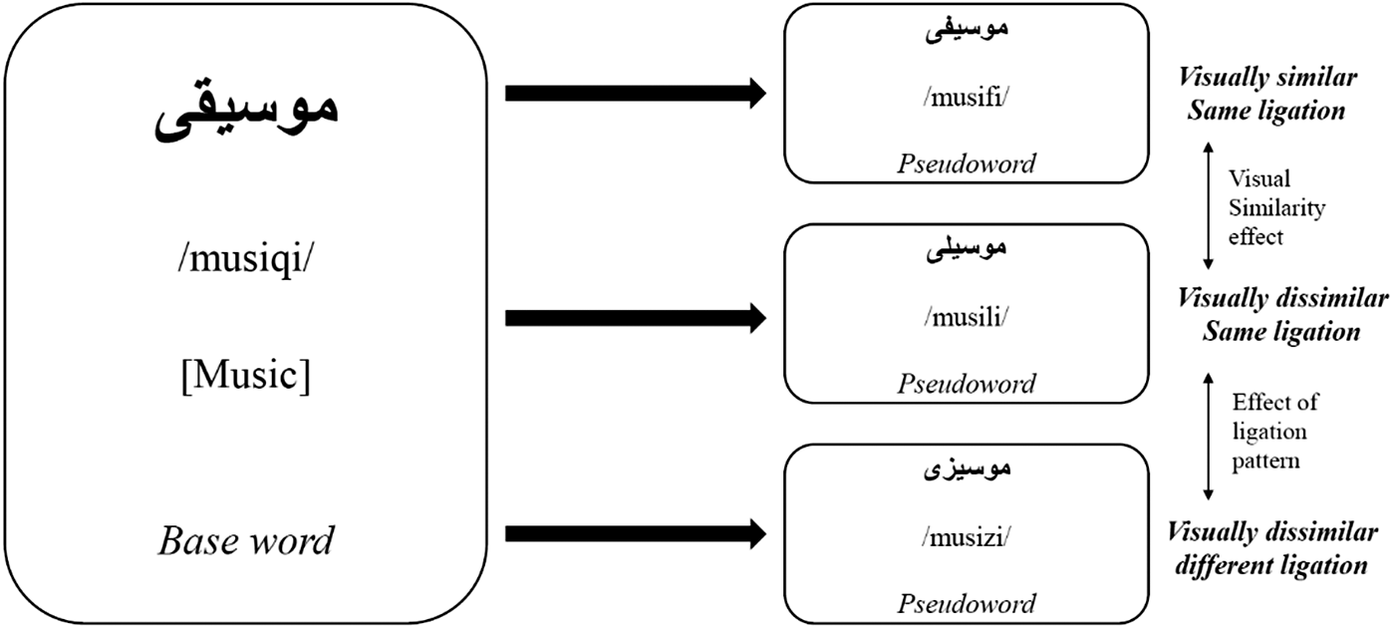
To operationalize these contrasts, we created three types of pseudowords derived from a single-letter substitution in each base word (see Figure 1): (1) visually similar, where the substituted letter preserved overall shape and differed only in dot configuration (addition, omission or reposition) (e.g., موسیفی /musifi/ [base word: موسیقی /musiqi/ [music]]; ـقـ [q] was replaced with ـفـ [f]); (2) visually dissimilar–ligation preserved, where the substituted letter differed in shape but maintained the same connectivity pattern (e.g., موسیلی /musili/, replacing ـقـ [q] with ـلـ [l]); and (3) visually dissimilar–ligation altered, where the substitution changed both shape and connectivity (e.g., موسیزی /musizi/, replacing ـقـ [q] with ـز [z]). Thus, this design separates intrinsic visual similarity from the relational property of ligation, enabling a test of their respective contributions to lexical access. A fully crossed design was not feasible here because letters that differ only in dot configuration typically share the same basic letter shape and connectivity; therefore, altering the ligation pattern necessarily entails a larger change in letter shape than dot configuration alone.
Examples of the three pseudoword types derived from a single-letter substitution in each base word.

Figure 1. Long description
A large box on the left contains the base word in Arabic script, followed by the phonetic transcription forward slash m u s i q i forward slash, the English translation Music in brackets, and the label Base word. Three horizontal arrows point from this box to three smaller boxes stacked vertically on the right.
Top box: Arabic script with a single letter change, phonetic transcription forward slash m u s i f i forward slash, and the label Pseudoword. To its right, text reads Visually similar, Same ligation.
Middle box: Arabic script with a different letter change, phonetic transcription forward slash m u s i l i forward slash, and the label Pseudoword. To its right, text reads Visually dissimilar, Same ligation.
Bottom box: Arabic script with a third letter change, phonetic transcription forward slash m u s i z i forward slash, and the label Pseudoword. To its right, text reads Visually dissimilar, different ligation.
Vertical double-headed arrows connect the right-hand annotations. The arrow between the top and middle annotations is labeled Visual Similarity effect. The arrow between the middle and bottom annotations is labeled Effect of ligation pattern.
The predictions are straightforward: if visual letter similarity influences word recognition, visually similar pseudowords should elicit slower or more error-prone responses than visually dissimilar ones. If ligation independently modulates processing, pseudowords preserving the ligation pattern of their base word should produce slower responses than those disrupting it. A graded pattern (i.e., largest cost for visually similar ligation-preserved items, intermediate for visually dissimilar ligation-preserved items and smallest for ligation-disrupted items) would suggest partially independent contributions of visual and structural information. Conversely, the absence of such effects would support the view that lexical access operates primarily on abstract orthographic representations (Dehaene et al., Reference Dehaene, Cohen, Sigman and Vinckier2005; Grainger et al., Reference Grainger, Rey and Dufau2008).
We used a preregistration to commit in advance to the critical contrasts, exclusion criteria and modeling strategy in a relatively underexplored language written in an Arabic-derived script, thereby reducing analytic flexibility for the critical theoretical comparisons (Nosek et al., Reference Nosek, Hardwicke, Moshontz and Vazire2022; see also Heyman et al., Reference Heyman, Pronizius, Lewis and Buchanan2026).
1. Experiment 1
1.1. Methods
The sample size and data analyses followed the preregistered protocol available at https://osf.io/cnxbm/overview?view_only=4f1c468464514121b6237f1cf6af8478
The stimuli, data, scripts and output of the experiments are available at: https://osf.io/fa32x
1.1.1. Participants
We recruited 36 native skilled readers of Persian (26 women, M age = 28.4 years, SD = 5.4; 10 men, M age = 25.6 years, SD = 4.9). This yielded approximately 1,800 observations per pseudoword condition (36 * 50 = 1,800), in line with the recommendations of Brysbaert and Stevens (Reference Brysbaert and Stevens2018) for experiments with small to medium effect sizes. All participants were adults with normal (or corrected-to-normal) vision and without reading or learning disorders. Participants provided informed consent prior to testing and volunteered without compensation.
1.1.2. Materials
We selected 150 Persian words (either nouns or adjectives) as base words for the pseudoword stimuli. The mean length of these words was 6.4 letters (range: 4–7), and the mean frequency was 115.69 per million (range: 13.13–743.37) in the WordPars database (Esmaeelpour et al., Reference Esmaeelpour, Saneei and Nourbakhsh2022). From each base word, we generated three pseudowords by replacing a single internal letter; the same letter position was replaced across the three pseudowords within each set (see Figure 1), but position itself was not manipulated as an independent factor. The three pseudoword types were as follows: (1) a visually similar letter that preserved the basic letter skeleton and differed only in dot configuration (addition, omission or reposition) (visually similar condition; e.g., موسیفی /musifi/ was created from موسیقی /musiqi/ [music], replacing ـقـ [q] with ـفـ [f]); the mean similarity was 4.86 (range: 2.93–6.33) on Boudelaa et al. ‘s (Reference Boudelaa, Perea and Carreiras2020) 1–7 visual similarity scale; (2) a visually dissimilar letter that preserved the ligation pattern of the base word (visually dissimilar–ligation preserved condition; e.g., موسیلی /musili/, replacing ـقـ [q] with ـلـ [l]); mean similarity = 1.96 (range: 1.33–2.72); and (3) a visually dissimilar letter that altered the ligation pattern (visually dissimilar–ligation altered condition; e.g., موسیزی /musizi/, replacing ـقـ [q] with ـز [z]); mean similarity = 1.65 (range: 1.00–2.36).Footnote 1 Thus, the visually similar condition included different instances of dot-based substitution (addition, omission or reposition), all of which preserved the letter skeleton while altering only dot configuration; this variability was introduced so that participants could not anticipate the nature of the pseudowords. The two visually dissimilar conditions were both low in visual similarity overall, although the visually dissimilar ligation-preserved pseudowords were minimally closer to the base word than the visually dissimilar ligation-altered pseudowords (mean ratings = 1.96 vs. 1.65, respectively, on the 1–7 scale) – as shown in the Results section, we conducted exploratory analyses to examine whether this small difference could have affected the findings. Bigram frequency was controlled across the three pseudoword types (Ms = 17.89, 17.79, 17.84, respectively) using the Persian database in Worldlex (Gimenes & New, Reference Gimenes and New2016). Importantly, for all pseudoword sets, the base word was the only possible lexical neighbor in the WordPars database, ensuring minimal confusability.
An additional 150 Persian words (nouns or adjectives) served as lexical controls (M = 6.4 letters, range = 4–7; frequency = 49.50 per million, range = 0.20–580.58). Three counterbalanced lists were created so that each participant saw every base word only once and across conditions, yielding 300 trials (150 pseudowords, 50 of each type, and 150 words). Twelve participants were assigned to each list.
1.1.3. Procedure
The experiment was created with PsychoPy 3 (Peirce & MacAskill, Reference Peirce and MacAskill2018; version 2021.1.1) and deployed via Pavlovia (https://pavlovia.org) for online data collection (see Angele et al., Reference Angele, Baciero, Gómez and Perea2023; Ratcliff & Hendrickson, Reference Ratcliff and Hendrickson2021, for comparable online–laboratory reliability). Participants first completed a brief demographic questionnaire on LimeSurvey (https://www.limesurvey.org) regarding age, gender, education and visual or reading difficulties. They were instructed to perform the experiment in a quiet environment and to avoid distractions. Each trial required deciding whether the string on the screen was a real Persian word by pressing M (‘Yes’) or Z (‘No’) with the index fingers. Participants were told to respond as quickly and accurately as possible. After 16 practice trials, the main session began, comprising 300 experimental trials. Each trial started with a fixation cross (+) for 500 ms, followed by the target stimulus (Arial 18 pt) presented until response or until the 2-s deadline. Trial order was randomized. The session lasted approximately 15 minutes.
1.1.4. Data analyses
Correct pseudoword RTs and accuracy data were analyzed using Bayesian linear mixed-effects models implemented in R (R Core Team, 2022) with the brms package (Bürkner, Reference Bürkner2018, Reference Bürkner2022) using Stan (Stan Development Team, 2022). Latencies were modeled with the ex-Gaussian family and accuracy (1 = correct, 0 = incorrect) with the Bernoulli family. We used the default weakly informative priors provided by brms, which exert only a minimal influence on posterior distributions given the large number of observations analyzed here (see Bürkner, Reference Bürkner2018).
The model included one fixed factor, type of pseudoword, with three levels. The reference level was the visually dissimilar–ligation preserved condition, allowing direct contrasts with (a) visually similar pseudowords (visual similarity effect) and (b) visually dissimilar pseudowords with altered ligation (ligation pattern effect).
We employed the maximal random-effects structure: (1 + TypePseudoword | subject) + (1 + TypePseudoword | item) with 5,000 iterations across four chains (1,000 warm-up). Bayesian models provided the posterior mean (b), standard error (SE) and 95% credible interval (CrI). Evidence for an effect was inferred when the 95% CrI excluded zero.
1.2. Results and discussion
Incorrect responses (5.0% of pseudoword trials) and correct responses faster than 250 ms (0.05%; two pseudoword trials) were excluded from the RT analyses. Trials without a response before the 2-s deadline were coded as incorrect. Mean RTs for words were 712 ms, with 94.9% accuracy. Both Bayesian models for RT and accuracy converged successfully (all R̂s = 1.00).
1.2.1. Visual similarity effect (visually similar vs. visually dissimilar–ligation preserved)
RTs were, on average, slower for visually similar than for visually dissimilar–ligation preserved pseudowords (786 vs. 769 ms, respectively), b = 12.51, SE = 5.15, 95% CrI [2.54, 22.71]. Accuracy was numerically lower for visually similar than for visually dissimilar pseudowords (0.935 vs. 0.955; i.e., a 2% difference), although the 95% CrI of the difference included zero (b = −0.28, SE = 0.28, 95% CrI [−0.83, 0.30]).
1.2.2. Ligation effect (visually dissimilar–ligation preserved vs. visually dissimilar–ligation altered)
Neither the RT nor the accuracy data showed any clear evidence of an effect of the ligation pattern. Indeed, the small differences were in opposite directions for the RT and accuracy data: RTs [altered: 788 ms, preserved: 769 ms], b = 6.53, SE = 4.49, 95% CrI [-2.24, 15.39]; accuracy [altered: 0.960, preserved: 0.955]: b = 0.51, SE = 0.37, 95% CrI [-0.19, 1.28].
The present lexical decision experiment revealed a small but reliable effect of visual letter similarity in Persian: responses were slower for visually similar replaced-letter pseudowords (e.g., موسیفی /musifi/; base word: موسیقی /musiqi/ [music]) than for visually dissimilar ones that preserved the ligation (e.g., موسیلی /musili/). In contrast, there was no evidence for an effect of ligation pattern.
This finding is theoretically informative because it shows that visual similarity among letters can produce a measurable cost in lexical decision in an Arabic-derived script. As noted in Introduction, comparable lexical-decision effects in Latin script are typically absent for common words and only emerge for items whose base forms are usually encountered in a homogeneous visual format (e.g., brand names and logotypes; see Pathak et al., Reference Pathak, Velasco and Calvert2019; Perea et al., Reference Perea, Baciero, Labusch, Fernández-López and Marcet2022).
To replicate and extend these findings, Experiment 2 was identical to Experiment 1 except that stimulus exposure was limited to 200 ms, followed by a mask. This manipulation was designed to minimize any role of a slow, letter-by-letter verification process.
2. Experiment 2
2.1. Method
The sample size and data analyses followed the preregistered protocol available at https://osf.io/sb54q/overview?view_only=b857c783eebc4d548c399a7b17240838
2.1.1. Participants
We recruited an additional 36 native Persian readers from the same population as in Experiment 1 (17 women, M = 30.4 years, SD = 5.8; 19 men, M = 29.9 years, SD = 6.7). All participants provided informed consent prior to testing.
2.1.2. Materials, procedure and data analyses
These were identical to those of Experiment 1, except that the target stimulus was presented for 200 ms, after which it was replaced by a mask of hash marks (#####) that remained on the screen until the participant responded or the 2-s deadline elapsed. All the analyses were parallel to those of Experiment 1.
2.2. Results and discussion
Incorrect responses (10.36% for pseudowords) and RTs faster than 250 ms (two trials for pseudowords; less than 0.05%) were removed from the RT analysis. For words, the mean RT was 630 ms and the accuracy was 0.920. The two Bayesian linear mixed-effects models of the pseudowords converged successfully (all R̂s = 1.00).
2.2.1. Visual similarity effect (visually similar vs. visually dissimilar–ligation preserved)
Lexical decision times were slower for visually similar than for visually dissimilar–ligation preserved pseudowords (696 vs. 689 ms, respectively; b = 9.01, SE = 4.41, 95% CrI [0.39, 17.99]). The accuracy data showed a pattern in the same direction (i.e., lower accuracy for the visually similar than for the visually dissimilar pseudowords; 0.881 vs. 0.903, respectively; a 2.2% difference), but its 95% CrI contained zero, b = -0.15, SE= 0.22, 95% CrI [-0.57, 0.28].
2.2.2. Ligation effect (visually dissimilar–ligation preserved vs. visually dissimilar–ligation altered)
There was no clear evidence for an effect from the ligation pattern: RTs were nearly identical for pseudowords with altered versus preserved ligation (696 vs. 689 ms, respectively), b = 3.75, SE = 4.14, 95% CrI [–4.33, 12.03]; accuracy was likewise comparable (0.905 vs. 0.903), b = 0.11, SE = 0.20, 95% CrI [–0.27, 0.51].
Using a brief stimulus exposure (200 ms), Experiment 2 replicated the main pattern observed in Experiment 1, where stimuli remained visible until response. RTs were again slower for visually similar pseudowords (e.g., موسیفی /musifi/; base word: موسیقی /musiqi/ [music]) than for visually dissimilar ones (e.g., موسیلی /musili/). As before, no evidence emerged for an effect of ligation pattern between the two visually dissimilar conditions (e.g., موسیلی /musili/ vs. موسیزی /musizi/). The only differences from Experiment 1 were overall faster latencies and slightly lower accuracy, consistent with the shorter exposure duration.
To examine the time course of the visual similarity effect, we computed quantile-based delta plots for the critical visual similarity contrast; this exploratory analysis was preregistered as descriptive. For each participant and condition, we calculated RT quantiles at .10, .30, .50, .70 and .90 using correct pseudoword trials with RTs greater than 250 ms, and we plotted the corresponding delta values (similar minus dissimilar). As shown in Figure 2, the effect appeared small but stable across most quantiles, with a minimal decrease in the last quantile. To evaluate this pattern inferentially, we conducted an additional, non-preregistered quantile analysis on the same subject-wise quantile data (see OSF for details). For Experiment 1, the analysis did not provide evidence that the magnitude of the visual similarity effect varied reliably across the RT distribution (Condition × Quantile: b = −2.38, SE = 23.12, 95% CrI [−47.46, 43.81]). In Experiment 2, although the interaction term was numerically larger, the analysis did not provide clear evidence that the size of the visual similarity effect changed across the RT distribution (Condition × Quantile: b = −18.72, SE = 15.31, 95% CrI [−48.96, 11.48]). We therefore refrain from concluding that the effect disappears for slower responses. At most, the delta plots suggest a slight numerical attenuation at the slowest quantile (e.g., see Gomez & Perea, Reference Gomez and Perea2020).
Delta plots showing the visual similarity effect across response-time quantiles (.10, .30, .50, .70 and .90) for each subject and condition in Experiment 1 (Panel A) and Experiment 2 (Panel B).
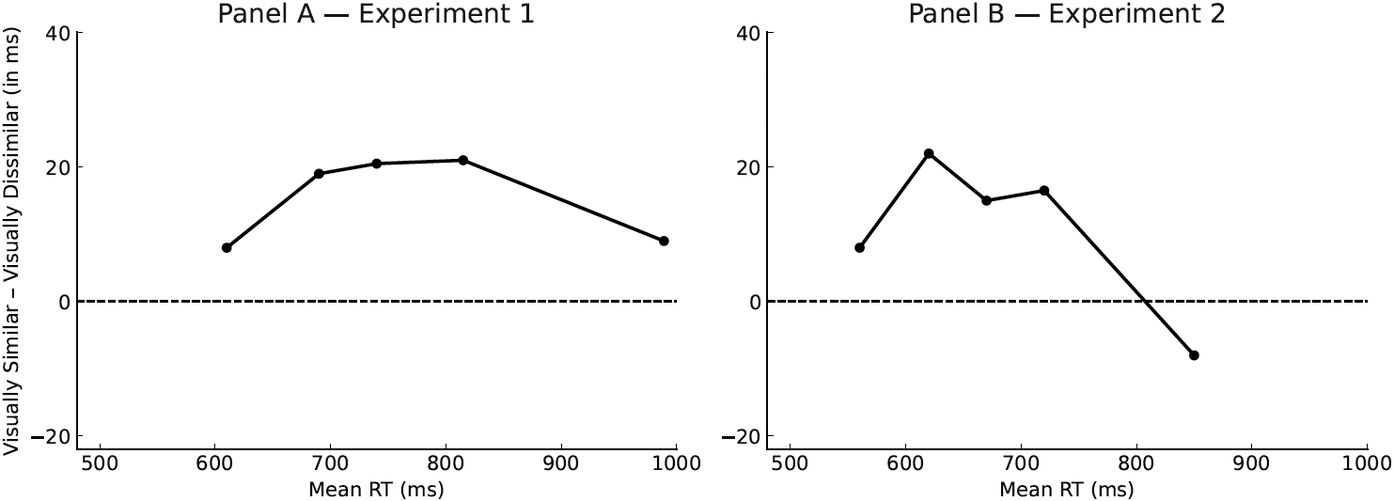
Figure 2. Long description
The multi-panel figure contains two line graphs arranged horizontally. Both graphs share the same axes. The x-axis is labeled Mean R T in m s, ranging from 500 to 1000. The y-axis is labeled Visually Similar minus Visually Dissimilar in m s, ranging from negative 20 to 40, with a dashed horizontal baseline at 0.
* Panel A Experiment 1. The data line starts above the baseline at approximately 610 m s. It shows a positive slope reaching a peak of about 20 m s between 700 and 800 m s. It then follows a gradual downward trend, ending at approximately 10 m s at the 990 m s mark.
* Panel B Experiment 2. The data line begins above the baseline at approximately 560 m s. It rises sharply to a peak of over 20 m s at 620 m s. It then fluctuates downward, crossing the dashed baseline into negative territory at approximately 810 m s, and ends at a trough of negative 10 m s at the 850 m s mark.
In addition, as suggested by a reviewer, we conducted an exploratory, non-preregistered analysis on the relationship between the magnitude of the visual similarity effect (visually similar vs. visually dissimilar–ligation preserved pseudowords) and the letter similarity score in the Boudelaa et al. (Reference Boudelaa, Perea and Carreiras2020) database. The Pearson correlations were negligible in both experiments (r = 0.03 and r = 0.01 in Experiments 1 and 2, respectively). We acknowledge that this null finding needs to be interpreted with caution, as the similarity ratings were homogeneous within each category. To address this issue in future research, it would be desirable to include a relatively large number of items distributed across the full visual similarity spectrum.
Finally, because the two visually dissimilar conditions differed slightly in mean similarity, we conducted exploratory, non-preregistered item-level analyses and mixed-effects models including similarity as a covariate. The item-level correlations between similarity differences in the ligation contrast were negligible (Experiment 1: r = 0.109, p = .185; removing one outlier yielded r = 0.073; Experiment 2: r = −0.008), providing no indication that the null ligation effect was driven by small residual differences in visual similarity. We also conducted additional mixed-effects analyses including similarity as a centered covariate and again found no evidence that residual similarity accounted for the ligation contrast. Thus, neither analysis provided evidence that residual similarity accounted for the null ligation effect.
3. General discussion
The foremost neurobiologically inspired models of visual word recognition propose that lexical access relies on abstract letter identities, with visual features influencing processing only at the earliest perceptual stages (Dehaene et al., Reference Dehaene, Cohen, Sigman and Vinckier2005; Grainger et al., Reference Grainger, Rey and Dufau2008). Evidence from the Latin script supports this view: visual similarity has minimal impact on lexical decisions to misspelled words (e.g., viotin and viocin yield comparable RTs, even though viotin is visually closer to violin). What remains uncertain is whether this rapid abstraction of visual form also characterizes scripts with markedly different visual properties.
Arabic script provides a particularly informative test case. It lacks case alternation, employs position-dependent letter forms and includes many letters that share a common skeleton and are distinguished primarily by dot number or placement. These properties do not imply greater visual uniformity in any absolute sense, but they do create a dense space of local visual overlap that is directly relevant to the present manipulation.
We conducted two lexical decision experiments that varied in presentation duration (until response vs. 200 ms) to examine whether visual similarity or ligation patterns modulate recognition of misspelled words in Persian, an Indo-European language written in an Arabic-derived script. If visual information contributes to word recognition, pseudowords visually closer to their base words should elicit longer RTs or more errors. In both experiments, the results converged on the same pattern: responses were slower for visually similar than for visually dissimilar pseudowords that preserved the ligation pattern (e.g., موسیفی /musifi/ vs. موسیلی /musili/; base word: موسیقی /musiqi/ [music]), with a parallel but weaker trend in accuracy. There was no reliable evidence that ligation pattern modulated lexical decision in the present experiments: pseudowords preserving the ligation of their base words behaved much like those disrupting it.
The present contribution is therefore not merely cross-script generalization. The use of Persian allowed us to assess whether a visual similarity effect emerges in an Arabic-derived script without the interpretive complications introduced by Semitic root morphology of Arabic. The key finding of the present experiments is that dot-based visual similarity exerted a small but reliable influence on lexical decision in Persian: ‘no’ responses to misspelled words were slower when the replaced letter preserved the same basic skeleton and differed only in dot configuration than when it did not. The effect was small (approximately 17 ms in Experiment 1 and 7 ms in Experiment 2), which is consistent with a brief perceptual contribution before abstraction into letter identities (Carreiras et al., Reference Carreiras, Perea, Gil-López, Abu Mallouh and Salillas2013). Taken together, these results show that visual overlap can leave a small trace in Persian lexical decision, even though processing appears to rely primarily on abstract letter identities. Importantly, this residual sensitivity likely reflects the same early perceptual mechanisms identified by AlJassmi and Perea (Reference AlJassmi and Perea2024) in letter-level tasks, now extended to whole-word processing. Finally, it is worth noting that such sensitivity may vary across populations. Readers with less stable orthographic representations (e.g., individuals with dyslexia) may rely more heavily on visual form, producing stronger visual similarity effects (see Friedmann & Haddad-Hanna, Reference Friedmann and Haddad-Hanna2012, for discussion). A further consideration for future research is that the visually similar condition pooled several dot-based manipulations (addition, omission and repositioning). Although all of these manipulations preserved the base letter, they were included to increase stimulus heterogeneity and were not designed as separate experimental conditions. Future experiments should examine whether different types of dot change produce distinct processing costs.
A remaining question is why visual similarity effects have not been observed in masked priming or parafoveal preview paradigms in Arabic (AlJassmi et al., Reference AlJassmi, McGowan, White and Paterson2020; Perea et al., Reference Perea, Abu Mallouh, Mohammed, Khalifa and Carreiras2016, Reference Perea, Abu Mallouh, Mohammed, Khalifa and Carreiras2018). Differences across paradigms should be interpreted with caution, because the tasks tap partially different processes: lexical decision to pseudowords concerns the rejection of a near-word after full target processing, whereas masked priming and parafoveal preview index earlier pre-activation and integration processes under different temporal constraints. One plausible explanation is that, once prime and target are integrated into a single orthographic code, visually similar letters that map onto the same abstract identity unit (or onto highly similar units) generate strong mutually inhibitory interactions at the letter-identity level, thereby cancelling any net facilitation (see Pittrich & Schroeder, Reference Pittrich and Schroeder2023, for the analogous case of mirror-letter pairs b–d in Latin script; see also the letter-level inhibition account of AlJassmi & Perea, Reference AlJassmi and Perea2024). Consequently, a pseudoword prime like صخفية, though visually close to the target صحفية [journalist], may fail to activate it efficiently because the letters ـحـ and ـخـ inhibit one another once prime and target percepts are integrated.
Regarding ligation pattern, no evidence of an effect emerged in the present task: misspelled words preserving the ligation pattern of their base forms (e.g., موسیلی /musili/ [base: موسیقی /musiqi/]) behaved much like those that disrupted it (e.g., موسیزی /musizi/). This suggests that letter connectivity contributed little, if at all, to lexical decision under the present scenario, once abstract letter identities have been encoded (see Carreiras et al., Reference Carreiras, Perea, Gil-López, Abu Mallouh and Salillas2013).
Overall, the present findings are consistent with the view that word recognition in Arabic and Latin scripts relies on similar abstraction mechanisms, albeit with small quantitative differences in the contribution of early visual information. Letter encoding thus appears to operate according to the same principles across writing systems (Carreiras et al., Reference Carreiras, Perea, Gil-López, Abu Mallouh and Salillas2013; see also AlJassmi & Perea, Reference AlJassmi and Perea2024). Future cross-script research using ERPs with bilingual readers will be critical for pinpointing the moment at which visual form gives way to abstract identity coding. Indeed, benchmark orthographic effects, such as form priming and transposed-letter priming, have been observed in both scripts (Perea et al., Reference Perea, Abu Mallouh and Carreiras2014; Yakup et al., Reference Yakup, Abliz, Sereno and Perea2015), reinforcing the existence of shared core mechanisms.
To conclude, hierarchical, neurobiologically inspired models of visual word recognition, originally developed for Latin scripts, appear to extend well to Arabic-derived scripts, while also accommodating script-specific properties (see also Okano et al., Reference Okano, Grainger and Holcomb2013, for a similar conclusion with Japanese syllabaries). As shown by Carreiras et al. (Reference Carreiras, Perea, Gil-López, Abu Mallouh and Salillas2013), in both Arabic and Roman scripts there is a small residual sensitivity to visual letter form, consistent with an early but rapidly diminishing visual contribution. In Arabic, abstract letter detectors likely integrate input from position-dependent allographs according to positional context (e.g., ب, بـ, ـبـ, ـب would be integrated for ب), while segmentation mechanisms accommodate the semicursive nature of the script (Alluhaybi & Witzel, Reference Alluhaybi and Witzel2020). At the same time, the consonantal root morphology of Arabic may reinforce rapid abstraction, since fine dot-based distinctions must be resolved quickly to access the correct lexical root. Persian, which lacks Semitic root morphology, may therefore provide a useful test case for detecting small visual similarity effects during lexical access without challenging models in which lexical access is governed primarily by abstract letter units.
Taken together, these findings are consistent with a general principle of visual recognition: perceptual inputs are rapidly transformed into abstract identity codes, although a limited trace of visual specificity can persist under certain conditions (see Baciero et al., Reference Baciero, Gómez, Duñabeitia and Perea2023; Dehaene et al., Reference Dehaene, Cohen, Sigman and Vinckier2005; DiCarlo et al., Reference DiCarlo, Zoccolan and Rust2012; Grill-Spector & Weiner, Reference Grill-Spector and Weiner2014). Applied to reading, this principle implies that visual word forms undergo the same rapid transition from low-level perceptual features to abstract identity codes that characterizes object recognition more generally.
Data availability statement
The experiments were preregistered at:
Experiment 1: https://osf.io/65s7c/?view_only=16bf17350c5141c0ae719328ce0f18e2
Experiment 2: https://osf.io/ewtxq/?view_only=b994dc5de3ab48669da4a96b84338c96
The data, scripts and output are available at: https://osf.io/fa32x

 Open access

