

Introduction
Late-life divorce is a relatively new phenomenon that is likely to expand (Brown and Lin, Reference Brown and Lin2022) due to increasing life expectancy (Shnoor and Cohen, Reference Shnoor and Cohen2022) and changes in marital and family values (Berkovitch and Manor, Reference Berkovitch and Manor2023). Family structure, boundaries and roles are likely to change following late-life divorce. Research on divorce after long-term marriages (e.g. Knöpfli et al., Reference Knöpfli, Morselli and Perrig-Chiello2016), including consequences for offspring (e.g. Amato, Reference Amato2010; Jensen and Bowen, Reference Jensen and Bowen2015), focuses on young and middle-aged adults (e.g. Cohen and Finzi-Dottan, Reference Cohen and Finzi-Dottan2012). When research includes older divorced adults (e.g. Gray et al., Reference Gray, De Vaus, Qu and Stanton2011), it mainly refers to adults who had divorced earlier in life. Furthermore, a familial/dyadic perspective on late-life divorce occurring around age 60 and its consequences has scarcely been applied. Accordingly, our study employs a holistic perspective on the family unit after divorce. This is especially relevant to societies that value familism alongside self-determination (Fogiel-Bijaoui and Rutlinger-Reiner, Reference Fogiel-Bijaoui and Rutlinger-Reiner2013). Coincidingly, the term familyhood refers to a feeling of collective welfare and unity (Bryceson and Vuorela, Reference Bryceson, Vuorela, Bryceson and Vuorela2020). A commonly used expression in Israel, it expresses an atmosphere of closeness among family members. Using a family-systems framework (Bowen, Reference Bowen1978), we aimed to examine how, if at all, familyhood is experienced after divorce considering how it was experienced prior to divorce from a long-term marriage in Israel.
Late-life divorce
Late-life divorce is defined in some studies as occurring when at least one spouse was 60 or older (e.g. Weingarten, Reference Weingarten1989). Others define it as occurring at midlife (50–64) including old age (65+) (e.g. Brown and Lin, Reference Brown and Lin2022), without necessarily specifying long-term marriages (Jensen and Bowen, Reference Jensen and Bowen2015). Research on late-life divorce has focused on its motivations and consequences. Motivations include growing apart (Bair, Reference Bair2007); infidelity, spouses' mental health problems, financial problems and abuse (Crowley, Reference Crowley2018); and differences in values and lifestyles, falling out of love, relationship boredom or personal change (Montenegro, Reference Montenegro2004). Furthermore, when children leave home, unhappy couples are disinclined to remain together especially due to the desire to enjoy life at this relatively older age (Bair, Reference Bair2007). Consequences of late-life divorce are both positive and negative (Montenegro, Reference Montenegro2004; Bowen and Jensen, Reference Bowen and Jensen2017). Negative consequences include personal pain related to loss, loneliness (Crowley, Reference Crowley2018) and possible depression (Brown and Wright, Reference Brown and Wright2017), while positive consequences include freedom, independence and being happier once liberated from ex-spouses (Crowley, Reference Crowley2018). Mental health benefits after divorce were related to re-partnering (Bowen and Jensen, Reference Bowen and Jensen2017; Lin et al., Reference Lin, Brown, Wright and Hammersmith2019). Studies also identified economic hardships due to fewer remaining years to compensate for financial losses associated with divorce, especially without spousal support when health conditions reduce work capacity (Brown and Wright, Reference Brown and Wright2017). The limited research addressing consequences of divorce for adult children suggests that they are less vulnerable than young children to changes in their parents' marital status. However, studies did identify negative consequences for adult children's self- and family identities and their family relationships (Greenwood, Reference Greenwood2012).
These studies used samples of individuals aged 50+ at the time of divorce; some were divorced more than once, not necessarily with children or after a long-term marriage. Our research diverges by taking a qualitative snapshot of late-life divorce in Israel, occurring around age 60, from a long-term marriage raising children.
Family and familyhood
In recent decades, profound social, political and economic changes have reshaped family life (Coontz, Reference Coontz2016). Accordingly, official definitions of family have evolved from ones restricted to being related by marriage or birth and living together to broader definitions that include unmarried partners and adopted children. A sociological definition extends this to any primary institution into which people feel socially integrated, where this connectedness is essential for either family members' or society's wellbeing (Durkheim, Reference Durkheim1897). Unofficial definitions include functions that people in family units are expected to perform for one another and for society, such as emotional and economic support, reproduction and socialisation of children (Tillman and Nam, Reference Tillman and Nam2008).
Scholarship on family includes related concepts such as ‘family cohesion’, which refers to the emotional bonding between family members (Olson, Reference Olson2000); ‘family functioning’, expressed in the ability to solve problems, communicate and respond effectively, fulfil roles and control behaviours (Epstein et al., Reference Epstein, Bishop and Levin1978); and ‘family resilience’, which refers to families' ability to adapt to stress and overcome it (Hawley and DeHann, Reference Hawley and DeHaan1996).
‘Familyhood’ is used here to refer to an atmosphere of closeness and feeling of collective welfare and unity among family members (Bryceson and Vuorela, Reference Bryceson, Vuorela, Bryceson and Vuorela2020). The term is scarcely found in research, mainly in studies on collective societies such as in Zimbabwe (Maviza and Carrasco, Reference Maviza and Carrasco2023) or among Turkish migrants to the United Kingdom (Usta, Reference Usta2023). However, its Hebrew equivalent (mishpachtiyyut) is commonly used in Israel.
Israeli society
Despite moving significantly towards individualism in the past three decades (Berkovitch and Manor, Reference Berkovitch and Manor2023), Israeli society is still ‘family oriented’ compared to other industrialised countries (Fogiel-Bijaoui and Rutlinger-Reiner, Reference Fogiel-Bijaoui and Rutlinger-Reiner2013), expressed in a lower age of marriage, higher marriage and birth rates, and lower divorce rates compared to Organisation for Economic Co-operation and Development (OECD) countries (OECD Family Database, 2021), as well as widely practised rituals such as celebrating holidays with extended family (Shoham, Reference Shoham2014). The rate of divorce above age 55 more than doubled in Israel between 1996 and 2019, from 1.6 to 4.1 per cent (Israel Central Bureau of Statistics (ICBS), 2021). Divorce rates are lower above age 55 compared to other age groups (ICBS, 2021). However, like in the United States of America (Brown and Lin, Reference Brown and Lin2022), late-life divorce rates are expected to increase along with life expectancy (Shnoor and Cohen, Reference Shnoor and Cohen2022) and decreasing social disapproval. Thus, the present study could inform research on other societies experiencing individualisation.
Study framework: family systems
Family systems include family structure, boundaries, roles and interdependence between family subsystems such as parents, children and siblings (Minuchin, Reference Minuchin2018). Our study refers to the interdependence between late-life divorced parents' subsystem and their adult children's subsystem, addressing how each is affected by late-life divorce and how it interacts with the other. Furthermore, late-life divorce raises questions such as whether and how family members continue to consider themselves a family, and whether and how they restore/reconstruct family balance, structure, roles and boundaries. This coincides with our aim to examine the interplay between late-life divorce and familyhood, as defined above, from a familial/dyadic perspective, using family systems as a framework. Accordingly, the research question is: How, if at all, is familyhood experienced after late-life divorce from a long-term marriage with children in Israel?
Method
This article is based on data collected as part of a large qualitative interview study of the experience and meaning of late-life divorce, from a familial, dyadic and gender perspective, funded by The Israel Science Foundation (ISF no. 811/19). The aim of the larger study was to study family units by interviewing each family member separately to derive individual, dyadic and family perspectives.
Sample
The sample criteria were ex-spouses who divorced for the first time at age 60+ after a long-term marriage raising children. The latter is the most common family type for this cohort in Israel: among the 60+ age group 67 per cent are married, of whom 90.8 per cent are in their first marriage and 96.1 per cent have children (ICBS, 2021). Our age criterion was 60+ (instead of the 50+ divorce age commonly studied) in order to capture life transitions typical of this cohort (such as the ‘empty nest’), and under the assumption that late-life divorce is likely to be experienced differently than at younger age.
The sample includes four datasets: (a) family units (N = 7) that include both divorced parents and their adult children (33 interviews); (b) spousal dyadic units (N = 3) who were unable/unwilling to recruit their adult children (six interviews); (c) parent–adult child dyadic units (N = 9) who were unable to recruit the other divorced parent (18 interviews); and (d) single units (N = 15) of divorced parents (six fathers and nine mothers) willing to share their experiences without other family members' participation. The sample includes 34 study units, with a total of 72 participants, all Jewish, the majority non-religious: 44 divorced parents (aged 56–68 at the time of divorce) and 28 adult children (aged 19–40 at the time of divorce). Most parents (N = 39) divorced at age 60 or older, but due to recruitment challenges we included five participants who divorced between the ages of 56 and 59. All parent participants divorced after a long-term marriage lasting 23–45 years (for demographic information, see Table 1). The units of families and dyads enabled us to capture multiple perspectives within a study unit, resulting in a more complex picture of the phenomenon compared to units of individuals. Yet, the four datasets together allow for presenting a range of experiences, resulting in an overall richer and more reliable picture of the interplay between familyhood and late-life divorce strengthening trustworthiness (Merriam and Tisdell, Reference Merriam and Tisdell2016).
Demographic information
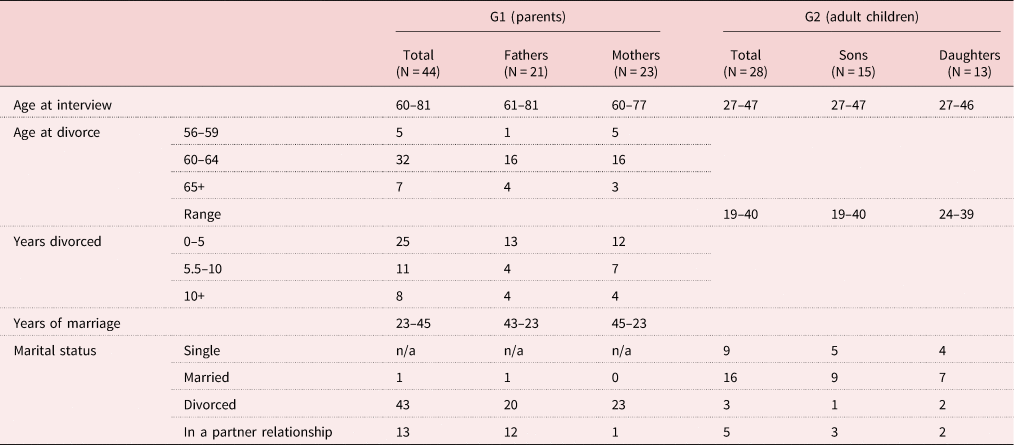
Notes: Values are frequencies. n/a: not applicable.
Recruitment and data collection
Recruitment was conducted through a sponsored Facebook campaign that enabled potential participants to contact a research team member proactively. This was requested by the Ethics Committee to ensure that participation was voluntary. After the study aims were explained and several screening questions were asked to determine potential participants' suitability, an interview was scheduled. Families and dyadic members were recruited by the participant who had initiated contact with the research team. Following their consent, a research team member arranged a separate interview with each participant.
Data were collected between February and October 2020 by the research assistants and the principal investigator (PI). Seven in-person interviews were conducted before the outbreak of COVID-19, after which only online interviews were possible, using the Zoom platform. After the lockdown was lifted, participants were given a choice between an in-person and online interview. Despite in-person interviews being considered superior (Davies et al., Reference Davies, LeClair, Bagley, Blunt, Hinton, Ryan and Ziebland2020), no substantial differences were detected between the two formats in terms of substantive content, openness, depth and emotional expression. This is attributable to the quality of participant–interviewer interaction (Kvale and Brinkmann, Reference Kvale and Brinkmann2009).
Research tool
The research tool was a semi-structured interview guide with open-ended questions about the experience of divorce and its implications. The opening question was: ‘Tell me the story of your/your parents’ late-life divorce’, along with open-ended questions regarding five main domains: married life, late-life divorce, old age, gender and intergenerational relationships. When necessary, clarification questions were asked. Interviews were conducted with each participant separately, lasting between 1 and 3.5 hours. In-person interviews were audio-recorded, whereas online interviews were video-recorded.
Data analysis
Data analysis was conducted by the research team members which included the PI, two post-doctoral students and an MA student, all well-trained in qualitative research. Analysis was based on principles of inductive thematic analysis (Braun and Clarke, Reference Braun and Clarke2013) and dyadic qualitative analysis (Eisikovits and Koren, Reference Eisikovits and Koren2010). The analysis was organised using Microsoft Office Excel worksheets for each dataset and Word documents including line numbers and new comment notation for each interview. Each interview was read and reread while writing notes to become familiarised with the data. Complete coding was employed, addressing each data item with equal importance. Themes were identified through inclusive and comprehensive coding. One such theme, the meaning of familyhood after late-life divorce, is the topic of this article. The Findings section of this article opens with a detailed analysis process description for this theme.
Trustworthiness and ethics
Triangulation, a way of achieving trustworthiness (Merriam and Tisdell, Reference Merriam and Tisdell2016), was performed by combining the perspectives of family members and through several research practices, including having each of the four research team analysts conduct a separate analysis of the interviews, and discussing the classifications of themes when disagreements arose.
This study received approval from the University Faculty Ethics Committee. The objectives of the study were explained to all participants, and they were promised confidentiality. As recommended by the University Faculty Ethics Committee, all interviewees provided audio-recorded participation consent in their voice at the beginning of the interview to increase confidentiality. All interview recordings were transcribed verbatim for data analysis. For ethical reasons, the video recordings were deleted, participants' names were removed from the transcripts and their demographic details were gathered in an encrypted file that was accessible only to the interviewers. Identifying information such as age, place of residence and place of work was removed or altered in presenting the findings, without distorting the content.
Findings
The meaning of familyhood was identified as a central theme in participants' experiences. The expression ‘familyhood’ was used by participants on their own initiative without being prompted. This indicates its continued meaningfulness despite divorce. Familyhood was described by participants in terms of maintaining a good atmosphere at family gatherings on holidays, birthdays, weekend meals and trips, expressing affection, functioning well and mutual aid. Most adult children and some parents perceive familyhood as including all family members. Yet some parents perceive familyhood as pertaining to the relationship with their children without their ex-spouse.
After identifying familyhood as a central issue, we searched for it in all datasets using selective coding (Braun and Clarke, Reference Braun and Clarke2013). The research team located the quotes referring to familyhood from all 34 units and arranged them in a table by units. Some participants directly used the term familyhood and others described their experience in similar words. After analysing these quotes separately and noticing that the participants addressed familyhood before and after the divorce, we sorted the quotations by descriptions addressing familyhood before and after divorce. We then read and reread the quotes, identifying whether and how it was experienced. This process resulted in a fourfold typology referring to continuity/change in the experience of familyhood before and after divorce. A typology is a form of classification which should be exhaustive and its categories mutually exclusive, meaning there is one and only one correct type for each case (Bailey, Reference Bailey1994). Analysis of family units/dyads was based on dyadic qualitative analysis (Eisikovits and Koren, Reference Eisikovits and Koren2010) and referred to overlaps, contrasts, congruences and incongruences between the experiences of family/dyad members regarding familyhood. It included how, when, by whom and where familyhood is practised, enabling the complexity of familyhood structures to be presented.
A fourfold typology of familyhood continuity/change before and after late-life divorce
The typology includes combinations of familyhood experienced as present and/or lacking, before and/or after divorce. Four types were identified (see Table 2):
• Type A: ‘continuity-of-familyhood’, whereby familyhood was experienced as present both before and after the divorce, albeit not necessarily in the same way.
• Type B: ‘change-to-familyhood’, whereby familyhood was experienced as lacking before the divorce, yet experienced as present after it due to an essential change.
• Type C: ‘change-from-familyhood’, whereby familyhood was experienced as present before the divorce but as lacking after it due to an essential change.
• Type D: ‘continuity-of-non-familyhood’, whereby familyhood was experienced as absent both before and after the divorce.
Typology: familyhood continuity/change before and after late-life divorce
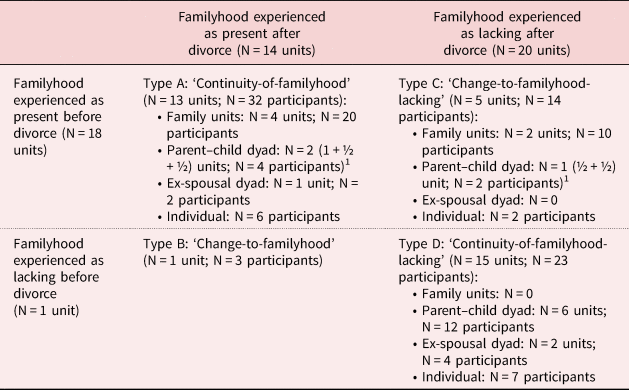
Notes: N = 34 units; N = 72 participants. 1. Two parent–child dyads are split between Type A and Type C because the parent and child experiences contrast regarding familyhood after divorce. One member of the dyad experienced familyhood, the other did not. For all other dyads, the parent and child experiences are in congruence regarding familyhood before and after divorce.
The meaningfulness of familyhood is underlined by this final type, where it is addressed by interviewees despite having never been experienced as present.
All four types are illustrated by units that provide rich and complex experiences of late-life divorce. In presenting examples from each type below, we also highlight the issues of who maintains familyhood, how, when and where. Translations are our own.
Type A: ‘continuity-of-familyhood’
These experiences are illustrated on a continuum between familyhood being similar before and after divorce, and familyhood being reconstructed differently after divorce. The former end of the continuum is illustrated by a family unit of parents and four adult children. The parents are 14 years divorced, after 34 years of marriage, due to lack of emotional intimacy and years of infidelity by the mother.
Before divorce, familyhood is described as functioning well, including good atmosphere, with parents expressing affection towards their children but not towards each other. Son4 describes his experience: ‘A good atmosphere. I remember a happy home … There was a lot of touching, and hugging, and kissing us.’ The mother adds: ‘I think they grew up in a home that despite not seeing gestures of affection between us [the parents] – I think their experience was of a good family … we felt we were functioning.’
Who, how, when, where – familyhood continues
After divorce, it was the children who assumed an active role in maintaining familyhood in a similar way (who). Their parents continue to come to family events with their new partners and manage the family together. The parents' and children's perspectives are congruent. The father said: ‘We continue to get on as a family. All events are celebrated as a family, and new partners come along and participate.’ According to the mother:
We run a family, continue somehow to be a family. It is clear to both of us that it is very important for both of us to be with the children, and when one of us hosts, the other is invited. Even when we had other partners.
Familyhood is maintained due to a good relationship between the parents after the divorce, allowing new spouses to participate in family gatherings. Family gatherings include all family members at events and family meals on Friday nights (when) at either of the parents' homes (where).
Strategies of maintaining familyhood: distinction between couplehood and familyhood
Son2 illustrates a strategy of separating between a couplehood that has ended and a familyhood that can continue (how):
They did continue to be in touch, and it was clear that Dad is part of the family and Mom is part of the family, and Dad would still come with us to mom's family events. We would sit and have Friday night dinners together the whole family, even though they weren't together … and I think pretty quickly life returned to normal, only in two homes … separate.
Son3 emphasises they did an amazing job in preserving the family:
Mom and Dad in that respect are always, they would both come to events after they broke up. In that respect I think they did an amazing job in that respect. That they managed to maintain a bond of friendship and functionality.
A differently constructed familyhood after divorce is illustrated by a family unit of parents, three adult children and three grandchildren. The parents are six years divorced after 42 years of marriage, due to marriage burnout and mutual infidelity.
Before divorce, family members experienced familyhood as meaningful, characterised by daily family meals and on special occasions like holidays, frequent family gatherings and extended family events celebrated at home. According to Daughter1:
I remember a lot of familyhood, very important. Holidays were always at our place, or at our grandparents' … everyone comes to us … large holiday meals. Events would also be held at our place … a lot of familyhood. Really, like family – family, in every sense of the word.
The father describes his contribution to the familyhood atmosphere:
I was very attentive to the home. I'm the kind of father who was at home at 12:00 pm to be there with the children. Feed them and be with them and return at 4:00 pm to work. So, I invest in it.
Having daily family meals together was also recalled by Daughter2: ‘Since a very young age I remember that there was always someone at home for lunch. I always remember that we would come home from kindergarten, from school, and we would have a family meal together.’
Although Son3 appreciates the daily meals his father prepared, he introduces reservations:
My father came home every afternoon to make lunch for me, [he] was always home at lunchtime, whether the time was quality or not. But he prepared it for me; it was a very appreciated act that he came to make lunch for me at home.
The mother's perspective is incongruent to the rest of the family:
It [his work] was for many, many years also at the expense of our family, because on Friday nights he wasn't home. We'd sit at the table, and he'd sit with clients in his study, forgetting it's Friday evening.
Who, how, when, where – familyhood continues
After divorce, familyhood changed from meeting with all members together to meetings each parent holds separately with their children, although at times the other parent joins in (how). However, each family member has different expectations.
The father relates an ideal state of familyhood, with all family members spending time together when visiting the children and having family meals at the mother's home (where):
Great children, fantastic relationships among all of us, a lot [of time] together, eating at my ex-wife's. We're always together, at events or when travelling to our daughter who lives far away. I drive by my ex-wife's house, pick her up, drive to our other daughter, collect [everyone], drive together … I try very hard to preserve familyhood because it's very important to me.
The mother prefers to meet with her children separately, describing her difficulty with the father's expectations to be included in all family gatherings:
The children know how to navigate … I think they maintain a good relationship with both of us; I'm not creating a competition. I think he's the one who makes an emotional issue out of it. A year ago, they travelled together with his side of the family, and I was so happy for them, I didn't say a word … When he heard that I was going with the children for a few days [he complained]: ‘Why don't I know about it, why am I not invited, why?’
Daughter1 reinforces both parents' experiences:
We travel together, we do things. Although yesterday I told my father that we were going without him, he was a little upset. But okay, my mother also has her limits, and that's okay. It's a bit difficult. It happened that this time my mother decided she wasn't interested, she wanted to travel with us alone.
Daughter2 adds that they are still seeking balance:
Let's say we decided to go with my mother on vacation next week; he was terribly offended why he wasn't invited too. ‘Okay, we're family, but you're divorced.’ So, to us it's clear, it's a little hard for him to understand this … We're still looking for balance.
Son3 illustrates the complexity of maintaining familyhood vis-à-vis the contrast between his parents' expectations:
My mother invites us to a resort, because it's very important to her that we go on vacation together the whole family. So, what do we do with Dad? Do we need to invite Dad or not? Nope! No need to invite Dad! You got divorced, you're not the same family, hello and goodbye. But Dad will be offended … ‘Why didn't you invite me too?’
The daughters and mothers assumed the role of ‘familyhood guardians’ (who), the family gatherings are held at one of the parent's or children's homes (where), usually at weekends and birthdays (when) with a different composition of family members. Grandparenthood was found to contribute to familyhood construction by softening the mother's attitude from complete separation to accepting family gatherings that include both parents. As Daughter2 puts it:
I think it's because of the birthday. She's my Mom and Dad's first granddaughter, and I think it's because of that, because we wanted to celebrate the whole family together, my mother stopped getting angry with my father and realised that we had to preserve the meaning of our family, whether it's holidays together or whether it's birthdays together, and then there was no longer that split.
This family is amid a process of reconstructing a new familyhood experience, while trying to bridge the parents' conflicting expectations regarding the desired familyhood. The daughters describe attempts to find an appropriate balance, while the son and mother support separate family gatherings. However, grandparenthood contributes to flexibility regarding joint meetings with all family members.
Type B: ‘change-to-familyhood’
This type, characterised by familyhood experienced as lacking before divorce yet present after divorce, is illustrated by a family unit of parents, three adult children and five grandchildren. The youngest daughter and the parents were interviewed. The parents are 10 years divorced after 40 years of marriage, due to the husband's infidelity.
Before divorce, family members experienced detachment between the parents and between them and their children. The father describes being often absent from home, also on weekends: ‘Most of the time I wasn't home. It was convenient. On Saturdays she'd go down to the beach with her parents and I had time for myself. I could go wherever I wanted.’ The mother illustrates the atmosphere at home and its effect on the children: ‘They [the children] would come, but there was no [familyhood] atmosphere, and the children really felt that tension at home.’ The daughter illustrates lack of warmth and parental involvement, which resulted in each family member conducting life separately: ‘At home I wouldn't share [anything] about friends, about quarrels with friends. It wasn't a home where people come and share. Everyone lived their own life.’
Who, how, when, where – familyhood reconstructed
After divorce, a meaningful reversal occurred regarding familyhood. Family gatherings are now held with all family members. The mother claims it was she who reconstructed familyhood (who). The divorce was essential for practising familyhood and is feasible due to her willingness to host and be hosted by her ex-husband (how):
I think that in my divorce – it's a sentence I say a lot, you can write this, it's an important sentence – I broke up a divorce, uh, marriage, and built a family, and I succeeded in it. I broke up a marriage, that's clear … With my behaviour, with my own words, I have caused us to meet all the time, including my divorcee. At first it was ‘they go to him, they go to me’. One time something didn't work out, and we went to him, and he came to me. We are together in all the holidays. It's either at my place, usually at his.
The family usually gathered at holidays (when), at the mother's or father's house (where). The mother contrasts the good current atmosphere with the formerly stressful one: ‘Our unity, our meetings, our gatherings, our help to each other, our fun together, that we meet – is today greater than it used to be. They used to be stressful meetings.’
Strategies of reconstruction familyhood: issuing an ultimatum
The daughter, like her mother, describes how she took on the role of constructing familyhood (who) by using a strategy of issuing an ultimatum (how):
We met one week with Mom, one week with Dad, one week with Mom, one week with Dad, and I told them: ‘Listen, if you want to see me, you have to be together. I can't, I myself, come once every two weeks. When I come, I have to meet both you and my spouse's parents. If you want to, then start coming one after the other’, and it took hold, this format. And today we're, like, all the time together, it just took hold.
Despite the geographical distance, the family gets together on holidays and on a nearly regular weekly basis with both parents together. As the daughter relates:
I hold this family together, that's how I feel, like someone who glues this family together, as a rule, the family meets every holiday. Almost every week. Even if I don't come, they meet. Maybe once every two weeks, but we meet a lot. Yes, to most of the gatherings they both come.
Despite lack of familyhood before the divorce, after it both mother and daughter claim to have reconstructed familyhood (who), highlighting its importance.
Type C: ‘change-from-familyhood’
This type includes units that experienced a conflictual divorce which removed their previous ability to experience familyhood. This is illustrated by a family unit of parents, three adult children and grandchildren. The parents are nine years divorced after 32 years of marriage, due to the father's ongoing infidelity and the couple growing apart.
Before divorce, familyhood was experienced as good by all members, besides the son.
The father says: ‘Dinner together with all the laughs, and I always insisted that it would be a home meal and it was a fun end of the day. I've always said, if I audiotape you, they'll think we're crazy.’ The youngest daughter: ‘Always Friday evenings there was music in the house. We sat in the garden, with the dogs. Overall, I remember a happy childhood.’
The son expresses reservations:
I remember some sense of security at home. It was expressed in that I would fall asleep on my father Friday night in front of the TV. I remember small details, things that provided a sense of security, but it was that kind of familyhood, more for the parents' convenience. You know, what's important is their comfort.
After divorce, familyhood changed with nearly no family reunions. According to all family members, the divorce hampered family gatherings because of the mother's anger towards the father. The mother had trouble with the father's partner's presence to the point that the children avoided organising family reunions. When the mother did come to a family reunion which included the father's partner, she would ruin the atmosphere. However, the mother's recent experience is that she overcame her anger:
I don't relate to her [ex-husband's partner] at all, so my kids stopped organising birthdays. They said ‘We won't do birthdays for grandchildren’ because I'm a sourpuss, I ruin the atmosphere, I cause a terrible party for them. I'm on the sidelines, and I'm constantly nervous. I'm not well. But at the last birthday I said ‘WTF’, enough with that, enough, eight years have passed, put it aside, enough.
The mother's and oldest daughter's experiences of familyhood lacking due to the mother's anger towards the father are congruent. However, they disagree regarding the mother's experience of putting the anger behind her. According to the oldest daughter:
Since then, the whole family has met together at my brother's wedding and maybe twice by chance, but they can't live together, they can't. They are unable to celebrate holidays together, they are unable to; no, they haven't even tried. My mother is so angry with him, to this day she's angry with him … I'm always exhausted before the event itself. Just knowing that the dynamic is going to be weird, that my father's girlfriend will be there, and that my mother will be there and how to keep them apart … It never goes well.
The oldest daughter compares her parents:
The family's very important to her … no matter what, she'll grab us by the throat, you know, that we meet from time to time in all kinds of ways, that we come to hers for dinner, that she comes here for dinner, that she sees the grandchildren, talks to the grandchildren, it's terribly important to her. My father doesn't care, but for my mother it's very, very important.
The youngest daughter's experience is congruent with her sister's: ‘I'm lucky that Dad doesn't celebrate holidays. Dad doesn't care for these things at all. On holidays he likes to sit alone at home, most of the time pursuing hobbies, so most holidays I celebrate with Mom.’
The son's familyhood experience is congruent with his sisters':
This [familyhood] connects with disconnection. I'm saying this, really, it's not a paradox, because we very much [live] separately … We are completely scattered. In the diaspora, we are in the diaspora. When we meet, it's almost never at full strength.
The parents express sorrow for the loss of familyhood and a desire for it. The father says: ‘I dream that our nuclear family system is different. My ex-wife's, mine, with the children. I mean, that it'll be more, more flowing, more – there are grudges.’
The mother:
Maybe I would have done everything to avoid a divorce, not to break up the family because it breaks up the family. The family is no longer, we are no longer glued to each other. It's not that we were that glued together, but my daughters aren't so in touch with their brother, because he thinks one way about his father, and they think differently about their father.
In this type, the mother sabotages the children's attempts to preserve familyhood at family events yet her relationships with her children are important to her. On holidays (when), the mother hosts her children (where) but there are no family gatherings and the connection between the siblings is weak. Although for years the mother refrained from meeting the ex-husband's partner, she recently decided to speak with her; however, the implications for familyhood are unclear.
Type D: ‘continuity-of-non-familyhood’
This type includes units whose complicated married life involved a lack of familyhood both before and after the divorce, illustrated by a dyad of a father and his adult daughter. The father is two years divorced after 34 years of marriage, due to emotional distancing and his desire for freedom. Before divorce, both father and daughter describe familyhood as lacking. According to the daughter:
Until a few years ago, I didn't want [a family of my own], because I didn't understand what it was all about, I didn't understand why family is something fun, why would anyone want to do it? Because I grew up in a place where familyhood didn't exist.
The father also describes familyhood as lacking, but more mildly:
If there'd be a family let's say, for meals and food … But you can't fake it, I wasn't ready to play the game, okay. I did understand and yes, I knew, but it's hard to play the game, because the food wasn't there in such a home – I actually taught them how to cook.
By repeating several times that he was not willing to ‘play the game’, he takes responsibility for the lack of familyhood, while simultaneously presenting himself as an honest person who cannot pretend everything is fine. For him the lack of familyhood was reflected by not having family meals. In stating that he was the one who taught the children to cook, he takes credit for the effort to provide a familyhood experience.
After divorce, father and daughter continue to experience familyhood as lacking. The daughter says: ‘I think that if we were a tighter family unit, it might have been harder for me. But since there was no family there in the first place, I didn't feel like I was losing anything.’ The father answers the question, ‘How do you celebrate family birthdays or holidays today?’:
Each for himself. For example, last Passover … she invited her whole family … and the children … to her, here, to the home, and didn't invite me, even to say: ‘Hello kids, how are you?’ Then the day after the holiday, I invited them to a restaurant, the children, which is fine for me … I wasn't hurt.
The lack of familyhood before the divorce continues after it. The father describes holidays as celebrated separately by each parent with their children, though he would have preferred to experience familyhood. The daughter illustrates that she does not miss familyhood because it never existed for her.
These findings reveal the in-depth structure of familyhood after late-life divorce: who – the adult children/mothers usually took on the role of familyhood guardians; when and where – the family gathering usually took place in the children's or mothers' homes on holidays/birthdays/weekend; how – preserving familyhood required using strategies such as distinction between familyhood and couplehood, and issuing an ultimatum for the parents. Furthermore, the preoccupation of Types C and D with familyhood, despite its absence, points to its meaningfulness.
Discussion
Divorce is a significant life event that marks a dramatic shift in the family system, as family structure, relationships and boundaries undergo profound change (Ahrons, Reference Ahrons2007). The typology above illustrates continuity and change in familyhood, which are well-known phenomena (Conger et al., Reference Conger, Lorenz and Wickrama2004). This study's contribution lies in examining in depth how familyhood continuity/change is experienced after late-life divorce.
Taken together, the findings reveal a depth structure in terms of the who, where, when and how of familyhood after late-life divorce. The adult children/mothers usually took on the role of familyhood guardians, and family gatherings for holidays/birthdays/weekends usually took place in the children's or mothers' homes. Preserving familyhood required using strategies such as distinction between familyhood and couplehood and issuing an ultimatum to the parents.
The structures (who, when, where and how) of reconstructing familyhood after late-life divorce are discussed along with the meaningfulness of familyhood, both serving as key contributions which are missing in the theoretical literature.
Structures of reconstructing familyhood after late-life divorce
The findings illustrate reconstructing familyhood along with family members' new roles. These components are now discussed in reference to roles and boundaries of the family system (Bowen, Reference Bowen1978).
Who maintains familyhood?
Changes in family structure following late-life divorce contribute to changes in family members' behaviour (Minuchin, Reference Minuchin2018). Our findings reveal that adult children (especially daughters) and mothers are those who actively promote familyhood. This coincides with other findings on mothers taking on the role of family guardians (Brown and DeRycke, Reference Brown and DeRycke2010) and feeling greater commitment than fathers to actively strengthen family ties. Based on family-system theory (Bowen, Reference Bowen1978), attempts to preserve familyhood might represent attempts to restore balance to the family system. After divorce, mothers were found to influence the strength of family ties between all family members, and especially between adult children and fathers (Kalmijn et al., Reference Kalmijn, de Leeuw, Hornstra, Ivanova, van Gaalen and van Houdt2019). In our study, attempts at maintaining familyhood were described in a range of experiences, from a sense of success to frustration due to lack of co-operation. Reconstructing familyhood included new roles such as the role of ‘familyhood guardians’, which consists of several sub-roles maintaining the relationships between (a) parents and adult children, (b) grandparents and grandchildren, and (c) all family members as a unit. Studies have suggested that late-life divorce could lead to less-frequent contact between parents and adult children (Kalmijn, Reference Kalmijn2007) or even for the latter to spend a period of time without speaking to one or both parents (Greenwood, Reference Greenwood2012). However, the adult children in our sample emphasise the importance familyhood has for them, expressed in initiating family gatherings. This could be attributed to the strong family values that still characterise Israeli society (Berkovitch and Manor, Reference Berkovitch and Manor2023).
These new roles lead to additional changes in family structure and boundaries: the family structure changed from a spousal subsystem and a children subsystem to new parent–child subsystems (Minuchin, Reference Minuchin2018), and family boundaries changed, from narrow boundaries, perceiving familyhood in the relationship between each of the parents and their children separately, to wider boundaries, perceiving familyhood as including all family members.
Adult children's activism in maintaining familyhood may be related to their benefiting from familyhood preservation more than their parents, who were the ones to separate. What adult children seem to gain from familyhood is a sense of belonging, security, continuity and protection within the familiar family base. This coincides with studies (e.g. Ahrons, Reference Ahrons2007) on parents who divorced earlier in life and whose adult children want them to maintain a good relationship because they wish to continue sharing family events without feeling distress.
When and where is familyhood practised?
Late-life divorce brings up issues such as how adult children distribute their time among both parents and where they should meet. For example, are birthdays and holidays celebrated with each parent separately, or with both parents together, and where? Our findings indicate that it is not always possible to practise familyhood in the same home because of one parent's unwillingness to host the other, thus marking a change in family boundaries (Minuchin, Reference Minuchin2018).
Strategies for maintaining familyhood after late-life divorce
Distinction between familyhood and couplehood
Some mothers put the relationship with their ex-husband aside for the benefit of maintaining familyhood, despite the voluntary nature of family ties with adult children (Leustek and Theiss, Reference Leustek and Theiss2017). This differs from divorce with young children, where parents are obligated to have contact with their ex-spouse for their children's sake (Bastaits and Pasteels, Reference Bastaits and Pasteels2019). The adult children also distinguish between their parents' divorce and familyhood.
Adult children issuing an ultimatum
Parents who wanted to maintain their relationship with their grandchildren adjusted to their children's demands. This coincides with findings from adult children who experienced divorce as young children. As adults, they reported inviting their divorced parents to family events, conditioning it on maintaining a good atmosphere (Ahrons, Reference Ahrons2007). However, such ultimatums do not necessarily occur because of conflict with the parents, but rather because they are efficient (Jappens and Van Bavel, Reference Jappens and Van Bavel2016). Similar experiences arose in our study when adult children had to arrange separate meetings between each parent and the grandchildren, thus, pressuring them to adjust themselves to the new reality, using ultimatums as a mechanism for recapturing balance (Minuchin, Reference Minuchin2018).
The meaningfulness of familyhood after late-life divorce
Familyhood, whether experienced as present or lacking, was raised by participants on their own initiative. Paradoxically, participants emphasise familyhood regardless of whether or not it was experienced before the divorce, thus emphasising its meaningfulness. This differs from divorce at earlier lifestages, when spouses are at fertility age, have young children and usually focus on constructing new families (Sanner et al., Reference Sanner, Ganong, Coleman and Berkley2022).
Three features stand out. First, the extent to which some participants act to reconstruct familyhood after divorce strongly indicate its meaningfulness. Reconstructing familyhood is part of a larger (re)construction pattern whenever there is a significant family transition. Lifecourse theory highlights the importance of transitions as a turning point that might lead to reorganisation of family relations (Elder, Reference Elder1985; Settersten, Reference Settersten2017). Divorce is one of the main disruptions of this type, forcing family members to reorganise relationships and seek new balance (Van Gasse and Mortelmans, Reference Van Gasse and Mortelmans2020).
Second, the typology demonstrates that even those who did not experience familyhood after divorce were preoccupied by its lack, whether as something they miss (Type C) or that they never experienced (Type D). This demonstrates how the family as a system continues to influence adults' daily lives (Fingerman and Bermann, Reference Fingerman and Bermann2000). Even when family members feel disconnected, familyhood still profoundly affects their feelings (Bowen, Reference Bowen1978).
Third, familyhood continues on a voluntary basis rather than as an obligation. Even though family members are adults and are not required to maintain familyhood, adult children in particular insist on preserving it. This is different from divorce at earlier lifestages, when the parents' relationship with their children is regulated as part of their parental roles, including the time children spend with each parent, thus setting new familyhood boundaries according to custodial arrangements (Bastaits and Pasteels, Reference Bastaits and Pasteels2019). Furthermore, when parents are no longer their children's legal guardians, the adult child–parent relationship changes (Fingerman et al., Reference Fingerman, Pitzer, Lefkowitz, Birditt and Mroczek2008), and familyhood becomes voluntary. Moreover, even when the divorce was conflictual, some family members insisted on maintaining familyhood (e.g. the second family unit in Type A).
What promotes or inhibits familyhood after late-life divorce?
Grandparenthood was found to soften parents' attitudes towards holding family meetings and ease boundary change by including both ex-spouses at family gatherings. This coincides with findings that grandparenthood cultivates significant intergenerational ties and solidarity, and symbolises family continuity (Taubman Ben-Ari et al., Reference Taubman Ben-Ari, Ben Shlomo, Findler, Demir and Süme2018). Maintaining good relations with adult children plays a significant role in creating strong grandparent–grandchild ties (Even-Zohar, Reference Even-Zohar2023). Thus, after divorce, grandparenthood continues to be a significant family-uniting factor.
Repartnering, whether in the relationship that caused the divorce or in a new relationship, could be an obstacle to familyhood. Participants who repartnered after divorce emphasised that their family ties take priority over their new couplehood, thus setting clear boundaries to who is included in familyhood (Minuchin, Reference Minuchin2018). This coincides with findings on late-life repartnering motivated by a desire to enjoy life, rather than to construct a new family (Koren, Reference Koren2011).
Intergenerational differences in the perception of familyhood
For the adult children, familyhood means that all family members participate in family gatherings, expressed in the more unequivocal statements they make about familyhood as a value and as a practice, not only a gesture for other family members. For their parents, in contrast, familyhood can mean each parent separately having a relationship with their offspring. Furthermore, parents note that familyhood preservation is mainly for the sake of their children and/or grandchildren. Previous research found that parents perceive relationships with their children as closer than the children do (Bertogg and Szydlik, Reference Bertogg and Szydlik2016). Therefore, parents might feel they do not need family gatherings to maintain close relationships after divorce. However, because parents understand the meaning of familyhood for their children, they adapt themselves to the new situation, illustrating interdependence between family subsystems (Minuchin, Reference Minuchin2018).
The paradox of familyhood after late-life divorce
Another contribution of our research is to reveal the contradiction between the sociocultural values of self-determination and familism in Israel (Fogiel-Bijaoui and Rutlinger-Reiner, Reference Fogiel-Bijaoui and Rutlinger-Reiner2013). Family becomes part of the individual's identity, providing a sense of belonging (Berkovitch and Manor, Reference Berkovitch and Manor2023), while divorce may be perceived as family dissolution, possibly threatening the identity of adult children. This might explain why adult children – more than their parents – strive to preserve familyhood, using strategies that demonstrate an attempt to reconcile it with late-life divorce. Although the parents are the ones who created the family and who dissolved their relationship, it is the adult children who actively maintain familyhood. Consequently, those who created the family are not necessarily those who maintain it.
In conclusion, this study reveals several aspects of familyhood after late-life divorce:
(1) Familyhood is meaningful for the participants, whether existing or not, as illustrated by the typology describing patterns of continuity/change. Adult children and/or mothers' effort to preserve familyhood on a voluntary basis indicates its meaningfulness.
(2) The depth structure of familyhood shows consistent patterns in terms of when, where, how and by whom it is maintained.
(3) Two intergenerational gaps regarding familyhood emerged:
(a) The parents preserve familyhood for their adult children and grandchildren, while the adult children do it for their own wellbeing.
(b) For the parents, having a relationship with their children is enough to experience familyhood, whereas for most of the adult children, it is important that family gatherings include all family members.
Limitations
Limitations are related to recruitment, which used the Facebook platform. This means that divorcees without access to social media could not participate in this study. It is possible that the proactiveness and initiative of the participants to be interviewed led us to reach only those who are more open and willing to share their experiences. Another limitation was the difficulty in recruiting all family members to be interviewed. Thus, additional perspectives are missing. However, the resulting sample included various datasets, providing a broad range of experiences, from more agreeable divorces to very conflictual ones. Furthermore, the sample included participants motivated to share both continuingly painful experiences and happy consequences. Nevertheless, interviewees in our study did not state that reconstructing or retaining familyhood after late-life divorce would be suboptimal or undesirable for them. Perhaps if we were able to reach participants who had experienced more extreme painful experiences of marriage and family life, such instances of not desiring familyhood would have occurred. Thus, future research could attempt to explore such instances of discontinuance of familyhood following late-life divorce. Another limitation is the broad time range since divorce, ranging from very recent to nearly a decade earlier. However, the main themes were repeated in the interviews.
Implications
Despite conflictual couplehood dissolution and family-structure change, familyhood continued among some of the families, highlighting the theoretical distinction between family and familyhood. Another theoretical contribution is to identify the structure of familyhood after late-life divorce, emphasising the role of adult children in preserving and reconstructing familyhood, including the strategies they used and the different familyhood types reflected in the typology.
Understanding familyhood before divorce is important for helping families reconstruct familyhood after late-life divorce. The practices illustrated in this study to preserve familyhood can provide ideas for families interested in familyhood after late-life divorce, and help professionals understand associated challenges such as maintaining relationships with family members, navigating between their differing expectations regarding familyhood and adapting to a new reality that might require reconstructing familyhood using strategies such as ultimatums. Therefore, special attention should be paid to familyhood after late-life divorce.
Author contributions
All authors took part in conducting the initial coding stages and categorisation, identified the theme familyhood and conducted the selective data analysis specific to this article. CK led the development of the theme into a typology. All authors identified the relevant data for the Findings section. CK and YC wrote and revised the article. All authors approved the submitted manuscript.
Financial support
This work was supported by the Israel Science Foundation (ISF number 811/19).
Competing interests
The authors declare no competing interests.
Ethical standards
This study received approval from the University Faculty Ethics Committee (approval number 011/20).


 Open access

