Highlights
-
• A multiple sclerosis self-management module was implemented to improve self-management abilities through oral and written education, patient self-directed activities and management of drug-related problems.
-
• The self-management module may improve patient engagement, perception of care and medication adherence.
-
• The negative effect of age on self-management can be neutralized by the intervention.
Introduction
Multiple sclerosis (MS) is a chronic, neuroinflammatory and progressive disease of the central nervous system and is known as one of the leading neurological diseases affecting young adults. It is estimated that 2.8 million people worldwide live with MS in 2020, with an incidence of 36 per 100,000.1 Disease-modifying therapies, symptom management and adaptation of self-management strategies can limit the impact of disability, improve quality of life and ensure continuity of social life in patients.Reference Toosy, Ciccarelli and Thompson2–Reference Hauser and Cree4 However, insufficiencies were reported in the provision of self-management strategies by healthcare professionals.5
Self-management can be defined as actions taken by individuals, families and communities to promote, maintain or improve health, including self-protection, medication and methods of coping with illness and disability with or without the support of health professionals, in a comprehensive manner.Reference Liddy, Blazkho and Mill6 Successful self-management strategies have been shown to be influenced by personal factors and the surrounding social and physical environment.Reference Ballester, Orrego and Heijmans7,Reference Malcomson, Lowe-Strong and Dunwoody8 According to Lorig and Holman Reference Ghahari, Forwell and Suto9, the key determinants of self-management are medical management (e.g., knowledge about medication use), emotional management (e.g., depression, fear and/or anger management) and role management (e.g., new friendships or life roles). Furthermore, problem-solving, decision-making, resource use, establishing a patient-provider collaboration and action plan and self-tailoring are emphasized as important skills in the development of successful self-management.Reference Ghahari, Forwell and Suto9 Potential barriers to the success of self-management strategies were identified as physical limitations, ignorance, lack of communication, low social support and insufficient socioeconomic resources.Reference Ballester, Orrego and Heijmans7,Reference Ghahari, Forwell and Suto9–Reference Wilski and Tasiemski11 It has been reported that the self-confidence necessary for patients to take action, achieve goals and take control of their own health can be achieved through effective self-management education.Reference Ghahari, Forwell and Suto9 MS patients have reported being dissatisfied with the information provided about the disease and its treatment, as healthcare professionals tend to focus on medication and symptom management.Reference Ballester, Orrego and Heijmans7,Reference Lorig and Holman10,Reference Bishop, Frain and Rumrill12 In this context, the need for healthcare professionals to meet the information needs of patients and maintain self-management programs has emerged. The integration of the clinical pharmacist into the MS outpatient clinic facilitated the access to medications, improved care coordination (communication between physician and patient) and increased patients’ adherence to medication, self-confidence and willingness to participate in treatment.Reference Koopman and Schweitzer13 In addition, clinical pharmacists can take an active role within a multidisciplinary care team to meet patients’ educational needs and provide medication counseling.
This study aimed to evaluate the impact of the MS self-management module developed by a multidisciplinary team in the short (4 months) and long term (8 months). The effects of the module on patient engagement, satisfaction with care and medication adherence were assessed, and potential factors influencing self-management were identified.
Material and Methods
Study design and patients
This prospective, two-arm, parallel, randomized controlled trial was conducted in accordance with the requirements of the Consolidated Standards of Reporting Trials (CONSORT) statement between January 2020 and November 2021 in a neurology outpatient clinic at a university hospital, Ankara, Turkiye.Reference Hanson, Habibi and Khamo14 Patients over 18 years of age, diagnosed with MS, using disease-modifying therapies for MS for at least 45 days, without a relapse in the last 30 days and who gave written consent were included in the study. Pregnant patients and patients with a disability that prevents communication were excluded. Patients were interviewed by a clinical pharmacist at baseline (I1), 4 months (I2) and 8 months (I3) thereafter (Figure 1). The 4-month time intervals were selected to align with the standard procedures of this university hospital.
Study design. MSSM-R = Multiple Sclerosis Self-Management Revised; PHE® questionnaire = Patient Engagement Scale®; PACIC = Patient Assessment of Chronic Illness Care.

Patient demographics were obtained from the hospital automation system and medical records. The Expanded Disability Status Scale (EDSS) scores were determined by the physician during the physical examination of the patients at the clinic. Medication adherence rates were determined according to the Proportion of Days Covered formula, which is calculated by dividing the number of days that the patient takes the prescribed medication by the number of days that the patient should take the prescribed medication.Reference Schulz, Altman and Moher15
The evaluation of medication adherence was conducted according to the dosage forms of certain disease-modifying therapies (glatiramer acetate, interferon beta, teriflunomide, dimethyl fumarate and fingolimod) that are self-administered, in order to prevent overestimation of medication adherence by disease-modifying therapies that are administered at long intervals and require a health center to be administered. The Multiple Sclerosis Self-Management Revised (MSSM-R) scaleReference Osterberg and Blaschke16, the Patient Engagement Scale® (PHE® questionnaire)Reference Bishop and Frain17 and the Patient Assessment of Chronic Illness Care (PACIC)Reference Graffigna, Barello and Bonanomi18 scale were administered to the patients at the three interviews.
Randomization and sample size
According to the primary outcome (which was to observe an increase in the MSSM-R scale at the end of the study), the analysis of variance in repeated measures with a fixed factor was used; with 80% power and 5% alpha, a minimum of 75 patients per group was required for the study. Due to the potential loss of follow-up, the number of patients planned to be included in the study was increased by the ratio of 1/3, and it was decided to include 200 patients. Block randomization was performed by an external investigator to assign patients to groups (study or control), with a block size of 4 and a seed number of 123.
The statistician, as an external investigator, decided the block size and had no contact with the patients. The research pharmacist enrolled patients sequentially according to the code provided by the statistician without concealment. The neurologist responsible for the patient’s treatment and the statistician responsible for conducting the analysis were blinded to which patient was in the intervention group. The pharmacist’s face-to-face meetings with the patients were conducted separately in another room in the clinic. Given the nature of the intervention, the pharmacist and study participants could not be blinded.
Intervention
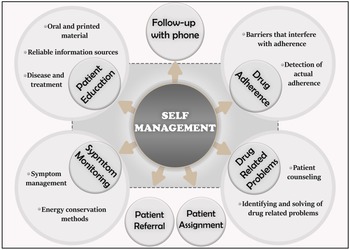
The self-management module was designed by a multidisciplinary team (clinical pharmacists and neurologists) in the light of the literature. Many behavior change techniques have been described in the literature.Reference Glasgow, Wagner and Schaefer19,Reference Abraham and Michie20 In this study, instruction, motivational interviews and feedback techniques were used. Within the scope of the developed self-management module, patient education (as instruction), medication adherence, symptom monitoring and patient referral (as motivational interview) and self-directed activity assignment and telephone follow-up (as feedback technique) were implemented. In addition, drug-related problems were identified and classified according to a system commonly used in the pharmacy literature.Reference Plow, Finlayson and Rezac21 The structure of the self-management module is given in Appendix, Table A.1. Thus, in the scope of literature, the self-management module consists of seven topics that have a potential impact on MS disease management including patient education, patients’ assignments (self-directed activity), symptom management, patient referral to supportive care, identification of drug-related problems, assessment of medication adherence and patient empowerment through telephone calls (Figure 2).
The multiple sclerosis self-management module.

The care process was overseen by a clinical pharmacist in collaboration with the attending neurologists. At the first interview, the clinical pharmacist implemented the self-management module in the study group, while patients in the control group received the usual outpatient care. The self-management module consists of patient education (via verbal and written information) about MS disease and drug treatments and the importance of diet, exercise, medication adherence and active participation in the treatment process. All patients were interviewed face-to-face three times (I1, I2 and I3). In addition, patients in the study group were called by the clinical pharmacist once by phone 2 months after the first interview (mid-interview).
The MS information leaflet was provided to patients to enable them to monitor their own symptoms at home, in order to maintain awareness of active participation. The MS information leaflet included a section for the Monitoring My Multiple Sclerosis (MMMS) scale questions, which patients were asked to complete twice, 2 months (mid-interview) and 4 months (I2) after the first interview (I1). Meanwhile, the patients’ questions about medication use and medication-related problems were identified and resolved by the clinical pharmacist via telephone call to prevent medication-related problems at any time during the study.
Measures
All scales used in this study have been proven to be valid and reliable in the Turkish language.Reference Basger, Moles and Chen22–Reference İncirkuş and Nahcivan25
Multiple Sclerosis Self-Management Revised (MSSM-R): The scale was developed to assess knowledge and behavior related to self-management and consists of 24 items and 5 subdimensions. The subdimensions are as follows: relationships and communication with healthcare providers, treatment adherence/barriers, social/family support, knowledge about MS and health maintenance behaviors. The scale is scored on a 5-point Likert scale ranging from 0 to 100, with scores indicating a higher level of self-management.Reference Osterberg and Blaschke16
Patient Engagement Scale® (PHE® questionnaire): The scale is designed to assess the emotional, behavioral and cognitive competencies of patients during the course of their care. An understanding of the level of patient engagement enables the provision of healthcare that is tailored to the patient’s needs. The PHE® questionnaire consists of five items, with each item presenting four expressions and seven options. As the scale is ordinal, the median value determines the level of patient engagement, with patients divided into four categories according to their level of engagement, which are classified as blackout, arousal, adhesion and eudaimonic project. Patients’ engagement with their healthcare increases from the blackout phase to the eudaimonic project phase, where the arousal and adhesion phases may be considered a transition of information into the practice. The term “blackout phase” is used to describe patients who are in denial about their diagnosis and are therefore unable to engage with their treatment (described as “frozen”). Patients in this phase lack the requisite knowledge about their disease and the strategies for its management. In the arousal phase, patients have emotionally accepted the disease as a new aspect of their identity; however, they remain incapable of adequately understanding and implementing strategies for managing the disease. In the adhesion phase, patients demonstrate an ability to respond to physician prescriptions in a satisfactory manner; however, they exhibit an emotional inability to accept lifestyle changes that would facilitate a comprehensive disease management. In the eudaimonic phase, the patients have developed an appropriate cognitive and emotional response to their disease and the necessary skills to manage it, allowing them to practice the required self-management skills.Reference Bishop and Frain17
Patient Assessment of Chronic Illness Care (PACIC): The scale consists of 20 items and 5 subdimensions (patient activation, decision support, goal setting, problem-solving and follow-up). The total score is the average value of the subdimension scores. An increase in the score indicates that people with chronic conditions are satisfied with the care they receive.Reference Graffigna, Barello and Bonanomi18 The scale was used to assess the contribution of the clinical pharmacist to the quality of care for the MS patient in this study.
Monitoring My Multiple Sclerosis (MMMS): The scale consists of 26 items and 4 subdimensions (physical, relationships, energy and mental state), the score ranges from 26 to 104 and higher scores indicate patients’ satisfaction with their functional status.Reference Usta, Korkmaz and Akyar26
Pharmaceutical Care Network Europe (PCNE) v9.1 Classification: The PCNE system was used to classify drug-related problems that were identified and resolved by the clinical pharmacist for patients in the study and control groups. This system classifies drug-related problems into problems, causes, interventions, acceptance of recommendations and final status of problems.Reference Plow, Finlayson and Rezac21
Main outcome measures
It was hypothesized that (1) effective MS disease management can be achieved through a multidisciplinary healthcare team and patient empowerment; (2) patients’ self-management skills can be improved by education, close monitoring and follow-up by healthcare providers and empowerment by active involvement in the disease management; and (3) implementation of such a comprehensive MS self-management module can improve medication adherence and patients’ satisfaction with the care.
As the primary aim was to evaluate the effectiveness of the self-management model developed in this study, the primary outcome was the mean change in the MSSM-R total score between the baseline and 4 and 8 months thereafter. The secondary outcomes included changes in patient engagement using the PHE® questionnaire, patient satisfaction with the care using the PACIC score and medication adherence. Additionally, potential patient-related factors that may have an effect on the MSSM-R scale scores were examined.
Ethical consideration
The study was approved by the University Clinical Trials Ethics Committee (no. KA-20003) and registered on ClinicalTrials.gov (NCT05209113, retrospectively registered).
Statistical analysis
Data were analyzed using IBM SPSS Statistics v23. Categorical variables are presented as frequencies and percentages; numerical variables are presented as means, standard deviations, medians and interquartile ranges. The distribution of numerical variables was evaluated using normality tests (Shapiro–Wilk and Kolmogorov–Smirnov) as well as graphical methods (histogram and box plots). Comparisons between two independent groups for numerical variables were carried out with the Independent Samples t test or the Mann–Whitney U test. Comparisons between the two dependent groups were conducted using the Dependent Samples t test or the Wilcoxon test. The significance level was considered as 0.05.
To examine the changes in MSSM-R and PACIC scale scores over time, parametric test assumptions were met and repeated measures ANOVA with one fixed factor was used. The change over time in the categories obtained by the PHE® questionnaire was examined using chi-square analysis. As the assumption of normal distribution could not be met in the analysis of the change in medication adherence between the groups over time, the comparisons were made using the Mann–Whitney U test (between groups) and the Friedman test (within groups). The increase in type 1 error due to the use of multiple testing was controlled by the Bonferroni correction. Since the analyses evaluating three different times were carried out dependently, patients with missing data were excluded from the analysis, and n values were obtained in the tables. Partial eta square (0.1 small, 0.3 medium, 0.5 large effect size) and r (0.01 small, 0.06 medium, 0.14 large effect size) values were used to calculate effect sizes.Reference Gulick, Namey and Halper27
The relationships between the numerical variables were evaluated using the Pearson and Spearman correlation coefficients, according to the assumptions of the parametric test. Multiple linear regression analysis was used to determine the independent variables that have an effect on the dependent numerical variable. A multiple linear regression analysis was conducted to observe the change in patients’ baseline characteristics and scale scores obtained at the first (I1 – baseline) and last interview (I3 – 8 months). The stepwise selection method was used to select the variables. By examining the assumptions (such as normality of residuals, absence of multicollinearity problem), a clinically appropriate model was obtained that met the assumptions.
Results
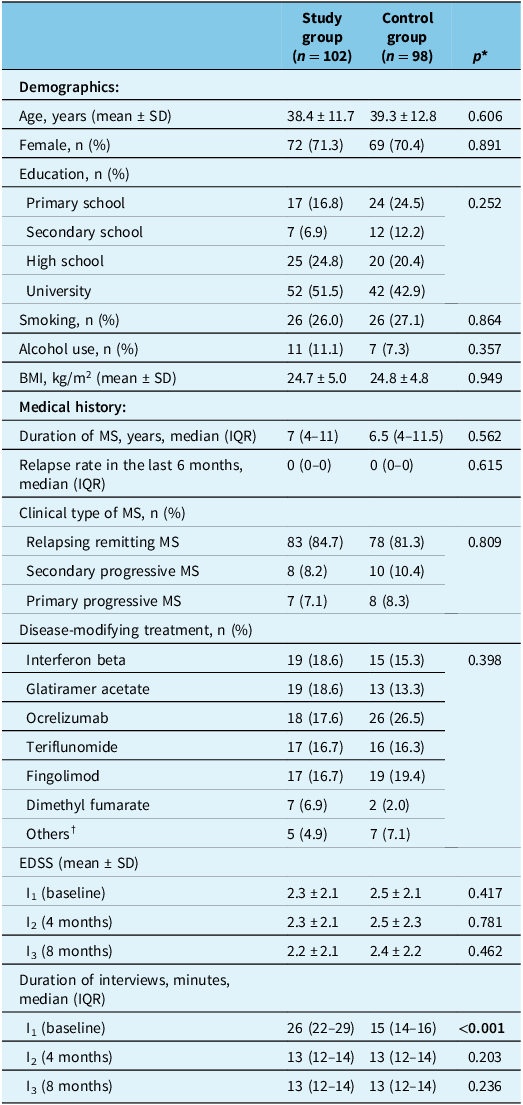
One hundred and two patients were included in the study group and 98 patients were in the control group (Figure 3). There were no differences in patient characteristics between the study and the control groups at baseline (p > 0.05); only the duration of the first interview was longer in the study group (p < 0.001) due to the implementation of the self-management module. No significant difference was found in the changes in EDSS scores of the patients in the study and the control groups during the follow-up (Table 1). The disease-modifying treatments used by the patients were grouped as platform (interferon beta, glatiramer acetate, teriflunomide, dimethyl fumarate) and high-efficacy (ocrelizumab, fingolimod, natalizumab, cladribine, azathioprine, secukinumab) therapies, and the analysis was repeated.Reference Maher, Markey and Ebert-May28 Accordingly, no difference was found between the study and control groups in terms of the number of patients receiving platform and high-efficacy treatments (p = 0.05).
Flow diagram of study recruitment.

Patient demographics

MS = multiple sclerosis; BMI = body mass index; IQR = interquartile range; EDSS = Expanded Disability Status Scale; SD = standard deviation; I1 = Interview 1; I2 = Interview 2; I3 = Interview 3.
* Student’s t, Mann–Whitney U and chi-square tests were performed. †Others: Natalizumab, cladribine, azathioprine, secukinumab.
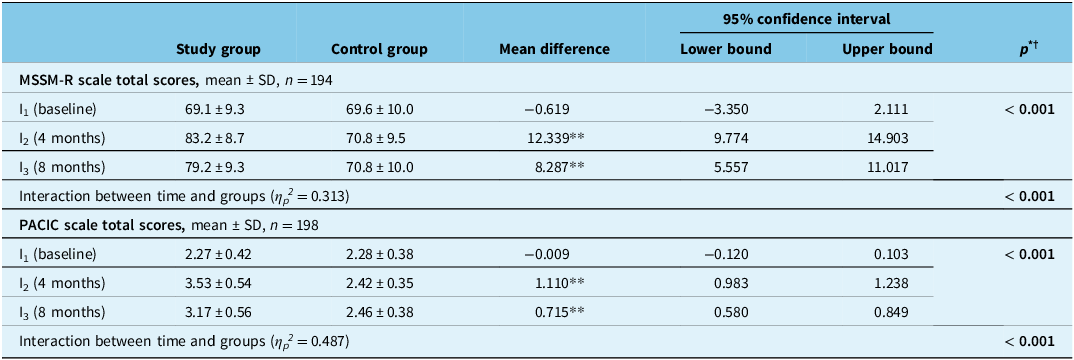
With the implementation of the self-management module, the MSSM-R scale scores of the study group increased significantly compared to the control group (the mean difference was greatest at 4 months with a value of 12.3 points [95% CI: 9.8–14.9], and it decreased to 8.3 points at 8 months [95% CI: 5.6–11.0], while statistical significance was maintained), particularly in the subdimensions of communication with healthcare professionals, knowledge of MS and treatment adherence. At Interview 3 (I3 – 8 months), the MSSM-R scores of the study group decreased, while those of the control group remained stable compared to Interview 2 (I2 – 4 months). The interaction assessing the change between groups over three timepoints was found to be significant (η p2 = 0.313, p < 0.001). According to the PACIC scale, increases were observed in the study and the control groups in the scores of all subdimensions over three interviews, but the increase in the total score was significantly greater in the study group (the mean difference was highest at 4 months with 1.1 points (95% CI: 0.9–1.2). The interaction assessing the change between groups over three timepoints was found to be significant (η p2 = 0.487, p < 0.001) (Table 2). Pairwise comparisons between each time point within each group are provided in Appendix, Table A.2.
MSSM-R and PACIC scale scores of patients during the interviews

MSSM-R = Multiple Sclerosis Self-Management Revised; PACIC = Patient Assessment of Chronic Illness Care; ηp2 = partial eta square; SD = standard deviation; I1 = Interview 1; I2 = Interview 2; I3 = Interview 3.
* p-value is given for statistical significance between the study and control groups. **The mean difference is significant at the 0.05 level. †Repeated measures ANOVA was performed.
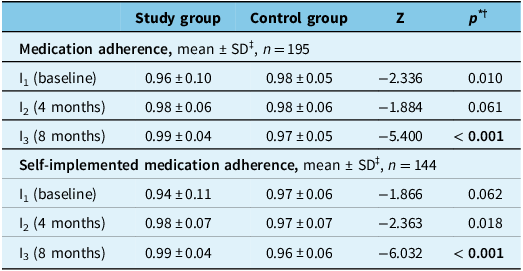
Although patients’ medication adherence was higher in the control group at baseline (I1), it increased in the study group, whereas it decreased in the control group at 8 months (I3) (Z = −5.400, p < 0.001). The sub-analysis of adherence also revealed that adherence to self-administered medication was significantly increased in the study group after the implementation of the self-management module (Z = −6.032, p < 0.001) (Table 3). Furthermore, the effect size was calculated, given that medication adherence was found to be high in both groups. The effect size was found to be moderate for medication adherence (r = 0.39) and large for self-administered medication adherence (r = 0.51) at the third interview (I3 – 8 months).
Medication adherence of patients during the interviews

SD = standard deviation; I1 = Interview 1; I2 = Interview 2; I3 = Interview 3.
* p-value is given for statistical significance between the study and control groups.†Mann–Whitney U test for medication adherence was performed.‡As a result of the Bonferroni correction, the statistical significance threshold was determined as p < 0.01.
The PHE® questionnaire categories of the patients have changed during the interviews. The number of patients in the categories “adhesion” and “arousal” decreased, whereas the number of patients in the category “eudaimonic project” increased in the study group. However, in the control group, the number of patients in the “adhesion” category decreased, but the number in the “arousal” category increased. During the implementation of the self-management module, patient engagement improved in the study group (Table 4).
PHE® questionnaire categories of the patients during the interviews

PHE® questionnaire = Patient Engagement Scale®; I1 = Interview 1; I2 = Interview 2; I3 = Interview 3.
* p-value is given for statistical significance between the study and control groups. †Chi-square test for the PHE® questionnaire was performed regardless of change over time. The p-value provides information regarding the difference between the groups at specific time points. a,b: The fact that the categories in the study and control groups have the same indices indicates that the values do not differ, while the fact that they have different indices reveals that the values are significantly different.
Patients’ engagement was stimulated by the implementation of the MMMS questions in the study group. Although a slight increase in the MMMS total score at 4 months (I2) was observed compared to the scores at the mid-interview (I1–2) conducted at 2 months after the baseline interview, there was no significant difference in terms of scale scores (appendix, Table A.3).
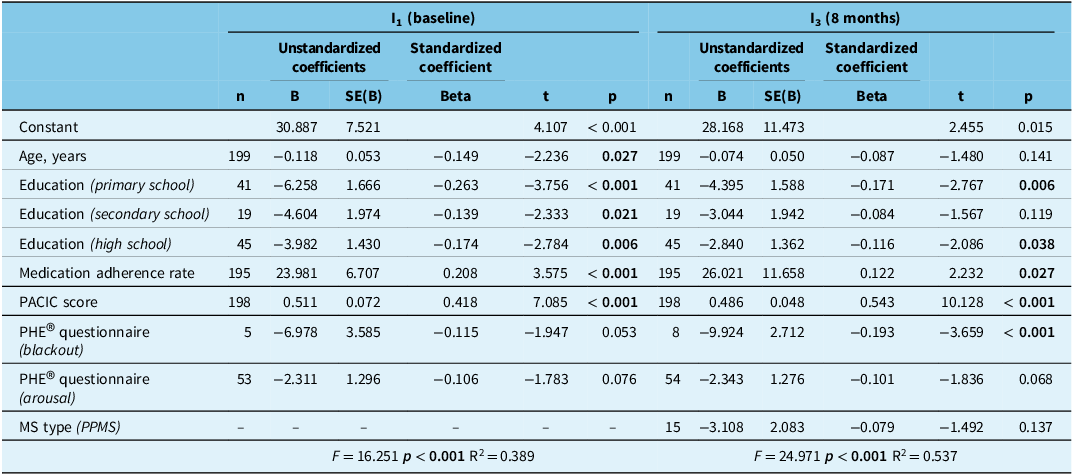
In order to identify potential factors affecting self-management abilities in patients with MS, the associations between the MSSM-R scale, the other scales used in this study and patients’ demographics were investigated. The results demonstrated a significant association between the MSSM-R score and several factors, including age, the PHE® questionnaire, the PACIC scale, education level, MS type and medication adherence rate. The regression analysis (explaining 38.9% of the variance at the baseline analysis and 53.7% at the 8-month analysis) showed that a one-standard-deviation increase in age was associated with a 0.2 standard-deviation decrease in the MSSM-R score at baseline. However, the effect of age on the MSSM-R score was no longer statistically significant at the 8-month analysis. Regarding medication adherence, a one-standard-deviation increase was observed to result in a 0.2 standard-deviation increase in the MSSM-R score at baseline, and this effect maintained its significance at 8 months. Having a primary school education was found to result in a 0.3 standard-deviation decrease in the MSSM-R score in comparison to having a university education at baseline, and this effect maintained its significance at the 8-month analysis. At the baseline assessment, while the PHE® questionnaire categories did not reveal statistically significant results, at the 8-month follow-up, individuals in the blackout category exhibited a 0.2 standard-deviation decrease in the MSSM-R score compared to those in the eudaimonic project category. With regard to the PACIC score, one-standard-deviation increase was found to result in an increase in the MSSM-R score by 0.4 standard deviation at baseline and 0.5 standard deviation at 8 months (Table 5).
Factors associated with MSSM-R scale scores at baseline and last interview

MSSM-R = Multiple Sclerosis Self-Management Revised; PHE® questionnaire = Patient Engagement Scale®; PACIC = Patient Assessment of Chronic Illness Care; PPMS = primary progressive multiple sclerosis; I1 = Interview 1; I3 = Interview 3.
According to the PCNE classification system, the most common drug-related problems were associated with potential adverse events (69.8%), followed by inappropriate drug/nutritional supplement combinations (34.9%) and inappropriate drug administration (24%) by the patients. The majority (95.4%) of planned interventions by a clinical pharmacist to resolve the problems were drug counseling, and the interventions were mostly (89.2%) accepted and fully implemented by the patients or the healthcare team. As a result, 93.8% of the problems were completely or partially resolved (appendix, Table A.4).
Discussion
This study evaluated the effectiveness of a clinical pharmacist-implemented self-management intervention in patients with MS. Implementation of a comprehensive self-management module, designed by a multidisciplinary care team, increased scores on the MSSM-R scale across all subdimensions (particularly knowledge of MS and medication adherence). The self-management module also improved patients’ self-management skills, which contributed to improved patient perceptions of care and engagement in disease management.
According to the previous studies, self-management was considered as an approach that can be effective in reducing MS-related symptoms and helping patients to manage the impact of MSReference Cree, Hartung and Barnett29, as well as practices that are essential to guide clinical decision-making for more effective therapies.Reference Fraser, Ehde and Amtmann30 A systematic review reported that the psychological benefits of self-management interventions may not be obtained immediate, and therefore, the long-term effects of the interventions should be investigated.Reference Ehde, Arewasikporn and Alschuler31 Therefore, this study investigated the short-term (4 months) and the long-term (8 months) effects of implementing the self-management module and found that the score on the MSSM-R scale increased significantly at 4 months but decreased at 8 months, although it was significantly higher than the baseline. This suggests that the self-management module is more effective in the short term and that iterative reminders are needed to achieve higher levels of self-management in patients with MS.
Receiving adequate social support and having broad socioeconomic resources were found to be the most predictive parameters of self-management in MS, but patient demographics (except female gender and older age) do not significantly affect self-management.Reference Lorig and Holman10,Reference Kidd, Carey and Mold32 Satisfaction with healthcare encourages patients to take a more active role in disease management, which has a positive impact on self-management.Reference Wilski, Tasiemski and Kocur33,Reference Desmedt, Vertriest and Petrovic34 In this study, significant associations were found between the MSSM-R score and patients’ age, educational status, medication adherence, PHE® questionnaire category and in particular with the PACIC scale score.
Although some studies have indicated that there is no correlation between age and self-management in patients with MSReference Osterberg and Blaschke16,Reference Kidd, Carey and Mold32 , other research has demonstrated that age is a contributing factor in the attrition rates observed in self-management programs.Reference Barello, Palamenghi and Graffigna35 Furthermore, older patients exhibit a greater tendency toward passive decision-making, which is contrary to the self-management strategies.Reference Arafah, Bouchard and Mayo36 It is known that age and educational level are associated with the development of cognitive dysfunction in patients with MS.Reference Mah, Muthupalaniappen and Chong37 As cognitive performance is a determinant of self-management, the negative relationship found between age and self-management observed in this study may be explained by the fact that the cognitive dysfunction increases with age.Reference Mah, Muthupalaniappen and Chong37,Reference Basci and Tulek38 Moreover, the impact of age on self-management was no longer statistically significant following the intervention, suggesting that the negative effect of age on self-management can be neutralized by the intervention. Despite a reduction in the standardized coefficient, patients with primary school education remained at a disadvantage in terms of self-management following the intervention, in comparison to patients with a university education. This finding is consistent with research indicating that a higher educational level is associated with better self-management abilities.Reference Osterberg and Blaschke16 In a study conducted with MS patients, it was reported that self-management programs led to improved medication adherence, which is in line with the findings of this study.Reference Efendi, Ünal and Akçalı39 Among the PHE® questionnaire categories, the euidaimonic project was taken as a reference, and it was revealed that although being in the blackout category before the intervention had no significant effect on MSSM-R scores, after the intervention (due to the increase in numbers in the eudaimonic project category), being in the blackout category had a negative effect on MSSM-R scores. The improvements in the patients’ PHE® questionnaire categories following the intervention and the significant change in the number of patients in the categories were acknowledged as the reason for this finding. Although there is no study reporting regression analysis and direct score change in the literature, a study suggesting that the incorporation of a robust and well-structured patient engagement component into self-management strategies may enhance the effectiveness of these strategies, which found a significant increase in self-management behaviors following the intervention targeting patient engagement.Reference Yang, Lee and Wang40 Furthermore, it has been suggested that there may be some overlap between patient activation and engagement.Reference Bishop and Frain17 Consequently, self-management interventions were identified as being positively associated with patient activation.Reference Hessler, Fisher and Dickinson41,Reference Hosseinzadeh, Verma and Gopaldasani42 Following the intervention, the positive correlation between PACIC and MSSM-R scores maintained its statistical significance with an increasing standardized coefficient at 8 months. In this regard, the observed increase in self-management scores for MS patients is consistent with the reported increase in satisfaction with the care provided. Similarly, Glasgow et al. found that the PACIC scores were positively related to self-management.Reference Howell, Pond and Bryant-Lukosius43 The study demonstrated the establishment of a preferable pharmacist–patient relationship, whereby the clinical pharmacist contributed to the enhancement of patients’ self-management abilities through the implementation of the aforementioned module. Therefore, the strong relationship between self-management and PACIC score was attributed to the patient’s enhanced involvement in the care process while having closer contact with the pharmacist and being satisfied with this process. Similarly, a positive correlation was identified between favorable patient–healthcare professional relationship and the PACIC score in a study conducted on patients with chronic diseases.Reference Glasgow, Whitesides and Nelson44 Furthermore, it has been previously reported that receipt of self-management support is associated with an increase in patient activation, which constitutes one of the subdimensions of PACIC.Reference Graffigna, Barello and Bonanomi18 The fact that some of the items in the patient participation, decision-making support and monitoring/coordination subdimensions of the PACIC scale are also included in the relationships with healthcare providers and health maintenance behaviors subdimensions of the MSSM-R scale may have contributed to this significant association.
Therefore, it has been shown that interventions by a clinical pharmacist within the self-management module directly increase the scores on the MSSM-R scale and indirectly improve self-management by developing patients’ perception of care and patient engagement. In line with these findings, it can be said that self-management interventions should be tailored according to the needs of patients who are older, less educated and have low adherence to the treatment. It should also be remembered that the patient’s perception of disease management, expectations of treatment outcomes and willingness to participate in the care process determine the scope of the self-management strategy. Sorensen et al. emphasized the necessity of MS units in providing comprehensive services and the importance of multidisciplinary teams in enhancing patient satisfaction and engagement. However, the potential of pharmacists regarding this enhancement is expressed only briefly and indirectly. This indicates that there is still a gap in understanding the contributions that pharmacists can provide to multidisciplinary teams in MS units. This study demonstrates the contributions of clinical pharmacists in different dimensions regarding medication management in MS patients.Reference Lim, Lim and Teh45
Self-management is a nonlinear, dynamic and cumulative process, and well-designed self-management programs provide a set of effective skills for patients, such as knowledge acquisition, self-monitoring, problem-solving, goal setting, identifying current strengths and coping, to deal with the challenges of MS.Reference Malcomson, Lowe-Strong and Dunwoody8,Reference Soelberg Sorensen, Giovannoni and Montalban46–Reference Lorig, Sobel and Ritter48 Therefore, in this study, education was provided with the support of written materials and reinforced by patients’ questions regarding self-monitoring. Although the duration of the education session was shorter (11 minutes) than in the previous study (1-hour session for 4 months) Reference Knaster, Yorkston and Johnson49, the telephone counseling service by the clinical pharmacist was always accessible and frequently used by the patients. By serving as a professional and accessible source of health information, the clinical pharmacist was able to identify and resolve drug-related problems (including inappropriate drug administration), contribute to medication adherence and thus improve the implementation of the self-management module. A recent study has indicated that older age, lower socioeconomic status and physical status are associated with reduced utilization of telehealth services among patients with MS.Reference Hemmatpoor, Gholami and Parnian50 However, since the use of telephone services was not recorded, it is not possible to assess this dimension in this study.
The rate of medication adherence in the MS population is reported to be 60%–80%, depending on the definition and analysis used, and higher adherence is associated with significantly fewer MS relapses and hospitalizations.Reference Marrie, Kosowan and Cutter51,Reference Tan, Cai and Agarwal52 In this study, medication adherence increased significantly in the study group after implementation of the self-management module, whereas it decreased in the control group, and the differences between the groups were significant only at the third interview (8 months). These findings highlight the fact that the self-management module is effective in improving medication adherence but that it requires at least 8 months to have a significant impact on patient outcomes. This study also found that medication adherence tended to decrease in patients who did not receive any intervention.
The study has inevitable limitations, such as the fact that the interviews with the patients were conducted in the outpatient clinic during a limited time frame and the fact that quality of life was not assessed due to many other scales administered to the patients. Self-reporting by patients on their medication adherence may result in an overestimation of the actual adherence levels. The findings of patients’ self-reports should be interpreted with caution. In addition, the impact of the self-management module on long-term clinical (change in the number of relapses, cognitive function, fatigue) and economic outcomes could not be evaluated. The frequency of telephone service usage by patients was not documented. Finally, the allocation of patients to groups was not fully concealed, and blinding could not be performed due to the nature of the study.
Conclusions
The self-management module developed in this study has been shown to increase patient self-management, perceived care and engagement in the treatment of MS. Factors such as age, educational status, medication adherence, chronic disease perception level and patient engagement category were identified as predictive determinants of patient self-management skills. Therefore, comprehensive, multidisciplinary designed but individualized patient self-management programs will strengthen the relationship between patients and healthcare professionals and maintain effective disease management in MS. It may be advantageous to extend the methodology of this study to other chronic neurological disorders in order to ascertain its potential benefits.
Supplementary material
The supplementary material for this article can be found at https://doi.org/10.1017/cjn.2024.345.
Acknowledgment
None.
Author contributions
Conceptualization was conducted by CG, ABE and AT; investigation and writing – original draft preparation were conducted by CG, SBE, AT and PAO; writing – review and editing and supervision were conducted by AT, ABE, PAO and MK; methodology was determined by CG, MK, CG and ABE; and formal analysis and software were conducted by MK, PAO, CG.
Funding statement
This research did not receive any specific grant from funding agencies in the public, commercial or not-for-profit sectors.
Competing interests
None.