




Introduction
The search for salt, a basic biological necessity, became a fundamental companion to the consumption of carbohydrate-rich diets with the rise of agriculture and diverse civilisations worldwide. Hunter-gatherers may obtain sufficient dietary salt from game but agricultural and urban populations require supplementary salt, which may be obtained through mining or via the solar evaporation or boiling of brine from salt springs and salt-enriched seawater. Understanding the technology used to increase the availability of this restricted resource provides insights into the (pre)historic production and distribution of salt. The evaporation of brine in pots over fires was a common method of salt production worldwide that also created abundant ‘briquetage’—broken salt-making pottery—that can, in turn, track the scale of salt production from family use to household surplus to industrial manufacturing (McKillop & Sills Reference McKillop and Sills2022). Salt-making pots were supported over the fire by a clay pedestal in parts of Vietnam, Europe and Africa (Li & von Falkenhausen Reference Li and von Falkenhausen2010; McKillop Reference McKillop2019: 30–36). The loose salt was sometimes further heated to make hardened salt for storage or trade, either in the same pots—as on Bohol Island in the Philippines (Yankowski Reference Yankowski, Shicheng and von Falkenhausen2010)—or in different containers. At Sacapulas in the Guatemalan highlands, brine-boiling bowls were turned over on a griddle to harden the salt before the pots were broken to remove the salt cakes (Reina & Monaghan Reference Reina and Monaghan1981). Some ancient civilisations controlled the production and distribution of salt by assigning administrators at salt works or by levying a salt tax, as in ancient China (Adshead Reference Adshead1992) where brine was transported hundreds of kilometres in raised bamboo pipes to boiling stations on the Yangzi River (Li & Falkenhausen Reference Li and von Falkenhausen2006). The trade, but not the production, of salt was state-controlled in the Roman Empire (Saile Reference Saile, Brigand and Weller2015: 202–4) and the Inca state-maintained salt warehouses and kept quipus records of the volumes stored (DeLeonardis Reference DeLeondaris2011).
In Central America, the diet of the Maya civilisation focused primarily on corn, beans, squash and other salt-deficient plant foods, and individual diets were supplemented with manufactured salt. Fieldwork at the Paynes Creek Salt Works in southern Belize indicates that coastal Maya households produced surplus salt in the Classic period (AD 250–900), constructing dedicated salt kitchens and separate residences such as at Ta'ab Nuk Na (Figure 1; McKillop & Sills Reference McKillop and Sills2022). Here, we report on excavations at the nearby site of Jay-yi Nah (Figure 2), which has a pole and thatch salt kitchen but no residence, and where briquetage consists of large, incurved bowls rather than the jars and pots supported by clay cylinders typical of other local salt works. Radiocarbon dating of a building post at Jay-yi Nah pushes back the earliest date for salt making at the Paynes Creek Salt Works, demonstrating a difference in the technology and organisation of early salt production and expanding the narrative around the origins of the salt industry in southern Belize.
Map of the Maya area showing the locations of salt works and other Maya sites mentioned in the article (figure by H. McKillop).

Aerial view of the Western Lagoon and West Point areas of Punta Ycacos Lagoon, showing the location of Jay-yi Nah (Site 71), Ta'ab Nuk Na (Site 7), Eleanor Betty (Site 67) and selected other sites at the Paynes Creek Salt Works. Ek Way Nal (Site 60) is located in another arm of the lagoon to the north-west (figure by H. McKillop).

Ancient Maya salt production
Estimates of population size and salt production yields at coastal and inland salt works during the height of the Late Classic period (AD 550–800) support a model of the regional production and distribution of salt from coastal or inland salt works (McKillop Reference McKillop2019). The arid landscape of the Yucatan Peninsula provides an ideal setting for solar evaporation. In contrast, rainier conditions further south in Belize and along the Pacific coast of Guatemala favour the brine boiling method, in which pots of brine are supported (typically by stones or clay cylinders) over a fire to force evaporation of the water and crystallisation of the salt. In historic times, brine boiling was used at salt springs in the Maya highlands of Guatemala and Mexico, such as Sacapulas where salinity was further increased by pouring salty water over salty soil before the enriched brine was boiled in pots over fires in dedicated family salt kitchens (Reina & Monaghan Reference Reina and Monaghan1981; Andrews Reference Andrews1983). The Maya highland salt works at Salinas de los Nueve Cerros provided salt to inland cities in the central Maya lowlands during the Preclassic and Classic periods (Woodfill et al. Reference Woodfill, Dillon, Wolf, Avendaño and Canter2015).
Most of the salt works along the coast of Belize date to the Late Classic period, corresponding with a time of population growth in the southern Maya lowlands (Figure 1). These include salt works at Northern River Lagoon (Masson & Mock Reference Masson, Mock, Demarest, Rice and Rice2004), Wits Cah Ak'al (Murata Reference Murata2015), Marco Gonzalez and other sites on Ambergris Cay (Graham et al. Reference Graham2017; Simmons et al. Reference Simmons, Mayfield, Aimers and Stemp2018), Moho Cay (McKillop Reference McKillop and Garber2004), Colson Point (Graham Reference Graham, McKillop and Healy1989, Reference Graham1994), Placencia Lagoon (MacKinnon & Kepecs Reference MacKinnon and Kepecs1989; Graham Reference Graham1994: fig. 5.36 n–u; Sills Reference Sills2016) and the Paynes Creek Salt Works. Large-scale salt production seems to have ended by the Terminal Classic period (AD 800–900), and perhaps earlier at Marco Gonzalez (Simmons & Graham Reference Simmons, Graham, Patton and Manion2017), when much of the southern Maya lowlands was abandoned and there is a marked increase in circum-peninsular trade, including exotics wares such as Fine Orange, Plumbate, Yucatan slate and other pottery evident from Marco Gonzalez and Wild Cane Cay in particular (Graham et al. Reference Graham2017; McKillop Reference McKillop and Lyell2024).
At some salt works, fire-hardened salt cakes were transported inside the pots in which they were produced, such as on Bohol Island in the Philippines (Yankowski Reference Yankowski, Shicheng and von Falkenhausen2010). This process results in an absence of briquetage at the production site. At other sites, instead of making hardened salt cakes, loose salt was traded in baskets or large jars. For example, a ‘salt person’ with a large pot may be identified in a mural depicting a marketplace at Late Classic Calakmul (Martin Reference Martin, Golden, Houston and Skidmore2012: fig. 19). At the Paynes Creek Salt Works, 89–98 per cent of the pottery excavated from the salt kitchens is briquetage, indicating that salt was removed from the pots prior to transport (McKillop Reference McKillop2019: tab. 6.1). Abundant, standardised jars and bowls also support a model of salt cake production rather than the transportation of loose salt (McKillop Reference McKillop2021).
The remarkable preservation of wooden building posts in red mangrove peat (Rhizophora mangle) at Jay-yi Nah and other Paynes Creek Salt Works sites has allowed radiocarbon dating of the pole and thatch buildings associated with the briquetage. At Ta'ab Nuk Na, most of the 10 buildings were constructed in the Late Classic period (McKillop & Sills Reference McKillop and Sills2022). At Ek Way Nal, another large site with 10 pole-and-thatch buildings, most were constructed in the Terminal Classic period, with limited earlier construction at the end of the Late Classic (McKillop & Sills Reference McKillop and Sills2023). Although wooden buildings have not preserved at other salt works farther north along the coast of Belize, associated pottery dates most sites to the Late Classic period (MacKinnon & Kepecs Reference MacKinnon and Kepecs1989; Masson & Mock Reference Masson, Mock, Demarest, Rice and Rice2004; Murata Reference Murata2015; Sills Reference Sills2016; Graham et al. Reference Graham2017; Simmons & Graham Reference Simmons, Graham, Patton and Manion2017).
The Paynes Creek Salt Works provide a model of indoor salt making using the brine-boiling method that was likely widespread on the coasts of Belize and Guatemala. Numerous solid clay cylinder vessel supports are identified across the sites and are a typical find at other salt works in southern Belize, Moho Cay and Northern River Lagoon, though they are absent from Marco Gonzalez and the Colson Point sites. Salt pots vary in form but are typically smooth on the interior and rough on the exterior. At the Paynes Creek Salt Works, brine was boiled inside pole and thatch salt kitchens reminiscent of the historic salt works at Sacapulas. At Paynes Creek, each salt pot was raised above a fire by three clay cylinder vessel supports. At the top of each cylinder was a clay socket with a concave surface for the vessel to rest upon, and clay was added to the bottom of the cylinders to form a flat surface to rest on the ground (McKillop Reference McKillop1995: fig. 3.15). At Sacapulas, rocks were used to hold the pots above a fire on a raised hearth in the centre of the salt kitchen (Reina & Monaghan Reference Reina and Monaghan1981). Broken pots and vessel supports are found alongside funnels used in the salinity enrichment process at the Paynes Creek Salt Works (McKillop Reference McKillop2019: fig. 3.4) and a canoe at the Eleanor Betty Site (Figure 2) that had been repurposed as a container for salty soil and raised on wooden stakes was discovered with a large clay funnel placed underneath it to collect enriched brine (McKillop et al. Reference McKillop, Sills and Celluci2014). The discovery and excavation of thousands of incurved bowl sherds at Jay-yi Nah and the absence of vessel supports, funnels and other briquetage at this site is in stark contrast to the wider Paynes Creek model of salt production.
Discovery and excavation at Jay-yi Nah salt works
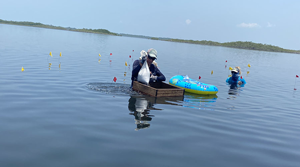
Jay-yi Nah was discovered during a systematic floatation survey (traversing back and forth on floatation devices) in Punta Ycacos lagoon in 2006, and building posts and pottery were mapped in 2008 during total station mapping of sites in the West Point area of the lagoon (McKillop Reference McKillop2019: fig. 4.15). The shallow underwater site is located west of a cluster of larger salt works, including Ta'ab Nuk Na (Figure 2; McKillop Reference McKillop2019: fig. 4.10). In 2023, we carried out a systematic floatation survey at Jay-yi Nah, traversing the site back and forth, shoulder to shoulder, on Research Flotation Devices and flagging wooden posts and distinctive artefacts that protruded above the sea floor. The water surface is approximately 0.3m above the sea floor in the area of the site, with archaeological deposits to a depth of 0.3m below the sea floor, as determined by a shovel test. Two excavation units were placed in areas of high artefact density (Figure 3). Compass-orientated metal grid frames measuring 1 × 1m were placed on the sea floor and held down with dive weights (Figure 4). All material from 0–0.1m depth was excavated using a trowel, placed in a large sack and water-screened through one-quarter-inch mesh in the sea (Figure 5).
Site plan of Jay-yi Nah showing wooden building posts (with post number), associated pottery and chert (with artefact letter) on the sea floor, excavation units (black squares) and estimated building locations (blue rectangles) (figure by H. McKillop).

Metal 1 × 1m excavation grid placed in areas with a high density of sea-floor pottery (photograph by E.C. Sills).

Water screening at Jay-yi Nah beside excavation unit 2 (photograph by E.C. Sills).

Excavated material consisted of pottery and charcoal, with chert found on the sea-floor survey. All pottery from the sea-floor survey and excavations was placed in containers of fresh water in the field. Drying of salt water-saturated pottery results in the surface movement of salt crystals that expand, cracking and exfoliating the surface of the pottery. Standard desalination practice was followed: pottery from the excavations, shovel test and sea-floor mapping was placed in fresh water for two weeks, rinsed periodically with fresh water and then dried in the sun on tarps. The artefacts were photographed, drawn and measured, and a selection were 3D scanned. The tops of all wood posts were cut at the site and exported for radiocarbon dating and species identification.
Results
The distribution of 15 hardwood and two palmetto palm (Acoelorrhaphe wrightii) posts at Jay-yi Nah suggests two or more pole and thatch buildings were constructed at the site (Figure 3). The tops of the identified posts are level with or slightly protrude above the sea floor, raising the possibility that there are more posts to be discovered. Radiocarbon dating of hardwood post 1 provides an Early Classic period (AD 250–550) date of 1570±30 BP (Beta-670248, calibrated at 95.4% confidence to AD 424–564, following Reimer et al. Reference Reimer2020). This date extends the chronology of salt production at the Paynes Creek Salt Works back to the Early Classic period.
Pottery finds at Jay-yi Nah suggest that the salt production technology used at this early point differed from that of the Late Classic period elsewhere at the Paynes Creek Salt Works. Jay-yi Nah lacks the solid clay cylinder vessel supports and the associated clay bases and sockets found at the other sites. The site also lacks brine boiling jars and basins (McKillop & Sills Reference McKillop and Sills2022, Reference McKillop and Sills2023). The recovery of wood charcoal and briquetage does, however, suggest that brine boiling was carried out at the site, despite the lack of burning on the pottery.
Briquetage and other pottery from Jay-yi Nah
The uniformity of large bowl sherds on the sea floor at Jay-yi Nah is evident from the systematic sea-floor survey and excavations. Twenty bowl and 11 jar sherds were flagged and collected from the sea floor (Figure 3). Eighteen of the bowl rims are incurved or round sided, with exterior folded rims and square or round lips (Figure 6). The vessel openings range from 0.32 to 0.5m or larger, and the vessels are smooth on the interior and rough on the exterior, with brush marks visible on the body. The sherds are thickest at the rim (83–143mm) and taper towards the base (33–73mm), with the latter measurement partly a function of the sherd size.
Incurved wall bowls from the sea-floor survey. Exterior view (top), interior view (middle) and rim profiles (bottom) (figure by H. McKillop).

All jar sherds discovered during sea-floor survey were collected for further study. The sample consists of four high-necked jars and five short-necked jars, with outflared or outcurved rims that have double grooves and round lips (Figure 7). The surfaces are smooth on the interior and exterior. They are assigned to the Paynes Creek pottery type (McKillop Reference McKillop2002). The vessel openings range from 0.20–0.38m in diameter. There are two jar rims with direct rims, round lips, incurved necks and outcurved walls. These are pock marked on the interior and exterior and assigned to the Mangrove Unslipped type (McKillop Reference McKillop2002). One measurable rim is 0.2m in diameter.
Sherds from necked jars with everted or outflared grooved rims. Interior view (left), exterior view (right) and rim profiles (bottom right) (figure by H. McKillop).

In addition to the incurved bowls, two sherds were found on sea-floor survey with appliqué fillet decoration on the vessel shoulder (Figure 8). One sherd is smooth on the interior and exterior with two gouge-incised lines below the rim and an applique fillet on the vessel body (Figure 8a). The overall vessel shape is unclear but appears to have been slightly incurved. The second sherd (Figure 8c) with an appliqué fillet may be from a bowl or jar. A body sherd with a painted checkerboard pattern was also found during the sea-floor survey; it has been discoloured by the salt water and mangrove peat and the decoration is only apparent as different shades of grey.
Non-briquetage pottery from sea-floor survey: a) incurved bowl rim with appliqué fillet and circumferential grooves (71-1/1-19); b) discoloured body sherd with painted checkerboard pattern (71 K); c) body sherd with appliqué fillet (71-1/1-20) (figure by H. McKillop).

The excavations yielded 2393 sherds, including 1160 (48%) from unit 1 and 1233 (52%) from unit 2 (Table 1). The excavated pottery from unit 1 includes 70 measurable bowl rims and 75 bowl rims too small to measure, 1006 bowl body sherds and three jar rims. There were 115 bowl rims (20 measurable) and 1104 bowl body sherds from unit 2, along with three jar rims and 11 jar body sherds. Bowls also predominate by weight, comprising 94 per cent of the pottery by weight in unit 1, which is within the range of briquetage at other salt kitchens at the Paynes Creek Salt Works (89–98%; McKillop Reference McKillop2019: tab. 6.1).
Counts and weights of briquetage from excavations (weights were not available for all unit 2 pottery).

The briquetage consists of large bowls with diameters of 0.32–0.5m or more and incurved walls. The underwater setting in mangrove peat means that there has been little post-depositional trampling, resulting in large sherds that preserve large portions of the vessel walls and up to 10 per cent of the vessel diameter. In addition to the briquetage, the pottery assemblage includes a small number of high or low-necked jar sherds with everted or outflared rims and a single or double groove on the rim. Although the surface finish and original colour are no longer apparent after immersion in the salt water and mangrove peat, the jars are smooth on the interior and exterior. The pottery assemblage is dominated by utilitarian wares and lacks the trade wares typical of the Late Classic sites elsewhere at the Paynes Creek Salt Works, such as Ta'ab Nuk Na. Household goods such as ocarinas (figurine whistles), spindle whorls, grinding stones, stone tools and pottery of diverse shapes and uses were also recovered from the later Paynes Creek site but not from Jay-yi Nah (McKillop & Sills Reference McKillop and Sills2022).
Early Classic midden deposits at Wild Cane Cay, an island trading port near the Paynes Creek Salt Works, yield incurved bowls and high-necked jars similar to the Jay-yi Nah sherds (McKillop Reference McKillop2005: fig. 4.7). Yet at Wild Cane Cay, the deposits also contained abundant fish bones (preserved in anaerobic deposits below the water table) and a variety of household goods, suggesting that the midden did not arise from a dedicated salt kitchen. Similar pottery is reported in excavations at Ambergris Cay in the far north of Belize at Marco Gonzalez, a site that also lacks clay cylinder vessel supports (Aimers et al. Reference Aimers, Haussner, Farthing, Murata and Walker2016; Graham et al. Reference Graham2017), as well as at the Colson Point sites (Graham Reference Graham1994) and Indian Hill 2 at Placencia Lagoon (Graham Reference Graham1994: fig. 5.36 n–u). Abundant “crudely made, roughly standardized vessels (Coconut Walk ware)” were placed over a fire to evaporate brine and make salt at Marco Gonzalez during the Late Classic period, first appearing sometime in the sixth century AD (Graham et al. Reference Graham2017: 118). Bowls and jars resembling salt-making pottery from Jay-yi Nah are seen at the Colson Point sites, including jars with everted grooved rims (Graham Reference Graham1994: figs. 5.12 & 5.13) and thin-walled Coconut Walk bowls with exterior folded lips (Graham Reference Graham1994: figs. 5.5 & 5.8). Some grooved-rim jars occur at Placencia Lagoon (Graham Reference Graham1994: fig. 3.34), including red-rimmed, striated jars common along the coast, referred to as Petroglyph red-rimmed or Puletan Red and Unslipped wares, which date to the Terminal Preclassic (AD 100–250) and Early Classic elsewhere (Graham Reference Graham1994: figs. 5.15 & 5.16).
Chert objects
The absence of formal chert tools at Jay-yi Nah, in contrast to other sites at the Paynes Creek Salt Works (including other sites nearby at the West Point area) is unusual. Other salt works, including Ta'ab Nuk Na and Site 70 near Jay-yi Nah, exhibit a variety of formal tools made from high-quality chert derived from the northern Belize chert bearing zone and characteristic of the tool manufacturing site of Colha (McKillop & Aoyama Reference McKillop and Aoyama2018). These tools include unifacial stemmed points made from macroblades, thin bifacial points, chert adzes and chopper pounders. Informal, expedient tools at the Paynes Creek Salt Works were made from local chert that was generally of low quality. Finished Colha chert tools and blade blanks for further modification into bifaces or stemmed points are found at the coastal island site on Moho Cay in northern Belize (McKillop Reference McKillop and Garber2004) and at Marco Gonzalez on Ambergris Cay (Simmons et al. Reference Simmons, Mayfield, Aimers and Stemp2018). Finished formal tools on northern Belize chert have been recovered from Wild Cane Cay (McKillop Reference McKillop2005).
As with the pottery finds, the chert at Jay-yi Na is of local origin. Although chert was not recovered from the excavations, six chert flakes were flagged and mapped during systematic sea-floor survey (Figures 3 & 9). All but one small flake includes cortex from the original outer surface of a large cobble, indicating that these are fragments from initial flake production. The flakes were chipped from the same local chert cobble, using direct percussion, and attempts at refitting saw three flakes join (71 G1, 71 G2 and 71 L; Figure 9). Production of the flakes differs from the core-blade technology typical of formal tool production at Colha and other sites in the Maya lowlands.
Chert from sea floor at Jay-yi Nah (Site 71: a) 71 C; b) 71 D; c) 71 F1; d) 71 F2; e) 71 G2; f) 71 G1; g) 71 H; h) 71 J; i) 71 L; j) refitting of flakes 71-G1, G2 and L (figure by H. McKillop).

Obsidian
Obsidian blades or fragments are not apparent at Jay-yi Nah but were previously recovered from sites in all five areas of the lagoon system (McKillop Reference McKillop2019: tab. 7.4). Obsidian was a common import from the Maya highland outcrops of El Chayal and Ixtepeque as early as the Middle Preclassic (600–300 BC) at Ich'ak’tun, through the Classic and Postclassic periods (AD 250–1500) at Wild Cane Cay and at other island and coastal sites in the Port Honduras (McKillop Reference McKillop2005; McKillop & Robertson Reference McKillop and Robertson2019), so its absence at Jay-yi Na is notable.
Discussion
Jay-yi Nah is a single component site dating to the Early Classic period that focused on salt production for local use or perhaps local production for down-the-line trading. The site consists of one or more salt kitchens but lacks any artefactual evidence of habitation, indicating that the salt workers lived elsewhere. Such a setup could indicate surplus household production of salt, with locational separation of residences and kitchens. The site was abandoned before the Late Classic construction of new salt kitchens and residences less than 100m to the east in the West Point area at Ta'ab Nuk Na and other nearby sites (Figure 2). It is possible that rising sea levels flooded Early Classic salt kitchens along the shores of Punta Ycacos lagoon, forcing the salt workers to relocate their salt kitchens and homes farther from the shore (see McKillop Reference McKillop2019: fig. 4.15).
Reconstruction sketches of the Jay-yi Nah incurved bowl rim sherds indicate that these containers have large vessel openings, averaging 0.42m in diameter. Of the 175 bowl rims that were drawn, many preserved substantial portions of the vessel wall. No bases were recovered, suggesting that these were rounded like the vessel walls. To aid in reconstruction, the curvature of the vessel wall was continued at the same angle to complete the shape (Figure 10). While the wall and base shapes may diverge somewhat from the reconstructions, the sherds all demonstrate similar curvature to the reconstructed vessels, which reveal large containers with wide openings suitable for solar or fire evaporation. Since the excavated bowls were discovered alongside charcoal, an interpretation of use in brine boiling is suggested.
Reconstructed bowls based on rim sherds from Jay-yi Nah (Site 71). a) 71-1/1-1, b) 71-1/1-3; c) 71-1/1-4; d) 71-1/1-6 (see Figure 6 for photographs of sherds) (figure by H. McKillop).

Technological changes in salt production reflect changes in the organisation of the production and distribution of salt at the Paynes Creek Salt Works. Early Classic production at Jay-yi Nah likely focused on local use or down-the-line trade. Demand for salt increased dramatically in the Late Classic period with the expansion of inland settlements, and the Late Classic salt works at Ta'ab Nuk Na focused on surplus household production of salt for regional trade to inland communities (McKillop Reference McKillop2019; McKillop & Sills Reference McKillop and Sills2022). Trade goods such as Belize Red serving bowls, Warrie Red ‘unit-stamped’ jars, obsidian, Colha chert and jadeite indicate Late Classic householders participated in marketplace trade to obtain these goods in exchange for the salt that they produced (McKillop Reference McKillop2019). Standardisation in the dimensions of the brine boiling pots that were used to create hardened salt cakes allowed the trading of predetermined salt quantities as a commodity or even a currency equivalency to obtain corn, pots and other goods at marketplaces (McKillop Reference McKillop2021). The discovery of fragments of clay ovens in building J at Ek Way Nal may reflect Late Classic attempts to intensify salt production; introduction of stoves for boiling brine in antiquity in China and France increased efficiency by reducing the loss of heat to the atmosphere (Olivier & Kovacik Reference Olivier and Kovacik2006; Li & Falkenhausen Reference Li and von Falkenhausen2010).
At Zhongba, along the Yangzi River in China, the emphasis on large-scale salt production changed to producing salt to preserve fish (Flad Reference Flad2011). Although fish and other bones rarely preserve in the acidic mangrove peat of the Paynes Creek Salt Works, use-wear analysis of the edges of chert stone tools indicates that most were used to process fish and/or meat (McKillop & Aoyama Reference McKillop and Aoyama2018). Production of salt for the preservation of fish and manufacture of fish oil increases storable and tradable food supplies, as documented across the Roman Empire, Thailand and the Philippines at various times in the past and continuing in Asia to the present (Curtis Reference Curtis1984; Yankowski Reference Yankowski, Shicheng and von Falkenhausen2010; Halliwell et al. Reference Halliwell, Yankowski, Chang, Kelley and Ardren2016).
Radiocarbon dating a post from Jay-yi Nah indicates the pole and thatch building was constructed in the Early Classic period, making the site currently the earliest reported salt works in southern Belize. The lack of nearby residences, which feature at later sites in the Paynes Creek Salt Works, raises the question of whether surplus household production of salt developed later, in the Late Classic period. At nearby Ta'ab Nuk Na, the diversity of pottery and stone household objects and the presence of a residence separate from the dedicated salt kitchens indicates that salt workers lived and worked at the salt works (McKillop & Sills Reference McKillop and Sills2022). It is probable that Jay-yi Nah served local coastal needs and was abandoned before the Late Classic population growth at nearby inland sites that drove the increased demand for salt.
Jay-yi Nah is further distinguished from later sites at the Paynes Creek Salt Works by its limited evidence for external contact, distinctive large bowls with incurved walls and lack of ceramic cylinder vessel supports, highlighting differences in salt production and trade. The obsidian, high-quality northern Belize chert, jadeite and other ground stones, and trade pottery apparent at other Paynes Creek sites are not found at Jay-yi Nah. Yet similarities in salt-making technology with sites on Wild Cane Cay opens the possibility for Early Classic contacts, and the demand for salt in Early Classic inland communities (such as Uxbenka in southern Belize) could have driven trade. Jay-yi Nah may have produced salt for down-the-line trade prior to the more organised marketplaces of the Late Classic documented by the presence of ocarinas and other trade goods at the salt works (McKillop Reference McKillop2019, Reference McKillop2021).
Conclusion
Sea-floor survey and excavations at Jay-yi Nah revealed the earliest evidence of ancient Maya salt production along the coast of southern Belize. Distinctive large bowls with incurved walls and necked jars with grooved lips were associated with an Early Classic pole and thatch salt kitchen, but the vessel supports and trade goods characteristic of later salt work sites were absent. These artefactual differences allow for a consideration of technological changes in coastal salt production and the widening of trade networks as inland demand for salt increased in the Late Classic period. Despite the challenges of archaeology in shallow underwater sites, research at Jay-yi Nah underscores the value of excavating in mangrove peat below the sea floor where preserved wooden architecture precisely dates and provides context to ancient practices of commodity production—in this case, salt.
Acknowledgements
We are grateful to the Belize Institute of Archaeology for granting permits, and to Cher Foster, Rachel Watson and John Young for field and lab assistance. We appreciate support from Louisiana State University and the University of Texas at Tyler.
Funding statement
The research was funded by the National Science Foundation (grant number 1826653).


 Open access

