




Introduction
North Greenland is the northernmost land mass on earth, reaching almost to 83°40′N, and yields the northernmost assemblages of Cambrian fossils. Cambrian paleogeography, however, was markedly different, with the present high arctic terrane lying just south of the equator on the eastern side of the Laurentian paleocontinent (Torsvik and Cocks, Reference Torsvik and Cocks2016). The record of this equatorial history persists in the extensive Cambrian (Cambrian Series 2–Furongian) fossil assemblages that have been described from carbonate-dominated sections in northern Greenland in the century that has elapsed since Cambrian fossils were first collected by the Danish polar explorer and geologist Lauge Koch (1882–1964) from Inglefield Land (Poulsen, Reference Poulsen1927; Christie and Dawes, Reference Christie, Dawes and Trettin1991; Fig. 1.3).
Geographical and geological background. (1) Collection localities: Localities A (GGU samples 313012 and 315028) and B (GGU samples 315043 and 315045) in northern Lauge Koch Land, North Greenland; Locality C yields Miaolingian trilobites of Baltic aspect described by Babcock (Reference Babcock1994a, Reference Babcockb) from the Kap Stanton Formation; Locality D is type locality of the Aftenstjernesø Formation in southern Lauge Koch Land (Ineson and Peel, Reference Ineson and Peel1997); (2) Greenland showing location of present study area (1) and Cambrian outcrops in Svalbard and North-East Greenland; (3) land areas in northern Greenland; (4) Cambrian stratigraphy in the Lauge Koch Land area, North Greenland. The Ediacaran age of the lower Portfjeld Formation was recently established by Willman et al. (Reference Willman, Peel, Ineson, Schovsbo, Rugen and Frei2020). (5) Schematic cross-section through the Franklinian Basin of North Greenland, based on Higgins et al. (Reference Higgins, Ineson, Peel, Surlyk and Sønderholm1991a), showing fossil localities at the northern limit of the Aftenstjernesø Formation. The traces of the two principal structural elements (Navarana Fjord Escarpment and Portfjeld Escarpment) are shown in (1).

Northern Greenland preserves an extensive Cambrian (Series 2–Furongian) record with southern, carbonate-dominated shelf sediments and a northern deep-water trough succession, in terms of present day geography (Higgins et al., Reference Higgins, Ineson, Peel, Surlyk and Sønderholm1991a, Reference Higgins, Ineson, Peel, Surlyk, Sønderholm and Trettinb). The present paper, however, documents the diverse fauna of just a single horizon from North Greenland: a thin unit recording the initiation of carbonate sedimentation on the shelf during Cambrian Stage 4 following the earlier transgression by siliciclastic sediments (Fig. 1.4, 1.5). This unique horizon, the basal member of the Aftenstjernesø Formation, is typically only 3–5 m in thickness, but it can be traced over a distance of 200 km east–west from southern Peary Land to southern Freuchen Land, and 50 km south–north from southern Lauge Koch Land to its northern shore (Fig. 1.1, 1.3). Its value in a regional context is that its distinctive lithology and fauna facilitate linkage between Cambrian stratigraphic successions in the separate southern and northern successions.
The fossil assemblages described herein are derived from the eastern side of Navarana Fjord, northern Lauge Koch Land, near the northern limit of the Aftenstjernesø Formation (Fig. 1.1, 1.5). They provide a point of reference close to the outer margin of the shelf for comparisons with equivalent, but as yet largely undescribed faunas from the same member in the prograding inner shelf environments to the south, in southern Freuchen Land, southern Lauge Koch Land, and across southern Peary Land (Fig. 1.1, 1.3). In a broader context, the fossil assemblage supports Cambrian Stage 4 correlations elsewhere in Greenland and Laurentia, and beyond into other paleocontinents.
Geological background
Cambrian sediments in northern Greenland crop out in three main areas. Following transgression by lower Cambrian siliciclastic sediments, the classic area of Inglefield Land and adjacent Daugaard-Jensen Land (Fig. 1.3) is dominated by inner shelf carbonates. Olenelloid assemblages of Cambrian Stage 4 (Poulsen, Reference Poulsen1927, Reference Poulsen1958, Reference Poulsen1964; Lieberman, Reference Lieberman1999) are followed by Miaolingian Series (Wuliuan Stage) and Furongian Cambrian faunas typical of the Laurentian inner carbonate shelf (Poulsen, Reference Poulsen1927, Reference Poulsen1964; Palmer and Peel, Reference Palmer and Peel1981; Peel, Reference Peel2020a, Reference Peelb, Reference Peel2021).
An eastern belt extending from southern Wulff Land across southern Peary Land also commences with transgressive siliciclastic sediments (Fig. 1.3–1.5; Buen Formation), but these are followed by a complex of shelf carbonates (Brønlund Fjord and Tavsens Iskappe groups; Fig. 1.4, 1.5) that progrades northward, out across the open shelf (Higgins et al., Reference Higgins, Ineson, Peel, Surlyk and Sønderholm1991a, Reference Higgins, Ineson, Peel, Surlyk, Sønderholm and Trettinb; Ineson and Peel, Reference Ineson and Peel1997). The Buen Formation yields rich Cambrian Stage 3–Stage 4 faunas (Peel and Willman, Reference Peel and Willman2018) before carbonate sedimentation commences in Stage 4, small shelly fossils from which are described herein. Diverse open shelf faunas culminate in a well-developed late Stage 4 Ovatoryctocara granulata assemblage (Blaker and Peel, Reference Blaker and Peel1997; Geyer and Peel, Reference Geyer and Peel2011; Peel et al., Reference Peel, Streng, Geyer, Kouchinsky and Skovsted2016), followed by Miaolingian faunas that combine elements of the Laurentian inner shelf fauna with open shelf agnostid assemblages (Robison, Reference Robison1988; Geyer and Peel, Reference Geyer and Peel2017).
Along the northern coast, from northern Nyeboe Land to Peary Land (Fig. 1.3), outer shelf and deep-water trough successions re-emerge from beneath a cover of Ordovician and Silurian strata as a result of middle Paleozoic Ellesmerian orogenesis (Higgins et al., Reference Higgins, Ineson, Peel, Surlyk and Sønderholm1991a, Reference Higgins, Ineson, Peel, Surlyk, Sønderholm and Trettinb). The northern coast successions in Nyeboe Land (Fig. 1.3) are characterized by the trilobite Serrodiscus Richter and Richter, Reference Richter and Richter1941 (Blaker and Peel, Reference Blaker and Peel1997; Peel and Skovsted, Reference Peel and Skovstedin press). The Sirius Passet Lagerstätte (Cambrian Series 2, Stage 3) from the lower Buen Formation in western Peary Land (Fig. 1.1, 1.5) requires special mention as the most significant Cambrian discovery from North Greenland, representing the oldest major Cambrian lagerstätte from Laurentia (Conway Morris et al., Reference Conway Morris, Peel, Higgins, Soper and Davis1987; Conway Morris and Peel, Reference Conway Morris and Peel1995; Ineson and Peel, Reference Ineson and Peel2011; Peel and Ineson, Reference Peel and Ineson2011a, Reference Peel and Inesonb; Botting and Peel, Reference Botting and Peel2016; Harper et al., Reference Harper, Hammarlund, Topper, Nielsen, Rasmussen, Park and Smith2019). This unique locality with exceptionally preserved fossils lies 12 km to the north of the fossiliferous localities described herein (Fig. 1.1, 1.5) and was deposited just offshore from the outer degraded edge of the carbonate platform of the Portfjeld Formation, which underlies the more southerly Cambrian successions (Fig. 1.5).
Series 2 strata in northern Nyeboe Land are followed by Laurentian shelf faunas, but the Miaolingian in northwestern Peary Land (Fig. 1.1, locality C) preserves faunas of Baltic aspect (Babcock, Reference Babcock1994a, Reference Babcockb; Robison, Reference Robison1994). Babcock (Reference Babcock1994b) proposed that this difference indicated the presence of a thermocline in Miaolingian strata in North Greenland, with warmer water shelf faunas of Laurentian aspect overlying faunas of Baltic aspect in a cooler, deeper water, outer shelf environment. Thus, typically middle to high latitude, shallow water, Baltic faunas were present at depth in the low latitudes occupied by North Greenland during the Cambrian, emphasizing that the faunal aspect was not governed by latitude differences alone (Babcock, Reference Babcock1994b).
The sedimentological dynamics of this profound faunal differentiation are magnificently exposed along the sheer sides of J.P. Koch Fjord (Higgins et al., Reference Higgins, Ineson, Peel, Surlyk and Sønderholm1991a, Reference Higgins, Ineson, Peel, Surlyk, Sønderholm and Trettinb; Ineson et al., Reference Ineson, Surlyk, Higgins and Peel1994; Ineson and Peel, Reference Ineson and Peel1997; Fig. 1.1, 1.5) that preserve a cross-section through this margin of the transarctic Franklinian Basin. Inner shelf and prograding platform margin sediments in southern Lauge Koch Land pass through areas of outer shelf deposition to deep-water trough sedimentation in northernmost Lauge Koch Land (Fig. 1.1, 1.4, 1.5).
All material described herein was collected from the Aftenstjernesø Formation from outcrops on the eastern side of Navarana Fjord (Fig. 1.1, localities A and B). The Aftenstjernesø Formation is the basal formation in a Cambrian–Early Ordovician, carbonate-dominated, prograding sedimentary complex referred to the Brønlund Fjord and Tavsens Iskappe groups (Fig. 1.4, 1.5; Higgins et al., Reference Higgins, Ineson, Peel, Surlyk and Sønderholm1991a, Reference Higgins, Ineson, Peel, Surlyk, Sønderholm and Trettinb; Ineson et al., Reference Ineson, Surlyk, Higgins and Peel1994; Ineson and Peel, Reference Ineson and Peel1997). The progradation reflects a deepening trend that is coeval with eustatic deepening along the present day eastern shore of Laurentia (Landing, Reference Landing2012), but was also related to early Caledonide accretion along the same margin by Surlyk (Reference Surlyk1991) and Higgins et al. (Reference Higgins, Ineson, Peel, Surlyk and Sønderholm1991a). In southern Lauge Koch Land and adjacent western Peary Land, the complex consists of an alternation of cliff-forming prograding coarse, cross-bedded dolomitic grainstones with frequent debris flows, deposited during highstands of sea level, and recessive mudstone-limestone-dolostone units representing lowstand conditions (Higgins et al., Reference Higgins, Ineson, Peel, Surlyk and Sønderholm1991a, Reference Higgins, Ineson, Peel, Surlyk, Sønderholm and Trettinb; Ineson and Peel, Reference Ineson and Peel1997; Fig. 1.4, 1.5). This alternation of highstand and lowstand deposition promoted the establishment of a lithostratigraphic subdivision that is not applicable in northern Lauge Koch Land, where dark outer shelf mudstones and carbonates of the Henson Gletscher and Kap Stanton formations dominate the succession (Ineson et al., Reference Ineson, Surlyk, Higgins and Peel1994) beyond the offshore limit of most of the prograding units (Fig. 1.4, 1.5).
The Aftenstjernesø Formation documents the initial establishment of carbonate deposition following the siliciclastic shelf sediments of the Buen Formation (Ineson and Peel, Reference Ineson and Peel1997; Peel and Willman, Reference Peel and Willman2018; Wallet et al., Reference Wallet, Slater, Willman and Peel2020), which crop out extensively across central and eastern North Greenland (Ineson and Peel, Reference Ineson and Peel1997; Peel and Willman, Reference Peel and Willman2018). The formation is dominated by cliff-forming dolostone grainstones. In its type area in southern Lauge Koch Land (Fig. 1.1, locality D), the formation attains a thickness of ~62 m (Ineson and Peel, Reference Ineson and Peel1997), but this is reduced to only 18 m at the fossil collection sites in northern Lauge Koch Land (Fig. 1.1, localities A and B). In the southern Freuchen Land-southern Peary Land area, fossils from the Aftenstjernesø Formation are generally restricted to the basal few meters of nodular dolomitic grainstones that are rich in glauconite, phosphorite bioclasts, pyrite, and phosphatized hardgrounds (Frykman, Reference Frykman1980; Peel, Reference Peel2017a). This condensed unit accumulated in a sediment-starved outer ramp setting and can be traced from southern to northern Lauge Koch Land (Fig. 1.1) and eastward across Peary Land. Its initial recognition in northern Lauge Koch Land was a key element in establishing correlation between outcrops of the Brønlund Fjord Group in southern Freuchen Land and southern Peary Land and the structurally uplifted Cambrian successions of the northern coast.
The Navarana Fjord fauna
The faunas of the individual samples described herein from the lower Aftenstjernesø Formation at Navarana Fjord (Fig. 2.2) are not closely similar to each other in detail despite their comparable stratigraphic level, suggesting that the full faunal diversity of the sediment-starved ramp deposits is not yet known. GGU samples 313012 and 315043 are probably autochthonous, but fossils in GGU samples 315028 and 315045 were transported down the shelf from the south. The basal stratum of the Aftenstjernesø Formation at locality B (Fig. 1.1) consists of pyrite-rich, brown-weathering dolostone with large tubes of Hyolithellus Billings, Reference Billings1871 in life position (GGU sample 315043; not figured). Similar, unusually large specimens preserved in life position were described from the basal Aftenstjernesø Formation at Henson Gletscher (Fig. 1.1, locality D) by Skovsted and Peel (Reference Skovsted and Peel2011). GGU sample 313012 yielded only a single specimen—an almost complete bradoriid Spinospitella coronata Skovsted, Brock, and Paterson, Reference Skovsted, Brock and Paterson2006 (Figs. 2.2, 3). Only nine of the 17 species recorded from GGU sample 315028 (Figs. 2.2, 4) occur in GGU sample 315045, where 40 species were recovered (Figs. 2.2, 5–15). However, most taxa in GGU sample 315045 are represented by very few specimens, indicating a remarkable diversity in a sample of about 1.5 kg.
(1) Localities in North America discussed in the text. 1, J.P. Koch Fjord area (Fig. 1.1); 2, south-west Svalbard; 3, north-east Svalbard; 4, Nares Strait region (Nyeboe Land, Greenland, and Judge Daly Promontory, Ellesmere Island, Nunavut, Canada); 5, Inglefield Land, North-West Greenland; 6, North-East Greenland; 7, western Newfoundland; 8, Ville-Guay, Québec; 9, Taconic allochthon, New York State; 10, Thomasville, Pennsylvania; 11, Yukon Territory; 12, Northwest Territories; 13, Mural Formation, southwestern Canada; 14, western USA; 15, Sonora, Mexico. (2) Faunal list for the basal Aftenstjernesø Formation on the eastern side of Navarana Fjord, northern Lauge Koch Land (Fig. 1.1, localities A and B).

Spinospitella coronata Skovsted, Brock, and Paterson, Reference Skovsted, Brock and Paterson2006, PMU 36980 from GGU sample 313012, Aftenstjernesø Formation, Navarana Fjord, Cambrian Series 2, Stage 4. (1) Left valve in lateral view; (2) anterior first order spine with covering of second order spines; (3) posterior first order spine with covering of second order spines; (4) second order spine with corona of third order spines; (5) dorso-lateral view showing hinge line (arrow); (6) dorsal view showing spines on right valve (arrowed), anterior to right. Scale bars: 10 μm (4), 100 μm (2, 3), 500 μm (1, 5, 6). SEM images: Christian B. Skovsted.

Helcionelloids and hyoliths from GGU sample 315028, Aftenstjernesø Formation, Navarana Fjord, Cambrian Series 2, Stage 4. (1) Yochelcionella greenlandica Atkins and Peel, Reference Atkins and Peel2004, PMU 36882, lateral view of internal mold with broken apex; (2, 9) Triplicatella sinuosa Skovsted, Peel, and Atkins, Reference Skovsted, Peel and Atkins2004, PMU 36883, hyolith operculum showing folded dorsal margin (2) and plan view of external surface (9); (3) Cupitheca sp., PMU 36884, hyolith internal mold; (4) Hyptiotheca? sp., PMU 36885, operculum external surface; (5, 6) Emargimantus tunuensis (Peel and Skovsted, Reference Peel and Skovsted2005), PMU 36886, encrusted internal mold showing sub-apical surface (5) and in dorso-lateral view (6) with radial carina arrowed; (7, 8) Figurina? polaris n. sp., PMU 36887, holotype, in dorsal (7) and sub-apical (8) views; (10) Conotheca? sp. 2, PMU 36888, oblique lateral view of operculum inner surface. Scale bars: 200 μm (1, 3, 7, 8), all others 100 μm.

Trilobites, brachiopods, and a cnidarian from GGU sample 315045, Aftenstjernesø Formation, Navarana Fjord, Cambrian Series 2, Stage 4. (1–6) Serrodiscus sp., cranidia; (1, 2) PMU 36889; (3, 4) 36890; (5, 6) PMU 36891; (7, 8) Pagetides? sp., PMU 36892, pygidium with attached thoracic segments; (9, 10) Ekwipagetia sp., PMU 36893, fragment of pygidium; (11, 12) Eoobolus priscus (Poulsen, Reference Poulsen1932); (11) PMU 36894, ventral valve; (12) PMU 36895, dorsal valve, interior; (13, 14) Botsfordia sp., PMU 36896, dorsal valve, with detail of first-formed shell (13); (15) Olivooides? sp., 36897, encrusted with diagenetic mineralization. Scale bars: 200 μm (12), all others 100 μm.

Olenelloid trilobite remains are not known from the present material, but occur in the Aftenstjernesø Formation ~10 km to the east (Fig. 1.1, locality C). Apart from the eodiscoid Serrodiscus sp. (Fig. 5.1–5.5), only two trilobite specimens are known from the samples from Navarana Fjord: an internal mold (Fig. 5.7, 5.8) of Pagetides? sp. and a single broken pygidium of Ekwipagetia sp. (Fig. 5.9, 5.10), the latter also known from the Kap Troedsson Formation (Cambrian Stage 4) in southern Wulff Land (Blaker and Peel, Reference Blaker and Peel1997; Fig. 1.3).
Apart from Obolella crassa (Hall, Reference Hall1847) (Fig. 6), brachiopods are rare, with only two specimens of Eoobolus priscus (Poulsen, Reference Poulsen1932) (Fig. 5.11, 5.12) and a single fragment of Botsfordia sp. (Fig. 5.13, 5.14). The cnidarian Olivooides? sp. (Fig. 5.15) and Hertzina? sp. (Fig. 6.10, 6.13) are also represented by single specimens.
Obolella crassa (Hall, Reference Hall1847) from GGU sample 315045, Aftenstjernesø Formation, Navarana Fjord, Cambrian Series 2, Stage 4. (1, 5) PMU 36898, internal surface of ventral valve showing detail of pseudointerarea (5) with posterior adductor muscle scar (pm); (2) PMU 36899, internal surface of ventral valve showing lateral depressions in front of pseudointerarea (arrows); (3) PMU 36900, dorsal valve exterior; (4) PMU 36901, ventral valve exterior; (6, 7, 9) PMU 36902, internal mold of dorsal valve, with detail of scars of posterior adductor muscles (6) and anterior adductor muscles around median groove (9); (8) PMU 36903, internal mold of dorsal valve with anterior adductor muscle scars; (10) PMU 36904, internal mold of ventral valve with visceral area and rod-like infilling of pedicle groove/tube. Scale bars = 100 μm.

The calcarean poriferan Eiffelia Walcott, Reference Walcott1920 is represented by single specimens of six-rayed (Fig. 7.1) and four-rayed sclerites from GGU sample 315045, together with common hexactin and rare pentactin sponge spicules characterized by long, slender rays (Fig. 7.11). Sclerites of Chancelloria Walcott, Reference Walcott1920 (Fig. 7.2–7.4, 7.8) are similar to Platyspinatus Vassiljeva, Reference Vassiljeva1985. Archiasterella cf. A. pentactina Sdzuy, Reference Sdzuy1969 mainly occurs as five-rayed sclerites (Fig. 7.7, 7.9). Echinoderms are represented by a variety of thecal plates, mainly of edrioasteroids (Fig. 8.1–8.16).
Small shelly fossils GGU sample 315045, Aftenstjernesø Formation, Navarana Fjord, Cambrian Series 2, Stage 4. (1) Eiffelia sp., PMU 36905; (2–4, 8) Chancelloria sp., (2, 3) PMU 36906; (4, 8) PMU 36907; (5–7, 9) Archiasterella cf. A. pentactina Sdzuy, Reference Sdzuy1969; (5) PMU 36908, three-rayed form; (6) PMU 36909, four-rayed form; (7, 9) PMU 36910, five-rayed form; (10, 13) Hertzina? sp., PMU 36911; (11) slender hexactine, PMU 34334; (12) Pelagiella sp., PMU 36912; (14–18) Inughuitoconus borealis n. gen. n. sp.; (14–16, 18) PMU 36913, holotype, in oblique dorsal (14), dorsal (15), and dorso-lateral (16) views, with detail of ornamentation (18); (17) PMU 36914, paratype, oblique view of sub-apical surface. Scale bars: 200 μm (5, 6, 8, 13, 14), all others 100 μm.

Echinoderm plates from GGU sample 315045, Aftenstjernesø Formation, Navarana Fjord, Cambrian Series 2, Stage 4. (1, 5, 8, 10–12, 14, 15) Edrioasteroid thecal plates; (1, 5) PMU 36915; (8, 11) PMU 36916; (10) PMU 36917; (12) PMU 36918; (14, 15) PMU 36919, with detail of stereom (15); (6, 9) edrioasteroid ambulacral flooring plates? (6) PMU 36920; (9) PMU 36921; (2–4, 7, 13, 16) echinoderm thecal plates; (2) PMU 36922; (3) PMU36923; (4) PMU 36924; (7, 16) PMU 36925, with detail of stereom; (13) PMU 36926. Scale bars: 100 μm (15, 16), all others 200 μm.

Hyolith opercula are common, but conchs are rare. Internal molds of Cupitheca Duan in Xing et al., Reference Xing, Ding, Luo, He and Wang1984 (Fig. 4.3) in GGU sample 315028 resemble Cupitheca holocyclata (Bengtson in Bengtson et al., Reference Bengtson, Conway Morris, Cooper, Jell and Runnegar1990). Microcornus? sp. is known from just a single specimen (Fig. 15.12).
Described originally from North-East Greenland by Malinky and Skovsted (Reference Malinky and Skovsted2004), unusually robust opercula of Cassitella baculata are common at Navarana Fjord (Fig. 10). Triplicatella Conway Morris in Bengtson et al., Reference Bengtson, Conway Morris, Cooper, Jell and Runnegar1990 is represented by three species (Fig. 12.1–12.11). Other opercula are referred to Parkula bounites Bengtson in Bengtson et al., Reference Bengtson, Conway Morris, Cooper, Jell and Runnegar1990 (Fig. 9.4–9.8), Hyptiotheca? sp. (Fig. 4.4), Conotheca laurentiensis Landing and Bartowski, Reference Landing and Bartowski1996 (Fig. 11.18–11.20), Conotheca? spp. 1 and 2, Neogloborilus Qian and Zhang, Reference Qian and Zhang1983 (Fig. 9.1–9.3), and allathecid spp. 1 and 2 (Figs. 11.11–11.13, 12.14, 12.15).
Hyolith opercula and mollusks from GGU sample 315045, Aftenstjernesø Formation, Navarana Fjord, Cambrian Series 2, Stage 4. (1–3) Neogloborilus sp., PMU 36927, oblique (1, 3) and plan (2) views of inner surface of operculum; (4–8, 12) Parkula bounites Bengtson in Bengtson et al., Reference Bengtson, Conway Morris, Cooper, Jell and Runnegar1990, opercula; (4) PMU 36928, internal surface; (5) 36929, internal surface; (6, 7) PMU 36930, external surface showing circular early growth stage at summit (7); (8, 12) PMU 36931, internal surface of cardinal area (8) and external view (12); (9, 11) operculum sp. 2; PMU 36932, external views; (10, 13) Ocruranus? sp., PMU 36933, oblique dorsal views of internal mold; (14–18) Pojetaia runnegari Jell, Reference Jell1980; (14, 16) PMU 36934, detail of dentition (14) and umbonal view of internal mold (16); (15) PMU 36935, right lateral view; (17, 18) PMU 36936, left lateral view (17) with impression of shell structure (18). Scale bars = 200 μm.

Cassitella baculata Malinky and Skovsted, Reference Malinky and Skovsted2004 from GGU sample 315045, Aftenstjernesø Formation, Navarana Fjord, Cambrian Series 2, Stage 4. (1–3) PMU 36937, internal views; (4) PMU 36938, cardinal surface; (5, 10) PMU 36939, external surface (5) and oblique view showing growth discontinuity (10); (6, 11, 12) PMU 36940; (7, 8) PMU 36941; (9) PMU 36942. Scale bars = 200 μm.

Hyolith opercula from GGU sample 315045, Aftenstjernesø Formation, Navarana Fjord, Cambrian Series 2, Stage 4. (1, 2) Neogloborilus sp., PMU 36943 in oblique lateral (1) and external (2, broken edge) views; (3–8, 14–16) Conotheca? sp. 1, internal views of opercula; (3, 4) PMU 36944; (5–8) PMU 36945; (14) PMU 36946; (15) PMU 36947; (16) PMU 36948; (9, 10) operculum sp. 1, PMU 36949, internal surface; (11–13, 17) Allathecid sp. 1; (11, 12) PMU 36950, external surface; (13, 17) PMU 36951, internal surface; (18–20) Conotheca laurentiensis Landing and Bartowski, Reference Landing and Bartowski1996, PMU 36952, oblique views with initial shell arrowed in (18). Scale bars: 200 μm (1, 2), all others 100 μm.

Hyolith opercula from GGU sample 315045, Aftenstjernesø Formation, Navarana Fjord, Cambrian Series 2, Stage 4. (1, 2, 6, 7, 9, 11) Triplicatella disdoma Conway Morris in Bengtson et al., Reference Bengtson, Conway Morris, Cooper, Jell and Runnegar1990; (1, 9) PMU 36953, oblique views of outer surface; (2) PMU 36954, oblique view of inner surface; (6) PMU 36955, external surface; (7, 11) PMU 36956, oblique vies of inner surface; (3, 4) Triplicatella cf. T. xinjia Pan et al., Reference Pan, Skovsted, Sun and Li2019, PMU 36881, external surface in oblique (3) and plan (4) views; (5, 8, 10) Triplicatella sinuosa Skovsted, Peel, and Atkins, Reference Skovsted, Peel and Atkins2004; (5) PMU 36957, oblique view of inner surface showing folded margin; (8, 10) PMU 36958, external surface; (12, 13) Conotheca laurentiensis Landing and Bartowski, Reference Landing and Bartowski1996, PMU 36959, inner surface; (14, 15) Allathecid sp. 2, PMU 36960, oblique views of outer surface. Scale bars: 100 μm (12–15), 200 μm (1–11).

Possible stem-group aculiferans are conspicuous and include the palaeoloricate Qaleruaqia sodermanorum Peel, Reference Peel2020c (Figs. 13.14–13.19, 15.9–15.11) and the sachitid (halkieriid) Hippopharangites groenlandicus new species (Fig. 13.1–13.13). The former is the currently the oldest known palaeoloricate and its description by Peel (Reference Peel2020c) motivated a re-appraisal of early molluscan evolution. Robust cap-shaped shells of Ocruranus? kangerluk new species (Fig. 15.1–15.8), Ocruranus? sp. (Fig. 9.10, 9.13), and Inughuitoconus borealis new genus new species (Fig. 7.14–7.18) are interpreted as possible aculiferans, following Vendrasco et al. (Reference Vendrasco, Li, Porter and Fernandez2009).
Stem-group Aculifera? from GGU sample 315045, Aftenstjernesø Formation, Navarana Fjord, Cambrian Series 2, Stage 4. (1–13) Hippopharangites groenlandicus n. sp., individual sclerites; (1, 2) PMU 36061, holotype; (3, 6) PMU 36961; (4) PMU 36962; (5, 8, 12) PMU 36062, showing central foramen (5, 8, arrows) and detail of ornamentation on concave surface (12); (7) PMU 36963; (9) PMU 36964, basal facet with central foramen; (10) PMU 36063; (11) PMU 36965; (13) PMU 36966, cross-section of shell showing poorly preserved pores in wall; (14–19) Qaleruaqia sodermanorum Peel, Reference Peel2020c from GGU sample 315045, Aftenstjernesø Formation, Navarana Fjord, Cambrian Series 2, Stage 4; (14, 16, 17) PMU 36057, holotype, dorsal (14) and lateral (16) views, with detail of inner fibrous layer (17); (15) PMU 36058, apical area, arrow indicates anterior; (18, 19) PMU 36059, dorso-lateral view (19) and detail of lamellar ornamentation on apical area (18, arrow indicates anterior). Scale bars: 50 μm (17, 18), 100 μm (1–13, 15), 200 μm (14, 16, 19).

The widely distributed bivalve Pojetaia runnegari Jell, Reference Jell1980 (Fig. 9.14–9.18) is the most common mollusk in GGU sample 315045, with more than 50 specimens. Internal molds of helcionelloids are not common, but include Capitoconus artus Skovsted, Reference Skovsted2004 (Fig. 14.7, 14.8), Davidonia rostrata (Zhou and Xiao, Reference Zhou and Xiao1984) (Fig. 14.9), Davidonia taconica (Landing and Bartowski, Reference Landing and Bartowski1996) (Fig. 14.10–14.13), and Yochelcionella greenlandica Atkins and Peel, Reference Atkins and Peel2004 (Fig. 4.1). The range of Emargimantus tunuensis (Peel and Skovsted, Reference Peel and Skovsted2005) (Fig. 4.5) is extended from North-East Greenland to northern Lauge Koch Land. Figurina? polaris new species (Fig. 4.7, 4.8), Anabarella? navaranae new species (Fig. 14.4), and Stenotheca? higginsi new species (Fig. 14.1–14.3) are new helcionelloids currently only known from North Greenland. Only rare internal molds of the otherwise cosmopolitan Pelagiella sp. (Fig. 7.12) are known from Navarana Fjord.
Helcionellid mollusks from GGU sample 315045, Aftenstjernesø Formation, Navarana Fjord, Cambrian Series 2, Stage 4. (1–3, 5, 6) Stenotheca? higginsi n. sp.. internal molds; (1) PMU 36967, lateral view with shallow apical constriction (arrow); (2) PMU 36968, lateral view; (3) PMU 36969, holotype, lateral view; (5) PMU 36970, lateral view; (6) PMU 36971, oblique lateral view; (4) PMU 36972 Anabarella? navaranae n. sp., holotype, internal mold in lateral view with shallow apical constriction (arrow); (7, 8) Capitoconus artus Skovsted, Reference Skovsted2004, PMU 36973, internal mold; (9) Davidonia rostrata (Zhou and Xiao, Reference Zhou and Xiao1984), PMU 36974, internal mold in lateral view; (10–13) Davidonia taconica (Landing and Bartowski, Reference Landing and Bartowski1996), internal molds; (10) PMU 36975; (11–13) PMU 36976, oblique lateral (11, 12) and dorsal (13) views. Scale bars = 100 μm.

Materials and methods
Carbonate rock samples were digested in weak acetic acid and the dried, sieved residues were picked by hand under a binocular microscope. Selected specimens were gold-coated prior to scanning electron microscopy, using a Zeiss Supra 35VP scanning electron microscope; images were assembled using Adobe Photoshop CS4.
Locality information
GGU sample 313012 was collected by A.K. Higgins on June 28th 1984 from the lowest beds of the Aftenstjernesø Formation on the southern limb of the prominent Navarana Fjord anticline (Fig. 1.1, locality A; 82°35.5′N, 42°14′W). In this section the Aftenstjernesø Formation attains a thickness of 18 m, culminating in a 3–4 m thick debris flow; overlying strata are assigned to the Henson Gletscher Formation. Fossils from GGU sample 313012 are illustrated in Figure 3. GGU sample 315028 was collected by J.S. Peel on July 3rd 1984 from the same locality, but clearly not the same horizon, as GGU sample 313012; its fossils are illustrated in Figure 4.
GGU sample 315045 was collected by J.S. Peel on July 7th 1984 on the east side of Navarana Fjord on the northern limb of the Navarana Fjord anticline (Fig. 11.1, locality B; 82°36.4′ N, 42°18′W) at an altitude of ~260 m a.s.l. It is derived from ~60 cm above the base of Aftenstjernesø Formation, from a 40 cm thick dark, blue-black weathering, bioclastic dolostone with abundant pyrite, with a heavily weathered (phosphatized?), irregular, upper surface. The underlying stratum yields large tubes of Hyolithellus in life position (GGU sample 315043; not figured). Fossils from GGU sample 315045 are illustrated in Figures 5–15.
Small shelly fossils from GGU sample 315045, Aftenstjernesø Formation, Navarana Fjord, Cambrian Series 2, Stage 4. (1–8) Ocruranus? kangerluk n. sp.; (1–3) PMU 36977, in dorso-lateral view (1) that over-emphasizes the curvature of the lateral margin, oblique lateral view of sub-apical surface (2), and dorsal view (3); (4, 6) PMU 36978, oblique apertural views showing thick shell; (5, 7, 8) PMU 36979, holotype, in dorso-lateral view (5), oblique lateral view of sub-apical surface showing broad sub-apical fold (7), and dorsal view (8); (9–11) Qaleruaqia sodermanorum Peel, Reference Peel2020c, PMU 36060, head plate in oblique posterior (9), dorsal (10), and oblique lateral (11) views; (12) Microcornus? sp., PMU 36880, hyolith conch. Scale bars = 200 μm.

Preservation
Following acid treatment, fossils were seen to be preserved typically as phosphatic internal molds (Fig. 9.16), as thin phosphatic coatings (Fig. 11.4), or replacements (Fig. 10) of the now dissolved originally calcareous shells. Exquisite details of echinoderm stereom may be retained (Fig. 8.15, 8.16). Large specimens of the rhynchonelliform brachiopod Obolella crassa in GGU sample 315045 are coarsely silicified, but smaller specimens and their internal molds are phosphatized (Fig. 6.2, 6.10), lending support to the notion that the assemblage has been transported down slope. While opercula of hyoliths are abundant in GGU sample 315045 (Fig. 11), accompanying remains of the conchs are rare. Fragments of poorly preserved, large, phosphatic internal molds of hyoliths (Fig. 4.3) accompany abundant, well-preserved, but much smaller opercula in GGU sample 315028.
A characteristic feature of microfossils from GGU sample 315045 is their encrustation with authigenic euhedral albite crystals (Figs. 5.1, 8.16, 12.5, 13.14), the composition of which was determined by Raman spectroscopy. Although generally strewn across the surfaces, the crystals may be partially embedded in the outer phosphatic coating. Albite encrustation is not currently known from other Greenland localities. Daly (Reference Daly1917) described subhedral albite from dolostones of the Cambrian Waterton Formation of Alberta that he considered to be formed in situ prior to sediment consolidation, as appears to be the case at Navarana Fjord. Hearn and Sutter (Reference Hearn and Sutter1985) reported the widespread development of authigenic potassium feldspar in Cambrian carbonates throughout the Appalachians, an occurrence considered due to the migration of late Paleozoic brines, and similar scenarios were invoked by Harper et al. (Reference Harper, Mongstaffe, Wadleigh and McNutt1995) and Spötl et al. (Reference Spötl, Longstaffe, Ramseyer and Rüdinger1999). In contrast, Álvaro and Bauluz (Reference Álvaro and Bauluz2008) considered euhedral feldspar crystals in Cambrian limestones from the Moroccan Atlas Mountains to be of pyroclastic origin, but there is no evidence to support such an interpretation in the North Greenland occurrence. At this time. however, the encrusting albite crystals are known only from GGU sample 315045, invalidating the more regional theories concerning the origin of the albite.
Repositories and institutional abbreviations
GGU prefix indicates a sample collected by Grønlands Geologiske Undersøgelse (Geological Survey of Greenland), now part of the Geological Survey of Denmark and Greenland, Copenhagen, Denmark. Specimen repositories: Natural History Museum of Denmark, Copenhagen (MGUH prefix); Nanjing Institute of Geology and Palaeontology, Chinese Academy of Sciences, Nanjing, China (NIGPAS prefix); New York State Museum, Albany (NYSM prefix); Museum of Evolution, Uppsala University, Sweden (PMU prefix); South Australian Museum, Adelaide (SAMP prefix); Senckenberg Museum, Frankfurt (SMF prefix).
Systematic paleontology
Phylum Arthropoda Siebold, Reference Siebold, Siebold, von and Stannius1848
Class Trilobita Walch, Reference Walch1771
Order Eodiscida Kobayashi, Reference Kobayashi1939
Superfamily Eodiscoidea Raymond, Reference Raymond1913
Family Weymouthidae Kobayashi, Reference Kobayashi1943 Genus Serrodiscus Richter and Richter, Reference Richter and Richter1941
Type species
Serrodiscus serratus Richter and Richter, Reference Richter and Richter1941, lower Cambrian of Spain.
Remarks
Serrodiscus has been described from North Greenland by Peel (Reference Peel1979), Blaker and Peel (Reference Blaker and Peel1997), and Peel and Willman (Reference Peel and Willman2018). The stratigraphically oldest material, Serrodiscus sp. 1 of Peel and Willman (Reference Peel and Willman2018), occurs in mudstones near the middle of the Buen Formation in southern Peary Land in strata interpreted as straddling the Montezuman-Dyeran (Cambrian Stage 3-Stage 4) boundary. Serrodiscus sp. 2 of Peel and Willman (Reference Peel and Willman2018), described by Blaker and Peel (Reference Blaker and Peel1997) as Serrodiscus sp. A, occurs in the upper Buen Formation (Dyeran Stage). Three additional species were described by Blaker and Peel (Reference Blaker and Peel1997) from northern Nyeboe Land (Fig. 1.3), where Serrodiscus may be abundant in dark limestones of the Aftenstjernesø Formation: Serrodiscus speciosus (Ford, Reference Ford1873); Serrodiscus daedalus Öpik, Reference Öpik1975; and Serrodiscus latus? Rasetti, Reference Rasetti1966. All this material is represented by holaspids, whereas currently described specimens from GGU sample 315045 are known only as meraspids. Sundberg et al. (Reference Sundberg, Geyer, Kruse, McCollum, Pegel’, Żylińska and Zhuravlev2016) tentatively recognized a basal Serrodiscus speciosus Zone in North Greenland, although the boundaries of this were uncertain.
Serrodiscus sp.
Figure 5.1–5.6
Occurrence
Aftenstjernesø Formation, North Greenland, Cambrian Series 2, Stage 4.
Description
Cephalon almost hemispherical in dorsal view with length about two thirds of width. Greatest transverse width occurs at the level of the antero-lateral spines, about three-fifths of the distance from the front margin to the posterior border. Transverse width reduced from these short spines to the genal angles, which also carry short spines.
Glabella tapers forwards with shallowly convex sides and a pointed anterior, decreasing in relief from posterior to anterior. A blunt spine at the elevated posterior may slightly overhang the steep posterior glabellar margin. An obscure furrow may cross the glabellar slightly anterior to the level of the antero-lateral spines. Preglabellar field is narrow and weakly defined, almost occluded by the border furrow approaching the broad axial furrow; a border furrow cusp may separate the strongly inflated genal areas. Shallow border furrow and slightly convex border, comprising about one-tenth of the length of the cephalon, are of uniform width until widening and flattening just anterior of the genal spines. Cephalon ornamented by fine granules that become elongated into short comarginal ridges near the perimeter. Other skeletal elements are not known.
Materials
PMU 36889–PMU 36891 and two additional cranidia from GGU sample 315045.
Remarks
Comparison of these meraspids with holaspids of other specimens of Serrodiscus described from North Greenland is obviously hindered by great differences in size and anticipated ontogenetic changes. From a stratigraphical point of view, it is most likely that Serrodiscus sp. is the meraspid of S. speciosus from the Aftenstjernesø Formation of Nyeboe Land (Blaker and Peel, Reference Blaker and Peel1997), the holaspids of which lack antero-lateral spines, but Serrodiscus sp. lacks the prominent border tubercles illustrated by Blaker and Peel (Reference Blaker and Peel1997).
Serrodiscus sp. 1 of Peel and Willman (Reference Peel and Willman2018) from the middle Buen Formation in southern Peary Land has antero-lateral spines, but differs in the substantial extension of the border in front of the glabellar. Peel and Willman (Reference Peel and Willman2018) argued that the relatively large size (transverse width of 2–3 mm) of the Buen specimens suggested that they were holaspids in contrast to the meraspids from GGU sample 315045, which attain a maximum transverse width of ~500 μm.
Antero-lateral cephalic spines, as preserved in Serrodiscus sp., are also seen in meraspids of Serrodiscus ctenoa Rushton, Reference Rushton1966 from the Purley Shale Formation (Cambrian Series 2) of central England, but they are lost in holaspids of Serrodiscus ctenoa at a transverse width of 1.5 mm (Rushton, Reference Rushton1966). Similarly, antero-lateral spines are present in meraspids of Tannudiscus balanus Rushton, Reference Rushton1966 from the Purley Shale Formation, but absent in its holaspids.
Type species
Pagetides elegans Rasetti, Reference Rasetti1945, from the upper “Anse Miranda Formation” conglomerate at Ville-Guay (late Cambrian Stage 4), Québec.
Pagetides? sp.
Figure 5.7, 5.8
Occurrence
Aftenstjernesø Formation, North Greenland, Cambrian Series 2, Stage 4.
Materials
PMU 36892 from GGU sample 315045.
Remarks
This single internal mold is similar to a pygidium with attached thoracic segments of Pagetides elegans Rasetti, Reference Rasetti1945 that were illustrated by Blaker and Peel (Reference Blaker and Peel1997, fig. 23.1) from the upper Henson Gletscher Formation of Løndal, south-western Peary Land. It differs in the axis of the pygidium having fewer axials rings and terminating at a greater distance from the posterior margin. Prominent axial nodes are present on all segments, with the most-anterior ones curved towards the posterior and more transversely elongate. Pleural surfaces pass smoothly onto the border without the development of border furrows.
Pagetides elegans is abundant in the southern Freuchen Land-Peary Land area in an Ovatoryctocara granulata assemblage (Cambrian Series 2, latest Stage 4), the Bonnia-Pagetides elegans Zone of Sundberg et al. (Reference Sundberg, Geyer, Kruse, McCollum, Pegel’, Żylińska and Zhuravlev2016), in the upper Henson Gletscher Formation (Geyer and Peel, Reference Geyer and Peel2011), and in the correlated upper “Anse Miranda Formation” conglomerate at Ville-Guay (Landing et al., Reference Landing, Geyer and Bartowski2002). The pair of faint pleural ridges crossing the pleural areas on each segment in the Navarana Fjord specimen are reminiscent of the pygidium of Yukonides lacrinus Fritz, Reference Fritz1972 from the Sekwi Formation (Cambrian Stage 3) of the Mackenzie Mountains (Fritz, Reference Fritz1972, pl. 8, fig. 12; see also Fritz Reference Fritz1973, pl. 3, fig. 32), but the Greenland specimen has a narrower axis and broad pleural furrows.
Family Yukoniidae Zhang in Zhang et al., Reference Zhang, Lu, Zhu, Qian, Lin, Zhou, Zhang and Yuan1980
Genus Ekwipagetia Fritz, Reference Fritz1973
Type species
Ekwipagetia plicofimbria Fritz, Reference Fritz1973 from Cambrian Series 2 (Stage 3), Mackenzie Mountains, north-western Canada.
Ekwipagetia sp.
Figure 5.9, 5.10
Occurrence
Aftenstjernesø Formation, North Greenland, Cambrian Series 2, Stage 4.
Materials
PMU 36893 from GGU sample 315045.
Remarks
The axial and pleural furrows in this single broken pygidium are broader and less sharply defined than in material from the Kap Troedsson Formation (Cambrian Stage 4) in southern Wulff Land (Fig. 1.3) assigned to Ekwipagetia marginata (Rasetti, Reference Rasetti1967) by Blaker and Peel (Reference Blaker and Peel1997). The surface is covered with fine tubercles. The prominent axial spine is located more anteriorly than in pygidia of Ekwipagetia plicofimbria illustrated by Fritz (Reference Fritz1973), which are also more inflated. Skovsted (Reference Skovsted2006a) illustrated a heavily coated specimen from the upper Bastion Formation (Cambrian Stage 4) of North-East Greenland as Ekwipagetia, but it is too poorly preserved to compare with the material from North Greenland.
Class uncertain
Order Bradoriida Raymond, Reference Raymond1935
Family Mongolitubulidae Topper et al., Reference Topper, Skovsted, Brock and Paterson2007
Genus Spinospitella Skovsted, Brock, and Paterson, Reference Skovsted, Brock and Paterson2006
Type species
Spinospitella coronata Skovsted, Brock, and Paterson, Reference Skovsted, Brock and Paterson2006 from the Mernmerna Formation of South Australia, Cambrian Series 2, Stage 4.
Remarks
Skovsted et al. (Reference Skovsted2006a) described Spinospitella from the Mernmerna Formation (Cambrian Stage 3–4) of South Australia based on broken, but relatively complete, bradoriid carapaces. Spines and plate-like fragments are covered by numerous smaller, second order, spines, which themselves are encircled by crowns of minute third order spines.
Spinospitella coronata Skovsted, Brock, and Paterson, Reference Skovsted, Brock and Paterson2006
Figure 3
- Reference Skovsted and Holmer2006
Spinospitella coronata Skovsted, Brock, and Paterson, p. 21, figs. 6–9.
- Reference Topper, Skovsted, Brock and Paterson2007
Spinospitella coronata; Topper et al., p. 85, fig. 9.
- Reference Betts, Paterson, Jago, Jacquet, Topper and Brock2016
Spinospitella coronata; Betts et al., fig. 20L–P.
Holotype
SAMP 41425, Mernmerna Formation of ‘Angorichina’ Station, Flinders Ranges, South Australia (Skovsted et al., Reference Skovsted, Brock and Paterson2006, fig. 9A–C).
Occurrence
Mernmerna Formation of South Australia, Holyoake Formation of East Antarctica (Claybourn et al., Reference Claybourn, Jacquet, Skovsted, Topper, Holmer and Brock2019), Aftenstjernesø Formation and probably Buen Formation of North Greenland; Cambrian Series 2, Stage 4.
Materials
PMU 36980 from GGU sample 313012.
Remarks
Spinospitella coronata was fully described by Skovsted et al. (Reference Skovsted, Brock and Paterson2006), who placed particular emphasis on the nature of the spinose ornamentation. An almost complete shield from northern Lauge Koch Land (Fig. 3) displays fine details of the outer surface ornamentation that are obscured by a thin, crystalline or flaky, diagenetic phosphatic coating. However, the diagnostic circlets of third order spines (Fig. 3.4) are visible on the second order spines covering the surface of the shield. The single specimen is slightly crushed: length ~3.4 mm (Fig. 3.1), height about half of length. The holotype (Skovsted et al., Reference Skovsted, Brock and Paterson2006, fig. 9A) is only half as high, while specimens figured by Topper et al. (Reference Topper, Skovsted, Brock and Paterson2007) have a maximum length of 2.1 mm. The great size difference between the specimen from northern Lauge Koch Land and the complete juvenile, length 750 μm, figured by Skovsted et al. (Reference Skovsted, Brock and Paterson2006, fig. 9D–F) is accompanied by ontogenetic changes in morphology, particularly the enhanced postplete shape and greater prominence of the antero-dorsal spine. The first order spines increase in prominence in the adult and their tips turn in towards each other (Fig. 3.6). Second order spines are strongly developed and more acute.
Assemblages of small carbonaceous fossils described by Slater et al. (Reference Slater, Willman, Budd and Peel2018) and Wallet et al. (Reference Wallet, Slater, Willman and Peel2020) from the middle Buen Formation of southern Peary Land contain numerous fragments of Spinospitella.
Type species
Olivooides multisulcatus Qian, Reference Qian1977 from the early Cambrian (Meishucunian Stage) of China.
Olivooides? sp.
Figure 5.15
Occurrence
Aftenstjernesø Formation of North Greenland, Cambrian Series 2, Stage 4.
Materials
PMU 36897 from GGU sample 315045.
Remarks
This single spherical fossil has a diameter of almost 400 μm. Its surface is encrusted by a diagenetic granular layer of phosphate that preserves the imprints of numerous crystal termini and in which micaceous flakes are embedded. Similar phosphatized spheres of varying size, with a smooth envelope, are often interpreted as egg capsules. Their later ontogenetic development is well known in the case of material referred to Olivooides Qian, Reference Qian1977, to which the current specimen is tentatively referred, and Markuelia Valkov, Reference Valkov, Khomentovsky, Yakshin and Karlova1983. Phosphatized spheres are known from the Ediacaran (Xiao et al., Reference Xiao, Muscente, Chen, Zhou, Schiffbauer, Wood, Polys and Yuan2014; Cunningham et al., Reference Cunningham, Vargas, Yin, Bengtson and Donoghue2017; Anderson et al., Reference Anderson, McMahon, Macdonald, Jones and Briggs2019) and Cambrian and Early Ordovician (Donoghue et al., Reference Donoghue, Kouchinsky, Waloszek, Bengtson, Dong, Valkov, Cunningham and Repetski2006) in Canada, China, Siberia, Australia, and USA. Specimens from the Yukon Territory referred to Olivooides by Pyle et al. (Reference Pyle, Narbonne, Nowlan, Xiao and James2006) are up to more than 1 mm in diameter. Olivooides is generally regarded as a cnidarian (Dong et al., Reference Dong, Vargas, Cunningham, Zhang, Liu, Chen, Liu, Bengtson and Donoghue2016), while Markuelia is interpreted as a scalidophoran (Dong et al., Reference Dong, Bengtson, Gostling, Cunningham, Harvey, Kouchinsky, Val'kov, Repetski, Stampanoni, Marone and Donoghue2010). The affinities of Ediacaran forms are obscure (Cunningham et al., Reference Cunningham, Vargas, Yin, Bengtson and Donoghue2017).
Phylum Brachiopoda Duméril, Reference Duméril1806
Subphylum Linguliformea Williams et al., Reference Williams, Carlson, Brunton, Holmer and Popov1996
Class Lingulata Gorjansky and Popov, Reference Gorjansky and Popov1985
Order Lingulida Waagen, Reference Waagen1885
Superfamily Linguloidea Menke, Reference Menke1828
Family Eoobolidae Holmer, Popov, and Wrona, Reference Holmer, Popov and Wrona1996 Genus Eoobolus Matthew, Reference Matthew1902
Type species
Obolus (Eoobolus) triparilis Matthew, Reference Matthew1902 from Cambrian Series 3 of Cape Breton Island, Canada.
Eoobolus priscus (Poulsen, Reference Poulsen1932)
Figure 5.11, 5.12
- Reference Poulsen1932
Lingulella (Lingulepis) prisca Poulsen, p. 13, pl. 1, figs 1–5.
- Reference Skovsted and Holmer2005
Eoobolus priscus; Skovsted and Holmer, p. 330, pl. 2, figs. 1–13; pl. 3, figs. 1–11 (see for earlier synonymy).
- Reference Skovsted and Peel2007
Eoobolus priscus; Skovsted and Peel, fig. 2a, b.
- Reference Paterson, Skovsted, Brock and Jago2007
Eoobolus priscus; Paterson et al., p. 138, fig. 3a–e.
- Reference Skovsted and Peel2010
Eoobolus priscus; Skovsted and Peel, fig. 2.22.
- Reference Skovsted, Knight, Balthasar and Boyce2017
Eoobolus priscus; Skovsted et al., p. 28, fig. 15.
Holotype
MGUH 3503, upper Bastion Formation, Hyolithus Creek, Kap Weber, North-East Greenland (Poulsen, Reference Poulsen1932, pl. 2, fig. 1).
Occurrence
See Skovsted et al. (Reference Skovsted, Knight, Balthasar and Boyce2017), and subsequently Aftenstjernesø Formation, North Greenland, Cambrian Series 2, Stage 4.
Materials
PMU 36894 and PMU 36895 from GGU sample 315045, and fragments from GGU sample 315028.
Remarks
The illustrated internal surface of the dorsal valve (Fig. 5.11) agrees with material described from the Bastion Formation of North-East Greenland (Skovsted and Holmer, Reference Skovsted and Holmer2005). Skovsted et al. (Reference Skovsted, Knight, Balthasar and Boyce2017) noted that Eoobolus priscus was characteristic of outer shelf deposits in the Forteau Formation, whereas Botsfordia caelata (Walcott, Reference Walcott1912) occurred in higher energy, transgressive, inner shelf deposits. Rare specimens of each occur together in GGU sample 315045 from Navarana Fjord.
Superfamily Acrotheloidea Walcott and Schuchert in Walcott, Reference Walcott1908
Family Botsfordiidae Schindewolf, Reference Schindewolf1955
Genus Botsfordia Matthew, Reference Matthew1891
Type species
Obolus pulcher Matthew, Reference Matthew1889 from the Cambrian of New Brunswick.
Botsfordia sp.
Figure 5.13, 5.14
Occurrence
Aftenstjernesø Formation, North Greenland, Cambrian Series 2, Stage 4.
Materials
A single fragment, PMU 36896 from GGU sample 315045.
Remarks
Botsfordia Matthew, Reference Matthew1891 is represented only by a single fragment, but this shows the characteristic initial growth stage of the dorsal valve (Fig. 5.13, 5.14). The fragment likely belongs to Botsfordia caelata (Walcott, Reference Walcott1912), which in North Greenland (Fig. 1.3) may be abundant in samples from the Kap Troedsson Formation in southern Wulff Land (Peel, Reference Peel2014a), and was also described from the Wulff River Formation of Inglefield Land by Poulsen (Reference Poulsen1927). Botsfordia is known also from the uppermost Buen Formation at Navarana Fjord (Peel and Willman, Reference Peel and Willman2018), while Skovsted and Holmer (Reference Skovsted and Holmer2005) described material from the Bastion Formation of North-East Greenland (Fig. 1.2). Skovsted et al. (Reference Skovsted, Knight, Balthasar and Boyce2017) gave a full synonymy while describing material from the Forteau Formation of Labrador and Newfoundland, with Ushatinskaya and Korovnikov (Reference Ushatinskaya and Korovnikov2016) reviewing records from Siberia and elsewhere. All these occurrences are from Cambrian Stage 4.
Subphylum Rhynchonelliformea Williams et al., Reference Williams, Carlson, Brunton, Holmer and Popov1996
Class Obolellata Williams et al., Reference Williams, Carlson, Brunton, Holmer and Popov1996
Order Obolellida Rowell, Reference Rowell and Kaesler1965
Superfamily Obolelloidea Walcott and Schuchert in Walcott, Reference Walcott1908
Family Obolellidae Walcott and Schuchert in Walcott, Reference Walcott1908
Genus Obolella Billings, Reference Billings, Hitchcock, Hitchcock, Hager and Hitchcock1861
Type species
Obolella chromatica Billings, Reference Billings, Hitchcock, Hitchcock, Hager and Hitchcock1861 from Cambrian Series 2, Anse au Loup, Canada.
Obolella crassa (Hall, Reference Hall1847)
Figure 6
- Reference Hall1847
Orbicula? crassa Hall, p. 290, pl. 79, fig. 8a.
- Reference Walcott1912
Obolella crassa; Walcott, p. 592, pl. 54, fig. 2a–n, text fig. 14.
- Reference Poulsen1932
Obolella congesta Poulsen, p. 14, pl. 1, figs 6–13.
- Reference Rowell1962
Obolella crassa; Rowell, p. 137.
- Reference Skovsted and Holmer2005
Obolella crassa; Skovsted and Holmer, p. 340, pl. 5, figs. 1–15.
- Reference Skovsted and Peel2007
Obolella crassa; Skovsted and Peel, fig. 2H, I.
Holotype
Not designated (see Walcott, Reference Walcott1912, p. 851).
Occurrence
See Skovsted and Holmer (Reference Skovsted and Holmer2005) and subsequently the Forteau Formation of western Newfoundland and the Aftenstjernesø Formation, North Greenland, Cambrian Series 2, Stage 4.
Description
Biconvex, slightly longer than wide, and acuminate at the posterior (Fig. 6.1–6.4) in the small specimens illustrated here. External surfaces appear to be slightly worn with only periodic comarginal growth lamellae retained to form a step-wise profile near the anterior margin (Fig. 6.4).
Viewed internally, the prominent triangular pseudointerarea of the ventral valve is bisected by a deep and narrow pedicle groove (Fig. 6.1, 6.5) built up of imbricate lamellae (Fig. 6.5). Anterior margin of the pseudointerarea curves convexly forward on either side of the pedicle groove, forming lateral concavities in the pseudointerarea margin that reflect the position of the posterior margin of the posterior adductor muscles (Fig. 6.5, pm); resultant deep cavities are often evident even in less well-preserved material (Fig. 6.2, arrows). Sides of the pedicle groove formed by struts supporting the pseudointerarea; groove circular in cross-section, with overhanging margins, and seemingly tubular in form in some specimens (Fig. 6.10). Visceral platform raised, forming a depressed ring on the internal mold (Fig. 6.10). Form of muscle attachment scars and vasculae not known, apart from the posteriormost adductor pair (Fig. 6.5, pm).
Internal molds of dorsal valve with transversely elongate posterior muscle scars adjacent to notothyrium (Fig. 6.6, 6.7) and medial depression corresponding to a raised oval visceral platform on the shell interior (Fig. 6.7). Visceral platform about half of length of preserved specimens (Fig. 6.7, 6.8), with sharp median ridge (groove on internal mold) lying centrally within a broad, shallow median hollow (raised on internal mold; Fig. 6.7–6.9). U-shaped anterior adductor scar symmetrically disposed around anterior end of the median (Fig. 6.7, 6.9).
Valve interior with widely spaced small pits preserved as fine tubercles on internal mold (Fig. 6.7, 6.9).
Materials
PMU 36898–PMU 36904 and ~15 additional isolated valves from GGU sample 315045.
Remarks
Obolella crassa was fully described by Skovsted and Holmer (Reference Skovsted and Holmer2005) from the upper Bastion Formation of North-East Greenland, with Obolella congesta Poulsen, Reference Poulsen1932 from the same area placed in synonymy. Obolella crassa is the only common brachiopod in the samples from Navarana Fjord. The most common specimens attain a length of 5.5 mm and are coarsely silicified, with attached small crystals and patches of pyrite. Rare small specimens illustrated herein attain a length of ~600 μm (Fig. 6) and are generally phosphatized. They are encrusted with scattered euhedral crystals of albite, as is the case with other fossils of similar size in the acid residue. Differences from material illustrated by Skovsted and Holmer (Reference Skovsted and Holmer2005), including the slightly acuminate shape (Fig. 6.1–6.4), probably reflect the larger size of their North-East Greenland material. Specimens figured by Poulsen (Reference Poulsen1932) exceed 10 mm in diameter (Skovsted and Holmer, Reference Skovsted and Holmer2005, pl. 5, fig. 1), ~20 times larger than most specimens figured here (Fig. 6).
The median forward curvature of the anterior margin of the pseudointerarea in the ventral valve and the deep pits associated with the posterior adductor muscles (Fig. 6.1, 6.2, 6.5) resemble the closely related Bicia Walcott, Reference Walcott1912, as illustrated by Rowell (Reference Rowell1962) and Ushatinskaya (Reference Ushatinskaya1988).
Phylum Porifera Grant, Reference Grant and Todd1836
“Stem Calcarea + Homoscleromorpha” sensu Botting and Muir, Reference Botting and Muir2018
Genus Eiffelia Walcott, Reference Walcott1920
Type species
Eiffelia globosa Walcott, Reference Walcott1920 from the Burgess Shale (Miaolingian) of British Columbia.
Eiffelia sp.
Figure 7.1
Occurrence
Aftenstjernesø Formation, North Greenland, Cambrian Series 2, Stage 4.
Materials
PMU 36905 from GGU sample 315045.
Remarks
Peel (Reference Peel2019a) reported robust spicules of the calcarean Eiffelia from the Aftenstjernesø and Kap Troedsson formations at several localities in North Greenland. Single specimens of six-rayed (Fig. 7.1) and four-rayed forms are known from GGU sample 315045.
Occurrence
Aftenstjernesø Formation, North Greenland, Cambrian Series 2, Stage 4.
Materials
PMU 34334 from GGU sample 315045.
Remarks
Botting and Muir (Reference Botting and Muir2018) considered that the widely used name Calcihexactina Sdzuy, Reference Sdzuy1969 for spicules of this type lacked any useful meaning, and Peel (Reference Peel2019a) recommended that it should be restricted to the type suite.
Common hexactins and rare pentactins from GGU sample 315045 are characterized by long, slender rays of uniform diameter and with a circular cross-section (Fig. 7.11). In the context of North Greenland spicule assemblages, these distinctive spicules were reported by Peel (Reference Peel2019a) from several localities within the Kap Troedsson and Aftenstjernesø formations in North Greenland. The four paratangential rays may lie within a single plane perpendicular to the axial ray, but they are often inclined, or slightly curved, towards it.
Similar spicules were illustrated from the Bastion Formation in North-East Greenland by Skovsted (Reference Skovsted2006a), and from Cambrian Series 2 in the United Kingdom (Brasier, Reference Brasier1984; Hinz, Reference Hinz1987), China (Ding and Qian, Reference Ding and Qian1988; Mao et al., Reference Mao, Li, Lin, Muir and Botting2013), and Antarctica (Wrona, Reference Wrona2004). Rays in specimens from the lower-middle Cambrian of Korea referred to Calcihexactina by Lee (Reference Lee2006) are more robust and more strongly tapering. Specimens assigned to Calcihexactina by Brock and Cooper (Reference Brock and Cooper1993) from the early Cambrian of South Australia also have more tapered rays than the Greenland spicules, with less sharply defined junctions between the rays. Kouchinsky et al. (Reference Kouchinsky, Bengtson, Clausen and Vendrasco2015) illustrated slender pentactins from the Emyaksin Formation (Cambrian Series 2, Stages 2–3) of northern Siberia, but these differ from the North Greenland specimens in that the paratangential rays slope away from the axial ray rather than shallowly towards it.
“Protomonaxonida” sensu Botting and Muir, Reference Botting and Muir2018
Order Chancelloriida Walcott, Reference Walcott1920
Family Chancelloriidae Walcott, Reference Walcott1920
Genus Chancelloria Walcott, Reference Walcott1920
Type species
Chancelloria eros Walcott, Reference Walcott1920 from Cambrian (Miaolingian) of British Columbia, Canada.
Chancelloria sp.
Figure 7.2–7.4, 7.8
Occurrence
Aftenstjernesø Formation, North Greenland, Cambrian Series 2, Stage 4.
Materials
PMU 36906 and PMU 36907 from GGU sample 315045.
Remarks
Most of the ~20 fragmentary sclerites of Chancelloria have ray formulas of 8 + 1 (8 radial rays and one perpendicular axial ray) to 10 + 1 (Fig. 7.2–7.4, 7.8). Radial rays are usually curved slightly towards the axial ray and most are similar in length; the axial ray is usually longer and more robust. The overall sclerite form is similar to Platyspinatus digitatus Vassiljeva, Reference Vassiljeva1985 from the Terreneuvian of Yakutia, Siberia (Vassiljeva, Reference Vassiljeva1985), but similar sclerites were also illustrated by Kouchinsky et al. (Reference Kouchinsky, Bengtson, Clausen, Gubanov, Malinky and Peel2011) from Cambrian Series 3 in northern Siberia. Too few sclerites are available to assess meaningfully spicule composition in the scleritome.
Genus Archiasterella Sdzuy, Reference Sdzuy1969
Type species
Archiasterella pentactina Sdzuy, Reference Sdzuy1969 from Sierra Morena, Spain, Cambrian.
Remarks
An emended diagnosis was presented by Moore et al. (Reference Moore, Li and Porter2014). An axial ray is lacking, but one of the radial rays is strongly bent perpendicular to the plane of the remaining rays.
Archiasterella cf. A. pentactina Sdzuy, Reference Sdzuy1969
Figure 7.5–7.7, 7.9
Holotype
SMF 26167, Molinos Shale, Cazalla de la Sierra, Sierra Morena, southern Spain (Sdzuy, Reference Sdzuy1969, pl. 15, fig. 12).
Occurrence
See Moore et al. (Reference Moore, Li and Porter2014) and (Devaere et al., Reference Devaere, Clausen, Porfirio Sosa-Leon, Palafox-Reyes, Buitron-Sánchez and Vachard2019), subsequently Aftenstjernesø Formation, Navarana Fjord, Cambrian Series 2, Stage 4.
Materials
PMU 36908–PMU 36910 and ~20 additional sclerites from GGU sample 315045.
Remarks
In describing material from the Shiyantou Formation of Yunnan, China (Terreneuvian Series), Moore et al. (Reference Moore, Li and Porter2014) gave a full synonymy and revision of Archiasterella. Sclerites illustrated as Archiasterella cf. pentactina by Moore et al. (Reference Moore, Li and Porter2014) show greater inflation of the axial parts of the rays than specimens from GGU sample 315045 or those figured by Sdzuy (Reference Sdzuy1969). Devaere et al. (Reference Devaere, Clausen, Porfirio Sosa-Leon, Palafox-Reyes, Buitron-Sánchez and Vachard2019) presented an extensive discussion of three-, four-, and five-rayed species of Archiasterella from the Puerto Blanco Formation (Cambrian Stages 2–4) of Mexico, recognizing their utility in the establishment of four assemblages of small shelly fossils. Most of the sclerites from GGU sample 315045 are five-rayed forms (Fig. 7.7, 7.9) that resemble specimens assigned to Archiasterella cf. A. pentactina by Devaere et al. (Reference Devaere, Clausen, Porfirio Sosa-Leon, Palafox-Reyes, Buitron-Sánchez and Vachard2019). They occur together with rare three-rayed (Fig. 7.5) and four-rayed (Fig. 7.6) sclerites, which likely belong to the same scleritome, although individually referred to Allonia erromenosa (Jiang in Luo et al., Reference Luo, Jiang, Wu, Song, Ouyang, Zhang, Luo, Xue, Li, Liang, Xie and Li1982) and Allonia tetrahallis (Jiang in Luo et al., Reference Luo, Jiang, Wu, Song, Ouyang, Zhang, Luo, Xue, Li, Liang, Xie and Li1982) by Devaere et al. (Reference Devaere, Clausen, Porfirio Sosa-Leon, Palafox-Reyes, Buitron-Sánchez and Vachard2019).
?Phylum Chaetognatha Leuckart, Reference Leuckart1854
Class, Order, and Family Uncertain
Genus Hertzina Müller, Reference Müller1959
Type species
Hertzina americana Müller, Reference Müller1959 from the Cambrian of Nevada.
Hertzina? sp.
Figure 7.10, 7.13
Occurrence
Aftenstjernesø Formation of North Greenland, Cambrian Series 2, Stage 4.
Materials
PMU 36911, a single specimen from GGU sample 315045.
Remarks
The concave sub-apical surface and lateral angulations invite comparison with Hertzina Müller, Reference Müller1959, in which the supra-apical surface is uniformly rounded in the type species H. americana Müller, Reference Müller1959. However, specimens of H. elongata Müller, Reference Müller1959 from the Furongian of Sweden illustrated by Müller and Hinz (Reference Müller and Hinz1991, fig. 9) may have an acutely angled supra-apical surface. In terms of the medial flange on the supra-apical surface, this specimen resembles Hagionella cultrata Missarzhevsky, Reference Missarzhevsky and Tatarinov1977, but the flange in the latter is much more prominent (Peel et al., Reference Peel, Streng, Geyer, Kouchinsky and Skovsted2016). Additionally, the transverse profile of the sub-apical surface is uniformly convex in Hagionella cultrata whereas it is concave in Hertzina? sp.
Landing and Bartowski (Reference Landing and Bartowski1996, fig. 9.14, 9.15) illustrated, but did not describe, two specimens assigned to Hertzina elongata from the Browns Pond Formation (Cambrian Series 2, Stage 4) of the Taconic sequence in New York in which the sub-apical surface is closely similar to the current specimen.
Phylum Echinodermata Klein, Reference Klein1754
Edrioasteroid thecal plates
Figure 8.1, 8.5, 8.8, 8.10–8.12, 8.14, 8.15
Materials
PMU 36915–PMU 36919 from GGU sample 315045.
Remarks
Similar plates in a similar state of preservation were described from the upper Emyaksin Formation of the Anabar Uplift in Siberia (Cambrian Series 2, Botoman Stage, Calodiscus-Erbiella Biozone) by Kouchinsky et al. (Reference Kouchinsky, Bengtson, Clausen and Vendrasco2015).
Edrioasteroid ambulacral flooring plates?
Figure 8.6, 8.9
Materials
PMU 36920 and PMU 36921 from GGU sample 315045.
Remarks
These two figured plates are tentatively interpreted as edrioasteroid ambulacral flooring plates after comparison with specimens illustrated by Clausen and Peel (Reference Clausen and Peel2012) from the Henson Gletscher Formation (Cambrian Miaolingian Series, Wuliuan Stage) of Peary Land, North Greenland.
Echinoderm thecal plates
Figure 8.2–8.4, 8.7, 8.13, 8.16
Materials
PMU 36922–PMU 36926 from GGU sample 315045.
Remarks
Most of the plates placed here exhibit a prominent honeycomb pattern on the outer surface (Fig. 8.2–8.4) that is reminiscent of the pattern seen on co-occurring edrioasteroid thecal plates (Fig. 8.8, 8.11), suggesting a common derivation. A similar pattern was illustrated in plates from the Browns Pond Formation of New York State (Landing and Bartowski, Reference Landing and Bartowski1996). Plates with and without epispires are present. A rectangular, pyramidal plate with radiating ridges on one side (Fig. 8.7, 8.13) may be a brachioliferous plate.
“Hyolitha”
Phylum uncertain
Remarks
As chronicled by Malinky and Yochelson (Reference Malinky and Yochelson2007), hyoliths have been regarded as a class of mollusks (Class Hyolitha Marek, Reference Marek1963) or a separate phylum. Moysiuk et al. (Reference Moysiuk, Smith and Caron2017) considered them to be lophophorates, but Liu et al. (Reference Liu, Skovsted, Topper, Zhang and Shu2019) considered it more likely that they are basal lophotrochozoans. Hyoliths are traditionally subdivided into two orders, Hyolitha and Orthothecida (but see Kruse, Reference Kruse2002). Peel and Yochelson (Reference Peel and Yochelson1984) proposed Toxeumorphorida Shimansky, Reference Shimansky1962 as a third order of hyoliths for a group of Permian conical shells earlier regarded as part of the defunct Class Xenoconchia (Shimanksy, Reference Shimansky1963; Starobogatov, Reference Starobogatov1974).
Order Hyolithida Syssoiev, Reference Syssoiev1957
Family uncertain
Genus Microcornus Mambetov, Reference Mambetov1972
Type species
Microcornus parvulus Mambetov, Reference Mambetov1972, lower Cambrian of Kazakhstan.
Microcornus? sp.
Figure 15.12
Occurrence
Aftenstjernesø Formation, North Greenland, Cambrian Series 2, Stage 4.
Materials
PMU 36880 from GGU sample 315045.
Remarks
This single, partially exfoliated fragment of a conch has a low, arched dorsum and a flattened ventral surface. Ornamentation consists of growth lamella that curve slightly towards the aperture just prior to passing around the angular lateral edges of the conch. The median dorsal plane of a similar conch from the Bastion Formation of North-East Greenland described by Malinky and Skovsted (Reference Malinky and Skovsted2004, fig. 3A, B) has a prominent angulation on the shell exterior that is only weakly discernible in the internal mold from North Greenland. Microcornus is globally distributed in Cambrian stages 3–5 (Pan et al., Reference Pan, Skovsted, Sun and Li2019).
Genus Parkula Bengtson in Bengtson et al., Reference Bengtson, Conway Morris, Cooper, Jell and Runnegar1990
Type species
Parkula bounites Bengtson in Bengtson et al., Reference Bengtson, Conway Morris, Cooper, Jell and Runnegar1990 from the Parara Limestone (Cambrian Series 2) of South Australia.
Parkula bounites Bengtson in Bengtson et al., Reference Bengtson, Conway Morris, Cooper, Jell and Runnegar1990
Figure 9.4–9.8, 9.12
- Reference Bengtson, Conway Morris, Cooper, Jell and Runnegar1990
Parkula bounites Bengtson in Bengtson et al., p. 223, figs. 149–151.
- Reference Malinky and Skovsted2004
Parkula bounites; Malinky and Skovsted, p. 559, figs. 3g, 4a, b.
- Reference Devaere, Clausen, Porfirio Sosa-Leon, Palafox-Reyes, Buitron-Sánchez and Vachard2019
Parkula bounites; Devaere et al., p. 33, fig. 15.7–15.20.
Holotype
SAMP 30892, Parara Limestone, Kulpara, South Australia (Bengtson et al., Reference Bengtson, Conway Morris, Cooper, Jell and Runnegar1990, fig. 149A–C).
Occurrence
See Devaere et al. (Reference Devaere, Clausen, Porfirio Sosa-Leon, Palafox-Reyes, Buitron-Sánchez and Vachard2019) and subsequently Aftenstjernesø Formation of North Greenland, Cambrian Series 2, Stages 3–4.
Materials
PMU 36928–PMU 36931 from GGU sample 315045.
Remarks
The specimens from North Greenland differ from the slightly older type material from South Australia in having a more pointed dorsal margin to the cardinal area (Fig. 9.6, 9.12) and less-protruding cardinal processes. With regard to shape, they are similar to specimens described by Malinky and Skovsted (Reference Malinky and Skovsted2004) from the Bastion Formation of North-East Greenland and by Skovsted and Peel (Reference Skovsted and Peel2007) from the Forteau Formation of western Newfoundland.
Parkula esmeraldina Skovsted, Reference Skovsted2006b, from the Emigrant Formation (Cambrian Stage 4, Dyeran) of Nevada, is distinguished by having prominent comarginal growth ornamentation on the conical shield and robust cardinal processes that project strongly into the conch interior. These strong cardinal processes are also seen in Parkula cf. P. esmeraldina of Kouchinsky et al. (Reference Kouchinsky, Bengtson, Clausen and Vendrasco2015) from the upper Emyaksin Formation (Botoman Stage) of Siberia and were compared by Pan et al. (Reference Pan, Skovsted, Sun and Li2019) to Protomicrocornus Pan et al., Reference Pan, Skovsted, Sun and Li2019 from the early Cambrian of the North China Platform.
The well-defined circular summit (Fig. 9.12) was also illustrated by Devaere et al. (Reference Devaere, Clausen, Porfirio Sosa-Leon, Palafox-Reyes, Buitron-Sánchez and Vachard2019, fig. 15.13, 15.19) from the Puerto Blanco Formation of Sonora, Mexico, and by Pan et al. (Reference Pan, Skovsted, Sun and Li2019) in material from North China, although the cardinal processes are more prominent in the latter material.
Genus Cassitella Malinky and Skovsted, Reference Malinky and Skovsted2004
Type species
Cassitella baculata Malinky and Skovsted, Reference Malinky and Skovsted2004 from the Bastion Formation, Cambrian Series 2, Stage 4, of North-East Greenland.
Cassitella baculata Malinky and Skovsted, Reference Malinky and Skovsted2004
Figure 10
- Reference Malinky and Skovsted2004
Cassitella baculata Malinky and Skovsted, p. 574, fig. 15.
- Reference Skovsted and Peel2007
Cassitella baculata; Skovsted and Peel, p. 741, fig. 5m, n.
Holotype
MGUH 27130 from GGU sample 314835, upper Bastion Formation, Albert Heim Bjerge, North-East Greenland (Malinky and Skovsted, Reference Malinky and Skovsted2004, fig. 15a).
Occurrence
Upper Bastion Formation, North-East Greenland, Forteau Formation, western Newfoundland and Aftenstjernesø Formation, North Greenland, Cambrian Series 2, Stage 4.
Materials
PMU 36937–PMU 36942 from GGU sample 315045; a single specimen from GGU sample 315028.
Remarks
Cassitella baculata Malinky and Skovsted, Reference Malinky and Skovsted2004 was proposed on the basis of material from the Bastion Formation (Cambrian Stage 4) of North-East Greenland by Malinky and Skovsted (Reference Malinky and Skovsted2004) who also noted its occurrence in the Aftenstjernesø Formation of southern Peary Land, North Greenland and the Forteau Formation of western Newfoundland. Specimens from the Bastion Formation are of similar size to the Aftenstjernesø Formation examples, but the latter are taller, with more steeply inclined lateral areas. The distinctive raised, circular, earliest growth stage illustrated by Malinky and Skovsted (Reference Malinky and Skovsted2004, fig. 15 C3, 4) has not been observed.
Cassitella baculata has a robust thick shell and is similar in this respect to the contemporaneous Ocruranus? kangerluk n. sp. (Fig. 15.1–15.8). The external surface is circular to slightly angular at the dorsal margin with the summit located at about one-third of the distance from the dorsal margin to the ventral edge. It is divided into a short concave cardinal surface and a long convex conical shield, but without the distinct groove or fold that is present in most hyolithids. The massive internal processes are two in number, rounded at their dorsal extremity (Fig. 10.2), but becoming blade-like towards the ventral surface (Fig. 10.9), possibly suggesting incipient division into cardinal processes and clavicles. The processes extend beyond the plane of the aperture (Fig. 10.7, 10.8, 10.10) and their edges may show division into minor lobes (Fig. 10.11).
In lateral view (Fig. 10.8, 10.11), the curvature of the margin suggests that the operculum belonged to a hyolithid conch with an amblygonal aperture and well-developed ligula; there is no indication of folds for the passage of helens. Unlike most hyolithids, the cardinal surface slopes downward rather than upward towards the dorsal margin, indicating that the operculum summit was raised above the dorsum of the conch, as suggested also by the arched sub-apical margin (Fig. 10.4).
Massive thickening of the internal processes is also present in Protomicrocornus from the early Cambrian of the North China Platform (Pan et al., Reference Pan, Skovsted, Sun and Li2019, fig. 8), where the summit is located similarly close to the dorsal margin, but bounded by an upturned ridge partly equivalent to the narrow cardinal shield. Pan et al. (Reference Pan, Skovsted, Sun and Li2019) noted that various specimens referred to Parkula Bengtson in Bengtson et al., Reference Bengtson, Conway Morris, Cooper, Jell and Runnegar1990 by Malinky and Skovsted (Reference Malinky and Skovsted2004), Skovsted (Reference Skovsted2006b), and Kouchinsky et al. (Reference Kouchinsky, Bengtson, Clausen and Vendrasco2015) resembled Protomicrocornus in this respect, and Cassitella may be related to this group. It differs, however, in the manner in which the dorsal surface in Parkula is strongly turned back towards the summit of the operculum, such that inner surface with the cardinalia is projected forward (Skovsted, Reference Skovsted2006b, fig. 3e, f). This upturned dorsal margin is not seen in Cassitella baculata Malinky and Skovsted, Reference Malinky and Skovsted2004, but it is present in specimens from the Bastion Formation of North-East Greenland referred to Cassitella sp. by Skovsted (Reference Skovsted2006a, fig. 10.24–10.27).
Genus Hyptiotheca Bengtson in Bengtson et al., Reference Bengtson, Conway Morris, Cooper, Jell and Runnegar1990
Type species
Hyptiotheca karraculum Bengtson in Bengtson et al., Reference Bengtson, Conway Morris, Cooper, Jell and Runnegar1990 from the Parara Limestone of South Australia.
Hyptiotheca? sp.
Figure 4.4
Occurrence
Aftenstjernesø Formation, North Greenland, Cambrian Series 2, Stage 4.
Materials
PMU 36885 from GGU sample 315028.
Remarks
This single specimen shows broad folds (rooflets) that extend radially from the summit towards the margins, separating the dorsal (cardinal) and ventral (conical) shields of the outer surface. The outer surface is shallowly convex and the summit lies closer to the presumed dorsal margin. Characters of the inner surface are not known. Similar radial folds are known in Hyptiotheca karraculum Bengtson et al., Reference Bengtson, Conway Morris, Cooper, Jell and Runnegar1990 described from the Parara Limestone (Bengtson et al., Reference Bengtson, Conway Morris, Cooper, Jell and Runnegar1990) and from the Bastion Formation of North-East Greenland (Malinky and Skovsted, Reference Malinky and Skovsted2004). Such folds are also present in Nasaaraqia hyptiotheciformis Peel and Willman, Reference Peel and Willman2018, described from the Buen Formation (Cambrian Stage 4) in southern Peary Land, which is distinguished by a third fold, which bisects the cardinal shield. Ornamentation consists of fine comarginal growth lines (Peel and Willman, Reference Peel and Willman2018).
Order Orthothecida Marek, Reference Marek1966
Family Circothecidae Missarzhevsky, Reference Missarzhevsky1969
Genus Conotheca Missarzhevsky, Reference Missarzhevsky1969
Type species
Conotheca mammilata Missarzhevsky, Reference Missarzhevsky1969, Cambrian, Tommotian Stage, Siberian Platform.
Conotheca laurentiensis Landing and Bartowski, Reference Landing and Bartowski1996
Figures 11.18–11.20, 12.12, 12.13
- Reference Landing and Bartowski1996
Conotheca laurentiensis Landing and Bartowski, p. 756, fig. 7.3, 7.4, 7.6.
- Reference Malinky and Skovsted2004
Conotheca australiensis Bengtson in Bengtson et al.; Malinky and Skovsted, p. 572, fig. 14.
Holotype
NYSM 15558, Browns Pond Formation, New York State, Cambrian Series 2, Stage 4.
Occurrence
New York State, Québec, and North Greenland, Cambrian Series 2, Stage 4.
Materials
PMU 36952 and PMU 36959 from GGU sample 315045.
Remarks
Only opercula of Conotheca laurentiensis Landing and Bartowski, Reference Landing and Bartowski1996 are known from Navarana Fjord. The external surface is shallowly convex, almost flat, with concentric growth lines. A slightly raised initial growth stage is located at about one-third of the distance from the dorsal margin to the ventral margin (Fig. 11.18, arrow). On the inner side, a clavicular ring is raised along the ventro-lateral portions into radially striated clavicular ridges (Fig. 12.12). The cardinal processes are sub-circular in cross-section. Unlike the prominent horizontal clavicular spines of Neogloborilus sp., the cardinal processes in the latter are much longer and more robust than in Conotheca laurentiensis.
Malinky and Skovsted (Reference Malinky and Skovsted2004) and Pan et al. (Reference Pan, Skovsted, Sun and Li2019) considered Conotheca laurentiensis to be a junior synonym of Conotheca australiensis Bengtson in Bengtson et al., Reference Bengtson, Conway Morris, Cooper, Jell and Runnegar1990 from the Parara Limestone of South Australia, but Landing and Bartowski (Reference Landing and Bartowski1996) stressed the shorter cardinal processes and radiating tubules of the latter. Specimens from the Bastion Formation of North-East Greenland illustrated by Malinky and Skovsted (Reference Malinky and Skovsted2004, fig. 14) are conspecific with the Navarana Fjord material.
Conotheca? sp. 1
Figure 11.3–11.8, 11.14–11.16
- Reference Malinky and Skovsted2004
Operculum sp. B Malinky and Skovsted, p. 562, fig. 7.
Occurrence
Aftenstjernesø Formation, North Greenland, and the upper Bastion Formation North-East Greenland; Cambrian Series 2, Stage 4.
Materials
PMU 36944–PMU 36948 from GGU sample 315045.
Remarks
Conotheca? sp. 1 is known only from opercula (diameter ~1.2 mm) with a flat outer surface with concentric growth rings. The inner surface is divided into an outward sloping border zone and a concave center by a clavicular ring. Long, slender, cardinal processes located close to the dorsal margin are circular in cross-section (Fig. 11.5–11.7). The clavicules diverge from the median line, slightly overhanging the clavicular ring laterally (Fig. 11.5, 11.15). They are blade-like, longer than wide, and may show a tendency towards division into two.
Operculum B of Malinky and Skovsted (Reference Malinky and Skovsted2004, fig. 7) from the Bastion Formation of North-East Greenland is assigned to Conotheca? sp. 1. The operculum of Conotheca hensoni Peel et al., Reference Peel, Streng, Geyer, Kouchinsky and Skovsted2016, from the Henson Gletscher Formation of southern Peary Land, is distinguished from Conotheca? sp. 1 in having has two short clavicular teeth located ventrally, within the clavicular ring of each of its cardinal processes, whereas a single prominent clavicule is present in Conotheca? sp. 2.
Conotheca sp. of Kouchinsky et al. (Reference Kouchinsky, Bengtson, Clausen and Vendrasco2015, fig. 28A, B) from the Emyaksin Formation of Siberia differs from Conotheca? sp. 1 in lacking clavicles. In Conotheca rotunda Qian, Yin, and Xiao, Reference Qian, Yin and Xiao2000 from the Yuertus Formation (Cambrian Series 2) of Xinjiang, China, the clavicular ring is composed of a series of short rods, and prominent clavicles of the type seen in Conotheca? sp. 1 are absent.
Conotheca? sp. 2
Figure 4.10
Occurrence
Aftenstjernesø Formation, North Greenland, Cambrian Series 2, Stage 4.
Materials
PMU 36888, GGU sample 315028.
Remarks
Conotheca? sp. 2 differs from Conotheca? sp. 1 in lacking a clavicular ring joining the ventral terminations of the clavicles. Additionally, the blade-like clavicles are convex in lateral profile (Fig. 4.10), while those of Conotheca? sp. 1 are prongs.
Genus Neogloborilus Qian and Zhang, Reference Qian and Zhang1983
Type species
Neogloborilus applanatus Qian and Zhang, Reference Qian and Zhang1983, Cambrian Series 2, Qiongzhusian Stage, South China.
Neogloborilus sp.
Figures 9.1–9.3, 11.1, 11.2
Occurrence
Aftenstjernesø Formation, North Greenland, Cambrian Series 2, Stage 4.
Materials
PMU 36927 and PMU 36943 from GGU sample 315045.
Remarks
This species is known in northern Lauge Koch Land only from the large operculum (diameter ~1.2 mm), which has a concave outer surface with concentric growth rings. The inner surface is convex, without a clavicular ring. A pair of large cardinal processes is located close to the dorsal margin; they are blade-like near their bases, but become circular in cross-section distally (Fig. 9.2) and are raised prominently above the inner surface of the operculum. A cylindrical, horizontal clavicule is directed ventrally from the base of each cardinal process. The clavicules diverge slightly towards the ventral margin of the operculum and are extended into spines at their ventral end (Fig. 9.1, 9.3). The clavicles in Neogloborilus applanatus Qian and Zhang, Reference Qian and Zhang1983, as illustrated by Pan et al. (Reference Pan, Skovsted, Sun and Li2019) from the Xinji Formation (Cambrian Series 2) of North China, are shorter and not distally spinose.
Pan et al. (Reference Pan, Skovsted, Sun and Li2019) noted the similarity of Operculum B of Malinky and Skovsted (Reference Malinky and Skovsted2004, fig. 7) from the Bastion Formation of North-East Greenland with Neogloborilus, although herein it is compared to Conotheca? sp. 1. Operculum A of Skovsted and Peel (Reference Skovsted and Peel2007, fig. 5H) from the Forteau Formation of western Newfoundland is closely similar to Neogloborilus sp., but its cardinal processes diverge in a V-shape, whereas those of the Greenland form have a wider, U-shaped relationship (Fig. 9.3).
Neogloborilus sp. differs from Conotheca hensoni from the Henson Gletscher Formation (Cambrian Stage 4) of southern Peary Land in terms of its deep concave outer surface and lack of a clavicular ring on the inner surface (Peel et al., Reference Peel, Streng, Geyer, Kouchinsky and Skovsted2016). In addition, Conotheca hensoni has two short clavicular teeth located ventrally from its cylindrical cardinal processes, whereas Neogloborilus sp. has a single, large, horizontally directed clavicular tooth on each side. The external surface of opercula of Conotheca laurentiensis differs from Neogloborilus sp. in being almost flat (Fig. 11.18–11.20). On the inner side of Conotheca laurentiensis, a well-developed clavicular ring is elevated into latero-ventral clavicular ridges, unlike the prominent horizontal clavicular spines of Neogloborilus sp. The cardinal processes in the latter are longer and more robust than in Conotheca laurentiensis.
Family Allathecidae Missarzhevsky, Reference Missarzhevsky1969
Allathecid sp. 1
Figure 11.11–11.13, 11.17
Occurrence
Aftenstjernesø Formation, North Greenland, Cambrian Series 2, Stage 4.
Materials
PMU 36950 and PMU 36951 from GGU sample 315045; two specimens from GGU sample 315028.
Remarks
The conch is not known. The outer surface of the oval operculum is gently convex with a central summit. Comarginal growth lines are lamellose near the periphery and crossed by obscure fine growth lines (Fig. 11.11). The inner surface has a well-developed clavicular ring that slightly overhangs the deep groove on its distal margin. Internally, the sides of the ring are radially ridged, uneven, and slope towards the center of the operculum. The clavicular walls are robust and of variable height, although markedly higher laterally (Fig. 11.17).
The operculum is similar to specimens from the late Tommotian of Siberia illustrated as Majatheca tumefacta Missarzhevsky, Reference Missarzhevsky1969 by Kouchinsky et al. (Reference Kouchinsky, Bengtson, Clausen and Vendrasco2015, fig. 24) and as Allatheca sp., from the late Tommotian of Siberia by Missarezhevsky (1969, pl. XI, fig. 4).
Allathecid sp. 2
Figure 12.14, 12.15
Occurrence
Aftenstjernesø Formation, North Greenland, Cambrian Series 2, Stage 4.
Materials
PMU 36960 from GGU sample 315045; a single specimen from GGU sample 315028.
Remarks
This operculum has a conical form with a central summit. It is weakly sub-triangular, narrowing dorsally, and is ornamented with coarse radial cords and comarginal growth lines. Internally, the clavicular ring is similar to that of allathecid sp. 1, from which it is distinguished by its prominent radial ornamentation and greater height (Fig. 12.14, 12.15).
Family uncertain
Genus Cupitheca Duan in Xing et al., 1984
Type species
Paragloborilus mirus He in Qian, Reference Qian1977 from the lower Cambrian of South China.
Cupitheca sp.
Figure 4.3
Occurrence
Aftenstjernesø Formation, North Greenland, Cambrian Series 2, Stage 4.
Materials
PMU 36884 and one additional specimen from GGU sample 315028.
Remarks
The internal mold of the characteristic decollated conch resembles that of Cuptitheca holocyclata (Bengtson in Bengtson et al., Reference Bengtson, Conway Morris, Cooper, Jell and Runnegar1990) from the Parara Limestone of South Australia, but information concerning external sculpture is lacking. Similar specimens are widely distributed, including the Bastion Formation of North-East Greenland (Malinky and Skovsted, Reference Malinky and Skovsted2004) and in undescribed collections from the Aftenstjernesø Formation elsewhere in North Greenland. The association of an operculum with a conch of Cuptitheca holocyclata was recently described by Skovsted et al. (Reference Skovsted, Pan, Topper, Betts, Li and Brock2016) from the Ajax Formation of South Australia and the Xinji Formation of North China.
Genus Triplicatella Conway Morris in Bengtson et al., Reference Bengtson, Conway Morris, Cooper, Jell and Runnegar1990
Type species
Triplicatella disdoma Conway Morris in Bengtson et al., Reference Bengtson, Conway Morris, Cooper, Jell and Runnegar1990 from the lower Cambrian of South Australia.
Remarks
Although originally described just on the basis of isolated opercula, articulated complete conchs and opercula of the type species Triplicatella disdoma Conway Morris in Bengtson et al., Reference Bengtson, Conway Morris, Cooper, Jell and Runnegar1990 were described from Cambrian Series 2 in South Australia by Skovsted et al. (Reference Skovsted, Topper, Betts and Brock2014). Demidenko (Reference Demidenko, Alexander, Jago, Rozanov and Zhuravlev2001, pl. X, fig. 7) previously illustrated an operculum and a portion of the conch, also from South Australia. Subsequently, Liu et al. (Reference Liu, Skovsted, Topper, Zhang and Shu2019) described articulated Triplicatella from the Chengjiang Lagerstätte (Cambrian Stage 3) of China.
Triplicatella disdoma Conway Morris in Bengtson et al., Reference Bengtson, Conway Morris, Cooper, Jell and Runnegar1990
Figure 12.1, 12.2, 12.6, 12.7, 12.9, 12.11
- Reference Bengtson, Conway Morris, Cooper, Jell and Runnegar1990
Triplicatella disdoma Conway Morris in Bengtson et al., p. 232, figs. 157, 158.
- Reference Skovsted, Topper, Betts and Brock2014
Triplicatella disdoma; Skovsted et al., p. 148, figs. 2–4.
- Reference Pan, Skovsted, Sun and Li2019
Triplicatella disdoma; Pan et al., fig. 6F, G.
Holotype
SAMP 30910, Parara Limestone, Curramulka, South Australia (Bengtson et al., Reference Bengtson, Conway Morris, Cooper, Jell and Runnegar1990, fig. 157D–F).
Occurrence
South Australia, North China (Pan et al., Reference Pan, Skovsted, Sun and Li2019) and subsequently Aftenstjernesø Formation, North Greenland, Cambrian Series 2, Stage 4.
Materials
PMU 36953–PMU 36956 from GGU sample 315045.
Remarks
The prominent transverse bar lying dorsally on the internal surface in the cardinal area of Triplicatella disdoma (Fig. 12.2, 12.7) is also present in Triplicatella peltata Skovsted, Peel, and Atkins, Reference Skovsted, Peel and Atkins2004 described from the Aftenstjernesø Formation of southern Peary Land, the upper Bastion Formation of North-East Greenland, and the Forteau Formation of western Newfoundland (Skovsted et al., Reference Skovsted, Peel and Atkins2004). It is less strongly developed in the type material of Triplicatella disdoma from South Australia where an angulation is typically developed on the internal surface between the dorsal margin and the center of the operculum (Bengtson et al., Reference Bengtson, Conway Morris, Cooper, Jell and Runnegar1990, fig. 158E–G). Greenland specimens are variable in shape, from triangular (Fig. 12.1) to oval (Fig. 12.6). A quadrangular form (Fig. 12.3, 12.4) is compared to Triplicatella xinjia Pan et al., Reference Pan, Skovsted, Sun and Li2019 from North China, which also has the prominent transverse bar on the internal surface near the dorsum. Folding of the dorsal surface also varies in expression, from prominent (Fig. 12.1) to effaced (Fig. 12.6), the latter specimens resembling Triplicatella peltata, as illustrated by Skovsted et al. (Reference Skovsted, Peel and Atkins2004).
Triplicatella sinuosa Skovsted, Peel, and Atkins, Reference Skovsted, Peel and Atkins2004
Figures 4.2, 4.9, 12.5, 12.8, 12.10
- Reference Skovsted2004
Triplicatella sinuosa Skovsted, Peel, and Atkins, p. 1279, figs. 2A–K, 3A–F.
Holotype
MGUH 27064 from GGU sample 314835, upper Bastion Formation, Albert Heim Bjerge, North-East Greenland (Skovsted et al., Reference Skovsted, Peel and Atkins2004, fig. 2A, B).
Occurrence
Aftenstjernesø Formation, North Greenland, Cambrian Series 2, Stage 4.
Materials
PMU 36883 and two additional specimens from GGU sample 315028 (Fig. 4.2, 4.9). PMU 36957 and 36958 from GGU sample 315045 (Fig. 12.5, 12.8, 12.10). Additional specimens from the Aftenstjernesø Formation in southern Peary Land were described by Skovsted et al. (Reference Skovsted, Peel and Atkins2004).
Remarks
Triplicatella sinuosa Skovsted, Peel, and Atkins, Reference Skovsted, Peel and Atkins2004 was described by Skovsted et al. (Reference Skovsted, Peel and Atkins2004) on the basis of opercula from the upper Bastion Formation of North-East Greenland and the Aftenstjernesø Formation of North Greenland. Illustrated specimens from the Aftenstjernesø Formation (Skovsted et al., Reference Skovsted, Peel and Atkins2004, fig. 3A–F) were collected in southern Peary Land, but the species was also recorded from southern Lauge Koch Land. The distinctive folds at the dorsum (Figs. 4.2, 12.8), projecting into the shell interior as pseudo-cardinal processes (Fig. 12.5), distinguish the species from the co-occurring Triplicatella disdoma where a prominent transverse bar lies dorsally on the internal surface (Fig. 12.2, 12.7).
Triplicatella papilio Kouchinsky in Kouchinsky et al., Reference Kouchinsky, Bengtson, Clausen and Vendrasco2015 from the uppermost Emyaksin Formation (Cambrian Series 2, Botoman Stage) of northern Siberia lacks the small median fold between the two major folds on the dorsal margin characteristic of Triplicatella sinuosa (Figs. 4.2, 12.8).
Triplicatella cf. T. xinjia Pan et al., Reference Pan, Skovsted, Sun and Li2019
Figure 12.3, 12.4
Holotype
NIGPAS 167850, Xinji Formation, Sanjianfang, Ye County, Henan Province, China (Pan et al., Reference Pan, Skovsted, Sun and Li2019, fig. 6I).
Occurrence
Xinja Formation of North China, Cambrian Stage 3–4 (Pan et al., Reference Pan, Skovsted, Sun and Li2019) and Aftenstjernesø Formation, North Greenland, Cambrian Series 2, Stage 4.
Materials
PMU 36881 from GGU sample 315045.
Remarks
This single operculum is reminiscent of Triplicatella xinjia Pan et al., Reference Pan, Skovsted, Sun and Li2019 from the Xinji Formation (Cambrian Series 2) of North China in its oblong form and distribution of folds, although the latter is taller and with deeper dorsal folds.
operculum sp. 1
Figure 11.9, 11.10
Occurrence
Aftenstjernesø Formation, North Greenland, Cambrian Series 2, Stage 4.
Materials
PMU 36949 from GGU sample 315045.
Remarks
The cardinal processes and pair of clavicles in this single circular specimen are robust, blade-like, with the latter slightly longer than the former (Fig. 11.9). All four projections overhang the weakly expressed clavicular ring, which is obscure ventrally.
operculum sp. 2
Figure 9.9, 9.11
Occurrence
Aftenstjernesø Formation, North Greenland, Cambrian Series 2, Stage 4.
Materials
PMU 36932 from GGU sample 315045.
Remarks
This circular, almost flat operculum has a sub-central summit with a broad, shallow fold running towards the presumed dorsum (Fig. 9.9). It is ornamented with comarginal growth lines near the periphery.
Phylum Mollusca Cuvier, Reference Cuvier1797
Subphylum Aculifera Hatschek, Reference Hatschek and Blumrich1891
Order Sachitida He, Reference He, Yin, Ding, He, Shilin and Shen1980
Genus Hippopharangites Bengtson in Bengtson et al., Reference Bengtson, Conway Morris, Cooper, Jell and Runnegar1990
Type species
Hippopharangites dailyi Bengtson in Bengtson et al., Reference Bengtson, Conway Morris, Cooper, Jell and Runnegar1990 from Cambrian (Terreneuvian and Series 2) of South Australia.
Hippopharangites groenlandicus new species
Figure 13.1–13.13
- Reference Peel2020c
Hippopharangites sp. Peel, fig. 7A–D.
Holotype
PMU 36061 from GGU sample 315045, Aftenstjernesø Formation, Navarana Fjord, Cambrian Series 2, Stage 4.
Diagnosis
Species of Hippopharangites in which sclerites have a rounded termination and elliptical to sub-rhomboid basal facet; the concave surface with faint transverse ribs.
Occurrence
Aftenstjernesø Formation, North Greenland, Cambrian Series 2, Stage 4.
Description
Sclerites long and tapering, blade-like, curving through ~60–90° from the proximal basal facet towards the rounded distal termination (Fig. 13.2, 13.4). Cross-section of blade elliptical, inflated on the convex surface, but only shallowly convex on the concave surface. Basal facet transversely elliptical to sub-rhomboid with central foramen (Fig. 13.5, 13.9). Convex surface with irregular rows of rounded scales with distal scales overlain by more proximal scales (Fig. 13.2, 13.7). Concave surface ornamented by slightly irregular, flattened transverse ribs.
Etymology
From Grønland, the Danish name for Greenland.
Materials
PMU 36061, holotype, PMU 36062, PMU 36063, PMU 36961–PMU 36966 and four other sclerites from GGU sample 315045.
Remarks
Specimens from Navarana Fjord were illustrated by Peel (Reference Peel2020c, fig. 7A–D). They differ from the type species Hippopharangites dailyi Bengtson in Bengtson et al., Reference Bengtson, Conway Morris, Cooper, Jell and Runnegar1990, originally described from the Parara Limestone (Cambrian Stage 3) of South Australia (Bengtson et al., Reference Bengtson, Conway Morris, Cooper, Jell and Runnegar1990), in having a more elliptical cross-section and a rounded, rather than pointed, termination. In addition, sclerites of Hippopharangites groenlandicus n. sp. are often more strongly curved adjacent to the basal facet (Fig. 13.1). The concave surface does not carry tubercles, as reported in Hippopharangites dailyi by Bengtson et al. (Reference Bengtson, Conway Morris, Cooper, Jell and Runnegar1990), but is traversed by slightly irregular ribs.
Hippopharangites dailyi was also described from the underlying Kulpara and Horse Gulley limestones by Bengtson et al. (Reference Bengtson, Conway Morris, Cooper, Jell and Runnegar1990) and Demidenko (Reference Demidenko, Alexander, Jago, Rozanov and Zhuravlev2001). A Hippopharangites dailyi Zone within strata considered to represent the Atdabanian Stage of Siberian usage (Cambrian Stage 3) was established, but the nominate species was also recorded within the overlying Halkieria parva Zone of the Botoman Stage (Cambrian Stage 4). Betts et al. (Reference Betts, Paterson, Jago, Jacquet, Topper and Brock2016) did not employ these zones, but introduced a new scheme and it appears that Hippopharangites dailyi ranges through the Kulparina rostrata (Terreneuvian, Stage 2), Micrina etheridgei, and Dailyatia odyssei Zones of Betts et al. (Reference Betts, Paterson, Jago, Jacquet, Topper and Brock2016), the latter terminating at or near the base of Cambrian Series 2, Stage 4 (Betts et al., 2018, fig. 27). Thus, it seems that Hippopharangites groenlandicus n. sp. from North Greenland appears in the uppermost part of the range of Hippopharangites dailyi or succeeds it.
Poorly preserved specimens from Cambrian Series 2 of New York State and Québec illustrated as Halkieria sp. by Landing and Bartowski (Reference Landing and Bartowski1996) and Landing et al. (Reference Landing, Geyer and Bartowski2002), respectively, may belong here.
Vinther (Reference Vinther2009, text-fig. 4) illustrated specimens from South Australia similar to Hippopharangites that show numerous phosphate-infilled pores extending from the inner cavity through the shell wall. Similar structures are preserved in Hippopharangites groenlandicus n. sp. from Navarana Fjord (Fig. 13.6, 13.13), although corresponding pores on the sclerite exterior surface have not been observed due to diagenetic coating with phosphate.
Order Palaeoloricata Bergenhayn, Reference Bergenhayn1955
Family Mattheviidae Walcott, Reference Walcott1886
Genus Qaleruaqia Peel, Reference Peel2020c
Type species
Qaleruaqia sodermanorum Peel, Reference Peel2020c, from the Aftenstjernesø Formation, Navarana Fjord, North Greenland, Cambrian Series 3, Stage 4.
Remarks
Peel (Reference Peel2020c) considered Qaleruaqia to be the oldest known palaeoloricate, occurring ca. 20 Ma before Matthevia Walcott, Reference Walcott1886, which was originally described from the Furongian of New York (Walcott, Reference Walcott1885, Reference Walcott1886; English, Reference English2002). However, an Ordovician species of Matthevia was identified by Pojeta et al. (Reference Pojeta, Taylor and Darrough2005). When considered to be the oldest palaeoloricate, Matthevia held a central position in discussions concerning the origin of aplacophorans and polyplacophorans (Vendrasco and Runnegar, Reference Vendrasco and Runnegar2004; Pojeta et al., Reference Pojeta, Vendrasco and Darrough2010; Vinther et al., Reference Vinther, Sperling, Briggs and Peterson2012, Reference Vinther, Parry, Briggs and Van Roy2017). Various reconstructions based on its disarticulated plates have been proposed, but generally it is accepted as a serially plated mollusk (Vendrasco and Runnegar, Reference Vendrasco and Runnegar2004). The reconstruction reproduced by Vinther (Reference Vinther2014, fig. 2) and Vinther et al. (Reference Vinther, Sperling, Briggs and Peterson2012, fig. 4) portrays an eight-plated form, as conventionally assumed in polyplacophorans. However, only seven plates are preserved in the supposed Silurian aplacophoran Kulindroplax perissokomos Sutton et al., Reference Sutton, Briggs, Siveter, Siveter and Sigwart2012.
On the basis of comparisons with Matthevia, head and intermediate plates were recognized in Qaleruaqia by Peel (Reference Peel2020c), although the number of intermediate plates and the eventual presence of a morphologically distinct tail plate have not been established.
Qaleruaqia sodermanorum Peel, Reference Peel2020c
Figures 13.14–13.19, 15.9–15.11
- Reference Peel2020c
Qaleruaqia sodermanorum Peel, p. 131, figs. 4–6.
Holotype
PMU 36057, intermediate plate from GGU sample 315045, Aftenstjernesø Formation, Navarana Fjord, Cambrian Series 2, Stage 4.
Occurrence
Aftenstjernesø Formation, North Greenland, Cambrian Series 2, Stage 4.
Materials
Head plate: PMU 36060; intermediate plates: PMU 36057–PMU 36059, holotype and paratypes, all from GGU sample 315045.
Remarks
Qaleruaqia sodermanorum was described by Peel (Reference Peel2020c) from GGU sample 315045 on the basis of rare disarticulated head and intermediate plates. The head plate resembles that of Matthevia variablis Walcott, Reference Walcott1885 and M. wahwahensis Vendrasco and Runnegar, Reference Vendrasco and Runnegar2004 from the Furongian of USA (Runnegar et al., Reference Runnegar, Pojeta, Taylor and Collins1979; Vendrasco and Runnegar, Reference Vendrasco and Runnegar2004). Intermediate plates of Matthevia differ from Qaleruaqia sodermanorum in tapering strongly towards the posterior and being massively thickened, with one or two deep lacunae (Yochelson, Reference Yochelson1966; Vendrasco and Runnegar, Reference Vendrasco and Runnegar2004; Pojeta et al., Reference Pojeta, Taylor and Darrough2005). Qaleruaqia sodermanorum is relatively thin shelled with only a single shallow lacuna, in which respect it more closely resembles Chelodes Bergenhayn, Reference Bergenhayn1955.
Order and family uncertain
Genus Ocruranus Liu, Reference Liu1979
Type species
Ocruranus finial Liu, Reference Liu1979 from the Zhongyicun Member, Meisuchun Stage, Yunnan, South China (Qian and Bengtson, Reference Qian and Bengtson1989, p. 103).
Remarks
Thorough revisions of the systematics of Ocruranus Liu, Reference Liu1979 and exhaustive synonymies were given by Qian and Bengtson (Reference Qian and Bengtson1989), Vendrasco et al. (Reference Vendrasco, Li, Porter and Fernandez2009), and Parkhaev and Demidenko (Reference Parkhaev and Demidenko2010). Records of Ocruranus from the Bastion Formation (Stage 4) of North-East Greenland by Peel and Skovsted (Reference Peel and Skovsted2005) were revisited by Vendrasco et al. (Reference Vendrasco, Li, Porter and Fernandez2009) who suggested only tentative assignment to the genus. Skovsted et al. (Reference Skovsted, Brock and Topper2012) transferred the Greenland species and Ocruranus trulliformis (Jiang, Reference Jiang1980) to Emargimantus Skovsted, Brock and Topper, Reference Skovsted, Brock and Topper2012.
Vendrasco et al. (Reference Vendrasco, Li, Porter and Fernandez2009, text-fig. 2) considered that Ocruranus represented the tail plate in a polyplacophoran-like mollusk, in which interpretation the emarginate, shallowly concave sub-apical surface lies at the anterior (right in Fig. 15.1). They recognized three types of plate with intermediate plates of Gotlandochiton? minimus Yu, Reference Yu1987 lying between a head plate of Eohalobia Jiang in Luo et al., Reference Luo, Jiang, Wu, Song, Ouyang, Zhang, Luo, Xue, Li, Liang, Xie and Li1982 and a tail plate of Ocruranus. In contrast, Parkhaev (Reference Parkhaev, Ponder and Lindberg2008, fig. 3.3) interpreted Ocruranus as the anterior plate of a halkieriid following comparison to material figured by Conway Morris and Peel (Reference Conway Morris and Peel1995), with the subapical surface interpreted as posterior. Skovsted et al. (Reference Skovsted, Brock and Topper2012) assigned Emargimantus to the Class Helcionelloida Peel, Reference Peel, Simonetta and Conway Morris1991a in which Peel (Reference Peel, Simonetta and Conway Morris1991a, Reference Peelb) interpreted this sub-apical surface as posterior.
Ocruranus? kangerluk new species
Figure 15.1–15.8
Holotype
PMU 36979 from GGU sample 315045, Aftenstjernesø Formation, Navarana Fjord, Cambrian Series 2, Stage 4.
Diagnosis
Seemingly a species of Ocruranus with blunt rounded apex; short sub-apical surface with broad fold and corresponding marginal sinus.
Occurrence
Aftenstjernesø Formation, North Greenland, Cambrian Series 2, Stage 4.
Description
Sub-circular in dorsal view (Fig. 15.8) with height just less than diameter. Slightly curved in lateral view (Fig. 15.1), with well-developed supra-apical and sub-apical surfaces; blunt rounded apex closer to sub-apical margin. Sub-apical surface with a variably expressed broad fold that passes gradually into the lateral areas and forms the locus of a broad, shallow sinus in the margin (Fig. 15.7). Shell thick, with closely spaced, lamellose growth lines that may be wrinkled perpendicular to the growing edge.
Etymology
From kangerluk, the Greenlandic name for fiord (Danish: fjord), referring to Navarana Fjord.
Materials
PMU 36979, holotype, PMU 36977 and PMU 36978, paratypes, and five shells from GGU sample 315045.
Remarks
Ocruranus? kangerluk n. sp. is closely similar to one specimen of Ocruranus trulliformis (Jiang, Reference Jiang1980) illustrated by Qian and Bengtson (Reference Qian and Bengtson1989, fig. 69A) from the Zhongyicun Member, Meishucun Stage, Yunnan, South China, in terms of the width of the sub-apical fold, but this fold is narrower in a second specimen (Qian and Bengtson, Reference Qian and Bengtson1989, fig. 69B). Ocruranus? kangerluk n. sp. differs from both of these in its less-pointed apex, shorter sub-apical surface, and deeper sub-apical sinus. Specimens of Ocruranus trulliformis illustrated by Parkhaev and Demidenko (Reference Parkhaev and Demidenko2010, pl. 44) from the same general locality are more conical in form, with flattened lateral areas, and somewhat pointed at the sub-apical margin.
Kouchinsky et al. (Reference Kouchinsky, Bengtson, Landing, Steiner, Vendrasco and Ziegler2017, fig. 35) illustrated internal molds referred to Purella cristata Missarzhevsky, Reference Missarzhevsky, Zhuravleva and Rozanov1974 from the early Cambrian Medvezhaya Formation, some of which show a similar tendency to develop a broad fold on the sub-apical surface. Ocruranus? kangerluk n. sp. is distinguished by the presence of a broad emargination in its sub-apical marginal and lacks any indication of the scaly ornamentation characteristic of Purella Missarzhevsky, Reference Missarzhevsky, Zhuravleva and Rozanov1974.
Vendrasco et al. (Reference Vendrasco, Li, Porter and Fernandez2009) only tentatively assigned Ocruranus trulliformis to Ocruranus because it is taller than the type species Ocruranus finial and lacked evidence of association with other elements in a multi-element polyplacophoran scleritome of Ocruranus-Eohalobia type. Other, similar, constituent plate types have not been recognized together with Ocruranus? kangerluk n. sp. in GGU sample 315045, with the exception of a single elongate form referred with much hesitation to Ocruranus sp., but sample size is small. Skovsted et al. (Reference Skovsted, Brock and Topper2012) transferred Ocruranus trulliformis to a new genus, Emargimantus, with type species Emargimantus angulatus Skovsted, Brock, and Topper, Reference Skovsted, Brock and Topper2012 from the Arrowie Basin of South Australia. It was placed together with species from the upper Bastion Formation (Dyeran Stage; Stage 4) of North-East Greenland that Peel and Skovsted (Reference Peel and Skovsted2005) had assigned to Ocruranus, and was assigned to Class Helcionelloida Peel, Reference Peel, Simonetta and Conway Morris1991a.
Ocruranus sp. of Peel and Skovsted (Reference Peel and Skovsted2005, fig. 4) from the upper Bastion Formation of Albert Heim Bjerge, North-East Greenland was only tentatively assigned to Emargimantus on account of its lower shell, in which feature it also differs from Ocruranus? kangerluk n. sp. It differs from the latter also on account of its more centrally placed apex and deeper, more V-shaped sinus in the sub-apical surface. Both species have thick shells, but Ocruranus sp. lacks the broad sub-apical fold seen in Ocruranus kangerluk n. sp. (Fig. 15.7). Vendrasco et al. (Reference Vendrasco, Li, Porter and Fernandez2009) questioned the assignment of Ocruranus sp. from the Bastion Formation on account of its granular shell structure, but Peel and Skovsted (Reference Peel and Skovsted2005) noted that only a phosphatic coating of the original, now dissolved, shell was preserved. Ocruranus sp. is transferred herein to Inughuitoconus n. gen.
Ocruranus? sp.
Figures 9.10, 9.13
Occurrence
Aftenstjernesø Formation, North Greenland, Cambrian Series 2, Stage 4.
Materials
PMU 36933 from GGU sample 315045.
Remarks
As preserved, this elongate internal mold is almost twice as long as wide, with the bluntly rounded apex located close to the sub-apical margin (Fig. 9.13). The supra-apical surface is separated from the sub-apical surface by an angular change in slope; a broad, shallow median sinus occupies the supra-apical margin. The apex and sub-apical surface are smooth, but broad, poorly defined ridges with low tubercles slope from the apical area across the flanks of the supra-apical surface (Fig. 9.10). Medial and distal ornamentation on the supra-apical surface consists of irregular granules.
In its lateral profile and the form of its sub-apical surface, this elongate internal mold resembles a low specimen of Ocruranus trulliformis (Jiang, Reference Jiang1980) illustrated by Parkhaev and Demidenko (Reference Parkhaev and Demidenko2010, pl. 45, fig. 1c), and specimens illustrated as Ocruranus finial Liu, Reference Liu1979 by Qian and Bengtson (Reference Qian and Bengtson1989, fig. 66A3, B3) and Vendrasco et al. (Reference Vendrasco, Li, Porter and Fernandez2009, pl. 6, fig. 6). These Meishucunian species, however, are taller and more rounded in plan view. There is also some resemblance to the operculum of hyolithids, with the sub-apical surface equivalent to the dorsal cardinal shield and the supra-apical surface to the conical shield. However, the angle of divergence of the sides of the supra-apical surface is much narrower than in the conical shield of hyolithids, and there is no indication of cardinalia.
Genus Inughuitoconus new genus
Type species
Inughuitoconus borealis n. sp., Aftenstjernesø Formation, Navarana Fjord, Cambrian Series 2, Stage 4. Masculine.
Diagnosis
As for the type species, by monotypy.
Occurrence
Aftenstjernesø Formation, North Greenland, Cambrian Series 2, Stage 4.
Etymology
For the Inughuit, the native Inuit inhabitants of northern Greenland.
Remarks
Tunudiscus Skovsted, Reference Skovsted2006a, from the Bastion Formation of North-East Greenland, is distinguished by its lower circular conical shell with thin growth lamellae. In terms of the robust shell, Inughuitoconus n. gen. resembles the contemporaneous Ocruranus? kangerluk n. sp., but the latter is both taller and more strongly coiled.
Inughuitoconus borealis new species
Figure 7.14–7.18
Holotype
PMU 36913 from GGU sample 315045, Aftenstjernesø Formation, Navarana Fjord, Cambrian Series 2, Stage 4.
Diagnosis
Low, circular in dorsal view, cap-shaped, with blunt rounded sub-central apex and thick shell. Sub-apical surface slightly flattened relative to supra-apical and lateral surfaces, culminating in a broad marginal emargination. Ornamentation of slightly irregular comarginal cords with narrow interstices. Inner surface with obscure radial ridges near the periphery. Shell originally calcareous, with radially fibrous structure.
Occurrence
Aftenstjernesø Formation, North Greenland, Cambrian Series 2, Stage 4.
Description
The low, circular, thick, cap-shaped shell has a blunt sub-central apex. Supra-apical and lateral surfaces are shallowly convex, with the slightly flattened sub-apical surface culminating in a broad marginal emargination. Ornamentation consists of slightly irregular comarginal cords with narrow interstices. Inner surface with obscure radial ridges near the periphery. Shell originally calcareous, with radially fibrous structure that may form a weak external radial striation.
Etymology
From borealis, Latin, meaning northern.
Materials
In addition to the holotype, PMU 36914, paratype, from GGU sample 315045.
Remarks
Inughuitoconus borealis n. gen. n. sp. is similar to two specimens from the upper Bastion Formation of Albert Heim Bjerge that Peel and Skovsted (Reference Peel and Skovsted2005, fig. 4) and Skovsted et al. (Reference Skovsted, Brock and Topper2012) referred to Ocruranus sp. They are here referred to the new genus Inughuitoconus sp. on account of their low circular form.
Subphylum Conchifera Gegenbaur, Reference Gegenbaur1878
Class Helcionelloida Peel, Reference Peel, Simonetta and Conway Morris1991a
Order Helcionellida Geyer, Reference Geyer1994
Family Helcionellidae Wenz, Reference Wenz and Schindewolf1938
Genus Capitoconus Skovsted, Reference Skovsted2004
Type species
Capitoconus inclinatus Skovsted, Reference Skovsted2004, from the Bastion Formation, North-East Greenland, Cambrian Series 2, Stage 4.
Capitoconus artus Skovsted, Reference Skovsted2004
Figure 14.7, 14.8
- Reference Skovsted2004
Capitoconus artus Skovsted, p. 20, fig. 5A–L.
Holotype
MGUH 26976 from GGU sample 314835, upper Bastion Formation, Albert Heim Bjerge, North-East Greenland (Skovsted, Reference Skovsted2004, fig. 5A, B, F).
Occurrence
Upper Bastion Formation, North-East Greenland and Aftenstjernesø Formation, North Greenland, Cambrian Series 2, Stage 4.
Materials
PMU 36973 from GGU sample 315045.
Remarks
This single internal mold of the early growth stage shows the swollen elongate protoconch and lamellose comarginal ornamentation characteristic of Capitoconus artus Skovsted, Reference Skovsted2004 from the Bastion Formation, North-East Greenland (Skovsted, Reference Skovsted2004, Reference Skovsted2006a). Kouchinsky et al. (Reference Kouchinsky, Bengtson, Clausen and Vendrasco2015) described a similar form from the uppermost Emyaksin Formation (Cambrian Stage 4, Botoman Stage) to Parailsanella sp. 2, but the lamellar comarginal ornamentation in that is more subdued.
Genus Davidonia Parkhaev, Reference Parkhaev2017
Type species
Mackinnonia davidi Runnegar in Bengtson et al., Reference Bengtson, Conway Morris, Cooper, Jell and Runnegar1990, from the lower Cambrian Parara Limestone, Stansbury Basin, South Australia, Cambrian Series 2, Dailyatia odyssei Zone (non Mackinnonia Janiszewska, Reference Janiszewska1967).
Remarks
Parkhaev (Reference Parkhaev2017) regarded Mackinnonia Runnegar in Bengtson et al., Reference Bengtson, Conway Morris, Cooper, Jell and Runnegar1990 as a junior homonym of the myriosporid sporozoan Mackinnonia Janiszewska, Reference Janiszewska1963, and introduced Davidonia as a replacement name. However, Jackson and Claybourn (Reference Jackson and Claybourn2018) considered Mackinnonia Janiszewska, Reference Janiszewska1963 to be a nomen nudum and maintained Mackinnonia Runnegar in Bengtson et al., Reference Bengtson, Conway Morris, Cooper, Jell and Runnegar1990. Claybourn et al. (Reference Claybourn, Jacquet, Skovsted, Topper, Holmer and Brock2019) cited Jackson and Claybourn (Reference Jackson and Claybourn2018), but maintained Davidonia without discussion. Following Jackson and Claybourn (Reference Jackson and Claybourn2018), Geyer et al. (Reference Geyer, Valent and Meier2019, p. 225) concluded that Davidonia Parkhaev, Reference Parkhaev2017 is a junior synonym of Mackinnonia Runnegar in Bengtson et al., Reference Bengtson, Conway Morris, Cooper, Jell and Runnegar1990 due to the unavailable status of Janiszewska's (Reference Janiszewska1963) species. He noted, however, the subsequent usage of Mackinnonia by Janiszewska (Reference Janiszewska1967). A protozoan family Mackinnoniidae was also erected by Vivier (Reference Vivier1981).
Mackinnonia Janiszewska, Reference Janiszewska1963 is a nomen nudum because it is only mentioned in the text (Janiszewska, Reference Janiszewska1963) without any form of characterization other than its association with an equally unavailable species epithet tubificis. Mackinnonia was diagnosed, fully described, and compared to other taxa by Janiszewska (Reference Janiszewska1967), although she attributed its authorship to Janiszewska (Reference Janiszewska1963). As described, the genus included only a single species, with the characters of the genus, and Mackinnonia tubificis Janiszewska, Reference Janiszewska1967 is therefore the type species of Mackinnonia Janiszewska, Reference Janiszewska1967, by monotypy. Thus, Mackinnonia Runnegar in Bengtson et al., Reference Bengtson, Conway Morris, Cooper, Jell and Runnegar1990 is a junior homonym of Mackinnonia Janiszewska, Reference Janiszewska1967, and the substitute name Davidonia proposed by Parkhaev (Reference Parkhaev2017) is accepted.
Davidonia rostrata (Zhou and Xiao, Reference Zhou and Xiao1984)
Figure 14.9
- Reference Zhou and Xiao1984
Mellopegma rostratum Zhou and Xiao, p. 132, pl. 3, figs. 7–10.
- Reference Bengtson, Conway Morris, Cooper, Jell and Runnegar1990
Mackinnonia davidi Runnegar in Bengtson et al., p. 234, figs. 159, 160J.
- Reference Parkhaev, Alexander, Jago, Rozanov and Zhuravlev2001
Mackinnonia rostrata; Parkhaev, p. 176, pl. 40, 41.
- Reference Skovsted2004
Mackinnonia rostrata; Skovsted, p. 16, fig. 3A–H.
- Reference Jackson and Claybourn2018
Mackinnonia rostrata; Jackson and Claybourn.
- Reference Missarzhevsky2019
Davidonia rostrata; Claybourn et al., p. 444, fig. 4.6–4.14 (with additional references).
- Reference Li, Zhang, Skovsted, Yun, Pan and Li2019a
Davidonia rostrata; Li et al., p. 17, fig. 11.
Holotype
Geological Institute, Anhui Province, specimen number 800059, Yutaishan Formation, Anhui Province, North China (Zhou and Xiao, Reference Zhou and Xiao1984, pl. 3, figs. 7–10).
Occurrence
See Claybourn et al (Reference Claybourn, Jacquet, Skovsted, Topper, Holmer and Brock2019) and Li et al. (Reference Li, Zhang, Skovsted, Yun, Pan and Li2019a) and subsequently the Aftenstjernesø Formation, North Greenland, Cambrian Series 2, Stage 4.
Materials
PMU 36974 from GGU sample 315045.
Remarks
Li et al. (Reference Li, Zhang, Skovsted, Yun, Pan and Li2019a, fig. 11) illustrated the wide variation in degree of expression of comarginal ribbing, from smooth to coarsely rugose, on internal molds from the Xinji Formation (Cambrian Series 2) of North China. Davidonia rostrata from Navarana Fjord lies near the middle of this range also in the degree of concavity of its sub-apical surface (Fig. 14.9). In both respects it compares closely to specimens illustrated by Skovsted (Reference Skovsted2004, fig. 3A–H) from the Bastion Formation of North-East Greenland and by Landing and Bartowski (Reference Landing and Bartowski1996, fig. 5.10–5.18) from the Browns Pond Formation of New York State. Most specimens illustrated by Claybourn et al. (Reference Claybourn, Jacquet, Skovsted, Topper, Holmer and Brock2019) from the Shackleton Limestone of eastern Antarctica are less rugose, whereas those illustrated by Parkhaev (Reference Parkhaev, Alexander, Jago, Rozanov and Zhuravlev2001) have strongly rugose internal molds.
Davidonia taconica (Landing and Bartowski, Reference Landing and Bartowski1996)
Figure 14.10–14.13
- Reference Landing and Bartowski1996
Stenotheca taconica Landing and Bartowski, p. 753, figs. 5.5, 5.7–5.9, 10.2, 10.3.
- Reference Parkhaev, Alexander, Jago, Rozanov and Zhuravlev2001
Aequiconus taconica; Parkhaev, p. 138.
- Reference Landing, Geyer and Bartowski2002
Stenotheca taconica; Landing et al., fig. 8.4.
- Reference Skovsted2004
Mackinnonia taconica; Skovsted, p. 16, figs. 3I–R, 4A–C.
- Reference Skovsted and Peel2007
Mackinnonia taconica; Skovsted and Peel, p. 734, fig. 4A.
- Reference Jackson and Claybourn2018
Mackinnonia taconica; Jackson and Claybourn.
- Reference Claybourn, Jacquet, Skovsted, Topper, Holmer and Brock2019
Davidonia taconica; Claybourn et al., p. 444.
Holotype
NYSM 15529, Browns Pond Formation, Claverack, New York State (Landing and Bartowski, Reference Landing and Bartowski1996, fig. 5.7–5.9).
Occurrence
New York State, Québec, western Newfoundland, North-East Greenland and Aftenstjernesø Formation, North Greenland, Cambrian Series 2, Stage 4.
Materials
PMU 36975 and PMU 36976 from GGU sample 315045.
Remarks
Parkhaev (Reference Parkhaev, Alexander, Jago, Rozanov and Zhuravlev2001) designated Stenotheca taconica Landing and Bartowski, Reference Landing and Bartowski1996 as type species for a new genus, Aequiconus Parkhaev, Reference Parkhaev, Alexander, Jago, Rozanov and Zhuravlev2001, but Skovsted (Reference Skovsted2004) placed this in synonymy with Mackinonnia Runnegar in Bengtson et al., Reference Bengtson, Conway Morris, Cooper, Jell and Runnegar1990, currently renamed Davidonia (see above). Type material of Stenotheca taconica from the Browns Pond Formation of New York State is almost pyramidal in lateral perspective, with the apex located centrally, whereas specimens from Navarana Fjord are strongly coiled with the apex close to the sub-apical margin (Fig. 14.12). In consequence, the supra-apical surface is strongly convex in lateral view while it is only shallowly convex in material from New York and in large specimens illustrated by Skovsted (Reference Skovsted2004, fig. 3I). It is likely that this difference reflects ontogenetic change resulting from expansion of the logarithmic spire of the shell, with early growth stages more strongly coiled than later growth stages. A detailed morphometric comparison of Davidonia rostrata and Davidonia taconica was carried out by Jackson and Claybourn (Reference Jackson and Claybourn2018).
Family Stenothecidae Runnegar and Jell, Reference Runnegar and Jell1980
Remarks
A detailed analysis of stenothecids was given by Vendrasco et al. (Reference Vendrasco, Kouchinsky, Porter and Fernandez2011b). They excluded Anabarella Vostokova, Reference Vostokova1962 from the Family Stenothecidae on account of its much more strongly coiled shell. However, Anabarella? navaranae n. sp., although much younger than the type species Anabarella plana Vostokova, Reference Vostokova1962, may bridge that morphological gap and the genus is tentatively retained within Stenothecidae.
Genus Stenotheca Salter in Hicks, Reference Hicks1872
Type species
Stenotheca cornucopia Salter in Hicks, Reference Hicks1872 from the middle Cambrian of Pembrokeshire, Wales, U.K.
Stenotheca? higginsi new species
Holotype
PMU 36969 from GGU sample 315045, Aftenstjernesø Formation, northern Lauge Koch Land, North Greenland, Cambrian Series 2, Stage 4.
Diagnosis
Bilaterally symmetrical, strongly laterally compressed, open coiled through almost one quarter of a whorl; upright shell expanding slowly in plane of symmetry; comarginal ornamentation.
Occurrence
Aftenstjernesø Formation, North Greenland, Cambrian Series 2, Stage 4.
Description
The slowly expanding bilaterally symmetrical shell is open coiled through less than a quarter of a whorl and is strongly laterally compressed. In lateral profile it is upright, with height slightly greater than overall length (Fig. 14.1), and with the blunt apex overhanging the sub-apical margin. A shallow constriction on the internal mold delimits the initial, more gradually expanding, growth stage from the later shell (Fig. 14.1, arrow). Aperture simple, without emarginations. Ornamentation of low, broad, comarginal ribs, which may become shallowly concave on lateral areas (Fig. 14.3).
Etymology
For Anthony (‘Tony’) K. Higgins (1940–2018), whose regional geological studies around Navarana Fjord, during a life-long career with the Geological Survey of Greenland, formed a precursor to the present paper.
Materials
In addition to the holotype, PMU 36967, PMU 36968, PMU 36970–PMU 36971, paratypes, from GGU sample 315045.
Remarks
Stenotheca? higginsi n. sp. is known from internal molds showing a much lower rate of expansion than the holotype of the type species from Pembrokeshire, Wales (Cobbold, Reference Cobbold1934, pl. 23, fig. 1a, b), and consequently a taller, narrower shell. Hence the assignment to the poorly known genus is questioned. However, a reconstruction of an additional fragment of a specimen illustrated by Cobbold (Reference Cobbold1934, pl. 23, fig. 3) is much taller than the holotype. In lateral profile Stenotheca? higginsi n. sp. is similar to specimens described as Stenotheca sp. by Bengtson et al. (Reference Bengtson, Conway Morris, Cooper, Jell and Runnegar1990) from the Oraparinna Shale (Cambrian Stage 4) at Bunyeroo Gorge in the Flinders Range of South Australia, but more laterally compressed. The Australian specimens were referred to Anuliconus by Parkhaev (Reference Parkhaev, Alexander, Jago, Rozanov and Zhuravlev2001, p. 142; Reference Parkhaev2019, p. 182), but are much more laterally compressed, with less-prominent comarginal ribs than Anuliconus magnificus Parkhaev, Reference Parkhaev, Alexander, Jago, Rozanov and Zhuravlev2001, the type species. In terms of its lateral perspective, Stenotheca? higginsi n. sp. more closely resembles Anuliconus truncatus Parkhaev, Reference Parkhaev, Alexander, Jago, Rozanov and Zhuravlev2001, which is stated to be laterally compressed. As regards the degree of lateral compression, Stenotheca? higginsi n. sp. resembles Stenotheca drepanoida (He and Pei in He et al., Reference He, Pei and Fu1984) from China and Australia (Bengtson et al., Reference Bengtson, Conway Morris, Cooper, Jell and Runnegar1990; Parkhaev Reference Parkhaev, Alexander, Jago, Rozanov and Zhuravlev2001; Li et al., Reference Li, Zhang, Skovsted, Yun, Pan and Li2019a), Stenotheca acutacosta Walcott, Reference Walcott1890, and Stenotheca norvegica (Resser, Reference Resser1938), the latter recently described by Høyberget et al. (Reference Høyberget, Ebbestad, Funke and Nakrem2015). However, it differs from these in terms of its upright, more gradually expanding shell and more open coiling. The degree of lateral compression of Stenotheca? higginsi n. sp. is comparable to that seen in the co-occurring Anabarella? navaranae n. sp., internal molds of which also have an upright and gradually expanding shell form.
Genus Anabarella Vostokova, Reference Vostokova1962
Type species
Anabarella plana Vostokova, Reference Vostokova1962, from the Tommotian Stage of Siberia.
Anabarella? navaranae new species
Figure 14.4
Holotype
PMU 36972 from GGU sample 315045, Aftenstjernesø Formation, Navarana Fjord, North Greenland, Cambrian Series 2, Stage 4.
Diagnosis
Bilaterally symmetrical, strongly laterally compressed; internal mold with upright, narrow, form due to the low rate of whorl expansion; long sub-apical surface and deep pegma cleft.
Occurrence
Aftenstjernesø Formation, North Greenland, Cambrian Series 2, Stage 4.
Description
Bilaterally symmetrical, upright, known only from the internal mold that is loosely coiled through about half to three-quarters of a whorl and gradually expanding along the plane of symmetry. Strongly compressed laterally. Bluntly rounded early growth stage is delimited from the later shell by a broad shallow constriction (Fig. 14.4, arrow). Deep cleft corresponding to a pegma separates the long sub-apical surface from its continuation as the sub-apical fold. Lateral areas traversed by comarginal rugae separated by broad, shallow, concavities. Shell outer surface and ornamentation unknown.
Etymology
For Navarana Mequpaluk Avigah Marsauguq Freuchen (1898?–1921), on the 100th anniversary of her death from the Spanish Flu epidemic. Inughuit wife and expedition companion of Danish explorer Peter Freuchen (1888–1957); their names are perpetuated in Freuchen Land and Navarana Fjord.
Materials
Anabarella? navaranae n. sp. is known only from the holotype in GGU sample 315045, but it occurs also in the Aftenstjernesø Formation of southern Lauge Koch Land and northern Nyeboe Land (J.S. Peel, unpublished observations).
Remarks
In its upright form and rate of expansion, Anabarella? navaranae n. sp. closely resembles the contemporaneous Stenotheca? higginsi n. sp. from which it is distinguished by its greater curvature in lateral view (Fig. 14.4), coarser comarginal ornamentation, and the prominent pegma and fold in the sub-apical margin. Anabarella? navaranae n. sp. resembles internal molds of Anabarella argus Runnegar in Bengtson et al., Reference Bengtson, Conway Morris, Cooper, Jell and Runnegar1990 from the Ajax Limestone of South Australia in terms of the deep cleft formed by the pegma on the sub-apical surface and lateral compression. It is delimited from Anabarella argus by its lower rate of expansion of the shell in the plane of symmetry and consequent more upright form in lateral profile (Fig. 14.4). The sub-apical surface between the apex and the sub-apical fold is also much longer in Anabarella navaranae n. sp., and the apex less curved.
Anabarella australis Runnegar in Bengtson et al., Reference Bengtson, Conway Morris, Cooper, Jell and Runnegar1990 from the Parara Limestone and upper Kulpara Limestone of South Australia (Bengtson et al., Reference Bengtson, Conway Morris, Cooper, Jell and Runnegar1990) and the Bastion Formation of North-East Greenland (Gubanov et al., Reference Gubanov, Skovsted and Peel2004) is more tightly coiled through a full whorl, such that the apex lies in contact with the previous whorl, or almost so, as in the Terreneuvian type species (Vostokova, Reference Vostokova1962; Gubanov and Peel, Reference Gubanov and Peel2003). However, these two species are known from specimens with shell preserved, whereas Anabarella? navaranae n. sp. is known only from the more slender internal molds. The shape difference and variation in shell form between the internal mold and specimens with the shell preserved prompted Parkhaev (Reference Parkhaev, Alexander, Jago, Rozanov and Zhuravlev2001) and Li et al. (Reference Li, Zhang, Skovsted, Yun, Li and Pan2019b) to place the tightly coiled Anabarella argus as a junior synonym of Anabarella australis, but Anabarella? navaranae n. sp. is much less tightly coiled, as evinced by the greater length of the sub-apical surface. Vendrasco et al. (Reference Vendrasco, Kouchinsky, Porter and Fernandez2011b, p. 6) considered Anabarella australis to be a stenothecid, while rejecting Anabarella from that family.
Family Trenellidae Parkhaev, Reference Parkhaev, Alexander, Jago, Rozanov and Zhuravlev2001 Genus Figurina Parkhaev, Reference Parkhaev, Alexander, Jago, Rozanov and Zhuravlev2001
Type species
Figurina figurina Parkhaev, Reference Parkhaev, Alexander, Jago, Rozanov and Zhuravlev2001, from the Horse Gulley Limestone, Cambrian Series 2, Botoman Stage, of South Australia.
Figurina? polaris new species
Figure 4.7, 4.8
Holotype
PMU 36887 from GGU sample 315028, Aftenstjernesø Formation, Navarana Fjord, North Greenland, Cambrian Series 2, Stage 4.
Diagnosis
Tentatively a species of Figurina with widely spaced, prominent radial ribs crossed by slightly lamellose comarginal growth lines.
Occurrence
Aftenstjernesø Formation, North Greenland, Cambrian Series 2, Stage 4.
Description
Low, oval shell with width about two-thirds of length. Supra-apical surface uniformly shallowly convex in long section; sub-apical surface concave, steeply inclined such that the apex lies above the margin. Ornamentation of widely spaced, prominent radial ribs with rounded upper surfaces, crossed by slightly lamellose comarginal growth lines (Fig. 4.8, arrow).
Etymology
From Polaris, the North Star.
Materials
Only the holotype is known from northern Lauge Koch Land, but poorly preserved specimens occur in undescribed collections from southern Peary Land.
Remarks
Reference of this species to Figurina is tentative because definition of the genus (Parkhaev, Reference Parkhaev, Alexander, Jago, Rozanov and Zhuravlev2001; Skovsted, Reference Skovsted2004) is largely based on characters of the internal mold that are not visible here in the partly exfoliated specimen. Figurina? groenlandica Skovsted, Reference Skovsted2004 from the Bastion Formation of North-East Greenland has a slightly taller, narrower shell with parallel sides, and with the supra-apical surface more strongly curved in lateral view (Skovsted, Reference Skovsted2004). It is known mainly from internal molds, often with a partial phosphate coating that may show weak traces of radial ribs. Internal molds assigned to the genus by Parkhaev (Reference Parkhaev, Alexander, Jago, Rozanov and Zhuravlev2001) have a more strongly overhanging apex; they lack the radial ribs characteristic of Figurina? polaris n. sp., but may show comarginal corrugations absent in the latter species.
Family Yochelcionellidae Runnegar and Jell, Reference Runnegar and Jell1976
Genus Yochelcionella Runnegar and Pojeta, Reference Runnegar and Pojeta1974
Type species
Yochelcionella cyrano Runnegar and Pojeta, Reference Runnegar and Pojeta1974, early middle Cambrian, (Ordian); Cambrian Series 3, New South Wales, Australia.
Yochelcionella greenlandica Atkins and Peel, Reference Atkins and Peel2004
Figure 4.1
- Reference Atkins and Peel2004
Yochelcionella greenlandica Atkins and Peel, p. 3, fig. 2A–Q.
- Reference Atkins and Peel2008
Yochelcionella greenlandica; Atkins and Peel, p. 34, figs. 4O, 4P, 7D, 8A–D.
Holotype
MGUH 27016 from GGU sample 271471, Aftenstjernesø Formation, southern Lauge Koch Land, North Greenland (Atkins and Peel, Reference Atkins and Peel2004, fig. 2A–D).
Occurrence
Québec, New York State, Pennsylvania, MacKenzie Mountains (Canada), and North Greenland, Cambrian Series 2, Stage 4.
Materials
PMU 36882 from GGU sample 315028.
Remarks
Erroneous reports of this species from the upper Henson Gletscher Formation of Peary Land by Atkins and Peel (Reference Atkins and Peel2004) were corrected by Atkins and Peel (Reference Atkins and Peel2008) and Peel et al. (Reference Peel, Streng, Geyer, Kouchinsky and Skovsted2016). As currently known, Yochelcionella greenlandica is restricted in Greenland to the basal Aftenstjernesø Formation, although it was also reported by Atkins and Peel (Reference Atkins and Peel2008) from the lower Kinzers Formation of Thomasville, Pennsylvania (Skovsted and Peel, Reference Skovsted and Peel2010), the Sekwi Formation of the MacKenzie Mountains (Voronova et al., Reference Voronova, Drosdova, Esakova, Zhegallo, Zhuravlev, Rozanov, Sayutina and Ushatinskaya1987), the Browns Pond Formation of New York State (Landing and Bartowski, Reference Landing and Bartowski1996), and the “Anse Miranda Formation” of Québec (Landing et al., Reference Landing, Geyer and Bartowski2002).
Type species
Cyrtolites atlantoides Matthew, Reference Matthew1894, from the Hanford Brook Formation, Cambrian Series 2–3, New Brunswick, Canada.
Occurrence
Pelagiella has a world-wide distribution, mainly in strata of Cambrian Series 2 and 3. More than 30 species have been proposed, largely on the basis of internal molds (Parkhaev, Reference Parkhaev, Alexander, Jago, Rozanov and Zhuravlev2001; Wotte and Sundberg, Reference Wotte and Sundberg2017; Claybourn et al., Reference Claybourn, Jacquet, Skovsted, Topper, Holmer and Brock2019; Li et al., Reference Li, Zhang, Skovsted, Yun, Pan and Li2019a). Laurentian records (Fig. 2.1) include Svalbard (Major and Winsnes, Reference Major and Winsnes1955), the Browns Pond Formation of New York (Landing and Bartowski, Reference Landing and Bartowski1996),Ville-Guay, Québec (Landing et al., Reference Landing, Geyer and Bartowski2002), North-East Greenland (Skovsted, Reference Skovsted2004), the Forteau Formation of western Newfoundland, (Skovsted and Peel, Reference Skovsted and Peel2007), the Kinzers Formation, Pennsylvania (Skovsted and Peel, Reference Skovsted and Peel2010; Thomas et al., Reference Thomas, Runnegar and Matt2020), Nevada and California (Skovsted, Reference Skovsted2006b; Wotte and Sundberg, Reference Wotte and Sundberg2017), and Mexico (Devaere et al., Reference Devaere, Clausen, Porfirio Sosa-Leon, Palafox-Reyes, Buitron-Sánchez and Vachard2019), to which is now added the Aftenstjernesø Formation of North Greenland.
Pelagiella sp.
Figure 7.12
Occurrence
Aftenstjernesø Formation, North Greenland, Cambrian Series 2, Stage 4.
Materials
PMU 36912 and two additional specimens from GGU sample 315045.
Remarks
Only rare internal molds are known from Navarana Fjord, but Skovsted (Reference Skovsted2004) commented that similar well-preserved specimens are the dominant mollusk in the Bastion Formation of North-East Greenland. Pelagiella internal molds are widely distributed and abundant also in undescribed collections from the Aftenstjernesø Formation elsewhere in North Greenland.
Order and family uncertain
Genus Emargimantus Skovsted, Brock, and Topper, Reference Skovsted, Brock and Topper2012
Type species
Emargimantus angulatus Skovsted, Brock, and Topper, Reference Skovsted, Brock and Topper2012 from the Ajax Limestone, Cambrian Stage 3, South Australia.
Emargimantus tunuensis (Peel and Skovsted, Reference Peel and Skovsted2005)
Figure 4.5, 4.6
- Reference Peel and Skovsted2005
Ocruranus tunuensis Peel and Skovsted, p. 463, fig. 3.
- Reference Skovsted, Brock and Topper2012
Emargimantus tunuensis; Skovsted, Brock, and Topper, p. 258.
Holotype
MGUH 27222 from GGU sample 314835, upper Bastion Formation, Albert Heim Bjerge, North-East Greenland (Peel and Skovsted, Reference Peel and Skovsted2005, fig. 3A–D).
Occurrence
Bastion Formation of North-East Greenland, Aftenstjernesø Formation of North Greenland, Cambrian Series 2, Stage 4.
Materials
PMU 36886 from GGU sample 315028.
Remarks
This encrusted single specimen from Navarana Fjord compares well in terms of shape with the holotype from the upper Bastion Formation of North-East Greenland (Peel and Skovsted, Reference Peel and Skovsted2005, fig. 3A–D). Growth ornamentation is obscure in the North Greenland specimen and the prominent radial cord is less sharply delimited (Fig. 4.6, arrows). Internal molds assigned to Emargimantus tunuensis by Peel and Skovsted (Reference Peel and Skovsted2005) display a dense pattern of spines, mainly on the supra-apical surface, similar to Asperconella Landing in Landing and Bartowski, Reference Landing and Bartowski1996, but this surface is not visible in the current specimen.
Emargimantus angulatus Skovsted, Brock, and Topper, Reference Skovsted, Brock and Topper2012 from the Ajax Limestone (Cambrian Stage 3) of South Australia, differs from Emargimantus tunuensis by its radially folded sub-apical surface. The median area is formed by a triangular raised area, slightly concave medially, and passes laterally into broad, shallow, radial concavities that terminate at the prominent radiating lateral cords. This surface is uniformly convex in Emargimantus tunuensis.
Class Bivalvia Linnaeus, Reference Linnaeus1758
Family Fordillidae Pojeta, Reference Pojeta1975
Genus Pojetaia Jell, Reference Jell1980
Type species
Pojetaia runnegari Jell, Reference Jell1980 ‘Salterella Limestone,’ near Ardrossan, South Australia. This likely corresponds to the Parara Limestone at Horse Gully, near Ardrossan, South Australia (Jell, Reference Jell1980, p. 234; Bengtson et al., Reference Bengtson, Conway Morris, Cooper, Jell and Runnegar1990, fig. 4), Cambrian Series 2.
Pojetaia runnegari Jell, Reference Jell1980
Figure 9.14–9.18
- Reference Jell1980
Pojetaia runnegari Jell, p. 234, figs. 1A–F, 2A–I, 3C–K.
- Reference Elicki and Gürsu2009
Pojetaia runnegari; Elicki and Gürsu, p. 281, pl. 1, pl. 2, figs. E–H.
- Reference Claybourn, Jacquet, Skovsted, Topper, Holmer and Brock2019
Pojetaia runnegari; Claybourn et al., p. 443, fig. 3.
Holotype
National Museum of Victoria specimen number P59669, Salterella limestone, South Australia (Jell, Reference Jell1980, fig. 2A, B).
Occurrence
Detailed synonymies of Pojetaia runnegari Jell, Reference Jell1980 were given by Elicki and Gürsu (Reference Elicki and Gürsu2009) and Claybourn et al. (Reference Claybourn, Jacquet, Skovsted, Topper, Holmer and Brock2019). Elicki and Gürsu (Reference Elicki and Gürsu2009) noted records of Pojetaia runnegari from Cambrian Series 2–3 of Australia, Germany, China, Transbaikalia, Mongolia, North-East Greenland, and Turkey. Skovsted and Peel (Reference Skovsted and Peel2007) reported specimens from the Forteau Formation of western Newfoundland, while Claybourn et al. (Reference Claybourn, Jacquet, Skovsted, Topper, Holmer and Brock2019) described material from Antarctica. To these is added the current record from the Aftenstjernesø Formation of North Greenland.
Materials
PMU 36934–PMU 36936 and more than 50 additional internal molds of specimens with conjoined valves from GGU sample 315045.
Remarks
Pojetaia runnegari is the most common mollusk in GGU sample 315045 and the internal molds of the conjoined valves compare well with Turkish material from the Çal Tepe Formation illustrated by Elicki and Gürsu (Reference Elicki and Gürsu2009). Internal molds often display prismatic imprints (Fig. 9.18) of the type reported by Runnegar (Reference Runnegar1985) and described in detail by Vendrasco et al. (Reference Vendrasco, Checa and Kouchinsky2011a).
Biostratigraphy and faunal comparisons
The nevadiid trilobite Buenellus Blaker, Reference Blaker1988, from the Sirius Passet Lagerstätte (Montezuman Stage) on the northern coast (Fig. 1.1, 1.5; Blaker and Peel, Reference Blaker and Peel1997; Peel and Willman, Reference Peel and Willman2018) is the oldest trilobite known from Greenland, and was also recorded from the Iapetan margin of Laurentia in Tennessee (Webster and Hageman, Reference Webster and Hageman2018). Buenellus is not known from the Buen Formation in southern outcrops of Peary Land, but nevadiid and olenellid trilobites occurring together in the middle of the Buen Formation (Buen Assemblage 1 of Peel and Willman, Reference Peel and Willman2018) were referred by Hollingsworth (Reference Hollingsworth2011) to the late Montezuman Stage. Immediately overlying olenellid-bearing strata (Buen Assemblages 2–4 of Peel and Willman, Reference Peel and Willman2018) that underlie the Aftenstjernesø Formation were attributed to the Dyeran Stage (Peel and Willman, Reference Peel and Willman2018). The boundary between these two North American stages has been equated with the boundary between Cambrian Stages 3 and 4 of the international standard, but Geyer (Reference Geyer2019) reviewed difficulties associated with this correlation, with the Montezuman-Dyeran boundary now placed low in Stage 3 (Sundberg et al., Reference Sundberg, Karlstrom, Geyer, Foster, Hagadorn, Mohr, Schmitz, Dehler and Crossey2020).
The boundary between the Dyeran Stage and the overlying Delamaran Stage was drawn by McCollum and Sundberg (Reference McCollum and Sundberg2007) immediately above the extinction of olenellid trilobites. Recent establishment of the base of the Miaolingian Series and the Wuliuan Stage at the base of the Oryctocephalus indicus Zone (Zhao et al., Reference Zhao, Yuan, Babcock, Guo, Peng, Yin, Yang, Peng, Wang, Gaines, Esteve, Tai, Yang, Wang, Sun and Yan2019) placed the basal Delamaran Eokochaspis nodosa and Amecephalus arrojosensis zones within Stage 4. In North Greenland, this Cambrian Series 2–Miaolingian boundary lies in the upper Henson Gletscher Formation in southern Peary Land (Geyer and Peel, Reference Geyer and Peel2011; Fig. 1.4).
The presence of olenellid trilobites below, within, and above the Aftenstjernesø Formation (Blaker and Peel, Reference Blaker and Peel1997; Geyer and Peel, Reference Geyer and Peel2011; Peel and Willman, Reference Peel and Willman2018) confirms its assignment to the Dyeran Stage (the traditional Bonnia-Olenellus Zone of North American usage).
Sundberg et al. (Reference Sundberg, Geyer, Kruse, McCollum, Pegel’, Żylińska and Zhuravlev2016) tentatively recognized three zones within the Dyeran of North Greenland, but seem not to have considered the fauna of the Buen Formation. A basal Serrodiscus speciosus Zone was followed after an unresolved interval by an Eoagnostus roddyi-Oryctocarella duyunensis Zone and a Bonnia-Pagetides elegans Zone. Serrodiscus speciosus (Ford, Reference Ford1873) occurs abundantly in the Aftenstjernesø Formation of northern Nyeboe Land (Fig. 1.3; Blaker and Peel, Reference Blaker and Peel1997), but is only tentatively identified as meraspids at the base of the formation (Fig. 5.1–5.6) at Navarana Fjord. Serrodiscus species occur throughout the Buen Formation, except at Sirius Passet (Peel and Willman, Reference Peel and Willman2018), but are not known from the overlying Henson Gletscher Formation. Eoagnostus roddyi (Resser and Howell, Reference Resser and Howell1938) and Oryctocarella duyunensis (Qian, Reference Qian1961), the latter synonymous with Arthricocephalus cf. A. chauveaui of Geyer and Peel (Reference Geyer and Peel2011; the Oryctocarella duyunensis of Peng et al., Reference Peng, Babcock, Zhu, Lei and Dai2017; Geyer Reference Geyer2019), first appear in the middle Henson Gletscher Formation in southern Peary Land such that the zonal status of strata from the upper Aftenstjernesø and lower Henson Gletscher Formation in this area is unresolved.
The Buen Formation (Cambrian Stages 3–4), underlying the Aftenstjernesø Formation (Fig. 1.4), yields a rich biota dominated by trilobites and hyoliths in southern Peary Land (Peel and Willman, Reference Peel and Willman2018), but the lack of carbonates precludes sampling for small shelly fossils that might be compared to the Navarana Fjord assemblages. Digestion of Buen mudstones in hydrofluoric acid has yielded abundant small carbonaceous fossils (Slater et al., Reference Slater, Willman, Budd and Peel2018; Wallet et al., Reference Wallet, Slater, Willman and Peel2020), but these show little similarity with the carbonate-derived small shelly fossils of the basal Aftenstjernesø Formation.
Small shelly fossils of Cambrian Series 2 age occur world wide, and there is a substantial literature, much of which is cited herein. Many taxa, for example within Mollusca (Claybourn et al., Reference Claybourn, Jacquet, Skovsted, Topper, Holmer and Brock2019; Li et al., Reference Li, Zhang, Skovsted, Yun, Pan and Li2019a; Parkhaev, Reference Parkhaev2019), are reported from several continents and paleocontinents. Similarities between the extensive faunas of the upper Bastion Formation of North-East Greenland and occurrences in Australia, Siberia, and Antarctica discussed by Skovsted (Reference Skovsted2006a) are confirmed, although the present discussion focuses on Laurentia (Fig. 2.1). However, as noted by Landing and Bartowski (Reference Landing and Bartowski1996), many small shelly fossils from eastern North America have long stratigraphic ranges in the middle and late Dyeran.
The fauna from Navarana Fjord accumulated on the currently southern side of the transarctic Franklinian Basin on the Innuitian margin of Laurentia, influenced by Ellesmerian orogenesis (Trettin, Reference Trettin1991; Higgins et al., Reference Higgins, Ineson, Peel, Surlyk and Sønderholm1991a, Reference Higgins, Ineson, Peel, Surlyk, Sønderholm and Trettinb; Dewing and Nowlan, Reference Dewing and Nowlan2012). While equivalent small shelly faunas are known as far west as easternmost Ellesmere Island, Nunavut (Peel and Skovsted, Reference Peel and Skovstedin press; Fig. 2.4), they have not been described through the Canadian Arctic Islands (Fig. 2.1). Most described equivalent faunas occur along the Iapetan Margin of Laurentia, which was influenced by Caledonide orogenesis, currently the eastern coast of North America from North-East Greenland to Pennsylvania (Fig. 2.6–2.10). It is questionable, however, given the strong similarity between the faunas of Navarana Fjord and North-East Greenland (Skovsted, Reference Skovsted2006a), if this distinction had any significant effect on faunal distribution in these northern areas during the Cambrian.
Svalbard
North Greenland preserves the present day northernmost Cambrian in Laurentia, but the easternmost outcrops lie on the archipelago of Svalbard, ~600 km to the east of North Greenland, at ~76–80°N, 11–28°E (Gee and Teben'kov, Reference Gee, Teben'kov, Gee and Pease2004; Figs. 1.2, 2.1). The islands have a complex structural history, but fossiliferous lower Cambrian (Cambrian Series 2) strata in the southwest (Fig. 2.1, locality 2) yield trilobite faunas with Serrodiscus and olenellids, comparable to North Greenland (Major and Winsnes, Reference Major and Winsnes1955; Birkenmajer and Orlowski, Reference Birkenmajer and Orlowski1977; Blaker and Peel, Reference Blaker and Peel1997; Peel and Willman, Reference Peel and Willman2018). The succession in the northeast (Fig. 2.1, locality 3) compares closely with North-East Greenland (Harland, Reference Harland1997; Stouge et al., Reference Stouge, Christiansen and Holmer2011). From this latter area, Salterella Billings, Reference Billings, Hitchcock, Hitchcock, Hager and Hitchcock1861 was described by Lauritzen and Yochelson (Reference Lauritzen and Yochelson1982), Knoll and Swett (Reference Knoll and Swett1987), Dunkley Jones (Reference Jones2007), and Stouge et al. (Reference Stouge, Christiansen and Holmer2011). It is widely distributed in Greenland (Peel and Yochelson, Reference Peel and Yochelson1982; Peel, Reference Peel2017b), but has not been recognized in the outer shelf setting at Navarana Fjord.
Wrona (Reference Wrona1982) described the palaeoscolecidan sclerite Hadimopanella apicata from southwest Svalbard (Fig. 2.1, locality 2). While not reported herein from the relatively coarse-sieve fractions of the residues available from Navarana Fjord, Hadimopanella apicata occurs widely in fine-sieve fractions from the Aftenstjernesø Formation in northern Nyeboe Land, southern Lauge Koch Land, and Peary Land, in the Kap Troedsson Formation of southern Wulff Land, and in the Henson Gletscher Formation of southern Freuchen Land (Fig. 1.3; Peel and Larsen, Reference Peel and Larsen1984; Bendix-Almgren and Peel, Reference Bendix-Almgren and Peel1988; Peel, Reference Peel2017b). Other records of Hadimopanella apicata include North-East Greenland (Fig. 2.1, locality 6; Skovsted, Reference Skovsted2006a), Antarctica (Wrona, Reference Wrona2004), and Australia (Topper et al., Reference Topper, Brock, Skovsted and Paterson2010).
Southern Freuchen Land to southern Peary Land
The fauna of the basal Aftenstjernesø Formation at the type section in southern Lauge Koch Land (Fig. 1.1, locality D) is not yet described, but it includes the great majority of taxa described herein from Navarana Fjord. Notable differences include common tubes of Hyolithellus, spines of Mongolitubulus henrikseni Skovsted and Peel (Reference Skovsted and Peel2001), and a greater diversity of helcionelloid internal molds in the south. Eiffelia, Chancelloria, and Archiasterella are also more common in the south, but some of these differences may reflect sample size. Similar faunas are known also from the basal Aftenstjernesø Formation in outcrops across southern Peary Land to southern Freuchen Land (Fig. 1.3). The bivalve Fordilla Barrande, Reference Barrande1881 may be locally common in southern Peary Land, but is not present at Navarana Fjord. Published records include Peel et al. (Reference Peel, Dawes and Troelsen1974), Runnegar and Pojeta, (Reference Runnegar and Pojeta1992), Atkins and Peel (Reference Atkins and Peel2004, Reference Atkins and Peel2008), Vendrasco et al. (Reference Vendrasco, Checa and Kouchinsky2011a), and Peel (Reference Peel2019a, Reference Peelb).
Rich macrofaunas and small carbonaceous fossils of Stage 4 occur also in the siliciclastic sediments of the underlying Buen Formation in these southern outcrops (Blaker and Peel, Reference Blaker and Peel1997; Peel and Willman, Reference Peel and Willman2018; Slater et al., Reference Slater, Willman, Budd and Peel2018). Overlying carbonates and mudstones of the Henson Gletscher Formation preserve diverse late Stage 4 faunas (Blaker and Peel, Reference Blaker and Peel1997; Geyer and Peel, Reference Geyer and Peel2011; Peel et al., Reference Peel, Streng, Geyer, Kouchinsky and Skovsted2016) not recognized in northern outcrops.
Southern Wulff Land
The Kap Troedsson Formation (Cambrian Stage 4) of southern Wulff Land (Fig. 1.3) grades to the northeast into the equivalent lower member of the Aftenstjernesø Formation (Ineson and Peel, Reference Ineson and Peel1997). The carbonate ramp succession of the Kap Troedsson Formation is dominated by gray, thin-bedded, silty, skeletal grainstones, packstones, and lime mudstones with phosphatized hardgrounds (Ineson and Peel, Reference Ineson and Peel1997; Peel, Reference Peel2014a, Reference Peel2017a, b, c).
The Kap Troedsson Formation is richly fossiliferous and differences in fauna with the Navarana Fjord assemblage likely represent its shallower water setting. Trilobites from the Kap Troedsson Formation include Calodiscus (Howell, Reference Howell1935), Ekwipagetia, Olenellus Hall, Reference Hall1861, Labradoria misera? (Billings, Reference Billings, Hitchcock, Hitchcock, Hager and Hitchcock1861), and Kootenia Walcott, Reference Walcott1889 (Blaker and Peel, Reference Blaker and Peel1997). Ekwipagetia occurs together with Serrodiscus at Navarana Fjord, but Calodiscus is not reported; conversely, Serrodiscus is not present in the Kap Troedsson Formation. Botsfordia and Eoobolus priscus are rare at Navarana Fjord, but may be abundant in the Kap Troedsson Formation (Peel, Reference Peel2014a). Chancelloria, Pelagiella, Pojetaia, Eifffelia, Davidonia, Triplicatella, and edrioasteroid plates are present in both. Hyolith conchs are common in the Kap Troedsson Formation, but opercula dominate at Navarana Fjord. The bradoriids Beyrichona avanga Peel, Reference Peel2017c and Hipponicharion skovstedi Peel, Reference Peel2017c are common in the Kap Troedsson Formation (Peel, Reference Peel2017c), but absent in northern Lauge Koch Land. However, Spinospitella is present in northern Lauge Koch Land, but absent from the Kap Troedsson Formation. Discinella micans (Billings, Reference Billings1871), Microdictyon Bengtson, Matthews, and Missarzhevsky in Missarzhevsky and Mambetov, Reference Missarzhevsky and Mambetov1981, Mongolitubulus henrikseni, Salterella, and Hadimopanella are common in the Kap Troedsson Formation, but not recorded from Navarana Fjord.
Northern Nyeboe Land and Nunavut
Faunas from the Aftenstjernesø Formation in northern Nyeboe Land (Figs. 1.3, 2.1, locality 4) were reported by Peel (Reference Peel1974) and Dawes and Peel (Reference Dawes and Peel1984), with trilobite assemblages dominated by species of Serrodiscus described by Blaker and Peel (Reference Blaker and Peel1997), including Serrodiscus daedalus, which otherwise is known from Australia (Öpik, Reference Öpik1975). Small shelly fossils are similar to those known from Navarana Fjord (Peel and Larsen, Reference Peel and Larsen1984; Peel, Reference Peel2014b; Peel and Skovsted, Reference Peel and Skovstedin press), but are largely undescribed.
A similar fauna was reported from the Kennedy Channel Formation on Judge Daly Promontory, Ellesmere Island, Nunavut (Fig. 2.1, locality 4) by Long (Reference Long1989), but Dewing et al. (Reference Dewing, Harrison, Pratt and Mayr2004) demonstrated subsequently that the fossiliferous strata were tectonically emplaced within the Proterozoic(?) Kennedy Channel Formation from the overlying Ellesmere Group. The Judge Daly fauna collected by Long (Reference Long1989) is dominated by Pojetaia and chancelloriid rays, with Pelagiella, Hyolithellus, Cupitheca, and fragmentary linguliformean brachiopods (Peel and Skovsted, Reference Peel and Skovstedin press), most of which are present at Navarana Fjord and indicate a Cambrian Stage 4 age. This appears to be the same fauna as that reported by Nowlan (Reference Nowlan2001).
Inglefield Land
The Laurentian inner shelf carbonate succession in Inglefield Land (Figs. 1.3, 2.1, locality 5) is one of the classic areas of Cambrian paleontology in North America, with diverse macrofossil assemblages described by Poulsen (Reference Poulsen1927, Reference Poulsen1958, Reference Poulsen1964), Palmer and Peel (Reference Palmer and Peel1981), and Peel (Reference Peel2020a, Reference Peelb), but it has not been sampled for small shelly fossils. Equivalent strata in southern Daugaard-Jensen Land (Fig. 1.3), recovered from the transition from transgressive siliciclastic sediments of the Humboldt Formation (equivalent to the Buen Formation, Fig. 1.4) to the overlying inner carbonate shelf succession, contains internal molds of Chancelloria, Hyolithellus, Pelagiella, and hyoliths (Peel and Skovsted, Reference Peel and Skovstedin press), and olenellid fragments, indicating a Dyeran age similar to that of the Aftenstjernesø Formation (Cambrian Stage 4). The bradoriid Beyrichona is conspicuous, as are small colonial archeocyaths and fragments of Setatella Skovsted et al., Reference Skovsted, Streng, Knight and Holmer2010, but they are not recorded at Navarana Fjord. Conversely, the widely distributed stem-group bivalve Pojetaia runnegari and the stem-group aculiferans Hippopharangites and Qaleruaqia are not present in Daugaard-Jensen Land.
North-East Greenland
Following the usage of Grønlands Geologiske Undersøgelse (Geological Survey of Greenland) since 1976, Cambrian strata described by Skovsted (Reference Skovsted2006a) and subsequent authors (e.g., Jensen et al., Reference Jensen, Harper and Stouge2016) are located to North-East Greenland (Figs. 1.2, 2.1, locality 6). North-East Greenland encompasses the area from Kong Oscars Fjord (72°N) in the south to Nioghalvfjerdsfjorden in the north (79°30′N). Watt (Reference Watt2019) restricted North-East Greenland to areas north of Kuhn Ø (75°N), introducing a new descriptor, northern East Greenland, for the area 72°N–75°N, but this is not followed (Fig. 2.1, locality 6).
The most diverse small shelly fossil assemblages in Greenland, and likely throughout Laurentia, were described from the Bastion and Ella Island formations of North-East Greenland (Fig. 2.1, locality 6) by Skovsted (Reference Skovsted2006a), with detailed studies of individual groups by Skovsted and Peel (Reference Skovsted and Peel2001), Skovsted (Reference Skovsted2003, Reference Skovsted2004), Skovsted and Holmer (Reference Skovsted and Holmer2003, Reference Skovsted and Holmer2006), Gubanov et al. (Reference Gubanov, Skovsted and Peel2004), Malinky and Skovsted (Reference Malinky and Skovsted2004), Skovsted et al. (Reference Skovsted, Peel and Atkins2004, Reference Skovsted, Streng, Knight and Holmer2010), Peel and Skovsted (Reference Peel and Skovsted2005), and Skovsted and Topper (Reference Skovsted and Topper2018). The fauna includes more than 90 species—almost twice the number described here from northern Lauge Koch Land—but it is based on more than 50 samples. Notwithstanding these differences, the faunas are similar in diversity and composition, with almost all taxa from Navarana Fjord represented in North-East Greenland. However, specimens of linguliformean brachiopods and mollusks are much more numerous in North-East Greenland. Mongolitubulus henrikseni, Salterella, and Discinella are abundant in North-East Greenland, but absent in the samples from Navarana Fjord, although present in the Kap Troedsson Formation of southern Wulff Land. As is also the case with the latter formation, the fauna from Navarana Fjord likely accumulated in a deeper water setting than North-East Greenland. Skovsted (Reference Skovsted2006a) proposed a Cambrian Stage 4 (Dyeran, Botoman) age for the faunas of the upper Bastion and Ella Island formations, but Watt (Reference Watt2019, p. 127) erroneously stated Tommotian–Atdabanian (Cambrian Stage 3) as the age of the Bastion Formation on the basis of trace fossils described by Pickerill and Peel (Reference Pickerill and Peel1990) from just the lower beds.
Western Newfoundland
The fauna of small shelly fossils described by Skovsted et al. (Reference Skovsted, Peel and Atkins2004, Reference Skovsted, Knight, Balthasar and Boyce2017) and Skovsted and Peel (Reference Skovsted and Peel2007) from the Forteau Formation (Stage 4) of western Newfoundland (Fig. 2.1, locality 7) shows similarities to Navarana Fjord, not least among the mollusks and hyolith opercula. The occurrence of Cassitella baculata, otherwise known from North and North-East Greenland, is noteworthy, but the distinctive operculum here assigned to Neogloborilus was also recorded by Skovsted and Peel (Reference Skovsted and Peel2007). Triplicatella peltata, reported from the Forteau Formation, is not recorded at Navarana Fjord, but its holotype is derived from the basal Aftenstjernesø Formation of western Peary Land (Skovsted et al., Reference Skovsted, Peel and Atkins2004). The brachiopod assemblage described by Skovsted et al. (Reference Skovsted, Knight, Balthasar and Boyce2017) from the Forteau Formation is much more diverse than that described herein from Navarana Fjord, where brachiopods are infrequent, but Botsfordia, Eoobolus priscus, and Obolella crassa are present in both.
Skovsted et al. (Reference Skovsted, Knight, Balthasar and Boyce2017) noted that Eoobolus priscus was characteristic of outer shelf deposits in the Forteau Formation, whereas Botsfordia caelata (Walcott, Reference Walcott1912) occurred in higher energy, transgressive, inner shelf deposits. Rare specimens of each occur together in GGU sample 315045 from Navarana Fjord.
Ville-Guay, Québec
Trilobites indicate that the Bicella bicensis microfauna from the “Anse Maranda Formation” of Ville-Guay, Québec (Landing et al., Reference Landing, Geyer and Bartowski2002; Fig. 2.1, locality 8) is a correlative of latest Stage 4 faunas in North Greenland preserved in the upper Henson Gletscher Formation of western Peary Land (Geyer and Peel, Reference Geyer and Peel2011; Peel et al., Reference Peel, Streng, Geyer, Kouchinsky and Skovsted2016), and therefore younger than the Aftenstjernesø Formation at Navarana Fjord and elsewhere in the southern Peary Land area. Much of the non-trilobitic fauna from Ville-Guay is similar to the that of older Browns Pond Formation of New York (Landing and Bartowski, Reference Landing and Bartowski1996), but few of these particular species are present at Navarana Fjord.
Taconic sequence of New York
The fauna of the Browns Pond Formation of the Taconic allochthon of New York State (Landing and Bartowski, Reference Landing and Bartowski1996; Fig. 2.1, locality 9) is similar in composition to that of the Aftenstjernesø Formation at Navarana Fjord, in part reflecting their common deposition in slope environments. The formation is assigned to the Elliptocephala asaphoides Zone of the Dyeran and is likely of the same age as the lower Aftenstjernesø Formation in North Greenland (Landing and Bartowski, Reference Landing and Bartowski1996; Sundberg et al., Reference Sundberg, Geyer, Kruse, McCollum, Pegel’, Żylińska and Zhuravlev2016). The Browns Pond Formation shares Davidonia, Pelagiella, Yochelcionella, Conotheca laurentiensis, and possibly Hippopharangites groenlandicus n. sp. with the Navarana Fjord samples. Similar edrioasteroid plates also occur in both. Olenellids and Calodiscus present in the Browns Pond Formation are not recorded at Navarana Fjord, but do occur in the Aftenstjernesø Formation in southern Peary Land. Conversely, Landing and Bartowski (Reference Landing and Bartowski1996) did not record Serrodiscus or Ekwipagetia in their samples from the Browns Pond Formation, but both were described from New York State by Rasetti (Reference Rasetti1967). The distinctive helcionellid mollusk Asperconella, originally described from the Browns Pond Formation by Landing and Bartowski (Reference Landing and Bartowski1996), is widespread in more southern outcrops of the Aftenstjernesø Formation, but is not known from Navarana Fjord.
Pennsylvania
Small shelly fossils from the Kinzers Formation (Cambrian Stage 4) at Thomasville (Fig. 2.1, locality 10) were described by Runnegar and Pojeta (Reference Runnegar and Pojeta1980), Atkins and Peel (Reference Atkins and Peel2008), Skovsted and Peel (Reference Skovsted and Peel2010), and Thomas et al. (Reference Thomas, Runnegar and Matt2020). Skovsted et al. (Reference Skovsted, Knight, Balthasar and Boyce2017) commented on the similarity with the Forteau Formation. Chancelloria, Conotheca, Yochelcionella, Pelagiella, and Eoobolus priscus also occur at Navarana Fjord, but Salterella is absent.
Western Canada
Small shelly fossil assemblages described from the Yukon Territory (Fig. 2.1, locality 11) and Northwest Territories (Fig. 2.1, locality 12) by Nowlan et al. (Reference Nowlan, Narbonne and Fritz1985), Voronova et al. (Reference Voronova, Drosdova, Esakova, Zhegallo, Zhuravlev, Rozanov, Sayutina and Ushatinskaya1987), and Pyle et al. (Reference Pyle, Narbonne, Nowlan, Xiao and James2006) were derived from strata of Terreneuvian age and therefore older than the Cambrian Series 2 (Stage 4) faunas from Navarana Fjord. Assemblages of exceptionally preserved small carbonaceous fossils have been described from the Mount Cap Formation (Cambrian Series 2–3), Northwest Territories (Butterfield, Reference Butterfield1994; Harvey and Butterfield, Reference Harvey and Butterfield2011; Fig. 2.1, locality 12), but cannot be compared closely to the fauna of the Aftenstjernsø Formation, as is the case also with material from the Buen Formation of southern Peary Land described by Slater et al. (Reference Slater, Willman, Budd and Peel2018) and Wallet et al. (Reference Wallet, Slater, Willman and Peel2020).
Skovsted et al (Reference Skovsted, Balthasar, Vinther and Sperling2020) described early Cambrian faunas (Stage 3–4) from the Mural Formation of southwestern Canada (Fig. 2.1, locality 13), but only Hyolithellus is shared with the assemblage from Navarana Fjord.
Western USA
Small shelly fossils from the Great Basin (Fig. 2.1, locality 14) were described by Skovsted (Reference Skovsted2006b), Skovsted and Holmer (Reference Skovsted and Holmer2006), and Wotte and Sundberg (Reference Wotte and Sundberg2017). The fauna from the basal Emigrant Formation at Split Mountain, Nevada, described by Skovsted (Reference Skovsted2006b), is late Dyeran (Cambrian Stage 4) in age and thus correlative with faunas described from the upper Henson Gletscher Formation in North Greenland (Geyer and Peel, Reference Geyer and Peel2011; Peel et al., Reference Peel, Streng, Geyer, Kouchinsky and Skovsted2016) rather than with the underlying Aftenstjernesø Formation. Anabarella and Parkula occur at Split Mountain and at Navarana Fjord, but are represented by different species. In both cases they are associated with Chancelloria, pelagiellids, echinoderm plates, and a slender hexactine sponge spicule. Wotte and Sundberg (Reference Wotte and Sundberg2017) also described small Montezuman (Cambrian Stage 3) faunas from the Campito and Poleta formations, but these do not compare closely with Navarana Fjord.
Skovsted and Holmer (Reference Skovsted and Holmer2006) described a Dyeran fauna from the Harkless Formation of Nevada, but this shows little similarity with Navarana Fjord. Trilobites described by Palmer (Reference Palmer1964) from the upper part of the formation indicate equivalence with the Henson Gletscher Formation (Blaker and Peel, Reference Blaker and Peel1997; Geyer and Peel, Reference Geyer and Peel2011; Sundberg et al., Reference Sundberg, Geyer, Kruse, McCollum, Pegel’, Żylińska and Zhuravlev2016).
Sonora, Mexico
Devaere et al. (Reference Devaere, Clausen, Porfirio Sosa-Leon, Palafox-Reyes, Buitron-Sánchez and Vachard2019) described Cambrian Stage 3–4 small shelly faunas from the Puerto Blanco Formation of Sonora, Mexico (Fig. 2.1, locality 15). Material compared to Archiasterella pentactina occurs throughout the Puerto Blanco Formation and in the Aftenstjernesø Formation of Navarana Fjord. Chancelloria, Davidonia, Parkula bounites, Cupitheca, Pelagiella, and Pojetaia occur in both faunas, but closer species comparisons were not made. Devaere et al. (Reference Devaere, Clausen, Porfirio Sosa-Leon, Palafox-Reyes, Buitron-Sánchez and Vachard2019) assigned most of the Puerto Blanco fossils to Cambrian Stage 3, while the present fauna from Navarana Fjord is Stage 4. Fossils of Stage 3 age in North Greenland are known only from siliciclastic sediments of the Buen Formation (Peel and Willman, Reference Peel and Willman2018).
Acknowledgments
Samples were collected during the North Greenland Project (1984–1985) of Grønlands Geologiske Undersøgelse, now a part of the Geological Survey of Denmark and Greenland (GEUS), Copenhagen, Denmark. Raman spectroscopy was carried out in 2014 by A. Seale, H. Andersson, and S. Dahlgren under the supervision of P. Lazor as project work within the M.Sc. Course ‘Analytical Methods’ at the Department of Earth Sciences, Uppsala University. SEM images of Spinospitella were made by C.B. Skovsted. Comments from the editors and two anonymous reviewers are gratefully acknowledged.


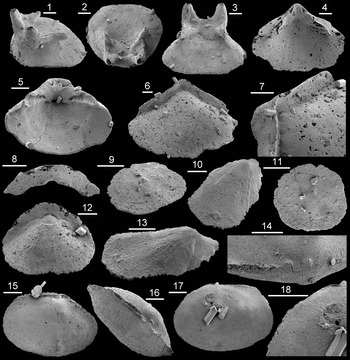


 Open access

