


This chapter investigates citizens’ attitudes toward preferential trade liberalization with China using original survey data in an advanced economy. I focus on Switzerland as an empirical case due to data availability and the fact that the landlocked, continental European country is one of the few advanced democracies to have concluded a preferential trade agreement (PTA) with China. I consider the Sino-Swiss PTA as an instance of a North-South PTA between countries with significant differences in factor endowments and social standards, and I will assess individual attitudes in North-South trade relations against the benchmark of North-North preferential trading among similar countries, using the case of the bilateral agreements between Switzerland and the European Union (EU).
I am interested in whether the impact of the distributive effects of international trade on preferences over PTAs is conditional upon the type of trade (North-South vs. North-North). Moreover, I am interested in whether the belief that ‘deep’ economic integration requires the strengthening of compensatory welfare policies – the ‘embedded liberalism’ compromise redux (Ruggie, Reference Ruggie1982) – mitigates the uneven distributional effects of North-South vs. North-North preferential trade liberalization among the losers of international trade. Relatedly, I ask what type of compensation policies – belief in passive and protective labor market policies or actual social investment policies – increases support for North-South PTAs among the losers of trade. Lastly, given that North-South trade has strong distributional consequences and raises issues of social standards in developing countries, I focus on the role of individuals’ ideological (i.e., partisan) self-identification on PTA preferences.
The argument is fourfold. First, the losers from international trade in advanced economies (i.e., low-educated, low-skilled, low-status, and poor individuals) will less strongly support North-South PTAs, such as PTAs with China, than they do North-North PTAs, such as PTAs with the EU. Second, the belief that compensation policies legitimize deep integration among losers will more strongly increase their support for North-South than for North-North PTAs. Third, compared to social investment policies (i.e., training), belief in compensatory welfare and protective labor market policies more strongly increases support for North-South PTAs among globalization losers. Finally, North-South PTAs, in particular preferential liberalization involving a developing country with low social and human rights standards such as China, will drive a stronger wedge between left- and right-leaning individuals than North-North PTAs. The empirical analysis corroborates these expectations.
The chapter makes three contributions to the literature in international political economy. Firstly, while scholars have extensively examined individual preferences over free trade, we know relatively little about attitudes toward PTAs. This is among the first studies that investigates the determinants of mass attitudes toward preferential trade liberalization with China, and among the first that places such analysis in a more general context by theorizing about individual preferences over North-South versus North-North PTAs (though see Chiang et al. Reference Chiang2013). Secondly, most studies focus on mega-regional or hypothetical PTAs, and find that political factors such as sympathy/antipathy toward particular countries or security concerns outweigh explanations based on the income effects of trade (Spilker et al., Reference Spilker, Bernauer and Umaña2018; DiGiuseppe and Kleinberg, Reference DiGiuseppe and Kleinberg2019; see also Naoi and Urata, Reference Naoi and Urata2013; Jungherr et al., Reference Jungherr, Mader, Schoen and Wuttke2018; Dür, Reference Dür2019). Focusing on the more common bilateral PTAs and on real PTAs, I find that respondent characteristics related to the distributional effects of trade liberalization, such as education, skills, financial situation, and social status, strongly explain public attitudes toward trade agreements. Lastly, the findings have noteworthy implications for the backlash against globalization. National-populist reactions to the China shock are a big part of the globalization backlash (Autor et al., Reference Autor, Dorn and Hanson2013; Feigenbaum and Hall, Reference Feigenbaum and Hall2015; Colantone and Stanig, Reference Colantone and Stanig2018b). The results provide strong evidence for the role of domestic compensation policies in the form of passive/protective labor market policies in increasing support for trade liberalization with China among globalization losers.
The chapter is organized as follows. The first section identifies blind spots in the literature that the study begins to fill. The second introduces the argument. The third and fourth sections present the empirical analysis. The fifth provides a discussion while the final section concludes.
I Literature
Over the past twenty years, research on individual preferences over free trade has fast grown in number and sophistication, with seemingly no end in sight. One prominent line of inquiry and debate has been whether economic self-interest explains trade policy preferences (e.g., Scheve and Slaughter, Reference Scheve and Slaughter2001; Mayda and Rodrik, Reference Mayda and Rodrik2005; Mansfield and Mutz, Reference Mansfield and Mutz2009). A second, and related line of inquiry has been whether compensatory welfare policies help legitimize trade openness (e.g., Hays et al., Reference Hays, Ehrlich and Peinhardt2005; Ehrlich and Hearn, Reference Ehrlich and Hearn2014). These studies have largely focused on individual preferences over free trade (or protectionism) in general. Jungherr et al. (Reference Jungherr, Mader, Schoen and Wuttke2018) interrogate whether individual-level preferences for the general principle of free trade and for specific trade agreements are similar. Using public opinion data from Germany, the authors show that while the standard economic and non-economic models perform well in explaining public opinion on trade, contextual factors unrelated to trade are more useful in explaining support for the Transatlantic Trade and Investment Partnership (TTIP).
In fact, we know little about the determinants of citizens’ support for and opposition to PTAs in democracies (Baccini, Reference Baccini2019: 82). The few studies on ‘real-world’ PTAs tend to focus on atypical PTAs, namely the mega-regional trade agreements, which, due to their sheer scope and geopolitical considerations, may introduce some bias in the literature’s research findings. For example, Naoi and Urata (Reference Naoi and Urata2013) examine individual attitudes toward the Trans-Pacific Partnership Agreement (TPP) in Japan and find that partisanship rather than economic self-interest is the most relevant determinant of TPP support. Jungherr et al. (Reference Jungherr, Mader, Schoen and Wuttke2018) find that postures toward transatlantic cooperation and predispositions toward the role of interest groups in politics as well as toward domestic market regulation correlate with support for TTIP. Dür (Reference Dür2019) demonstrates that the argument that the TTIP would allow foreign firms to sue domestic governments had a large negative effect on public opinion, while the promise of job creation hardly mattered. Rankin (Reference Rankin2004) shows that national identity rather than economic interest explains American and Canadian opinion on the North American Free Trade Agreement.
Experimental studies probing preferences for hypothetical PTAs also conclude about the primacy of non-economic over economic factors. DiGiuseppe and Kleinberg (Reference DiGiuseppe and Kleinberg2019) investigate the role of security considerations. Focusing on American respondents, they find that PTAs involving political rivals and those promising diminished international influence reduce support for PTAs, and that security concerns diminish the degree to which information about the projected economic effects influences individuals’ preferences for PTAs. Spilker et al. (Reference Spilker, Bernauer and Umaña2018) study individual attitudes toward PTAs in Costa Rica, Nicaragua, and Vietnam. They show that sympathy/antipathy toward particular countries matters more than economic considerations. Finally, in his study on mass support for potential PTA partners in Canada, India, and the US, Tuxhorn (Reference Tuxhorn2019) finds limited support for economic preferences derived from the factor endowment trade model.
II The Argument
North-South trade is based on differences in the factor endowments of countries (Heckscher-Ohlin model). Rich countries have a comparative advantage in the production of goods that make intensive use of capital and skilled labor, their abundant factors. Conversely, poor countries, being well endowed in (semi- and) unskilled labor, will specialize production in goods that make intensive use of low-skilled labor. North-South trade is predominantly inter-industry trade, a type of trade that has sharp distributional consequences. According to Stolper-Samuelson, under the assumption of costless inter-sectoral mobility of production factors, trade benefits the owners of the abundant factors and harms the owners of the scarce factors. In rich countries, the losers are the semi- and low-skilled workers, whereas the winners are capital owners and high-skilled workers. Opposition to trade in advanced countries should therefore be concentrated among low-skilled workers (and unions representing them), particularly opposition to trade liberalization with developing countries richly endowed with unskilled (manual) labor, such as China.
By contrast, North-North trade is predominantly intra-industry trade, driven by customer preferences for differentiated goods. Compared to inter-industry trade, adjustment costs are likely lower as jobs lost due to customers shifting to foreign suppliers may be offset to a large degree by the job-enhancing expansion in foreign demand for similar, differentiated goods produced domestically. A typical example is the case of the Frenchman buying a VW car and the German buying a Renault, whereas prior to trading they bought domestically produced cars. In short, North-North trade has less strong distributional effects than North-South trade and should therefore be less strongly opposed by the losers of international trade in rich countries. Hence:
Hypothesis 1: Among the losers of trade in advanced economies (i.e., low-educated, low-skilled, low-status, and poor individuals), the level of support is lower for North-South PTAs, in particular preferential trade liberalization with China, than for North-North PTAs.
The post-war compromise of “embedded liberalism” was premised on the idea that domestic welfare compensation helps legitimize an open economy (Ruggie, Reference Ruggie1982). Governments committed to free trade provided insurance and other transfers to compensate those who lost economically from increased trade. Historical-comparative analysis has demonstrated an association between economic openness and welfare spending in advanced economies (Cameron, Reference Cameron1978; Rodrik, Reference Rodrik1998), at least up until the 1990s (Busemeyer, Reference Busemeyer2009).
Research has corroborated the microfoundations of the ‘compensation’ thesis. For a sample of thirteen advanced economies, Hays et al. (Reference Hays, Ehrlich and Peinhardt2005) show that individuals employed in import-competing sectors strongly oppose trade, while unemployment insurance and active labor market programs moderate their opposition. Similarly, using a survey experiment in the United States (US), Ehrlich and Hearn (Reference Ehrlich and Hearn2014) show that knowledge of the Trade Adjustment Assistance (TAA) program, introduced to the experimental group as a federal program providing expanded unemployment insurance and job retraining opportunities to workers who lose their jobs, results in higher support for free trade among low-income individuals. Based on Swiss survey data, Walter (Reference Walter2010) finds that globalization losers, in particular low-skilled workers, are more likely to experience economic insecurity, demand welfare compensation, and vote for social-democratic parties.
While actual compensatory policies or the belief that compensation buys support for globalization should increase the losers’ support for (preferential) trade liberalization, I expect this effect to be stronger in the North-South than in the North-North trade context. North-South trade and trade agreements have strong labor market effects (Hakobyan and McLaren, Reference Hakobyan and McLaren2016), stronger than North-North trade. Trade integration with low-wage countries is thus more likely to generate demands for compensation (Burgoon, Reference Burgoon2001), and, conversely, compensatory policies are more likely to increase support for North-South than for North-North PTAs and trade.
It is well established that trade with China has strongly affected labor markets in advanced economies. Autor et al. (Reference Autor, Dorn and Hanson2013) report negative effects of Chinese import competition on employment levels and wages in local labor markets in the US, but also higher social transfer payments (see also Autor et al., Reference Autor, Dorn and Hanson2016). Thewissen and Van Vliet (Reference Thewissen and Van Vliet2019) generalize the finding of depressing employment effects in sectors facing Chinese imports to eighteen OECD countries while showing that low-skilled workers endure most adjustment costs as production work by these workers is substituted by Chinese exports. Since preferential trade liberalization tends to be associated with more trade flows among trading partners, losers in advanced economies should be particularly prone to oppose PTAs with China, and belief that compensation enables openness should reduce such opposition.
Hypothesis 2: Among the losers of trade in advanced economies, the belief that increased government compensation (i.e., the strengthening of employment protection, unemployment insurance, and the protection of working hours) enables ‘deep’ economic integration more strongly increases support for North-South PTAs, in particular preferential trade liberalization with China, than for North-North PTAs.
Compensation measures take various forms. Perhaps the most obvious government policies to offset job losses due to increased imports are income support measures. In cross-sectional analysis, the generosity of unemployment benefits correlates with support for free trade (Hays et al., Reference Hays, Ehrlich and Peinhardt2005). In the US, the losers of international trade are more inclined to support trade-related unemployment insurance than the winners (Ehrlich, Reference Ehrlich2010).
Globalization is a source of job insecurity (Rodrik, Reference Rodrik1998; Scheve and Slaughter, Reference Scheve and Slaughter2004). The losers report higher levels of fear of losing their jobs (Walter, Reference Walter2010). Rules that make it costly for employers to fire their workers may prevent job losses and therefore reduce actual or perceived economic insecurity associated with trade openness. Employment protection regulation and unemployment insurance may thus be substitutes in how they increase support for trade liberalization among globalization losers. Alternatively, because wages tend to be sticky due to income policies or collective agreements, labor market adjustments to increased trade competition might occur through longer working hours at a given wage level. European labor markets facing rising Chinese imports might be particularly susceptible to responding in this way. Europeans typically work short hours (while caring about work-life balance issues) whereas the Chinese work long hours, not least because many of them have a preference for working overtime hours to increase their income. Rules and regulations protecting standard working hours in advanced economies might thus also condition attitudes towards (preferential) trade liberalization. In short, not just compensatory welfare institutions but also protective labor market policies ought to moderate the losers’ opposition to trade, particularly North-South trade and PTAs.
What about social investment policies such as occupational training? The evidence is mixed. In the cross-national context, Hays et al. (Reference Hays, Ehrlich and Peinhardt2005) show that spending on active labor market programs is associated with higher individual support for trade, while Hays (Reference Hays2009) finds that it does not increase support for trade among those employed in tradeable sectors. The results are also inconclusive as to whether participation in TAA training programs improves the employment outcomes of participants (Decker and Corson, Reference Decker and Corson1995; Reynolds and Palatucci, Reference Reynolds and Palatucci2012). Regarding training, while it might upgrade skills, help career advancement, and/or sustain wage increases, it does not necessarily reduce the risk of job losses due to increased trade competition. With job retraining programs, meanwhile, individuals run the risk of social downgrading, as they might be required to accept employment at lower skill levels. Finally, government spending on active labor market policies remains a small fraction of total social spending in advanced economies. In short, we have the basis for the third hypothesis.
Hypothesis 3: Among the losers of trade in advanced economies, the belief that increased compensatory welfare and protective labor market policies enables ‘deep’ economic integration more strongly increases the support for North-South PTAs, in particular preferential trade liberalization with China, than social investment policies (i.e., training).
Partisanship matters for trade policy with right-wing parties and individuals being more supportive of free trade than their left-wing counterparts are (Scheve and Slaughter, Reference Scheve and Slaughter2001; Milner and Judkins, Reference Milner and Judkins2004). North-South trade integration is likely to raise concerns about poor labor and human rights and low environmental protection in developing countries, opening up a cleavage between left parties that are critical of North-South PTAs and right parties that are supportive. PTAs with China are a case in point, given the extensive violations of fundamental labor rights in China. Moreover, Beijing objects to the inclusion of far-reaching labor provisions in its PTAs, which explains why PTAs signed by China include rather shallow provisions (LABPTA dataset; Raess and Sari, Reference Raess and Sari2018, Reference Raess and Sari2021). This constitutes a major obstacle to the conclusion of bilateral trade agreements between China and the big trading powers. In those circumstances, existing labor-related level playing field rules in Chinese trade agreements are unlikely to increase support for trade liberalization with China in advanced economies, because they do not provide the kind of ex-ante reassurance mechanism or the fair trade norms that help legitimize trade openness (Bastiaens and Postnikov, Reference Bastiaens and Postnikov2020). Left-oriented parties and individuals should be particularly concerned, given their stance on labor and human rights issues. Hence the final hypothesis:
Hypothesis 4: In advanced economies, the effect of partisanship – with left-leaning individuals being less supportive than right-leaning individuals – is stronger for North-South PTAs, in particular preferential trade liberalization with China, than for North-North PTAs.
III Data
I use representative data from Swiss individuals to test my arguments. I use an original dataset combining data from the 2015 wave of the Measurement and Observation of Social Attitudes in Switzerland survey (MOSAiCH; Ernst Stähli et al., Reference Ernst Stähli, Joye, Sapin, Pollien, Ochsner, Nisple and van den Hende2015) and from my topical module on Switzerland’s foreign economic relations, which, after a nationally competitive bid, was included in the MOSAiCH survey. While the former provided data on most independent and control variables, the latter provided the survey questions for the dependent variables and a few key independent and control variables.
While the selection of the Swiss case is data related, it is well suited to examine public attitudes toward trade cooperation with China. Switzerland’s leading trade partner in Asia and its third largest partner worldwide is China. Importantly, Switzerland is one of the few advanced economies, and the first major European country, to have signed a PTA with China.Footnote 1 The Sino-Swiss PTA was concluded in July 2013, after only two years of negotiations, and came into force on July 1, 2014. The Swiss proponents hailed the deal as their most important agreement since the 1972 PTA with the EU (Dadush et al., Reference Dadush and Domínguez-Jiménez2020). While Switzerland was keen to gain preferential market access to the Chinese market before its main competitors (i.e., EU member states, but also the US), “China saw Switzerland as a gateway into Europe and viewed the trade agreement as an important test case, one that might soften the EU’s traditional reluctance to negotiate with China” (Dadush et al., Reference Dadush and Domínguez-Jiménez2020). Given the salience of the Sino-Swiss trade deal and the timing of the data collection (the survey was administered between February and July 2015), choices made by survey respondents are likely to accurately capture choices they would make in real-world situations (Hainmueller et al., Reference Hainmueller, Hangartner and Yamamoto2015).Footnote 2
The selection of the EU as the benchmark against which to compare China in terms of attitudes toward trade cooperation is equally fitting. The EU is by far Switzerland’s largest trading partner. Bilateral treaties govern the economic relations between Switzerland and the EU. The 1972 PTA created a free trade zone for industrial products. After the Swiss people voted against joining the European Economic Area in 1992, the government proposed bilateral negotiations (Linder, Reference Linder, Trampusch and Mach2011). The Bilaterals I (1999) cover agreements in seven areas (free movement of persons, technical barriers to trade, public procurement, agriculture, research, civil aviation, and overland transport), the Bilaterals II (2004) in nine (processed agricultural products, statistics, pensions, education/vocational training, environment, media, fight against fraud, taxation of savings, and Schengen/Dublin on internal security). So-called ‘flanking measures’ were adopted in June 2004 in connection with the effective introduction of the free movement of persons. These measures aim to prevent the undercutting of wages and social conditions. They include the reinforcement of collectively agreed on minimum wages, the facilitation of extension clauses (making it easier to declare collective labor agreements generally binding), and the hiring of labor inspectors. In the face of opposition from the national-conservative party, the government, and the business community needed the trade unions’ support to win the referendum, which they did with a comfortable majority of two-thirds (Linder, Reference Linder, Trampusch and Mach2011; Oesch, Reference Oesch, Trampusch and Mach2011).
Switzerland has historically enjoyed good political relations with both China and the EU. The Swiss government was one of the first Western countries to recognize the People’s Republic of China on January 17, 1950. It has maintained broad-based bilateral relations with Beijing since the 1980s, including a high-level annual human rights dialogue since 1991. Geographic, cultural, and economic reasons explain Switzerland’s good relations with its European neighbors.
In a comparative perspective, Switzerland is a coordinated market economy, although it has hybrid features not least due to liberal labor market institutions (Hall and Soskice, Reference Hall and Soskice2001; Mach and Trampusch, Reference Mach, Trampusch, Trampusch and Mach2011). The Swiss tend to work long hours, collective bargaining coverage is moderate, the protection of employment is low, while unemployment benefits are relatively generous (Emmenegger, Reference Emmenegger, Trampusch and Mach2011; Scruggs et al., Reference Scruggs, Detlef and Kuitto2017).
(i) Dependent Variables
Pro-EU PTA is an ordinal variable measuring respondents’ opinions on “The bilateral agreements with the EU have reinforced the exchanges of goods and services between Switzerland and the EU. To what extent are you favorable to this policy led by the Confederation?” Answers are recorded on a 5-point scale, as follows: 1 = “very unfavorable”; 2 = “somewhat unfavorable”; 3 = “neither/nor”; 4 = “somewhat favorable”; and 5 = “very favorable.” Higher values thus indicate greater support for preferential trade liberalization between Switzerland and the EU. The responses by individuals who expressed no opinion or who did not answer were coded as missing.
Pro-CN PTA measures attitudes towards bilateral trade liberalization between Switzerland and China. Survey respondents were asked their opinion on the following question: “In 2013, Switzerland signed a trade agreement with China, reinforcing the exchanges of goods and services. To what extent are you favorable to this policy led by the Confederation?” Answers are recorded on the same 5-point scale, while “don’t knows” and “no responses” were treated as missing values.
Pro-PTA, the main dependent variable in the statistical analysis, is generated by stacking the data, specifically by stacking the variables Pro-EU PTA and Pro-CN PTA. I created a dummy variable labeled China PTA, which takes a score of 1 for all observations of the variable Pro-CN PTA (0 otherwise; that is, 0 if the observations pertain to the variable Pro-EU PTA). I interacted this dummy with the variables for globalization losers to test Hypothesis 1 and, in a triple interaction model, I interacted these interaction terms with variables measuring compensatory welfare and labor market policies to test Hypotheses 2 and 3.
(ii) Independent Variables
1 Losers of International Trade
I considered four groups of losers in advanced economies, defined by their level of education, their skills, their financial situation, and their (self-declared) social status. Operationalizing the losers of international trade by way of individuals’ educational attainment and skill profile is commonplace in the literature. Considering (subjective) measures of individuals’ finances and social status is less common though no less important as globalization has led to stagnating or eroding incomes for some workers and, if not outright downward social mobility, the perception of declining (relative) social status.
Low education equals 1 if the respondent has completed less than twelve years of full-time schooling. According to this measure, low-educated individuals are high-school dropouts. Manual workers are individuals whose job involves primarily physical work such as building, making, carrying, caring, etc. Individuals in the following major groups of the International Standard Classification of Occupations (ISCO-8) are considered manual workers: clerical support workers (group #4), services and sales workers (#5), skilled agricultural, forestry, and fishery workers (#6), craft and related trades workers (#7), plant and machine operators and assemblers (#8), elementary occupations (#9), and armed forces occupations (#0).Footnote 3
Poor financial situation gets a score of 1 if individuals answer “bad” or “very bad” to the survey question “How do you rate your current financial situation?” (0 otherwise). Finally, Low status equals 1 if individuals self-identify as belonging to groups that tend to be toward the bottom of society (i.e., on the reverted 1–10 scale, individuals who place themselves on the scores 6–10). It should be noted that the bivariate correlations between these variables are moderate at best.Footnote 4
2 Compensatory Welfare and Labor Market Institutions
In the drop-off questionnaire, I asked respondents if they believe that government compensatory policies help legitimize deep economic integration. The survey question probes individual opinions regarding various compensatory welfare and protective labor market policies, as follows (English translation): “Would you be more in favor of strengthening foreign investment in Switzerland and trade in goods and services with other countries, if the Swiss government took measures to (1) discourage companies from laying off their employees? (2) protect the weekly working time? (3) strengthen the right to unemployment?” The questions are framed as support for moving beyond existing levels of compensation and openness, which is why earlier I referred to belief in the ‘embedded liberalism’ compromise redux. Pro-globalization compensation (or simply compensation), a dummy, equals 1 if respondents say they would be “probably more” or “more” in support (scores of 3 and 4 on the 4-point scale) for each of the policies (0 otherwise). While I aggregated the measures for presentational reasons, I consider disaggregated results in the discussion section.
The measure of social investment policies is actual training. Upskilling through training might thwart trade-related job losses. Training is a dummy that equals 1 if the individual received any training that allowed him or her to improve skills in the past 12 months.
3 Individuals’ Party Orientation
Included as a control, Right ideology measures self-placement on the ideological left-right scale (0–10). Right-wing individuals prefer free markets and should therefore be supportive of PTAs. In the model that tests the variegated effect of partisanship on North-South vs. North-North PTAs (Hypothesis 4), I use a trichotomous variable where Left equals the low scores (0–3), Centre the middle (4–6), and Right the high (7–10).
(iii) Control Variables
The baseline model controls for socio-demographic determinants of trade policy. Female is a dummy that equals 1 if respondents are women. If anything, women are more protectionist than men (Mansfield et al., Reference Mansfield, Mutz and Silver2015). Age, measured in years, captures inter-generational differences in attitudes toward trade due for instance to socialization processes. Previous studies have included the effect of rural-urban residence in models of trade policy preferences (Mayda and Rodrik, Reference Mayda and Rodrik2005; Mansfield and Mutz, Reference Mansfield and Mutz2009). Urban residence is a categorical variable with five residential types, ranging from a farm or house in the countryside to a big city. Urban residence should positively correlate with support for PTAs.
Next, I include controls for pre-existing cultural and ideological dispositions. Swiss-German is a dummy that equals 1 if the survey was administered in Swiss-German or Romansh (0 if French or Italian). It captures differences in trade opinions and stereotypes of trading partners that may be rooted in different Swiss cultures (and/or related sub-national ideologies of political economy) as well as differences that may exist in the phrasing of the survey questions in each national language. As Swiss-German citizens more strongly embrace economic liberalism than their French-Swiss or Swiss-Italian counterparts, being Swiss German should positively correlate with Pro-PTA attitudes. Nationalism is measured as opinions on the item “open borders and the intermingling of populations endanger important characteristics of Swiss culture,” with higher values on the 5-point scale indicating stronger nationalist sentiment. Nationalism should negatively correlate with Pro-PTA attitudes. Trust in the EU is an ordinal variable measuring respondents’ trust in the EU. Individuals who trust the supranational institution should generally be more supportive of PTAs, particularly PTAs with the EU. As mentioned above, I include a measure of individuals’ party orientation.
I also control for alternative explanations derived from competing trade theories. Foreign business share is the respondent’s answer, measured on a 4-point scale, to the question “How much does your company or employer export its production or engage in economic activities abroad?” Capturing within sector firm heterogeneity (Melitz, Reference Melitz2003), foreign business share ought to positively correlate with Pro-PTA attitudes. Mobility is a dummy that takes the value of 1 if respondents have ever moved to improve their employment prospects. Mobility influences attitudes toward trade policy (Mansfield et al., Reference Mansfield, Mutz and Silver2015; Owen, Reference Owen2013: 729). Specifically, it should be positively associated with support for preferential trade liberalization. Moreover, individuals as consumers may have different preferences over trade than they do as producers of goods and services (Baker, Reference Baker2005). Trade lowers prices records opinions on “one must open the borders to trade so that prices fall,” measured on a 5-point scale. Individuals who believe that trade openness lowers consumer prices are likely to be more supportive of PTAs.
Finally, Media exposure measures the frequency with which respondents use the media (including television, newspapers, radio, and the internet) to obtain political news or information (measured on a 7-point scale). As a proxy for cognitive capacity, we expect individuals who regularly use media to be more favorable toward PTA.
The baseline models include ten industry dummies that control the respondents’ sector of employment. Industry characteristics, such as export orientation or import competition, correlate with industry-level preferences over trade policy. I restrict the sample to the working-age population in order to include only individuals directly affected by the distributional effects of trade. The models are estimated using an ordered probit estimator, with robust standard errors clustered by industry. Using ordered logistic models instead does not change the results. Descriptive statistics for all the variables are shown in Appendix Table A1.
IV Results
Figure 13.1 shows the average scores in favor of North-North vs. North-South PTAs among globalization losers. As can be seen in Panels A-D, the level of support is consistently higher for the PTA with the EU than for the PTA with China, providing initial support for Hypothesis 1.
Globalization losers and support for EU PTA vs. China PTA.
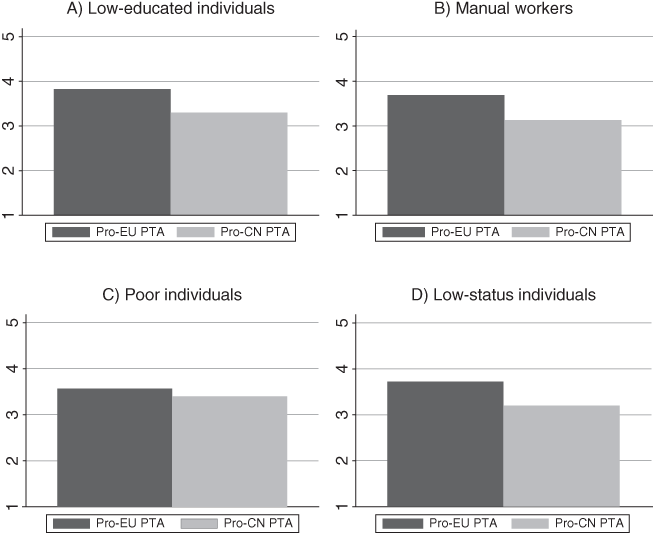
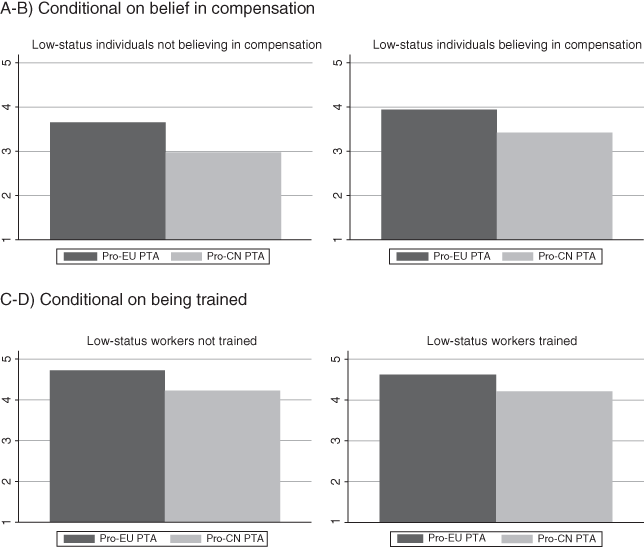
Figure 13.2 displays the difference in support for North-North vs. North-South PTAs for low-status workers as a function of believing in pro-globalization compensation (Panels A and B) and of being recently trained (Panels C and D). The graphs show that belief in compensation more strongly increases support for trade liberalization with China (+14.8%, from 2.98 to 3.42) than with the EU (+7.7%, from 3.66 to 3.94), whereas training does not seem to affect support for PTAs with either the EU or China. This provides initial support for Hypotheses 2 and 3.
Support for EU PTA vs. China PTA among low-status individuals.
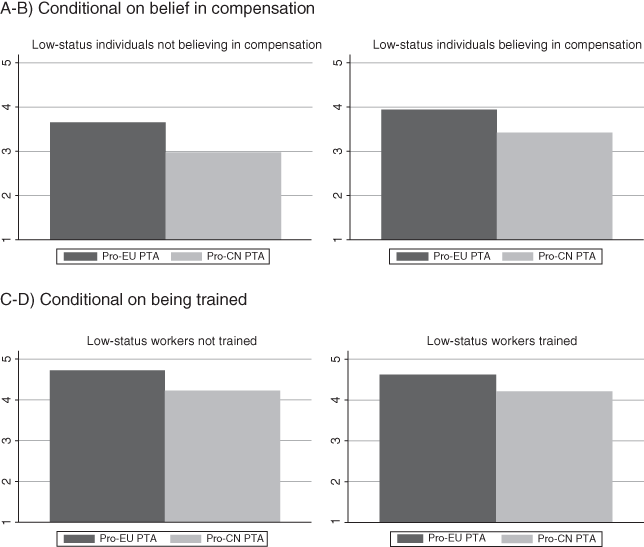
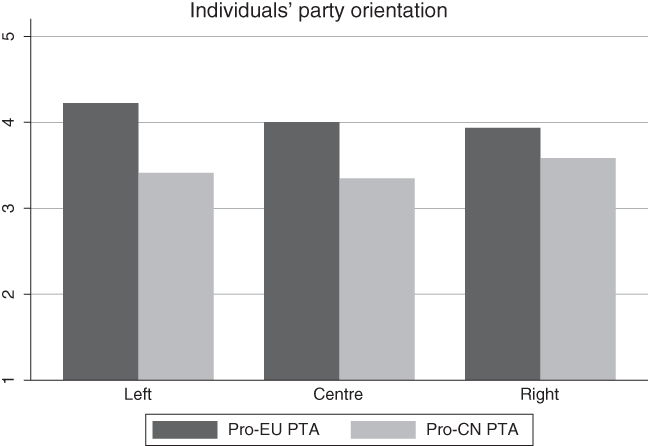
Figure 13.3, finally, shows the average support for North-North vs. North-South trade liberalization among left-, centre- and right-leaning individuals. Left-wing individuals hold more negative views of preferential trade with China than their right-wing counterparts do, while the same does not hold for preferential trade with the EU, suggesting first evidence for Hypothesis 4.
Partisan orientation and support for EU PTA vs. China PTA
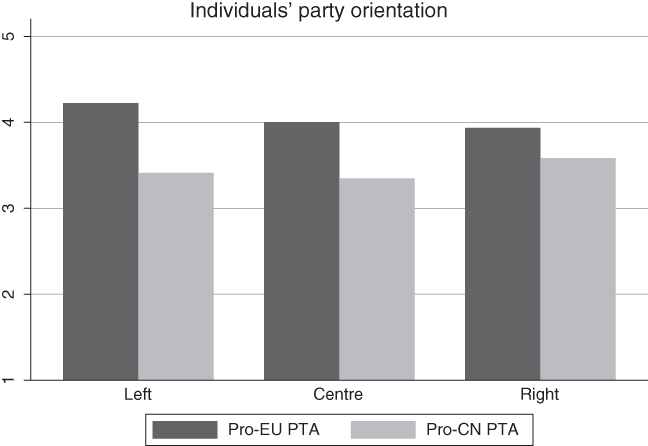
Table 13.1 shows the multivariate regression results for the interaction models involving one of the measures of globalization losers at the time and the China PTA dummy with Pro-PTA as the dependent variable. The statistically significant controls perform as expected, raising our confidence in the model specification. Female respondents and individuals expressing nationalist sentiment are less likely to support PTAs. By contrast, individuals living in urban centers (likely due to their more cosmopolitan worldviews), those trusting in the supranational body of the EU, those working in a firm doing business abroad, those who believe trade is good for consumers, and those more exposed to the media are more likely to support PTAs.
| (1) | (2) | (3) | (4) | |
|---|---|---|---|---|
| DV = Pro-PTA | ||||
| Low education | −0.294*** | |||
| (0.082) | ||||
| Manual worker | −0.527*** | |||
| (0.078) | ||||
| Poor financial situation | −0.390** | |||
| (0.186) | ||||
| Low status | −0.295** | |||
| (0.141) | ||||
| China PTA | −0.803*** | −0.808*** | −0.734*** | −0.763*** |
| (0.100) | (0.081) | (0.054) | (0.073) | |
| Low edu*China PTA | 0.165 | |||
| (0.118) | ||||
| Manual*China PTA | 0.206* | |||
| (0.113) | ||||
| Poor*China PTA | 0.613*** | |||
| (0.162) | ||||
| Low stat*China PTA | 0.211 | |||
| (0.150) | ||||
| Female | −0.423*** | −0.392*** | −0.415*** | −0.407*** |
| (0.074) | (0.087) | (0.081) | (0.087) | |
| Age | 0.006* | 0.004 | 0.005 | 0.005* |
| (0.003) | (0.003) | (0.003) | (0.003) | |
| Urban residence | 0.099** | 0.098** | 0.114** | 0.121** |
| (0.044) | (0.050) | (0.050) | (0.051) | |
| Swiss-German | 0.216** | 0.181 | 0.194* | 0.178 |
| (0.109) | (0.111) | (0.118) | (0.115) | |
| Right ideology | 0.036 | 0.029 | 0.038 | 0.033 |
| (0.026) | (0.024) | (0.028) | (0.025) | |
| Nationalism | −0.282*** | −0.272*** | −0.292*** | −0.288*** |
| (0.042) | (0.041) | (0.041) | (0.042) | |
| Trust in the EU | 0.124** | 0.110** | 0.130** | 0.115** |
| (0.053) | (0.048) | (0.053) | (0.056) | |
| Foreign business share | 0.150* | 0.146** | 0.170** | 0.176** |
| (0.081) | (0.072) | (0.074) | (0.078) | |
| Mobility | 0.072 | 0.074 | 0.110 | 0.092 |
| (0.077) | (0.083) | (0.073) | (0.076) | |
| Trade lowers prices | 0.219*** | 0.226*** | 0.214*** | 0.214*** |
| (0.038) | (0.038) | (0.037) | (0.035) | |
| Media exposure | 0.062** | 0.052* | 0.073*** | 0.067** |
| (0.028) | (0.028) | (0.026) | (0.028) | |
| Observations | 980 | 978 | 980 | 972 |
| Pseudo R-squared | 0.130 | 0.139 | 0.129 | 0.130 |
Robust standard errors in parentheses; *** p < 0.01, **p < 0.05, *p < 0.1.
The main results show a consistent pattern across the various measures of globalization losers. First, the coefficients for globalization losers are all negative and statistically significant. In the presence of the interaction terms, these coefficients indicate the difference in support for EU PTA between globalization losers and winners. In line with the factor model of international trade, we find that low-educated individuals, manual workers, poor individuals and low-status individuals are less supportive of preferential trade liberalization with the EU than their respective counterparts are. Second, the coefficients for China’s PTA are negative and highly significant, indicating that on average individuals are less supportive of the PTA with China compared to the PTA with the EU. Third, the coefficients for the interaction terms are positive and, in two cases out of four, statistically significant. This indicates that the gap in support between globalization losers and winners tends to be narrower for the PTA with China than for the PTA with the EU. While this finding runs against the predictions from international trade theory, it may hide a more complex pattern whereby compensatory policies condition the relationships between being a globalization loser and support for North-North vs. North-South PTAs (see below).
In any event, is the level of support for PTAs among globalization losers lower for PTA with China than for PTA with the EU, as suggested by Hypothesis 1? Answering this question requires post-estimation analysis. Based on Model 4, keeping all other variables are their mean values, low-status workers are approximately 50 per cent less likely to be very favorable (score of 5) to a PTA with China than a PTA with the EU. The corresponding figures for low-skilled individuals, manual workers, and poor individuals are 53, 54, and 13 per cent, respectively. In short, the empirical analysis corroborates Hypothesis 1.
Table 13.2 shows the results for the triple interaction models with belief in compensation as one of the constituent terms. With one exception, the coefficients for the measures of globalization losers remain negative and statistically significant, and so do the coefficients for PTA with China. Interestingly, the coefficients of the interaction terms globalization losers*China PTA are now negative (with one exception) and statistically insignificant, which is more in line with trade theory. The interpretation of this (double) interaction is that the gap in support between globalization losers and winners who do not believe in compensation tends to increase as one moves from PTA with the EU to PTA with China, although the effect is not statistically significant. The triple interactions are with one exception as expected positive and highly significant, suggesting that the narrowing gap in support between losers and winners tends to be reduced more strongly for PTA with China than PTA with the EU as one moves from non-belief to belief in compensation.
| (5) | (6) | (7) | (8) | |
|---|---|---|---|---|
| DV = Pro-PTA | ||||
| Low edu*China PTA*Compensation. | −0.096 | |||
| (0.294) | ||||
| Manual*China PTA*Compensation. | 0.567*** | |||
| (0.182) | ||||
| Poor*China PTA*Compensation. | 1.366** | |||
| (0.648) | ||||
| Low stat*China PTA*Compensation. | 0.849*** | |||
| (0.215) | ||||
| Low education | −0.554*** | |||
| (0.145) | ||||
| Manual worker | −0.520*** | |||
| (0.163) | ||||
| Poor financial situation | 0.388 | |||
| (0.741) | ||||
| Low status | −0.321* | |||
| (0.165) | ||||
| China PTA | −0.793*** | −0.629*** | −0.655*** | −0.608*** |
| (0.117) | (0.083) | (0.071) | (0.099) | |
| Low education*China PTA | 0.215 | |||
| (0.150) | ||||
| Manual*China PTA | −0.116 | |||
| (0.186) | ||||
| Poor*China PTA | −0.184 | |||
| (0.530) | ||||
| Low stat*China PTA | −0.214 | |||
| (0.206) | ||||
| Compensation | −0.298 | 0.015 | 0.032 | −0.012 |
| (0.189) | (0.154) | (0.104) | (0.127) | |
| Low education*Compensation | 0.498** | |||
| (0.225) | ||||
| Manual*Compensation | 0.017 | |||
| (0.253) | ||||
| Poor*Compensation | −0.952 | |||
| (0.813) | ||||
| Low stat*Compensation | −0.046 | |||
| (0.220) | ||||
| China PTA*Compensation | −0.124 | −0.422*** | −0.270* | −0.429** |
| (0.281) | (0.143) | (0.158) | (0.172) | |
| Female | −0.424*** | −0.389*** | −0.421*** | −0.405*** |
| (0.078) | (0.094) | (0.083) | (0.094) | |
| Age | 0.003 | 0.001 | 0.003 | 0.003 |
| (0.003) | (0.003) | (0.004) | (0.003) | |
| Urban residence | 0.130** | 0.127** | 0.140** | 0.151** |
| (0.053) | (0.058) | (0.057) | (0.061) | |
| Swiss-German | 0.156 | 0.130 | 0.159 | 0.129 |
| (0.103) | (0.107) | (0.104) | (0.104) | |
| Right ideology | 0.036* | 0.036* | 0.041* | 0.030 |
| (0.022) | (0.020) | (0.023) | (0.019) | |
| Nationalism | −0.282*** | −0.284*** | −0.304*** | −0.293*** |
| (0.050) | (0.049) | (0.048) | (0.052) | |
| Trust in the EU | 0.122* | 0.122** | 0.136** | 0.123* |
| (0.067) | (0.059) | (0.065) | (0.070) | |
| Foreign business share | 0.106 | 0.107 | 0.133 | 0.128 |
| (0.105) | (0.097) | (0.102) | (0.107) | |
| Mobility | 0.084 | 0.086 | 0.111 | 0.102 |
| (0.078) | (0.091) | (0.084) | (0.081) | |
| Trade lowers prices | 0.207*** | 0.199*** | 0.196*** | 0.192*** |
| (0.039) | (0.036) | (0.040) | (0.038) | |
| Media exposure | 0.051* | 0.054* | 0.062** | 0.058** |
| (0.030) | (0.030) | (0.026) | (0.029) | |
| Observations | 837 | 837 | 837 | 831 |
| Pseudo R-squared | 0.143 | 0.149 | 0.140 | 0.146 |
Robust standard errors in parentheses; ***p < 0.01, **p < 0.05, *p < 0.1.
Post-estimation analysis reveals the magnitude of the hypothesized effects. Based on Model 8, low-status individuals are about 65 per cent more likely to strongly support (score of 5) PTA with China when they believe in compensation than when they do not. By contrast, they are about 5 per cent less likely to strongly support PTA with the EU when they believe in compensatory policies than when they do not. For manual workers (Model 6), the corresponding (rounded) figures are +30 and +3 per cent, respectively, while for poor individuals (Model 7) they are +20 and –55 per cent. Only in the case of low-educated individuals do we observe that belief in compensation less strongly increases support for PTAs with China than with the EU (–3 and +20 per cent, respectively).Footnote 5 Overall, these findings provide support for Hypothesis 2.
In Table 13.3, we replace our measure of compensatory welfare and labor market policies with our measure of social investment policy. The results show that none of the double interaction terms of interest (globalization losers*training) and none of the triple interaction terms are statistically significant. This suggests that training does not condition the support for North-South PTAs (or North-North PTAs for that matter) among globalization losers. The main results from Tables 13.2 and 13.3 lend support for Hypothesis 3.
| (9) | (10) | (11) | (12) | |
|---|---|---|---|---|
| DV = Pro-PTA | ||||
| Low edu*China PTA*Training | −0.269 | |||
| (0.504) | ||||
| Manual*China PTA*Training | 0.127 | |||
| (0.351) | ||||
| Poor*China PTA*Training | 0.140 | |||
| (0.603) | ||||
| Low stat*China PTA*Training | 0.240 | |||
| (0.229) | ||||
| Low education | −0.422** | |||
| (0.207) | ||||
| Manual worker | −0.567*** | |||
| (0.147) | ||||
| Poor financial situation | −0.942 | |||
| (0.919) | ||||
| Low status | −0.220 | |||
| (0.238) | ||||
| China PTA | −1.113*** | −0.949*** | −0.814*** | −0.858*** |
| (0.307) | (0.174) | (0.080) | (0.095) | |
| Low education*China PTA | 0.426 | |||
| (0.386) | ||||
| Manual*China PTA | 0.187 | |||
| (0.298) | ||||
| Poor*China PTA | 0.113 | |||
| (0.482) | ||||
| Low stat*China PTA | 0.141 | |||
| (0.217) | ||||
| Compensation | ||||
| Training | −0.236 | −0.167* | −0.116 | −0.114 |
| (0.183) | (0.101) | (0.083) | (0.092) | |
| Low education*Training | 0.108 | |||
| (0.286) | ||||
| Manual*Training | −0.067 | |||
| (0.208) | ||||
| Poor*Training | 0.543 | |||
| (1.060) | ||||
| Low stat*Training | −0.158 | |||
| (0.225) | ||||
| China PTA*Training | 0.395 | 0.200 | 0.166 | 0.141** |
| (0.285) | (0.134) | (0.104) | (0.063) | |
| Female | −0.424*** | −0.389*** | −0.416*** | −0.416*** |
| (0.081) | (0.083) | (0.093) | (0.087) | |
| Age | 0.006*** | 0.004** | 0.006*** | 0.006*** |
| (0.002) | (0.002) | (0.002) | (0.002) | |
| Urban residence | 0.089* | 0.092* | 0.111* | 0.116* |
| (0.054) | (0.056) | (0.060) | (0.063) | |
| Swiss-German | 0.307** | 0.278* | 0.260* | 0.271* |
| (0.152) | (0.148) | (0.156) | (0.153) | |
| Right ideology | 0.016 | 0.007 | 0.017 | 0.014 |
| (0.038) | (0.033) | (0.039) | (0.036) | |
| Nationalism | −0.279*** | −0.267*** | −0.291*** | −0.288*** |
| (0.041) | (0.044) | (0.046) | (0.041) | |
| Trust in the EU | 0.105** | 0.098** | 0.118** | 0.112** |
| (0.054) | (0.047) | (0.049) | (0.049) | |
| Foreign business share | 0.181* | 0.180** | 0.208** | 0.198** |
| (0.104) | (0.089) | (0.096) | (0.101) | |
| Mobility | 0.039 | 0.036 | 0.097 | 0.058 |
| (0.108) | (0.113) | (0.106) | (0.105) | |
| Trade lowers prices | 0.241*** | 0.248*** | 0.233*** | 0.235*** |
| (0.038) | (0.037) | (0.038) | (0.040) | |
| Media exposure | 0.067* | 0.056* | 0.077** | 0.069** |
| (0.036) | (0.030) | (0.032) | (0.033) | |
| Observations | 830 | 828 | 830 | 823 |
| Pseudo R-squared | 0.136 | 0.146 | 0.134 | 0.135 |
Robust standard errors in parentheses; ***p < 0.01, **p < 0.05, *p < 0.1.
| (13) | |
|---|---|
| DV = Pro-PTA | |
| Centre | −0.120 |
| (0.103) | |
| Right | −0.215* |
| (0.129) | |
| China PTA | −1.038*** |
| (0.081) | |
| Centre*China PTA | 0.212* |
| (0.114) | |
| Right*China PTA | 0.747*** |
| (0.137) | |
| Low education | −0.140* |
| (0.081) | |
| Manual worker | −0.400*** |
| (0.098) | |
| Poor financial situation | −0.017 |
| (0.191) | |
| Low status | −0.070 |
| (0.124) | |
| Female | −0.393*** |
| (0.085) | |
| Age | 0.004 |
| (0.003) | |
| Urban residence | 0.094* |
| (0.050) | |
| Swiss-German | 0.182 |
| (0.123) | |
| Nationalism | −0.271*** |
| (0.044) | |
| Trust in the EU | 0.105** |
| (0.051) | |
| Foreign business share | 0.140* |
| (0.078) | |
| Mobility | 0.039 |
| (0.094) | |
| Trade lowers prices | 0.233*** |
| (0.037) | |
| Media exposure | 0.036 |
| (0.029) | |
| Observations | 970 |
| Pseudo R-squared | 0.147 |
Robust standard errors in parentheses;
***p < 0.01, **p < 0.05, *p < 0.1.
Finally, Table 13.4 shows the results for the effect of individuals’ partisan orientation. In this model, left-wing orientation is the reference (and thus omitted) category. While the coefficients for Centre and Right are negative, only the latter is (weakly) statistically significant. In the presence of the interaction term, this means that the support for PTA with the EU tends to be lower among right-wing than among left-wing individuals. This finding comports with the national-conservative Swiss People’s Party’s opposition to and the Socialist Party’s support for the bilateral agreements. The interaction terms Centre*China PTA and Right*China PTA are positive and statistically significant, as expected. Taken together, we observe ‘traditional’ partisan effects on individual support for North-South PTAs but not for North-North PTAs, providing support for Hypothesis 4. Indeed, based on Model 13, the predicted probabilities of respondents having a score of 5 (“very favorable”) on the dependent variable indicate that left individuals are 10 per cent more likely to support PTA with the EU than individuals who self-identify as centrists, while centrists are 8 per cent more likely to support PTA with the EU than right individuals. By contrast, right-wing individuals are 70 per cent more likely to support PTA with China than centrists, who in turn are about 15 per cent more likely to support PTA with China compared to left-wing individuals.
(i) Robustness Checks
I ran supplementary models to assess the robustness of the results.Footnote 6 First, I used an alternate operationalization of the dependent variable. By collapsing the categories 1=“very unfavorable” and 2=“somewhat unfavorable,” on the one hand, and 4=“somewhat favorable” and 5=“very favorable,” on the other hand, I obtained a trichotomous variable. The main results hold up.
Second, I tested for omitted variable bias by including additional controls. The survey question on attitudes toward PTA with the EU is framed in relation to deepening trade liberalization within the context of the Swiss-European bilateral agreements. As explained above, the bilateral agreements consist of a series of sectoral agreements among which the agreement on the free movement of people together with the flanking measures features prominently. Therefore, I added a control measuring respondents’ opinion on “the free movement of people with the EU has had positive effects for Switzerland.”Footnote 7 Moreover, I included a measure of self-assessment of economic knowledge (i.e., understanding of international economic relations). Finally, I controlled for a sector’s comparative advantage (i.e., net exports as a share of sector production), to capture the distributional effects as per the sector model of international trade, as well as attitudes toward incoming FDI from the respective countries (EU and China).Footnote 8 If I introduce these variables individually or jointly in the baseline model, the results are very similar.Footnote 9
V Discussion
Perhaps the most interesting finding is that domestic compensation strongly increases globalization losers’ support for PTAs with China in advanced economies. What compensation policies drive the overall result? Breaking down the aggregate compensation measure in its parts, I find that all three components condition globalization losers’ support for the Sino-Swiss PTA.Footnote 10 The analysis shows that the literature’s finding that generous unemployment insurance increases support for free trade among losers travels to preferential trade liberalization, particularly in the North-South configuration. Not surprisingly perhaps, the strengthening of employment protection has a similar effect. This might hold particularly in countries, such as Switzerland, with low levels of employment protection. The conditional effect of policies aimed at protecting weekly standard hours is more surprising. Arguably, the economies of China and Switzerland are complementary, dampening the fear of job losses. Nonetheless, actual or perceived increased competition in North-South trade might lead to (the fear of) an intensification of work to keep labor costs down. Concerns about work-life balance issues, which are prevalent across advanced economies and particularly in Europe, might explain this result.
Do individuals’ partisan preferences over the Sino-Swiss PTA bear any resemblance with how political parties positioned themselves in relation to it? The ratification of the trade agreement exposed a classical left-right cleavage. The Swiss National Council (lower house of Parliament) ratified the agreement in December 2013, despite misgivings by the Socialist Party and the Green Party.Footnote 11 The left parties remained concerned about labor rights, the environment, and human rights. Even though the PTA included labor and environmental provisions, they were considered weak. While the agreement made scant and only indirect references to human rights, the substantive labor commitments only referenced the 1998 ILO Declaration on Fundamental Principles and Rights at Work, not the eight ILO fundamental Conventions themselves as is custom in the PTAs signed by the European Free Trade Association (EFTA) – of which Switzerland is a member – since 2011.Footnote 12 The Socialists (and the labor unions) in particular bemoaned the weak monitoring mechanism (Pedrina and Doka, Reference Pedrina and Doka2014). They brought forward three motions in the National Council to strengthen the scope and stringency of the labor and human rights commitments as well as the means for the effective monitoring and implementation of the commitments. Large majorities defeated the motions in December 2013.Footnote 13 In short, in line with theoretical expectations, non-trade issues such as labor and human rights drove a wedge between left and centre-right parties, and the positions these parties took over the China-Switzerland PTA appear to have affected the preferences of their members and sympathizers.
It is plausible to argue that Swiss citizens have greater sympathy for their neighboring European countries compared to geographically remote and culturally distinct China. This might explain the observed lower level of support for the PTA with China than the PTA with the EU among globalization losers (Hypothesis 1). However, this explanation cannot account for why belief in compensatory policies among the losers tends to more strongly increase support for the former compared to the latter. This finding suggests that it is trade’s distributional effects rather than (or as well as) sympathy/antipathy toward particular countries that drive the results for Hypothesis 1.
VI Conclusion
Standard economic models and the ‘compensation’ hypothesis have considerable explanatory power when it comes to explaining citizens’ attitudes toward trade agreements, particularly preferential trade liberalization with China. The main findings are as follows. First, the losers of international trade are more supportive of PTAs with the EU (North-North PTA) than of PTAs with China (North-South PTA). Second, belief in compensation by losers leads to a larger increase in their support for PTA with China than for PTA with the EU. Third, the increase in support for PTA with China among globalization losers is driven by compensatory welfare and protective labor market institutions, not by social investment policies. Finally, reflecting left parties’ concerns about poor human and labor rights, left-leaning voters are lukewarm at best to strike North-South PTAs, particularly PTAs with China, unless strong human and/or labor rights provisions accompany them, yielding a partisan effect in North-South PTAs, less so in North-North PTAs.
As twenty-first-century globalization is globalization under Chinese influence, not least due to China’s accession to the WTO in 2001, which strongly increased its trade integration into the world economy, policies to compensate the losers are of paramount importance to sustain the process of global economic integration with Chinese characteristics. The evidence presented in this study on the role of domestic compensatory policies is consistent with the rise of national-populist and protectionist electoral responses to China shock in countries such as the US and the United Kingdom with small welfare states and flexible labor markets or trade-related compensation programs that are unresponsive to changing market conditions (Colantone and Stanig, Reference Colantone and Stanig2018a, 2018b; Kim and Pelc, Reference Kim and Pelc2021; see also Hays, Reference Hays2009; Feigenbaum and Hall, Reference Feigenbaum and Hall2015; Che et al., Reference Mitchell and Prusa2016). The core finding is a reminder that in more socially embedded forms of capitalism, demands for more compensation remain popular and are likely the best bulwark against mounting protectionism and nationalism against the background of increased Chinese competition. Clearly, to preempt the collapse of preferential trade liberalization in the North-South context, particularly trade liberalization with China, it is essential to compensate the losers.

 Open access