





1. Introduction
The present article investigates uses of the modals will and would with a particular focus on these modals’ negation and contraction patterns. While there has been a surge in synchronic analyses of the collocation patterns of (negated) modals (e.g. Bybee Reference Bybee2010; Lorenz Reference Lorenz2013a, Reference Lorenz2013b; Daugs Reference Daugs2022; Leclerq Reference Leclerq2022; Daugs & Lorenz Reference Daugs and Lorenz2024), we have much less knowledge about intervarietal differences (see, however, Yaeger-Dror et al. Reference Yaeger-Dror, Hall-Lew and Deckert2002; López-Couso & Pérez-Guerra Reference López-Couso, Pérez-Guerra, De Smet, Petré and Szmrecsanyi2023). Are speakers’ preferences in terms of modal-negation patterns the same in British as in American English? Have these developed at the same rate and in the same direction? In many respects, American English is more progressive and tends to gravitate towards colloquial features where British English tends to preserve more formal features (cf. Rohdenburg & Schlüter Reference Rohdenburg and Schlüter2009a: 421). This seems to suggest that contractions should have been adopted more widely in American English. Yet, for verbal constructions in general and modal constructions in particular, evidence is not as clear. Here, it is often British English which is more innovative (cf. Algeo Reference Algeo2006: 22–3; Rohdenburg & Schlüter Reference Rohdenburg and Schlüter2009a: 406–7).
The aim of the present study is to (partially) fill this gap by comparing usage patterns of will and would in British and American English in the nineteenth and twentieth centuries. This timeframe allows us to capture the spread of the contracted forms. Our choice of modals was governed both by frequency as well as by the fact that these are the only core modals of which contracted forms exist both in the affirmative (’ll, ’d) as well as in negative syntactic contexts (won’t, ’ll not, wouldn’t, ’d not). Besides not-negation, we also take into consideration negation with the adverb never, as it has transpired that amongst the idiosyncrasies of ’ll and ’d is a repulsion of not and n’t coupled with an affinity for never (cf. Tagliamonte & Smith Reference Tagliamonte and Smith2002: 268; Flach Reference Flach2020a: 752; Schneider Reference Schneider2023: 17).
The study has two additional goals, namely to address the constructional status of the contracted forms as well as to assess which cognitive model best describes them. It is well established in cognitive-functional, usage-based approaches to language that repetition, typically operationalised as different kinds of usage intensity (cf. Stefanowitsch & Flach Reference Stefanowitsch, Flach and Schmid2017), has a facilitating effect on the entrenchment (i.e. the ease of cognitive processing and storage) of utterance types as units (cf. Diessel Reference Diessel2019; Divjak & Caldwell-Harris Reference Divjak, Caldwell-Harris, Dąbrowska and Divjak2015; Langacker Reference Langacker1987; Schmid Reference Schmid2015, Reference Schmid2020; to name a few). Entrenched units may further undergo reduction and can become emancipated; that is, the reduced form ceases to be a mere production phenomenon but actually develops into an autonomous mental representation and eventually into a conventionalised utterance (see e.g. Daugs Reference Daugs, Hilpert, Cappelle and Depraetere2021, Reference Daugs2022; Daugs & Lorenz Reference Daugs and Lorenz2024; Lorenz Reference Lorenz2013a, Reference Lorenz2013b; Lorenz & Tizón-Couto Reference Lorenz and Tizón-Couto2017). The process is gradual, and while some emancipated forms have completely replaced their parents (e.g. al(l) be it > albeit, God be with you/ye > goodbye), others continue to coexist alongside and compete with them for selection within the same onomasiological space (e.g. going to > gonna, I will > I’ll, will not > won’t). Furthermore, it has been argued that the variation between these forms is contingent on, for example, mode (written vs spoken), register (informative vs interactive), collocational biases (subj + v combinations), prosody and social factors (cf. Biber Reference Biber1988; Daugs Reference Daugs2022; Daugs & Lorenz Reference Daugs and Lorenz2024; Yaeger-Dror Reference Yaeger-Dror2002; Yaeger-Dror et al. Reference Yaeger-Dror, Hall-Lew and Deckert2002). This view is compatible with both cognitive constructionist frameworks (cf. Croft Reference Croft2001; Goldberg Reference Goldberg2005) as well as radically dynamic network models (cf. Goldberg Reference Goldberg2019; Schmid Reference Schmid2020). Although these approaches share the conception of language being stored as a network in the minds of speakers, their focus is quite different.
From the more traditional constructionist perspective, which puts nodes in the network centre-stage, a contraction like won’t could constitute such a node, that is, an entrenched form–meaning pair with idiosyncratic formal properties that cannot be predicted based on any pre-existing patterns (cf. Daugs Reference Daugs, Hilpert, Cappelle and Depraetere2021: 18–24). Moreover, if modal constructions are treated as semi-schematic patterns that consist of the modal as the pivot and the following infinitive as the variable element, their individual, and crucially unpredictable, collexemic preferences are an indicator of both their semantic structure as well as their constructional status (cf. Hilpert Reference Hilpert2016).
In dynamic, network-oriented models, where associative links rather than nodes receive full attention, contractions like won’t are rather conceived of as complex variable patterns of differentially entrenched types of associations that are cognitively represented along symbolic, syntagmatic, paradigmatic and pragmatic dimensions in a multidimensional space (cf. Schmid Reference Schmid2020: 44–51). Accordingly, the question about the node status of won’t does not arise. What is crucial is the degree of entrenchment of its associations, which link the form to its meanings (e.g. ‘epistemic prediction’, ‘unwillingness’), its cotext (i.e. the preceding subject and the following verb infinitive), its onomasiological competitors (e.g. will not, be not going to) and its context. Of course, the same logic applies to the full form will not. Therefore, the differences between these patterns can straightforwardly be understood as probabilistic tendencies where each has preferences for specific subjects and collocating verb infinitives that, in combination, give rise to a specific meaning (i.e. modal interpretation).
To contextualise these diachronic and variationist questions, section 2 provides a brief historical overview of English verbal negation and discusses what we currently know about the degree of emancipation of the contracted forms. Section 3 focuses on potential British–American differences in the usage patterns of will and would. In section 4, we detail how our data was retrieved from corpora of nineteenth- and twentieth-century fiction. In section 5, we first look at general diachronic trends in the use of will and would as well as contracted forms before introducing Configural Frequency Analysis (CFA; cf. Krauth & Lienert Reference Krauth and Lienert1973; von Eye et al. Reference Eye, Mair and Mun2010; Bortz & Schuster Reference Bortz and Schuster2010: 148–50), which will subsequently be used to retrieve association patterns. In section 6, we draw conclusions concerning differences and similarities between the varieties as well as concerning the degree of emancipation of the different patterns.
2. Historical overview of English verbal negation
Jespersen (Reference Jespersen1917: 4) observes that negation is often subject to a ‘curious fluctuation’:
the original negative adverb is first weakened, then found insufficient and therefore strengthened, generally through some additional word, and this in its turn may be felt as the negative proper and may then in course of time be subject to the same development as the original word.
This has become known as Jespersen’s Cycle. English negation has already undergone the cycle once. Old English (OE) started out with the negator ne preceding the finite verb, as in (1) (cf. e.g. Jespersen Reference Jespersen1917: 9; Denison Reference Denison1993: 449; Laing Reference Laing2002: 298; Fischer et al. Reference Fischer, De Smet and van der Wurff2017: 157).

When combining with forms of the auxiliaries beon/wesan (‘be’) and habban (‘have’) as well as with pre-modals like wile (‘will’) and some frequent verbs like witan (‘know’), ne cliticised onto the verb, ne + wile > nele, see (2) (cf. e.g. Denison Reference Denison1993: 449; Fischer et al. Reference Fischer, De Smet and van der Wurff2017: 157), which Jespersen (Reference Jespersen1917: 9) classifies as weakening.

OE allowed negative concord, i.e. multiple negators in the same clause, which did not cancel each other out. Thus, ne often appeared together with other negative elements which strengthened the negation. One of these was nawith (‘no wight’), originally a negative pronoun, as in (3), which later reduced to nouht and eventually to not and became a negative adverb, as in (4) (cf. e.g. Denison Reference Denison1993: 449; Laing Reference Laing2002: 299–300; Fischer et al. Reference Fischer, De Smet and van der Wurff2017: 157).


In Middle English (ME), ne was increasingly dropped and not remained as the only negator, such as in (5) and (6), which completed the cycle (cf. e.g. Jespersen Reference Jespersen1917: 9; Denison Reference Denison1993: 450; Laing Reference Laing2002: 299; Fischer et al. Reference Fischer, De Smet and van der Wurff2017: 157–8).


While not could initially follow any finite verb,Footnote 3 be it an auxiliary, as in (5), or a lexical verb, as in (6), between c. 1500 and 1700, the pattern finite lexical verb + not gradually fell out of use, except with some highly frequent verbs with which it survived longer (cf. e.g. Ellegård Reference Ellegård1953: 200). The standard pattern in negative declarative sentences became finite operator + not. Where no other auxiliary was present, do became the obligatory operator (cf. e.g. Jespersen Reference Jespersen1917: 10–11; Ellegård Reference Ellegård1953: 162; Visser Reference Visser1969: 1534–6; Strang Reference Strang1970: 151; Denison Reference Denison1993: 451; Fischer et al. Reference Fischer, De Smet and van der Wurff2017: 130–1, 158). In the late sixteenth or early seventeenth century, not began to contract and to cliticise onto the operator, as in (7) (cf. e.g. Jespersen Reference Jespersen1917: 117; Denison Reference Denison1993: 309). Contraction was rare at first but caught on in the nineteenth century (cf. Daugs Reference Daugs, Hilpert, Cappelle and Depraetere2021: 26; Hejná & Walkden Reference Hejná and Walkden2022: 79; Nakamura Reference Nakamura2023; Schneider Reference Schneider2023: 25).

While we may simply note that this marks the beginning of a second spin around Jespersen’s Cycle, there are actually good reasons to look more closely at the alternating variants, i.e. full-form not and contracted n’t, as there are indications that (while variation persists) speakers are associating not and n’t with different cotextual factors.
Using data from the Corpus of Contemporary American English (COCA; Davies Reference Davies2008–) and collostructional methods (see e.g. Stefanowitsch & Flach Reference Stefanowitsch, Flach, Pastor and Colson2020 for an overview), Daugs & Lorenz (Reference Daugs and Lorenz2024) show that won’t is distributionally skewed towards inanimate subjects (e.g. it, there, that) and stative verbs (e.g. be, happen, matter), thereby predominantly conveying ‘prediction’. By contrast, will not typically collocates with animate first-person subjects (I and we) and verbs conjointly indicating ‘unwillingness’ (e.g. accept, tolerate, permit). Uses of n’t have furthermore been shown to be associated with informal spoken language and fiction as well as with syntactically independent contexts, with monosyllabic lexical verbs and verbs encoding mental processes as well as with different kinds of modality than their full-form counterparts (cf. Bergs Reference Bergs, Trousdale and Gisborne2008: 122; Biber et al. Reference Biber, Johansson, Leech, Conrad and Finegan1999: 1129–32; Szmrecsanyi Reference Szmrecsanyi2003: 302–9; Daugs Reference Daugs, Hilpert, Cappelle and Depraetere2021: 32, 40–1).
Similar observations have been made for the enclitics ’d and ’ll. Nesselhauf (Reference Nesselhauf and Hundt2014), for example, claims that ’ll developed the meaning ‘spontaneous decision’ in Late Modern British English, which is hardly ever expressed with the full form. Daugs (Reference Daugs2022) supports this finding with data from American English, but proposes that the meaning is not directly expressed by the enclitic but by specific subject and verb collocations that are more likely to co-occur with ’ll than with will.
The key conclusions drawn from these results are that (i) the contractions’ and full forms’ symbolic associations (i.e. the form–meaning correspondences) are not inherent properties of their nodes in the network, but they emerge dynamically from and are continuously updated through the interaction of all associations that each pattern evokes; and (ii) the distinction between contractions and their full forms is not categorical but gradient, reflecting the strength of their respective associations (cf. Daugs Reference Daugs2022: 242–5; Daugs & Lorenz Reference Daugs and Lorenz2024: 18–23).
3. British–American differences and commonalities
In how far various modal constructions have evolved and changed along different paths in British and American English and whether speakers’ cognitive associations with these constructions differ between varieties is currently difficult to determine due to the dearth of studies on the topic. What we do know is that will and would are the most frequent modals in both British and American English, together constituting over 40 per cent of all uses of core modals in written English in the twentieth century (based on data from the Brown corpora provided by Leech Reference Leech, Facchinetti, Palmer and Krug2003: 228, 2013: 101; Mair Reference Mair2006: 101 as well as Leech et al. Reference Leech, Hundt, Mair and Smith2009: 74). Their share rises to over 70 per cent once we look at spoken language (based on British data provided by Leech et al. Reference Leech, Hundt, Mair and Smith2009: 78). Over the course of the twentieth century, usage of the modals seems to have been on the decline in both varieties – yet not at equal rates.
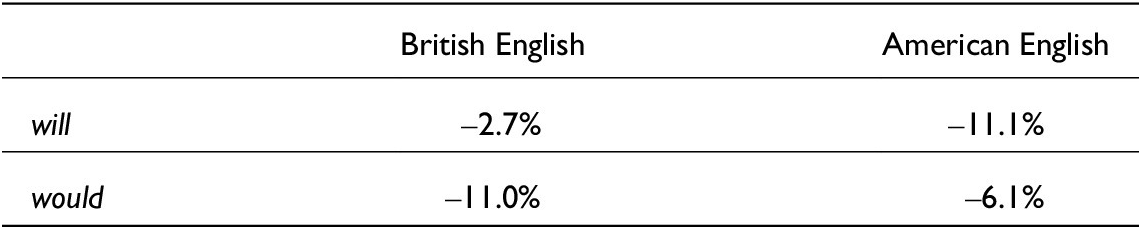
Table 1 shows that in the Brown corpora (written English), will declined at a faster rate in American English between 1961 and 1991 while it was would which declined faster in British English. This may be at least partially explained by the faster spread of going to in American English (cf. Biber et al. Reference Biber, Johansson, Leech, Conrad and Finegan1999: 488; Tottie Reference Tottie2002: 158; Leech Reference Leech, Facchinetti, Palmer and Krug2003: 229). As a consequence, will may have become associated with more formal language in American English as evidenced by going to and will being equally frequent in informal American English, but will being more frequent in formal American English (cf. Mair Reference Mair2006: 99; see also Leech Reference Leech, Marín-Arrese, Carretero, Hita and van der Auwera2013: 112) – an effect not found in British English.
Changes in usage frequency of will and would in written British and American English (based on data from the Brown corpora provided by Leech Reference Leech, Facchinetti, Palmer and Krug2003: 228, 2013: 101; Mair Reference Mair2006: 101 as well as Leech et al. Reference Leech, Hundt, Mair and Smith2009: 74)

Besides medium/register, the most influential determinant of diverging usage rates of will and would in British and American English may be competition with shall/should. While today any remaining uses of shall are strongly associated with British English (cf. Bergs Reference Bergs, Trousdale and Gisborne2008: 118), Kytö’s (Reference Kytö1991) analysis of will/shall and would/should variation in Early Modern English indicates that this has not always been the case. Between 1570 and 1640, American writers were far more likely to opt for shall or should instead of will or would with first-person subjects than British writers (cf. Kytö Reference Kytö1991: 334). By this time, shall was already strongly associated with first-person subjects in American English, an association which subsequently also developed in British English (cf. Kytö Reference Kytö1991: 334–6). The revival of the subjunctive in American English does not seem to have had an effect on the usage frequency of will, though (despite it being interchangeable with the subjunctive in some contexts). In the subjunctive-triggering context analysed by Schlüter (Reference Schlüter2009), no such effect is evident.
Concerning contracted forms of the modals, we see ’ll appearing as a contracted form of will in writing from the sixteenth century onwards (cf. Schneider Reference Schneider2023: 16). The contraction ’d as a short form of would, however, doesn’t appear until much later. Before the nineteenth century ’d almost exclusively occurs as a representation of the past tense and past participle -ed suffixes (cf. Schneider Reference Schneider2023: 10).Footnote 4 Both ’ll and ’d are initially rare in writing. By the twentieth century, ’ll has caught up with will in British novels, yet the frequency of would is still more than four times higher than that of ’d (cf. Schneider Reference Schneider2023: 16). Results for American English vary. On the one hand, ’ll has been shown to be less frequent in twentieth-century American English than in British English (cf. Algeo Reference Algeo2006: 23; Szmrecsanyi Reference Szmrecsanyi2003: 302), on the other hand, data with pronominal subjects shows high contraction rates in twentieth-century American English (cf. Daugs Reference Daugs2022: 234).Footnote 5 Interestingly, Nesselhauf (Reference Nesselhauf, Hundt, Nesselhauf and Biewer2007: 291) indicates that a rise in the use of shall in nineteenth-century British English does not seem to have come at the expense of will but at that of reduced ’ll (this is, however, only the case in one of two datasets representing British fiction; cf. Nesselhauf Reference Nesselhauf, Hundt, Nesselhauf and Biewer2007: 295).
After contractions of the negator not (e.g. can’t) emerged in the late sixteenth or early seventeenth century (cf. Jespersen Reference Jespersen1917: 117; Denison Reference Denison1993: 309), they were much less frequent than their full-form counterparts for about 200 years. Not before the twentieth century do they surpass the full forms in frequency (cf. Millar Reference Millar2009: 211; Daugs Reference Daugs, Hilpert, Cappelle and Depraetere2021: 26; Hejná & Walkden Reference Hejná and Walkden2022: 79; Nakamura Reference Nakamura2023; Schneider Reference Schneider2023: 25).
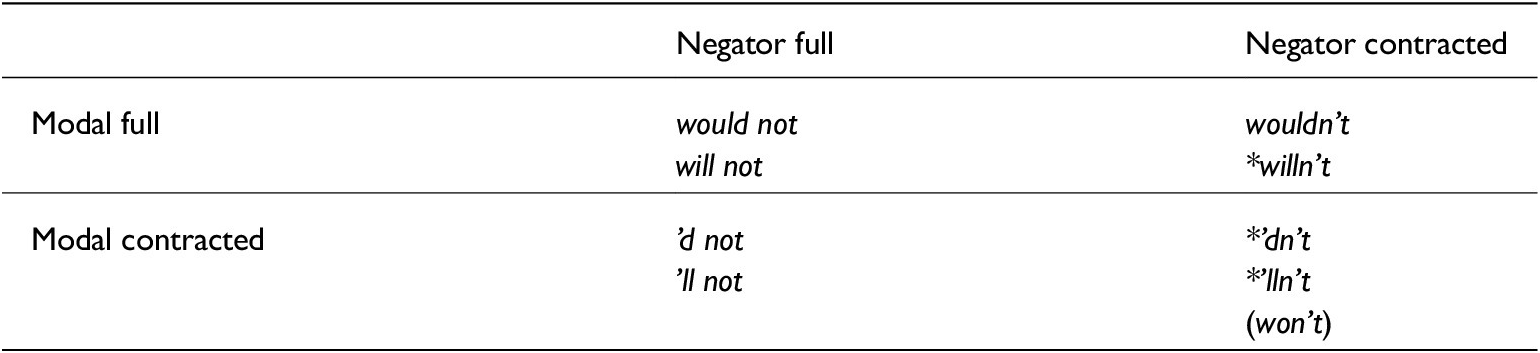
Crucially, modal contraction and negative contraction are incompatible (e.g. *he’lln’t go; though some combinations of modal + contracted negator trigger a different kind of contraction of the modal, as in won’t). While this theoretically still leaves speakers with three options to choose from, e.g. he will not go, he won’t go and he’ll not go, ’ll and particularly ’d are hardly used in negative contexts – if so, it is mostly in British English (cf. Yaeger-Dror et al. Reference Yaeger-Dror2002: 99; Szmrecsanyi Reference Szmrecsanyi2003: 304; Nesselhauf Reference Nesselhauf, Hundt, Nesselhauf and Biewer2007: 292; Varela Pérez Reference Varela Pérez, Aarts, Close, Leech and Wallis2013: 267; Schneider Reference Schneider2023: 17). Algeo (Reference Algeo2006: 23), for instance, notes that won’t is 36 times as frequent as ’ll not in British English, while it is 346 times (!) more frequent than ’ll not in American English. He further finds that ‘’d not (representing both would not and had not) occurs 4 times as often in British texts as in American’ (Algeo Reference Algeo2006: 24). It seems that ’ll not is a regional feature of certain British dialects (cf. Tagliamonte & Smith Reference Tagliamonte and Smith2002: 268). Interestingly, nineteenth-century rates of ’ll not seem to have been higher than those in the twentieth century (cf. Nesselhauf Reference Nesselhauf, Hundt, Nesselhauf and Biewer2007: 296; Schneider Reference Schneider2023: 17). Concerning the use of full forms, Algeo (Reference Algeo2006: 22–3) suggests that they are more typical of American English, while in López-Couso & Pérez-Guerra’s (Reference López-Couso, Pérez-Guerra, De Smet, Petré and Szmrecsanyi2023: 12) multifactorial analysis, variety (British vs American) was not found to be a significant predictor of negative contraction versus use of the full form. Unfortunately, most analyses are binary, contrasting only two of the options, i.e. either negative contraction versus auxiliary contraction or full form versus negative contraction. Moreover, there are actually further options worth exploring, one of them being negation by means of never: while not-negation rates of ’ll and ’d are low, these contracted modals actually attract never more strongly than the full forms of the modals do (cf. Tagliamonte & Smith Reference Tagliamonte and Smith2002: 268; Flach Reference Flach2020a: 752; Schneider Reference Schneider2023: 17).
4. Data and method
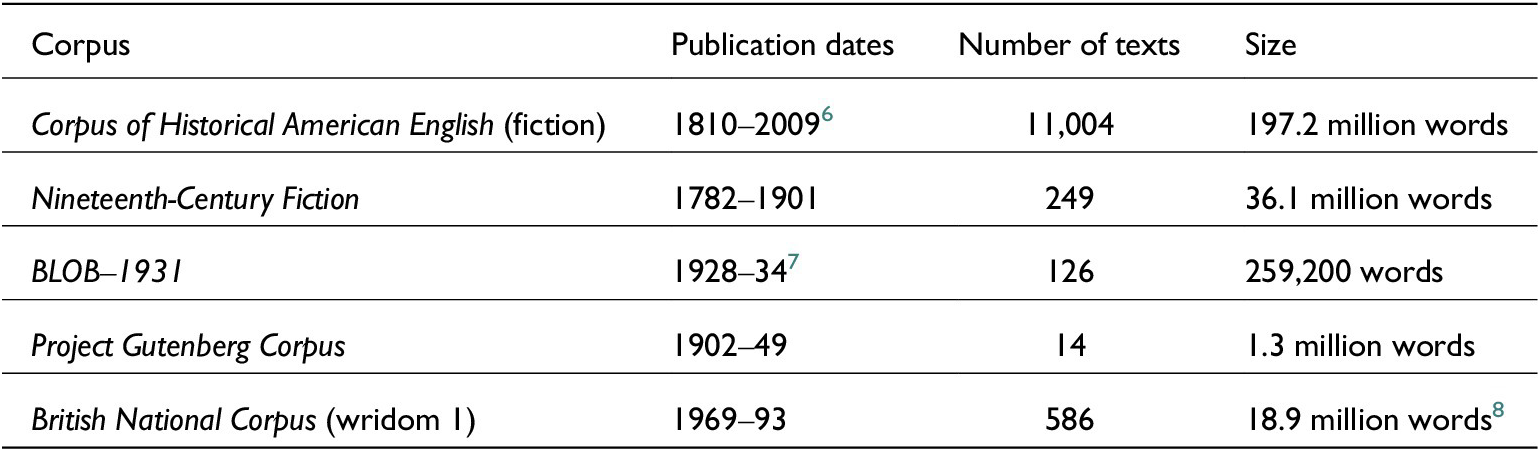
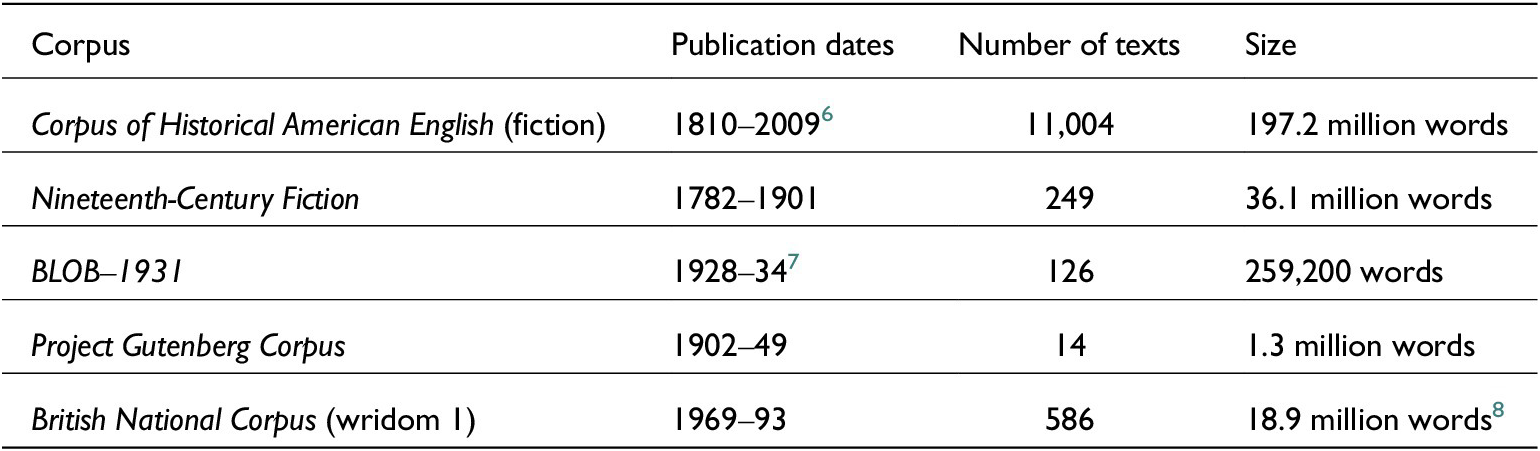
In order to explore the cognitive associations speakers have with different – particularly negated – modal constructions with will and would, how these have changed over the course of the nineteenth and twentieth centuries as well as potential differences between British and American speakers’ behaviour, we need large amounts of comparable diachronic data, preferably from a consistent genre. We therefore restricted our analysis to prose fiction. For American English, we opted for the Corpus of Historical American English (Davies Reference Davies2010–), which provides nineteenth-century and twentieth-century fiction. For British English, complete coverage of both centuries is harder to achieve and we had to combine several corpora. Two larger corpora, i.e. Nineteenth-Century Fiction (Karlin & Keymer Reference Karlin and Keymer1999–2000) and the imaginative prose subdomain of the British National Corpus (1995), leave a gap in the first half of the twentieth century, which we had to fill. To do so, we used the imaginative prose section of BLOB-1931, a member of the Brown family of corpora (Leech & Smith Reference Leech and Smith2005), as well as a collection of British novels freely available through Project Gutenberg (gutenberg.org). Table 2 lists the time-periods covered by the individual corpora as well as their sizes.
American and British corpora used in the present study
From these corpora, we extracted all tokens of the following pattern:

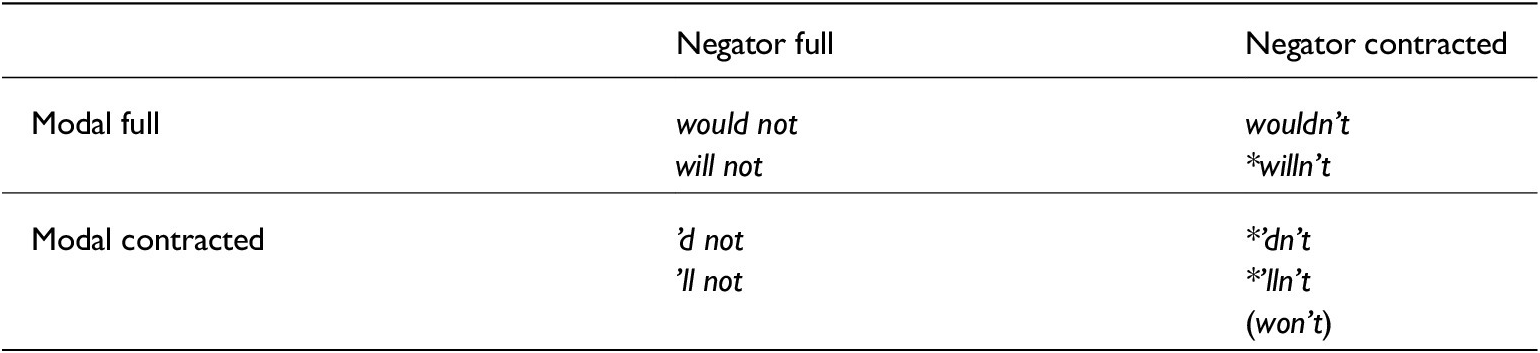
This means we extracted all negated and non-negated occurrences of will and would with pronominal subjects from the corpora. Crucially, contraction of the modal and contraction of the negator are for the most part incompatible, as illustrated in table 3 – except in won’t, where a phonetically reduced form of will combines with contracted n’t (cf. Schneider Reference Schneider2023: 25). Thus, the predominant use of ’d or ’ll in a specific environment precludes the use of n’t in that environment.
Modal-negation contractions
In total, we obtained 967,149 datapoints, c. 743,500 from American English and 223,500 from British English. Each token was then coded for the following factors which transpired to be significant predictors in our previous work on modal negation and contraction (cf. Daugs Reference Daugs2022; Schneider Reference Schneider2023; Daugs & Lorenz Reference Daugs and Lorenz2024):
-
variety – British English or American English
-
year of publication
-
modal – will or would
-
negation – affirmation or negation
-
negator – not, n’t or never
-
contraction of the modal – full form or contracted; for statistical purposes wo in won’t was treated as a full form of will
-
subject – I,you/thou, s/he, it, we or they
-
semantics of the lexical verb – for this purpose, a tagger based on the WordNet lexical database (Princeton University 2010) was used. It assigns every verbal lemma the most frequent sense of that lemma, i.e. body, change, cognition, communication competition, consumption, contact, creation, emotion, motion, perception, possession, social, stative or weather (Schneider Reference Schneider2022).
Graphs were generated in R (2023); trend curves are based on generalised additive models (GAMs).
5. Analysis and results
5.1. General trends
A first look at the frequency distribution of the data reveals that previous assumptions about developments in the use of core modals are not born out. Figure 1 shows the relative frequency of all tokens of will and would combined (whether full or contracted, negated or affirmed). Instead of the predicted loss of these two core modals, we see that usage increases over the course of the nineteenth century and plateaus for most of the twentieth century – with the exception of will in American English, which actually declines again.Footnote 9 The factors most likely responsible for this discrepancy between our results and those of Leech (Reference Leech, Marín-Arrese, Carretero, Hita and van der Auwera2013) are genre and pronominal subjects, though similar results obtained by Schneider (Reference Schneider2023) based on a wider range of subjects suggest that genre is the stronger contender: core modals may have been retained at higher rates in prose fiction than in other written registers.
Relative frequencies of will and would in British and American English

Figure 2 shows changes in the negation rate over time – or rather lack thereof, as negation rates are remarkably consistent. This indicates that the changes in usage frequency evident in figure 1 are distributed equally across affirmed and negated tokens. In both varieties, negation rates are around 15 per cent for will and just over 17 per cent for would. Only in nineteenth-century British English is the negation rate for will slightly higher (18.4 per cent). Compared to the average negation rate of English verb phrases, which lies at around 7 per cent (cf. Schneider Reference Schneider2023: 14), negation rates of will and would are highly elevated.
Negation rates of will and would in British and American English. Point size is proportional to the sum total frequency per million words for each pair per year

5.2. Modal contractions
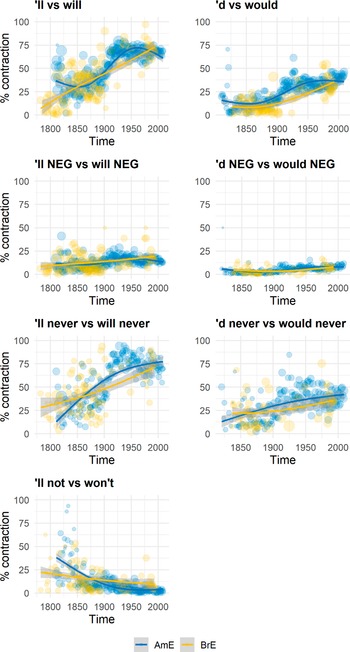
We will now narrow in on uses of will and would in which either the modal or the negator – if present – is contracted. The top panels in figure 3 show overall contraction rates. As is typical for robust language change in progress, the observable trend has an S-curve shape, indicating how a variant diffuses and gains ground on its competing alternative (cf. e.g. Blythe & Croft Reference Blythe and Croft2012; Nevalainen Reference Nevalainen and Sanchez-Stockhammer2015). In the case of will, the beginning of the twentieth century marks the point when contracted ’ll becomes more frequent in American fiction than full will. Contraction rates of would are lower, reaching only around 20 per cent by the beginning of the twentieth century. Developments in British English are similar, though in the case of would British English seems to reach the steep phase in the S-curve slightly later.
Contractions of will and would in British and American English
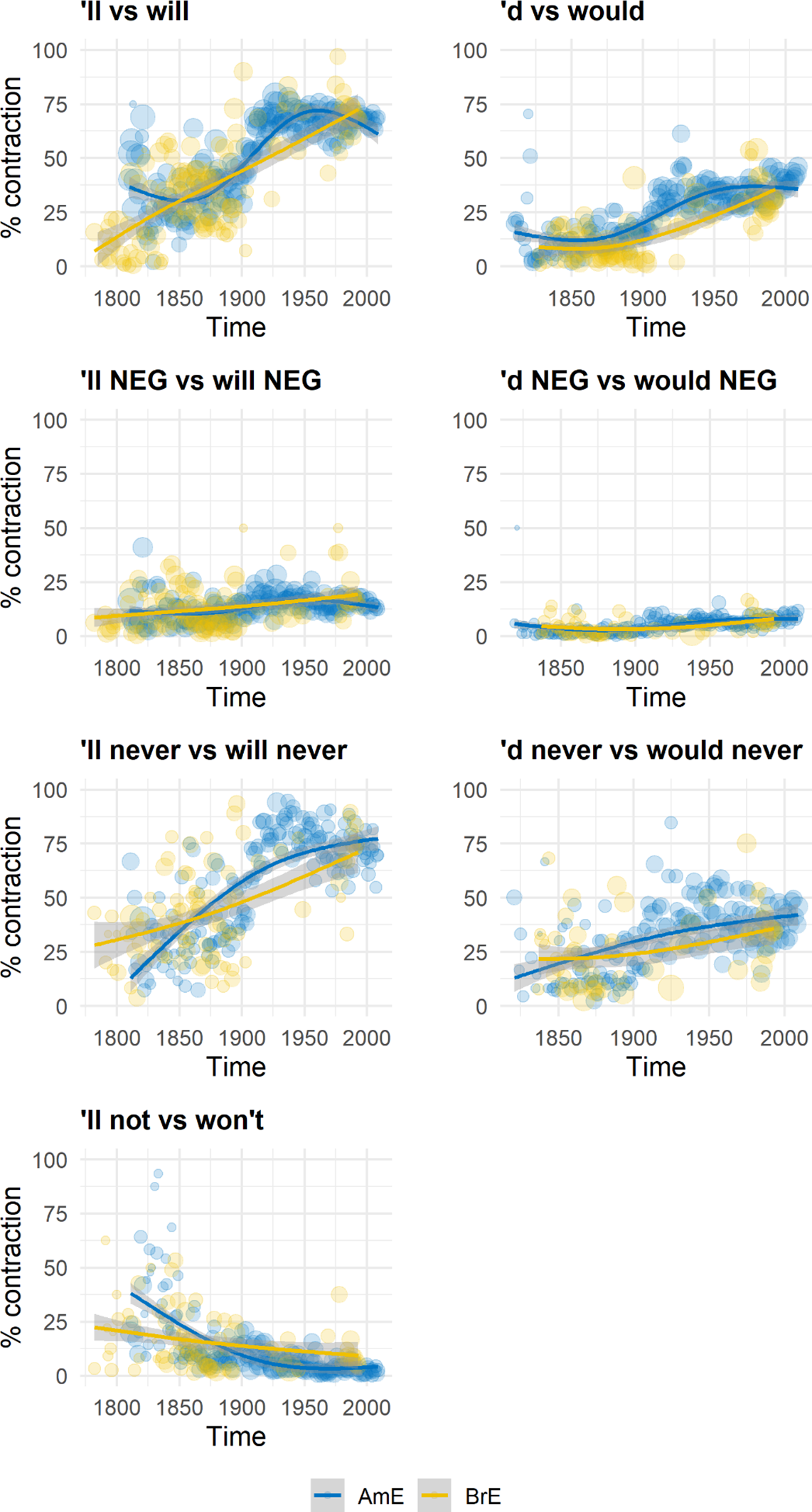
First idiosyncrasies of the contracted forms ’ll and ’d become evident when we turn to contraction rates in negated contexts (second row in figure 3). These are far below the overall contraction rates. This indicates that in both varieties a split has emerged in that will/wo and would are associated with negation while ’ll and ’d are used in affirmative contexts. This is particularly strongly evident in the case of twentieth-century will; in both varieties, reduced ’ll only has a 4 per cent chance of being negated while negation rates of will/wo are nine times higher (34 per cent in BrE and 37 per cent in AmE).
Interestingly, though, this split is not found with the adverbial negator never. In this context, usage rates of ’ll and ’d are even higher than they are overall (compare the first and third row of panels in figure 3), which indicates that ’ll and ’d indeed attract never.
Finally, the last panel in figure 3 contrasts ’ll not with won’t in order to assess whether the former is a predominantly British variant. The graph suggests that this had not been the case in the nineteenth century but that an American dispreference for the construction may have developed over the course of the twentieth century.
5.3. Configural Frequency Analysis
In order to probe for further relevant usage patterns, we employ Configural Frequency Analysis (CFA). CFA is a multivariate extension of the more widely known χ²-test for larger than 2x2 contingency tables (cf. Krauth & Lienert Reference Krauth and Lienert1973; von Eye & Wiedermann Reference Eye and Wiedermann2021). As an exploratory method, it aims at detecting patterns in categorical data by assessing what configurations of variables constitute types (where observed frequencies are significantly higher than expected frequencies) or antitypes (where observed frequencies are significantly lower than expected frequencies). Importantly, CFA is geared towards identifying local contributions to describing the structure in the data. In other words, it detects and ranks the configurations (or cells in a large contingency table) that add most to the variability.
Due to it being a relative of the χ²-test, CFA suffers from some of the same flaws and is subject to similar limitations. Firstly, p-values are dependent on sample size. Therefore, when running a CFA on close to a million datapoints, we are bound to a find a large number of types and antitypes. We will counter this to some degree by ranking types based on their contribution to overall χ², which is less susceptible to token frequencies.Footnote 10
Secondly, empty cells in the configuration table, i.e. non-observed configurations, can be problematic. These fall into two categories: structural zeros (more problematic) and empirical zeros (less problematic).
Structural zeros represent configurations which for logical, grammatical or other reasons cannot occur. Thus, statistically expected values need to be adjusted accordingly. In our case, this applies to the combined occurrence of contracted modals with a contracted negator, as in *he’lln’t, which we know cannot (yet) occur. This configuration has been ‘blanked out’ (cf. von Eye & Mair Reference Eye and Mair2007), so that the CFA does not generate expected values for configurations with *’lln’t or *’dn’t.
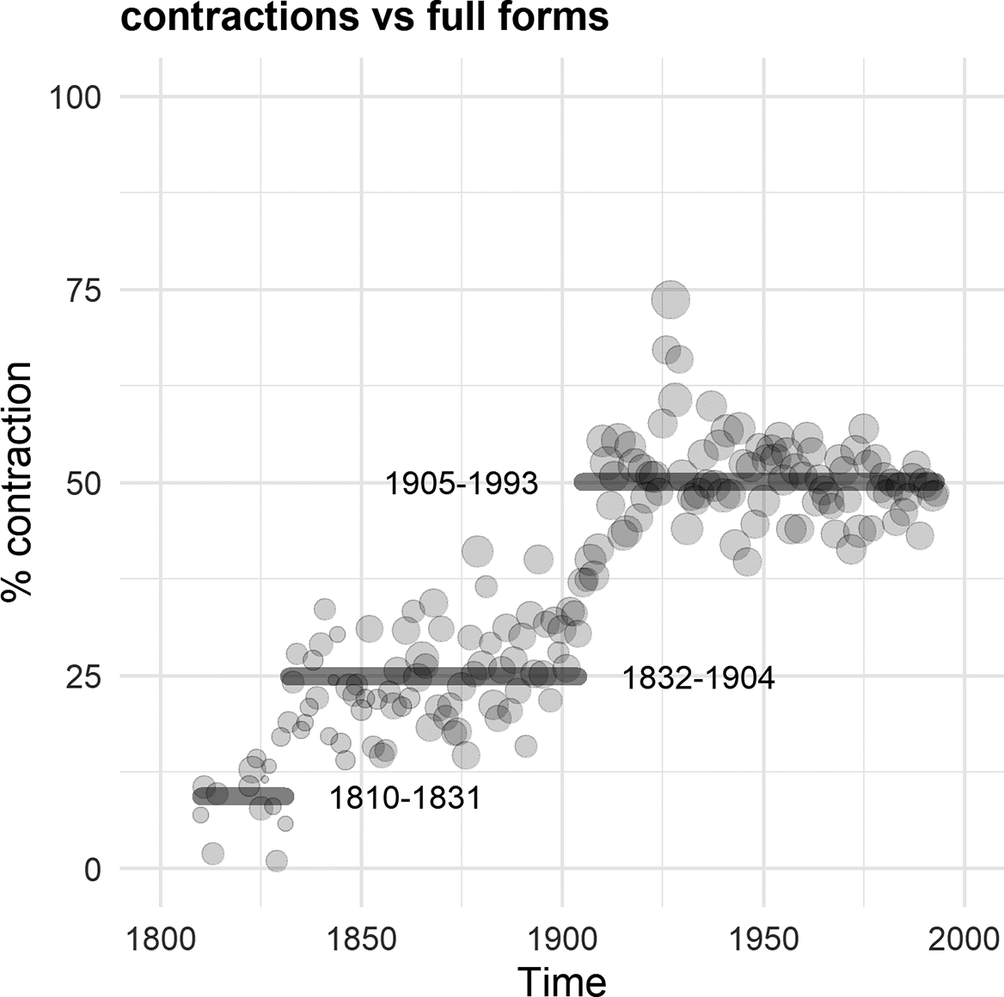
Empirical zeros, on the other hand, are configurations which could have been observed, had more data been available (cf. von Eye et al. Reference Eye, Mair and Mun2010: 42). These are less problematic for exploratory analyses (like the present one) than they are for significance testing (cf. Winter Reference Winter2019: 277–9). Nevertheless, we made efforts to reduce these, by (a) excluding tokens with weather verbs from the analysis, as they were extremely rare and (b) by merging the annual datapoints into larger periods using Variability-based Neighbour-Clustering (VNC; cf. Hilpert & Gries Reference Hilpert and Gries2009). Based on the annual rate of modal contraction across both varieties, this algorithm identifies the similarity between adjacent years by means of the standard deviation. After outlier-detection, the algorithm segmented the S-curve into three periods (P1: 1810–31, P2: 1832–1904; 1905–93); see figure 4. The three horizontal bars represent the respective mean rate of modal contraction for each VNC-determined period (P1: 9.5%, P2: 25.1%, P3: 50.1%). Consequently, we use binned years of publication in the CFA instead of exact years of publication.
The overall development of contractions relative to their full forms in British and American English with VNC-determined stages

Several studies (presumably) assume a nested structure in the data and therefore employ Hierarchical Configural Frequency Analysis (HCFA), an alternative to CFA (see e.g. Hoffmann Reference Hoffmann2019; Hilpert et al. Reference Hilpert2021), where variables are recursively eliminated by essentially running multiple CFAs to help determine the minimal adequate configuration (cf. Gries Reference Gries2009: 248). In the present context, we opted for a more theory-driven approach and ran a CFA with exactly the configurations that cater to the variables we predicted to have an impact rather than finding the ‘best’ configuration via automated selection (cf. Winter Reference Winter2019: 277–9).
Accordingly, the following variables entered the CFA: period, variety, modal, contraction, negation (affirmation, not, n’t, never), semantics, subject. The analysis was performed with the help of the cfa package in R (Mair et al. Reference Mair, Funke, Harloff and von Eye2024). Out of the possible 7,056 configurations (after blank-out), 5,258 occurred. Of these, 150 were classified as types, 34 as antitypes. In order to provide a more structured overview of the results, the discussion will proceed period by period.
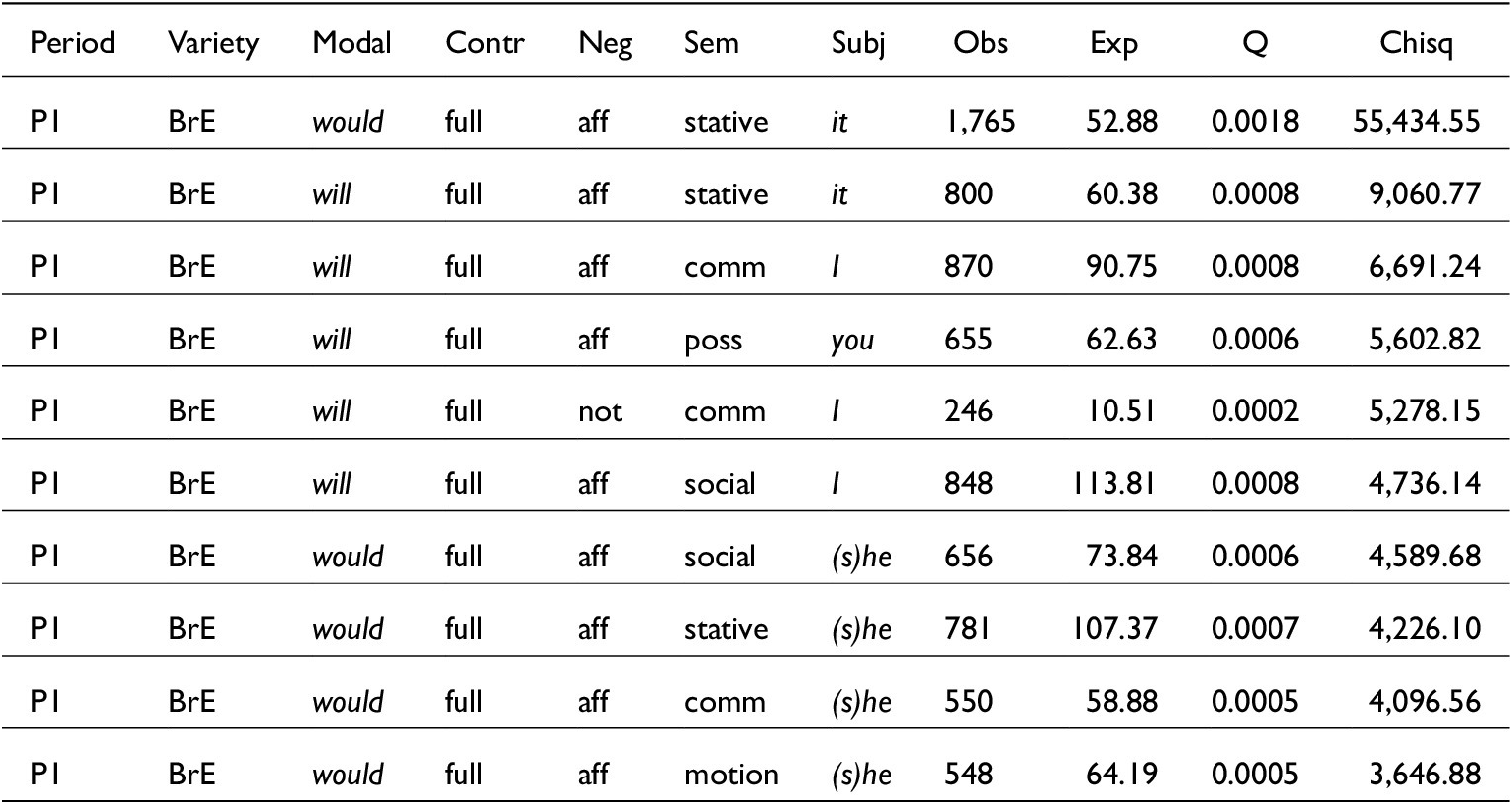
Table 4 shows the ten strongest types for the first period. All of them stem from British English. The CFA, in fact, only declares a single configuration in American English a type for this period. This skew partially owes to the fact that before 1832 (i.e. in the timespan encompassed by the first period) will and would were significantly more frequent in British English than in American English – a contrast that reversed in the twentieth century (third period).Footnote 11
Strongest types in the first period (<1832)
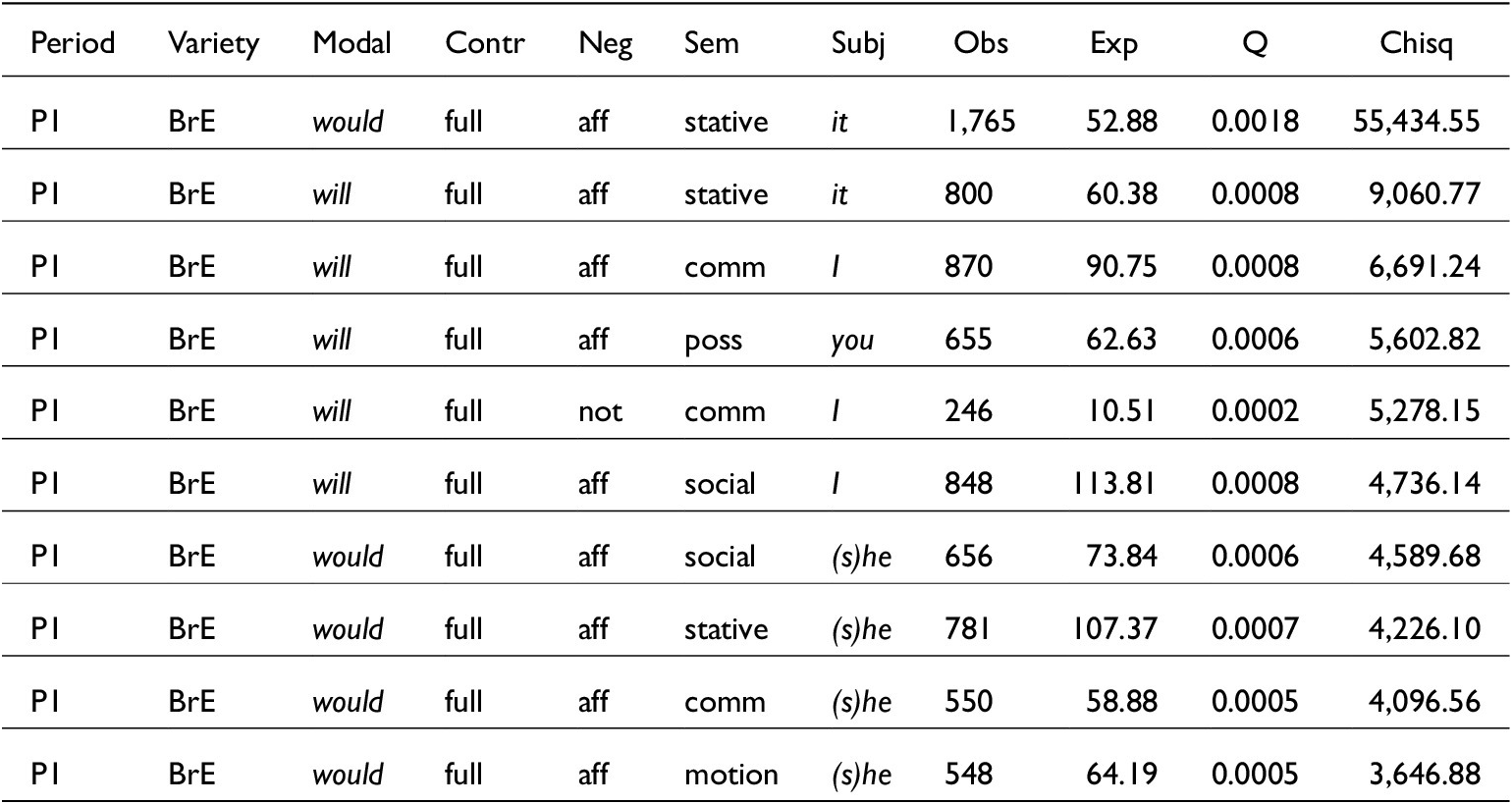
The fact that only the full forms will and would form types that stand out for the period before 1831 is not surprising. It confirms that the contractions ’ll and ’d were comparatively rare in the early nineteenth century. In this respect, will and would show similar usage patterns. What differentiates them is that would is associated with uses in the third-person singular (i.e. it forms almost exclusively types with third-person-singular subjects) while all types with will (bar one) have I or you as the subject. The single exception is it will Vstative (e.g. be). Of the few negated types of this period, only I will not + Vcommunication makes it into the top ten.
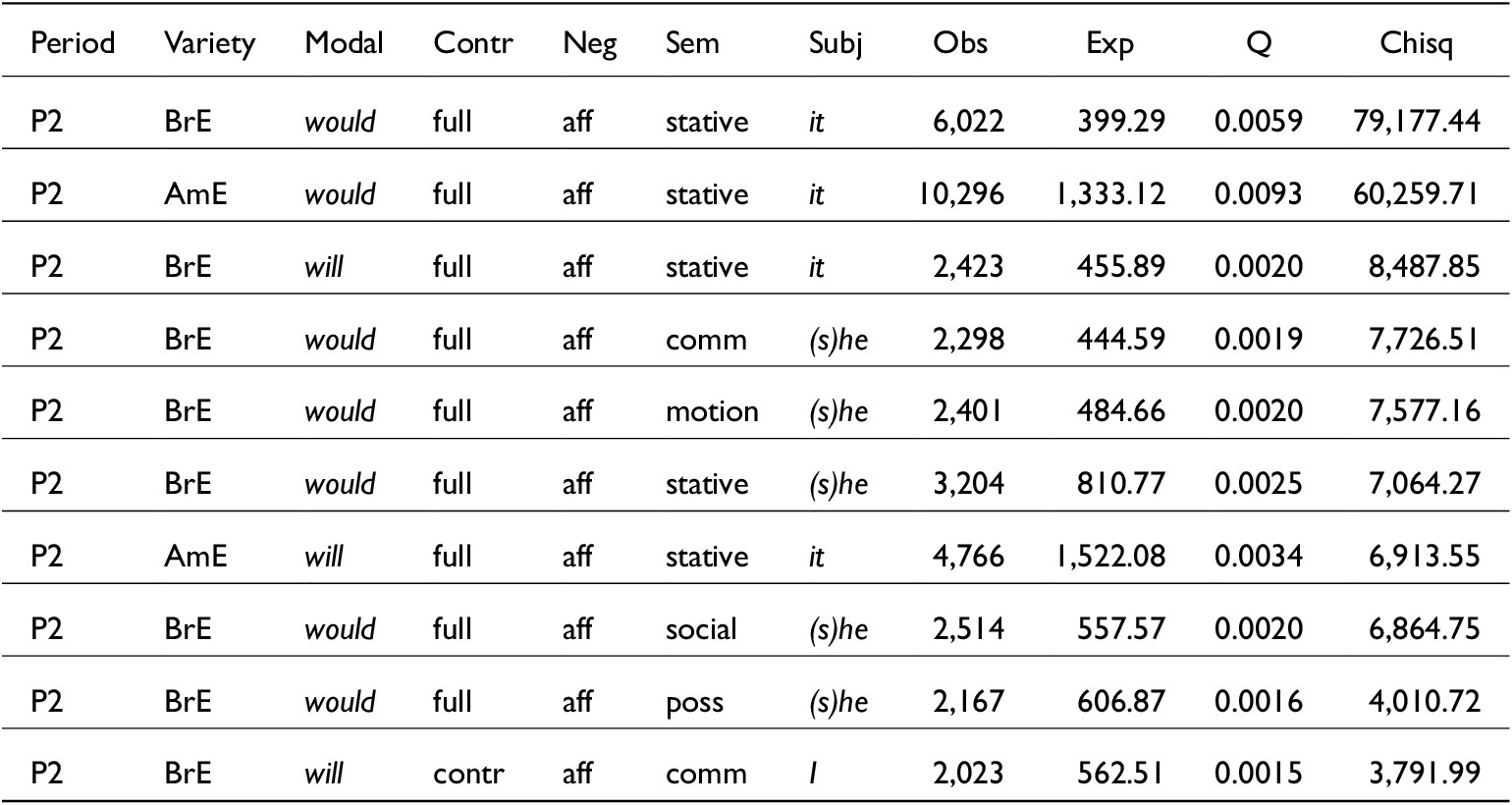
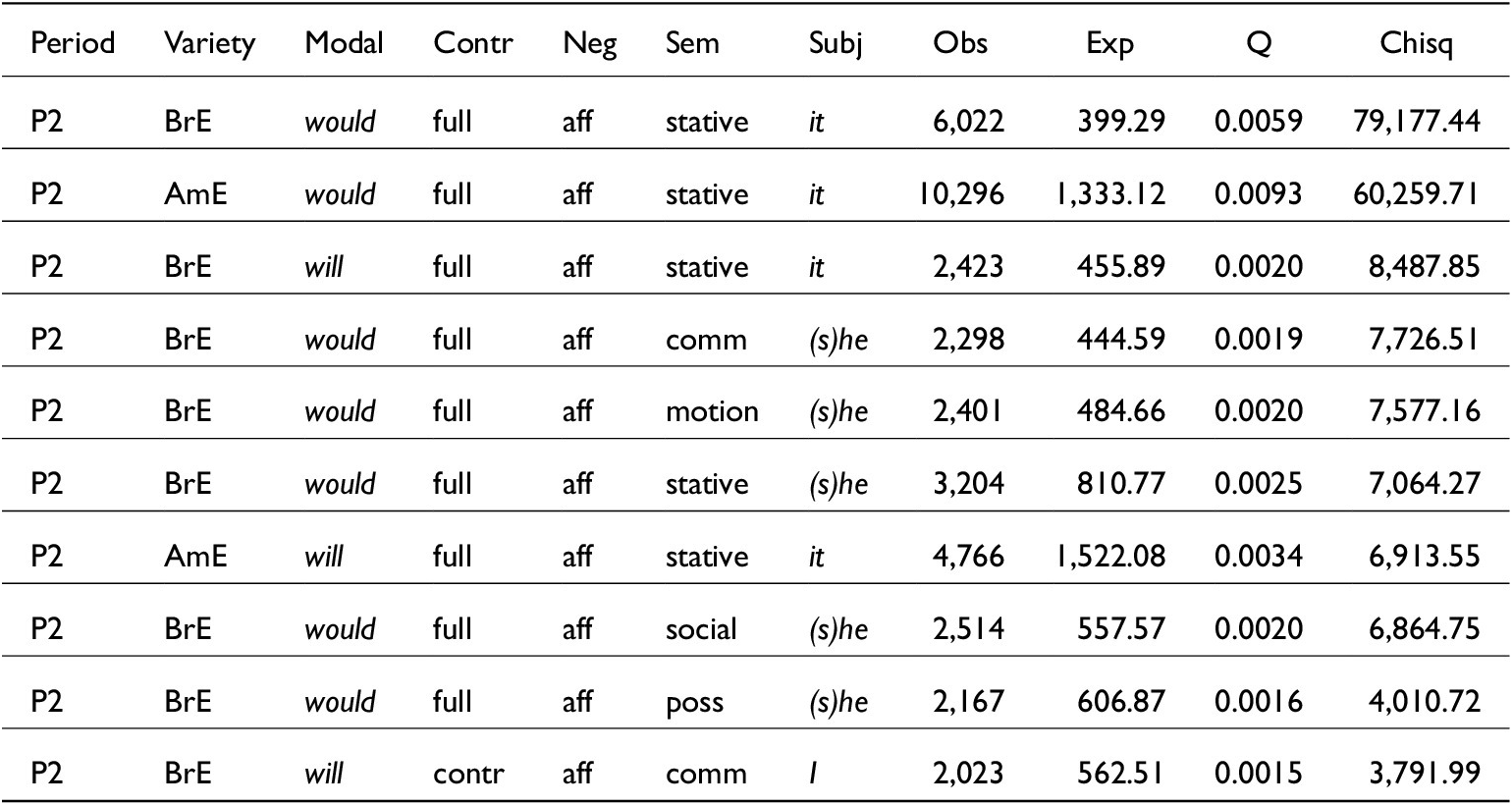
The period 1832–1904 is a transitional one. While British authors still use significantly more will and would than their American counterparts (see fn. 11), we also see American types characterising this period (in fact, almost half of the second-period types are from American English, i.e. 28 out of 60). What we also find now are types with contracted ’ll – though not yet with ’d. Types with contracted ’ll occur in both varieties and almost exclusively have first-person-singular subjects. The strongest such type is I’ll + Vcommunication (BrE); see table 5. Interestingly, while none of the configurations from the first period were antitypes, there are seven antitypes from the second period. Five of these are uses of contracted ’d, all in American English, which puts into doubt that American speakers were the innovators when it comes to contracting would to ’d.
Strongest types in the second period (1832–1903)
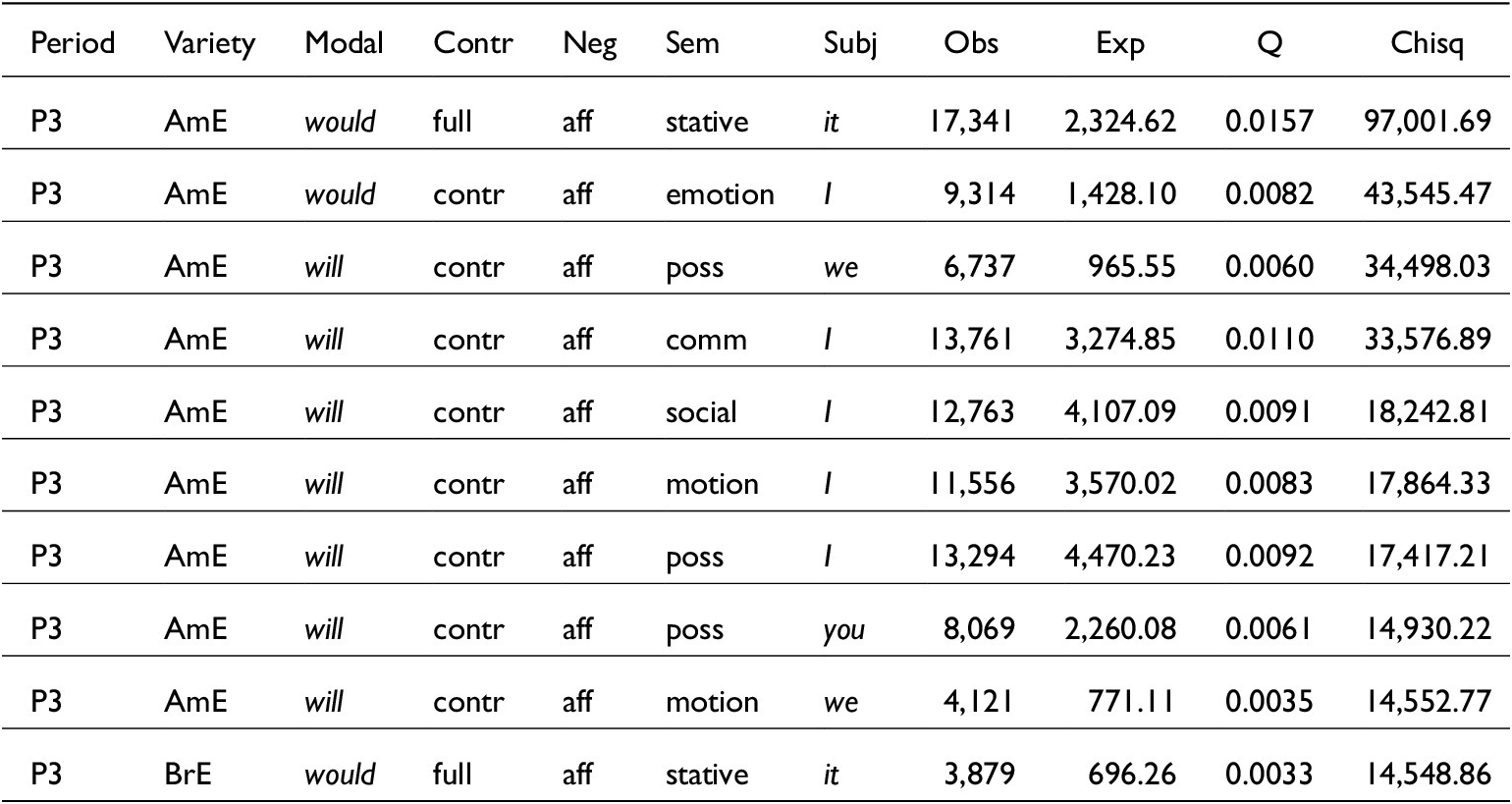
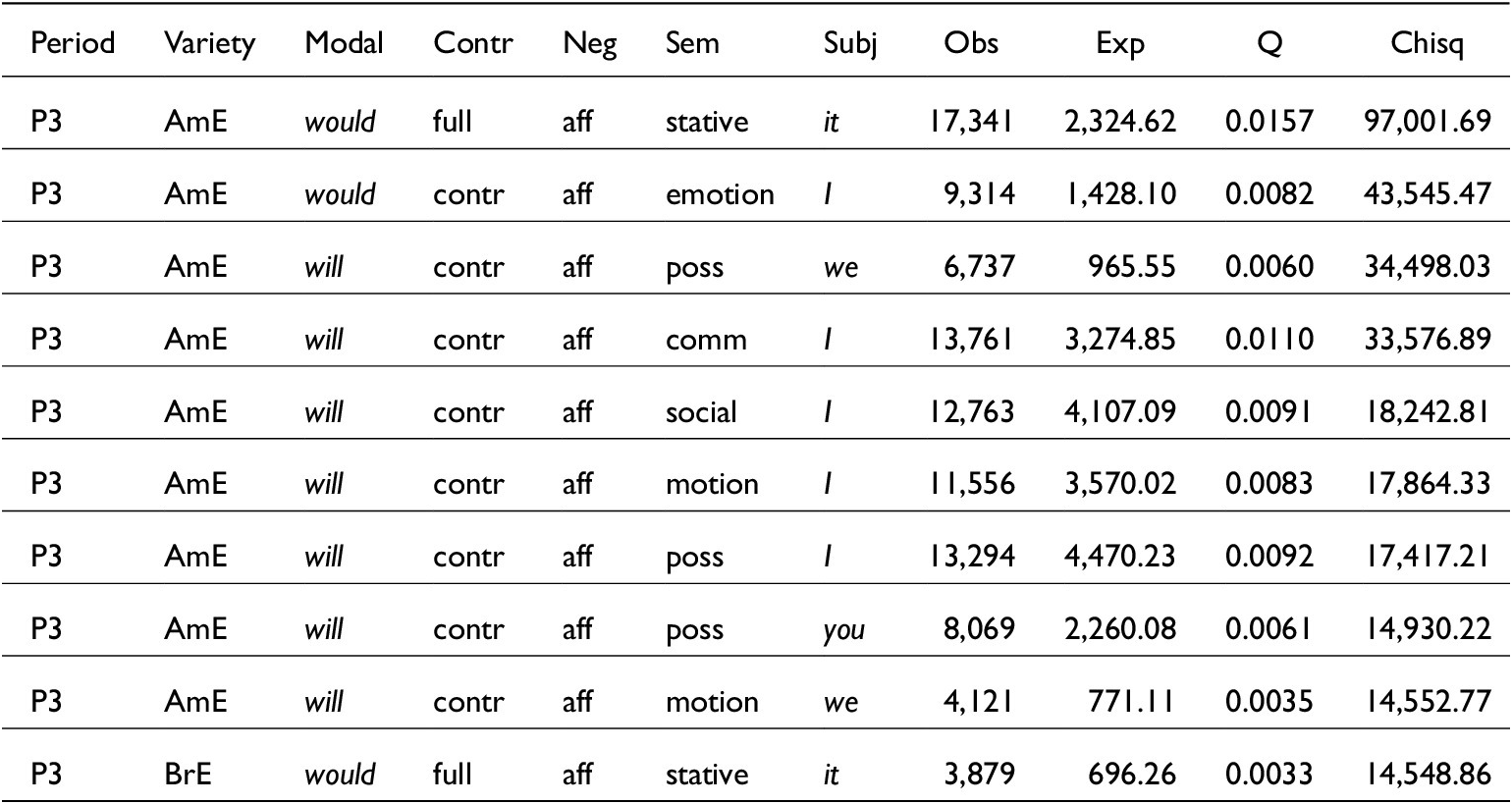
By the twentieth century, usage frequencies have reversed; see table 6: American English has higher rates of will and would than British EnglishFootnote 12 and the majority of twentieth-century types are American (78 out of 86). Some of the types are familiar, but there are also many unfamiliar ones among the top ten. Types with contracted ’ll predominate. ’ll exclusively forms types with first- and second-person subjects and mostly with affirmation. There are, however, three negated types with ’ll, none of which have made it into the top ten. They are:

This indicates that ’ll never is associated with cognitive verbs such as think, know, forget and believe. Moreover, that the configurations in (9) are the only negated types with ’ll in any of the three periods and that they are types in AmE leads us to conclude that ’ll not does not stand out in the CFA as a predominantly British phenomenon.
The third period is also the first one in which we find types with ’d. The strongest of these is I’d + Vemotion (e.g. like, worry, wish), as seen in table 6, but it also forms types with cognition verbs (not among the top ten). While full-form would is still associated with third-person subjects, ’d is so strongly associated with emotion and cognition that it is more likely to have I or you as its subject.
Strongest types in the third period (>1903)
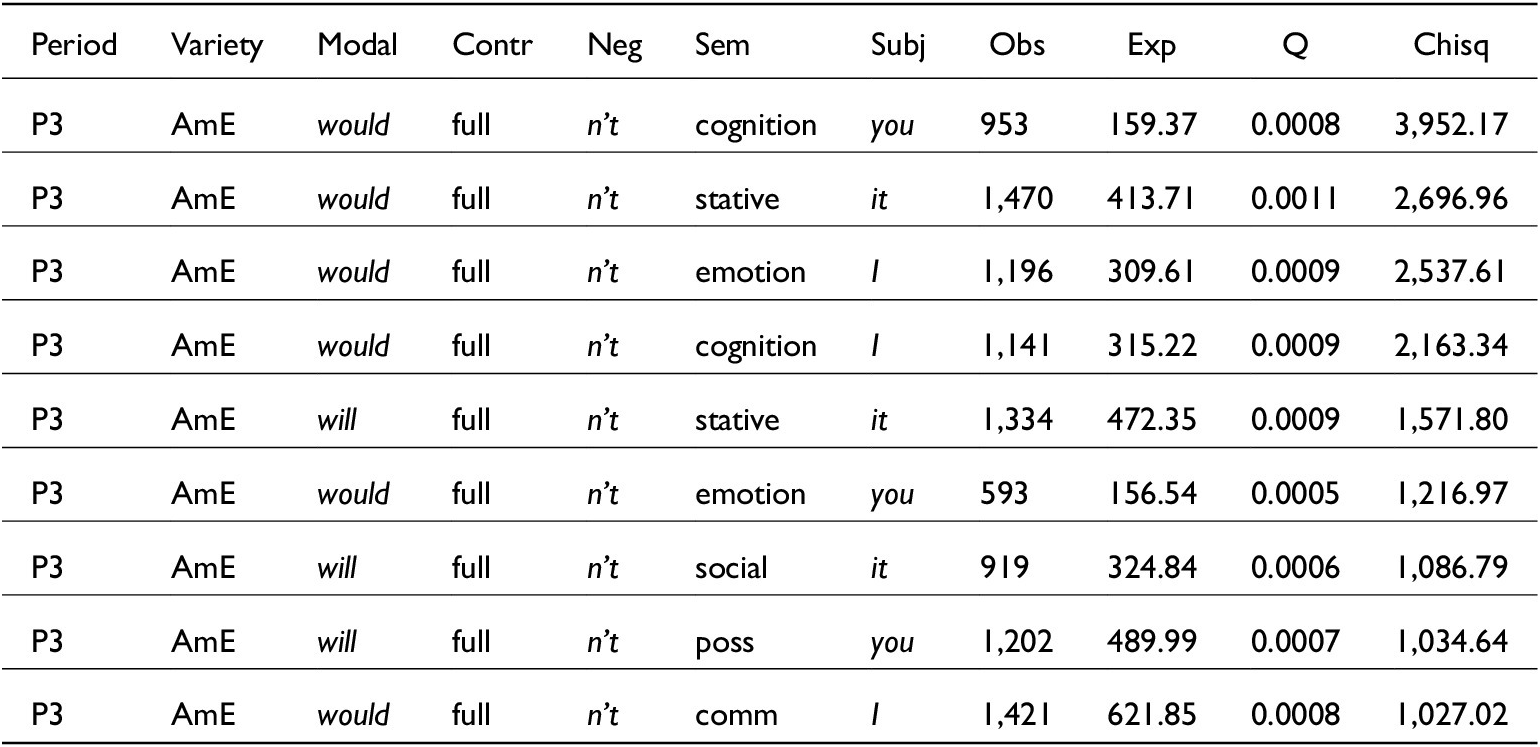
Finally, all types with n’t come from the third period. Table 7 shows that wouldn’t contrasts with other uses of would in terms of the subjects it is associated with. Like ’d, it forms types with verbs of cognition and emotion and consequently also with first and second-person subjects instead of would’s usual third-person subjects.
Types with n’t

6. Discussion and conclusion
We are now in a position to reconcile the obtained results with our initial research questions and integrate them in a cognitive-functional, usage-based framework. At the most general level, modal-negation strategies appear to be mostly congruent across BrE and AmE, as both varieties have trended largely together for the past 200 years, with neither of the two emerging as the undisputed leader of the changes at hand. At a finer level of resolution, however, these assessments become more complex.
First, although the contractions ’ll and ’d are generally on the rise in AmE and BrE (cf. the top panels in figure 3), which appears to attest to both their increasing degree of conventionality at the level of the community as well as their degree of entrenchment in individual speakers (presumably), they do not simply supplant their full-form counterparts. If that were the case, cotextually determined distributional skews would be absent from the data. What we find instead is a distinctive preference for enclitics to be used with affirmation rather than negation.
Interestingly, this does not pertain to their use with never. Both contractions – ’ll considerably more so than ’d – have occupied this niche to the extent that contraction rates amount to 70–75 per cent and 35–40 per cent respectively for will/’ll never and would/’d never in both varieties by the end of the twentieth century (see the second and third panels in figure 3).
The difference in the contraction rates between will/’ll and would/’d is noteworthy. Given that will and would have quite similar overall frequency profiles and are arguably conventionalised to the same degree, we would perhaps expect not only the direction of the trend but also the magnitude to be more similar if a common systemic change were at work. Yet the observed developments rather point to a series of selective changes, i.e. each pattern undergoing at least partly autonomous developments. This is in line with Hilpert’s (Reference Hilpert2013) notion of constructional change. That contractions are becoming more frequent has been widely attested and is often attributed to colloquialisation, that is, the intra- and inter-register spread of colloquial, informal language features (cf. e.g. Leech et al. Reference Leech, Hundt, Mair and Smith2009; Rühlemann & Hilpert Reference Rühlemann and Hilpert2017). But this does not explain, for example, the fact that ’d never is underrepresented in comparison to ’ll never, as both contractions should profit equally from such universal trends. Since ’d never is somewhat ‘held back’ in both varieties, a constructionist explanation, i.e. that form–meaning pairings are affected individually, seems more plausible to account for the discrepancy between both enclitics. While colloquialisation has undoubtedly assisted the diffusion of these contractions, their respective full forms remain alive in PDE, which suggests a functional split that likely manifests in specific usage patterns.
Second, although they can serve as a first approximation, simple, global frequency trends must be treated with caution because they conflate underlying usage patterns. For example, although ’ll, ’d, won’t and wouldn’t have generally become more frequent in AmE and BrE over the course of the nineteenth and twentieth centuries, such an assessment reveals little about the specific configurations that might be the driving force behind this development. We therefore employed CFA to detect which usage patterns stand out and to account for (some of) the multidimensionality of modal expressions. Modals are syntagmatically tied to a subject, to an infinitive and potentially to a negator, with each sequence as a whole evoking specific modal meanings and being paradigmatically associated with potential competitors, all of which the multivariate design of CFA takes into consideration. The CFA thus does not ask whether a contraction becomes more frequent than its corresponding full form but rather which configurations describe the variance in the data best and explain the changes at hand.
It comes as no surprise that full forms are generally overrepresented in the first period. Importantly, both it would/will v stative and I will (not) v communication/social emerged as types, respectively conveying epistemic and dynamic modality (cf. Coates Reference Coates1983; Daugs Reference Daugs2022). With contractions generally increasing, we might thus expect that exactly these common sequences are gradually replaced in the next periods by ’d, ’ll and won’t, but this is not the case. Instead, in combination with it and stative verbs, like be, have or seem, would retains its type-status throughout the remaining periods. By contrast, ’d is favoured with first-person-singular subjects and emotion verbs (e.g. I’d like, I’d wish), thereby expressing ‘desire’ rather than ‘epistemic hypotheticals’. In a similar vein, the contraction of will operates selectively, in that speakers continue to favour sequences like it will v stative over it’ll v stative while the enclitic emerges as a dominant type in combination with I but only in affirmative contexts.
The story is different for negation strategies. Speakers are generally hesitant to combine ’ll and not, while won’t has become more prominent. It does not, however, take over the onomasiological space completely, but preferably combines with it (see table 7). By contrast, ’ll is strongly associated with I + never + v cognition. Given that all elements in this pattern (i.e. first-person subjects, contractions, analytic negation, cognitive or private verbs) may express (personal) involvement, which is typical for speech-like registers (cf. Biber Reference Biber1988), their combined occurrence creates an especially cohesive sequence. In summary, the results from the CFA substantiate the view that contractions and full forms do not simply constitute pronunciation variants but are somewhat independent sub-schemas with specific cotextual preferences, each yielding a specific modal meaning (cf. Daugs Reference Daugs2022; Daugs & Lorenz Reference Daugs and Lorenz2024).
Third, we will return to potential intervarietal differences and particularly to the question whether ’ll not is a British phenomenon. According to figure 3, ’ll not remained rare but rather stable in BrE over the course of the twentieth century relative to won’t, while it strongly decreased in AmE. However, the CFA did not uncover any types containing this configuration in BrE. Different explanations are plausible regarding this issue. Firstly, although ’ll not is possible in BrE, won’t and ’ll never are simply more conventionalised. Alternatively, ’ll not may be too heterogeneous with regard to the subjects and verb types it combines with to be picked up as a type in a complex multi-dimensional CFA.
Another interesting case is that of contracted ’d. BrE initially had an advantage in the use of ’d + never patterns but was quickly surpassed by AmE. The type distributions in the CFA support this finding, as both varieties gradually traded places with regard to the number of types from the first to the third period. Overall, varietal differences are not borne out clearly, neither does there seem to be any trendsetter leading the change.
The final issue to be addressed is which of the two models – a cognitive constructionist framework or a radically dynamic network model – is the better fit for our data. The node-centred view would be concerned with questions such as whether subj ’ll never v and subj will never v constitute separate constructions or whether they are variants of the same construction and would couch this in a discussion on constructional change and/or constructionalisation (i.e. the emergence of a new construction; cf. Hilpert Reference Hilpert2013; Traugott & Trousdale Reference Traugott and Trousdale2013). That ’ll has become somewhat autonomous from will has already been addressed elsewhere (see e.g Daugs Reference Daugs2022; Flach Reference Flach2020a; Nesselhauf Reference Nesselhauf and Hundt2014), but if the focus rests on when exactly the enclitic emerged as a construction (i.e. its constructionalisation), this study (or any other previous study for that matter) fails to provide a definitive answer, which is to some degree due to the fact that the time window we considered covers a period in which ’ll as well as the other contractions were already commonly used.Footnote 13 What we certainly observe are clear instances of constructional change, at least construction-internal reconfiguration if we treat contractions as variants of their respective parent forms.
Network-oriented approaches like Schmid’s (Reference Schmid2015, Reference Schmid2020) Entrenchment-and-Conventionalisation Model avoid this conundrum and offer a simpler, more elegant solution. Any usage-based approach would model the utterances investigated here as having different degrees of conventionalisation in PDE; compare, for example subj ’ll never v and subj ’ll not v. Utterances with a higher degree of conventionality have a higher potential to be licensed in actual usage events and speakers are likely to be exposed relatively more often to them, which, in turn, contributes to higher degrees of entrenchment in their minds.Footnote 14 What becomes more entrenched in a network-oriented model, however, are not the nodes in the network but the links between them, for example, the links between the elements of specific subj ’ll never v cognition instances like you’ll never know or I’ll never forget (see section 5; cf. also Hilpert Reference Hilpert2021). This means that network-oriented models do not force one to make (arbitrary) ‘node decisions’. Thus, the way they account for the inherent dynamicity of language makes them the more suitable model, not only in our specific case, but for historical change in general. In short, the distributional changes that we discussed can be conceived of as seismographic activities of how the linguistic system is adjusted at the level of the community and (potentially) the level of individuals regardless of whether contractions count as constructions or not.
To conclude, our study shows how modal expressions and their corresponding contractions have developed in affirmative and negative contexts across AmE and BrE over the last two centuries. While global trends are largely the same in terms of direction and magnitude, differences can be detected at a granular level. In fact, we hope to have shown that disentangling different cotextual configurations, rather than simply focusing on higher-order generalisations, can bring important insights to the fore which would otherwise go unnoticed. In line with cognitive, usage-based approaches, we propose that the emergence of several emancipated sub-schemas that are each differentially entrenched and conventionalised provides the best description of the developments uncovered here.
Of course, we do not purport to have exhaustively described modal and negative contraction in English. A variety of pragmatic and prosodic factors which have been shown before to be significant predictors, particularly of negative contractions, have not been taken into account. Some of these, like prosodic prominence or social agreement,Footnote 15 are near impossible to code for in written historical data. Others, like the sequence of stressed and unstressed syllables in the surrounding cotext or position in the sentence, were merely too labour-intensive to code for in a dataset of nearly a million tokens. Future studies focusing predominantly on the direct speech passages in the novels could probe whether such prosodic factors are significant predictors in historical writing.



 Open access

