


Introduction
Herbicide resistance has increased rapidly over the past decades, greatly increasing costs of weed management, especially with the lack of new herbicides (Norsworthy et al. Reference Norsworthy, Ward, Shaw, Llewellyn, Nichols, Webster, Bradley, Frisvold, Powles, Burgos, Witt and Barrett2012). The use of alternative practices to control a resistant weed population once it evolves or the implementation of preventive measures before weed populations become resistant are common solutions to this serious problem (Beckie Reference Beckie2006; Beckie and Harker Reference Beckie and Harker2017; Owen Reference Owen2016). Switching to a different herbicide that is still active on the resistant weed population is often the immediate response, but integration of appropriate tactics based on adequate knowledge of the weed biology and of the herbicide mode of action is required for long-lasting management of herbicide resistance. Nevertheless, herbicide resistance is affected by several factors, with human decision-making interacting with all preventive efforts (Shaw Reference Shaw2016).
The development of herbicide resistance is greatly affected by farmers’ decisions and actions, but little analysis has been conducted on this dimension (Shaw Reference Shaw2016). Indeed, intentional decisions of growers to apply herbicides or other weed control practices can contribute to herbicide-resistance development, whereas poor attention has been paid to the role of farmers in herbicide-resistance evolution and management with respect to related decisions (Ervin and Jussaume Reference Ervin and Jussaume2014; Jussaume and Ervin Reference Jussaume and Ervin2016; Ward Reference Ward2016). Farmers’ decision-making and behavior are complex processes that can vary largely from grower to grower (Damalas and Koutroubas Reference Damalas and Koutroubas2018). This variation is often dictated by the economics of weed management practices, ability to access financing, availability of equipment and labor, knowledge, perceptions, and personal experience of the grower, which all interact with farmers’ decision-making.
Farmers’ surveys have been used by weed scientists to determine perceptions of weed problems (Gibson et al. Reference Gibson, Johnson and Hillger2005), understanding producers’ needs (Norsworthy Reference Norsworthy2003), and recording shifts in weed flora and herbicide-resistance development (Scott and VanGessel Reference Scott and VanGessel2007). However, few studies have examined farmers’ awareness of herbicide resitance (Johnson et al. Reference Johnson, Owen, Kruger, Young, Shaw, Wilson, Wilcut, Jordan and Weller2009; Llewellyn et al. Reference Llewellyn, Lindner, Pannell and Powles2002). In Australia, growers had a high level of awareness of herbicide resistance and perceived a high potential cost (Llewellyn et al. Reference Llewellyn, Lindner, Pannell and Powles2002). In the United States, 30% of surveyed farmers perceived glyphosate-resistant weeds as a serious concern, whereas most farmers underrated the possibility for resistance evolution to glyphosate in an agroecosystem dominated by glyphosate as the common tactic of weed control (Johnson et al. Reference Johnson, Owen, Kruger, Young, Shaw, Wilson, Wilcut, Jordan and Weller2009). In Germany, the majority of the farmers (88%) knew about herbicide resistance cases in the country and 64% of the farmers mentioned that such cases had been identified in their county (Ulber and Rissel Reference Ulber and Rissel2018). Because herbicide-resistant weeds occur all over the world, information about farmers’ weed control practices, perceptions, and awareness of herbicide resistance would be useful for designing effective strategies and outreach programs (Jussaume et al. Reference Jussaume, Dentzman and Owen2019). This information could help in the design of proper educational programs targeting promotion of farmers’ awareness of herbicide resistance and modification of farmers’ behavior toward weed management practices. Even if farmers are aware of herbicide resistance, understanding how farmers react toward this issue and adjust their management practices under certain conditions is essential for selecting interventions for the promotion of sustainable agriculture (Jussaume and Dentzman Reference Jussaume and Dentzman2016).
The aim of the survey we conducted was to assess current weed control practices in cereal cultivation and farmers’ awareness of herbicide resistance in the Evros district of northern Greece. Such information is expected to be useful and could be exploited for targeted extension education.
Materials and Methods
Survey Details
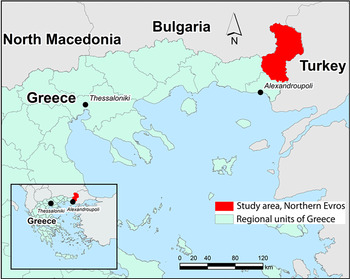
The survey was conducted in the area of northern Evros, Thrace, northern Greece in 2018 (Figure 1). The study area was selected for the survey because its economy is based on agriculture, with cotton (Gossypium hirsutum L.), cereal grains, and sunflower (Helianthus annuus L.) as the main crops. Multistage sampling was followed by dividing the study area into districts and villages. Then, the districts of interest were selected and villages were chosen at random. A total of 250 farmers were randomly contacted on the basis of formal lists provided by the local authorities. Most farmers were willing to participate after hearing the objective of the study; in cases of no response, another person on the list was contacted. With this procedure, a response rate of 83% was achieved. Respondents were selected because they were active farmers and responsible for decisions concerning purchase of seeds, cultivars, and pesticides. Face-to-face interviews with the farmers were conducted to determine awareness of herbicide resistance among cereal farmers in the study area.
Map of Greece showing the study area in Evros Prefecture.

Data Collection
The tool used for data collection was a structured questionnaire developed by the authors, based on experience from previous similar studies (Damalas and Hashemi Reference Damalas and Hashemi2010; Damalas and Koutroubas Reference Damalas and Koutroubas2014). The questionnaire contained two sections. The first section consisted of farmers’ demographic details like age, sex, educational status, and farm size. The second section consisted of nine questions assessing the level of farmers’ awareness about herbicide resistance (Table 1). The responses to those nine questions were documented as “no,”, “yes,” or “do not know.” For each yes response, a score of 1 was given; for each no or do not know response, a score of 0 was given. In this sense, our scale of awareness ranged from 0 to 9, with a score of 5 (the middle point of the scale) or above considered as good awareness (good knowledge), and a score less than 5 was considered as poor awareness (poor knowledge). The questionnaire was validated by two agronomy professors and members of the specialized laboratory and teaching staff of the university. A pilot survey with 10 farmers tested whether the questions were well defined, presented consistently, and clearly understood to smooth out difficulties before administering the main survey. Minor corrections in wording were applied according to feedback. Questionnaires of the pilot study were included in the analysis. The survey was conducted by the authors. Respondents gave oral consent to participate in the project.
Socioeconomic background of the surveyed cereal farmers in northern Greece.

Data Analysis
Percentages of poor knowledge and good knowledge were calculated for each question. Then, the data were arranged in contingency tables and the Fischer exact test was used to examine the significance of the association between variables. According to this test, if the proportions in the table columns vary significantly between rows (or vice versa), the two variables are not independent. In the opposite case, it is said that the two variables are independent. Moreover, a binary model was applied to examine the effect of some variables on the levels of poor knowledge and good knowledge of herbicide-resistance issues. In this model, poor knowledge and good knowledge were the dependent variables, and demographic variables and weed control variables were the independent variables. Differences were declared significant at P < 0.05.
Results and Discussion
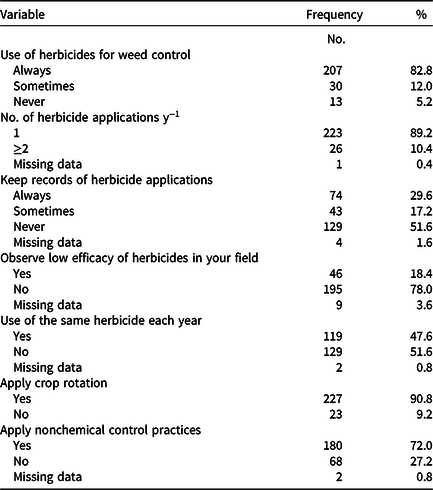
Approximately two-thirds of respondents were men (67.2%) (Table 1). Most farmers were older than 50 years. Their education levels varied, ranging from less than elementary school to tertiary education (university degree and above). Most farmers used herbicides in cereal production, making one application per growing season (Table 2). However, the majority of the farmers never kept records of herbicide applications. Farmers appeared divided with respect to using the same herbicide each year. Most farmers did not observe low efficacy of herbicide applications in their fields. The majority of the farmers stated that they applied crop rotation and nonchemical weed control practices in their fields (Table 2).
Weed control practices of the surveyed cereal farmers of northern Greece.
Almost half of the farmers (47.2%) did not know what herbicide resistance is, but most farmers (75.1%) felt that herbicide resistance would be a problem for them in terms of yield losses and would increase production cost (Table 3). Almost seven in 10 farmers (69.8%) did not consider herbicide resistance when purchasing an herbicide, and only 40.4% were willing to change common weed control practices for preventing herbicide resistance. Based on nine knowledge questions about herbicide resistance, 66.8% of the farmers had good knowledge, and 33.2% had poor knowledge of herbicide resistance. Knowledge levels did not differ by sex, whereas poor knowledge levels increased with advanced age, low education levels, and small farm size (Table 4). Farmers who always used chemical weed control had higher knowledge levels of herbicide resistance than did farmers who never used herbicides (Table 5). Farmers who always kept records of herbicide applications had higher knowledge levels of herbicide resistance than did farmers who never kept records of herbicide applications. Farmers who observed low efficacy of herbicides in their field, those who used different herbicides each year, and those who applied crop rotation had good knowledge of herbicide resistance, whereas farmers who always used the same herbicide had poor knowledge of herbicide resistance. Moreover, farmers who applied nonchemical control practices had good knowledge of herbicide resistance (Table 5).
Cereal farmers’ knowledge of herbicide resistance in northern Greece.

Association of cereal farmers’ awareness of herbicide resistance with demographic variables.

a Mean, 9.12 ha.
Association of farmers’ awareness of herbicide resistance with weed control practices.

According to the results of the binary model, advanced age (50–59 years), low education level (elementary school or less), systematic use of herbicides for weed control, and use of the same herbicide each year were negatively associated with knowledge of herbicide resistance (Table 6). On the other hand, keeping records of herbicide applications, observing low efficacy of herbicides in the field, applying crop rotation, and applying nonchemical control practices were positively associated with knowledge of herbicide resistance (Table 6). The main information source about weed control practices among cereal farmers was the personnel of agricultural supply centers; 20% of the farmers reported multiple sources of information (Table 7).

a Dependent variables: good knowledge and poor knowledge regarding farmers knowledge of herbicide resistance
b Hosmer and Lemeshow test: χ2 = 4.41; degrees of freedom = 8; Sig. = 0.91; −2 Log likelihood = 141.02; Cox & Snell R 2 = 0.50; Nagelkerke R 2 = 0.69; overall percentage of right prediction, 86.4%; N = 250 farmers.
c Abbreviations: B, regression coefficient; Exp(B), exponentiation of the B coefficient (odds ratio); SE, standard error; Sig., significance; Wald, χ2 test.
* Significant at P < 0.05.
** Significant at P < 0.01.
Sources of information for weed control practices among cereal farmers in northern Greece.

In this study, we assessed weed control practices and awareness of herbicide resistance among cereal farmers in the Evros district of northern Greece. Because similar studies do not exist for the area, the collected information provides a good view of cereal farmers’ situation concerning weed control and herbicide resistance. Most farmers used herbicides in cereal production, with one application per growing season. Farmers appeared divided with respect to using the same herbicide each year, and the majority of the farmers applied crop rotation.
Weeds compete with cereals for space, water, and nutrients, thereby reducing yields, slowing harvest, and increasing combine repair costs. These aspects are particularly important in the case of monoculture cropping, a common system for cereal production that increases the need for chemical weed control (Dauer et al. Reference Dauer, Luschei and Mortensen2009; Ervin and Jussaume Reference Ervin and Jussaume2014). Previous research reported that farmers felt trapped to a forced dependence on herbicides (Dentzman Reference Dentzman2018). Similarly, the majority of the farmers in this study relied on information provided by agricultural retailers, who might have pushed farmers to use chemical weed control. Agricultural retailers are unlikely to promote integrated weed management (IWM), emphasizing the potential of new herbicide options of weed control (Bonny Reference Bonny2016; Mortensen et al. Reference Mortensen, Egan, Maxwell, Ryan and Smith2012).
The tendency toward chemical weed control among farmers in the study area shows a high possibility of development of herbicide resistance, but this possibility has not translated into confirmed cases of herbicide resistance, probably because half of the farmers used a different herbicide each year and the majority of them applied crop rotation. Indeed, although herbicide resistance cases have been confirmed in cereal fields of northern Greece (Kaloumenos and Eleftherohorinos Reference Kaloumenos and Eleftherohorinos2008; Kaloumenos et al. Reference Kaloumenos, Adamouli, Dordas and Eleftherohorinos2011; Papapanagiotou et al. Reference Papapanagiotou, Damalas, Menexes and Eleftherohorinos2020), cases of herbicide resistance have not been confirmed in the study area. Previous research reported that those working with farmers in areas with high occurrence of herbicide resistance will probably share the skepticism of farmers toward the future potential of chemical weed control options by providing IWM (Dentzman et al. Reference Dentzman, Gunderson and Jussaume2016). However, this is not the case for the present study because of the lack of cases of herbicide resistance.
The implementation of crop rotation and herbicide rotation with different sites of action is a major tool for the management of herbicide resistance. These practices help in the control of resistant weeds and delay the development of new resistant weeds. Preserving the efficacy of herbicides depends on the awareness of the increasing cases of herbicide resistance and the coordinated action by farmers to address the problem. The evidence we have presented demonstrates that despite heterogeneity, farmers had knowledge of herbicide resistance and followed good agricultural practices in their fields. This response, even among farmers who had not yet experienced cases of herbicide resistance on their farm, can be regarded positively in terms of proactive behavior, as reported elsewhere (Ulber and Rissel Reference Ulber and Rissel2018).
The implemented weed control practices did not seem to contribute significantly to the development of herbicide resistance. Nevertheless, more action is required to promote farmers’ knowledge of herbicide resistance, because one-third of the farmers had poor knowledge of herbicide resistance. Advanced age was negatively associated with knowledge of herbicide resistance. Although advanced age is linked with great farming experience, the more farmers age, the less knowledge they have about technical issues such as herbicide resistance (Abdulai et al. Reference Abdulai, Hoffmann, Jassogne, Asare, Graefe, Tao, Muilerman, Vaast, Van Asten, Läderach and Rötter2020; Ogunmodede and Awotide Reference Ogunmodede and Awotide2020; Prashanth et al. Reference Prashanth and Bose2018), a situation probably related to poor education and limited access to new information technologies that tend to be more accessible to the younger generation. The negative association with low level of education and the positive association with higher education probably reflect educated persons’ high levels of knowledge and good access to information sources. Farmers who always used herbicides for weed control had less knowledge about herbicide resistance compared with farmers who never used herbicides. The latter group probably used other options of weed control, perhaps after understanding the concept of herbicide resistance, and thus they reduced their dependence on herbicides. Farmers who always kept records of herbicide applications had more knowledge compared with farmers who never kept records of herbicide applications. Pesticide record keeping is usually a weak point of farmers and has been identified as a priority of farmers’ training in pest management in Iran (Hashemi et al. Reference Hashemi, Hosseini and Damalas2009). Keeping records of herbicide applications is a measure for monitoring the effectiveness of herbicides, so farmers who keep records of herbicide applications definitely pay more attention to herbicide efficacy and thus have more knowledge of herbicide resistance. Observing low efficacy of herbicides had a positive effect on knowledge of herbicide resistance. In fact, farmers who observed low efficacy of herbicides in their field had more knowledge compared with the other group. Farmers who used the same herbicide each year compared with the other group had less knowledge of herbicide resistance. Using the same herbicide each year increases the chances of resistance to herbicides; thus, farmers who did not follow this practice were probably influenced by their greater knowledge of herbicide resistance. Applying crop rotation had a positive effect on knowledge of herbicide resistance. Farmers who applied crop rotation had more knowledge compared with the other group probably because crop rotation reduces the likelihood of using same herbicides.
Understanding why farmers decide on some weed control tactics but are hesitant to adopt other practices that could delay herbicide resistance is essential, considering the changing demographics in agriculture (Owen Reference Owen2016). The information reported in this study provides a good sense of weed control practices used by cereal growers of the Evros district. Thus, opportunities for varying weed control practices to reduce possibilities for herbicide-resistance evolution are highlighted. Because farmers count on simple solutions for weed control, educational programs could emphasize how IWM can preserve and support the potential continued use of certain chemical herbicides (Jussaume and Dentzman Reference Jussaume and Dentzman2016). Considering the adoption of IWM practices in western Australia, research has found that extending the impacts of farming systems beyond resistance management was likely to be more effective than just aiming at the efficacy of practices for controlling major weeds (Llewellyn et al. Reference Llewellyn, Pannell, Lindner and Powles2005). Also, IWM adoption and the management of herbicide resistance required intensive information and decisions based on an intertemporal management of resources (Llewellyn et al. Reference Llewellyn, Lindner, Pannell and Powles2007).
Our study also provides a good picture of farmers’ awareness of herbicide resistance and could function as a comparative benchmark study for future research in the area and as a guide in other areas where growers have been highly affected by instances of herbicide resistance. Similar research in areas with cases of herbicide resistance could reveal differences in personal experiences with and risk perceptions of herbicide resistance that can drive farmers’ decisions regarding the choice of resistance management strategies, not excluding diversity in farmer and farm management characteristics that can also influence weed management strategies. Therefore, similar research is expected to enhance opportunities for university personnel, crop consultants, and pesticide retailers to provide more accurate information to help farmers make decisions about avoiding and/or managing herbicide-resistant weeds. In particular, weed scientists could use this information to provide targeted advice on best management practices for promotion of sustainable weed control on cereal farms.
It should be noted that farmers in this study are located within a specific area of northern Greece where no cases of resistance have been confirmed and thus findings are not generalizable to other areas where herbicide-resistant weeds are more common. This emphasizes the need for additional studies of different groups of farmers from different areas to determine whether trends are consistent across groups. Apart from guides to action by extension officers, farmer surveys are important tools available for policy formation and evaluation. Concerning areas where growers have been highly affected by instances of herbicide resistance, future similar research could evaluate which management practices are most cost-effective in adapting to herbicide-resistant weed infestations and how to effectively assist farmers to adopt those practices.
Acknowledgments
The authors thank Dr. George Mallinis, Democritus University of Thrace, for providing the map in Figure 1 of the study area. No conflict of interest has been declared.


 Open access

