


Introduction
The Great Southern Reef in southern Australia is internationally recognised for its exceptional ecological productivity. It is regarded as a global hotspot for marine biodiversity, particularly for seaweeds, sponges, crustaceans, chordates, bryozoans, echinoderms, and molluscs (Bennett et al., Reference Bennett, Wernberg, Connell, Hobday, Johnson and Poloczanska2015; Shepherd and Edgar, Reference Shepherd and Edgar2013). Reef ecosystem productivity is underpinned by upwelling systems along the southern shelf of Australia (Kämpf et al., Reference Kämpf, Doubell, Griffin, Matthews and Ward2004; Nieblas et al., Reference Nieblas, Sloyan, Hobday, Coleman and Richardsone2009). Highly seasonal in nature, these annual events contribute cold, nutrient-rich water to the sea surface, thereby supporting high levels of primary productivity and species diversity.
Marine protected areas (MPAs) are internationally recognised as a management tool to protect and conserve marine habitats, species biodiversity and abundance, as well as community, economic, social, and cultural heritage values. However, the use of MPAs to protect fisheries is widely debated (Hilborn, Reference Hilborn2018; Linwood et al., Reference Linwood, Ahmadia, Browman, Thurstan, Kaplan and Bartolino2018). For lobster fisheries, reported outcomes of MPAs include spillover into the fishable biomass (Goñi et al., Reference Goñi, Hilborn, Díaz, Mallol and Adlerstein2010; Lenihan et al., Reference Lenihan, Gallagher, Peters, Stier, Hofmeister and Reed2021; Spanier, Reference Spanier2024) that can lead to changes in fishing effort adjacent to the MPA boundaries (Kerwath et al., Reference Kerwath, Winke, Götz and Attwood2013; Nillos Kleiven et al., Reference Nillos Kleiven, Espeland, Olsen, Abesamis, Moland and Kleiven2019).
Australia has obligations to protect marine biodiversity and ecosystem integrity at both national and international levels (United Nations Environment Programme (UNEP), 1992; Commonwealth of Australia, 1992a, 1992b). In 1998, through the establishment of a National Representative System of Marine Protected Areas (NRSMPA), Australia committed to the expansion of its existing marine reserve system, which in South Australia led to the design of 19 MPAs encompassing locally representative ecosystems and habitats across eight marine bioregions. In 2014, the South Australian MPA network was fully implemented, and fishing restrictions inside specific no-take sanctuary zones (SZs) came into effect. This led to the cessation of all commercial (and recreational) rock lobster fishing within SZs of the Northern Zone.
Across southern mainland Australia, Tasmania, and New Zealand, temperate reefs support numerous recreational and commercial fisheries. One of the most economically important fisheries is that for southern rock lobster Jasus edwardsii. In South Australia, the fishery is divided into two zones, Northern and Southern (Figure 1). This study was undertaken in the Northern Zone, which has 63 commercial licences and a long history of fishery management controls that include limited entry, spatial closures, and gear restrictions (Primary Industries and Regions South Australia (PIRSA), 2021). A minimum legal size of 105 mm carapace length (measured from between the antennae to the rear edge of the carapace) exists for both males and females. Female size of maturity varies both spatially and temporally, with estimates between 1991 and 2015 ranging from 82 to 137 mm carapace length (McLeay et al., Reference McLeay, Doubell and Linnane2019). In 2003, a total allowable commercial catch (TACC) was introduced, which is currently set at 300 tonnes for the 2024/25 season. Fishing is undertaken all year round, but the majority of the TACC is taken from November to March of each season (Linnane et al., Reference Linnane, McGarvey, Feenstra, Mark and Graske2024).
Map showing location of the Northern Zone Rock Lobster Fishery, marine fishing areas (MFA), and sanctuary zones (SZs) 1 and 3 at the Neptune Islands Group and Western Kangaroo Island Marine Parks (inset).

In 2018, the harvest strategy for the South Australian Northern Zone Rock Lobster Fishery (NZRLF) was reviewed with an agreed objective to rebuild the biomass (Primary Industries and Regions South Australia (PIRSA), 2021). This decision was based on the observed decline in several fishery indicators across large spatial scales (Linnane et al., Reference Linnane, Gardner, Hobday, Punt, McGarvey, Feenstra, Matthews and Green2010). A harvest control rule (HCR), which was first used to set the annual TACC in 2021, relied heavily on the outcomes of population modelling and harvest strategy evaluation. The HCR set the TACC based on the previous fishing season’s CPUE, assuming that CPUE was representative of legal-size biomass, thereby allowing a TACC to be adopted based on a conservative level of exploitation (McGarvey et al., Reference McGarvey, Matthews, Feenstra, Punt and Linnane2016, Reference McGarvey, Linnane, Matthews and Jones2017).
The first insight into population responses of southern rock lobster afforded protection inside marine park SZs was provided through a dedicated sampling programme undertaken at the Western Kangaroo Island Marine Park (WKIMP) in 2017 (McLeay et al., Reference McLeay, Linnane, McGarvey, Bryars and Hawthorne2021). Sanctuary Zone 3 (SZ-3) of the WKIMP is located to the south of Cape du Couedic and encompasses MFA 48 of the NZRLF (Figure 1). Survey estimates of the relative abundance of legal-size lobsters were 4.4 times greater inside SZ-3 compared to outside in 2017. Since 2014, when fishing was last permitted inside SZ-3, the relative abundance of lobsters had increased by 75%.
In 2022, the WKIMP Management Plan was amended, and approximately 75% of SZ-3 was reopened to commercial fishing. In addition, approximately 75% of SZ-1 in the Neptune Islands Group Marine Park was also reopened (Figure 1). In the context of gaining knowledge about the potential increase in lobster densities due to MPA implementation, dedicated surveys were undertaken to compare lobster biomass inside and outside the two SZs at the Neptune Islands Group and Western Kangaroo Island. The specific aim was to estimate the relative abundance of southern rock lobster, both inside and outside SZs 1 and 3, and to compare survey results to historical estimates of relative abundance obtained from commercial fishery-dependent data inside MFAs where the marine parks are located.
Methods
Surveys
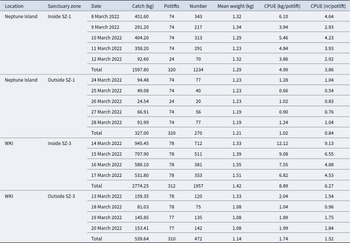
Surveys were undertaken both inside and outside the two SZs from 8 to 28 March 2022 (Table 1) using two commercial rock lobster fishing vessels and crew. Surveys were conducted just after the SZs were reopened to fishing and prior to other commercial fishers entering the areas. Each vessel had an independent fishery observer from the South Australian Research and Development Institute onboard, with fishing undertaken using standard commercial fishing pots with escape gaps (Primary Industries and Regions South Australia (PIRSA), 2021). At both locations, fishers targeted known lobster reef sites both within the SZs and in the adjoining MFA just outside the SZ. To maintain comparison of the survey data with the historical data (1983–2021) collected by fishers in commercial fishing operations, pots were set and retrieved at locations chosen at the discretion of the vessel Master based on their previous fishing experience (∼30 years) in the area.
Summary of the number of pots deployed and legal-size lobsters sampled inside and outside sanctuary zones 1 and 3 at Island and Western Kangaroo Island (WKI) Marine Parks, respectively

The first survey was conducted at north Neptune Island within the Neptune Islands Group Marine Park (Figure 1), where a total of 320 pots were deployed both inside SZ-1 and outside in MFA 39 (Table 1). The second survey was undertaken at Cape du Couedic within the WKIMP, where 320 pots were deployed inside SZ-3 and 310 were set outside in MFA 48 (Figure 1; Table 1). Throughout the surveys, the observer onboard the vessel recorded all data relating to each potlift, including pot location (latitude and longitude), depth, number of lobsters, lobster carapace length (mm), and sex. All pots were set individually and deployed and retrieved within 24 h.
Survey analyses
Catch per unit effort (CPUE) is used as an indicator of relative abundance in crustacean fisheries worldwide and is the primary performance indicator used to assess fishery performance in the NZRLF (Linnane et al., Reference Linnane, McGarvey, Feenstra, Mark and Graske2024). Estimates of relative abundance, both inside and outside each SZ, were calculated for legal-size (carapace length ≥ 105 mm) lobsters captured and released during the survey as follows:
 \begin{equation*}CPU{E_{legal\,size}}\, = \frac{{{\text{Total weight }}\left( {{\text{legal size}}} \right){ }\left( {{\text{kg}}} \right)}}{{{\text{Total number of potlifts}}}}\end{equation*}
and
 \begin{equation*}CPU{E_{legal\,number}}\, = \frac{{{\text{Total Number }}\left( {{\text{legal size}}} \right){ }\left( {{\text{Nr}}} \right)}}{{{\text{Total number of potlifts}}}}\end{equation*}
Differences in lobster size were compared between inside and outside the SZ using measures of mean weight and length frequencies. Mean weight was estimated as follows:
 \begin{equation*}Mean\,Weigh{t_{legalsize}}\, = \frac{{{\text{Total weight }}\left( {{\text{legal size}}} \right){ }\left( {{\text{kg}}} \right)}}{{{\text{Total number of lobster }}\left( {{\text{legal size}}} \right)}}\end{equation*}
Length frequencies were estimated using the carapace length data of all lobsters sampled during the surveys. The carapace length of lobsters was grouped into 5 mm bins and analysed to estimate the percentage frequency of female and male lobsters present in each size class inside and outside each SZ.
Historical catch analysis
To compare survey results with historical fishery trends, data were analysed from commercial fishery logbooks from both MFA 39 and 48. Commercial fishery logbooks are mandatory in the NZRLF and require fishers to record on a daily basis: (i) legal size catch by weight; (ii) legal size catch by number; (iii) fishing effort (potlifts); (iv) depth where fishing occurred; and (v) MFA where fishing occurred. These data allow annual indices of CPUE and mean weight to be calculated by MFA.
Results
Surveys
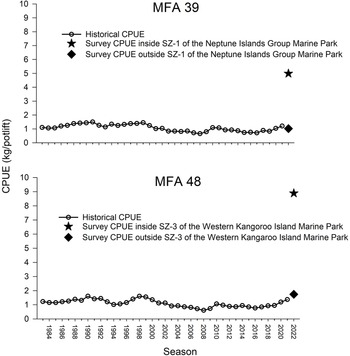
A total of 1,262 pots were set and sampled during the survey, resulting in 3,933 legal-sized lobsters being captured (Table 1). Catch rates inside the SZs were higher than those outside at both sampling locations as estimated by both weight and number (Table 1; Figures 2 and 3). Within SZ-1 of the Neptune Islands Group Marine Park, the legal-size catch rate was 4.99 kg/potlift, 389% higher than that recorded outside at 1.02 kg/potlift. Similarly, at Cape du Couedic inside SZ-3 of the WKIMP, catch rates were 8.89 kg/potlift, which was 411% higher than those outside SZ-3 at 1.74 kg/potlift (Table 1; Figure 2). These results were also similar to catch rates estimated by the number of lobsters per potlift inside and outside SZ-3 (Table 1; Figure 3).
Historical legal-size southern rock lobster catch per unit effort (CPUE; kg/potlift) within marine fishing areas (MFAs) 39 and 48, including 2022 survey results inside and outside of two marine park sanctuary zones.

Historical legal-size southern rock lobster catch per unit effort (CPUE; number/potlift) within marine fishing areas (MFAs) 39 and 48, including 2022 survey results inside and outside of two marine park sanctuary zones.

In total, 95% of all lobsters caught inside the SZs of both marine parks were of legal minimum length (≥105 mm carapace length) (Figure 4). Outside the SZs, in MFA 39 and 48, the percentage of legal-size lobsters recorded in the catch was 82% and 85%, respectively. For the Neptune Islands Group Marine Park, the legal-size mean weight of lobsters recorded from surveys was similar both inside (1.29 kg) and outside (1.21 kg) SZ-1 (Figure 5; Table 1). For the WKIMP, the mean weight of lobsters within SZ-3 was 1.42 kg, which was 25% higher than that recorded outside at 1.14 kg. Larger-sized lobsters were particularly dominant at this location, with 29% of all lobsters above 150 mm carapace length inside SZ-3 compared to 13% in this size category outside SZ-3.
Length frequencies of southern rock lobsters both inside and outside of two marine park sanctuary zones during the 2022 surveys. The vertical lines indicate the minimum legal size (MLS) of 105 mm carapace length.

Historical legal-size southern rock lobster mean weight within marine fishing areas (MFAs) 39 and 48, including 2022 survey results inside and outside of two marine park sanctuary zones.

Historical catch analysis
Survey catch rates within the SZs were considerably higher than historical catch rates from logbook data within each MFA (Figures 2 and 3). Within MFA 39, historical catch rates by weight ranged from 0.65 to 1.50 kg/potlift, with a mean of 1.07 kg/potlift between 1983 and 2021. At 4.99 kg/potlift, the survey catch rate within SZ-1 of the Neptune Islands Group Marine Park was 366% higher than the historical fishery mean. Similarly, logbook-derived catch rates in MFA 48 ranged from 0.61 to 1.60 kg/potlift, with a mean of 1.10 kg/potlift. This compares to 8.89 kg/potlift inside SZ-3 of the WKIMP, which is 708% higher than the historical fishery mean.
The mean weight of lobsters measured from surveys within the SZs was also consistently greater than historical mean weights calculated from logbook data (Figure 5). Within MFA 39, the mean weight of lobster ranged from 0.88 to 1.10 kg, with a long-term mean of 0.96 kg between 1983 and 2021. At 1.29 kg, the mean weight of lobsters estimated from surveys within SZ-1 of the Neptune Islands Group Marine Park was 34% higher than the fishery mean. Similarly, the annual mean weight of lobsters in MFA 48 derived from logbook data ranged from 0.87 to 1.10 kg between 1983 and 2021, with an overall mean of 0.96 kg. This compares to 1.42 kg inside the marine park, which is 48% higher than the historical fishery mean.
Discussion
Information on how a population responds in the absence of fishing offers valuable insight into the resource’s potential productivity. This study highlighted that lobster biomass within a temperate reef ecosystem increased considerably, in a relatively short timeframe, within a no-take SZ. The results are comparable to those recorded in other studies for southern rock lobster across its geographical range. In New Zealand, after 22 years of marine park establishment, southern rock lobster biomass was 25 times higher in no-take areas compared to fished locations (Shears et al., Reference Shears, Grace, Usmar, Kerr and Babcock2006), with Kelly et al. (Reference Kelly, Scott, MacDiarmid and Babcock2000) estimating a 9.5% per year increase in lobster densities inside protected areas. Within Australia, following a 10-year period of reserve implementation, J. edwardsii abundance in Tasmania increased 250% relative to fished areas (Barrett et al., Reference Barrett, Buxton and Edgar2009). Similar increases in lobster biomass have been reported from numerous MPAs in Australian waters over the past 25 years (Edgar et al., Reference Edgar, Barrett and Stuart-Smith2009; McLeay et al., Reference McLeay, Linnane, McGarvey, Bryars and Hawthorne2021; Young et al., Reference Young, Ierodiaconou, Edmunds, Hulands and Schimel2016).
Higher biomass levels in SZs are, in part, explained by the larger individual mean size of lobsters within protected areas. In the absence of commercial fishing, lobsters within SZs are afforded protection to grow to larger size classes compared to those located in areas available to fishing. Such differences in population size structure between fished and unfished areas are well documented for a range of lobster species globally (Spanier, Reference Spanier2024). Specific to the area of our study, McGarvey et al. (Reference McGarvey, Ferguson and Prescott1999) noted that some of the highest lobster growth rates in South Australia were recorded in the northern zone, thereby highlighting the productivity and growth potential of protected lobsters in this region.
Notably, the mean weight of lobsters surveyed outside the Neptune Islands Group SZ was similar to that recorded inside. These findings suggest a spillover effect into the surrounding fishing grounds as lobster densities within the SZ increase. Spillover of lobsters from protected areas has been observed from previous research with studies highlighting a ‘fishing the line’ effect whereby commercial fishing effort increases at the boundaries of areas closed to fishing (Bohnsack and Ault, Reference Bohnsack and Ault2002; Kelly et al., Reference Kelly, Scott and MacDiarmid2001; Murawski et al., Reference Murawski, Brown, Lai, Rago and Hendrickson2000). In South Australia, McGarvey (Reference McGarvey2003) quantified spillover rates and estimated that 62% of all lobsters tagged inside an SZ emigrated >3 km to nearby fished areas.
The marine park survey results are noteworthy in terms of the current biomass rebuilding objectives for the northern zone lobster fishery. Specifically, the catches recorded in SZs during our study highlight that, where commercial fishing is prohibited, the potential of temperate reefs to sustain high levels of lobster abundances is significant, with observed sanctuary biomass far exceeding that normally observed within fished areas. Projection modelling of the current harvest strategy indicates that catch rates within the fishery will double by 2036, with observed fishery values between 2019 and 2023 already showing a 72% increase (McGarvey et al., Reference McGarvey, Linnane, Feenstra, Matthews, McLeay, Jones, Toumazos and de Lestang S2024). The harvest strategy is underpinned by targeting a conservative level of exploitation rate (McGarvey et al., Reference McGarvey, Linnane, Matthews and Jones2017, Reference McGarvey, Matthews, Feenstra, Punt and Linnane2016) that accounts for known fishery recruitment trends in the region. Recruitment estimates used for projection modelling were attained from two sources. Recruitment in the first four projection years (2019–2022) used an observed 3-year relationship between puerulus settlement (the first benthic stage in the lifecycle) and legal-size recruitment to forecast indices from 2016 to 2019 (McGarvey et al., Reference McGarvey, Linnane, Feenstra, Matthews, McLeay, Jones, Toumazos and de Lestang S2024). Recruitment in subsequent projection years (2023–2036) was randomly resampled directly from historical (2003–2017) assessment model recruitment estimates. Years 2003–2017 were used as a historical period of recruitment resampling because lower recruitment in all Australian southern rock lobster fishery jurisdictions commenced around 2000 (Linnane et al., Reference Linnane, Smith, McGarvey, Feenstra, Matthews, Hartmann and Gardner2019). The outcomes of projection modelling highlight that when a conservative approach to resource management is adopted, the productivity of South Australia’s temperate reef ecosystem (Bennett et al., Reference Bennett, Wernberg, Connell, Hobday, Johnson and Poloczanska2015; Shepherd and Edgar, Reference Shepherd and Edgar2013) can lead to positive outcomes from a fishery perspective.
Estimates of recovery periods for J. edwardsii in South Australia are provided through the recurrent sampling undertaken at the Western Kangaroo Island SZ at Cape du Couedic. Despite not having a structured ‘before’ and ‘after’ sampling design (Smokorowski and Randall, Reference Smokorowski and Randall2017), previous sampling at this site gives some indication as to timeframes associated with biomass increases. The Western Kangaroo Island SZ was first sampled in 2017, 3 years after fishing was ceased in 2014 (McLeay et al., Reference McLeay, Linnane, McGarvey, Bryars and Hawthorne2021). Legal-sized catch rates within the SZ in 2017 were estimated at 2.59 kg/potlift, compared to 8.89 kg/potlift in 2022 (Table 1), reflecting a 243% increase in biomass in 5 years. Both these estimates are notably higher than the fishery mean for the MFA of approximately 1 kg/potlift. Overall, this result again highlights that where exploitation rates can be adequately controlled, considerable increases in lobster biomass can be expected within a relatively short timeframe.
Catch rate estimates in this study were based on unstandardised data. While such data can be influenced by factors like gear selectivity, fishing practices, and fleet dynamics (Maunder et al., Reference Maunder, Sibert, Fonteneau, Hampton, Kleiber and Harley2006), standardising northern zone CPUE for variables such as year, month, depth, MFA, mean weight, licence, and consumer price index produced a time series closely aligned with the unstandardised data (Linnane et al., Reference Linnane, McGarvey, Feenstra and Graske2018). This outcome supports the use of nominal catch rate as a reliable proxy for lobster abundance in this fishery.
The outcomes of marine park monitoring have provided indirect support to outcomes of harvest projection modelling previously undertaken for the fishery (McGarvey et al., Reference McGarvey, Linnane, Feenstra, Matthews, McLeay, Jones, Toumazos and de Lestang S2024). The projected catch rates of >2 kg/potlift had never been previously experienced in the history of the fishery with stakeholders questioning if such levels could actually be achieved in the northern zone. The northern zone fishery represents the western limit of southern rock lobster across its geographical range in south-east Australia. Consequently, levels of puerulus settlement, and subsequent recruitment into the fishable biomass, are low within the region compared to other jurisdictions (Linnane et al., Reference Linnane, Gardner, Hobday, Punt, McGarvey, Feenstra, Matthews and Green2010). In addition to low recruitment levels, the geological characteristics of the northern zone fishery indicate that typical lobster habitat is limited in the region. Unlike the southern zone fishery, which consists of continuous limestone reefs, ideal for maintaining high lobster densities, the northern zone largely consists of discrete and isolated granite or limestone formations, dispersed by vast areas of sand (Lewis, Reference Lewis1981), thereby restricting lobster fishing to specific locations in the zone. However, despite recruitment and habitat limitations, the results of this study highlight that the potential productivity of the region is significant and that existing reefs can sustain high levels of lobster abundance. This result is encouraging in terms of the biomass rebuilding strategy currently in place for the fishery. It indicates that with appropriate management, the productivity of the region is such that biomass can recover to significant levels. This can also be achieved within a relatively short period. The increased catch rates already experienced in the life of the current harvest strategy (a 72% increase in 4 years) support this. Our study also highlights the benefit of having marine park SZs as scientific reference sites that can inform fisheries management.
Harvest strategies that utilise explicit HCRs are well documented for a range of spiny lobster species across Australia and New Zealand (Breen et al., Reference Breen, Branson, Bentley, Haist, Lawson, Starr, Sykes and D’Arcy2016; McGarvey et al., Reference McGarvey, Matthews, Feenstra, Punt and Linnane2016; Penn et al., Reference Penn, Caputi and de Lestang S2015; Plagány et al., Reference Plagány, McGarvey, Gardner, Caputi, Dennis, de Lestang, Hartmann, Liggins, Linnane, Ingrid and Arlidge2018). Our research has provided a valuable insight into the potential of temperate reef ecosystems to sustain high levels of southern rock lobster in South Australia. It indicates that where harvest strategies apply appropriate HCRs that control exploitation rates, the habitat can deliver catch rates considerably higher than those observed historically. The spillover effect from SZs may also contribute to increases in the available fishable biomass.
Acknowledgements
The NZRLF’s Association assisted in the provision of commercial rock lobster fishing vessels to undertake marine park surveys. We thank Les Polkinghorne, skipper of fishing vessel Untouchable, and Dan Robinson, skipper of fishing vessel Satori. Kylie Howard (Dept. of Primary Industries and Regions South Australia) provided valuable and timely administrative support for data entry.
Author contributions
A.L. analysed the data, interpreted the findings, and wrote the article. L.M. designed the study and wrote the article. P.H. and D.G. collated the at-sea data. K.T. coordinated the commercial fishing vessels on behalf of the NZRLF’s Association. A.J. provided fishery management support for the surveys.
Funding
This research received no specific grant from any funding agency, commercial or not-for- profit sectors.
Competing interests
No potential conflict of interest was reported by the authors.



 Open access

