


Introduction
Qin emerged as one of the most successful states in the late Warring States period (316–221 BC), exerting a profound impact on later Chinese history. One strategic step during the unification of China under the Qin was the occupation of the present-day Sichuan basin in south-west China, home of the Shu State (Figure 1). The Sichuan basin was one of the most resource-rich regions in Bronze Age China (e.g. Sanxingdui), with prosperous agriculture, established bronze production and a large population. Historical documents (e.g. Records of History (《史记》司马迁)) record that the Qin conquest of Sichuan (316 BC) was likely resource driven. Following the conquest, a series of workshops was established in Sichuan by the Qin State, of which copper and copper alloys were the main products.
Distribution map of mou (a & b) and major states and sites mentioned in this study: 1) Shuangyuan; 2) Guanghua; 3) Metro Supermarket; 4) Baishou Road; 5) Qingjiang Road; 6) Xinfeng (figure by authors).

However, it remains uncertain to what extent these historical events affected local bronze production at Sichuan or contributed to unification. We argue that the Shu bronze production, especially objects made at local workshops, provides a unique angle to disentangle this issue. Our new scientific analyses show that although the casting technology remains similar to that of previous periods, alloying composition and the sources of copper and lead for bronze production changed after the conquest.
Nine bronze mou (鍪) unearthed from tombs in Guanghua Village and Metro Supermarket in Chengdu, dating from the late Warring States to Qin periods, were analysed. The presence of bronze mou (a typical Shu bronze vessel usually discovered in local elite tombs) illustrates a fine typochronological sequence. The dispersal of this vessel shows an increasing connectivity between Sichuan and central China after the Qin conquest (Figure 1a & b).
Typochronology of mou
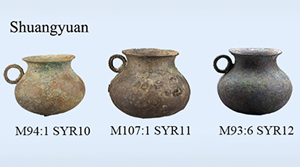
As illustrated in Figure 2, the earliest bronze mou have the largest handles (Type A). Around the middle Warring States period, mou are still characterised by the single handle, but it is smaller and attached to the lower part of the neck, with the broadest diameter on lower part of the body (Type B). The bellies of Type C vessels appear more bulging than Type B. The handle was subsequently moved from neck to shoulder and the maximum diameter of the body was pushed toward the middle, while the vessels were sometimes decorated by a raised line on the shoulder (Type D). Type E has two handles in different sizes (late stage of late Warring States to Qin). A combination of typology and excavation context shows that all the bronze mou derived from Guanghua Village and Metro Supermarket were made after the Qin conquest of Shu (Types D & E).
Typical bronze mou samples (figure by authors).

Transformation of the Shu bronze industry
Scanning electron microscopy with energy dispersive x-ray spectroscopy (SEM-EDS), metallography, multicollector inductively coupled plasma mass spectrometry (MC-ICP-MS) and inductively coupled plasma atomic emission spectroscopy (ICP-AES) are employed here. All samples are lead-tin bronze (Table 1), consistent with the prevailing alloying techniques in this and previous periods. Metallographic microstructures (Figure 3) exhibit casting structures, such as α dendrites with segregation and spherical lead inclusions, suggestive of room temperature casting and rapid cooling.
Chemical composition results of mou from Guanghua Village (GH) and Metro Supermarket (MS) (samples taken from the rim or handle of bronze mous).

Metallographic images of the mou samples from Guanghua (GH) and Metro Supermarket (MS) (figure by authors).

Figure 4a illustrates a reduction in the percentage of lead and tin in the mou from Guanghua Village and Metro Supermarket (late Warring States to Qin) compared to mou from Xindu Majia and Shuangyuan cemeteries (mid Warring States) (Wang et al. Reference Wang, Yang, Wang and Luo2024), probably due to strict administration post conquest. Similar low alloy percentages are also seen in the bronze mou from the Xinfeng Qin cemetery in Shaanxi (also dated to late Warring States) and from Paomadi M26 and M35 in Hubei (early Western Han, 206–141 BC) (Liu et al. Reference Liu, Xiao, Wang, Wang and Liu2018; Zhang et al. Reference Zhang, Wang, Jia and Jian-Li2019). Yet, on a broader scale, Qin vessels exhibit a higher average but wider variation in lead and tin content than Shu vessels (Figure 4a) also show an overall increase in tin content compared with earlier vessels from the mid-late Spring and Autumn periods (Figure 4b), raising questions about where Qin people obtained tin.
Differences in chemical composition between Shu and Qin vessels: a) Shu mou, Qin vessels, and Paomadi mou; b) alloy composition data of bronze vessels unearthed from Qin tombs in Eastern Zhou (figure by authors).

Lead isotope ratios of local bronzes decrease after the Qin conquest (compare Xinfeng, Guanghua Village and Metro Supermarket to Shuangyuan in Figure 5), indicative of a change in lead sources. Moreover, the isotopic consistency between the local mou and the Qin coinage recovered from the Shu region points to a shared supply of lead.
Comparison of lead isotope ratio of bronzes from Shu before and after the Qin conquest (figure by authors).

Impurity patterns illustrate the diachronic changes in copper resources used by the Shu culture during the Eastern Zhou period (770–221 BC) (after Pollard et al. Reference Pollard, Bray, Hommel, Hsu, Liu and Rawson2017). The same type of copper, characterised by silver and antimony impurities (Copper Group (CG) 4 & 7), was used consistently prior to the Qin conquest (Li et al. Reference Li2020), but post-conquest copper sources are characterised by silver and arsenic impurities (CG9 & 12) (Figure 6).
Statistical diagram of copper group percentage in Shu bronzes (figure by authors).

Conclusion and future prospects
While the current dataset is admittedly small, it is possible to argue that the Qin conquest of Shu had a substantial impact on local bronze production; precipitating a reduction in the tin content of bronze mous and a shift in copper or lead sources. The Qin State benefited from the rich resources of Sichuan, sustaining their own bronze production (e.g. Qin standardised weapons) that supported the annexation of other states. Meanwhile, subsequent unification of China facilitated communication between the Sichuan basin and the Yangzi and Yellow Rivers, as reflected by the increased distribution of the mou vessels (Figure 1b). The Qin-Shu interaction undoubtedly played a role in the integration of the Qin State of China, and more compositional and lead isotopic analyses of bronze could provide more insights into this turbulent period.
Acknowledgements
This research is supported by the National Social Science Foundation of China (No. 20VJXG018). Ruiliang Liu acknowledges the support by UK Research & Innovation and the European Research Council Synergy project Horsepower (EP/X042332/1 and 101071707).



