


Introduction
Vascular Dementia (VaD), the second most prevalent cause of dementia after Alzheimer’s disease (AD), is characterized by cognitive impairment caused by progressive vascular brain damage, including cerebral small vessel disease and recurring strokes (Wolters & Ikram, Reference Wolters and Ikram2019). Ample evidence exists that in VaD patients, already in an early stage, both global cognitive decline, and impairment of specific neurocognitive functions, such as information processing speed, attentional control and executive functions, occur (Hamilton et al., Reference Hamilton, Backhouse, Janssen, Jochems, Maher, Ritakari, Stevenson, Xia, Deary and Wardlaw2021; Sokolovič et al., Reference Sokolovič, Hofmann, Mohammad and Kukolja2023; Tian et al., Reference Tian, Zhang, Liu, Xue, Zhang, Tian, Fang, Fan, Li and Zhang2023). In contrast, in patients with early-stage VaD, little is known about the possible presence of impairments in social cognition, the neurocognitive domain that refers to the ability to perceive, evaluate and integrate social information and subsequently regulate behavior (Adolphs, Reference Adolphs2009; Frith & Frith, Reference Frith and Frith2012).
Social cognitive processes are associated with prefrontal and medial temporal brain regions, including the orbitofrontal and anterior cingulate cortex, insula, and amygdala (Adolphs, Reference Adolphs2002; Xu et al., Reference Xu, Peng, Luo and Gong2021). In patients with damage to these brain regions and broader associated networks, e.g. after acute injury such as a cerebrovascular accident, or in neurodegenerative diseases, impairments in social cognition often occur (Henry et al., Reference Henry, von Hippel, Molenberghs, Lee and Sachdev2016; McDonald et al., Reference McDonald, Wearne and Kelly2023). Such impairments can underlie social behavioral changes in patients and can have serious implications for social relationships, daily functioning and quality of life of both patients and close others (Desmarais et al., Reference Desmarais, Lanctôt, Masellis, Black and Herrmann2018; Henry et al., Reference Henry, von Hippel, Molenberghs, Lee and Sachdev2016; McDonald et al., Reference McDonald, Wearne and Kelly2023; Van den Berg et al., Reference van den Berg, Reesink, de Haan, Kremer, Spikman and Huitema2021).
A crucial aspect of social cognition is facial emotion recognition, which can be reliably assessed with neuropsychological tests. Emotion recognition impairments are well established in patients with AD and behavioral variant frontotemporal dementia (bv-FTD) in an early stage (Desmarais et al., Reference Desmarais, Lanctôt, Masellis, Black and Herrmann2018; Roheger et al., Reference Roheger, Brenning, Riemann, Martin, Flöel and Meinzer2022). As a matter of fact, impaired social cognition, including deficient emotion recognition, is a hallmark characteristic in patients with bv-FTD (Dilcher et al., Reference Dilcher, Malpas, O’Brien and Vivash2023; Dodich et al., Reference Dodich, Crespi, Santi, Luzzi, Ranaldi, Iannaccone, Marcone, Zamboni, Cappa, Cerami and Matias-Guiu2021). In contrast, there is very limited knowledge about emotion recognition in patients with early-stage VaD (Anor et al., Reference Anor, O’Connor, Saund, Tang-Wai, Keren and Tartaglia2017). Currently a gap exists between previous findings: to our knowledge, Shimokawa et al. (Reference Shimokawa, Yatomi, Anamizu, Ashikari, Kohno, Maki, Torii, Isono, Sugai, Koyama and Matsuno2000, Reference Shimokawa, Yatomi, Anamizu, Torii, Isono and Sugai2003) up until now were the only researchers who investigated emotion recognition and social cognition in patients with vascular dementia, and the patients in their sample were in a more advanced phase of the disease. Shimokawa et al. (Reference Shimokawa, Yatomi, Anamizu, Ashikari, Kohno, Maki, Torii, Isono, Sugai, Koyama and Matsuno2000, Reference Shimokawa, Yatomi, Anamizu, Torii, Isono and Sugai2003) reported clear deficits in emotion recognition, in addition to impairments in non-social neurocognitive functions. On the other hand, several more recent studies found evidence for of deficient emotion recognition in persons with stroke and substantial white matter hyperintensities (WMH), without a diagnosis of dementia, but which in time might progress to VaD (Aben et al., Reference Aben, Visser-Meily, Biessels, de Kort and Spikman2020; Adams et al., Reference Adams, Schweitzer, Molenberghs and Henry2019; Kynast et al., Reference Kynast, Lampe, Luck, Frisch, Arelin, Hoffmann, Loeffler, Riedel-Heller, Villringer and Schroeter2018).
Thus, knowledge whether social cognition, and particularly emotion recognition, is already impaired in patients with early-stage VaD is lacking, but crucial, given the potential negative consequences for patients and caregivers. Therefore, our first aim is to investigate whether these patients display emotion recognition impairments, compared to cognitively healthy older adults, but also to patients with early-stage AD and bv-FTD. A second aim is to study emotion recognition performance in relation to non-social neurocognitive functions (memory encoding and retrieval, information processing speed, and cognitive control as a measure of executive functions), and to compare profiles of impairments in VaD, AD and bv-FTD patients, with the overall aim to investigate whether profiles are generic or specific for different etiologies. We deem the latter as the more likely option, as we know that deficient episodic memory encoding and retrieval are characteristic for patients with AD and deficient information processing speed for patients with VaD (Baratono & Press, Reference Baratono and Press2023; Hamilton et al., Reference Hamilton, Backhouse, Janssen, Jochems, Maher, Ritakari, Stevenson, Xia, Deary and Wardlaw2021; Sokolovič et al., Reference Sokolovič, Hofmann, Mohammad and Kukolja2023; Tian et al., Reference Tian, Zhang, Liu, Xue, Zhang, Tian, Fang, Fan, Li and Zhang2023). Thus, this study is a first attempt to include social cognition in a neurocognitive profile of VaD, albeit not all-encompassing. Detailed knowledge about profiles of social and non-social cognition of different patient groups with early-stage dementia may greatly enhance their recognizability in the diagnostic stage in clinical practice.
Method
Participants
After approval of the ethics committee of the University Medical Center Groningen and in accordance with the Helsinki Declaration, between 2010 and 2024, patients were included from the Parelsnoer Initiative for Neurodegenerative Diseases (a Dutch national biomarker databank in which our center participated), after giving informed consent, as well as from anonymized archival neuropsychological data from our academic hospital memory clinic. Eighty-one patients were included, who were recently diagnosed with (early-stage) dementia, either of the VaD (N = 30), bv-FTD (N = 21), or AD (N = 30) type, according to the following diagnostic criteria:
-
Probable AD of the amnestic type: NIA-AA criteria (McKhann et al., Reference McKhann, Knopman, Chertkow, Hyman, Jack, Kawas, Klunk, Koroshetz, Manly, Mayeux, Mohs, Morris, Rossor, Scheltens, Carrillo, Thies, Weintraub and Phelps2011), without large cerebral infarctions, and WMH ≤ Fazekas 1.
-
Probable bv-FTD: Rascovsky criteria (Rascovsky et al., Reference Rascovsky, Hodges, Knopman, Mendez, Kramer, Neuhaus, van Swieten, Seelaar, Dopper, Onyike, Hillis, Josephs, Boeve, Kertesz, Seeley, Rankin, Johnson, Gorno-Tempini, Rosen and Miller2011).
-
Probable VaD: NINDS-AIREN criteria (Román et al., Reference Román, Tatemichi, Erkinjuntti, Cummings, Masdeu, Garcia, Amaducci, Orgogozo, Brun, Hofman, Moody, O’Brien, Yamaguchi, Grafman, Drayer, Bennett, Fisher, Ogata and Scheinberg1993), in which cerebrovascular disease (CVD; either small vessel disease, large infarctions, or combined cerebrovascular pathology) is the main cause of cognitive impairment, as objectified on neuroimaging and with a temporal relationship between onset of CVD and cognitive impairment.
Patients with cerebral autosomal dominant arteriopathy with subcortical infarcts and leukoencephalopathy, or cerebral amyloid angiopathy were not included. Patients were considered to be in an early disease stage when their scores on both the Mini Mental Status Examination (MMSE; Folstein et al., Reference Folstein, Folstein and McHugh1975) and Montreal Cognitive Assessment (MOCA; Nasreddine et al., Reference Nasreddine, Phillips, Bédirian, Charbonneau, Whitehead, Collin, Cummings and Chertkow2005) were not lower than 20 points or a comparable score on a Dutch screening tool (Cognitive Screening Test; De Graaf & Deelman, Reference De Graaf and Deelman1991). The MMSE was assessed in 110 out of 121 participants, this was either done by a trained geriatrician, neurologist, or neuropsychologist, during the neuropsychological (NP) assessment, or during the doctor’s assessment, which took place at most a few weeks before the extensive NP assessment.
The healthy control (HC) group was composed of forty participants ≥50 years, without cognitive complaints and MMSE ≥28, after giving informed consent for anonymous use of neuropsychological data and demographic characteristics. Patients and HCs were excluded in case of a major comorbid diagnosis affecting cognition (e.g. recent hospitalization with delirium, alcohol/drug abuse, or major psychiatric/neurological disorders, other than the current diagnosis, affecting (social) cognition.
Procedures and measures
Tests were administered by trained neuropsychologists, test assessors, or supervised clinical neuropsychology interns. All patients were tested on site in the memory clinic, in which the departments of Geriatrics and Neurology cooperate. Healthy control participants were tested in different locations (usually at home).
Emotion recognition
The Dutch version of the Ekman 60 Faces Test (EFT) was used to measure emotion recognition (Ekman & Friesen, Reference Ekman and Friesen1976; Young et al., Reference Young, Perrett and Calder2002). EFT contains sixty black and white photographs depicting six basic universal emotions (anger, disgust, fear, happiness, sadness, surprise) in male and female faces. Participants selected an emotion for each picture, using verbal labels, in either a computerized, or a booklet version, dependent on location of test assessment: all patients from the department of Neurology performed the computer version, whereas several patients from the department of Geriatrics and HCs performed the booklet version. A previous study demonstrated similar EFT performances in both versions (Strijkert et al., Reference Strijkert, Huitema and Spikman2022). For EFT-Total, we used the sum score (range 0–60), by adding the six emotion scores (range 0–10).
Neurocognitive measures
Episodic memory (encoding and retrieval) was assessed with the (Dutch) Auditory Verbal Learning Test (AVLT; Saan & Deelman, Reference Saan, Deelman, Bouma, Mulder, Lindeboom and Schmand2012). AVLT immediate recall (AVLT-IR), contains five trials of fifteen orally presented unrelated one-syllable nouns (range: 0–75). Delayed recall (AVLT-DR) was assessed after twenty minutes (range: 0–15). For information processing speed, Trailmaking Test A (TMT-A, in seconds) was assessed: participants were required to connect randomly distributed numbers (1–25) on paper in consecutive order as quickly as possible. In TMT-B (in seconds), participants were required to alternate between numbers and letters (1-A-2-B, etcetera). In case TMT-B was discontinued (e.g. due to inability to complete independently), a maximum time of 460 seconds was allocated, which was the maximum time recorded to complete TMT-B independently. For executive functions, a cognitive control index was computed by dividing TMT-B by TMT-A (TMT-B/A).
Data analysis
For all measures, we reported means and standard deviations (M&SD) of raw test scores, and age, sex and education adjusted Dutch norm percentile scores, which were subsequently converted to standardized Z scores (Schmand et al., Reference Schmand, Houx and De Koning2012; Voncken et al., Reference Voncken, Timmerman and Spikman2018). To account for AVLT-IR performance influencing AVLT-DR, we computed ‘AVLT-DR adjusted’: (AVLT-DR / (AVLT-IR/5)), subsequently standardized, by using M&SDs of the HC group (Z= (AVLT-DR adjusted – mean HC group AVLT-DR adjusted) (0.902 / standard deviation HC group AVLT-DR adjusted (0.247). In case TMT-B was discontinued, Z = −2.6 was used for TMT-B/A.
IBM SPSS version 28 was used for statistical analyses, with α ≤ .05, corrected for multiple comparisons when appropriate. Potential differences in age, sex and education were reported (M&SD) and assessed with univariate analysis of variance (ANOVA), or chi square tests. We analyzed whether patient groups and HCs differed significantly on mean Z norm scores on EFT-Total, AVLT-IR, AVLT-DR, AVLT-DR adjusted, TMT-A, TMT-B and TMT-B/A index score, using ANOVA and post hoc tests, Bonferroni corrected for multiple comparisons, with effect sizes (eta squared) reported. The performance profiles on the tests we assessed (mean Z scores), were visually represented in a radar chart per patient category (HC excluded). Finally, we ranked within each patient group, mean Z norm scores from most to least impaired and subsequently tested whether distances between these ranks differed significantly (Wilcoxon matched-pair signed ranks non parametric tests for related samples). Because AVLT-DR performance is influenced by AVLT-IR performance, the AVLT-DR adjusted variable was created. AVLT-DR adjusted was used in the radar chart and the analyses of the ranks instead of AVLT-DR. Because TMT-B is not purely a processing speed or executive function measure, we reported only TMT-A for processing speed and TMT-B/A as an executive measure.
Results
Clinical and demographic characteristics
Based on patient records, including radiologists’ reports of neuroimaging, the following clinical characteristics were found in the VaD group:
-
N = 20 VaD patients had both small vessel disease (as defined by WMH Fazekas grade 3) and brain infarctions
-
N = 4 VaD patients only had multiple infarctions (both cortical and subcortical) with at most minor to mild white matter hyperintensities (Fazekas 1–2)
-
N = 3 patients only had small vessel disease
-
N = 3 patients had at least one of both, but it remained unclear from the radiologists report whether combined pathology existed.
Furthermore, most patients had multiple cardiovascular risk factors and diseases (CVRD), including hypertension (N = 20 patients), cardiac disease (including myocardial infarction, N = 20 patients), diabetes (N = 7) and hypercholesterolemia (N = 7), and often multiple CVRD combined.
Table 1 shows comparisons between the three patient groups and controls: no significant differences for age, education, or sex were found. For MMSE a significant main effect was found. Post hoc group comparisons (Bonferroni corrected for multiple comparisons), showed that all three patient groups had significant lower scores on MMSE than the HC group (all p < .001), whereas between the patient groups, no significant differences were found on the MMSE.
Demographic characteristics (age, sex and level of education) and cognitive screening (MMSE) in HCs and VaD, bv-FTD and AD patients, testing group differences with ANOVA/Chi square test statistics and p-values (M & SD)

Note: HC = healthy control group, VAD = vascular dementia; bv-FTD = behavioral variant frontotemporal dementia, AD = Alzheimer disease. MMSE = Mini Mental Status Examination. Test statistics: F (Age, Education, MMSE), Chi square (Sex).
Emotion recognition
Table 2 displays EFT-Total test scores (M&SD) and mean Z norm scores. The ANOVA shows a significant main effect for Z EFT-Total (F (3,117) = 22.57, p < .001, η2 = 0.37). In post-hoc analyses (Bonferroni corrected for multiple comparisons), all patient groups had significant lower Z EFT-Total than HCs (p < .001). Bv-FTD patients had significant lower performances than AD patients (p < .01), VaD patients did not differ significantly from AD and bv-FTD patients.
Means and standard deviations and mean Z norm scores of emotion recognition (EFT), memory performance (AVLT-IR, AVLT-DR and DR adjusted for IR), processing speed (TMT-A, TMT-B) and cognitive control (TMT B/A) in HCs and VaD, bv-FTD and AD patient groups

Note: HC = healthy controls, VaD = Vascular Dementia. bv-FTD = behavioral variant Frontotemporal Dementia. AD = Alzheimer’s Disease.
M = Mean, SD = standard deviation. EFT = Ekman 60 Faces Test. AVLT = Auditory Verbal Learning Test, IR = Immediate Recal, DR = Delayed Recall,
DR adj.= DR adjusted for IR performance, see Methods. TMT-A and TMT-B= Trailmaking Test parts A & B, TMT-B/A= Part B divided by part A
Non-social neurocognitive performances
Between group comparisons
Table 2 displays neurocognitive test performances (M&SD, mean Z norm scores). ANOVA showed significant main effects with large effect sizes for AVLT-IR (F (3,114) = 34.99, p < .001, η2 = 0.48), AVLT-DR (F (3,114) = 23.27, p < .001, η2 = 0.38, AVLT-DR adjusted (F (3,114) = 16.81, p < .001, η2 = 0.31, TMT-A (F (3,115) = 12.89, p < .001, η2 = 0.25), TMT-B (F (3,115) = 32,36, p < .001, η2 = 0.48) and TMT-B/A (F (3,115) = 31,46, p < .001, η2 = 0.46), all for mean Z. In post-hoc analyses (Bonferroni corrected), all patient groups performed significantly lower than HCs on AVLT-IR, TMT-B and TMT-B/A (all p < .001). For, AVLT-DR, both VaD and AD patient groups performed significantly worse than the HC group (both p < .001), whereas for AVLT-DR adjusted, only AD patients performed significantly worse than HCs (p = .001). For TMT-A, VaD patients performed significantly worse than HCs (p < .001), as well as AD patients compared to HCs (p = .01).
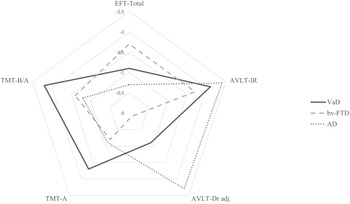
Regarding comparisons between patient groups, AD patients performed significantly lower than bv-FTD patients on both AVLT-IR (p < .02) and AVLT-DR (p < .001), not than VaD patients. On AVLT-DR adjusted, AD patients performed significantly lower than both bv-FTD (p = .001) and VaD patients (p < .01). On neither of the AVLT measures, significant differences were found between VaD and bv-FTD patient groups. Furthermore, on TMT-A, the VaD group had significant lower performance than both the bv-FTD and AD patient groups (both p < .04), whereas on TMT-B, the VaD group only had significant lower performance than the bv-FTD group (p = .02). No significant differences between patient groups were found for TMT B/A; the AD and bv-FTD groups did not differ significantly on any of the TMT measures. These findings are visually presented in the radar chart in figure 1.
Radar chart representing neurocognitive profiles for the VaD, bv-FTD and AD groups, with mean Z norm scores (sex, age, education adjusted) for EFT-total, AVLT-IR, AVLT-DR adjusted, TMT-A and TMT-B/A.

Within group comparisons of social and non-social neurocognitive performances
Finally, in Table 3, the order of impairment within each group, per test performance (ranked from most to least impaired) is displayed. Subsequently we tested possible differences in ranks with Wilxocon matched-pair signed ranks non-parametric tests for related samples (α corrected Bonferroni corrected for multiple comparisons).
Ranked mean Z norm scores in patients with VaD, bv-FTD and AD using Wilcoxon matched-pair signed ranks tests (Bonferroni corrected)

Note: VaD = Vascular Dementia. bv-FTD = behavioral variant Frontotemporal Dementia. AD = Alzheimer’s Disease. EFT = Ekman 60 Faces Test. AVLT-IR = Auditory Verbal Learning Test- Immediate Recall. AVLT-DR adj.= Auditory Verbal Learning Test – Delayed Recall adjusted. TMT-A = Trailmaking Test part A. TMT-B/A= Trailmaking Test Part B divided by part A.
-
In all three patient groups, none of the subsequent ranks significantly differed from each other.
-
As is shown in Table 3, in the VaD group, both TMT B/A and AVLT-IR did significantly differ in rank to both EFT-Total and AVLT-DR adjusted.
-
In the bv-FTD group, both EFT-Total and AVLT-IR differed significantly from TMT-A and AVLT-DR adjusted, as did EFT-Total, AVLT-IR and TMT-B/A from AVLT-DR adjusted.
-
Finally, in the AD group, AVLT-IR ranked significalty different from TMT-B/A, TMT-A and EFT-Total, as did AVLT-IR, AVLT-DR adjusted and TMT-B/A from TMT-A and EFT-Total.
Discussion
This study is the first to assess social cognition in patients with early-stage VaD: we investigated whether emotion recognition is impaired, and how this compares to performance of patients with early-stage AD and bv-FTD. Furthermore, we compared social cognition performance to other relevant neurocognitive domains (i.e. memory encoding and retrieval, information processing speed and cognitive control), which was a first attempt to create profiles of social and non-social neurocognitive functions, and assess between group differences, aiming to enhance the recognition of VaD, AD and bv-FTD in clinical practice. We deem these questions highly relevant: evidence is accumulating that impaired social cognition can have severe consequences for well-being, relationships and independent living (Desmarais et al., Reference Desmarais, Lanctôt, Masellis, Black and Herrmann2018; Henry et al., Reference Henry, von Hippel, Molenberghs, Lee and Sachdev2016; McDonald et al., Reference McDonald, Wearne and Kelly2023; Van den Berg et al., Reference van den Berg, Reesink, de Haan, Kremer, Spikman and Huitema2021). However, up until now there is only evidence of deficient emotion recognition in patients with VaD in an advanced phase (Shimokawa et al., Reference Shimokawa, Yatomi, Anamizu, Ashikari, Kohno, Maki, Torii, Isono, Sugai, Koyama and Matsuno2000, Reference Shimokawa, Yatomi, Anamizu, Torii, Isono and Sugai2003), and it is unknown whether social cognition is impaired in patients with early-stage VaD and how this compares to impairments in other neurocognitive domains.
Our main finding is that emotion recognition is clearly impaired in patients with early-stage VaD, compared to cognitively healthy older adults, after adjusting for (differences in) age, education and sex, with VaD performance in between the levels of impairment in the AD and bv-FTD groups, who both also perform significantly lower than healthy controls. Bv-FTD patients perform significantly worse than AD patients, as was expected based on previous findings (Dodich et al., Reference Dodich, Crespi, Santi, Luzzi, Ranaldi, Iannaccone, Marcone, Zamboni, Cappa, Cerami and Matias-Guiu2021), but no differences are found between the VaD and AD groups, or the VAD and bv-FTD groups. Hence, this study shows that emotion recognition impairments are as prevalent in early-stage VaD as in other dementias. Furthermore, our findings bridge the gap between previous findings of impaired social cognition in patients with advanced VaD, first demonstrated by Shimokawa et al., (Reference Shimokawa, Yatomi, Anamizu, Ashikari, Kohno, Maki, Torii, Isono, Sugai, Koyama and Matsuno2000, Reference Shimokawa, Yatomi, Anamizu, Torii, Isono and Sugai2003), and in persons with neurovascular impairment, such as stroke, or high WMH burden, without dementia (Aben et al., Reference Aben, Visser-Meily, Biessels, de Kort and Spikman2020; Adams et al., Reference Adams, Schweitzer, Molenberghs and Henry2019; Kynast et al., Reference Kynast, Lampe, Luck, Frisch, Arelin, Hoffmann, Loeffler, Riedel-Heller, Villringer and Schroeter2018). Our findings confirm the findings by Shimokawa et al., (Reference Shimokawa, Yatomi, Anamizu, Ashikari, Kohno, Maki, Torii, Isono, Sugai, Koyama and Matsuno2000, Reference Shimokawa, Yatomi, Anamizu, Torii, Isono and Sugai2003) and add that emotion recognition is also impaired in patients with early-stage VaD.
A possible explanation of the occurrence of emotion recognition impairments in persons within the broad range of Vascular Cognitive Impairment, is that not only strategic damage (e.g. after stroke), but also deterioration of cerebral white matter tracts might contribute: these tracts, including the inferior fronto-occipital fasciculus and superior longitudinal fasciculus, are crucial in connecting brain structures involved in social cognition, such as prefrontal and limbic areas (Desmarais et al., Reference Desmarais, Lanctôt, Masellis, Black and Herrmann2018; Wang et al., Reference Wang, Metoki, Alm and Olson2018; Xu et al., Reference Xu, Peng, Luo and Gong2021). This is corroborated by Kynast et al. (Reference Kynast, Lampe, Luck, Frisch, Arelin, Hoffmann, Loeffler, Riedel-Heller, Villringer and Schroeter2018) who found clearly impaired social cognition (Theory of Mind) in persons with quite severe WMH (Fazekas 3), compared to persons with less severe WMH (Kynast et al., Reference Kynast, Lampe, Luck, Frisch, Arelin, Hoffmann, Loeffler, Riedel-Heller, Villringer and Schroeter2018).
As a second aim, we investigated a profiles of impairment in social and non-social cognition (i.e. episodic memory encoding and retrieval, information processing speed and cognitive control as a measure of executive functions) in patients with early-stage VaD and compared this profile to that of patients with AD and bv-FTD in a comparable disease stage. Whereas in previous studies prominent impairments in episodic memory encoding and retrieval were established in patients with early-stage AD, impaired information processing speed in patients with VaD, and impaired social cognition in patients with bv-FTD (Dilcher et al., Reference Dilcher, Malpas, O’Brien and Vivash2023; Dodich et al., Reference Dodich, Crespi, Santi, Luzzi, Ranaldi, Iannaccone, Marcone, Zamboni, Cappa, Cerami and Matias-Guiu2021; Hamilton et al., Reference Hamilton, Backhouse, Janssen, Jochems, Maher, Ritakari, Stevenson, Xia, Deary and Wardlaw2021; Sokolovič et al., Reference Sokolovič, Hofmann, Mohammad and Kukolja2023; Tian et al., Reference Tian, Zhang, Liu, Xue, Zhang, Tian, Fang, Fan, Li and Zhang2023), up until now, this picture was incomplete due to the lack of studies in which social cognition was investigated in patients with early-stage VaD. Indeed, our novel findings add that three profiles of impairments appear, with differences between groups regarding the magnitude and order of impairment.
First, it is of note that memory encoding and cognitive control are among the most impaired functions in all three groups, compared to other neurocognitive performances (in the range of mean Z −1.7 to −2.4 for memory encoding and Z −1.2 to −2.2 for cognitive control). In the VaD group, cognitive control and memory encoding are significantly more impaired than emotion recognition and episodic memory retrieval, but not processing speed, for which the magnitude of impairment is in between that of the other performances in this group. VaD patients did have significant lower information processing speed performances than bv-FTD and AD patients. Second, in accordance with previous studies (Baratono & Press, Reference Baratono and Press2023; Sokolovič et al., Reference Sokolovič, Hofmann, Mohammad and Kukolja2023), in the AD group, episodic memory encoding and retrieval are most impaired, significantly more so than impaired information processing speed and emotion recognition. Here, cognitive control performance is in between other performances. Moreover, memory encoding and retrieval performance in the AD group are significantly lower than in the VaD and bv-FTD groups. Finally, in bv-FTD patients, in particular impairments in emotion recognition and memory encoding are significantly more pronounced than memory retrieval, whereas information processing speed and cognitive control are in between other performances. Furthermore, emotion recognition performance is significantly lower in the bv-FTD group than the AD group.
Thus, broadly speaking, as we hypothesized based on previous findings (Baratono & Press, Reference Baratono and Press2023; Sokolovič et al., Reference Sokolovič, Hofmann, Mohammad and Kukolja2023), information processing speed is most distinctively impaired in the VaD group, emotion recognition in the bv-FTD group, and episodic memory retrieval in the AD group, in addition to generic impairments in memory encoding and cognitive control in all three groups. Our findings newly include social cognition to the profile of neurocognitive functioning, which further aids differentiation of often encountered patient groups with neuropsychological assessment in clinical practice (Hamilton et al., Reference Hamilton, Backhouse, Janssen, Jochems, Maher, Ritakari, Stevenson, Xia, Deary and Wardlaw2021; Sokolovič et al., Reference Sokolovič, Hofmann, Mohammad and Kukolja2023; Strijkert et al., Reference Strijkert, Huitema and Spikman2022; Tian et al., Reference Tian, Zhang, Liu, Xue, Zhang, Tian, Fang, Fan, Li and Zhang2023). Hereby, our findings reaffirm the messages of Cotter et al. (Reference Cotter, Granger, Backx, Hobbs, Looi and Barnett2018) and McDonald et al. (Reference McDonald, Wearne and Kelly2023) that social cognition is a “transdiagnostic issue” which needs addressing in both research and clinical practice (Cotter et al., Reference Cotter, Granger, Backx, Hobbs, Looi and Barnett2018; McDonald et al., Reference McDonald, Wearne and Kelly2023). Many brain structures are involved in facial emotion recognition, which in essence is the processing of complex social information, known to be particularly vulnerable to deterioration after brain damage, including in different types of dementia (Cotter et al., Reference Cotter, Granger, Backx, Hobbs, Looi and Barnett2018; McDonald et al., Reference McDonald, Wearne and Kelly2023).
Compared to AD and bv-FTD, patients with VaD are underrepresented in research and without a solid scientific basis, they risk being underserved in treatment and guidance after diagnosis, in particular regarding negative consequences of impaired social cognition. Unfortunately, studies investigating potentially effective social cognition treatment and guidance are scarce for patients with dementia and their caregivers. In our opinion, this should be an important topic for future research, with, in addition to emotion recognition, a broad scope of aspects of social cognition (e.g. ToM, affective empathy), as well as measures of consequences for daily living (e.g. managing social relationships).
The main limitation of this study is the small sample size, yielding concerns about generalizability and limits more in-depth analysis of different subtypes within the broader diagnostic categories (e.g. subtypes of VaD). Furthermore, even though patients groups did not significantly differ on the demographic characteristics we assessed (age, level of education and sex), our VaD group was male dominated (70%), which does not align with sex differences in overall dementia prevalence, or with VaD in particular (Huque et al., Reference Huque, Eramudugolla, Chidiac, Ee, Ehrenfeld, Matthews, Peters and Anstey2023). Following clinical practice, we accounted for the potential influence of differences in demographic characteristics by using relevant norm scores (Saan & Deelman, Reference Saan, Deelman, Bouma, Mulder, Lindeboom and Schmand2012; Schmand et al., Reference Schmand, Houx and De Koning2012; Voncken et al., Reference Voncken, Timmerman and Spikman2018). However, this procedure does not account for social economic status and cultural and ethnic backgrounds, known to be associated with differing prevalences of cardiovascular risk factors and diseases (CVRD), which in turn are associated with higher incidence of cognitive impairment and dementia (Livingston et al., Reference Livingston, Huntley, Liu, Costafreda, Selbæk, Alladi, Ames, Banerjee, Burns, Brayne, Fox, Ferri, Gitlin, Howard, Kales, Kivimäki, Larson, Nakasujja, Rockwood, Samus and Mukadam2024). Aforementioned factors are being investigated in large cohort studies, however often without incorporating social cognition.
Conclusion
In conclusion, emotion recognition is impaired in patients with early-stage VaD, as well as in patients with AD and bv-FTD. In VaD patients, severity of impairment is intermediate between that of AD and bv-FTD patients. Addition of emotion recognition to neuropsychological assessment in clinical practice, discerns these patient groups from each other, based on their differing profiles of impairments in social and non-social neurocognitive functions: patients with early-stage VaD are most distinctly impaired on information processing speed, patients with early-stage AD on episodic memory retrieval and early-stage bv-FTD on social cognition. With these results, we emphasize the importance of systematic assessment of social cognition in all patients with (suspected) dementia visiting the memory clinic, including VaD, and to address social cognitive impairment in consultation and treatment.
Funding statement
None.
Competing interests
We declare no competing interests.




 Open access

