





1. Introduction
Attitudes express psychological evaluations that show a degree of favour or disfavour towards a specific entity (Eagly & Chaiken, Reference Eagly, Chaiken, Gilbert, Fiske and Lindzey1998). Language attitudes (henceforth, LA) express positive or negative evaluations or preferences towards a linguistic stimulus and are complex, socially embedded cognitive constructs (Coronel-Molina, Reference Coronel-Molina2014). Language variation is an interesting venue to tap into speakers’ LA. Indeed, a part of LA research has investigated how language variability is perceived with different variants representing “alternate ways of saying the same thing” (Labov, Reference Labov1972:188). The use of one variant as opposed to another may depend on different factors. For example, bilingual children may choose one variant over another to accommodate to their interlocutor’s language choices via pragmatic adjustments (Ghimenton et al., Reference Ghimenton, Chevrot and Billiez2013), or the variants produced may be forms of alignment in conversations (Garrod & Pickering, Reference Garrod and Pickering2004). Children start producing variation early (see review in Sim & Post, Reference Sim, Post and Babatsouli2024), and this reflects the process of language socialisation through their interactions with different interlocutors in their social circles, starting with their caregivers and later on with their peers.
LAs are influenced by processes of language standardization (Bouchard Ryan & Giles, Reference Bouchard Ryan and Giles1982; Garrett, Reference Garrett2010) which push towards uniformity and perceived correctness (Gadet, Reference Gadet2007; Milroy & Gordon, Reference Milroy and Gordon2003). Normative variants are supported by “elite” ideologies, impacting LA preferences (Bouchard Ryan & Giles, Reference Bouchard Ryan and Giles1982). Philosopher Michel Foucault wrote extensively on the pressures towards conformity and on the power exerted by institutions on the individuals (Foucault, Reference Foucault1975). Schools fall under this category and are places of socialisation where the normative variants are promoted in discourses of correctness produced by teachers, yielding metalinguistic reflections on the appropriate uses of language. These discourses are undoubtedly influenced by prescriptive grammar and writing (Chervel, Reference Chervel1977, Reference Chervel2008; Gadet, Reference Gadet2007). Yet school is also a context where children are socialised with their peers and are in contact with heterogeneous language practices. Nardy et al. (Reference Nardy, Chevrot and Barbu2014) showed this influence in a longitudinal study conducted in a French classroom setting investigating production and the evaluation of three linguistic variables: optional liaisons, optional deletion of post-consonantal /ʁ/ in final word position and the optional deletion of /l/ in the clitic pronoun context. The 4–5-year-olds in the sample did not converge towards the teacher’s production, which contained more standard variables, but rather to the one of the most popular peers, which in that context contained more non-standard variants. Despite this, the children’s evaluations remained stable throughout the length of the study. Moreover, some linguistic variants may carry systematic socio-indexical patterns in both production and perception, meaning that an individual may associate a non-linguistic attribute (gender, popularity, and intelligence) to the use of that particular linguistic variant (Ochs, Reference Ochs, Stigler, Shweder and Herdt1990). For example, in French, the realisation of both adverbial elements in the construction of negation (ne … pas) may be perceived as a speech feature of an individual who has a well-paid job and a high status in society (Gadet, Reference Gadet2007).
Numerous studies on LA have investigated the developmental patterns underpinning the emergence of preferences towards the normative variants: In some studies from different linguistic communities, 8 years appears to be a pivotal age where children start to prefer standard variants over non-standard ones (Kinzler & DeJesus, Reference Kinzler and DeJesus2013). Findings from bidialectal communities have shown a different scenario, indicating that children expressed preferences for standard variants between ages 3 and 6 (Day, Reference Day1980; Fehér, Reference Fehér2020; Rosenthal, Reference Rosenthal1974). Further, in a Francophone setting, Barbu et al. (Reference Barbu, Nardy, Chevrot and Juhel2013) investigated the evolution in 2- to 6-year-old monolingual children’s production and evaluation of standard and non-standard variants in metropolitan France. They found that only the 5–6-year-old children from higher socioeconomic status (SES) families preferred the standard variants. Investigating how 5- to -12-year-old children develop their socio-semiotic landscapes, Vaughn and Becker (Reference Vaughn and Becker2024) showed that the children’s perception and categorisation of variation become increasingly more fine-grained with age as their language experience and socialisation widen.
Differences between studies in the sociolinguistic contexts investigated, in the nature of the linguistic variables (syntactic, lexical, and phonological), in the definition of concepts like monolingualism and bilingualism, and finally in the method designs may explain the variability in their results. In addition, very few studies, if any, have been conducted in metropolitan France where monolingual and bilingual children’s LA towards linguistic variation are compared, i.e., comparing monolingual and bilingual school-going children’s LA development to see if their respective language experiences, within their monolingual or bilingual socialisation contexts, influence the way their language preferences unfold over time.
This paper aims to fill this gap and reports the results from an experiment conducted in metropolitan France investigating the emergence of monolingual and bilingual children’s language-based preferences towards sociolinguistic variables attested in the developmental literature available. The aim is twofolded. First, we document the factors that influence the emergence of LA towards normative and non-normative variants within the same language (French) through one explanatory regression model. Second, we examine whether LA towards language variation unfolds in similar or different ways in bilingual and monolingual children. In the next sections, we present a brief review of the literature on the socio-psychological foundations of the development of LA, reporting the results from studies on LA towards different linguistic variables and non-linguistic factors that may influence LA. We then present the research method, report the results, and discuss the factors explaining the children’s LA’s developmental trajectories.
1.1. A developmental approach to the emergence of attitudes towards linguistic variables
Children are sensitive to the variation in the input and show preferences towards their L1 or familiar accents until the age of 5 (Kinzler & DeJesus, Reference Kinzler and DeJesus2013). Their exposure to the linguistic variants used in their language environment influences their LAs measured in terms of their preferences towards one rather than the other variant. LA towards phonological variables are by and large the most documented, in particular in psychology and sociolinguistic studies on language variation. In France, the focus has been placed primarily on judgements on large-scale diatopic or diastratic variation of French (perceptions of two varieties of French spoken in Jura versus in Toulouse (Girard et al., Reference Girard, Floccia and Goslin2008); alternation between standard and non-standard realisations of the post-consonantal /ʁ/ (Chevrot et al., Reference Chevrot, Beaud and Varga2000) or of optional liaisons (Nardy, Reference Nardy2008). Barbu et al. (Reference Barbu, Nardy, Chevrot and Juhel2013) investigated both the production and perception of obligatory and optional liaisons in Francophone monolingual children aged between 2 and 6 years. Via a matched-guise protocol, the children had to indicate their preferences between either the normative or the non-normative variant. The results showed that as early as 3, children’s judgements and productions are intimately linked, regardless of their respective social backgrounds. However, by age 5, the children’s social backgrounds impacted both their productions and judgements. The authors suggest that although children are capable of evaluating different linguistic forms at an early age, they are not necessarily capable of decoding the indexical value carried by standard and non-standard liaison variants.
Kinzler and DeJesus’s (Reference Kinzler and DeJesus2013) speaker evaluation design study comparing American monolingual Anglophone children’s perceptions (aged 5–6 and 9–10) of northern (prestigious) and southern accents (non-prestigious) showed that the youngest in their sample preferred their home variety, regardless of the variants’ prestige. However, the older children (9-year-olds), regardless of their geographical provenance, preferred the English variants of prestige. In particular, speakers of the Northern variety were perceived as being more intelligent than speakers with an accent from the south, who were viewed merely as “nice.” By age 9, the children aligned their preferences with those found in adults (Preston, Reference Preston, Bauer and Trudgill1998), favouring the more prestigious accents rather than less prestigious ones. Investigating LA in a Francophone Belgian school context, Lafontaine (Reference Lafontaine1986) tested liaisons (phonological) as well as lexical and morphological variables and showed that by age 12, preteens prefer the prestigious variants. In addition, the children’s LA matched the “institutional stance” towards the local varieties: the teachers in the school manifested the same preference patterns as the 12-year-olds, notwithstanding their own effective use of local regional features, the latter being viewed negatively. In another sociolinguistic context where one prestigious variety is in contact with a regional and less prestigious one, Cremona and Bates (Reference Cremona and Bates1977) investigated children’s (6–10-year-old) preferences towards standard Italian, the prestige variety, compared to the local dialect. While the 6-year-olds in this study had equal preferences towards Italian and the local dialect, the 8-year-olds favoured the standard (100% preference rates), even if these preferences did not reflect their effective practices. Similarly, in the British context, Giles et al. (Reference Giles, Hewstone and Ball1983) noticed that by the time they were 10 years old, children from Bristol preferred Received Pronunciation, the prestige variety, over Welsh English.
Other findings in bidialectal contexts showed that preferences for the normative variants may emerge even earlier: Day (Reference Day1980) and Rosenthal (Reference Rosenthal1974) showed that children as early as 3 were already able to express language-based social awareness by preferring the prestigious variants. Kinzler et al. (Reference Kinzler, Shutts and Spelke2012) suggested that early emergence of social awareness may be due to a bidialectal or bilingual sociolinguistic context, which may awaken children’s LA earlier than in monolingual contexts. Indeed, Rosenthal (Reference Rosenthal1974) found that children’s social awareness becomes more sophisticated between 3 and 5 years as they express preferences towards the normative, mainstream American English in contrast with African American Vernacular English. In bidialectal Austria, however, Kaiser and Kasberger’s (Reference Kaiser and Kasberger2014) investigation showed another result based on a discrimination protocol of phonological and lexical variables: the 7–8-year-old Austrian German children in their cohort preferred the standard varieties. In another bidialectal sociolinguistic situation in Switzerland, Häcki Buhofer and Studer (Reference Häcki Buhofer and Studer1993) tapped into primary school children’s preferences towards lexical variants from two varieties in the German-speaking Canton. In their study, they found that 6-year-old children did not express any specific preferences towards any particular variety. Yet, by age 7, children preferred standard German, and from 8 years onwards, they manifested attitudes favouring the regional variety over the standard one.
The contrasting sociolinguistic contexts and the different nature of the linguistic variables tested (phonological, lexical, morphophonological, etc.) may explain the different results reported hitherto. However, considering the results altogether, it would appear that a preference towards the prestigious variables emerges between the ages of 3 and 12 years.
1.2. Socioeconomic status, bilingualism and language prestige as factors influencing children’s attitudes
SES has been well documented in developmental literature on language perceptions (Day, Reference Day1980; Lambert et al., Reference Lambert, Frankle and Tucker1966; Nardy et al., Reference Nardy, Chevrot and Barbu2014; Rosenthal, Reference Rosenthal1974). The way this factor has been operationalised in the literature reveals a particularly complex, socioculturally specific phenomenon. Related to the family’s SES is the parents’ level of instruction because of the “symbolic capital” (Bourdieu, Reference Bourdieu1979) it carries in relation to social mobility afforded via higher levels of education. The parents’ professions have also been considered as pertinent criteria for the establishment of social classes (see among others Barbu et al., Reference Barbu, Nardy, Chevrot and Juhel2013; Barbu et al., Reference Barbu, Martin and Chevrot2014; Chevrot et al., Reference Chevrot, Beaud and Varga2000). Sometimes used as a proxy for SES, the mothers’ level of education seems to have a noticeable influence on both production (Hoff, Reference Hoff2006; Hoff et al., Reference Hoff, Laursen, Tardif and Bornstein2002) and judgements and attitudes (Barbu et al., Reference Barbu, Nardy, Chevrot and Juhel2013; Kaiser & Kasberger, Reference Kaiser and Kasberger2018). In Kaiser and Kasberger (Reference Kaiser and Kasberger2018), three SES groups were established depending on the mothers’ degree: low (no high school diploma), middle (high school diploma) and high (university/college degree). Although this factor has been dealt with in varying ways, most of the literature available limits this factor to two categories: high or low SES, often based on the mother’s profession. Yet societal trends show that mothers are increasingly involved in the workforce. Nardy (Reference Nardy2008) indicated that in France, in 2008, 82.3% of women aged 25–49 were employed. This indicates that childcare is increasingly shared by both parents, meaning that the father’s role should better be accounted for.
Being monolingual or bilingual has also been investigated as a potential factor affecting LA, yet its influence is less clear. Souza et al. (Reference Souza, Byers-Heinlein and Poulin-Dubois2013) compared 4–6-year-old monolingual and bilingual preferences towards non-native and accented native speech samples. They found that preferences for in-group members using a familiar language variety were shared by both monolinguals and bilinguals and that bilinguals did not manifest greater social flexibility compared to monolinguals. Byers-Heinlein et al. (Reference Byers-Heinlein, Behrend, Said, Girgis and Poulin-Dubois2017) investigated whether 4–6-year-old monolingual and bilingual children’s preferences were impacted by their bilingual status and by the mono/bilingual status of their interlocutors. Children in their sample had to choose the speaker they wanted to be friends with after listening to two verbal stimuli produced either by monolingual and bilingual adults or by two monolinguals. Monolinguals showed preferences towards monolingual speakers. Bilinguals displayed similar preferences towards monolinguals who used their dominant language.
The influence of language prestige was also discussed as a potential factor influencing LA. Yet, DeJesus et al. (Reference DeJesus, Hwang, Dautel and Kinzler2017) found no influence on preferences based on language status and found that children, monolinguals and bilinguals, preferred productions from native-accented speakers. In her investigation on status-based preferences in Hungary, Fehér (Reference Fehér2020) found that by the age of 6, both monolingual and bidialectal children preferred the standard variety over the local dialect.
Lambert et al. (Reference Lambert, Frankle and Tucker1966) conducted a large-scale study (373 French Canadian girls between the ages of 9 and 18) in Canada aiming to understand at what age negative LAs emerged. In this particular context and at the time of the study, English was considered to be the most prestigious language. Children aligned their preferences with this mainstream view by the age of 12. Particularly stable were the LAs of the “upper-class” bilingual girls in private schools. Yet, this factor should be handled with caution because Anisfeld and Lambert’s (Reference Anisfeld and Lambert1964) study yielded different results: bilinguals did not show any preferences towards the prestigious variety, whereas monolinguals did. This factor thus needs further supporting evidence with a greater control of other (potentially confounding) factors of variation presumed to influence attitudes (SES, influence of institutions like schools, definition of bilingualism, etc.).
1.3. Research questions and hypotheses
A few gaps appear in the literature concerning LAs’ developmental agenda. Firstly, monolinguals’ LA have been studied extensively: they are generally asked to express their preferences between two variants of a linguistic variable (involving mainly phonetic variation within the same language system). Although some studies have explored more than one variable (e.g., Vaughn & Becker, Reference Vaughn and Becker2024, for an experiment with children, and Buson et al. (Reference Buson, Nardy, Muller and Chevrot2018) with adults), LAs from monolinguals are by far and large the most documented. Secondly, should bilingual or bidialectal individuals be involved, they are asked to categorise speakers of prestigious or less prestigious varieties in their environment (Dekker et al., Reference Dekker, Duarte and Loerts2021; Kaiser & Kasberger, Reference Kaiser and Kasberger2014; Rosseel et al., Reference Rosseel, Speelman and Geeraerts2018). Furthermore, comparisons between studies are difficult because these have been conducted in sociolinguistic contexts with contrasting sociopolitical ideologies and historical specificities.
In our study, we focus on different points of variation (morphosyntactic, morphophonological, and phonetic) within one language variety, metropolitan French, by asking primary school monolinguals and bilinguals living in France to express their preferences towards the 5 sociolinguistic constructions selected in the study (see Methods section for the linguistic constructions). In light of the literature presented, the following research questions were addressed and hypotheses tested.
RQ1: Do children’s LAs unfold at the same time regardless of the linguistic construction involved?
Hypothesis 1: LA literature suggests that eight is a pivotal age for the emergence of preferences for the normative variants, but LAs have mainly been documented by using phonetic variables. Considering that different linguistic levels show different developmental trajectories, children’s LAs vary depending on the linguistic construction evaluated.
RQ2: What factors explain the variation in children’s preferences for the normative variants?
Hypothesis 2: We hypothesise that the factors documented in the literature in different models influence children’s LAs differentially. While they are highlighted separately in different studies, combining them in a single regression model can provide a holistic and better articulated view of the emergence of LA in monolingual and bilingual children.
2. Methods
2.1. The sociolinguistic context of the study: language variation in France
France is well known for its monolingual ideology (Hélot, Reference Hélot, Helot and de Mejia2008). Significantly, the French language has a specific mention in the second article of the French constitution stating that it is the national language of France. In addition, the “standard ideology,” particularly vigorous in France, valorises uniformity in the language practices and is highly influenced by prescriptive rules, where writing norms are considered the most valued forms, associated with the production of speakers with a high social status (Gadet, Reference Gadet2007). The prescriptive pressures for producing correct forms as opposed to supposedly deviant ones thus influence perceptions on how speakers should speak, potentially leading to a social depreciation of alternative non-standard forms, in particular those present in spontaneous, ordinary speech. Combining a variationist approach in his analysis of the phenomena of variation in oral French, Laks (Reference Laks2000) discussed the sociological and structural underpinnings of different variables and illustrated how variants are placed differentially on the social scale, depending on their status in the linguistic market (Bourdieu, Reference Bourdieu1979).
Regardless of the standard ideology sketched above, sociolinguistic studies have documented variation phenomena in ordinary language practices in both adults and children. An emblematic point of variation is the negation construction, where in monitored speech both adverbial particles (ne… pas) are maintained whilst the ne deletion is characteristic of spoken French (Gadet, Reference Gadet1989). In their corpus study, Blanche-Benveniste and Pallaud (Reference Blanche-Benveniste and Pallaud2001) observed that both adults and children omit the first part of the negation construction in 80% of the cases in informal interactions. Children thus bathe in heterogeneous practices where both standard and non-standard forms circulate, even in interactions in institutional contexts where the standard forms are expected (Nardy et al., Reference Nardy, Chevrot and Barbu2014). This heterogeneity has been documented in previous developmental sociolinguistic studies where children at school are confronted with heterogeneous practices on a daily basis because, on the one hand, teachers tend to use more standard forms of French when adopting a teaching stance (Bigot & Maillard, Reference Bigot and Maillard2014; Buson & Nardy, Reference Buson and Nardy2020) but, on the other hand, may use non-standard forms of the negation in conversations with the children or other adults present in the classroom (Buson et al., Reference Buson, Nardy, Rousset and Zhang2023). Interestingly, in Bigot and Maillard’s (Reference Bigot and Maillard2014) qualitative inquiry in primary and secondary teachers’ discourses, it was found that teachers’ production of the standard form of the negation construction increased as the learners got older. This gradual increase in the production of standard forms could suggest that teachers adjust the quantity of their monitored speech according to the learners’ stylistic and metalinguistic development.
The five linguistic constructions used in this study (see Materials section), documented extensively in the literature, have been chosen because (1) they all have a standard/normative and non-standard/non-normative form, and (2) they circulate in various spaces of socialisation and their availability does not depend on the exposure to a particular, geographically constrained (social) dialect.
2.2. Participants
We initially enrolled 143 monolingual and bilingual children from metropolitan France, using a snowball sampling recruitment procedure (Milroy & Gordon, Reference Milroy and Gordon2003). Following the general personal data protection regulations (registered number 2-201108), once every parent was informed of the project, they filled out and signed a consent form authorising the collection and the use of anonymous data. All participants were healthy individuals with no declared audition problems. Both parents’ levels of education were used as a proxy for the children’s SES. Children whose parents had school-level education only were assigned to the lower-class background. Children who had one parent with graduate-level education and the other parent with a lower level of education were classified as low-to-middle-class. Children whose parents had graduate-level education (bachelor’s degree in the French education system) or higher were placed in the middle-to-upper-class background. This tripartite categorisation was an attempt to include a more holistic measure of the family’s cultural capital through both parents’ level of education, in tune with current trends where women and men are involved in childcare. Twenty-four children from the initial sample whose SES was not completed were excluded. The only child in 5th grade (153 months old) was also excluded from this initial sample. In the remaining 118 participants, the children’s choices were sometimes ambiguous, as either both or neither one of the variants were selected. Ten of these ambiguous answers were produced by one 61-month-old child, who was consequently excluded from the sample. Further, all “Other” responses were excluded (the full procedure is provided in the Supplementary Material).
These answers represented 2% (N = 46) of the total number of choices (N = 2223). Figure 1 gives a bird’s-eye view of the distribution of the responses in our sample, according to the linguistic components under study. It clearly appears that word-final post-consonantal /ʁ/ (PostC-R: 37/468) generated the highest number of “Other” responses.
Response distribution in the sample (117 children, mean age = 103.5, SD = 21.39, range: 63–143).

Figure 1. Long description
A grid of 15 scatter plots organized by social class in rows and linguistic categories in columns.
Axes and Legend:
* The horizontal X axis represents Age in months, ranging from 70 to 142.
* The vertical Y axis represents response types: Normative, Non-normative, and Other.
* Column headers from left to right: Interrogative Pronoun, Negative Adv. Particle, Optional Liaisons, Word-final post cons. /ʁ/, and Relative Pronoun.
* Row labels from top to bottom: lower-class, low-middle-class, and middle-to-upper-class.
* Legend: Linguistic background is indicated by shape, with solid squares for bilingual and hollow squares for monolingual. Sex is indicated by color, with orange for Girls and purple for Boys.
Data Distribution:
* Across all panels, the highest density of data points is concentrated in the Normative row, followed by the Non-normative row. The Other row contains very few sparse data points.
* The middle-to-upper-class row at the bottom shows the highest overall density of participants across all five linguistic categories compared to the lower-class and low-middle-class rows.
* Data points are distributed fairly evenly across the age range from 70 to 142 months in most categories.
* In the Word-final post cons. /ʁ/ column, there is a slightly higher frequency of Other responses compared to the other linguistic categories, particularly in the lower-class and middle-to-upper-class rows.
The final sample comprised 117 children aged between 63 (5;3) and 143 (11;11) months: 46 monolingual Francophones (20 girls, 26 boys) and 71 bilingual children (35 girls and 36 boys). The mean age for girls was 103.01 months (range: 63–141, SD = 20.33) and for boys 103.93 months (range: 63–143, SD = 22.45). Approximately half of the cohort came from a middle-to-upper-class background. Additional information on the final sample is provided in the Supplementary Material.
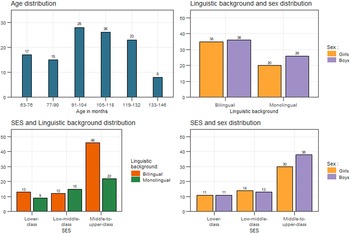
Figure 2 reports the distribution of the participants according to the target demographic, socioeconomic and sociolinguistic constructions of our study: age, sex, linguistic background and SES.
Distribution of the participants (N = 117) in the final sample according to different age groups, sex, linguistic background and SES.

Figure 2. Long description
The display consists of four bar charts.
Top-left panel: Age distribution. The x-axis shows age in months and the y-axis shows participant count. Data points are: 63 to 76 months has 17 participants, 77 to 90 has 15, 91 to 104 has 28, 105 to 118 has 26, 119 to 132 has 23, and 133 to 146 has 8.
Top-right panel: Linguistic background and sex distribution. The x-axis lists Bilingual and Monolingual groups. A legend identifies orange bars as Girls and purple bars as Boys. Bilingual group includes 35 girls and 36 boys. Monolingual group includes 20 girls and 26 boys.
Bottom-left panel: S E S and Linguistic background distribution. The x-axis lists S E S categories: Lower-class, Low-middle-class, and Middle-to-upper-class. A legend identifies orange bars as Bilingual and green bars as Monolingual. Lower-class has 13 bilingual and 9 monolingual. Low-middle-class has 12 bilingual and 15 monolingual. Middle-to-upper-class has 46 bilingual and 22 monolingual.
Bottom-right panel: S E S and sex distribution. The x-axis lists the same three S E S categories. A legend identifies orange bars as Girls and purple bars as Boys. Lower-class has 11 girls and 11 boys. Low-middle-class has 14 girls and 13 boys. Middle-to-upper-class has 30 girls and 38 boys.
2.3. Bilingual participant recruitment and sample
Before presenting the bilingual children of our sample, we should consider how the monolingual/bilingual categories were operationalised in this study. First of all, it is challenging to draw a clear divide between monolingualism and bilingualism (Mackey, Reference Mackey1962; Surrain & Luk, Reference Surrain and Luk2019) or between monodialectalism and bidialectalism (Chevrot & Ghimenton, Reference Chevrot, Ghimenton, De Houwer and Ortega2019). In addition, when dealing with primary school-going children’s repertoires, it is equally difficult to find children who are completely monolingual, i.e., children who have had no contact with another language besides their first language. Indeed, learning of a foreign language is compulsory in the French school curriculum, and this begins at the age of 6 years. Despite these challenges, all children who spoke only French at home and attended a French-medium school were considered monolingual. Although it is a multifaceted concept comprising multiple features (Byers-Heinlein et al., Reference Byers-Heinlein, Esposito, Winsler, Marian, Castro and Luk2019; Surrain & Luk, Reference Surrain and Luk2019), bilingualism is defined here quite categorically as the regular use of two languages in an individual’s daily life (Grosjean, Reference Grosjean, Grosjean and Li2013). The bilingual children in the sample were recruited following De Houwer’s (Reference De Houwer2009) classification of the patterns of bilingual acquisition and socialisation, as they were declared by their caregivers: (1) Children in the “Bilingual First Language Acquisition” (BFLA) category had two languages from birth; (2) Children in the “Early Second Language Acquisition” (ESLA) category started with one language spoken at home and were introduced to the second language within their second birthday; (3) Children in the “Late Second Language Acquisition” (LSLA) category started with one language and then were introduced to the second language from 6 years onwards.
The 71 bilingual children in our sample had the following language acquisition profiles: 18 BFLA children; 52 ESLA children and 1 LSLA child. The ESLA category had two different languages at the onset of acquisition: it was either French or another family language to which the children were exposed first, before being introduced to a second language between ages 2 and 6 upon entering kindergarten. Three children in our sample were emergent bilinguals, as they came from Francophone families who had enrolled the child in a bilingual French–English kindergarten from age 2 onwards. The only Late Second Language child started learning French at school at age 6 and had at least 3 years of schooling in the French system. Because he attended a monolingual school, used both Lithuanian and French at home and had received at least 8 hours of French daily in a formal school setting for 3 consecutive years, we considered that he had sufficient cumulative experience of French for this particular perception study. Table 1 summarises the children’s home language(s) and school setting. We have reported the home languages as they were declared by the children’s caregivers. For example, none of the Chinese families specified the dialectal variety they spoke at home.
Bilingual children’s language background and exposure: Home language(s) and school settings and children’s language acquisition profile (Bilingual First Language Acquisition, Early Second Language Acquisition, Late Second Language Acquisition)

Table 1. Long description
The table is divided into four main sections based on acquisition profiles.
1. B F L A (Bilingual First Language Acquisition) with 18 children total. All have French-Chinese home languages. 3 attend a Bilingual School and 15 attend a Monolingual French School.
2. E S L A (Early Second Language Acquisition) where French was acquired between 2 and 6 years, with 26 children total.
- Bilingual School: 5 Chinese and 1 Spanish home language speakers.
- Monolingual French School: 3 Diankhanké, 9 Chinese, 2 Russian, and 6 Turkish home language speakers.
3. E S L A where French was acquired from birth and a second language (L 2) was introduced between 2 and 6 years, with 26 children total.
- Bilingual School: 2 Chinese and 4 English home language speakers.
- Monolingual French School: 5 Chinese, 10 Arabic, 4 Kabyle, and 1 Turkish home language speakers.
4. L S L A (Late Second Language Acquisition) where French was acquired in school at age 6 for at least 3 years, with 1 child total. This child has a Lithuanian-French home language and attends a Monolingual French School.
a The children attending a bilingual school were exposed to both French and their home language. For example, in the first BFLA case, the three children attending a bilingual school were exposed to French and to six additional hours in Chinese in their school curriculum.
b Three were emergent bilingual children who belonged to Francophone families and who attended a bilingual French-English school. The fourth child in this context had bilingual parents who used French at birth and then added English when the child went to a bilingual kindergarten.
The children had different language pairs and came from language backgrounds that do not usually fall under the typical label of “elite bilinguals” (De Mejía, Reference De Mejía2002), except for the 4 English–French children and one Spanish–French bilingual child. However, the question of elite bilingualism is a complex one, as elitism is socially constructed and evolves along with the host society’s perceptions and ideologies. For example, Codó and Sunyol (Reference Codó and Sunyol2018) documented the changes in discourses of elitism produced in a Spanish community towards a Chinese community, through an ethnography of children enrolled in an international school in Barcelona. Despite the complexity underpinning elite bilingualism, this was not considered to be problematic, as our study was not centred on language proficiency and maintenance of the minority family language but was focused rather on the perception and categorisation of variation in French, the language that all the children had in common and to which they had exposure in school and in wider social circles.
In addition, in the French context, the majority of schools have a monolingual language instruction mode, yet some schools have a bilingual program where children receive six additional hours of language instruction in another language (see Ghimenton et al. (Reference Ghimenton, Cohen and Minniear2023) for a study on the bilingual French–English habitus in children enrolled in a French international primary school). The children in our sample were enrolled in a bilingual program that involved their home language, except for the three emergent bilinguals who came from Francophone families but were exposed to English since they were 2 years old.
2.4. Materials
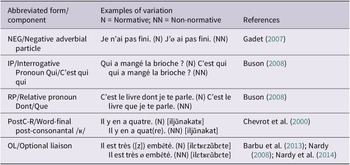
A PowerPoint presentation was used to project the experiment using a laptop computer. Each slide contained two identical female faces on a white background (see Figure 1 in Supplementary Material). A female vocal stimulus was associated with each female face. Each slide corresponded to one trial in which two sentences (stimuli) were presented, one after the other. Both expressed the same semantic meaning, but one was a normative realisation of one of the five phonetic or syntactic constructions, and the other a non-normative realisation. The constructions are well documented in both sociolinguistic and psycholinguistic literature, see Table 2 (see also Müller (Reference Müller1989) and Gadet (Reference Gadet2007) for a comprehensive account of variation in French). For example, there were two realisations of the sentence il est très embêté: in the first possible realization, the optional liaison was realised [ilɛtʁɛzɑ̃bɛte], whereas in the second it was not [ilɛtʁɛɑ̃bɛte]. The stimuli (see Supplementary Material for the stimuli list) were produced by the same female adult talker who was a French L1 speaker and was familiar with both linguistic variants. Each sentence lasted no longer than 3 seconds. The stimuli were presented in counterbalanced order (slide order and normative/non-normative presentation order). Five linguistic constructions were considered: their abbreviated forms appearing in Table 2 will be henceforth used in the body of this paper. The terms “component”/“construction” are used rather than “variable” for the sake of clarity, since in our statistical models, NEG, IP, RP, PostC-R and OL are the five levels of a single categorical variable playing the role of a predictor of the participants’ choices.
The five linguistic components investigated in the study

Table 2. Long description
The table is organized into three columns: Abbreviated form/component, Examples of variation (N equals Normative; N N equals Non-normative), and References.
* Row 1: N E G / Negative adverbial particle. Examples: Je n'ai pas fini. (N) and J’ø ai pas fini. (NN). Reference: Gadet (2007).
* Row 2: I P / Interrogative Pronoun Qui / C'est qui qui. Examples: Qui a mangé la brioche ? (N) and C'est qui qui a mangé la brioche ? (NN). Reference: Buson (2008).
* Row 3: R P / Relative pronoun Dont / Que. Examples: C'est le livre dont je te parle. (N) and C'est le livre que je te parle. (NN). Reference: Buson (2008).
* Row 4: Post C dash R / Word-final post-consonantal /ʁ/. Examples: Il y en a quatre. (N) [iljɑ̃nakatʁ] and Il y en a quat(re). (NN) [iljɑ̃nakat]. Reference: Chevrot et al. (2000).
* Row 5: O L / Optional liaison. Examples: Il est très ([z]) embêté. (N) [ilɛtʁɛzɑ̃bɛte] and Il est très ø embêté. (NN) [ilɛtʁɛɑ̃bɛte]. References: Barbu et al. (2013); Nardy (2008); Nardy et al. (2014).
As mentioned in the sociolinguistic presentation of the context, the linguistic variables included in this set are all typical of the French metropolitan area and circulate in various spaces of socialisation, including school, as the alternation between normative and non-normative forms is the fruit of inter- and intra-individual stylistic variation.
2.5. Procedure
Children first performed a working memory task involving numbers and words in order to test whether they were capable of storing two sentence stimuli in their working memory (BALE – Batterie analytique du langage écrit, www.cognisciences.com). All the children were capable of performing the test, and once completed, they participated in the experiment comprising 20 trials (4 trials per linguistic construction). Before the experiment started, the investigator explained the task to the child and ran two practice trials. Following Barbu et al. (Reference Barbu, Nardy, Chevrot and Juhel2013) experimental design, the task was introduced by the investigator as follows: “In each slide, you will hear two sentences, one after the other. After hearing both sentences, you must say which one of the two speakers spoke best.” For each trial, the investigator showed the pair of identical female faces and played the voice stimuli by pointing at the corresponding face. Once the child heard both stimuli, s/he pointed towards the stimulus that best matched the answer to the investigator’s question. The task was filmed in order to capture the child’s choice, that either corresponded to a normative or non-normative production. Once the child completed all 20 trials, the investigator asked what s/he thought of the sentences. For one of the variables, the RP dont/que, only 3 trials were taken into consideration due to a technical failure. Our final results are thus based on 19 sentence pairs and not on 20, as initially expected.
2.6. Modelling speaker preferences
Adopting a confirmatory approach to assess predefined hypotheses, we performed statistical modelling of the participants’ preferences toward the normative or non-normative variants of the 5 linguistic components.
We worked with R (R Development Core Team, 2023) and the following packages of functions: lme4 (Bates et al., Reference Bates, Maechler, Bolker and Walker2015), lmerTest (Kuznetsova et al., Reference Kuznetsova, Brockhoff and Christensen2017), DHARMa (Hartig, Reference Hartig2022), emmeans (Lenth, Reference Lenth2023), ggplot2 (Wickham, Reference Wickham2016), and sjPlot (Lüdecke, Reference Lüdecke2023). The workflow used to analyse this sample is available in the Supplementary Material.
We considered a mixed-effects logistic regression model (Barth & Kapatsinski, Reference Barth, Kapatsinski, Speelman, Heylen and Geeraerts2018; Levshina, Reference Levshina2015; Speelman, Reference Speelman, Glynn and Robinson2014) to account for the participants’ two possible answers: preference for the normative or the non-normative variant of the linguistic component presented. We defined our binary dependent variable, RESPONSE, as follows: 0 means preferring the non-normative variant and 1 preferring the normative variant.
We included the following fixed predictors, which translate both our linguistic cases of interest and the several demographic, socioeconomic, and sociolinguistic factors we want to investigate:
-
• The categorical variable LING_VAR, with 5 levels corresponding to the different linguistic components under study: NEG, IP, RP, PostC-R, and OL
-
• The categorical variable SES, with 3 levels: lower-class, low-middle-class, and middle-to-upper-class
-
• The categorical variable SEX, with two levels: boy and girl
-
• The categorical variable MONO_BI, with two levels: monolingual and bilingual
-
• The continuous variable AGE in months
One can note that many studies in LA treat age as a categorical variable (after binning), but beyond, in many sociolinguistic and psycholinguistic studies, this choice is by and large unmotivated (Bowie, Reference Bowie2014; Eckert, Reference Eckert2014; Macaulay, Reference Macaulay2009). We chose to keep age as continuous since binning means losing potentially valuable information and scaled it in the model to ease convergence.
Given our research questions and our willingness to conduct an integrative investigation of our various parameters, in addition to main effects we also included in our model all possible 10 (simple/double) interactions between the predictors: LING_VAR:SES, LING_VAR:SEX, LING_VAR:MONO_BI, LING_VAR:AGE, SES:SEX, SES:MONO_BI, SES:AGE, SEX:MONO_BI, SEX:AGE, and MONO_BI:AGE. We did not consider higher-level interactions due to the complexity of their analysis.
Based on the literature reported above, we expected:
-
• a facilitator effect of SES: the higher the class, the more adherence to the normative variants
-
• an interaction between AGE and SEX: girls prefer normative forms before boys
-
• an interaction between AGE and MONO_BI: bilingual children prefer the normative forms before monolinguals
With respect to the non-independence of our observations given the by-subject and by-item (i.e., in our case, by-sentence pairs) groupings, we considered random effects in addition to the previous fixed effects. Our key variables were named ID for the participants (with 117 levels) and SENTENCE_PAIR for the pairs of sentences (with 19 levels). To remain conservative when formulating conclusions, we compared different models to determine the best random-effects structure – with appropriate random intercepts and random slopes – given our fixed effects, considering Barr (Reference Barr2013) and Barr et al. (Reference Barr, Levy, Scheepers and Tily2013)’s maximalist stance and Bates et al. (Reference Bates, Kliegl, Vasishth and Baayen2018)’s more pragmatic recommendations.
We eventually ended with a converging model with two crossed random intercepts for ID and SENTENCE_PAIR and a single categorical random slope: LING_VAR for ID. The step-by-step procedure is described in detail in Supplementary Material.
Following the usual syntax in lme4 in R, our final model can be written as:
RESPONSE ~ LING_VAR + scale(AGE) + MONO_BI + SEX + SES +
LING_VAR:SES + LING_VAR:SEX + LING_VAR:MONO_BI + LING_VAR:AGE + SES:SEX + SES:MONO_BI + SES:AGE + SEX:MONO_BI + SEX:AGE + MONO_BI:AGE + (0 + LING_VAR | ID) + (1 | SENTENCE_PAIR)
[Family: binomial (logit)]
We verified that our model satisfied the assumptions of logistic regressions. We then assessed the significance of the various fixed effects. In particular, we derived estimated marginal means for the groups corresponding to the various levels of our categorical predictors in order to assess significant differences between them. p-Values were adjusted when performing multiple tests.
3. Results
We first investigated the higher-level predictors of the model, i.e., the ten two-way interactions. The first four interactions tested were between one categorical variable and the continuous variable (age). Given that none of these interactions were significant, we focused on age as a main effect. It was highly significant (z = 4.407, p < .0001), with children gradually growing into preferring the normative variants, all other things considered equal. A one-month increase in age was associated with a 0.0216 increase on the log-odds linear scale (95% confidence interval [0,012–0,0312]). Figure 3 reports predicted values on the probability scale for the different levels of the categorical variables. This figure also illustrates that the probability of preferring the normative variant for OL among monolingual girls was very high regardless of age. Conversely, the increase in preference for the normative variants over time was most obvious for RP. One can further note the children’s indecision concerning IP, particularly among girls and boys from the lower and low-middle-class.
Individual predicted probabilities of preference for the normative variants and population mean curves by age, linguistic variable, sex, linguistic background and SES. Each mean curve reported is based on fixed effects only, i.e., all random effects are set to zero. Ninety-five percent confidence intervals (CIs) are also based on the fixed effects and their uncertainty only.

Figure 3. Long description
The multi-panel display consists of 60 individual plots arranged in 6 rows and 10 columns.
Axes and Scale
* The vertical Y axis represents Predicted Probabilities ranging from 0.0 to 1.0 in increments of 0.2.
* The horizontal X axis represents Age in months ranging from 70 to 142.
Column Organization (Linguistic Variables and Background)
The columns are paired by linguistic variable, with each pair showing bilingual then monolingual data.
* Columns 1 and 2: Interrogative Pronoun (black curves).
* Columns 3 and 4: Negative Adv. Particle (green curves).
* Columns 5 and 6: Optional Liaisons (blue curves).
* Columns 7 and 8: Word-final post cons. /ʁ/ (grey curves).
* Columns 9 and 10: Relative Pronoun (red curves).
Row Organization (Sex and S E S)
* Rows 1 to 3: Girls, categorized by Lower-class, Low-middle-class, and Middle-to-upper-class.
* Rows 4 to 6: Boys, categorized by Lower-class, Low-middle-class, and Middle-to-upper-class.
Data Trends
Each plot contains individual data points as open circles, a solid mean curve representing fixed effects, and a shaded area representing the 95 percent confidence interval.
* Most curves show a positive linear or asymptotic increase in probability as age increases.
* The steepest upward trajectories are generally observed in the Middle-to-upper-class rows (rows 3 and 6), particularly for Relative Pronouns and Interrogative Pronouns.
* Negative Adv. Particle (green) and Optional Liaisons (blue) often start at higher baseline probabilities (above 0.4) compared to other variables.
* Monolingual columns frequently show slightly higher predicted probabilities or steeper maturation curves than their bilingual counterparts across most S E S levels.
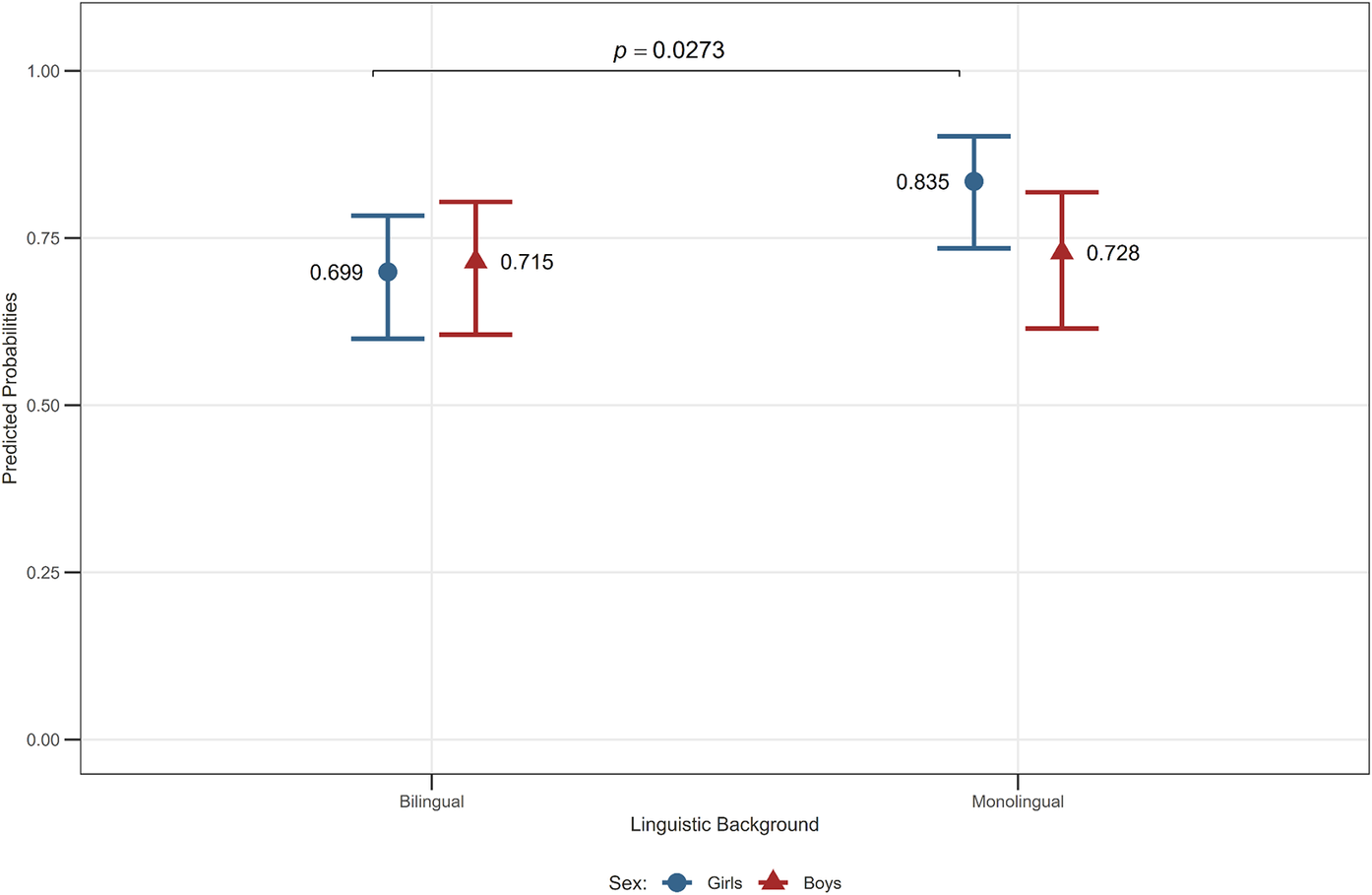
As for interactions between categorical variables, we first found the effect of the linguistic background on children’s preference for the normative variants to be modulated by sex. Multiple comparisons with a “mvt”Footnote 1 adjustment suggested that a single difference was significant, between monolingual and bilingual girls (z = −2.784, p = .0273) (see Figure 4). For monolingual girls, the probability of choosing the normative variants reached 83.5% (95% CI [73.5%–90.2%]), while it was only 69.9% (95% CI [59.9%–78.3%]) for bilingual girls (averaging the effect of the linguistic variable, age, and SES).
Linguistic Background × Sex Interaction plot for predicted probabilities of favouring the normative variants, with 95% confidence error bars. The single significant contrast is indicated at the top of the figure.

Regarding the 2 × 3 interaction between linguistic background and SES, two significant pairwise differences involved monolinguals from the middle-to-upper class. As illustrated in Figure 5, their probability of preferring the normative variants (85.5%, 95% CI [75.9%–91.3%]) was significantly higher than that of bilinguals (65.1%, 95% CI [48.1%–79.1%]) (z = −3.251, p = .014) and monolinguals from the low-middle-class (62.7%, 95% CI [42.5%–79.3%]) (z = −3.336, p = .0104). Interestingly, only the 95% confidence interval of the marginal mean for low-middle-class monolingual and bilingual children included 50%, and thus one cannot reject the hypothesis of a possible random choice for these groups.
Linguistic Background × SES Interaction plot for predicted probabilities of favouring the normative variants, with 95% confidence error bars. Only significant contrasts are indicated.

Figure 5. Long description
An interaction plot with the y-axis labeled Predicted Probabilities ranging from 0.0 to 0.9 and the x-axis labeled Linguistic Background with two categories: Bilingual and Monolingual. A legend at the bottom identifies three S E S groups: lower-class represented by blue circles, low-middle-class by grey triangles, and middle-to-upper-class by red squares. All data points include 95 percent confidence error bars.
In the Bilingual group on the left:
- Middle-to-upper-class has the highest probability at 0.757.
- Lower-class is in the middle at 0.707.
- Low-middle-class is the lowest at 0.651.
In the Monolingual group on the right:
- Middle-to-upper-class is highest at 0.852.
- Lower-class is nearly equal at 0.837.
- Low-middle-class is significantly lower at 0.627.
Statistical significance markers:
- A horizontal bracket connects the Bilingual middle-to-upper-class point to the Monolingual middle-to-upper-class point with a p-value equal to 0.014.
- In the Monolingual group, a small bracket connects the lower-class and middle-to-upper-class points with a p-value equal to 0.0104.
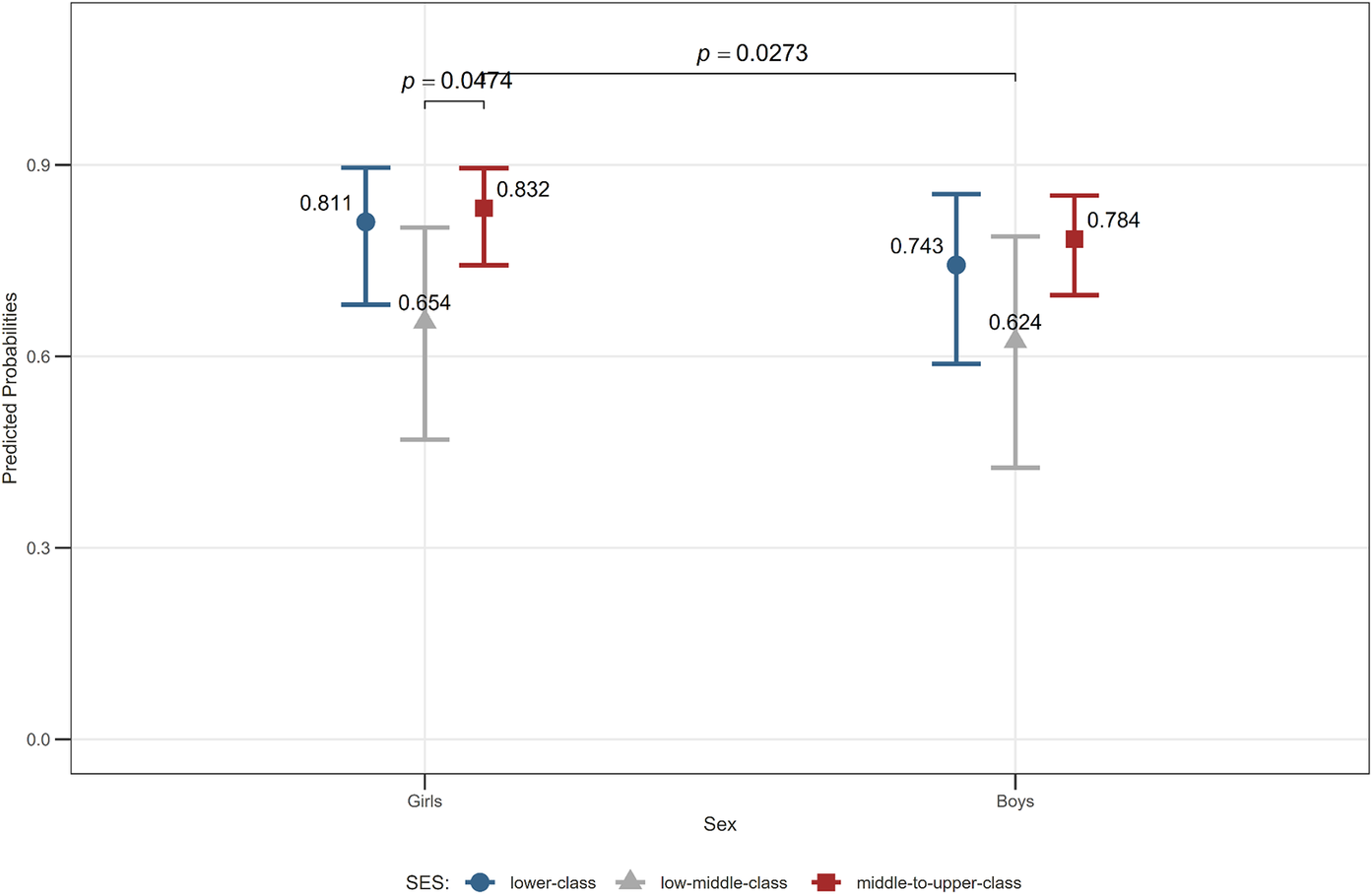
As for the 2×3 interaction between sex and SES (see Figure 6), the probability of preferring the normative variants was significantly higher for girls from the middle-to-upper class (83.2%, 95% CI [74.3%–89.5%]) than for girls (65.4%, 95% CI [47.0%–80.2%]) (z = −2.854, p = .0475) and boys (62.4%, 95% CI [42.5%–78.8%]) (z = −3.042, p = .0275) from the low-middle-class. No significant differences emerged between the other social conditions. The 95% confidence interval of the marginal means for low-middle-class girls and boys both include 50%.
Sex × SES Interaction plot for predicted probabilities of favouring the normative variants, with 95% confidence error bars. Only significant contrasts are indicated.

Figure 6. Long description
An interaction plot with the Y axis labeled Predicted Probabilities ranging from 0.0 to 0.9 and the X axis labeled Sex with two categories Girls and Boys. A legend at the bottom identifies three S E S levels. lower-class represented by blue circles. low-middle-class represented by grey triangles. middle-to-upper-class represented by red squares.
For Girls on the left.
. lower-class has a probability of 0.811.
. low-middle-class has a probability of 0.654.
. middle-to-upper-class has a probability of 0.832.
A bracket indicates a significant difference between low-middle-class and middle-to-upper-class with p equals 0.0474.
For Boys on the right.
. lower-class has a probability of 0.743.
. low-middle-class has a probability of 0.624.
. middle-to-upper-class has a probability of 0.784.
A long horizontal bracket connects the lower-class data point for Girls to the lower-class data point for Boys with p equals 0.0273. All data points include vertical 95% confidence error bars.
Children’s preferences towards the normative variants were also modulated by the 2 × 5 interaction between linguistic backgrounds and linguistic variables (averaging the effect of sex, SES, and age). As illustrated in Figure 7, of all the five linguistic variables investigated, the probabilities of preferring the normative variant were the lowest for IP for both bilinguals and monolinguals: 58.7% (95% CI [40.2%–75.1%]) among bilinguals 57.9% (95% CI [37.1%–76.3%]) among monolinguals. These two 95% CIs included 50%. Conversely, the probability of preferring the normative variant was the highest for OL among monolinguals (90.1%, CI [78.2%–95.8%]). The pairwise tests indicated that the predicted preference for the normative variants was significantly higher for monolinguals than for bilinguals (73.2%, CI [57.7%–84.5%]) for OL (z = −3.409, p = .0216). The former was also significantly higher than the probability of favouring the normative variant for the IP in bilinguals (z = −4.307, p = .0007) and in monolinguals (z = −4.078, p = .0019).
Linguistic variable × Linguistic background Interaction plot for predicted probabilities of favouring the normative variants, with 95% confidence error bars. Only significant contrasts are indicated.

Figure 7. Long description
An interaction plot with Predicted Probabilities on the y-axis ranging from 0.0 to 1.0 and Linguistic Variables on the x-axis. A legend at the bottom identifies blue triangles as Bilingual and red squares as Monolingual.
From left to right, the data points are:
* Interrogative Pronoun: Bilingual at 0.587 and Monolingual at 0.579.
* Negative Adv. Particle: Bilingual at 0.73 and Monolingual at 0.768.
* Optional Liaisons: Bilingual at 0.732 and Monolingual at 0.901.
* Word-final post cons. forward slash s forward slash: Bilingual at 0.729 and Monolingual at 0.755.
* Relative Pronoun: Bilingual at 0.745 and Monolingual at 0.841.
Statistical significance bars at the top indicate three significant contrasts:
1. Between Interrogative Pronoun and Optional Liaisons for the Bilingual group with p equals 0.0007.
2. Between Interrogative Pronoun and Optional Liaisons for the Monolingual group with p equals 0.0019.
3. Between Bilingual and Monolingual backgrounds within the Optional Liaisons category with p equals 0.0216.
Turning to the 2×5 interaction between sex and linguistic variables, as illustrated in Figure 8, the probability of preferring the normative variant was the highest for OL in girls (88%, 95% CI [75.6%–94.5%]). This probability was significantly higher than that of preferring the normative variant for IP in both girls (z = −4.349, p = .0006) and boys (z = 3.397, p = .0225). It is also worth mentioning that, as with the previous two-way interaction between linguistic variables and linguistic backgrounds, the probabilities of preferring the normative variant were lowest for IP, both in girls (53.6%, 95% CI [34.4%–71.8%]) and boys (62.9%, 95% CI [43.2%–79.1%]). The 95% confidence interval for these two marginal means comprised, once again, 50%.
Linguistic variable × Sex Interaction plot for predicted probabilities of favouring the normative variants, with 95% confidence error bars. Only significant contrasts are indicated.

Figure 8. Long description
An interaction plot with a Y-axis labeled Predicted Probabilities ranging from 0.0 to 1.2 and an X-axis labeled Linguistic Variables. A legend at the bottom indicates blue circles for Girls and red triangles for Boys.
From left to right, the data points for each linguistic variable are
* Interrogative Pronoun. Girls at 0.536 and Boys at 0.629.
* Negative Adv. Particle. Girls at 0.781 and Boys at 0.715.
* Optional Liaisons. Girls at 0.88 and Boys at 0.772.
* Word-final post cons. forward slash s forward slash. Girls at 0.797 and Boys at 0.678.
* Relative Pronoun. Girls at 0.8 and Boys at 0.794.
Statistical significance bars at the top indicate two significant contrasts
* A bracket between Interrogative Pronoun and Optional Liaisons for Girls with p equals 0.0006.
* A bracket between Interrogative Pronoun and Optional Liaisons for Boys with p equals 0.0225.
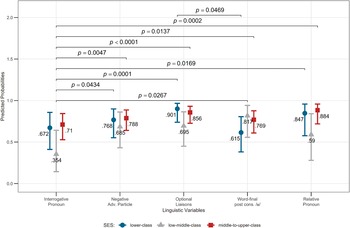
The 3 × 5 interaction between SES and linguistic variables was more difficult to interpret. The first feature to point out is that in the intermediate social class, the probability of preferring the normative variant for the IP was the lowest (35.4%, 95% CI [14.4%–64.2%]) and this induced eight of the nine significant contrasts found in total (see Figure 9).
Linguistic variable × SES Interaction plot for predicted probabilities of favouring the normative variants, with 95% confidence error bars. Only significant contrasts are indicated.

Figure 9. Long description
An interaction plot with Predicted Probabilities on the y-axis from 0.0 to 2.0 and Linguistic Variables on the x-axis. A legend at the bottom identifies three S E S groups: lower-class (blue circle), low-middle-class (grey triangle), and middle-to-upper-class (red square).
Data points for each variable from left to right:
* Interrogative Pronoun: lower-class .672, low-middle-class .354, middle-to-upper-class .71.
* Negative Adv. Particle: lower-class .768, low-middle-class .685, middle-to-upper-class .788.
* Optional Liaisons: lower-class .901, low-middle-class .695, middle-to-upper-class .856.
* Word-final post cons. /s/: lower-class .615, low-middle-class .817, middle-to-upper-class .769.
* Relative Pronoun: lower-class .847, low-middle-class .59, middle-to-upper-class .884.
Statistical significance brackets above the data points indicate p-values for specific contrasts:
* Interrogative Pronoun low-middle-class vs. Negative Adv. Particle lower-class: p equals 0.0267.
* Interrogative Pronoun low-middle-class vs. Negative Adv. Particle middle-to-upper-class: p equals 0.0434.
* Interrogative Pronoun low-middle-class vs. Optional Liaisons lower-class: p equals 0.0001.
* Interrogative Pronoun low-middle-class vs. Optional Liaisons middle-to-upper-class: p equals 0.0169.
* Interrogative Pronoun low-middle-class vs. Word-final post cons. /s/ low-middle-class: p equals 0.0047.
* Interrogative Pronoun low-middle-class vs. Word-final post cons. /s/ middle-to-upper-class: p less than 0.0001.
* Interrogative Pronoun low-middle-class vs. Relative Pronoun lower-class: p equals 0.0137.
* Interrogative Pronoun low-middle-class vs. Relative Pronoun middle-to-upper-class: p equals 0.0002.
* Relative Pronoun low-middle-class vs. Relative Pronoun middle-to-upper-class: p equals 0.0469.
Within the intermediate social group, with the exception of the PostC-R level, for which the probability of preferring the normative variant was 81.7% (95% CI [55.7%–94.1%]), the CIs for the marginal means of the other four levels included 50%. Conversely, among children from middle-to-upper social classes, the CIs for the five linguistic variables did not include 50%, suggesting that within 95% of cases, children from this social group preferred the normative variants. Within the lower class, only the CIs for the PostC-R and IP levels included 50%. More generally, it is noteworthy that for the IP, NEG, OL and RP levels, the preferences of lower-class children were very close to those of middle-to-upper-class children. Conversely, the behaviour of low-middle-class children showed a different, and above all random, response pattern, since the CIs for each of these four levels included zero. In more peripheral terms, the contrast between the probability of preferring the normative variant for OL and for PostC-R was also significant in the lower social class (z = 3.382, p = .0469).
4. Discussion
Summing up very briefly the general results, our mixed-effects model revealed several statistical differences. Age was the main effect; thus, it was possible to conclude that children’s preferences for normative variants increased with age. Although no overall significant differences appeared between boys and girls, the interactions found between factors revealed a more complex picture. Preferences for the normative variants were significantly higher for monolingual girls than for bilingual girls and also higher for girls from the middle-to-upper class than for both low-to-middle-class girls and boys.
These results shed light on our two research questions, enabling us to assess the two respective hypotheses.
Concerning our first research question inquiring on the way children’s LAs unfold over time, we found that age was a highly significant predictor explaining the evolution of LAs, enabling the conclusion that normative variants are acquired over time through the children’s language socialisation experiences. However, the emerging preferences for the normative variants had different developmental slopes depending on the linguistic construction. This means that each linguistic construction documented was subject to a different preference timeframe. When investigating each linguistic construction in detail, it is worth noting that the differences in the probability of preferring the normative variant for OL and IP were such that they induced many significant contrasts. When averaging across all the other variables, only the 95% confidence interval of the marginal mean of the IP level included 50% (58.3%, 95% CI [44.1%–71.3%]). Hence, the hypothesis of a random choice concerning the IP construction cannot be rejected. All in all, while this study corroborated the fact that, with age, children start preferring the normative variants, the pivotal age of 8 documented in the literature was not confirmed for all the linguistic components. The first hypothesis was thus confirmed: children’s LAs vary depending on the linguistic construction evaluated, just as each linguistic level (phonetic, morphological, syntactic, etc.) is subject to different acquisition patterns. In this case, the probabilities of preferring the normative variant for OL (morphohonological level) were the highest from the onset (63 months), whilst the level of indecision was the highest for the IP construction (syntactic level) throughout the age range (63–141 months).
Moving on to the second research question, we wanted to know which factors explained the possible variation patterns observed in the children’s preferences for the normative variants. Because in the developmental literature, different factors have been shown to influence the patterns in language production acquisition patterns, we hypothesised that these same factors could also influence our participants’ LA trajectories. Importantly, instead of documenting the factors in different models, we considered them all within the same model so that we could obtain a more holistic yet robust and explicative view of the emergence of LA in monolingual and bilingual children. For the sake of clarity, we will briefly discuss each factor, excluding age, separately, and then we will move on to the general discussion.
4.1. Sex
No overall significant differences appeared between boys and girls, and this may be surprising in the light of the results in the literature. Indeed, previous studies on production dealing with sociolinguistic variation in language acquisition (Barbu et al., Reference Barbu, Martin and Chevrot2014) have shown that boys produced more vernacular variables than girls and that boys were exposed to more non-normative variants than girls (Foulkes et al., Reference Foulkes, Docherty and Watt2005). However, the interactions found between sex, and respectively, the children’s linguistic background and their family’s SES shed light on the complexity of LA mechanisms. For example, the probabilities of preferring the normative variants were particularly high for monolingual girls from privileged social backgrounds. We discuss this point further below.
4.2. Linguistic background
Regarding the differences noted between bilinguals and monolinguals, our results are in contrast with other studies where bilinguals were found to develop preferences for the prestigious varieties before monolinguals (Day, Reference Day1980; Rosenthal, Reference Rosenthal1974). However, in these studies, children were asked to express their preferences towards two distinct varieties, whereas in our study, children had to evaluate variants within one language variety. Bilinguals may require more time to develop clear-cut preferences towards the normative variants in the French context, where both are regularly used in everyday conversations. In general, given their wider exposure to language variation in the input (intra- and inter-linguistic), Francophone bilinguals may manifest preferences towards the French normative (prescriptive) variety at a later stage compared to monolinguals who have a narrower set of variants in competition in their environment (intralinguistic only). These variants, together with their indexical values, would become entrenched earlier than other, less frequent ones (Langacker, Reference Langacker and Rudzka-Ostyn1988).
4.3. SES
Previous research conducted with the same type of preference-based task with Francophone monolingual children showed that only the children from a high-SES background preferred the normative variants (Barbu et al., Reference Barbu, Nardy, Chevrot and Juhel2013; Nardy, Reference Nardy2008). Our sample comprised slightly older children with respect to the aforementioned studies, and we found slightly different patterns. For the results involving SES, lower-class and upper-class children had similar preference patterns for most of the linguistic components under study. Yet, low-to-middle-class children’s preferences showed the most contrasts and random responses. These results support the tripartite coding system we used for SES, as it may help shed light on another sociolinguistic phenomenon that has seldom been considered in the attitudinal literature: The lower-to-middle-class children’s indecision regarding their preferences for the normative variants may illustrate what Labov (Reference Labov1972) called linguistic insecurity. Indeed, children in this category had parents who came from two different SES, backgrounds and this may have exposed them to language practices and representations anchored in different social allegiances. In other words, these children belonged to families that were likely to have different social class legitimacies which may have contributed to a general lack of confidence towards the assignment of their preferences on the basis of what form was considered to be socially most desirable.
4.4. General discussion: Reading the attitudes through the lens of language socialisation via exposure and experience
Considering our set of results, schooling and exposure to the written medium are undoubtedly important factors pushing children’s preferences towards the normative variants. The negative adverbial particle (NEG) illustrated this point: The sociolinguistic literature showed that the absence of the first element of negation is highly frequent in spoken French, irrespective of the situation’s level of formality (Gadet, Reference Gadet2007; Müller, Reference Müller1989). Hence, because children start with exposure to the spoken language, their familiarity with the non-normative variant is substantially higher than their exposure to the normative variant. Once they go to school, however, their increasing exposure to the written medium raises awareness of the first element of variation ne (which is compulsory in the written medium). Exposure to the written norms that contrast with the norms underpinning the forms to which they are most accustomed could result in competing preferences towards two different levels of legitimacy during the first stages of schooling.
Contrastively, it is possible to interpret the results obtained for the LAs towards OL by considering the effects of frequency of exposure. Although children are exposed to fluctuations between uses of the normative and the non-normative realisations, unlike for NEG, they are exposed to these fluctuations very early in their lives. Hence, they have more time to build socio-cognitive representations of the different uses of the variable. Said otherwise, earlier exposure to the normative and non-normative variants could familiarise the children with the societal preferences towards the more prestigious variants during the early stages of language socialisation. Consequently, this would lead to the earlier emergence of language preferences towards the more prestigious variant. The indecision noted in the LAs towards the IP component is the most intriguing. As a syntactic component, LAs towards IP would require more language exposure before they are stabilised. However, unlike with NEG, the other syntactic component, there may be less discourse produced on the IP constructions because these are not linked to a formal and compulsory rule in writing. There could also be a complementary explanation for the particular status of the IP component. Bonhomme (Reference Bonhomme2021) explored the different IP constructions found in six CHILDES (MacWhinney, Reference MacWhinney2000) corpora: Champaud (Reference Champaud1994); Leveillé (Suppes et al., Reference Suppes, Smith and Leveillé1973); MTLN (Le Normand et al., Reference Le Normand, Moreno-Torres, Parisse and Dellatolas2013); Palasis (Reference Palasis2009); Pauline (Bassano et al., Reference Bassano, Laaha, Maillochon and Dressler2004); York/Anne (De Cat & Plunkett, Reference De Cat and Plunkett2002). The corpora considered comprised spontaneous interactions between children (1–4-year-olds) and their caregivers. Although the age groups did not correspond to those in our sample, they nonetheless provided an estimate of the typical Francophone child’s cumulative exposure to, and experience of, the interrogative pronoun use prior to the ages tested in our experiment. It was found that in spoken language produced in ordinary conversations, there were different constructions expressing interrogation: (1) qui+verb realisations (normative); (2) c’est qui qui; (3) qui c’est qui or (4) qui est-ce qui. It could be argued then that, faced with these variable forms that circulate in different spaces of socialisation, children take longer to “prefer” one as opposed to another variant because the normative and non-normative forms are not in a strict binary relation with one another (normative variant versus non-normative variant) and have other competitors.
In more general terms, LAs would be the fruit of the accumulation of language socialisation experiences via the input but also of the exposure to the societal ideologies that influence the way forms are interpreted as more desirable than others. Because ideologies circulate within the spaces of socialisation to which children participate and where they are exposed, these ideologies are reproduced in discourses that shape and reinforce children’s social representations and forms of prescription in a rather top-down fashion (e.g. with the acquisition of writing, children are systematically exposed to discourse on the compulsory nature of the first particle of the NEG construction). Children’s input influences the elaboration of their sociolinguistic representations (bottom-up process), and these representations consequently shape the children’s perceptions and attitudes. Such bottom-up processes are driven by factors such as frequency of exposure to a particular use of one or more variants of linguistic constructions. As for the top-down processes, they also encompass language ideologies regarding language prestige where one particular variant, usually the normative variant, is preferred over another, perceived as less prestigious (Garrett, Reference Garrett2010; Milroy, Reference Milroy2001). The language ideologies and representations carried in child-directed discourse or in normative discourses produced at school preempt the non-normative variants produced by the child or in the child’s environment, reinforcing ideals of correctness. Hence, this would explain why it is likely that the child is socialised into preferring variants that do not necessarily match the ones found in her production, nor those in her social group. Both top-down and bottom-up processes depend on time, frequency of exposure and on the indexical values a social group establishes between linguistic features and a speaker’s characteristics. Through these bottom-up and top-down influences (Fuchs & Hofkirchner, Reference Fuchs and Hofkirchner2005), the sociocognitive representations of each variable become progressively stabilised and attuned with the social pressures for the promotion of the prestigious variants, contributing to the children’s socialisation process.
4.5. Conclusion: Limitations and future directions
One of the study’s limitations, which is currently being addressed, is an investigation where the collection of perception data is complemented with production data in order to better comprehend how the linguistic constructions circulate in monolingual and bilingual children’s spaces of socialisation. Future directions should consider combining self-declared and objective language proficiency measures and dominance within the methodological set-up. This would shed light on the potential linguistic insecurity effects hypothesised in this study and paint a finer-grained picture of the development of LA. All in all, the interactions emerging in our statistical model highlight the complexity of the construct “language attitudes towards variation.” Our holistic approach is a first attempt to account for this complexity through a single model explaining the factors influencing the developmental trajectory of social cognition.
Supplementary material
The supplementary material for this article can be found at http://doi.org/10.1017/S0305000925000169.
Acknowledgements
The authors are grateful to the ASLAN project (ANR-10-LABX-0081) of the Université de Lyon for its financial support within the French program “Investments for the Future” operated by the National Research Agency (ANR). The first author created the experimental design, supervised the data collection, and wrote the discussion. The second and the corresponding authors created the statistical models and performed the statistical analyses. The corresponding author also curated the data, interpreted the results and prepared all the figures. The third and fourth authors collected part of the data and prepared the databases from which the analyses were performed.
Competing interests
The authors declare none.
Disclosure of use of AI tools
An AI tool (OpenAI ChatGPT 4o mini) was used to check that the formatting of the bibliography met APA standards.








 Open access

