


This article gives the perspectives and experience of Robert Hafes, who wrote it in collaboration with Mason McGlynn.
Across history and cultures, the visual arts, dance, music and storytelling have served as intrinsic tools for healing and connection. Once anecdotal, these practices are now supported by empirical evidence of mental health benefits. Psychiatry is uniquely placed to explore the intersection of the arts and suffering, as mental healthcare draws on multiple domains of knowledge.
The perinatal setting
Mother and baby units (MBUs) present distinct challenges that heighten vulnerability. They typically support mothers in acute psychiatric crisis, often with established diagnoses such as postpartum psychosis, depression or complex personality difficulties. The transition into motherhood can collide with trauma and child welfare concerns, intensifying distress. These may be compounded by sleep deprivation, medication effects, family conflict, safeguarding pressures and linguistic barriers.
As a psychiatry trainee, I was drawn to the relational depth of perinatal care; as an artist, I have long seen creativity as a way of accessing truths that are deeply personal and widely shared. In the perinatal setting, these two perspectives came into dialogue. I see the arts as a species shorthand: shared, intrinsic language that transcends culture, time and speech, offering flexible tools for connection and healing. In the MBU, non-verbal communication and early attachment are foundational – not only between mother and baby, but also within the therapeutic team.
Fancourt et al (Reference Fancourt, Bone and Bu2023) highlighted the potential of art-based interventions to support mental health treatment – particularly for anxiety and depression – by offering structured yet flexible ways to process emotions, reduce stigma and foster peer support. Yet many individuals hesitate to engage with the arts because of fears of judgement, lack of skill or feeling out of place. The study also identified a clear social gradient in arts participation, with parental social status being the strongest predictor of a patient’s ability to participate. Although school environments may help neutralise this for children, access outside of school remains limited for lower socioeconomic groups, perpetuating existing inequalities in creative engagement.
Building on this understanding, I introduced a collaborative drawing group for patients and staff within the ‘arts in health’ framework, designed to encourage creative exploration and artistic connection. Unlike art psychotherapy – which requires a trained art therapist – this model promotes accessibility and wider participation, complementing clinical care. To support sustainability and embed it in the weekly schedule, the group was co-facilitated by a permanently embedded occupational therapist in the team.
The role of drawing in mental health
Creative engagement activates neural pathways involved in emotion regulation, cognitive processing and social bonding – making it a valuable tool in mental healthcare. Drawing is a low-risk, non-verbal intervention that complements standard treatments. Focusing on lines, shapes and colours has been linked to reduced stress-related brain activity and improved emotion regulation (Bolwerk Reference Bolwerk, Mack-Andrick and Lang2014). It also activates the default mode network (DMN), which supports self-reflection, emotional insight and planning (Bolwerk Reference Bolwerk, Mack-Andrick and Lang2014; Barnett Reference Barnett and Vasiu2024). Drawing bridges language and cognitive gaps, which is vital in psychiatric settings. Further research is needed to assess efficacy, delivery models and long-term effects in perinatal mental healthcare.
Through an evobiopsychosocial lens (Hunt Reference Hunt, St-John Smith and Abed2022), creative expression may support social cohesion and adaptation to uncertainty, suggesting a deep-rooted connection between creativity and survival. Visualisation through drawing or painting has also been shown to reduce amygdala hyperactivity, dampening the threat response and promoting emotional stability (Barnett Reference Barnett and Vasiu2024). These neural mechanisms may help explain why creative engagement is particularly effective in treating mood disorders and anxiety.
Beyond its neurological effects, drawing supports emotional integration by helping individuals externalise internal experiences. This is especially valuable where verbal communication is limited or emotionally charged. Malchiodi (Reference Malchiodi2020) highlights creative expression as a flexible route for those with alexithymia, trauma or mood dysregulation – providing safe exploration of grief, fear and joy, supporting emotional catharsis.
Creative engagement also operates relationally. In psychiatric settings, collaborative art-making can foster trust and connection. Patients often find emotional safety in shared activity over conversation. Malchiodi (Reference Malchiodi2020) also links creative practices to enhanced cognitive resilience, emotional flexibility and executive functioning.
These interpersonal and communal benefits echo long-standing cultural rituals. Durkheim’s concept of collective effervescence – the shared emotional intensity experienced during group rituals – captures the energising, unifying effects of collaborative artistry. In therapeutic settings, creating together can transcend isolation and build a sense of mutual presence and solidarity (Durkheim Reference Durkheim1912).
Relevance to perinatal medicine
The perinatal period reshapes a woman’s inner world. Hormonal cascades of oxytocin, cortisol and prolactin ready the body for caregiving, but also render it exquisitely sensitive to disruption. Sleep fragments. Emotional thresholds lower. This heightened state, meant to orient mothers to the needs of their infant, also opens them to the pain of past trauma, the pressure of scrutiny and the weight of relational uncertainty. What begins as adaption is, without support, at risk of becoming destabilising.
Drawing, rather than serving as mere distraction, offers a way to externalise feeling, reclaim agency and be seen without judgement. It creates a space for mothers to reconnect with themselves and their babies beyond the frame of illness.
By softening clinical boundaries, such activities invite shared presence and authentic engagement. In these moments, what begins as expression unfolds into recognition; reflection gathers weight, softens judgement and opens the mother to herself – not as a case to manage, but as a being in repair, reaching again for the rhythm of connection.
The week in the MBU moved in therapeutic rhythms: baby sensory, art therapy, mentalising motherhood – each session a shared space where patients and staff coexisted not just as clinicians and recipients, but as participants in care. This rhythm helped establish a sense of safety through repetition and relational presence. By the time the drawing group was introduced, the women were already used to entering new experiences with a familiar clinician.
The drawing group
Attendance was entirely voluntary. Each session began with a quiet invitation, an outline of what to expect and the reassurance that anyone could step in or out as they chose. Even those assessed as having diminished capacity retained that freedom, preserving participation as a gesture of agency rather than mandated attendance.
We anticipated the risks. Art materials could be misused. Emotions might rise. Fractures in staff–patient dynamics could surface. To hold the space safely, we used only therapy-approved materials, co-facilitated with an occupational therapist, and kept 1:4 staff-to-patient ratios. Babies were cared for by nursery nurses or kept close, depending on what felt safest to each mother.
The small scale of the MBU allowed for attuned care. Through daily handovers and shared clinical reflections, staff stayed close to each patient’s emotional state. If someone was struggling, unwell, distressed or in conflict – adjustments could be made immediately, and with care. Although the group welcomed all, this openness was held within a vigilant frame. Each session walked the line between invitation and containment, balancing risk with trust. In doing so, it preserved a sense of ownership for the mothers, while ensuring that the space remained both safe and therapeutically alive.
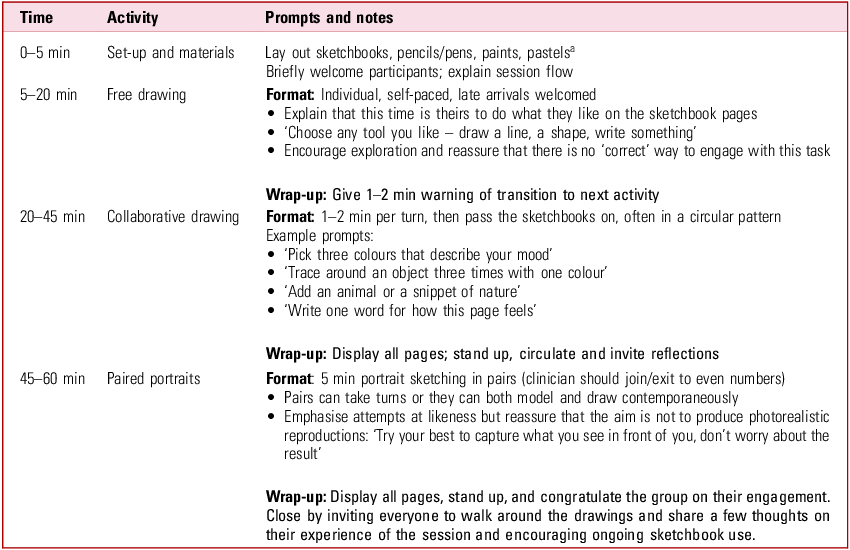
As outlined in Table 1, each session began with free drawing – an unstructured invitation to arrive without pressure. For mothers juggling fatigue, cognitive fog or emotional weight, this openness offered space to begin gently, at their own pace. There was no requirement to perform or produce, only to begin. Many described entering a kind of flow, where attention softened, thoughts quieted and the usual noise of anxiety gave way to something more spacious.
An outline of a 60 min drawing-based group session

a. Sessions sometimes took place in the garden space, allowing participants to draw directly from natural elements.
The session would then shift into collaborative exercises – quiet rituals of co-creation that echoed ancestral patterns of shared expression. Participants followed simple prompts, passing their sketchbooks for others to respond. What emerged was less artwork than visual dialogue. Many noted that shared authorship eased the fear of judgement; when no one owned the outcome, perfection no longer applied. Process took precedence, inviting play, surprise and connection, where value lay not in what was made, but in how it was made, together.
These interactions gradually softened the usual boundaries between patients and staff. Clinicians engaged as fellow participants – fumbling, adapting, creating. Trust formed in the shared effort. The group culminated in paired portraits, a task that stirred quiet anxiety about ability and exposure. Yet all took part. Drawing each other dissolved judgement; laughter replaced hesitation. In watching staff struggle and try again, patients glimpsed not authority, but humanity – a fleeting levelling that made room for connection and fostered repairing via shared vulnerability.
Ultimately the group gave me a way to explore unfamiliar ground, not only as a facilitator but as an observer of how people opened themselves up to new and challenging experiences. I watched the group form into a briefly connected whole. Beyond its emotional impact, the group also proved clinically useful, offering a low-pressure way to observe who might benefit from individual art therapy within the unit.
Integrating ‘arts into health’ interventions into clinical practice
The drawing group demonstrated how creative interventions can enhance clinical care, empowering clinicians to think holistically, work collaboratively and reshape therapeutic culture. Co-facilitation with an occupational therapist supported sustainability and helped embed the practice into everyday care. Involving staff as participants dismantled rigid hierarchies, fostering mutual respect and a more open model of care. The relational environment matters and shared creative effort became part of it.
Clinicians might look to their own skills and passions as entry points. Even small, low-cost interventions can strengthen connection, reduce isolation and remind us that care includes meaning, not just management.
Acknowledgements
The authors would like to thank Mrs Kathryn Sheppard, occupational therapist, for her co-facilitation of the group and for being integral to its ongoing delivery. Thanks also to the staff of the Mother Baby Unit, Central and North West London, for their participation and support, which were essential to the success of the group. Finally, we gratefully acknowledge Dr Thomas Walker for his critique of the article and his encouragment in shaping its direction.
Author contributions
R.H. is the first author and M.M. contributed to theoretical framing and reviewed the manuscript for intellectual content.
Funding
This research received no specific grant from any funding agency, commercial or not-for-profit sectors.
Declaration of interest
None.



eLetters
No eLetters have been published for this article.