





In the past decades, there has been a significant increase in the prevalence of depressive disorders Reference Steffen, Thom, Jacobi, Holstiege and Bätzing1,Reference Goodwin, Dierker, Wu, Galea, Hoven and Weinberger2 and anxiety disorders. Reference Yang, Fang, Chen, Zhang, Yin and Man3 According to the World Health Organization, 4 depressive and anxiety disorders together make up approximately 60% of all mental disorders worldwide. Depression and anxiety are associated with reduced quality of life, Reference Hansson5,Reference Olatunji, Cisler and Tolin6 impaired role functioning Reference Druss, Hwang, Petukhova, Sampson, Wang and Kessler7 and increased mortality risks. Reference Chesney, Goodwin and Fazel8 Besides the individual consequences, mental disorders are accompanied by an immense economic burden. According to a systematic review including studies from 48 countries, annual societal costs per patient range from US$1180 to 18 313 (adjusted for inflation and the country’s power parity rate to the USA price level) depending on the mental disorder, whereas depressive and bipolar disorders are associated with annual societal cost per patient of US$5703. Reference Christensen, Lim, Saha, Plana-Ripoll, Cannon and Presley9 Still, very few patients receive adequate treatment, which is reflected by notable treatment gaps for both depressive and anxiety disorders. Reference Alonso, Liu, Evans-Lacko, Sadikova, Sampson and Chatterji10,Reference Moitra, Santomauro, Collins, Vos, Whiteford and Saxena11 Additionally, treatment refusal and premature termination are common in treatment of mental disorders. In their meta-analysis, Swift et al Reference Swift, Greenberg, Tompkins and Parkin12 found an overall treatment refusal rate of 8.2% and an overall premature termination rate of 21.9%.
A main issue that arises when the demand cannot be met by the system is the long waiting times for psychotherapy. For example, in Germany in 2017, a structural reform was made to improve access to out-patient psychotherapy. However, a pre-post evaluation of this reform showed that the time between the initial contact with a psychotherapist and the start of therapy became even longer. Reference Kruse, Kampling, Bouami, Grobe, Hartmann and Jedamzik13 The sum of those findings suggests that the mental healthcare system is used to full capacity. Efficient allocation of resources is an important driver to secure mental healthcare in the future across all countries. In 2001, the Institute of Medicine introduced six aims to improve healthcare quality. 14 One of those aims is patient-centredness. Per definition, supplying patient-centred healthcare includes acknowledging the patient’s needs, values and preferences, and adapting care accordingly. Patient preferences are defined as the choices an individual makes on different treatment options and characteristics. Reference Swift, Callahan and Vollmer15 In various guidelines across many countries, the integration of patient preferences in the decision-making process of mental healthcare is already highly advised. 16–Reference American Psychological Association18 Research indicates that accommodating treatment preferences increases patient satisfaction Reference Umar, Schaarschmidt, Schmieder, Peitsch, Schollgen and Terris19 and enhances health outcomes and treatment adherence. Reference Swift, Callahan, Cooper and Parkin20
In the light of an expected increase in prevalence, an overwhelmed mental healthcare system and the positive effects of integration of preferences, efficient patient-centred care is gaining in importance, which is reflected by previous research. For example, Tünneßen et al Reference Tünneßen, Hiligsmann, Stock and Vennedey21 conducted a systematic review of discrete choice experiments on treatment preferences in patients with depressive or anxiety disorder, including studies that were published before April 2019. They discovered that, in general, process and cost attributes were more important to patients than outcome attributes. To build on those findings, we chose to include all study types in our review. Furthermore, we add value to existing research by examining preferences for various treatment approaches as well as treatment modalities, and review determinants that influence those preferences, which, to our knowledge, has not been done before. Therefore, we seek to address the following research questions: (a) What treatment preferences do adults with symptoms of depressive or anxiety disorder express with regard to out-patient mental healthcare? and (b) What determinants influence these preferences?
Such knowledge is important because research shows that resources in mental healthcare are not optimally allocated. By gaining deeper insights into mental health patients’ preferences, treatment for depressive and anxiety disorders can be further individualised. This contributes to a more patient-centred mental healthcare and improves treatment outcomes and satisfaction.
Method
We conducted a systematic review on treatment preferences and their determinants among adults with depressive or anxiety disorder in out-patient mental healthcare. The review was registered in PROSPERO (identifier CRD42024546311). Extending PROSPERO, we further explored determinants of preferences, if examined. Structure and content of the review are consistent with the Reporting Guidelines for Meta-analyses of Observational Studies (MOOSE) Reference Brooke, Schwartz and Pawlik22 and the most recent version of the Preferred Reporting Items for Systematic Reviews and Meta-Analyses (PRISMA) Statement. Reference Moher, Liberati, Tetzlaff and Altman23,Reference Page, McKenzie, Bossuyt, Boutron, Hoffmann and Mulrow24 The completed PRISMA checklist can be found in Supplementary Material D available at https://doi.org/10.1192/bjo.2025.10849. As this was a systematic review of published studies, informed consent and ethical approval were not required.
Search strategy
First, the search string was created by first author L.L. Second, a librarian from the University Medical Centre Hamburg-Eppendorf was consulted for further inspection of the search string and chosen databases. The librarian agreed on and endorsed our search strategy, so no changes were made. The final search included the following keywords and was applied in Web of Science, PubMed, PsycINFO and CINAHL on 16 May 2024 (see Supplementary Material A for the exact search terms and strings): preferences, patient preferences, depression, depressive disorder, anxiety, anxiety disorder and treatment.
Studies were included if they fulfilled all of the following inclusion criteria: (a) peer-reviewed primary qualitative, quantitative or mixed-methods study; (b) adults (aged 18 years and older); (c) symptoms of depressive or anxiety disorder (clinically diagnosed or self-reported); and (d) out-patient care. For simplicity and readability reasons, in this paper, we will refer to the term ‘disorder’, even if diagnostic criteria may not be fulfilled in all patients. Studies were excluded if they met one or more of the exclusion criteria: (a) review or meta-analysis, (b) in-patient care, (c) secondary depression/anxiety (including perinatal depression/anxiety), (d) veterans and (e) studies comparing different dosing schemes of pharmacological treatment. Furthermore, the search was restricted to articles in English or German. No restrictions were made regarding year of publication or geographical location. We did not review grey literature. Title, abstracts and full texts were screened in a three-step-process in duplicate (by L.L. and M.L.). Both researchers conducted a pre-screening to ensure conformity with inclusion and exclusion criteria. As no clarifications or adjustments had to be made after 20 titles, we further continued to screen independently (deviating from the intended pre-screening of 100 titles as stated in PROSPERO). Any conflicts throughout the screening process were resolved through discussion between L.L. and M.L. No third reviewer (A.H.) had to be consulted.
Data extraction and synthesis
Starting on 17 June 2024, data extraction was performed by L.L. and carefully checked by M.L. Therefore, a sheet was created a priori that contained fields for study characteristics (e.g. sample size, disorder), methods (e.g. preference elicitation method) and results (i.e. preferences and determinants) that were filled for each study. If an article included both anxiety disorder and depression, we treated each disorder as a separate study and extracted data for each disorder. Results from the preference elicitations were described narratively and, where possible, frequencies and coefficients were extracted. If missing, summary statistics were carefully computed or converted manually. Preference types were grouped into three main categories with two subcategories each: (a) treatment approaches (psychotherapy versus pharmacotherapy, other treatment types), (b) psychotherapy delivery and setting (delivery, setting), and (c) psychotherapy parameters (frequency, provider). Each study was assigned at least one of those main categories. Frequencies for each main and subcategory were calculated. Determinants were presented if they were significantly associated with certain preferences in at least one study. The final set of determinants and the signs of the effects or associations are displayed in a table. Any inconsistencies in terms of data extraction and categorisation were planned to be discussed and resolved between L.L., M.L. and A.H., but none occurred.
Quality assessment
The quality of included studies was assessed with the Mixed Methods Appraisal Tool, Reference Hong, Fàbregues, Bartlett, Boardman, Cargo and Dagenais25 which is commonly used in reviews and enables the appraisal of various study types and designs. For each study design there are five questions regarding the sample, appropriateness of methods and risk of bias that can be answered with yes, no or can’t tell. The assessment was performed independently by two researchers (L.L. and M.L.). Disagreements occurred in 15% of the questions and were resolved through discussion. An overall score is calculated for all questions answered with yes and displayed in percentages for each study (20%, 40%, 60%, 80% or 100%). The quality assessment does not result in exclusion of studies.
Results
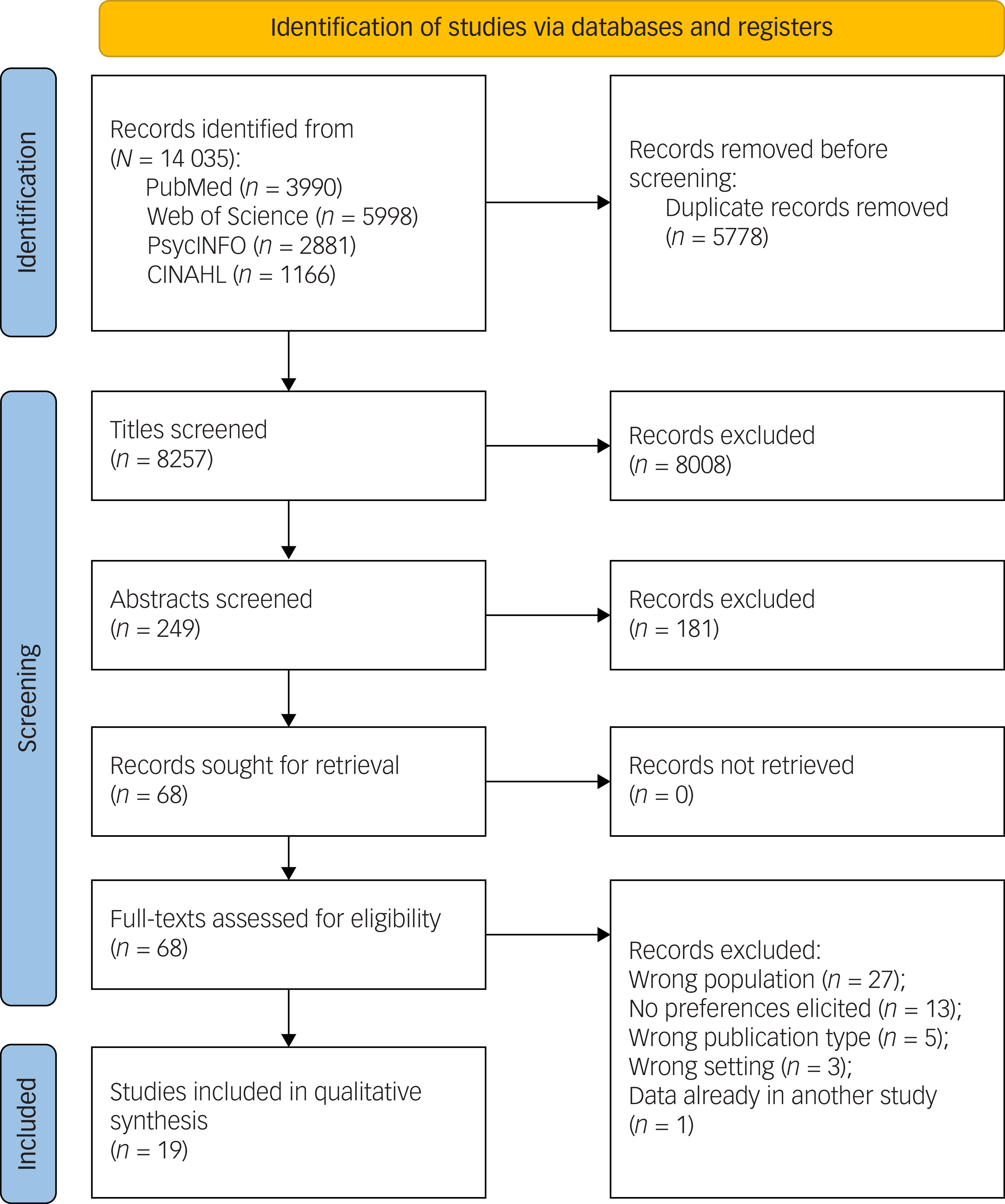
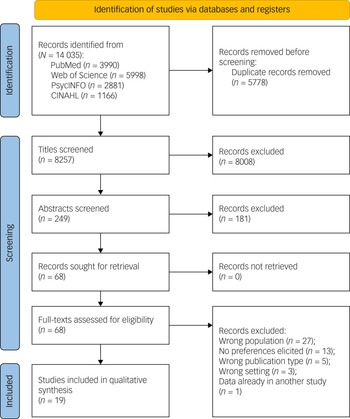
Figure 1 depicts the PRISMA flow diagram Reference Page, McKenzie, Bossuyt, Boutron, Hoffmann and Mulrow24 for the study selection process. The electronic search of PubMed, Web of Science, PsycINFO and CINAHL resulted in 14 035 identified studies (see Fig. 1). After removing duplicates, 8257 studies remained. After screening the titles, 8008 records were excluded. We screened the abstracts of the remaining 249 studies and excluded another 181 studies. In total, 68 studies were then screened in full text and 19 studies were included in the qualitative synthesis of the review. Reference Backenstrass, Joest, Frank, Hingmann, Mundt and Kronmuller26–Reference Soucy and Hadjistavropoulos44 The reasons for exclusion of full texts were wrong population (i.e. mental disorder other than depression or anxiety, n = 27), no preferences were assessed (n = 13), wrong publication type (e.g. conference presentation, n = 5), wrong setting (n = 3) or same data was already reported in another included study (n = 1). In the latter case, the more detailed article was chosen to be included. Reference Dorow, Löbner, Pabst, Stein and Riedel-Heller30
PRISMA flow diagram.
Study characteristics
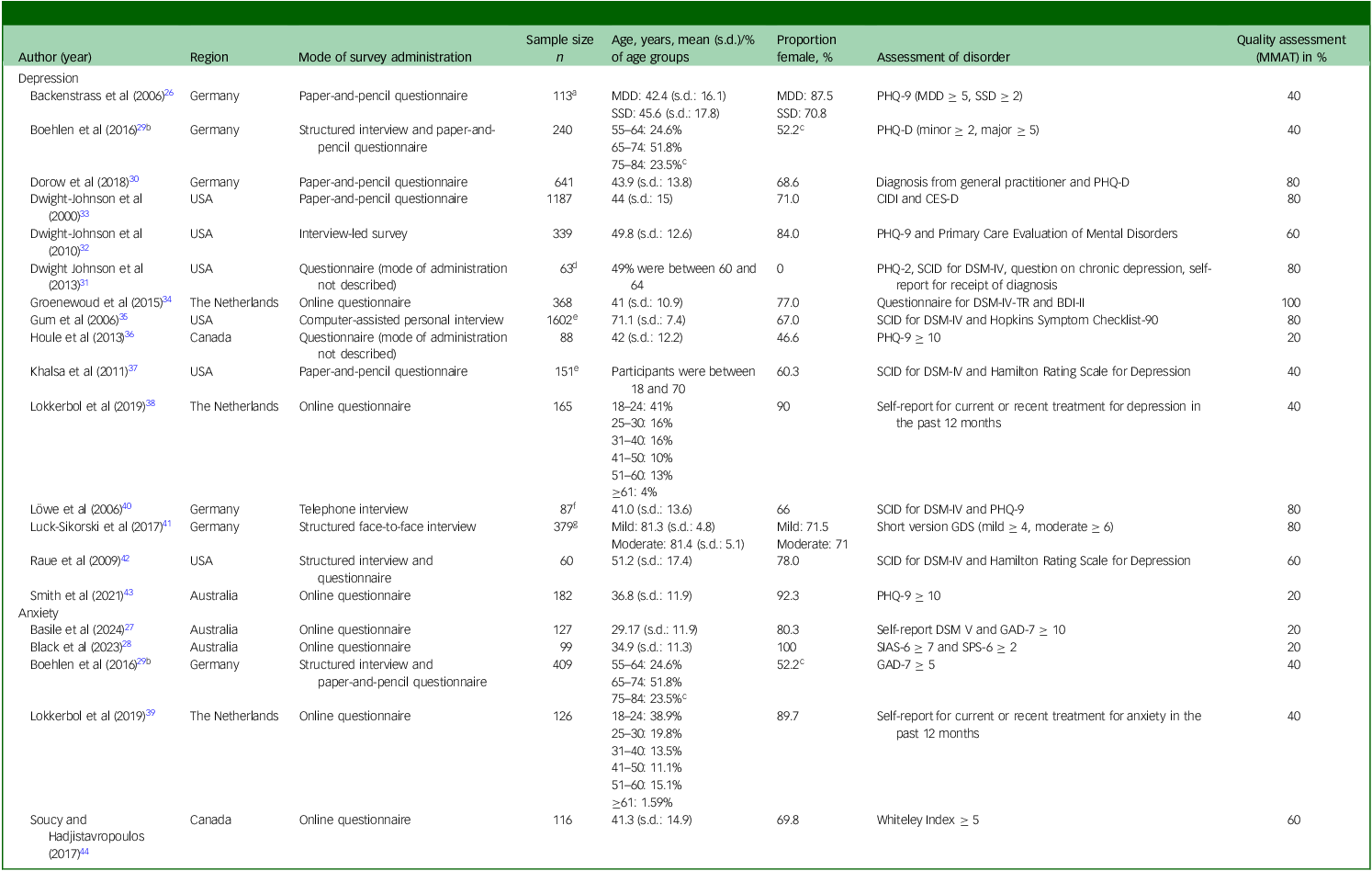
The study characteristics are displayed in Table 1. The included studies were conducted in Europe (n = 8, five in Germany Reference Backenstrass, Joest, Frank, Hingmann, Mundt and Kronmuller26,Reference Boehlen, Herzog, Maatouk, Saum, Brenner and Wild29,Reference Dorow, Löbner, Pabst, Stein and Riedel-Heller30,Reference Löwe, Schulz, Grafe and Wilke40,Reference Luck-Sikorski, Stein, Heilmann, Maier, Kaduszkiewicz and Scherer41 and three in the Netherlands Reference Groenewoud, Van Exel, Bobinac, Berg, Huijsman and Stolk34,Reference Lokkerbol, Geomini, van Voorthuijsen, van Straten, Tiemens and Smit38,Reference Lokkerbol, van Voorthuijsen, Geomini, Tiemens, van Straten and Smit39 ), North America (n = 8, six in the USA Reference Dwight Johnson, Apesoa-Varano, Hay, Unutzer and Hinton31–Reference Dwight-Johnson, Sherbourne, Liao and Wells33,Reference Gum, Areán, Hunkeler, Tang, Katon and Hitchcock35,Reference Khalsa, McCarthy, Sharpless, Barrett and Barber37,Reference Raue, Schulberg, Heo, Klimstra and Bruce42 and two in Canada Reference Houle, Villaggi, Beaulieu, Lespérance, Rondeau and Lambert36,Reference Soucy and Hadjistavropoulos44 ) and Oceania (n = 3, all of them in Australia Reference Basile, Newton-John and Wootton27,Reference Black, Paparo and Wootton28,Reference Smith, Paparo and Wootton43 ). The majority of the studies was published between 2010 and 2019. All of the studies were cross-sectional, 17 studies were quantitative Reference Backenstrass, Joest, Frank, Hingmann, Mundt and Kronmuller26–Reference Lokkerbol, van Voorthuijsen, Geomini, Tiemens, van Straten and Smit39,Reference Luck-Sikorski, Stein, Heilmann, Maier, Kaduszkiewicz and Scherer41–Reference Smith, Paparo and Wootton43 and two used a mixed-methods approach. Reference Löwe, Schulz, Grafe and Wilke40,Reference Soucy and Hadjistavropoulos44 Self-administered online or paper-and-pencil questionnaires were more frequently used than interviews. The total sample size equalled 6640 and ranged from 60 to 1602 participants in the individual studies. Most of the studies included about 100–400 participants. In studies including both men and women, proportion of women ranged from 46.6 Reference Houle, Villaggi, Beaulieu, Lespérance, Rondeau and Lambert36 to 92.3%. Reference Smith, Paparo and Wootton43 One study included only women Reference Black, Paparo and Wootton28 and another study only men. Reference Dwight Johnson, Apesoa-Varano, Hay, Unutzer and Hinton31 On average, participants were middle aged in most studies, i.e. between 40 and 50 years old. In studies using online questionnaires, respondents were mainly somewhat younger (e.g. Lokkerbol et al Reference Lokkerbol, Geomini, van Voorthuijsen, van Straten, Tiemens and Smit38 ). Two studies were published during or after the COVID-19 pandemic, but did not report the exact period of data collection. Reference Basile, Newton-John and Wootton27,Reference Smith, Paparo and Wootton43 In all other studies, data collection was performed before the pandemic.
Study characteristics
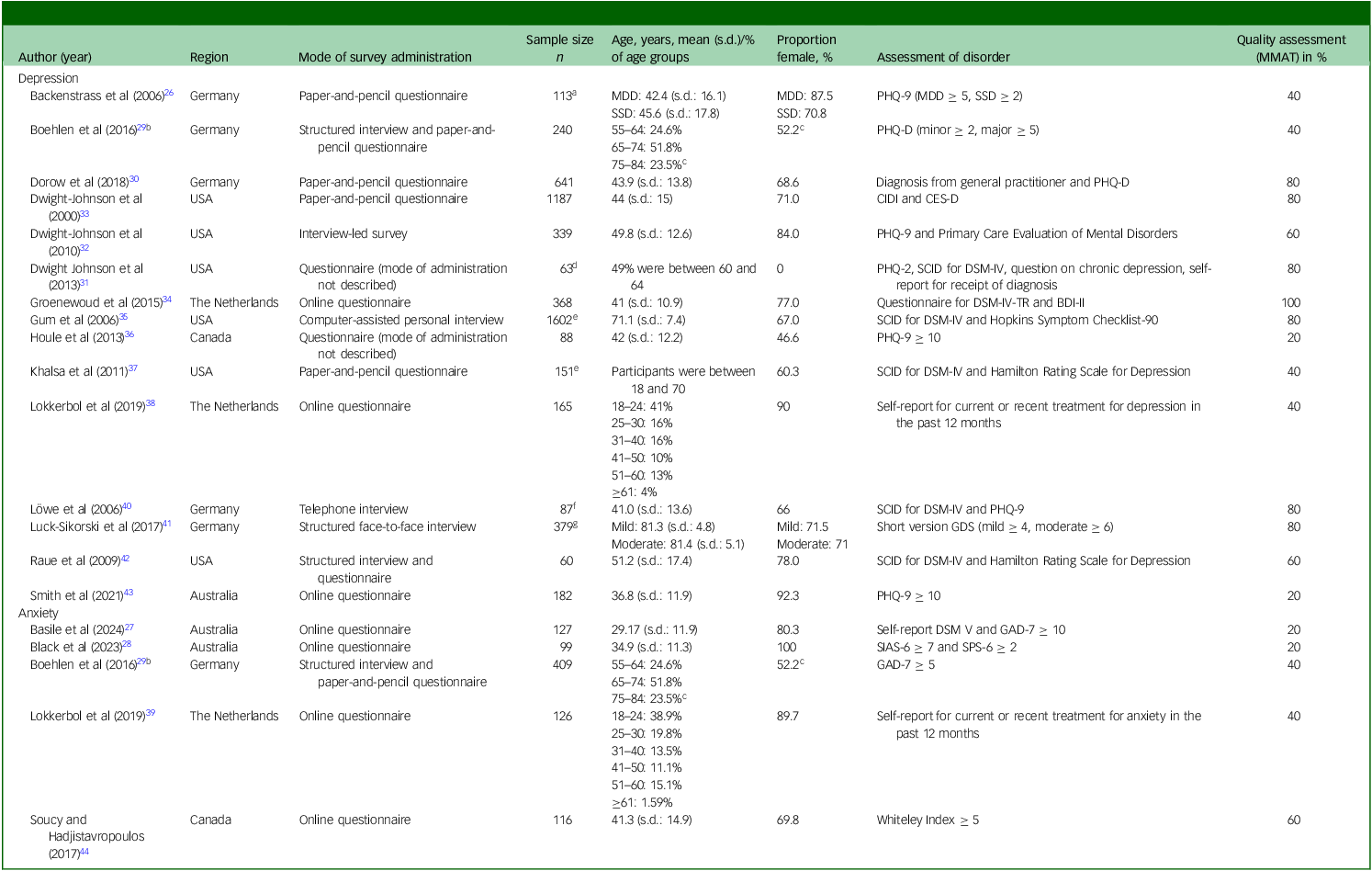
MMAT, Mixed Methods Appraisal Tool; MDD, major depressive disorder; SSD, subsyndromal depression; PHQ, Patient Health Questionnaire; PHQ-D, Patient Health Questionnaire-Depression; CIDI, Composite International Diagnostic Interview; CES-D, Center for Epidemiological Studies Depression Scale; SCID, Structured Clinical Interview for DSM Disorders; BDI-II, Beck Depression Inventory-II; GDS, Geriatric Depression Screening Scale; GAD-7, Generalised Anxiety Disorder Screener; SIAS, Social Interaction Anxiety Scale, SPS, Social Phobia Scale.
a . Proportionate sample of participants with MDD or SSD.
b . Boehlen et al (2016) Reference Boehlen, Herzog, Maatouk, Saum, Brenner and Wild29 is one study (results are reported for both disorders separately).
c . Age and proportion of women only calculated for the whole study sample.
d . Proportionate sample of participants included in conjoint analysis.
e . Proportionate sample of participants who expressed a preference for either psychotherapy or antidepressants.
f . Proportionate sample of participants with depression.
g . Proportionate sample of patients with mild or moderate depressive symptoms.
Depression alone was examined in 14 studies, Reference Backenstrass, Joest, Frank, Hingmann, Mundt and Kronmuller26,Reference Dorow, Löbner, Pabst, Stein and Riedel-Heller30–Reference Lokkerbol, Geomini, van Voorthuijsen, van Straten, Tiemens and Smit38,Reference Löwe, Schulz, Grafe and Wilke40–Reference Smith, Paparo and Wootton43 anxiety disorder alone in four studies Reference Basile, Newton-John and Wootton27,Reference Black, Paparo and Wootton28,Reference Lokkerbol, van Voorthuijsen, Geomini, Tiemens, van Straten and Smit39,Reference Soucy and Hadjistavropoulos44 and one study observed both disorders. Reference Boehlen, Herzog, Maatouk, Saum, Brenner and Wild29 Both disorders were mostly assessed with multiple measures (see Table 1). For depression, the most common ones used were different versions of the Patient Health Questionnaire (PHQ), Reference Backenstrass, Joest, Frank, Hingmann, Mundt and Kronmuller26,Reference Boehlen, Herzog, Maatouk, Saum, Brenner and Wild29–Reference Dwight-Johnson, Lagomasino, Hay, Zhang, Tang and Green32,Reference Houle, Villaggi, Beaulieu, Lespérance, Rondeau and Lambert36,Reference Löwe, Schulz, Grafe and Wilke40,Reference Smith, Paparo and Wootton43 followed by the DSM-IV criteria. Reference Dwight Johnson, Apesoa-Varano, Hay, Unutzer and Hinton31,Reference Groenewoud, Van Exel, Bobinac, Berg, Huijsman and Stolk34,Reference Gum, Areán, Hunkeler, Tang, Katon and Hitchcock35,Reference Khalsa, McCarthy, Sharpless, Barrett and Barber37,Reference Löwe, Schulz, Grafe and Wilke40,Reference Raue, Schulberg, Heo, Klimstra and Bruce42 Anxiety was measured with the Generalised Anxiety Disorder Scale-7 (GAD-7), Reference Basile, Newton-John and Wootton27,Reference Boehlen, Herzog, Maatouk, Saum, Brenner and Wild29 DSM-V criteria, Reference Basile, Newton-John and Wootton27 the Social Interaction Anxiety Scale, Reference Black, Paparo and Wootton28 the Social Phobia Scale Reference Black, Paparo and Wootton28 or the 14-item Whiteley Index. Reference Soucy and Hadjistavropoulos44
Quality assessment
The calculated total score of the quality assessment is displayed in Table 1. A more detailed description of the assessment can be found in Supplementary Material B. The overall quality of the included studies was moderate (see Table 1). Only one study fulfilled all five quality criteria and scored 100%, Reference Groenewoud, Van Exel, Bobinac, Berg, Huijsman and Stolk34 indicating a high quality, whereas four studies fulfilled only one criterion and scored 20%, Reference Basile, Newton-John and Wootton27,Reference Black, Paparo and Wootton28,Reference Houle, Villaggi, Beaulieu, Lespérance, Rondeau and Lambert36,Reference Smith, Paparo and Wootton43 indicating a poor quality. The main concerns among all studies were related to the risk of non-response bias, especially when online surveys were conducted (e.g. Lokkerbol et al Reference Lokkerbol, Geomini, van Voorthuijsen, van Straten, Tiemens and Smit38 ). Further issues refer to the elicitation of preferences, as most studies neither used an established instrument nor based their choice of questions and attributes on literature or qualitative evidence. Additionally, some studies used very basic statistical methods to calculate the preferences and reported only means or frequencies (e.g. Basile et al, Reference Basile, Newton-John and Wootton27 Boehlen et al Reference Boehlen, Herzog, Maatouk, Saum, Brenner and Wild29 ).
Preference elicitation methods
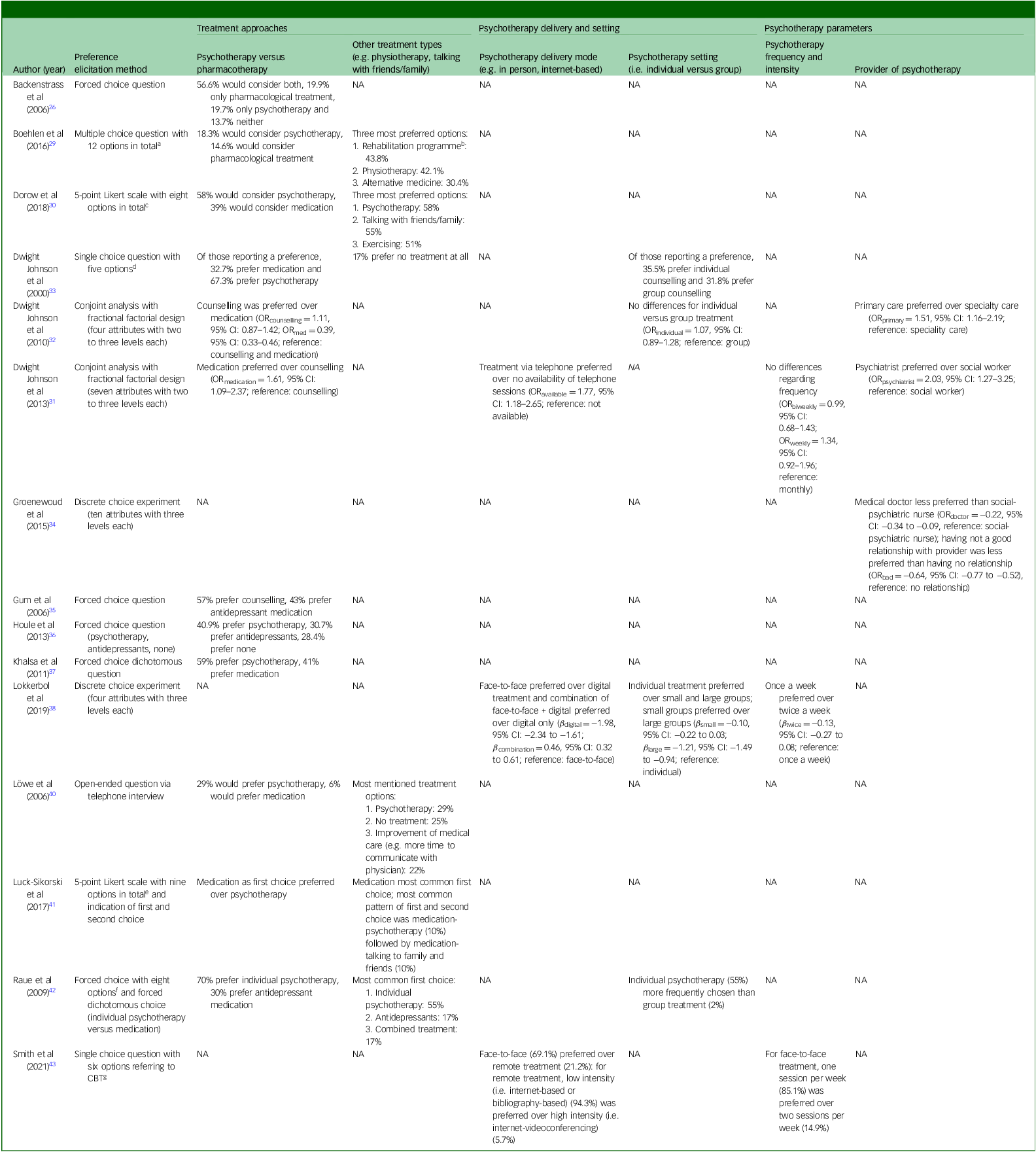
Preferences were elicited with various methods, such as simple (single or multiple choice) questions with predefined options, open-ended questions, rating tasks or choice tasks (see Table 2 and 3). Most commonly, simple questions with predefined options were used (n = 9 Reference Backenstrass, Joest, Frank, Hingmann, Mundt and Kronmuller26,Reference Boehlen, Herzog, Maatouk, Saum, Brenner and Wild29,Reference Dwight-Johnson, Sherbourne, Liao and Wells33,Reference Gum, Areán, Hunkeler, Tang, Katon and Hitchcock35–Reference Khalsa, McCarthy, Sharpless, Barrett and Barber37,Reference Raue, Schulberg, Heo, Klimstra and Bruce42–Reference Soucy and Hadjistavropoulos44 ), either asking for the preferred treatment option (i.e. single choice; e.g. Soucy and Hadjistavropoulos Reference Soucy and Hadjistavropoulos44 ) or asking what treatment options would be taken into consideration (i.e. multiple choice; e.g. Boehlen et al Reference Boehlen, Herzog, Maatouk, Saum, Brenner and Wild29 ). In one study, Reference Löwe, Schulz, Grafe and Wilke40 participants were asked open-ended questions to assess their preferred treatment and their responses were grouped into ten preference categories. Five studies applied choice experiments to elicit the respondents’ preferences. Reference Dwight Johnson, Apesoa-Varano, Hay, Unutzer and Hinton31,Reference Dwight-Johnson, Lagomasino, Hay, Zhang, Tang and Green32,Reference Groenewoud, Van Exel, Bobinac, Berg, Huijsman and Stolk34,Reference Lokkerbol, Geomini, van Voorthuijsen, van Straten, Tiemens and Smit38,Reference Lokkerbol, van Voorthuijsen, Geomini, Tiemens, van Straten and Smit39 These studies included up to ten attributes. Reference Groenewoud, Van Exel, Bobinac, Berg, Huijsman and Stolk34 Two studies with choice experiments applied multiple surveys in the same sample, with each consisting of four different attributes. Reference Dwight Johnson, Apesoa-Varano, Hay, Unutzer and Hinton31,Reference Dwight-Johnson, Lagomasino, Hay, Zhang, Tang and Green32 Furthermore, some studies used rating tasks (i.e. Likert scales) to assess the preference strength for different treatment options. One study used solely rating tasks, Reference Dorow, Löbner, Pabst, Stein and Riedel-Heller30 whereas three studies combined rating tasks with simple single choice questions. Reference Basile, Newton-John and Wootton27,Reference Black, Paparo and Wootton28,Reference Luck-Sikorski, Stein, Heilmann, Maier, Kaduszkiewicz and Scherer41 Only four studies provided patients with education about the treatments, including a description, benefits and disadvantages, before assessing their preferences. Reference Dwight Johnson, Apesoa-Varano, Hay, Unutzer and Hinton31,Reference Dwight-Johnson, Lagomasino, Hay, Zhang, Tang and Green32,Reference Houle, Villaggi, Beaulieu, Lespérance, Rondeau and Lambert36,Reference Soucy and Hadjistavropoulos44
Preference attributes for depressive disorders
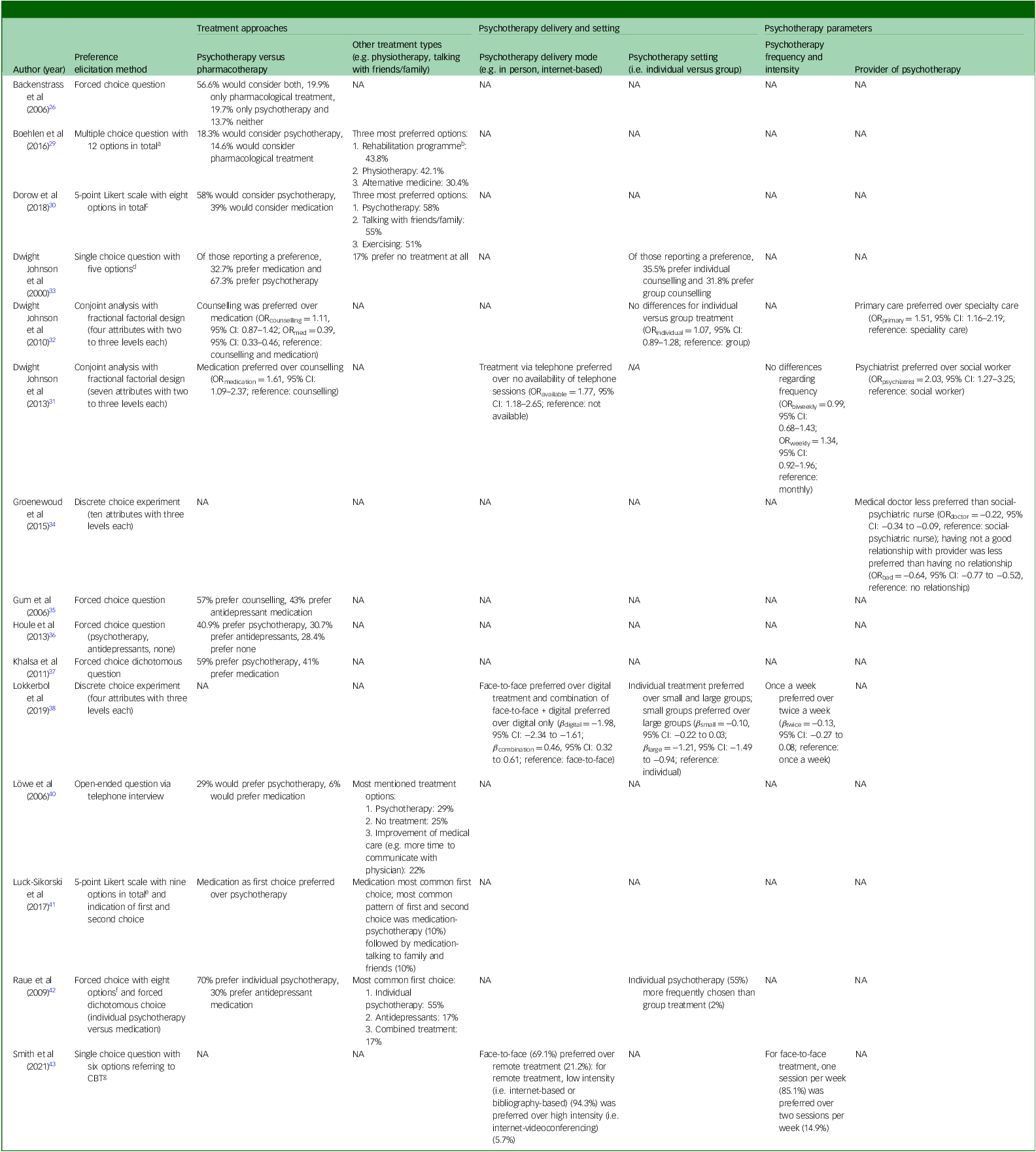
NA, Not assessed; CBT, cognitive–behavioural therapy.
a . Options: regular consultations with GP, rehabilitation programme, psychotherapy, self-help group, pharmacological treatment, relaxation techniques, more time for consultations with GP, alternative medicine, more information/education, physiotherapy, nothing.
b . Not further specified.
c . Options: medication, psychotherapy, combined treatment, alternative therapies, talk with friends and family, exercise, self-help literature, internet-based self-help programmes.
d . Options: 1. Free medication daily for 6 months, often causes nausea and headaches, 75% chance of cure; 2. Medication daily for 6 months, no or only minor side effects, costs you $80/month ($480 total), 75% chance of cure; 3. Individual counselling 1 h per week for 3 months, costs you $25 a session ($300 total), 75% chance of cure; 4. Group counselling 1 h per week for 3 months, costs you $5 per session ($75 total), 75% chance of cure; 5. Wait and see (no treatment, no cost), 40% chance of cure.
e . Options: medication, psychotherapy, combined treatment, alternative approaches, talking to family and friends, exercise, self-help books, self-help groups, I do not know.
f . Options: antidepressants, individual psychotherapy, group psychotherapy, combined treatment, herbal remedies, religious/spiritual activities, exercise, do nothing.
g . Options: 1. standard weekly face-to-face contact (once a week); 2. accelerated face-to-face treatment (twice a week); 3. internet videoconferencing; 4. low intensity intervention (non-face-to-face); 5. other treatment; 6. none.
Preference attributes for anxiety disorders
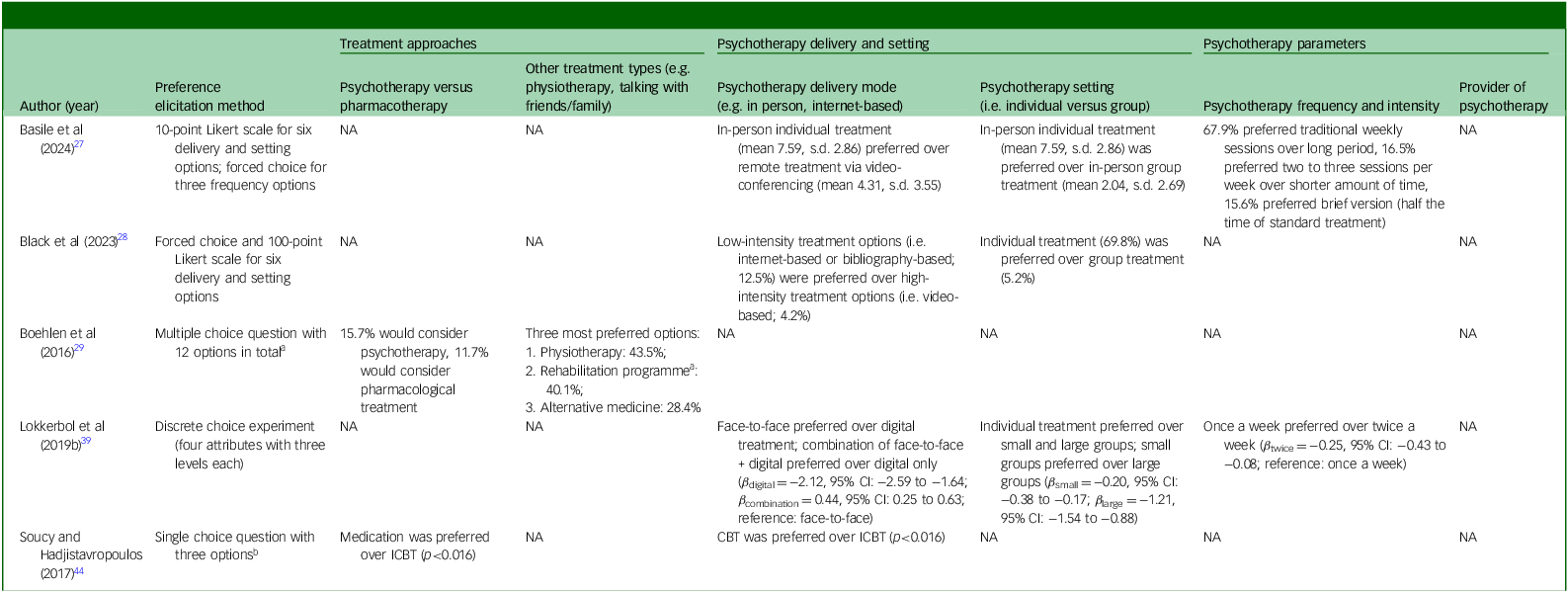
NA, Not assessed; CBT, cognitive–behavioural therapy; ICBT, internet-based–cognitive behavioural therapy.
a . Options: regular consultations with GP, rehabilitation programme, psychotherapy, self-help group, pharmacological treatment, relaxation techniques, more time for consultations with GP, alternative medicine, more information/education, physiotherapy, nothing.
b . Options: CBT, ICBT, medication.
Preference attributes
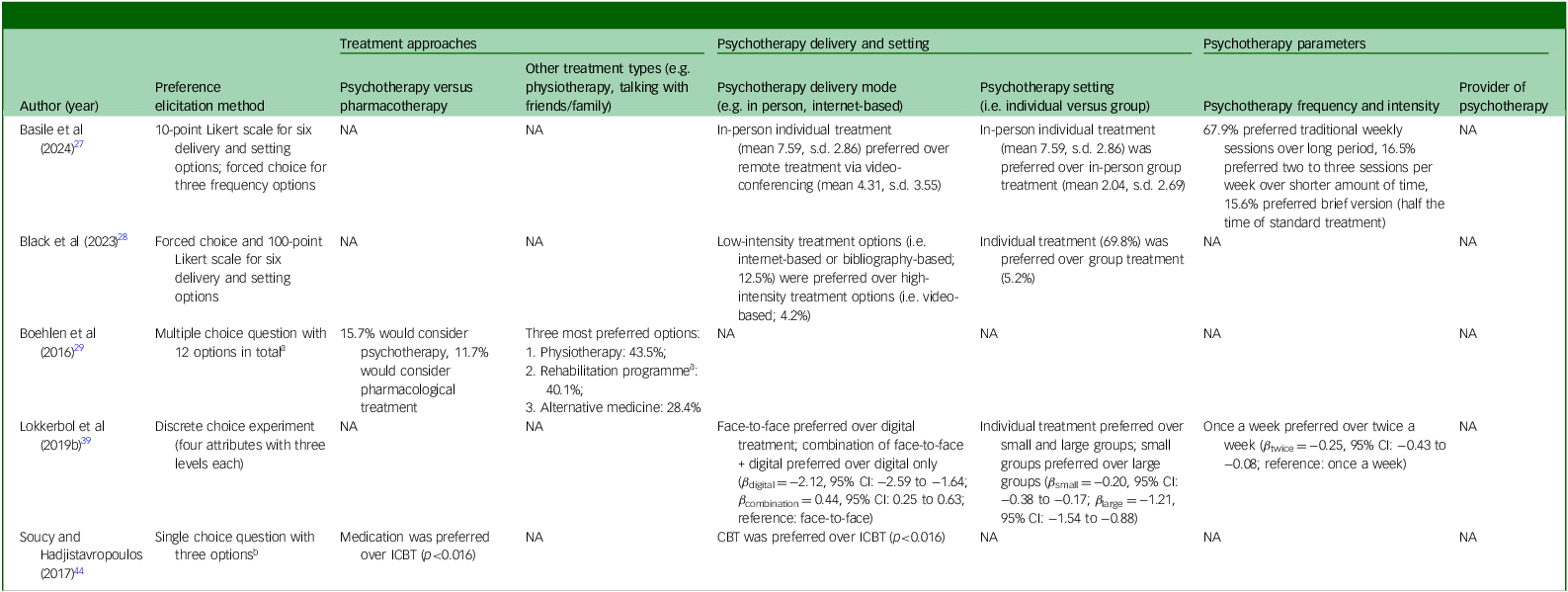
The preferences extracted from the included studies were categorised into treatment approaches, psychotherapy delivery and setting, and psychotherapy parameters. They are displayed in Table 2 for depressive disorders and Table 3 for anxiety disorders and will be further explained in the following sections. Fourteen studies explored preferences for the choice between psychotherapy and pharmacotherapy (12 in depression studies, two in anxiety studies). Other treatment approaches were investigated in seven studies (six in depression studies and one in anxiety studies). Regarding psychotherapy delivery and setting, preferences for delivery were studied in three depression studies and four anxiety studies, and preferences for the setting were investigated in four depression studies and three anxiety studies. Frequency and intensity preferences were assessed in five studies (three depression and two anxiety studies), and provider preferences were only studied in three depression studies. Thus, in total, in depression studies, treatment approaches were by far the most explored attributes, followed by delivery and setting attributes and psychotherapy parameters. In anxiety studies, delivery and setting attributes were most assessed, followed by treatment approaches and psychotherapy parameters, whereby no anxiety study investigated provider preferences.
Treatment approaches
Depression
In studies investigating preferences for depression treatment, preferences for psychotherapy versus pharmacological treatment were compared in 12 out of 15 studies. The findings show that psychotherapy was preferred over medication in all but two studies. In studies using a forced choice dichotomous question, psychotherapy was always preferred over medication, with shares between 57 v. 43% Reference Gum, Areán, Hunkeler, Tang, Katon and Hitchcock35 and 70 v. 30%. Reference Raue, Schulberg, Heo, Klimstra and Bruce42 In other studies using single or multiple choice questions or ratings tasks, the share of respondents considering psychotherapy was always larger than the share considering pharmacological treatment. For example in Löwe et al, Reference Löwe, Schulz, Grafe and Wilke40 29% would prefer psychotherapy and only 6% would choose medication as their preferred treatment. In contrast to this, two studies reported stronger preferences for medication compared with psychotherapy. Reference Backenstrass, Joest, Frank, Hingmann, Mundt and Kronmuller26,Reference Dwight Johnson, Apesoa-Varano, Hay, Unutzer and Hinton31 In Backenstrass et al Reference Backenstrass, Joest, Frank, Hingmann, Mundt and Kronmuller26 more than half of the respondents (56.6%) stated they would consider both treatment options, 19.9% would consider only pharmacological treatment and 19.7% would only consider psychotherapy. In another study applying conjoint analysis, medication was also preferred over counselling (odds ratio 1.61, 95% CI 1.09–2.37). Reference Dwight Johnson, Apesoa-Varano, Hay, Unutzer and Hinton31
Regarding other treatment approaches, in six studies, participants considered further treatment options apart from psychotherapy or pharmacotherapy. For example, talking to friends and family was among the most common top three choices in two studies. Reference Dorow, Löbner, Pabst, Stein and Riedel-Heller30,Reference Luck-Sikorski, Stein, Heilmann, Maier, Kaduszkiewicz and Scherer41 In Boehlen et al, Reference Boehlen, Herzog, Maatouk, Saum, Brenner and Wild29 the most preferred treatment option was rehabilitation programme (43.8%), followed by physiotherapy (42.1%) and alternative medicine (30.4%). However, the option rehabilitation programme was not further specified to respondents. Psychotherapy and pharmacological treatment were the seventh and ninth choice among the most preferred treatment methods. Moreover, in one study, a preference for a combined treatment was as common as a preference for antidepressant medication. Reference Raue, Schulberg, Heo, Klimstra and Bruce42 In three studies, about one-fourth to one-fifth of respondents chose no treatment over any kind of active treatment, Reference Boehlen, Herzog, Maatouk, Saum, Brenner and Wild29,Reference Dwight-Johnson, Sherbourne, Liao and Wells33,Reference Löwe, Schulz, Grafe and Wilke40 whereas in two other studies, treatment was refused by no one Reference Raue, Schulberg, Heo, Klimstra and Bruce42 or very few respondents (2.4% in Smith et al Reference Smith, Paparo and Wootton43 ).
Anxiety
In studies eliciting preferences for treatment of anxiety disorder, comparison of preferences for psychotherapy versus pharmacological treatment was performed in two studies. Boehlen et al Reference Boehlen, Herzog, Maatouk, Saum, Brenner and Wild29 reported that 15.7% of respondents with generalised anxiety disorder would consider psychotherapy, whereas 11.7% would consider pharmacological treatment. In another study, preference strength for medication was significantly higher than for internet-delivered cognitive–behavioural therapy, but not in comparison to regular cognitive–behavioural therapy. Reference Soucy and Hadjistavropoulos44
Regarding other treatment approaches, only in one study, participants expressed preferences for other treatment approaches besides psychotherapy and pharmacotherapy. In Boehlen et al, Reference Boehlen, Herzog, Maatouk, Saum, Brenner and Wild29 the three most preferred options were physiotherapy (43.5%), rehabilitation programme (40.1%, not further specified) and alternative medicine (28.4%). The share of respondents choosing psychotherapy or medication in this study was 15.7 and 11.7%, respectively. Reference Boehlen, Herzog, Maatouk, Saum, Brenner and Wild29
Psychotherapy delivery and setting
Depression
In three studies, preferences for delivery modes were assessed. Face-to-face treatment was preferred over digital treatment in two studies, Reference Lokkerbol, Geomini, van Voorthuijsen, van Straten, Tiemens and Smit38,Reference Smith, Paparo and Wootton43 and a combination of face-to-face and digital therapy was preferred over fully digital treatment. Reference Lokkerbol, Geomini, van Voorthuijsen, van Straten, Tiemens and Smit38 Moreover, Lokkerbol et al Reference Lokkerbol, Geomini, van Voorthuijsen, van Straten, Tiemens and Smit38 found that the attribute face-to-face versus digital had the highest conditional relative importance in the discrete choice experiment (45.7%). In Dwight Johnson et al, Reference Dwight Johnson, Apesoa-Varano, Hay, Unutzer and Hinton31 the option to receive treatment via telephone was preferred over not having this option (odds ratio 1.77, 95% CI 1.18–2.65).
Regarding the setting, individual therapy was preferred over group therapy. Reference Dwight-Johnson, Sherbourne, Liao and Wells33,Reference Lokkerbol, Geomini, van Voorthuijsen, van Straten, Tiemens and Smit38,Reference Raue, Schulberg, Heo, Klimstra and Bruce42 Additionally, small groups of three to five persons were preferred over large groups of six to ten persons, and this attribute was the second most conditional relative important of all (32.9%). Reference Lokkerbol, Geomini, van Voorthuijsen, van Straten, Tiemens and Smit38 In one study, individual psychotherapy was the most common first choice (55%) and group therapy was only chosen by 2%, Reference Raue, Schulberg, Heo, Klimstra and Bruce42 but this difference was smaller in Dwight-Johnson et al Reference Dwight-Johnson, Sherbourne, Liao and Wells33 (35.5 v. 31.8%), and another study did not find a significant preference for either individual or group treatment. Reference Dwight-Johnson, Lagomasino, Hay, Zhang, Tang and Green32
Anxiety
In accordance with the delivery mode preferences for depression treatment, in studies investigating preferences for anxiety disorder, face-to-face treatment was preferred over digital treatment, Reference Basile, Newton-John and Wootton27,Reference Lokkerbol, van Voorthuijsen, Geomini, Tiemens, van Straten and Smit39 and combined face-to-face with digital treatment was preferred over fully digital treatment. Reference Lokkerbol, van Voorthuijsen, Geomini, Tiemens, van Straten and Smit39 Again, the attribute concerning face-to-face versus digital treatment had the highest conditional relative importance in the discrete choice experiment (47.2%). Reference Lokkerbol, van Voorthuijsen, Geomini, Tiemens, van Straten and Smit39 Furthermore, low-intensity treatment options (i.e. internet-based or bibliography-based psychotherapy) were preferred over high-intensity treatment options (i.e. video-based psychotherapy). Reference Black, Paparo and Wootton28
Regarding setting, individual psychotherapy was preferred over group psychotherapy in all studies assessing this attribute. Reference Basile, Newton-John and Wootton27,Reference Black, Paparo and Wootton28,Reference Lokkerbol, van Voorthuijsen, Geomini, Tiemens, van Straten and Smit39 Again, small groups (three to five persons) were preferred over large groups (six to ten persons) (small groups: odds ratio −0.20, 95% CI −0.38 to −0.17; large groups: odds ratio −1.21, 95% CI −1.54 to −0.88; reference: individual) and this attribute had the second highest conditional relative importance (31.8%). Reference Lokkerbol, van Voorthuijsen, Geomini, Tiemens, van Straten and Smit39
Psychotherapy parameters
Depression
Concerning frequency and intensity, two studies reported a preference for one session per week over two sessions per week; Reference Lokkerbol, Geomini, van Voorthuijsen, van Straten, Tiemens and Smit38,Reference Smith, Paparo and Wootton43 that is, in Smith et al, Reference Smith, Paparo and Wootton43 85% of participants chose standard face-to-face treatment (once a week) and 15% chose the accelerated version (twice a week). In Lokkerbol et al, Reference Lokkerbol, Geomini, van Voorthuijsen, van Straten, Tiemens and Smit38 two times per week was less preferred than once a week (two times a week: odds ratio −0.13, 95% CI −0.27 to 0.08), and the intensity of treatment had the lowest conditional relative importance among all assessed attributes (5.0%). One study did not find any differences regarding frequency preferences. Reference Dwight Johnson, Apesoa-Varano, Hay, Unutzer and Hinton31
Concerning the treatment provider, the findings all derive from studies applying choice experiments. In Dwight Johnson et al, Reference Dwight Johnson, Apesoa-Varano, Hay, Unutzer and Hinton31 a psychiatrist was preferred over a social worker as treatment provider (odds ratio 2.03, 95% CI 1.27–3.25), whereas in another study, a medical doctor was less preferred than a social-psychiatric nurse (odds ratio −0.22, 95% CI −0.34 to −0.09). Reference Groenewoud, Van Exel, Bobinac, Berg, Huijsman and Stolk34 Furthermore, in one study, primary care was preferred over speciality care. Reference Dwight-Johnson, Lagomasino, Hay, Zhang, Tang and Green32 Regarding the relationship with the treatment provider, Groenewoud et al Reference Groenewoud, Van Exel, Bobinac, Berg, Huijsman and Stolk34 found that having no relationship with the provider was preferred over having a not very good relationship with the provider (Poor relationship: odds ratio −0.64, 95% CI −0.77 to −0.52; reference: no relationship).
Anxiety
Concerning frequency and intensity, two studies reported preferences for the frequency or intensity of treatment. In one study, treatment once a week was preferred over treatment twice a week (two times a week: odds ratio −0.25, 95% CI −0.43 to −0.08; reference: once a week). Reference Lokkerbol, van Voorthuijsen, Geomini, Tiemens, van Straten and Smit39 Moreover, Basile et al Reference Basile, Newton-John and Wootton27 assessed three different frequency options: 67.9% preferred traditional weekly sessions over a long period, 16.5% preferred two to three sessions per week over a shorter time period and 15.6% preferred a brief version of treatment (i.e. half the time of standard treatment).
Other preferences
Further findings regarding preferences for depression or anxiety treatment were low cost Reference Dwight Johnson, Apesoa-Varano, Hay, Unutzer and Hinton31,Reference Groenewoud, Van Exel, Bobinac, Berg, Huijsman and Stolk34 and short waiting times until the onset of treatment. Reference Groenewoud, Van Exel, Bobinac, Berg, Huijsman and Stolk34,Reference Lokkerbol, Geomini, van Voorthuijsen, van Straten, Tiemens and Smit38,Reference Lokkerbol, van Voorthuijsen, Geomini, Tiemens, van Straten and Smit39 The conditional relative importance of waiting time was 16.1% in a study on preferences for anxiety treatment, Reference Lokkerbol, van Voorthuijsen, Geomini, Tiemens, van Straten and Smit39 and 16.4% in a study on preferences for depression treatment. Reference Lokkerbol, Geomini, van Voorthuijsen, van Straten, Tiemens and Smit38
Determinants
Socioeconomic and health-related determinants of treatment preferences will be explained in the following section. If a determinant was significantly associated with treatment preferences in at least one study, it is displayed in a column in Supplementary Table S1. An overview of all investigated determinants per study is provided in Supplementary Material C. Sociodemographic factors were more frequently examined in the included studies than health-related factors.
Socioeconomic factors
Depression
Regarding age, older respondents were less likely to choose internet-based treatment compared with younger respondents. Reference Dorow, Löbner, Pabst, Stein and Riedel-Heller30 Furthermore, one study showed that, in general, older respondents showed more difficulties in choosing their preferred treatment. Reference Luck-Sikorski, Stein, Heilmann, Maier, Kaduszkiewicz and Scherer41 Besides age, gender was also found to be associated with preferences. Women preferred psychotherapy over medication Reference Dwight-Johnson, Sherbourne, Liao and Wells33,Reference Gum, Areán, Hunkeler, Tang, Katon and Hitchcock35,Reference Houle, Villaggi, Beaulieu, Lespérance, Rondeau and Lambert36 and individual counselling over group counselling. Reference Dwight-Johnson, Sherbourne, Liao and Wells33 Male respondents were less likely to choose alternative treatment (odds ratio 0.63, 95% CI 0.46–0.87) or self-help literature (odds ratio 0.66, 95% CI 0.48–0.90) compared with female respondents. Reference Dorow, Löbner, Pabst, Stein and Riedel-Heller30 Being single was also associated with choosing psychotherapy compared with being married. Reference Dorow, Löbner, Pabst, Stein and Riedel-Heller30 In the matter of ethnicity, Dwight Johnson et al Reference Dwight Johnson, Apesoa-Varano, Hay, Unutzer and Hinton31 found that White men were more likely to choose medication compared with Mexican men, whereas in another study, being Black American was associated with preferring counselling over medication. Reference Dwight-Johnson, Sherbourne, Liao and Wells33 Three studies did not find any significant associations between ethnicity and preferences. Reference Gum, Areán, Hunkeler, Tang, Katon and Hitchcock35–Reference Khalsa, McCarthy, Sharpless, Barrett and Barber37 Groenewoud et al Reference Groenewoud, Van Exel, Bobinac, Berg, Huijsman and Stolk34 found that respondents with a higher level of education based their choice on a larger number of attributes compared with respondents with a lower level of education. Moreover, a high education level was associated with a preference for psychotherapy, Reference Dorow, Löbner, Pabst, Stein and Riedel-Heller30,Reference Houle, Villaggi, Beaulieu, Lespérance, Rondeau and Lambert36 choosing individual over group therapy Reference Dwight-Johnson, Sherbourne, Liao and Wells33 and having an aversion against long waiting times and fully digital treatment. Reference Lokkerbol, Geomini, van Voorthuijsen, van Straten, Tiemens and Smit38 In one study, wealthy respondents were more likely to choose any kind of active treatment over no treatment (odds ratio 3.74, 95% CI 1.77–7.91). Reference Dwight-Johnson, Sherbourne, Liao and Wells33
Anxiety
In one anxiety study, younger respondents had less aversion against digital treatment compared with older adults, Reference Lokkerbol, van Voorthuijsen, Geomini, Tiemens, van Straten and Smit39 whereas another study did not find any significant differences in treatment preferences regarding age. Reference Black, Paparo and Wootton28 Additionally, in terms of education, respondents with a higher level of education had a stronger preference for shorter waiting times and a stronger aversion against a treatment intensity of two times per week compared with respondents with a lower level of education. Reference Lokkerbol, van Voorthuijsen, Geomini, Tiemens, van Straten and Smit39
Health-related factors
Depression
Although four studies found no significant association between the severity of symptoms and preferences, Reference Backenstrass, Joest, Frank, Hingmann, Mundt and Kronmuller26,Reference Dorow, Löbner, Pabst, Stein and Riedel-Heller30,Reference Groenewoud, Van Exel, Bobinac, Berg, Huijsman and Stolk34,Reference Lokkerbol, Geomini, van Voorthuijsen, van Straten, Tiemens and Smit38 other studies reported that a higher depression severity was associated with higher preference for medication (major depression: odds ratio 1.45, 95% CI 1.12–1.86; reference: dysthymia) Reference Gum, Areán, Hunkeler, Tang, Katon and Hitchcock35 and lower endorsement of psychotherapy, Reference Luck-Sikorski, Stein, Heilmann, Maier, Kaduszkiewicz and Scherer41 or it was simply reported that symptom severity affected treatment choice. Reference Dwight-Johnson, Lagomasino, Hay, Zhang, Tang and Green32 In terms of comorbidity, one study reported that having a comorbid anxiety disorder was associated with a general preference for active treatment compared with no treatment, Reference Dwight-Johnson, Sherbourne, Liao and Wells33 whereas another study reported an association of comorbid anxiety disorder with a preference for alternative treatment. Reference Dorow, Löbner, Pabst, Stein and Riedel-Heller30 Regarding the treatment history, one study found that having a treatment history of depression was associated with a lower preference for medication and combined treatment, Reference Dorow, Löbner, Pabst, Stein and Riedel-Heller30 and another study reported that having no recent antidepressant treatment was associated with preferring counselling over medication. Reference Dwight-Johnson, Sherbourne, Liao and Wells33 Additionally, Gum et al Reference Gum, Areán, Hunkeler, Tang, Katon and Hitchcock35 found that patients who had previously received antidepressant medication or had found it helpful in the past were more likely to prefer medication over psychotherapy, whereas patients who had previously received psychotherapy or had found it helpful in the past were less likely to prefer medication over psychotherapy. In contrast to this, one study reported that participants who preferred psychotherapy had fewer previous courses of psychotherapy compared with respondents preferring medication. Reference Khalsa, McCarthy, Sharpless, Barrett and Barber37 One study explored the association of having a family history of depression and found that respondents with a family history of depression had a stronger preference for psychotherapy compared with respondents without a family history of depression (odds ratio 7.8, 95% CI 1.6–37.7). Reference Houle, Villaggi, Beaulieu, Lespérance, Rondeau and Lambert36 Furthermore, having a greater knowledge about medication was associated with preferring active treatment over no treatment, whereas having a greater knowledge about counselling was associated with preferring counselling over medication and individual over group counselling. Reference Dwight-Johnson, Sherbourne, Liao and Wells33
Anxiety
One study explored the association of having a treatment history of anxiety disorder with treatment preferences and found that respondents who had previously received psychological treatment were more likely to choose individual face-to-face treatment compared with those who had not. Reference Black, Paparo and Wootton28
Other factors
Three studies found other factors associated with preferences apart from the described sociodemographic and health-related factors (not displayed). For example, in a USA study, Reference Dwight-Johnson, Sherbourne, Liao and Wells33 having paid sick leave was associated with preferring counselling over medication (odds ratio 1.59, 95% CI 1.10–2.30). Moreover, in another study, higher empowerment was associated with lower preference for medication and combined treatment, and stronger preference for talking with family and friends and exercising. Reference Dorow, Löbner, Pabst, Stein and Riedel-Heller30 Houle et al Reference Houle, Villaggi, Beaulieu, Lespérance, Rondeau and Lambert36 found that currently receiving psychotherapy was associated with a strong preference for psychotherapy compared with antidepressant medication (odds ratio 17.3, 95% CI: 2.7–109.3 Reference Houle, Villaggi, Beaulieu, Lespérance, Rondeau and Lambert36 ).
Discussion
Our systematic review synthesised the existing evidence on treatment preferences and their determinants among adults with depressive or anxiety disorder in out-patient mental healthcare. To our knowledge, this is the first systematic review on that topic that includes all study types and designs. However, no qualitative study meeting the eligibility criteria could be identified. Of 19 studies included in this review, four studies examined preferences for anxiety disorders, two focused on both depression and anxiety, and the remaining studies investigated preferences for depressive disorders only. We observed high heterogeneity in terms of the study designs and methods, impeding the formulation of robust conclusions. However, some patterns emerged from the data, suggesting a possible tendency toward preferences for psychotherapy over medication, face-to-face over digital treatment and individual over group therapy.
Preferences and determinants
Preferences as well as their determinants were heterogeneous, and most findings of this review resulted from single studies. In the following section, we will discuss the three main findings in more detail and renounce the in-depth interpretation of further results deriving from single studies.
Preference for psychotherapy (and determinants)
Data synthesis of the study results showed that psychotherapy was preferred over medication in the majority of samples with depressive disorder (nine out of 19 studies). Yet, three studies reported a preference for antidepressant medication. In previous systematic reviews, one with meta-analysis, it has been shown that psychotherapy was preferred over medication, Reference McHugh, Whitton, Peckham, Welge and Otto45,Reference van Schaik, Klijn, van Hout, van Marwijk, Beekman and de Haan46 with the main reasons for not choosing pharmacological treatment being fear of side-effects and fear of losing control. Reference van Schaik, Klijn, van Hout, van Marwijk, Beekman and de Haan46 Another meta-analysis Reference Swift, Greenberg, Tompkins and Parkin12 evaluated treatment refusal and premature treatment termination in patients with mental disorders and found that patients with depression were more likely to refuse or drop out of treatment if they received pharmacotherapy compared with psychotherapy. Regarding determinants, our results showed that women in particular Reference McHugh, Whitton, Peckham, Welge and Otto45 were more likely to choose psychotherapy. It is well known that men are less likely to seek psychotherapy for mental health problems compared with women, Reference Rommel, Bretschneider and Kroll47 which is often associated with their image of masculinity and feelings of shame. Reference Shepherd, Astbury, Cooper, Dobrzynska, Goddard and Murphy48 Moreover, our findings suggest that patients with a higher level of education also tend to prefer psychotherapy.
Preference for face-to-face treatment (and determinants)
Digital mental health interventions receive growing attention, especially since the COVID-19 pandemic. Besides equivalent effectiveness of remote psychotherapy and face-to-face treatment, Reference Carlbring, Andersson, Cuijpers, Riper and Hedman-Lagerlof49 digital mental health interventions produce lower costs and enable easier access independent from time and place compared with traditional face-to-face-treatment. Reference Woon, Maguire, Reay and Looi50 However, our results suggested that face-to-face treatment may be preferred over digital treatment (five out of 19 studies). This could be related to numerous factors ranging from person-related barriers (such as lack of familiarity or limited digital literacy) to technology-related barriers (such as restricted access or technical issues). Reference Borghouts, Eikey, Mark, De Leon, Schueller and Schneider51 Data synthesis of determinants indicated that younger respondents were generally more likely to accept and choose digital mental health treatment compared with older respondents. Hence, benefits of digital mental health treatment need to be further promoted to increase acceptance of digital mental health interventions, especially among older adults.
Preference for individual therapy (and determinants)
Regarding the setting of psychotherapy, six studies reported a preference for individual therapy compared with group therapy, and there was one study reporting no significant difference for either one of the setting options. A previous meta-analysis revealed that individual treatment was slightly more effective than group treatment in depression, Reference Cuijpers, van Straten and Warmerdam52 whereas another meta-analysis showed no significant differences regarding effectiveness in anxiety disorders. Reference Barkowski, Schwartze, Strauss, Burlingame and Rosendahl53 Thus, there must be reasons for the observed preference apart from effectiveness. Benefits (both objective and perceived) of individual therapy compared with group therapy might include higher anonymity and stronger focus on individual needs and values.
Study quality and future research
Overall, the included studies were of moderate quality, which was mainly because of convenience samples and risk of non-response bias, as well as the applied methods for assessing preferences in the sample.
The majority of studies used online convenience samples for their research. Despite the numerous advantages (e.g. inexpensive, easy and efficient access to the sample) of this sampling strategy, it holds a few severe limitations. Patients who engage actively in online questionnaires might differ from patients who do not, and in most studies, analyses on the difference between respondents and non-respondents usually cannot be made. Hence, selection bias as well as non-response bias cannot be ruled out.
Furthermore, we observed high heterogeneity in the studies regarding their applied methods and investigated preference types. The applied methods ranged from simple calculation of frequencies from single choice questions Reference Khalsa, McCarthy, Sharpless, Barrett and Barber37 to complex choice modelling methods. Reference Lokkerbol, Geomini, van Voorthuijsen, van Straten, Tiemens and Smit38 Moreover, many studies compared different treatment approaches, Reference Boehlen, Herzog, Maatouk, Saum, Brenner and Wild29 whereas fewer investigated delivery or setting preferences. Reference Smith, Paparo and Wootton43 The resulting diversity of study results and evidence strength aggravates the data synthesis in systematic reviews. To promote comparability of studies in the future, researchers should use validated instruments (such as the Cooper Norcross Inventory Reference Cooper and Norcross54 ) or develop new tools that include parameters that have not yet been considered in existing instruments.
In only a few studies did patients receive information about the different treatments they could choose from. Future research could study the impact of patient education on treatment preferences and decision-making.
Investigated determinants were also highly diverse and most studies only examined the influence of single determinants. Interactions of multiple determinants or application of latent class analysis would be interesting to detect patterns that contribute to the understanding of preferences and choices in out-patient mental healthcare.
Finally, we only included quantitative and mixed-methods studies, as no qualitative study met the predefined inclusion criteria during the selection process. However, qualitative evidence might contribute to more in-depth results. More precisely, qualitative studies could contribute to possible explanations for the patients’ preferences and choices. Moreover, with findings from qualitative research unobserved treatment attributes that are important for patients’ choice of treatment and provider in out-patient mental healthcare could be identified.
Strengths and limitations
We want to acknowledge some strengths and shortcomings of this review. To increase transparency and quality, our review was registered in PROSPERO and follows the MOOSE and PRISMA guidelines. Our search term was approved by a librarian from the University Medical Centre Hamburg-Eppendorf and then applied in four databases. No further hand search was conducted. We included only peer-reviewed articled that were published in either English or German. As a result, we may have failed to include relevant articles; however, this choice contributed to the quality of included studies. Also, key steps in study selection and data extraction were performed in duplicate, as well as the quality assessment.
In conclusion, our systematic review summarised studies on treatment preferences and determinants in out-patient mental healthcare. The majority of studies focused on depressive disorders, and only a few investigated preferences of patients with anxiety disorders. The results indicate a tendency to favour psychotherapy over medication for depression treatment. Furthermore, tendencies toward a preference for face-to-face treatment and individual therapy were observed among patients of both depressive and anxiety disorders. However, the determinants of these preferences were primarily derived from single studies or were somewhat inconsistent. It is important to note that the included studies demonstrated considerable heterogeneity in terms of tools, statistical methods and examined preference types, restricting the generation of robust conclusions. This underscores the need for standardised instruments in future research, to enhance comparability and strengthen the evidence for treatment preferences among adults with depressive or anxiety disorder in out-patient mental healthcare. In terms of clinical implications, providers should be aware that preferences can be diverse and cannot be generalised, which highlights the importance of assessment and integration of treatment preferences into individual care planning.
Supplementary material
The supplementary material is available online at https://doi.org/10.1192/bjo.2025.10849
Data availability
Data availability is not applicable to this article as no new data were created or analysed in this study.
Author contributions
L.L., A.H. and H.-H.K. conceived the study. L.L., M.L. and A.H. were responsible for data curation. L.L. wrote the original draft of the manuscript and M.L., A.H. and H.-H.K. reviewed and edited the manuscript. A.H. supervised the study.
Funding
This work was funded by the German Academic Research Foundation (DFG), grant number GRK 2805/1, awarded to the University Medical Centre Hamburg-Eppendorf.
Declaration of interest
None.


 Open access


eLetters
No eLetters have been published for this article.