


Introduction
Invasive alien species are among the primary drivers of biodiversity loss globally (Poorter et al., Reference Poorter, Pagad and Ullah2007; Kettunen et al., Reference Kettunen, Genovesi, Gollasch, Pagad, Starfinger, ten Brink and Shine2008). Among the species causing concern in northern Europe is the American mink Neovison vison, which escaped from mink farms across Europe at the beginning of the 20th century and subsequently established widespread feral populations (Sheail, Reference Sheail2004; Bonesi & Palazon, Reference Bonesi and Palazon2007; Reynolds, Reference Reynolds2009). Without natural enemies and being a generalist predator, the mink has had negative effects on European populations of native species, including globally threatened waders and seabirds, passerines, small mammals and reptiles (e.g. Nordström et al., Reference Nordström, Högmander, Laine, Nummelin, Laanetu and Korpimäki2003; Ahola et al., Reference Ahola, Nordström, Banks, Laanetu and Korpimäki2006; Bonesi & Palazon, Reference Bonesi and Palazon2007). Apart from a few notable success stories (Bonesi & Palazon, Reference Bonesi and Palazon2007; Bryce et al., Reference Bryce, Oliver, Davies, Gray, Urquhart and Lambin2011), there is a history of failed conservation efforts aimed at eradication or control of mink. Although numbers may be reduced to acceptable levels, maintaining mink-free areas is labour intensive, requiring ongoing control that may also include buffer zones adjacent to the target conservation zones (Robertson et al., Reference Robertson, Adriaens, Lambin, Mill, Roy, Shuttleworth and Sutton-Croft2016).
Large-scale collaborative efforts including non-professional hunters or trappers could potentially retain sufficient manpower to facilitate initial removal and control recolonization in targeted areas. Hunters could be motivated to participate in collaborative removal efforts because of their personal engagement in safeguarding threatened species or protecting fish and game populations for consumptive uses. Where intrinsic motivation to protect native species is strong, hunters could be encouraged to contribute voluntarily to removing mink over large areas. One such example is the Scottish Mink Initiative, where a range of local interested parties, including gamekeepers, fisheries staff, wildlife conservation professionals, land managers and local residents, collaborated to successfully control mink in an area of > 29,000 km2 in and around Cairngorms National Park (Bryce et al., Reference Bryce, Oliver, Davies, Gray, Urquhart and Lambin2011; Robertson et al., Reference Robertson, Adriaens, Lambin, Mill, Roy, Shuttleworth and Sutton-Croft2016). Alternatively, monetary rewards (i.e. extrinsic motivation) could be offered to incentivize hunters to trap mink. Uncritical use of economic rewards such as bounties could potentially reduce the intrinsic motivations for mink control over the long term; however, in circumstances where there is little interest in conservation, monetary rewards may be the only option to recruit hunters and trappers to the campaign (Gosling & Baker, Reference Gosling and Baker1989; Rode et al., Reference Rode, Gómez-Baggethun and Krause2015). Social benefits are also important for volunteer retention in conservation campaigns (e.g. Ryan et al., Reference Ryan, Kaplan and Grese2001; Asah & Blahna, Reference Asah and Blahna2012). Hunters could be motivated by hunting together with friends and family (Kaltenborn et al., Reference Kaltenborn, Andersen, Vittersø and Bjerke2012), and providing social networking arenas could be crucial for the success of long-term mink control campaigns. Alternatively, hunters could be more engaged in local conservation actions near their homes (Selinske et al., Reference Selinske, Coetzee, Purnell and Knight2015), which would be advantageous as it would place less demand on individuals and avoid them overcommitting at the outset.
In Norway mink control programmes have had little success to date. Government-led bounty schemes were in operation during 1946–1975 (Bevanger & Henriksen, Reference Bevanger and Henriksen1995) but thereafter the responsibility was devolved to local municipalities to decide on bounty schemes. In 2013 only 27.78% of the 152 coastal municipalities from the five highest ranked counties for mink capture (SSB, 2013) provided bounties, of NOK 20–400 (EUR 2.36–47.33) per mink (J. Stien, unpubl. data). The Norwegian Environment Agency began a national-scale programme for mink control in 2011, including some additional economic rewards for mink catches (Direktoratet for Naturforvaltning, 2011; Stien et al., Reference Stien, Ims and Yoccoz2011). The national action plan highlighted a need for mink control, particularly in coastal areas, to establish mink-free areas to conserve vulnerable ground-nesting seabird species. The Norwegian Environment Agency attempted to increase awareness of and recruitment to the programme by collaborating with the Norwegian Association of Hunters and Anglers, which has 120,000 members (c. 2.5% of the Norwegian population; SSB, 2013), and met with participants of a successful citizen-initiated mink control programme at the World Heritage Site on Vega Island, in Nordland County (Supplementary Material 1). Finally, it was decided to train professional staff to undertake mink removal from a number of prioritized protected areas. During these government-led campaigns no scoping studies were initiated to investigate whether hunters and trappers shared a concern for the conservation of native species and would be willing to contribute to large-scale mink removal campaigns.
We investigated the possibility of including hunters and trappers in large-scale collaborative campaigns in Norway. We assumed that hunters and trappers who were concerned about the conservation of native species would be more willing to participate voluntarily in mink removal campaigns. More specifically, we expected that hunters with strong consumptive and conservation motives would maximize their catches compared to those with more appreciative motives (e.g. relaxation, excitement, experiencing nature, sensu Kaltenborn et al., Reference Kaltenborn, Andersen, Vittersø and Bjerke2012), and that those who hunted primarily for consumptive reasons would be more likely to be concerned about the protection of fish and game species rather than species of conservation concern. We also expected that hunters who received bounty would catch the most mink, indicating the potential of financial incentives to increase captures. We discuss our results together with the type of leadership preferred by hunters and their suggestions to improve mink hunting, and compare our results with the experiences of large-scale removal programmes elsewhere.
Methods
Survey questionnaire
We designed an internet survey in Questback (Questback, Oslo, Norway), targeted at mink hunters (Table 1). The questionnaire was tested on a subset of eight respondents and employees of the Norwegian Association of Hunters and Anglers and amended based on their feedback before being made available to other respondents. The questionnaire consisted of 47 questions, including questions about the number of mink caught and general hunting effort during the 2012 hunting season (1 April 2012–31 March 2013), respondents’ motivation for mink hunting (based on Kaltenborn et al., Reference Kaltenborn, Andersen, Vittersø and Bjerke2012), and payment of bounty (Fulton et al., Reference Fulton, Manfredo and Lipscomb1996). To explore possible forms of leadership of mink control programmes we asked hunters who they thought should be responsible for mink control. We also asked them to state the relative importance of personal, social and conservation benefits in motivating them to hunt (Asah & Blahna, Reference Asah and Blahna2013), and to check one or more statements describing why they hunt. We supplemented these general questions with more specific questions to elicit attitudes and intent to participate in mink control for conservation purposes. These included questions about perceived threats of mink to fish, game and threatened species, and the importance of mink removal from protected areas, including nature reserves, National Parks, World Heritage Sites and other specially protected areas. The variable Red List species of bird (based on the 2010 Norwegian Red List; Kålås et al., Reference Kålås, Viken, Henriksen and Skjelseth2010) was aggregated to include the black guillemot Cepphus grylle, puffin Fratercula arctica, black-throated diver Gavia arctica and common scoter Melanitta nigra, which were perceived to be threatened by mink. The variable ground-nesting species not on the Red List refers to the common eider Somateria mollissima and other ground-nesting birds. We included threat to salmon and other salmonids as a separate variable. There were two questions on mink-hunting behaviour (Table 1), to investigate how motivations and conservation attitudes affected the number of mink caught and the effort invested in mink hunting. We analysed the number of hunting days and intentions to remove mink during the next 3 years, but we only retained mink catches in the 2012 season as our analyses showed a significant correlation among these three variables.
Variables used in analysis of the perceptions of Norwegian mink hunters, based on survey questions about the 2012 hunting season.

With a view to setting up a conservation programme targeted towards removing mink, we asked respondents who they thought should be in charge of such a programme. As this was the first study targeted towards mink hunters in Norway, we wanted to ensure that we identified a broad range of challenges and alternatives for initiating control programmes. We therefore included an open question inviting respondents to contribute suggestions that could improve mink hunting. The questionnaire and ethics were reviewed and approved by the Norwegian Social Science Data Services (project number 34676).
Survey administration
Our study was intended to gather knowledge to inform the design and elucidation of alternative strategies for a targeted volunteer and incentive programme. As there is no arena for recruiting mink hunters directly we decided to recruit broadly through the Norwegian Association of Hunters and Anglers. With their cooperation we advertised the questionnaire in a news item in September 2013, both on their website's homepage and in their monthly magazine, with a link to the electronic questionnaire. This was followed 6 weeks later by direct e-mail contact with all of the Association's county level (n = 19) and municipality (n = 509) groups, as well as the 152 local government authorities in the five counties with the highest mink returns in the 2012 hunting season. The e-mail explained the goals of the project and asked for contact information for potential respondents. The e-mail to groups belonging to the Norwegian Association of Hunters and Anglers also asked that the survey be promoted at county and municipality level. We followed up contacts by telephone and raised awareness of the study by means of local radio.
Data analysis
We received 104 completed surveys. We used multiple correspondence analysis (Tenenhaus & Young, Reference Tenenhaus and Young1985) to explore the categorical data on motivation and leadership variables, and the results (i.e. coordinates) from this analysis were used to create classes of motivation and leadership data by agglomerate hierarchical clustering. Clusters were determined using a Euclidean distance metric for coordinate distances, and Ward's method was used to define optimum clusters (Ward, Reference Ward1963; Husson et al., Reference Husson, Josse and Pagès2010). Clustering was chosen because of the small sample size, and the analyses were carried out in the package FactoMineR (Husson et al., Reference Husson, Josse, Le and Mazet2015) in R v. 3.12 (R Development Core Team, 2015).
We used generalized linear regression, assuming a Poisson error distribution, to model the number of mink caught as a function of the variables bounty and motivation. We used cumulative logistic models to predict the ordinal dependent variables conservation attitudes and leadership from motivation using the clm function with a probit link in the R package ordinal (Christensen, Reference Christensen2015). The best model was chosen based on the Akaike Information Criterion corrected for small sample sizes (AICc; Burnham & Anderson, Reference Burnham and Anderson2002) using the R package AICcmodavg (Mazerolle, Reference Mazerolle2016).
Results
One hundred and four respondents answered the questionnaire, of whom 96 were members of the Norwegian Association of Hunters and Anglers. Although the sample size is statistically small, it represents hunters who are reportedly responsible for a high number of mink caught in Norway during the 2012 season (a total of 1,053 mink, mean 12.84, range 1–80 per hunter). Their reported catch represents a significant percentage (19.87%) of the total national catch for the 2012 season (SSB, 2013). More than 60% reportedly caught fewer than five mink during the 2012 season, which suggests that a large proportion of the mink are being caught by only a few hunters (Fig. 1). The mean age of respondents was 41.29 years (range 16–76 years); most were male (96%), lived in coastal municipalities (86%) and hunted in their residential or neighbouring municipality (91%, n = 90).
The percentage of hunters who caught various numbers of American mink Neovison vison during the 2012 hunting season.

The effect of bounty, motivation and hunting effort on the number of mink caught
Almost all mink hunters subscribed to conservation, consumptive and appreciative reasons for hunting (Table 2). Differences among hunters were captured only by two variables, ‘whether they like to hunt with family and friends’ (social) and ‘whether they like to hunt close to where they live’ (local), which also explains the differences among the three classes identified by clustering. For the 2012 hunting season hunters who reported enjoying hunting alone and not necessarily locally were estimated to catch on average 1.87 more mink than those who reported hunting locally (estimated effect of non-social, non-local motivation: 8.06 ± SE 1.09 mink, P < 0.001). In the same season hunters who like to hunt with family and friends were estimated to catch 1.39 more mink than hunters who like to hunt locally (estimated effect of hunting for social reasons: 7.58 ± SE 0.08 mink, P < 0.001). Estimates from the model predicting the number of mink caught (Fig. 2) indicate that receiving bounty increased the mean reported number of mink caught by 4.70 (estimated effect of reference value (no bounty) on reported mink catch frequency: 6.19 ± SE 1.07 mink; estimated effect of bounty on reported mink catch frequency: 10.89 ± SE 1.07 mink, P < 0.001). Three outliers that had a large effect on the coefficient estimates were removed. Inspection of the model residuals indicated that standard deviations were larger than expected when theoretical quantiles were > 1 or < 1.
The exponential of the Poisson error regression estimates of the effects of motivation (M) and bounty on the number of mink caught by 101 mink hunters during the 2012 hunting season. The reference level is the number of mink caught by hunters motivated to hunt near home and not receiving a bounty. M2, non-social and non-local hunters; M3, social hunters.

Descriptive values of categories of hunters’ reported motivations to hunt mink, as defined by hierarchical agglomerative clustering (see text for details), with the number of hunters (n = 101) in each cluster. The v test is a transformation of the P value, with values > or < 2 denoting statistical significance of the linkage between categories at P < 0.05 (Husson et al., Reference Husson, Josse, Le and Mazet2015). As the software provides v-test values only for P < 0.05, values for P ≥ 0.05 are denoted by NS (non-significant).

* Values of > 2 are significant at the P < 0.05 level, indicating that the frequency of respondents agreeing (positive) or disagreeing (negative) with the statement is larger or smaller than the mean number of respondents agreeing with the statement (global mean).
Most hunters reported being interested in removing mink to aid conservation management (Table 3), agreeing strongly that mink are a threat to Norwegian biodiversity and that they should be removed from protected areas. Hunters believed it was more important to remove mink to conserve ground-nesting species such as eider and grouse than focusing on specific ground-nesting species from the Red List (Table 3). Opinion was divided regarding the protection of salmonid fishes. Motivations were not significant in predicting conservation attitudes.
Percentage of conservation attitudes expressed by hunters in the self-reported motivation classes: local; non-social, non-local; social. We found no significant differences among classes.

Leadership and recommendations for conservation targeted towards mink control campaigns
Leadership classes were best defined by three clusters (Table 4). Cluster 1 consisted of 47% of the respondents, who reported a preference for government-led campaigns, respondents in cluster 2 reported a preference for NGO leadership and were negative towards municipal involvement (33%), and respondents in cluster 3 reported a preference for self-initiated and landowner actions to hunt and were against any hierarchical-led actions (20%).
Descriptive values of categories of hunter-reported preference for leadership, as defined by hierarchical agglomerative clustering (see text for details), with the number of hunters (n = 101) in each cluster. The v test is a transformation of the P value, with values > or < 2 denoting statistical significance of the linkage between categories at P < 0.05 (Husson et al., Reference Husson, Josse, Le and Mazet2015). As the software provides v-test values only for P < 0.05, values for P ≥ 0.05 are denoted by NS (non-significant).
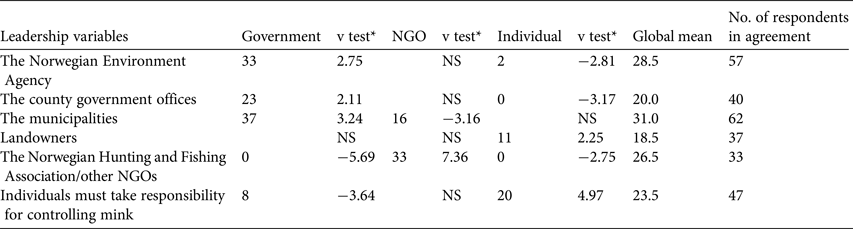
*Values of > 2 are significant at the P < 0.05 level, indicating that the frequency of respondents agreeing (positive) or disagreeing (negative) with the statement is larger or smaller than the mean number of respondents agreeing with the statement (global mean).
The majority of hunters (86%) recommended one or more ways that mink hunting could be made more appealing, with bounty (52%) and raising awareness and increasing recruitment of mink hunters (36%) being common to all leadership classes (Table 5). The recommendation of more logistical and financial support for undertaking mink hunting (29%) was supported equally by those in favour of governmental and NGO-led mink control programmes, but not by hunters favouring landowner or self-initiated mink removal (Table 5). The recommendation of centralizing the organization of landowner permissions was supported only by those emphasizing government-led programmes (Table 5). Most recommendations were not directed explicitly towards a specific leadership class. A third of hunters recommended that bounty should be increased to attract mink hunters.
Recommendations to make mink hunting more appealing, with the categories of leadership preferred by the hunters (government, NGO, individual). Numbers of hunters in each category are shown, with examples of statements from 86 mink hunters who were active during the 2012 hunting season.

Discussion
The overall insight gained from this study is that recruitment to, and interest in, mink control programmes in Norway is low. Previous attempts to set up such programmes and our extensive efforts to recruit participants in our study suggest a low potential for large-scale collaborative efforts at present. The few mink hunters who participated in the study accounted for 19.9% of the reported mink catches in the 2012 hunting season, which implies that a few hunters are responsible for a significant portion of the mink harvest in Norway. Mink hunters in receipt of bounty caught substantially more mink than those who were not, and increasing bounty payments as well as awareness were among the main recommendations provided by respondents. Offering bounties has not always succeeded in reducing populations of invasive species over time (Thompson, Reference Thompson1962; Gosling & Baker, Reference Gosling and Baker1989; Bevanger & Henriksen, Reference Bevanger and Henriksen1995); however, given the low interest in mink hunting at present, it could help to recruit more hunters to remove mink from strategically planned buffer areas. Financial incentives should be planned carefully to avoid crowding-out effects (i.e. participation for economic rewards rather than to conserve fish, game or threatened species) but can be beneficial, having reportedly increased the feeling of intrinsic motivation in cases where it had been lacking previously (i.e. crowding-in effects; Rode et al., Reference Rode, Gómez-Baggethun and Krause2015). For example, goal-oriented incentives that reward staff for completing eradication has proved successful in coypu Myocastor coypus removal programmes in the UK (Gosling & Baker, Reference Gosling and Baker1989), and seasonal bonus payments (e.g. for independently assessed mink-free areas at the start of the breeding season) could be included as part of the collaborative campaign in prioritized conservation areas. To avoid recolonization and to recruit a larger pool of mink hunters to the campaign, bounty programmes should continue in the buffer areas surrounding the core conservation areas.
The general willingness to remove mink to protect ground-nesting birds is not surprising given the strong support for recreational grouse hunting in Norway (Kaltenborn et al., Reference Kaltenborn, Andersen, Vittersø and Bjerke2012). However, mink hunters appear to be less concerned about threatened species prioritized by the Norwegian Environment Agency. Awareness and recruitment campaigns aimed at increasing hunters’ interest in removing mink may be more successful if there is a perceived threat to popular harvestable species, such as grouse, eider or salmonid species. The case study from Vega World Heritage Site indicates that hunters can be motivated to participate in mink removal programmes to protect seabird colonies, possibly in part because of a feeling of historical cultural identity. In Vega the interest in mink removal reflects a strong cultural history, as coastal communities were sustained economically by the eider down industry until the 1940s (e.g. Soot-Ryen, Reference Soot-Ryen1941).
Several studies have indicated that social benefits are important in maintaining long-term participation in collaborative efforts (e.g. Ryan et al., Reference Ryan, Kaplan and Grese2001; Asah & Blahna, Reference Asah and Blahna2012), in agreement with previous findings for small game hunters (Andersen et al., Reference Andersen, Kaltenborn, Pedersen, Storaas, Faye-Schjøll and Solvang2008). These studies point to a positive relationship between volunteer retention and a sense of belonging fostered by hunting together with friends and family or by membership of local cultures (Selinske et al., Reference Selinske, Coetzee, Purnell and Knight2015). In our study most mink were removed by hunters who reportedly preferred to hunt alone and not necessarily near their home. These patterns may reflect a lack of game or conservation species of interest in their local area, that mink has already been removed, or that the hunters’ goal was to maximize catch in high-density localities. In terms of mink catches, hunters who preferred to hunt with family and friends caught more mink than those who preferred to hunt locally. Creating social arenas for mink hunters from various local communities to meet and share their experiences could potentially engage their interest in catching more mink.
We believe that any mink removal campaigns would have to be adapted to the socio-political context of the target area. Most of the examples of volunteer-based programmes for the removal of invasive alien species are from Britain, the USA and Australia (Silvertown et al., Reference Silvertown, Buesching, Jacobson, Rebelo, Macdonald and Willis2013), where conservation-oriented volunteer work in general is more widespread. In Norway only 3.8% of the population volunteered in conservation-related work in 2002, compared to 5.9% in Sweden and 8.9% in the UK (European Social Survey, 2002). In Norway, environmental conservation is organized differently, derived from the corporatist style of governance common to all Scandinavian countries (Dryzek et al., Reference Dryzek, Hunold, Schlosberg, Downes and Hernes2002). All organizations, including conservation organizations, are perceived as the arms of the state, and receive financial and logistical support from the government. It is therefore not surprising that hunters prefer top-down initiatives led by the government or the Norwegian Association of Hunters and Anglers to programmes initiated by citizens or landowners. Organizing mink control programmes as collaborative efforts between the government, municipalities and the Norwegian Association of Hunters and Anglers is sensible given the number of local organizations represented by the Norwegian Association of Hunters and Anglers, and the financial and logistical support the government could provide. The hunters who responded to our survey requested that the government play a more active role in providing infrastructure, bounty, and trapping equipment, organizing landowner permissions to hunt, and setting up recruitment and education programmes to increase participation in mink hunting.
We conclude that there is currently little interest in mink hunting in Norway. The Environment Agency has opted to train its own staff to remove mink from a small number of coastal islands with high conservation priority for ground-nesting seabird species, using guns and tracking dogs. However, these reserves represent only a small fraction of Norway's coastline cohabited by mink and vulnerable native prey species. Collaborative efforts involving hunters to control the red fox Vulpes vulpes population in Norway indicate that effective control is feasible by a combination of contractual operators (i.e. The Norwegian Environment Agency State Supervisor Inspectorate), hunting organizations and bounty payment (which in this case was notably higher than in any mink control programme). We recommend trialling a similar collaborative approach, with hunter activity concentrated in buffer zones of priority core conservation areas, with potential for expansion to additional areas. This could be implemented, for example, by offering seasonal target-based bonus payments for early delivery before the breeding season of ground-nesting birds. We suggest that this approach could lead to effective larger-scale control of mink in coastal Norway, and serve as a case study of mink control for other countries characterized by generally low volunteer participation in conservation projects.
Acknowledgements
This work has been funded by the Norwegian Environment Agency, the County Governor of Troms and the University of Tromsø, Norway's Arctic University. We are grateful for the comments of two anonymous reviewers.
Author contributions
JS and VHH designed the study and questionnaire, analysed the data and wrote the article. JS collected and collated the data.
Biographical sketches
Jennifer Stien is interested in conservation science, in particular the management of predator–prey interactions in birds of conservation concern, and human–predator conflicts resulting from the loss of Norwegian semi-domestic reindeer to protected large predators. Vera Helene Hausner has a broad interest in conservation science, focusing on interdisciplinary analyses of socio-ecological systems, ecosystem services, protected areas, community-based management and adaptive governance in Arctic and alpine areas.



