


In the United Kingdom (UK), consumers are exposed to a variety of marketing activities for food and drinks that are high in fat, salt or sugar (hereafter ‘HFSS foods’). This includes mass media advertising to increase the visibility and attractiveness of HFSS foods(Reference Griffith, O’Connell and Smith1–Reference Cerny4), point-of-sale promotions and price offers to stimulate the purchase of HFSS foods(Reference Martin, Angus and Mitchell5,Reference Martin, Bauld and Angus6) , and packaging or product designs that enhance the consumption experience(Reference Ogba and Johnson7).
Research consistently suggests that exposure to marketing for HFSS foods influences consumption patterns, nutritional knowledge and diet-related health (e.g. overweight and obesity) among children and adolescents(Reference Boyland, Nolan and Kelly8–Reference Hastings, McDermott and Angus10). In response to this link, the UK government recently held two consultations on the feasibility and effectiveness of new marketing restrictions, as part of their Childhood Obesity Plan(11). The first consultation, from January 2018 to April 2019, focused on promotions (e.g. ‘buy one, get one free’) and placement of HFSS foods in the retail setting (e.g. at checkouts)(12). A similar consultation was also held by the Scottish government(13). The second consultation, from March to June 2019, proposed new restrictions on advertising for HFSS foods, including limiting broadcast and online advertising to between 21.00 and 05.30 hours(14). As of mid-2020, submissions to both consultations remain under review.
The Cancer Policy Research Centre at Cancer Research UK(15) commissioned several studies to inform the UK government’s consultations. This included focus groups that explored awareness of marketing for HFSS foods among children and adolescents, and how such marketing may shape their consumption of, and attitudes towards, HFSS products(Reference Aznar, MacGregor and Rosenberg16–Reference MacGregor, Attygalle and Shields18). The research also included the 2017 Youth Obesity Policy Survey (YOPS), a cross-sectional survey with a nationally representative sample of 11–19-year-olds. The survey has found that adolescents consume a variety of HFSS foods, recall exposure to a variety of marketing activities for HFSS foods (with reports focusing particularly on broadcast and on-demand television), and that awareness of HFSS marketing is associated with increased consumption of HFSS foods(Reference Thomas, Hooper and Petty19–Reference Thomas, Thomas and Hooper22). Similar trends were also demonstrated in a cross-sectional survey of 7–11-year-olds(Reference Boyland, Whalen and Christiansen23). Additional research to inform the consultations also included a narrative review exploring the impact and regulation of digital marketing of HFSS foods(Reference Critchlow, Angus and Stead24,Reference Critchlow, Angus and Stead25) , and how often consumers use price promotions when purchasing HFSS foods(Reference Coker, Rumgay and Whiteside26).
In this short communication, we provide an open rejoinder to the UK government consultations by presenting new analyses from the 2017 YOPS. We examined how often adolescents recalled seeing marketing for HFSS foods, aggregate awareness across marketing activities in the past month, and what association past month awareness had with weekly consumption of HFSS foods. We did so among 11–19-year-olds, thus highlighting that the consultations should consider how marketing may shape the consumption of HFSS foods across the various stages of adolescence(27), not just in childhood.
Methods
Design
An online cross-sectional survey with 11–19-year-olds in the United Kingdom (n 3348) was conducted between April and May 2017. The survey was administered by YouGov, a market research company, who recruited a sample intended to be representative of the UK population from their online panel. Participants under 16 years of age were recruited through e-mail invitations to existing adult panel members (i.e. their parents), while participants aged ≥16 years received e-mail invitations directly. A survey weight (based on age, gender, ethnicity, region and social grade) enabled descriptive data to be representative of the UK population.
Measures
Demography
Information on age (coded 11–13, 14–17 and 18–19 years), gender, ethnicity (coded White British or other), resident country (coded England, Scotland, Wales, Northern Ireland) and a measure of deprivation (Index of Multiple Deprivation (IMD) – a quantitative measure based on a respondent’s postcode and accounting for varied sociodemographic factors)(28) were obtained from existing details held about panel members or survey questions.
Weight category
Participants self-reported their height (options presented in both feet and inches or centimetres) and weight (options presented in stones and pounds, kilograms or pounds only). For both, participants could say ‘Don’t know’ or ‘Prefer not to say’. Where possible, BMI was calculated using the weight and height data, and participants were categorised using the extended International Obesity Task Force BMI classifications (including age and gender adjustments for 11–17-year-olds) as either underweight, healthy weight, overweight or obese(Reference Cole and Lobstein29).
Awareness of marketing for foods high in fat, salt or sugar
Participants were prompted with the statement ‘Over the last month, how often, if at all, have you…’ and presented with ten examples of marketing activities for HFSS foods (Table 1). For each marketing activity, the frequency of awareness was self-reported on a six-point scale (1 = everyday; 6 = not in the past month), or participants could indicate ‘not sure’. Prior to answering, participants were provided with a statement indicating that the question focused on marketing of ‘unhealthy food and drinks’ – a term considered more accessible than HFSS foods to younger participants, based on preliminary focus group research(Reference MacGregor, Bicquelet and Lepps17) and survey piloting – and examples of HFSS foods (e.g. donuts, chocolate and takeaways).
Past month awareness of marketing activities for high fat, salt or sugar (HFSS) foods among 11–19-year-olds in the United Kingdom
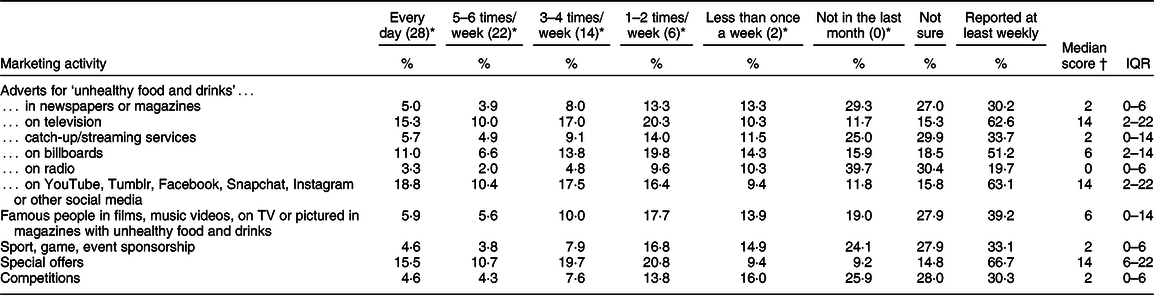
Base: all participants (n 3348). All data are weighted. IQR, inter quartile range.
* Estimated number of days on which a participant noticed marketing for HFSS foods in a 1-month period.
† Median number of HFSS marketing instances noticed in a 1-month period.
For each marketing activity, the self-reported frequency of awareness was converted into the estimated number of days that the participant had seen marketing over a 4-week period (i.e. ‘one month’). For example, an answer of ‘five to six times per week’ equated to twenty-two reported instances of awareness in the past month (5·5 times/week multiplied by 4). An aggregate estimate of past month awareness was then obtained by summing scores across all ten marketing activities. To provide meaningful interpretation, the aggregate scores were split into tertile categories of low, medium and high awareness. If a participant indicated ‘not sure’ to any marketing activity, they were coded as ‘not stated’ for the aggregate awareness score. This was to avoid underestimating the tertile boundaries. This replicates a method used for assessing awareness of alcohol marketing among adolescents in the United Kingdom, which was based on the same self-report measures used in this study. Further details on this approach are reported elsewhere(Reference Critchlow, MacKintosh and Thomas30).
Consumption of foods high in fat, salt or sugar v. healthy foods
Participants were prompted with the statement ‘How often do you usually eat or drink….’ and provided with a list of fifteen food and drink groups (Tables 2 and 3). This included twelve HFSS foods (e.g. crisps), two non-HFSS foods (fruit and vegetables) and one HFSS alternative (diet/sugar-free drinks). The rationale for food and drink choice are reported elsewhere(Reference Thomas, Hooper and Petty19–Reference Thomas, Thomas and Hooper22). For each, consumption was self-reported on a nine-point scale (1 = a few times per day; 9 = never), with an additional option for ‘not sure’. The scale responses for each food group were binary-coded to indicate ‘higher’ or ‘lower’ weekly consumption. Consistent with previous research, foods were split into two groups based on calorific content, the UK Nutrient Profiling Model and portion sizes(Reference Thomas, Hooper and Petty19,Reference Thomas, Thomas and Hooper22) . For group 1 (e.g. cakes/biscuits; Table 2) ‘higher’ consumption was defined as ≥2 portions per week. For group 2 (e.g. takeaways; Table 3) ‘higher’ consumption was defined as ≥1 portions per week.
Binary logistic regressions exploring the association between high fat, salt or sugar (HFSS) marketing awareness and consumption of group 1 foods

AOR, adjusted OR; IMD, Index of Multiple Deprivation; NS, not significant (P > 0.05).
Dependant variable for all models = high consumption (≥2 portions per week) v. low (≤1 portion); Hosmer–Lemeshow test for all models, P > 0·05; χ 2 test of coefficients for all models, P < 0·001.
* HFSS products.
† Non-HFSS products.
‡ HFSS alternatives.
Cases with missing data on one or more variables excluded model-by-model, sugary drinks (n 895), flavoured yoghurts (n 911), sweets/chocolate (n 892), cake/biscuits (n 898), fruit (n 900), vegetables (n 899), diet/sugar-free drinks (n 927), crisps (n 892) and desserts (n 906).
Binary logistic regressions exploring the association between high fat, salt or sugar (HFSS) marketing awareness and consumption of group 2 foods
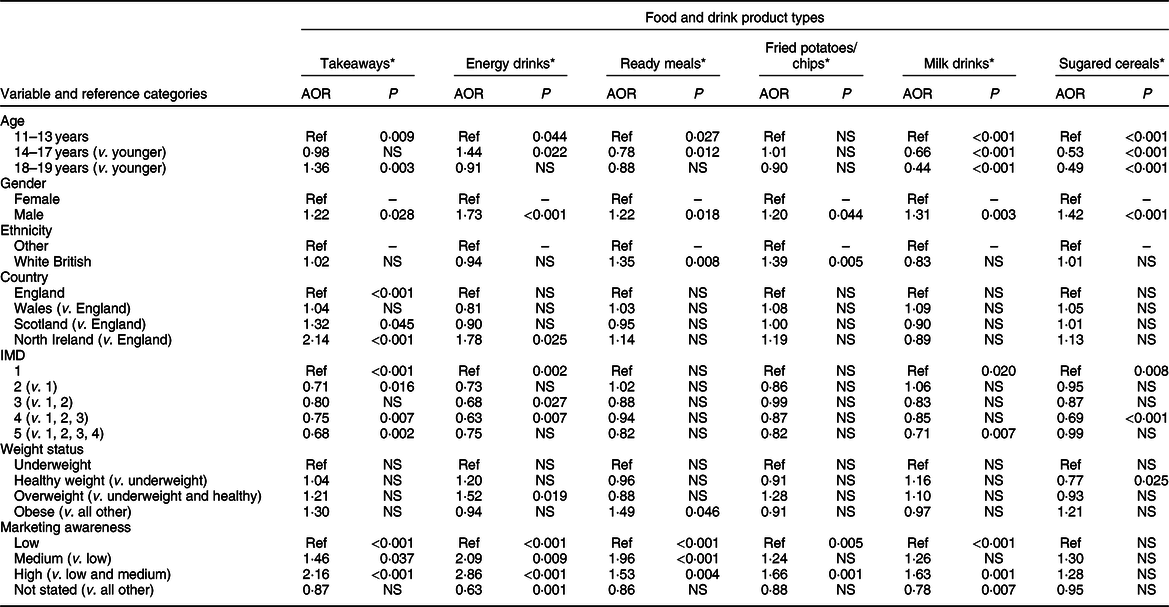
AOR, adjusted OR; IMD, Index of Multiple Deprivation; NS, not significant (P > 0.05).
Dependant variable for all models = high consumption (≥1 portion per week) v. low (0 portion per week); Hosmer–Lemeshow test for all models, P > 0·05; χ2 test of coefficients for all models, P < 0·005.
* HFSS products.
Cases with missing data on one or more variables excluded model-by-model, takeaways (n 899), energy drinks (n 914), ready meals (n 901), fried potatoes/chips (n 897), milk drinks (n 927) and sugar-sweetened cereals (n 898).
Analysis
Data were analysed using SPSS, version 24 (SPSS Inc.). Weighted frequencies examined self-reported awareness of marketing for HFSS foods through each indivudal activity, and aggregate past month awareness across all marketing activities. Binary logistic regressions were conducted with self-reported weekly consumption of the fifteen food and drink groups as the dependent variables (‘higher’ v. ‘lower’ consumption). Participants who indicated ‘not sure’ for a food and drink group were excluded test-by-test. Self-reported awareness of marketing for HFSS foods was the key independent variable (‘low’, ‘medium’, ‘high’ or ‘not stated’ awareness). Covariates of age, gender, ethnicity, country of residence, IMD and weight group were also included. The reference groups for categorical variables with two levels are reported in the results. For age, IMD, weight group and aggregate marketing awareness, which had ≥3 levels and were ordinal data, the contrast=difference function enabled comparison of each increasing category relative to the combined preceding levels. For example, the first comparison for marketing was medium v. low awareness, and the second comparison was high awareness v. low and medium combined. Including ‘not stated’ awareness as the final level enabled a comparison of those for whom an awareness score could be calculated v. those where it could not, thus retaining the maximum sample size possible in each regression(Reference Critchlow, MacKintosh and Thomas30). For country, the simple contrast function compared Scotland, Wales and Northern Ireland with England. All regressions were conducted on unweighted data, as the factors used to construct the weights were included in the models.
Results
Sample characteristics
Approximately a third (32·3 %) of the weighted sample were 11–13 years old; almost half (43·7 %) were 14–17 years old; and the remainder (24·0 %) were 18–19 years old. There was an even distribution of males (51·0 %) and females (49·0 %). The majority of participants were White British (76·7 %) and lived in England (84·4 %). There was an even proportion from each IMD quintile of deprivation (each 20·0 %). After excluding participants with missing data for height or weight (n 816, weighted), 61·5 % were categorised as healthy weight, 17·3 % underweight, 16·2 % overweight and 5·0 % obese.
Awareness of marketing for foods high in fat, salt or sugar
Overall, 90·8 % of the weighted sample reported seeing marketing for HFSS foods through at least one activity in the past month. Television, social media and special offers were the marketing activities reported most frequently (all three median (mdn) = fourteen instances in the past month), with approximately two-thirds of participants reporting awareness of these marketing activities at least weekly (Table 1). Billboard adverts and celebrity endorsement were reported less often (both mdn = six instances), albeit at least two-fifths of participants reported awareness of these marketing activities at least weekly. Print adverts, adverts on catch-up or streaming services, sports and event sponsorship and competitions were reported less often still (all mdn = two instances), although approximately a third of participants reported awareness of these activities at least weekly. Radio adverts had the lowest frequency of recall (mdn = zero instances), with only around a fifth of participants reporting awareness at least weekly.
Aggregate awareness of marketing for foods high in fat, salt or sugar in the past month
The median aggregate score for marketing awareness in the past month was 70·70 (weighted, IQR = 34–126). This translates as half of participants reporting awareness of ≥70 instances of HFSS food marketing in the past month. When split into tertiles, 32·2 % of the valid sample (i.e. excluding those classed ‘not stated’) were categorised as low awareness (≤44 instances of awareness in past month), 34·0 % as medium awareness (45–104 instances) and 33·8 % as high awareness (≥105 instances).
Marketing awareness and weekly consumption of foods high in fat, salt or sugar
The first series of binary logistic regressions examined the association between self-reported awareness of marketing for HFSS foods and weekly consumption of HFSS foods from the first product group, where ≥2 weekly portions equalled higher consumption. After controlling for demographic factors and weight group, there were significant associations between both medium and high awareness of marketing for HFSS foods, and higher weekly consumption of sugared-sweetened drinks, cakes/biscuits and crisps (Table 2). For each, the likelihood of higher weekly consumption increased relative to marketing awareness. For example, those reporting medium marketing awareness were 1·51 times (95 % CI 1·10, 2·08) more likely to report higher weekly consumption of cakes/biscuits v. low awareness, whereas those reporting high awareness were 1·77 times more likely (95 % CI 1·33, 2·36) v. low and medium awareness combined. For flavoured yoghurts and chocolate/sweets, there were only associations between high awareness of marketing for HFSS foods and higher weekly consumption. There was no overall associaton between marketing awareness and weekly consumption of desserts.
The second series of binary logistic regressions examined the association between self-reported awareness of marketing for HFSS foods and weekly consumption of HFSS foods from the second product group, where ≥1 weekly portions equalled higher consumption. After controlling for demographic factors and weight group, there were significant associations between both medium and high awareness of marketing for HFSS foods and higher weekly consumption for takeaways, energy drinks and ready meals (Table 3). Consistent with the first group, the likelihood of higher weekly consumption increased relative to marketing awareness. For example, those reporting medium marketing awareness were 1·46 times (95 % CI: 1·02, 2·08) more likely to report higher weekly consumption of takeaways v. low awareness, while those reporting high awareness were 2·16 times (95 % CI 1·62, 2·86) more likely v. low and medium combined. For fried potatoes and milk drinks, there was only an association between high awareness of marketing of HFSS foods and higher weekly consumption. There was no overall association between marketing awareness and weekly consumption of sugared cereals.
Marketing awareness and weekly consumption of healthy foods
The final series of binary logistic regressions found no association between awareness of marketing for HFSS foods and consumption of either fruit or vegetables (both non-HFSS foods) (Table 2). There was an association between awareness of marketing for HFSS foods and higher weekly consumption of diet/sugar-free drinks (HFSS alternative) – with those reporting high marketing awareness being 1·7 times (95 % CI 1·28, –2·26) more likely to report high weekly consumption of diet/sugar-free drinks than those reporting medium or low awareness.
Discussion
Adolescents in the United Kingdom report awareness of marketing for HFSS foods through a variety of activities, ranging from mass media (e.g. television advertising) to subtle marketing (e.g. celebrity endorsement). Television, social media and special offers are the marketing activities reported most frequently; at least half of adolescents reported awareness of these activities almost once every other day. This supports the specific focus on these activities in the recent UK government consultations on marketing regulation(12–14). The findings also show that awareness of marketing for HFSS foods is cumulative. Half of adolescents reported awareness of at least seventy instances of marketing for HFSS foods in the past month, equating to around twice a day. A third reported awareness of at least 105 instances, equating to approximately three to four exposures a day.
Greater awareness of marketing for HFSS foods was associated with higher weekly consumption of such products, a finding consistent with previous research(Reference Boyland, Nolan and Kelly8–Reference Hastings, McDermott and Angus10). This supports the need for further marketing controls, such as those proposed in the UK government consultations on price promotions and advertising. The findings also support the strategic approach employed by the UK government’s Childhood Obesity strategy(11), namely that greater changes in HFSS food consumption and obesity among young people may be achieved by employing a comprehensive approach to marketing regulation, rather than focusing solely on individual components of the ‘marketing mix’(Reference Critchlow, Angus and Stead24). The findings also support the need to consider how marketing may shape the consumption of HFSS foods across all adolescents, and not just among children(27,Reference Boyland and Harris31) .
Reviews of research provide tentative support that statutory restrictions, such as those proposed by the UK government, can be successful in reducing young people’s exposure to marketing for HFSS foods, or at least that statutory measures perform better than alternatives such as self-regulation and educational strategies(Reference Boyland and Harris31,Reference Chambers, Freeman and Anderson32) . Nevertheless, reviews of evidence also highlight that there is limited research demonstrating the real-world effectiveness of statutory restrictions. It is, therefore, important that any new restrictions implemented as a consequence of the UK government consultations are robustly evaluated, ideally through longitudinal or repeat-monitoring designs that demonstrate to what extent, if at all, the restrictions generate changes in the awareness of marketing for HFSS foods and consumption of such products.
The principal limitation of the study is the cross-sectional design, which cannot demonstrate a causal relationship between marketing awareness and consumption. Alternative hypotheses are that higher weekly consumption of HFSS foods leads to greater marketing exposure, recognition and recall, not vice versa. Moreover, although the findings show associations between marketing awareness and weekly consumption of HFSS foods, they do not demonstrate the overall contribution of these HFSS foods to diet nor the wider context in which they are consumed (e.g. extent of physical activity or whether it was parental purchasing that determined consumption). Nevertheless, the fact that marketing awareness has any association with weekly consumption of HFSS foods suggests that it must play either an initiating or reinforcing role. Focusing solely on the direct association with consumption also underestimates the sophisticated influence marketing has, for example, on normative beliefs and perceived norms, brand attitudes and encouraging market shifts from non-HFSS foods or HFSS alternatives(Reference Aznar, MacGregor and Rosenberg16–Reference MacGregor, Attygalle and Shields18,Reference Cairns33–Reference Smith, Kelly and Yeatman39) .
The data were self-reported; consequently, the awareness of marketing for HFSS foods and the association with consumption may be underestimated due to lapses in recall, exposure to marketing activities not measured, and influence from activities not consciously recognised as marketing (e.g. subtle celebrity endorsement and social influencers)(Reference Coates, Hardman and Halford40). The results also only show the awareness of marketing of HFSS foods and weekly consumption of such products at a single timepoint, both of which may be influenced by seasonality. They do, however, provide a baseline against which to compare the 2019 YOPS, which was conducted in October–November 2019, which will enable a test of seasonality. The results also provide a baseline against which to compare any change in regulation following the UK government consultations, the intention being to establish a repeat-monitor similar to the Youth Tobacco Policy Survey(Reference Moodie, MacKintosh and Brown41).
Finally, different marketing activities and branding will not be universally appealing and effective among all young people. Examining aggregate awareness of marketing of HFSS foods, and assuming each unit of exposure to be equal across marketing activities, may disguise important associations between individual activities and consumption of HFSS foods. Examining aggregate awareness across all marketing activities also does not account for the influence and salience of branding, nor how the design and creativity of marketing may shape consumer reactions. Further scrutiny of brand-specific exposure and young people’s own perceptions of how different marketing activities and branding shapes consumption of HFSS foods are important avenues for future research(Reference Boyland and Tatlow-Golden37–Reference Smith, Kelly and Yeatman39).
In conclusion, adolescents in the United Kingdom report awareness of a variety of marketing activities for HFSS foods, and this is associated with increased weekly consumption of such products. As previous research suggests this link between marketing exposure and consumption is causal, the restrictions proposed in the UK government consultations are, therefore, likely to help reduce the consumption of HFSS foods. Longer-term evaluation is required to determine the impact of any regulatory change on marketing awareness and consumption.
Acknowledgements
Acknowledgements: The authors thank YouGov for their assistance in preparing and managing the delivery of survey data; NatCen Social Research for their contribution to the original scoping studies; Anne Marie MacKintosh (Institute for Social Marketing and Health, University of Stirling) for their contribution to the design of surveys and development of the analytical approach; and other staff from the Cancer Policy Research Centre, Cancer Research UK, for comments on study design and analysis. Financial support: This work was supported by a grant from Cancer Research UK (C61042/A28892), and a paid research consultancy arrangement between Dr Nathan Critchlow and Cancer Research UK. Conflicts of interest: Cancer Research UK, the funder, employed L.B., C.T., L.H. and J.V. at the time of conducting the study. N.C. was on secondment as a paid research consultant for the Cancer Policy Research Centre, Cancer Research UK, at the point of conducting the study. The views expressed are those of the researchers and not necessarily those of their respective funder/employer(s). Authorship: L.H., C.T. and J.V. led the study design and data acquisition. L.H., C.T., L.B. and J.V. were involved in the design of study tools. N.C. led the development of research questions and conducted all the data analysis. N.C. conceived the manuscript idea and led manuscript preparation, with edits provided by L.B. All authors approved the final submission. Ethics of human subject participation: This study was conducted according to the guidelines laid down in the Declaration of Helsinki, and all procedures involving study participants were approved by the University of Stirling’s General University Ethics Panel (GUEP59). Written informed consent was obtained from all subjects. All survey measures and study materials were designed based on preliminary focus group research and were pilot-tested for cultural and age-appropriateness with the target sample.


 Open access

