





Children’s relationships and environments shape their views of the social world around them. This process is thought to occur through children’s internal working models (IWMs), or general representations of self and others (Fivush, Reference Fivush2006). Two interrelated developmental theories – attachment theory and emotional security theory (EST) – emphasize the importance of the parent–child and interparental relationship, respectively, in the development of child IWM. From an attachment perspective, the quality of early parent–child relationships form the foundation for children’s perceptions of caregivers and others as secure bases that can be relied on for safety and comfort (Bretherton, Reference Bretherton1985). EST builds upon attachment theory by extending the importance of security in the parent–child relationship to consider security in the broader family context. Attachment and EST share overlap (Waters & Cummings, Reference Waters and Cummings2000), but theoretical work argues that security in the parent–child versus interparental relationship reflect distinct processes with regard to child IWM (Cummings & Miller-Graff, Reference Cummings and Miller-Graff2015; Davies et al., Reference Davies, Harold, Goeke-Morey, Cummings, Shelton, Rasi and Jenkins2002; Forman & Davies, Reference Forman and Davies2005). Few empirical studies have examined child attachment IWM and emotional security IWM simultaneously. Moreover, questions remain regarding relations between contexts of familial risk, such as maltreatment, intimate partner violence (IPV), and maternal depressive symptoms, and insecure representation patterns of family relationships. The current study addresses these gaps by evaluating child attachment IWM and emotional security IWM concurrently, and by assessing relations among maltreatment, IPV, and maternal depressive symptoms with patterns of IWM.
Child IWMs emerge in infancy and grow increasingly complex during the preschool and early school years along with rapid brain and language development (Cicchetti & Schneider-Rosen, Reference Cicchetti and Schneider-Rosen1986; Sroufe, Reference Sroufe, Cicchetti and Beeghly1990; Thompson, Reference Thompson2008). During this time, narrative-based tasks, such as the MacArthur Story Stem Battery (MSSB), are often used to capture IWM of relationships (Bretherton et al., Reference Bretherton, Oppenheim, Buchsbaum and Emde1990a, Reference Bretherton, Ridgeway, Cassidy, Greenberg, Cicchetti and Cummings1990b). In the MSSB, an experimenter introduces a relationship-based narrative using dolls representing family members, and the child completes the narrative. Children’s IWM through their MSSB narratives have been linked extensively with children’s behavior and experiences (Kelly & Bailey, Reference Kelly and Bailey2021; Yuval-Adler & Oppenheim, Reference Yuval-Adler, Oppenheim and Sarracho2014).
Some past literature has used narrative-based techniques with samples exposed to maltreatment, IPV, and parent psychopathology, but the work in this area is limited. Further, to the authors’ knowledge, no past work has empirically compared IWM in the parent–child and interparental contexts or evaluated consistency in IWM security across multiple family contexts. From a developmental psychopathology perspective, considering development in different adverse contexts, such as maltreatment, IPV, and parent psychopathology, can inform the sequalae of child psychopathology (Cummings et al., Reference Cummings, Davies and Campbell2020). Examining IWM in contexts where children are exposed to severe disruptions in family relationships can provide important insight into the nature of early representations. Further, evaluating consistency (i.e., secure in both or insecure in both) and inconsistency (i.e., secure in one and insecure in the other) in attachment IWM versus emotional security IWM can inform a higher-order understanding of the nature of security in IWM across the family system.
Attachment theory
At the heart of attachment theory is the notion that caregiver sensitivity (i.e., warmth and responsiveness) in early parent–child interactions supports children’s perceptions of caregivers as reliable sources of support and protection (Cummings & Davies, Reference Cummings and Davies1996; De Wolff & van Ijzendoorn, Reference De Wolff and Van Ijzendoorn1997). Attachment frameworks identify four attachment patterns based on child behaviors during times of distress and parent–child reunion: one secure pattern and three insecure patterns – insecure anxious, insecure avoidant, and insecure disorganized (Bretherton, Reference Bretherton1985). The secure attachment pattern is characterized by children who feel safe to explore their environment in the presence of their caregiver and who seek caregiver contact when they are distressed. In turn, caregivers of securely attached children tend to recognize and respond consistently and sensitively to their children’s needs. Children with an insecure anxious attachment pattern tend to show signs of seeking and resisting contact with their caregiver in times of distress. In turn, these caregivers respond inconsistently to child needs. Children with an insecure avoidant attachment pattern may often appear unphased by their caregiver’s presence or absence. However, these children tend to exhibit high physiological arousal when experiencing a stressor, suggesting they may be hiding their distress (Hill-Soderlund et al., Reference Hill-Soderlund, Mills-Koonce, Propper, Calkins, Granger, Moore and Cox2008). This pattern is often reflective of caregivers who neglect or fail to respond to child needs. The insecure disorganized pattern is characterized by the absence of organization in child behavior in response to distress and often occurs in families who have been exposed to more severe stressors or traumas (e.g., maltreatment). Thus, insecure attachment patterns reflect distinct breakdowns in sensitivity and reciprocity in the parent–child relationship.
Attachment insecurity is a robust indicator of later difficulties, including risk for emotional and behavioral maladjustment and peer problems (see Groh et al., Reference Groh, Fearon, van IJzendoorn, Bakermans-Kranenburg and Roisman2017 for meta-analysis). One theorized mechanism whereby insecure attachment confers risk for maladjustment is through children’s developing IWM (Silva & Calheiros, Reference Silva and Calheiros2020). The presence of certain risk factors or stressors such as maltreatment, IPV, and caregiver depression are associated with unique patterns of attachment security. For example, maltreatment has been associated with insecure disorganized attachment (Baer & Martinez, Reference Baer and Martinez2006), IPV has been linked with insecure anxious attachment (Velotti et al., Reference Velotti, Rogier, Beomonte Zobel, Chirumbolo and Zavattini2020), and elevated maternal depressive symptoms have been associated with insecure avoidant and disorganized attachment (Badovinac et al., Reference Badovinac, Martin, Guérin-Marion, O’Neill, Pillai Riddell, Bureau and Spiegel2018; Martins & Gaffan, Reference Martins and Gaffan2000). Better understanding of the nature of IWM in contexts where which patterns of insecure attachment are more likely to appear can inform understanding of those factors that contribute to specific patterns of security in IWM.
Child maltreatment is a threat to the development of secure attachment. Child abuse and neglect are serious concerns in the United States, with an estimated one in seven children aged 0 to 17 years experiencing maltreatment every year (Finkelhor et al., Reference Finkelhor, Turner, Shattuck and Hamby2015). Child maltreatment represents one of the most fundamental breakdowns in the parent–child relationship, whereby the caregiver fails to provide or respond adequately to child needs (i.e., neglect) or directly violates basic child needs for safety and security (i.e., abuse). Empirical evidence indicates that early maltreatment is associated with insecure parent–child attachment, especially disorganized attachment (see Cicchetti, Reference Cicchetti2016; Cyr et al., Reference Cyr, Euser, Bakermans-Kranenburg and Van Ijzendoorn2010). Children who experience maltreatment report more negative maternal, self, and attachment representations than children who do not experience maltreatment, including in studies using similar narrative-based assessments to the current study (Charest et al., Reference Charest, Hébert and Bernier2018; Stronach et al., Reference Stronach, Toth, Rogosch, Oshri, Manly and Cicchetti2011; Toth et al., Reference Toth, Cicchetti, Macfie and Emde1997). Further, IWM of (in)security in children who have experienced maltreatment have been associated with important developmental outcomes; for instance, through cluster analysis, Hawkins and Haskett (Reference Hawkins and Haskett2014) identified two categories of narrative representations (“positive IWM” and “negative IWM”) in the parent–child context among physically abused children and showed that these profiles – or classes – were associated with child self-regulation and internalizing and externalizing behaviors. Together, the theoretical and empirical evidence suggests that early maltreatment experiences contribute to children’s attachment IWM.
Notably, maltreatment often co-occurs with other forms of family risk that may affect children’s developing schemas of security in the family, such as IPV (Noonan & Pilkington, Reference Noonan and Pilkington2020) and exposure to caregiver psychopathology (e.g., depression). Attachment theory may also inform developmental effects of IPV on child IWM. IPV is physical, sexual, or psychological harm committed by a current or former partner or spouse (CDC, 2020). IPV is highly prevalent in the United States; one in four women and one in seven men report experiencing physical violence from an intimate partner in their lifetime (Smith et al., Reference Smith, Basile, Gilbert, Merrick, Patel, Walling and Jain2017), and approximately 17% of children witness IPV (Finkelhor et al., Reference Finkelhor, Turner, Shattuck and Hamby2013). From family systems and attachment theory perspectives, although the interparental relationship is distinct from the parent–child relationship, positive and negative interparental behaviors may “spillover” into child perceptions of caregivers as secure (or insecure) bases, and for how conflicts are addressed in and beyond the family system (Sherrill et al., Reference Sherrill, Lochman, DeCoster and Stromeyer2017). Indeed, some empirical evidence supports the notion that insecurity in the interparental context may impact security in the parent–child context. For example, children exposed to destructive interparental conflict are more likely to form insecure attachment relationships with their caregivers (Levendosky et al., Reference Levendosky, Bogat, Huth-Bocks, Rosenblum and von Eye2011) and are more likely to portray conflict in the interparental context spreading to conflict in the parent–child context (Lawson et al., Reference Lawson, Speidel, Fondren, Cummings and Valentino2020). Further, children of mothers who have experienced IPV portray higher conflict escalation, aggression, and avoidance, and less coherence in their narratives of family – interparental and parent–child – relationships (Grych et al., Reference Grych, Wachsmuth-Schlaefer and Klockow2002; Minze et al., Reference Minze, McDonald, Rosentraub and Jouriles2010). Thus, the extant literature suggests that IPV exposure may negatively inform child IWM.
From an attachment perspective, parental depression may also impact child perceptions of caregivers as a safe haven during times of stress (Cummings & Davies, Reference Cummings and Davies1994). Maternal depressive symptoms are linked with less positive parenting behaviors, including higher parental irritability, less positive emotional expressivity, and lower sensitivity during parent–child interactions (Bernard et al., Reference Bernard, Nissim, Vaccaro, Harris and Lindhiem2018; Silk et al., Reference Silk, Shaw, Prout, O’Rourke, Lane and Kovacs2011). Over time, these behaviors may indicate to the child that their caregiver is not a reliable source of support and may serve as a source of fear or distress, which poses direct negative implications for child IWM of attachment (Bretherton, Reference Bretherton1985). In fact, there are robust links between maternal depressive symptoms and insecurity in the parent–child relationship in preschool-aged children, particularly disorganized and avoidant attachment (see Badovinac et al., Reference Badovinac, Martin, Guérin-Marion, O’Neill, Pillai Riddell, Bureau and Spiegel2018 and Martins & Gaffan, Reference Martins and Gaffan2000 for meta-analysis). Despite links between parent depressive symptoms and attachment insecurity, evidence of associations between parent depression and child IWM is less clear. For example, some research has identified that maternal depressive symptoms increase children’s negative caregiver representations and negative self-representations through effects of insecurity in the parent–child relationship (Cummings et al., Reference Cummings, Cheung and Davies2013; Toth et al., Reference Toth, Rogosch, Sturge-Apple and Cicchetti2009). However, some work has also shown null associations between parental depressive symptoms and child IWM, or that associations are only present when depressive symptoms are current (e.g., Goodman et al., Reference Goodman, Aber, Berlin and Brooks-Gunn1998, Reference Goodman, Bartlett and Stroh2013; Trapolini et al., Reference Trapolini, McMahon and Ungerer2007).
Maltreatment, IPV, and parent depressive symptoms may influence child IWM. Much of the past work assessing child IWM has taken an attachment perspective. However, EST posits that IWM can also be influenced by the larger family system and the family can serve as a secure (or insecure) base more broadly (Bowlby, Reference Bowlby1949; Byng-Hall, Reference Byng-hall1995; Waters & Cummings, Reference Waters and Cummings2000).
Emotional security theory
Complimenting attachment theory, EST reflects a broader concept of security across the whole family, including parent–child relations, interparental relations, and other familial relations (Cummings & Davies, 1996, Reference Cummings and Davies2010; Forman & Davies, Reference Forman and Davies2005). EST posits that exposure to interparental conflict informs children’s IWM for how everyday conflicts are addressed and informs patterns of child coping that maximize security in the family system in response to conflict (Davies & Martin, Reference Davies and Martin2013; Forman & Davies, Reference Forman and Davies2005; Waters & Cummings Reference Waters and Cummings2000). Similar to attachment theory, the EST framework proposes patterns of security and insecurity that emphasize children’s response to familial conflict. Davies and Martin (Reference Davies and Martin2013) propose four emotional security classes: one secure and three insecure – insecure mobilizing, insecure dominant, and insecure demobilizing. These patterns are characterized by the degree to which children exhibit negative reactivity in response to the conflict, involvement in or avoidance of the conflict, and the overall impact of the conflict on the child and the broader family (Cummings & Miller-Graff, Reference Cummings and Miller-Graff2015; Davies & Martin, Reference Davies and Martin2013). Children with an emotionally secure pattern expect that family cohesion will be maintained and display positive representations of conflict resolution (e.g., cooperation, apology). Children with emotionally insecure patterns (insecure mobilizing, insecure dominant, and insecure demobilizing) characterize interparental conflict by destructive behaviors that represent a serious threat to family cohesion (e.g., aggression, avoidance, conflict escalation; Davies & Martin, Reference Davies and Martin2013). For example, the insecure mobilizing pattern is characterized by the child’s desire to manage conflicts and maintain social ties through displays of distress and vulnerability and is expected in contexts of inconsistent parent responsiveness. The insecure dominant pattern is characterized by children’s drive to manage conflicts through involvement in the conflict and suppression of vulnerable emotions and is expected in cases of parent vulnerability (e.g., parental depression and chaotic family environments). In contrast to the insecure dominant pattern, the insecure demobilizing pattern is characterized by children’s full disengagement from or avoidance of the conflict, which is posited to protect the child from hostility and is theorized to occur in contexts of family violence and frightening parent behaviors (e.g., IPV, maltreatment). Elements of these theoretical classes have been supported by past data-driven approaches based on children’s responses to simulated interparental conflict (Davies & Forman, Reference Davies and Forman2002; Maughan & Cicchetti, Reference Maughan and Cicchetti2002).
According to EST, child IWMs of conflict stand to be heavily influenced by children’s actual experiences in the family context. Thus, IPV is considered a key contextual risk for children’s healthy IWM. However, most EST work is conducted among families without a known history of severe conflict. Thus, there are gaps regarding relations between emotional security and IPV (Davies & Martin, Reference Davies and Martin2013). EST traditionally focuses on impacts of interparental conflict but can be broadened to include other factors across the family, such as maltreatment and parental psychopathology (Cummings & Miller-Graff, Reference Cummings and Miller-Graff2015). As emotional security is informed by the quality of the family environment, exploring the effects of maltreatment and maternal depressive symptoms on children’s IWM of security address important questions (Forman & Davies, Reference Forman and Davies2005). Specifically, violence or severe neglect in the parent–child relationship is often reflective of a broader breakdown in the family unit and thus might be expected to be linked to greater insecurity in IWMs of the family system (Cicchetti & Toth, Reference Cicchetti and Toth2005; Cummings & Miller-Graff, Reference Cummings and Miller-Graff2015). Caregiver depressive symptoms may also be linked with child emotional insecurity through IWM, with prior research indicating that caregiver depression is associated with higher child emotional insecurity (Cummings et al., Reference Cummings, Cheung, Koss and Davies2014).
Distinctions in attachment theory and EST
Theoretical work describes attachment and EST as distinct yet complementary models and posits that overlap in children’s security in the parent–child and interparental context is expected. Notably, both theories emphasize how negative parenting behaviors (e.g., harsh, destructive behaviors) can compromise secure and supportive representations of caregivers (Davies & Woitach, Reference Davies and Woitach2008). Secure base conceptualizations have been extended to children’s security in the parent–child and interparental relationship (Waters & Cummings, Reference Waters and Cummings2000), and similar classes to those articulated for parent–child attachment regarding emotional security have been identified in response to interparental conflict (Davies & Forman, Reference Davies and Forman2002; Sturge-Apple et al., Reference Sturge-Apple, Davies, Winter, Cummings and Schermerhorn2008). Consistencies across these family systems in terms of the security of IWMs have also been theorized. For example, children who are emotionally insecure in the interparental context are also expected to experience insecurity across the broader family context and within the parent–child attachment relationship (Davies & Martin, Reference Davies and Martin2013). Despite these consistencies, attachment theory and EST are distinct in the scope of contexts highlighted to be relevant to child security. Attachment theory focuses on the parent–child relationship and EST focuses on the broader family system, with an emphasis on interparental and broader family contexts (Cummings & Davies, Reference Cummings and Davies2010; Davies & Sturge-Apple, Reference Davies, Sturge-Apple and Kail2007; Forman & Davies, Reference Forman and Davies2005; Waters & Cummings, Reference Waters and Cummings2000), and community and societal contexts in recent work (e.g., Townsend et al., Reference Townsend, Taylor, Furey, Merrilees, Goeke-Morey, Shirlow and Cummings2020). Work assessing parent–child attachment and emotional security related to interparental conflict shows weak associations between these two constructs in community samples, suggesting that despite some consistencies, they do reflect two distinct contexts (Davies et al., Reference Davies, Harold, Goeke-Morey, Cummings, Shelton, Rasi and Jenkins2002; Sturge-Apple et al., Reference Sturge-Apple, Davies, Winter, Cummings and Schermerhorn2008). In addition, representations of parent–child and interparental relationships have been shown to be distinct in their contributions to children’s developing socioemotional capacities (Davies et al., Reference Davies, Harold, Goeke-Morey, Cummings, Shelton, Rasi and Jenkins2002; Sturge-Apple et al., Reference Sturge-Apple, Davies, Winter, Cummings and Schermerhorn2008).
EST further argues that child security can look different across multiple family contexts (Davies & Sturge-Apple, Reference Davies, Sturge-Apple and Kail2007). That is, although many children are anticipated to have similar patterns of representations across family relationships (e.g., security in both parent–child and interparental relationships), some children may have inconsistent patterns of security. Exploration of consistency and inconsistency in IWM across interparental and parent–child relationships, and in the context of maltreatment, IPV, and parent psychopathology may inform a broader conceptualization of security in IWM in the family system. For example, some children may be securely attached in the parent–child relationship while having destructive patterns of IWM of interparental conflict (or vice versa). The current study advances past work by using a data-driven approach to evaluate and compare patterns of security and insecurity in the attachment (i.e., parent–child) and emotional security (i.e., interparental conflict) contexts to yield a broader family-wide understanding of IWM of security (Ainsworth et al., Reference Ainsworth, Blehar, Waters and Wall1978; Main & Solomon, Reference Main, Solomon, Yogman and Brazelton1986). Given that insecure disorganized patterns of emotional security have been associated with maltreatment, IPV, and parent psychopathology, it is important to apply a developmental psychopathology perspective to explore disorganization in IWMs across family systems in these contexts (Cummings et al., Reference Cummings, Davies and Campbell2020).
The current study
The current study had three objectives: (a) to examine latent classes in child IWM of attachment (i.e., parent–child relationship) and emotional security (i.e., interparental conflict); (b) to examine associations between resulting classes and child and family demographics and key family risk factors (i.e., maltreatment, IPV, and maternal depressive symptoms); and (c) to explore patterns of consistency and inconsistency in attachment IWM classes and emotional security IWM classes, including differences in patterns of consistency as a function of maltreatment, IPV, and maternal depressive symptoms. Given the data-driven approach, no explicit hypotheses were made regarding specific classes. However, guided by theory, we expected to see classes reflecting secure and insecure patterns of attachment IWM and emotionally secure (i.e., constructive) and insecure (i.e., destructive) IWM of interparental conflict. Given that results of objectives 2 and 3 were largely contingent upon the classes revealed in objective 1, the hypotheses for aims 2 and 3 were exploratory. If the hypothesized secure/constructive and insecure/destructive classes did emerge, we expected to see associations between maltreatment, IPV, and maternal depressive symptoms with patterns of insecurity in child IWM. Further, we expected to see consistency across latent class membership as reflective of higher-order organization of security in children’s IWM of family relationships.
This study also extends the study of IWMs of emotional security across family systems by examining these associations among a racially and ethnically diverse sample that includes groups who have been historically underrepresented in research on child development. This is important because much of the existing empirical work in these areas focuses on White middle-class families. In addition, much of the past work examining child narratives has reported differences in the presence or absence of representation-based variables (e.g., positive and negative self, positive and negative caregiver, etc.). Importantly, the current study takes a person-centered approach to evaluate attachment IWM and emotional security IWM simultaneously, thus, extending our knowledge of child IWM in multiple ways.
Methods
Participants
Mothers and their 3- to 6-year-old children (N = 248 dyads) were recruited in a mid-sized Midwestern city in the United States to participate in a longitudinal randomized controlled trial evaluating an intervention designed for mothers who had perpetrated maltreatment. Data from the baseline assessment were used in the current study. Approximately two-thirds of the dyads (n = 165) were recruited through Department of Child Services (DCS) by family case workers who introduced the project to eligible families using a verbal script and informational flyer. For the maltreatment sample, eligible families were biological mother–child pairs with at least one substantiated case of child maltreatment in which the mother was a perpetrator, and in which the child resided in the custody of the mother at the time of enrollment. The remaining one-third of dyads (n = 83) were families with no prior involvement with DCS and were recruited at locations that serve similar demographic populations to the families who had experienced maltreatment, including Head Start and the housing authority. All participants provided informed consent and signed release forms granting access to their DCS records which were used with a maternal interview to corroborate the presence or absence of maltreatment.
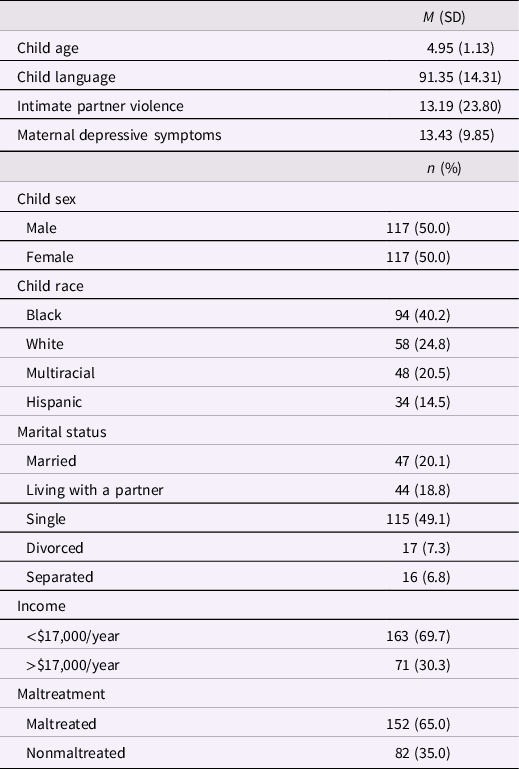
To minimize the influence of language impairments or potential intellectual disability on the results of the study, children with Peabody Picture Vocabulary Test, Fourth Edition (PPVT-4; Dunn & Dunn, Reference Dunn and Dunn2007) standard scores less than two standard deviations below the sample mean (standard scores < 59) were excluded from all analyses (n = 5). Nine additional children were dropped due to issues with the narrative story stem task, including inappropriate caregiver involvement (n = 2), missing video (n = 1), or the child not providing narratives for the attachment or emotional security stems (n = 6). The final sample consisted of N = 234 mothers (n = 152 maltreatment, n = 82 no maltreatment) and their 3- to 6-year-old children (M = 4.95, SD = 1.13). Table 1 presents demographics of the final sample.
Demographics, maltreatment, intimate partner violence, and maternal depressive symptoms of the sample
Maltreatment classifications
Maltreatment was evaluated from families’ DCS records. To provide a description of the maltreatment that characterized the maltreatment sample, DCS records were coded using the Maltreatment Classification System (MCS; Barnett et al., Reference Barnett, Manly, Cicchetti, Cicchetti and Toth1993) for sexual abuse, physical abuse, neglect, and emotional maltreatment (κ = 0.81–1.00). Among children who experienced maltreatment, and across all perpetrators, 4.7% experienced sexual abuse, 13.4% experienced physical abuse, 59.7% experienced emotional abuse, and 81.2% experienced neglect. Consistent with the high prevalence of comorbidity of maltreatment in the literature (Herrenkohl & Herrenkohl, Reference Herrenkohl and Herrenkohl2009), 63.8% of children experienced two or more subtypes of maltreatment. Given the low incidence of abuse and the high incidence of comorbidity, maltreatment was treated as a dichotomous variable (0: no maltreatment, 1: maltreatment).
Procedure
Children and mothers participated in a 2-hr laboratory visit as part of the project Fostering Healthy Development Among Maltreated Preschool-Aged Children (IRB approval 12-06-376 from the University of Notre Dame). Among various tasks that were part of the assessment battery, children participated in a narrative story stem task and a receptive language task. Parents were not present in the assessment room when children completed either task. Mothers reported on demographics, their current depressive symptoms, and IPV.
Measures and coding
Child IWM
Children participated in a revised version of the MSSB (Bretherton et al., Reference Bretherton, Oppenheim, Buchsbaum and Emde1990a; Cummings et al., Reference Cummings, Davies, Goeke-Morey and Shamir2001). In this task, the experimenter introduced seven story stems, each describing an event or conflict occurring within the family. For each stem, the experimenter told the story (e.g., the mother takes cookies out of the oven for the child and warns the child not to touch the pan because it is hot) up to the height of the conflict (e.g., when the mother leaves the room, the child grabs a cookie and burns their hand). Children were then instructed to “show and tell me what happens next.” The experimenter first presented a “warm-up” story about a birthday party to facilitate rapport and children’s understanding of the task. The six subsequent “test” stories included an accident (spilled juice), parent–child attachment (hot cookies, falling off the bike, and departure/reunion), and emotional security interparental conflict (lost keys and messy kitchen). Child responses on the three attachment and two emotional security test narratives were used in the present study to examine classes of child IWM in the attachment context and the emotional security context.
To facilitate child engagement, experimenters used animated voices, dolls (e.g., mother, father, grandmother, daughter, and son), and household props to demonstrate each story. The ethnicities of the dolls and sex of the main child character were matched with the participating child. The task was videotaped and coded by a PhD psychologist and a psychology doctoral candidate following a manualized coding system (available from Monica Lawson) based on past research and established coding systems (Cummings et al., Reference Cummings, Davies, Goeke-Morey and Shamir2001, Reference Cummings, Davies, Schermerhorn, Winter and Sutton2003). Reliability was established using n = 50 independently double-coded videos (20% of the sample). Attachment stem narratives were coded for the following five elements: avoidance, behavioral dysregulation, maternal competence, secure attachment, and conflict escalation. Emotional security stem narratives were coded for the following six elements: avoidance, behavioral dysregulation, parent constructive behaviors, parent destructive behaviors, conflict spread, and conflict resolution. Scores were dichotomized, informed by the coding manual and median values to ensure adequate variability, and that cut points were practically meaningful according to theory.
Representations measured in both attachment IWM and emotional security IWM stems
Avoidance was coded during the attachment and emotional security stems on a three-point scale based on the degree to which children avoided the conflict in their narratives (1: low avoidance, 2: moderate avoidance, 3: high avoidance; reliability: attachment kappa (κw) = .75, emotional security κw = .76). Higher scores reflected higher avoidance, including narration of off-topic content, physical avoidance of the task, requiring extra prompting to address the conflict, or failing to ever address the conflict (adapted from Cummings et al, Reference Cummings, Davies, Schermerhorn, Winter and Sutton2003; Grych et al., Reference Grych, Wachsmuth-Schlaefer and Klockow2002). Composite attachment avoidance scores were computed by summing avoidance scores from the three attachment stems, resulting in a possible range of scores from 3 to 9 (M = 4.99, SD = 2.00, median = 4). The attachment avoidance variable was dichotomized such that values less than 6 were coded as low avoidance. This value was informed by the coding manual to ensure that to be classified as low avoidance, avoidance was low (score of 1) in at least one of the three stems. Composite interparental conflict avoidance scores were computed by summing avoidance scores from the two emotional security stems, resulting in a possible range of scores from 2 to 6 (M = 3.28, SD = 1.33, median = 3). The composite interparental conflict variable was dichotomized such that values less than 4 were classified as low avoidance. This value was similarly informed by the coding manual and ensured that avoidance had to be low (score of 1) in at least one of the two stems in order to be classified low avoidance.
Behavioral dysregulation was coded in the attachment and emotional security stems on a four-point scale to assess the degree to which children depicted dysregulated and aggressive behaviors (0: no behavioral dysregulation, 1: low behavioral dysregulation, 2: moderate dysregulation, 3: high behavioral dysregulation; reliability: attachment κw = .68, emotional security κw = .77). Higher scores reflected narration of increasingly dysregulated behaviors, including angry outbursts, misbehavior, and physical aggression (adapted from Cummings et al., Reference Cummings, Faircloth, Mitchell, Cummings and Schermerhorn2008; Schermerhorn et al., Reference Schermerhorn, Cummings and Davies2008; Sturge-Apple et al., Reference Sturge-Apple, Davies, Winter, Cummings and Schermerhorn2008). Composite attachment behavioral dysregulation scores were computed by summing behavioral dysregulation scores from the three attachment stems, resulting in a possible range of scores from 0 to 9 (M = 1.03, SD = 1.99, median = 0). Informed by the median value and coding manual, the composite attachment behavioral dysregulation variable was dichotomized so that a score of 1 was classified as low behavioral dysregulation, and values greater than 1 were high behavioral dysregulation; as the parent–child stems were presented without inherent dysregulation, the child introducing any dysregulation into the stem was considered evidence of high dysregulation in this context. Composite interparental conflict behavioral dysregulation scores were computed by summing behavioral dysregulation scores from the two interparental conflict stems, resulting in a range of scores from 0 to 6 (M = 2.31, SD = 2.29, median = 2). Informed by the coding manual, the composite behavioral dysregulation variable was dichotomized such that values of less than 4 were coded as low behavioral dysregulation, ensuring that the child needed to show no or low behavioral dysregulation (scores of 0 or 1) in at least one of the two story stems to be classified as low behavioral dysregulation. Because the interparental conflict stems were presented with some dysregulation (e.g., angry tone), the threshold for being classified as high behavioral dysregulation was higher for the interparental conflict stems relative to the parent–child stems.
Representations measured in parent–child attachment stems
Maternal competence was coded during the attachment stems on a five-point scale (1: no competence, 2: low competence, 3: mild competence, 4: moderate competence, and 5: high competence; reliability: single-measures ICC = .86). Higher scores reflected increasingly appropriate caregiving behaviors and evidence of mothers’ ability to handle relationship challenges, including serving as a source of support and protection (adapted from Bascoe et al., Reference Bascoe, Davies, Cummings and Sturge-Apple2009; Cummings et al., Reference Cummings, Davies, Schermerhorn, Winter and Sutton2003; Davies et al., Reference Davies, Sturge-Apple, Winter, Cummings and Farrell2006). Examples of high maternal competence include supportive problem-solving, comforting, and providing care. Composite maternal competence scores were created by summing maternal competence scores across the three attachment stems, resulting in a possible range of 3 to 15 (M = 6.64, SD = 2.43, median = 7). Informed by the median and coding manual, values less than 8 were classified as low competence as this value ensured that to be considered low competence, at least 2 of the 3 stems showed evidence of no, low, or mixed competence (scores of 1, 2, 3).
Attachment security was coded during the attachment stems on a continuous five-point scale to assess the degree to which children desired to be physically close to and seek comfort from their mothers during times of distress, and the degree to which mothers were available, responsive, and sensitive to children’s needs (1: no security, 2: low security, 3: mild security, 4: moderate security, and 5: high security; reliability: single-measures ICC = .81). Higher scores reflected stronger security, with increasing evidence that the child views their mother as a safe haven in times of distress and that their mother is attentive, responsive, and sensitive to their needs. Composite attachment security scores were computed by summing the three attachment security scores from the three attachment stems, resulting in a possible range of 3 to 15 (M = 9.19, SD = 3.97, median = 9). Informed by the median and coding manual, the variable was dichotomized such that values less than 9 were classified as low attachment security. This split ensured that there could not be evidence of no or low security (scores of 0 or 1) in more than one of the three attachment stems in order to be classified as high attachment security.
Conflict escalation was coded during the attachment stems as the frequency or tally of instances where there was an increase in verbal or physical conflict between any two characters in child narratives (adapted from Laible, Reference Laible2004; Toth et al., Reference Toth, Cicchetti, Macfie, Rogosch and Maughan2000). Composite conflict escalation scores were computed by summing the conflict escalation tallies across the three attachment stems. The resulting composite score ranged from 0 to 6 (M = .36, SD = .93, median = 0; single-measures ICC = .76). Informed by the median and the coding manual, the composite variable was dichotomized such that scores of 0 were classified as low conflict escalation, and scores of greater than 0 were classified high conflict escalation, ensuring that any evidence of increase in verbal or physical conflictual interactions during the attachment stems was considered as evidence of high conflict escalation.
Representations measured in emotional security IWM stems
Parent constructive behaviors were coded during the two emotional security stems on a four-point scale to assess the degree to which mothers and fathers engaged in constructive behaviors (0: no constructive behavior, 1: low constructive behavior, 2: moderate constructive behavior, 3: high constructive behavior; reliability: maternal constructive κw = .71, paternal constructive κw = .74). Higher scores were coded when parents engaged in more emotionally supportive and positive behaviors, such as affection, apologies, compromising, and support (Cummings et al., Reference Cummings, Davies, Schermerhorn, Winter and Sutton2003, Reference Cummings, Davies, Goeke-Morey and Shamir2001). Composite maternal and paternal constructive behavior scores were computed by summing maternal and paternal constructive scores from the two emotional security stems, respectively, resulting in a possible range of 0 to 6 (maternal constructive: M = 1.88, SD = 1.92, median = 1; paternal constructive: M = 2.12, SD = 2.01, median = 2). The resulting composite maternal and paternal variables were considered when forming an overall parental constructive behavior variable such that both maternal and paternal scores needed to be greater than 2 to be coded as high parental constructive. Thus, there needed to be evidence of both mothers and fathers engaging in at least moderate or high (scores of 2 or 3) constructive behaviors in order to be classified in the high constructive group.
Parent destructive behaviors were coded during the two emotional security stems on a four-point scale to assess the degree to which mothers and fathers engaged in angry, hostile, self-serving, or withdrawn behaviors during the conflict (0: no destructive behavior, 1: low destructive behavior, 2: moderate destructive behavior, 3: high destructive behavior; reliability: maternal destructive κw = .72, paternal destructive κw = .78). For example, higher scores were coded when parents engaged in physical aggression, threats, verbal anger, and avoidance (Cummings et al., Reference Cummings, Davies, Schermerhorn, Winter and Sutton2003, Reference Cummings, Davies, Goeke-Morey and Shamir2001). Composite maternal and paternal destructive behavior scores were computed by summing maternal and paternal destructive scores from the two emotional security stems, respectively, resulting in a possible range of 0 to 6 (maternal destructive: M = 1.91, SD = 2.13, median = 1; paternal destructive: M = 2.12, SD = 2.16, median = 2). The resulting composite maternal and paternal variables were considered when forming an overall parental destructive behavior variable such that both maternal and paternal scores needed to be greater than 2 to be coded as high parental destructive. Thus, there needed to be evidence of both mothers and fathers engaging in moderate or high destructive behaviors (scores of 2 or 3) in order to be classified in the high destructive group.
Conflict spread was coded during the two emotional security stems on a three-point scale (0: the child did not address the conflict or provide a narrative, 1: parental conflict did not lead to hostility or aggression toward the child, 2: parental conflict did lead to hostility and aggression toward the child; Grych et al. Reference Grych, Wachsmuth-Schlaefer and Klockow2002). Reliability was good (κw = .75). Informed by the coding manual, if the child scored a 2 on either of the emotional security stems, they were classified as high conflict spread, otherwise they were classified as low conflict spread.
Conflict resolution was coded during the emotional security stems on a four-point scale (0: the conflict ended in a negative manner, 1: no resolution was provided but there was no conflict escalation, 2: a partial resolution was provided, 3: a full resolution was provided; Cummings et al., Reference Cummings, Davies, Schermerhorn, Winter and Sutton2003). Reliability was good (κw = .76). Conflict resolution scores were summed across the two emotional security stems, resulting in a possible range of 0 to 6 (M = 2.9, SD = 1.73, median = 3). Informed by the median and coding manual, the resulting composite conflict resolution variable was dichotomized such that scores less than 4 were classified as low conflict resolution, ensuring that there needed to be at least partial conflict resolution (score of 2) present in both emotional security stems to be classified as high resolution.
IPV
Mothers reported on the IPV that occurred between themselves and their romantic partners in the past year using the short form of the Conflict Tactics Scale, second edition (CTS-2; Straus & Douglas, Reference Straus and Douglas2004). Mothers specified the incidence of psychological aggression, physical assault, injury, and sexual coercion committed by themselves and by their partners on 16 items. The occurrence of these events was classified into seven categories: 0: never, 1: once, 2: twice, 4: 3 to 5 times, 8: 6 to 10 times, 15: 11 to 20 times, and 25: 20+ times. Mothers’ own and their partners’ behaviors for each subscale were summed to form the IPV variable (α = .76). If the mother was not in a relationship in the past year, the CTS-2 measure was scored 0 on all items. It is important to note that there is some conceptual overlap between IPV exposure and emotional maltreatment. In the current sample, 19 children (8% of the full sample and 13% of the sample who experienced maltreatment) experienced emotional maltreatment due to exposure to IPV. The continuous IPV variable was positively skewed (M = 13.19, SD = 23.80, median = 4.00, min = 0, max = 175, skewness = 3.57). A natural log-transformation (applied after adding a constant of 1 to each value) relieved the positive skew (new skewness = .29). For analyses using ANOVA, the log-transformed variable was used. For analyses using chi-square, IPV was dichotomized using a mean split such that untransformed scores of 13 and lower were categorized as low IPV, and untransformed scores greater than 13 were categorized as high IPV.
Maternal depressive symptoms
Mothers reported on their depressive symptoms using the Center for Epidemiologic Studies Depression Scale (CESD; Radloff, Reference Radloff1977), which is often used to screen for major depressive disorder (MDD). Mothers rated the frequency of specific symptoms of MDD within the last week across 20 items on a 4-point scale (0: rarely or none of the time (1 day or less) to 3: most or all of the time (5–7 days). The internal consistency of the symptom score was good (α = .88). The symptom score was positively skewed (M = 13.43, SD = 9.85, skewness = 1.23). A natural log-transformation (applied after adding a constant of 1 to each value) relieved the positive skew (new skewness = −.75). For analyses using ANOVA, the log-transformed variable was used. For analyses using chi-square, the continuous variable was dichotomized using the recommended clinical threshold score of 16 or higher being classified as high depressive symptoms (Lewinsohn et al., Reference Lewinsohn, Seeley, Roberts and Allen1997). Based on this cutoff, 31.8% (n = 74) of mothers scored in the clinical range on maternal depressive symptoms.
Data analytic plan
Two latent class analyses (LCA; one for the attachment narratives and one for the emotional security IWM narratives) were conducted in Mplus Version 8 (Muthén & Muthén, Reference Muthén and Muthén2021) to examine data-driven patterns present in the MSSB data. There was no missing data among indicators of the latent classes. The five dichotomized attachment indicators (1 = low and 2 = high on each dimension) were considered in the attachment IWM LCA: avoidance, behavioral dysregulation, maternal incompetence, insecure attachment, and conflict escalation. The six dichotomized interparental conflict indicators (1 = low and 2 = high on each dimension) were considered in the emotional security IWM LCA: avoidance, behavioral dysregulation, parent constructive behaviors, parent destructive behaviors, conflict spread, and conflict resolution. Multiple fit indices were used to select the best-fitting class solution: Akaike information criterion (AIC, Akaike, Reference Akaike1987), for which lower values indicate a better fit; Bayesian information criterion (BIC, Schwarz, Reference Schwarz1978), for which lower values indicate a better fit; entropy, for which higher values (around .80 or > .80) indicate strong delineation between the classes within a solution (Muthén & Muthén, Reference Muthén and Muthén2007); the Lo–Mendell–Rubin adjusted likelihood ratio test (aLRT) for which a significant result indicates that an n class solution fits better than an n – 1 class solution. In addition to these factors, class proportion was also taken into consideration such that class solutions where less than 10% of the sample was represented were given lower preference to maximize model parsimony and predictive utility. Once optimal LCA solutions were identified, all following analyses were conducted in SPSS 26. Associations between the latent classes and child demographic variables and maltreatment, IPV, and maternal depressive symptoms were examined using ANOVA for continuous outcome variables (IV: latent classes, DV: child age, child language, IPV, and maternal depressive symptoms) and chi-square tests of independence for categorical outcome variables (IV: latent classes, DV: child sex, child race, marital status, income, and maltreatment). Consistency across the attachment IWM and emotional security IWM class context was examined via chi-square. Finally, consistency in class status across the attachment IWM and emotional security IWM contexts was examined in relation with maltreatment, IPV, and maternal depressive symptoms.
Results
LCA results
Attachment IWM LCA
One to 5-class solutions were considered in the LCA (see Table 2 for model fit comparisons). BIC was minimized in the 3-class solution compared with 1-, 2-, 4, and 5-class solutions. BIC and AIC values dropped drastically from the 1-class to a 2-class, and again from the 2-class to a 3-class solution, suggesting a better fit of the 3-class solution over the 1- and 2-class solutions. Further, the aLRT test was statistically significant for the 3-class solution (p = .0001), supporting evidence of an improved fit of the 3- versus 2-class solution. The aLRT was also statistically significant for the 4- versus 3-class solution, but the AIC and adjusted BIC did not show as pronounced a decline from the 3- to the 4-class solution. Additionally, in the 4-class solution, one of the resulting classes was populated by 13 children (5.6% of the full sample), suggesting this may not yield a practically or statistically informative class solution. Given improvement in fit from a 2-class to a 3-class solution, and that the 3-class solution provided a more parsimonious fit compared with the 4-class solution, the 3-class solution was selected as the best-fitting solution. Entropy was high for 3-class model (.88), indicating that the classes were distinct.
Comparison of LCA solution results
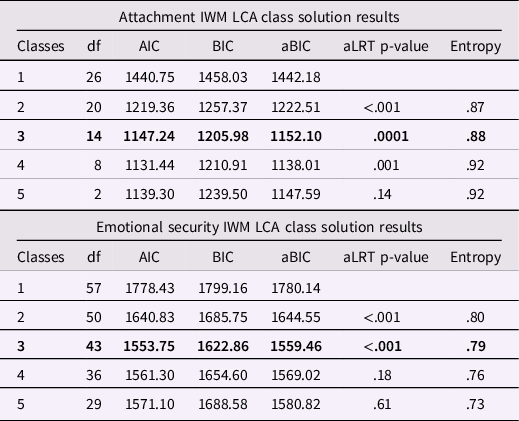
Note. The final selected class solution is bolded.
Interpretation of the attachment IWM LCA
The following three latent classes were identified: (a) a secure class (SC; n = 114, 48.7%), characterized by low avoidance, low behavioral dysregulation, high maternal competence, high attachment security, and low conflict escalation, (b) an insecure dysregulated class (IDC; n = 48, 20.5%), characterized by low avoidance, high behavioral dysregulation, low maternal competence, low attachment security, and high conflict escalation, and (c) an insecure avoidant class (IAC; n = 72, 30.8%) characterized by high avoidance, low dysregulation, low maternal competence, low attachment security, and low conflict escalation. Item response proportions of the dichotomous indicator variables are reported in the full sample and by latent class in Table 3.
LCA 3-class solution item response probabilities
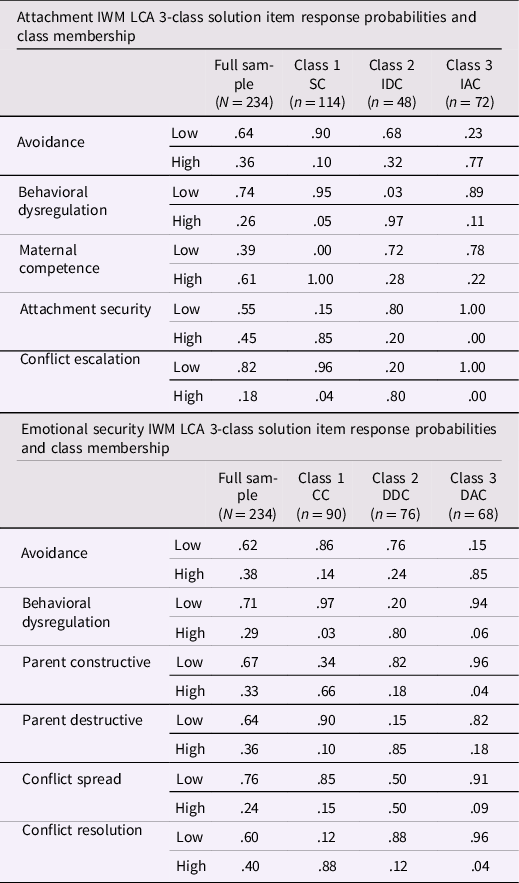
Note. SC = secure class; IDC = insecure dysregulated class; IAC = insecure avoidant class; CC = constructive class; DDC = destructive dysregulated class; DAC = destructive avoidant class.
Emotional security IWM LCA
One to 5-class solutions were considered (see Table 2 for model fit comparisons). BIC was minimized in the 3-class solution compared with 1-, 2-, 4-, and 5-class solutions. The aLRT results suggested that the 3-class solution was a significantly better fit compared with the 2-class solution (p < .001), and the 4-class solution did not improve upon the 3-class solution (p = .18). The least populated class in the 3-class solution was sufficiently represented by 68 children (29%) of the sample. Therefore, the 3-class solution was selected as the best-fitting solution. Entropy for the 3-class solution was .79, suggesting adequate distinction between the classes.
Interpretation of the emotional security IWM LCA
The following three latent classes were identified: (a) a constructive class (CC; n = 90, 38.5%), characterized by low avoidance, low behavioral dysregulation, high parent constructive behaviors, low parent destructive behaviors, low conflict spread, and high conflict resolution, (b) a destructive dysregulated class (DDC; n = 76, 32.5%), characterized by low avoidance, high behavioral dysregulation, low parent constructive behaviors, high parent destructive behaviors, high conflict spread, and low conflict resolution, and (c) a destructive avoidant class (DAC; n = 68, 29.1%), characterized by high avoidance, low behavioral dysregulation, low parent constructive behaviors, low parent destructive behaviors, low conflict spread, and low conflict resolution. Item response proportions are reported in the full sample and by latent class in Table 3.
Sensitivity analyses
Although the dichotomization process was theory-driven and reduced the risk of bias due to nonnormality in the original composite variables, dichotomizing the IWM variables may have resulted in a potential loss of data. Given this potential concern, two sensitivity analyses were conducted using two latent profile analyses (LPAs) in Mplus Version 8 with the original composite IWM variables. The LPAs replicated similar three-profile solutions to the attachment IWM LCA (secure, insecure dysregulated, and insecure avoidant) and emotional security IWM LCA (constructive, destructive dysregulated, and destructive avoidant). Further, individual children were classified in the same parallel LCA-LPA class in 90% of cases, suggesting strong overlap and consistency across the LCA and LPA approaches. See the Supplemental Materials for full results of the LPA sensitivity analyses.
Associations between class status and child and family factors
Associations between latent classes and child demographic variables and maltreatment, IPV, and maternal depressive symptoms were examined using ANOVA’s and chi-square tests of independence (see Table 4)Footnote 1 . Attachment IWM classes and emotional security IWM classes were associated with child age. Post hoc pairwise comparisons with Tukey’s correction revealed that in the attachment IWM classes, children in the IAC were younger than children in the SC (p < .001) and the IDC (p < .001). Within the emotional security IWM classes, children in the CC were older than children in the DDC (p = .002) and the DAC (p < .001), and children in the DDC were older than children in the DAC (p = .05). Child language was associated with attachment IWM and emotional security IWM class status. Post hoc pairwise comparisons with Tukey’s correction revealed that within the attachment IWM classes, children in the IAC were lower in language than children in the SC (p < .001) and children in the IDC (p = .03). Within the emotional security IWM classes, children in the DAC were lower in language than children in the CC (p = .01). Child sex was associated with attachment IWM classes, in that males were less likely to be in the SC and were more likely to be in the IDC or IAC. Family income was associated with emotional security IWM classes, in that children in families with an annual income of less than $17,000 per year were less likely to be in the CC and were more likely to be in the DDC. Maltreatment was associated with attachment IWM classes, in that children who experienced maltreatment were less likely to be in the SC and were more likely to be in the IDC. Maltreatment was not associated with emotional security IWM. IPV, maternal depressive symptoms, child race, and marital status were not associated with any attachment IWM classes or emotional security IWM classes.Footnote 2
Associations between LCA classes and demographics, maltreatment, IPV, and maternal depressive symptoms

Note. SC = secure class; IDC = insecure dysregulated class; IAC = insecure avoidant class; CC = constructive class; DDC = destructive dysregulated class; DAC = destructive avoidant class; IPV = intimate partner violence; MDS = maternal depressive symptoms. aNatural log-transformed values were used for IPV and maternal depressive symptoms were used for ANOVA analyses to alleviate skew in the data. Untransformed means and standard deviations are reported for ease in interpretation. *p < .05, **p < .01, ***p < .001.
Discrepancy in LCA status
The chi-square test of independence assessing consistency between attachment IWM and emotional security IWM class was statistically significant χ 2 (4) = 38.15, p < .001, indicating that attachment IWM class status was associated with emotional security IWM class status (see Table 5). Using a Bonferroni correction to adjust for multiple testing, adjusted-standardized residuals (ASRs) were considered to determine which effects were driving differences. Results supported evidence of consistency in class membership across the two contexts, suggesting some evidence of family-wide patterns of security. Specifically, with Bonferroni correction, children in the secure attachment class were more likely to be classified in the constructive emotional security IWM class (ASR = 3.8), children in the insecure dysregulated attachment class were more likely to be classified in the destructive dysregulated emotional security IWM class (ASR = 3.9), and children in the insecure avoidant attachment class were more likely to be classified in the destructive avoidant emotional security IWM class (ASR = 5.0) and less likely to be in the CC (ASR = −2.8).
Discrepancy in LCA status across attachment IWM and emotional security IWM contexts

Note. SC = secure class; IDC = insecure dysregulated class; IAC = insecure avoidant class; CC = constructive class; DDC = destructive dysregulated class; DAC = destructive avoidant class. Bolded cells indicate statistically significant post hoc effects (using Bonferroni correction, CV = 2.80) that are driving chi-square effects. Adj Res = adjusted standardized residuals.
Though there was evidence of consistency in classifications across the two IWM contexts, there was also evidence of inconsistency. A sizable subset of children (n = 88, 37.6% of the sample) were classified as secure or constructive in one context but insecure or destructive in the other. Notably, although 50.9% (n = 58 out of 114) of children classified in the secure attachment IWM class were also classified in the constructive emotional security IWM class, the remaining 49.2% (n = 56 out of 114) of children in the secure attachment IWM class were classified in the destructive dysregulated (28.1%, n = 32 out of 114) or DAC (21.1%, n = 24 out of 114). Additionally, while 56.3% (n = 27 out of 48) of children classified in the IDC were also classified in the DDC, the remaining 43.7% (n = 21 out of 48) were classified in either the constructive emotional security IWM class (29.2%, n = 14 out of 48) or the destructive avoidant emotional security IWM class (14.6%, n = 7 of 48). Finally, though 51.4% (n = 37 out of 72) of children in the IAC were classified in the DAC, the remaining 48.6% (35 out of 72) were classified in either the constructive emotional security IWM class (25.0%, n = 18 out of 72) or the destructive dysregulated emotional security IWM class (23.6%, n = 17 out of 72). Thus, although there was some consistency across context, about half of the children showed patterns of security in one context but insecurity in the other context, suggesting that child internal representations of the attachment IWM and family context are often distinct or inconsistent in the preschool years.
Class discrepancy and maltreatment, IPV, and maternal depressive symptoms
To examine whether patterns of consistency in attachment IWM and emotional security IWM classifications differed depending on maltreatment experience, exposure to IPV, and maternal depressive symptoms, three 3-way chi-square tests of independence were conducted to examine associations between attachment IWM and emotional security IWM classifications at each category (e.g., maltreatment, nonmaltreatment) of each variable. Bonferroni corrections were used to adjust for multiple testing and ASRs were compared across groups to assess for evidence of differences in patterns of consistency as a function of maltreatment, IPV, and maternal depressive symptoms.
Maltreatment
The chi-squares examining consistency in attachment IWM and emotional security IWM classes were statistically significant in the sample of children who had not experienced maltreatment, χ 2 (4) = 18.64, p = .001 and the sample of children who had experienced maltreatment, χ 2 (4) = 23.55, p < .001, indicating that attachment IWM class status was associated with emotional security IWM class status in both groups of children (see Table 6 and Figure 1A). In both samples, children who were classified in the insecure avoidant attachment class were more likely to also be classified in the destructive avoidant emotional security IWM class (no maltreatment ASR = 4.2; maltreatment ASR = 3.1). Specific to the sample of children who had not experienced maltreatment, children in the secure attachment class were less likely to be classified in the destructive avoidant emotional security IWM class (ASR = −3.5) and children in the IAC were less likely to be classified in the constructive emotional security IWM class (ASR = −3.4). Specific to the sample of children who had experienced maltreatment, children in the IDC were more likely to be classified in the destructive dysregulated emotional security IWM class (ASR = 4.1).
Discrepancy in LCA status in nonmaltreated and maltreated children
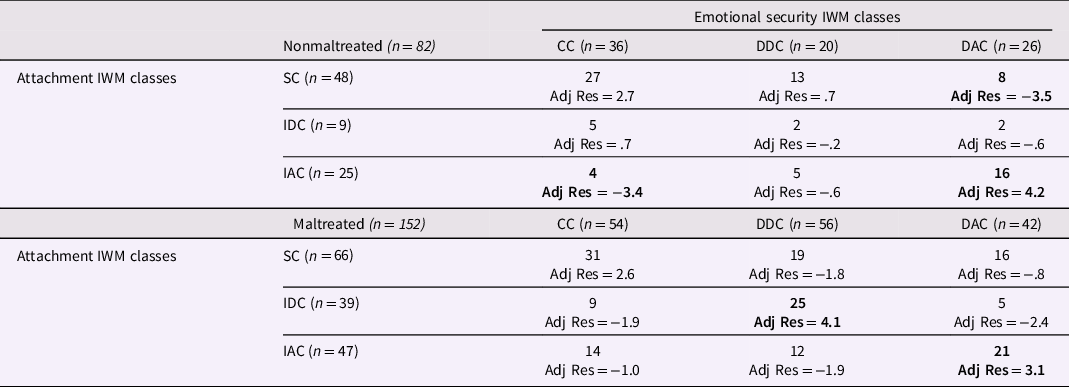
Note. SC = secure class; IDC = insecure dysregulated class; IAC = insecure avoidant class; CC = constructive class; DDC = destructive dysregulated class; DAC = destructive avoidant class. Bolded cells indicate statistically significant post hoc effects (using Bonferroni correction) driving chi-square effects. Adj Res = adjusted standardized residuals.
Associations between parent-child attachment and interparental conflict LCA classification in nonmaltreated and maltreated children (A), children exposed to low and high IPV (B), and children exposed to low and high maternal depression (C).

IPV
The chi-square examining associations between attachment IWM and emotional security IWM class status was statistically significant in the low IPV group, χ 2 (4) = 30.71, p < .001. In the high IPV group, one of the cells had an expected count of less than 5. Thus, the Fisher’s exact test was used instead of the chi-square test of independence; the Fisher’s test was marginally significant, F = 9.49, p = .051 (see Table 7 and Figure 1B). Specific to the low IPV group, children in the secure attachment class were more likely to also be in the constructive emotional security IWM class (ASR = 3.7), children in the insecure dysregulated attachment IWM class were more likely to be classified in the destructive dysregulated emotional security IWM class (ASR = 3.2), children in the insecure avoidant attachment IWM class were more likely to be classified in the destructive avoidant emotional security IWM class (ASR = 4.4), and children in the insecure avoidant attachment class were less likely to be classified in the constructive emotional security IWM class (ASR = −3.3). No significant post hoc effects emerged in the high IPV group, indicating no evidence of consistency between attachment IWM and emotional security IWM among children exposed to high IPV.
Discrepancy in LCA status in children exposed to low and high IPV
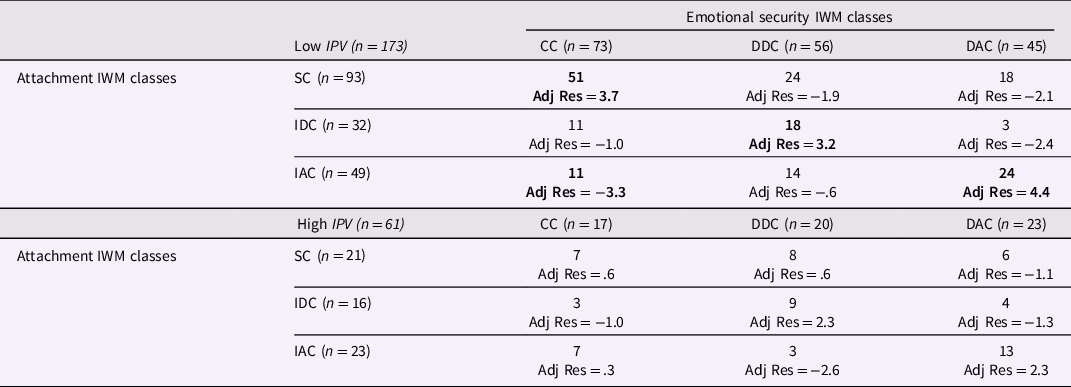
Note. SC = secure class; IDC = insecure dysregulated class; IAC = insecure avoidant class; CC = constructive class; DDC = destructive dysregulated class;, DAC = destructive avoidant class. Bolded cells indicate statistically significant post hoc effects (using Bonferroni correction) that are driving chi-square effects. Adj Res = adjusted standardized residuals.
Maternal depressive symptoms
The chi-square examining associations between attachment IWM and emotional security IWM class status was statistically significant in the low maternal depressive symptoms group, χ 2 (4) = 31.56, p < .001. In the high maternal depressive symptoms group, one of the cells had an expected count of less than5. Thus, the Fisher’s exact test was used instead of the chi-square test of independence; the Fisher’s test was trending, F = 8.70, p = .07 (see Table 8 and Figure 1C). In the low maternal depressive symptoms group, there was marked consistency in attachment IWM and emotional security IWM classes. Specifically, in the low maternal depressive symptoms group, children in the secure attachment class were more likely to be classified in the constructive emotional security IWM class (ASR = 3.5), children in the insecure dysregulated attachment class were more likely to be classified in the destructive dysregulated emotional security IWM class (ASR = 3.8), and children in the insecure avoidant attachment class were more likely to be classified in the destructive avoidant emotional security IWM class (ASR = 4.3). No significant post hoc effects emerged in the high maternal depressive symptoms group, indicating no consistency between attachment IWM and emotional security IWM among children with a mother who had elevated depressive symptoms.
Discrepancy in LCA status in children exposed to low and high maternal depression
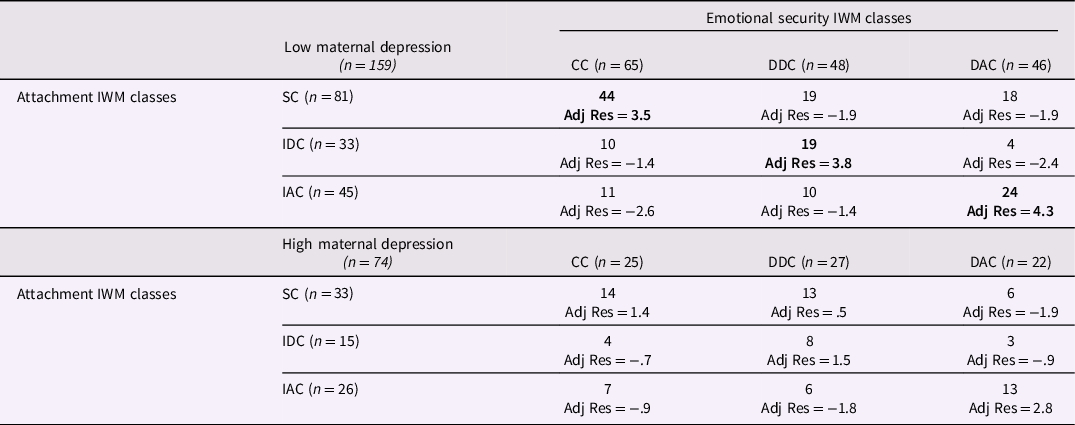
Note. SC = secure class; IDC = insecure dysregulated class; IAC = insecure avoidant class; CC = constructive class; DDC = destructive dysregulated class; DAC = destructive avoidant class. Bolded cells indicate statistically significant post hoc effects (using Bonferroni correction) that are driving chi-square effects. Adj Res = adjusted standardized residuals.
Discussion
The current study breaks new ground by simultaneously assessing data-driven classifications in child IWM in the parent–child (e.g., attachment) and interparental (e.g., emotional security) contexts. Three parallel latent classes emerged in each familial context. From a theoretical perspective, parallels in IWM across family contexts may reflect consistencies in secure base relationships across family relationships (Cummings & Davies, Reference Cummings and Davies2010; Waters & Cummings, Reference Waters and Cummings2000). For instance, the secure attachment class and constructive emotional security IWM class were both characterized by low avoidance, low behavioral dysregulation, and positive caregiver behaviors. The insecure behavioral dysregulation and destructive dysregulated emotional security IWM class were both characterized by low avoidance, high behavioral dysregulation, conflict escalation, and negative caregiver behaviors. Finally, the insecure avoidant and destructive avoidant emotional security IWM classes were both characterized by high avoidance of conflict across the stems.
The latent attachment and emotional security IWM classes showed consistencies with theories of classes of IWM. Indeed, the latent attachment classes show conceptual overlap with secure, insecure anxious, and insecure avoidant classifications from the Strange Situation (Bretherton, Reference Bretherton1985). The emotional security IWM classes also cohere with the secure, insecure mobilizing or dominant, and insecure demobilizing patterns posited by Davies and Martin (Reference Davies and Martin2013). Aligning with theorized patterns of IWM, a secure, dysregulated, and avoidant group emerged in both contexts. The identification of these classes using a data-driven approach builds upon years of theory and research to provide additional evidence for these classes in contexts of maltreatment, IPV, and maternal depressive symptoms (Davies & Martin, Reference Davies and Martin2013; Schermerhorn et al., Reference Schermerhorn, Cummings and Davies2008).
In the current sample, the attachment and emotional security IWM classes yielded SC and CC, representing 48.7% and 38.5% of the child sample, respectively. The presence of secure and constructive IWM classes is notable because it indicates that even amidst contexts of elevated risk of adversity within the family system, many children develop internal representations of relationships that are characterized by sensitivity and support. Further illustrative of parallels in security in IWM across family contexts (Waters & Cummings, Reference Waters and Cummings2000), the presence of avoidant classes fits theoretically with conceptualizations of avoidant attachment and conceptualizations in the emotional security framework whereby avoidant and disengaged approaches to conflict reflect a distinct pattern of emotional insecurity (demobilizing) in that children actively avoid conflict to protect themselves from threat (Davies & Martin, Reference Davies and Martin2013). It is also possible that the avoidant classes reflect a general style of disengagement in parent–child and interpersonal relationships (Sturge-Apple et al. Reference Sturge-Apple, Davies, Winter, Cummings and Schermerhorn2008).
The insecure dysregulated and DDCs of emotional security-based IWMs also merit discussion in terms of profiles advanced by EST-R (Davies & Martin, Reference Davies and Martin2013). Given that behavioral dysregulation included children’s expressions of anger and aggression, it is possible that the DDC could be reflective of the dominant rather than the mobilizing pattern in EST-R. On the other hand, given that children’s avoidance of the conflict was low, parent destructive behaviors were high, and there was moderate evidence of conflict spread from parental conflict to the child in this class, and it is also plausible that this class reflects the mobilizing pattern in EST-R as evidenced by children’s immersion in the interparental conflict.
It is notable that we did not see robust evidence of a disorganized attachment IWM pattern in the attachment IWM classes, which might be expected especially among children who have experienced maltreatment. Notably, a fourth attachment class characterized by low avoidance, high behavioral dysregulation, high maternal competence, high attachment security, and high conflict escalation emerged in the LCA. This class was marked by inconsistency, with high dysregulation and conflict escalation, as well as high maternal competence and security, which may have represented a disorganized class pattern. However, this class was classified by only 13 children (5.6% of the sample), which limited our ability to analytically assess this class.
Consistencies in secure base IWMs across family contexts may also be informative regarding the security of IWM across family contexts. Results across the full sample showed that 52.1% of children were consistent in class status, reflecting evidence for a shared function of child IWM of parent–child and interparental relationships. This is consistent with the theorized shared characteristics of attachment and EST and may reflect organization in children’s IWM of security in the family (Cicchetti et al., Reference Cicchetti, Cummings, Greenberg, Marvin, Greenberg, Cicchetti and Cummings1990; Davies & Martin, Reference Davies and Martin2014). Children in the secure attachment class were more likely to be in the constructive emotional security IWM class, children in the insecure dysregulated attachment class were more likely to be in the destructive dysregulated emotional security IWM class, and children in the insecure avoidant attachment class were more likely to be in the destructive avoidant emotional security IWM class.
However, inconsistencies across family contexts in the organization of IWM may also be informative about security in family relationships among children from families exposed to maltreatment, IPV, and maternal depressive symptoms. Despite some evidence of consistency, 47.9% of children showed inconsistency in class status across the attachment IWM and emotional security IWM context. These findings of inconsistency suggest that for many children in this sample, their IWM across the attachment and emotional security context are differentiated during the preschool years. For example, 23.9% of children were secure in their IWM of the parent–child attachment relationship but insecure in their IWM of emotional security, and 13.7% of children were insecure in their attachment IWM but constructive in their IWM of emotional security. There are various potential interpretations of these results. By one interpretation, patterns of inconsistency may be indicative of protective mechanisms among children exposed to early adversity. For instance, for children with emotional insecurity in representations in the emotional security domain, co-existing representations of security in the attachment IWM domain may be protective for child outcomes. Thus, children’s developing scripts of relationships and their understanding of their roles in these relationships may differ depending on children’s unique experiences.
By another interpretation, inconsistency in IWM across the attachment and emotional security IWM contexts may reflect disorganization in IWM across the broader family context, similar to what is seen in cases of disorganized attachment. From this family-wide perspective on security of IWM, there may have been a large amount of disorganized security across this sample that was relatively high in risk of exposure to pathogenic family relationships due to exposures to maltreatment, IPV, and maternal depression. The distinctions revealed here in IWM across familial relationships may reflect disorganization or important differentiation whereby children show advanced ability to differentiate understanding of their security at different levels of the family. Future work should assess how patterns of inconsistency relate to child developmental outcomes, and whether differentiation is protective or maladaptive.
Child age and child language were associated with class status in each context. In general, children in the avoidant classes tended to be younger on average compared with children in the SCs across the attachment IWM and emotional security IWM classes. The role of age on class membership was consistent with effects of child language; children in the avoidant classes had lower receptive language on average. These associations correspond to past literature linking attachment insecurity with lower language, including in work that does not rely on language-based narrative tasks (Murray & Yingling, Reference Murray and Yingling2000). Given that the MSSB is a language-based task, younger children and children with lower language may have had more difficulty with the task. However, the MSSB was developed for preschool-aged children and child narrative-based representations have been shown to be internally consistent during the preschool period (Bretherton & Oppenheim, Reference Bretherton, Oppenheim, Emde, Wolf and Oppenheim2003; Wolcott et al., Reference Wolcott, Williford and Hartz-Mandell2019). An important future research question is to assess children’s IWM and latent classes across time to see if children develop more SCs as they age and as their language skills develop.
Children living in a household with an annual income of less than $17,000 were less likely to be classified in the CC (32.5%) compared with children living in a household with an annual income of greater than $17,000 (52.1%). This aligns with past literature that identifies finances as a common source of conflict and stress for families (Papp et al., Reference Papp, Cummings and Goeke-Morey2009). Interparental conflicts may be less constructive when stress is high and money is scarce (Evans & Kim, Reference Evans and Kim2012; Steele et al., Reference Steele, Bate, Steele, Dube, Danskin, Knafo, Nikitiades, Bonuck, Meissner and Murphy2016). Income was not associated with attachment IWM class membership, importantly indicating that unique family factors can be differentially related to children’s IWM across distinct familial relationships. Child gender was associated with attachment IWM class membership in that females were more likely to be in the secure attachment class, which is consistent with literature noting similar gender differences in children’s internal representations of attachment security (Pierrehumbert et al., Reference Pierrehumbert, Torrisi, Glatz, Dimitrova, Heinrichs and Halfon2009). There were no gender differences in emotional security IWM class, which is consistent with the body of research in this area (e.g., Cummings & Davies, Reference Cummings and Davies2010).
Children who experienced maltreatment were less likely to be in the secure attachment class and were more likely to be in the insecure dysregulated attachment class. This is consistent with past literature linking early maltreatment with insecure attachment and with differences in child IWM of attachment and emotion dysregulation (Cicchetti & Doyle, Reference Cicchetti and Doyle2016; Lavi et al., Reference Lavi, Katz, Ozer and Gross2019) but extends this past work by using a data-driven approach to assess associations between IWM of security and maltreatment. Notably, there was no association between emotional security IWM class and maltreatment, suggesting that representations of the interparental relationship may be distinct from representations of the parent–child relationship in the maltreatment context. Similarly, neither IPV nor maternal depressive symptoms were associated with class membership in the attachment IWM or emotional security IWM context. These null findings may speak to heterogeneity in IWM, even in contexts of maltreatment, IPV, and maternal depressive symptoms. It may also indicate that unique combinations of adverse experiences contribute differentially to child IWM, or that security in the broader family system needs to be considered to see more nuanced effects of maltreatment, IPV, and maternal depressive symptoms on IWM patterns. Evidence from the current study may support this latter interpretation. For example, when considering discrepancy between LCA membership in the attachment IWM and emotional security IWM contexts, distinct patterns of consistency and inconsistency emerged as a function of maltreatment, IPV, and maternal depressive symptoms. Children who had experienced maltreatment were more likely to be classified as consistently insecure. In other words, although maltreatment was not directly associated with emotional security IWM, it was associated with consistent patterns of dysregulation across the attachment and emotional security IWM context. Thus, when maltreatment is associated with dysregulation in IWM of attachment, this seems to correspond with broader breakdowns in family interactions beyond the parent–child relationship. Additionally, the lower IPV and lower maternal depressive symptoms groups showed strong consistency across IWM context, but the higher IPV and higher maternal depressive symptoms groups showed inconsistency across IWM context. Exposure to IPV and caregiver psychopathology may interrupt organization in child IWM across family relationships and may be indicative of a disorganized family-wide pattern of IWM. From a clinical perspective, the current results may speak to the utility of intervention efforts among families exposed to maltreatment, IPV, and parental psychopathology that are aimed at supporting early attachment relationships and that also cut across the broader family context, including interventions focused on supporting communication and constructive conflict resolution among family members (e.g., Attachment and Biobehavioral Catch-up [ABC] intervention; Bernard et al., Reference Bernard, Dozier, Bick, Lewis-Morrarty, Lindhiem and Carlson2012, child–parent psychotherapy; Lieberman et al., Reference Lieberman, Van Horn and Ippen2005, and constructive family conflict interventions; Miller-Graff et al., Reference Miller-Graff, Cummings and Bergman2016).
There were notable strengths in the current study, including the use of a sample with exposures to various forms of adversity, a data-driven approach, and the opportunity to use observational data to assess child representations across the attachment IWM and emotional security IWM contexts. There were also limitations that bear mention. We were limited in our ability to assess effects of maltreatment subtype due to high comorbidity in maltreatment (over 60% of children experienced more than one form of maltreatment) and limited prevalence of abuse. The maltreatment that characterized this sample was largely neglect-based (over 80% neglect), suggesting that these effects may most strongly generalize to neglect-based maltreatment. Future work with larger samples should assess effects of maltreatment subtypes on child IWM. There was large variability in IPV exposure in the current sample (scores on the CTS ranged from 0 to 175). To maximize power while also ensuring that the higher IPV group reflected more severe instances of IPV, we chose a mean split to assess effects of IPV in the consistency analyses. Future work should consider a more detailed examination of class consistency among families reporting different forms of IPV or more severe IPV. Future work should also assess the effects of other forms of parental psychopathology, including effects of both maternal and paternal psychopathology, and effects in clinical samples. It will also be important for research to assess stability in data-driven classes of child representations over time, and potential effects of child, parent, and family factors on stability or change over time in child representations. The current study extends past literature by assessing IWM of attachment and emotional security in an ethnically diverse sample. Approximately 75% of participating children were Black, Hispanic, or multiracial. Notably, race did not emerge as a correlate of attachment IWM class or emotional security IWM class, suggesting that in the current sample, Black, Hispanic, multiracial, and White children were similar in their propensity to have secure versus insecure IWM. More studies with participants from historically underrepresented racial and ethnic groups are essential to the field and should continue to be a focus in future research.
The current study provides an in-depth evaluation of classes present in preschool-aged children’s representations of attachment and emotional security. This study is the first to juxtapose attachment and emotional security perspectives when applying a data-driven approach and to evaluate effects of multiple forms of adversity on consistency in child IWM across different family relationships. The results suggest that some children do show consistency in their representations of the parent–child attachment and emotional security relationships, but that many children also show marked distinctions in their representations of these relationships during the preschool period. Future work should continue to use a person-centered approach to assess factors that may contribute to IWM during the preschool years.
Supplementary material
The supplementary material for this article can be found at https://doi.org/10.1017/S0954579422000293.
Acknowledgments
The authors thank the children and mothers who participated, and the members of the Center for Children and Families who helped with data collection.
Funding statement
This work was supported by a National Institute of Child Health and Development grant (grant number R01HD071933-01A1) awarded to Dr. Kristin Valentino.
Conflicts of interest
None.


 Open access

