





1. Introduction
Can butter sting when rubbed into a wound? Joachim Jungius (1587–1657), perhaps referring to a contemporary method of wound treatment, thought that someone might indeed have this “experience” (experientia). Yet, it would be a “confused” one (experientia confusa): The experimenter does not have experience of the sting of butter as such, but rather of salted butter. Scientific knowledge cannot be built on such weak foundations: Instead, “distinct experience” (experientia distincta) is required (Jungius [1638] Reference Jungius and Rudolf1957, 208–209). But when is experience “distinct”? And how can a scientist obtain it? We pursue these questions in search of the “image of science” that was constructed by Jungius in his logical writings and operative in his scientific practice.
We owe the metaphor of an “image of science” to Yehuda Elkana, who introduced the terminology in his project of “reali[sing] a reconstruction of the changes [of knowledge] that is both rational and historical” (Elkana Reference Elkana, Robert and Marx1974, 280). Elkana believed in the timeliness of this task in the 1970s because then, many historians and philosophers of science had internalized the view that the “body of knowledge” – another of Elkana’s terms, denoting the collection of scientific ideas or concepts at a time as well as the propositions formed from them and accepted as true (Corry Reference Corry2004, 4–5) – could not provide the basis for its own rationality (Elkana Reference Elkana, Robert and Marx1974, 277–288). While the body of knowledge can “point to possible directions of change” (Elkana Reference Elkana, Robert and Marx1974, 279), it does not contain the resources for weighing the options. For example, the Ptolemaic systemic was replaced by the Copernican system in the body of knowledge, partly because of the latter’s simplicity. But recognizing the latter as simpler than the former and thus, according to Elkana’s thesis (also endorsed by us), judging it as preferable could not have come about purely on the basis of the systems themselves but relied, at least implicitly, on “guiding principles” and “selectors” from the “image of science” (Corry Reference Corry2004, 3). We believe Elkana’s project to be still worthwhile today and agree with him that it requires plenty of “case-histories” so as “to allow the burden of evidence to carry its own weight” (Elkana Reference Elkana, Robert and Marx1974, 280).Footnote 1
Premodern and early modern philosophy and science occupy an important systematic place in what could be called the history of images of science, not least because they allow scholars to see alternatives to whichever images might be operative today.Footnote 2 The sixteenth and seventeenth centuries have attracted considerable attention as a period in which images of science were debated, constructed, and consolidated. There are, for instance, studies on Renaissance discussions of method exemplified by the writings of Jacopo Zabarella (1533–1589) (Randall Reference Randall1940; Wallace Reference Wallace1995; Kessler Reference Kessler, Di Liscia, Kessler and Methuen1997), the scientific methodology promoted by Sir Francis Bacon (1561–1626) (Rossi Reference Rossi and Peltonen1996; Malherbe Reference Malherbe and Peltonen1996; Giglioni Reference Giglioni2013; Jalobeanu Reference Jalobeanu2016), and the epistemology of René Descartes (1596–1650) (Clarke Reference Clarke1982). Comparatively little has been said about Jungius in this context, notable exceptions notwithstanding (Muller Reference Muller and Klein1990; Clucas Reference Clucas, Sorell, Kraye and Rogers2010; Meinel Reference Meinel, Franz, Harms, Krummacher and Welzig2011). However, his logic and natural philosophy, both closely tied to his teaching activities, contain much that is of value for the investigation of early modern images of science. While the belief that experience is a source of knowledge and the requirement for pertinent experiences to be of a specific type – “distinct” in his terminology – is common to many images of science, Jungius’ explication of “distinct experience” is original and thus relevant for the history of images of science.
As we shall show, the notion of “distinct experience” is, in Jungius’ case, tied up with that of “division.” What is “division”? For the present purpose, we wish to use the term to denote both a wide cluster of operations of taking apart and their resulting divisions. While the semantic spectrum spanned by “division” as used by us is broader, it is propped up and stabilized by the logical term of art “division” (divisio, διαίρϵσις). Building on a long philosophical tradition, Jungius’ Logica Hamburgensis distinguishes between nominal division (divisio nominis) and real division (divisio rei). The former, also called “distinction” (distinctio), is a way of disambiguating equivocal terms, as when one says that “one [sense of] ‘freedom’ is political, another Christian” (Jungius [1638] Reference Jungius and Rudolf1957, 210, ll. 12–13).Footnote 3 A real division is further (nominally) divided into a “partition” (partitio), in which an integral whole, such as an eye, is divided into its proper parts, such as pupil, iris, and so on, and division in the strict sense, which “divides a universal whole into [its] subjective parts” (Jungius [1638] Reference Jungius and Rudolf1957, 213, ll. 3–4).Footnote 4 An example of the latter is the division of the genus “living body” into the species “plant” and “animal,” in which case it is an “essential division” (divisio essentialis) (Jungius [1638] Reference Jungius and Rudolf1957, 213, ll. 19–23),Footnote 5 or of “butter” into “salted” and “unsalted,” in which case it is an “accidental division” (divisio per accidens sive accidentalis) (Jungius [1638] Reference Jungius and Rudolf1957, 214, ll. 4–9).Footnote 6 Beyond these instances, we include in the category of “division” physical operations of taking objects apart. Jungius sometimes uses diacrisis to denote this process. Together with its opposite syncrisis, it serves as part of syndiacrisis, Jungius’ main method for investigating the characteristics of natural objects (Kangro Reference Kangro1968, 19–20). Elsewhere, one finds “anatomy” (anatomia) for the division of a natural object (Meinel Reference Meinel, Franz, Harms, Krummacher and Welzig2011, 168). Divisio, distinctio, partitio, diacrisis, anatomia – all these are operations of dividing and results thereof. Therefore, we feel justified in positing an analytic category of “division” (though not an actor’s category), at the heart of which is the logical term “division,” but which also includes operations of taking apart physical objects, both theoretically and in practice.Footnote 7
We choose the perspective of division thus generously understood to shed light on Jungius’ view on the role distinctness plays in his image of science. This is intended to bring Jungius the logician and Jungius the natural philosopher closer together. The article, thereby, attempts further to demonstrate his importance for the history of both philosophy and science through a single perspective. There would, surely, be alternative approaches to reconstructing his image of science with respect to distinctness: Focusing, for example, solely on his scientific practices of observation, note-taking, and compiling, or focusing solely on the philosophical side by paying closer attention to his logic of concepts. Although perhaps methodologically cleaner, these approaches would have the disadvantage of painting a one-sided picture of Jungius. We, therefore, adopt a methodologically heterogeneous approach, combining philosophical with historical reconstruction, unified by a single perspective, that of division. The result is a study that is chiefly expository, drawing attention to a fascinating element in the thought and work of a neglected early modern polymath.
The article is divided into three parts, which build on each other. First, we embed Jungius’ logical discussions of division and distinct experience into his biography, as well as his institutional and intellectual context. Through a careful analysis of his logical writings, we show that Jungius is committed to three claims: Any good scientific method (that is, any acceptable induction or demonstration) must, in some way, presuppose a real division; distinct experiences are themselves divisions; and distinct experiences are assumed to be the foundations of the sciences. But we argue that these three commitments taken together pose an epistemological problem, the “Problem of Distinct Experience”: Jungius’ epistemology of science involves a circularity or infinite regress of divisions.
Second, we test our reconstruction of Jungius’ three commitments through a case study of his lifelong investigation of fossilia, minerals “dug out” from the soil. We show that in that case, Jungius’ practical efforts were indeed directed at finding a reliable essential division of the kind or genus fossile first, in line with the first commitment. Moreover, he aimed to achieve the essential division through finding the correct partition of the fossile into its integral parts and ultimately the physical division (diacrisis) of fossilia into their “substantial parts” (partes hypostaticae), the real constituents of physical objects. This is compatible with the second and third commitments because the distinct experiences serving as the foundation of scientific knowledge of fossilia are indeed meant to be contained in or at least to presuppose divisions. Moreover, we suggest through a careful study of Jungius’ pertinent correspondence that the Problem of Distinct Experience was less serious for Jungius at his time precisely because he was himself aware not to have found the pertinent physical divisions into substantial parts and thus not to have the distinct experiences that could have been foundational for scientific knowledge of fossilia. To the contrary, the case study evokes the flipside to the Problem of Distinct Experience: His ambitious epistemic goals might have been a motivator to persist with an arduous research project whose insights ultimately remained provisional.
Third, we finish with a brief philosophical appraisal, querying whether it would have been a historically plausible option for Jungius not to elect distinct experiences as the epistemic foundations of the sciences. We argue that there would have been at least one alternative, Zabarella’s view as expressed in his account of the demonstrative regress. Focusing on the example of how Zabarella demonstrates the existence of prime matter, we show that in Jungius’ terminology, Zabarella makes confused experience the foundation of scientific knowledge. We conclude by suggesting why Jungius’ logical commitments would not have allowed him to adopt a position close to Zabarella’s.
2. Jungius on division
We first turn to Jungius’ logical writings in our quest to understand distinct experience. No stranger to historians of logic, Jungius has been recognized for his contributions to early modern logic.Footnote 8 His reputation is, at least in part, due to his influence on Leibniz, who was inspired by Jungius’ writings on non-syllogistic inferences and the logic of relations.Footnote 9 As is standardly pointed out, Leibniz in fact put Jungius on a par with Aristotle and Descartes, the men from whom Leibniz would have expected the pursuit of a characteristica universalis before himself:
Joachim Jungius from Lübeck is a man known to few even in Germany, but he was of such large judgment and such broad intellectual talent that I do not know whether from any mortal – Descartes not excluded – the big reform (restauratio magna) of the sciences could have been expected more rightly if the man had been either recognized or helped. But he was already an old man when Descartes began to flourish, so it is rather deplorable that they were never acquainted. (Leibniz Reference Leibniz and Gerhardt1890, 186)Footnote 10
In this section, we introduce the institutional and intellectual context of the man from whom “the big reform of the sciences could have been expected” before we discuss against this background what he had to say about distinct experience. Our presentation is necessarily cursory and must bracket any in-depth comparison of his views with those of his predecessors and contemporaries.
Born in the Hanseatic city of Lübeck in 1587, he attended the Katharineum, the local grammar school (Gelehrtenschule).Footnote 11 In 1606, he began his studies at the faculty of arts in Rostock. He transferred to Gießen in 1608, where he encountered Ramism, an influential reform movement founded by Petrus Ramus (1515–1572).Footnote 12 After obtaining the degree magister artium, he became professor of mathematics there in 1609. At this early stage of his career, Jungius met pedagogical reformers and participated in their discussions. He in fact quit his professorship in 1612 to join Wolfgang Ratke (1571–1635) and Christoph Helwig (1581–1617) to work towards a reform of education.
In August 1616, he returned to Rostock to study medicine. From autumn 1618 onwards, he attended the University of Padua, a stronghold of medical learning and the scientific methodology epitomized by Jacopo Zabarella (1533–1589). Jungius obtained his doctorate in December under Cesare Cremonini (1550–1631), Zabarella’s pupil and successor. In August 1619, Jungius returned to Rostock to continue his own studies and investigations of natural philosophy, of which he kept track on paper slips (Meinel Reference Meinel, Franz, Harms, Krummacher and Welzig2011).Footnote 13 In 1622, he then founded the first German academy of science in Rostock, the short-lived Societas ereunetica.
Jungius became a professor of mathematics at the University of Rostock in 1624 and wrote his Geometria empirica, which he published in 1627. In this textbook, Jungius sought to introduce his students to the principles of Euclidean geometry through a problem-centred approach (Jungius [1627] Reference Jungius and Elsner2004). In 1629, Jungius was appointed rector of the Akademisches Gymnasium in Hamburg as well as the Johanneum, a preparatory school for the former. The Akademisches Gymnasium is comparable to the faculty of arts at an early modern university, covering similar material at an equivalent level of difficulty. However, unlike a university, it did not have the right to confer the degree of magister artium onto its graduates (De Ridder-Symoens Reference De Ridder-Symoens and Rüegg1996, 141). More concretely, the Akademisches Gymnasium in Hamburg prepared students, most of them sons of senators, theologians, and merchants, for further university education or civil service. In his role as rector, Jungius published the Logica Hamburgensis (first three books in 1635; complete textbook in 1638), apart from Geometria empirica the only major publication during his lifetime (Risse Reference Risse1977, 7).Footnote 14 The Logica Hamburgensis received severe criticism from Jungius’ contemporaries, in particular the Lutheran theologian Johann Scharf, professor at Wittenberg, who authored the Lima logicae Hamburgensis (1639), a “file” (lima) grinding on the many problems he saw in Jungius’ text (Risse Reference Risse1977, 323; Clucas Reference Clucas, Sorell, Kraye and Rogers2010, 54–55). Many of them concern Jungius’ treatment of the categories, but, if only in passing, Scharf also voiced some concerns about the notion of “scientific method” (methodus scientifica) advanced by Jungius:
[The concept of] a scientific method is not contained in [the concept of] a discursive process from what is better known, as the author Jungius indeed states, but requires something higher and far more sublime. The principles of demonstration must hold in every case, in themselves, and universally, and [must] not [be] particulars, accidents, or singulars. (Risse Reference Risse1977, 327)Footnote 15
In his Logica Hamburgensis, Jungius – Scharf was right here – indeed proposed a wider notion of scientia, the final form of which is characterized as follows: “A science as a whole (scientia totalis) is a system of conclusions inferred through scientific methods, together with the principles of these methods” (Jungius [1638] Reference Jungius and Rudolf1957, 240, ll. 7–8).Footnote 16 Here, a scientific method is, as Scharf correctly attributes to Jungius, considered as “a discursive process (dianoeticus … processus) from better known propositions to some unknown universal proposition [i.e., a sentence, statement, or assertion about every case],Footnote 17 and it is a scientific induction (inductio scientialis) or a demonstration” (Jungius [1638] Reference Jungius and Rudolf1957, 201, ll. 5–7).Footnote 18 Therefore, Jungius does not require that the starting points of demonstrations, that is, the principles in Scharf’s terminology, “must hold in every case, in themselves, and universally,” criteria that go back to Aristotle’s Posterior Analytics I.4 and still had great currency in Jungius’ day.Footnote 19 However, this does not mean, as Scharf seems to insinuate, that any “better known proposition” would do as a starting point for induction or demonstration. We shall, in the following two subsections, argue for two claims. First, the decisive criterion that renders an induction or demonstration good for Jungius is that it must, in some way, involve a division. Second, Jungius insists that distinct experiences, which he conceptualizes as themselves presupposing divisions, are the epistemic foundations of the sciences. He, therefore, indeed breaks with the image of science upheld by Scharf, and especially with the criterion in Posterior Analytics I.4. But this does not mean that his image of science would open the door for arbitrariness. “Something higher and far more sublime,” as Scharf puts it, is required – and for Jungius, this is division.
2.1. Division and induction or demonstration
The discursive processes of Jungius’ scientific method, scientific induction and demonstration alike, presuppose real divisions (divisiones rei; see Jungius’ taxonomy in section 1). While he does not make this explicit, the logical treatments of induction and demonstration betray this strong commitment, as we shall argue in this subsection. We discuss each process in turn.
Chapter IX of Book IV of the Logica Hamburgensis shows this most clearly for induction. “Scientific induction,” Jungius writes,
comes about successively and by degree, that is to say, it does not ascend immediately from singulars to higher genera, but first to the lowest species, and from these then to the lower genera, and thus step by step to the higher ones. Indeed, often one must not even rush to the lowest species understood absolutely, but [first] to the [lowest species] restricted by accidental differences and then proceed from the restricted to the less restricted [species]. For example, if someone notices that in Egypt, a vine retains its leaves throughout winter, he will not immediately assert this of every vine, but [only] of a vine that grows in Egypt or other similarly warm regions. (Jungius [1638] Reference Jungius and Rudolf1957, 222, ll. 4–11)Footnote 20
It is not difficult to hear echoes of the criticism of what was considered an Aristotelian picture of induction that we are familiar with from Bacon (Malherbe Reference Malherbe and Peltonen1996, 79–81): Jungius, who had six of Bacon’s books in his personal library (Meinel Reference Meinel1992, 104), likewise eschews a sudden jump from singulars to the most general principles and wishes to replace such a mental operation by a gradual process. But what does Jungius mean in the passage by proceeding “successively and by degree”? The concept he implicitly draws on to explicate this process is that of division. Performing an induction scientifically means to proceed from lower branches of a division to higher ones: from species to genus in an essential division or from the more to the less restricted in an accidental division.
Besides essential and accidental division, that is to say, division in the strict sense (see Jungius’ taxonomy in section 1), Jungius also allows for ascending along a partition, the other type of real division. This is implicit in his caveat that inductions
that come about regarding simpler things are safer and less liable to counterexamples than those concerning more composite things. For example, that induction is safer through which we infer that every salt is dissolved in water [or that through which we infer] that all clay is hardened by heat than that through which we collect that every tree with meagre foliage sheds its leaves in winter [or that through which we collect] that every horned quadruped grows fat with hard, rather than soft, fat. (Jungius [1638] Reference Jungius and Rudolf1957, 223, ll. 5–9)Footnote 21
Evidently, to decide whether an item is more or less composite, one must know its partition. Therefore, any scientific induction, or at least any safe one, necessarily presupposes knowledge of a real division, be it an essential or accidental division or a partition.
This shows Jungius’ commitment to the idea that scientific induction presupposes a real division. To understand how real divisions enter demonstrations, we shall look at how demonstrations appear within a science, for which we turn from the Logica Hamburgensis to the Disputationes Hamburgenses, disputations held by the students at the Akademisches Gymnasium and usually presided over by Jungius himself, in which philosophical or scientific theses were scrutinized. Many of these disputations concern logic and scientific methodology, engaging very carefully with Aristotle and his early modern interpreters, especially Zabarella. The disputations most relevant to our topic are entitled “On the constitution of natural science” and were held in 1631 and 1632.Footnote 22 As the title suggests, these are a direct response to and critique of Zabarella’s Liber de naturalis scientiae constitutione (1586). In the disputations, we find Jungius’ view on the constitutive elements of a science. Following Aristotle’s Posterior Analytics I.7, these are genus, principles, and conclusions, and it turns out that the logic of division is relevant for all three, but we focus here on genus and conclusions.
Concerning the genus, also called “subject genus,” Jungius writes:
But by “subject genus” (subiectum genus) […], we understand some genus distributed into its species and sub-species, and posited with clear nominal definitions in the foyer of the science and the parts of the science. […] It is not to say to mix in distributions or (sive) divisions of the Ramists themselves in the way explained, although they must precede in the mind of the constituting maker [of the science] (constituentis artificis). For it is easy to collect them from correctly constituted definitions, if it pleases. (Jungius Reference Jungius and Müller-Glauser1988, 59.37–60.7)Footnote 23
Jungius, therefore, requires the subject genus of a science to be distributed into its species and sub-species. He then goes on to equate “distribution” and “division” through the epexegetical sive, stating that these distributions or divisions do not have to be made explicit (pace the Ramists). However, they must be in the mind of the person setting up the science. Therefore, any science must, at the mental level of the constituens artifex, presuppose a division of a genus into species and sub-species, which is a real division.Footnote 24 What does this imply for the demonstrations within the science? Are they also based on real divisions? They are indeed – and this is a consequence of the real division of the subject genus – which can be gleaned from what Jungius has to say about their conclusions. Contrary to “those maintaining that demonstrations are of three terms,” the triterminae demonstrationis assertores – clearly a stab at avowed Aristotelians like Zabarella – he does not think of a conclusion as consisting of an attribute’s being predicated (affirmatively or negatively) of the subject genus or any of its species or sub-species (Jungius Reference Jungius and Müller-Glauser1988, 60.20–24).Footnote 25
Rather, Jungius conceptualizes it as composed of a subject and a bipartite predicate such that the subject and one part (in regimented Latin, the final part) of the predicate are a species (or sub-species) of the subject genus and the other part (in regimented Latin, the first part) of the predicate is a “simple and indemonstrable attribute” (affectio simplex et indemonstrabilis). Together, the two parts of the predicate make up the “demonstrable attribute” (affectio demonstrabilis) (Jungius Reference Jungius and Müller-Glauser1988, 60.24–29).Footnote 26 Like the first parts of demonstrable attributes (species and sub-species of the subject genus), simple and indemonstrable attributes are obtained from the division of the subject genus insofar as they serve as the (specific) differences “to constitute the species of the subject [genus]” (Jungius Reference Jungius and Müller-Glauser1988, 61.16).Footnote 27 To give an example, in the conclusion “A continuous body can have parts with different forms in them,” the subject is “continuous body,” the simple and indemonstrable attribute is “having a part,” and the remaining part of the demonstrable attribute is “a body with different substantial forms.” The first and third components would occur explicitly in a division, while in Jungius’ view, “having a part” appears as a difference in the division (Jungius Reference Jungius and Müller-Glauser1988, 61.1–7).Footnote 28 Clearly, the latter only makes sense if, in this case, the division into subjective parts is built on a partition or division into (physical) parts. This issue will be revisited in section 3.
The components of conclusions in a science are, therefore, fully specified by a real division, and accordingly, demonstrations presuppose such divisions, just like scientific inductions. Hence, for Jungius, any discursive process of a scientific method presupposes the presence of a real division. Real divisions are thus presupposed by “principles of the [scientific] methods,” which, according to Jungius’ definition of a science (scientia totalis), are also contained in the science. This demonstrates what we set out to argue for in this subsection: Jungius, like Scharf, imposes specific requirements on principles, yet unlike Scharf, these are not that the principles “must hold in every case, in themselves, and universally,” but rather that real divisions are, in some way, present.
2.2. Division and experience
A science is, as seen above, defined by Jungius as “a system of conclusions inferred through scientific methods, together with the principles of these methods.” In the previous subsection, we have argued that any scientific method presupposes a real division. But where does this division arise from? How can it be grasped? If it were graspable by means of a scientific method, then this scientific method would presuppose yet another division, for which we would need to ask the same question again. This would lead to circular reasoning or an infinite regress unless some divisions can be grasped satisfactorily without any scientific method. Jungius’ philosophical commitments suggest that the ultimate source of the divisions presupposed by scientific methods lies in experience.Footnote 29 In this subsection, we explain that the best candidate to serve as an ultimate source of the divisions is what Jungius calls “distinct experience.” It will, however, also emerge that this solution is blemished by an implication of Jungius’ definitions of “distinct experience” and “division”: Distinct experiences themselves presuppose divisions. This is the Problem of Distinct Experience flagged in the introduction.
Before arriving there, we should like briefly to situate the notions of “distinctness” and “experience” in the intellectual context of the sixteenth and seventeenth centuries. Descartes famously emphasized the epistemic function of “distinct perception,” defined as “so distinct (seiuncta) from all other [such perceptions] and [so] precise that it contains nothing plainly different from what is clear” (Descartes Reference Descartes1644).Footnote 30 In his Meditationes de Cognitione, Veritate et Ideis (1684), Leibniz, influenced by Jungius’ Disputationes noematicae (the basis of discussions Jungius held in collegio privato in 1635),Footnote 31 similarly distinguished between a “clear cognition” that is “distinct,” where one can “enumerate sufficient marks,” and one that is “confused,” where one cannot (Leibniz Reference Leibniz and Gerhardt1880, 422).Footnote 32 Distinctness in this context is a property of concepts (conceptus, notiones), one of Jungius’ chief interests in logic.Footnote 33 However, since our main focus here is on distinct experience, which as we shall see below is propositional and not conceptual, this otherwise worthwhile topic must be set aside.Footnote 34
In Bacon’s writings, we find a notion like “distinctness” applied to “experience,” although the latter is not necessarily understood as a proposition. Bacon’s concept of experience aims to strike a balance between the theoretical reflections of the “Reasoners” and the unreflected practice of the “Empirics” (Ross 1996, 27–29). He consequently needs ways to distinguish scientifically productive from unproductive experience. One of Bacon’s expressions of the latter type is experientia vaga:
But we must not only seek and get a greater abundance of experiments, an abundance of a kind different from that made hitherto; we must also bring in a quite different method, order and process for keeping experience going, and advancing it. For unguided experience (vaga … Experientia), following itself alone, is […] just groping in the dark, and it muddles men more than it informs them. But when experience starts going forward according to a certain law, step by step and steadily, then will we be able to hope for better things from the sciences. (Bacon [1620] Reference Bacon2004, 159)
Goclenius’ seventeenth-century Lexicon philosophicum indicates that the adjective vagus can be synonymous to confusus, bringing us closer to Jungius’ terminology (Gabbey Reference Gabbey and Garrett2021, 215–216; Krop Reference Krop, van Bunge, Krop, Steenbakkers and van de Ven2014). Vague, confused, and unguided experience is, for Bacon in this passage, one that comes about through “simplified methodologies of experimentation, reduced to the mere variation and repetition of an arbitrarily selected and badly limited number of particular cases” (Jalobeanu Reference Jalobeanu2016, 336). Therefore, the opposite is characterized by “going forward according to a certain law, step by step and steadily.” Experiential vagueness and confusedness are thus the result of undisciplined experimental practices (Jalobeanu Reference Jalobeanu2016).
Jungius’ way of weaving together “distinctness” and “experience” is different in its focus. To see this, we turn to the Logica Hamburgensis, where Jungius distinguishes four types of such “experience” (Jungius [1638] Reference Jungius and Rudolf1957, 207, ll. 3–16).Footnote 35 The first one, also called experimentum (πϵῖρα, phaenomenon), is the “sensible accident” (accidens sensile) of the object “that we perceive, experience, and subject to the sense” (Jungius [1638] Reference Jungius and Rudolf1957, 207, ll. 3–5).Footnote 36 The second type is the “sensation” (sensio) of that accident itself (Jungius [1638] Reference Jungius and Rudolf1957, 207, ll. 7–8).Footnote 37 The third and most interesting type for us is what Jungius calls “assertive cognition of the intellect” (cognitio intellectus enuntiativa) or “actual experience” (actualis experientia). As it is an “assertion” (enuntiatio) or “proposition” (propositio), it is also called “empirical proposition” (propositio empirica) or “empirical theorem” (theorema empiricum). Importantly, this means that actual experiences have the logical structure of a sentence (Jungius [1638] Reference Jungius and Rudolf1957, 207, ll. 9–11/14–16).Footnote 38 Fourth, and lastly, “sometimes [‘experience’] designates the habit born from exercise of actual experience” (Jungius [1638] Reference Jungius and Rudolf1957, 207, ll. 12–13).Footnote 39
An illustrative example might be helpful.Footnote 40 If someone, call her Anne, adds salt to warm water, she will see that the salt dissolves. The dissolution of the salt is a sensible accident of the salt, specifically a change (mutatio), and hence an experience of the first type, while the sensation of seeing the salt’s dissolving is an experience of the second type. Moreover, the assertion or proposition “The salt here is dissolved by water” expresses, or rather, as Jungius seems to have it, is what Anne cognizes in the presence of the dissolution of the salt. This is, therefore, an actual experience. While every actual experience arises “from the perception of singular things” (Jungius [1638] Reference Jungius and Rudolf1957, 207, ll. 9–10),Footnote 41 Jungius admits “(All) salt is dissolved by water” as an actual experience.Footnote 42 He, in fact, counts it as a “common experience” (experientia vulgaris) known also to those “who do not treat natural things for the sake of knowing or inspect [them only] in passing” (Jungius [1638] Reference Jungius and Rudolf1957, 208, ll. 11–14).Footnote 43 The Logica Hamburgensis, we should note, offers no account of how such generalized propositions can come about “from the perception of singular things.” The fourth type of experience seems to be the ability to recall such actual experiences.
The relevant sense of “experience” for us is the third one. Jungius offers various distinctions between types of such actual experiences, one of which is that between a “confused experience” (experientia confusa) and a “distinct experience” (experientia distincta) (Jungius [1638] Reference Jungius and Rudolf1957, 208, l. 24).Footnote 44 A confused experience is that experience “in which those that are different are taken as one” (Jungius [1638] Reference Jungius and Rudolf1957, 208, ll. 25–26).Footnote 45 Experiences can be confused in one of two ways. First, they can be confused “with respect to parts” (ratione partium), in which case something “that is proper to one part or belongs partly to this and partly to that part is attributed to the whole or to multiple parts together at once” (Jungius [1638] Reference Jungius and Rudolf1957, 208, ll. 28–30).Footnote 46 Jungius gives the example of what Aristotle says about eye colour in Historia animalium I.10 492a1–5:Footnote 47
The white of the eye is very much the same in all animals, but the black as it is called shows differences. In some animals it really is black, in others, quite blue, in some, greyish-blue, in some, yellow: the last is a sign of the finest disposition, and is best of all for sharpness of sight. (Aristotle Reference Peck1965, 41)
According to Jungius, this actual experience is confused because the so-called “black of the eye” (nigrum oculi) has parts – pupil and iris – and eye colour belongs only to the iris while the pupil always appears black. Conversely, a non-confused – that is, distinct, experience – attributes eye colour to the iris. To understand Jungius’ point fully, it is important to keep in mind that the distinction between confused and distinct experience pertains to the third, not the first, type of experience. If, for instance, Anne sees that her friend Beth has brown eyes and thereby perceives the sensible accident “brown” in Beth’s eyes, this experience of the first type does not depend on whether she attributes the colour distinctly to the pupil or confusedly to the so-called “black of the eye.” By contrast, the corresponding actual experiences differ: “Beth’s black of the eye is brown” is true, but in light of the real division (partition) of “black of the eye” into “pupil” and “iris,” the experience is understood to be confused insofar as it does not indicate the part that is actually brown.
The second way in which an actual experience can be confused is “with respect to an accident or accidents” (accidentis aut accidentium respectu) if “that which is by accident is not sufficiently distinguished from that which is per se” (Jungius [1638] Reference Jungius and Rudolf1957, 209, ll. 1–3).Footnote 48 We have already encountered an example in the introduction: “This butter stings the wound” is a confused experience because one of the accidents of the substance rubbed into the wound – its saltiness – is what stings. As in the previous case, both “This butter stings the wound” and the distinct experience “The saltiness of this butter stings the wound” are different experiences of the third type, while they correspond to the same experience of the first type. Like before, “This butter stings the wound” is true, but it ignores a real division, here that of “butter” by the accidents “salted” and “unsalted.”
Both types of confused experience, therefore, fall short with respect to divisions. Using Jungius’ example, the person having the confused experience about eye colour has a confused experience with respect to the division of the integral whole “eye” into its integral parts. Likewise, the one having the confused experience about butter has a confused experience with respect to the division of “butter” by the accidents “salted” and “unsalted.”Footnote 49 As Jungius states, divisions are themselves actual experiences.Footnote 50 Therefore, confused experiences – which as we have seen are captured by sentences where a property is predicated of something in a confused way – arise from a lack of another type of experience. In order to have a non-confused experience, an experience is needed that is equivalent to a division. Since divisions entail distinctions, Jungius rightly calls non-confused experiences distinct and characterizes a distinct experience as that experience “in which to each part its own is attributed, and what comes about by accident is distinguished from what is per se” (Jungius [1638] Reference Jungius and Rudolf1957, 209, ll. 6–8).Footnote 51
In a manner close to Bacon’s non-vague experiences, a “distinct experience” comes about (oritur)
when observations (observationes) are arranged (instituuntur) in such an order that one proceeds from what is simpler to what is composite, from what is pure to what is mixed, from what is less composite little by little to what is more composite. This order must be kept not only for agents, but also for patients. (Jungius [1638] Reference Jungius and Rudolf1957, 209, ll. 9–12)Footnote 52
“Observation” is used here as a technical term meaning an “ordered series of sensations arranged by certain judgment for the sake of knowledge” (Jungius [1638] Reference Jungius and Rudolf1957, 208, ll. 17–18).Footnote 53 The passage, therefore, specifies the way in which this “ordered series” must be arranged so as to give rise to a distinct experience. Jungius gives an example of how this ought to work:
If someone desires to investigate the nature of oil and its powers, they will choose oil that is neither raw or immature, nor rancid, nor salted, nor medicinal […], nor clearly warm or cold, but behaving in an average way (medio modo se habens). But they will attend to homogeneous (admovebit … similaribus) before heterogeneous bodies (dissimilaribus corporibus). So if they strive to investigate the powers of that [oil] in the human body, they will investigate them in the healthy and well-tempered body before the sick one, and in a simple disease before a composite one. (Jungius [1638] Reference Jungius and Rudolf1957, 209, ll. 12–18)Footnote 54
This further confirms our point: Distinct experience requires another experience, which is a division.
Following Jungius up to here has led us into a serious philosophical predicament. Scientific methods presuppose divisions. To avoid circularity or infinite regress, some of the divisions in a science must be grasped without scientific induction or demonstration. Jungius wants to build sciences “from distinct or discrete non-confused experience,” as it is said in the Doxoscopiae (Jungius Reference Jungius and Fogelius1662),Footnote 55 which suggests that distinct experiences are meant to deliver the divisions needed for scientific methods. However, as just argued, a distinct experience too presupposes a division, which again introduces the threat of circularity or infinite regress. This poses an epistemological problem, the Problem of Distinct Experience.
Jungius has, in principle, three options: (i) to eschew a foundationalist epistemology and accept circularity or infinite regress of scientific methods; (ii) to declare confused experience the foundation of a science; or (iii) to stick to distinct experience despite the epistemological problem. While (i) would not have been a viable option in the sixteenth and seventeenth centuries, (ii) was, or at least so we shall suggest in section 4. Nevertheless, Jungius was committed to (iii). In the next section, we shall explain how Jungius’ scientific practice and commitments in natural philosophy soften the blow of epistemic circularity or infinite regress.
3. Dividing fossile, dividing fossilia
Jungius faces the Problem of Distinct Experience: The foundations of the sciences, which are distinct experiences, can only be had on the basis of grasping divisions, an epistemic circularity or infinite regress. We diagnosed the problem through a careful study of Jungius’ logical writings in section 2. In the texts studied by us, we could find no indication that Jungius was at all concerned about this epistemological problem. The goal of the present section is to suggest through a case study why, from his point of view as an investigator of nature, the challenge posed by the Problem of Distinct Experience would have been less serious. Our overarching point – though we can make it here only within the restricted scope of our example – is that Jungius’ corpuscularian ontology allowed for an ontologizing of the Problem of Distinct Experience: An actual experience is distinct and can play the foundational role for scientific methods if and only if it is the case that if the subject (of the propositional actual experience) is divided (partitioned) further into pertinent parts – Jungius calls them “substantial parts” (partes hypostaticae), as we shall see – then the attribute or property (predicated of the subject in the propositional actual experience) still belongs fully to all pertinent parts. This, of course, does not solve the epistemological problem – for how can one know about such a partition if not through a distinct experience? – but it shifts the problem to a practical one, that of finding substantial parts. If one is then convinced that one has not found these parts yet – as Jungius was in the example discussed below – the ontological version of the problem poses no direct challenge. To the contrary, it sets the investigator in motion further to “undertake a most painstaking dissection and anatomy of the world,” to borrow Bacon’s expression (Bacon [1620] Reference Bacon2004, 187), thereby serving as a guiding principle or heuristic for research.
In this section, we illustrate this by taking a closer look at Jungius’ treatment of fossilia, physical bodies “dug out” from the soil.Footnote 56 This case is particularly apt for showing that Jungius’ “dissection and anatomy of the world” operates under an ontological assumption: that the divisions forming the backbone of a science (see section 2.1) bottom out at the minimal parts constituting physical bodies. Indeed, Jungius believes physical bodies to be composed of several “substantial parts” (partes hypostaticae), the real parts of a physical body that have their own existence (Jungius Reference Jungius and Fogelius1662).Footnote 57 Such a part is to be differentiated from a “consubstantial part” (pars synhypostatica) which exists on its own yet always comes with substantial parts (Jungius Reference Jungius and Fogelius1662).Footnote 58 The latter kind is to be avoided, if at all possible, in scientific explanation:
Consubstantial parts should not be invoked for demonstrating whichever phenomenon can be demonstrated through substantial parts [alone]. For if sensible principles suffice, what use is it to admit non-sensible principles of sensible things in addition? Substantial parts are sensible, but consubstantial parts, if they exist, have I know not what intermediate [existence] between sensibles and non-sensibles. (Jungius Reference Jungius and Meinel1982, 100)Footnote 59
Jungius therefore aims for the division of natural bodies into substantial parts, which is reflected in the structure of the sciences he proposes. To put it succinctly for fossilia: Dividing fossile (as part of the subject genus of a science) just is (the process of) dividing fossilia (physically into their substantial parts). Jungius knew that this process was provisional, but he wanted to make “the beginnings of some future system of physics” (Jungius Reference Jungius and Fogelius1662).Footnote 60
This section has two parts. We shall first introduce the problem of fossilia in his Praelectiones physicae and the Doxoscopiae physicae minores and second give a glimpse into his practice of arriving at the division.
3.1. Dividing fossile
Jungius introduces this topic in the context of discussing uniform bodies. He states with a focus on the location where the natural objects are found: “The differences that distinguish (varient) the species of uniform [bodies] can in no case be taken from the place of origin or the finding place” (Jungius Reference Jungius and Fogelius1662).Footnote 61 In particular, the attribute fossile, that is, “dug out” from the earth (thus indicating a place of origin) cannot be a specific difference of “uniform body.” A tree resin retains its nature as such, whether it be drawn from the sea or unearthed from the ground – much as salt does, regardless of its provenance.Footnote 62 Hence, from what has been argued in section 2.1, fossilia cannot be part of the science that investigates uniform bodies. However, this is precisely what some of Jungius’ contemporaries were claiming. A prominent example is the De natura fossilium by the metallurgist Georgius Agricola (1494–1555). Against these scientists, Jungius argues in the Doxoscopiae that instead of studying fossilia as objects of investigation, the relevant parts of uniform bodies must be understood:
A certain and safe division of uniform [bodies], be they fossilia or not, into species cannot come about before any uniform [body] is analyzed into its substantial parts (in hypostaticas suas partes resolutum sit). This will become clear when in the following assertions, we uncover the invalid attempt of those who tackled the division of fossilia into species – even if perhaps not all of them try to sell their distribution as the accurate division into species. (Jungius Reference Jungius and Fogelius1662)Footnote 63
At the heart of Jungius’ scrutiny, we find the close connection between the division of kinds of physical objects into species, that is, essential divisions in Jungius’ taxonomy, and the material division into their constituent parts, that is, partitions. Indeed, we cannot, says Jungius, have a stable essential division unless we have hit on the “substantial parts” of the physical bodies in question. Accordingly, he offers the following criticism:
Some divide fossile into “composite” and “non-composite.” They call “composite” (which one can also call “apparently non-uniform”) that which is divided into parts that are not similar to each other, such as a clod, which consists of earth, stone, and metal in such a way that some parts appear soft and crumbled, some hard and stiff, some dividable or bendable and bright, or they differ in other perceivable attributes. But [they call something] “non-composite” [if] any part of which is perceived as similar to [any] other by the sense (which we can also call “apparently uniform”). This division is acceptable, but it is no division of a genus into species, nor is it appropriate for the fossile. (Jungius Reference Jungius and Fogelius1662)Footnote 64
It does not suffice, for Jungius, that the fossile merely appears to be a non-composite or homogeneous body. While such a judgment may yield practical clarity and provide a preliminary orientation in the description of the natural object – grounds upon which Jungius considers such a classification provisionally acceptable – he nonetheless insists that it cannot yield an essential division.
But how to arrive at an essential division? All parts of scientific experience, including metallurgy and mining, had to be mobilized:
The same people further divide “non-composite” into “simple” and “mixed,” yet they do not sufficiently differentiate (discernunt) these parts (membra) of the division through fitting definitions. But they seem to understand [that as] “mixed” which appears uniform, but can be separated (secerni) into substantial parts (in partes hypostaticas) differing in species through division (per diacrisin). For example, some metallic vein or clod, though apparently uniform, is, if thrown into the furnace, separated into a metal or even [multiple] metals, [such as] slag, pompholyx [zinc oxide], or soot. Likewise, some clod, though appearing as common earth, makes, if immersed in water, salt present in the water. “Simple” is called that which just as it appears, so it also consists in reality of parts similar to each other in species. This division can be adjusted (aptari) to every apparently uniform body. (Jungius Reference Jungius and Fogelius1662)Footnote 65
This passage beautifully illustrates the parallelism between an essential division of “non-composite,” the partition of the non-composite body into its parts, and the experimental division (diacrisis) of a non-composite body into substantial parts. For the successful experimental division, Jungius needed to draw upon the expertise of experimentalists, artisans, and craftsmen:
Furthermore, few of those counted among the simples are of this kind in reality. For example, gold, silver, mercury, sulfur, and soapstone, as well as some other [bodies], though treated and explored in various ways, could so far not be taken apart (discerni) into substantial parts. That the remaining [bodies] can be taken apart (secerni) is partly a matter of experience (compertum est) and partly [mere] hope. For the dividability (secretio) of some is hidden up to now because no use or no other occasion for dividing them has presented itself to chemists, metallurgists, artisans, and craftsmen. (Jungius Reference Jungius and Fogelius1662)Footnote 66
Nonetheless, Jungius sticks to the division he criticizes, at least provisionally: “The simple fossile is divided into four species: common earth, moist solid matter, stone, and metal. We must use this division until a better one is found. What we would want in a [better] one will be clear from the definitions of [its] parts” (Jungius Reference Jungius and Fogelius1662).Footnote 67 For Jungius, the quest of finding a better division of fossile was one of his own projects that he spent time and money on. This can be seen from his correspondence, which we shall turn to now.
3.2. Dividing fossilia
This subsection is intended as an illustration of our claim that the quest for an essential division of fossile indeed involves the physical division of fossilia – or at least the attempt thereof – and that the corresponding search for distinct experiences did not run into the epistemic Problem of Distinct Experience, in part because, insofar as fossilia are concerned, he knew that he had not yet found the relevant physical division.
In his search of the experiential foundation of natural philosophy, Jungius had to procure material objects. Some of these were easier to acquire than others. In the context of botany, for instance, Jungius regularly found unfamiliar plants from across the globe at the harbour and the market, first in Rostock and later in Hamburg. Commercial gardeners and botanical gardens were also among Jungius’ usual sources (Görsch Reference Görsch2025). By contrast, Jungius primarily attempted to obtain metals and rocks from mines in Central and Northern Europe (see figure 1), which was not always easy. His letters indicate that over several decades, he repeatedly attempted to obtain metals and stones from mines. The earliest documented letter on this issue, dating from 1622, in fact, concerns an instrument by which the operation of physical division can be performed, a specific type of oven:
With the sailor N. Bilefelt from Rostock, I first send you a “Rectificir” oven with included cap, finely finished and ready, well packed in a sack with straw. 2nd, the iron oven next to its grill, 3rd the iron cap, 4th a bladder-shaped vessel, 5th a cooling device; you must demand these five pieces from the aforementioned sailor, and all are marked with this labelling. (Jungius Reference Jungius and Rothkegel2005, 59, ll. 16–21)Footnote 68
Metals, minerals, and fossils, either known to or dispatched to Jungius, alongside the routes traced by letters and transported rock samples. The Harz Mountains contain several key locations referenced in the correspondence; the region is magnified in the top right corner. Map created with QGIS (v. 3.28). Vector and raster layers: Natural Earth.

The letter and with it the oven and other tools were sent by Jungius’ friend and colleague Hermann Westhoff (1587–1655). Jungius was in Rostock at the time, where in the same year, he co-founded the Societas ereunetica. Equipped with ovens, Jungius could heat rocks and then study them further. But where did he get the rocks from? Colleagues near mines in some of the German territories and in Norway would provide him with Bergarten (rock samples). In a letter from his friend and colleague Johann Adolf Tassius (1585–1654), it becomes apparent that Tassius sought to obtain samples of rocks in Zellerfeld from mines in the Harz for Jungius and the Societas ereunetica (Jungius Reference Jungius and Rothkegel2005, 86, ll. 3–4).Footnote 69 There, Tassius got in touch with mining officials: “I was, by good fate, able to become acquainted with the inspector of mines and metals (quaestoris metallici), a man more than adequately trained in the art of chemistry and other physical matters, from whom it will be possible to learn what can be of great use to us” (Jungius Reference Jungius and Rothkegel2005, 87, ll. 20–23)Footnote 70 Rothkegel, the editor of Jungius’ letters, identifies Johannes Diegel behind this quaestor metallicus, the person responsible for the finances of mining. In the early 1630s, when Jungius had just become rector in Hamburg, Tassius indeed contacted a Johannes Diegel, who was by then in Kongsberg, Norway, and was asked for types of rocks:
[I] persist in the previous desire with Dr Joachim Jungius, my esteemed lord and friend (who sends his friendly greetings to Your Honour), to investigate nature and its works as far as possible. But in these current long and sorrowful times of war, we have lacked means, especially regarding the types of rocks, to pursue such an intent, since nothing could be obtained from Meißen and the Harz due to the uncertainty of the routes. (Jungius Reference Jungius and Rothkegel2005, 820, l. 31–821, l. 2)Footnote 71
Tassius here mentions the Thirty Years’ War, which restricted access to the Harz from Hamburg’s Akademisches Gymnasium. Accordingly, Hans Blome, Jungius and Tassius’ mutual colleague, was on his way to Norway instead. He might even have been sent there, which would highlight the value the Hamburg educators placed on obtaining new metals and rocks.
Tassius continues in his letter to Diegel:
But since we have learned that the Norwegian mines are said to yield various types of metals, and Your Honour still now, as I fully believe, supervises them, and [since] our good friend Hans Blome will arrive near that area for his business and dealings, please let our friendly and diligent search extend to that place, where you, sir, may graciously show favour and provide the attached specified types of rocks, or whatever else may be useful for investigation (zur contemplation), some pieces of each, especially if not valuable, wrapped separately in paper with attached names and placed in a small barrel to be sent without [added] weight. Whatever expenses are incurred, whatever else needs to be paid for, should be reimbursed in Christiania (where it is also to be sent to people appointed by the aforementioned merchant and indicated to you, sir) with gratitude by those people. (Jungius Reference Jungius and Rothkegel2005, 821, ll. 3–16)Footnote 72
Tassius and Jungius thus attempted to obtain types of rocks from Kongsberg, via Christiania as a transshipment hub. Whether this attempt succeeded remains unclear. However, in 1632, Jungius received small stones from Norwegian silver mines via Rostock, sent by Christian Schmilow to Hamburg, who quipped: “I send you small stones called garnet by the miners and found in the silver mines in Norway, in which nature, perhaps so as not to forget it, practiced geometry. I had promised them to you a year ago, but due to moving house twice, they were lost and then found again” (Jungius Reference Jungius and Rothkegel2005, 222, ll. 17–20).Footnote 73
In another letter from Schmilow in 1633, it is evident that he requested a catalog of the types of rocks available in Norway (Jungius Reference Jungius and Rothkegel2005, 243, l. 33).Footnote 74 As in the field of botany, practitioners of geology worked with lists (or catalogs) to assure an accurate identification of the objects sent along with them or separately. Jungius could indeed compile a collection of natural specimens, as is evident from one of his letters to Johannes Seldener from 1641, but he seems to have been dissatisfied with the extent of the collection, at least in the early 1640s: “Send many greetings to Dr Masius from me and tell [him] that the fossilia he is going to share will be most welcome. Tell [him] that I am enriching the treasury of physical objects, but that the undertaking proceeds slowly on account of these domestic wars in Germany” (Jungius Reference Jungius and Rothkegel2005, 408, ll. 22–24)Footnote 75
Around seven years later, at the end of the war, Jungius still attempted to resume contact with the Harz region. Westermann wrote in 1648:
Metals in Zellerfeld, Clausthal, Wildemann, and Andreasberg are being sought and mined today with such great enthusiasm as never before; not only those who come from these places remain at our university for the sake of their studies, but also the highly esteemed sir, my friend, has his scattered friends there. Therefore, if there is anything in which our efforts could be of use to you, you will make use of them without any inconvenience or difficulty. (Jungius Reference Jungius and Rothkegel2005, 717, ll. 9–14)Footnote 76
The University of Helmstedt apparently secured access to the Harz region and its metal and rock types for investigation. Jungius and Westermann thus established further corresponding contacts with the university, and Johannes Rhode, whose parents were mining officials, offered his assistance. Meanwhile, Westermann gathered more information about the Harz mines:
The mines of Andreasberg, as Herr Doctor thinks, are much richer in silver than those of Zellerfeld, Clausthal, and Wildemann, without the mines of Lautenthal emerging to such an extent at this time that they would surpass any of these latter mines in abundance, whether in silver, iron, or lead. The mines of Rammelsberg yield a lot of lead, but in contrast, those of Andreasberg have much more metallic marble or spar. It is certain that no magnets, sebisti, or haematitae are found in the iron mines in the Harz. There is also no copper there like at Rammelsberg. As for the others, where I have found a greater opportunity for investigation or more certainty, I shall also inform you. I hope soon to procure for you the very species of minerals (fossilium species) you have requested; for this purpose, the learned young man Johannes Rhode has kindly offered his assistance, whose parents hold a position of no small dignity among the superintendents of mining affairs, so you need not worry any further about that. It may also be possible that, before I leave this university, I will still make another excursion to the mines near Brunswick, and if I do, I may be able to provide you with greater assistance in observing. (Jungius Reference Jungius and Rothkegel2005, 722, ll. 19–34)Footnote 77
The composition of the mountain ranges of the mines was thus of interest, as well as the comparison of deposits in the Harz mines. Jungius had already sought knowledge about the mines of the Harz region in the 1620s, but the war thwarted his efforts to expand the body of knowledge on fossilia until the late 1640s. Jungius possibly asked specifically about magnets, sebisti, and haematitae, which were not found there, in line with Christoph Sander’s suggestion that it was an open problem whether magnets typically occur in iron deposits (Sander Reference Sander2020, 140).
Westermann writes again in 1649:
I have already received a few pieces of metallic substances that you desired and daily await more from Zellerfeld from a certain pastor who was recently made philosophiae magister here. He reported to me that brass is best produced there and also that a large quantity of copper is found there, although there is not so much concern about its extraction, as it is more profitably used in the exploration of silver ore. (Jungius Reference Jungius and Rothkegel2005, 727, ll. 21–25)Footnote 78
In 1650, Jungius was still seeking further information about mining in the Harz region. Daniel Fischer wrote to him that he could not obtain any new information about the mines in the Harz (Jungius Reference Jungius and Rothkegel2005, 754, ll. 17–19). After access to the Harz region was evidently once again obstructed, Jungius turned his attention to another area.
Siegfried Thomsen tried to obtain rock samples at the Leipzig Trade Fair, and with the help of Heinrich Andreas Mengering (1624–1663), a student of medicine, he obtained rock samples with corresponding names on slips (schedulae) (Jungius Reference Jungius and Rothkegel2005, 760, ll. 19–23).Footnote 79 Thomsen reported in another letter about further mines, specifically those in Freiberg, Annaberg, and Joachimsthal (Jungius Reference Jungius and Rothkegel2005, 762, l. 37–763, l. 4). Furthermore, Thomsen reported that Mengering had mineral species from the river Unstrut to offer. Mengering had received rock samples from mines where gold was suspected to be mixed with them, as Thomsen wrote to Jungius: “I received this specimen from veins uncovered at Unstrut from Mr Mengering (who respectfully greets Your Excellency), and it is thought to have some gold mixed in” (Jungius Reference Jungius and Rothkegel2005, 763, ll. 5–6).Footnote 80 Thus, it was through the commitment of several colleagues that Jungius in Hamburg was able to investigate composite bodies originating from the Unstrut region. The employment of such transport routes incurred notable expenses. In the same letter, Thomsen recounts these transportation costs and his negotiations with coachmen:
After our merchants had left, six more samples were brought by a special messenger, who had transported them for half a taler per two miles, but when we unsealed the box (capsulam), no names were listed. Nevertheless, I paid the price and received [the specimens from] those veins. I would have sent them long ago if I had been able to reach an agreement with our coachmen about the transport costs. The excessively greedy men demanded a whole taler and were unwilling to relent despite many pleas, but I hope that soon I will have the opportunity to send them without cost, along with Mr Albert Schrötering’s books, which he left with me to be sent from here to Hamburg when he went to Giessen. (Jungius Reference Jungius and Rothkegel2005, 763, ll. 30–38)Footnote 81
At this point, six years before Jungius’ passing in 1657, end the traces left of his efforts to obtain rock samples through a network of friends, scholars, and officials. The project was certainly impeded by the Thirty Years’ War and material limitations, but as seen, some rock samples and experimental equipment actually made their way to Jungius. But what did he do with it? Which conclusions did he draw from it about fosslia? Jungius noted down his findings on slips of paper, and those pertaining to minerals, metals, and fossilia were compiled and published posthumously in 1689 as Mineralia. The entries in the Mineralia give us a sense of the fruits of Jungius’ efforts in procuring fossilia.
The following entry, for instance, implies that the samples sent by Schmilow in 1633 (see above) must have included silver, leading to the following observation under the lemma “unprocessed (rude) red silver or red golden ore”:
the true [fossile] is somewhat darker than the one I have from Mr Schmilow. For [Schmilow’s] processed (factitium) one is brighter. But it gives off an intense yellow smelling smoke. The true [fossile] flows onto a knife and turns into silver straightaway. It also smokes, but not as much and [only] with [the help of] a stronger fire. (Jungius Reference Jungius, Buncke and Vaget1689, 78)Footnote 82
This paper slip invites us into Jungius’ engagement with rock samples. In front of him were two fossilia – perhaps prousite (the “unprocessed” and “true” ore) and pyrargyrite (the “processed” ore) – and he wished to classify them properly, that is to say, to understand where the two fossilia occur in the essential division of fossile. He took an experimental approach, heating the samples and observing smoke. On that basis, Jungius was able to attribute different properties to the two fossilia. However, if his ultimate goal, as proclaimed, was physically to divide fossilia into their substantial parts and explain their properties from them, the slip indicates that he was not at all close. This is alas a typical situation for Jungius’ corpuscularian project, which rendered his natural philosophy thoroughly provisional.Footnote 83 However, it did nonetheless, as we have illustrated, motivate detail-oriented investigations.
Therefore, the physical division of fossilia into substantial parts and the essential division of fossile into its species and sub-species was not achieved. But the upshot was that the ontologized version of the Problem of Distinct Experience posed no threat: Jungius and his contemporaries knew that the distinct experiences needed for the epistemic foundation of the sciences had not been attained. His ambitious research goal has, accordingly, allowed them simply to bracket the epistemic problem and implicitly defer it to future generations.
4. A philosophical appraisal
As seen in section 2, Jungius runs into an epistemological problem in his logical writings. Scientific methods are not free of presuppositions. In particular, they presuppose divisions (section 2.1). Distinct experience, the mental act intended by Jungius as a foundation for the sciences, likewise presupposes divisions (section 2.2). His scientific methodology, therefore, runs the risk of involving circularity or infinite regress. This poses a serious philosophical problem, which surprisingly is not addressed by Jungius.
As suggested in section 3, his silence on the matter might be explained by the worldview that he is committed to and that underwrites his pursuit of natural philosophy. Jungius believes that natural effects can be explained by the properties of substantial parts: Any natural object, an integral whole, can be divided, in the sense of a partition, into substantial parts, whose properties explain the properties of the object. Therefore, any distinct experience presupposes a division that must be compatible with the partitions of natural objects. Distinct experiences can, accordingly, serve as foundations of science precisely if they are distinct with respect to the partition of natural objects into their substantial parts. While this does not solve the epistemological problem – for how should Jungius know if a given part is substantial or not, and for that matter, which epistemic warrant does Jungius have for the ontology of substantial parts? – it softens it, allowing for a slippage from divisions in the mind to the real composition of objects these divisions are meant to mirror and which are, in principle, experimentally testable through physical division (diacrisis). The previous section illustrates that this slippage is hardly noticeable as long as the substantial parts and thus the adequate divisions have not been reached yet. To the contrary: Jungius’ image of science, which both singles out distinct experiences as the epistemic foundation of the sciences and then commits to an ontology of distinct parts explaining the properties of every natural object, plausibly motivates tedious research efforts like the ones he pursued, which in fact contribute to the growth of the body of knowledge. And as long as the body of knowledge puts no pressure on the image of science – for instance because reasonable candidates for substantial parts have actually been identified experimentally – its epistemological problems can seemingly be set aside.
Nonetheless, Jungius’ commitments are philosophically unsatisfactory because they leave the threat of circularity or infinite regress that his methodology faces ultimately unresolved. This poses the task of arriving at an at least contextual understanding of his position: What are the underlying philosophical motivations for Jungius’ position viewed against the background of the philosophies of his contemporaries? Although this larger undertaking cannot be pursued here in full, we shall initiate it through a brief presentation of an alternative position Jungius might have developed. Specifically, we turn to the scientific methodology of Zabarella, under whose student Cesare Cremonini Jungius studied in Padua. Our goal is to give a concise account of Zabarella’s elaborations on “distinct cognition” (cognitio distincta) in his De regressu so as to suggest that the second alternative listed at the end of section 2 would have been conceivable in the sixteenth century: to elect what Jungius calls confused experience as the foundation of the sciences.Footnote 84
Distinctness plays an important role in Zabarella’s account of the demonstrative regress in De regressu.Footnote 85 Zabarella defines that “we know an effect confusedly (effectum confuse cognoscimus) when we know that it exists [but] without knowledge of the cause.” By contrast, we know such an effect “distinctly (distincte) when [we know that it exists] by means of knowledge of the cause.” Therefore, distinct cognition is cognition of the reason why something is the cause while confused cognition is cognition of the fact only (Zabarella [1578] Reference Zabarella and McCaskey2014, 371). It helps to illustrate this with an example. Suppose we want to understand the role of matter – more precisely, prime matter – in the process of the generation and corruption of natural substances. According to Zabarella, we can first form the following demonstration of the fact:
Where there is generation, there is underlying subject matter there; and in natural body there is generation; therefore, in natural body, there is matter. In this demonstration, the minor premise [“In natural body, there is generation”] is known to us confusedly, since we do discern that natural bodies are generated and pass away, of course, but do not know the cause. And although the major premise [“Where there is generation, there is underlying subject matter there”] is not known by sense, it nevertheless easily becomes known by some applied mental consideration (adhibita mentali consideratione). (Zabarella [1578] Reference Zabarella and McCaskey2014, 373)
The way in which the major premise “easily becomes known” is through “demonstrative induction” (inductio demonstrativa), in which not all, but only some particulars need to be inspected, only enough so “our mind at once notes the essential connection, and then, leaving aside the singulars, at once gathers the universal” (Zabarella [1578] Reference Zabarella and McCaskey2014, 375). The cognition thus obtained of the major premise “is nothing but confused because granted that the predicate is the cause of the subject, nevertheless it is not known as cause” (Zabarella [1578] Reference Zabarella and McCaskey2014, 375). As a result, cognition of the conclusion is also confused.
It is helpful to summarize this first step of the regress. Zabarella presupposes that “Every natural body is subject to generation” (or equivalently “In natural body, there is generation,” as in the translation quoted above) is known. It would appear that this is, to use Jungius’ term, an instance of a common experience (experientia vulgaris), amounting to confused cognition for the same reason why it would only be a confused experience for Jungius: The relevant part or aspect of the natural body that is responsible for generation is not identified in the proposition. Zabarella then goes on to explain that by a “mental consideration” (consideratio mentalis), specifically a type of induction, one grasps “Everything subject to change has matter” (or equivalently “Where there is generation, there is underlying subject matter there”). This is again only cognized confusedly, and likewise only a confused experience in Jungius’ sense.Footnote 86 From the two propositions, Zabarella obtains the conclusion “Every natural body has matter” (or equivalently “In natural body, there is matter”), cognized confusedly because it follows from propositions cognized confusedly. In this first step of the regress, therefore, all propositions – at least the premises – are distinct experiences in Jungius’ terminology. As we shall see, this first step is the basis for distinct cognition. Zabarella has thereby been shown to endorse confused experience as the foundation of scientific knowledge, as claimed above.
How does Zabarella proceed from here? If one thinks very hard – through a “mental examination” (examen mentalis) or a “negotiation of the intellect” (negotiatio intellectus) as Zabarella calls it (Zabarella [1578] Reference Zabarella and McCaskey2014, 382) – one can understand that the major premise “converts,” that is to say, that wherever there is (prime) matter, there is generation, or in other words, that (prime) matter is the substrate of generation. If one now combines this proposition with the conclusion of the first step, one obtains a new demonstration: Whatever has matter is subject to generation; every natural body has matter; therefore, every natural body is subject to generation. This conclusion just is the minor premise of the first demonstration, initially cognized confusedly. But now, so Zabarella’s claim, it is cognized distinctly because after the mental examination, the premise “Whatever has matter is subject to generation” is cognized distinctly:
Now after we have come to know and have examined all this, it easily becomes known to us that such matter is the cause of generation. For since it has the potential of taking on all forms, arrogates to itself no determinate form, and is equally able to take on a form and its privation, it therefore makes that anything having matter cannot be perpetual, but out of necessity sometimes perishes, and from it something else is generated. To consider this is to perform the regressus, that is, the final progression, conveying to us, from distinct knowledge of the cause, distinct knowledge of the effect, which we did not have earlier. For when we know that that is the cause of that effect, we form the major premise […]. For once the underlying subject to which we know matter belongs has been set out – this is the minor premise […] – we gather that generation belongs to it also. (Zabarella [1578] Reference Zabarella and McCaskey2014, 385)
Therefore, as Zabarella’s exposition shows, obtaining scientific knowledge on the basis of what Jungius calls “confused experience” was a well-formulated epistemological position that was available to Jungius. Zabarella’s account itself has potential philosophical problems (Wallace Reference Wallace1995), which we must bracket here, but since Jungius’ position is also not unproblematic, it is important to understand which philosophical reasons might have kept him from developing a view closer to Zabarella’s.
Two reasons should be highlighted. First, there is a fundamental difference between Zabarella’s and Jungius’ respective conceptions of distinctness. To be sure, Zabarella and Jungius agree that distinctness has to do with identifying the right cause or explanation. When cognizing the saltiness of salted butter, rather than the butter itself, as the cause of stinging, we have correct cognition of the causal powers. And when cognizing the iris as the subject of eye colour, we get the order of explanation right by attributing the accident to the correct part. However, what Jungius cannot get on board with is that for Zabarella, the same state of affairs – in the example “Whatever has matter is subject to generation” – can be cognized both confusedly and distinctly. For Jungius, distinctness qualifies the proposition. This implies that it does not make sense for Jungius to have the same proposition first as a confused experience and then as a distinct one: An experience can be characterized as either distinct or confused purely by virtue of the relevant division of the subject term.
Second, for Jungius, there cannot be a process, “be it a consideration, discourse, or negotiation of the intellect or a mental examination” (sive consideratio sive discursus sive negotiatio intellectus sive mentale examen) outside of the order of logic which could upgrade confused experience to distinct experience, for “if something is a proof and turns [something] unknown into [something] known and [something] uncertain into [something] certain, then it is either an induction, a demonstration, or a [mere] story” (Jungius Reference Jungius and Meinel1982, 107–108)Footnote 87 . What little that has been said here about Zabarella’s scientific methodology and what little that we have extracted about the fundamental differences to Jungius suffices to clarify why Zabarella’s view did not present a viable alternative for him. This goes some way towards explaining why he settled on his position despite its shortcomings.
5. Conclusion
In theory and practice, Jungius outlines and enacts an image of science that attributes a special role to “distinct experience,” a role which can be understood by way of comparison with Zabarella’s Aristotelian image of science. Both images of science make use of the pair “distinct – confused” to characterize the source of scientific knowledge. According to Zabarella, knowledge begins with the confused, which through a mental act that is not a logical inference, is then endowed with distinctness. For Jungius, by contrast, the only such mental act outside of logic is fiction and thus not fit to be a foundation for a science. He therefore requires distinctness from the start. As intimated, Jungius’ image of science has more in common with that of Bacon, at least insofar as the experiential foundations of the sciences are concerned. However, it seems distinctive about Jungius’ account that division features so prominently in the characterization of the pertinent experiences.
This intimate connection between “distinct experience” and “division” was discussed by us in detail in this article, and so was the resulting epistemological Problem of Distinct Experience. We also explained at length why a close look at Jungius’ actual practice as a natural philosopher shows that the problem was less serious for him and his contemporaries. Jungius has thus emerged as a polymath still worthy of our scholarly attention, within both the history of philosophy and the history of science. But we believe that our nuanced picture of Jungius’ image of science was only made possible by pursuing a methodologically heterogeneous approach that intrinsically combined philosophical with historical reconstruction. So it is our hope that in addition to expounding fascinating material, we have also made a contribution, however small, to methodological pluralism in the disciplines studying the history of images of science.
Acknowledgments
We thank Staffan Müller-Wille and two anonymous referees for valuable suggestions. We are also grateful for comments from the participants of the 2024 summer colloquium (Research Group Krause) at the Max Planck Institute for the History of Science in Berlin, where a previous draft of this article was presented. Dominic Dold’s work on this project was supported by a Feodor Lynen Research Fellowship funded by the Alexander von Humboldt Foundation and Notre Dame Research. The completion of the manuscript was support by the John Templeton Foundation under Grant 62848. Niklaas Görsch acknowledges funding from the Swiss National Science Foundation and the University of Lübeck.
Competing interests
The authors have no competing interests to declare.
Dominic Dold is a postdoctoral researcher at the University of Notre Dame. He holds a PhD in philosophy (2025, Berlin) and a PhD in mathematics (2018, Cambridge). His current research focuses on medieval logic and natural philosophy, as well as the history and philosophy of modern physics.
Niklaas Görsch is a postdoctoral researcher and a teacher at the Werner-von-Siemens-Schule Gransee. He holds a PhD in the history of science (2025, Lübeck). His current research focuses on historical geography, the history of knowledge, and the history of education.
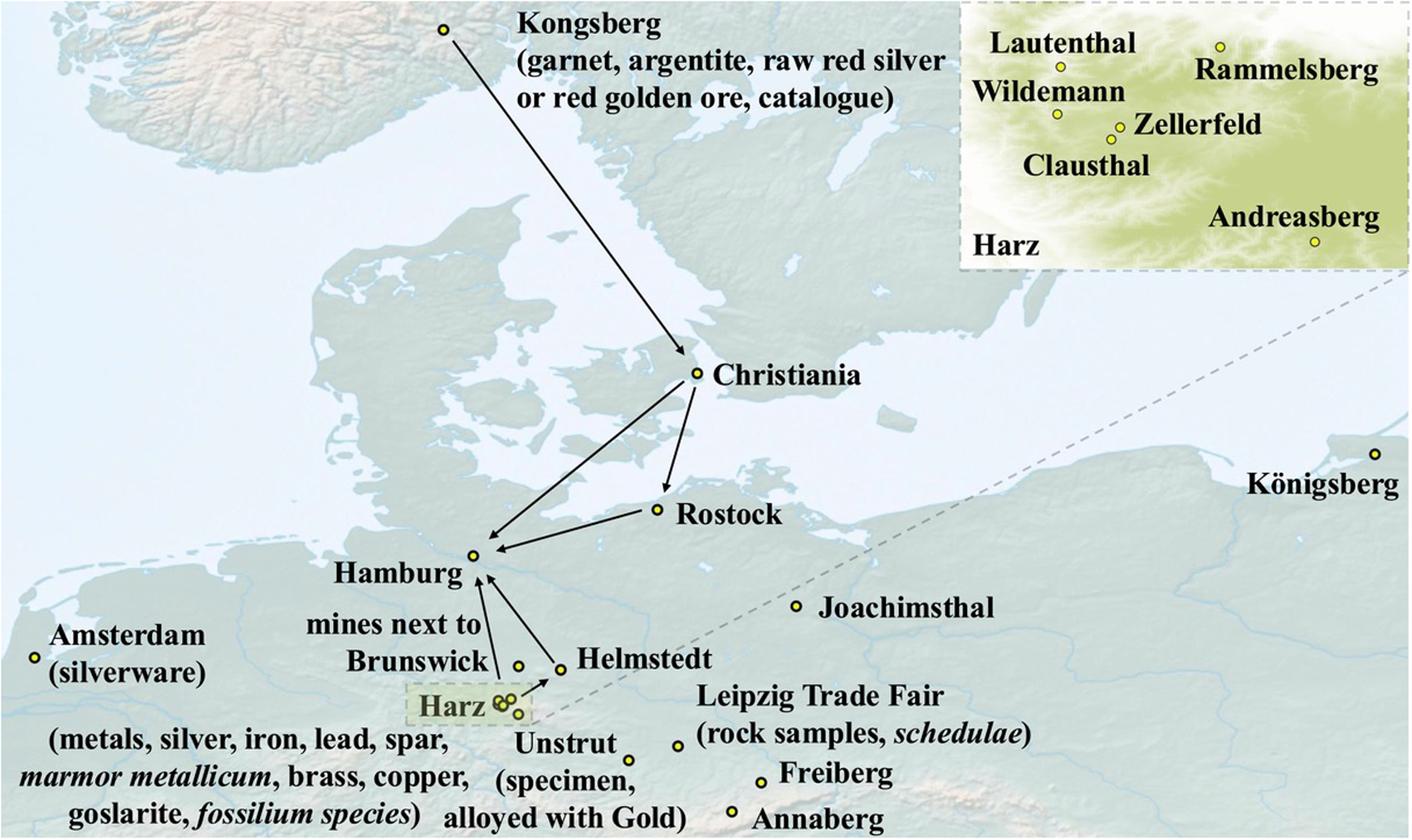

 Open access

