




Language contact
Language contact is a frequent phenomenon in an ever-increasing globalised world. It can take different forms, two of which are inter- and intra-modal language contact (Bellugi, Poizner, & Klima Reference Bellugi, Poizner and Klima1989). In the context of this article, the former relates to contact between spoken languages and signed languages, and the latter to contact between two signed languages.
As minority communities, deaf people are almost always in contact with the hearing majority, which manifests in language contact between a signed language and a spoken language. This inter-modal language contact, also referred to as bimodal bilingual language contact (Emmorey, Borinstein, Thompson, & Gollan Reference Emmorey, Borinstein, Thompson and Gollan2008), has been shown to lead to transference of many features from one language to another (Quinto-Pozos Reference Quinto-Pozos2008). One example of transference from a spoken language to a signed language is mouthing. Mouthing is defined as the full or reduced articulation of words from the surrounding spoken language(s), which are usually articulated silently and whose meaning is often semantically equivalent to the manual sign used (Boyes-Braem & Sutton-Spence Reference Boyes-Braem and Sutton-Spence2001; see the section Mouthing for a detailed description of this phenomenon). For example, one can sign CHILDRENFootnote 1 in Sign Language of the Netherlands (NGT) and mouth the equivalent Dutch word Kinderen ‘children’, or a reduced form of the word, as in kinder- (Schermer, Brien, & Brennan Reference Schermer, Brien and Brennan2001:278).
Inter-modal language contact studies have mostly investigated contact between one signed language and one spoken language (e.g. BSL and English in Proctor & Cormier Reference Proctor and Cormier2022; Sign Language of the Netherlands and Dutch in van de Sande & Crasborn Reference van de Sande, Crasborn, Botma and Kampen2009; Israeli Sign Language and Hebrew in Cohen-Koka, Nir, Meir Reference Cohen-Koka, Nir and Meir2023; Russian Sign Language and Russian in Bauer & Kyuseva Reference Bauer and Kyuseva2022). Fewer studies have investigated contact between more than one spoken language and more than one signed language (e.g. English and Spanish, and American Sign Language and Mexican Sign Language on the Texas-Mexico border in Quinto-Pozos Reference Quinto-Pozos2002; Inuktitut and English and Inuit Sign Language and American Sign Language in Canada in Schuit Reference Schuit, Zeshan and Vos2012; see a detailed review in the section Mouthing in bimodal multilingual language contact situations). However, to the best of our knowledge, no study has looked at contact between two signed languages and two spoken languages in which one of the spoken languages is diglossic (i.e. has two language varieties; Ferguson Reference Ferguson1959).
In this article, we investigate the phenomenon of mouthing as evidence of inter-modal language contact in a bimodal multilingual deaf community. To this end, we focus on the Kufr Qassem deaf community, a Palestinian deaf community situated in the town of Kufr Qassem in what is now known as Israel. Due to years of language contact, younger deaf signers in Kufr Qassem are multimodal multilingual in the local sign language, Kufr Qassem Sign Language (KQSL), and the dominant sign language,Footnote 2 Israeli Sign Language (ISL)—which is used in education, interpreting, and the media, as well as the spoken-written languages, Arabic and Hebrew. Notably, ISL signers are exposed to different languages depending on the surrounding hearing community and the spoken/written language(s) of instruction at school, either Arabic or Hebrew or both.
Arabic is a typical case of diglossia (Ferguson Reference Ferguson1959): Modern Standard Arabic (MSAFootnote 3) is the variety used in formal contexts (e.g. schools, media, and religious settings) and Colloquial ArabicFootnote 4 is used in informal contexts (e.g. conversations with family and friends). We investigate mouthing frequency and distribution in a bimodal multilingual situation, while also taking into consideration the role of diglossia on mouthing.
We begin in the next section with an introduction to the literature related to mouthing. Following this, we describe our innovative methods and results from two studies. One study looks at the frequency of mouthing across different generations of KQSL signers (see Study 1: Methodology and results) and the second study looks at how mouthing is used in different interlocutor conditions (see Study 2: Methodology and results). In the Discussion section, we discuss our findings in light of other studies, and we consider the implications of these results.
Mouthing
Mouth actions have been described in many sign language studies to date (Boyes-Braem & Brentari Reference Boyes-Braem, Brentari and Brentari2001; Boyes-Braem & Sutton-Spence Reference Boyes-Braem and Sutton-Spence2001; Meir & Sandler Reference Meir and Sandler2007; van de Sande & Crasborn Reference van de Sande, Crasborn, Botma and Kampen2009; Bank, Crasborn, & van Hout Reference Bank, Crasborn and van Hout2011, Reference Bank, Crasborn and van Hout2015; Bauer Reference Bauer2019; McKee, Safar, & Alexander Reference McKee, Safar and Alexander2021; Proctor & Cormier Reference Proctor and Cormier2022; Cohen-Koka et al. Reference Cohen-Koka, Nir and Meir2023; Bisnath Reference Bisnath2024). There are two major types of mouth actions: mouthing and mouth gestures. The latter, mouth gestures, are not derived from spoken languages, but rather deliver linguistic information associated with the signed discourse (e.g. manner or degree in which the manual sign is produced; Bank et al. Reference Bank, Crasborn and van Hout2011). In this article we focus on the former, mouthing, defined as the full or reduced articulation of words from the surrounding spoken language(s), which are usually articulated silently and whose meaning is often semantically equivalent to the manual sign used (Boyes-Braem & Sutton-Spence Reference Boyes-Braem and Sutton-Spence2001). For example, in Israeli Sign Language (ISL), when one signs ‘boy’, it is common to mouth the equivalent meaning in Hebrew yeled ‘boy’. Although the mouthing is borrowed from Hebrew, it does not affect the sign language grammar.Footnote 5 It is also worth noting that mouthing does not necessarily occur with all signs.
Mouthing is described as an outcome of language contact between languages from two different modalities, spoken and signed. Bauer & Kyuseva (Reference Bauer and Kyuseva2022) add that the written modality also plays a role. They argue that signers in their dataset (Russian and Russian Sign Language bilinguals) are familiar with the full written form, and this is reflected in the reduced mouthing based on the first syllable of the respective Russian word. While it is agreed that mouthing is an outcome of language contact, there is debate regarding terminologies and the linguistic status of mouthing. Some researchers refer to mouthing as a type of code-blendingFootnote 6 (Emmorey, Borinstein, & Thompson Reference Emmorey, Borinstein, Thompson, Cohen, MacSwan, McAlister and Rolstad2005), code-mixing (e.g. Berent Reference Berent, Bhatia and Ritchie2004), or code-switchingFootnote 7 (e.g. Boyes-Braem Reference Boyes-Braem2001), suggesting that mouthing is a part of sign language grammar, albeit unintegrated. Others see it as an integrated feature, part of the morphosyntactic structure, referring to it as a type of borrowing from spoken or written languages (Crasborn, Van Der Kooij, Water, Woll, & Mesch Reference Crasborn, Sloetjes, Zwitserlood, Crasborn and Efthimiou2008; Mohr Reference Mohr2012; Quinto-Pozos & Adam Reference Quinto-Pozos, Adam, Schembri and Lucas2015).
As with any linguistic phenomenon, mouthing frequency and distribution is not the same across sign languages. Mouthing has been reported as frequent in some sign languages (e.g. Italian Sign Language in Ajello, Mazzoni, & Nicolai Reference Ajello, Mazzoni and Nicolai2001; Sign Language of the Netherlands in Bank et al. Reference Bank, Crasborn and van Hout2011; Russian Sign Language in Bauer Reference Bauer2019; British Sign Language in Sutton-Spence & Day Reference Sutton-Spence and Day2001), and less frequent in others. For example, signers of Kata Kolok, a sign language used in two neighbouring rural villages near Bali, Indonesia, are reported to use no or minimal mouthing (Marsaja Reference Marsaja2008). Similarly, in Nicaraguan Sign Language (ISN) no mouthing was observed in situations in which deaf people communicated with one another; rather, mouthing was only found when deaf people communicated with hearing people (Kegl, Senghas, & Coppola Reference Kegl, Senghas, Coppola and DeGraff1999). Looking at a community with a similar sociolinguistic situation as the one under investigation in the current study, mouthing was reported as rare in Al-Sayyid Bedouin Sign Language (ABSL), a sign language used in the southern part of what is now known as Israel, particularly in comparison to other sign languages, including ISL (Weisenberg Reference Weisenberg2009; Meir, Sandler, Padden, & Aronoff Reference Meir, Sandler, Padden and Aronoff2010). For a detailed literature review on mouthing as well as mouthing types in many sign languages, see Bisnath (Reference Bisnath2024).
Sociolinguistic factors influencing mouthing
Mouthing is influenced by several social and linguistic factors, affecting both its frequency and distribution. One important factor discussed in several sign language studies is education (e.g. McKee Reference McKee2006; Militzer Reference Militzer2009; Mohr Reference Mohr2012; Luna Reference Luna2015; Bank, Crasborn, & van Hout Reference Bank, Crasborn and van Hout2016), in particular, the type of educational method and language of instruction. Oral educationFootnote 8 has been shown to increase mouthing frequency through signer's direct contact with spoken language (Hohenberger & Happ Reference Hohenberger and Happ2001; Sutton-Spence & Day Reference Sutton-Spence and Day2001). Palfreyman (Reference Palfreyman2020) associates the rare mouthing instances of one signer in the BISINDO (Indonesian Sign Language) corpus to not receiving any formal education, for instance. However, in some cases, education does not lead to increased mouthing. Bank and colleagues (Reference Bank, Crasborn and van Hout2016) found an effect of both region and level of education on mouthing frequency among the deaf community in the Netherlands, with signers from the Voorburg region mouthing more than signers from other regions, and with those who received higher education mouthing less. The authors argued that these factors are interrelated since the Voorburg sample received lower education. A similar effect of region was found in BSL, with signers from southern regions mouthing more on verbs than those from northern regions (Procter & Cormier Reference Proctor and Cormier2022).
Some studies have shown gender differences in terms of mouthing patterns, which are largely related to segregated education of girls and boys in Ireland (Militzer Reference Militzer2009), showing the role of schools in mouthing behaviours. Furthermore, Procter & Cormier (Reference Proctor and Cormier2022) found a significant gender effect, in which females mouthed more than males. Following Labov (Reference Labov2001), Procter & Cormier (Reference Proctor and Cormier2022) suggest that the gender difference can be attributed to the fact that mouthing is viewed as more prestigious in BSL. This raises the issue of language ideologies with regard to mouthing (Kusters, Green, Moriarty, & Snoddon Reference Kusters, Green, Moriarty, Snoddon, Kusters, Green, Moriarty and Snoddon2020). That is, some signers view mouthing negatively and therefore produce fewer mouthings. This could be the reason why we see fewer mouthings among signers of certain sign languages (e.g. American Sign Language in Nadolske & Rosenstock Reference Nadolske, Rosenstock, Perniss, Pfau and Steinbach2007). Furthermore, while some researchers view mouthing as an integral part of sign languages (Ebbinghaus & Heßmann Reference Ebbinghaus and Heßmann2001; Schermer et al. Reference Schermer, Brien and Brennan2001; Bank, Crasborn, & van Hout Reference Bank, Crasborn and van Hout2015), others view it as part of a ‘linguistic colonization’ (Ladd Reference Ladd2003) and the outcome of oralist methods in deaf schools (Adam & Braithwaite Reference Adam and Braithwaite2022).
Regarding age, a number of studies show that younger signers mouth less than older signers (New Zealand Sign Language in McKee Reference McKee2007; British Sign Language in Sutton-Spence & Day Reference Sutton-Spence and Day2001) due to improved changes in educational policies, resulting in a reduction in oralist approaches, and with increased tolerance towards sign language over the years. Similar to Militzer (Reference Militzer2009) and Procter & Cormier (Reference Proctor and Cormier2022), Sutton-Spence & Day (Reference Sutton-Spence and Day2001) attributed the age effect or the lack thereof to the different education policies over the years.
Another factor shown to affect the frequency and distribution of mouthing is the interlocutor. Mouthing may be a natural outcome of linguistic accommodation, in which language users adapt their language in accordance with their interlocutors (Giles, Taylor, & Bourhis Reference Giles, Taylor and Bourhis1973). Interestingly, accommodation is an important marker when seeking social approval (Giles et al. Reference Giles, Taylor and Bourhis1973). Palfreyman (Reference Palfreyman2020) describes the contact situation between Indonesian Sign Language (BISINDO) and several spoken languages in Indonesia and suggests that deaf bimodal multilinguals code-switch in mouthing between Javanese and Indonesian when communicating with other deaf signers in Solo, where Javanese identity is stronger (Errington Reference Errington1985; Vander Klok Reference Vander Klok2012). Palfreyman argues that code-switching to Javanese mouthing is a way to create social meaning: ‘Since “being Javanese” is perceived as important—especially in Solo—and given that Javanese is used by much of hearing Solonese society, it is unsurprising that deaf signers also use language to “be Javanese”, employing the practice of Javanese mouthings to index a Javanese identity’ (Palfreyman Reference Palfreyman2020:109).
In the next section, we present a handful of studies which investigated mouthing in bimodal multilingual language contact situations.
Mouthing in bimodal multilingual language contact situations
Most studies on mouthing have looked at contact between one spoken language and one signed language (e.g. Boyes-Braem & Brentari Reference Boyes-Braem, Brentari and Brentari2001; Crasborn et al. Reference Crasborn, Van Der Kooij, Waters, Woll; and Mesch2008; Bank et al. Reference Bank, Crasborn and van Hout2011; Johnston, Van Roekel, & Schembri Reference Johnston, Van Roekel; and Schembri2016; Proctor & Cormier Reference Proctor and Cormier2022; Cohen-Koka et al. Reference Cohen-Koka, Nir and Meir2023). Very few studies, however, have investigated contact between more than one spoken language and more than one signed language (e.g. Quinto-Pozos Reference Quinto-Pozos2002; Schuit Reference Schuit, Zeshan and Vos2012; Zeshan & Panda Reference Zeshan and Panda2015). One of the first studies investigating this was Quinto-Pozos (Reference Quinto-Pozos2002), who examined language contact on the Texas border with Mexico between American Sign Language (ASL) and Mexican Sign Language (LSM). He reports that due to extensive language contact, ASL deaf signers and LSM deaf signers use both Spanish and English mouthings. He argues that English mouthing is associated with ASL, and Spanish mouthing with LSM. Thus, when bilingual signers use English mouthing on LSM signs, or Spanish mouthing on ASL signs, he described it as a form of ‘mouthing interference’. In this article, we suggest an alternative term for ‘mouthing interference’ especially in communities where multilingualism is the norm (see the Discussion).
Another study examined different aspects of language use, including mouthing, among deaf international students in India (Zeshan & Panda Reference Zeshan and Panda2015). The researchers describe one international student from Burundi (where the dominant spoken language is Kirundi, and Hindi is not used) who uses Burundi Sign Language and Indian Sign Language with mouthings from Hindi. They attribute this to the fact that the deaf signer experienced extensive contact with Hindi while studying in India. Furthermore, they report that many Indian students use both English and Hindi when signing Indian Sign Language. In an example of two spoken languages used with one sign language, Mckee (Reference McKee2007) reports that Māori deaf people, the aboriginal community in New Zealand, use both Māori and English mouthings when producing New Zealand Sign Language (NZSL).
To the best of our knowledge, the only study to date which looked at contact between two spoken languages and two signed languages within the same country is Schuit (Reference Schuit, Zeshan and Vos2012), who investigated language contact in Canada. She examined multilinguals of ASL (where mouthing is typically English) and Inuit Sign LanguageFootnote 9 (where mouthing is typically English and Inuktitut). Because deaf Inuit children were sent to schools where the languages of instruction were ASL, written and spoken English, and Signed English, there was extensive contact between these languages and Inuit Sign Language. As a result, some features may have transferred from ASL or Signed English to Inuit Sign Language, including English mouthing with Inuit signs. This language contact situation is perhaps the most similar to the situation investigated in the current article (as we discuss in The community under investigation). The main difference is that one of the spoken languages under examination in the current study is a classic example of a diglossic language, Arabic.
In summary, mouthing frequency and distribution varies from language to language, and is dependent on the social or linguistic situation, or both. In the current article, we look at mouthing frequency and distribution to better understand the changing social dynamics in the Kufr Qassem deaf community.
The community under investigation
Israel, the site of this study, is linguistically diverse, not only in terms of spoken languages (e.g. Arabic, Hebrew, Russian, etc.), but also in terms of signed languages. Alongside ISL, there are several hyper-localised sign languages which emerged in towns and villages with high incidences of hereditary deafness. The sign languages in Israel are considered relatively young given that they emerged within the last 100 years. The emergence of ISL dates back to the 1930s, when a group of Jewish deaf people in Palestine (now Israel) came together with deaf Jewish immigrants from Europe, North Africa, and Middle Eastern countries (Meir & Sandler Reference Meir and Sandler2007). Schools in Jerusalem, Haifa, and Tel Aviv, which were established in the 1930s and 1940s, played a vital role in developing and shaping ISL, providing a social space for deaf children to sign with one another. The educational method in these schools, however, was oralist until the 1970s (Meir & Sandler Reference Meir and Sandler2007).
Alongside ISL, other sign languages emerged but were not in contact with one another. The social dynamics of these sign languages are different from ISL in that they emerged in somewhat insular homogeneous communities with high incidences of hereditary deafness (Meir et al. Reference Meir, Sandler, Padden and Aronoff2010). The ISL community, on the contrary, is less homogenous with loose social networks. As a macro-community sign language,Footnote 10 ISL is the dominant language in the media, education, and sign language interpreting across Israel. Moreover, ISL has received a great deal of attention from researchers (Nespor & Sandler Reference Nespor and Sandler1999; Meir & Sandler Reference Meir and Sandler2007; Meir, Aronoff, Börstell, Hwang, Ilkbasaran, Kastner, Lepic, Lifshitz Ben-Basat, Padden, & Sandler Reference Meir, Aronoff, Börstell, Hwang, Ilkbasaran, Kastner, Lepic, Ben-Basat, Padden and Sandler2017; Tkachman & Sandler Reference Tkachman and Sandler2013; Cohen-Koka et al. Reference Cohen-Koka, Nir and Meir2023). Most micro-community sign languages in Israel, in contrast, are severely understudied.
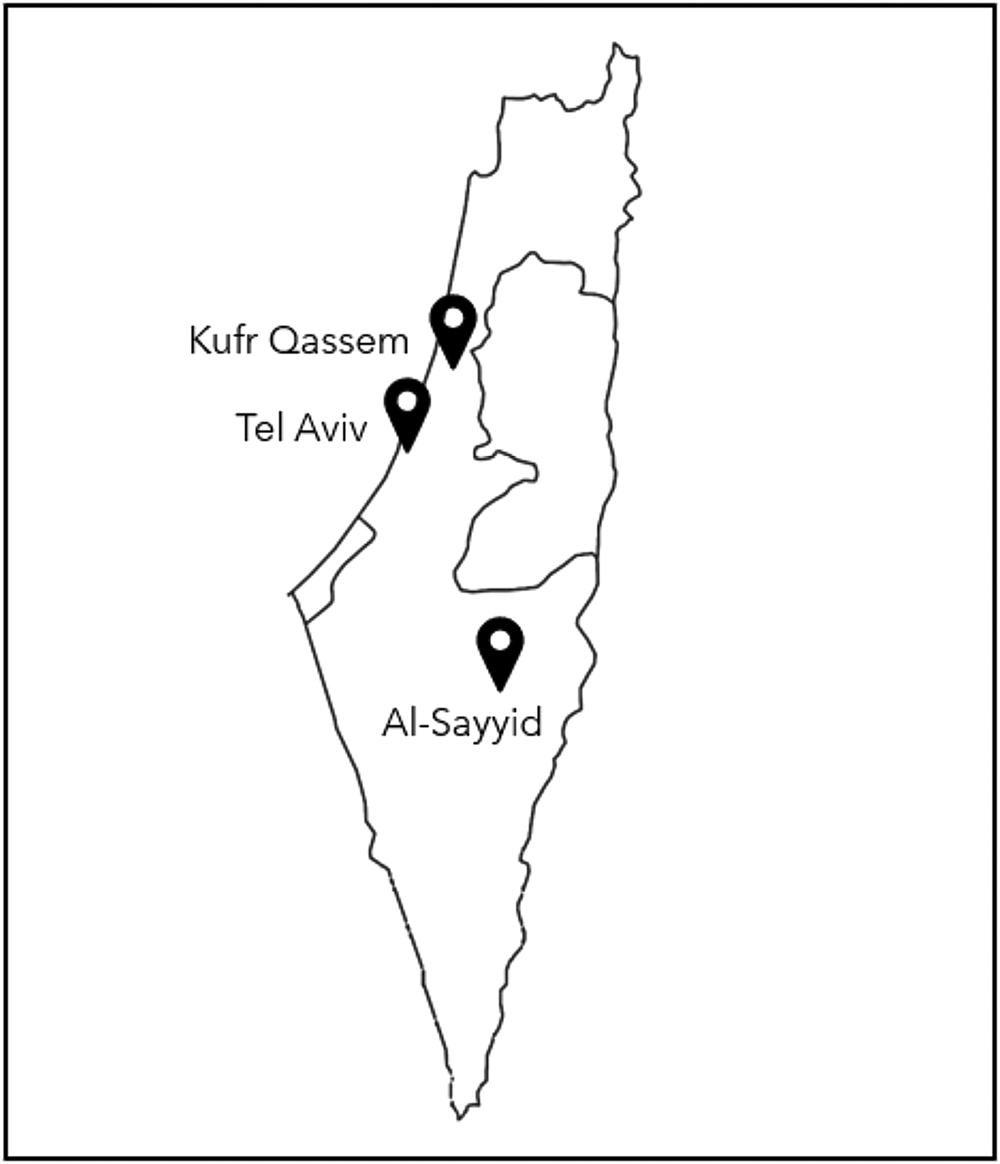
The focus of the current study is the deaf community in Kufr Qassem. The Kufr Qassem deaf community, which resides in a Palestinian-Arab town in Israel (see Figure 1), has their own local sign language, known as Kufr Qassem Sign LanguageFootnote 11 (KQSL). Consanguineous marriage in this community resulted in a relatively high rate of hereditary deafness and led to the emergence of KQSL as a shared means of communication between deaf people themselves, and between deaf and hearing people in the town (Sarsour Reference Sarsour2020). During its emergence, KQSL was linguistically and geographically isolated from the wider Israeli deaf community (Kafr Qasem Sign Language Dictionary 2013). It is important to note that from 1948 until late 1966, the Israeli government imposed a military rule on Palestinian citizens of Israel, which meant that people could not leave their hometowns or areas without a permit. This situation led to the isolation of both hearing and deaf communities from communities in nearby towns and villages.
Location of Kufr Qassem in Israel.

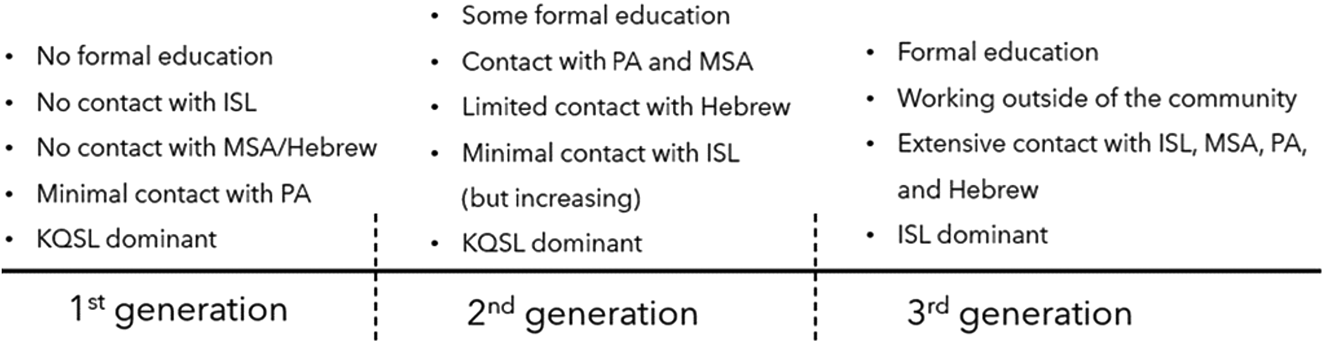
The status of Arabic as the ambient spoken language has not changed throughout the years in Kufr Qassem, but the nature and degree of exposure to it has. In this article, we focus on the first three living generations in the Kufr Qassem deaf community (see Figure 2) as the fourth and youngest generation of signers were children at the time of data collection (2018–2019). Generation time may differ from one country, culture, or community to another. In this study we follow the concept of ‘social generation’. Mannheim (Reference Mannheim1952) argued that people are affected by their sociohistorical environment; those who experienced similar sociohistorical events or went through similar social experiences form a cohort that can be considered as a social generation. In this article we consider education as the key factor to determine the boundaries of each generation. The first generation of deaf signers (1934–1959) neither attended school nor received speech training. Instead, they worked in various professions and crafts such as agriculture and sewing with other members of the hearing and deaf community in Kufr Qassem. Deaf members of the community were better integrated in the past and many of their hearing relatives knew KQSL, and there was no need to communicate using spoken languages. Therefore, KQSL remained relatively uninfluenced by other signed (mainly ISL) and spoken languages (e.g. Arabic and Hebrew; Kafr Qasem Sign Language Dictionary 2013; Kastner, Meir, Sandler, Dachkovsky Reference Kastner, Meir, Sandler and Dachkovsky2014). In the following years, more deaf children were born into the deaf community of Kufr Qassem, leading to the establishment of the first deaf class in Kufr Qassem in 1979 at a local mainstream elementary school. Some second-generation deaf signers (1960–1975) attended this class, and some went to other schools nearby. However, teachers did not know ISL, and had limited knowledge of KQSL. In the last few decades, ISL made its way into local deaf classes in Kufr Qassem and nearby towns and villages through hearing teachers who knew the language. Therefore, signers from the second generation were the first to be exposed to ISL explicitly and systematically through education. The deaf schools in nearby Jewish towns used Hebrew and ISL as the languages of instruction, while those in Kufr Qassem used Arabic along with ISL. Since the third (1976–2001) and fourth generations (2001–2019) of Kufr Qassem deaf community attended these schools in addition to social interactions with the surrounding hearing and deaf communities such as in the workplace, they were exposed to ISL, Hebrew, and Arabic more so than previous generations. Deaf people in Kufr Qassem are exposed to Arabic more than deaf people living in Jewish communities who are mainly exposed to Hebrew; this is due to the difference in the language used by the surrounding hearing communities.
Language contact and educational background in the first three generations in Kufr Qassem.

As aforementioned, Arabic is a diglossic language, in which there are two related language varieties used in different contexts (Ferguson Reference Ferguson1959) and for different functions (Albirini Reference Albirini2016). The first is MSA, fus-ha, which is the variety used in formal settings such as the media and education. The second is Colloquial Arabic, usually used in informal day-to-day contexts and is referred to as a'mmiyyah. Colloquial Arabic varieties are also usually used in writing in informal settings such as text messages or social media posts (Ferguson Reference Ferguson1959). In this study, we look at a specific dialect of Colloquial Arabic, which is Palestinian Arabic (PA). Within the deaf community, most deaf Arabs are exposed to PA to varying degrees, whether through communicating with immediate family members at home, or hearing Arabic speakers in their surroundings. Today, many deaf Arabs attend Arabic speaking schools in which MSA is used, while others attend schools in which Hebrew is used as the main spoken-written language, but may use some MSA, mainly in Arabic language classes.
In summary, no research has investigated mouthing in the Kufr Qassem deaf community, a highly multilingual community, and no study to date has looked in depth at diglossia-related patterns of language use among Arab deaf signers in general. This study fills this gap in the literature. We therefore address three research questions:
(i) What is the effect of the changing social dynamics across the years in the Kufr Qassem deaf community on mouthing frequency and distribution?
(ii) Which language and which language variety is mouthing influenced by?
(iii) Do the interlocutor and sign langauge influence mouthing patterns?
Study 1: Methodology and results
In this section we describe the methods and results of the first study. The aim of this study was to look at the use of mouthing across different generations of signers in the Kufr Qassem deaf community. We start with a description of the participants, followed by an explanation of the stimuli and procedure, and data coding and analysis, and then we present the results.
Participants
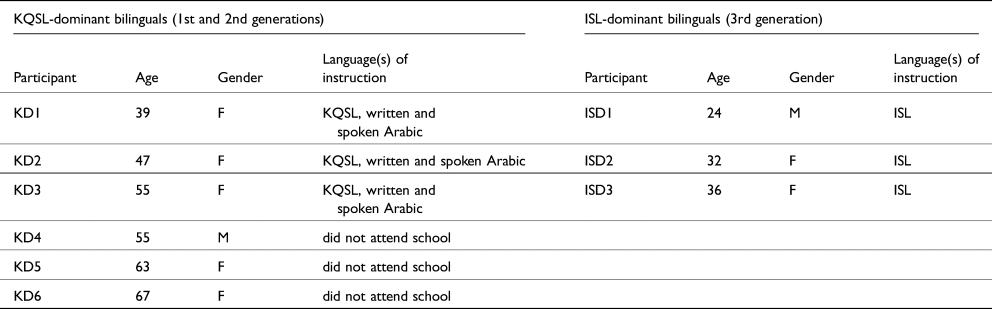
Twelve deaf participants were recruited for this study, six ISL-dominant bilinguals and six KQSL-dominant bilinguals (ISL-dominant bilinguals: age range: 21–42, mean age: 29.8; KQSL-dominant bilinguals: age range: 39–67, mean age: 54.3). The KQSL-dominant group was originally recruited as a monolingual group as part of the European Research Council funded project ‘Grammar of the Body (GRAMBY)’ based at the University of Haifa and led by Professor Wendy Sandler. In a recent related study, it has been shown that there is frequent contact between ISL and KQSL (Stamp & Jaraisy Reference Stamp and Jaraisy2021). Importantly, the KQSL-dominant signers were not taught or exposed to ISL in a formal setting, and they predominantly use KQSL on a daily basis mixed with some ISL signs which they learned through communicating with the younger generations (Stamp & Jaraisy Reference Stamp and Jaraisy2021). Therefore, in this study, we use the term KQSL-dominant bilinguals to describe this group, rather than KQSL monolinguals. The first generation, who are KQSL-dominant, did not receive formal education. Some members of the second generation, who are also KQSL-dominant, attended schools in which the languages of instruction were KQSL as well as written and spoken Arabic (see Table 1).
Participant characteristics.

With the assistance of a deaf collaborator from the community who herself is a fluent KQSL-ISL bilingual, we recruited ISL-dominant bilinguals from the third generation. All but one graduated high school with ISL as the main language of instruction at school in addition to other languages (e.g. Signed Arabic, Signed Hebrew, Hebrew, Arabic; see Table 1). We refer to this group as ISL-dominant bilinguals because they all reported using ISL as their main and preferred language of communication in general, especially at work or school, in addition to social interactions with their peers and when interacting with other deaf people from outside the community. They reported using KQSL when interacting with older deaf relatives or hearing relatives who do not know ISL (see Table 1).
Notably, we refer to the participants from both groups as bilinguals though technically they are multilingual given the spoken-written languages they know. However, in this study we focus on their sign bilingualism and how mouthing patterns when switching between the two sign languages in question: KQSL and ISL.Footnote 12
Despite aiming for parity in participant recruitment and data analysis, we could only annotate and analyse the data of three ISL-dominant bilinguals due to difficulties relating to camera angles leading to indecipherable mouthing instances.
Prior to performing the task, all participants signed a consent form and filled out a demographic questionnaire about their educational background and language preferences and use. Filming took place in the deaf club or sometimes in participants’ homes in Kufr Qassem, and our deaf collaborators supervised the process using each signer's preferred sign language.
Stimuli and procedure
Participants performed a video-retelling task in a dyadic setup with another signer matched for age and language background. Participants watched a short black and white silent movie entitled ‘The Lion's Cage’ featuring Charlie Chaplin. To elicit detailed responses, participants were told that their interlocutors would perform a comprehension task in which they would order five scenes taken from the movie in chronological order, based on the retelling alone. To avoid issues related to memory, participants watched the full movie first (3 min 23s), then re-watched it in five segments (37s, 52s, 45s, 31s, 30s, respectively), signing the events of each segment to their interlocutor after each part, then retelling the whole story from beginning to end.
Data coding and analysis
Data were coded using ELAN, a video annotation software (Crasborn & Sloetjes Reference Crasborn, Sloetjes, Zwitserlood, Crasborn and Efthimiou2008). Mouthing instances were coded according to the language variety used: MSA, PA, Shared MSA/PA, Hebrew, and Shared MSA/PA/Hebrew. Since there is some overlap between MSA and PA, we followed Saiegh-Haddad & Spolsky's (Reference Saiegh-Haddad, Spolsky, Saiegh-Haddad and Malatesha Joshi2014) research. They suggest that three types of Arabic words can be identified which vary in terms of their phonological distance between MSA and PA:
(a) Identical words: phonologically fully shared words between MSA and PA. For example, the word for the colour ‘green’ is /ʔxdar/ (ﺃﺧﻀﺮ) in both MSA and PA.
(b) Cognate (similar) words: these are phonologically partially shared words between MSA and PA, the distance can be as small as a difference in one phoneme (PA /ftu:r/, MSA /futu:r/ meaning ‘breakfast’); or a relatively large distance with differences in a number of phonological parameters (PA /tayya:ra/, MSA /ta:ʔira/ ‘airplane’).
(c) Unique words: completely different in phonology between MSA and PA, as in the word for ‘man’: MSA /rʌʒol/ (ﺭَﺟُﻞ), and PA /zʌlʌmə/ (ﺯَﻟﻤﺔ).
In this study, unique words were coded separately as MSA or PA, cognate words were coded based on the phonological features of the word and attributed to either MSA or PA, and identical words were coded under the Shared MSA/PA category (Saiegh-Haddad Reference Saiegh-Haddad2003). The fifth mouthing category (Shared MSA/PA/Hebrew) included partial mouthings in which the spoken language variety was not clear due to similarities between Arabic and Hebrew as Semitic languages (e.g. ‘sugar’ in Arabic and Hebrew is /suk.kar/ and /suka:r/, respectively). All shared and indecipherable mouthings were also excluded from the analysis.
This study was part of the first author's MA work, which mainly looked at intra-modal language contact in the Kufr Qassem deaf community. Given the similarities across some sign languages due to iconicity, modality, and/or culture, we only looked at mouthings of lexical signs that are unique in KQSL and ISL. We acknowledge the debate in the literature regarding lexical signs and the lexicon as possible ambiguous concepts (e.g. Lepic Reference Lepic2019). For the purpose of this study, however, we follow Johnston & Ferrara's (Reference Johnston and Ferrara2012) definition of lexical signs as conventionalised signs in a language community. To calculate mouthing frequency, the number of ISL and KQSL lexical signs produced with mouthing was divided by the overall number of ISL and KQSL lexical signs produced, including those without mouthing. We carried out multivariate statistical analyses of the data using Rbrul (Johnson Reference Johnson2009).
Results
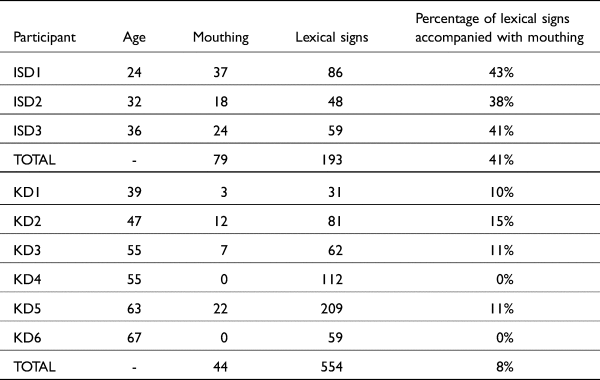
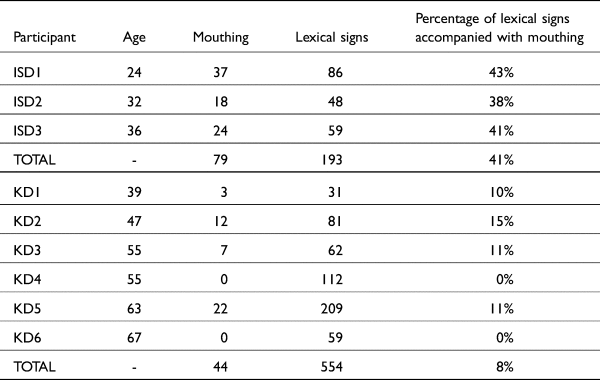
A total of 747 lexical signs were analysed from nine signers (see Table 2 for individual and group frequencies). Of these, 123 were accompanied by mouthing (average 16%). Results showed a clear difference in mouthing frequency between generations, with mouthing frequency from the third generation (41%) significantly higher than those from the first and second generations (8%).
Results of mouthing frequency across groups.
We ran a statistical analysis to determine whether there was a significant difference in mouthing across the groups. The dependent variable was the presence of mouthing and the independent variable was group (ISL-dominant bilingual vs. KQSL-dominant bilingual). Participant was included as a random effect, accounting for individual-specific variability. Table 3 presents the results, including the log odds, number of tokens analysed, percentage of mouthing produced and the centred factor weight (with mouthing presence as the application value). Results with a positive log-odd and a factor weight over 0.5 indicate that this factor results in an increased likelihood that there is mouthing produced (highlighted in bold in Tables 3 and 5) while a negative log-odd and a factor weight below 0.5 indicate decreased likelihood that mouthing was present.
Multiple regression results for mouthing across groups.

The results indicated that group was a significant predictor of mouthing (p < 0.01), with significantly more mouthing produced by the ISL-dominant bilingual group (0.739) than the KQSL-dominant group (0.261).
Study 2: Methodology and results
In this section, we present Study 2 which is a more in-depth investigation, focusing on ISL-dominant bilinguals, and examining their use of mouthing in a task in which the interlocutor was manipulated.
Participants
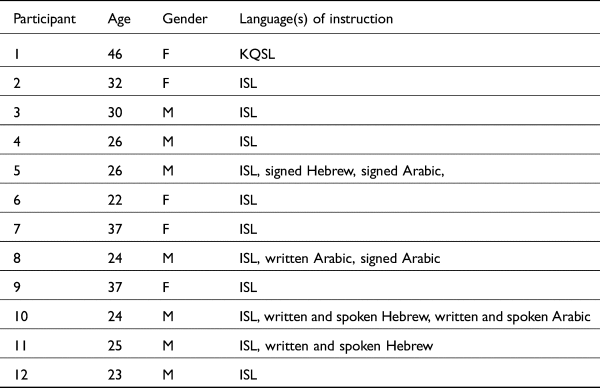
Twelve self-reported ISL-dominant bilinguals from the third generation were recruited for this study (mean age: 29; age range: 22–46, five females, seven males); all participants were born deaf and reside in Kufr Qassem (see Table 4). Two confederates were recruited to serve as consistent conversational partners for all participants. Confederates were not instructed to behave in any particular way; their role was to complete the tasks just like other participants. One confederate is a KQSL-dominant bilingual who uses KQSL as a first language (L1) (female, forty-seven years old) and received no formal training in ISL. The other monolingual confederate uses ISL as their L1 (female, thirty-three years old), is not from Kufr Qassem, and does not know KQSL. This study was approved by the Ethics Committee at Bar-Ilan University. All participants were compensated for their time.
Participant characteristics of Study 2.

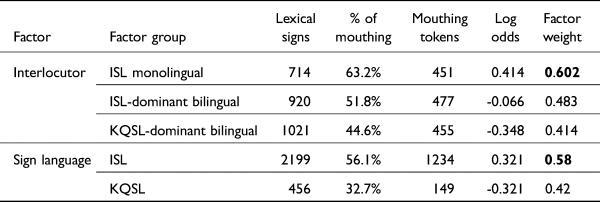
Multiple regression results for mouthing frequency .

Stimuli and procedure
The stimulus adopted in this study is a ‘spot the difference’ task, which was designed and created by the first author as part of her MA studies. For a detailed description on the development of the stimuli, see Jaraisy & Stamp (Reference Jaraisy and Stamp2022). The task was designed specifically to create a semi-spontaneous interaction while controlling for the production of a number of lexical items. The target items were lexical signs that differ between KQSL and ISL, and thereby created a situation of lexical competition. For example, in the right picture shown in Figure 3, a signer can describe the dog sleeping under the table by producing a lexical sign for ‘dog’, which is signed differently in KQSL and ISL. The aim of the task was to find a total of twelve differences between two versions of a cartoon illustration of a scene (see Figure 3 as an example) by conversing with their interlocutor.
Example of a completed picture scene; on the right is the picture with twelve differences circled.

Participants completed two scenes in three different conditions: (i) with another ISL-dominant bilingual, (ii) with a KQSL-dominant bilingual, and (iii) with a monolingual ISL signer. Therefore, there were a total of six picture scene pairs: kitchen (as in Figure 3), field, street, beach, living room, and riverbank. Participants engaged in other tasks in between conditions, to ensure that the task was not repetitious. We also designed each pair of scenes to elicit the same set of lexical items in each condition.
Data coding and analysis
The completion of both scenes in each condition took fifteen minutes on average, ranging from eight to twenty minutes in each condition, and an average of forty-five minutes for the entire task. As in Study 1, we carried out data coding and analysis in the same way as described for the first study. We ran multivariate statistical analyses of the data using Rbrul (Johnson Reference Johnson2009). In the results section for the second study below, we present two statistical analyses: the first relates to mouthing frequency and the second relates to mouthing language.
Results
A total of 2,655 lexical signs with and without mouthing were analysed, accompanying 2,199 ISL signs and 456 KQSL signs.
Mouthing frequency
In the first analysis, the dependent variable was the presence of mouthing and three independent variables were included: gender (male, female), interlocutor (ISL-dominant bilingual, KQSL-dominant bilingual, monolingual ISL), and sign language (ISL, KQSL). In addition, we included participant and lexical item as random effects. The inclusion of these two variables enabled us to account simultaneously for individual-specific and stimuli-specific variability.
Fifty six percent of ISL signs were accompanied with mouthing, with a total of 1,234 mouthing instances; and around thirty three percent of KQSL signs were accompanied with mouthing—a total of 149 mouthing instances. We found two significant predictors of the presence of mouthing: interlocutor (p < 0.0001) and sign language (p < 0.0001); see Table 5 below. The findings showed that mouthing was more likely to be produced when communicating with a ISL monolingual (0.602) than with an ISL-dominant bilingual (0.483) or the KQSL-dominant bilingual (0.414). Moreover, mouthing was more likely to occur with ISL lexical signs (0.58) than with KQSL lexical signs (0.42). Gender was not found to be a significant predictor of mouthing presence.
Mouthing language
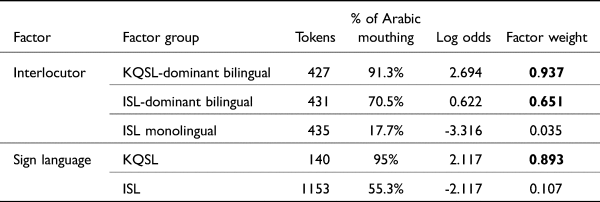
In the second analysis, we looked at the factors that predict the language of the mouthing. To this end, we only analysed the instances of mouthing, with a total 1,293 tokens. The results displayed in Table 6 relate to the use of Arabic mouthing, as Arabic was included as the application value (with the total including Arabic and Hebrew examples of mouthing). The dependent variable was language of the mouthing, as a binary distinction of Arabic or Hebrew (Arabic was the application value). We included the type of language interaction (with an ISL-dominant bilingual, a KQSL-dominant bilingual, or an ISL monolingual), sign language (ISL, KQSL), word class (noun, adjective, verb) and gender (male, female) as independent variables. Participant and lexical item were included as random effects.
Multiple regression results for mouthing language (Arabic as application value).

When excluding similar and identical Arabic words (i.e. Shared MSA/PA), the results show no MSA mouthing, and 100% of the Arabic mouthing comes from PA only. Our findings for the second analysis, shown in Table 6, revealed that interlocutor (p < 0.001) and sign language (p < 0.001) were significant predictors of mouthing language. Arabic was preferred when communicating with the KQSL-dominant bilingual (0.937) or another ISL-dominant bilingual (0.651). Also, Arabic was preferred when signing KQSL signs (0.893) than when signing ISL signs (0.107). Word class and gender were not significant predictors of the mouthing language.
Discussion
This article investigated mouthing frequency and patterns in deaf signers of different generations with different sociolinguistic backgrounds in Kufr Qassem. In the following subsections, we address and discuss each aspect of our results.
Increase in mouthing frequency across generations
The results in this study show a significant difference in mouthing frequency between the first- and second-generation signers and the third-generation signers in Kufr Qassem. By adopting the Apparent Time Hypothesis (Labov Reference Labov1963), we interpret these age-related differences as evidence of diachronic differences, indicating an increase in mouthing over time. Our findings show that mouthing frequency among ISL-dominant bilinguals is relatively high with an average of 41% found in Study 1, which was further emphasised by our finding in Study 2, with 63%. We see that there is a clear increase when we compare this to the average mouthing frequency in KQSL-dominant bilinguals, which is only 8%. We suggest that this may reflect the increase in intermodal language contact as a result of the changes in education experienced by the younger deaf generations in Kufr Qassem, similar to the findings in other sign language studies (Nonaka Reference Nonaka2004; Kisch Reference Kisch, Zeshan and de Vos2012). The first generation did not receive any formal education, but they were exposed to PA when communicating with the hearing community in Kufr Qassem. This exposure was limited since it was common for hearing relatives to communicate in KQSL. However, little is known about hearing signers’ mouthing frequency and patterns, and future studies should consider this as a possible effect (or the lack thereof) on the older generations’ minimal mouthing. In contrast, the younger generation received increased exposure to spoken and written languages (Hebrew, MSA, and PA) mainly through education and work inside and outside of Kufr Qassem in recent years. Not only the degree of exposure to Arabic has changed, but also the nature of such contact. In other words, contact with spoken languages was formerly minimal and spontaneous and it has become extensive and systematic over time.
The increase in mouthing frequency in the Kufr Qassem deaf community may also be explained by the recent increased contact with ISL in which mouthing is frequent, due to the effects of oralism as an educational method for many years in Israel (Meir & Sandler Reference Meir and Sandler2007; Tkachman & Sandler Reference Tkachman and Sandler2013; Cohen-Koka et al. Reference Cohen-Koka, Nir and Meir2023). In other words, we argue that sign language contact (contact between KQSL and ISL) may not only result in lexical borrowings from one sign language to another (Quinto-Pozos & Adam Reference Quinto-Pozos, Adam, Schembri and Lucas2015; Stamp & Jaraisy Reference Stamp and Jaraisy2021), but also in borrowings of non-manual markers such as mouthing.
Sign language and interlocutor determine mouthing frequency
The results show that mouthing varies depending on the interlocutor and the sign language used, suggesting that mouthing variation is not random; rather, it is systematic and constrained. More mouthing was observed when ISL-dominant bilinguals communicated with a monolingual ISL signer than with another ISL-dominant bilingual or with a KQSL-dominant signer. This suggests that signers adapted their mouthing behaviours based on the interlocutor. This follows the accommodation theory proposed by Giles at al. (Reference Giles, Taylor and Bourhis1973) in which language users adapt their linguistic behaviour to that of their interlocutor.
Moreover, we found that sign language was an important predictor of mouthing. There was a higher frequency of mouthing when signing ISL signs (56.1%) compared to KQSL signs (32.7%). Previous studies point to the strong relationship between ISL and mouthing, albeit predominantly in Hebrew (Meir & Sandler Reference Meir and Sandler2007; Cohen-Koka et al. Reference Cohen-Koka, Nir and Meir2023). Therefore, our findings support the notion that mouthing is a feature of ISL within the Kufr Qassem deaf community. However, minimal mouthing was found among KQSL-dominant bilinguals (Study 1), and the third generation mouthed less with KQSL signs and when communicating with a KQSL-dominant bilingual (Study 2). This suggests that mouthing is not necessarily a prominent feature of KQSL. These findings fall in line with other studies examining micro-community sign languages which also suggest that mouthings are rare (e.g. Marsaja Reference Marsaja2008; de Vos Reference de Vos2012; Tkachman & Sandler Reference Tkachman and Sandler2013).
The language of mouthing distribution is systematic
Aside from mouthing frequency, it is important to examine the spoken language used in examples of mouthing to understand the full extent of language contact. The results show that both the interlocutor and the sign language influenced the language of mouthing. Hebrew mouthing was mostly used when communicating with an ISL monolingual, while Arabic mouthing was used mostly when conversing with a signer from Kufr Qassem (a KQSL-dominant bilingual or another ISL-dominant bilingual) where the ambient spoken language is Arabic. This supports the idea that signers are adapting their signing for accommodative purposes (Giles et al. Reference Giles, Taylor and Bourhis1973), similar to the frequency result we described. Moreover, there was more Arabic mouthings together with KQSL signs than ISL signs regardless of the interlocutor's language background. In addition, we examined the distribution of Arabic varieties in mouthing patterns among the ISL-dominant bilinguals. Since Arabic is a diglossic language (see Language contact), we were interested in which language variety was favoured in mouthing. We found that MSA unique words are non-existent in mouthing, and unique words come only from PA. This suggests that mouthings, especially those borrowed from a diglossic language, are influenced by the informal PA variety, rather than the formal MSA one. Hendriks’ (Reference Hendriks2008) study on Jordanian Sign Language (LIU) reports that Jordanian deaf signers do not use MSA mouthing, but rather Colloquial Arabic in the Jordanian dialect. An interesting example in our data is taken from a first-generation KQSL-dominant signer, who mouthed the equivalent PA word for ‘mommy’ /yim.mʌ/, along with signing AFRAIDKQSL. Saying /yim.mʌ/ when one is afraid is very common among users of the Palestinian dialect, suggesting that the source of the mouthing is spoken language.
A recent study on Russian Sign Language (RSL) suggests that mouthing may be influenced by contact with the written language of the surrounding hearing community more so than what has been previously reported (Bauer & Kyuseva Reference Bauer and Kyuseva2022), suggesting that increased contact with the written variety is an important influence affecting mouthing patterns. Indeed, in recent years younger deaf generations in Kufr Qassem have been exposed to written varieties as well as spoken varieties of language through formal education and contact in workplaces outside of the community where there might be fewer hearing signers; in addition to the increasing use of hearing aids and cochlear implants among children in recent years.Footnote 13 Results from our study suggest that there is an influence from the spoken variety (i.e. lip patterns), but no clear evidence of influence from the written variety. A thorough analysis of the data shows that the mouthing of young ISL-dominant bilinguals may even reflect the pronunciation of the local Kufr Qassem dialect. One example is the Arabic word for ‘dog’ (ﻛﻠﺐ, written as /k-l-b/ and pronounced as /kalb/ in MSA and many PA dialects). In our data we found several instances in which a signer mouthed /tʃalb/, which is the way ‘dog’ is pronounced in the Kufr Qassem dialect. It should be noted that while the word is pronounced as /tʃalb/, it is still written as /k-l-b/. That is, the ‘k’ sound is only replaced with the /tʃ/ sound in the spoken PA, and not in written PA. Furthermore, some Arabic words, which seem like examples of Shared MSA/PA at first analysis, had unique phonological features of PA, and in many cases, these features were manifested in vowel changes. One example from our data is the Arabic word for ‘donkey’ is written similarly in MSA and PA (ﺣﻤﺎﺭ /ħmar/), and in some dialects, it is pronounced the same /ħimar/. However, in PA and in the Kufr Qassem dialect, there is vowel reduction (the short ‘i’ sound): /ħmar/.
Translingual mouthing
Our study showed instances of Hebrew mouthing together with KQSL signs (5%), and even when communicating with a KQSL-dominant bilingual (4%), and while these were rare, they should be noted. One example shows a signer producing the KQSL sign LIONKQSL while mouthing the Hebrew word meaning lion, aryeh (the Arabic word is asad). Following Quinto-Pozos (Reference Quinto-Pozos2002), cases of Hebrew mouthing with KQSL signs could be considered as examples of mouthing interference since Hebrew is not the dominant spoken language in contact with KQSL. Yet, given that the norm in this community is multilingualism, and the language situation can be described as mixed, we suggest a different perspective. Exposure to Hebrew by both deaf and hearing residents of Kufr Qassem is frequent through work, education, media, governmental services, and so on. Therefore, Hebrew is part of deaf people's linguistic repertoire, and Hebrew mouthings with KQSL signs should not be considered as mouthing interference due to the multilingual nature of the Kufr Qassem deaf community.
We argue that the notion of mouthing interference, which associates one spoken language with one signed language, is limiting in our study. Our research adopts the notion of translanguaging to describe this situation (Williams Reference Williams1994), which advocates that languages do not necessarily have fixed boundaries. Therefore, we suggest ‘translingual mouthing’ as a more accurate term to describe the use of more than one spoken language together with one signed language. Furthermore, while the mouthing situation may seem similar to what Quinto-Pozos (Reference Quinto-Pozos2002) described, it is quite different when we consider the power dynamics of the two communities in question. In Quinto-Pozos’ study, ASL and LSM are used in two different countries, and each one is dominant and institutionally supported in its respective region. KQSL and ISL exist in the same country, and their power dynamics are quite different; while ISL is the dominant sign language and is institutionally supported, KQSL is one of several non-dominant sign languages which receives no institutional support. Contact between KQSL and ISL therefore has not only led the younger generations to shift their sign language use from KQSL to ISL (Jaraisy & Stamp Reference Jaraisy and Stamp2022), but also to a shift in their mouthing patterns (i.e. using Hebrew mouthing with KQSL signs).
Likewise, there were many instances of Arabic mouthing with ISL signs. This, also, should not be considered as examples of mouthing interference. While Hebrew is the majority spoken language in Israel, it is important to remember that Arabic is the surrounding spoken language for several deaf communities who live in Arab cities and villages, like Nazareth and Ein Mahel (Northern modern-day Israel). In fact, Arabic mouthing with ISL signs in our data was frequent (56%), much more than Hebrew mouthing with KQSL signs (5%).
Limitations and future studies
Naturally, this study has limitations which should be addressed in future studies. In the first study, we could not elicit consistent narratives as participants varied in terms of their level of detail. For example, some older signers in particular gave brief descriptions, while some repeated themselves to make sure their interlocutor understood them, resulting in some cases with a smaller number of signs and in other cases with a higher number of signs produced. Furthermore, the nature of the tasks used in this article might influence the frequency and patterns of mouthing. Particularly, the informal setting of the task in the second study where participants engaged in a game (spot the difference), might account for the lack of MSA mouthings. It would be interesting to compare mouthings across formal (e.g. an exam, or religious settings such as reciting the Holy Quran) and informal settings (e.g. a game or spontaneous informal conversations) to see whether MSA mouthing is adopted in these cases.
In addition, the coding scheme in this study focused on lexical signs which differ in KQSL and ISL. This is because this study is based on the first author's MA work which looked at intra-modal language contact between KQSL and ISL. To gain a clearer picture of mouthing patterns in the Kufr Qassem deaf community, future studies should look at all manual sign types, including pointing and classifier constructions, and if (and how) they co-occur with mouthing.
Lastly, not all instances of Arabic mouthing were easily categorised since many of them were produced in reduced forms, or they are identical or cognate Arabic words (categorised under ‘shared’). Therefore, further investigations of mouthings in other languages of a diglossic nature are necessary to capture a wider picture of how diglossia may influence language features such as mouthing (e.g. in Swiss German Sign Language).
Conclusion
Mouthing is an interesting outcome of language contact between signed and spoken/written languages. We present the findings with a special focus on the younger population in Kufr Qassem who are multilingual in KQSL, ISL, as well as Arabic and Hebrew. We showed that mouthing patterns are changing. By taking an apparent time approach, we suggest that mouthing has increased in frequency in the last three generations in Kufr Qassem. This finding points to the significant role of education in increasing mouthing frequency and changing distribution patterns. Importantly, we argue that mouthing frequency is not only a direct outcome of inter-modal language contact (signed-spoken), but also an indirect outcome of intra-modal language contact (signed-signed).
Lastly, following the notion of translanguaging, we suggest ‘translingual mouthing’ as a more accurate term to describe the use of two or more mouthing languages together with one signed language, especially in communities where multilingualism is the norm.



 Open access

