


Introduction
Is bilingualism better than monolingualism? In a globalized world, bilingualism has clear advantages. For example, in a multilingual society, speaking two or more languages may provide economic opportunities. In recent years, there has been increasing scientific interest in understanding the benefits of being bilingual. One of the areas that has been explored in previous studies is the bilingual advantage in executive functions (see Bialystok, Craik & Luk, Reference Bialystok, Craik and Luk2012; Barac, Bialystok, Castro & Sanchez, Reference Barac, Bialystok, Castro and Sanchez2014 for reviews). Tasks that require executive functions include planning, inhibiting, shifting, and updating (see Valian, Reference Valian2015). Since one of the first papers was published (Peal & Lambert, Reference Peal and Lambert1962), research in this area has grown exponentially (Kroll & Bialystok, Reference Kroll and Bialystok2013). However, recently, there has been an upsurge of studies that have questioned the bilingual advantage (e.g., de Bruin, Treccani & Della Sala; Reference De Bruin, Treccani and Della Salla2015; Paap & Greenberg, Reference Paap and Greenberg2013; Paap, Johnson & Sawi, Reference Paap, Johnson and Sawi2014).
Studies that question the bilingual advantage argue that the benefits of bilingualism are confounded by other sociodemographic variables, such as high socioeconomic status, immigration status, and cultural differences (Paap & Greenberg, Reference Paap and Greenberg2013; Paap et al., Reference Paap, Johnson and Sawi2014); and meta-analyses in support of the bilingual advantage (e.g., Adesope, Lavin, Thompson & Ungerleider, Reference Adesope, Lavin, Thompson and Ungerleider2010) ignore the publication bias. For example, de Bruin and colleagues (Reference De Bruin, Treccani and Della Salla2015) collected conference abstracts on bilingualism and executive control for 13 years and found that, of those abstracts that were published, 63% report an advantage in favor of the bilinguals, compared to 23% of abstracts that report no differences between monolinguals and bilinguals. One of the reasons the cognitive advantage is not always found is because this field is relatively new and the methods and approaches used are diverse (Valian, Reference Valian2015). However, executive functions are one of the cognitive areas that have received the most support (e.g., Adesope et al., Reference Adesope, Lavin, Thompson and Ungerleider2010; Bak, Reference Bak2015; Bak, Vega-Mendoza & Sorace, Reference Bak, Vega-Mendoza and Sorace2014; Cox et al., Reference Cox, Bak, Allerhand, Redmond, Starr, Deary and MacPherson2016; Bialystok et al., Reference Bialystok, Craik and Luk2012; Barac et al., Reference Barac, Bialystok, Castro and Sanchez2014; Valian, Reference Valian2015).
Of particular interest in this study is the bilingual advantage in switching between two mental sets, which has been defined as cognitive flexibility. Merian (Reference Meiran, Hassin, Ochsner and Trope2010) describes cognitive flexibility as involving two control operations when switching between tasks. Specifically, when switching from Task A to Task B, the first operation is to inhibit Task set A, which is no longer required, and the second operation is to activate Task set B, which is now required (see Meiran, Reference Meiran, Hassin, Ochsner and Trope2010 for a review of cognitive tasks involving cognitive flexibility). Peal and Lambert (Reference Peal and Lambert1962) suggested that bilinguals have an advantage in cognitive flexibility and that this increased ability was the result of bilinguals having to switch between two languages. Since then, studies have tested this link between bilingualism and cognitive flexibility using different cognitive tasks in children and adults (see Barac et al., Reference Barac, Bialystok, Castro and Sanchez2014; Bialystok et al., Reference Bialystok, Craik and Luk2012; Bialystok, Craik, Green & Gollan, Reference Bialystok, Craik, Green and Gollan2009 for reviews). In the current study, we extend the cognitive flexibility advantage in bilinguals to the social domain. Specifically, we propose that bilinguals have increased social flexibility and that they can switch with ease and adapt between different social environments. Similar to the process required for cognitive flexibility, as bilinguals switch from social situation A to social situation B, they bring out the necessary social skill set B and inhibit social skill set A, which is no longer required.
The relation between cognitive flexibility and social flexibility
Meiran (Reference Meiran, Hassin, Ochsner and Trope2010) argues that cognitive flexibility is not only relevant to solving cognitive tasks, but is also fundamental for social interactions. For example, when individuals work together to solve a problem there is a need for flexible attention to one's own perspective and to the collaborator's perspective (Meiran, Reference Meiran, Hassin, Ochsner and Trope2010). In support of this argument, Bonino and Cattelino (Reference Bonino and Cattelino1999) found that pairs of children who performed better at resolving the Wisconsin Card Sorting task (a cognitive flexibility assessment in which children are required to inhibit a learned classification to find a new classification) were more cooperative during their social interactions. This cooperative interaction involves emotion regulation to evaluate the social signals in a certain situation and bring out the social strategies necessary for that situation, which is functionally analogous to cognitive switching (Meiran, Reference Meiran, Hassin, Ochsner and Trope2010). Therefore, we propose that bilinguals, in addition to be able to adapt to social environments, they are also able to read social cues in the environment, an ability that facilitates social interaction and cooperation.
A recent study provides additional support for the association between cognitive flexibility and bilingualism in the social domain. Marzecová, Bukowski, Correa, Boros, Lupiáñez and Wodniecka (Reference Marzecová, Bukowski, Correa, Boros, Lupiáñez and Wodniecka2013) used social stimuli to test bilinguals’ ability to switch social categorization rules. Participants were asked to indicate (1) whether a target was female vs. male or (2) young vs. old using different sets of keys on a keyboard. The color of the frame instructed participants to evaluate the targets in terms of female vs. male or young vs. old. Marzecová and colleagues found that bilinguals were faster in switching between tasks that required categorizing targets based on different types of social information.
Research on theory of mind is also relevant to the relationship between cognitive flexibility and social flexibility. Theory of mind is the ability to understand and attribute the mental states of others, and studies demonstrate that bilingual children surpass monolingual children in these abilities as early as 3-years of age (Goetz, Reference Goetz2003; Kovácz, Reference Kovácz2009). Rubio-Fernández and Glucksberg (Reference Rubio-Fernandez and Glucksberg2012) also demonstrated that bilingual adults are better at determining others’ beliefs than monolinguals.
Theory of mind has also been found to be associated with better social interactions in children (Hughes, Fujisawa, Ensor, Lecce & Marfleet, Reference Hughes, Fujisawa, Ensor, Lecce and Marfleet2006; Hughes & Leekam, Reference Hughes and Leekam2004). Hughes et al. (Reference Hughes, Fujisawa, Ensor, Lecce and Marfleet2006) recruited 2-year-old children and their siblings to be videotaped while playing. These interactions were later coded for various attributes. Results demonstrated that higher levels of reciprocal play with siblings were associated with more frequent talk about perceptions, desires, and cognitions. Hughes and Leekam (Reference Hughes and Leekam2004) propose a reciprocal relationship between theory of mind skills and social interactions: theory of mind skills enhance social interactions as social interactions enhance these skills. For example, most 4-year-old children have the ability to understand tricks, jokes, and deception, which reflects their theory of mind. This understanding of tricks, jokes, and deception might make them more sophisticated social interaction partners who can sustain connected conversations with other children. Similarly, children from large families typically demonstrate accelerated development of false-belief comprehension, suggesting social interactions enhance theory of mind related skills.
In sum, research has shown that cognitive flexibility is associated with social interactions; and that theory of mind, a construct parallel to social flexibility, is associated with bilingualism and social interactions. However, to our knowledge, no studies have tested the extrapolation of cognitive flexibility to the social domain with adult bilinguals. We believe there is a gap in the current literature on adults in terms of an individual trait that we describe here as social flexibility.
Therefore, in the current exploratory study, we investigate the link between bilingualism and social flexibility, defined here as the ability to (a) switch with ease and adapt between different social environments and (b) accurately read social cues in the environment. Whereas cognitive flexibility contributes to effective switching between different types of behavioral tasks (i.e., when switching from Task A to Task B, Task set A is inhibited and Task set B is activated), we propose that social flexibility contributes to effective switching and adapting to different types of social environments (i.e., when switching from social situation A to social situation B, social skill set A is inhibited and social skill set B is activated). Furthermore, since in social situations emotion regulation is required to be able to read the social cues that facilitate cooperation (Merian, Reference Meiran, Hassin, Ochsner and Trope2010), social flexibility also involves sensitivity to social signals in the environment that facilitate social interaction.
In this study, we also explore the consequences of social flexibility for social interactions. We propose that an enhanced ability to switch among and adapt to different types of social environments and sensitivity to social signals in the environment, would facilitate social interactions, increasing their frequency.
Assessing social flexibility
Social flexibility is a dimension that can be considered a facet of emotional intelligence, which is defined as the ability to recognize what we and other people feel, and finding ways to deal with (Martins, Ramalho & Morin, Reference Martins, Ramalho and Morin2010) and manage (Barchard & Hakstian, Reference Barchard and Hakstian2004) those emotions. A very well established emotional intelligence questionnaire called the Trait Emotional Intelligence Questionnaire (TEIQue, Petrides, Reference Petrides, Parker, Saklofske and Stough2009a; Petrides, Reference Petrides2009b) includes four dimensions (well-being, self-control, emotionality, sociability) and is composed of 16 facets (e.g., adaptability, impulse control, self-esteem, stress management, trait optimism). This questionnaire includes items that fit with our definition of social flexibility, such as the ability to switch and adapt between different types of social environments (“Generally, I'm able to adapt to new environments,” “I would describe myself as a flexible person,” “On the whole, I can cope with change effectively.”), and the ability to read social cues in the environment during social interactions (“I'm normally able to ‘get into someone's shoes’ and experience their emotions,” “Imagining myself in someone else's position is not a problem for me.”). In this investigation, we did a target selection of these relevant items, ignoring the original facets of the TEIQue (Petrides, Reference Petrides, Parker, Saklofske and Stough2009a), and used an exploratory factor analysis to isolate a social flexibility dimension. We also included other items that are not relevant to social flexibility as controls (see methods section).
Goals and expectations
In this study, we use bilingualism as the predictor variable. In other words, we hypothesize that bilingualism will affect levels of social flexibility. Although individual traits, such as emotional intelligence, have typically been used as predictor variables, there is now an emerging research literature showing that it is also possible to conceptualize personality traits as outcomes and bilingualism and multilingualism as predictors (see Dewaele, Reference Dewaele, Mercer, Ryan and Williams2012; Dewaele, Reference Dewaele, Wei and Cook2016; Tracy-Ventura, Dewaele, Köylü & McManus, Reference Tracy-Ventura, Dewaele, Köylü and McManus2016). For example, Dewaele and Van Oudenhoven (Reference Dewaele and Van Oudenhoven2009) showed that bilinguals scored higher on the personality trait of open-mindedness than monolinguals, and the number of languages known predicted open-mindedness.
In addition, we examine whether bilingualism and social flexibility are associated with the self-reported frequency of social interactions. Previous research has shown that emotional intelligence is related to the quality of social interactions (Song, Huang, Peng, Law, Wong & Chen, Reference Song, Huang, Peng, Law, Wong and Chen2010; Lopes, Brackett, Nezlek, Schütz, Sellin & Salovey, Reference Lopes, Brackett, Nezlek, Schütz, Sellin and Salovey2004), and the frequency of social interactions has also been found to be related to cognitive flexibility (Ybarra, Burnstein, Winkielman, Keller, Manis, Chan & Rodriguez, Reference Ybarra, Burnstein, Winkielman, Keller, Manis, Chan and Rodriguez2008). For example, individuals in frequent contact with their friends and family perform better in tasks that require cognitive flexibility. Also, as discussed before, theory of mind in children is associated with greater frequency of social interactions (e.g., Hughes et al., Reference Hughes, Fujisawa, Ensor, Lecce and Marfleet2006).
More specifically our predictions are: If bilinguals have a social flexibility advantage over monolinguals, then bilinguals will score higher than monolinguals on relevant items selected from the TEIQue (Petrides, Reference Petrides2009b) to assess this dimension. If bilinguals score higher on social flexibility than monolinguals and social flexibility is related to social interactions, then bilinguals will benefit from this advantage and will engage in more social interactions than monolinguals. We test these expectations in bilinguals who are proficient in both of their languages. We reasoned that bilingual status is not sufficient to facilitate social flexibility; bilinguals must be proficient in both of their languages in order for them to exhibit increased ability to adapt to different social environments (Dewaele & Wei, Reference Dewaele and Wei2012; Reference Dewaele and Wei2013).
Method
Participants and procedure
Participants were bilingual and monolingual Mechanical Turk users living in the U.S. or Canada. Participants received a link to our online survey via Mechanical Turk, an Internet crowd-sourcing site that connects interested participants with paid research studies. In line with the IRB protocol approved by the University of Connecticut's ethics board, participants were directed to the survey website, read a description of the study, and indicated consent via clicking the “next” button. Participants were paid 1.00 USD for completing the survey that took about 30 minutes of their time.
Characteristics of monolingual participants
The total number of monolingual participants who completed the survey was 494. Twenty-nine participants were excluded from the analyses because they reported being bicultural, and potentially bilingual. The final sample was 465 monolingual participants (203 male, 259 female, and 3 did not report gender). Mean age was 41.12 (SD = 12.83). See Table 1 for participants’ ethnicity, socioeconomic status, and education levels.
Demographic Characteristics of Monolingual and Bilingual Participants
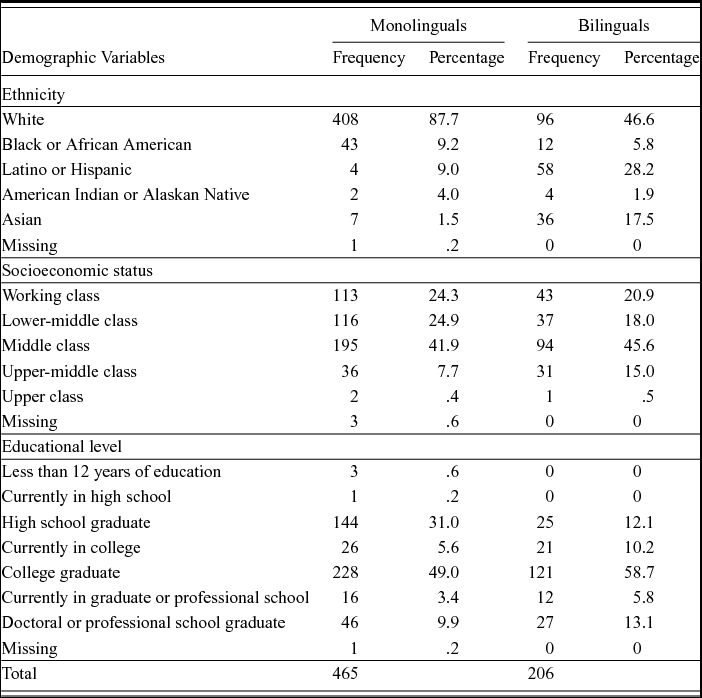
Note. Participants reported their and their parents’ socioeconomic status. If participants indicated they were financially dependent, their parents’ socioeconomic status was used.
Characteristics of bilingual participants
The total number of bilingual participants who completed the survey was 265. Participants indicated their level of bilingualism on a self-report questionnaire that assesses levels of proficiency in speech, reading, writing, and pronunciation in their native and second languages from 1 = none to 8 = like a native speaker (Ramírez-Esparza, Gosling & Pennebaker, Reference Ramírez-Esparza, Gosling and Pennebaker2008). Participants were excluded from the analyses if they gave information that would suggest that they are not fully bilingual: (a) they scored less than 4.0 on average proficiency for their second language (n = 22); (b) did not provide information about their second language (n = 22); and/or (c) reported they learned their second language after 20 years of age (n = 18; because they can no longer practice their second language with peers in an educational setting and they have reached adulthood). Furthermore, since we focus on spoken bilingualism in this investigation, we also removed participants who reported that their second language was American Sign Language (n = 5). Fifty-nine participants were removed, and the remaining bilingual participants were 206 individuals (90 male, 116 female). Mean age was 37.00 (SD = 11.22). See Table 1 for participants’ ethnicity, socioeconomic status, and education levels.
Language characteristics of bilingual participants
The mean age when participants learned their second language was 6.49 years (SD = 5.98). For first language proficiency, overall mean was 7.84 (SD = 0.59), with a mean of 7.89 for speech (SD = 0.51), 7.87 for reading (SD = 0.63), 7.76 for writing (SD = 0.86), and 7.82 for pronunciation (SD = 0.58). For second language proficiency, overall mean was 6.24 (SD = 1.17), with a mean of 6.28 for speech (SD = 1.31), 6.42 for reading (SD = 1.33), 5.91 for writing (SD = 1.49), and 6.37 for pronunciation (SD = 1.29). The second language was Spanish for 90 participants (43.7%), English for 37 participants (18.0%), French for 16 participants (7.8%), German for 14 participants (6.8%), and other for 49 participants (23.8%, e.g., Russian, Mandarin, Greek, etc.).
Assessment of constructs
Social flexibility
Our goal was to assess social flexibility; a construct that has not been previously defined in the literature by means of self-reports. In order to accomplish this goal, we designed a scale according to the following steps. First, because social flexibility fits conceptually as a dimension of emotional intelligence, we researched the short and long versions of a well-known emotional intelligence questionnaire: the Trait Emotional Intelligence Questionnaire (i.e., TEIQue, Petrides, Reference Petrides, Parker, Saklofske and Stough2009a; Petrides, Reference Petrides2009b). The short version of the TEIQue has 30 items and four factors: well-being, self-control, emotionality, and sociability. The long version of the TEIQue has 153 items and has the same four factors that make up 15 smaller facets (e.g., emotion expression, empathy, impulsiveness, self-esteem, etc.). However, since none of the dimensions from the short and long version of the TEIQue overlapped with our definition of social flexibility, we then did a target selection of items. For the target selection of the items, we gathered a group of bilingual (N = 3) and monolingual (N = 3) judges and used a consensus decision-making approach so they could help us to isolate items of interest. Specifically we started with the short version of the TEIQue and the judges (along with the authors of this paper), discussed for each item if it fit our definition of social flexibility or not; once we reached an agreement for that particular item, we flagged the item as belonging to social flexibility or not. Following this approach, we selected 8 items. Sample items are “I'm usually able to influence the way other people feel.”, “I would describe myself as a good negotiator.”, and “Generally, I'm able to adapt to new environments.” (see Table 2). Then we focused on the long version of the TEIQue and using the same consensus decision-making approach we selected 10 items; for example, “On the whole, I can cope with change effectively.” and “I don't mind frequently changing my daily routine.” (see Table 2). The final number of items that the judges considered to fit with social flexibility were 18.
Factor Structure of the TEIQue for the Whole Sample and for Monolinguals and Bilinguals Independently

Note 1. Extraction Method: Principal Component Analysis. Rotation Method: Varimax with Kaiser Normalization. Rotation converged in 3 iterations for all analyses.
Note 2. Loadings > .4 are bolded.
Note 3. Items that were included in calculating the scale scores are italicized.
Note 4. Reverse items are denoted as (R).
As a final step, we decided to include the remaining 22 items from the short version of the TEIQue as a control. This approach allowed us to isolate the social flexibility dimension among other dimension(s) and to observe if bilingualism is associated with social flexibility above and beyond other facets of being emotionally intelligent. We did not, however, have a specific prediction of how many factors would result by including extra items and how these factors would be conceptually.
The final scale had 40 items that were rated on a 7-point Likert scale ranging from 1 = completely disagree to 7 = completely agree. After data were collected, we performed a principal components extraction with Varimax rotation with data from the whole sample, and then independently confirmed the validity for monolinguals and bilinguals (see results section).
Social interaction
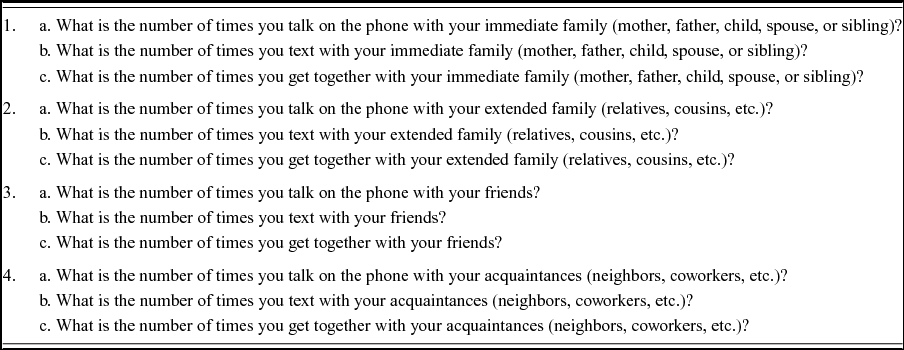
Our goal was to assess social interactions by including a wide range of items that would tap the different ways people socialize and the different groups they socialize with (e.g., Ramírez-Esparza, Mehl, Álvarez-Bermúdez & Pennebaker, Reference Ramírez-Esparza, Mehl, Alvarez-Bermúdez and Pennebaker2009). In order to accomplish this goal, we adapted the social interaction scale from Ybarra and colleagues (Reference Ybarra, Burnstein, Winkielman, Keller, Manis, Chan and Rodriguez2008). Ybarra and colleagues’ social interaction scale had two items and asked the frequency with which participants (a) talked on the phone and (b) met with friends, neighbors and relatives. We added frequency with which they texted and we were more specific about the groups that they socialize with. That is, instead of asking if they socialize with relatives, we asked them the frequency with which they socialize with their immediate family and their extended family. Instead of asking if they socialize with neighbors, we used a more broad term and we asked them the frequency with which they socialize with acquaintances, so participants could think about people with whom they socialize in other environments (e.g., colleagues at work).
The final scale included 12 items and asked the frequency of participants’ interactions with (1) their immediate family, (2) their extended family, (3) friends, and (4) acquaintances. All items were rated on a Likert scale ranging from 1 = never to 6 = more than once a day (see Table 3 for the final scale). The 12 items were averaged to assess the overall frequency of self-reported social interactions. Cronbach's alpha across the 12 items was .80 for monolinguals and .81 for bilinguals (see Table 4 for means and standard deviations for monolinguals and bilinguals).
Items on the Frequency of Social Interactions Scale (adapted from Ybarra et al., Reference Ybarra, Burnstein, Winkielman, Keller, Manis, Chan and Rodriguez2008)
Means and Standard Deviations for the Main Variables
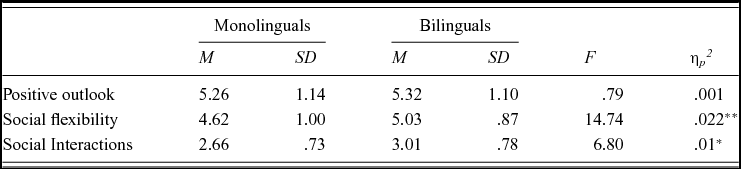
Note 1. * represents p values < .01, ** represents p values < .001.
Note 2. Age, education, ethnicity, and socioeconomic status are controlled for.
Results
Social flexibility and social interaction scales
Social flexibility scale
Following the guidelines from Osborne and Fitzpatrick (Reference Osborne and Fitzpatrick2012) we first performed an exploratory principal components extraction with Varimax rotation with data from the whole sample (i.e., for both monolinguals and bilinguals) and then we performed a confirmatory principal component analyses for each sample independently.
Results for the whole sample
Diagnostic tests indicated that a factor model was appropriate for the data (KMO = .95, Bartlett's test of sphericity = 13,348.82, p < .001). The results showed two factors with eigenvalues above 2.20 based on a scree plot of Eigenvalues for the principal components (Cattell, Reference Cattell1966). The two factors cumulatively accounted for 41.74% of the total variance. Since we observed this conceptual separation and the statistical values supporting a 2-factor structure, we settled on the 2-factor structure.
Results for each sample
In order to confirm the validity for the 2-factor structure for monolinguals and bilinguals, we performed a 2-factor confirmatory analysis with Varimax rotation for each sample. For the monolingual sample, diagnostic tests indicated that a factor model was appropriate for the data (KMO = .94, Bartlett's test of sphericity = 9,869.60, p < .001) and the two factors cumulatively accounted for 42.83% of the total variance. For the bilingual sample, diagnostic tests indicated that the factor model was appropriate for the data (KMO = .89, Bartlett's test of sphericity = 4,053.16, p < .001) and the two factors cumulatively accounted for 39.09% of the total variance.
Our goal was to include only items that loaded approximately .40 or higher on a specific factor for the whole sample, and for the bilinguals and monolinguals separately. Table 2 shows the number of items retained for both factors (items that were included in calculating the scale scores are italicized). Twelve items were retained for the first factor and included items such as “On the whole, I have a gloomy perspective on most things,” “I generally don't find life enjoyable.” These items were reverse coded and using a qualitative approach, we labeled this factor positive outlook.
Eleven items were retained for the second factor and included items such as “I would describe myself as a flexible person.” “Expressing my emotions with words is not a problem for me.”, and “I often find it difficult to see things from another person's viewpoint.” We labeled this factor social flexibility.
The Cronbach's alpha across the 12 items for the positive outlook scale was .90 for monolinguals and .90 for bilinguals. The Cronbach's alpha across the 11 items for the social flexibility scale was .87 for monolinguals and .83 for bilinguals (see Table 4 for means and standard deviations for each dimension for monolinguals and bilinguals).
Preliminary analyses
As preliminary analyses, we evaluated correlations between demographic variables (age, gender, education, ethnicity, and socioeconomic status) and each of the 2 emotional intelligence factors, positive outlook and social flexibility. Table 5 shows that age, education, ethnicity, and socioeconomic status correlated significantly with positive outlook and/or social flexibility; therefore, in subsequent analyses, we controlled for these demographic variables.
Bivariate Correlations between Demographic Variables and Emotional Intelligence Variables
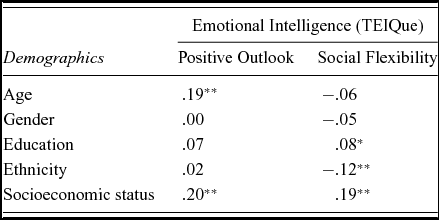
Note 1. *denotes correlation is significant at the .05 level (2-tailed) and **denotes correlation is significant at the 0.01 level (2-tailed).
Note 2. Gender was coded as 1 = male, 2 = female.
Note 3. Ethnicity was coded as 1 = American Indian or Alaskan Native, 2 = Asian, 3 = Black or African American, 4 = Latino or Hispanic, 5 = Native Hawaiian or Pacific Islander, 6 = White.
Is social flexibility an advantage for bilinguals?
In order to answer this question, we performed univariate analyses independently for social flexibility and positive outlook dimensions, controlling for age, education, ethnicity, and socioeconomic status. Table 4 shows that bilinguals scored higher (M = 5.03, SD = 0.87) than monolinguals (M = 4.62, SD = 1.00, F = 14.74, partial η2 = .022) on social flexibility. However, there were no significant differences for positive outlook between bilinguals (M = 5.32, SD = 1.10) and monolinguals (M = 5.26, SD = 1.14, F = .79, partial η2 = .001).
Is social flexibility in bilinguals related to frequency of social interactions?
We examined the mediating role of social flexibility on the relationship between bilingual status and the frequency of social interactions. In order to accomplish this, we first investigated the partial correlations between bilingual status (i.e., 1= monolingual, 2 = bilingual), positive outlook, social flexibility, and the frequency of social interactions, controlling for age, ethnicity, education, and socioeconomic status. Results demonstrate that bilingual status correlates significantly with both social flexibility (r = .15, p <.001) and the frequency of social interactions (r = .10, p = .009), but not with positive outlook (r = .04, p = .38). Whereas, social flexibility and the frequency of social interactions were moderately correlated (r = .33, p < .001), positive outlook was significantly but weakly correlated to the frequency of social interactions (r = .11, p = .005).
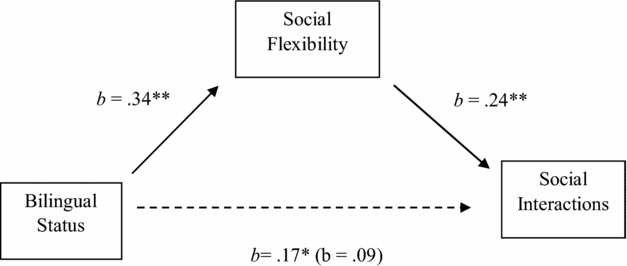
Second, we performed a mediation analyses using Hayes’ Process (Hayes, Reference Hayes2013), controlling for age, ethnicity, education, and socioeconomic status. Figure 1 shows that there was a significant and positive relation between bilingual status and social flexibility, (b = .34, p < .001, 95% CI [.16, .52]). There was a positive and significant relation between social flexibility and the frequency of social interactions, (b = .24, p < .001, 95% CI [.18 .29]). There was also a positive and significant relation between bilingual status and social interactions, (b = .17, p = .009, 95% CI [.04, .30]). When social flexibility was entered into the model as a mediator, with bootstrapping for a 1000 samples, CI of the indirect effect did not include zero (i.e., .04 to .14). Consequently, we can conclude that the mediation of the relationship between bilingual status and the frequency of social interactions by social flexibility is significant. When social flexibility was included in the model, the direct effect of bilingual status on the frequency of social interactions drops from b = .17 to b = .09 (p =.15, 95% CI [−.03, .21]). These results demonstrate that the link between bilingual status and the frequency of social interactions was fully mediated by social flexibility (See Figure 1).
The mediation analyses showing that social flexibility fully mediates the relationship between bilingual status and social interactions. b = indicates the regression coefficient; *p < .01 level; **p< .001 level. Monolinguals were coded as 0 and bilinguals were coded as 1. Age, education, ethnicity and socioceonomic status were controlled for each analysis.
Discussion
Bilinguals are cognitively flexible, and they have an increased ability to switch between different mental sets (e.g., Barac et al., Reference Barac, Bialystok, Castro and Sanchez2014; Bialystok et al., Reference Bialystok, Craik, Green and Gollan2009; Reference Bialystok, Craik and Luk2012; Pearl & Lambert, Reference Peal and Lambert1962). In this investigation, we explored the idea that bilinguals are also socially flexible. Specifically, we proposed that bilinguals have the ability to switch with ease and adapt between different social environments and accurately read social cues in the environment. In order to test this idea, we selected items from a well-established emotional intelligence questionnaire (i.e., TEIQue, Petrides, Reference Petrides, Parker, Saklofske and Stough2009a; Reference Petrides, Parker, Saklofske and Stough2009b) to isolate a social flexibility dimension. Factor analysis yielded a 2-factor structure (social flexibility and positive outlook). We compared monolinguals and bilinguals in terms of social flexibility and we evaluated the association between social flexibility and social interactions.
Results demonstrated that after controlling for socio-demographic variables, bilinguals reported being more socially flexible than monolinguals. The second factor (positive outlook) provided the opportunity to test associations between bilingualism and other facets of emotional intelligence. Results showed that after controlling for socio-demographic variables, bilinguals and monolinguals did not differ significantly on this dimension. This set of findings suggest that the bilingual language switching experience generalizes to social flexibility. We believe that bilingualism is related to social abilities in a manner similar to cognitive abilities. In addition, this is further supported by the fact that bilinguals and monolinguals did not differ on positive outlook. Having a positive or negative perspective in life does not contribute to social flexibility.
The findings from this investigation suggest that, as bilinguals switch between two languages, they develop the ability to adapt to new environments, cope with change, and attend to others’ perspectives. This is in agreement with previous work that shows that immigrants, people with experience living abroad, or multilinguals, score higher in tolerance of ambiguity, a personality trait reflecting how individuals experience and process information about ambiguous situations (Dewaele & Wei, Reference Dewaele and Wei2013). Dewaele and Wei (Reference Dewaele and Wei2012) also measured cognitive empathy in multilinguals, which is a facet of empathy and reflects individuals’ appreciation of another's affective state. The authors found that knowing more languages did not relate to cognitive empathy. However, the frequency of usage of the second language and proficiency in the second language was related to cognitive empathy. A more recent study also shows that a high-level use of various languages is linked to higher scores on cultural empathy and open-mindedness (Dewaele & Stavans, Reference Dewaele and Stavans2014).
In this study, we went beyond investigating differences in social flexibility among monolinguals and bilinguals, and evaluated the implications of social flexibility on other positive outcomes. We chose the frequency of social interactions because we hypothesized that bilinguals’ social flexibility (i.e., the ability to switch with ease between different social environments and accurately assess cues in social interactions) would facilitate social interactions. Furthermore, previous work has shown that cognitive flexibility is associated with the frequency of social interactions (Ybarra et al., Reference Ybarra, Burnstein, Winkielman, Keller, Manis, Chan and Rodriguez2008). Our mediation analyses supported this assumption. The relationship between being bilingual and engaging in social interactions was fully mediated by social flexibility. Importantly, the positive outlook dimension correlated weakly with social interactions compared to social flexibility.
Social flexibility and cognitive flexibility in social interactions
One important theoretical question arising from our results is the relationship between cognitive flexibility and social flexibility: does cognitive flexibility foster social flexibility or does social flexibility foment cognitive flexibility? There is evidence that supports both arguments. Bonino and Cattelino (Reference Bonino and Cattelino1999) showed that more cognitively flexible children were able to find more cooperative (rather than competitive) solutions in interactive tasks compared to their less flexible peers, suggesting cognitive flexibility could lead to social flexibility. In contrast, Ybarra and colleagues (Reference Ybarra, Burnstein, Winkielman, Keller, Manis, Chan and Rodriguez2008) showed that engaging in social interactions in the lab for as short as 10 minutes resulted in increased performance in subsequent cognitive tasks. Therefore, it is theoretically possible that bilingualism increases social flexibility resulting in more social interactions and increased ability to resolve cognitive tasks. This is further supported by research on theory of mind. Research has shown that bilingual children (Goetz, Reference Goetz2003; Kovácz, Reference Kovácz2009) and bilingual adults (Rubio-Fernández & Glucksberg, Reference Rubio-Fernandez and Glucksberg2012) are better at understanding and attributing other people's mental states. Furthermore, theory of mind has been found to be associated with both social interactions (Hughes et al., Reference Hughes, Fujisawa, Ensor, Lecce and Marfleet2006; Hughes & Leekam, Reference Hughes and Leekam2004) and executive function (e.g., Carlson, Moses & Claxton, Reference Carlson, Moses and Claxton2004). Future experimental work is needed to specify how bilingualism influences social flexibility, social interactions, and cognitive flexibility (e.g., Dewaele, Reference Dewaele, Mercer, Ryan and Williams2012; Dewaele, Reference Dewaele, Wei and Cook2016; Dewaele & Van Oudenhoven, Reference Dewaele and Van Oudenhoven2009; Tracy-Ventura et al., Reference Tracy-Ventura, Dewaele, Köylü and McManus2016).
What other variables could be associated with social flexibility?
In this investigation, we recruited bilinguals who reported being proficient in both of their languages because we assumed that ease in shifting between their two languages would be accompanied by ease in shifting between different social environments. However, there is a possibility that biculturalism may be affecting our results. Bicultural individuals identify themselves with two cultures; they possess values, attitudes and behaviors of the two cultures, and they take part in the life of their two cultures (Grosjean, Reference Grosjean2015). Since biculturals alternate between two cultural worlds in their everyday lives, in a similar way as bilinguals alternate between their two languages, it is possible that biculturalism is also associated to social flexibility. In fact, previous work has suggested that multicultural experience or being an immigrant is associated with cognitive abilities and other emotional intelligence traits. For example, Leung, Maddux, Galinsky and Chiu (Reference Leung, Maddux, Galinsky and Chiu2008) argue that multiculturalism is associated with creativity in problem solving. Also, other studies show that immigrants or people with experience living abroad score higher in tolerance of ambiguity, a personality trait reflecting how individuals experience and process information about ambiguous situations (Dewaele & Wei, Reference Dewaele and Wei2013).
In this first exploration of social flexibility, we focused on bilinguals living in the U.S. and Canada, where biculturalism is an innate part of the bilingual experience. Our study is limited in the sense that we cannot tease apart the effects of two languages and two cultures on social flexibility. Future research investigating social flexibility in monocultural bilinguals (i.e., people who identify themselves with one culture, but speak two languages) from different cultures will be crucial in making this distinction (see Grosjean, Reference Grosjean2015).
Limitations, implications, and future directions
As the world becomes increasingly multicultural and multilingual, findings of the current study will be useful in applications ranging from educational programs to hiring decisions. The current study demonstrates that bilinguals have a social advantage that reflects on their social interactions. These skills can have a positive impact on other social, psychological, and economic variables. For example, educators could make second language classes a priority when planning curricula. Similarly, employers could take the results of the current study into consideration when making hiring decisions. Furthermore, it is possible that individuals who know more than two languages have even increased social flexibility. This was not investigated in the current study; however, future studies would benefit from researching this possibility.
In this investigation, we propose the term social flexibility; however, this is a term that has been previously measured in other ways in other investigations. We borrowed items from the construct of emotional intelligence. Our goal here was to take a first step in defining this advantage for bilinguals using a self-report questionnaire that overlaps with our definition of social flexibility. However, it is important that future research tests whether there are important differences in behavior. For this goal, measures similar to cognitive flexibility tasks that test whether participants are able to switch between different mental sets can be used. Also, bilinguals and monolinguals can be compared on how fast and accurate they are in different kinds of social tasks, such as tasks measuring attribution accuracy in a fundamental attribution bias paradigm, theory of mind, negotiation success, or persuasion success. Moreover, in this study, we only measured the self-reported frequency of social interactions as an outcome of social flexibility. Future work should also focus on a wider range of outcomes of social flexibility, such as mental and physical health; and relationship, job, and overall life satisfaction. Finally, future investigations could observe if specific dimensions of the TEIQue correlate with our social flexibility dimension and if bilinguals differ from monolinguals on other TEIQue dimensions.
Finally, although in this investigation we tested our hypotheses by controlling for sociodemographic variables, our findings could be affected by the same factors that have been brought up in the cognitive flexibility literature (Paap & Greenberg, Reference Paap and Greenberg2013; Paap et al., Reference Paap, Johnson and Sawi2014). For example, in our study we did not collect information about whether the bilinguals spoke more than two languages, their patterns of language switching or if they were indeed bicultural. These variables are important information that should be considered in future investigations. As Grosjean (Reference Grosjean2015) proposes, it is important to distinguish bilinguals using both the linguistic component (i.e., in terms of competence, number of languages spoken, code switching) and the cultural component (i.e., the degree that they identify with two cultures or more). This is especially important given that there is research that shows that bilingual biculturals change their personalities as they alternate between their two languages (Ramírez-Esparza et al., Reference Ramírez-Esparza, Gosling and Pennebaker2008; Ramírez-Esparza, Gosling, Benet-Martínez, Potter & Pennebaker, Reference Ramírez-Esparza, Gosling, Benet-Martínez, Potter and Pennebaker2006; Rodriguez-Arauz, Ramírez-Esparza, Boyd & Perez-Brena, under review). Therefore, in light of these limitations, the findings of this investigation must be taken cautiously.
Conclusion
Previous work has shown the positive impact of bilingualism on cognitive abilities. The findings of the current study indicate that bilinguals have a similar social advantage, which, in turn, is related to increased social interactions. There needs to be future investigations focusing on this construct of bilinguals’ social flexibility. Future investigations should focus on specific factors related to bilingualism that create this social advantage, such as exposure to multiple languages and/or cultures. Effects of social flexibility on factors other than social interactions will reveal the contributions of bilingualism to life outcomes. We believe that this first attempt to demonstrate social flexibility in bilinguals is theoretically important and has an applied aspect that can help improve hiring decisions and educational programs.



