

Introduction
Financial transfers from adult children are critical for rural Chinese older adults (China Research Center on Aging, 2003; Zimmer and Kwong, Reference Zimmer and Kwong2003; Giles et al., Reference Giles, Wang and Zhao2010). Upstream intergenerational transfers occur because of the cultural norms of filial piety (i.e. respect and responsibility towards elders) as well as practical reasons, such as the unavailability or relatively lower levels of public pension programmes in rural areas (Giles et al., Reference Giles, Wang and Zhao2010; Wu and Li, Reference Wu and Li2014). In China, the population aged 65 and above was 143.9 million in 2015, accounting for 10.5 per cent of the total population (National Bureau of Statistics of China, 2016); it is projected that by 2030, 23.85 per cent of the population, or 341.7 million, will be older adults (Poston and Duan, Reference Poston and Duan2000). In addition, the traditional family support system is facing acute challenges due to fast economic growth and accompanying social changes in contemporary China. Thus, it is essential to examine family dynamics that motivate, promote and contextualise upward transfers that are crucial for vulnerable rural older adults’ wellbeing.
The theoretical perspectives on financial transfers from adult children to parents mainly fall into one of the following several categories or their variants, including: the altruism perspective; the reciprocity/strategic investment perspective wherein adult children repay parents’ earlier investments in their children; and the intergenerational bonds and solidarity perspective wherein emotional closeness and/or filial piety prompt upward financial transfers. Rural Chinese families are characterised by strong intergenerational solidarity, with the intense flow of intergenerational support from younger to older generations (Lin and Pei, Reference Lin and Pei2016). Parental investment in a child's education occurs much earlier in time than adult children's financial transfers to older parents. Over such a long time period, maintaining emotional bonds with their children is not just satisfying, it also forms a bridge from the time period of parental investment to the time of adult–child reciprocity (Becker, Reference Becker1993). As well, parents in China also socialise their children to adopt the norm of filial piety to reduce the moral hazard problems of adult children, possibly due to children's self-interest (Silverstein and Conroy, Reference Silverstein, Conroy and Schoenpflug2009). In this investigation, we examine the financial transfers from adult children to their older parents in rural families with the aim of discovering the roles played by reciprocity and intergenerational bonds.
Background
Importance of children's financial support for rural elders
Chinese rural older adults are financially vulnerable because of the lack of availability of social security programmes and pensions, lifelong poverty, and asset transfers in the forms of educational and marriage investments in children (Yan, Reference Yan2003; Zheng, Reference Zheng2013). Financial transfers from adult children to rural older adults provides some insurance function against older adults’ disadvantaged economic status and high medical expenses (Wu and Li, Reference Wu and Li2014). Given their circumstances, rural older adults are dependent on their children for financial support (China Research Center on Aging, 2003; Zimmer and Kwong, Reference Zimmer and Kwong2003; Giles et al., Reference Giles, Wang and Zhao2010).
In rural China, providing financial support to older parents remains the responsibility of adult children and older adults’ economic disadvantages and limited access to formal support are mitigated by filial piety (Sung, Reference Sung1995; Zimmer, Reference Zimmer2005). Filial piety is rooted in Confucianism and involves the belief that adult children have strong obligations to support their ageing parents and support should be provided with respect and love (Sung, Reference Sung1995, Reference Sung1998). These norms are enforced by laws in China that mandate financial support from adult children to their needy parents and neglecting filial obligations to older parents might result in severe penalties (Chou, Reference Chou2011; Giles et al., Reference Giles, Wang and Zhao2010).
Although generally disadvantaged, older adults might get access to increasing social wealth through their children, who have improved economic capacity as a result of higher educational achievements (Zhu, Reference Zhu2016). In modern times, China saw a relatively smooth increase in schooling over time with exceptions during the periods of the Great Leap Forward and the Cultural Revolution, when social turmoil produced temporary declines and caps on educational attainment (Treiman, Reference Treiman2013). Since these times, there has been a substantial increase in the average number of years of schooling across successive cohorts (Wu and Treiman, Reference Wu and Treiman2004). Rapid economic development since 1978 in contemporary China has enabled the government to increase its expenditures on education dramatically, resulting in the establishment of nine-year mandatory education in the 1990s. Children from rural areas have more opportunities than in the past, at least through the junior high school level. But because of uneven distributions of educational opportunities, urban children have more choices at higher levels of education. China has a registration system that controls where citizens may live (hukou), which consequently prevents rural children from accessing the greater opportunities of urban areas (Wu, Reference Wu2010; Wu and Zhang, Reference Wu and Zhang2010). In addition, unaffordability of education-related expenses, lack of migration opportunities and the possibility of unemployment after graduation may discourage rural families from allowing their children to attend senior high school or encourage children to drop out of senior high school (Liu, Reference Liu2004; Wu and Treiman, Reference Wu and Treiman2004; De Brauw and Giles, Reference De Brauw and Giles2016). Thus, educational achievements of rural residents reflected substantial commitment and investment from parents to overcome those barriers.
Motivations for upstream intergenerational financial transfers
Upstream intergenerational financial transfers reflect cultural enthusiasm about filial piety and the responsibility of adult children to guarantee the old-age financial security of their older parents. These transfers could represent a form of altruism of adult children for their parents (Cong and Silverstein, Reference Cong and Silverstein2011; Wu and Li, Reference Wu and Li2014). Altruism as a motivation for children's financial transfers to parents has found wide support in the previous literature on Chinese families (Zimmer et al., Reference Zimmer, Korinek, Knodel and Chayovan2008; Cong and Silverstein, Reference Cong and Silverstein2011). Low-income parents, especially, benefit from the altruism of their children (Cai et al., Reference Cai, Giles and Meng2006; Wu and Li, Reference Wu and Li2014).
Despite the evidence for altruism as a motivation, exchange motivations, such as reciprocity, also explain adult children's financial transfers to their older parents. Due to the decline in parental power, modernisation, rural-to-urban migration, and the trend towards individualism, the meaning of filial piety in China has changed from an unconditional duty of adult children to a sense of intergenerational reciprocity: a child's filial obligations are conditional on older parents’ early support of them, such as the earlier parental educational investment in children (Yan, Reference Yan2003; Cheung and Kwan, Reference Cheung and Kwan2009; Lin and Pei, Reference Lin and Pei2016). From the older parents’ perspective, parents invest financially in their children and children are expected to provide informal insurance in times of need in the future (Chou, Reference Chou2008; Zheng, Reference Zheng2013). Reciprocity as a mechanism also explains children's repayment for the care that the older parents provided to grandchildren (Cong and Silverstein, Reference Cong and Silverstein2011, Reference Cong and Silverstein2012a). Children are also selfishly motivated by expecting bequests from parents as an exchange for their support (Yin, Reference Yin2010; Jiang et al., Reference Jiang, Li and Feldman2015).
Reciprocity as a principle guiding long-term serial transfers across generations has an intellectual history within the framework of exchange theory. Both economic exchange theory and social exchange theory share the premise that social exchanges between generations are governed by self-interest orientations and the norms of reciprocity (Emerson, Reference Emerson, Rosebberg and Turner1981; Molm and Cook, Reference Molm, Cook, Cook, Fine and House1995). The notion of a support bank (Antonucci, Reference Antonucci, Binstock and George1990) regards parents’ investment in their children as a deposit into a support bank and parents may withdraw from this bank later in their life when they have the need. For example, parents strategically invest in children's education earlier in the family lifecourse, and children with higher education tend to provide more financial support for their parents’ old age (Chou, Reference Chou2008; Zhu, Reference Zhu2016).
Parents also strategically invest in selected children to maximise financial returns from children (Yan, Reference Yan2003; Cong and Silverstein, Reference Cong and Silverstein2011; Lin and Pei, Reference Lin and Pei2016). Intra-household resources are distributed unequally among siblings as a result of the family decision process, which evaluates children's innate abilities and other characteristics that would affect their potential contributions to the family, such as children's gender in the patrilineal family system (Chu et al., Reference Chu, Xie and Yu2007; Zheng, Reference Zheng2013). When parents experience budget constraints, they would invest more family resources in children, who are more likely to benefit from education and succeed in the labour market, and thus have better capacity and likelihood to repay or reciprocate parents’ investment in their education in the future than siblings with lower labour market value or lower possibilities of providing for parents (Blake, Reference Blake1981; Chang and Li, Reference Chang and Li2016). Traditional large Chinese families might sacrifice the education opportunities of female, especially older female, siblings and save their resources to promote male siblings’ education attainment (Chu et al., Reference Chu, Xie and Yu2007; Zheng, Reference Zheng2013). When resources are limited, a complicated family decision process will decide who may continue their education. Thus, the child with the highest education is likely to be a reflection of older parents’ early investment in that child.
Because traditional Chinese social culture is based on blood ties, whereas social security programmes and pensions are limited, older parents consider investments in children as an alternative long-term mechanism for receiving financial security in old age (Chou, Reference Chou2008; Zheng, Reference Zheng2013). Educational investments in children have been regarded as one of the most important investments parents can make (Wei and Zhang, Reference Wei and Zhang2011; Zheng, Reference Zheng2013). Parents’ investment in the education of children is likely to increase the children's human capital, and thus their earning potential (Becker, Reference Becker1991). Studies show that the educational attainment of children in rural China is positively related to income for both migrants and non-migrants (Yang, Reference Yang2004; Lu and Song, Reference Lu and Song2006). In addition, education has played an important role in cultivating filial piety in China for many centuries and attenuates the impact of modernisation on filial piety in contemporary times (Fu and Chiu, Reference Fu and Chiu2007; Cheung and Kwan, Reference Cheung and Kwan2009). For example, Cheung and Kwan (Reference Cheung and Kwan2009) found that the negative association between filial piety and city-level modernisation, which is indicated by Gross Domestic Product per capita, the average annual income and the labour force participation rate in the service sector, is less among children with higher levels of education. Thus, adult children with higher education are less likely to be influenced by the negative impacts of modernisation and could be more willing to provide financial support to their older parents. Studies have also shown that higher income and stronger piety norms in children with higher levels of education translate into more financial support to their older parents than those children with lower levels of education (Chou, Reference Chou2008; Xie and Zhu, Reference Xie and Zhu2009; Cong and Silverstein, Reference Cong and Silverstein2011; Zhu, Reference Zhu2016).
We propose that adult children's motivation for upstream intergenerational transfers is more likely to be based on parents’ earlier educational investments in them. Evidence suggests that Chinese adult children with higher levels of education provide more financial support to their older parents (Chou, Reference Chou2008; Xie and Zhu, Reference Xie and Zhu2009; Cong and Silverstein, Reference Cong and Silverstein2011; Zhu, Reference Zhu2016). As the highest educated child received more resources in the earlier family lifecycle than other children, they would provide more financial support to their older parents. Thus, in addition to hypothesising that children with higher levels of education provide more financial support to their parents, unique to this study, we further hypothesise that the highest educated child will provide more financial support to their older parents if they have higher levels of education.
• Hypothesis 1: The highest educated child will provide more financial support to their older parents than other children.
• Hypothesis 2: Among the highest educated children, those who have higher levels of education will provide more financial support to their older parents than others.
The role of emotional closeness and moral capital in intergenerational transfers
As noted, in parent–child relationships, there is a long time lag between parents’ investment in children and their later receipt of support from children. It is possible that parents’ earlier ‘investment’ would depreciate over time, leading to the possibility that the adult child may not reciprocate; that is, the lack of reciprocity represents a moral hazard (Silverstein and Conroy, Reference Silverstein, Conroy and Schoenpflug2009). Therefore, there should be mechanisms in place to reduce the risks of moral hazards. Even in a strong familistic culture, adult children may renege on the implicit contract to reciprocate. To prevent reneging, parents maintain positive emotional bonds with their adult children. As well, parents may socialise their children to adopt the norm of filial piety to ensure that their earlier investment in children will be paid back (Silverstein and Conroy, Reference Silverstein, Conroy and Schoenpflug2009). As discussed by Becker (Reference Becker1993: 400), ‘parents worried about old-age support may try to instill in their children feelings of guilt, obligation, duty, and filial love that indirectly, but still very effectively, can ‘commit’ children to helping them out’. In other words, reciprocity often intersects with or depends upon emotional closeness and moral obligations to ensure old-age support (Roberts et al., Reference Roberts, Richards and Bengtson1991).
In a collectivistic culture, like rural China, children are expected to have strong filial obligations towards their older parents (Zuo et al., Reference Zuo, Wu and Li2011; Cong and Silverstein, Reference Cong and Silverstein2014). Filial responsibilities in China highlight the devotion of children to their older parents and subordination of personal interest to intergenerational solidarity (Guo et al., Reference Guo, Chi and Silverstein2012). In rural China, the major direction of intergenerational support is still from younger to older generations, suggesting that rural Chinese families continue to be characterised by strong intergenerational solidarity (Lin and Pei, Reference Lin and Pei2016). Studies have shown that parents who are emotionally close to their children and who promote the norm of filial obligation tend to receive more support from their children (Silverstein et al., Reference Silverstein, Parrott and Bengtson1995, Reference Silverstein, Gans and Yang2006; Lin and Yi, Reference Lin and Yi2011; Lin and Pei, Reference Lin and Pei2016). Thus, we hypothesise that the highest educated child will provide more financial support to their older parents if parents are more emotionally close to that child and/or more strongly endorse filial norms.
• Hypothesis 3: The highest educated child will provide more financial support to older parents who are more emotionally close than to those who are less close.
• Hypothesis 4: The highest educated child will provide more financial support to older parents who endorse the traditional filial norms than those who do not.
In the United States of America (USA), older fathers and mothers have demonstrated different strategic advantages from each other. Mothers, compared to fathers, tend to have more influence over their children through emotional integration; but fathers, compared to mothers, have more influence when instilling moral obligations through traditional filial norms to children (Silverstein and Conroy, Reference Silverstein, Conroy and Schoenpflug2009; Silverstein et al., Reference Silverstein, Parrott and Bengtson1995). Turning to research on Chinese families, in traditional rural families, older mothers are more emotionally close to their children possibly because they provide more instrumental support to and have more interactions with their children over the lifecourse than fathers do (Fei, Reference Fei1939; Li et al., Reference Li, Song and Feldman2009). Older fathers may have more power in influencing children by instilling moral obligations than mothers do due to fathers’ dominating status in patrilineal families (Li et al., Reference Li, Song and Feldman2009; Cong and Silverstein, Reference Cong and Silverstein2012b). Thus, we also expect gender differences in the moderating roles of emotional closeness and moral obligations on the effects of children's education on their financial support to parents and propose the following hypotheses.
• Hypothesis 5: Emotional closeness between parents and their highest educated child will predict greater intergenerational upstream transfers for mothers than for fathers.
• Hypothesis 6: Filial piety beliefs of parents would encourage their highest educated children's financial transfers more among fathers than among mothers.
Methods
Sample
The study used six waves of panel data from the Longitudinal Study of Older Adults in Anhui Province, China from 2001 to 2015. Located in the east-central part of China, Anhui is a mostly rural province with more than 80 per cent rural population (State Council of the People's Republic of China, 2000). It was chosen because of its relatively high density of older adults and a high proportion of labour migration to the cities of Hefei, Nanjing and Shanghai (Chaohu Statistical Bureau, 2001).
The sampling frame consisted of the population aged 60 years and older who lived in 72 villages in six rural townships in the Chaohu region. Using a stratified multi-stage method, the eligible respondents were randomly selected from village rosters, with an over-sampling of people 75 years and older. These participants represented birth cohorts from the 1930s. Of the 1,800 eligible respondents selected in 2001, 1,715 completed the survey, yielding a response rate of 95.3 per cent. The number of original respondents who participated in the 2003, 2006, 2009, 2012 and 2015 waves was 1,391, 1,067, 807, 605 and 437, respectively. Mortality was the major reason for attrition. In 2009, a new sample of 417 was replenished. This replenished sample had 374 and 326 respondents left in 2012 and 2015.
The purpose of the investigation is to examine the influence of adult children's education, measured by whether the child was the highest educated one, on their financial transfers to parents. The children included in this study were those who were 16 years or older when their parents started to participate in the study (i.e. 2001 or 2009). By excluding 1,717 cases (responding to 763 adult children and 421 older parents) with only one child from Waves 1–5 and those siblings who received equal education in a family, we could test the hypotheses concerning whether the child with the highest education transferred more financially to older parents. Based on six waves of data, we constructed up to five transition intervals (i.e. 2001–2003, 2003–2006, 2006–2009, 2009–2012 and 2012–2015) for each eligible parent–child dyad. The missing values were about 15.9 per cent; after deleting missing values, the sample was reduced to 14,002 longitudinal dyads representing 5,468 unique children associated with 1,396 older parents including 656 fathers and 740 mothers. For each interval, we named the earlier wave ‘interval baseline’ (e.g. 2001, 2003, 2006, 2009 and 2012) and the later wave ‘interval follow-up’ (e.g. 2003, 2006, 2006, 2009, 2012 and 2015). Overall baseline means 2001 in this study.
Due to the nested nature of the data, we used Stata to estimate the random-effects model to examine the influences of both children's (within-family differences) and parents’ characteristics (family level, between-family differences) on children's financial transfers to their older parents. The random-effects model regards the intercept as a random deviation from the mean intercept based on group membership and the model produces unbiased standard errors because of clustering (Rabe-Hesketh and Skronda, Reference Rabe-Hesketh and Skronda2008).
We did the analysis first for fathers and mothers separately and then for all parents combined. For the whole sample, we introduced three-way interaction terms between parents’ gender, the highest educated child or not, and emotional closeness or traditional norms to examine whether men's and women's models were significantly different from each other. We used p < 0.10 to identify statistical significance for interactions due to the low power associated with multiplicative variables.
Dependent variables
Financial transfers from children
The dependent variable was financial transfers from children measured at the follow-up for each interval. Financial transfers from children were based on the total amount of money that the ageing parent (and his/her spouse) received from each child during the year prior to when the survey was conducted. Participants (older parents) were asked to provide the actual amount of money first, and if they could not give an exact number, they were asked to choose from the following categories (Chinese RMB currency): 0 = none, 1 = <50, 2 = 50–99, 3 = 100–199, 4 = 200–499, 5 = 500–999, 6 = 1,000–2,999, 7 = 3,000–4,999, 8 = 5,000–9,999, and 9 = 10,000 and above. In our analysis, we took the reported amount if it was available or used the median amount of the category if the respondent did not provide the exact amount. We used 10,000 for the category ‘9 = 10,000 and above’. This value was logged (+ 1) to improve its distribution from a strong positive skew. We controlled for interval baseline financial transfers from children to parents, thus, coefficients of independent variables in the model suggested their effects on residualised change in financial transfers from children to parents for each interval.
Independent variables
Children’ education
We identified whether a specific child received the highest level of education among siblings (1 = the child was the highest educated child of all living children, 0 = the child was not the highest educated child of all living children) at the interval baseline. In addition, we also included the actual education level of the highest educated child at the interval baseline (1 = senior middle school and above, 0 = lower than senior middle school) to examine its influence on the association between children's education and their financial transfers to parents.
Children's emotional closeness with parents
We included intergenerational emotional support measured at the interval baseline by using three questions adapted from the intergenerational solidarity inventory (Mangen et al., Reference Mangen, Bengtson and Landry1988) that assesses emotional cohesion between generations. The questions were: (a) ‘Taking everything into consideration, how close do you feel to (this child)?’; (b) ‘How much do you feel that this child would be willing to listen when you need to talk about your worries and problems?’; (c) ‘Overall, how well do you and (this child) get along together?’ The items were coded as follows: 0 (not at all close/not at all/not at all well), 1 (somewhat close/somewhat /somewhat well) or 2 (very close/very much/very well). The reliability coefficients for this scale ranged from 0.79 to 0.86 across waves. An additive scale was computed for each child, ranging from 0 to 6.
Parents’ beliefs in traditional norms
In Waves 1 and 2, respondents were asked if they agreed with the statement, ‘Sons are the best guarantee when parents become old’. In Waves 3–5, respondents were asked if they agreed with the statement, ‘Uncle Wang and Aunt Wang said: ‘Sons are the best guarantee when parents become old’. Although there are subtle differences concerning the wording, they capture the same beliefs. Thus, we coded it consistently as 1 (agree) and 0 (disagree).
Control variables
We controlled for overall baseline parents’ characteristics including age in chronological years, cohort (0 = cohort recruited in 2001, 1 = cohort replenished in 2009), gender (1 = female), education (1 = some formal education) and occupation (1 = agriculture work). Parents’ marital status was a dummy variable (1 = married). We also controlled the number of living children. Income was represented as the ln (+ 1) value of the total annual income of participants and their spouse generated from work or pension. Parents’ functional limitations were measured by 15 items reflecting difficulties in performing personal activities of daily living and instrumental activities of daily living. Participants were asked the level of difficulty performing each task: 0 = no difficulty, 1 = some difficulty and 2 = cannot do it without help. The reliability coefficients for this scale ranged from 0.94 to 0.96 across waves, and thus we calculated a summed scale that ranged from 0 (no difficulties) to 30 (unable to perform all tasks).
We also controlled for important characteristics of children and exchanges, which may influence financial transfers from children to older parents. Children's chronicle age and gender (1 = female) was time-invariant and measured at the time when their parents started to participate in the study, i.e. 2001 for the original sample and 2009 for the replenished sample. We also controlled for children's interval baseline characteristics including marital status (1 = married), children's distance to their parents (0 = co-resided with parents, 1 = lived in the same village with parents, but did not co-reside, 2 = did not live in the village) and number of children (i.e. grandchildren of the older adults). We also included financial transfers from parents which were measured at the interval baseline. Similar to financial transfers from children, financial transfers to children were based on elder parents’ report of the amount that each child received from the parent during the past 12 months. Because only 21 per cent of children received financial support from their parents, we used dummy coding to present financial support provided from parents (1 = provided some financial support, 0 = did not provide any financial support).
We also controlled for grandchildren care measured at the interval baseline. We asked the participants about the frequency of providing grandchildren care for each child on a seven-point scale (0 = no care to 6 = full day custody). Because this variable was non-normally distributed with high percentages providing no grandchildren care, we used dummy coding to represent grandchildren care (1 = provided grandchildren care, 0 = did not provide grandchildren care).
Results
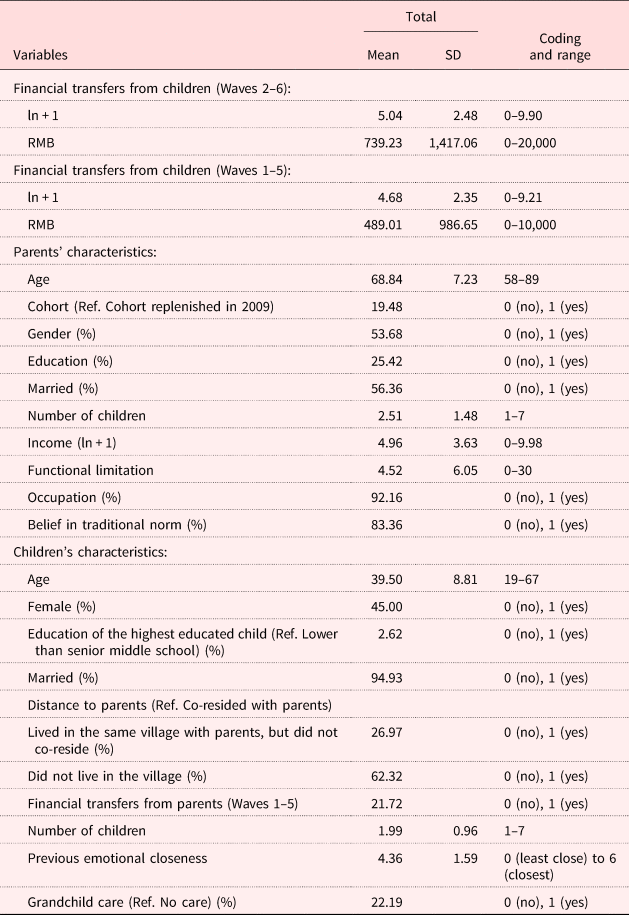
The summary statistics for the deleted study sample is shown in Table A1. Table 1 contains the mean values of study variables for the total sample and by gender. For the total sample, children's financial transfers to parents at Waves 2–6 averaged 565 RMB (standard deviation (SD) = 1,143) and at Waves 1–5 averaged 428 RMB (SD = 987). The average age of the sample was 68.2 (SD = 6.7), slightly more than half (53%) were women, 28 per cent had some formal education and 63 per cent were married. The average respondent had four living children (SD = 1.4). The logged income was 5.0 (SD = 3.6), a figure converting to 2,049 RMB. The average functional impairment score was 4.20 (SD = 6.13) on a scale ranging from 0 to 30, and 85 per cent of older parents agreed with the statement indicating a belief in the traditional norm that ‘sons are the best guarantee when parents become old.’
Description of analytic variables
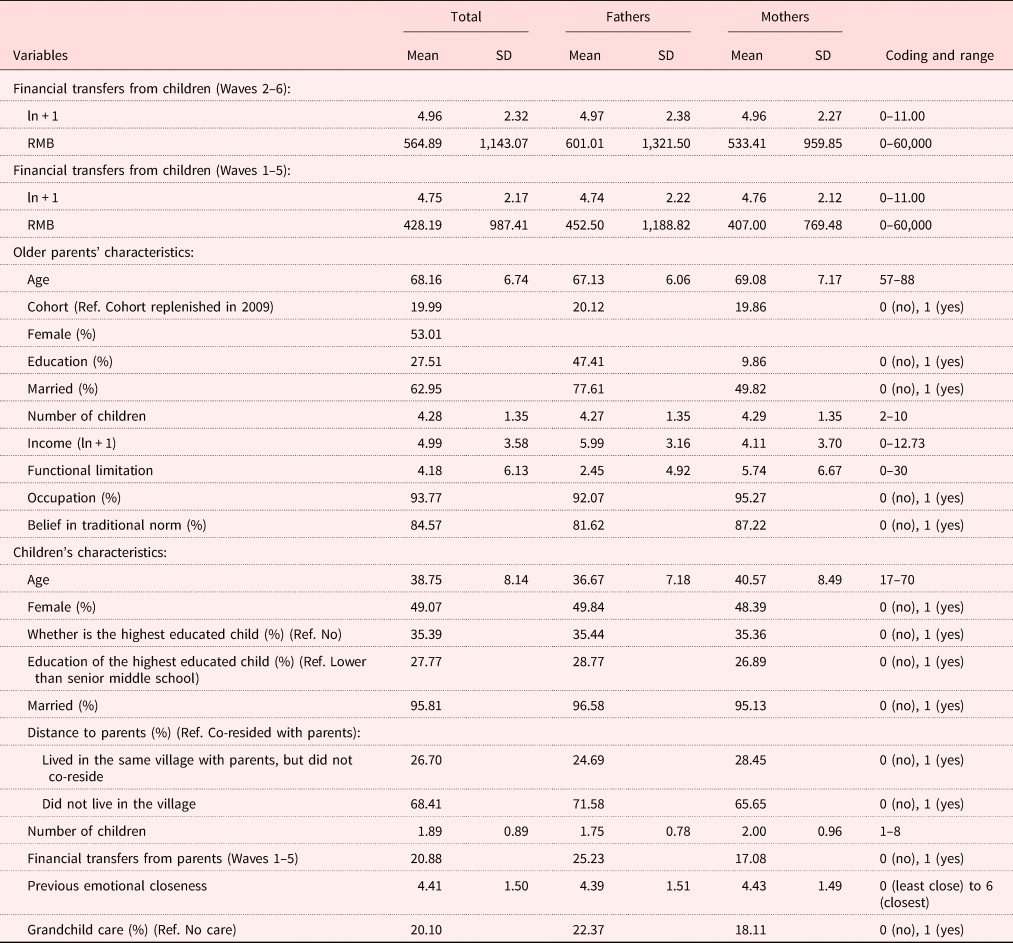
Notes: N = 6,521 father–child dyads; N = 7,481 mother–child dyads. SD: standard deviation. Ref.: reference category.
In terms of children's characteristics, they averaged 38.8 years of age (SD = 8.1); slightly less than half (49.1%) were daughters. Thirty-five per cent of children were the highest educated child, and 28 per cent of the highest educated children had a senior middle school education and above. A large majority (95.8%) were married. Sixty-eight per cent of children did not live in the village; approximately 27 per cent of children lived in the same village with parents but did not co-reside. Children had an average of 1.9 children. Twenty-one per cent of children received financial support from their parents and their emotional closeness with elder parents averaged 4.4 (SD = 1.5) out of 6. Twenty per cent received grandchildren care from their parents.
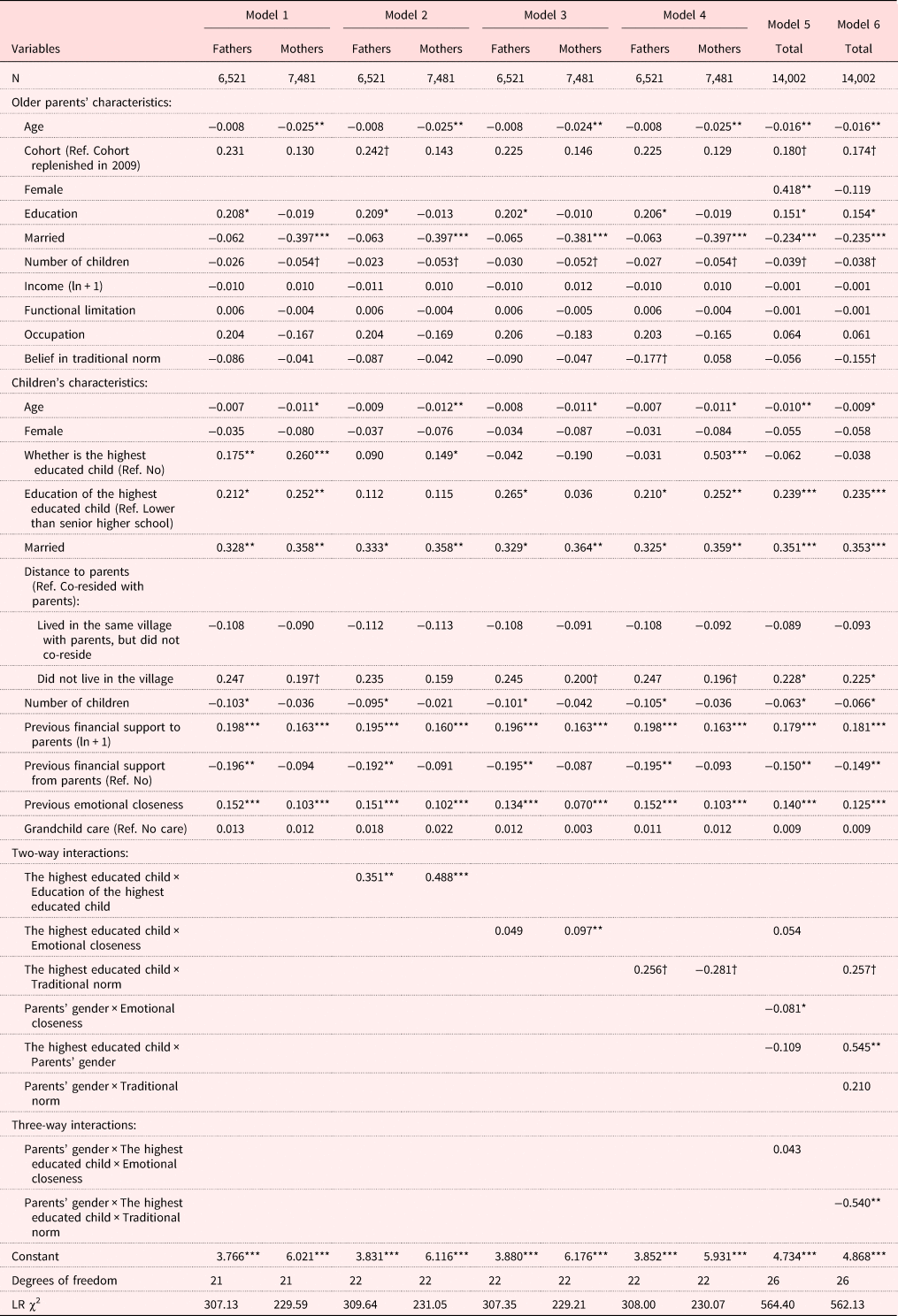
Table 2 provides results of the six models estimating financial transfers to parents. Models 1–4 test mothers and fathers separately. Models 5 and 6 combine parents. In Model 1, financial transfers to both fathers and mothers showed strong continuity over time as the earlier financial transfers were a significant predictor of later financial transfers. Relative to those who were not the best educated children in the family, the highest educated children provided more financial support both to fathers and mothers, controlling for their actual educational attainment. In addition, both older fathers and mothers received more financial support from married children than from unmarried ones. Parents also received more financial support from children who were emotionally closer. Fathers who received some formal schooling received more financial support than those who did not receive any education. The more children adult children have, the less older fathers received from each child. Fathers who provided financial support to children received less financial support from children. Mothers who were married received less financial support from their children than other mothers.
Random-effects models predicting financial transfers from adult children to their older parents unstandardised coefficients
Notes: N = 1,396 parents with 5,468 children. Ref.: reference category. LR: likelihood ratio.
Significance levels: † p < 0.1, * p < 0.05, ** p < 0.01, *** p < 0.001.
In Model 2, the two-way interaction of children's highest education status and their actual education level showed that the highest educated child provided more financial support to their parents when they received higher levels of education. In Model 3, we found that the highest educated children provided more financial support to their mothers when they had more emotional closeness with mothers. However, this pattern was not found among fathers. In Model 5, no gender difference was statistically significant in the analysis for all parents. Thus, the difference in the strength of association between mothers’ and fathers’ coefficients was not statistically significant.
In Model 6, we found that the highest educated children provided more financial support to their fathers who endorsed traditional norms. However, we found that the highest educated children provided less financial support to their mothers who endorsed traditional norms. This gender difference was statistically significant in the analysis for all parents, indicated by the significant three-way interaction between being the highest educated child, parents’ traditional norm beliefs and parents’ gender. Fathers’ traditional norm beliefs were more powerful in generating financial support from the highest educated child than mothers’.
Discussion
Rapid population ageing and the decline in fertility rates has raised concerns about older adults’ financial security in rural China, whose vulnerable and disadvantaged financial status was sometimes buffered by support from older children. The main purpose of this analysis was to apply the exchange theory-based strategic investment perspective and the model of intergenerational solidarity to address how children's education influences their financial transfers to older parents and how such reciprocity was conditional on the emotional closeness between parents and adult children, parents’ traditional filial norm endorsement and the gender of parents.
We found that controlling for their actual educational attainment, the highest educated children provided more financial support to their older fathers and mothers than did their counterparts. This supports the reciprocity hypothesis (Hypothesis 1). Parents’ earlier educational investment in the highest educated child enables a higher income among those children and a consequent sharing of wealth with older parents because of the norm of reciprocity (Emerson, Reference Emerson, Rosebberg and Turner1981; Molm and Cook, Reference Molm, Cook, Cook, Fine and House1995). Parents tend to allocate more intra-family resources to the education of the particular children who had greater potential to reciprocate as a strategic investment (Blake, Reference Blake1981; Chang and Li, Reference Chang and Li2016). These findings offer support for the strategic investment perspective and that reciprocity appeared to be a driving force behind children's financial support to their parents.
Moreover, we found that the amount of financial support from the highest educated child to their ageing fathers or mothers was conditional on the actual educational attainment of the highest educated child. This provides support for Hypothesis 2. Family investment on certain children would be better realised when the selected children did make to a higher level of education. This is consistent with other findings that higher income and stronger filial norms enabled children with higher levels of education to provide more financial support (Chou, Reference Chou2008; Xie and Zhu, Reference Xie and Zhu2009; Cong and Silverstein, Reference Cong and Silverstein2011; Zhu, Reference Zhu2016). The lagged reciprocity may continue to explain the bi-directional resource transfers between generations because in the long-term it maximises the interests of both parents and children. These findings highlight that investing more in children's education with the purpose of raising children with better prospects in rural China played a vital role in old-age support (Zimmer and Kwong, Reference Zimmer and Kwong2003).
The hypothesis that financial support from the highest educated child to their ageing parents depended on parents’ emotional closeness with children and on beliefs in traditional filial norms (Hypotheses 3 and 4) was partly supported. Our findings also support the gender differences posited in Hypotheses 5 and 6. Our supplemental analyses (see Table A3) did not find that sons provided more financial support than daughters when parents exhibit the traditional norm. The highest educated children with better emotional relationships with their mothers provided more financial support to mothers. Also, the highest educated children provided more financial support to their fathers if the fathers more strongly believed in traditional filial norms. To some extent, these findings were consistent with previous findings that parents who were emotionally close to their children and those who endorsed traditional filial norms tended to receive more support from their adult children (Silverstein et al., Reference Silverstein, Parrott and Bengtson1995, Reference Silverstein, Gans and Yang2006; Lin and Yi, Reference Lin and Yi2011; Lin and Pei, Reference Lin and Pei2016). In three-way interactions, father's traditional filial norm beliefs were more successful in ensuring greater financial support from the highest educated child. Drawing on the notion of strategic advantage, our findings suggested that mothers’ emotional closeness with the highest educated children was more consequential than with other children with respect to receiving financial support. Older fathers, compared to older mothers, appeared to obtain influences over their highest educated children by the endorsement of traditional filial norms. These findings were similar to patterns of strategic advantage that have been found in the USA (Silverstein and Conroy, Reference Silverstein, Conroy and Schoenpflug2009; Silverstein et al., Reference Silverstein, Parrott and Bengtson1995). With emotional closeness and traditional filial norms representing solidarity elements, the motivations for resource transfers between parents and adult children are commingled with long-term reciprocity and intergenerational solidarity. The gender differences in strategic advantage may exist because fathers and mothers enact strict, and different, gender roles in traditional rural Chinese families. Older mothers are more emotionally close to their children than fathers because of their kin-keeper roles and this also presents their unique advantages to reinforce reciprocity from children; whereas, older fathers may have more power in influencing children by instilling moral obligation than mothers due to their dominating status in patrilineal families, which characterises their advantages to buttress children's reciprocity (Li et al., Reference Li, Song and Feldman2009; Cong and Silverstein, Reference Cong and Silverstein2012b).
This study has several limitations. First, the sample was drawn from a poor rural region in China, where older parents mainly rely on their children for financial support. Therefore, our findings may not be generalisable to urban older adults who do not necessarily rely on the transfers but still receive a nominal amount of money from their children because of its cultural and symbolic meaning (e.g. children's respect and care) (Xie and Zhu, Reference Xie and Zhu2009). Furthermore, the exclusion of families with no siblings and when siblings received the same level of education may result in sample selection bias, which is an innate part of the hypotheses we targeted to test. To avoid selection bias, we also used the differences in siblings educational level in our supplemental analysis (see Table A2), which allowed us to keep all families in the estimating sample. However, the result are different because the ranking of education among siblings is conceptually different from sibling differences in educational levels. Second, the one-item measurement of parents’ belief in traditional norms variable could be an over-simplification of the complex concept. Nevertheless, a previous study successfully used a similar operationalisation of this concept, which adds to our confidence in the validity of this measure (Chen and Silverstein, Reference Chen and Silverstein2000). Moreover, to reduce the possibility of reverse causality, we used a lagged data structure and controlled for the interval baseline outcome variable so that the coefficients reflect the effect of independent variables on residualised changes in financial support from children; nevertheless, we could not completely exclude the possibility of reverse causality. In addition, we did not ask older adults to report their children's income, which could be a more direct measure of children's financial capacity, because of the concerns about whether older adults could answer that question accurately.
Despite these limitations, as the ageing population grows rapidly and families are prominent sources of support, our findings could have important implications for rural Chinese older adults’ financial security. Our studies show that to overcome the problem of imperfect compliance due to the long-term gap between parents’ earlier investment and children's old-age support, fathers and mothers have different strategic advantages. By investing in children's education early in the family lifecycle, older parents improve their own wellbeing and that of their next generation.
Acknowledgement
The project was supported partly by grants from the Fogarty International Center of the National Institutes of Health (R03TW01060), internal grants from the University of Southern California and Xi'an Jiaotong University, and the Natural Science Foundation of China (71573207 and 71273205). We would like to thank Drs. Merril Silverstein, Shuzhuo Li, Iris Chi, and Dongmei Zuo for their invaluable contributions to this project.
Appendix
The descriptive of the reduced sample for those have only one child and whose sibling received the same education
Random-effects models predicting financial transfers from adult children to their older parents
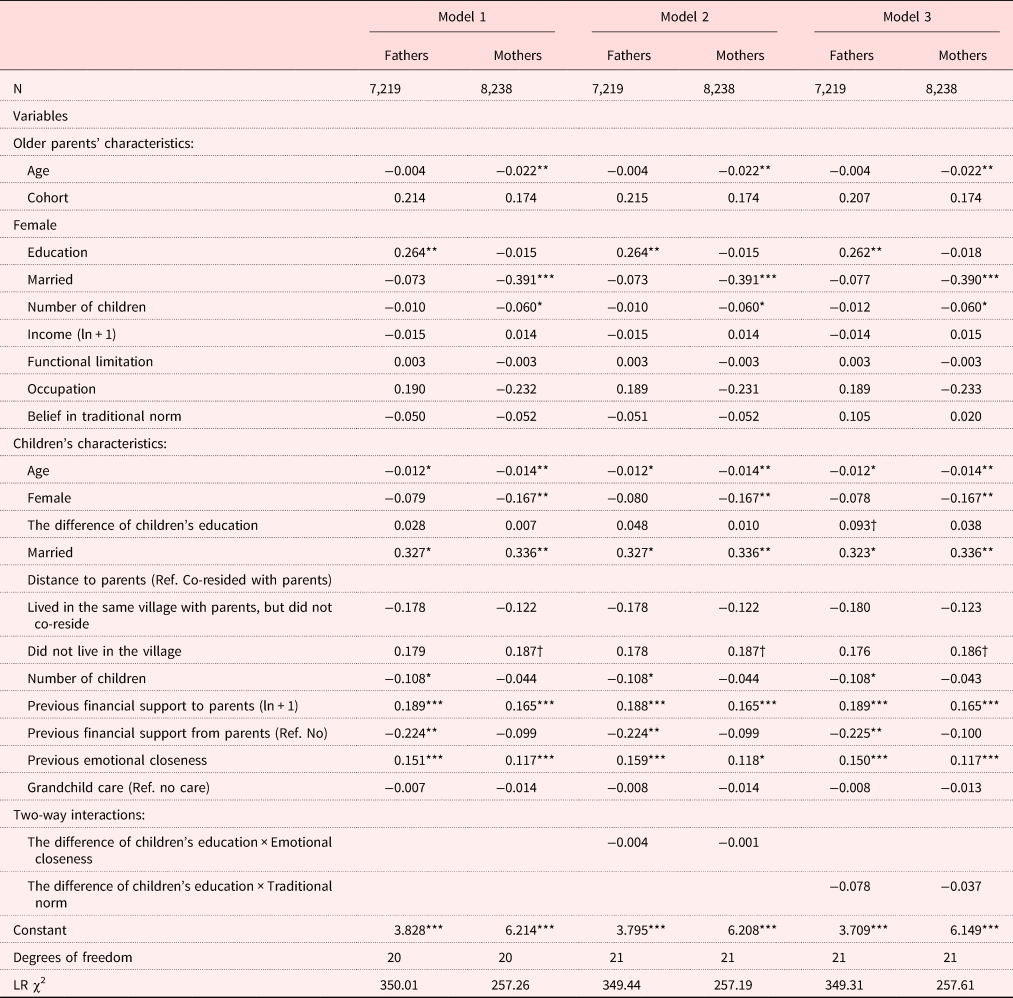
Random-effects models predicting financial transfers from adult children to their older parents



