


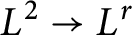
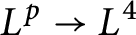

1 Introduction
In the last few decades, much attention has been given to the Fourier restriction/extension problem for various surfaces, in part because it is closely related to questions about partial differential equations as well as problems in geometric measure theory such as the Kakeya conjecture. Given a surface V in $\mathbb R^{d}$
endowed with surface measure
$\mathbb R^{d}$
endowed with surface measure $d\sigma $
, the extension problem for V is to determine all pairs of exponents
$d\sigma $
, the extension problem for V is to determine all pairs of exponents $(p,r)$
with
$(p,r)$
with $1\le p,r\le \infty $
such that the extension inequality
$1\le p,r\le \infty $
such that the extension inequality
 $$ \begin{align*} \|(fd\sigma)^\vee\|_{L^{r}(\mathbb R^{d})} \le C \|f\|_{L^{p}(V,\,d\sigma)} \end{align*} $$
holds for all functions $f \in L^{p}(V,\,d\sigma ).$
By duality, the extension inequality above is equivalent to the following restriction inequality:
$f \in L^{p}(V,\,d\sigma ).$
By duality, the extension inequality above is equivalent to the following restriction inequality:
 $$ \begin{align*} \|\widehat{g}\|_{L^{p^\prime}(V,d\sigma)} \le C \|g\|_{L^{r^\prime}(\mathbb R^{d})}, \end{align*} $$
where $p^\prime $
and
$p^\prime $
and $r^\prime $
denote usual Hölder’s conjugates of p and
$r^\prime $
denote usual Hölder’s conjugates of p and $r,$
respectively (i.e.,
$r,$
respectively (i.e., $p^\prime =p/(p-1)$
and
$p^\prime =p/(p-1)$
and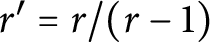 $r^\prime =r/(r-1)$
). Since this problem was initiated by Stein [19], many deep results have been established, but the problem remains open in higher dimensions. We refer the reader to [Reference Zygmund25, Reference Barcelo3, Reference Wolff24, Reference Tao21, Reference Tao20, Reference Guth5] for a more detailed description and recent developments on the Euclidean restriction conjecture.
$r^\prime =r/(r-1)$
). Since this problem was initiated by Stein [19], many deep results have been established, but the problem remains open in higher dimensions. We refer the reader to [Reference Zygmund25, Reference Barcelo3, Reference Wolff24, Reference Tao21, Reference Tao20, Reference Guth5] for a more detailed description and recent developments on the Euclidean restriction conjecture.
In 2002, Mockenhaupt and Tao [Reference Mockenhaupt and Tao16] initially studied the finite field analogue of the Fourier restriction/extension problem for various algebraic varieties. In this introduction, we review the definition and state our main results on this problem for spheres.
Let $\mathbb F_{q}^{d}$
be the d-dimensional vector space over a finite field
$\mathbb F_{q}^{d}$
be the d-dimensional vector space over a finite field $\mathbb F_{q}$
with q elements. Throughout this paper, we assume that q is an odd prime power. We endow the space
$\mathbb F_{q}$
with q elements. Throughout this paper, we assume that q is an odd prime power. We endow the space $\mathbb F_{q}^{d}$
with a counting measure
$\mathbb F_{q}^{d}$
with a counting measure $dm$
. We write
$dm$
. We write $\mathbb F_{q*}^{d}$
for the dual space of
$\mathbb F_{q*}^{d}$
for the dual space of $\mathbb F_{q}^{d}$
, which is endowed with the normalized counting measure
$\mathbb F_{q}^{d}$
, which is endowed with the normalized counting measure $dx.$
Given an algebraic variety V in
$dx.$
Given an algebraic variety V in $\mathbb F_{q*}^{d}$
, we endow it with the normalized surface measure
$\mathbb F_{q*}^{d}$
, we endow it with the normalized surface measure $d\sigma $
, which assigns a mass of
$d\sigma $
, which assigns a mass of $|V|^{-1}$
to each point in
$|V|^{-1}$
to each point in $V.$
Notice that the surface measure
$V.$
Notice that the surface measure $d\sigma $
on V can be written by
$d\sigma $
on V can be written by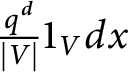 $\frac {q^{d}}{|V|} 1_{V} dx$
, a measure on
$\frac {q^{d}}{|V|} 1_{V} dx$
, a measure on $\mathbb F_{q^*}^{d},$
namely,
$\mathbb F_{q^*}^{d},$
namely,
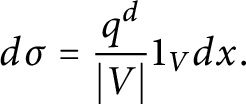 $$ \begin{align*} d\sigma= \frac{q^{d}}{|V|} 1_{V} dx. \end{align*} $$
Hence, we can view the measure $d\sigma $
on V as a function
$d\sigma $
on V as a function $\frac {q^{d}}{|V|} 1_{V}$
on
$\frac {q^{d}}{|V|} 1_{V}$
on $\mathbb F_{q^*}^{d}.$
Let
$\mathbb F_{q^*}^{d}.$
Let $\chi $
denote the canonical additive character of
$\chi $
denote the canonical additive character of $\mathbb F_{q}$
. We recall that the orthogonality relation of
$\mathbb F_{q}$
. We recall that the orthogonality relation of $\chi $
states that
$\chi $
states that
 $$ \begin{align*} \sum_{m\in \mathbb F_{q}^{d}} \chi(x\cdot m) = \left\{\begin{array}{@{}ll} 0 &\text{if} x\ne (0,\ldots,0), \\ q^{d} &\text{if} \text{x}=(0,\ldots,0).\end{array}\right. \end{align*} $$
Given a complex-valued function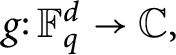 $g\colon \mathbb F_{q}^{d} \to \mathbb C,$
the Fourier transform of g is defined by
$g\colon \mathbb F_{q}^{d} \to \mathbb C,$
the Fourier transform of g is defined by
 $$ \begin{align*} \widehat{g}(x)=\sum_{m\in \mathbb F_{q}^{d}} g(m) \chi(-x\cdot m). \end{align*} $$
Let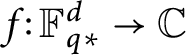 $f\colon \mathbb F_{q*}^{d} \to \mathbb C$
be a complex-valued function on the dual space
$f\colon \mathbb F_{q*}^{d} \to \mathbb C$
be a complex-valued function on the dual space $\mathbb F_{q*}^{d}$
of
$\mathbb F_{q*}^{d}$
of $\mathbb F_{q}^{d}.$
Then the inverse Fourier transform of f is defined by
$\mathbb F_{q}^{d}.$
Then the inverse Fourier transform of f is defined by
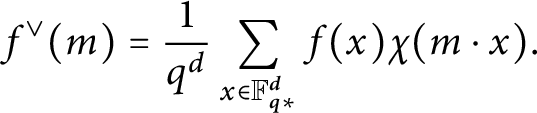 $$ \begin{align*} f^{\vee} (m)= \frac{1}{q^{d}} \sum_{x\in \mathbb F_{q*}^{d}} f(x) \chi(m\cdot x). \end{align*} $$
Moreover, the inverse Fourier transform of the measure $f d\sigma $
is given by
$f d\sigma $
is given by
 $$ \begin{align*} (fd\sigma)^{\vee} (m)= \frac{1}{|V|} \sum_{x\in V} f(x) \chi(m\cdot x), \end{align*} $$
where $d\sigma $
denotes the normalized surface measure on an algebraic variety
$d\sigma $
denotes the normalized surface measure on an algebraic variety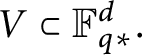 $V\subset \mathbb F_{q*}^{d}.$
Since the space $\mathbb F_{q}^{d}$
is isomorphic to its dual space
$\mathbb F_{q}^{d}$
is isomorphic to its dual space $\mathbb F_{q*}^{d}$
as an abstract group, we will simply write
$\mathbb F_{q*}^{d}$
as an abstract group, we will simply write $\mathbb F_{q}^{d}$
for
$\mathbb F_{q}^{d}$
for $\mathbb F_{q*}^{d}$
in the case when the measure on
$\mathbb F_{q*}^{d}$
in the case when the measure on $\mathbb F_{q*}^{d}$
does not play an important role. For example, to denote a sum over
$\mathbb F_{q*}^{d}$
does not play an important role. For example, to denote a sum over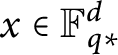 $x \in \mathbb F_{q*}^{d}$
, we write
$x \in \mathbb F_{q*}^{d}$
, we write $\sum _{x\in \mathbb F_{q}^{d}}$
for
$\sum _{x\in \mathbb F_{q}^{d}}$
for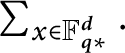 $\sum _{x\in \mathbb F_{q*}^{d}}.$
It is clear that
$\sum _{x\in \mathbb F_{q*}^{d}}.$
It is clear that
 $$ \begin{align*} f(\alpha)=\widehat{(f^\vee)}(\alpha)=\sum_{\beta\in \mathbb F_{q}^{d}} f^\vee(\beta) \chi(-\alpha\cdot \beta), \end{align*} $$
which is called the Fourier inversion formula. Expanding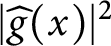 $|\widehat {g}(x)|^{2}$
by the definition of the Fourier transform and using the orthogonality relation of
$|\widehat {g}(x)|^{2}$
by the definition of the Fourier transform and using the orthogonality relation of $\chi ,$
one can easily deduce the following equation:
$\chi ,$
one can easily deduce the following equation:
 $$ \begin{align*} q^{-d}\sum_{x\in \mathbb F_{q}^{d}} |\widehat{g}(x)|^{2} = \sum_{m\in \mathbb F_{q}^{d}} |g(m)|^{2}. \end{align*} $$
This formula is referred to as the Plancherel theorem and can be rewritten as
 $$ \begin{align*} \|\widehat{g}\|_{L^{2}(\mathbb F_{q*}^{d}, dx)}=\|g\|_{L^{2}(\mathbb F_{q}^{d}, dm)}. \end{align*} $$
With the notation above, the Fourier extension problem for V is to determine exponents $1\le p, r\le \infty $
such that the extension inequality
$1\le p, r\le \infty $
such that the extension inequality
 $$ \begin{align} \| (fd\sigma)^{\vee}\|_{L^{r}(\mathbb F_{q}^{d}, dm)} \ll \|f\|_{L^{p}(V, d\sigma)} \end{align} $$
holds for any functions f on V with the operator norm independent of the size of the underlying finite field $\mathbb F_{q}.$
Here and throughout the paper, we use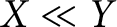 $X \ll Y$
or
$X \ll Y$
or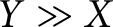 $Y\gg X$
to denote that there exists a constant
$Y\gg X$
to denote that there exists a constant $C>0$
independent of q such that
$C>0$
independent of q such that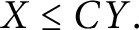 $ X\le C Y.$
In addition,
$ X\le C Y.$
In addition,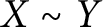 $X\sim Y$
means that
$X\sim Y$
means that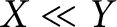 $X\ll Y$
and
$X\ll Y$
and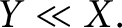 $Y\ll X.$
We use the notation $R_{V}^*(p\to r)\ll 1$
to indicate that the above extension estimate (1.1) holds. By duality (see Theorem A.1 in the Appendix), the extension estimate (1.1) is equivalent to the following Fourier restriction estimate:
$R_{V}^*(p\to r)\ll 1$
to indicate that the above extension estimate (1.1) holds. By duality (see Theorem A.1 in the Appendix), the extension estimate (1.1) is equivalent to the following Fourier restriction estimate:
 $$ \begin{align*} \| \widehat{g}\|_{L^{p'}(V, d\sigma)} \ll \|g\|_{L^{r'}(\mathbb F_{q}^{d}, dm)}. \end{align*} $$
Necessary conditions for $R_{V}^*(p\to r)\ll 1$
can be given in terms of
$R_{V}^*(p\to r)\ll 1$
can be given in terms of $|V|$
and the cardinality of an affine subspace H lying on
$|V|$
and the cardinality of an affine subspace H lying on $V.$
Indeed, Mockenhaupt and Tao [Reference Mockenhaupt and Tao16] showed that if
$V.$
Indeed, Mockenhaupt and Tao [Reference Mockenhaupt and Tao16] showed that if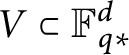 $V\subset \mathbb F_{q*}^{d}$
with
$V\subset \mathbb F_{q*}^{d}$
with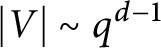 $|V|\sim q^{d-1}$
and it contains an affine subspace H with
$|V|\sim q^{d-1}$
and it contains an affine subspace H with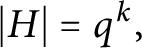 $|H|=q^{k},$
then the necessary conditions are given by
$|H|=q^{k},$
then the necessary conditions are given by
 $$ \begin{align} r\geq \frac{2d}{d-1} \quad \text{and} \quad r\geq\frac{p(d-k)}{(p-1)(d-1-k)}. \end{align} $$
When the variety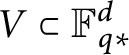 $V\subset \mathbb F_{q*}^{d}$
is either a paraboloid or a sphere, the restriction/extension problem has received a lot of attention. Here, we recall that the paraboloid P in
$V\subset \mathbb F_{q*}^{d}$
is either a paraboloid or a sphere, the restriction/extension problem has received a lot of attention. Here, we recall that the paraboloid P in $\mathbb F_{q*}^{d}$
is defined by
$\mathbb F_{q*}^{d}$
is defined by
 $$ \begin{align*} P:=\{x\in \mathbb F_{q*}^{d}: x_{1}^{2}+\cdots+x_{d-1}^{2}=x_{d}\}, \end{align*} $$
and the sphere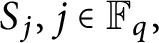 $S_{j}, j\in \mathbb F_{q},$
is defined by
$S_{j}, j\in \mathbb F_{q},$
is defined by
 $$ \begin{align} S_{j}:=\{x\in \mathbb F_{q*}^{d}: x_{1}^{2} +\cdots+ x_{d}^{2}=j\}. \end{align} $$
The restriction/extension conjectures for curves on $\mathbb F_{q*}^{2}$
were completely solved. For example, Mockenhaupt and Tao [Reference Mockenhaupt and Tao16] established
$\mathbb F_{q*}^{2}$
were completely solved. For example, Mockenhaupt and Tao [Reference Mockenhaupt and Tao16] established $R^*_{P}(2\to 4)\ll 1$
for the parabola, which implies the conjecture, and the second and fifth authors [Reference Koh and Shen10] showed that the result holds for any curve that does not contain a line. However, the finite field restriction problem for varieties in higher dimensions has not been solved.
$R^*_{P}(2\to 4)\ll 1$
for the parabola, which implies the conjecture, and the second and fifth authors [Reference Koh and Shen10] showed that the result holds for any curve that does not contain a line. However, the finite field restriction problem for varieties in higher dimensions has not been solved.
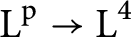
In the finite field setting, it would be very interesting and hard to establish the sharp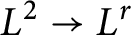 $L^{2}\to L^{r}$
or
$L^{2}\to L^{r}$
or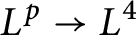 $L^{p}\to L^{4}$
estimate for the sphere or the paraboloid in even dimensions, because the conjectured results in those cases are much better than the Stein–Tomas result, the
$L^{p}\to L^{4}$
estimate for the sphere or the paraboloid in even dimensions, because the conjectured results in those cases are much better than the Stein–Tomas result, the $L^{2}\to L^{(2d+2)/(d-1)}$
bound, which can be obtained by using the Stein–Tomas argument. It was shown by Mockenhaupt and Tao [Reference Mockenhaupt and Tao16] that an
$L^{2}\to L^{(2d+2)/(d-1)}$
bound, which can be obtained by using the Stein–Tomas argument. It was shown by Mockenhaupt and Tao [Reference Mockenhaupt and Tao16] that an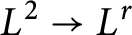 $L^{2}\to L^{r}$
extension result for the paraboloid can be obtained from a consequence of an
$L^{2}\to L^{r}$
extension result for the paraboloid can be obtained from a consequence of an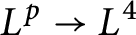 $L^{p}\to L^{4}$
extension estimate. Developing their method with the optimal
$L^{p}\to L^{4}$
extension estimate. Developing their method with the optimal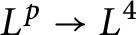 $L^{p}\to L^{4}$
extension estimate, the authors of [Reference Lewko and Lewko13] obtained the
$L^{p}\to L^{4}$
extension estimate, the authors of [Reference Lewko and Lewko13] obtained the $L^{2}\to L^{2d^{2}/(d^{2}-2d+2) }$
extension estimate for the paraboloid in even dimensions. This result is much better than the Stein–Tomas result. Further improvement was made by Lewko [Reference Lewko12] who reduced the
$L^{2}\to L^{2d^{2}/(d^{2}-2d+2) }$
extension estimate for the paraboloid in even dimensions. This result is much better than the Stein–Tomas result. Further improvement was made by Lewko [Reference Lewko12] who reduced the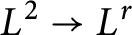 $L^{2}\to L^{r}$
extension problem to the estimation of the additive energy
$L^{2}\to L^{r}$
extension problem to the estimation of the additive energy
 $$ \begin{align*} E(A):=|\{(x,y,z,w)\in A^{4}: x+y=z+w\}| \end{align*} $$
for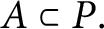 $A\subset P.$
In recent papers [Reference Iosevich, Koh and Lewko9, Reference Rudnev and Shkredov18, Reference Lewko14], improving this additive energy is the crucial step to get new results on $L^{2}$
-extension theorems for the paraboloid. For example, in a recent work [Reference Rudnev and Shkredov18], with a new additive energy bound, Rudnev and Shkredov followed the scheme in [Reference Iosevich, Koh and Lewko9] to obtain the sharp
$L^{2}$
-extension theorems for the paraboloid. For example, in a recent work [Reference Rudnev and Shkredov18], with a new additive energy bound, Rudnev and Shkredov followed the scheme in [Reference Iosevich, Koh and Lewko9] to obtain the sharp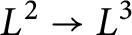 $L^{2}\to L^{3}$
extension estimate for the paraboloid in the dimension
$L^{2}\to L^{3}$
extension estimate for the paraboloid in the dimension $4$
. For any
$4$
. For any $d\ge 8$
even, the sharp
$d\ge 8$
even, the sharp $L^{2}\to L^{(2d+4)/d}$
extension estimate for the paraboloid was obtained by the first and second authors and Lewko in an earlier work [Reference Iosevich, Koh and Lewko9].
$L^{2}\to L^{(2d+4)/d}$
extension estimate for the paraboloid was obtained by the first and second authors and Lewko in an earlier work [Reference Iosevich, Koh and Lewko9].
The Focus of this Article
In this paper, we develop the restriction/extension theory for spheres $S_{j}$
in
$S_{j}$
in $\mathbb F_{q*}^{d}.$
Let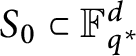 $S_{0}\subset \mathbb F_{q^*}^{d}$
be the zero radius sphere. As mentioned in (1.2), necessary conditions for
$S_{0}\subset \mathbb F_{q^*}^{d}$
be the zero radius sphere. As mentioned in (1.2), necessary conditions for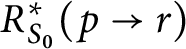 $R_{S_{0}}^*(p\to r)$
bound can be determined by the size of a subspace H lying in
$R_{S_{0}}^*(p\to r)$
bound can be determined by the size of a subspace H lying in $S_{0}.$
In particular, if
$S_{0}.$
In particular, if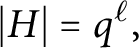 $|H|=q^{\ell },$
then a necessary condition for
$|H|=q^{\ell },$
then a necessary condition for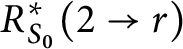 $R^*_{S_{0}}(2\to r)$
bound is given by
$R^*_{S_{0}}(2\to r)$
bound is given by
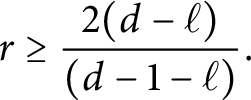 $$ \begin{align} r\geq\frac{2(d-\ell)}{(d-1-\ell)}. \end{align} $$
The following lemma is well known.
Lemma 1.1 [Reference Vinh23] Let H be a maximal subspace lying on the zero radius sphere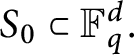 $S_{0}\subset \mathbb F_{q}^{d}.$
Then the following statements hold:
$S_{0}\subset \mathbb F_{q}^{d}.$
Then the following statements hold:
-
1. If $d=4k-2, k\in \mathbb N,$
and
$q\equiv 3 \mod {4},$
then
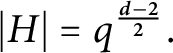
$|H|=q^{\frac {d-2}{2}}.$
$d=4k-2, k\in \mathbb N,$
and
$q\equiv 3 \mod {4},$
then
$|H|=q^{\frac {d-2}{2}}.$
-
2. If
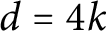
$d= 4k$
(or
$d=4k-2$
with
$q\equiv 1\mod {4}),$
then
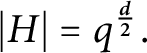
$|H|=q^{\frac {d}{2}}.$
-
3. If
$d\ge 3$
is odd, then
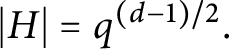
$|H|=q^{(d-1)/2}.$





The following is the conjecture of the sharp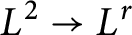 $L^{2}\to L^{r}$
extension estimate for the zero radius sphere, which can be easily made from (1.4) and Lemma 1.1.
$L^{2}\to L^{r}$
extension estimate for the zero radius sphere, which can be easily made from (1.4) and Lemma 1.1.
Conjecture 1.2 Let $S_{0}$
be the zero radius sphere in
$S_{0}$
be the zero radius sphere in $\mathbb F_{q}^{d}.$
Then the following statements hold:
$\mathbb F_{q}^{d}.$
Then the following statements hold:
-
1. If
$d=4k+2, k\in \mathbb N,$
and
$q\equiv 3 \mod {4},$
then
$R^*_{S_{0}}(2\to \frac {2d+4}{d})\ll 1.$
-
2. If
$d= 4k$
(or
$d=4k-2$
with
$q\equiv 1\mod {4}),$
then
$R^*_{S_{0}}(2\to \frac {2d}{d-2})\ll 1.$
-
3. If
$d\ge 3$
is odd, then
$R^*_{S_{0}}(2\to \frac {2d+2}{d-1})\ll 1.$



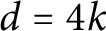





Statements (ii) and (iii) of the above conjecture were established by using the finite field Stein–Tomas argument (see [Reference Koh and Shen11, Theorem 2.1]). In fact, the following sharp Fourier decay estimates on the surface measure $d\sigma $
on
$d\sigma $
on $S_{0}$
were mainly used to prove them:
$S_{0}$
were mainly used to prove them:
 $$ \begin{align*} \max_{m\in \mathbb F_{q}^{d}\setminus \{\vec{0}\}}|(d\sigma)^{\vee}(m)| \ll \left\{\begin{array}{ll} q^{-(d-2)/2} &\text{for even} \text{d}\ge 4, \\ q^{-(d-1)/2} &\text{for odd} \text{d}\ge 3. \end{array}\right. \end{align*} $$
In this paper, we solve Conjecture 1.2 completely by showing that the first statement of the conjecture is also true. In conclusion, all sharp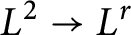 $L^{2}\to L^{r}$
estimates for the zero radius sphere are attained. Our main result is as follows.
$L^{2}\to L^{r}$
estimates for the zero radius sphere are attained. Our main result is as follows.
Theorem 1.3 Let $S_{0}$
be the sphere in
$S_{0}$
be the sphere in $\mathbb F_{q*}^{d}$
with zero radius. If
$\mathbb F_{q*}^{d}$
with zero radius. If $q\equiv 3 \mod {4}$
and
$q\equiv 3 \mod {4}$
and $d=4k+2$
for
$d=4k+2$
for $k\in \mathbb N$
, then we have
$k\in \mathbb N$
, then we have
 $$ \begin{align*} R_{S_{0}}^*(2 \to r) \ll 1\quad \text{for } \frac{2d+4}{d} \le \text{r}\le \infty. \end{align*} $$
A new idea is to relate our problem to the explicit Gauss sum estimate, which enables us to deduce much stronger results under the assumptions of Theorem 1.3. We strongly expect that the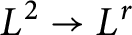 $L^{2} \to L^{r}$
extension estimates for
$L^{2} \to L^{r}$
extension estimates for $S_{0}$
will lead to further surprising applications.
$S_{0}$
will lead to further surprising applications.
Compared to the case of the paraboloid, we are faced with many difficulties in studying the restriction problem for spheres of non-zero radii. As we mentioned earlier, for the paraboloid, there is an approach to reduce the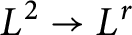 $L^{2}\to L^{r}$
extension estimates to the additive energy estimate of sets in the paraboloid. Nevertheless, such a connection has not yet been discovered in the case of spheres yet. Moreover, giving good bounds on the additive energy of sets on spheres is harder than the paraboloid case. The main reason is the defined equation of the paraboloid forms a graph; thus, it is easy to reduce the problem to one-lower dimensional space. With these difficulties, the known results for non-zero radii spheres are much weaker than those for the paraboloid. More precisely, the following results are known for spheres with non-zero radii.
$L^{2}\to L^{r}$
extension estimates to the additive energy estimate of sets in the paraboloid. Nevertheless, such a connection has not yet been discovered in the case of spheres yet. Moreover, giving good bounds on the additive energy of sets on spheres is harder than the paraboloid case. The main reason is the defined equation of the paraboloid forms a graph; thus, it is easy to reduce the problem to one-lower dimensional space. With these difficulties, the known results for non-zero radii spheres are much weaker than those for the paraboloid. More precisely, the following results are known for spheres with non-zero radii.
Proposition 1.4 Let $S_{j}$
be the sphere in
$S_{j}$
be the sphere in $\mathbb F_{q*}^{d}$
with non-zero radius
$\mathbb F_{q*}^{d}$
with non-zero radius $j.$
Then the following results hold:
$j.$
Then the following results hold:
-
1. If
$d\ge 3,$
then
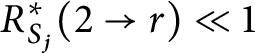
$ R_{S_{j}}^*(2\to r) \ll 1$
for
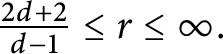
$\frac {2d+2}{d-1}\le r \le \infty .$
-
2. If
$d\ge 4$
is even, then
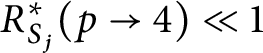
$ R_{S_{j}}^*(p\to 4) \ll 1$
for
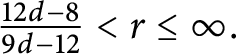
$\frac {12d-8}{9d-12}< r \le \infty .$


We note that a smaller exponent gives a better extension result. The first result in Proposition 1.4 was given in [Reference Iosevich and Koh7], and it gives the Stein=-Tomas result, the $L^{2}\to L^{(2d+2)/(d-1)}$
bound. It is well known in [Reference Iosevich and Koh8] that the Stein–Tomas result gives the optimal
$L^{2}\to L^{(2d+2)/(d-1)}$
bound. It is well known in [Reference Iosevich and Koh8] that the Stein–Tomas result gives the optimal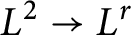 $L^{2}\to L^{r}$
estimate for spheres in general odd dimensions. In even dimensions d, it is conjectured that the “r” index of the Stein–Tomas result can be improved to
$L^{2}\to L^{r}$
estimate for spheres in general odd dimensions. In even dimensions d, it is conjectured that the “r” index of the Stein–Tomas result can be improved to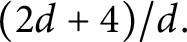 $(2d+4)/d.$
The second result in Proposition 1.4 was proved in [Reference Iosevich and Koh8] and gives a much better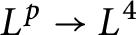 $L^{p}\to L^{4}$
extension result than the optimal result in odd dimensions. In our next result, we significantly improve the second result of Proposition 1.4.
$L^{p}\to L^{4}$
extension result than the optimal result in odd dimensions. In our next result, we significantly improve the second result of Proposition 1.4.
Theorem 1.5 Let $S_{j}$
be the sphere in
$S_{j}$
be the sphere in $\mathbb F_{q*}^{d}$
, defined as in (1.3). If
$\mathbb F_{q*}^{d}$
, defined as in (1.3). If $j\ne 0$
and
$j\ne 0$
and $d\ge 4$
is even, then we have
$d\ge 4$
is even, then we have
 $$ \begin{align*} R_{S_{j}}^*(p\to 4) \ll 1 \quad \text{for } \frac{4d}{3d-2}\le \text{p} \le \infty.\end{align*} $$
Furthermore, the above result is sharp.
In next sections, we will focus on the proofs of Theorems 1.3 and 1.5, and the sharpness as well.
2 Sharp
$\text{L}^{2}\to \text{L}^{\text{r}}$
Estimates for the Zero Radius Sphere (Theorem 1.3)
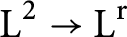
We first prove the following weak-type restriction estimate for the sphere of zero radius, which makes a key role in proving Theorem 1.3.
2.1 Weak-Type Restriction Estimates for the Zero Radius Sphere
Lemma 2.1 Let $d\sigma $
denote the normalized surface measure on the sphere
$d\sigma $
denote the normalized surface measure on the sphere $S_{0}$
with zero radius in
$S_{0}$
with zero radius in $\mathbb F_{q*}^{d}.$
In addition, assume that
$\mathbb F_{q*}^{d}.$
In addition, assume that $d=4k+2$
for
$d=4k+2$
for $k\in \mathbb N$
, and
$k\in \mathbb N$
, and $q\equiv 3 \mod {4}.$
Then, for
$q\equiv 3 \mod {4}.$
Then, for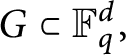 $G\subset \mathbb F_{q}^{d},$
we have
$G\subset \mathbb F_{q}^{d},$
we have
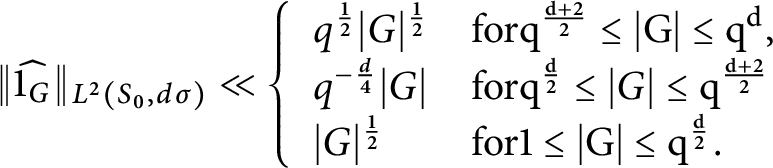 $$ \begin{align*} \|\widehat{1_{G}}\|_{L^{2}(S_{0}, d\sigma)} \ll \left\{\begin{array}{ll} q^{\frac{1}{2}} |G|^{\frac{1}{2}} &\text{for} \text{q}^{\frac{\text{d}+2}{2}} \le |\text{G}|\le \text{q}^{\text{d}},\\ q^{-\frac{d}{4}} |G| &\text{for} \text{q}^{\frac{\text{d}}{2}} \le |G|\le \text{q}^{\frac{\text{d}+2}{2}}\\ |G|^{\frac{1}{2}} &\text{for} 1 \le |\text{G}|\le \text{q}^{\frac{\text{d}}{2}}. \end{array}\right. \end{align*} $$
Proof By a direct comparison, it suffices to prove the following two inequalities: for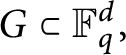 $G\subset \mathbb F_{q}^{d},$
 $$ \begin{align} \|\widehat{1_{G}}\|_{L^{2}(S_{0}, d\sigma)} \ll q^{\frac{1}{2}} |G|^{\frac{1}{2}} \end{align} $$
and
 $$ \begin{align} \|\widehat{1_{G}}\|_{L^{2}(S_{0}, d\sigma)} \ll |G|^{\frac{1}{2}} + q^{\frac{-d}{4}} |G|. \end{align} $$
To prove (2.1), observe from the Plancherel theorem that the following extension estimate holds:
 $$ \begin{align*} \|(fd\sigma)^\vee\|_{L^{2}(\mathbb F_{q}^{d}, dm)} = \Big(\frac{|\mathbb F_{q}^{d}|}{|S_{0}|}\Big)^{\frac{1}{2}} \|f\|_{L^{2}(S_{0}, d\sigma)} \ll q^{\frac{1}{2}} \|f\|_{L^{2}(S_{0}, d\sigma)}. \end{align*} $$
By duality, we obtain that
 $$ \begin{align*} \|\widehat{g}\|_{L^{2}(S_{0}, d\sigma)} \ll q^{\frac{1}{2}}\|g\|_{L^{2}(\mathbb F_{q}^{d}, dm)}. \end{align*} $$
Now taking g as the indicate function $1_{G}$
on
$1_{G}$
on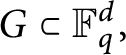 $G\subset \mathbb F_{q}^{d},$
, we obtain the inequality (2.1). It remains to prove inequality (2.2). Expanding the left-hand side of (2.2) and using the fact that
$G\subset \mathbb F_{q}^{d},$
, we obtain the inequality (2.1). It remains to prove inequality (2.2). Expanding the left-hand side of (2.2) and using the fact that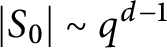 $|S_{0}|\sim q^{d-1}$
, we see that inequality (2.2) is equivalent to
$|S_{0}|\sim q^{d-1}$
, we see that inequality (2.2) is equivalent to
 $$ \begin{align} \sum_{x\in S_{0}} |\widehat{1_{G}}(x)|^{2} \ll q^{d-1}|G| + q^{\frac{d-2}{2}} |G|^{2}. \end{align} $$
Hence, our task is to prove this inequality. To this end, we define
 $$ \begin{align*} \nu(0):=\sum_{m, m'\in G: m-m'\in S_{0}}1 =\sum_{m, m'\in \mathbb F_{q}^{d}} 1_{G}(m) 1_{G}(m') 1_{S_{0}}(m-m'). \end{align*} $$
Then it is clearly true that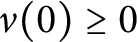 $\nu (0)\ge 0$
(in fact, we have
$\nu (0)\ge 0$
(in fact, we have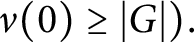 $\nu (0)\ge |G|).$
Applying the Fourier inversion formula to the indicate function
$\nu (0)\ge |G|).$
Applying the Fourier inversion formula to the indicate function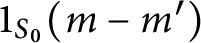 $1_{S_{0}}(m-m')$
, it follows that
$1_{S_{0}}(m-m')$
, it follows that
 $$ \begin{align} 0\le \nu(0) &= \sum_{m, m'\in \mathbb F_{q}^{d}} 1_{G}(m) 1_{G}(m') \sum_{x\in \mathbb F_{q}^{d}} (1_{S_{0}})^{\vee}(x) ~\chi(x\cdot (m-m'))\\ &=\sum_{x\in \mathbb F_{q}^{d}} |\widehat{1_{G}}(x)|^{2} (1_{S_{0}})^{\vee}(x).\nonumber \end{align} $$
We now apply the following consequence whose proof will be given in the next subsection.
Lemma 2.2 Let $S_{0}$
be the sphere with zero radius in
$S_{0}$
be the sphere with zero radius in $\mathbb F_{q}^{d}.$
Assume that
$\mathbb F_{q}^{d}.$
Assume that $d=4k+2$
for
$d=4k+2$
for $k\in \mathbb N$
and
$k\in \mathbb N$
and $q\equiv 3 \mod {4}.$
Then we have
$q\equiv 3 \mod {4}.$
Then we have
 $$ \begin{align*} (1_{S_{0}})^{\vee}(\alpha) :=q^{-d} \sum_{y\in S_{0}} \chi(\alpha\cdot y) = q^{-1} \delta_{0}(\alpha) -q^{\frac{-(d+2)}{2}} \sum_{r\ne 0} \chi\big(r\|\alpha\|\big),\end{align*} $$
where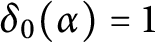 $\delta _{0}(\alpha )=1 $
for
$\delta _{0}(\alpha )=1 $
for $\alpha =(0,\ldots ,0)$
, and
$\alpha =(0,\ldots ,0)$
, and $0$
otherwise.▪
$0$
otherwise.▪
Inserting the formula for $(1_{S_{0}})^{\vee }$
into (2.4), we get
$(1_{S_{0}})^{\vee }$
into (2.4), we get
 $$ \begin{align*} 0\le \sum_{x\in \mathbb F_{q}^{d}} |\widehat{1_{G}}(x)|^{2} q^{-1} \delta_{0}(x) -q^{\frac{-(d+2)}{2}} \sum_{x\in \mathbb F_{q}^{d}} |\widehat{1_{G}}(x)|^{2} \sum_{r\ne 0} \chi(r\|x\|). \end{align*} $$
Applying the orthogonality relation of $\chi $
to the sum over
$\chi $
to the sum over $r\ne 0$
,
$r\ne 0$
,
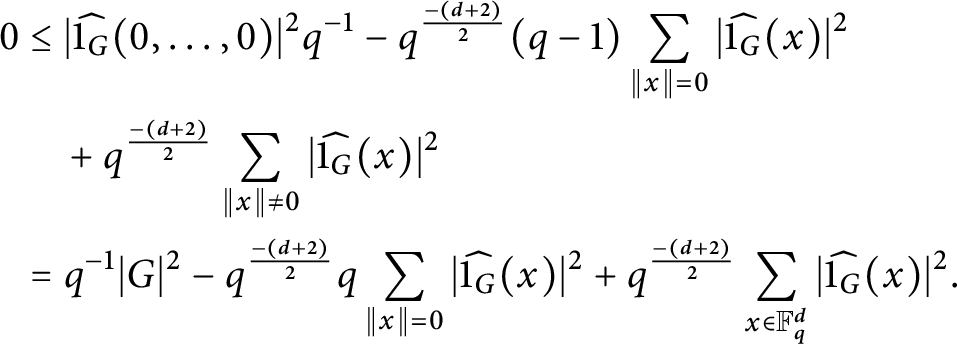 $$ \begin{align*} 0&\le |\widehat{1_{G}}(0,\ldots,0)|^{2} q^{-1} -q^{\frac{-(d+2)}{2}} (q-1) \sum_{\|x\|=0} |\widehat{1_{G}}(x)|^{2} \\&\quad + q^{\frac{-(d+2)}{2}} \sum_{\|x\|\ne 0} |\widehat{1_{G}}(x)|^{2} \\ &= q^{-1}|G|^{2} -q^{\frac{-(d+2)}{2}} q\sum_{\|x\|=0} |\widehat{1_{G}}(x)|^{2} + q^{\frac{-(d+2)}{2}} \sum_{x\in \mathbb F_{q}^{d}} |\widehat{1_{G}}(x)|^{2}. \end{align*} $$
Since $\sum _{x\in \mathbb F_{q}^{d}} |\widehat {1_{G}}(x)|^{2} =q^{d} |G|$
, solving for
$\sum _{x\in \mathbb F_{q}^{d}} |\widehat {1_{G}}(x)|^{2} =q^{d} |G|$
, solving for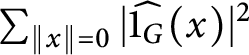 $\sum _{\|x\|=0} |\widehat {1_{G}}(x)|^{2}$
yields inequality (2.3), which completes the proof of Lemma 2.1.
$\sum _{\|x\|=0} |\widehat {1_{G}}(x)|^{2}$
yields inequality (2.3), which completes the proof of Lemma 2.1.
2.2 Proof of Lemma 2.2
We make use of the following fact.
Lemma 2.3 ([Reference Iosevich and Koh8, Lemma 4])
Let $S_{j}$
be the sphere in
$S_{j}$
be the sphere in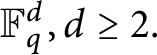 ${\mathbb F}_{q}^{d}, d\ge 2.$
Then for any
${\mathbb F}_{q}^{d}, d\ge 2.$
Then for any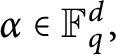 $\alpha \in {\mathbb F}_{q}^{d},$
we have
$\alpha \in {\mathbb F}_{q}^{d},$
we have
 $$ \begin{align*} (1_{S_{j}})^{\vee}(\alpha) = q^{-1} \delta_{0}(\alpha) + q^{-d-1}\eta^{d}(-1) G^{d}(\eta, \chi) \sum_{r \in {\mathbb F}_{q}^*} \eta^{d}(r)\chi\Big(jr+ \frac{\|\alpha\|}{4r}\Big), \end{align*} $$
where $\eta $
denotes the quadratic character of
$\eta $
denotes the quadratic character of $\mathbb F_{q}^*$
and
$\mathbb F_{q}^*$
and $G(\eta , \chi ):=\sum _{s\in \mathbb F_{q}^*} \eta (s)\chi (s)$
which is the standard Gauss sum.
$G(\eta , \chi ):=\sum _{s\in \mathbb F_{q}^*} \eta (s)\chi (s)$
which is the standard Gauss sum.
We also invoke the explicit value of the Gauss sum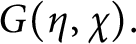 $G(\eta , \chi ).$
Theorem 2.4 ([Reference Lidl and Niederreiter15, Theorem 5.15])
Let $\mathbb F_{q}$
be a finite field with
$\mathbb F_{q}$
be a finite field with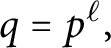 $ q= p^{\ell },$
where p is an odd prime and
$ q= p^{\ell },$
where p is an odd prime and $\ell \in {\mathbb N}.$
Then we have
$\ell \in {\mathbb N}.$
Then we have
 $$ \begin{align*} G(\eta, \chi)= \left\{\begin{array}{@{}ll} {(-1)}^{\ell-1} q^{\frac{1}{2}} &\text{if} \text{p} \equiv 1 \mod{4}, \\ {(-1)}^{\ell-1} i^\ell q^{\frac{1}{2}} &\text{if} \text{p}\equiv 3 \mod{4}. \end{array}\right. \end{align*} $$
Proof Combining the assumption that $d=4k+2$
for
$d=4k+2$
for $k\in \mathbb N$
and Lemma 2.3, we have
$k\in \mathbb N$
and Lemma 2.3, we have
 $$ \begin{align*} (1_{S_{0}})^{\vee}(\alpha) = q^{-1} \delta_{0}(\alpha) + q^{-d-1} G^{d}(\eta, \chi) \sum_{r \in {\mathbb F}_{q}^*} \chi\Big(\frac{\|\alpha\|}{4r}\Big). \end{align*} $$
It is clear that $q\equiv 3\mod {4}$
if and only if
$q\equiv 3\mod {4}$
if and only if $q=p^\ell $
for some prime
$q=p^\ell $
for some prime $p\equiv 3 \mod {4}$
and odd integer
$p\equiv 3 \mod {4}$
and odd integer $\ell .$
Hence, it follows from Theorem 2.4 that
$\ell .$
Hence, it follows from Theorem 2.4 that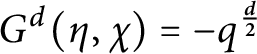 $G^{d}(\eta , \chi )=-q^{\frac {d}{2}}$
provided that
$G^{d}(\eta , \chi )=-q^{\frac {d}{2}}$
provided that $q\equiv 3\mod {4}$
and
$q\equiv 3\mod {4}$
and $d=4k+2.$
Now the statement of Lemma 2.2 follows by a simple change of variables (namely, we replace
$d=4k+2.$
Now the statement of Lemma 2.2 follows by a simple change of variables (namely, we replace $1/4r$
by r).▪
$1/4r$
by r).▪
We are now ready to give a proof of Theorem 1.3.
2.3 Proof of Theorem 1.3
Assume that $q\equiv 3\mod {4}$
and
$q\equiv 3\mod {4}$
and $d=4k+2$
for
$d=4k+2$
for $k\in \mathbb N.$
By the nesting properties of
$k\in \mathbb N.$
By the nesting properties of $L^{p}$
-norms, we only need to prove the following extension estimate for
$L^{p}$
-norms, we only need to prove the following extension estimate for $S_{0}:$
 $$ \begin{align*} \|(fd\sigma)^\vee\|_{L^{\frac{2d+4}{d}}(\mathbb F_{q}^{d}, dm)} \ll \|f\|_{L^{2}(S_{0}, d\sigma)}. \end{align*} $$
By duality, it suffices to establish the following restriction estimate for $S_{0}$
:
$S_{0}$
:
 $$ \begin{align*} \|\widehat{g}\|_{L^{2}(S_{0}, d\sigma)} \ll \|g\|_{L^{\frac{2d+4}{d+4}}(\mathbb F_{q}^{d}, dm)} := \Big( \sum_{m\in \mathbb F_{q}^{d}} |g(m)|^{\frac{2d+4}{d+4}} \Big)^{\frac{d+4}{2d+4}}. \end{align*} $$
Normalizing the functions g, it suffices to show that $\|\widehat {g}\|_{L^{2}(S_{0}, d\sigma )} \ll 1$
for all functions g on
$\|\widehat {g}\|_{L^{2}(S_{0}, d\sigma )} \ll 1$
for all functions g on $\mathbb F_{q}^{d}$
such that
$\mathbb F_{q}^{d}$
such that
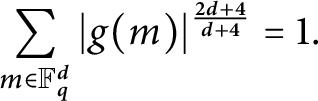 $$ \begin{align} \sum_{m\in \mathbb F_{q}^{d}} |g(m)|^{\frac{2d+4}{d+4}}=1. \end{align} $$
Without loss of generality, we can assume that the function g takes the following form: for $i=0,1, \ldots , L\ll \log {q},$
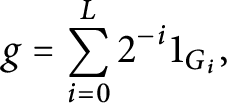 $$ \begin{align} g=\sum_{i=0}^{L} 2^{-i} 1_{G_{i}}, \end{align} $$
where $\{G_{i}\}$
is a collection of pairwise disjoint subsets of
$\{G_{i}\}$
is a collection of pairwise disjoint subsets of $\mathbb F_{q}^{d}.$
From (2.5) and (2.6), we can also assume that $ \sum _{i=0}^{L} 2^{-\frac {2d+4}{d+4}i} |G_{i}| =1.$
This clearly implies that
$ \sum _{i=0}^{L} 2^{-\frac {2d+4}{d+4}i} |G_{i}| =1.$
This clearly implies that
 $$ \begin{align} |G_{i}|\le 2^{\frac{2d+4}{d+4} i} \quad \text{for all }i=0,1,2, \ldots, L. \end{align} $$
In summary, our task is to prove that $ \|\widehat {g}\|_{L^{2}(S_{0}, d\sigma )} \ll 1 $
for any function g such that for
$ \|\widehat {g}\|_{L^{2}(S_{0}, d\sigma )} \ll 1 $
for any function g such that for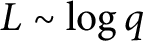 $L \sim \log {q}$
and a collection
$L \sim \log {q}$
and a collection $\{G_{i}\}$
of pairwise disjoint subsets of
$\{G_{i}\}$
of pairwise disjoint subsets of $\mathbb F_{q}^{d},$
one can write
$\mathbb F_{q}^{d},$
one can write $ g=\sum _{i=0}^{L} 2^{-i} 1_{G_{i}}$
with (2.7).
$ g=\sum _{i=0}^{L} 2^{-i} 1_{G_{i}}$
with (2.7).
We have
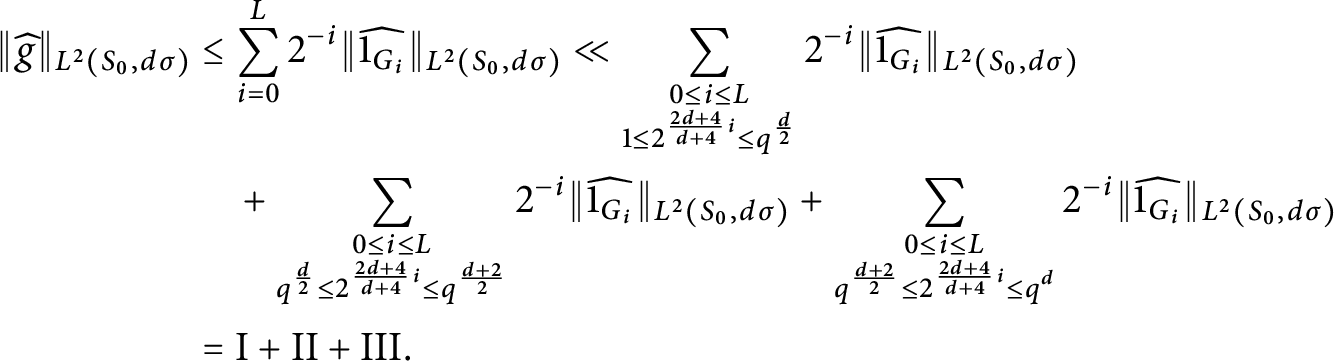 $$ \begin{align*} \|\widehat{g}\|_{L^{2}(S_{0}, d\sigma)} &\le \sum_{i=0}^{L} 2^{-i} \|\widehat{1_{G_{i}}}\|_{L^{2}(S_{0}, d\sigma)} \ll \sum_{\substack{0\le i\le L\\ 1\le 2^{\frac{2d+4}{d+4} i}\le q^{\frac{d}{2}}}} 2^{-i} \|\widehat{1_{G_{i}}}\|_{L^{2}(S_{0}, d\sigma)}\\ &\quad + \sum_{\substack{0\le i\le L\\ q^{\frac{d}{2}}\le 2^{\frac{2d+4}{d+4} i}\le q^{\frac{d+2}{2}}}} 2^{-i} \|\widehat{1_{G_{i}}}\|_{L^{2}(S_{0}, d\sigma)} + \sum_{\substack{0\le i\le L\\ q^{\frac{d+2}{2}}\le 2^{\frac{2d+4}{d+4} i}\le q^{d}}} 2^{-i} \|\widehat{1_{G_{i}}}\|_{L^{2}(S_{0}, d\sigma)} \\ & = \mbox{I} + \mbox{II} +\mbox{III}. \end{align*} $$
Using Lemma 2.1 with (2.7), we get
 $$ \begin{align*} \mbox{I} &\ll \sum_{\substack{0\le i\le L\\ 1\le 2^{\frac{2d+4}{d+4} i}\le q^{\frac{d}{2}}}} 2^{-i} |G_{i}|^{\frac{1}{2}} \ll \sum_{\substack{0\le i\le L\\ 1\le 2^{\frac{2d+4}{d+4} i}\le q^{\frac{d}{2}}}} 2^{-i}2^{\frac{d+2}{d+4} i} \ll 1, \\ \mbox{II} &\ll \sum_{\substack{0\le i\le L\\q^{\frac{d}{2}}\le 2^{\frac{2d+4}{d+4} i}\le q^{\frac{d+2}{2}}}} 2^{-i} q^{-\frac{d}{4}}|G_{i}| \ll q^{-\frac{d}{4}}\sum_{\substack{0\le i\le L\\ q^{\frac{d}{2}} \le 2^{\frac{2d+4}{d+4} i}\le q^{\frac{d+2}{2}}}} 2^{-i}2^{\frac{2d+4}{d+4} i} \ll q^{-\frac{d}{4}} q^{\frac{d}{4}} = 1\\ &\text{and}\\ \mbox{III} &\ll \sum_{\substack{0\le i\le L\\ q^{\frac{d+2}{2}}\le 2^{\frac{2d+4}{d+4} i}\le q^{d}}} 2^{-i} q^{\frac{1}{2}} |G_{i}|^{\frac{1}{2}} \ll q^{\frac{1}{2}} \sum_{\substack{0\le i\le L\\q^{\frac{d+2}{2}}\le 2^{\frac{2d+4}{d+4} i}\le q^{d}}} 2^{-i}2^{\frac{d+2}{d+4} i} \ll q^{\frac{1}{2}}q^{-\frac{1}{2}}=1. \end{align*} $$
Thus, we complete the proof.
3 Sharp
$\text{L}^{\text{p}}\to \text{L}^{\text{4}}$
Extension Estimate for Spheres of Non-zero Radii (Theorem 1.5)
One of key steps in the proof of Theorem 1.5 is the following lemma on an additive energy estimate of a set on spheres.
Lemma 3.1 Let $S_{j}$
be the sphere with non-zero radius
$S_{j}$
be the sphere with non-zero radius $j\ne 0$
in
$j\ne 0$
in $\mathbb {F}_{q}^{d}$
with
$\mathbb {F}_{q}^{d}$
with $d\ge 4$
even. For
$d\ge 4$
even. For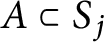 $A\subset S_{j}$
, let
$A\subset S_{j}$
, let $E(A)$
be the number of tuples
$E(A)$
be the number of tuples $(a, b, c, d)\in A^{4}$
such that
$(a, b, c, d)\in A^{4}$
such that $a+b=c+d.$
Then we have
$a+b=c+d.$
Then we have
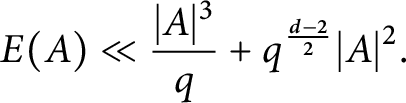 $$ \begin{align*} E(A)\ll \frac{|A|^{3}}{q}+q^{\frac{d-2}{2}}|A|^{2}. \end{align*} $$
We will see later in subsection 3.1 that spheres $S_{j}$
actually contain an affine subspace H of dimension
$S_{j}$
actually contain an affine subspace H of dimension $\frac {d-2}{2}$
. Therefore, by taking
$\frac {d-2}{2}$
. Therefore, by taking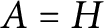 $A=H$
, we have
$A=H$
, we have $E(A)=|A|^{3}=q^{\frac {d-2}{2}}|A|^{2}$
. In other words, Lemma 3.1 is optimal up to a constant factor.
$E(A)=|A|^{3}=q^{\frac {d-2}{2}}|A|^{2}$
. In other words, Lemma 3.1 is optimal up to a constant factor.
Note that over prime fields, Rudnev [Reference Rudnev17] derived the following estimate for sets on non-zero radius spheres in only three and four dimensions:
 $$ \begin{align*} E(A) \ll \frac{|A|^{3}}{q}+|A|^{\frac{5}{2}} + |A|k_{0}^{2} + |A|^{2} k_{0}, \end{align*} $$
where $k_{0}$
denotes the maximal number of points of A lying on an isotropic line.
$k_{0}$
denotes the maximal number of points of A lying on an isotropic line.
The main challenge in the proof of Lemma 3.1 is to give an optimal upper bound on the number of pairs $(x, y)\in A\times A$
such that
$(x, y)\in A\times A$
such that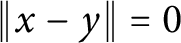 $\|x-y\|=0$
. Since A is a set on
$\|x-y\|=0$
. Since A is a set on $S_{j}$
, the equation
$S_{j}$
, the equation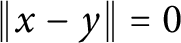 $\|x-y\|=0$
is equivalent to
$\|x-y\|=0$
is equivalent to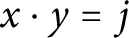 $x\cdot y=j$
. When d is small, the problem can be handled by combinatorial arguments. However, when d is large, the problem becomes difficult.
$x\cdot y=j$
. When d is small, the problem can be handled by combinatorial arguments. However, when d is large, the problem becomes difficult.
It is not hard to construct a set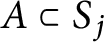 $A\subset S_{j}$
with many pairs of zero distance. Indeed, suppose
$A\subset S_{j}$
with many pairs of zero distance. Indeed, suppose $d=4k+2$
, and the subspace
$d=4k+2$
, and the subspace $\mathbb {F}_{q}^{d-2}\times \{0\}\times \{0\}$
contains
$\mathbb {F}_{q}^{d-2}\times \{0\}\times \{0\}$
contains $\frac {d-2}{2}$
vectors that are mutually orthogonal (see [Reference Hart, Iosevich, Koh and Rudnev6] for a detailed proof). Let
$\frac {d-2}{2}$
vectors that are mutually orthogonal (see [Reference Hart, Iosevich, Koh and Rudnev6] for a detailed proof). Let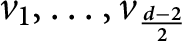 $v_{1}, \ldots , v_{\frac {d-2}{2}}$
be such vectors. If we change the last coordinate of each
$v_{1}, \ldots , v_{\frac {d-2}{2}}$
be such vectors. If we change the last coordinate of each $v_{i}$
from
$v_{i}$
from $0$
to j for all
$0$
to j for all $1\le i\le (d-2)/2$
, then we have
$1\le i\le (d-2)/2$
, then we have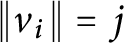 $\|v_{i}\|=j$
and
$\|v_{i}\|=j$
and $\|v_{i}-v_{i'}\|=0$
for all
$\|v_{i}-v_{i'}\|=0$
for all $i\ne i'$
. Let A be the subspace spanned by these changed
$i\ne i'$
. Let A be the subspace spanned by these changed $v_{i}$
,
$v_{i}$
,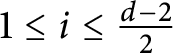 $1\le i\le \frac {d-2}{2}$
; then we have
$1\le i\le \frac {d-2}{2}$
; then we have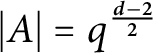 $|A|=q^{\frac {d-2}{2}}$
and the number of pairs
$|A|=q^{\frac {d-2}{2}}$
and the number of pairs $(x, y)\in A\times A$
such that
$(x, y)\in A\times A$
such that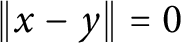 $\|x-y\|=0$
is
$\|x-y\|=0$
is $|A|^{2}$
.
$|A|^{2}$
.
Thanks to the following result due to the first and second authors in [Reference Iosevich and Koh8], we have an optimal bound on the number of pairs $(x, y)\in A\times A$
such that
$(x, y)\in A\times A$
such that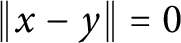 $\|x-y\|=0$
.
$\|x-y\|=0$
.
Lemma 3.2 ([Reference Iosevich and Koh8, Theorem 5])
Let $S_{j}$
be the sphere in
$S_{j}$
be the sphere in $\mathbb F_{q}^{d}.$
If
$\mathbb F_{q}^{d}.$
If $d\ge 4$
is even and A is any subset of
$d\ge 4$
is even and A is any subset of $S_{j}$
with
$S_{j}$
with $j\ne 0$
, then we have
$j\ne 0$
, then we have
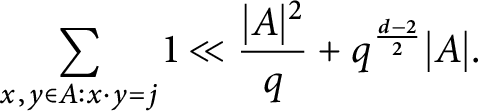 $$ \begin{align*} \sum_{x, y\in A: x\cdot y=j} 1 \ll \frac{|A|^{2}}{q} + q^{\frac{d-2}{2}} |A|. \end{align*} $$
The following lemmas are also important in the proof of Lemma 3.1.
Lemma 3.3 Let $\mathcal {P}$
be a paraboloid in
$\mathcal {P}$
be a paraboloid in $\mathbb {F}_{q}^{d+1}$
. Suppose that
$\mathbb {F}_{q}^{d+1}$
. Suppose that $\mathcal {A}$
and
$\mathcal {A}$
and $\mathcal {B}$
are subsets in P with the property that there are no two points
$\mathcal {B}$
are subsets in P with the property that there are no two points $x=(x', \|x'\|)$
and
$x=(x', \|x'\|)$
and $y=(y', \|y'\|)$
in
$y=(y', \|y'\|)$
in $\mathcal {A}$
such that
$\mathcal {A}$
such that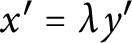 $x'=\lambda y'$
with
$x'=\lambda y'$
with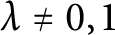 $\lambda \ne 0, 1$
. Then the number of pairs
$\lambda \ne 0, 1$
. Then the number of pairs $(\alpha , \beta )\in \mathcal {A}\times \mathcal {B}$
with
$(\alpha , \beta )\in \mathcal {A}\times \mathcal {B}$
with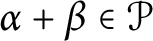 $\alpha +\beta \in \mathcal {P}$
is bounded by
$\alpha +\beta \in \mathcal {P}$
is bounded by $\sim $
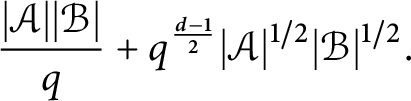 $$ \begin{align*} \frac{|\mathcal{A}||\mathcal{B}|}{q}+q^{\frac{d-1}{2}}|{\mathcal A}|^{1/2} |{\mathcal B}|^{1/2}. \end{align*} $$
Proof For $\alpha \in \mathcal {A}$
and
$\alpha \in \mathcal {A}$
and $\beta \in \mathcal {B}$
, we write
$\beta \in \mathcal {B}$
, we write $\alpha =({\alpha }', \|{\alpha }'\|)$
and
$\alpha =({\alpha }', \|{\alpha }'\|)$
and $\beta =({\beta }', \|{\beta }'\|)$
.
$\beta =({\beta }', \|{\beta }'\|)$
.
It is clear that if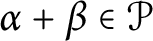 $\alpha +\beta \in \mathcal {P}$
, then we have
$\alpha +\beta \in \mathcal {P}$
, then we have
 $$ \begin{align*} \|{\alpha}'+{\beta}'\|= \|{\alpha}'\|+\|{\beta}'\|. \end{align*} $$
This implies that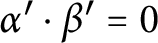 ${\alpha }'\cdot {\beta }'=0$
.
${\alpha }'\cdot {\beta }'=0$
.
Note that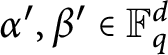 ${\alpha }', {\beta }'\in \mathbb {F}_{q}^{d}$
. Let
${\alpha }', {\beta }'\in \mathbb {F}_{q}^{d}$
. Let ${\mathcal A}'$
and
${\mathcal A}'$
and ${\mathcal B}'$
be the projections of
${\mathcal B}'$
be the projections of $\mathcal {A}$
and
$\mathcal {A}$
and $\mathcal {B}$
on
$\mathcal {B}$
on $\mathbb {F}_{q}^{d}$
, respectively. Let N be the number of pairs
$\mathbb {F}_{q}^{d}$
, respectively. Let N be the number of pairs $({\alpha }', {\beta }')\in {\mathcal A}'\times {\mathcal B}'$
such that
$({\alpha }', {\beta }')\in {\mathcal A}'\times {\mathcal B}'$
such that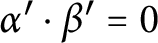 ${\alpha }'\cdot {\beta }'=0$
.
${\alpha }'\cdot {\beta }'=0$
.
To each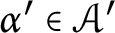 ${\alpha }'\in {\mathcal A}'$
, we assign a hyperplane in
${\alpha }'\in {\mathcal A}'$
, we assign a hyperplane in $\mathbb {F}_{q}^{d}$
defined by the equation
$\mathbb {F}_{q}^{d}$
defined by the equation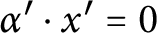 ${\alpha }'\cdot x'=0$
. Let H be the set of all corresponding hyperplanes in
${\alpha }'\cdot x'=0$
. Let H be the set of all corresponding hyperplanes in $\mathbb F_{q}^{d}$
. It follows from the assumption of the lemma that all hyperplanes in H are distinct. So we have
$\mathbb F_{q}^{d}$
. It follows from the assumption of the lemma that all hyperplanes in H are distinct. So we have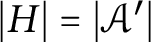 $|H|=|{\mathcal A}'|$
.
$|H|=|{\mathcal A}'|$
.
It is clear that N is equal to the number of incidences between hyperplanes in H and points in ${\mathcal B}'$
, denoted by
${\mathcal B}'$
, denoted by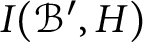 $I({\mathcal B}', H)$
. One can apply a point-plane incidence theorem due to Vinh in [Reference Vinh22] to achieve the following:
$I({\mathcal B}', H)$
. One can apply a point-plane incidence theorem due to Vinh in [Reference Vinh22] to achieve the following:
 $$ \begin{align*} I({\mathcal B}', H)\le \frac{|{\mathcal B}'||H|}{q}+q^{\frac{d-1}{2}}\sqrt{|{\mathcal B}'||H|}=\frac{|{\mathcal A}'||{\mathcal B}'|}{q}+q^{\frac{d-1}{2}}\sqrt{|{\mathcal A}'||{\mathcal B}'|}. \end{align*} $$
Using the fact that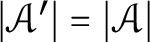 $|{\mathcal A}'|=|\mathcal {A}|$
and
$|{\mathcal A}'|=|\mathcal {A}|$
and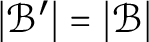 $|{\mathcal B}'|=|{\mathcal B}|$
, the lemma follows.▪
$|{\mathcal B}'|=|{\mathcal B}|$
, the lemma follows.▪
Lemma 3.4 Suppose that $S_{j}$
is the sphere centered at the origin of radius
$S_{j}$
is the sphere centered at the origin of radius $j\ne 0$
. Then there are no three distinct points
$j\ne 0$
. Then there are no three distinct points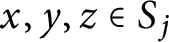 $x, y, z\in S_{j}$
such that
$x, y, z\in S_{j}$
such that
 $$ \begin{align*} x-z=\lambda (y-z) \end{align*} $$
with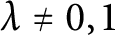 $\lambda \ne 0, 1$
and
$\lambda \ne 0, 1$
and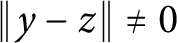 $\|y-z\|\ne 0$
.
$\|y-z\|\ne 0$
.
Proof Indeed, if there exist such points, this means that $x, y, z$
lie on both a line and
$x, y, z$
lie on both a line and $S_{j}$
, and the norm of its direction vector is non-zero. This is impossible, because the line intersects
$S_{j}$
, and the norm of its direction vector is non-zero. This is impossible, because the line intersects $S_{j}$
in at most
$S_{j}$
in at most $2$
points.▪
$2$
points.▪
Proof of Lemma 3.1 Since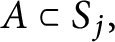 $A\subset S_{j},$
it is clear that the number of tuples
$A\subset S_{j},$
it is clear that the number of tuples $(x, y, z, t)\in A^{4}$
with
$(x, y, z, t)\in A^{4}$
with $x+y=z+t$
is at most the number of triples
$x+y=z+t$
is at most the number of triples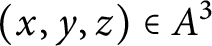 $(x, y, z)\in A^{3}$
such that
$(x, y, z)\in A^{3}$
such that $x+y-z\in S_{j}$
. In other words, if
$x+y-z\in S_{j}$
. In other words, if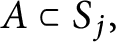 $A\subset S_{j},$
then
$A\subset S_{j},$
then
 $$ \begin{align} E(A)\le \sum_{x\in A} \sum_{y\in A} \sum_{z\in A} 1_{S_{j}}(x+y-z). \end{align} $$
It is observed in [Reference Rudnev17] that if $x,y,z\in A\subset S_{j}$
with
$x,y,z\in A\subset S_{j}$
with $x+y-z\in S_{j},$
then
$x+y-z\in S_{j},$
then $(x-z)\cdot (y-z)=0.$
Indeed, suppose that
$(x-z)\cdot (y-z)=0.$
Indeed, suppose that $x,y,z\in A\subset S_{j}$
and
$x,y,z\in A\subset S_{j}$
and $x+y-z\in S_{j}.$
Then it satisfies that
$x+y-z\in S_{j}.$
Then it satisfies that
 $$ \begin{align*} \|x+y-z\|=j. \end{align*} $$
Namely, we have
 $$ \begin{align*} \|x\|+ \|y\|+ \|z\| +2x\cdot y-2y\cdot z-2x\cdot z=j, \end{align*} $$
which is equivalent to
 $$ \begin{align*} \|x\|+\|y\|+\|z\|+2y\cdot(x-z)-2x\cdot z=j. \end{align*} $$
Since $\|x\|=\|y\|=\|z\| =j,$
we obtain
$\|x\|=\|y\|=\|z\| =j,$
we obtain
 $$ \begin{align*} y\cdot(x-z)-x\cdot z=-j, \end{align*} $$
which can be rewritten as
 $$ \begin{align*} y\cdot(x-z)-x\cdot z=-z\cdot z, \end{align*} $$
because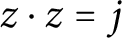 $z\cdot z=j$
for
$z\cdot z=j$
for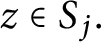 $z\in S_{j}.$
Namely, it satisfies that
$z\in S_{j}.$
Namely, it satisfies that
 $$ \begin{align*} (x-z)\cdot (y-z)=0. \end{align*} $$
From (3.1) and this fact, in order to complete the proof of Lemma 3.1, it will be enough to show that
 $$ \begin{align*} \sum_{x,y,z\in A: (x-z)\cdot (y-z)=0} 1 \ll \frac{|A|^{3}}{q}+q^{\frac{d-2}{2}}|A|^{2}. \end{align*} $$
We now consider two cases.
Case 1: We count the number of triples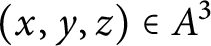 $(x, y, z)\in A^{3}$
with the desired property such that
$(x, y, z)\in A^{3}$
with the desired property such that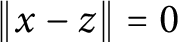 $\|x-z\|=0$
or
$\|x-z\|=0$
or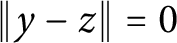 $\|y-z\|=0$
.
$\|y-z\|=0$
.
Since $\|a-b\|=2j-2a\cdot b$
for
$\|a-b\|=2j-2a\cdot b$
for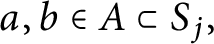 $a,b\in A\subset S_{j},$
it follows from Lemma 3.2 that the number of pairs
$a,b\in A\subset S_{j},$
it follows from Lemma 3.2 that the number of pairs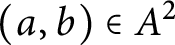 $(a, b)\in A^{2}$
with
$(a, b)\in A^{2}$
with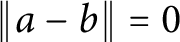 $\|a-b\|=0$
is bounded by
$\|a-b\|=0$
is bounded by $\sim (|A|^{2}/q+q^{(d-2)/2}|A|)$
. Thus, the number of such triples is bounded by the quantity similar to
$\sim (|A|^{2}/q+q^{(d-2)/2}|A|)$
. Thus, the number of such triples is bounded by the quantity similar to
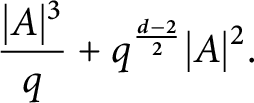 $$ \begin{align*} \frac{|A|^{3}}{q}+q^{\frac{d-2}{2}}|A|^{2}. \end{align*} $$
Case 2: For each fixed $z\in A$
, we will count the number of triples
$z\in A$
, we will count the number of triples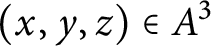 $(x, y, z)\in A^{3}$
with the desired property that
$(x, y, z)\in A^{3}$
with the desired property that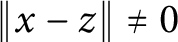 $\|x-z\|\ne 0$
and
$\|x-z\|\ne 0$
and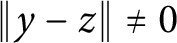 $\|y-z\|\ne 0$
.
$\|y-z\|\ne 0$
.
For a fixed $z\in A,$
define
$z\in A,$
define
 $$ \begin{align*} X&:=\big\{(x-z, \|x-z\|)\colon x\in A, \|x-z\|\ne 0\big\}\\ &\text{and}\\ Y&:=\big\{(y-z, \|y-z\|)\colon y\in A, \|y-z\|\ne 0\big\} \end{align*} $$
as subsets in a paraboloid in $\mathbb {F}_{q}^{d+1}$
.
$\mathbb {F}_{q}^{d+1}$
.
We observe that if $(x-z)\cdot (y-z)=0$
, then we have
$(x-z)\cdot (y-z)=0$
, then we have
 $$ \begin{align*} \big(x-z, \|x-z\|\big)+\big(y-z, \|y-z\|\big)\in {\mathcal P}, \end{align*} $$
where ${\mathcal P}$
denotes the paraboloid in
${\mathcal P}$
denotes the paraboloid in $\mathbb F_{q}^{d+1}.$
Thus, we may reduce the problem to counting the number of pairs
$\mathbb F_{q}^{d+1}.$
Thus, we may reduce the problem to counting the number of pairs $(\alpha , \beta )\in X\times Y$
such that
$(\alpha , \beta )\in X\times Y$
such that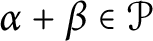 $\alpha +\beta \in {\mathcal P}$
. We denote this number by
$\alpha +\beta \in {\mathcal P}$
. We denote this number by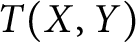 $T(X, Y)$
. We also see that the condition
$T(X, Y)$
. We also see that the condition $(x-z)\cdot (y-z)=0$
implies
$(x-z)\cdot (y-z)=0$
implies $(x-z)\cdot (\lambda y-\lambda z)=0$
for any
$(x-z)\cdot (\lambda y-\lambda z)=0$
for any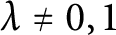 $\lambda \ne 0, 1$
. It follows from Lemma 3.4 that there are no two pairs
$\lambda \ne 0, 1$
. It follows from Lemma 3.4 that there are no two pairs $(x,z), (y, z)\in A^{2}$
such that
$(x,z), (y, z)\in A^{2}$
such that $x-z=\lambda (y-z)$
with
$x-z=\lambda (y-z)$
with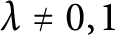 $\lambda \ne 0,1$
. Thus, for each fixed
$\lambda \ne 0,1$
. Thus, for each fixed $z\in A,$
we can define a new set
$z\in A,$
we can define a new set
 $$ \begin{align*} Y':=\big\{(\lambda (y-z), \lambda^{2}\|y-z\|)\colon y\in A, \|y-z\|\ne 0, \lambda \ne 0, 1 \big\}. \end{align*} $$
It is clear that $|Y'|=(q-2)|Y|$
and
$|Y'|=(q-2)|Y|$
and $(q-2)T(X, Y)= T(X, Y')$
. Note that the set
$(q-2)T(X, Y)= T(X, Y')$
. Note that the set $Y'$
satisfies the condition of Lemma 3.3. Therefore, we can apply Lemma 3.3 to obtain that
$Y'$
satisfies the condition of Lemma 3.3. Therefore, we can apply Lemma 3.3 to obtain that
 $$ \begin{align*} T(X, Y')\ll \frac{(q-2)|A|^{2}}{q}+q^{\frac{d-1}{2}}|A|^{1/2}|Y'|^{1/2}, \end{align*} $$
where we have used the fact that $|X|=|Y|\le |A|.$
Hence,
$|X|=|Y|\le |A|.$
Hence, $T(X, Y)\ll \frac {|A|^{2}}{q}+q^{\frac {d-2}{2}}|A|.$
Summing over all
$T(X, Y)\ll \frac {|A|^{2}}{q}+q^{\frac {d-2}{2}}|A|.$
Summing over all $z\in A$
, we obtain the desired estimate. Thus, the proof of Lemma 3.1 is complete.▪
$z\in A$
, we obtain the desired estimate. Thus, the proof of Lemma 3.1 is complete.▪
As a consequence of Lemma 3.1, we have the following weak-type $L^{4}$
extension estimate, which will be used in the proof of Theorem 1.5.
$L^{4}$
extension estimate, which will be used in the proof of Theorem 1.5.
Lemma 3.5 Let $d\sigma $
denote the normalized surface measure on the sphere
$d\sigma $
denote the normalized surface measure on the sphere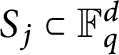 $S_{j} \subset \mathbb F_{q}^{d}$
with non-zero radius
$S_{j} \subset \mathbb F_{q}^{d}$
with non-zero radius $j\ne 0.$
If
$j\ne 0.$
If $d\ge 4$
is even and
$d\ge 4$
is even and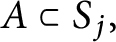 $A\subset S_{j},$
then we have
$A\subset S_{j},$
then we have
 $$ \begin{align*} \|(1_Ad\sigma)^\vee\|_{L^{4}(\mathbb F_{q}^{d}, dm)} \ll \left\{\begin{array}{ll} q^{\frac{-3d+3}{4}} |A|^{\frac{3}{4}} &\text{for} \text{q}^{\frac{\text{d}}{2}} \le |\text{A}|\ll \text{q}^{\text{d}-1},\\ q^{\frac{-5d+6}{8}} |A|^{\frac{1}{2}} &\text{for} \text{q}^{\frac{\text{d}-2}{2}} \le |\text{A}|\le \text{q}^{\frac{\text{d}}{2}},\\ q^{\frac{-3d+4}{4}}|A|^{\frac{3}{4}} &\text{for} \le |\text{A}|\le \text{q}^{\frac{\text{d}-2}{2}}, \end{array}\right. \end{align*} $$
Proof By expanding $\|(1_Ad\sigma )^\vee \|_{L^{4}(\mathbb F_{q}^{d}, dm)}$
and applying the orthogonality property of
$\|(1_Ad\sigma )^\vee \|_{L^{4}(\mathbb F_{q}^{d}, dm)}$
and applying the orthogonality property of $\chi $
, we see
$\chi $
, we see
 $$ \begin{align*} \|(1_Ad\sigma)^\vee\|_{L^{4}(\mathbb F_{q}^{d}, dm)} =\frac{q^{\frac{d}{4}}}{|S_{j}|} E(A)^{1/4} \sim q^{\frac{-3d+4}{4}}E(A)^{1/4}, \end{align*} $$
where $E(A)=\sum _{a,b,c,d\in A: a+b=c+d} 1.$
When
$E(A)=\sum _{a,b,c,d\in A: a+b=c+d} 1.$
When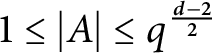 $1\le |A|\le q^{\frac {d-2}{2}}$
, we use the trivial estimate that
$1\le |A|\le q^{\frac {d-2}{2}}$
, we use the trivial estimate that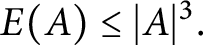 $E(A)\le |A|^{3}.$
On the other hand, when
$E(A)\le |A|^{3}.$
On the other hand, when $ q^{\frac {d-2}{2}} \le |A|\ll q^{d-1},$
applying Lemma 3.1 yields the statement of Lemma 3.5 by a direct computation.▪
$ q^{\frac {d-2}{2}} \le |A|\ll q^{d-1},$
applying Lemma 3.1 yields the statement of Lemma 3.5 by a direct computation.▪
We are now ready to give a proof of Theorem 1.5.
Proof By the nesting properties of $L^{p}$
-norms, it suffices to establish the following extension estimate:
$L^{p}$
-norms, it suffices to establish the following extension estimate:
 $$ \begin{align} \|(fd\sigma)^\vee\|_{L^{4}(\mathbb F_{q}^{d}, dm)} \ll \|f\|_{L^{4d/(3d-2)}(S_{j}, d\sigma)}\sim \Big(q^{-d+1} \sum_{x\in S_{j}} |f(x)|^{\frac{4d}{3d-2}}\Big)^{\frac{3d-2}{4d}}. \end{align} $$
To prove (3.2), by normalizing functions f, it will be enough to prove
 $$ \begin{align*} \Omega:=q^{\frac{3d^{2}-5d+2}{4d}} \|(fd\sigma)^\vee\|_{L^{4}(\mathbb F_{q}^{d}, dm)} \ll 1, \end{align*} $$
assuming that
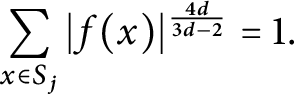 $$ \begin{align} \sum_{x\in S_{j}} |f(x)|^{\frac{4d}{3d-2}}=1. \end{align} $$
Without loss of generality, we can assume that the function f can be decomposed as follows: for $k=0,1, \ldots , L\ll \log {q},$
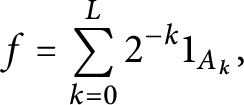 $$ \begin{align} f=\sum_{k=0}^{L} 2^{-k} 1_{A_{k}}, \end{align} $$
where $\{A_{k}\}$
is a collection of pairwise disjoint subsets of
$\{A_{k}\}$
is a collection of pairwise disjoint subsets of $S_{j}.$
From (3.3) and (3.4), we have
$S_{j}.$
From (3.3) and (3.4), we have
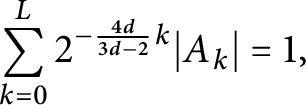 $$ \begin{align*} \sum_{k=0}^{L} 2^{-\frac{4d}{3d-2}k} |A_{k}| =1, \end{align*} $$
This implies that
 $$ \begin{align} |A_{k}|\le 2^{\frac{4d}{3d-2}k}\quad \text{for all } k=0,1,2,\ldots. \end{align} $$
It follows that
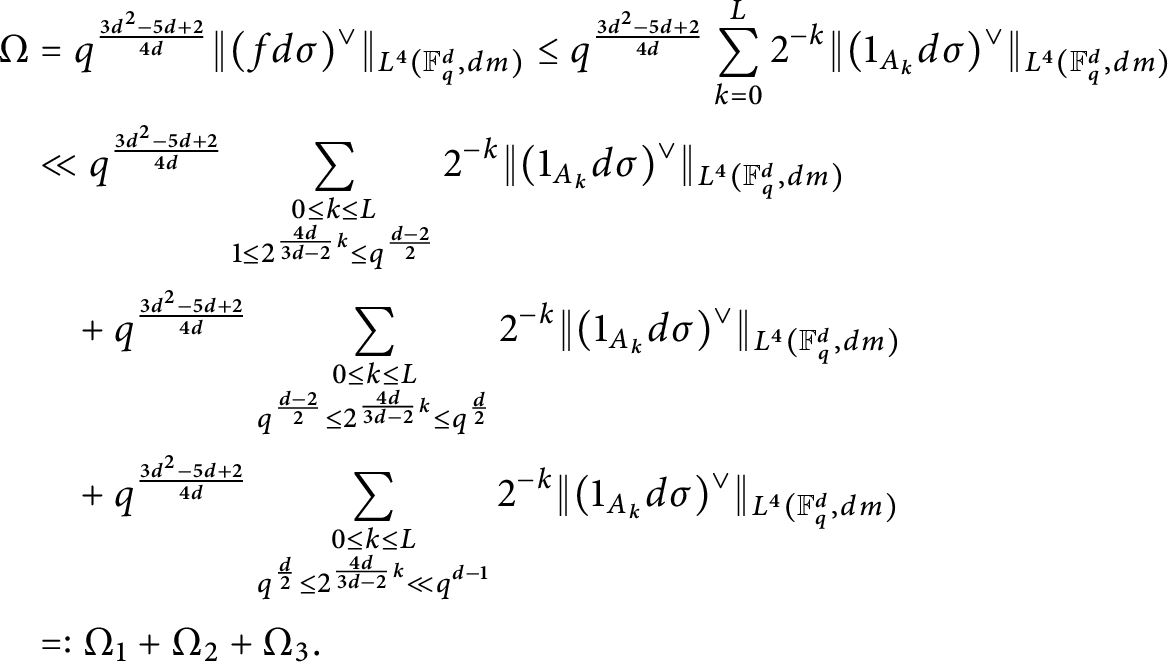 $$ \begin{align*} \Omega&=q^{\frac{3d^{2}-5d+2}{4d}} \|(fd\sigma)^\vee\|_{L^{4}(\mathbb F_{q}^{d}, dm)} \le q^{\frac{3d^{2}-5d+2}{4d}} \sum_{k=0}^{L} 2^{-k} \|(1_{A_{k}}d\sigma)^\vee\|_{L^{4}(\mathbb F_{q}^{d}, dm)}\\ &\ll q^{\frac{3d^{2}-5d+2}{4d}}\sum_{\substack{0 \leq k \leq L\\ 1\le 2^{\frac{4d}{3d-2}k} \leq q^{\frac{d-2}{2}}}} 2^{-k} \|(1_{A_{k}}d\sigma)^\vee\|_{L^{4}(\mathbb F_{q}^{d}, dm)}\\ &\quad + q^{\frac{3d^{2}-5d+2}{4d}} \sum_{\substack{0 \leq k \leq L\\ q^{\frac{d-2}{2}} \le 2^{\frac{4d}{3d-2}k} \leq q^{\frac{d}{2}}}} 2^{-k} \|(1_{A_{k}}d\sigma)^\vee\|_{L^{4}(\mathbb F_{q}^{d}, dm)}\\ &\quad +q^{\frac{3d^{2}-5d+2}{4d}}\sum_{\substack{0 \leq k \leq L\\ q^{\frac{d}{2}}\le 2^{\frac{4d}{3d-2}k} \ll q^{d-1}}} 2^{-k} \|(1_{A_{k}}d\sigma)^\vee\|_{L^{4}(\mathbb F_{q}^{d}, dm)}\\ &=: \Omega_{1} + \Omega_{2} + \Omega_{3}. \end{align*} $$
Applying Lemma 3.5 with (3.5), we have
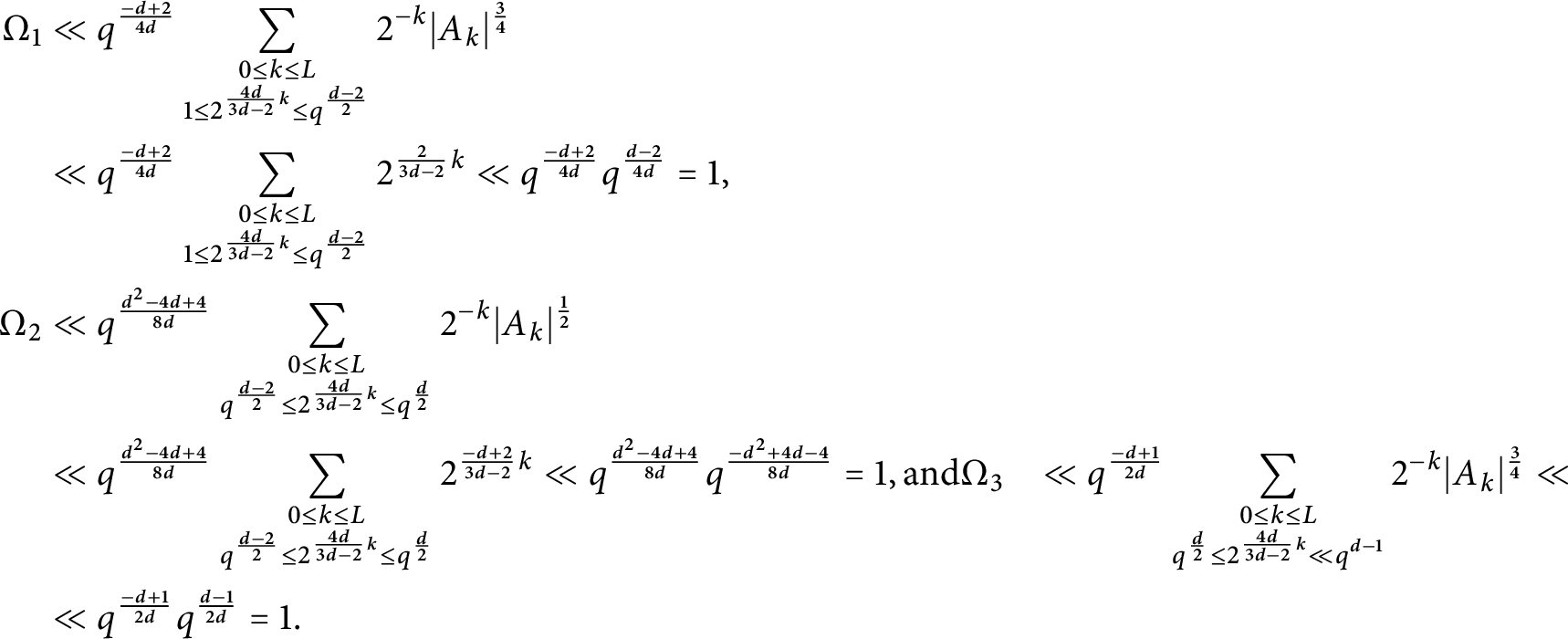 $$ \begin{align*} \Omega_{1} &\ll q^{\frac{-d+2}{4d}} \sum_{\substack{0 \leq k \leq L\\ 1\le 2^{\frac{4d}{3d-2}k} \leq q^{\frac{d-2}{2}}}} 2^{-k} |A_{k}|^{\frac{3}{4}} \\ &\ll q^{\frac{-d+2}{4d}} \sum_{\substack{0 \leq k \leq L\\ 1\le 2^{\frac{4d}{3d-2}k} \leq q^{\frac{d-2}{2}}}} 2^{\frac{2}{3d-2}k} \ll q^{\frac{-d+2}{4d}} q^{\frac{d-2}{4d}}=1,\\ \Omega_{2} &\ll q^{\frac{d^{2}-4d+4}{8d}} \sum_{\substack{0 \leq k \leq L\\ q^{\frac{d-2}{2}} \le 2^{\frac{4d}{3d-2}k} \leq q^{\frac{d}{2}}}} 2^{-k} |A_{k}|^{\frac{1}{2}} \\ &\ll q^{\frac{d^{2}-4d+4}{8d}} \sum_{\substack{0 \leq k \leq L\\ q^{\frac{d-2}{2}} \le 2^{\frac{4d}{3d-2}k} \leq q^{\frac{d}{2}}}} 2^{\frac{-d+2}{3d-2}k} \ll q^{\frac{d^{2}-4d+4}{8d}} q^{\frac{-d^{2}+4d-4}{8d}} =1,\\ &\text{and}\\ \Omega_{3} &\ll q^{\frac{-d+1}{2d}}\sum_{\substack{0 \leq k \leq L\\ q^{\frac{d}{2}}\le 2^{\frac{4d}{3d-2}k} \ll q^{d-1}}} 2^{-k} |A_{k}|^{\frac{3}{4}} \ll q^{\frac{-d+1}{2d}}\sum_{\substack{0 \leq k \leq L\\ q^{\frac{d}{2}}\le 2^{\frac{4d}{3d-2}k} \ll q^{d-1}}} 2^{\frac{2}{3d-2}k} \\&\ll q^{\frac{-d+1}{2d}} q^{\frac{d-1}{2d}} =1. \end{align*} $$
Thus, the proof is complete.▪
3.1 Sharpness of Theorem 1.5
To prove the sharpness, it will be enough from the second necessary condition in (1.2) to show that the sphere $S_{j}$
with
$S_{j}$
with $j\ne 0$
contains an affine subspace H with
$j\ne 0$
contains an affine subspace H with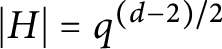 $|H|=q^{(d-2)/2}$
for even
$|H|=q^{(d-2)/2}$
for even $d\ge 4.$
It is well known from [Reference Grove4, p. 79] or [Reference Ahmadi and Mohammadian1, Theorem 1] that if d is even, then the sphere
$d\ge 4.$
It is well known from [Reference Grove4, p. 79] or [Reference Ahmadi and Mohammadian1, Theorem 1] that if d is even, then the sphere $S_{j}$
can be equivalently classified as the following variety:
$S_{j}$
can be equivalently classified as the following variety:
 $$ \begin{align} \widetilde{S_{j}}:=\{x\in \mathbb F_{q}^{d}: x_{1}^{2}-x_{2}^{2}+ \cdots+ x_{d-3}^{2}-x_{d-2}^{2} + x_{d-1}^{2}- \alpha x_{d}^{2}=j\}, \end{align} $$
where $\alpha $
takes 1 or a fixed non-square number of
$\alpha $
takes 1 or a fixed non-square number of $\mathbb F_{q}^*$
, which is determined by
$\mathbb F_{q}^*$
, which is determined by $1=\eta ((-1)^{d/2})~ \eta (\alpha )$
for the quadratic character
$1=\eta ((-1)^{d/2})~ \eta (\alpha )$
for the quadratic character $\eta $
of
$\eta $
of $\mathbb F_{q}^*.$
Hence,
$\mathbb F_{q}^*.$
Hence, $\widetilde {S_{j}}$
contains a
$\widetilde {S_{j}}$
contains a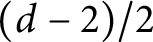 $(d-2)/2$
-dimensional affine subspace
$(d-2)/2$
-dimensional affine subspace
 $$ \begin{align*} \big\{(t_{1},t_{1}, \ldots, t_{(d-2)/2}, t_{(d-2)/2}, a, b)\in \mathbb F_{q}^{d}: t_{j}\in \mathbb F_{q}, j=1,2,\ldots, (d-2)/2\big\}, \end{align*} $$
where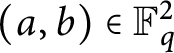 $(a,b)\in \mathbb F_{q}^{2}$
is a solution to the equation
$(a,b)\in \mathbb F_{q}^{2}$
is a solution to the equation $a^{2}-\alpha b^{2}=j\ne 0.$
Thus,
$a^{2}-\alpha b^{2}=j\ne 0.$
Thus, $S_{j}$
also contains a
$S_{j}$
also contains a $\frac {d-2}{2}$
-dimensional affine subspace. This completes the sharpness of Theorem 1.5.
$\frac {d-2}{2}$
-dimensional affine subspace. This completes the sharpness of Theorem 1.5.
A
In this appendix, we provide a proof of the duality of extension and restriction estimates for a variety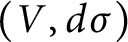 $(V, d\sigma )$
in
$(V, d\sigma )$
in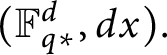 $(\mathbb F_{q*}^{d}, dx).$
More precisely, we prove the following theorem whose proof is well known in the Euclidean setting.
$(\mathbb F_{q*}^{d}, dx).$
More precisely, we prove the following theorem whose proof is well known in the Euclidean setting.
Theorem A.1 (Duality of extension and restriction estimates)
Let $1\le p, r\le \infty $
and let C be a constant. Then the following two statements are equivalent:
$1\le p, r\le \infty $
and let C be a constant. Then the following two statements are equivalent:
-
1. For all functions
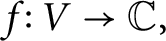
$f\colon V\to \mathbb C,$
we have
$\| (fd\sigma )^{\vee }\|_{L^{r}(\mathbb F_{q}^{d}, dm)} \le C \|f\|_{L^{p}(V, d\sigma )}.$
-
2. For all functions
$g\colon \mathbb F_{q}^{d} \to \mathbb C,$
we have
$\| \widehat {g}\|_{L^{p'}(V, d\sigma )} \le C \|g\|_{L^{r'}(\mathbb F_{q}^{d}, dm)}.$

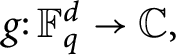

To prove the theorem, we need some definitions and notation. Given functions $f_{1}, f_{2}\colon (V, d\sigma ) \to \mathbb C$
and
$f_{1}, f_{2}\colon (V, d\sigma ) \to \mathbb C$
and $g_{1}, g_{2}\colon (\mathbb F_{q}^{d}, dm) \to \mathbb C,$
we define
$g_{1}, g_{2}\colon (\mathbb F_{q}^{d}, dm) \to \mathbb C,$
we define
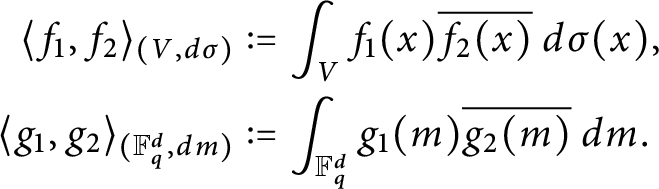 $$ \begin{align*} \langle f_{1}, f_{2}\rangle_{(V, d\sigma)}&:= \int_{V} f_{1}(x) \overline{f_{2}(x)} ~ d\sigma(x), \\ \langle g_{1}, g_{2}\rangle_{(\mathbb F_{q}^{d}, dm)}& := \int_{\mathbb F_{q}^{d}} g_{1}(m) \overline{g_{2}(m)} ~dm. \end{align*} $$
By a direct computation, it is not hard to prove that
 $$ \begin{align} \langle f, \widehat{g}\rangle _{(V, d\sigma)} = \langle (fd\sigma)^{\vee}, g \rangle _{(\mathbb F_{q}^{d}, dm)}. \end{align} $$
We also need the following lemma.
Lemma A.2 Let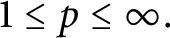 $1\leq p \le \infty .$
Then we have
$1\leq p \le \infty .$
Then we have
-
1.
$\|f\|_{L^{p}(V, d\sigma )}=\sup _{\|g\|_{L^{p'}(V, d\sigma )}\le 1} | \langle f, g\rangle _{(V, d\sigma )}|;$
-
2.
$\|g\|_{L^{p}(\mathbb F_{q}^{d}, dm)} = \sup _{\|f\|_{L^{p'}(\mathbb F_{q}^{d}, dm)}\le 1} | \langle g, f\rangle _{(\mathbb F_{q}^{d}, dm)}| .$


Proof of the first conclusion By Hölder’s inequality, we have
 $$ \begin{align*} \|f\|_{L^{p}(V, d\sigma)}\ge\sup_{\|g\|_{L^{p'}(V, d\sigma)}\le 1} | \langle f, g\rangle _{(V, d\sigma)}|. \end{align*} $$
Now, we prove the following reverse inequality:
 $$ \begin{align*} \|f\|_{L^{p}(V, d\sigma)}\le\sup_{\|g\|_{L^{p'}(V, d\sigma)}\le 1} | \langle f, g\rangle _{(V, d\sigma)}|. \end{align*} $$
Since there is nothing to prove in the case that $f\equiv 0$
, we can assume
$f\equiv 0$
, we can assume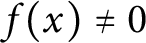 $f(x)\neq 0$
for some x in
$f(x)\neq 0$
for some x in $V.$
We consider three cases. For simplicity, the notation
$V.$
We consider three cases. For simplicity, the notation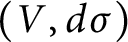 $(V ,d\sigma )$
is omitted from now on.
$(V ,d\sigma )$
is omitted from now on.
Case 1. If $p=1,$
then
$p=1,$
then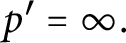 $p'=\infty .$
In this case, we take
$p'=\infty .$
In this case, we take
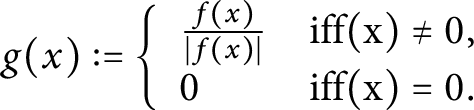 $$ \begin{align*} g(x):= \left\{\begin{array}{ll} \frac{{f(x)}}{|f(x)|} & \text{if} \text{f}(\text{x}) \neq 0,\\ 0 & \text{if} \text{f}(\text{x})=0. \end{array}\right. \end{align*} $$
Then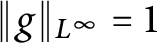 $\|g\|_{L^\infty }=1$
and
$\|g\|_{L^\infty }=1$
and $|\langle f, g\rangle |=\|f\|_{L^{1}}$
.
$|\langle f, g\rangle |=\|f\|_{L^{1}}$
.
Case 2. If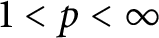 $1< p < \infty $
, then
$1< p < \infty $
, then $1< p'=p/(p-1) <\infty .$
We choose
$1< p'=p/(p-1) <\infty .$
We choose
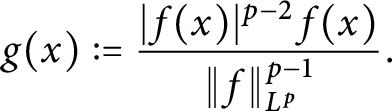 $$ \begin{align*} g(x):=\frac{|f(x)|^{p-2}{f(x)}}{\|f\|_{L^{p}}^{p-1}}. \end{align*} $$
It is not hard to check that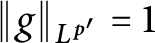 $\|g\|_{L^{p'}}=1$
and
$\|g\|_{L^{p'}}=1$
and $ | \langle f, g\rangle |=\|f\|_{L^{p}}$
.
$ | \langle f, g\rangle |=\|f\|_{L^{p}}$
.
Case 3. If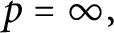 $p=\infty ,$
then
$p=\infty ,$
then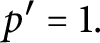 $p'=1.$
Let
$p'=1.$
Let $x_{0}$
be an element in V such that
$x_{0}$
be an element in V such that
 $$ \begin{align*} |f(x_{0})|=\max_{x\in V} |f(x)|. \end{align*} $$
In other words, $|f(x_{0})|=\|f\|_{\infty }.$
We set
$|f(x_{0})|=\|f\|_{\infty }.$
We set
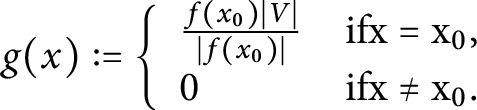 $$ \begin{align*} g(x):= \left\{\begin{array}{ll} \frac{{f(x_{0})}|V|}{|f(x_{0})|} & \text{if} \text{x}=\text{x}_{0},\\ 0 & \text{if} \text{x}\ne \text{x}_{0}. \end{array}\right. \end{align*} $$
Then we have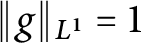 $\|g\|_{L^{1}}=1$
and
$\|g\|_{L^{1}}=1$
and $| \langle f, g\rangle |=|f(x_{0})|=\|f\|_{L^\infty }.$
We have completed the proof of the first part of the lemma. The second part of Lemma A.2 is almost identical to that of the first part, except we use the counting measure $dm$
and
$dm$
and $\mathbb F_{q}^{d}$
in the place of
$\mathbb F_{q}^{d}$
in the place of $d\sigma $
and
$d\sigma $
and $V.$
In fact, Lemma A.2 holds for any measure spaces in the finite field setting.▪
$V.$
In fact, Lemma A.2 holds for any measure spaces in the finite field setting.▪
We are ready to prove Theorem A.1.
(Case 1) Assume that the first part of Theorem A.1 holds. Then, using the first conclusion of Lemma A.2, the equality (A.1), Hölder’s inequality, and our assumption, we obtain the statement of the second part of Theorem A.1 as follows:
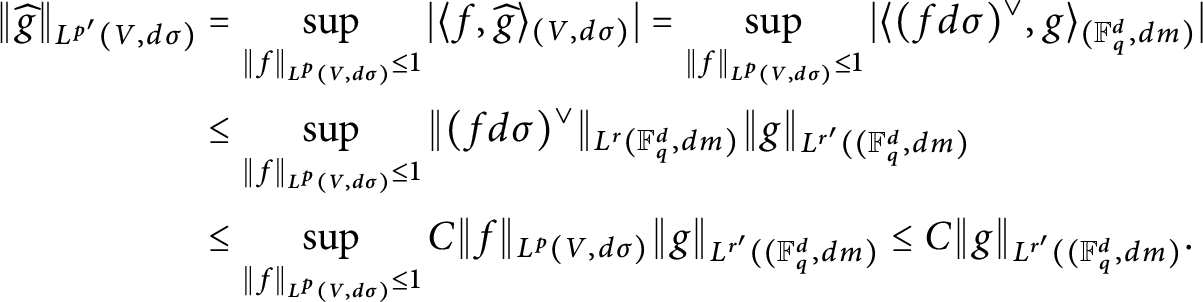 $$ \begin{align*} \| \widehat{g}\|_{L^{p'}(V, d\sigma)} &=\sup_{\|f\|_{L^{p}(V, d\sigma)} \le 1} | \langle f, \widehat{g}\rangle_{(V, d\sigma)}| =\sup_{\|f\|_{L^{p}(V, d\sigma)} \le 1} |\langle(fd\sigma)^{\vee}, g\rangle_{(\mathbb F_{q}^{d}, dm)}|\\ &\le \sup_{\|f\|_{L^{p}(V, d\sigma)} \le 1} \| (fd\sigma)^{\vee}\|_{L^{r}(\mathbb F_{q}^{d}, dm)} \|g\|_{L^{r'}((\mathbb F_{q}^{d}, dm)} \\ &\le \sup_{\|f\|_{L^{p}(V, d\sigma)} \le 1} C \|f\|_{L^{p}(V, d\sigma)} \|g\|_{L^{r'}((\mathbb F_{q}^{d}, dm)} \le C\|g\|_{L^{r'}((\mathbb F_{q}^{d}, dm)}. \end{align*} $$
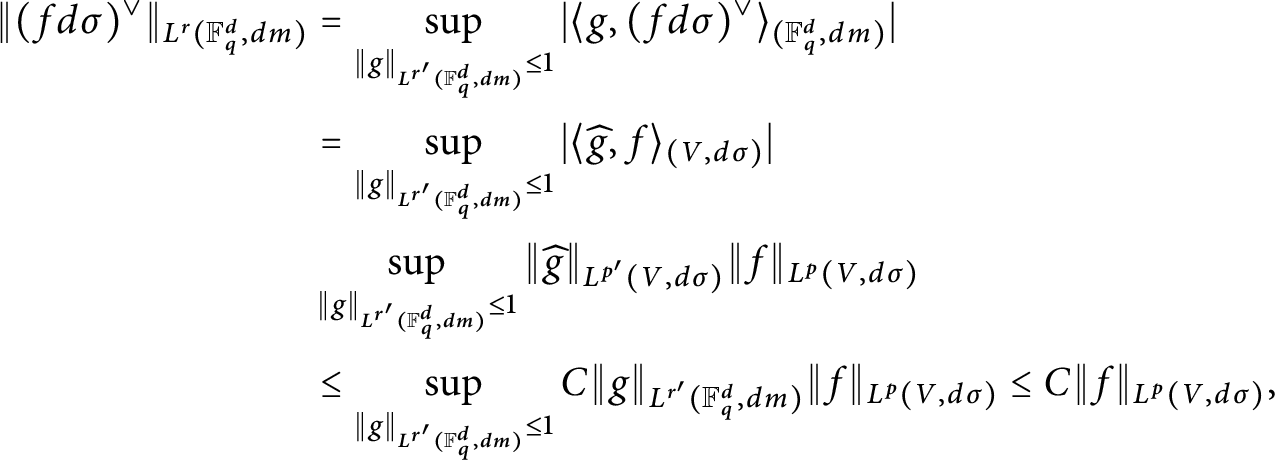
(Case 2) Assume that the second part of Theorem A.1 is satisfied. In this case, we use the second conclusion of Lemma A.2, the equality (A.1), Hölder’s inequality, and our assumption. Then the statement of the first part of Theorem A.1 is proved as follows:
 $$ \begin{align*} \| (fd\sigma)^{\vee}\|_{L^{r}(\mathbb F_{q}^{d}, dm)} &=\sup_{\|g\|_{L^{r'}(\mathbb F_{q}^{d}, dm)} \le 1} |\langle g, (fd\sigma)^{\vee}\rangle_{(\mathbb F_{q}^{d}, dm)}|\\ &=\sup_{\|g\|_{L^{r'}(\mathbb F_{q}^{d}, dm)} \le 1} |\langle \widehat{g}, f\rangle_{(V, d\sigma)}|\\ &\sup_{\|g\|_{L^{r'}(\mathbb F_{q}^{d}, dm)} \le 1} \| \widehat{g}\|_{L^{p'}(V, d\sigma)} \|f\|_{L^{p}(V, d\sigma)} \\ &\le \sup_{\|g\|_{L^{r'}(\mathbb F_{q}^{d}, dm)} \le 1} C \|g\|_{L^{r'}(\mathbb F_{q}^{d}, dm)}\|f\|_{L^{p}(V, d\sigma)} \le C\|f\|_{L^{p}(V, d\sigma)}, \end{align*} $$
as desired.
Acknowledgment
The authors thank anonymous reviewers for their valuable comments which helped us improve the quality of our paper.



