




Introduction
Long-distance trade and cross-cultural interaction played a significant role in shaping the socio-economic and cultural developments in prehistoric South-eastern Arabia (Frenez Reference Frenez2019). According to geochemical analysis and Sumero-Akkadian cuneiform texts (Begemann et al. Reference Begemann, Hauptmann, Schmitt-Strecker and Weisgerber2010; Laursen & Steinkeller Reference Laursen and Steinkeller2017), the Oman Peninsula was a major source of copper for the surrounding regions from at least the late fourth millennium BC. While local copper minerals were processed in Oman from the Late Neolithic period (mid fourth millennium BC), large-scale copper working began in the Hafit period (c. 3100–2700 BC) (Frenez Reference Frenez2019: 12). This period is characterised by extensive socio-economic and cultural innovation, including the incipient establishment of oasis farming (Charbonnier Reference Charbonnier, Lavie and Marshall2017), the introduction of a new collective funerary ritual based on collective stone cairns (Bortolini & Munoz Reference Bortolini, Munoz, Al-Lawati and Frenez2015: 65–67), and the appearance of massive stone platforms (called ‘towers’ in the scientific literature), the function of which is not yet fully understood (Döpper & Schmidt Reference Döpper and Schmidt2017). The socio-economic and cultural complexity of South-eastern Arabian populations further increased during the Umm an-Nar period (c. 2700–2000 BC), which is marked by the intensification of sedentary settlement (Azzarà Reference Azzarà2009), the development of larger, more complex funerary structures (Bortolini & Munoz Reference Bortolini, Munoz, Al-Lawati and Frenez2015: 71–73), the proliferation of stone ‘towers’ (Cable & Thornton Reference Cable, Thornton, Abraham, Gullapalli, Raczek and Rizvi2013), and the beginning of intensive, diversified cross-cultural interactions (Frenez Reference Frenez2019: 12–29).
The emergence of the Hafit and Umm an-Nar Cultures—often referred to as the ‘Magan’ civilisation—is often interpreted as a socio-economic response to the growing export of local copper (Cleuziou Reference Cleuziou, Afanasev, Cleuziou, Lukacs and Tosi1996: 159; Laursen & Steinkeller Reference Laursen and Steinkeller2017: 14). In this period, Omani copper was increasingly used in Mesopotamia (Begemann et al. Reference Begemann, Hauptmann, Schmitt-Strecker and Weisgerber2010: 157–59 & fig. 5): by the beginning of the third millennium BC, it was used to produce about 30 per cent of objects tested for copper provenance, reaching up to 55 per cent towards the end of the Umm an-Nar period. In these 1000 years, the Umm an-Nar communities diversified and greatly expanded long-distance trade, interacting also with south-eastern Iran and the Indus Valley (Cleuziou & Méry Reference Cleuziou, Méry, Cleuziou, Tosi and Zarins2002; Thornton Reference Thornton and Crawford2013; Frenez Reference Frenez2019). Meanwhile, the construction of such massive stone and mud-brick structures and the intensification of copper production must have required a coordinated effort to plan operations and mobilise the necessary workforce. As summarised by Laursen and Steinkeller (Reference Laursen and Steinkeller2017: 26), however,
in stark contrast to the neighbours of the Oman Peninsula, which all were organised in urban and proto-urban systems, Magan society apparently continued its organisation along kinship lines in some stratified tribal or clan-like system […] Qualitative and quantitative variation in the collective Umm an-Nar tombs appears to be the result of social competition that aimed to enforce rank hierarchy among groups equivalent to extended households, in contrast to hierarchies between prominent individuals.
Nevertheless, high variability in the size of Umm an-Nar tombs and the increasing presence of prized, exotic goods in both tombs and settlements suggest that this dynamic economic environment may have eventually favoured some individuals and their clans over others, possibly leading to an incipient form of social stratification and political centralisation (Frenez Reference Frenez2019: 13–29).
At the end of the third millennium BC, South-eastern Arabia witnessed an extensive socio-cultural and economic reorganisation that marked the transition from the Umm an-Nar to the so-called Wadi Suq period (c. 2000–1300 BC, Middle and Late Bronze Ages). The population was still distributed across the territory with remarkable continuity, but the scant archaeological data show a lower density in the settlement pattern and a reorganisation of the subsistence strategy, with a more active pastoral component (Cleuziou & Tosi Reference Cleuziou and Tosi2007: 258; Magee Reference Magee2014: 188). The abandonment of almost all monumental ‘towers’ and stone cairns with the sudden introduction of new types of semi-subterranean collective tombs marked a new strategy of social landscaping, possibly implying a deep cultural and political breakdown (Magee Reference Magee2014: 189; Laursen & Steinkeller Reference Laursen and Steinkeller2017: 66). In the material culture, exotic components were abandoned in favour of new, diversified local forms and styles (Magee Reference Magee2014: 189). While copper production continued—even if at an apparently reduced level (Weisgerber Reference Weisgerber, Cleuziou and Tosi2007)—long-distance exchanges decreased dramatically (Frenez Reference Frenez2019: 29–31), with the export of Omani copper to Mesopotamia now controlled by Dilmun merchants settled in Bahrain and the upper Gulf (Begemann et al. Reference Begemann, Hauptmann, Schmitt-Strecker and Weisgerber2010: 160–61; Laursen & Steinkeller Reference Laursen and Steinkeller2017: 68).
External factors, such as the temporary disruptions of long-distance trade networks due to major political and cultural breakdowns in Mesopotamia, southern Iran and the Indus Valley, have often been adduced to explain the emergence of the Wadi Suq Culture in South-eastern Arabia (Magee Reference Magee2014: 124). As noted by Cleuziou and Tosi (Reference Cleuziou and Tosi2007: 273), these transformations, however, began when southern Mesopotamia was still flourishing under the political control of the emerging local Isin and Larsa Dynasties, c. 2011–1755 BC (Sallaberger & Schrakamp Reference Sallaberger, Schrakamp, Sallaberger and Schrakamp2015: 136 & tab. 39), and the Indus Civilisation was still in its ‘mature’ phase (Harappa period 3C, c. 2200–1900 BC) (Kenoyer Reference Kenoyer and Pearsall2008: 717 & tab. 1). Magee (Reference Magee2014: 124–25) therefore suggested that the socio-cultural reorganisation that characterised the Wadi Suq period was “the ultimate step in affirming the tribal values that had defined the Southeast Arabian society for generations” against rising inequality created by wealth accumulated through long-distance trade during the Umm an-Nar period.
Subsequent to the contraction and reorganisation of settlement patterns that characterised the Wadi Suq period, the population rapidly expanded during the Iron Age I and II (c. 1300–600 BC), with long-distance exchange eventually thriving again following the previous ‘Dark Age’ (Cleuziou & Tosi Reference Cleuziou and Tosi2007: 257). Some scholars have suggested that both phenomena were due to the rise of the Achaemenid Empire (550–330 BC) (e.g. Humphries Reference Humphries1974: 53–54). Settlement expansion, however, was already underway during the Iron Age II (1000–600 BC), when the large-scale introduction of an irrigation system, known today as falaj (pl. aflaj), enabled a substantial increase in the extent of irrigated land and the occupation of new territories (Magee Reference Magee2014: 214 & 258). The Iron Age II also witnessed the final stage of dromedary (Camelus dromedarius) domestication in South-eastern Arabia. Over the previous millennia, these animals were, in fact, only used as a source of meat, milk and hair (Curci et al. Reference Curci, Carletti and Tosi2014; Magee Reference Magee2015: 271–72). Now, dromedaries were also used as pack animals to transport goods overland, opening up a new network of inland trade routes that crossed the Arabian Peninsula towards the Levant and the Mediterranean (Magee Reference Magee2014: 204–13 & 226), eventually fostering the emergence of a new class of ‘desert lords’ (Loreto et al. Reference Loreto, Mauro, Maini, Candilio, Frenez and Cattani2019).
This new socio-economic organisation, however, did not affect the political and cultural configuration of the local society, which remained based on the tribal cohesion formed over the previous millennia (Cleuziou & Tosi Reference Cleuziou and Tosi2007: 273; Magee Reference Magee2014: 124–25). Such continuity in social relations based on kinship bonds is evidenced predominantly by the widespread adoption of standardised forms of collective burial since the transition from the Neolithic to the Early Bronze Age in the second half of the fourth millennium BC (Munoz Reference Munoz, Williams and Gregoricka2019). In the Late Bronze and Early Iron Ages, South-eastern Arabia was characterised by greater variability in funerary structures, but tombs predominantly still contained the remains of multiple individuals accompanied by a broad range of both local and exotic grave goods (Yule Reference Yule2014: 34).
Tomb LCG-1
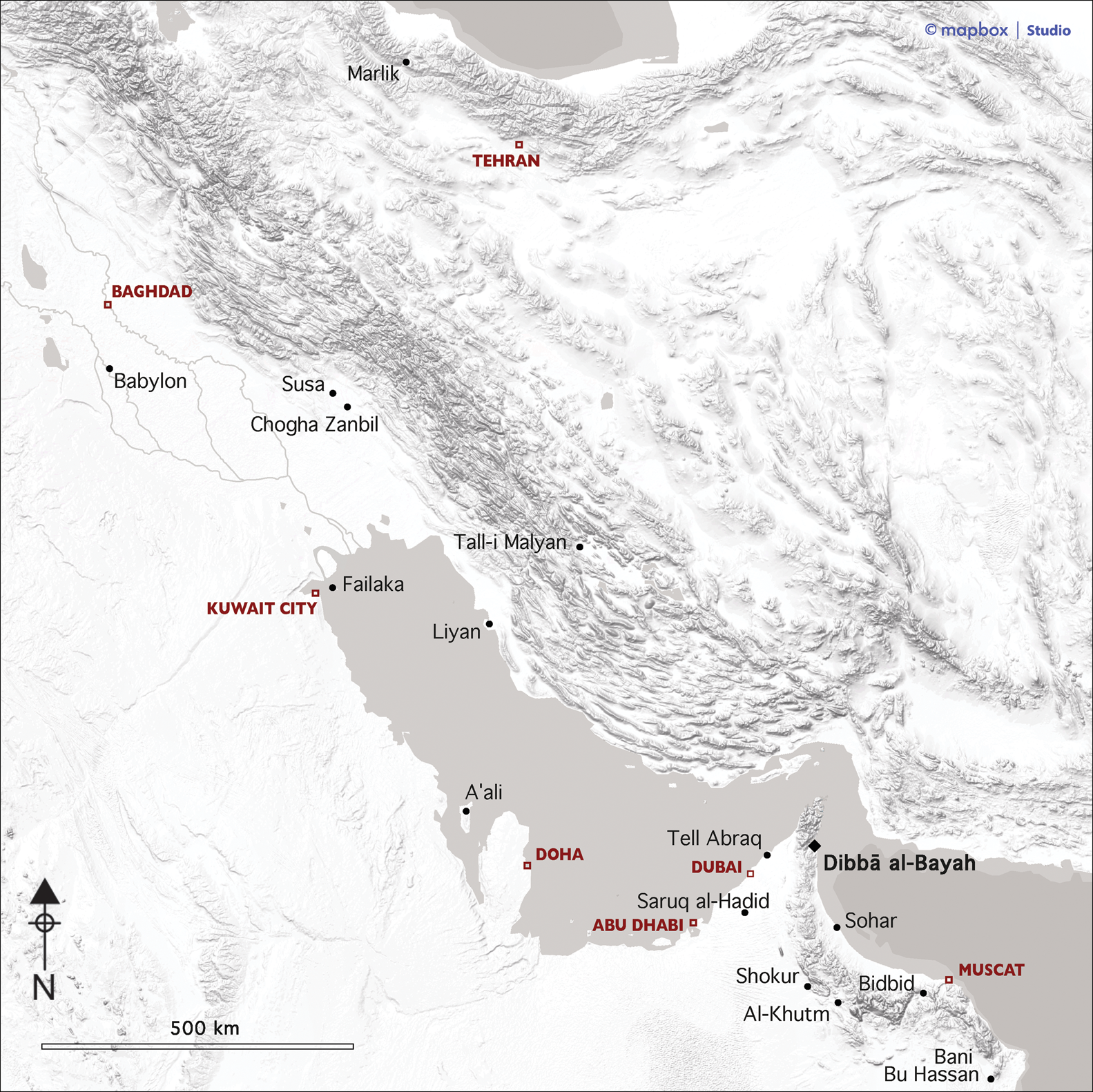
Tomb LCG-1 was discovered in early 2012 during construction works at the Sporting Club at Dibbā al-Bayah (25°36′38.78″ north, 56°15′28.57″ east), in the Musandam Governorate of the Sultanate of Oman (Figure 1). Later in 2012, the Ministry of Heritage and Culture of the Sultanate of Oman (now Heritage and Tourism) initiated an excavation of the tomb under the supervision of Sultan bin Saif Al-Bakri (Director General of Archaeology). A broader campaign of detailed topographic documentation and stratigraphic assessment was commissioned to Maurizio Cattani (University of Bologna) at the end of 2012.
Map showing the major archaeological sites mentioned in the text (figure by D. Frenez based on a MapboxTM layout).
Two additional excavation seasons were conducted in April and from October to December 2013 by the Ministry of Heritage and Culture, with Francesco Genchi (Sapienza—University of Rome) as field-director (Genchi Reference Genchi2013, Reference Genchi2014). In 2014, further investigations around tomb LCG-1, including test excavations and geophysical prospection, demonstrated that the tomb formed part of a burial ground comprising two large corridor tombs (LCG-1 and LCG-2) surrounded by clusters of funerary pits that were in use throughout the Iron Age (Genchi et al. Reference Genchi, Fattore, Nava and Maini2018).
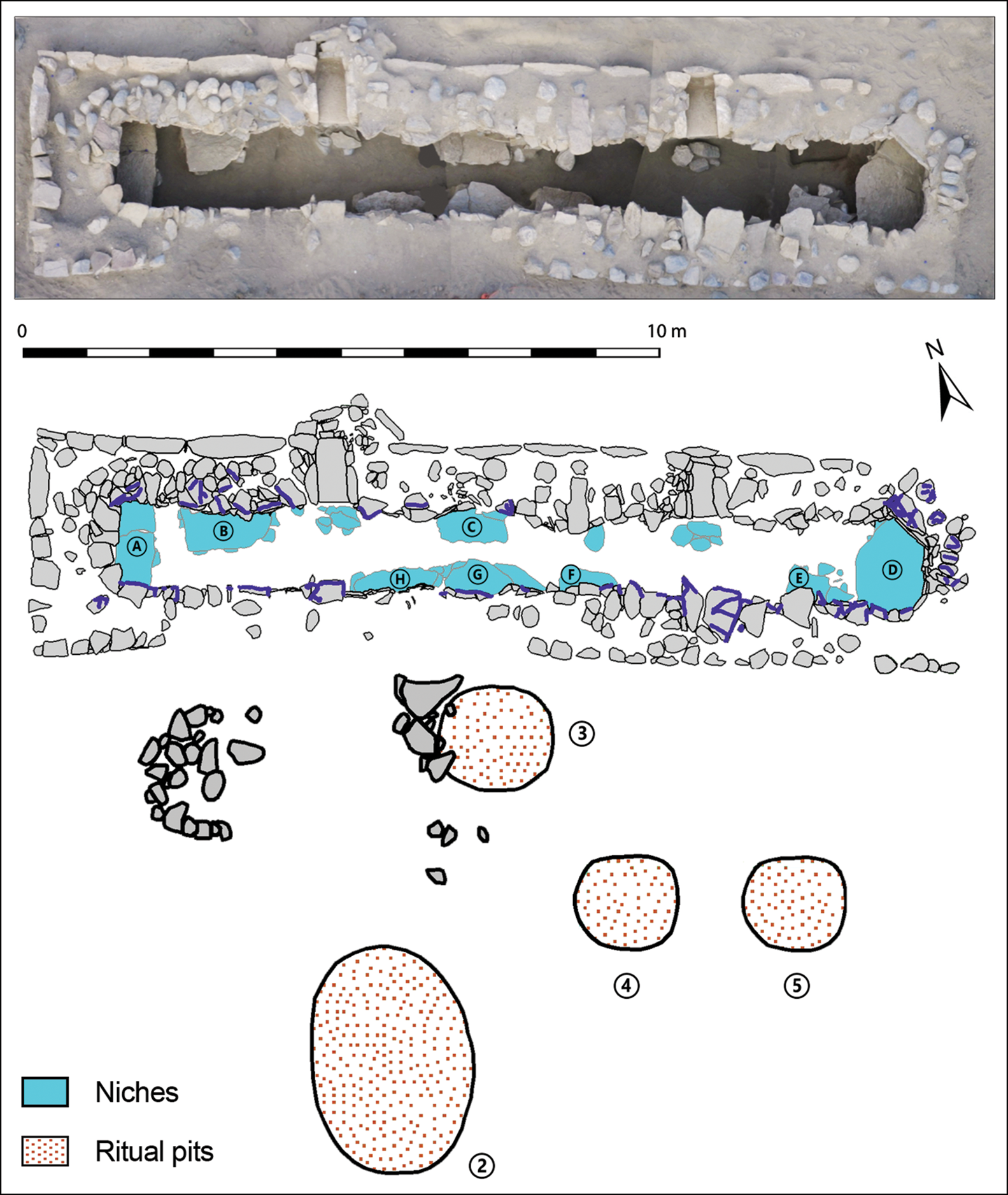
LCG-1 is a semi-subterranean, long-chamber tomb measuring approximately 14.75 × 3.50m. The tomb is lined internally with flat, irregular limestone blocks and roofed with a corbelled vault of large limestone slabs (Figure 2). A raised, limestone-paved floor covered part of the chamber's basement, possibly indicating a second structural phase. The tomb features two trapezoidal, short-corridor entrances in its northern side. Fourteen niches containing clusters of disarticulated human bones (in secondary deposition) were created along the inner walls of the structure using large slabs supported by smaller stones. Long-chamber tombs—either semi-subterranean or wholly above ground—and comparable ritual practices are known from other broadly contemporaneous funerary sites across the region (for summary and recent developments, see Genchi et al. Reference Genchi, Fattore, Nava and Maini2018; Pellegrino et al. Reference Pellegrino, Degli Esposti, Buta, Tagliamonte and Hassan2019).
Tomb LCG-1: final plan of the main funerary structure and related ritual pits (figure by M. Cattani & F. Genchi; courtesy of the Ministry of Heritage and Culture of the Sultanate of Oman).
Analysis of the structural stratigraphy and the material culture of LCG-1 indicate that the tomb underwent several phases of use, starting around the Middle to Late Bronze Age transition (c. 1600 BC), and throughout the Iron Age I and II, up to 600 BC. As no radiocarbon dates are yet available for LCG-1, the preliminary dating of its earliest phases is based predominantly on the soft-stone vessel assemblage. This includes several examples with designs comparable to those on vessels securely dated to the Middle to Late Bronze Age transition (see Velde Reference Velde, Potts, Al-Naboodah and Hellyer2003: fig. 6). Typological assessment of bronze arrowheads from LCG-1 indicates that the tomb was no longer frequented after c. 600 BC (Yule & Gernez Reference Yule and Gernez2018: 54 & fig. 4.11).
Analysis of the material from the main chamber and surrounding pits documents several episodes involving the rearrangement and relocation of previously deposited skeletal remains and grave goods, and the possible reburial of older skeletal remains in external funerary pits. Two such pits containing grave goods comparable with those found in the main tomb are radiocarbon-dated to the Iron Age I and the beginning of Iron Age II (Genchi Reference Genchi2013: 146): charcoal samples from pit3-SU5 and pit4-SU9 provide dates of 2867±40 BP and 2777±40 BP (LTL13337A: 1200–910 cal BC at 95.4%; LTL13338A: 1020–820 cal BC at 95.4%; dates modelled in OxCal v3.10 using the IntCal13 calibration curve; Bronk Ramsey Reference Bronk Ramsey2009; Reimer et al. Reference Reimer2013), respectively.
Osteological analysis
An initial assessment of the human bones retrieved during the first excavation season was undertaken by Antonio Todero (University of Bologna), while the skeletal remains recovered from the remaining eight niches were excavated and analysed by Luciano Fattore (Sapienza—University of Rome). A preliminary evaluation of the minimum number of individuals (MNI) suggests that LCG-1 contained at least 188 individuals, including 153 adults (both males and females) and 35 sub-adults (L. Fattore pers. comm.). A 90 per cent reduction in the expected number of smaller bones of the hands and feet (according to the MNI) indicates that LCG-1 was not intended as a place of primary inhumation (Fattore Reference Fattore2014: 50).
Material culture
The individuals buried in tomb LCG-1 were accompanied by 9666 objects, with an additional 1730 artefacts deposited in five external funerary pits (Genchi Reference Genchi2013: fig. 47). The combined assemblage from both the main tomb and the external pits includes decorated containers of local soft-stone (241 vessels and 73 lids), along with pottery vessels (116) characteristic of the local Late Bronze Age and Iron Age I and II ceramic tradition. Bronze vessels (79) and five large bronze cauldrons were also present, along with various bronze weapons, including swords (9) and daggers (139), axes (70) and halberds (10), spearheads (9) and many arrowheads (2620)—the latter often retaining their original arrangement inside quivers that would have been made from organic materials. The excavations also yielded 6802 beads and pendants made from local soft-stones, as well as from exotic, allochthonous gemstones and precious metals (Genchi Reference Genchi2013: fig. 64). Items intended for personal care and ornamentation also include bronze razors and pins, and bronze, silver and gold rings, earrings and bangles. Decorated seashell discs characteristic of this period across the wider Middle East were also discovered (Caputo & Genchi Reference Caputo and Genchi2016; Weeks et al. Reference Weeks, David-Cuny, Avanzini, Lischi, Genchi, Caputo, Al Ali and Boraik2019).
Most exceptional is the discovery in tomb LCG-1 of three seals—two stone stamp seals and one faience cylinder seal—as well as a gold-granulated pendant and an inscribed eye-stone. We present and discuss these artefacts in light of their significance for understanding of the long-distance cross-cultural exchange networks that connected South-eastern Arabia to the wider region during this period.
Furthermore, the careful evaluation of these artefacts using a broad spectrum of iconographic and manufacturing (i.e. raw materials and shapes) data, along with information from ancient textual sources, allows us to look beyond the intrinsic economic and aesthetic nature of trade. More profound, intimate motivations seem to have led to the acquisition of such exotic objects for reasons other than the basic, practical functions that they usually fulfilled (e.g. the search for apotropaic protection against evil forces, rather than simply the visual display of wealth). Indeed, this conscious selection of particular cultural traits over the primary function of an object required a deep understanding of distant cultures that could only have developed over a long history of cross-cultural interactions.
Stamp seals (DA34264, DA35873): the Gulf region
Although quite different from each other, both stamp seals DA34264 and DA35873 exhibit features that could derive from the Dilmun seal tradition (David-Cuny & Neyme Reference David-Cuny and Neyme2016: 19–45) (Figure 3). Recent discoveries in the Oman Peninsula, however, demonstrate the existence of consistent idiosyncrasies, suggesting that they instead resulted from local innovations, possibly inspired by external influences including Dilmun seals and Egyptian scarabs.
Tomb LCG-1: stamp seals DA34264 and DA35873 (figure by H. David-Cuny; images courtesy of the Ministry of Heritage and Culture of the Sultanate of Oman).

DA34264 was recovered during sieving of sediments from the first exploratory trench excavated in 2012. This Dilmun-inspired stamp seal has an elliptical, slightly asymmetrical disc, with a length of 20.4mm, a width of 16.2mm and a 3.3mm-thick rim. The domed boss has a height of 4.0mm, and a shallow groove running around the seal marks the division between the disc and the boss, without creating an actual collar. It has a transverse perforation with terminal diameters of 2.5mm. Like most Dilmun seals (David-Cuny & Neyme Reference David-Cuny and Neyme2016: 24–45), DA34264 was carved from a soft-stone before being heat-treated to harden and whiten the outer layers. The sealing surface is decorated with small opposing and intersecting triangles to create a zigzag pattern. The domed boss has four large, double-dotted motifs at the centre of each quadrant, and traces of three shallow parallel lines carved lengthwise—a pattern typical for Dilmun seals.
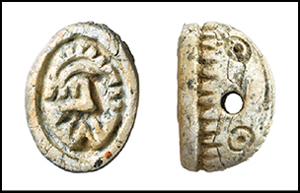
DA35873 was discovered in association with disarticulated human bones within niche D, which was created during the main construction phase of LCG-1 (Fattore Reference Fattore2014: 51). This small stamp seal is an elliptical disc, with a length of 14.7mm, a width of 11.3mm and a 1.8mm-thick rim. The thick, domed boss is 7.7mm high, and the interface between the boss and the disc is marked by a deep, toothed groove running around the seal. It has a transverse perforation with terminal diameters of 2.2mm. DA35873 is made of a homogeneous, fine-grained material that possibly results from the controlled, deep-core heating of steatite. The sealing surface features the deeply engraved image of a goat with large, lunate horns, framed within a partially toothed ellipse, along with a short, three-toothed projection between the goat's back and horns. The domed boss exhibits four small, single-dotted circle motifs at the centre of each quadrant, and a longitudinal ladder-like pattern. The morphology, manufacturing technique and iconography suggest that DA34264 is an example of Dilmun-inspired, provincial-style seals, which are attested predominantly at sites along the Hajar Mountains in South-eastern Arabia, but also on Failaka Island in Kuwait (David-Cuny & Neyme Reference David-Cuny and Neyme2016: 158; Cocca et al. Reference Cocca, Vinci, Cattani, Armigliato, Michele, Bianchi and Gennuso2019: fig. 10; Williams et al. Reference Williams, Frenez, David-Cuny and Gregorickain press; M. Boraik & H. David-Cuny pers. comm.) (Figure 4).
Dilmun-inspired seals from Failaka Island and northern Oman (figure by H. David-Cuny; images courtesy of the National Council for Culture, Arts and Letters of Kuwait and the Ministry of Heritage and Culture of the Sultanate of Oman).

The connection between DA35873 and the Dilmun seal tradition is less obvious, despite its general morphology and design. Instead, it can be compared to a series of seal-beads found on the Oman Peninsula and on Failaka Island (Figure 5). These are usually considered to be local adaptations of Egyptian-like scarab seals that were produced extensively in the Middle and Late Bronze Age Levant and diffused throughout the Middle East (Ben-Tor Reference Ben-Tor2007). A Levantine influence that probably reached northern Oman via the Gulf, where it combined with local features, is therefore proposed here for DA35873 and the other amulet-seals of this type found in South-eastern Arabia.
Imports and local imitations of Egyptian and Levantine scarab seals (figure by H. David-Cuny; images courtesy of the National Council for Culture, Arts and Letters of Kuwait and the Ministry of Heritage and Culture of the Sultanate of Oman).

Cylinder seal (DA29479/2): south-western Iran
Cylinder seal DA29479/2 was recovered during sieving of sediments from the first exploratory trench excavated in 2012. The seal is made from a whitish to light yellow glazed siliceous, artificial material (faience), and retains corrosion traces and fragments of two 5.5mm-high copper rings around both ends. The cylinder has a diameter ranging between 13.1 and 13.8mm and a height of 54.8mm (56.0mm including the surviving copper ring) (Figure 6).
Tomb LCG-1: cylinder seal DA29479/2 (figure by H. David-Cuny; images courtesy of the Ministry of Heritage and Culture of the Sultanate of Oman).

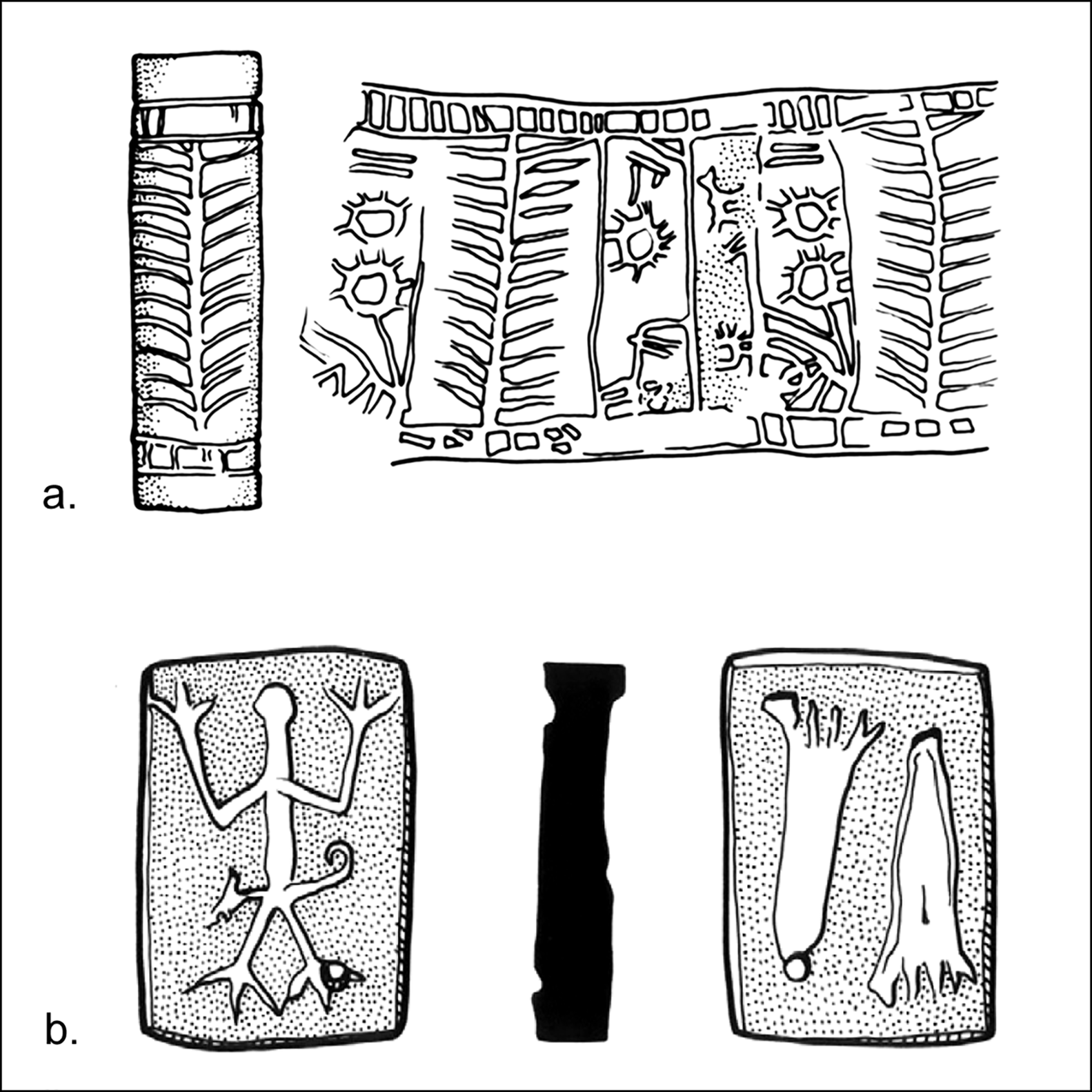
The cylinder's iconography is carved in the Luristan Provincial Style of the Late Middle Elamite period, which dates from the mid fourteenth to the start of the tenth century BC (Roach Reference Roach2008: 547). The main design is framed along the upper and lower horizontal axes by a ‘boxed-border’ characteristic of this style (Roach Reference Roach2008: 539–40). Close comparisons are found in the Luristan Provincial-Style cylinder seals from Susa and Chogha Zanbil in the Khuzestan province of south-western Iran (Roach Reference Roach2008: nos 3102, 3222, 3320, 3355) (Figure 7a–b).
a–b) Luristan Provincial Style seals from Susa; c) Late Middle Elamite seal from Chogha Zanbil; d) Middle Assyrian seal of unknown provenance [not to scale] (Matthews Reference Matthews1990: no. 429; Roach Reference Roach2008: nos 3102, 3222, 3094).

The main subject represented on the seal (Figure 6) is a winged, anthropomorphic creature with a raptor's (eagle?) head and talons, wearing a long robe and possibly a horned headdress. This creature stands on a horned goat (ibex?) to the left of a tripartite tree—possibly a date palm—with a small bird perched on top. The figure grasps the branch of the tree with its left hand, while in its right, it holds a small, possibly human or animal, figure. According to F. Wiggermann (pers. comm.), the anthropomorphic figure on DA29479/2
represents a master of animals (Anzû or Ukaduhhû) protecting the bearer of the seal against demonic forces, represented by the horned goats; the master of animals is a servant spirit of the great gods Ninurta and his wife Gula and, together, the three protect the bearer of the seal against evil in general and diseases in particular.
This subject is paralleled in a Late Middle Elamite cylinder seal from Chogha Zanbil, which exhibits a winged creature with an eagle's head and talons standing on two small, horned goats in front of a blooming palm tree, while holding two larger goats by their hind legs (Roach Reference Roach2008: no. 3094) (Figure 7c). Comparable scenes with a winged demon dominating animals are engraved on a few Second Kassite-style seals dated from the mid fourteenth to the end of the thirteenth century BC (Matthews Reference Matthews1990: 61–63, nos 142–49), and on a Middle Assyrian cylinder seal dated to the end of the thirteenth century BC (Matthews Reference Matthews1990: 104, no. 429) (Figure 7d).
A greenish faience cylinder seal engraved in the Luristan Provincial Style was found at Tell Abraq, on the north-western coast of the Oman Peninsula, about 70km west of Dibbā (Potts Reference Potts2000: 118) (Figure 8a). Tell Abraq and Saruq al-Hadid, about 120km to the south-west of Dibbā, have both yielded amulet seals featuring an apotropaic representation of Lamaštu (Potts et al. Reference Potts, Martin, Baustian and Osterholtz2013; M. Boraik & H. David-Cuny pers. comm.) (Figure 8b), an evil Babylonian demoness considered responsible for pre-natal and infant mortality (Wiggermann Reference Wiggermann, Stol and Wiggermann2000).
Tell Abraq: a) Luristan Provincial Style seal in faience [not to scale] (Potts Reference Potts2000: 118); b) Lamaštu plaque made from soft-stone (Potts et al. Reference Potts, Martin, Baustian and Osterholtz2013: fig. 3).
Gold pendant (DA29588): north-western Iran
DA29588 is a round gold pendant, approximately 29mm in diameter, decorated in granulation with a geometric rosette comprising 13 triangles extending from two parallel, single-grained lines running around the perimeter, and with the same design repeated around a central embossed knob. A large, wide suspension loop has double-grained lines running around the edges and the centre (Figure 9a). A wheel-type gold bead (Figure 9b), produced in a similar style to DA29588 and using an extremely fine granulation technique, was recovered from the large trench excavated immediately to the south of LCG-1.
Tomb LCG-1: a–b) gold granulated pendant DA29588 and wheel-bead DA34294 (figure by F. Genchi, courtesy of the Ministry of Heritage and Culture of the Sultanate of Oman); c–d) comparable ornaments from Marlik [not to scale] (Negahban Reference Negahban1996: pls 54 & 56).

Similar granulated gold ornaments have been found in graves at Marlik, in the Gilan Province of north-western Iran (Negahban Reference Negahban1996: nos 184 & 202) (Figure 9c–d). Maxwell-Hyslop (Reference Maxwell-Hyslop1971: 190) proposed that the Marlik examples may have been produced by the same workshop between the thirteenth and twelfth centuries BC, thus representing the earliest development of this most intricate gold-working technique. Metal pendants with apotropaic purposes have often been found in graves throughout the wider Middle East (Black & Green Reference Black and Green2014: 30 & fig. 21).
Eye-stone (DA34259): Babylonia
Eye-stone DA34259 was discovered in October 2013 during sieving of sediments associated with human remains in the main chamber (Genchi Reference Genchi2014: 26 & figs 31–32) (Figure 10). This exceptional find warrants special attention not only because it reflects the network of cross-cultural interactions established by the community represented in LCG-1, but also because it bears the southernmost cuneiform inscription so far discovered—and the only one found in South-eastern Arabia.
Tomb LCG-1: inscribed Kassite eye-stone DA34259 (figure by H. David-Cuny, courtesy of the Ministry of Heritage and Culture of the Sultanate of Oman).

Large beads made from stone or marine shell and decorated to recall eye designs have been found at sites from the Mediterranean to South Asia, dating from the sixth millennium BC onwards (Dubin Reference Dubin and Dubin2009: 310; Kenoyer Reference Kenoyer2013: 5–6). Beads made from banded varieties of chalcedony that are cut to expose a darker central disc against a lighter rim—thus producing an ‘eye’ effect—appeared in Mesopotamia in the Early Dynastic III period (c. mid third millennium BC). The practice of marking these beads with inscriptions to denote ownership or to indicate their votive or apotropaic functions was introduced at the end of the third millennium, in the transition between the Akkadian and Ur III periods (Clayden Reference Clayden2009: 41). The numbers and geographic distribution of eye-stones, along with their mention in cuneiform texts, increased dramatically in the late second millennium BC during the Kassite period (Clayden Reference Clayden2009: 43–44).
Eye-stone DA34259 from tomb LCG-1 is slightly oval, with a diameter ranging from 14.8–15.3mm, and a maximum thickness of 6.7mm. The bead was worked from a banded agate to obtain a central, slightly irregular brown-orange disc on a white background. It bears three cuneiform signs engraved cursively in two lines to form the divine name Gula (dgu-/la) (G. Marchesi pers. comm.), the principal Mesopotamian healing deity and patroness of doctors during the Kassite period (Böck Reference Böck2014). Such eye-stones that bear only the name of a deity all date to this period (Clayden Reference Clayden2009: 49). Gula is also mentioned on an eye-stone that features a three-line votive inscription from the king of Babylon Šagarakti-Šuriaš (1245–1233 BC) (Clayden Reference Clayden2009: 48 & tab. 3/34).
Discussion
As there is no direct information concerning the socio-economic and political organisation of the Oman Peninsula in any known textual source after the Ur III period to the very end of the time span covered by LCG-1 (Yule Reference Yule2014: 17–18), a detailed study of material culture from the tomb is essential for reconstructing the extensive network of Late Bronze Age and Early Iron Age cross-cultural interactions involving South-eastern Arabia. During this period, the major long-distance exchange networks developed across Western Asia were mainly based on the movement of unalloyed tin ingots and tin-bronze objects (Weeks Reference Weeks1999; Berger et al. Reference Berger, Soles, Giumlia-Mair, Brügmann, Galili, Lockhoff and Pernicka2019). Due to its relative isolation during the Wadi Suq period, in the Middle Bronze Age, metal objects in the Oman Peninsula were almost always made from pure, local copper, while tin-bronze artefacts began appearing in larger quantities in the region only from the Late Bronze Age (Begemann et al. Reference Begemann, Hauptmann, Schmitt-Strecker and Weisgerber2010: 140–41). During the Iron Age, Omani copper was no longer exported to Mesopotamia, which began to rely on Cypriot sources (Begemann et al. Reference Begemann, Hauptmann, Schmitt-Strecker and Weisgerber2010: 137), but rather it was processed at large metallurgical sites along the eastern fringes of the Rub al-Khali Desert. This evidence revealed the existence of an extensive, long-distance exchange network connecting the Oman Peninsula with the major metallurgical centres of Assyria, Urartu and the Elam (Potts Reference Potts2009; Weeks et al. Reference Weeks2017, Reference Weeks2018, Reference Weeks, David-Cuny, Avanzini, Lischi, Genchi, Caputo, Al Ali and Boraik2019; Gernez Reference Yule and Gernez2018).
The large, diversified assemblage of imported artefacts discovered in tomb LCG-1 confirms and further illustrates the features of such a network of long-distance cross-cultural exchange. Although the copper-based tools and weapons from LCG-1 are still under analysis (Genchi Reference Genchi2013: 39–44), they compare typologically to those found in the metal recycling workshop of ‘Uqdat al-Bakrah, along Wadi Dank in north-western Oman (Yule & Gernez Reference Yule and Gernez2018). According to Gernez (Reference Gernez, Yule and Gernez2018: 172), these were either inspired by or imported from Khuzestan, Luristan or the Gilan Plain in western and northern Iran (Gernez Reference Gernez, Yule and Gernez2018: 172).
The established Elamite presence along the eastern shores of the Gulf left scant archaeological evidence in Eastern Arabia. According to Potts (Reference Potts2006: 119), with reference to the Kassite control over Dilmun and the Western Gulf region, “this pattern can be explained by a deliberate attitude of non-interference in a zone that was clearly perceived as lying well within the sphere of influence of their Kassite relations-by-marriage”. The presence of both Elamite and Kassite artefacts at Dibbā al-Bayah and Tell Abraq seems, therefore, to define an area facing the Strait of Hormuz, where the two spheres overlapped and intertwined. Although the presence of Elamite seals at both sites may initially attest to direct commercial exchange, Potts (Reference Potts2010: 37) suggests that “cylinder seals may have been sought after as prestige objects by local east Arabians, and their presence might not necessarily signal the presence of foreigners or the adoption of sealing protocols”. This assumption might also apply to DA29479/2, which bears an iconography that appears to refer to a health-related demon connected to Gula, the ‘Great Healer’ (Black & Green Reference Black and Green2014: 43). The presence of a Kassite eye-stone specifically dedicated to Gula—a valuable, exotic object with strong apotropaic connotations—might further support this premise.
In the absence of documentary evidence for the adoption of seal-based, bureaucratic procedures at sites in South-eastern Arabia—either at the household or a higher administrative level—the local production of seal-like objects such as DA34264 and DA35873 could represent an attempt to create apotropaic amulets and symbols of high status, rather than actual administrative tools (Black & Green Reference Black and Green2014: 30). Phillips (Reference Phillips, Pini and Müller2010) proposes a comparable phenomenon for the early second-millennium BC production of hybrid Aegypto-Canaanite scarabs featuring local Minoan designs on Crete.
Conclusions
The discovery in tomb LCG-1 at Dibbā al-Bayah of a number of highly valuable, finely crafted objects imported from distant regions indicates an exceptionally affluent and influential community involved in trading with both the Kassite and Elamite cultural components of an interaction sphere that encompassed both shores of the Gulf. The likely production date of such artefacts within the use-life of tomb LCG-1 and the high degree of cross-cultural understanding attested by the selection of specific objects and iconographies—combined with the local creation of new object types inspired by contemporaneous exotic productions—seem to suggest that their arrival in the north of the Oman Peninsula probably resulted from somewhat direct interactions, rather than down-the-line, segmented exchange extending over several centuries.
Most of the objects presented and discussed in this article appear to have been selected not only for their exotic appeal, but also for their original apotropaic function. This suggests the existence of a significant degree of cross-cultural understanding that would presuppose an unbroken transmission between the producing and receiving cultural spheres. This cognitive process of reciprocal recognition probably also formed the basis for the local creation of objects, the forms and iconographic composition of which—even if adopted from foreign traditions—were considered suitable for conveying powerful meanings deeply rooted in the local culture. In these artefacts, the prehistoric communities of South-eastern Arabia further demonstrated their capacity for interacting with foreign polities (Frenez Reference Frenez2019: 34–35), displaying a deep understanding of distant cultures and a concomitant respect for their own traditions in a seamless history of assimilation through adaptation.
Acknowledgements
A special thanks to Gianni Marchesi (University of Bologna) for reading the cuneiform inscription on the eye-stone. All text is by Dennys Frenez (except for the ‘Stamp seals DA34264, DA35873’ section that was co-authored by Dennys Frenez and Hélène David-Cuny), and is based on an original graphic documentation by Hélène David-Cuny and contextual information provided by Francesco Genchi and Sultan Al-Bakri.
Funding statement
The authors wish to thank the Ministry of Heritage and Culture (now Heritage and Tourism) of the Sultanate of Oman for supporting and coordinating the excavation of LCG-1, and for permitting this publication.


 Open access

