




Introduction
This article introduces the earliest Chinese porcelain and celadon so far found in Europe, dating to the ninth to eleventh centuries AD. Both of these types of ceramic are extremely hard and are made from semi-vitrified porcelain stone and/or kaolin, which is fired up to 1100–1300°C (Guo Reference Guo1987). In Western Europe they are traditionally differentiated on the basis of their colour and transparency: celadon is greenish and opaque, while porcelain is white and translucent. In the Chinese language no distinction is made and a single term (ci 瓷) is used to refer to both.
Celadon and porcelain were first produced in China probably in the first century AD and the sixth to seventh centuries AD, respectively (Li Reference Li1998: 167; Kerr & Wood Reference Kerr and Wood2004: 151–53; Quan & Meng Reference Quan and Meng2008: 101–102; Feng Reference Feng2009: 238–39). Small numbers of vessels trickled into Europe during the thirteenth and fourteenth centuries, but only began to arrive in larger quantities once direct maritime trade routes between the Indian Ocean and the Mediterranean were established at the beginning of the sixteenth century. After the East India and Dutch India Companies began to conduct regular and direct trade with China in the seventeenth century, these ceramics became increasingly popular. By the eighteenth century, Chinese porcelain could be found in most households across Europe, while potters in the West still struggled to discover the secrets of its manufacture (Finlay Reference Finlay1998; Carswell Reference Carswell1993; Canepa Reference Canepa2016).
The archaeologist Juan Zozaya was the first to highlight the presence on archaeological sites in Spain of Chinese ceramics dating between the ninth and eleventh centuries AD (Zozaya Reference Zozaya1969). These rare and unique finds are the earliest Chinese ceramics ever to have been identified in Europe, and refute earlier claims that no porcelain entered Europe before the thirteenth century (Whitehouse Reference Whitehouse1972; Wetzel Reference Wetzel, Norrell, Leidy, Ross, Molà, Rosati, Wetzel, Piacentini and Di Flumeri Vatielli2012: 181). In this article, we examine how and why these particular vessels were transported so far west at such an early date. This reassessment is only now possible due to the recent discovery of further examples from Spain.
The early Chinese wares and their findspots
Thirteen fragments of Chinese ceramics, plus two of a slightly later date, have been recovered from six different archaeological sites in Spain (Figure 1), mainly at the residences of local elite rulers established at high-status secular sites, such as castles and palaces. The sherds are described individually in the online supplementary material (OSM), where all previous identifications and dating are revised to take account of recent research (Figures 2–6).
Main places mentioned in the text (drawn by A. Gutiérrez).
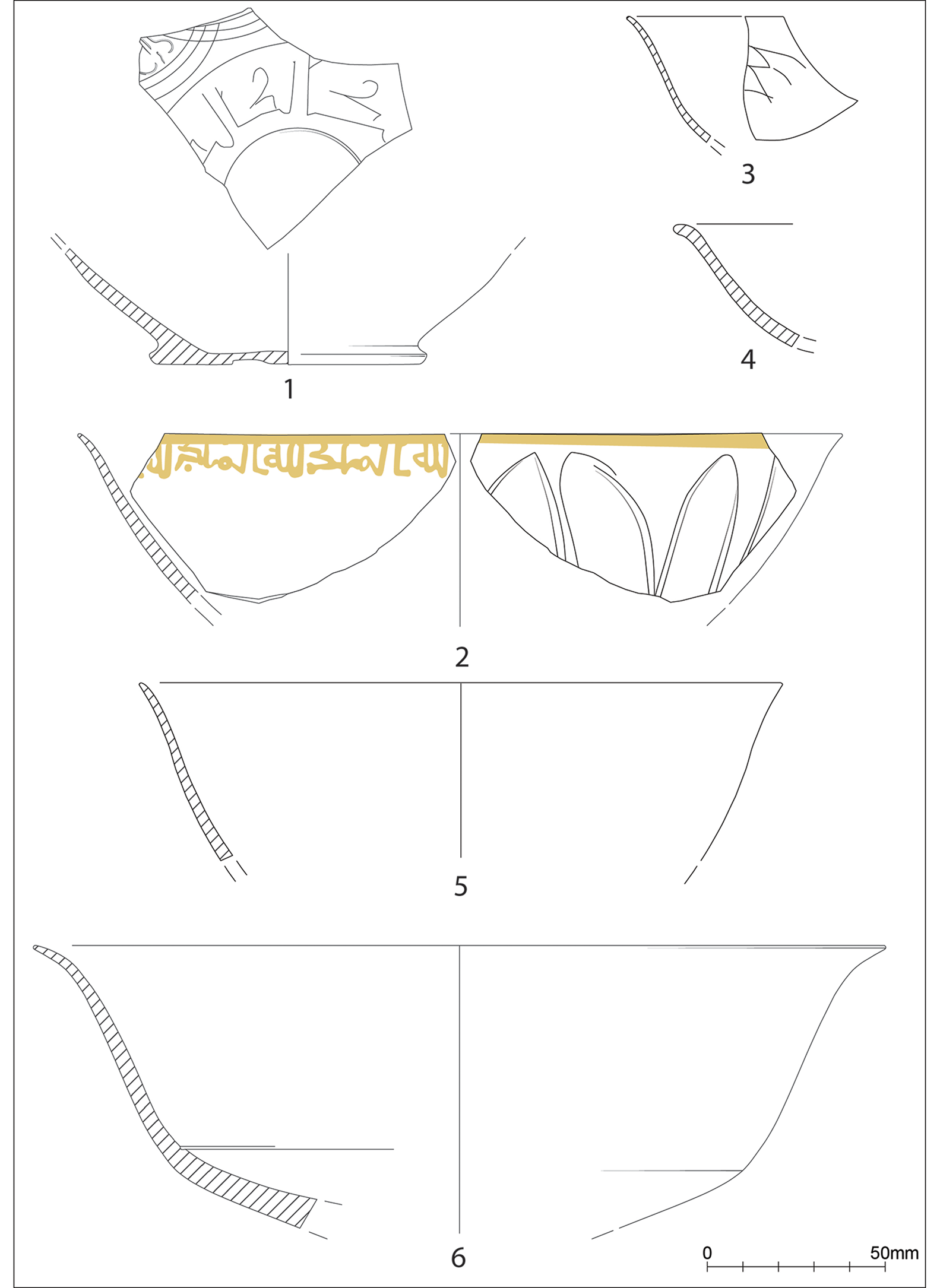
Porcelain from Almería (1–4) and Valencia (5–6) (drawn by A. Gutiérrez, after Heidenreich (Reference Heidenreich2007: pl. 8)).
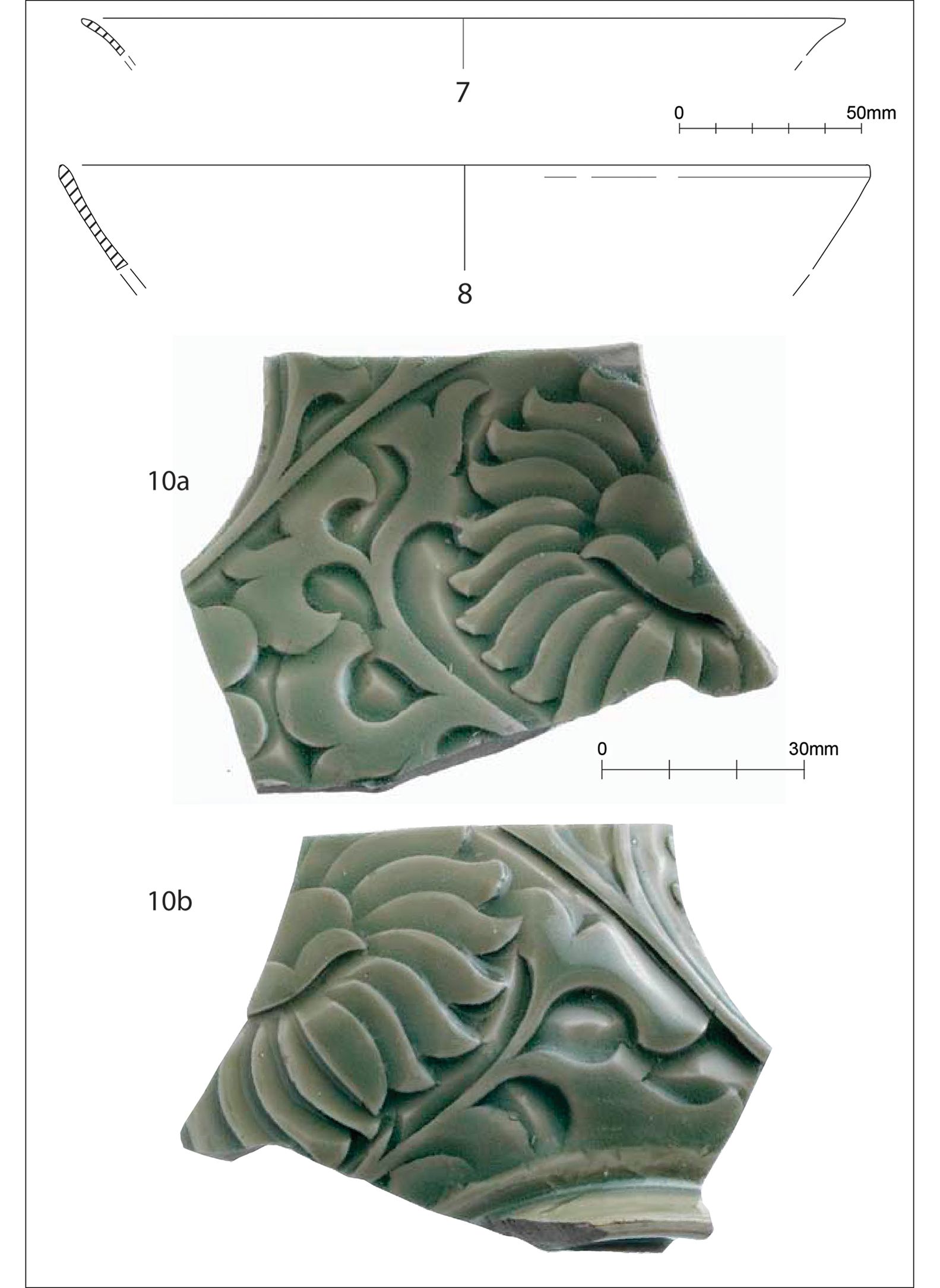
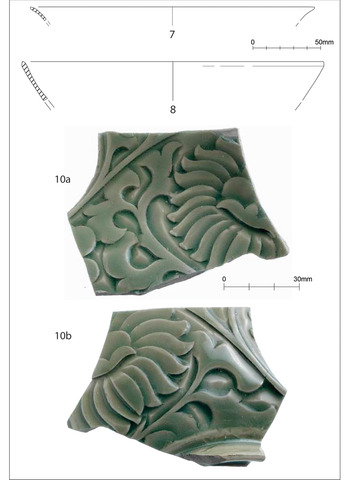
Porcelain from Cullera Castle (7–8) and celadon from Zaragoza (10a–b) (drawn by A. Gutiérrez, after Heidenreich (Reference Heidenreich2007: pl. 65); no. 10 photograph by J. Garrido © Museo de Zaragoza).
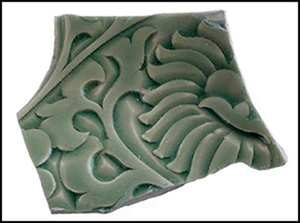
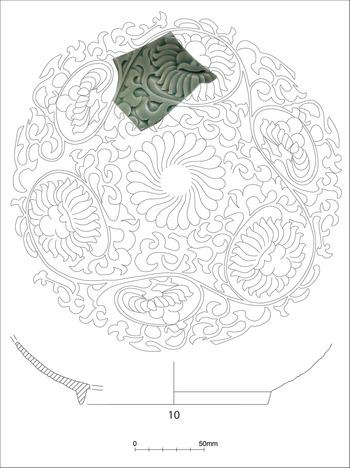
The reconstructed pattern on the interior of the exquisite celadon from Zaragoza (10). The exterior is similarly carved (drawn by A. Gutiérrez, after Heidenreich (Reference Heidenreich2007: pl. 8); photograph by José Garrido © Museo de Zaragoza).

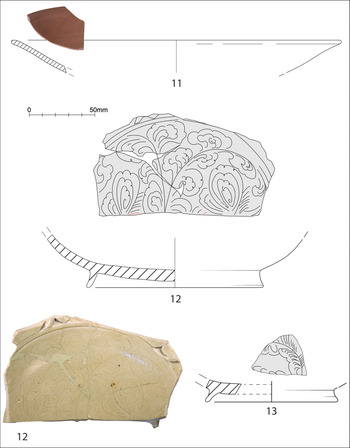
Celadon from Albarracín (11) and Valencia (12–13) (drawn by A. Gutiérrez, after Ortega (Reference Ortega2006: 301) and Heidenreich (Reference Heidenreich2007: pl. 60); no. 11 photograph by Jorge Escudero © Museo de Teruel; no. 12 photograph © Heidenreich (Reference Heidenreich2007: Va 47)).

Porcelain from Almería (1–2), Albarracín (9) and Valencia (14–15) (nos 1–2 © Alcazaba de Almería; no 9 photograph by C. Bazán © Acrótera; nos 14–15 © Sección de Investigación Arqueológica Municipal Valencia).
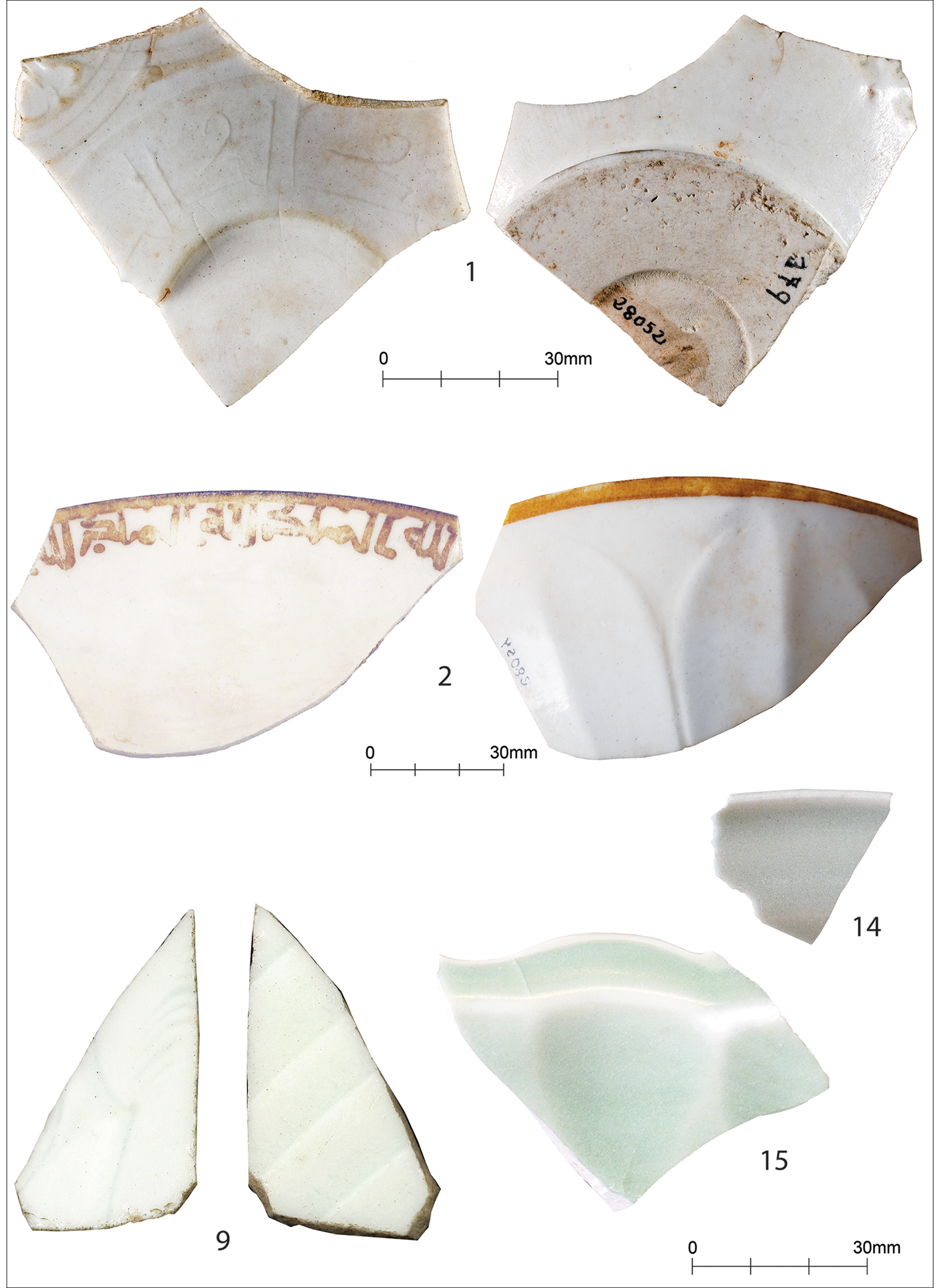
Almería in southern Spain provides the earliest and largest assemblage of white porcelain from northern China (Figure 2; catalogue nos 1–4 in the OSM). Between the end of the ninth century and AD 1147, when the city was almost completely destroyed by a Christian offensive, Almería was both the principal port of Islamic Spain and one of the most important trading hubs in the Mediterranean. Twelfth-century Arab geographers describe the city as the ‘key’ to Andalusi commerce (referring to al-Andalus, the part of the Iberian Peninsula under Islamic control; Constable Reference Constable1994: 18–19; Lirola Reference Lirola and Suárez2007), and they record maritime trade not only directly with North Africa and Egypt, but also with Syria. According to the geographer al-Idrisi, writing in the twelfth century, there were many local ‘marvellous’ industries in Almería, including 800 silk-weavers (Lirola Reference Lirola2005: 61). Ships laden with luxury cloths, oil and slaves sailed from the city to Alexandria, returning with silver ingots, dyes and brocades. Almería was also the main boarding port for pilgrimage from Muslim Spain to Mecca and, in the eleventh century, it became the base for the navy of the caliphate in al-Andalus (Lirola Reference Lirola and Suárez2007: 108). In short, Almería was a rich, cosmopolitan cultural centre with extensive commercial networks.
The Chinese porcelain sherds, which all come from bowls, were found in the alcazaba or the city's Islamic castle—a vast complex, some 400m long and 90m wide, divided into three precincts, each accommodating several buildings. The main structures in the second precinct were erected in AD 955 by ‘Abd al-Rahmān III (the Emir and later Caliph of Cordoba from AD 912–961) and comprised a palace with courtyards and baths. The alcazaba overlooked the port and from here it was possible to observe the arrival and departure of ships (Lirola Reference Lirola2005: 29). Although there have been more recent excavations at the site, this particular part of the castle was investigated in the 1940s by the architect in charge of its restoration. Unfortunately, this latter work lacked any strict archaeological methodology (Suárez Reference Suárez and Suárez2007) and the Chinese wares were retrieved without any stratigraphic information. Consequently, we know only that they were found in the second precinct.
Our study also includes six sherds from the city of Valencia: two of northern Chinese porcelain (Figure 2; catalogue nos 5–6) and four of Yue and Longquan celadon (Figures 5–6; catalogue nos 12–15). The sherds date to the eleventh to twelfth centuries (Figures 2 & 5–6; nos 5, 6, 12 and 13) and to the late thirteenth to fourteenth centuries (Figure 6; nos 14–15). While this group of material from Valencia is the largest, many of the sherds derive from unpublished excavations, making it difficult to evaluate their contexts and associations. At least one porcelain sherd (no. 5) and one Yue celadon sherd (no. 13) are from mixed deposits of different dates, representing material disturbed from their original contexts. The other Yue celadon sherd (no. 12) was recovered from an eleventh-century house within the Islamic city. The porcelain sherd (no. 6) came from the excavation of a large plot of land (approximately 5600m2) in the Valencian quarter of Velluters, just outside the Islamic walled city. This area seems to have been only partly urbanised in the eleventh century, and its housing was interspersed with allotments and cultivated fields (Martí Reference Martí, Dauksis and Taberner2002: 65). Little is known about this period of occupation, and Velluters has been heavily disturbed by later construction. The quarter is better known for its craft activities after the Christians regained control of Valencia in AD 1238. The Chinese sherd cannot be linked to a specific dwelling, although it was found in an eleventh-century deposit and dated by association with other ceramic finds (García Reference García2009).
Two of the Longquan celadon sherds (Figure 6; nos 14–15) date to the post-Islamic occupation of Valencia. One (no. 14) was found in the fill of a ditch next to the Islamic city wall, near the Exerea gate (Rosselló & Lerma Reference Rosselló, Lerma, Acién and Salvatierra1997: 306). The second (no. 15) was also recovered from post-Islamic occupation layers, at the Royal Palace site (Ribera et al. Reference Ribera, Lerma, Pascual, Coig-O'Donnell and Morín2016).
Some 40km south of Valencia lies the site of Cullera. The fortress here was built in the tenth century to control and defend the coast where the River Júcar flows into the Mediterranean. It remained an Islamic fortress until the Christian offensive of AD 1238 (Climent et al. Reference Climent, Giner, Rodrigo and Rodríguez-Navarro2015: 73). Excavation of the castle's main tower has yielded two plain porcelain sherds (Figure 3; catalogue nos 7–8). All the material recovered is of mixed date within the Islamic period, between the tenth and early thirteenth centuries (Rosselló Reference Rosselló2006).
Finds from the alcazaba (Islamic castle) of Albarracín in the province of Teruel include a fragment of a decorated Qingbai porcelain bowl (Figure 6; catalogue no. 9) made in Jingdezhen, southern China, found in a deposit dating to the first half of the twelfth century (Hernández Reference Hernández and Ortega2018). A second, unstratified Yue celadon sherd (Figure 5; catalogue no. 11) was found during older, unpublished excavations (Ortega Reference Ortega2006: 301). The alcazaba at Albarracín was built on an impressive rocky outcrop overlooking the settlement. Encircled by a defensive wall, the castle precinct enclosed approximately 3600m2, and has its origins in the early eleventh century (Almagro Reference Almagro, Ortega and Escriche2010). By that date, civil war among the ruling Muslims in Spain had led to political and territorial divisions and the emergence of smaller, independent taifas (principalities). Albarracín, the capital of one of these powerful new kingdoms, was established by the Berber family of Banu Razin in AD 1013/1014. It remained under Islamic control until AD 1168, although it was not until AD 1284 that it was finally taken by Christian troops from Aragón (Hernández Reference Hernández2015).
Excavations within the walled fortress—on the highest point of the outcrop—identified a large palatial residence with its hammam (hot bath) laid out around a central courtyard, together with a complex of buildings farther downslope, to the south. The lower part of the site occupied an area of 700m2 and consisted of three dwellings, each organised around its own paved courtyard (Motis Reference Motis and González2008; Hernández & Franco Reference Hernández, Franco and Ortega2010). It is assumed that these buildings were the residences of high officials associated with the court of the Albarracín taifa, but there would also have been other facilities, such as a public audience hall. The porcelain sherd (Figure 6; no. 9) was found near the most architecturally elaborate structure (house II with an arched portico), together with cooking pots and imported lustreware dating to c. 1100–1130; the deposit has been interpreted as soil and rubbish that had accumulated over time (Hernández Reference Hernández and Ortega2018).
The Aljafería in Zaragoza is an Islamic fortified palace built in the eleventh century by Ahmad al-Muqtadir, ruler of the taifa kingdom of Zaragoza (AD 1049–1082), in an architectural style that was clearly influenced by Umayyad Syria (Cabañero Reference Cabañero2007). Excavations in the courtyard area in 1993 produced a beautifully decorated Yaozhou celadon sherd (Figures 3–4; catalogue no. 10), which was redeposited in a mixed layer containing eighteenth- and nineteenth-century ceramics (J. Paz, Museo de Zaragoza pers. comm.). Ahmad al-Muqtadir was a powerful ruler who controlled not only Zaragoza, but also a region that extended to the Mediterranean, including Tortosa (Tarragona), Denia (Alicante) and Valencia—the latter providing direct access to maritime trade routes. Zaragoza's location in the Islamic Iberian Peninsula, and at the frontier of Islamic and Christian territories, ensured its importance as a trading centre. The taifa court here was famed for its patronage of the arts, such as philosophy and literature, as well as the sciences, such as astronomy and mathematics (Bosch Reference Bosch1960).
Given the paucity of Chinese ceramic sherds from well-published archaeological contexts, it is impossible to be specific about how the ceramics were used. None of the vessels could have been used to transport food or liquids as all are bowls. Given their exceptional quality and rarity for the time, it is conceivable that they were display objects. Their decorative details, tactile smooth surfaces and crystal-like properties would appeal to the eye, touch and even the ear; porcelains emit a clear ‘ring’ when tapped. The repeated inscription on the bowl fragment (Figures 2 & 6; catalogue no. 2) would have echoed decorative repertoires executed in filigree stucco in the architectural spaces in which the vessel was displayed. The full phrase—al-mulk li-llāhi (‘to God alone belongs sovereignty’)—is frequently found in architectural decoration, and its abbreviation ‘al-mulk’ appeared on ceramics and metalware from the ninth century across the Islamic territories. In the Qur'an the term al-mulk refers to God's sovereignty and authority, as well as to the earthly authority bestowed by God on notable individuals. During the caliphate of the Syrian Umayyads (AD 650–750), al-mulk came to signify the institution of the caliphate itself. In the context of the Cordoban emirate on the Iberian Peninsula (AD 756–929), the inscription evoked an association with the Syrian Umayyads—ancestors of the Cordoban rulers—and thus stood for Córdoba's legitimate claim to the caliphal authority that followed (AD 929–1031) (Anderson Reference Anderson2015).
Finds of ceramics at the residences of ruling families and the high aristocracy, such as Albarracín, Almería, Zaragoza and (later) Valencia, with their audience halls, pavilions and gardens, evoke the aesthetic opulence and colour palette of their surroundings rendered in carved stone, polished marble, bronze plating and stained glass. In these places of bureaucratic, personal and ideological power, Chinese ceramics were an unfamiliar art form, more akin to glass in texture and translucence, but also finer and harder than any known pottery. The addition of a gold inscription on a bowl (Figures 2 & 6; catalogue no. 2) would have been familiar from painted glass (Suleman Reference Suleman and Meri2006: 144) and other decorative arts, especially calligraphy. Gold was the colour of light, including the sun, and a symbol of knowledge, while white represented purity, brightness, loyalty and cleanliness (Cornell Reference Cornell2007; Al-Zadjali Reference Al-Zadjali2015). Porcelain and celadon vessels like these were exotic objects that were unavailable to even the ruler's wealthiest subjects. Their presence in urban deposits in Valencia (Figures 2 & 5–6; catalogue nos 5–6 & 12–14) is therefore intriguing, but at present cannot be investigated further.
Discussion
How did these porcelain and celadon vessels reach Islamic Spain? While goods from China did arrive indirectly in Europe via the overland caravan routes of the Silk Road, a more likely route for these ceramics would have been by sea across the Indian Ocean, linking the South China Sea and Persian Gulf with the Red Sea, the east coast of Africa and Egypt. These maritime routes were already active in the ninth and tenth centuries. The paucity of Chinese ceramics found in Central Asia, as opposed to the large quantities recorded in contemporaneous written accounts, as well as those recovered from shipwrecks, seems to confirm that these heavy but fragile objects were probably transported along a maritime route rather than overland (Qin & Xiang Reference Qin and Xiang2011; Miksic Reference Miksic and Ludden2017).
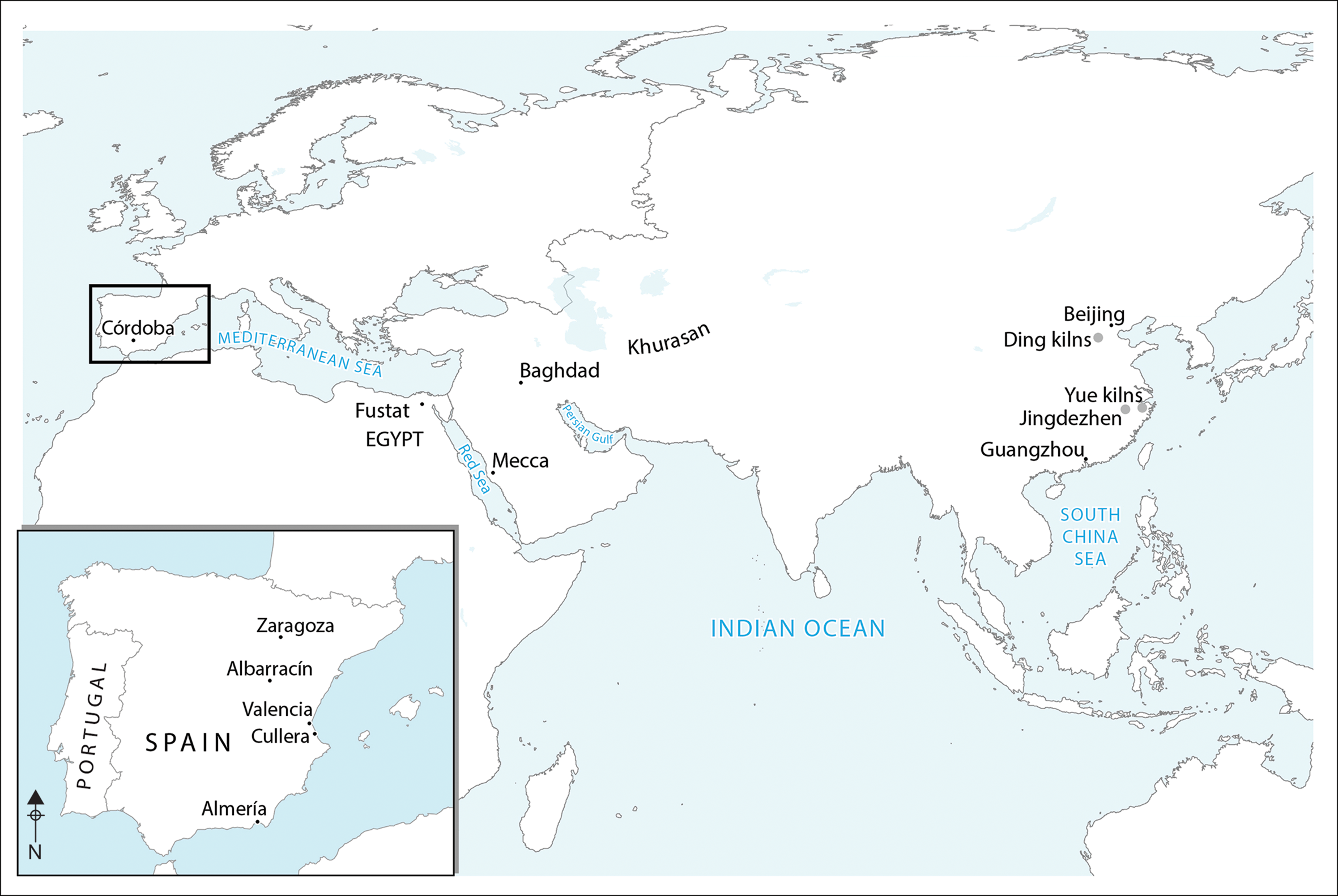
Figure 7 shows the wider distribution of wares similar to those identified in Spain. For the eighth to ninth centuries this includes Xing white porcelain and, for the tenth to twelfth centuries, Ding white porcelain, Jingdezhen Qingbai (bluish-white) porcelain, and Yue and Yaozhou celadon. The rarity of these vessels suggests that, rather than large-scale trade commodities, they were special or luxury items (Zhang Reference Zhang and gutaoci yanjiuhi2013). Tang Chinese ceramics (c. mid-eighth to mid-tenth centuries) have been recovered from Islamic archaeological sites in southern India, the Arabian Gulf, East Africa and at Fustat, the first capital of Egypt under Muslim rule (Zhang Reference Zhang and gutaoci yanjiuhi2013). The northern and central Persian Gulf has the largest concentration of such sites, which have yielded a wide range of wares, including Yue celadon, Xing white porcelain, Changsha polychrome stoneware, Dusun coarse transport jars made in Guangdong and south Jiangxi, and a few Sancai/green-splashed polychrome, highly fired vessels (Zhang Reference Zhang2016; Wen Reference Wen2018). This suggests that, at this time (mid-eighth to mid-tenth centuries), the Abbasid caliphate was a target for trade originating from the port of Guangzhou (Canton) in southern China, with the Persian Gulf acting as both the main consumer of ceramics and as a redistribution centre.
Distribution of known Chinese wares of the ninth to twelfth centuries AD (drawn by R. Zhang, after Zhang Reference Zhang2016).
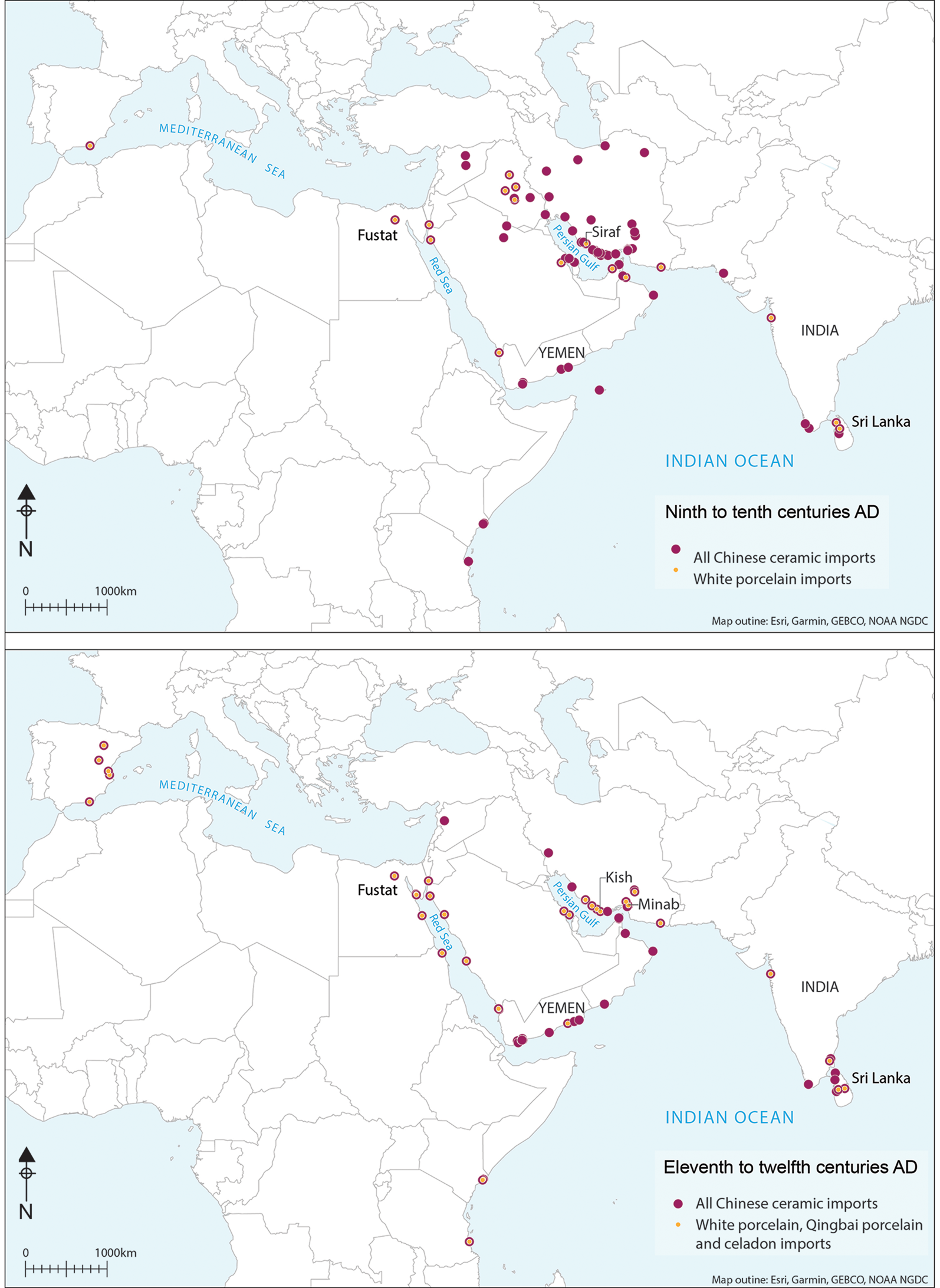
This distribution pattern shifted from the tenth century—the key period of interest for most of the Spanish ceramic finds. While some sites in southern India and Sri Lanka remained significant in the trade of Chinese ceramics, changes were taking place in the Persian Gulf: the centre of trade moved from Siraf (Iran) south to Kish and to the Minab area following the decline of the Abbasid caliphate in Iran and the rise of the Fatimid caliphate in Egypt (Chaudhuri Reference Chaudhuri1985: 58). Fatimid Egypt flourished as a connecting and meeting point between the East (China, India, Arabia) and the West (North Africa, the Eastern Mediterranean, Southern Europe), developing and expanding trade (Lev Reference Lev, Gertwagen and Jeffreys2012). Among the commodities brought or being sought were Chinese wares, and it is this improved access to ceramic imports in the Eastern Mediterranean that probably explains why Chinese ceramics reached Spain after the tenth century. Lustre-decorated pottery (painted with gold colours) made in Egypt in the tenth and eleventh centuries is present at major settlements and ports in Islamic Spain, including Almería, Valencia, Medinaceli and Tiermes (Heidenreich Reference Heidenreich2001, Reference Heidenreich2013; Muñoz & Flores Reference Muñoz, Flores and Suárez2007). In return, textiles, mercury and cinnabar were probably exported from Islamic Spain, while figs from Malaga are reported to have travelled all the way to China (Constable Reference Constable1994: 173–87 & 220).
The inscription on the bowl from Almería (catalogue no. 2) provides perhaps the most convincing evidence for the involvement of intermediaries in the distribution of Chinese ceramics. The lettering must have been added by a Muslim craftsman after the bowl was produced. It seems likely that this could have taken place while the ware was in transit, perhaps in Syria or Egypt, where lustre (gold colour) decoration was regularly painted onto glass as early as the fifth century (Suleman Reference Suleman and Meri2006: 144). It is less probable that the golden inscription may have been added in Almería itself, because the use of gold decoration on pottery and glass seems only to have started there in the second half of the eleventh century. While pottery originating in North Africa in the tenth and eleven centuries has a clear coastal concentration that reflects trans-Mediterranean commerce, the distribution of Chinese ceramics in Spain is quite different. This group is found at high-status sites, that is, mainly important castles, citadels and fortresses, several of them political centres. Although some of these places, such as Almería and Valencia, were important ports along the Mediterranean coast, the sherds are also found far inland, at Albarracín and Zaragoza, for example. Altogether, this evidence not only suggests the involvement of Arab merchants and craftsmen in the distribution system, but also that the acquisition of these wares was not determined simply by easy access to goods arriving at international ports. By contrast, in Italy, for example, where hundreds of eleventh- to twelfth-century ceramic bowls from Islamic sources (e.g. Tunisia, Morocco, Egypt, Sicily and Spain) were used to decorate church façades, no Chinese wares have been found. Indeed, all the 146 bowls still preserved at Pisa come exclusively from the Islamic world (Mathews Reference Mathews2014). This supports the suggestion that availability and access to Chinese wares was rare and difficult, and likely to be outside the normal trade channels.
The contemporaneous political context is also important. During the seventh and eighth centuries—the first two centuries of the Islamic empire—a single caliph maintained authority over the worldwide Muslim community. The ninth and tenth centuries, however, saw religious and political competition among rival imperial powers. By AD 930, the caliphate was divided among three rival dynasties: the Abbasids of Baghdad (AD 750–1258), the Umayyads of Córdoba (AD 756–1031) and the Fatimids of Cairo (AD 909–1171). Each dynasty laid claim to universal authority over the lands of Islam, each establishing capital cities beyond their caliphal courts and controlling vast regional territories in Central Asia, the Iberian Peninsula and North Africa (Anderson & Pruitt Reference Anderson, Pruitt, Flood and Necipoğlu2017). The eleventh century brought further political fragmentation and the creation of smaller independent states. Trade in the Iberian Peninsula was no longer run as a monopoly as it had been under the caliphate. International trade was strengthened, especially with Oriental Islam (in Asia), and coastal ports acted as redistributors, growing in importance as economic hubs within their respective taifa kingdoms (Lirola Reference Lirola1993). Although textual sources pay little attention to the architectural environment of palatial culture, it is evident that the visual arts played their part; in this respect, archaeology can contribute to our wider understanding of material culture in a courtly context.
In Zaragoza, Albarracín and Valencia, the tenth and eleventh centuries were also a time of cultural and economic prosperity. The Islamic palaces were places where transactions of power and allegiance occurred, often facilitated through the offering of reciprocal gifts; perhaps some individuals sought favour through the giving of exotic pottery. It is notable that even though Chinese ceramics have been found across Asia and East Africa, the number so far catalogued by archaeologists in the Western Mediterranean is remarkably low. This implies exclusivity. Were these gifts carefully selected for kings and rulers? The choice of bowls seems well adapted to suit local taste, as these forms were familiar on the Islamic tables of the time. Yet there are also rare, and sometimes unique, pieces, such as the beautifully carved celadon bowl from Zaragoza (catalogue no. 10), for which there are no known parallels outside China. Others, such the Almería sherd with its inscription (catalogue no. 2), were apparently specifically modified to increase their appeal. Gift giving was an essential part of Islamic culture, and written sources record that Chinese wares were transferred in exactly this manner. An early reference in a Persian text, for example, describes a group of 20 pieces of imperial China ware, along with 2000 other Chinese ceramics, being given to the Caliph of Baghdad by the governor of Khurasan in the eighth century—vessels never previously “seen at the court of any king” (Hallett Reference Hallett, Krahl, Guy, Keith Wilson and Rabi2011: 75).
The mechanisms for the arrival of this very early group of ninth- to eleventh-century Chinese wares seem to be unrelated to direct commercial transactions. It was only in the thirteenth century, when the dynamics of trade in the Mediterranean changed and Christian traders from Spain, Italy and southern France began to play an active role, that there was a second trickle of Chinese wares. These are found in thirteenth- and fourteenth-century contexts associated with wealthy merchants and diplomatic circles (e.g. Whitehouse Reference Whitehouse1966, with finds requiring reassessment; Amouric & Vallauri Reference Amouric, Vallauri and Sciallano2000; Roascio Reference Roascio2015; Lin & Zhang Reference Lin and Zhang2018). By then, Chinese wares were more common across Asia and Egypt, where archaeological finds amount to thousands of sherds, contrasting sharply with their rarity in earlier centuries (Yuba Reference Yuba2014). The post-Islamic finds from Valencia (catalogue nos 14–15) correspond to this phase and confirm the role of the city as one of the main ports of international trade in the Mediterranean.
Conclusions
In the ninth and tenth centuries there were no white ceramics being made in Spain, other than earthenwares painted with a white slip. By comparison, the porcelains described in this article would have had qualities previously unseen: not only were they bright white, hard and very thin, they were also translucent, and sometimes the Chinese wares were not just painted but also decorated in relief. These qualities would have been extraordinary in ninth- to tenth-century Western Europe. Even Muslim potters, who were famed for their skills, were unable to reproduce them.
We can only speculate as to how these particular vessels reached their destinations in Spain. Clearly, they must pre-date the fashion for Chinese porcelain that would drive Europeans to the other side of the world in the sixteenth century, and they certainly arrived in Spain through very different mechanisms. Islamic societies were fascinated by Far Eastern products (especially, for example, silk, gold decorated brocades, aromatics and a wide range of spices; Constable Reference Constable1994; George Reference George2015), including ceramics, and it was the Islamic empire's trade contacts with China that facilitated access to these goods. The distribution of Chinese ceramics at the western end of the Mediterranean, however, does not seem to have coincided with the international trade networks developing there in the tenth century, and must have been motivated by other factors. The rarity of the finds suggests that they were not goods purchased or exchanged through routine commercial transactions or channels. Instead, their discovery at high-status sites and places of political influence implies that they were carefully chosen objects, probably offered as gifts to kings and rulers, perhaps with the intention of easing diplomatic relations or otherwise gaining favour.
Whatever the precise mechanisms by which they travelled, this small group of ninth- to eleventh-century Chinese wares is unparalleled in Europe. Through the publication of this article, we hope to raise awareness of these early imports of Chinese wares into Europe and to encourage the search for similar finds from elsewhere in Spain and beyond.
Acknowledgements
We would like to thank all of our colleagues who gave access to the sherds, shared drawings or photographs and discussed the finds, especially María Luisa García Ortega, the Museum Alcazaba de Almería; Anja Heidenreich, Bamberg University; José Antonio Hernández, Acrótera; Diana García, Gobierno de Aragón; Isidro Aguilera, Museo de Zaragoza; J. Vicent Lerma, Sección de Investigación Arqueológica Municipal Valencia; and Jaime Vicente, Museo de Teruel. Hugo Blake, Fabrizio Benente, Marcella Giorgio, Lucy Vallauri and Valentina Vezzoli were kind enough to reply to queries and provide bibliographic references during the COVID-19 lockdown. Thanks also to Richard Lunt for his comments on the Arabic writing.
Funding statement
This research received no specific grant from any funding agency or from commercial and not-for-profit sectors.
Supplementary material
To view supplementary material for this article, please visit https://doi.org/10.15184/aqy.2021.95




 Open access

