


Throughout the developed world, cat obesity rates are rising, with approximately 30–40 % of cats in the USA being obese or overweight(Reference German and Martin1). Although obesity can occur in both neutered and intact cats, data suggest that neutered cats are more likely to become obese than sexually intact cats(Reference German and Martin1). Neutering rates for both pet male and female cats are high in the developed world and many cats are neutered before 1 year of age(Reference Murray, Roberts and Whitmarsh2, Reference Chu, Anderson and Rieser3). Furthermore, in an effort to control the stray and pet cat populations, early neutering is recommended as the most appropriate surgical choice(Reference Joyce and Yates4). Long-term studies(Reference Spain, Scarlett and Houpt5) have not identified early neutering (before puberty) as a risk factor for increased obesity v. traditional age neutering (7 months of age) and neutering studies carried out in pre-pubertal v. sexually mature kittens have not identified any differences in body weight (BW) and body condition score (BCS) in adulthood(Reference Root6, Reference Stubbs, Bloomberg and Scruggs7), and the effects on individual feeding behaviour have also not been measured.
The food intake in ad libitum-fed cats increases after neutering, and it has been shown that intake needs to be reduced by 20–30 % to prevent BW gain(Reference Flynn, Hardie and Armstrong8, Reference Belsito, Vester and Keel9), and one study has suggested that neutered female cats have a peak in food intake 8 weeks after neutering(Reference Vester, Sutter and Keel10). To understand the effects of neutering on feed intake, BW and changes in body composition in growing female kittens, data gathered from a study, that was performed for reasons unrelated to this objective, were subjected to post hoc analysis.
Materials and methods
The original study was reviewed and approved by the Waltham Ethical Review Committee and complied with UK Home Office regulations.
Animals and diet
Breeding queens (n 12) were fed ad libitum a nutritionally complete commercial dry diet formulated to meet the nutritional requirements for gestation, lactation and growth and confirmed by full nutritional analysis (moisture 7·5 g, protein 33·1 g, fat 20·8 g, ash 7·35 g, non-fermentable extract 31·4 g, predicted metabolisable energy (ME) 1628·4 kJ/100 g as fed) commencing 4 weeks before mating and continuing through gestation and lactation. Kittens born to these queens were gradually weaned on to the same diet at 8 weeks of age over a 2-week period and remained on this diet for the duration of the study. After weaning, all kittens were group-housed for socialisation during the day and singly housed overnight when they were allowed free access to food. All cats were offered ad libitum access to water throughout the study.
Experimental design
A total of twelve pairs of 11-week-old female kittens (one pair from each of twelve litters) were randomly assigned to two groups (either entire or neutered) such that each pair had one kitten in each group. The kittens assigned to the neutered group were neutered at 19 weeks as part of standard husbandry procedures and the entire group remained entire for the duration of the study. Data collection began at 11 weeks of age. Daily food intake and weekly BW were measured throughout the study. Body composition, BCS (9-point scale)(Reference LaFlamme11) and fasting blood samples were taken at 11, 18, 30 and 52 weeks of age.
Body composition
Lean mass and fat mass were determined using dual-energy X-ray absorptiometry(Reference Speakman, Booles and Butterwick12). Kittens were sedated, placed in lateral recumbency and body composition was analysed using a Hologic QDR-1000 W pencil beam dual-energy X-ray absorptiometer (Hologic, Inc., Waltham, MA, USA)(Reference Munday, Booles and Anderson13).
Statistical analysis
Weight and intake
Generalised additive mixed models (GAMM) were chosen to model BW and intake, as these can flexibly model non-linear relationships. GAMM can also correctly deal with the complex structure of the data, which has repeated measures for a cat, each of which is itself nested within a litter. An auto regressive (AR(Reference German and Martin1)) correlation structure was used, chosen to take into account that the measurement for a given time point would be correlated with that from the previous time point (for the same cat). In total, eighteen missing data points were filled in via interpolation between the previous and subsequent points. It was considered that a more sophisticated method was unnecessary because of the small amount of missing data ( < 2 %) and the fact that most missing values were isolated cases, with pairs of consecutive missing values only occurring four times in the entire dataset and never more than once for any cat.
The GAMM compared changes in BW or intake over time between neutered and entire kittens. It used the fixed terms age and weeks since neutering (set to zero for entire animals), and the random terms litter and cat (nested in litter). BW and intake were both log-transformed before analysis as this improved the residual distribution from the models, as assessed using standard residual plots. P values for main effects and interactions were calculated using Wald tests, and pairwise comparisons were carried out using Tukey's intervals.
Comparison of actual intake with theoretical intake in entire kittens
Individual kittens' theoretical ME were calculated(14) for each week, using the actual BW of kittens at week 52 as the ‘expected mature BW’. A linear mixed model was then fitted, using the intake:theoretical ME ratio as the response variable, age as a fixed numerical regressor and cat as a random factor. An AR(Reference German and Martin1) correlation structure was used to take into account that adjacent observations across time were correlated within a cat. P values for main effects were calculated using Wald tests.
Body condition score, percentage fat and percentage lean
A linear mixed model was used for BCS, percentage fat and percentage lean, with the four time points treated as a categorical variable. These models contained the fixed-effects group and week (together with a group × week interaction), and the random effects litter and cat (nested in litter). The response variables were again log-transformed before analysis, as this gave a slight improvement in residual distributions. Consequently, CI for differences are expressed in terms of percentages. A Bonferroni correction was applied to these secondary endpoints to take account of multiple testing, which included some variables not reported in the present study. Consequently, for BCS, percentage fat and percentage lean, P values must be < 0·00 714 to be significant and ‘95 % Bonferroni-corrected confidence intervals’ are used (equal to regular 99·286 % CI). P values for main effects and interactions were calculated using Wald tests and pairwise comparisons were carried out using Tukey's intervals.
Unless explicitly stated, a significance level of 5 % is used for all analysis. All analyses were carried out with the R version 2.10.1 statistical programming language (R Development Core Team (2009)), available at http://www.R-project.org). GAMM modelling was conducted using the R library mgcv (version 1.6-1), linear mixed modelling using the R library nlme (version 3.1-96), and multiple comparisons using the R library multcomp (version 1.2-1).
Results
Food intake and body weight
No significant differences were identified for any variable between the neutered and entire groups before neutering (all P>0·08). No significant differences were identified in routine blood haematology or biochemistry at any time point between the groups and all values were within the reference ranges. Neutered kittens exhibited mean increased food intake and increased BW compared with entire littermates (both P < 0·00 001; Fig. 1(a) and (b)).
Values are means ((a) intake, kJ/d; (b) body weight (BW)), with standard deviation represented by vertical bars for the entire (◇) and neutered ( ) groups of kittens. Time where neutering took place is shown by the vertical dotted line. Generalised additive mixed model (GAMM) prediction of (c) increased food intake (kJ/d per kg BW) and (d) BW gain associated with neutering. The model used the fixed terms age and weeks since neutering and random terms litter and cat (nested in litter). (c) R 2 73·8 % and (d) R 2 83·6 %, and dotted lines denote 95 % CI.

GAMM predictions of percentage change in intake (kJ/kg BW) relative to weeks since neutering showed differences between the groups from 4 to 18 weeks post-neutering, with a maximal difference of 17 (95 % CI 8, 27) % (P = 0·00 014) of the entire intake at 10 weeks post-neutering (Fig. 1(c)). At this point, observed mean intakes were 1200·81 (sd 221·75) v. 866·09 (sd 338·90) kJ for the neutered and entire groups, respectively (Fig. 1(a)).
GAMM predictions of percentage increase in BW relative to weeks since neutering showed that neutered kittens became increasingly heavier compared with their entire littermates, significantly so from 11 weeks post-neutering; by 52 weeks of age, the neutered kittens were 24 (95 % CI 11, 39) % (P < 0·0001) heavier than entire littermates, with an observed mean BW of 4·118 (sd 0·759) v. 3·230 (sd 0·530) kg, respectively (Fig. 1(b) and (d)).
Comparison of actual intake with theoretical intake in entire kittens
The ratio of actual intake and theoretical ME for entire kittens declined with age. At 26 weeks of age, entire kittens consumed 93 (95 % CI 87, 100) % of their theoretical ME. By 52 weeks of age, this had further reduced to 79 (95 % CI 72, 87) %.
Body condition score and body composition
The neuter group had a significant impact on how BCS, percentage fat and percentage lean changed over time (P < 0·0031). However, significant differences between the groups were not apparent in any variable before neutering (P>0·08; Table 1). Although there was no significant difference in percentage fat between the groups at 52 weeks (23·3 (95 % CI 19·2, 28·3) v. 30·2 (95 % CI 24·9, 36·7) for entire and neutered cats, respectively, difference 30·0 ( − 3·7, 75·3) %, P = 0·032), percentage fat increased significantly at every time point compared with the previous one for the neutered group (all P < 0·0014), while the entire group showed no significant change after 18 weeks (P = 0·033). Percentage lean also showed a significant drop between 30 and 52 weeks for the neutered group (difference − 11·6 (95 % CI − 18·1, − 4·5) %, P < 0·00 001) but did not change significantly in the entire group (difference − 3·0 (95 % CI − 10·2, 4·6) %, P = 0·88), although, again, this did not result in a significant difference in percentage lean between the groups at 52 weeks (72·5 (95 % CI 68·1, 77·3) v. 66·5 (95 % CI 62·4, 70·8) for entire and neutered cats, respectively, difference − 8·4 (95 % CI − 16·9, 1·0) %, P = 0·025). These trends are reflected in the BCS, which was significantly higher in the neutered cats by 52 weeks (5·2 (95 % CI 4·7, 5·7) v. 6·1 (95 % CI 5·5, 6·7) for entire and neutered cats, respectively, difference 16·6 (95 % CI 0·9, 34·8) %, P = 0·0028).
(Mean values and Bonferroni-corrected 95 % confidence intervals)
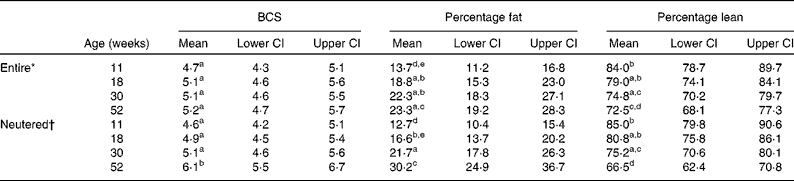
a,b,c,d,e Mean values with unlike superscript letters within a column were significantly different at 5 % significance level after Bonferroni correction according to Tukey's test.
* Entire kittens remained entire throughout the study.
† Neutered kittens were neutered at 19 weeks of age.
Discussion
To the best of our knowledge, this is the first evidence that shows that neutering female kittens results in a period of increased food intake. Increased food intake in neutered adult cats has been attributed to the loss of oestrogens(Reference Cave, Backus and Marks15) and data from other species suggest that oestradiol may influence feeding by advancing the onset of satiety(Reference Butera16). As such, ad libitum feeding should be avoided and portion control implemented to prevent overconsumption of food post-neuter in kittens. The resultant increases in BW cannot, however, be solely attributed to increased food intake. A GAMM substituting intake for weeks since neutering (data not shown) did not describe the variation in the BW data as accurately as the model using weeks since neutering, suggesting that there are other factors that are contributing to weight gain such as reduced ME requirements possibly caused by reduced spontaneous activity(Reference Belsito, Vester and Keel9, Reference Vester, Sutter and Keel10) or reduced lean body mass(Reference Laeuger17).
Entire kittens appear to regulate ME intake based on ME need for growth and did not show any significant changes in BCS from 10 to 52 weeks of age, indicating that feeding to an ideal BCS(Reference LaFlamme11) may be an appropriate method of feeding an individual kitten. Modelling the energy consumption of the entire kittens using their actual BW at an ideal BCS demonstrates that the current ME requirements for growth of kittens(14) is inappropriate for this colony of cats. Mean maintenance energy requirements of entire cats at 52 weeks of age (770·9 kJ) were comparable with those predicted (746·4 kJ) using the adult cat energy requirement equation recently suggested by Bermingham et al. (Reference Bermingham, Thomas and Morris18). Interestingly, although the neutered kittens consume the same amount of energy as their entire littermates from 37 weeks of age, their BW, BCS and percentage fat are still increasing, suggesting that neutering has reduced these kittens' energy requirements to less than those of their entire littermates. This is similar to the effects in adult females(Reference Vester, Sutter and Keel10), which also exhibited reduced spontaneous activity. Unfortunately, activity levels were not measured in our study.
The food intake peak seen in these neutered kittens and adult female cats(Reference Vester, Sutter and Keel10) suggests, that cats are in part able to reduce their feed intake based on metabolic feedback; however, it appears that this process takes many weeks to occur. Therefore, we would speculate that limiting food consumption by portion control after neutering may help reduce the fat mass accumulated and reduce the risk of obesity during this period of time. Further studies are required to assess the hormonal and activity response after neutering while feeding kittens to an ideal BCS(Reference LaFlamme11) or ad libitum.
Acknowledgements
The present study received no specific grant from any funding agency in the public, commercial or not-for-profit sectors. L. G. A. conducted the initiation of the post hoc analysis, data mining and manuscript writing; C. S. conducted the statistical analysis; G. T. provided the data support; R. B. was instigator of the original trial. The authors state that there is no conflict of interest.



